Tier III Two-Stroke
Technology
Contents
Introduction ...5
Tier III Technologies ...5
SCR Application for Tier III ...6
Fuels for Tier III engines ...6
Selective catalytic reduction ...6
SCR system for MAN B&W engines ...7
SCR control system ... 10
Results and discussion ... 11
SCR and HFO operation ... 15
SCR service experience ... 15
Future development aspects ... 15
Conclusion ... 17
EGR Application for Tier III ... 18
EGR investigation on 4T50ME-X ... 18
EGR Tier III confirmation test ... 19
EGR scrubber performance ... 19
EGR service test ... 21
Preparation of service test on newbuilding with 6S80ME-C9.2 ... 23
Water treatment system (WTS) ... 25
EGR high-speed blower ... 27
Tier III Two-Stroke Technology
Introduction
This MAN Diesel & Turbo two-stroke Tier III paper outlines the status and fu-ture development efforts in connection with Tier III technologies, and covers some of our efforts to develop measur-ing and calculation tools, securmeasur-ing bet-ter knowledge of engine processes like combustion, emission formation and scavenging of the engine.
Furthermore, details on the SCR devel-opment, not only for the catalyst appli-cation, but also on the requirements to the engine control system in connec-tion with the SCR applicaconnec-tion are given. Also, the status on service tests on the world’s first Tier III two-stroke engine will be outlined.
SCR application is challenging due to the requirement for installation on the high pressure side of the turbocharger, and it is space requiring due to the size of the SCR and urea mixing unit. It is accordingly relevant to evaluate if SCR applications can be further integrated in the engine design for compacting and securing easy application.
The EGR development project will also be described in detail, not only test re-sults from research engines will be cov-ered, but service results from prototype tests of the EGR system on the Alex-ander Maersk will be outlined, together with an update on the design for the lat-est and fully integrated EGR design on a 6S80ME-C9.2 engine, which will form the basis for the complete Tier III engine programme with EGR.
The Tier III EGR application will also open for the possibility of utilising EGR as Tier II reduction technology and
op-timisation of part load operation of the engine outside the EGR areas. Opera-tion modes for both ECA and non-ECA areas will be outlined.
As both EGR and after-treatment scrubbers for SO2 removal require WTS (Water Treatment Systems), we have, in cooperation with external partners, en-sured that a significant development ef-fort is in progress also in this area. Finally, our latest achievements within advanced measuring and calculation methods, for better understanding of combustion, and emission formation and scavenging of two-stroke engines will be discussed in this paper.
Tier III Technologies
IMO Tier III is mandatory for engines installed on vessels constructed after 1
January 2016 when operating inside an Emission Control Area (ECA). For an en-gine designer, it consists of three main requirements:
An 80% NOx-cycle value reduction,
compared to the Tier I level
A 150% mode cap on each load point
in the cycle (the “not to exceed limit”)
Tier III applies when operating the
en-gine in a NOx emission control area. Each of the three requirements is im-portant when developing the technol-ogy necessary for Tier III engines. The 80% load cycle NOx reduction require-ment means that internal engine optimi-sation is not sufficient – in other words: new technology is necessary.
The mode cap on the individual mode points of the load cycle means that the applied solutions have to suit a wide
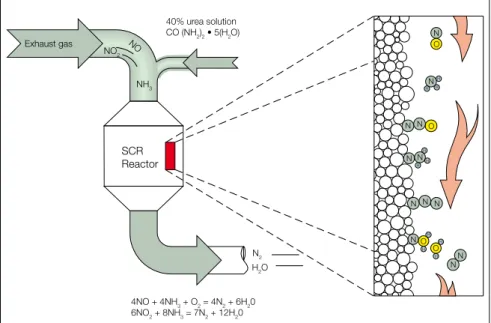
en-NO 40% urea solution CO (NH2)2 • 5(H2O) Exhaust gas NO2 N2 NH3 H2O SCR Reactor 4NO + 4NH3 + O2 = 4N2 + 6H20 6NO2 + 8NH3 = 7N2 + 12H20 N O N N N N N H O H H H H H N N N N N N O O H H H H
Fig. 1: Principles of the SCR system gine load range. As Tier III NOx limit only
applies in emission control areas, the engine must be able to switch between Tier II and Tier III NOx levels.
Within the last two years, technologies to achieve Tier III NOx reduction have successfully been tested at MAN Diesel & Turbo. Both EGR and SCR have been successfully tested for Tier III compli-ance as stand-alone NOx reduction technology. When the engine technol-ogy has demonstrated the required NOx reduction potential, the next develop-ment steps are initiated: gathering serv-ice hours, improving operational and safety aspects, optimisation of engine control strategies, reducing first cost and operational costs. Finally, specifi-cations for an entire engine programme have been formulated.
SCR Application for Tier III
The main focus for emission compli-ance development for large marine die-sel engine developers these years are the requirements applicable in the In-ternational Maritime Organisation (IMO) designated emission control areas (ECA). The 2015 0.1% fuel sulphur con-tent limitation and the 2016 80% NOx reduction limits are the targets.
For MAN B&W two-stroke marine en-gines, compliance will be achievable through tailored solutions. This goes for both the fuel sulphur regulation and the NOx regulation. For ships built from 2016, the operation of the main engine will be divided into two modes: opera-tion inside and outside an ECA. This requires NOx reduction technology that can be switched on and off.
The main focus in the following will be on the SCR path for compliance with Tier III NOx regulation chosen by MAN Diesel & Turbo for low speed two-stroke marine diesel engines.
Fuels for Tier III engines
Cost aspects are critical for the suc-cess of a technology. This is the case for both first cost and for operating costs. Many parameters affect the cost evaluation, as ships operate with differ-ent ownership models, differdiffer-ent trade patterns and different engine operation profiles. Added to those differences are uncertainties regarding prices and avail-ability of fuel and other consumables needed for the Tier III systems. Large marine diesel engines operate on a wide range of fuel qualities, ranging from low-viscosity ultra-low-sulphur distillates to very high-viscosity residual fuels. All MAN B&W Tier III engines will be capable of running on low-sulphur fu-els and, at the same time, options will be available for complying with the fuel
sulphur limits by other means, thus ena-bling heavy fuel oil (HFO) operation. Selective catalytic reduction
A way of meeting the IMO Tier III NOx limits is to install a selective catalytic reduction (SCR) reactor. In the reactor, NOx is reduced catalytically by ammo-nia (as urea) to nitrogen and water, see Fig. 1.
SCR reactors have been used in power plant applications since the late seven-ties, and MAN Diesel & Turbo (MDT) was involved in one of the first marine applications in 1989 on large two-stroke diesel engines. However, where-as the technology is mature for robust power plant applications, the technol-ogy still needs to be matured for daily marine operation. Therefore, MDT is in-volved in a targeted development of this technology together with Hitachi Zosen Corporation. Hitachi Zosen builds MAN B&W engines and has, among others, a division that develops and delivers SCR catalysts.
Fig. 2: Arrangement of a high-pressure SCR solution on a 6S46MC-C engine
SCR reactor
The SCR collaboration was initiated in 2008, and in the following period ex-tensive development and tests have been conducted on a 1S40MC and a 6S46MC-C engine fitted with SCR sys-tems.
MDT’s focus has been on the develop-ment of a dedicated SCR engine that ensures reliable SCR operation when HFO is employed. Hitachi Zosen’s focus has been centered on the development of SCR systems for large two-stroke diesel engines.
SCR system for MAN B&W engines
Preconditions for SCR operation
Due to the high-energy efficiency of two-stroke diesel engines, the exhaust gas temperature after the turbocharger is low: typically in the range from 230-260°C after the turbocharger depend-ent on load and ambidepend-ent conditions. These low temperatures are problemat-ic for the SCR when HFO is employed. Thus, in order to achieve the highest possible fuel flexibility, it has been a pri-ority to ensure that the engine produces an exhaust gas with the right tempera-ture for the SCR system.
The SCR inlet gas temperature should ideally be around 330-350°C when the engine is operated on HFO.
System configuration
At present, the too low exhaust gas temperature after the turbine has called for a solution where the SCR is placed on the high pressure side of the turbine. Depending on the engine load, this makes it possible to obtain exhaust gas temperatures that are between approxi-mately 50°C and 175°C higher than
Temperature before and after the turbine (turb.), based on a 6S50ME-C
Tamb=10°C 25% load 50% load 75% load 100% load
Tin turb. [°C] 299 308 337 395
Tout turb. [°C] 245 217 207 221
Tgain [°C] 54 92 130 174
Table 1
Vaporiser and mixer unit
after the turbine. Compare Table 1 and Fig. 2.
This means that the SCR system works according to the following: When NOx reduction is needed, the exhaust gas is guided to the SCR according to the flow direction illustrated in Fig. 2. When no SCR operation is needed, the exhaust gas is passed directly to the turbine in
the turbocharger (T/C) and the SCR is sealed by two valves.
Table 1 reveals that even though the reactor is placed before the turbine, the exhaust gas temperature is still too low at loads below approximately 50%. Therefore, it has been necessary to de-velop a “low load method”, which can be used to increase the exhaust gas
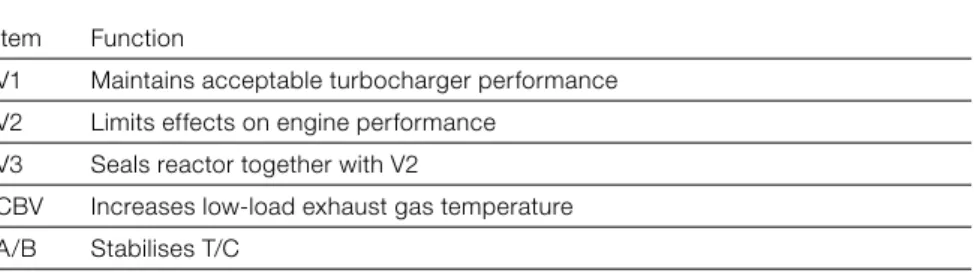
Items to be controlled by the ECS
Item Function
V1 Maintains acceptable turbocharger performance
V2 Limits effects on engine performance
V3 Seals reactor together with V2
CBV Increases low-load exhaust gas temperature
A/B Stabilises T/C
Table 2 temperatures. This is the cylinder & SCR bypass shown in Fig. 3.
The cylinder bypass valve (CBV) in-creases the exhaust gas temperature by reducing the mass of air through the cylinders at a fixed amount of fuel combustion. This means that higher exhaust gas temperatures for the SCR are obtained. Calculations have shown that this method is suitable, because the mass flow through the T/C remains almost unchanged. This means that the scavenge air pressure is maintained, and thus that the combustion is nearly unaffected.
From a combustion chamber tempera-ture point of view, the low-load method
constitutes a challenge, because the mass of cooling air through the cylin-ders is decreased. This is an effect that needs to be investigated during test bed operation.
Engine control system
In addition to the development of the low-load method, a new engine con-trol system (ECS) has been developed.
This is needed, because the SCR has a significant heat capacity. Due to the fact that the SCR is fitted before the turbocharger, this constitutes a chal-lenge for the energy balance between the engine and the turbocharger. Thus, it is necessary to bypass some of the exhaust gas directly to the turbocharger during engine start-up and acceleration in order to ensure sufficient energy input Fig. 3: Low-load method to increase exhaust gas temperatures
Exhaust gas reciever
Scaveange air reciever
SCR
reactor
Cylinder &
SCR bypass (CBV)
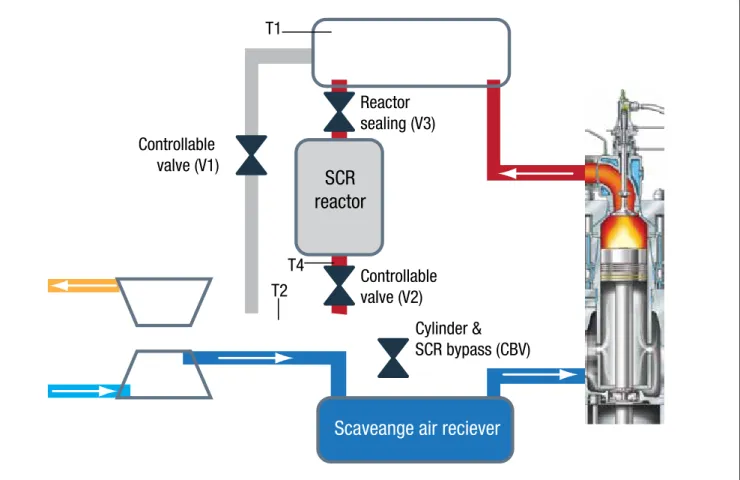
to the turbine. For the same reason, it may be necessary to bypass the turbine during de-acceleration of the engine, as the energy level of the exhaust gas from the SCR is too high. Lastly, the low-load method needs to be controlled to en-sure the right temperature at the SCR inlet. As a result, a dedicated ECS has been developed for the SCR engine. The outline of the ECS is illustrated in Fig. 4.
The success criteria for the ECS are:
To ensure acceptable engine
per-formance
To ensure quick heating of the SCR
system
To ensure a minimum exhaust gas
temperature Tmin.
Fig. 4 shows three bypass valves which control the distribution between the ex-haust gas that goes to the SCR system and the exhaust gas that goes directly to the turbine. These are called: V1, V2 and V3. Furthermore, the CBV are dis-played on the figure. The ECS also con-trols the auxiliary blowers (A/B), which have been fitted with larger electrical motors to assist during heating of the SCR and engine accelerations. The A/ Bs are able to operate in the entire load range of the engine. The functions of the individual valves are summarised in Table 2.
The four valves and the A/Bs are an in-tegrated part of the ECS, and they are controlled on the basis of three continu-ous temperature measurements of the
exhaust gas. These are also found in Fig. 4: T1, T2 and T4. T1 is the exhaust gas temperature in the exhaust gas re-ceiver, T2 is the exhaust gas tempera-ture at the inlet to the turbine, and T4 is the exhaust gas temperature at the outlet of the SCR reactor.
The difference between T1 and T2, denoted dT, is an expression for how much the energy balance between the engine and T/C is influenced because energy is either lost or gained by heat-ing/cooling of the SCR system. In the present system, a dT of 50°C has been found to ensure acceptable engine per-formance.
V1 and V2 open and close according to the limit given by dT, i.e. 50°C. V3 is an on/off valve. Urea is injected when V1 Fig. 4: Overview of bypass valves
Exhaust gas reciever
Scaveange air reciever
SCR
reactor
Controllable
valve (V2)
Cylinder &
SCR bypass (CBV)
Reactor
sealing (V3)
T1
Controllable
valve (V1)
T2
T4
is fully closed, and the T1 is above the critical temperature for urea injection. Based on these three temperature measurements, the ECS is able to en-sure that the engine performance is maintained during deceleration/accel-eration and heating/cooling of the SCR system. Furthermore, the ECS ensures that the exhaust gas temperature is kept above a certain Tmin by adjusting the position of the CBV.
The four bypass valves are all of the same butterfly type and are designed by MDT, see Fig. 5. V1, V2 and V3 are gas tight and are sealed by scavenge air. This is to avoid any condensation of exhaust gas in the SCR elements during non-SCR operation.
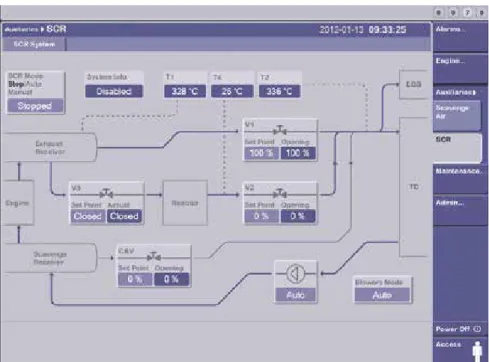
During engine tests in January and February 2011, the ECS was commis-sioned, and a print of the main operat-ing panel (MOP) is shown in Fig. 6. The ECS is able to handle all aspects related to the handling of the engine: heating of SCR, deceleration and acceleration. SCR control system
The SCR unit, including the urea dos-ing system, also needs to be control-led in order to ensure the right amount of urea injection at different loads and NOx emission levels. Furthermore, the urea injection system needs a flushing sequence during SCR close-down, and soot blowing of the catalyst elements. Hitachi Zosen has developed and deliv-ered this control system.
The dosing of urea is based on online NOx measurements before and after the SCR reactor with a ZrO2 based sensor. The measured value is compared with
Fig. 5: Butterfly valves installed on the SCR engine
an estimated NOx value based on test bed measurement (NOx map as a func-tion of engine load). This is to ensure that no under/over dosing of urea takes place in case of a sensor error.
Results and discussion
A full scale SCR system has been in-stalled on a 6S46MC-C engine at Hi-tachi Zosen’s workshop in the Ariake Prefecture of Japan, see Fig. 7. Details of the engine and SCR system are shown Table 3.
Engine and SCR used for full scale SCR tests Cylinders 6
Bore 460 mm
Stroke 1,932 mm
Output 6,780 kW @ 111 rpm
MEP 19 bar
Location of SCR system Before turbine
Fuel Heavy Fuel Oil
Reducing agent Urea solution (32.5 wt%)
Total mass of SCR line 15,000 kg
Mass of SCR catalyst 1,900 kg
Type of catalyst Corrugated honeycomb (TiO2/V)
Manufacturer of catalyst Hitachi Zosen Corporation
Manufacturer of SCR equipment Hitachi Zosen Corporation
Fig. 7: 6S46MC-C fitted with SCR
Table 3
1 SCR reactor
2 Vaporiser & mixer unit
3 Control panel for
reduc-tant injection and soot
blow
4 Air compressor & air
tanks
5 Urea solution tanks
6 Urea supply unit
A huge number of tests with various goals were conducted on this system in the period from January to April 2011. The objectives were the following:
To investigate low-load method To commission ECS
To verify Tier III compliance
To gain experience on SCR operation
in combination with HFO.
Low-load method at 25% engine load
The low-load method has been tested at engine loads ranging from approxi-mately 10% to 50%. Three issues were the main objectives:
Possible temperature increase of
ex-haust gas entering the SCR
Penalty on combustion chamber
components temperatures
Penalty on SFOC.
In the following, the results obtained at the lowest IMO load point (25% en-gine load) is discussed – this is where the lowest T1 temperature is obtained. The amount of scavenge air through the bypass was adjusted and the SFOC and combustion chamber temperature (CCT) was measured, among other things. The CCT measurements showed that the average temperature of the ex-haust gas spindle (X/V spindle) was the most influenced component, for which reason the other combustion chamber components (cylinder liner and piston) are omitted in the discussion.
During the reference test, the exhaust gas temperature, T1, was measured to 258°C. This means that T1 should be increased by at least 72°C to obtain a temperature above the mentioned 330°C minimum SCR inlet temperature.
Temperature in dg. C
Time in sec.
SCR/cylinder bypass in action
CBV Feedback
V2 Feedback
V1 Feedback
0
0
200
400
600
800
1000
1200
20
40
60
80
100
120
Plot 2: Loading from 20% to 100% of the engine to maintain SCR operation
Time →
Plot 1: Influence of increased T1 on X/V spindle (full line) and SFOC (dashed line). T1 is increased by opening CBV
0
1
2
3
4
5
6
0
10
20
30
40
50
60
70
80
90
0
50
100
150
200
SCOC penalty in g/kWh
Temperature increase X/V spindle dg. C
Temperature increase SCR inlet dg. C
Δ T(X/V spindle)
+24°C
Δ SFOC
With fully open CBV, T1 can be in-creased by 165°C. This means that the desired temperature increase of 72°C is obtainable. From Plot 1, it is revealed that this temperature increase causes an increased heat load of approx. 25°C on exhaust valve and an SFOC penalty of approx. 2-3 g/kWh.
Based on the investigations of the low-load method, it has been concluded that for the present system, the CBV will be em-ployed. However, in future applications, increased scavenge air temperature in combination with CBV may be needed to ensure SCR operation at even lower engine loads.
Engine control strategy
The ECS was also tested on the 6S46MC-C engine on the test bed. A typical heating of the SCR system dur-ing engine loaddur-ing from 20% to 100% is shown in Plots 2 and 3. At time equals to 0, the engine is operated at 20% engine load and the SCR system is in steady condition. This is followed by ac-celeration to 100% engine load. Plot 2 shows the development of T1 and T4, and Plot 3 shows the valve positions during the same period.
It can be seen that CBV is able to main-tain T1 at the desired Tmin of 310°C by slowly closing as the engine load in-creases.
250
300
350
400
450
500
0
200
400
600
800
1000 1200
Temperature in dg. C
Time in sec.
SCR/cylinder bypass in action
T1 (SCR in)
T2 (T/C in)
SCR
Requirement
Plot 4: Heating of the SCR system at 100% engine load
Time →
NOx emissions at the four IMO
engine load points
25 % 50 % 75 % 100 % Cycle Tier III
g/kWh 2.9 3.1 2.9 2.5 2.8
Table 4 After a certain period, the CBV is closed
(Plot 3) and T1 increases with the en-gine load. It is also important to observe that this loading ensures that V1 re-mains closed and thus ensures full NOx reduction at all times. In cases where V1 is opened due to too high dT, the urea injection is set at a very low flow to avoid NH3-slip.
Another cause of heating of the SCR system has been posted in Plot 4. In this case, the engine is operated at 100% engine load, thus T1 is well above Tmin of 330°C.
The SCR system, which is at ambient temperature, is engaged at time equals 0: V3 opens, V2 opens according to a dT of 50°C followed by closure of V1 also according to dT equals 50°C. V2 is opened during the first two thirds of the time before urea injection starts, and V1 is closed during the next period. Sub-sequently, the SCR system is ready for urea injection.
The plots illustrate that the ECS is able to handle the operation of the SCR system. It is also concluded that with normal loading and unloading speeds of the engine, it is possible to keep the SCR system engaged at all times. In addition, the tests show that the SCR system needs a certain time for heating before it is ready for NOx reduction.
IMO Tier III operation
It was also verified that the engine and SCR system was able to meet the IMO Tier III NOx limits, and the results are displayed in Table 4. The results were witnessed by ClassNK (Nippon Kaiji Kyokai) in April 2011. The table reveals that the SCR system ensures a NOx cycle value of 2.8 g/kWh, which is well below the IMO Tier III limit of 3.4 g/kWh. Based on these measurements, it was concluded that the world’s first Tier III compliant two-stroke engine has been demonstrated. The next important step is the further testing of the system, which is presently installed on a general cargo carrier. The ship was built at the Nakai shipyard and entered active serv-ice in late 2011. The owner of the vessel is the Japanese BOT Lease Co. Ltd., and the vessel is operated by Nissho Shipping Co. Ltd.
SCR and HFO operation
It is well known that the combination of sulphur containing fuels and SCR is challenging. This is because of the transformation of SO2 to SO3 inside the SCR. This allows formation of ABS and white plumes. In addition, it is also known that the inherent content of va-nadium in HFO makes the SO2 oxida-tion more pronounced over time. It is necessary to demonstrate that the present SCR system has been de-signed in a way that suppresses these undesired side reactions. This is a part of the service test which was initiated in the last part of 2011.
SCR service experience
Having concluded that it is possible to meet the IMO Tier III limit with the sys-tem presented in Table 4 and Fig. 7, this system was moved from the test bed to the general cargo carrier Santa Vista, see Fig. 8. Details of the ship are found in Table 5.
The system was commissioned in Oc-tober 2011 and Tier III operation was
Fig. 8: The world’s first Tier III compliant ship – the Santa Vista
Information on Santa Vista Name of the
ship-yard
Naikai Zosen
Vessel type 38,000 dwt general
cargo carrier
IMO number 9527946
Hull number 744
Vessel Owner BOT Lease Co., Ltd.
Operator Nissho Shipping
Co., Ltd.
confirmed. The Licence Days 2012 pa-per No. 9 from Hitachi covers installa-tion aspects and the service experience gained up to now.
Future development aspects
Obtaining a uniform ammonia concen-tration in an exhaust gas poses a mul-tifaceted problem. Common practice is to inject urea as a liquid into the exhaust stream via a spray nozzle. The urea evaporates and undergoes a chemical decomposition to form ammonia. This is troublesome as the process is fairly slow compared to flow time scales, as Table 5
droplets impinging on walls may de-posit and form solid structures, which may eventually clog the system. While this has to be avoided, the SCR unit needs a spatially uniform distribution of ammonia, at low costs in terms of unit pressure loss. This makes common in-dustrial mixing units prohibitively expen-sive.
Previous designs of the urea mixer (ref. Fig. 7) have been added onto the engine downstream of the exhaust receiver as an independent unit, piped together with a standard exhaust receiver and a separate SCR unit. As there is large mixing capacity available in the exhaust receiver, due to the unsteady nature and large gradients in velocity, a design which benefits from this is proposed. As such, the design is expected to have significantly lower pressure losses at the same level of mixing as traditional designs. Even more, the design has the potential to have lower pressure losses than standard exhaust receivers. The proposed design can be seen in Fig. 9 for a four-cylinder engine.
The four pipes feeding the unit can be seen at the top. In the centre of the unit, a straight open-ended pipe is located. At the right end of the central pipe, an ‘anti swirler’ is fitted. The gas leaves the unit to the right. As the exhaust gas is injected tangentially into the unit, a strong swirling flow forms inside. Ow-ing to this, a low pressure is obtained centrally in the left region of the unit. As the flow passes through the anti swirler, the tangential momentum of the gas is recovered as static pressure. This sets up a pressure gradient across the
cen-a cen-a cen-a cen-a
b
d c e
Fig. 10: A snapshot from a large eddy CFD simulation of the mixing of a scalar, representing urea. The scalar is injected in the central pipe and mixes with exhaust gas during its way to the outlet
Fig. 9: Proposed design of a urea mixer. Flow enters tangentially into the mixing chamber from the cyl-inders via separate runners (a). While swirling, the flow moves upwards, but loses its swirl as it passes through the vanes at (b). Due to the loss of swirl, static pressure is recovered leading to higher pressure at (c) than in the centre of the bottom of the mixing chamber. This causes reversed flow in the centrally mounted pipe. Urea is injected at (d) and evaporates in the non-swirling flow in the central pipe. The urea seeded flow leaves the pipe in the bottom of the chamber and mixes with the newly injected exhaust gas
tral pipe, which causes the flow here to be ‘reversed’, i.e. directed downwards in the figure. This is in principle similar to the vortex breakdown phenomenon which occurs spontaneously in swirl-ing flows. Here, it is tightly controlled by the geometry. It is proposed to inject the urea in the upper part of the central pipe. As the flow in this region is non-swirling, the urea is injected in a similar environment as previous, proven, de-signs.
To verify the concept and investigate the extent of mixing, a large eddy CFD simulation was performed. The four in-lets were fed with unsteady mass flows representative of an S50ME engine at full load. A snapshot from the simula-tion can be seen in Fig. 10. A pressure drop from this design is expected to be low, as flow pathways are kept large, and momentum from the individual cylinder,s high speed jets are converted into static pressure, in a manner which is not present in standard exhaust re-ceivers.
Conclusion
The application of selective catalytic reduction on an MAN B&W two-stroke diesel engine has been demonstrated by MAN Diesel & Turbo and Hitachi Zosen Corporation. It has been concluded that the SCR offers a degree of NOx reduc-tion that ensures IMO Tier III operareduc-tion. A low-load method provides the desired minimum operation temperature which suppresses undesired precipitation of ammonium bisulphate in the catalyst el-ements. Additionally, it has been found that the newly developed engine con-trol system is able to handle all aspects of IMO Tier III operation: heating of the system, deceleration/acceleration and start/stop of the SCR system.
The service installation has revealed that the data obtained on the test bed can be reproduced in service. Tier III compliance has been demonstrated, and it has also been shown that the low-load method is applicable.
How-ever, the service installation has also shown that attention needs to be paid to issues related to HFO operation. Until now corrosion of the SCR system and accumulation of ABS in the exhaust gas boiler have appeared.
From the experience obtained in con-nection with the test bed and the serv-ice installation, the following critical parameters for a successful technical solution have been identified.
From the engine side:
Pre-turbine SCR for the highest
pos-sible temperature
Low-load method to ensure correct
temperature
Engine control system. From the SCR system side: Urea injection and mixing
SCR elements to ensure HFO
opera-tion
SCR control system Proper installation.
EGR Application for Tier III
Since the ratification of the IMO Tier III criteria for NOx emissions from large ma-rine diesel engines in emission control areas (ECAs), marine engine manufac-turers worlwide have been challenged to develop new measures to reduce NOx. The extent of the necessary meas-ures to reduce NOx by up to 80%, in order to meet the IMO NOx criteria from 1 January 2016, is beyond well-known adjustments of the combustion proc-ess in two-stroke diesel engines. NOx reductions of this magnitude on two-stroke diesel engines require “add-on” technologies such as exhaust gas re-circulation (EGR) or selective catalytic reduction (SCR) as described above. In 2004, MAN Diesel & Turbo (MDT) started the first test program with EGR on the large 4T50ME-X two-stroke die-sel test engine in Copenhagen, in order to verify the effect of EGR. Since the 1970s, the effect of EGR on smaller four-stroke diesel engines used in the automotive sector has been known as a very efficient means to reduce NOx in combustion engines. The HFO burned in large marine engines is a challenge when using EGR, due to the presence of a high sulphur content and a high content of solids. Thus, a wet scrubber was introduced in the EGR system. In parallel with the EGR investigation on the 4T50ME-X test engine, MAN Die-sel & Turbo planned to make a service test on a ship in order to investigate the long-term effects on the engine components. In March 2010, a retrofit EGR system was installed on a 10MW 7S50MC Mk 6 engine on board the A. P. Moeller Maersk 1,100 teu contain-er vessel Alexander Maersk.
The following describes the investi-gation and testing that MAN Diesel & Turbo has completed with EGR on large two-stroke diesel engines.
EGR investigation on 4T50ME-X
Engine parameter study
Several comprehensive EGR test pro-grams have been carried out on the 4T50ME-X test engine to investigate the mechanism of different variations of engine parameters when running with EGR.
The study of engine parameter varia-tions during EGR operation revealed the following effects on SFOC and emis-sions, as also shown in Table 6:
Effects on SFOC
Increased Pcomp/Pscavratio has a
posi-tive impact on the SFOC penalty
Increased Phyd has a positive impact
on the SFOC penalty
Increased Pscav has a positive impact
on the SFOC penalty
Increased Tscav has a negative impact
on the SFOC penalty.
Effects on NOX
Increased Pscavhas a slightly positive
effect on NOX
Increased Phydhas a moderately
neg-ative effect on NOX
Increased Pcomp/Pscav has a slightly
negative effect on NOX
Increased Tscav has a slightly negative
effect on NOX.
Effects on CO:
Increased Phyd has a significantly
positive effect on CO
Increased Pscav has a moderately
pos-itive effect on CO
Increased Pcomp/Pscav has a moderately
positive effect on CO
Increased Tscav has a moderately
neg-ative effect on CO.
The reduced energy to the turbine side of the turbocharger, up to around 40%, when operating the EGR system, results in reduced scavenge air pressure and hereby negative effects on the SFOC. This highlights the need for compen-sating means as utilisation of cylinder bypass to compensate the decrease in the scavenge air pressure. Fig. 11 shows the two very different operating areas for the compressor running with and without EGR, corresponding to utili-sation of a turbocharger cut-out solution. As can be seen from Fig. 12, the heat release is only slightly affected by EGR. Increased hydraulic injection pressure can compensate for reduced heat re-lease in the early part of the combus-tion.
Fig. 12: Heat release running with and without EGR CV08CT70CA60 CV06CT40CA40 5.5 5.0 4.5 4.0 3.5 3.0 2.5 2.0 1.5 1.0 Pr essur e Ratio 0 4 8 12 16 20 24 Mass flow [kg/s]
Phyd = 200 bar, EGR = 0% Phyd = 200 bar, EGR = 29% Phyd = 200 bar, EGR = 40%
0 10 20 30 40 50 60 70 Crank angle 0.07 0.06 0.05 0.04 0.03 0.02 0.00 HHR (1/deg)
Test results from engine parameter variations at 75% engine load (auxiliary power for EGR lower, separator and pumps are not included in dSFOC)
NOx (g/kWh) dSFOC (g/kWh) CO (g/kWh) Pmax (bara) EGR rate(%) O2 (vol. %) No EGR 17.8 0 0.65 152 0 -Max. EGR 2.3 +4.9 4.17 151 39 16.0 EGR ref. 3.7 +3.0 2.57 151 36 16.8
Incr. Pcomp/Pscav 4.0 +2.5 2.18 156 36 16.8
Incr. Phyd 4.2 +2.8 1.83 151 37 16.6
Incr. Pscav 3.6 +1.9 2.12 156 37 16.6
Incr. Tscav 3.9 +3.6 2.82 156 34 16.8
Tier III setup 3.4 +0.6 1.34 157 41 16.2
Table 6
EGR Tier III confirmation test
The investigation on the 4T50ME-X test engine has shown that IMO Tier III NOx compliance is achievable by the use of high pressure EGR solely. A cycle value below 3.4 g/kWh of NOx was obtained, and also the not-to-exceed (NTE) level of 5.1 g/kWh of NOx at each engine load point 25, 50, 75 and 100% was proven during the test, see Fig. 13.
Fig. 13: NOx emission at different engine loads as a function of oxygen content in the scavenge air
15.0 16.0 17.0 18.0 19.0 20.0 21.0 22.0
Oxygen conc. in scav. rec (wet, vol %)
IMO Tier III cycle valve
24.0 22.0 20.0 18.0 16.0 14.0 12.0 10.0 8.0 6.0 4.0 2.0 0.0 Specific NO x (g/kWh) 100% load 75% load 50% load 25% load
EGR scrubber performance
Recently, an EGR scrubber test pro-gram was carried out on the 4T50ME-X test engine in order to investigate the influence on wet scrubbing efficiency by variation of different parameters in the scrubbing process.
The purpose of the EGR scrubber is to protect the combustion chamber parts as well as other exposed engine com-ponents from sulphuric acid and
parti-Fig. 11: Turbocharger compressor maps running the engine with and without EGR
cles from the exhaust gas when burning HFO with a high sulphur content. The parameters varied and were as fol-lows:
Water flow in the scrubber Pre-scrubber flow variations pH variations
Variations of internal hardware parts
in the scrubber.
The investigation showed that the wet scrubbing process chosen is a robust and efficient way to clean the exhaust gas. Results from the test showed the following overall numbers:
Up to 98% SO2 removal – typical
value: 90%
Up to 92% PM removal (ISO8178) –
typical value: 70-80%.
The SO2 removal in the scrubber proc-ess showed a clear correlation with the amount of dosed NaOH in the scrubber water, and hereby the pH value entering the scrubber.
Fig. 14 shows the PM removal in the scrubber during a test program com-pleted in August 2011. As can be seen from the figure, the PM removal is between 60 and 95% which is bet-ter than what is normally seen in afbet-ter- after-treatment scrubbers. It is expected that the improved scrubber performance (compared to normal after-treatment scrubbers) is caused by the fact that the properties of the particulate matter upstream the turbine is different from the properties of particulate at ambient conditions.
-100%
-90%
-80%
-70%
-60%
-50%
-40%
-30%
-20%
-10%
0%
PM reduction at 75% load
0.00
20.00
40.00
60.00
80.00
100.00
120.00
Before scrubber
After scrubber
After T/C
PM mg/Nm
3
Chemical composition of PM
(75% load, 0.75% S HFO)
ash calc
remaining
SO
4+Water
EC
OM
Fig. 14: PM reduction over scrubber
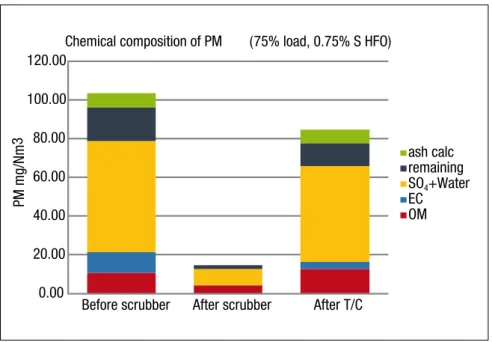
Fig. 15: Chemical composition before scrubber, after scrubber and after turbine As shown in Fig. 15, analyses of the
chemical composition of the particles before the scrubber, after the scrub-ber and after the turbine show that the scrubber removes all ashes and elemental carbon from the exhaust
gas. The presence of sulphur after the scrubber origins from small droplets of dissolved Na2SO4 carried over from the scrubber water and H2SO3 and H2SO4 droplets created from the remaining part of SO2 and the SO3.
The conclusion from the wet scrubber test is as follows:
The SO2 removal is good and
signifi-cantly influenced by the added NaOH amount
PM removal is good and only slightly
influenced by variations in the hard-ware internals
Ash and elemental carbon are almost
totally removed in the scrubber
Water carry-over from the EGR
scrubber should be avoided due to the risk of contamination by Na2SO4 from the scrubber water.
EGR service test
A service test of the EGR process and components is an important task in the development of the future EGR engines. Engine condition as well as conditions of the EGR components is necessary to follow and develop through thousands of running hours. Currently, one EGR service test is ongoing and another service test is under preparation.
Service test on Alexander Maersk
The main objective of the service test, which is still ongoing, is mainly to in-vestigate the long-term impact on the engine during EGR operation.
The EGR service test objectives are to:
Investigate the impact of EGR
opera-tion on engine components: cylinder liner, piston, piston rings, piston rod, cylinder cover, exhaust valve, etc. when burning HFO with a high con-tent of sulphur
Investigate impact on the EGR
com-ponents
Hand over operation of the EGR
sys-tem to the ship crew in order to get feedback on operation of the system, in order to adjust the system for easy, reliable and safe operation.
Currently, the EGR system on board Al-exander Maersk has been in operation close to 1,200 hours with the engine running on HFO with 3% sulphur. NOx is reduced by more than 50%, as shown in Fig. 16. The EGR system is currently operated by the ship crew. The EGR
system is a push button system con-trolled from the engine control room, except for the separator in the Water Treatment System (WTS), which has to be started on-site by the crew.
The thermodynamic performance of the EGR components was success-fully tested, and the EGR components fulfilled the expected performance. Commissioning of the EGR system in automatic mode was also successfully completed
Until now, the combustion chamber components and the exhaust gas path are not negatively affected by EGR op-eration. Fig. 17 shows the piston rings before and after approx. 900 running hours in EGR operation
1000 900 800 700 600 500 400 300 200 100 0 0 200 400 600 800 60 % NOx reduction NO-EGR EGR NOx (ppm)
Seconds run time
The service test, which is still ongoing, has been quite challenging due to the HFO operation with a high sulphur con-tent. The challenges have mainly been related to the following issues:
Corrosion of non-stainless
compo-nents. Heavy corrosion has been experienced on the EGR cooler housing, EGR cooler element, EGR blower wheel, drainers, EGR pipe and separator in the WTS system
Difficulties with controlling the dosing
of the correct amount of NaOH
Water carry-over from the scrubber
system, resulting in heavy deposits in the EGR system.
In order to deal with corrosion chal-lenges, the following components have been exchanged with stainless steel: the EGR blower wheel, drainers and some valves in the WTS system. The EGR cooler element will be exchanged with a stainless steel element. In ad-dition, a comprehensive repair of the EGR cooler housing and the EGR pipe from the blower to the connection on the charge air pipe has been completed due to insufficient coatings.
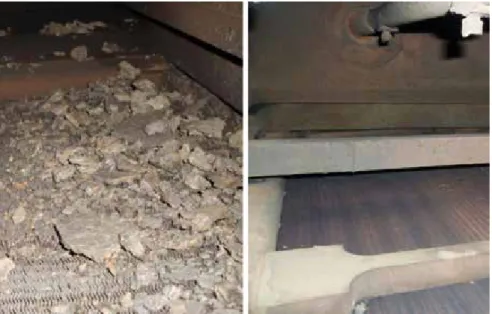
The service test has gained a lot of important learning and information on what the challenges are when running EGR on an HFO burning two-stroke marine diesel engine, as can be seen in Fig. 18. Corrosion of EGR components and deposits in the EGR system are im-portant to target. Until this state of the service test, the engine components are not affected by high pressure EGR operation.
Fig. 18: Left – deposits of sodium sulphate, iron sulphate and soot on main engine cooler top, caused by water carry-over from the scrubber system. Right – almost no deposits when water carry-over from EGR scrubber system is avoided
Preparation of service test on new-building with 6S80ME-C9.2
The newest target in the development of MAN Diesel & Turbo’s two-stroke EGR engines is a full Tier III compliant prototype with the EGR components integrated into the engine structure. With this project, MAN Diesel & Turbo targets larger two-stroke EGR engines with more than one turbocharger utilis-ing TC cut-out for high engine efficiency in future ECA areas.
The objectives of the service test are:
Maturing of the EGR engine concept
for IMO Tier III compliance
Monitoring combustion chamber
parts and other exposed engine parts under realistic conditions
Monitoring of the EGR components'
operational conditions under realistic operating conditions, i.e. during burn-ing of HFO
Education of crew to make reliable
operation of the EGR system and gain experience for future instruction books, education and support
Identifying simplification and cost
down potentials.
WMC
EGR blower
Small T/C
T/C
cut out
T/C
cut out
Scrubber
Mix Cooler
Shut-down
valve
Exhaust receiver
Scavenge air receiver
Large T/C
Cooler
WMC
Fig. 19: EGR system diagram for a 6S80ME-C9 with two turbochargers
The design experience from the project is to extend the EGR-2 principle through-out the MAN Diesel & Turbo engine pro-gramme.
As can be seen from Fig. 19, the 6S80ME-C9 EGR engine has one small turbocharger and one large turbocharg-er and cut-out facilities for the small tur-bocharger. The engine will run in the fol-lowing modes:
Non-ECA operation (blue and purple
lines): both turbochargers are work-ing in parallel under normal conditions supplying the engine with the neces-sary scavenge air. At low-load TC cut-out, it can be utilised to save fuel
ECA operation – Tier III (blue and
green lines): the small turbocharger is cut out to compensate the reduced exhaust gas amount, and the EGR blower is running to supply exhaust gas into the scavenge air receiver. The pre-scrubber and scrubber clean the EGR before the exhaust gas enters the scavenge air receiver. The EGR cooler has a double func-tion and acts as an EGR cooler in this mode and as a normal charge air cooler in non-ECA mode.
The vessel newbuilding No. 2358 is the last delivery of the APMM C-class series, see Fig. 20, from Hyundai Mipo Shipyard in Ulsan Korea. The ship is equipped with MAN B&W 6S80ME-C9 engines and an MHI waste heat recov-ery system de-rated from 27 MW to 23 MW.
The engine is planned for shop trial in August/September 2012, including full commissioning of the EGR system, in-cluding an Alfa Laval water treatment system. The engine will be certified by class ABS. The technical file will be ac-cording to the normal Tier II certificate. However, knowledge is gathered to make a proposal for a Tier III certifica-tion procedure.
The sea trial will take place in January 2013, and subsequently EGR commis-sioning will be carried out when the ves-sel is in service operation.
After delivery in early 2013, the vessel will go into service on the West Africa - Far East route. Even though the vessel would not sail in ECAs, it will be oper-ated in ECA mode for 20% of the time. For the remaining time, it is agreed to
operate the engine with low EGR rates – to allow service time on the EGR com-ponents and to fuel optimise the op-eration. The EGR service test period is planned to be for three years until early 2016, when the NOx Tier III limits enter into force.
HHI-EMD will produce the 6S80ME-C9.2 EGR engine, and the following en-gine modifications will be made:
Sequential turbocharging
EGR cooler and scrubber module in
duplex material from a local producer based on MAN Diesel & Turbo design
High-efficient EGR blowers
Stainless steel coolers with dual
functionality
Gas control valves
Changed components such as
ex-haust receiver, scavenge air receiver and galleries
The main engine outline is only
modi-fied slightly at the EGR-2 module – keeping the engine foot print un-changed
Control system modifications.
Besides integrated EGR components on the engine, as can be seen in Fig. 21, and related engine modifications, the following installation work will be carried out by HHI Shipbuilding Division:
Installation of NaOH and EGR sludge
tanks
Installation of water treatment system Installation of frequency converters
for EGR blowers
Installation of stainless piping for
scrubber water handling
Extended central cooling water
ca-pacity
Electrical installation
Software update of control alarm and
monitoring system for tank monitor-ing
Software update of power monitoring
system for waste heat recovery and ME heat capacities.
MAN Diesel & Turbo highly appreciates the close corporation with leading en-gine builders, shipyards and shipown-ers for this strategic important proto-type project.
Fig. 21: integrated design of EGR unit (orange) on a 6S80ME-C9 engine Water treatment system (WTS)
MAN Diesel & Turbo is heavily involved in the development of water treatment systems (WTS) for both EGR and SOX scrubbing systems. The WTS is essen-tial for running the EGR system, and compliance with IMO criteria for wash water discharge is highly prioritised. Over the last couple of years, Alfa Laval has, in cooperation with MAN Diesel & Turbo, developed a complete water treatment system for the EGR engine. Extensive testing and investigation on how to clean scrubber water in an effi-cient and reliable way have been carried out successfully.
WTS system layout and functionality
The EGR WTS system is an important part of operating the EGR system be-cause the contaminated scrubber water needs to be cleaned for soot particles to avoid clogging up the system. More-over, the water generated during com-bustion which is condensed in the EGR cooler, needs to be discharged to the sea, in a clean condition, to avoid large storage tanks on board.
During the development of the WTS, it became clear that the aim should go for a unit solution that is simple to install for the shipyards, like a “plug and play” solution. Much functionality is hereby included in the WTS system, i.e. the NaOH dosing, water flow control and discharge control.
In order to make installation highly flex-ible, the WTS module is divided into two units:
WTS1 module, see Fig. 22,
compris-es the separators, scrubber pumps, NaOH dosing, etc., to be placed wher-ever there is space in the ship
WTS2 module (collecting tank
mod-ule) for transportation of the scrubber water from engine site to the WTS1 module to be placed close to the gine below the EGR unit on the en-gine.
The WTS system is a necessary EGR auxiliary system for EGR operation be-cause of the following functionalities:
Controlling of the correct water
sup-ply to the EGR scrubber
Reliable and clean conditions in the
scrubber system
Correct dosing of NaOH
Controlling of the salt concentration
in the scrubber water
Compliance with IMO regulation for
wash water discharge
Minimal pumpable sludge
produc-tion.
As shown in Fig. 23, the WTS system is divided into modules. Module 1 com-prises separators for both cleaning of the scrubber water supplied to the EGR unit and for cleaning of the discharge water. All water supplied to the EGR scrubber is cleaned in order to ensure reliable operation without any clogging up of deposits scaling up in the scrub-ber system. Cleaning of the discharge water is carried out on the cleaned scrubber from the scrubber water cleaning separators. The WTS1 mod-ule controls the amount of scrubber water in the system by either discharge of water or addition of fresh water. The
Fig. 23: WTS process diagram
WTS system ensures compliance with IMO wash water criteria in all operation cases.
The following parameters will define the engine requirements to the WTS sys-tem:
Inlet scrubber water flow Inlet scrubber water pressure Inlet scrubber water temperature Quality of inlet scrubber water
- pH value
- salt concentration - solids fraction
Draining capacity.
The current development is aiming at defining all necessary specific values for the above-mentioned parameters. EGR high-speed blower
In order to improve the EGR process, in particular reduction of the additionally needed auxiliary power, MAN Diesel & Turbo has been involved in the develop-ment of a new high-speed EGR blower with a significantly higher thermody-namical efficiency than former designs. The high-speed EGR blower is based on a radial turbo compressor wheel run-ning at 2-3 times higher speeds than a conventional radial b-wheel.
MAN Diesel & Turbo is currently col-laborating with Siemens Turbo Systems on developing EGR blowers for the two 6S80ME EGR prototype service test. Besides, MAN Diesel & Turbo is also developing an in-house solution in or-der to ensure more than one supplier of EGR blowers.
1,30
1,25
1,20
1,15
1,10
1,00
1,05
Pressure Ra
tion (T
-T)
0,0
0,5
1,0
1,5
2,0
2,5
3,0
3,5
4,0
2000
3000
4000
5000
6000
7000
8000
9000
η=78
η=80
87
Fig. 24: Requirement for EGR high-speed blower.
The requirements for a high-speed EGR blower are:
High efficiency over wide flow range Fast dynamic flow response Corrosion resistant materials Reliable, well-known technologies Lube oil journal and thrust bearing Compact design
Flange mounting
Leakage proof by use of sealing air Simple control interface
Integrated monitoring of operation
condition.
Fig. 24 shows the required compressor map for an EGR blower from Siemens, including operational points for different engine loads. Tests have shown that re-quirements were met satisfactorily.
Fig. 25 shows the EGR blower pro-duced for testing on the 4T50ME-X test engine. Specifications of the EGR blower are as follows:
Power: 200 kW
Thermodynamic efficiency: 0% Pressure lift: 600 mbar
Mass flow: 4 kg/s (at 31°C inlet
tem-perature)
Weight: 600 kg Lube oil flow: 60 l/min
Cooling water flow: approx. 2 m3/h.
The EGR blower has been tested on the test bed at ambient conditions with satisfying performance figures, and is-sues with surging at a high pressure ra-tio against a closed valve at the blower outlet was tested not critical. The next step of testing will be a blower perform-ance and controlling test on the MDT 4T50ME-X test engine planned for April 2012. Subsequently, a test on Alexander Maersk will be conducted. Currently, two sizes of the Siemens high-speed EGR blowers are available, covering en-gines from approx. 5-23 MW.
Conclusion
As can be seen from the above, the EGR application on two-stroke MAN B&W engines has, over the last decade, developed from a basic idea on how to reduce NOx emissions to a dedicated design, suitable for application on the engine in standard configuration. The development process has ensured dedicated development of:
Water spraying systems for
pre-cool-ing of exhaust gas
Wet coolers capable of withstanding
SO2, SO3and H2SO4 condensation
Scrubbers with very high SO2 and
particulate emission removal capacity
Compact high-speed and
high-effi-ciency EGR blowers
Water treatment systems capable
of removing particulate matter ef-ficiently, and clean water to suitable discharge level
Control systems capable of securing
simple push-button operation of the EGR system
Control strategies securing optimal
engine performance in both Tier II ar-eas and in Tier III ECA arar-eas. This makes MAN Diesel & Turbo con-fident that the EGR system application will be available in due time before 2016 for the complete engine range.
MAN Diesel & Turbo Teglholmsgade 41 2450 Copenhagen SV, Denmark Phone +45 33 85 11 00 Fax +45 33 85 10 30 [email protected] www.mandieselturbo.com
MAN Diesel & Turbo – a member of the MAN Group All data provided in this document is non-binding. This data serves informational purposes only and is especially not guaranteed in any way. Depending on the subsequent specific individual projects, the relevant data may be subject to changes and will be assessed and determined individually for each project. This will depend on the particular characteristics of each individual project, especially specific site and operational conditions. Copyright © MAN Diesel & Turbo. 5510-0125-00ppr Aug 2012 Printed in Denmark



![Fig. 12: Heat release running with and without EGRCV08CT70CA60CV06CT40CA405.5 5.0 4.54.03.53.02.52.01.5 1.0Pressure Ratio0 4 8 12 16 20 24Mass flow [kg/s]](https://thumb-us.123doks.com/thumbv2/123dok_us/8681312.2347890/19.892.80.833.279.812/fig-heat-release-running-egrcv-pressure-ratio-mass.webp)