In the following report, Hanover Research benchmarks the faculty governance structures of the top 30 liberal arts colleges. Our report also presents in-depth profiles of governance structures in three of the top 30 colleges, as well as information on recent changes in governance at three additional institutions.
Faculty Governance
Structures Review
T
ABLE OF
C
ONTENTS
Executive Summary and Key Findings ... 4
INTRODUCTION ... 4
REPORT STRUCTURE ... 4
KEY FINDINGS ... 5
Faculty Committees ... 5
Selection of Department Chairs ... 5
Sub-Committees on Promotion/Tenure, Budget, and Curriculum ... 5
Faculty Governance Changes and Faculty Reactions ... 5
Section I: General Trends in College Governance Structures ... 6
FACULTY COMMITTEES AND DEPARTMENT CHAIRS ... 6
Changes in Faculty Governance Structures ... 9
Faculty Executive Committee Structures ... 10
Selection of Department Chairs ... 10
TENURE,PROMOTIONS,BUDGETING, AND CURRICULUM ... 11
Tenure and Promotions Process ... 16
Budget and Curriculum Decisions ... 16
Section II: College Governance Profiles ... 17
AMHERST COLLEGE ... 17
Faculty Committees ... 19
Selection and Responsibilities of Department Chairs... 19
Tenure and Promotion Decisions ... 20
Curriculum Decisions ... 21
Budget Decisions... 21
BOWDOIN COLLEGE ... 22
Faculty Committees ... 22
Tenure and Promotion Decisions ... 23
Curriculum Decisions ... 24
Budget Decisions... 25
OBERLIN COLLEGE ... 25
Faculty Committees ... 28
Tenure and Promotion Decisions ... 29
Curriculum and Budget Decisions ... 29
Section III: Changes in College Governance and Faculty Reactions ... 31
RENSSELAER POLYTECHNIC INSTITUTE ... 31
NATIONAL UNIVERSITY ... 32
MISSOURI STATE UNIVERSITY –ON THE IMPORTANCE OF SHARED GOVERNANCE ... 32
E
XECUTIVE
S
UMMARY AND
K
EY
F
INDINGS
I
NTRODUCTIONHanover research investigated faculty governance structures at the top 30 liberal arts colleges identified by U.S. News & World Report.1 Most of the information included in this report was gathered from institutional websites and faculty handbooks. However, we note that very little information was available on the websites of the two military institutions on the list of top 30 colleges (the United States Naval Academy and the United States Military Academy).
R
EPORTS
TRUCTUREIn Section I, we examine broad trends in governance at liberal arts institutions. We first examine faculty committees, including which committees speak for the faculty and relevant divisional committees, as well as department Chair selection. The second part of this section examines the bodies responsible for tenure/promotion, budget, and curriculum decisions at each institution for which information was available.
In Section II, we provide in-depth profiles of the faculty governance structures at three institutions: Amherst College, Bowdoin College, and Oberlin College. The faculty committees, budgeting decisions, curriculum decisions, department chair selection, and processes for tenure/promotion are reviewed in these profiles.
Finally, in Section III, we briefly discuss recent changes in college governance at three institutions: Rensselaer Polytechnic Institute (RPI), National University, and Missouri State University. However, we note the information regarding faculty reactions to changed governance structures was rarely available, either in news articles or on faculty or institutional websites.
The key findings from our research are presented on the following page.
1 “National Liberal Arts Colleges.” U.S. News & World Report. 2012.
http://colleges.usnews.rankingsandreviews.com/best-colleges/rankings/national-liberal-arts-colleges/data/spp+50
K
EYF
INDINGSF
ACULTYC
OMMITTEES
Most faculty governance structures at liberal arts institutions include one representative faculty body that is responsible for “speaking for” the faculty. Typically, this body is called a Faculty Executive Committee, and is comprised of between three and eight faculty representatives. These representatives are typically elected by the general faculty, and serve terms of two to four years.
Many of the top liberal arts institutions reviewed either require or strongly encourage faculty participation in faculty committees. Several institutions also have legislation limiting the number of times faculty members can serve on certain committees, or limiting the number of committees on which faculty members can serve concurrently.S
ELECTION OFD
EPARTMENTC
HAIRS
Department chairs are often either elected directly by the faculty, or are appointed by the President of the institution in consultation with faculty members. Department chairs typically serve terms of three to five years, although several institutions note that Chair service does not carry a fixed term. Department chairs can also typically be re-elected several times after their initial term is complete.S
UB-C
OMMITTEES ONP
ROMOTION/T
ENURE,
B
UDGET,
ANDC
URRICULUM
Nearly all institutions have faculty subcommittees responsible for hearing and deciding matters related to promotion and tenure of faculty members, the institution’s budget, and curriculum. Such committees are often comprised of various institutional representatives, including faculty members, administrators and students.F
ACULTYG
OVERNANCEC
HANGES ANDF
ACULTYR
EACTIONS
Information on changes to faculty governance structure was limited, as not many institutions choose to make such information public. However, Hanover found that faculty participation in college governance is very important to many faculty members. Indeed, a survey of Missouri State University faculty members during the beginning of the 2008 recession found that faculty satisfaction with an institution may be more influenced by the level of shared governance than by the level and allocation of institutional resource.
Our research suggests that faculty members are typically least receptive to changes to faculty governance structures when governance is restructured without faculty input or consent. In other words, the higher the level of cooperation and consultation between faculty members and the administration during the governance review process, the more likely faculty members are to support changes in faculty governance.S
ECTION
I:
G
ENERAL
T
RENDS IN
C
OLLEGE
G
OVERNANCE
S
TRUCTURES
In this section, we review faculty governance structures in place at many of the top thirty liberal arts institutions identified by the U.S. News & World Report. This section is comprised of two subsections: one examines faculty committees and department chairs, and one that examines tenure and promotion, budgeting and curriculum committees. For each subsection, we first present information for each institution in a summary table, and then provide a brief discussion of themes that emerged in our review of faculty governance structures at these institutions.
F
ACULTYC
OMMITTEES ANDD
EPARTMENTC
HAIRSHanover first surveyed institutional websites and faculty handbooks at each of the top 30 liberal arts institutions identified by the U.S. News & World Report for information regarding recent changes to college governance, faculty committee structures, requirements for committee service, and the selection of department chairs. However, most of the colleges did not provide information in all of these areas, and some institutions did not provide any information at all. Notably, no information was available for Swathmore College, Colgate University, Claremont McKenna College, Haverford College, Carleton College, the United States Naval Academy, or the United States Military Academy. Therefore, these institutions are excluded from our analysis and from the summary table below.
Figure 1.1: General Faculty Governance Information, by Institution
INSTITUTION (U.S. NEWSRANK)
RECENT CHANGE IN
GOVERNANCE
BODY THAT SPEAKS FOR FACULTY
(NUMBER OF MEMBERS)
COMMITTEE
SERVICE SELECTION OF DEPARTMENT CHAIR
Williams College
(#1) Creation of Williams Staff Committee2 Faculty Steering Committee (6)3 Unknown
President Consults with department, then President
appoints chair.4
Amherst College (#2)
Creation of the Advisory Budget Committee (2009)5
Committee of Six (8 including the President and Dean of Faculty who do not vote)6
Required, except in first year
Department elects chair to recommend to the President of
the College.7
2 “The New Williams Staff Committee.” Williams College Office of the President.
http://president.williams.edu/letters-from-the-president/the-new-williams-staff-committee/
3 “Committees, Panels, & Advisory Groups: Faculty Steering Committee.” Williams College.
http://committees.williams.edu/faculty-standing-committees/faculty-steering-committee/
4 “Academic Department Governance: Williams College Employee Handbook.” Williams College.
http://wiki.williams.edu/display/handbooks/Academic+Department+Governance
5 “Advisory Budget Committee.” Amherst College. https://www.amherst.edu/aboutamherst/economy/abc 6 “Committees.” Amherst College, Dean of the Faculty.
https://www.amherst.edu/academiclife/dean_faculty/fph/fachandbook/facresponsibilities/committees
7 “The Faculty.” Dean of the Faculty.
INSTITUTION (U.S. NEWSRANK)
RECENT CHANGE IN
GOVERNANCE
BODY THAT SPEAKS FOR FACULTY
(NUMBER OF MEMBERS)
COMMITTEE
SERVICE SELECTION OF DEPARTMENT CHAIR
Middlebury
College (#4) N/A
Faculty Council (6). Three of the members also serve on
Committee on Conference with Trustees, and the other three serve on the Committee
on Finance and Planning8
Required Appointed by the President9
Pomona College
(#4) N/A Executive Committee of the Faculty (6)10 Unknown Appointed by the President.11
Bowdoin College
(#6) Revised Committee Structure12 Committee on Governance and Faculty Affairs (6)13
Required, except in
first year Unknown
Wellesley College
(#6) N/A Unknown
Required, except in
first year Unknown
Vassar College
(#10) N/A Faculty Policy and Conference Committee (6)14 Encouraged Unknown
Davidson College (#12)
Formed Strategic Advisory Committee15
Faculty Executive Committee
(10)16 Unknown
Selected by the President and the Vice President for Academic
Affairs and Dean of Faculty, in consultation with departmental
faculty.17
Harvey Mudd
College (#12) N/A Faculty Executive Committee (6)18 Required
Appointed by the President upon the recommendation of
the Dean of Faculty after consultation with the members
of the department.19
8 “Faculty Rules and Procedures.” Middlebury College.
http://www.middlebury.edu/about/handbook/governance/Faculty_Rules_and_Procedures
9 “Administrative Appointments – Terms/Conditions.” Middlebury College Faculty Handbook.
http://www.middlebury.edu/about/handbook/faculty/administrative_appt
10 “Pomona College Faculty Handbook.” 2012. Pomona College. P. 18.
http://www.pomona.edu/administration/academic-dean/guidelines-policies/faculty-handbook.pdf
11 Ibid., 15.
12 “Revised Committee Structure.” Bowdoin College, Office of Academic Affairs.
http://www.bowdoin.edu/academic-affairs/faculty-flexibility/revised-committee-structure.shtml
13 “Academic Affairs: Committee on Governance and Faculty Affairs.” Bowdoin College.
http://www.bowdoin.edu/academic-affairs/faculty-governance/gfa.shtml
14 “Faculty Handbook.” 2010. Vassar College. P. 187.
http://deanofthefaculty.vassar.edu/docs/VassarFacultyHandbook.pdf
15 “The Strategic Advisory Committee.” The Davidson College Strategic Plan. P. 1.
http://www3.davidson.edu/cms/documents/OfficesServices/OfficeofthePresident/InstResearch/Strategic%20Adv isory%20Committee%20Overview.pdf
16 ‘The Davidson College Faculty Handbook.” August, 2005. Davidson College. P. 22.
http://www2.davidson.edu/administration/SACS/documents/FacultyHandbook2005.pdf
17 Ibid., 8.
18 “The Harvey Mudd College Faculty Notebook.” Harvey Mudd College. P. 6.
http://www.hmc.edu/files/DoF/faculty-notebook.pdf
INSTITUTION (U.S. NEWSRANK)
RECENT CHANGE IN
GOVERNANCE
BODY THAT SPEAKS FOR FACULTY
(NUMBER OF MEMBERS)
COMMITTEE
SERVICE SELECTION OF DEPARTMENT CHAIR
Washington and Lee University (#14) Faculty Administrators Evaluation Committee is dormant, considering eliminating this committee20
Faculty Executive Committee21 Unknown Unknown
Hamilton College
(#16) N/A Academic Council (6)22 Unknown Appointed by Dean from among members of the department23
Wesleyan
University (#17) N/A Faculty Executive Council (6)24 Unknown Unknown Colby College
(#18) N/A
No central body; rather, individual committees and
Division Chairs represent faculty to the administration.25
Encouraged
President, with advice of department and Dean of Faculty, appoints department
chair26
Smith College
(#18) N/A Faculty Council (5)27 Unknown Elected by qualified voting members.28
Bates College
(#22) N/A Committee on Faculty Governance (9)29 Unknown Unknown
Grinnell College
(#22) N/A Executive Council (8)30 Unknown
Elected or appointed from among the Regular faculty of
their department.31
Macalester
College (#24) N/A
Academic Liaison Committee - made of the three chairs of the
other Faculty Standing Committees (3)32
Unknown Appointed by Provost
20 “Faculty Handbook Listing of Committees and 2012-2013 Committee Members.” Washington and Lee University.
http://registrar2.wlu.edu/faculty/faccom.htm#faec
21 “Faculty Executive Committee.” Washington and Lee University. http://www.wlu.edu/x36404.xml 22 “Faculty Handbook.” December, 2009. Hamilton College. P. 13.
23 Ibid., 22.
24 “Accreditation Report: Standard Three: university Organization and Governance.” 2012. Wesleyan University Board
of Trustees. http://www.wesleyan.edu/accreditation/draftselfstudyoutline/03_organizationandgovernance.html
25 “Colby College Faculty Handbook.” 2012. Colby College. P. 68.
http://www.colby.edu/academics_cs/resources/offices/deanoffaculty/upload/2012-Faculty-Handbook.pdf
26 Ibid., 59.
27 “Smith at a Glance: College Committees & Governance.” Smith College.
http://www.smith.edu/about_governance.php
28 “Code of Faculty Legislation and Administrative Practice at Smith College.”2012-2013. Smith College. P. 23.
http://www.smith.edu/deanoffaculty/code/code12-13.pdf
29 “The Faculty Handbook of Bates College.” August, 2012. Bates College. P. 1.30.
http://www.bates.edu/dof/files/2010/09/FINAL-Complete-Faculty-Handbook-12-13.pdf
30 “Grinnell College Faculty Handbook.” July 20, 2012. Grinnell College. P. 19.
http://web.grinnell.edu/dean/Handbook/FacultyHandbook.pdf
31 Ibid., 11.
INSTITUTION (U.S. NEWSRANK)
RECENT CHANGE IN
GOVERNANCE
BODY THAT SPEAKS FOR FACULTY
(NUMBER OF MEMBERS)
COMMITTEE
SERVICE SELECTION OF DEPARTMENT CHAIR
Scripps College
(#24) N/A Faculty Executive Committee (8)33 Unknown
Appointed by Dean of Faculty, in consultation with members
of the department.34
Bryn Mawr
College (#26) N/A Representatives to the Board of Trustees (3)35 Required
Elected by department, approved by Provost in consultation with the
President.36
Oberlin College
(#26) N/A General Faculty Council (8)37 Required
Department chairs appointed by College Faculty Council upon recommendation of Dean, after
consultation by Dean with members of the department.38
Barnard College
(#28) N/A Faculty Advisory Council (6)39 Required Unknown
University of
Richmond (#28) N/A University Faculty Council (17)40 Unknown Appointed by the President of the University.41
C
HANGES INF
ACULTYG
OVERNANCES
TRUCTURESOnly five of the institutions we reviewed—Williams College, Amherst College, Bowdoin College, Davidson College, and Washington and Lee University—provided explicit information on recent changes in governance structures on their websites. Typically, recent changes to faculty governance structures at these institutions have revolved around the creation of new faculty sub-committees, such as the new Strategic Advisory Committee at Davidson College, which was formed in order to “consider strategic institutional issues and [serve] in an advisory capacity to the President and Principal Executive Staff (PES).”42 Additionally, Bowdoin College recently revised its committee structure to allow faculty more time for teaching and research. Information regarding faculty reactions to these governance structure changes was unavailable for the five top liberal arts colleges reviewed in this section of our report. However, faculty reactions to governance structure changes at other colleges and universities are reviewed in more detail in Section III.
33 “Scripps College Faculty Handbook.” 2010. Scripps College. P. 1.4.1.
https://scrippscollege.edu/offices/faculty/files/2010%20Faculty%20Handbook.pdf
34 Ibid., 3.1.1.
35 ‘Plan of Governance of Bryn Mawr College.” February 7, 2009. Bryn Mawr College. P. 5.
http://www.brynmawr.edu/provost/documents/PlanofGovernance4-09.pdf
36 Ibid., 7.
37 “Oberlin College Faculty Guide.” June 11, 2009. Oberlin College. P. 6. http://new.oberlin.edu/dotAsset/1476881.pdf 38 P. 9.
39 “A Faculty Guide to Barnard College.” July 30, 2012. Barnard College. P. 9.
http://barnard.edu/sites/default/files/inline/barnard_faculty_guide_2012-2013.pdf
40 “University Faculty Council.” University of Richmond Office of the Provost.
http://provost.richmond.edu/faculty-resources/UFC.html
41 “University of Richmond Guide to Faculty Governance: I. Preface: Mission, History, and Organization of the
University.” The University of Richmond. http://facultygovernance.richmond.edu/Ch_I/index.html
42 “Davidson’s Vision for the Future.” Davidson College. P. 1.
http://www3.davidson.edu/cms/documents/OfficesServices/OfficeofthePresident/InstResearch/Strategic%20Adv isory%20Committee%20Overview.pdf
F
ACULTYE
XECUTIVEC
OMMITTEES
TRUCTURESThe majority of top 30 liberal arts institutions reviewed appear to have a specific faculty committee that is charged with “speaking for” the faculty, or representing the collective faculty to the institution’s administration. Further, the majority of faculty committees at these institutions are comprised of six or more members, with only three institutions (Smith College, Macalester College, and Bryn Mawr College) noting that their faculty committees are comprised of less than six members. Typically, faculty executive committees include the president of the institution, the provost and/or academic dean of the institution, and three or more faculty members elected by the collective faculty. The notable exception to this general rule is the University of Richmond, which has a faculty committee comprised of 17 members, all of whom are elected faculty of the university’s five schools. Faculty members are typically elected by the general faculty to serve on these committees, and serve terms of between two and four years.
Faculty service on committees is typically either required or encouraged, though most institutions allow only tenure-track faculty to serve on committees, and to vote on matters such as department chair appointments and tenure and promotion decisions. We note, however, that the American Association of University Professors (AAUP) found that in 2009, 75 percent of faculty appointments in the U.S. were non-tenure-track, and that these faculty members are “only sometimes included in governance structures.” The AAUP is currently calling for more participation by these members, including “eligibility for voting and holding office.”43 Therefore, it may be wise for institutions to consider including non-tenure-track faculty in faculty governance structures moving forward.
Although several institutions have additional sub-committees and sub-councils comprised of faculty members, we note that only one institution—Oberlin College—appears to have divisional executive committees responsible for “approving legislation particular to their branches such as curricular policy.”44 Most other institutions appear to have separate curriculum committees or advisory boards who are responsible for setting legislation related to curricular policy, or designate decisions regarding these issues to departmental chairs or program coordinators.
S
ELECTION OFD
EPARTMENTC
HAIRSOnly fifteen institutions provided information on the selection of department chairs. Of these institutions, the majority note that all department chairs are appointed by the president of the institution, the provost, or the Dean of Faculty. Typically, however, all chair appointments are made in consultation with faculty and staff from the appropriate department. In general, only tenured or tenure-track faculty members are eligible to serve as departmental chairs.
43 “New Report on Contingent Faculty and Governance.” American Association of University Professors. 2012.
http://www.aaup.org/AAUP/newsroom/2012webhighlight/congovreport.htm
T
ENURE,
P
ROMOTIONS,
B
UDGETING,
ANDC
URRICULUMHanover next examined information found on institutional websites in order to determine the bodies responsible for tenure/promotions, budgeting, and curriculum decisions at the top 30 liberal arts colleges. Most institutions provided this information in faculty handbooks or faculty governance webpages. However, we note that no information was available for the United States Naval Academy or the United States Military Academy. A summary of information collected for this section is found in the table below.
Figure 1.2: Bodies Responsible for Tenure/Promotions, Budgeting, and Curriculum Decisions, by Institution
INSTITUTION (U.S.
NEWSRANK) TENURE/PROMOTIONS BUDGETING CURRICULUM
Williams College (#1)
Committee on Appointments and Promotions
Faculty Interviewing Panel
Faculty Review Panel
President
Trustees45
Dean of the Faculty46
VP for Finance and Administration47
Committee on Educational Policy48
Individual committees for each program49
Amherst College (#2)50
Department
Dean of the Faculty
Committee of Six
President
Board of Trustees51
Director of the Budget
President
Dean of the Faculty
Treasurer
Board of Trustees
Committee on Priorities and Resources
Advisory Budget Committee52
Committee of Six
Committee on Educational Policy
Swarthmore College (#3)53
Board of Managers
Committee on Promotion and Tenure
Individual departments
Finance Committee54
College Budget Committee
Curriculum Committee
Council on Educational Policy
Committee on Academic Requirements
45 “Committees, Panels, & Advisory Groups – Appointments & Promotions.” Williams College.
http://committees.williams.edu/faculty-standing-committees/appointments-promotions/
46 “Office of the Dean of the Faculty.” Williams College. http://dean-faculty.williams.edu/
47 “Vice President for Finance & Administration and Treasurer.” Williams College. http://vp-finance.williams.edu/ 48 “Educational Policy Committee.” Williams College. http://sites.williams.edu/educational-policy/
49 “Committees, Panels, & Advisory Groups – Membership.” Williams College.
http://committees.williams.edu/program-committees/membership/
50 “Committees.” Amherst College.
https://www.amherst.edu/academiclife/dean_faculty/fph/fachandbook/facresponsibilities/committees
51 “Promotion.” Amherst College.
https://www.amherst.edu/academiclife/dean_faculty/fph/fachandbook/facstatus/promotion
52 “Advisory Budget Committee.” Amherst College. https://www.amherst.edu/aboutamherst/economy/abc 53 “Committees of the Faculty.” Swarthmore College.
http://www.swarthmore.edu/academics/provosts-office/committees.xml
54 “Finance Committee.” Swarthmore College.
INSTITUTION (U.S.
NEWSRANK) TENURE/PROMOTIONS BUDGETING CURRICULUM
Middlebury College (#4)55
Promotions Committee of the Council on Reviews
Vice President for Academic Affairs
Department Chair (or Dean of the Faculty)
President
Board of Trustees
Budget Oversight Committee
Budget and Finance Committee
Board of Trustees56
Curriculum Committee (subcommittee of the Educational Affairs Committee)
Pomona College (#4)57
Department chairs
Faculty Personnel Committee
Associate Dean for Academic Affairs58
Dean
President
Cabinet
Board of Trustees
Faculty Grievance Committee
Budget Planning Advisory Committee
Executive Committee Curriculum Committee
Bowdoin College (#6)59
Individual departments
Dean for Academic Affairs
Committee on Appointments, Promotion, and Tenure
President of the College
Academic Affairs Committee of the Trustees
Board of Trustees
Financial Planning Committee
Committee on Governance and Faculty Affairs
Curriculum and Educational Policy
Curriculum Implementation
Recording Committee
Wellesley College (#6)60
Committee on Faculty Appointments
Department Chair
Departmental Reappointments and Promotions Committee
President
Board of Trustees
Advisory Committee on
Budgetary Affairs Committee on Curriculum and Academic Policy
Carleton College (#8)
Department Chair
Dean
President
Faculty Personnel Committee
Board of Trustees61
Budget Committee
(subcommittee of the College Council)62
Education and Curriculum Committee63
55 “Faculty Councils and Committees.” Middlebury College.
http://www.middlebury.edu/about/handbook/governance/Faculty_Councils_and_Committees#PC
56 “Self-Study Report.” 2011. Middlebury College.
http://www.middlebury.edu/media/view/284006/original/self_study_for_usb.pdf
57 “Faculty Committees 2012-13.” Pomona College.
http://www.pomona.edu/administration/academic-dean/files/faculty-committees.pdf
58 “Dean’s Office Staff.” Pomona College. http://www.pomona.edu/administration/academic-dean/office-staff.aspx 59 “Faculty Handbook 2011-12.” Bowdoin College.
http://www.bowdoin.edu/academic-affairs/forms-policies/policies/pdf/11-12FacultyHandbook.pdf
60 “Standing Committees of Academic Council.” Wellesley College. http://new.wellesley.edu/provost/committees 61 “Tenure Reviews.” Carleton College.
INSTITUTION (U.S.
NEWSRANK) TENURE/PROMOTIONS BUDGETING CURRICULUM
Haverford
College (#9)64 Academic Council Administrative Advisory Committee Educational Policy Committee
Claremont McKenna College (#10)65
Appointment, Promotion, and Tenure Committee
Executive Committee
Dean of the Faculty
President
Department
Administration Committee Curriculum Committee
Vassar College (#10)66
Department faculty
Dean of the Faculty
Faculty Policy and Conference Committee
Faculty Appointments and Salary Committee
President
Board of Trustees
Budget and Finance Committee
Committee on Curricular Policies
Davidson College (#12)
Vice President
Department Chair
Faculty Tenure Committee67
Trustee Audit and Budget Committee
Business Services Department68
Faculty Committee on Educational Policy69
Harvey Mudd College (#12)70
Reappointment, Promotion, and Tenure Committee
Department Chair
Department
President
Board of Trustees
Budget Committee Curriculum Committee
Washington and Lee University
(#14)
Advisory Committee
Tenure Committee (for each department)
President
Board of Trustees
Promotion Evaluation Committee
Dean of the College71
Budget Advisory Committee72 Courses and Degrees Committee73
62 “Budget Committee.” Carleton College. http://apps.carleton.edu/governance/budget/
63 “Education and Curriculum Committee.” Carleton College. http://apps.carleton.edu/governance/ecc/ 64 “Periodic Review Report.” 2004. Haverford College.
http://www.haverford.edu/ir/pdf/Periodic_Review_Report_2004.pdf
65 “Faculty Handbook.” 2010. Claremont McKenna College.
http://www.cmc.edu/dof/policies/Faculty_Handbook_July_2010.pdf
66 “The Governance of Vassar College 2010/11.” Vassar College.
http://deanofthefaculty.vassar.edu/docs/VassarGovernance.pdf
67 “Compliance Certification Report – Comprehensive Standard 3.7.2 – Evaluation of Faculty.” Davidson College.
http://www2.davidson.edu/administration/SACS/ccr_core3-7-2.asp
68 “Finance and Administration.” Davidson College. http://www3.davidson.edu/cms/x1047.xml
69 “Compliance Certification Report – Comprehensive Standard 3.5.1 – Competencies within the general education
core.” Davidson College. http://www2.davidson.edu/administration/SACS/ccr_core3-5-1.asp
70 “The Harvey Mudd College Faculty Notebook.” Harvey Mudd College.
http://www.hmc.edu/files/DoF/faculty-notebook.pdf
71 “Faculty Handbook.” 2012. Washington and Lee University.
INSTITUTION (U.S.
NEWSRANK) TENURE/PROMOTIONS BUDGETING CURRICULUM
Hamilton College (#16)74
Department Chair
Department voting members
Dean
Committee on Appointments
President
Faculty Committee on Budget and Finance
President
Vice Presidents
Committee on Academic Policy
Wesleyan University (#17)
Board of Trustees
Academic Affairs
Review and Appeals Board75
Executive Budget Committee
Cabinet
Budget Priorities Committee76
Educational Policy Committee77
Colby College (#18)78
Committee on Promotion and Tenure
Dean of Faculty
President
Financial Priorities Committee Academic Affairs Committee
Colgate University
(#18)79
Faculty Committee on Promotion and Tenure
Dean’s Advisory Council
Committee on Faculty Affairs
President
Department
Dean of the Faculty
Board of Trustees
Committee on Budget and Financial Planning (a Liaison Committee)
Director of Budget and Decision Support
Associate Provost
Vice President for Administration
Dean of the College
Vice President for Institutional Advancement
Academic Affairs Board
Curriculum Committee
Smith College (#18)80
Committee on Tenure and Promotion
Board of Trustees
Unit
Budget Director
Faculty Council
Advisory Committee on Resource Allocation
Committee on Academic Priorities
Bates College (#22)81
Department Chair
Committee on Personnel
President
Trustees
Budget and Finance Advisory
Committee Committee on Curriculum and Calendar
72 “University Budget.” Washington and Lee University. http://www.wlu.edu/x30915.xml
73 “Courses and Degrees Committee.” Washington and Lee University. http://www.wlu.edu/x36405.xml 74 “Faculty Handbook.” 2012. Hamilton College.
http://www.hamilton.edu/documents/Faculty%20Handbook%202012.pdf
75 “Academic Affairs.” Wesleyan University. http://www.wesleyan.edu/acaf/governance/rosters.html 76 “Accreditation Report – Standard Two : Planning and Evaluation.” Wesleyan University.
http://www.wesleyan.edu/accreditation/draftselfstudyoutline/02_planningandevalutation.html
77 “Academic Affairs – EPC Policies.” Wesleyan University.
http://www.wesleyan.edu/acaf/teach_advise/epcpolicies.html
78 “Colby College Faculty Handbook.” 2012. Colby College.
http://www.colby.edu/academics_cs/resources/offices/deanoffaculty/upload/2012-Faculty-Handbook.pdf
79 “Organization of the University.” Colgate University.
http://www.colgate.edu/portaldata/imagegallerywww/87419dab-508f-4bc1-b6d1-c4580a90e02a/ImageGallery/Faculty%20Handbook%20Revisions%20for%20web%20030211.pdf
80 “Code of Faculty Legislation and Administrative Practice.” Smith College.
http://www.smith.edu/deanoffaculty/code/code12-13.pdf
81 “The Faculty Handbook of Bates College.” 2012. Bates College.
INSTITUTION (U.S.
NEWSRANK) TENURE/PROMOTIONS BUDGETING CURRICULUM
Grinnell College (#22)82
Faculty Personnel Committee
Divisional Personnel Committee
Department Chair
Dean of the College
Executive Council
President
Trustees
Budget Committee of the Trustees
Budget Steering Committee83
Curriculum Committees within each division
Macalester College (#24)84
Faculty Personnel Committee
Provost
President
Board of Trustees
Resource and Planning
Committee Educational Policy and Governance Committee
Scripps College (#24)85
Appointments, Promotions, and Tenure Committee
President
Finance Committee
Faculty Executive Committee Faculty Executive Committee
Bryn Mawr College (#26)
Committee on Appointments
President
Board86
Committee on Academic Priorities
College Budget Committee (a subcommittee of Council on Institutional Priorities)87
Committee on the
Undergraduate Curriculum88
Oberlin College (#26) 89
Department Chair
Dean
Divisional Faculty Council
General Faculty Council
President
Trustees
Chairs, division directors, and program directors prepare budgets, which are then approved by the Dean of the College of Arts and Sciences or the Dean of the Conservatory
Curricular committees within each division
Barnard College (#28)90
President’s Advisory
Committee on Appointments, Tenure, and Promotion
Department faculty
President
Board of Trustees
Faculty Budget Planning Committee
Faculty Finance and Resource Committee
Committee on Instruction
82 “Faculty Handbook.” 2012. Grinnell College. http://web.grinnell.edu/dean/Handbook/FacultyHandbook.pdf 83 “Grinnell College Budget Steering Committee.” Grinnell College.
http://www.grinnell.edu/files/downloads/Budget%20Planning%20Schedule%202010-11_0.pdf
84 “By-Laws of the Faculty.” Macalester College. http://www.macalester.edu/provost/documents/bylaws.pdf 85 “Faculty Handbook.” Scripps College.
https://scrippscollege.edu/offices/faculty/files/2010%20Faculty%20Handbook.pdf
86 “Committee on Appointments.” Bryn Mawr College.
http://www.brynmawr.edu/provost/governance/appointments.html
87 “Budget Approval Policy.” Bryn Mawr College.
http://search.brynmawr.edu/search?q=cache:3VvwyhaQQeIJ:www.brynmawr.edu/humanresources/documents/
BudgetApprovalPolicy.doc+budget+committee&access=p&output=xml_no_dtd&ie=UTF-8&client=new_frontend&site=default_collection&proxystylesheet=new_frontend&oe=ISO-8859-1
88 “Committee on the Undergraduate Curriculum.” Bryn Mawr. http://www.brynmawr.edu/cc/ 89 “Oberlin College Faculty Guide.” Oberlin College. http://new.oberlin.edu/dotAsset/1476881.pdf 90 “Elected Committees fo Fall 2012 Faculty Elections.” Barnard College.
INSTITUTION (U.S.
NEWSRANK) TENURE/PROMOTIONS BUDGETING CURRICULUM
University of Richmond
(#28)91
Department and/or a faculty committee
Dean
Provost
President
Board of Trustees
Tenure and Promotion Committee
Planning and Priorities Committee
General Education Committee
Arts and Sciences Curriculum Committee
T
ENURE ANDP
ROMOTIONSP
ROCESSOf the institutions for which information was available, 18 specifically mention the Board of Trustees as a body responsible for providing input into tenure and promotion of faculty members. Further, all institutions reviewed note that there is a specific faculty council or committee that is responsible for overseeing the promotions/tenure processes. Much of the process of promoting or granting tenure to faculty members appears to happen at the divisional or departmental level, with divisional/departmental chairs, program directors, and departmental faculty making recommendations to upper-level administrators (e.g. the president, the dean, and the Board of Trustees) for review.
B
UDGET ANDC
URRICULUMD
ECISIONSThe majority of institutions have a specified budgeting committee—such as a planning committee, a finance committee, or an advisory committee—that is responsible for developing and reviewing the institution’s budget. Institutions without such a committee typically employ a Budget Director or other Institutional Planning official to oversee matters related to the budget. Similarly, most institutions have “curriculum” or “curricular” committees that are responsible for overseeing the institution’s curriculum. However, we note that several institutions—such as Oberlin College, Grinnell College, and Williams College—have departmental or divisional curricular committees that make decisions about curricula for these smaller units rather than utilizing committees that make decisions about curricula for the entire institution.
91 “University and School Committees.” University of Richmond.
S
ECTION
II
:
C
OLLEGE
G
OVERNANCE
P
ROFILES
In this section, we provide in-depth profiles of governance structures at three institutions examined in the first section of our report: Amherst College, Bowdoin College, and Oberlin College. These institutions were chosen to be profiled here due to the comparatively high level of information regarding faculty governance structures available of their websites, and to the unique structures in place at each institution. First, we examine faculty committees at each institution, paying specific attention to how these committees are elected. Next, we examine the tenure and promotion process, including which bodies are involved and which individuals or committees have the final decision about such decisions. We then review the bodies involved in curriculum and budget decisions. Finally, for Amherst and Oberlin, we discuss selection of department chairs, and provide organizational charts from these institutions’ websites.
A
MHERSTC
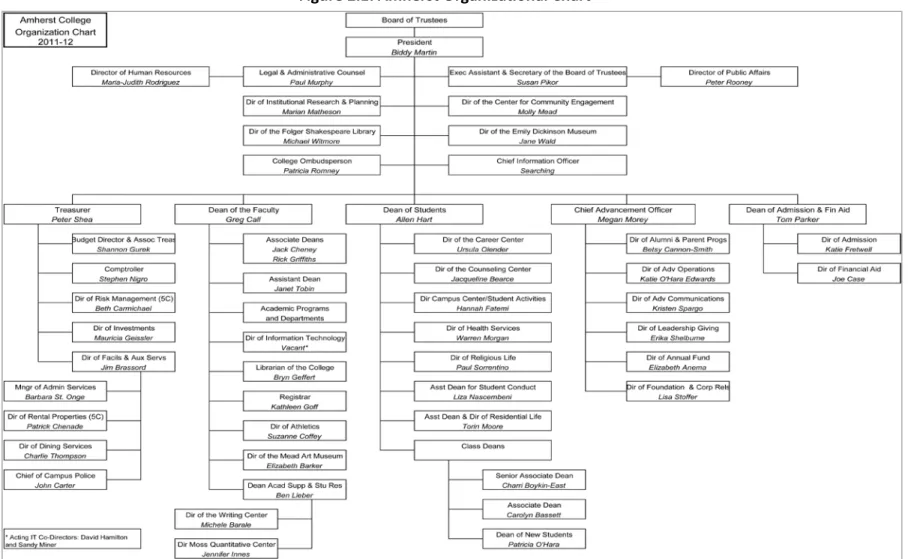
OLLEGEAmherst College is a private liberal arts college in Amherst, Massachusetts. It has an enrollment just under 1,791, a 13.3 percent acceptance rate, and ranks second on the U.S. News & World Report list of top national liberal arts colleges.92 Figure 2.1, on the following page, provides Amherst’s organizational chart for the 2011-2012 academic year.
92 “National Liberal Arts College Rankings.” U.S. News & World Report.
Figure 2.1: Amherst Organizational Chart93
F
ACULTYC
OMMITTEESAmherst’s faculty committee membership is limited to tenured and tenure-track faculty only. The Committee of Six, which serves as the executive committee of the faculty, is the premier faculty committee of the college. The six faculty members of the Committee of Six are elected by direct faculty vote, and are elected “without restrictions of rank, tenure status, age or department affiliation.”94 The following persons are not eligible for
appointment to the Committee of Six:95
The President and the Dean of the Faculty
Those newly appointed during their first year at Amherst
Those who will not be at Amherst for one or both semesters of the year following the election
Members of the Committee on Educational Policy
Members of the College Council
Retiring members of the Committee on Educational Policy and the College Council
Retiring members of the Committee of Six and those who retired from it in the previousthree years
Those who have served three or more terms on the Committee of Six and then exercise the option of taking their names off the ballot each year by contacting the Dean of Faculty’s Office before the election begins
Under extraordinary personal circumstances, those individuals for whom service on the Committee would be a particular hardship.The President of the College and Dean of the Faculty serve on the committee as chair and secretary, respectively, and as non-voting members. The Committee of Six is responsible for advising the President and the Faculty regarding College policy. This committee is also involved in promotion and tenure decisions, and is responsible for nominating faculty members to serve on other faculty committees.96
There are nineteen additional standing faculty committees at Amherst. Appendix A at the conclusion of this report includes a table listing all additional faculty committees, their roles and responsibilities, and the number of faculty members serving on each.
S
ELECTION ANDR
ESPONSIBILITIES OFD
EPARTMENTC
HAIRSAt Amherst, each department elects a chair by faculty vote. This person is then recommended to the President of the College for approval. Chairs can be untenured faculty members (although they are generally tenured), and often serve for three year terms. The
94 “Committees: Committees of the Faculty.” Amherst College.
https://www.amherst.edu/academiclife/dean_faculty/fph/fachandbook/facresponsibilities/committees
95 Ibid. 96 Ibid.
President of the college does have the power to appoint or remove a department Chair, though only under “special circumstances.” Responsibilities of the department Chair’s include course proposals, budget projections, and decisions on “hiring, reappointment, tenure and promotion of faculty.”97
T
ENURE ANDP
ROMOTIOND
ECISIONSSeveral bodies and individuals are involved in the decisions regarding tenure and promotion at Amherst. Tenure decisions begin with a recommendation for a candidate’s tenure by the tenured members of the department. The candidate’s tenure materials are submitted to the Dean of the Faculty, who then submits them to the Committee of Six. The department Chair discusses the letter of recommendation and the breakdown of faculty votes with the candidate. After this discussion, the candidate is allowed to send “commentary” to the Committee of Six.98
The Committee of Six then reviews each candidate for tenure, consulting with the candidate’s department for clarification if necessary. The President sits with the Committee of Six to review the tenure candidates. After the President receives the committee’s recommendation, he or she consults with the Dean of Faculty, and then forms an opinion regarding each candidate. If the Committee of Six and the department make negative recommendations regarding a tenure candidate, the President will usually “recommend a negative decision to the Board of Trustees.” Similarly, the President will usually recommend a positive decision to the Board of Trustees if the Committee of Six and the department make positive recommendations. However, the President is not bound by the decisions of others, and may give his or her own recommendation and reasoning to the Board of Trustees, the Committee of Six, the department Chair, and the tenure candidate in writing. If the candidate receives a negative recommendation, and wishes to challenge it, he or she may file a petition with the Chair of the Committee on Adjudication.99
The promotion process is similar to the tenure process. The recommendation can originate with the candidate, or with the department in the case of promotion to the rank of Professor. The department promotion committee is comprised of all of the tenured full Professors in the department, though two other full Professors from the College Faculty may be included if the candidate chooses, in consultation with the Dean of the Faculty, to bring them in. The Dean selects the Chair of the promotion committee, and the Chair is responsible for writing a letter detailing the candidate’s accomplishments. This letter is signed by the rest of the committee, and follows the promotion materials at all relevant stages. All of the candidates for promotion are reviewed by the Committee of Six. The President also reviews all candidates, formulates his or her own opinion, and presents all of the recommendations to the Board of Trustees. The final decision is made by the Board of Trustees.100
97 Ibid.
98 “Tenure for Regular Full-time Members of the Faculty.” Amherst College.
https://www.amherst.edu/academiclife/dean_faculty/fph/fachandbook/facstatus/fulltimetenure
99 Ibid.
100 “Promotion.” Amherst College.
C
URRICULUMD
ECISIONSThe Committee on Educational Policy and the Committee of Six are jointly responsible for overseeing curriculum decisions at the College. The Committee on Educational Policy is comprised of three student members and five faculty members. The five faculty members are nominated by the Committee of Six and then elected by the general Faculty. The Dean of the Faculty also serves as a non-voting member of the committee. All three College divisions (Humanities, Social Sciences, and Physical Sciences) must be represented on the committee, and the committee may select its own Chair and secretary. The Committee on Educational Policy is responsible for reviewing and evaluating the college’s general education policy, receiving suggestions and suggesting changes in educational policy, and making recommendations to the Committee of Six. It is also responsible for advising the President and Dean of the Faculty about how faculty positions should be allocated to the departments, and for assessing department curricular needs.101 Amherst also belongs to the
Five College Consortium, and occasionally the President or Dean of the Faculty, in collaboration with the Committee of Six, will appoint a set of faculty members “to serve as representatives on Five College Faculty Committees to consider questions of academic policy of joint interest to two or more of the Colleges.”102
B
UDGETD
ECISIONSIn 2009, Amherst College created the Advisory Budget Committee “in response to the global economic downturn” to “develop plans for how to keep Amherst’s projected budgets in line with what its reduced endowment can contribute.” 103 The college charged the committee with finding a way to reduce the spend rate of the endowment to five percent, as well as “more specific financial targets to be set by the Trustees,” within a decade.104 This committee consists of six faculty representatives, the President, the Dean of the Faculty, three students, three Trustees, one alumnus of the College, and three staff members, with one being appointed by the Trustees. The Treasurer serves as a consultant to the committee.
Amherst has also created a Committee on Priorities and Resources, which is charged with overseeing “1) The process of annually budgeting the resources of the college, and 2) The long-term allocation of resources.”105 This committee is comprised of four faculty members
(at least one each from each of the three divisions), two staff members elected by the staff, and three student members—two of whom are elected by the student body, and one who is elected by the student executive senate. The President of the college, the Dean of the Faculty, the Treasurer, the Director of the Budget, and the Director of Human Resources all serve on the committee ex officio. The faculty members on the committee are expected to “represent
101 “Committees: Committees of the Faculty.” Op. cit.
https://www.amherst.edu/academiclife/dean_faculty/fph/fachandbook/facresponsibilities/committees
102 Ibid.
103 “Advisory Budget Committee.” Amherst College. https://www.amherst.edu/aboutamherst/economy/abc 104 “Charge to the Advisory Budget Committee (ABC).” Amherst College.
https://www.amherst.edu/aboutamherst/economy/abc_charge
to the administration the views of the faculty concerning the budget and to report to the Faculty each year concerning the status of faculty salaries and compensation.”106
Regarding departmental budgets, each department Chair is responsible for overseeing their department’s budget. All budgets must be approved by the Dean of the Faculty, the Treasurer, and the Board of Trustees.107
BOWDOIN COLLEGE
Bowdoin College is a private, suburban liberal arts college in Brunswick, Maine. It has an enrollment just under 1,800, an acceptance rate of 16.1 percent, and ranks sixth on the U.S. News & World Report list of top national liberal arts colleges.108 No organizational chart was
available on the Bowdoin website.
F
ACULTYC
OMMITTEESBowdoin College requires all faculty members to engage in “active participation in the governance of the College.” 109 Bowdoin’s faculty handbook further notes that
“appointment, nomination, and election to committees should be accepted by faculty members as part of [the obligations of membership in the Bowdoin faculty], and that such acceptance should be taken for granted unless a faculty member provides compelling reasons to the contrary in writing to the Committee on Governance.”110 Normally, faculty members are appointed to committees, though three committees (the Committee on Governance and Faculty Affairs, the Committee on Appointments, Promotion, and Tenure, and the Committee on Faculty Appeals and Grievances) are comprised of faculty members who have been elected by the general faculty.
Bowdoin uses approval voting in order to elect faculty members to the three elected committees concurrently using overlapping lists of candidates. Through the approval voting process, the Committee on Governance and Faculty Affairs sends a ballot to voting-eligible faculty. This ballot includes the name of all faculty members who have been nominated—by the general faculty—to serve on the elected committees. Voting faculty are able to vote for as many candidates for each committee as they would like. Once all ballots are received, the Committee on Governance and Faculty Affairs counts the ballots and announces the results. First, votes are counted for the Committee on Appointments, Promotion, and Tenure, and then for the Committee on Governance and Faculty Affairs. If a candidate is elected to the
106 Ibid.
107 “The Faculty.” Amherst College.
https://www.amherst.edu/academiclife/dean_faculty/fph/fachandbook/collegeorganization/faculty
108 “National Liberal Arts College Rankings.” U.S. News & World Report.
http://colleges.usnews.rankingsandreviews.com/best-colleges/rankings/national-liberal-arts-colleges
109 “Faculty Governance.” Bowdoin College.
http://www.bowdoin.edu/academic-affairs/faculty-governance/index.shtml
Committee on Appointments, Promotion, and Tenure, that candidate will be removed from the election of the Committee on Governance and Faculty Affairs.111
The Committee on Governance and Faculty Affairs is the elected committee that is responsible for speaking for the faculty. This committee is comprised of six faculty members, four of whom must be tenured (including at least two full professors and one associate professor, one from each division). Two of the members must be untenured and from two separate divisions. The tenured members serve for three years, and the untenured members serve for two years.112
In general, the Committee on Governance and Faculty Affairs directs the faculty governance of the College. It is responsible for creating faculty meeting agendas in conjunction with the President and the Dean for Academic Affairs, communicating policy issues, advising the President and Dean on the faculty’s issues including compensation, intellectual freedom, family leave, budget and financial priorities, and other issues. It oversees faculty committee elections and appointments, creates necessary working groups, and hears issues raised by the faculty. Finally, it represents the faculty at administrative meetings, including meetings of the Board of Trustees, and attends meetings of the Trustee Executive Committee and the Trustee Committee on Admissions. The committee then reports back to the general faculty, when necessary.113
In 2007, Bowdoin revised its faculty committee structure by combining some committees, and reducing the number of members on others. This restructuring reduced the total number of seats available on committees from 140 to 90. The goal of these changes was to improve committee efficiency and allow more time for faculty to conduct their own research.114 While these changes did not include the creation of divisional committees, each division must still be represented on the most faculty committees. Currently, there are 22 faculty committees included in Bowdoin’s faculty governance structure.
T
ENURE ANDP
ROMOTIOND
ECISIONSCandidates for tenure are usually evaluated in sixth year at the College. When it is time for a decision on a candidate’s tenure, the Committee on Appointments, Promotion, and Tenure assesses the candidate, “whether or not the person has been proposed for tenure by the department.”115 The Committee on Appointments, Promotion, and Tenure is an elected
111 “Faculty Handbook, 2012-2013.” Bowdoin College. Pp.73-74.
http://www.bowdoin.edu/academic-affairs/forms-policies/policies/pdf/12-13FacultyHandbook.pdf
112 Ibid., P.58.
113 “Committee on Governance and Faculty Affairs.” Bowdoin College.
http://www.bowdoin.edu/academic-affairs/faculty-governance/gfa.shtml
114 “Revised Committee Structure.” Bowdoin College.
http://www.bowdoin.edu/academic-affairs/faculty-flexibility/revised-committee-structure.shtml
115 “Faculty Handbook, 2012-2013.” Bowdoin College. P.23.
committee with five members, including three professors, one from each division, and two associate professors. None of the members can be from the same department.116
During the tenure and promotions process, the Dean for Academic Affairs first solicits opinions regarding the candidate’s “actual and potential professional achievement” from colleagues in candidate’s field who are not members of the college (these colleagues are typically suggested by the candidate and by other departmental faculty). At this time, the candidate must also submit a packet of tenure materials to the Dean, a dossier prepared by the department or review committee chair from the candidate’s department, and an evaluation of the candidate from the department review committee.
Once all materials and opinions have been collected, the Committee on Appointments, Promotion, and Tenure then reviews each candidate’s materials, and requests follow-up information from the candidate or department as needed. Then, the Committee meets with the Dean for Academic Affairs and the President to discuss candidate, and the Committee meets again with the Dean for Academic Affairs to make recommendations for tenure or promotion. The Committee then informs the candidate of its decision, and presents this decision to the President of the college. The President can then choose to recommend or not recommend the candidate to the Trustees, who may then vote to promote or not to promote the candidate.117 Ultimately, the President “has discretionary authority to
authorize or not authorize promotion.118
C
URRICULUMD
ECISIONSThere are three curricular committees at Bowdoin College: the Curriculum and Educational Policy Committee, the Curriculum Implementation Committee, and the Recording Committee. The Curriculum and Educational Policy Committee is comprised of six members, including two faculty members from each division—one of whom must be tenured and the other of whom must be tenure-track. Three appointed students also serve on the committee, though one student serves as an alternate in the event that a participating student member is unable to attend a meeting. This committee is “responsible for broad oversight of the curriculum, and for proposing changes in academic policy and degree requirements for consideration by the faculty.” The Curriculum and Educational Policy Committee also advises administrators, presents proposed changes to the curriculum, and one of the members represents the faculty on the Trustee Committee on Academic Affairs.119
The Curriculum Implementation Committee is responsible for managing curricular implementation. This committee’s charge includes approving course revisions and new courses, supervising execution of policies such as grading, transfer of credit, and grading,
116 Ibid., P.59.
117 Ibid., Pp.23-27. 118 Ibid., Pp.29. 119 Ibid., P.60.
and other responsibilities. The committee consists of six appointed faculty members (two from each division), at least three of whom must be tenured.120
Finally, the Recording Committee “interprets, applies, and gives guidance on current academic policies, determines academic standing, reviews petitions re: academic standing, grading options, and transfer credit.”121 This committee is comprised of three appointed
faculty members, one from each division. None of the members have to be tenured or tenure-track.
B
UDGETD
ECISIONSThe Financial Planning Committee is responsible for reviewing and advising the Board of Trustees regarding budgetary issues. These issues include the annual operating and capital budget, financial needs and resources of the College, and the policies and administration of compensation benefits. This committee also deliberates on and provides recommendations regarding long-term plans and projections for the budget. The committee is comprised of one faculty member, usually from the Governance and Faculty Affairs Committee, the Senior Vice President for Finance and Administration and Treasures, the Vice President for Finance and Controller, one student, and six or more Trustees. 122
O
BERLINC
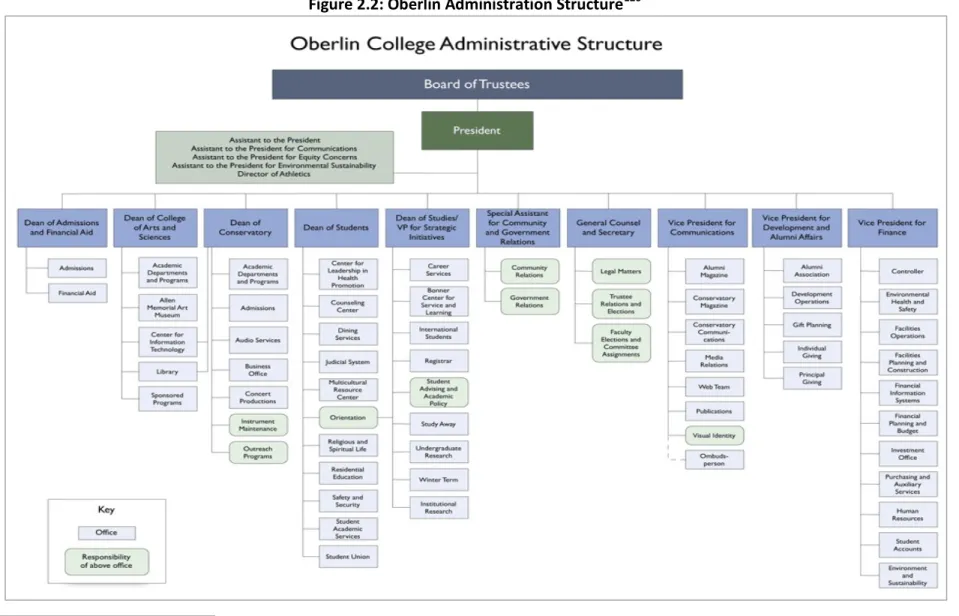
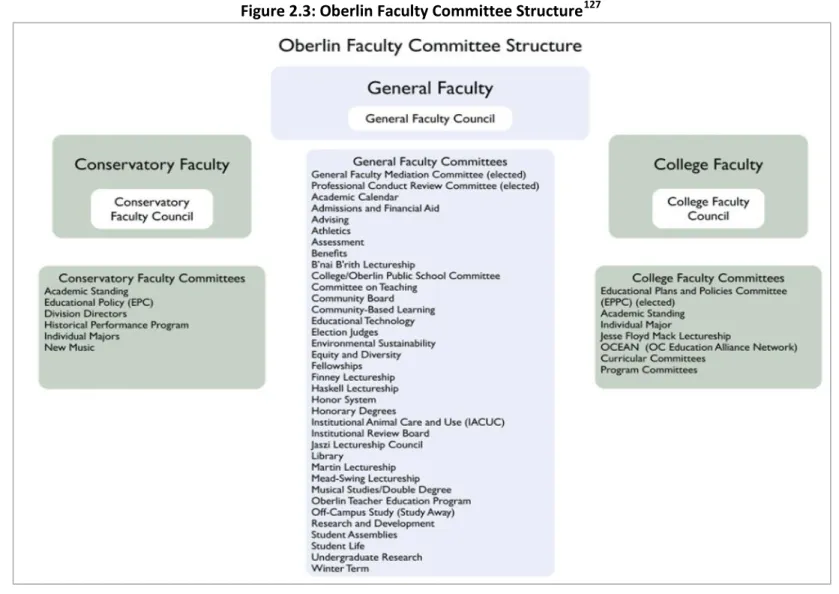
OLLEGEOberlin College is a private, suburban liberal arts college in Oberlin, Ohio that enrolls nearly 3,000 students, has an acceptance rate of 29.6 percent, and ranks 26th on the U.S. News & World Report list of top national liberal arts colleges.123 Oberlin’s website entitled “How Oberlin Works,” provides information on the administration and leadership structures, as well as a glossary of the offices, positions, and committees at Oberlin.124 According to the college, “although this site was created with the whole Oberlin campus community in mind, we hope it will be most used by students seeking to effect change in the institution.”125 Three organizational charts available on the “How Oberlin Works” website. These organizational charts are reproduced in Figures 2.2 and 2.3 below.
120 Ibid., Pp.60-61.
121 Ibid., P.61. 122 Ibid., Pp.71-72.
123 “National Liberal Arts College Rankings.” U.S. News & World Report.
http://colleges.usnews.rankingsandreviews.com/best-colleges/rankings/national-liberal-arts-colleges
124 Oberlin is divided into two divisions, the College and the Conservatory. Information on Oberlin’s tenure,
promotions, curriculum, budget, and chair selection apply to Oberlin’s College division.
Figure 2.2: Oberlin Administration Structure126
Figure 2.3: Oberlin Faculty Committee Structure127
F
ACULTYC
OMMITTEESAccording to the Oberlin Faculty Guide, each member of the Oberlin faculty is expected to “render a reasonable share of the general service that comes upon the Faculty in common. One of the ways in which this service is rendered is through the faculty committees.”128 As depicted in Figure 2.3, above, Oberlin College’s faculty governance structure is comprised of 36 faculty committees. Faculty committee members are typically either appointed by faculty and nominating committees or elected by the general faculty. Elected committees include the General Faculty Council, the College Faculty Council, the Conservatory Faculty Council, the College Educational Plans and Policies Committee, the General Faculty Mediation Committee, the Professional Conduct Review Committee, and some other standing Trustee committees.129
The General Faculty Council (GFC) is charged with managing the entire College and speaking for the faculty. It is comprised of six elected members, the Dean of Arts and Sciences, the Dean of the Conservatory, and the President of the college. The GFC is the executive committee elected by the general faculty, including all faculty members in the College and the Conservatory, certain administrators, and Student Senate Members. This committee’s duties include making and approving legislation, passing resolutions, and managing the rules regarding the “welfare, conduct, and discipline of students.” 130
Separate from the GFC are the divisional faculty councils, which serve as the executive committees of the faculty in their respective division. Faculty from the College division elect seven members to the College Faculty Council to manage the College division, while Conservatory Faculty elect seven members to manage the Conservatory Division. The division deans and the President of the college also serve on these divisional committees. The divisional councils have the responsibility to make appointment, promotion, tenure, and salary decisions within their division. However, their decisions are “subject to approval by the General Faculty Council and the Board of Trustees.”131
S
ELECTION ANDR
ESPONSIBILITIES OFD
EPARTMENTC
HAIRSThe department chairs in the College of Arts and Sciences are appointed by the College Faculty Council, upon recommendation of the Dean (after consultation with members of the department).The Chair appointment usually lasts four years. Responsibilities of the department Chair include administration of departmental affairs, maintaining department records, reporting on the work of the department, scheduling department classes, assigning Faculty advisors to department majors, supervising department employees, and other management duties of department faculty, staff, and finances. The Chair also participates in the hiring process by requesting faculty positions, providing the College Faculty Council with a job description, recruiting and screening applicants to fill the position, and requesting the initial appointment of a qualified candidate.132
128 “Oberlin College Faculty Guide.” Op. cit., 7. 129 Ibid.
130 “Oberlin Faculty Committee Structure.” Oberlin College. http://how.oberlin.edu/book/page/5 131 Ibid.
T
ENURE ANDP
ROMOTIOND
ECISIONSAll tenure-track faculty members may participate in deliberations regarding tenure decisions. However, first-year tenure-track faculty members are not permitted to vote on tenure decisions. After the department votes on tenure decisions, a faculty member writes a Department Report with recommendations to the College Faculty Council. The Department Chair also writes a report and meets with the Dean to discuss the candidate. Then, the College Faculty Council reviews the Department Report and the Chair’s Report, and decides whether to recommend the candidate for tenure or deny the candidate’s tenure request. If the College Faculty Council decides to recommend the candidate, the GFC reviews this decision, and then either recommends or does not recommend the candidate for tenure. If the GFC decides to recommend the candidate, the President presents the cases of the recommended candidates to the Trustees, who make the final decision to ratify or deny the tenure recommendation.
The promotion process is similar to the tenure decision process. The Department Chair prepares a dossier of promotion materials to put before the members of the department. The department members review the materials and vote on their recommendation, and then the Department Chair writes the Department Report containing the department’s assessments of the candidates, as well as the Chair’s Report “which reports the committee vote, presents any minority views within the committee, and certifies the process that was followed in committee deliberations.”133
The divisional Faculty council reviews the dossier, and may ask the department or candidate for clarifications. The divisional Faculty Council then makes a recommendation to the General Faculty Council, which makes its own recommendation to the President. The President presents the candidates for promotion to the Trustees, and the Trustees can ratify or deny the promotion.
C
URRICULUM ANDB
UDGETD
ECISIONSThe College of Arts and Sciences has several curricular committees, including curricular committees on archaeology, law and society, Russian and East European studies, and others. These committees are charged with “running” majors and offering courses, or administering academic offerings and requirements. Membership varies by curricular committees. For example, the Curricular Committee on Archaeology has faculty members from several disciplines, including Ancient Art, Anthropology, Classics, Religion, and other associated departments. The Curricular Committee on Law and Society usually only has three faculty members.134
The Vice President for Finance plays a major role in “managing the College’s annual operation budget.” This individual also aids in resource allocation, financial planning, accounting and reporting finances, management of the endowment and investments,
133 Ibid.