Chapter 28
Network Management: SNMP
Department of Information Technology Eastern Mediterranean University
• After completing this chapter you should be able to do the following:
– Discuss the general idea behind network management.
– Discuss the client/server application, SNMP, that is used for this purpose in the Internet.
Network Management System Simple Network Management Protocol (SNMP)
2/60
• We can define network management as monitoring, testing, configuring, and troubleshooting network
components to meet a set of requirements defined by an organization.
• These requirements include the smooth, efficient operation of the network that provides the predefined quality of
service for users.
• A network management system uses hardware, software, and humans.
ITEC310 Computer Networks II
Eastern Mediterranean University, Department of Information Technology
• Functions performed by a network management system can be divided into five broad categories.
Network Management System
Simple Network Management Protocol (SNMP)
Configuration Management Fault Management Performance Management Security Management Accounting Management
4/60
Network Management System
• A large network is usually made up of hundreds of entities that are physically or logically connected to one another.
• These entities have an initial configuration when the network is set up, but can change with time.
– Desktop computers may be replaced by others; application software may be updated to a newer version; and users may move from one group to another.
• The configuration management system must know, at any time, the status of each entity and its relation to other entities.
• Configuration management can be divided into two subsystems: reconfiguration and documentation.
ITEC310 Computer Networks II
Eastern Mediterranean University, Department of Information Technology
• Reconfiguration means adjusting the network components
and features.
– It can be a daily occurrence in a large network.
• There are three types of reconfiguration: hardware
reconfiguration, software reconfiguration, and user-account reconfiguration.
Network Management System
Simple Network Management Protocol (SNMP)
Configuration Management
Fault Management Performance Management Security Management Accounting Management
6/60
• Hardware reconfiguration covers all changes to hardware.
– For example,
• A desktop computer may need to be replaced.
• A router may need to be moved to another part of the network. • A subnetwork may be added or removed from the network.
• In a large network, there must be specialized personnel trained for quick and efficient hardware reconfiguration. • This type of reconfiguration cannot be automated and must
be manually handled case by case.
ITEC310 Computer Networks II
Eastern Mediterranean University, Department of Information Technology
• Software reconfiguration covers all changes to software.
– For example,
• New software may need to be installed on servers or clients. • An operating system may need updating.
• Most software reconfiguration can be automated.
– For example, updating an application on some or all clients can be electronically downloaded from the server.
Network Management System
Simple Network Management Protocol (SNMP)
Configuration Management
Fault Management Performance Management Security Management Accounting Management
8/60
• User-account reconfiguration is not simply adding or deleting users on a system.
• The user privileges must also be considered, both as an individual and as a member of a group.
– For example, a user may have read and write permission with regard to some files, but only read permission with regard to other files.
• User-account reconfiguration can be, to some extent, automated.
– For example, in a college or university, at the beginning of each semester, new students are added to the system.
• The students are normally grouped according to the courses they take or the majors they pursue.
ITEC310 Computer Networks II
Eastern Mediterranean University, Department of Information Technology
• The original network configuration and each subsequent change must be recorded accurately.
• This means that there must be documentation for
hardware, software, and user accounts.
Network Management System
Simple Network Management Protocol (SNMP)
Configuration Management
Fault Management Performance Management Security Management Accounting Management
10/60
• Hardware documentation normally involves two sets of documents: maps and specifications.
• Maps track each piece of hardware and its connection to network.
– There can be one general map that shows the logical relationship between each subnetwork.
– There can also be a second general map that shows the physical location of each subnetwork.
– For each subnetwork, then, there is one or more maps that show all pieces of equipment.
ITEC310 Computer Networks II
Eastern Mediterranean University, Department of Information Technology
• There must be a set of specifications for each piece of hardware connected to the network.
– These specifications must include information such as hardware type, serial number, vendor (address and phone number), time of
purchase, and warranty information.
Network Management System
Simple Network Management Protocol (SNMP)
Configuration Management
Fault Management Performance Management Security Management Accounting Management
12/60
• All software must also be documented.
• Software documentation includes information such as the
software type, the version, the time installed, and the license agreement.
ITEC310 Computer Networks II
Eastern Mediterranean University, Department of Information Technology
• Most operating systems have a utility that allows the
documentation of user accounts and their privileges. • The management must make sure that the files with this
information are updated and secured.
• Some operating systems record access privileges in two documents; one shows all files and access types for each user; the other shows the list of users that have a particular access to a file.
Network Management System
Simple Network Management Protocol (SNMP)
Configuration Management
Fault Management Performance Management Security Management Accounting Management
14/60
• Complex networks today are made up of hundreds and sometimes thousands of components.
• Proper operation of the network depends on the proper operation of each component individually and in relation to each other.
• Fault management is the area of network management that
handles this issue.
• An effective fault management system has two subsystems: reactive fault management and proactive fault management.
ITEC310 Computer Networks II
Eastern Mediterranean University, Department of Information Technology
• A reactive fault management system is responsible for detecting, isolating, correcting, and recording faults. • It handles short-term solutions to faults.
– The first step taken by a reactive fault management system is to detect the exact location of the fault.
– The next step taken by a reactive fault management system is to isolate the fault.
– The third step is to correct the fault.
– After the fault is corrected, it must be documented.
• The record should show the exact location of the fault, the
possible cause, the action or actions taken to correct the fault, the cost, and time it took for each step.
Network Management System
Simple Network Management Protocol (SNMP)
Configuration Management
Fault Management
Performance Management Security Management Accounting Management
16/60
• Proactive fault management tries to prevent faults from occurring.
• Some types of failures can be predicted and prevented.
– For example, if a manufacturer specifies a lifetime for a component or a part of a component, it is a good strategy to replace it before that time.
– As another example, if a fault happens frequently at one particular point of a network, it is wise to carefully reconfigure the network to prevent the fault from happening again.
ITEC310 Computer Networks II
Eastern Mediterranean University, Department of Information Technology
• Performance management tries to monitor and control the
network to ensure that it is running as efficiently as possible.
– It is closely related to fault management.
• Performance management tries to quantify performance by using some measurable quantity such as capacity, traffic, throughput, or response time.
Network Management System
Simple Network Management Protocol (SNMP)
Configuration Management Fault Management
Performance Management
Security Management Accounting Management
18/60
• Traffic can be measured in two ways: internally and externally.
– Internal traffic is measured by the number of packets (or bytes) traveling inside the network.
– External traffic is measured by the exchange of packets (or bytes) outside the network.
ITEC310 Computer Networks II
Eastern Mediterranean University, Department of Information Technology
• Every network has a limited capacity.
• The performance management system must ensure that it is not used above this capacity.
– For example, if a LAN is designed for 100 stations at an average data rate of 2 Mbps, it will not operate properly if 200 stations are connected to the network.
– The data rate will decrease and blocking may occur. Network Management System
Simple Network Management Protocol (SNMP)
Configuration Management Fault Management
Performance Management
Security Management Accounting Management
20/60
• Response time is normally measured from the time a user requests a service to the time the service is granted.
• Factors such as capacity and traffic can affect the response time.
• Performance management monitors the average response time and the peak-hour response time.
• Any increase in response time is a very serious condition as it is an indication that the network is working above its capacity.
ITEC310 Computer Networks II
Eastern Mediterranean University, Department of Information Technology
• Security management is responsible for controlling access
to the network based on the predefined policy.
Network Management System
Simple Network Management Protocol (SNMP)
Configuration Management Fault Management Performance Management
Security Management
Accounting Management
22/60
• Accounting management is the control of users’ access to
network resources through charges.
• Today, organizations use an accounting management system for the following reasons:
– It prevents users from monopolizing limited network resources. – It prevents users from using the system inefficiently.
– Network managers can do short-term and long-term planning based on the demand for network use.
ITEC310 Computer Networks II
Eastern Mediterranean University, Department of Information Technology
• Simple Network Management Protocol (SNMP) is a
framework for managing devices in an internet using the TCP/IP protocol suite.
• It provides a set of fundamental operations for monitoring and maintaining an internet.
Network Management System
Simple Network Management Protocol (SNMP)
Concept
Management Components Structure of Management Information Management Information Base (MIB) Lexicographic Ordering SNMP
Messages UDP Ports
Security 24/60
• SNMP uses the concept of manager and agent.
– A manager controls and monitors a set of agents.
• A manager is a host that runs the SNMP client program.
• An agent is a router (or a host) that runs the SNMP server program.
ITEC310 Computer Networks II
Eastern Mediterranean University, Department of Information Technology
Figure 28.2 SNMP concept
• The agent keeps performance information in a database. • The manager has access to the values in the database.
– For example, a router can store in appropriate variables the number of packets received and forwarded.
• The manager can fetch and compare the values of these two variables to see if the router is congested or not.
• The manager can also make the router perform certain actions.
– For example, a router periodically checks the value of a reboot counter to see when it should reboot itself.
Network Management System
Simple Network Management Protocol (SNMP)
Concept
Management Components Structure of Management Information Management Information Base (MIB) Lexicographic Ordering SNMP
Messages UDP Ports
Security 26/60
• Agents can also contribute to the management process. • The server program running on the agent can check the
environment, and if it notices something unusual, it can
send a warning message, called a trap, to the manager.
ITEC310 Computer Networks II
Eastern Mediterranean University, Department of Information Technology
• Management with SNMP is based on three basic ideas:
1. A manager checks an agent by requesting information that reflects the behavior of the agent.
2. A manager forces an agent to perform a task by resetting values in the agent database.
3. An agent contributes to the management process by warning the manager of an unusual situation.
Network Management System
Simple Network Management Protocol (SNMP)
Concept
Management Components Structure of Management Information Management Information Base (MIB) Lexicographic Ordering SNMP
Messages UDP Ports
Security 28/60
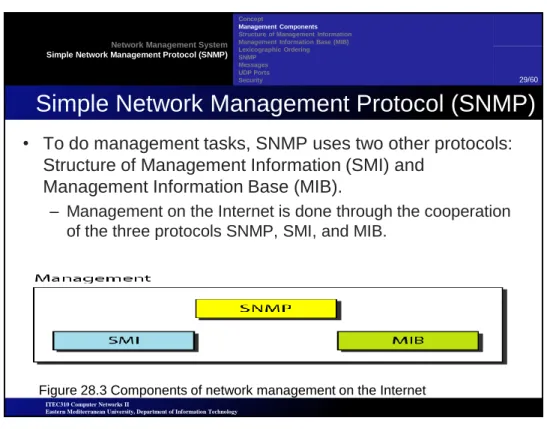
• To do management tasks, SNMP uses two other protocols: Structure of Management Information (SMI) and
Management Information Base (MIB).
– Management on the Internet is done through the cooperation of the three protocols SNMP, SMI, and MIB.
ITEC310 Computer Networks II
Eastern Mediterranean University, Department of Information Technology
Figure 28.3 Components of network management on the Internet
• SNMP defines the format of packets exchanged between a
manager and an agent.
– It reads and changes the status (values) of objects (variables) in SNMP packets.
• Structure of Management Information (SMI) defines the
general rules for naming objects, defining object types (including range and length), and showing how to encode objects and values.
Network Management System
Simple Network Management Protocol (SNMP)
Concept
Management Components
Structure of Management Information Management Information Base (MIB) Lexicographic Ordering SNMP
Messages UDP Ports
Security 30/60
• We can compare the task of network management to the task of writing a program.
– Both tasks need rules.
• In network management this is handled by Structure of Management Information (SMI).
– Both tasks need variable declarations.
• In network management this is handled by Management Information Base (MIB).
– Both tasks have actions performed by statements.
• In network management this is handled by Simple Network Management Protocol (SNMP).
ITEC310 Computer Networks II
Eastern Mediterranean University, Department of Information Technology
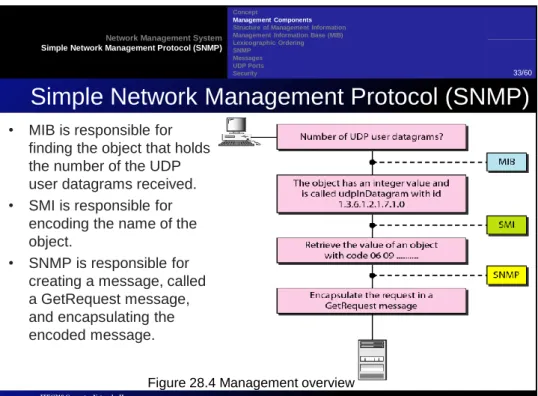
• A manager station (SNMP client) wants to send a message to an agent station (SNMP server) to find the number of UDP user datagrams received by the agent. • Figure shows an
overview of steps involved.
Network Management System
Simple Network Management Protocol (SNMP)
Concept
Management Components
Structure of Management Information Management Information Base (MIB) Lexicographic Ordering SNMP
Messages UDP Ports
Security 32/60
Simple Network Management Protocol (SNMP)
• MIB is responsible for finding the object that holds the number of the UDP user datagrams received. • SMI is responsible for
encoding the name of the object.
• SNMP is responsible for creating a message, called a GetRequest message, and encapsulating the encoded message.
ITEC310 Computer Networks II
Eastern Mediterranean University, Department of Information Technology
Figure 28.4 Management overview
• The Structure of Management Information, version 2
(SMIv2) is a component for network management. • Its functions are
1. To name objects.
2. To define the type of data that can be stored in an object. 3. To show how to encode data for transmission over the
network.
Network Management System
Simple Network Management Protocol (SNMP)
Concept
Management Components
Structure of Management Information
Management Information Base (MIB) Lexicographic Ordering SNMP
Messages UDP Ports
Security 34/60
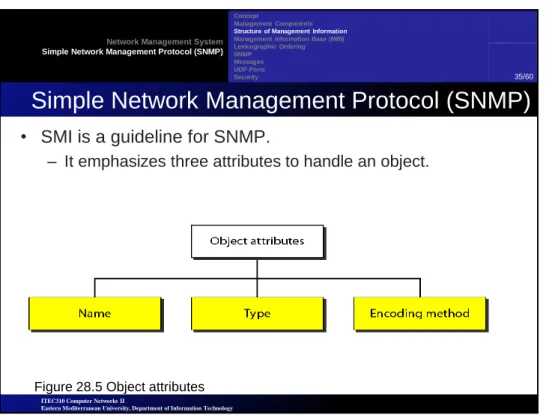
• SMI is a guideline for SNMP.
– It emphasizes three attributes to handle an object.
ITEC310 Computer Networks II
Eastern Mediterranean University, Department of Information Technology
Figure 28.5 Object attributes
• Management Information Base, version 2 (MIB2) is the
second component used in network management.
• Each agent has its own MIB2, which is a collection of all the objects that the manager can manage.
• The objects in MIB2 are categorized under 10 different groups: system, interface, address translation, ip, icmp, tcp, udp, egp, transmission, and snmp.
Network Management System
Simple Network Management Protocol (SNMP)
Concept
Management Components Structure of Management Information
Management Information Base (MIB)
Lexicographic Ordering SNMP
Messages UDP Ports
Security 36/60
• These groups are under the mib-2 object in the object identifier tree.
– Each group has defined variables and/or tables.
ITEC310 Computer Networks II
Eastern Mediterranean University, Department of Information Technology
Figure 28.15 mib-2
• The following is a brief description of some of the objects:
– sys: This object (system) defines general information about the node (system), such as the name, location, and lifetime.
– if: This object (interface) defines information about all the interfaces of the node including interface number, physical address, and IP address.
Network Management System
Simple Network Management Protocol (SNMP)
Concept
Management Components Structure of Management Information
Management Information Base (MIB)
Lexicographic Ordering SNMP
Messages UDP Ports
Security 38/60
• The following is a brief description of some of the objects (continued): – icmp: This object defines information related to ICMP, such as the number of
packets sent and received and total errors created.
– tcp: This object defines general information related to TCP, such as the connection table, time-out value, number of ports, and number of packets sent and received.
– udp: This object defines general information related to UDP, such as the number of ports and number of packets sent and received.
– snmp: This object defines general information related to SNMP itself.
ITEC310 Computer Networks II
Eastern Mediterranean University, Department of Information Technology
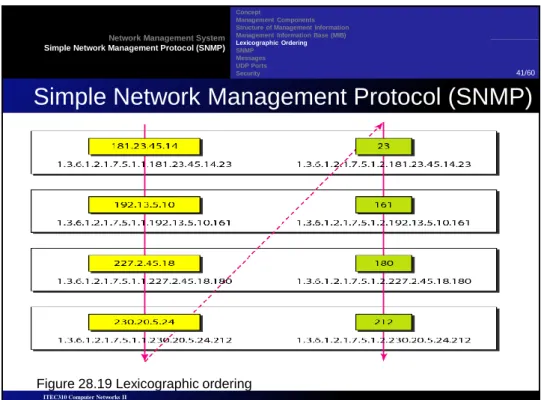
• One interesting point about the MIB variables is that the object identifiers (including the instance identifiers) follow in
lexicographic order.
• Tables are ordered according to column-row rules, which means one should go column by column.
• In each column, one should go from the top to the bottom.
Network Management System
Simple Network Management Protocol (SNMP)
Concept
Management Components Structure of Management Information Management Information Base (MIB)
Lexicographic Ordering
SNMP Messages UDP Ports
Security 40/60
ITEC310 Computer Networks II
Eastern Mediterranean University, Department of Information Technology
Figure 28.19 Lexicographic ordering
• SNMP uses both SMI and MIB in Internet network
management.
• It is an application program that allows
1. A manager to retrieve the value of an object defined in an agent.
2. A manager to store a value in an object defined in an agent. 3. An agent to send an alarm message about an abnormal
situation to the manager. Network Management System
Simple Network Management Protocol (SNMP)
Concept
Management Components Structure of Management Information Management Information Base (MIB) Lexicographic Ordering
SNMP
Messages UDP Ports
Security 42/60
• SNMPv3 defines eight types of packets (or PDUs):
GetRequest, GetNextRequest, GetBulkRequest, SetRequest, Response, Trap, InformRequest, and Report.
ITEC310 Computer Networks II
Eastern Mediterranean University, Department of Information Technology
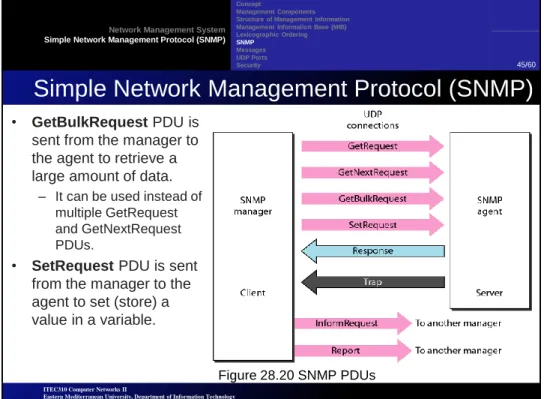
• GetRequest PDU is sent
from the manager (client) to the agent (server) to retrieve the value of a variable or a set of variables.
• GetNextRequest PDU is
sent from the manager to the agent to retrieve the value of a variable.
– The retrieved value is the value of the object following the defined Objectid in the PDU.
Network Management System
Simple Network Management Protocol (SNMP)
Concept
Management Components Structure of Management Information Management Information Base (MIB) Lexicographic Ordering
SNMP
Messages UDP Ports
Security 44/60
Simple Network Management Protocol (SNMP)
• GetBulkRequest PDU is sent from the manager to the agent to retrieve a large amount of data.
– It can be used instead of multiple GetRequest and GetNextRequest PDUs.
• SetRequest PDU is sent
from the manager to the agent to set (store) a value in a variable.
ITEC310 Computer Networks II
Eastern Mediterranean University, Department of Information Technology
Figure 28.20 SNMP PDUs
• Response PDU is sent from
an agent to a manager in response to GetRequest or GetNextRequest.
– It contains value(s) of variable(s) requested by manager.
• Trap (called SNMPv2 Trap to distinguish it from SNMPv1 Trap) PDU is sent from the agent to the manager to
Network Management System
Simple Network Management Protocol (SNMP)
Concept
Management Components Structure of Management Information Management Information Base (MIB) Lexicographic Ordering
SNMP
Messages UDP Ports
Security 46/60
• InformRequest PDU is sent from one manager to another remote manager to get the value of some variables from agents under the control of the remote manager.
– The remote manager responds with a Response PDU.
• Report PDU is designed to
report some types of errors between managers.
– It is not yet in use.
ITEC310 Computer Networks II
Eastern Mediterranean University, Department of Information Technology
Figure 28.20 SNMP PDUs
• The format for the eight SNMP PDUs is shown in figure.
– The GetBulkRequest PDU differs from the others in two areas, as shown in the figure.
Network Management System
Simple Network Management Protocol (SNMP)
Concept
Management Components Structure of Management Information Management Information Base (MIB) Lexicographic Ordering
SNMP
Messages UDP Ports
Security 48/60
Simple Network Management Protocol (SNMP)
• The fields are listed below:
– PDU type: This field defines the type of the PDU.
– Request ID: This field is a sequence number used by the manager in a Request PDU and repeated by the agent in a response.
• It is used to match a request to a response.
– Error status: This is an integer that is used only in Response PDUs to show the types of errors reported by the agent.
• Its value is 0 in Request PDUs.
ITEC310 Computer Networks II
Eastern Mediterranean University, Department of Information Technology
• Table lists the types of errors that can occur.
Network Management System
Simple Network Management Protocol (SNMP)
Concept
Management Components Structure of Management Information Management Information Base (MIB) Lexicographic Ordering
SNMP
Messages UDP Ports
Security 50/60
• The fields are listed below (continued):
– Nonrepeaters: This field is used only in GetBulkRequest and replaces
the error status field, which is empty in Request PDUs.
– Error index: The error index is an offset that tells the manager which
variable caused the error.
– Max-repetition: This field is also used only in GetBulkRequest and
replaces the error index field, which is empty in Request PDUs.
– VarBind list: This is a set of variables with the corresponding values the
manager wants to retrieve or set.
• The values are null in GetRequest and GetNextRequest.
• In a Trap PDU, it shows the variables and values related to a specific PDU.
ITEC310 Computer Networks II
Eastern Mediterranean University, Department of Information Technology
• SNMP does not send only a PDU, it
embeds the PDU in a message.
• A message in SNMPv3 is made of four elements: version, header, security parameters, and data (which include the encoded PDU).
Network Management System
Simple Network Management Protocol (SNMP)
Concept
Management Components Structure of Management Information Management Information Base (MIB) Lexicographic Ordering SNMP
Messages
UDP Ports
Security 52/60
Simple Network Management Protocol (SNMP)
• Versiondefines current version (3). • Headercontains values for message
identification, maximum message size, message flag, and a message security model (defining the security protocol). • The message security parameteris used
to create a message digest. • The data contain the PDU.
– If the data are encrypted, there is information about the encrypting engine (the manager program that did the encryption) and the encrypting context (the type of encryption) followed by the encrypted PDU.
– If the data are not encrypted, the data consist of just the PDU.
ITEC310 Computer Networks II
Eastern Mediterranean University, Department of Information Technology
Figure 28.22 SNMP message
• SNMP uses the
services of UDP on two
well-known ports, 161
and 162.
– The well-known port 161 is used by the server (agent). – The well-known port
162 is used by the Network Management System
Simple Network Management Protocol (SNMP)
Concept
Management Components Structure of Management Information Management Information Base (MIB) Lexicographic Ordering SNMP
Messages
UDP Ports
Security 54/60
• The main difference between SNMPv3 and SNMPv2 is the
enhanced security.
• SNMPv3 provides two types of security: general and specific.
• SNMPv3 provides message authentication, privacy, and manager authorization.
• SNMPv3 allows a manager to remotely change the
security configuration, which means that the manager does not have to be physically present at the manager station.
ITEC310 Computer Networks II
Eastern Mediterranean University, Department of Information Technology
• The five areas comprising network management are configuration management, fault management,
performance management, accounting management, and security management.
• Configuration management is concerned with the physical or logical changes of network entities. It includes the reconfiguration and documentation of hardware, software, and user accounts.
• Fault management is concerned with the proper operation of each network component. It can be reactive or
proactive.
Network Management System Simple Network Management Protocol (SNMP)
56/60
monitoring and control of the network to ensure the network runs as efficiently as possible. It is quantified by measuring the capacity, traffic, throughput, and response time.
• Security management is concerned with controlling access to the network.
• Accounting management is concerned with the control of user access to network resources through charges. • Simple Network Management Protocol (SNMP) is a
framework for managing devices in an internet using the TCP/IP protocol suite.
ITEC310 Computer Networks II
Eastern Mediterranean University, Department of Information Technology
• A manager, usually a host, controls and monitors a set of agents, usually routers.
• The manager is a host that runs the SNMP client program. • The agent is a router or host that runs the SNMP server
program.
• SNMP frees management tasks from both the physical characteristics of the managed devices and the underlying networking technology.
Network Management System Simple Network Management Protocol (SNMP)
58/60
• SMI names objects, defines the type of data that can be stored in an object, and encodes the data.
• MIB is a collection of groups of objects that can be managed by SNMP.
• MIB uses lexicographic ordering to manage its variables.
ITEC310 Computer Networks II
Eastern Mediterranean University, Department of Information Technology
• SNMP functions in three ways:
1. A manager can retrieve the value of an object defined in an agent.
2. A manager can store a value in an object defined in an agent. 3. An agent can send an alarm message to the manager.
• SNMP defines eight types of packets: GetRequest, GetNextRequest, SetRequest, GetBulkRequest, Trap, InformRequest, Response, and Report.
• SNMP uses the services of UDP on two well-known ports, 161 and 162.
• SNMPv3 has enhanced security features over previous versions.
Network Management System Simple Network Management Protocol (SNMP)
60/60