F
UNCTIONAL
R
EQUIREMENTS
F
OR
C
ONDUCTING
E
LECTRONIC
P
UBLIC
P
ROCUREMENT
U
NDER
T
HE
EU
F
RAMEWORK
V
OLUME
I
© European Communities 2005 Functional requirements Volume I Page 2 of 107
Produced by EUROPEAN DYNAMICS S.A.
on behalf of the EUROPEAN COMMISSION
Disclaimer
The views expressed in this document are purely those of the writer and may not, in any circumstances, be interpreted as stating an official position of the European Commission.
The European Commission does not guarantee the accuracy of the information included in this study, nor does it accept any responsibility for any use thereof.
Reference herein to any specific products, specifications, process, or service by trade name, trademark, manufacturer, or otherwise, does not necessarily constitute or imply its endorsement, recommendation, or favouring by the European Commission.
All care has been taken by the author to ensure that he has obtained, where necessary, permission to use any parts of manuscripts including illustrations, maps, and graphs, on which intellectual property rights already exist from the titular holder(s) of such rights or from his or their legal representative.
© European Communities 2005 Functional requirements Volume I Page 3 of 107
E
XECUTIVE SUMMARYThe new public procurement directives set the legislative framework for public eProcurement in Europe, which should be adopted by all Member States by 31 of January 2006. To assist public administrations in building eProcurement systems in compliance with the new directives, a public eProcurement project was launched in 2003, under the Interchange of Data between Administrations programme (IDA) with a twofold objective:
• to develop functional requirements and suggest technical solutions for the implementation of electronic public procurement systems in compliance with the new legislative framework
• to create eLearning demonstrators simulating the public eProcurement functionalities described by the new directives, allowing administrations and suppliers to familiarise themselves and to experiment with it
The development of guidelines and demonstrators followed an iterative approach, starting with a conceptual design of an eProcurement system and then the elaboration of static and dynamic models for individual contracts, dynamic purchasing systems, framework agreement systems and electronic auctions. In this respect, the present Functional Requirements report has gone through a number of validation cycles, incorporating feedback received by the European Commission and Member States, ensuring that all information included is accurate. This report analyses procedural aspects of the eProcurement procedures described by the new directives and includes functional and non-functional requirements for implementing them electronically. In addition it provides technical solutions for their implementation, enriched with good practices resulting from the two deliverables of the “analysis phase” of the project:
• State of the Art case studies on European electronic public procurement projects
• Description of electronic public procurement systems in non-European countries. An overview of possible technical specifications is also presented in the current report, comprising the proposed conceptual model for an eProcurement system supporting all required procedures and a Use Case analysis. Functioning as a mechanism for further projects, the report also incorporates a section documenting several “open issues” related to Public eProcurement, as discussed in various IDA workshops where the current report was presented.
The report is structured in two volumes.
• Volume I: the current document, presenting information and activity flows for all eProcurement procedures, functional requirements, non-functional requirements, an overview of technical specifications with a conceptual model and high-level Use Cases, and open issues related to eProcurement
• Volume II: presenting an in-depth technical analysis (Use Case analysis) for the main actors and functionalities of an eProcurement system supporting all eProcurement procedures. It also provides scenarios for interested parties to experiment with the dynamic demonstrators, developed in the context of the current project, so as to further understand the concepts described in the Functional Requirements report.
© European Communities 2005 Functional requirements Volume I Page 4 of 107
Abbreviations / Acronyms
Abbreviation or Acronym
Term
API Application Program(ming) Interface
CA Certification Authority
COTS Commercial Off-The-Shelf
CPV Common Procurement Vocabulary (European Community)
CSV Comma Separated Values
DMZ Demilitarised Zone
DPS Dynamic Purchasing Systems
DTD Document Type Definition (markup languages)
ERP Enterprise Resource Planning
EU European Union
FA Framework Agreement
FAQ Frequently Asked Questions
FReq Functional Requirements
FTP File Transfer Protocol
GUI Graphical User Interface
HTML Hyper Text Markup Language
HTTP Hyper Text Transfer Protocol
HTTPS Hyper Text Transfer Protocol Secure
J2EE Java 2 Enterprise Edition
LDAP Lightweight Directory Access Protocol
MEAT Most Economically Advantageous Tender
MS Member States
OJEU Official Journal of the European Union
OSS Open Source Software
PC Personal Computer
PDF Portable Document Format
PIN Prior Information Notice
PINB Prior Information Notice (Buyer Profile)
PKI Public Key Infrastructure
RDBMS Relational Database Management System
RTF Rich Text Format
RUP Rational Unified Process
SLA Service Level Agreement
SMIME Secure Multipurpose Internet Mail Extensions
SMS Short Message Service
SPSC Standard Products and Services Codes
SSL Secure Sockets Layer
TED Tenders Electronic Daily
TSA Time Stamping Authority
TXT Text
UCEC Universal Content Extended Classification
UTF Unicode Transformation Format
XML eXtensible Markup Language
XSL eXtensible Stylesheet Language
© European Communities 2005 Functional requirements Volume I Page 5 of 107
G
LOSSARYTerm Description
Authentication Proving a user’s identity. To be able to access a Website or resource, a user must provide authentication via a password or some combination of tokens, biometrics and passwords.
Authorisation The act of granting approval. Authorisation to resources or information within an application can be based on simple or complex access control methods.
Browser Based This term describes software that does not require any client software to be installed or configured on users' systems, except of the commercially supported Web-browsers (IE, NS, Mozilla, Opera, etc). Unlike a browser plug-in, browser based applications do not require manual download and execution of an installation program prior to Web site access; Unlike an ActiveX control or some Java applets, browser based applications do not force the user to agree to potentially confusing security warning dialogs. Unlike other client applications, browser based applications do not have a noticeable download time. In fact, download is transparent to the end-user.
Call Call for Tenders
Certificate An electronic "passport", typically contain a user's name and public key. A CA authorises certificates by signing the contents using its CA signing private key.
Certificate validation
The process of checking the trustworthiness of a certificate. Certificate validation involves checking that the certificate has not been tampered with, has not expired, is not revoked and was issued by a CA you trust.
Certification Authority (CA)
The system responsible for issuing secure electronic identities to users in the form of certificates.
Electronic signature
Data in electronic form which are attached to or logically associated with other electronic data and which serve as a method of authentication
Encryption / Decryption
To encrypt a file is to apply a mathematical function that transforms character(s) in the file into some other character(s). Encryption renders the file unreadable. This means no one, including the actor, can read the file until it is decrypted. Only authorised recipients can decrypt the file.
Identification see Authentication
Private key The portion of a key pair that is kept secret by the owner of the key pair. Private keys sign or decrypt data.
Public key The portion of a key pair that is available publicly.
Public Key Infrastructure (PKI)
A system that provides the basis for establishing and maintaining a trustworthy networking environment through the generation and distribution of keys and certificates. This is also the foundation technology for providing enhanced Internet security.
Secure Sockets Layer (SSL)
A secure session protocol used to maintain data confidentiality only between Web-browsers and Web servers. This is a fundamental component of basic Internet security.
Time Stamping The validity of storing the official date and time a business transaction has occurred.
Web Portal A Web portal is a single doorway for employees, customers and partners to access an organisation's content, data and services online. Also known as Enterprise portals, Web portals make it possible to establish online relationships by providing personalised content to different individuals and entities. Organisations are building portals not only to increase loyalty, but also to create competitive advantage, strengthen relationships, speed access to services and satisfy regulatory requirements. Portals also make it possible to increase revenue, efficiencies and cost savings by moving business processes online.
XML XML is the standard messaging format for business communication, allowing
companies to connect their business systems with those of customers and partners using the existing Internet infrastructure. Similar to HTML, XML uses tags (words bracketed by '<' and '>') and attributes (of the form name="value") to help place structured data into text files. XML is different from HTML in that it is a meta-language (a language for describing languages) and, therefore, does not define specific tags and attributes.
© European Communities 2005 Functional requirements Volume I Page 6 of 107
Table of contents
EXECUTIVE SUMMARY... 3
GLOSSARY... 5
1 INTRODUCTION ...12
1.1 Structure of the report ...13
1.2 B usiness framework ...14
2 DESCRIPTION OF EPROCUREMENT PROCEDURES ...15
2.1 Individual Contracts ...16
2.1.1 Open Procedure ...16
2.1.2 Restricted Procedure ...27
2.2 Repetitive contracts ...32
2.2.1 Dynamic Purchasing System (DPS) ...32
2.2.2 Framework Agreements...40
2.3 Extensions ...46
2.3.1 Electronic Auctions...46
2.4 Summary of Functional Requirements ...51
3 TECHNICAL GUIDELINES FOR IMPLEMENTING EPROCUREMENT PROCEDURES...52
3.1 Technical Solutions for Functional Req. 1 – User registration and Functional Req. 3 – User authentication...52
3.2 Technical Solutions for Functional Req. 2 – User profiling and Functional Req. 4 – User authorisation ...54
3.3 Technical Solutions for Functional Req. 5 – Tender workspace creation...54
3.4 Technical Solutions for Functional Req. 6 – Preparation of a Prior Information Notice...55
3.5 Technical Solutions for Functional Req. 7 – Use of the Common Procurement Vocabulary (CPV) classification standard and Functional Req. 9 – Nomenclature of Territorial Units for Statistics (NUTS) classification standard ...57
3.6 Technical Solutions for Functional Req. 8 – Publication of a Prior Information Notice...57
3.7 Technical Solutions for Functional Req. 10 – Tender Evaluation Mechanism ...57
3.8 Technical Solutions for Functional Req. 11 – Interface with the OJEU...58
3.9 Technical Solutions for Functional Req. 12 – Publication of Contract Documents...58
© European Communities 2005 Functional requirements Volume I Page 7 of 107
Tenders specifications ...60
3.12 Technical Solutions for Functional Req. 15 – Request for Additional Documents...61
3.13 Technical Solutions for Functional Req. 16 – Automated Notifications...61
3.14 Technical Solutions for Functional Req. 17 – Submission of Tenders ...63
3.15 Technical Solutions for Functional Req. 18 – Four-eye Principle ...63
3.16 Technical Solutions for Functional Req. 19 – Tender Confidentiality ...64
3.17 Technical Solutions for Functional Req. 20 – Tender Evaluation...65
3.18 Technical Solutions for Functional Req. 21 – Creation of Mandatory Reports...66
3.19 Technical Solutions for Functional Req. 22 – Invitation to Tender...67
3.20 Technical Solutions for Functional Req. 23 – DPS reporting...67
3.21 Technical Solutions for Functional Req. 24 – Creation of specific contract workspaces within DPS workspace ...67
3.22 Technical Solutions for Functional Req. 25 – Indicative Tenders in the form of electronic catalogues (eCatalogues) ...68
3.23 Technical Solutions for Functional Req. 26 – Creation of eAuction workspace and establishing eAuction...70
4 NON-FUNCTIONAL REQUIREMENTS...71
4.1 Usability...71
4.1.1 User Support Requirements...71
4.1.2 Application Graphical User Interface (GUI) ...72
4.2 Reliability ...76 4.3 Interoperability...77 4.3.1 Organisational Interoperability...77 4.3.2 Semantic Interoperability...79 4.3.3 Technical Interoperability...79 4.4 Scalability...83 4.4.1 Availability Requirements ...83 4.4.2 Performance Requirements...85 4.5 Security...86 4.5.1 Communication...88 4.5.2 Storage ...89
4.5.3 The “4-eyes Principle” ...89
4.5.4 Reporting, Logging and Monitoring ...90
4.5.5 User profiling...90
© European Communities 2005 Functional requirements Volume I Page 8 of 107
5.1 Conceptual Model...91
5.2 High level Use Case model...95
5.2.1 Guest 96 5.2.2 Procurement Officer - Administrative Staff ...97
5.2.3 Procurement Officer - Opening Staff...99
5.2.4 Procurement Officer - Evaluating Staff ...99
5.2.5 Tenderer ...101
5.2.6 System...102
6 OPEN ISSUES RELATED TO PUBLIC EPROCUREMENT...104
6.1 Legislative aspects...104
6.2 Technical aspects ...105
6.3 Business development aspects...105
© European Communities 2005 Functional requirements Volume I Page 9 of 107
List of figures
Figure 2-1: Information Flow Diagram for the Open Procedure...17
Figure 2-2: Activity diagram for the open procedure...26
Figure 2-3: Information Flow Diagram for the Restricted Procedure...28
Figure 2-4 : Activity diagram for the restricted procedure...31
Figure 2-5: Information Flow Diagram for Dynamic Purchasing System...33
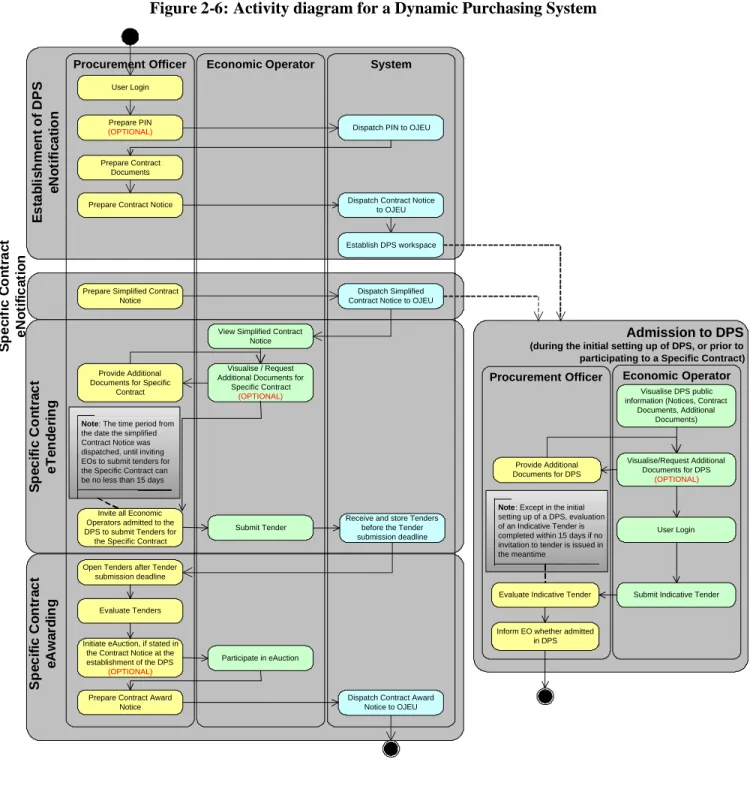
Figure 2-6: Activity diagram for a Dynamic Purchasing System...39
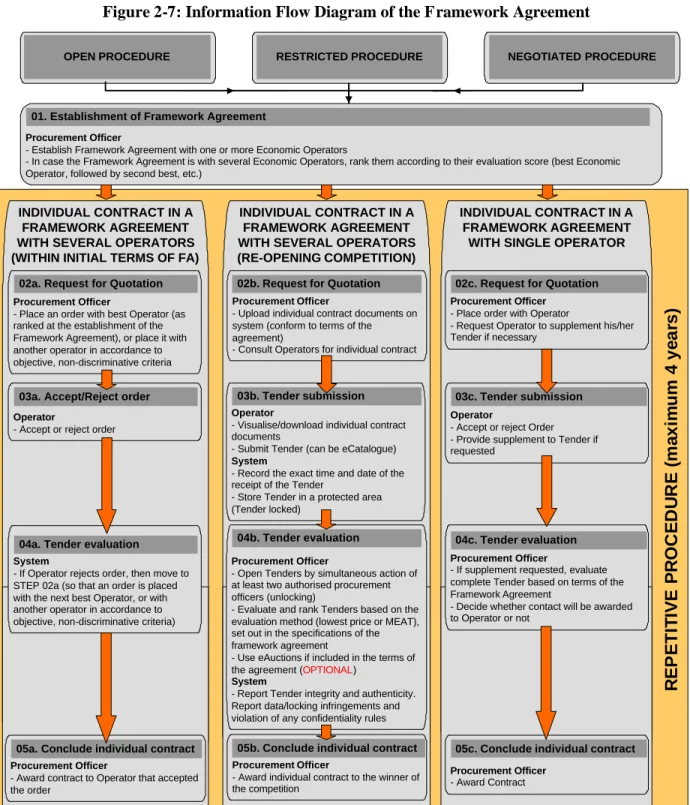
Figure 2-7: Information Flow Diagram of the Framework Agreement...41
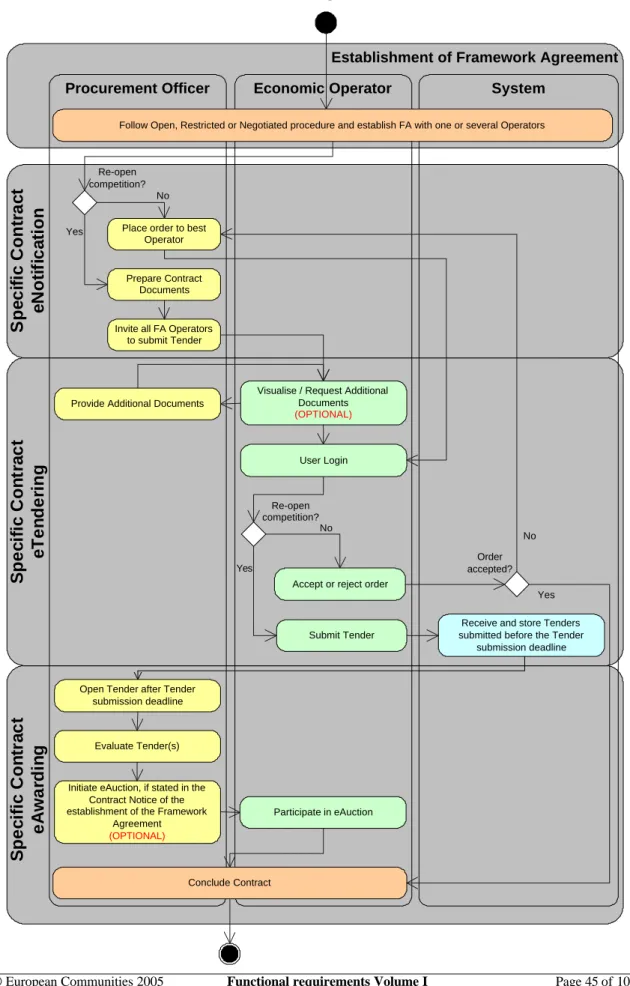
Figure 2-8: Activity diagram for the procurement of an individual contract within a framework agreement ...45
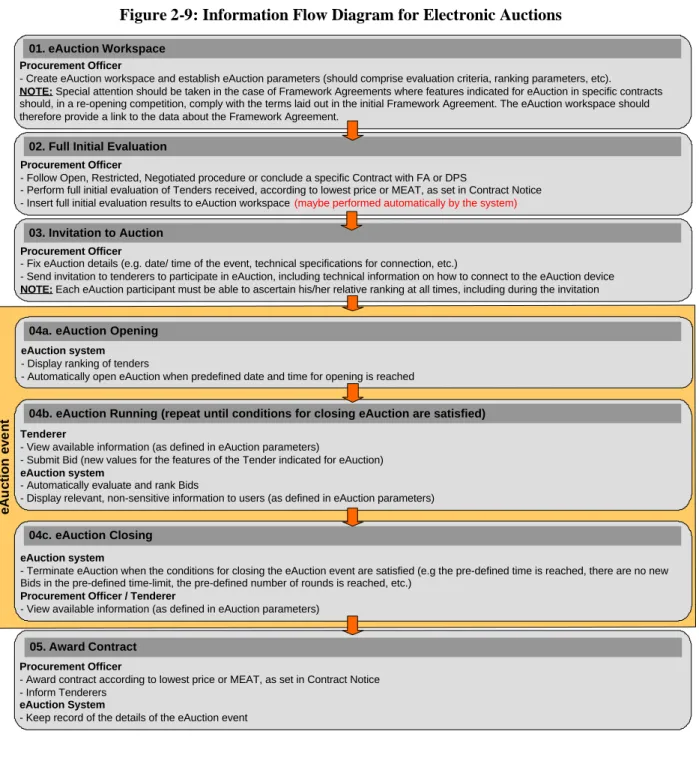
Figure 2-9: Information Flow Diagram for Electronic Auctions...47
Figure 2-10: Activity Diagram for eAuction...50
Figure 4-1: A security communication framework for an eProcurement system...88
Figure 5-1: Conceptual Model...92
Figure 5-2: Use Cases for the Guest User...97
Figure 5-3: Use Cases for the Procurement Officer Administrative User...98
Figure 5-4: Use Cases for the Procurement Officer Opening Staff User...99
Figure 5-5: Use Cases for the Procurement Officer Evaluating Staff User... 100
Figure 5-6: Use Cases for the Tenderer... 102
© European Communities 2005 Functional requirements Volume I Page 10 of 107
List of tables
Table 1 – List of Functional Requirements...51
Table 2 - Methods for supporting users...72
Table 3 - Economic Operator activities on a particular Call for Tenders...74
Table 4 - Description of Conceptual Schema Entities...93
© European Communities 2005 Functional requirements Volume I Page 11 of 107
Functional Req. 1: User Registration……… 18
Functional Req. 2: User Profiling………. 18
Functional Req. 3: User Authentication……… 18
Functional Req. 4: User Authorisation………. 18
Functional Req. 5: Tender workspace creation……… 19
Functional Req. 6: Preparation of a Prior Information Notice……….. 19
Functional Req. 7: Use of the Common Procurement Vocabulary (CPV) classification standard………. 20
Functional Req. 8: Publication of a Prior Information Notice……… 20
Functional Req. 9: Nomenclature of Territorial Units for Statistics (NUTS) classification standard…….20
Functional Req. 10: Tender Evaluation Mechanism……… 21
Functional Req. 11: Interface with the OJEU……….. 21
Functional Req. 12: Publication of Contract Documents……… 22
Functional Req. 13: Search Calls mechanism……….. 22
Functional Req. 14: Visualise/Download Call for Tenders specifications………. 22
Functional Req. 15: Request for Additional Documents………. 23
Functional Req. 16: Automated Notifications……….. 23
Functional Req. 17: Submission of Tenders………. 23
Functional Req. 18: Four-eye Principle………. 24
Functional Req. 19: Tender Confidentiality………. 24
Functional Req. 20: Tender Evaluation………. 24
Functional Req. 21: Creation of Mandatory Reports regulated by the legislation………... 25
Functional Req. 22: Invitation to Tender……….. 30
Functional Req. 23: DPS reporting……… 34
Functional Req. 24: Creation of specific contract workspaces within DPS workspace……… 35
Functional Req. 25: Indicative Tenders in the form of electronic catalogues (eCatalogues) ……….. 35
© European Communities 2005 Functional requirements Volume I Page 12 of 107
1 I
NTRODUCTIONThis report may concern anyone who is interested or involved in implementing systems for electronic public procurement in the EU. It was commissioned by the European Commission and seeks to assist interested parties to avoid problems and prevent the emergence of “e-barriers” by clarifying the functional and non-functional requirements for public eProcurement systems, as they result from the specific provisions of the new European public procurement directives.
The new public procurement directives set the legislative framework for public eProcurement in Europe, which should be adopted by all Member States by 31 of January 2006. To assist public administrations in building eProcurement systems in compliance with the new directives, a public eProcurement project was launched in 2003, under the Interchange of Data between Administrations programme (IDA) with a twofold objective:
• to develop functional requirements and technical solutions for the implementation of electronic public procurement systems, in compliance with the new legislative framework
• to create eLearning demonstrators, simulating the public eProcurement functionalities described by the new directives, allowing administrations and suppliers to familiarise themselves and to experiment with them
The development of guidelines and demonstrators followed an iterative approach, starting with a conceptual design of an eProcurement system and then the elaboration of static and dynamic models for individual contracts, dynamic purchasing systems, framework agreement systems and electronic auctions.
In a first phase, the project focused on the analysis and assessment of existing European and international eProcurement systems and the deduction of interesting eProcurement practices that could enhance the operation of new eProcurement systems. These findings are presented in detail within the:
• state of the Art case studies on European electronic public procurement projects
• description of electronic public procurement systems in non-European countries
Based on the new public procurement directives, and taking into account the findings of the reports above, the functional requirements to be respected by fully integrated eProcurement systems were identified. This should provide a conceptual framework for the technical implementation of electronic public procurement systems in compliance with the new legislative framework.
The report describes the functional system requirements and pre-requisites derived from the legal framework and presents the different actors participating in eProcurement systems, as well as information and activity flow diagrams for all eProcurement procedures. In addition, a technical overview for the creation of such system and some non-functional requirements are also presented.
Some of the functional requirements identified are direct legal requirements, while others are functional prerequisites for implementing those legal requirements in a fully integrated eProcurement system. The report should be understood as a set of indicative guidelines aimed at assisting Member States in transposing the EU framework and in setting up and managing eProcurement systems that are compliant with EU public procurement legislation. Its purpose is to serve as a reference for designing new eProcurement systems or for adapting existing ones, as well as for guiding standardisation activities at all levels.
© European Communities 2005 Functional requirements Volume I Page 13 of 107
incorporating additional information about public eProcurement. The reviews were performed by European Commission services, as well as, the IDA eProcurement expert group bringing together delegates from all Members States of the European Union and other countries participating in the IDA programme.
1.1 Structure of the report
The report is split into two volumes. The structure of the report is described below:
• Volume I:
o Section 1: introduction
o Section 2: analyses the eProcurement procedures regulated under the new directives, namely individual contracts (open and restricted) and repetitive contracts (DPS, framework agreement). Furthermore, extensions for both individual contracts and repetitive procedures are analysed (eAuction). This section includes eProcurement information flows, outlining the different steps involved in each procedure, and activity diagrams, clearly showing all different tasks, subtasks, branches, etc, that are related to the eNotification, eTendering, and eAwarding phases of each procedure
o Section 3: provides potential technical solutions for the implementation of a fully integrated eProcurement system capable of supporting the procedures required by the new directives
o Section 4: details non-functional requirements of an eProcurement system, as they emerge from the new EU eProcurement legislation, categorised into five main areas: usability, reliability, interoperability, scalability and security
o Section 5: provides an overview of technical specifications, through a conceptual model and high-level Use Cases for eProcurement systems supporting individual contracts, repetitive procedures and electronic auctions
o Section 6: documents “open issues” related to eProcurement, as they have been discussed in several fora
o Section 7: outlines main conclusions
• Volume II:
o Section 1: Provides an in-depth Use Case analysis for all main actors and functionalities of an eProcurement system supporting individual contracts
o Section 2: Provides an in-depth Use Case analysis for all main actors and functionalities of an eProcurement system supporting Dynamic Purchasing Systems
o Section 3: Provides an in-depth Use Case analysis for all main actors and functionalities of an eProcurement system supporting Framework Agreements
o Section 4: Provides an in-depth Use Case analysis for all main actors and functionality of an eProcurement system supporting eAuctions
o Section 5: Provides scenarios for interested parties to experiment with the dynamic demonstrators, which were elaborated in the context of the current project, so as to gain further understanding of the concepts discussed in the report
© European Communities 2005 Functional requirements Volume I Page 14 of 107
1.2 Business framework
The analysis performed for all eProcurement procedures is based on the EU public procurement Directive 2004/18/EC on the coordination of procedures for award of public works contracts, public supply contracts and public service contracts. All functional requirements and activity flow diagrams presented are independent from the technical implementation of an eProcurement system.
The modelling of these procedures was based on the following assumptions.
• One or more contracting authorities offer online eProcurement services, using a commonly accessible electronic platform. This platform operates as a single access point for users (e.g. procurement officers, economic operators, etc). For instance, such a platform might be a web-portal, openly accessible via the Internet.
• It is assumed that contracting authorities already make use of a number of existing information systems (e.g. back-office, legacy, etc.). The integration of the eProcurement platform with such systems can further assist contracting authorities to efficiently perform eProcurement. Whenever in the current document such an integration with existing information systems is discussed, it is assumed that the communication channel between these systems and the eProcurement platform is technically feasible, secure and reliable.
• Notices concerning Calls for Tenders are officially published on the Tender Electronic Daily (TED) website of the EU. This is a service offered by the EC Publications Office, which receives on a daily basis notices for all contracts covered by the Directives and provides facilities for the online searching, retrieval, visualisation, and downloading of notices.
• The functional analysis carried out for this document is based on requirements deriving from the EC public procurement Directive 2004/18/EC. It does not cover other aspects of the procurement cycle that contracting authorities may choose to implement electronically, in order to enhance their systems, such as electronic ordering or invoicing.
• Finally, it is also assumed that contracting authorities may have to adhere to national, regional and/or local legal requirements, depending on the field of their operation.
• The analysis presented in this report does not consider the negotiated procedure, as well as, competitive dialogues.
© European Communities 2005 Functional requirements Volume I Page 15 of 107
2 D
ESCRIPTION OF EPROCUREMENT PROCEDURESThis chapter presents an analysis of the procurement procedures described in the new EU directives. The procurement procedures for awarding public contracts are classified according to the following contract types:
• Individual contracts
o Open procedure: whereby any interested Economic Operator may submit a Tender
o Restricted procedure: whereby any Economic Operator may request to participate. Only those Economic Operators invited by the contracting authority may submit a Tender
• Repetitive contracts
o Dynamic Purchasing System (DPS): constitutes a fully electronic process for contracting authorities for making commonly used purchases, which are generally available on the market and meet the requirements of the contracting authority. The duration of a DPS should not exceed 4 years and should be open throughout its validity to any Economic Operator satisfying the selection criteria and having submitted an indicative Tender compliant with the specification
o Framework Agreement: is an agreement between one or more contracting authorities and one or more Economic Operators, the purpose of which is to establish the terms governing contracts to be awarded during a given period, in particular with regard to price and, where appropriate, the quantity envisaged
• Extensions
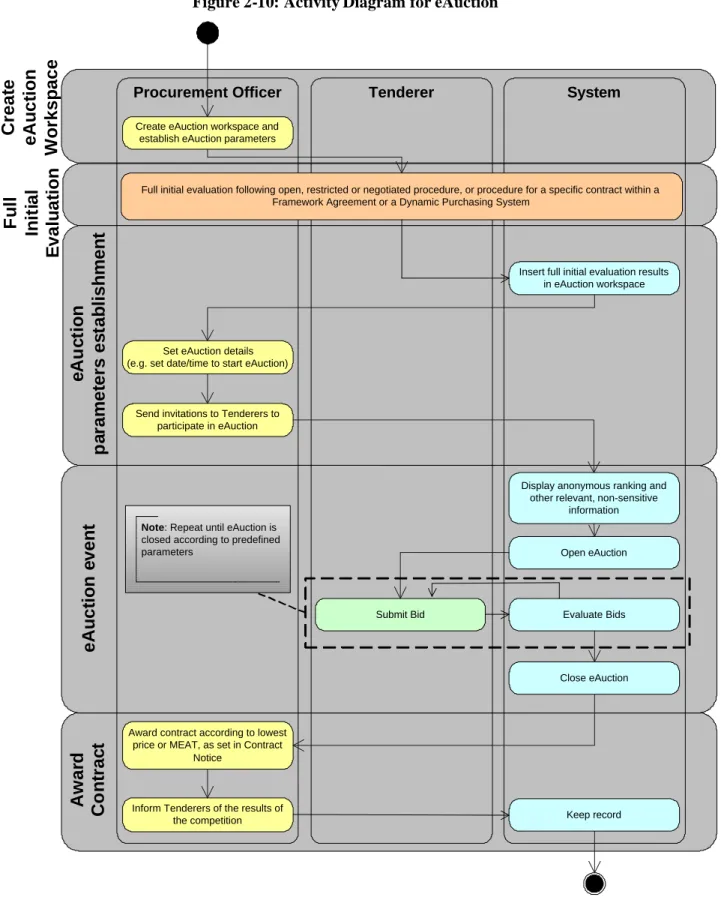
o Electronic auctions: are repetitive processes involving the use of an electronic
device for the presentation by tenderers of improved offers for a specific Call for Tenders (i.e. the submission of new prices revised downwards, and/or new values concerning certain elements of tenders, thus allowing the use of automatic evaluation methods). This occurs after an initial full evaluation of the Tenders. eAuctions can be used with contracts for works, supplies or services for which the specifications can be determined/quantified with precision. This excludes non-quantifiable elements of a tender, as well as, certain service and work contracts having as their subject-matter intellectual performances. Electronic auctions can be utilised as an extension to the awarding phase of a tendering procedure. They do not constitute a complete eProcurement procedure for awarding contracts.
© European Communities 2005 Functional requirements Volume I Page 16 of 107
2.1 Individual Contracts
This section considers the procedural aspects of the procurement processes that Contracting Authorities need to follow for procuring electronically under individual contracts. Individual contracts can be procured following any of the three public procurement procedures, namely: open, restricted and negotiated (with and without advertisement). In the subsequent sections, only the two main procedures, e.g. the open and the restricted procedures are analysed. The report describes the exact flows of events that need to be followed, and deduces functional requirements for the realisation of a fully integrated eProcurement system that would be compliant with the new EU public procurement legislation.
2.1.1 Open Procedure
The open procedure is a procedure whereby any interested Economic Operator may submit a Tender in response to a call for tender. It is the only procedure for the procurement of individual contracts in which any interested Economic Operator can participate by submitting a Tender, without the Contracting Authority performing a prior selection and/or dispatching an invitation.
2.1.1.1 Information Flow Diagram
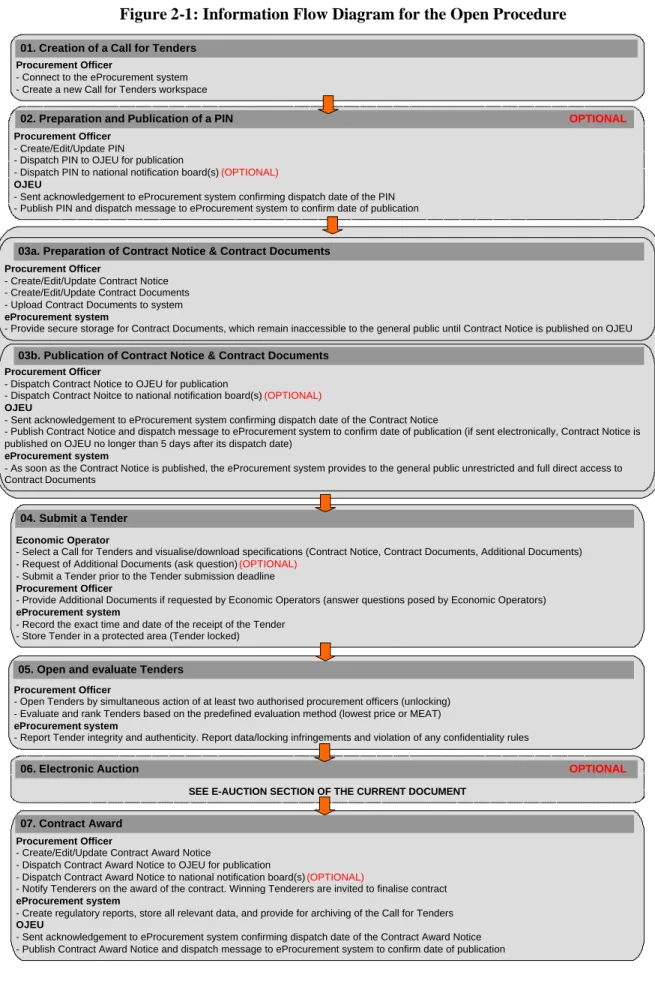
Figure 2-1 depicts the different steps of the open procedure, focusing on the actions performed by all parties involved.
© European Communities 2005 Functional requirements Volume I Page 17 of 107
Figure 2-1: Information Flow Diagram for the Open Procedure
Procurement Officer
- Connect to the eProcurement system - Create a new Call for Tenders workspace
01. Creation of a Call for Tenders
Procurement Officer
- Create/Edit/Update PIN
- Dispatch PIN to OJEU for publication
- Dispatch PIN to national notification board(s) (OPTIONAL)
OJEU
- Sent acknowledgement to eProcurement system confirming dispatch date of the PIN - Publish PIN and dispatch message to eProcurement system to confirm date of publication
02. Preparation and Publication of a PIN OPTIONAL
Procurement Officer
- Create/Edit/Update Contract Notice - Create/Edit/Update Contract Documents - Upload Contract Documents to system
eProcurement system
- Provide secure storage for Contract Documents, which remain inaccessible to the general public until Contract Notice is published on OJEU
Procurement Officer
- Dispatch Contract Notice to OJEU for publication
- Dispatch Contract Noitce to national notification board(s) (OPTIONAL)
OJEU
- Sent acknowledgement to eProcurement system confirming dispatch date of the Contract Notice
- Publish Contract Notice and dispatch message to eProcurement system to confirm date of publication (if sent electronically, Contract Notice is published on OJEU no longer than 5 days after its dispatch date)
eProcurement system
- As soon as the Contract Notice is published, the eProcurement system provides to the general public unrestricted and full direct access to Contract Documents
03b. Publication of Contract Notice & Contract Documents
Economic Operator
- Select a Call for Tenders and visualise/download specifications (Contract Notice, Contract Documents, Additional Documents) - Request of Additional Documents (ask question) (OPTIONAL)
- Submit a Tender prior to the Tender submission deadline
Procurement Officer
- Provide Additional Documents if requested by Economic Operators (answer questions posed by Economic Operators)
eProcurement system
- Record the exact time and date of the receipt of the Tender - Store Tender in a protected area (Tender locked)
04. Submit a Tender
Procurement Officer
- Open Tenders by simultaneous action of at least two authorised procurement officers (unlocking) - Evaluate and rank Tenders based on the predefined evaluation method (lowest price or MEAT)
eProcurement system
- Report Tender integrity and authenticity. Report data/locking infringements and violation of any confidentiality rules
05. Open and evaluate Tenders
SEE E-AUCTION SECTION OF THE CURRENT DOCUMENT
06. Electronic Auction OPTIONAL
Procurement Officer
- Create/Edit/Update Contract Award Notice
- Dispatch Contract Award Notice to OJEU for publication
- Dispatch Contract Award Notice to national notification board(s) (OPTIONAL)
- Notify Tenderers on the award of the contract. Winning Tenderers are invited to finalise contract
eProcurement system
- Create regulatory reports, store all relevant data, and provide for archiving of the Call for Tenders
OJEU
- Sent acknowledgement to eProcurement system confirming dispatch date of the Contract Award Notice - Publish Contract Award Notice and dispatch message to eProcurement system to confirm date of publication
07. Contract Award
© European Communities 2005 Functional requirements Volume I Page 18 of 107
2.1.1.2 Functional requirements for the Open Procedure
This section presents the functional requirements emerging from the legislation for the realisation of eProcurement systems capable to support the open procedure. All functional requirements are associated with one or more steps of Figure 2-1.
Step 01. Creation of a Call for Tenders
This step refers to the preparation of a virtual workspace in an eProcurement system where all information related to a specific call for tenders can be stored. In order to create and manage a Call for Tenders in an integrated eProcurement system, an isolated storage area is necessary where Notices, Contract Documents, Additional Documents, Tenders, etc. are safely kept. Furthermore, other information about the Call, like the associated persons involved, name of the specific Call for tenders, description, opening/closing dates, etc. are also stored in the Call for Tenders workspace.
The functional requirements identified for this step comprise: Functional Req. 1. User registration
This functional requirement allows for the user registration of new Procurement Officers and Tenderers/Economic Operators to the eProcurement system. The registration process must ensure the confidential transfer and storage of all personal information of users. Furthermore, mechanisms may be put in place for the validation of the information provided by new users of the system. Hence, the registration process may be performed in two phases. One phase can allow new users to apply for registration to the system, and another phase can allow authorised personnel to validate the submitted information and approve or reject a registration application. Functional Req. 2. User profiling
This functional requirement relates to the ability of the eProcurement system to store personal information of its registered users. Users can update their personal information if required. This personal information can be used for several other functionalities of the system, including reporting, automated notifications, etc. Also, each user is associated to a unique identifier, which can be used by the audit trailing facility of the system, in order to record all user activities, and to identify the initiator/actor of each activity.
Moreover, user profiling can allow users to setup their preferences when using the system, in terms of how data is searched, displayed, etc.
Functional Req. 3. User authentication
This functional requirement allows users to identify themselves to the eProcurement system. This is necessary for the system to display the appropriate data to users, as well as, to make available the appropriate activities to be executed according to a user’s role in the system.
Functional Req. 4. User authorisation
Each user in the system is commonly associated with a certain role. As presented in more detail in section 5.2, users can undertake and perform different roles, like Call administrators, Tender opening staff, Tender evaluating staff, etc. User authorisation can enable the eProcurement system to be aware of the role of a user. Depending on the user rights for each user, the system can control which activities a user can perform, as well as, what data a user should have access to.
© European Communities 2005 Functional requirements Volume I Page 19 of 107
Functional Req. 5. Tender workspace creation
When creating a Call for Tenders, the eProcurement system can make available to the Procurement Officers a virtual workspace for storing all Call-related information. This virtual workspace allows authorised users to provide core information about the Call, like its name, description, estimated value, etc., and provides the functionality for uploading documents, like Notices, Contract Documents, Additional Documents, etc.
Moreover, the Tender workspace can be used as the area for storing Tenders submitted by Tenderers, and all logically related data of a Call.
A Tender workspace needs to be well integrated with the User authorisation of the system (Functional Req. 4: “User authorisation”), as information stored in a Tender workspace should be accessed and/or manipulated by authorised users only. Furthermore, some activities should only be possible when certain events have already taken place (e.g. accessing the details of a Tender should only be possible for authorised personnel after Tenders are securely opened, following the four-eye principle).
Step 02. Preparation and Publication of a Prior Information Notice (PIN)
This step comprises the preparation of a Prior Information Notice (PIN). Contracting authorities should prepare and publish a PIN as early as possible, at the beginning of their budgetary year covering the awarding of the envisaged supplies and services contracts during the subsequent 12 months. For works contracts, a PIN may be published at any time. The use of a PIN is at the discretion of a contracting authority. Its use can shorten the time-limit for receipt of tenders to 36 days.
The functional requirements identified for this step comprise: Functional Req. 6. Preparation of a Prior Information Notice
Procurement Officers may be assisted in creating a PIN by using an application for the preparation of the Notice to be published in the Official Journal. Such an application, commonly known as “Form Filling Tool”, can be a part of the eProcurement system itself, or an external application integrated to the eProcurement system.
Document templates or electronic standard forms shall be used to prepare a PIN. Procurement Officers can be further assisted in preparing a PIN by automatically utilising Call information already provided to the system within the Tender workspace, during STEP 1 of the procedure. The Form Filling Tool may obtain all defined Call information from the eProcurement system, and automatically pre-fill as many fields in the PIN template as possible.
© European Communities 2005 Functional requirements Volume I Page 20 of 107
Functional Req. 7. Use of the Common Procurement Vocabulary (CPV) classification standard
The new Public Procurement Directives require contracting authorities to use the CPV to advertise their procurement needs. The CPV constitutes a European classification standard specifically tailored to describe goods, services or works purchased by public authorities by numerical codes. The CPV exists in the 20 official languages of the EU. Thanks to this classification, Economic Operators can easily identify the goods/services/works a contracting authority wishes to procure, irrespective of the language of the PIN and to perform specific searches on the TED database.
An eProcurement system can prompt Procurement Officers to make use of the CPV classification standard when creating a PIN.
Functional Req. 8. Publication of a Prior Information Notice
Once the PIN is created, Procurement Officers can be assisted to dispatch an appropriate electronic message to the OJEU, containing all information of the PIN, to request for its publication. The eProcurement system should be in position to store the dispatch date of the PIN to the OJEU.
Step 03a. Preparation of a Contract Notice & Contract Documents
This step comprises the preparation of the Contract Notice and Contract Documents for a specific Call for Tenders. The objective of the Contract Notice is to openly advertise to the general public the intention of the contracting authority to procure, as well as, to provide the core requirements for the contract. Contract Documents define more precisely the requirements/specifications of the contracting authority for the goods/services/works to be procured.
The main activities for the preparation of the Contract Notice are the same as those for the preparation of the PIN, the only difference being the content of the corresponding form. Hence, the basic functional requirements for the preparation of the Contract Notice are the same as those for the preparation of the PIN (Functional Req. 6: “Preparation of a Prior Information Notice” and Functional Req. 8: "Publication of a Prior Information Notice”). In addition, the preparation of a Contract Notice imposes some additional requirements.
Functional Req. 9. Nomenclature of Territorial Units for Statistics (NUTS) classification standard
The Contract Notice may specify the NUTS codes for the contract to be procured. NUTS is a classification standard for geographic regions, which uses numerical codes to define the location of the goods/services/works to be procured. Similarly to the CPV, the inclusion of NUTS codes in a Contract Notice allows Economic Operators to easily identify the locations to which they will be required to deliver the goods/services/works of the contract irrespective of the language of the Contract Notice.
An eProcurement system can prompt Procurement Officers to make use of the NUTS classification standard when creating a Contract Notice. This functional requirement is not legislated by the EU public procurement legal framework, nevertheless can significantly increase the services that can be offered by an eProcurement system (e.g, searching, reporting, system integration, etc.)
© European Communities 2005 Functional requirements Volume I Page 21 of 107
Functional Req. 10. Tender Evaluation Mechanism
Contracting authorities shall conclude a competition by performing the full evaluation of Tenders received, and the awarding of a contract. The evaluation of Tenders is based on one of the following two Tender evaluation models: either lowest price or Most Economically Advantageous Tender (MEAT). In both cases, the evaluation model to be used must be specified in the Contract Notice or the Contract Documents. In the latter case, this fact must be stated in the Contract notice. If the evaluation is based on the Most Economically Advantageous Tender, contracting authorities are required to define the exact evaluation criteria to be used, as well as to indicate their weightings either in the Contract Notice or in the Contract Documents. In the latter case this reference to the Contract Documents must be stated in the Contract Notice. In duly justified cases where the weighting cannot be established, contracting authorities must be able to give reasons, and indicate the descending order of importance of all criteria.
When the evaluation parameters of a Call based on MEAT can be established with precision, a contracting authority may decide that the award of the contract shall be preceded by an electronic auction. The intention of using an electronic auction as part of the awarding procedure needs to be mentioned in the Contract Notice of the Call. To accommodate the above, an eProcurement system can prompt Procurement Officers to define the evaluation mechanism to be used, as well as automatically include the details of the evaluation mechanism in the Contract Notice and/or Contract Documents.
Step 03b. Publication of Contract Notice & Contract Documents
This step comprises the publication of the Contract Notice and Contract Documents of a Call for Tenders. This operation involves the dispatch of the electronic message of the Contract Notice to the OJEU, as well as, the publication of the Contract Documents to the general public.
The functional requirements identified for this step comprise: Functional Req. 11. Interface with the OJEU
Once the Contract Notice of a Call for Tenders is completed, it needs to be made publicly available. For contracts above the EU thresholds, as defined in the EU public procurement directives, the Contract Notice needs to be published to the Official Journal of the European Union (OJEU).
The EU Publications Office, responsible for the daily publication of the Official Journal, offers several methods by which a notice can be published on the OJEU. An eProcurement system can offer the functionality for automating or semi-automating the publication of notices in the OJEU. This does not only simplify the processes a Procurement Officer needs to follow, but also allows to shorten the time-limit for the submission of Tenders.
© European Communities 2005 Functional requirements Volume I Page 22 of 107
Functional Req. 12. Publication of Contract Documents
The preparation of Contract Documents involves an “approval” lifecycle for documents (and possible notices), comprising their creation, validation, approval and publication. The “approval” lifecycle depends on the internal procedures of the contracting authority, and may involve multiple Procurement Officers. An eProcurement system can provide a functionality for modelling these internal workflows which can assist Procurement Officers to comply with the internal workflows of their contracting authority in a more efficient and time-effective manner. While a document is in “not-published” state, it is accessible only to the Procurement Officers associated with it.
The finalised Contract Documents approved by the contracting authority shall not be made publicly available until the Contract Notice is dispatched to the OJEU for publication. Once the Contract Notice has been published by the OJEU, it may also be published at the national level, and all interested parties should be given unrestricted and full access to the Contract Documents.
Once a Contract Document is made publicly available, it should not be possible for anyone to remove and/or modify this document.
Step 04. Submit a Tender
This step constitutes the eProcurement phase for the submission of Tenders by Economic Operators, commonly referred to as eTendering. During this phase, Economic Operators gain access to all publicly available information of a Call, may request Additional Documents, and submit their Tenders.
The functional requirements identified for this step comprise: Functional Req. 13. Search Calls mechanism
At this step, the Call for Tender is considered “open”, as it is publicly available. An eProcurement system may provide a search Calls mechanism to any interested party, so that it can search through all publicly “open” Calls and locate interesting ones, for which s/he might wish to participate.
Functional Req. 14. Visualise/Download Call for Tenders specifications
Any interested party should be provided with the functionality to access all publicly available information of a Call, comprising PIN, Contract Notice, Contract Documents, Additional Documents, etc. An eProcurement system may require interested parties to provide some personal information, so that they are notified if and when new information about the Call is published (Additional Documents, new Contract Documents, etc.)
The eProcurement system should ensure that full and unrestricted access to all publicly available information is provided equally to all interested parties.
© European Communities 2005 Functional requirements Volume I Page 23 of 107
Functional Req. 15. Request for Additional Documents
Any interested party may be provided with the possibility to request Additional Documents about a Call (i.e. ask a question to the awarding authority). This may be provided only within a predefined time period (i.e. accept questions posted before a certain date). All requests for Additional Documents and the Additional Documents themselves need to be made publicly available to all interested parties, and in due time before the end of the time-limit for submission to ensure non-discrimination and equal treatment of Economic Operators. The identities of Economic Operators posting requests for Additional Documents should not be disclosed, neither to the general public nor to other Economic Operators.
Functional Req. 16. Automated Notifications
An eProcurement system may support an automated notification mechanism, which can automatically notify its users of interesting events. For instance, Economic Operators that requested an Additional Document (i.e. posted a question) may be automatically notified when an Additional Document is published by the contracting authority (i.e. the contracting authority has provided an answer to the posted question). As described in Functional Requirement 15, such a notification mechanism must ensure equal treatment of all Economic Operators and operate within the time-limit for submission of tenders.
Functional Req. 17. Submission of Tenders
Economic Operators interested in a Call shall have the possibility to submit electronically the Tenders that they have prepared through generally available, non-discriminatory, and interoperable means of communication. Contracting authorities examine whether the Tenders received are compliant with the requirements defined in the Tender specifications.
Economic Operators that have submitted a Tender should be provided with the possibility to update their Tender until the Tender submission deadline.
The eProcurement system must ensure that all Tenders for a Call are stored in a secure environment and cannot be accessed until authorised Procurement Officers authorise their opening following the four-eye principle. If access prohibition is infringed, it should be reasonably ensured that the infringement is clearly detectable. Official time-stamping facility can ensure the exact submission date and time of a Tender is recorded, guaranteeing there are no misconceptions about the submission time of a Tender (see relevant non-functional requirement in section 4.3.3.2).
Security arrangements for all data transmitted to/from the eProcurement system and stored in the eProcurement system should ensure the integrity of the Tenders, as well as, the authenticity of the Economic Operators that have submitted them (see relevant non-functional requirements in section 4.5).
© European Communities 2005 Functional requirements Volume I Page 24 of 107
Step 05. Open and evaluate Tenders
This step refers to the opening and evaluation of electronic Tenders. Opening and evaluation take place once the Tender submission period has ended (i.e. eSubmission is complete). The secure opening of Tenders must involve at least two authorised procurement officers who proceed to open the Tenders received through simultaneous action following the so-called four-eye principle. Following this operation authorised procurement officers perform the evaluation of Tenders based on the pre-defined Tender evaluation mechanism and establish the ranking of Tenders.
Functional Req. 18. Four-eye Principle
An eProcurement system needs to ensure that access to Tenders cannot be obtained by anyone, until authorised procurement officers proceed to the opening of Tenders following the four-eye principle. To “open” or “unlock” Tenders, two or more authorised procurement officers need to perform simultaneous actions.
The opening of Tenders shall only be performed after the Tender submission deadline.
It is considered as best practice for the opening of Tenders to be performed in phases. Hence, for instance, proof documents are opened first, followed by the opening of technical document, and lastly the opening of financial offers. In all Tender opening phases, the Four-eye Principle can be applied.
Functional Req. 19. Tender Confidentiality
Once Tenders are opened, they can only be accessed by authorised personnel, ensuring that the confidentiality of Tenders is not violated.
Functional Req. 20. Tender Evaluation
An eProcurement system may assist procurement officers to perform the evaluation of Tenders, either in an automated or semi-automated manner. Initially, all Tenders should be evaluated in order to ensure that participating Tenderers satisfy the Conditions for Participation stated in the Contract Notice or Contract Documents of the Call.
This is followed by the full Tender evaluation according to the pre-defined evaluation mechanism stated in the Contract Notice or Contract Documents of the Call.
Step 06. Electronic Auctions
If the specifications of a Tender can be defined with precision, the contracting authority may choose to award the contract using an electronic auction. In this case, tenderers are given the opportunity to improve aspects of their Tenders through a repetitive bidding mechanism, increasing their possibility to win the competition. The evaluation of auction Bids is performed according to some or all of the evaluation criteria mentioned in step 3.
Electronic auctions can be used in an eProcurement competition only if this is clearly stated in the Contract Notice of the Call. The details regarding the steps involved in the execution of electronic auctions, as well as, related functional requirements are discussed in section 2.3.
© European Communities 2005 Functional requirements Volume I Page 25 of 107
Step 07. Contract Award
Once the awarding procedure is complete, the contract is awarded to the tenderer having submitted the lowest price or the Most Economically Advantageous Tender, as concluded by applying the evaluation methodology (defined in step 3). The contracting authorities are required to publish a Contract Award Notice, which informs all interested parties of the results of the competition. The procedure for creating and publishing a Contract Award Notice is the same as that for creating a PIN and a Contract Notice. Hence, Functional Req. 6: “Preparation of a Prior Information Notice”, Functional Req. 8: “Publication of a Prior Information Notice” and Functional Req. 11: “Interface with the OJEU” are also necessary for creating/publishing a Contract Award Notice.
In addition, contracting authorities shall contact the participating tenderers to inform them of the award decision. Upon request of the tenderer, the contracting authority should usually give the reasons for rejection. . An eProcurement system may assist in this process by automatically or semi-automatically preparing appropriate notification messages, which can inform tenderers accordingly. Functional Req. 16: “Automated Notifications” can assist in this process.
Functional Req. 21. Creation of Mandatory Reports regulated by the legislation
Another requirement of the legislation is related to the capability of the contracting authority to prepare regulatory reports, which provide information on all aspects of the competition. Such reports include information about the tenderers that participated in the competition, the successful tenderer(s), the reasons for their selection, etc. The contracting authority may be assisted in this process by an eProcurement system which, utilising all information created/stored in it during the competition, can automatically or semi-automatically produce such reports.
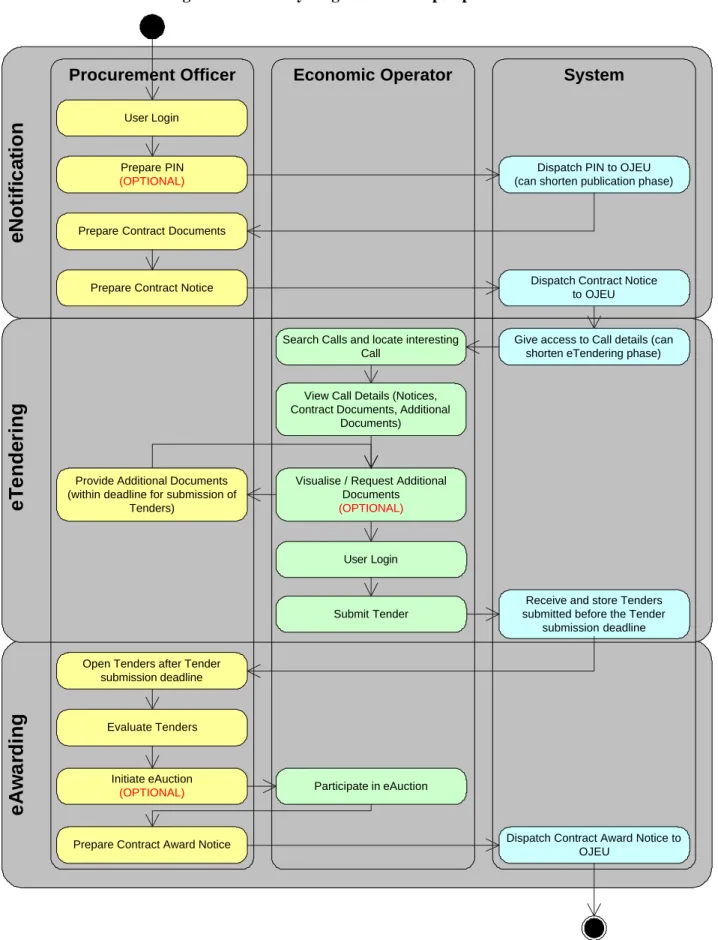
2.1.1.3 Open Procedure Activity Diagram
Figure 2-2 presents at granular level the open procedure, clearly displaying all activities that are being performed by the main actors (procurement officers, economic operators and an eProcurement system) in the different eProcurement phases: eNotification, eTendering, and eAwarding. The activity diagram groups in phases and serialises all activities that need to be performed in the whole procurement process. Some tasks are subject to legislated time-constraints that need to be respected by Contracting Authorities. Thus, the whole procurement process for a contract following the open procedure may require significant time.
© European Communities 2005 Functional requirements Volume I Page 26 of 107
Figure 2-2: Activity diagram for the open procedure
Procurement Officer Economic Operator System User Login
Prepare PIN (OPTIONAL)
Prepare Contract Documents
Dispatch PIN to OJEU (can shorten publication phase)
Prepare Contract Notice Dispatch Contract Notice to OJEU
Provide Additional Documents (within deadline for submission of
Tenders)
Visualise / Request Additional Documents (OPTIONAL)
Receive and store Tenders submitted before the Tender
submission deadline
Open Tenders after Tender submission deadline
Evaluate Tenders
Initiate eAuction (OPTIONAL)
Prepare Contract Award Notice Dispatch Contract Award Notice to OJEU
Search Calls and locate interesting Call
View Call Details (Notices, Contract Documents, Additional
Documents) User Login Submit Tender Participate in eAuction
e
N
o
ti
fi
c
a
ti
o
n
e
T
e
n
d
e
ri
n
g
e
A
w
a
rd
in
g
Give access to Call details (can shorten eTendering phase)
© European Communities 2005 Functional requirements Volume I Page 27 of 107
2.1.2 Restricted Procedure
A Restricted procedure is a procedure in which any Economic Operator may request to participate and whereby only those Economic Operators invited by the contracting authority may submit a Tender. Following this procedure, contracting authorities issue a Contract Notice for advertising the contract. Any Economic Operator may express interest to participate by submitting an appropriate request for participation to the contracting authority. The contracting authority may restrict the number of tenderers that will be invited to tender to a minimum of at least five. In this case, the contracting authority must state the objective criteria it will apply for short-listing in the Contract Notice, and only the candidates that are short-listed according to those criteria are subsequently invited to submit a tender. In the absence of such a restriction there is no short-listing. The contracting authority invites all Economic Operators that comply with the minimum capabilities required in the Contract notice to submit a tender.
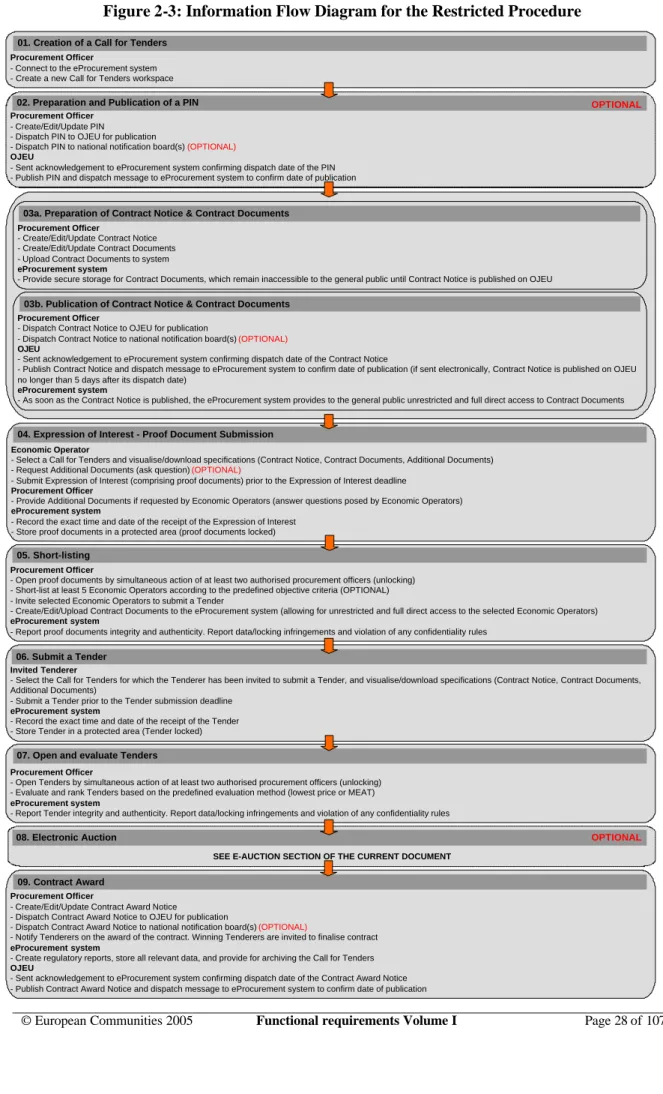
2.1.2.1 Information Flow Diagram
Figure 2-3 depicts the different steps of the restricted procedure, focusing on the actions performed by all parties involved.
© European Communities 2005 Functional requirements Volume I Page 28 of 107
Figure 2-3: Information Flow Diagram for the Restricted Procedure
Economic Operator
- Select a Call for Tenders and visualise/download specifications (Contract Notice, Contract Documents, Additional Documents) - Request Additional Documents (ask question) (OPTIONAL)
- Submit Expression of Interest (comprising proof documents) prior to the Expression of Interest deadline Procurement Officer
- Provide Additional Documents if requested by Economic Operators (answer questions posed by Economic Operators) eProcurement system
- Record the exact time and date of the receipt of the Expression of Interest - Store proof documents in a protected area (proof documents locked)
04. Expression of Interest - Proof Document Submission
Procurement Officer
- Open proof documents by simultaneous action of at least two authorised procurement officers (unlocking) - Short-list at least 5 Economic Operators according to the predefined objective criteria (OPTIONAL) - Invite selected Economic Operators to submit a Tender
- Create/Edit/Upload Contract Documents to the eProcurement system (allowing for unrestricted and full direct access to the selected Economic Operators) eProcurement system
- Report proof documents integrity and authenticity. Report data/locking infringements and violation of any confidentiality rules
05. Short-listing
Procurement Officer
- Connect to the eProcurement system - Create a new Call for Tenders workspace
01. Creation of a Call for Tenders
Procurement Officer - Create/Edit/Update PIN
- Dispatch PIN to OJEU for publication
- Dispatch PIN to national notification board(s) (OPTIONAL)
OJEU
- Sent acknowledgement to eProcurement system confirming dispatch date of the PIN - Publish PIN and dispatch message to eProcurement system to confirm date of publication
02. Preparation and Publication of a PIN
Procurement Officer
- Create/Edit/Update Contract Notice - Create/Edit/Update Contract Documents - Upload Contract Documents to system eProcurement system
- Provide secure storage for Contract Documents, which remain inaccessible to the general public until Contract Notice is published on OJEU
Procurement Officer
- Dispatch Contract Notice to OJEU for publication
- Dispatch Contract Notice to national notification board(s) (OPTIONAL)
OJEU
- Sent acknowledgement to eProcurement system confirming dispatch date of the Contract Notice
- Publish Contract Notice and dispatch message to eProcurement system to confirm date of publication (if sent electronically, Contract Notice is published on OJEU no longer than 5 days after its dispatch date)
eProcurement system
- As soon as the Contract Notice is published, the eProcurement system provides to the general public unrestricted and full direct access to Contract Documents
03b. Publication of Contract Notice & Contract Documents 03a. Preparation of Contract Notice & Contract Documents
Procurement Officer
- Open Tenders by simultaneous action of at least two authorised procurement officers (unlocking) - Evaluate and rank Tenders based on the predefined evaluation method (lowest price or MEAT) eProcurement system
- Report Tender integrity and authenticity. Report data/locking infringements and violation of any confidentiality rules
07. Open and evaluate Tenders
SEE E-AUCTION SECTION OF THE CURRENT DOCUMENT
08. Electronic Auction OPTIONAL
Procurement Officer
- Create/Edit/Update Contract Award Notice
- Dispatch Contract Award Notice to OJEU for publication
- Dispatch Contract Award Notice to national notification board(s) (OPTIONAL)
- Notify Tenderers on the award of the contract. Winning Tenderers are invited to finalise contract eProcurement system
- Create regulatory reports, store all relevant data, and provide for archiving the Call for Tenders OJEU
- Sent acknowledgement to eProcurement system confirming dispatch date of the Contract Award Notice - Publish Contract Award Notice and dispatch message to eProcurement system to confirm date of publication
09. Contract Award
Invited Tenderer
- Select the Call for Tenders for which the Tenderer has been invited to submit a Tender, and visualise/download specifications (Contract Notice, Contract Documents, Additional Documents)
- Submit a Tender prior to the Tender submission deadline eProcurement system
- Record the exact time and date of the receipt of the Tender - Store Tender in a protected area (Tender locked)
06. Submit a Tender
© European Communities 2005 Functional requirements Volume I Page 29 of 107
2.1.2.2 Functional requirements for the Restricted Procedure
The current section presents the functional requirements emerging from the legislation for the realisation of eProcurement systems capable to support the restricted procedure. Certain steps of the restricted procedure are identical to steps for the open procedure, discussed in section 2.1.1. Hence, only new steps, specific to the restricted procedure, are presented in this section. These new steps are Step 04. “Expression of Interest” and Step 05. “Short-listing”.
Step 04. Expression of Interest – Proof Documents Submission
During this step Economic Operators express their interest to participate in a restricted procedure competition. This process is also commonly referred to as “request to participate”. Following the visualisation of the Call details, in the form of Contract Notice, Contract Documents and/or Additional Documents, Economic Operators may express their interest to participate in the Call, by submitting the necessary proof documents. The proof documents, comprising legal, technical and financial information, are subsequently used by the contracting authority to either invite an Economic Operator to submit a Tender, or reject the tenderer from the subsequent steps of the competition.
An eProcurement system may assist contracting authorities in this process, by providing the opportunity to Economic Operators to express their interest electronically. All functional requirements of Step 04 of the open procedure are also applicable in this step:
• Functional Req. 13: Search Calls mechanism
• Functional Req. 14: Visualise/Download Call for Tenders specifications
• Functional Req. 15: Request for Additional Documents
• Functional Req. 16: Automated Notifications
• Functional Req. 17: Submission of Tenders
Step 05. Short-listing (Optional)
If a contracting authority has announced in the Contract Notice its intention to limit the number of candidates that will be invited to submit a tender, it proceeds to a short-listing based on the expressions of interest it has received. To this end, it evaluates the received proof documents according to the selection criteria, as defined in step 03a and identifies a minimum number of five candidates to be invited.
All functional requirements of step 05 (Open and Evaluate Tenders) of the open procedure are also applicable in this instance:
• Functional Req. 18: Four-eye Principle
• Functional Req. 19: Tender Confidentiality
© European Communities 2005 Functional requirements Volume I Page 30 of 107
Another activity of the contracting authority during this step is the preparation and publication of Contract Documents. Under the open procedure, Contract Documents need to be prepared and published when the Contract Notice is dispatched to the OJEU..
Functional Req. 22. Invitation to Tender
Once all proof documents have been examined and, where applicable, candidates have been short-listed based on the objective criteria stated in the Contract Notice, the contracting authority invites all or some Economic Operators to submit their Tenders until a defined submission deadline. Rejected Economic Operators should be notified that they will not be invited.
This process can be simplified for contracting authorities by an eProcurement system which can automatically or semi-automatically calculate the deadline for submitting Tenders, as well as, prepare appropriate messages to all Economic Operators involved. The identity of all Economic Operators involved must remain confidential. From this point onward, all Call related information (comprising Contract Documents and Additional Documents) can be disclosed only to the economic operators selected to submit a Tender.
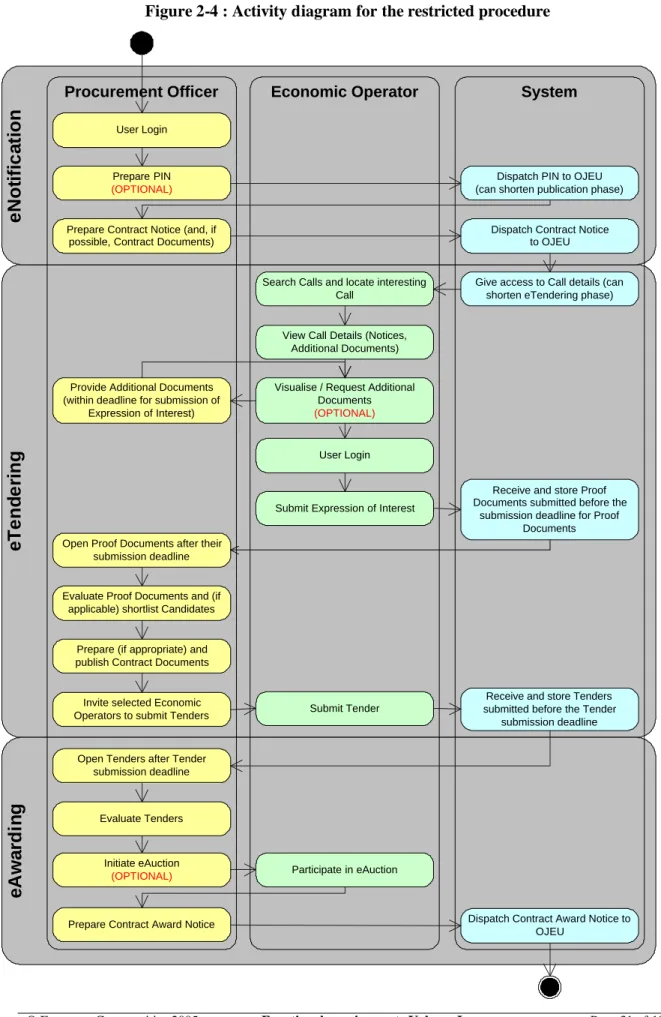
2.1.2.3 Restricted Procedure Activity Diagram
Figure 2-4 presents at granular level the restricted procedure, clearly displaying all activities that are performed by the main actors (procurement officers, economic operators and an eProcurement system) related to the different eProcurement phases: eNotification, eTendering, and eAwarding. The activity diagram groups in phases and serialises all activities that need to be performed in the whole procurement process. Some tasks are subject to legislated time-constraints that need to be respected by Contracting Authorities. Thus, the whole procurement process for a contract following the restricted procedure may require significant time.