AUSTRALIAN JOURNAL OF BASIC AND
Open Access Journal
Published BY AENSI Publication
© 2016 AENSI Publisher All rights reserved
This work is licensed under the Creative Commons Attribution International License
http://creativecommons.org/licenses/by/4.0/
To Cite This Article: Carine Meier, Daniela Meira, Tiago Olivoto, Diego Nicolau Follmann, Maicon Nardino, Ivan Ricardo Carvalho, Mauricio Ferrari, Alan Junior De Pelegrin, Vinícius Szareski, Velci
second-crop soybeans in Rio Grande do Sul state, Brazil.
Morphological traits and yield components of second
Grande do Sul state, Brazil
1Carine Meier, 1Daniela Meira, 1Tiago Olivoto, 2Alan Junior De Pelegrin, 2Vinícius Szareski,
1Federal University of Santa Maria – Agronomy Department, Linha 7 de Setembro, s/n, BR 386 Km 40, 98400
Rio Grande do Sul, Brazil.
2Federal University of Pelotas- Plant Genomics and Breeding Center
3Federal University of Pampa, Rua 21 de abril, 80
4Federal University of Santa Maria – Agronomy Department, Av.
do Sul, Brazil.
Address For Correspondence:
Carine Meier, 1Federal University of Santa Maria Frederico Westphalen, Rio Grande do Sul, Brazil.
A R T I C L E I N F O
Article history:
Received 3 March 2016; accepted 2 May 2016; published 26 May 2016
Keywords:
Glycine max, Indeterminate grown habit, grain yield.
Soybean (Glycine max L.) has prominent place in Brazilian agribusiness, mainly due to the great financial returns afforded by culture in the last agricultural harvests. The Brazilian production for the harvest 2015/2016 is estimated at 102.1 million tons, an increase of 6.1%
maximize production and economic returns on rural properties in southern Brazil, has practiced soybean seeding in second-crop, usually in succession of
High productive potential in soybean are obtained because of the contribution of several agronomic traits, such as adequate stand of plants per unit area, number of reproductive nodes, branches, pods,
and specific mass of kernels (ALCANTARA of joint action of genetic and environmental factors
AUSTRALIAN JOURNAL OF BASIC AND
APPLIED SCIENCES
ISSN:1991-8178 EISSN: 2309-8414 Journal home page: www.ajbasweb.com
© 2016 AENSI Publisher All rights reserved
This work is licensed under the Creative Commons Attribution International License (CC BY).
http://creativecommons.org/licenses/by/4.0/
Carine Meier, Daniela Meira, Tiago Olivoto, Diego Nicolau Follmann, Maicon Nardino, Ivan Ricardo Carvalho, Mauricio Ferrari, Alan Junior De Pelegrin, Vinícius Szareski, Velci Queiróz De Souza., Morphological traits and yield components of
crop soybeans in Rio Grande do Sul state, Brazil. Aust. J. Basic & Appl. Sci., 10(9): 81-88, 2016
Morphological traits and yield components of second-crop soybeans in
razil.
Tiago Olivoto, 4Diego Nicolau Follmann, 2Maicon Nardino, 2Ivan Ricardo Carvalho,
, 3Velci Queiróz De Souza
Agronomy Department, Linha 7 de Setembro, s/n, BR 386 Km 40, 98400
Plant Genomics and Breeding Center, s/n, 96010-165, Capão do Leão, Rio Grande do Sul, Brazil. Rua 21 de abril, 80, São Gregório, 96450-000, Dom Pedrito, Rio Grande do Sul, Brazil.
Agronomy Department, Av. Roraima nº 1000, bairro Camobi, 97105-900, Santa Maria, Rio Grande
1Federal University of Santa Maria – Agronomy Department, Linha 7 de Setembro, s/n, BR 386 Km 40, 98400 Frederico Westphalen, Rio Grande do Sul, Brazil.
A B S T R A C T
The seeding of soybean in second-crophave been conducted in southern Brazil, so it becomes necessary to know the traitsto grain yield contribution of crop in this grownseason.We aimed to evaluate the morphological traits and yield components of indeterminate growth habit soybean cultivarsgrown in second
was conducted at the Federal University of Santa Maria campus Frederico Westphalen – RS, Brazil, in the 2013 summer soybean growing season, using a randomized complete blocks design with nine cultivars (FPS Paranapanema RR, BMX Classe RR, BMX Potência RR, BMX Força RR, BMX Energia RR, BMX Turbo RR, FPS Iguaçu RR, BMX Tornado RR, BMX Alvo RR), arranged in three replications. The FPS Paranapanema RR cultivar has a higher number of reproductive nodes, number of pods and number of pods per node on the main stem, but their performance is hindered because their grain present lower density.The FPS Iguaçu RR cultivar has the highest grain yield because of high relative contribution of pods with three kernels (51%). number of branches was higher for BMX Potência RR BMX Classe RR, BMX Turbo RR, BMX Tornado RR e BMX Força RR cultivars. The traits number of pods containing three kernels, thousand-kernel mass of the pods with three kernels and relative contribution of pods with three kernels, have the strongest and most positive linear trends with the grain yield.
INTRODUCTION
L.) has prominent place in Brazilian agribusiness, mainly due to the great financial returns afforded by culture in the last agricultural harvests. The Brazilian production for the harvest 2015/2016 is estimated at 102.1 million tons, an increase of 6.1% over the previous harvest (CONAB, 2016
maximize production and economic returns on rural properties in southern Brazil, has practiced soybean seeding , usually in succession of maize (PEIXOTO et al., 2000).
High productive potential in soybean are obtained because of the contribution of several agronomic traits, such as adequate stand of plants per unit area, number of reproductive nodes, branches, pods,
(ALCANTARA NETO et al., 2011; SOUZA et al., 2015).These traits are the result of joint action of genetic and environmental factors and theirs interaction(PELUZIO et al., 2015)
Carine Meier, Daniela Meira, Tiago Olivoto, Diego Nicolau Follmann, Maicon Nardino, Ivan Ricardo Carvalho, Morphological traits and yield components of
crop soybeans in Rio
Ivan Ricardo Carvalho, 2Mauricio Ferrari,
Agronomy Department, Linha 7 de Setembro, s/n, BR 386 Km 40, 98400-000, Frederico Westphalen,
165, Capão do Leão, Rio Grande do Sul, Brazil. Rio Grande do Sul, Brazil.
900, Santa Maria, Rio Grande
Agronomy Department, Linha 7 de Setembro, s/n, BR 386 Km 40, 98400-000,
crophave been conducted in southern Brazil, so it becomes necessary to know the traitsto grain yield contribution of crop in this morphological traits and yield components of indeterminate growth habit soybean cultivarsgrown in second-crop. The experiment was conducted at the Federal University of Santa Maria campus Frederico Westphalen g season, using a randomized complete blocks design with nine cultivars (FPS Paranapanema RR, BMX Classe RR, BMX Potência RR, BMX Força RR, BMX Energia RR, BMX Turbo RR, FPS Iguaçu RR, BMX Tornado RR, BMX Alvo RR), arranged in three replications. The FPS aranapanema RR cultivar has a higher number of reproductive nodes, number of pods and number of pods per node on the main stem, but their performance is hindered because their grain present lower density.The FPS Iguaçu RR cultivar has the highest ld because of high relative contribution of pods with three kernels (51%).The BMX Potência RR BMX Classe RR, BMX Turbo RR, BMX Tornado RR e BMX Força RR cultivars. The traits number of pods kernel mass of the pods with three kernels and relative contribution of pods with three kernels, have the strongest and most positive
L.) has prominent place in Brazilian agribusiness, mainly due to the great financial returns afforded by culture in the last agricultural harvests. The Brazilian production for the harvest 2015/2016 (CONAB, 2016). In a view to maximize production and economic returns on rural properties in southern Brazil, has practiced soybean seeding
High productive potential in soybean are obtained because of the contribution of several agronomic traits, such as adequate stand of plants per unit area, number of reproductive nodes, branches, pods, kernels per pod These traits are the result
The most important traits can be described by the number of pods per area, seeds per pod and grain mass (McBLAIN & HUME, 1981). However, the availability of photoassimilates to the pods depends strongly on the source-sink ratio, where pods with greater mass in relation to the total pods per plant, have higher intensity drain receiving, therefore, higher amounts of photoassimilates to the detriment of pods with lower mass (BRUN; BETTS, 1984).
The existing variation in the number and mass of grains in each pod contributes differently to the yield of soybeans. In that way, research is needed to address this dynamic in soybean cultivars with indeterminate growth habit, and determine which traits contribute most to the yield of soybeans growing in second-crop. Thus, the aim of this study was to evaluate the morphological traits and contribution of yield components of indeterminate growth habit soybean grain grown in second-crop.
MATERIALS AND METHODS
The experiment was conducted in the 2013 summer soybean growing season on the experimental area of the Genetic Breeding and Plant Production Lab of the Federal University of Santa Maria, CampusFrederico Westphalen, RS, Brazil, located in the coordinates 27º39'S, 53º42'O, with 490 masl. The soil of the area is classified as Ferric Aluminic Latossol (EMBRAPA, 2006). The climate is characterized as humid subtropical (MALUF, 2000).
The experimental design was a randomized complete block, with treatments consisting of nine soybean cultivars with indeterminate growth habit, arranged in three replicates. The cultivars used were: FPS Paranapanema RR, BMX Classe RR, BMX Potência RR, BMX Força RR, BMX Energia RR, BMX Turbo RR, FPS Iguaçu RR, BMX Tornado RR, BMX Alvo RR.
Seeding was held on January 15th 2014, in direct system, where the base fertilization consisted of 200 kg ha
-1 N-P-K in the formulation 5-20-20. The population density was employed 260,000 plantsha-1. The control of
insect-pests, weeds and diseases was carried out preventively.
The experimental units were composed of four 5-m long cultivar rows spaced by 0.45 m. The traits of interest were measured in the floor area of each experimental unit, which is composed of the two central rows, disregarding the first meter of each end.On May 6th 2014 the crop was harvested, they were selecting randomly ten plants per experimental unit, which determined the following traits:
First pod insertion (FPI): measured from the ground level to the insertion of the first pod, results in centimeters (cm).
Plant height (PH): measured from the from ground level to the apex of the plant, results in cm.
Number reproductive nodes on main stem (NRNMS): accomplished to count the number of nodes that issued viable vegetables on the main stem.
Number of pods on main stem (NPMS): it has measured the number of viable pods on main stem.
Number of pods per node on main stem (NPNMS): ratio of the number of viable pods and the number of nodes on the main stem.
Number of branches (NB): has measured the number of upper branches to ten cm per plant.
Number of reproductive nodes in branches (NRNB): it was held counting the number of nodes that issued viable pods in the branches.
Number of pods per branch (NPB): it was held counting the number of pods per branch.
Internodes length (IL): ratio between the length of the main stem and number of reproductive nodes on main stem, results in cm.
Branches length (BL): it was measured the length of the upper branches to ten centimeters and subsequently these formed the average per plant, results in cm.
Number of viable pods (NVP): there was the measurement of the total number of viable pods per plant. Number of pods with a grain (NP1): stratify to count the number of pods containing one viable kernel.
Number of pods with two grains (NP2): stratify to count the number of pods containing two viable kernel.
Number of pods with three grains (NP3): stratify to count the number of pods containing three viable kernel.
Number of pods with four grains (NP4): stratify to count the number of pods containing four viable kernel.
Number of non-viable pods (NNP): stratify to count the number of pods containing there was non-viable kernel.
Thousand-kernel mass was obtained by stratification of pods containing a kernel (TGM1), pods containing two kernels (TGM2), pods with three kernels (TGM3) and pods containing four kernels (TGM4), and for that we used eight repetitions of 100 kernels, weighed on a precision scale, according to the Rule for Seed Analysis (BRAZIL, 2009). Afterwards the correction was performed to 13% humidity, results in grams (g).
Relative contribution of pods with one kernel (RC1); two kernels (RC2); three kernels (RC3) and four
kernels (RC4) to the grain yield. These traits were obtained by:
RC
nkm
n.100
tkm
=
,where: RCn = relativecontribution of pods with (n = 1, 2, 3 e 4 kernels); kmn = kernel mass of pods with (n= 1, 2, 3 e 4 kernels) e tkm = total kernel mass.
Aiming to characterize the weather conditions during the experiment period, was collected data on values off accumulated rainfall, average temperatures, maximum and minimum-absolute of air, provided by automatic station of the National Institute of Meteorology, code 86951, located at about 400 m of the experimental area.
The set of data was checked for the presuppositions and then subjected to one-way analysis of variance (p ≤ 0.05). The traits that showed significance were subjected to complementary analyzes by Tukey. Afterwards, it was determined a Pearson product-moment correlation matrixamong traits and grain yield, and its significance evaluated by t test (p ≤ 0.05). Statistical analyzes were performed using the Genes software (Cruz, 2013).
RESULTS AND DISCUSSIONS
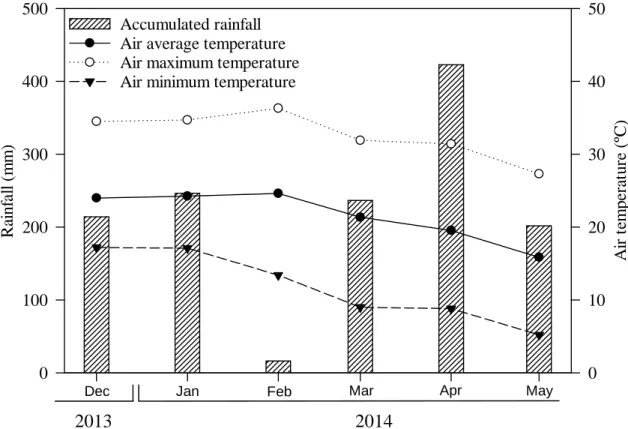
During the experiment driving period, the accumulated rainfall was 710 mm (Figure 1), sufficient to satisfy the water demand of crop, ranging 450-850 (CARVALHO et al., 2013). The month of February 2014 had the lowest accumulated rainfall (16.2 mm), with an average temperature of 24.6ºC. For the month of April, the highest cumulative rainfall was observed (422.8 mm), with an average temperature of 19.5 ° C.
Fig. 1: Values of accumulated rainfall (columns), average temperatures, maximum absolute and minimum absolute of air (lines), obtained by the automatic station INMET number 86951, located in Frederico Westphalen – RS, from December 2013 to May 2014.
The variance analysis showed significance to the traits, first pod insertion (FPI), plant height (PH), number reproductive nodes on main stem (NRNMS), number of pods on main stem (NPMS), number of pods per node on main stem (NPNMS), number of branches (NB), number of reproductive nodes in branches (NRNB), number of pods per branch (NPB), internodes length (IL), branches length (BL), number of viable pods (NLV), number of pods with two kernels(NP2), number of pods with three kernels(NP3), number of pods with four kernels(NP4),
number of non-viable pods (NNP), thousand-kernelsmass with one kernel(TGM1), two kernels(TGM2), three kernels(TGM3), grain yield (GY), relative contribution of pods with one kernel(RC1); two kernels(RC2); three
kernels(RC3) and four kernels(RC4) to the grain yield. No significance was found to the traits number of pods
R
ai
n
fa
ll
(
m
m
)
0
100
200
300
400
500
A
ir
t
em
p
er
at
u
re
(
ºC
)
0
10
20
30
40
50
Accumulated rainfall
Air average temperature
Air maximum temperature
Air minimum temperature
Dec Jan Feb Mar Apr May
with a kernel(NP1), thousand-kernelmass of pods with four kernels(TGM4) and relative contribution of pods
with three kernel (RC1).
The coefficients of variation (CV) measures used in assessing the accuracy of experiments ranged from 5.49% for plant height to 52, 68% to number of pods with four kernels, this can be explained by the fact present number variable branches within the replications, it is clear also that for these traits would need more repetitions and sample size when compared to other traits (FILHO et al, 2009). Overall, this trait is very variable according to cultivar, mineral nutrition, plant spacing, water availability, temperature and solar radiation and especially the environment (MUNDSTOCK; THOMAS, 2005).
In the trait first pod insertion becomes clear superiority for cultivars BMX Classe RR, BMX Potência RR, BMX Força RR and BMX Turbo RR, with an average of 16.14 cm. The cultivars FPS Paranapanema RR and BMX Energia RR showed FPI less than 10 cm (Table 1). This trait influence the mechanical harvesting process where smaller FPI result in increased crop losses, especially in areas with undulated relief (BRAZ et al., 2010).
Table 1: The first pod insertion (FPI), plant height (PH), number of reproductive nodes on main stem (NRNMS), number of pods on main stem (NPMS) and number of pods per node on main stem (NPNMS) of the nine indeterminate growth habit soybean cultivars grown in 2013 second-crop soybean on Rio Grande do Sul, Brazil.
Cultivars FPI PH NRNMS NPMS NPNMS
---cm--- ---unit---
FPS Paranapanema RR 8.84 c 51.54 ef 11.49 a 30.97 a 2.69 a
BMX Classe RR 17.69 a 81.73 a 9.88 b 22.91 b 2.33 abc
BMX Potência RR 16.33 ab 70.71 bc 8.29 cd 18.15 c 2.19 bc
BMX Força RR 17.20 ab 73.05 abc 9.42 bcd 20.02 bc 2.16 c
BMX Energia RR 8.61 c 48.47 f 8.09 d 18.69 c 2.30 abc
BMX Turbo RR 13.35 abc 59.18 de 8.02 d 21.11 bc 2.62 ab
FPS Iguaçu RR 12.44 bc 77.78 ab 9.78 bc 19.81 bc 2.01 c
BMX Tornado RR 11.33 c 65.64 cd 9.24 bcd 20.32 bc 2.19 bc
BMX Alvo RR 11.29 c 54.09 ef 8.69 bcd 20.88 bc 2.40 abc
CV (%) 12.60 5.49 5.61 6.49 6.71
Averages followed by the same letter in the column do not differ statistically by Tukey test at 5% of probabilityerror.
In plant height was observed that the cultivars BMX Classe RR, BMX Força RR e FPS Iguaçu RR showed the greatest height (Table 1). The PH magnitudes observed in this study ranged from 48.47 cm (BMX Energia RR) to 81, 73 cm (BMX Classe RR), revealing the differential response of cultivars for this trait. MARCHIORI
et al., (1999), also observed differences in PH of the cultivars. In studies evaluating cultivars and seeding
season. The authors observed that late seeding in the harvest soybeans tend to increase the AP of indeterminate cultivars, especially of the later cycle, they need greater photoperiod to complete its cycle. This fact is due to the cultivar of such branches vegetative growth issue, even after the start of the breeding period.
The FPS Paranapanema RR cultivar had the highest number of reproductive nodes on the main stem (NRNMS), being superior to the other cultivars (Table 1). It is important that the increasing number of nodes be positively correlated with the number of nodes productive, since we infertile demand photoassimilates but not translate into grain yield, not expressing thus the maximum production potential of the cultivar (JEUFFROY; WAREMBOURG, 1991).
The greater NRMS provides conditions for more flower formation and consequently of pods, because the plant reproductive structures are formed in in the axils nodes (LUDWIG et al., 2010). This was observed in cultivar Paranapanema FPS RR, which showed a higher number of pods on the main stem is greater number of pods per node, 30.97 and 2.69 respectively, thus revealing that this cultivar prioritizes the formation of reproductive structures the main stem(Table 1).
The number of branches were greater for BMX Potência RR, BMX Classe RR, BMX Turbo RR, BMX Tornado RR e BMX Força RR cultivars. The less NB was observed for BMX Energia RR (Table 2). The formation of branches in the plant favors the formation of the reproductive structures, because of the increased number of nodes. However, this causes higher energy demand to maintain these structures, resulting in competition for photoassimilates between these vegetative structures (JÚNIOR; COSTA, 2002).
Table 2: Number of branches (NB), number of reproductive nodes in branches (NRNB), number of pods per branch (NPB), branches lenght (BL) and internodes lenght (IL) of the nine indeterminate growth habit soybean cultivars grown in 2013 second-crop soybean on Rio Grande do Sul, Brazil.
Cultivars NB NRNB NPB BL IL
---unit--- ---cm---
FPS Paranapanema RR 0.68 bcd 2.48 bc 3.58 b 21.99 ab 5.26 c
BMX Classe RR 1.17 abcd 2.35 bc 3.37 b 17.99 b 8.20 ab
BMX Potência RR 1.77 a 4.26 ab 6.18 ab 19.67 b 7.23 abc
BMX Força RR 1.53 abc 3.37 abc 5.33 ab 20.03 b 7.43 abc
BMX Energia RR 0.27 d 0.77 c 1.32 b 14.94 b 7.14 abc
BMX Turbo RR 0.99 abcd 2.10 bc 3.87 b 15.63 b 7.36 abc
FPS Iguaçu RR 0.49 cd 1.24 bc 1.79 b 21.31 ab 8.99 a
BMX Tornado RR 1.72 ab 6.53 a 9.45 a 28.46 a 6.08 bc
BMX Alvo RR 0.60 cd 1.77 bc 3.12 b 17.60 b 6.93 abc
CV (%) 36.25 41.90 43.55 14.24 10.49
Averages followed by the same letter in the column do not differ statistically by Tukey test at 5% of probabilityerror.
For the branches lenght, the BMX Tornado RR cultivar expressed the greater magnitude, differing from the others cultivars, with the exception of FPS Paranapanema RR and FPS Iguaçu RR (Table 2). The soybean plant has high plasticity, able to acclimatize to environmental and management conditions by Averages of changes in morphology and yield components (NOGUEIRA et al., 2012). Branches with greater length may present as a higher power sink, diverting photoassimilates that otherwise could be used in the formation of reproductive structures (KOCH; SCHRADER, 1984).
The FPS Paranapanema RR cultivar presented the less internode length (IL) (5.26 cm), however differing only cultivars BMX Classe RR and FPS Iguaçu RR (Table 2). Less enable the formation of a larger number of nodes in plants that do not show changes in plant height (JÚNIOR; COSTA, 2002), that way, this type of plant architecture presents as an important feature in modern cultivars.
The number of viable pods (NVP) was greater for cultivar FPS Paranapanema RR, however differing only BMX Energia RR, FPS Iguaçu RR, which showed 19% less viable pods compared with others cultivars (Table 3). Researches have shown that the NVP has a positive direct effect on grain yield, due mainly to provide the increase in the number of kernels per plant (NOGUEIRA et al., 2012). The formation of viable pods is dependent on the balance between the production of flowers and the maintenance of the pods after fertilization (JÚNIOR; COSTA, 2002). Usually the soybean crop has a high rate of ovarian abortion and may present a final yield only 28% of the revenue potential presented in flowering (MAEHLER et al., 2003).
The period of greater floral abscission occurs during the process of anthesis (BRUN; BETTS, 1984), relating to the metabolism of the plant, which keeps balance in the production of photoassimilates and fixing reproductive structures. Thus, the limitation photoassimilates mainly provided by hydric, thermal and nutritional stresses at the time of anthesis, causes a reduction in the number of viable pods, damaging the production potential of crop (MAEHLER et al., 2003).
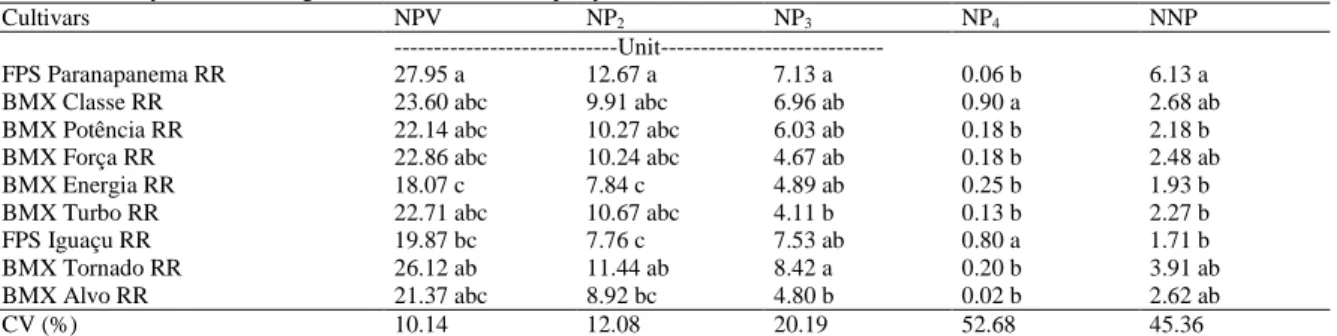
The FPS Paranapanema RR cultivar was superior the others in the number of pods with two kernels, representing 45.33% of total viable pods this cultivar (Table 3). For this trait, the FPS Iguaçu RR and BMX Energia RR cultivars presented 26.23% less pods with two kernels in relation to others cultivars studied. The number of pods with three kernels was greater for the FPS Paranapanema RR and BMX Tornado RR cultivars, representing 25.50% and 32.23% of the total number of viable pods, respectively. These cultivars differed only of BMX Turbo RR and BMX Alvo RR cultivars (Table 3). The number of pods with four kernels was superior for the BMX Classe RR and FPS Iguaçu RR cultivars, however, to represent only 3.81% and 4.02% of the total number of viable pods, respectively. The others cultivars did not differ for this character (Table 3).
Table 3: Number of viable pods (NPV), number of pods with one kernel (NP1), number of pods with two kernels(NP2), number of pods with
three kernels(NP3),number of pods with four kernels(NP4) andnumber of nonviable pods (NNP): of the nine indeterminate growth
habit soybean cultivars grown in 2013 second-crop soybean on Rio Grande do Sul, Brazil.
Cultivars NPV NP2 NP3 NP4 NNP
---Unit---
FPS Paranapanema RR 27.95 a 12.67 a 7.13 a 0.06 b 6.13 a
BMX Classe RR 23.60 abc 9.91 abc 6.96 ab 0.90 a 2.68 ab
BMX Potência RR 22.14 abc 10.27 abc 6.03 ab 0.18 b 2.18 b
BMX Força RR 22.86 abc 10.24 abc 4.67 ab 0.18 b 2.48 ab
BMX Energia RR 18.07 c 7.84 c 4.89 ab 0.25 b 1.93 b
BMX Turbo RR 22.71 abc 10.67 abc 4.11 b 0.13 b 2.27 b
FPS Iguaçu RR 19.87 bc 7.76 c 7.53 ab 0.80 a 1.71 b
BMX Tornado RR 26.12 ab 11.44 ab 8.42 a 0.20 b 3.91 ab
BMX Alvo RR 21.37 abc 8.92 bc 4.80 b 0.02 b 2.62 ab
CV (%) 10.14 12.08 20.19 52.68 45.36
For the cultivars studied notes is greater participation of pods with two kernels followed by three kernels, and the mass of kernels important factor. The number of kernels per pods by genetic factor is determined by breeding, however influenced by the environment, thus it recommends itself for cultivars producing three ovules (MCBLAIN & HUME, 1981). The high plant density, reduced spacing and unfavorable environmental conditions causes the number of pods formed under these conditions, depending on the nutritional competition does not develop the seeds, or as soon remain empty, resulting in reduction in production (HEIFFING, 2002).
For the trait number of non-viable pods (NNP), it became clear that the Paranapanema RR cultivar was higher than others (Table 3). Nonviable pods do not contribute to the grain yield, however, act as drain assimilates, thus impairing the productive potential of the crop. Researches assessing the yield potential of soybean during ontogeny, revealed that the increase in the number of empty pods and with one kernel occurs due to the lower water availability and photosynthate during the kernel filling (MAEHLER et al., 2003).
The thousand-kernel mass (TGM) is a major component of soybean in grain yield, as it has a positive and direct association with grain yield (SOUZA et al., 2015). For the traits TGM1, TGM2 and TGM3, the FPS Iguaçu
RR cultivar presented the higher magnitudes (176.12, 183.79 and 196.36 grams, respectively), already the BMX Classe RR cultivar had the less values (90.56, 108.48 and 120.83 grams, respectively) (Table 4).
Few researches revealed the importance of the one thousand-kernel mass in pods with different kernels numbers. It is noted that in all cultivars, TMG tended to be greater when there was a higher number of kernels in pods (Table 4). This can be physiologically explained by the greater competitive ability to accumulate photoassimilates per unit mass, observed in pods with the highest number of kernels (JEUFFROY; WAREMBOURG, 1991). The change in size or sink activity results in changes in patterns of translocation phloem sap, where pods with higher specific mass in proportion to the total number of plant pods have greater ability to import carbon, becoming a more competitive sink (BRUN; BETTS, 1984; JEUFFROY; WAREMBOURG, 1991).
Table 4: Thousand kernels mass of pods with a kernel (TGM1), two kernels (TGM2), three kernels (TGM3) and four kernels (TGM4) of the
nine indeterminate growth habit soybean cultivars grown in 2013 second-crop soybean on Rio Grande do Sul, Brazil.
Cultivars TGM1 TGM2 TGM3
---g 1000 kernels-1---
FPS Paranapanema RR 95.34 b 108.48 cd 120.83 bcd
BMX Classe RR 90.56 b 99.05 d 111.63 d
BMX Potência RR 114.04 b 113.00 bcd 119.89 bcd
BMX Força RR 108.12 b 120.98 bcd 124.81 bcd
BMX Energia RR 133.53 ab 142.076 b 151.24 bc
BMX Turbo RR 119.73 b 136.78 bc 144.73 bcd
FPS Iguaçu RR 176.12 a 183.79 a 196.36 a
BMX Tornado RR 102.83 b 113. 27 bcd 115.05 cd
BMX Alvo RR 122.82 ab 137.51 bc 152.59 b
CV (%) 16.29 8.41 9.23
Averages followed by the same letter in the column do not differ statistically by Tukey test at 5% of probabilityerror.
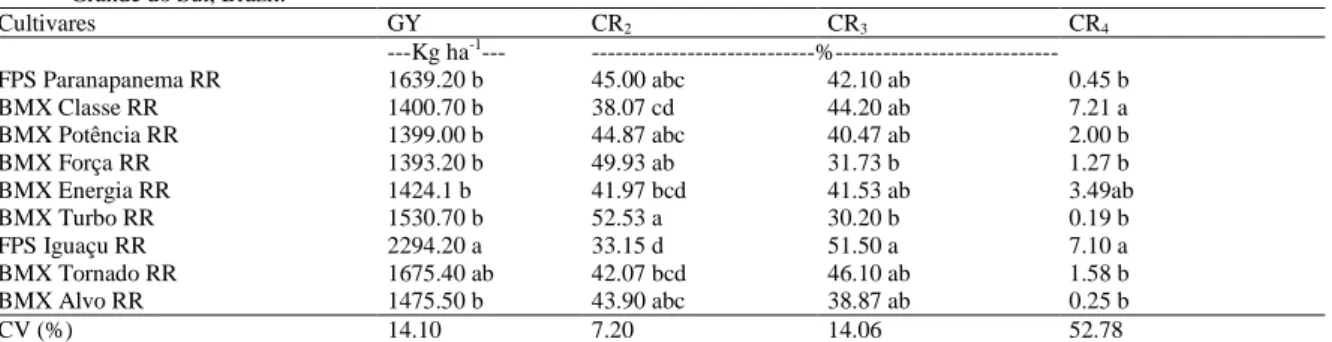
For the grain yield, superiority was evident to FPS Iguaçu RR cultivar (2294.20 kg), differing from the others, except of BMX Tornado RR cultivar (Table 5). Confirming the results Borges et al. (2013), the conduct of regional trials of cultivars showed similar grain yield to FPS Iguaçu RR cultivar (2326 kg ha-1). The evidenced results showed a reduction in grain yield of 39.30% from the overall average of the experiment and the average productivity of Rio Grande do Sul state in first crop soybean 2013/2014, which was 2605 kg ha-1 (CONAB, 2014). However, considering only cultivar FPS Iguaçu RR, the reduction is only 11.94%, That way there are potential crops to be seeding in second-crop for this soybean region without large reduction in grain yield. However, the relative performance of cultivars can change depending on where it is grown, due to the occurrence of the cultivar x environment interaction (PELUZIO et al., 2015).
Table 5: Grain yield (GY), relative contribution of pods with one kernel (RC1), two kernels (RC2), three kernels (RC3) and four kernels
(RC4) to total grain yield of the nine indeterminate growth habit soybean cultivars grown in 2013 second-crop soybean on Rio Grande do Sul, Brazil.
Cultivares GY CR2 CR3 CR4
---Kg ha-1--- ---%---
FPS Paranapanema RR 1639.20 b 45.00 abc 42.10 ab 0.45 b
BMX Classe RR 1400.70 b 38.07 cd 44.20 ab 7.21 a
BMX Potência RR 1399.00 b 44.87 abc 40.47 ab 2.00 b
BMX Força RR 1393.20 b 49.93 ab 31.73 b 1.27 b
BMX Energia RR 1424.1 b 41.97 bcd 41.53 ab 3.49ab
BMX Turbo RR 1530.70 b 52.53 a 30.20 b 0.19 b
FPS Iguaçu RR 2294.20 a 33.15 d 51.50 a 7.10 a
BMX Tornado RR 1675.40 ab 42.07 bcd 46.10 ab 1.58 b
BMX Alvo RR 1475.50 b 43.90 abc 38.87 ab 0.25 b
CV (%) 14.10 7.20 14.06 52.78
The relative contribution of total pods in relation to grain yield shows that cultivar BMX Turbo RR had its grain yield highly contributed by the number of pods with two kernels (52.53%). The lower contribution of these pods to GY was evidenced in the cultivar FPS Iguaçu RR (33.17%). For this cultivar, most of its GY (51.50%) was expressed in pods with three kernels differing only of BMX Força RR and BMX Turbo RR cultivars. The pods with four kernels represented a small part of the GY of cultivars studied, with the major contributions of this type of pod to the GY were observed for BMX Classe RR and FPS Iguaçu RR cultivars, with only 7.20% and 7.10%, respectively (Table 5).
The results revealed that the grain yield of each cultivar is influenced by pods with different number of kernels. For example, the highest grain yield for the FPS Iguaçu RR cultivar is explained by the higher number of pods with three kernels, higher specific mass of these kernels, in which more than 50% ofgrain yield of this cultivar was explained by these pods.
The phenotypic Pearson product-moment correlation analysis (N = 27) showed that 24 linear associations among traits and the grain yield, 12 were significant (Table 6).The trait number of pods containing three kernels, thousand-kernel mass of pods with three kernels and relative contribution of pods containing three kernels, present the strongest and positive linear trends with the grain yield, and they r = 0.75, r = 0.58 and r = 0.69, respectively, reinforcing the importance of these traits for grain yield.
Table 6: Pearsonproduct-momentliner correlation among morphological traits, yield components and grain yield of the nine indeterminate growth habit soybean cultivars grown in 2013 second-crop soybean on Rio Grande do Sul, Brazil.
Traits
a
FPI PH NRNMS NPMS NPNMS NB NRNB NPB BL
GY -0.17ns 0.39* 0.41* 0.43* 0.33ns -0.04ns 0.020ns 0.06ns 0.26ns
IL NPV NP1 NP2 NP3 NP4 NDP TGM1 TMG2
GY 0.18ns 0.49** -0.10ns 0.30ns 0.75** 0.44* 0.03ns 0.63** 0.57**
TGM3 TGM4 RC1 RC2 RC3 RC4 - - -
GY 0.59** 0.05ns -0.50** -0.69** 0.69** 0.34ns - - -
*significant at 5% probability by the t test with 25 Degrees Freedom.
a (FPI) first pod insertion; (PH) plant height; (NRNMS) number reproductive nodes on main stem; (NPMS)
number of pods on main stem; (NPNMS)number of pods per node on main stem; (NB) number of branches; (NRNB) number of reproductive nodes in branches; (NPB) number of pods per branch; (BL) branches length; (IL) internodes length; (NPV) number of viable pods; (NP1) number of pods with a kernel; (NP2) number of
pods with two kernels; (NP3) number of pods with three kernels; (NP4) number of pods with four kernels;
(NNP) Number of non-viable pods; (TGM1) thousand kernels mass of pods with a kernel; two kernels (TGM2),
three kernels (TGM3) and four kernels (TGM4); (RC1) relative contribution of pods with a kernel; two kernels
(RC2); three kernels (RC3) and four kernels (RC4).
Researches had revealed that the total number of pods per plant has a strong and positive correlation (r> 0.90) with grain yield (IQBAL et al., 2003). In this research, we revealed a positive association between NVP and GY (r = 0.49). However, it can be seen that the trend of the three pods kernels was higher (r = 0.75). The associations between the thousand-kernel mass derived from pods with one, two and three kernels, revealed a positive correlation with grain yield (r = 0.63, r = 0.57 and r = 0.59, respectively).
Conclusions:
The yield componentes show diferent among the cultivars in second-crop growth, except for the number of pods with a grain, thousand grain mass of pods with four grains and relative contribution of pods with a grain.
The FPS Paranapanema RR cultivar presents greater number of reproductive nodes, number of pods and number of pods per node on the main stem, but the yield is hindered because of their grain present lower specific mass for the second-crop condition.
Among the viable pods, the number of pods with three grains has the highest trend of linear association with grain yield. Under these conditions to FPS Iguaçu RR has the highest grain yield due to the high contribution of pods with three grains (51.50%) provided the largest number of these pods (7.53%) and higher specific mass (196.36), a decrease of only 12% compared to the average yield of the first crop in the Rio Grande do Sul state.
For cultivars in second-crop conditions, there has been greater participation of pods with two followed by three kernels, and the mass of these, limiting factor in performance.
REFERENCES
BORGES, W.L.B., G.P. MATEUS, R.S. FREITAS, DE, E. LAZARINI, G.C. FILHO, J.L. HIPÓLITO, F.S. TOKUDA, N.R. TOMAZINI, A.C. GASPARINO, E.L. FINOTO, 2013. Avaliação regional de cultivares de soja no noroeste paulista safras 2011/12 e 2012/13. Nucleus, 10: 3.
BRAZ, G.B.P., G.M. CASSOL, G.A.P. ORDOÑEZ, G.A. SIMON, S. DE OLIVEIRA PROCÓPIO, A.M. DE OLIVEIRA NETO, W.C. FERREIRA FILHO, H.A. DAN, 2010. Componentes de produção e rendimento de soja em função da época de dessecação e do manejo em pós-emergência. Revista Brasileira de Herbicidas, 9(2): 63-72.
BRUN, W.A., K.J. BETTS, 1984. Source/Sink relations of abscising and nonabscising soybean flowers. Plant Physiology, 75(1): 187-191.
CARVALHO, I.R., C. KORCELSKI, G. PELISSARI, A.D. HANUS, 2013. Demanda hídrica das culturas de interesse agronômico. Enciclopédia Biosfera, 9(17): 969-985.
CONAB., 2014. Acompanhamento da Safra Brasileira de Grãos. 10. ed. Brasília: Conab, 2014. Disponível em:<www.conab.gov.br/OlalaCMS/uploads/arquivos/14_07_09_09_36_57_10_levantamento_de_graos_julho_ 2014.pdf> Acesso em: 25 Jan. 2016
CONAB., 2016. Acompanhamento da Safra Brasileira de Grãos. 4. ed. Brasília: Conab. Disponível Em:<http://www.conab.gov.br/OlalaCMS/uploads/arquivos/16_01_12_14_17_16_boletim_graos_janeiro_2016. pdf> Acesso em: 25 Jan. 2016
CRUZ, C.D., 2013. GENES: a software package for analysis in experimental statistics and quantitative genetics. Acta Scientiarum. Agronomy, 35(3): 271-276.
EMBRAPA., 2006. Sistema Brasileiro de classificação de solos. 2. ed. Rio de Janeiro: Embrapa Solos. FILHO, A.C., D.H.R. EVANGELISTAII, E.C.P.G.L. STORCKI, 2009. Tamanho de amostra de caracteres de cultivares de soja. Ciência Rural, 39(4): 983-991.
JEUFFROY, M.H., F.R. WAREMBOURG, 1991. Carbon transfer and partitioning between vegetative and reproductive organs in Pisum sativum L. Plant Physiology, 97(1): 440-448.
JÚNIOR, H.M.N., J.A. COSTA, 2002. Contribuição relativa dos componentes do rendimento para produção de grãos em soja. Pesquisa Agropecuária Brasileira, 37(3): 269-274.
IQBAL, S., T. MAHMOOD, M.A. TAHIRA, M. ANWAR, M. SARWAR, 2003. Path coefficient analysis in different genotypes of soybean (Glycine max (L) Merril). Pakistan Journal of Biological Science, 6(12): 1085-1087.
KOCH, K.E., L.E. SCHRADER, 1984. 14C-photosynthate partitioning and translocation in soybeans during reproductive development. Plant Physiology, 75(4): 1040-1043.
LUDWIG, M.P., L.M.C. DUTRA, O.A. LUCCA FILHO, L. ZABOT, D. UHRY, J.I. LISBOA, A. JAUER, 2010. Morphologic characteristic of the conventional soybean genotype and Roundup ReadyTM according to the sowing season and seed densities. Ciência Rural, 40(4): 759-767.
MAEHLER, A.R., J.L.F. PIRES, J.A. COSTA, F.G. FERREIRA, 2003. Potencial de rendimento da soja durante a ontogenia em razão da irrigação e arranjo de plantas. Pesquisa Agropecuária Brasileira, 38(2): 225-231.
MALUF, J.R.T., 2000. Nova classificação climática do Estado do Rio Grande do Sul. Revista Brasileira de Agrometeorologia, 8(1): 141-150.
MARCHIORI, L.F.S., G.M. CÂMARA, S. DE, C.P. PEIXOTO, M.C. MARTINS, 1999. Desempenho vegetativo de cultivares de soja [Glycine max (l.) merrill] em épocas normal e safrinha. Scientia Agricola, 56(2): 383-390.
MCBLAIN, B.A., D.J. HUME, 1981. Reproductive abortion, yield components and nitrogen content in three early soybean cultivars. Canadian Journal of Plant Science, 61(3): 499-505.
MUNDSTOCK, C.M., A.L. THOMAS, 2005. Soja: fatores que afetam o crescimento e o rendimento de grãos. Porto Alegre: Evangraf, p: 31.
NOGUEIRA, A.P.O. et al. 2012. Análise de trilha e correlações entre caracteres em soja cultivada em duas épocas de semeadura. Bioscience Journal, 28: 6.
PEIXOTO, C.P., G.M. CÂMARA, S. DE, M.C. MARTINS, L.F.S. MARCHIORI, R.A. GUERZONI, P. MATTIAZZI, 2000. Épocas de semeadura e densidade de plantas de soja: I. Componentes da produção e rendimento de grãos. Scientia agricola, 57(1): 89-96.
PELUZIO, J.M., R.R. FIDELIS, P. GIONGO, J.C. SILVA, DA, D. CAPPELLARI, H.B. BARROS, 2015. Adaptabilidade e estabilidade de cultivares de soja em quatro épocas de semeadura no sul do Estado do Tocantins. Ceres, 55: 1.