The University of San Francisco
USF Scholarship: a digital repository @ Gleeson Library |
Geschke Center
Master's Theses Theses, Dissertations, Capstones and Projects
Fall 12-12-2014
Into The Red: A Look into the Reasons Why
Refugees Decide to Flee, Settle or Migrate to and
from Morocco
Fadeelah E. Holivay
University of San Francisco, [email protected]
Follow this and additional works at:https://repository.usfca.edu/thes
Part of theAfrican Languages and Societies Commons,African Studies Commons,Cultural History Commons,Economic History Commons,Ethics in Religion Commons,French and Francophone Language and Literature Commons,Gender, Race, Sexuality, and Ethnicity in
Communication Commons,History of Religion Commons,History of Religions of Eastern Origins Commons,Human Geography Commons,Infrastructure Commons,International and Intercultural Communication Commons,Islamic World and Near East History Commons,Legal Theory
Commons,Nature and Society Relations Commons,Near and Middle Eastern Studies Commons, Other International and Area Studies Commons,Other Legal Studies Commons,Other Public Affairs, Public Policy and Public Administration Commons,Peace and Conflict Studies Commons, Political History Commons,Race, Ethnicity and Post-Colonial Studies Commons,Social and Cultural Anthropology Commons,Social History Commons, and theSocial Welfare Commons
This Thesis is brought to you for free and open access by the Theses, Dissertations, Capstones and Projects at USF Scholarship: a digital repository @ Gleeson Library | Geschke Center. It has been accepted for inclusion in Master's Theses by an authorized administrator of USF Scholarship: a digital repository @ Gleeson Library | Geschke Center. For more information, please [email protected].
Recommended Citation
Holivay, Fadeelah E., "Into The Red: A Look into the Reasons Why Refugees Decide to Flee, Settle or Migrate to and from Morocco" (2014).Master's Theses. 123.
INTO THE RED
By Fadeelah E. HolivayThis research paper explores some of the main reasons why refugees and asylum seekers, particularly from sub-Saharan African countries, embark on a journey and decide to settle, flee or migrate to and from Morocco. Because of this phenomenon, Morocco has seen a 96% increase of refugees migrating to the borders of Morocco each year for the past three years. Many say that this astonishing increase of migrants choosing Morocco is due to such factors as: wars breaking out regionally across central African and Middle Eastern countries causing them to flee; Morocco being a culturaly diverse francophone country whose laws and policies are accepting to foreigners and it’s economy has become more prosperous as it develops towards liberal views seen in western countries, which makes them want to settle; and due to Morocco’s proximity to Europe many refugees and asylum seekers use it as a transit country to cross over into European territories, which ultimately makes them want to migrate from Morocco. This new migration trend, however poses many obstacles for Morocco’s still developing refuee laws a well as Intternational migration laws when they look at what actually constitutes as a refugee or an asylum seeker.
A Look into the
Into the RED: A Look into the Reasons why Refugees Decide to Flee, Settle or Migrate to and from Morocco
In Partial Fulfillment of the Requirements for the Degree
MASTER OF ARTS In
INTERNATIONAL STUDIES
By
Fadeelah E. Holivay
December 1, 2014
UNIVERSITY OF SAN FRANCISCO
Under the guidance and approval of the committee, and approval by all the members, this thesis project has been accepted in partial fulfillment of the requirements for the degree. APPROVED:
_________________________________ _________
Advisor Date
_________________________________ _________ Academic Director Date
Contents
Acknowledgment ... 5
Chapter 1: Introduction ... 6
Research Questions ... 9
Methodology ... 10
Interviews (Policy Makers and Migrants) and Observation ... 11
Surveys ... 12
Archival Research ... 13
Limitations ... 13
Biography ... 15
Broader Significance ... 16
Chapter 2: Literature Review ... 17
Refugee Law of Morocco: Then, Now and what’s to Come ... 19
Pull factors of Why Sub-Saharan Africans choose to Migrate to Morocco ... 23
Government and Political Makeup ... 23
Pull Factors to Migrate to Morocco -Morocco’s Economic Makeup ... 27
Social Makeup ... 28
Main Cities for Migration ... 29
Rabat ... 29
Casablanca ... 30
Push Factors to flee to Morocco- Refugees Migrating to Morocco... 31
Contributing Factors of Why Refugees Choose Morocco ... 31
Refugees Migrating to Morocco ... 33
Why Are Refugees Fleeing to Morocco? ... 34
Political and Civil Wars in Sub-Saharan Africa ... 35
Morocco a “Transit Country” to one of the World’s Top Destinations: Europe ... 40
Chapter 3: Data &Findings ... 42
Interviews ... 43
Policy Makers: The UNHCR and the UNESCO Center for Law and Migration ... 43
Local Moroccans ... 48
Archival Research ... 50
Surveys ... 60
Chapter 4: Discussion, Recommendations and Conclusion ... 63
Discussion Recommendations and Conclusion ... 64
Refugees Fleeing to Morocco ... 64
Refugees Settling in Morocco ... 66
Refugees Migrating from Morocco ... 66
Further Research ... 67
Theory Moving Ahead ... 68
Recommendations ... 68
Conclusion ... 70
Appendices ... 73
Appendix A: Descriptions of Government and Non-Government Organizations: The UHNCR and the UNESCO Centre for the Law and Migration... 74
The UNHCR ... 74
The UNESCO Centre “The Law and Migration” ... 75
Appendix B: Legal Framework of Migration and Refugee Laws and Policies of Morocco’s ... 76
Appendix C: Sample Surveys ... 77
Bibliography ... 84
Figures
Figure 1: Number of Refugees who flee to Morocco from the DRC ... 52Figure 2: Foreign Nationals Apprehended at Morocco’s Borders ... 53
Figure 3: Refugee and Asylum Seekers in Morocco ... 54
Figure 4: Asylum Seekers by Country ... 57
Tables
Table 1: Asylum Seeker Population in Morocco - 2014 ... 55
Table 2: Children Asylum Seekers - 2014 ... 56
Table 3: Women Asylum Seekers - 2014 ... 56
Table 4: Refugee Population in Morocco - 2014 ... 58
Table 5: Children Refugees - 2014 ... 58
Table 6: Women Refugees - 2014 ... 59
Table 7: Comparison of Refugee and Asylum Seeker who Migrated to Morocco 2011 & 2014 ... 64
Acknowledgment
First, I would like to thank my advisor Professor Stephen Zunes for taking me under his advisement and believing in my topic, as well as Professor Dorothy Kidd, Professor Khadija Elmadmad and Professor Lucia Cantero for your guidance through this entire writing process. Your help was crucial in the shaping of my ideas and structuring of my research topic that now lies before my readers. I appreciate your help immensely.
Secondly, I would like to thank my peers and colleagues from the MAIS program for believing in me and showing their support. There were times when I wanted to give up and I didn’t think that I would complete this paper, but you all gave me the strength and inspiration that got me through the darkest hours of writing. I honor the bonds and friendships that we have formed through this insanity they call grad school.
Automatically I am categorized when the train conductor chooses to speak to me not in French the preferred language amongst tourist here or even English the worldly language, instead he greets me in Arabic and thanks me by saying “Shukran” for giving him my ticket (billet). So far I am able to get by on my French mixed in with some English words however; English here in Morocco is definitely not preferred.As I make my way through the airport from passport entry to customs I get a sense that the people are not really sure where I am from. With my name and my US passport I get these knowing looks… “She is an Arab-Moroccan girl living the Western dream, or as the passport officer said “very nice origin, you are beautiful” I wonder how this experience will turn out. Will I be considered an insider or outsider and which one will be preferred when collecting my data for my research. Are there perks of being a foreigner in this foreign land comprised of many foreigners? I guess I will find out as this trip progresses…
Fadeelah Holivay Train Ride to Casablanca Morocco, “The country that travels within you” boasts a new strapline for an advertisement campaign on www.visitmorocco.com to get tourist from all over the world to come and encounter experiences and memories that will live in them throughout their lives. But one can’t help to think how that whole experience would translate to one that decides to migrate to Morocco in search of better opportunities for the families or to seek asylum from a war. Will it be an experience to remember or one to dread. Over the past decade, Morocco, a francophone country that is part of the Maghreb region and located in Northern Africa has been an unwilling recipient of refugees coming from Sub-Saharan Africa in the past decade.
refugees seeking asylum remains undocumented according to the UNHCR’s 2013 report (UNHCR, 2013). Consequently, Morocco has become both an origin and destination country for many migrants and “persons of concern”1.
Morocco has become one of the most important migration countries in the world. Morocco’s migration flows are actually considered to be highly diverse because the migrants who decide to migrate to Morocco belong to various ethnic groups and socio-economic positions, which are found in many different countries all over the world (De Haas, 2007). Accordingly, Moroccan migration occupies an important place in the overall picture of world migration (Sasin, 2008). The country has played an especially major role in labor migration to Europe over the past six decades (De Haas, 2007).
Thus, Morocco provides a perfect picture of the lively trend caused by
international migration that has been observed today. Migration is an important socio-economic process and has thus fundamentally influenced the country’s development and the livelihoods of the migrants and their families. Considering that, it is forecasted that international migration will continue to be prominent in Morocco. However one must think of the reasons why people from all over Africa and the Middle East would want to migrate to and from Morocco.
An article titled: Refugees living in Morocco must decide whether to settle or flee to Europe by Agence France-Presse, covers many reasons why hundreds of refugees in Sub-Saharan African countries like, The Democratic Republic of Congo, choose whether
1 According to the definition of the UNHCR “a person of concern includes people that are
to flee voluntarily or involuntarily from their country to avoid tribal/civil wars and look to settle in this “transit country” with scant opportunities, while According to a 2002 report by Channe Lindstrom titled: The Refugees Situation in Morocco states that the problem of illegal immigration into Morocco as a country of transit towards European destinations is one of the major problem facing Morocco today.
The current literature states that Morocco has a long standing Refugee law that is set in place to accommodate refugees, however even with such a law and a recent reform to its refugee law in 2014 (IRIN, 2014), Morocco is still not equipped or accustomed to accommodate the influx of refugees that continue to migrate to Morocco’s major cities in particular Casablanca and Rabat as far as infrastructure, social programs and economic wellbeing. Yet, the refugees continue to migrate there.
The purpose of my research thesis is to find out the reasons why refugees
specifically from sub-Saharan African countries like the Democratic Republic of Congo, Senegal, or even the Ivory Coast, choose and continue to migrate and seek asylum in the country of Morocco, despite the many obstacles they face socially as well as
economically.
Research Questions
the final destination for these refugees or is Morocco just a transit stop on their way to settling in Europe, which may be able to provide a stable political country, work and housing opportunities?
What is the general reception of refugees in Moroccan cities such as Rabat and Casablanca from the point of view of the migrants themselves as well as the local Moroccan population? Do these refugees choose to migrate to Morocco because it is a stable Islamic country with the same cultural and traditional values as well as colonial ties that they are accustomed to? Is it because it has liberal views connected to the modernity of western influence that is currently developing rapidly in Morocco?
These questions stem mainly from the policies and laws that Morocco has in place for accepting or declining foreigners therefore one can say that without the issues of immigration law and policy nationally as well as internationally, would these questions still be applicable?
Methodology
I wanted to find out the reception of refugees and asylum seekers in Morocco and find ways to visually connect and see the obstacles presented to these immigrants first hand. I decided to go there this summer for two weeks and conduct my field research in as many Moroccan cities that I could travel to which ended up being two. This was my first time in Morocco so culturally and socially it took some time getting used to, however with my time being limited I had to adapt and integrate almost instantly.
emphasis on qualitative techniques. In my short but very productive two-week research trip to the Moroccan cities of Casablanca and Rabat, I got the opportunity to conduct two two-hour meaningful interviews with members within the main migration organizations that creates immigration laws and policies, five ten-minute interviews with
refugee/asylum seekers2 from the sub-Saharan African region and five one-hour interviews with local Moroccan citizens. I even attempted to administer 10 enquetes3; however there were some limitations to this particular method. I also conducted archival research at institutions such as the Casablanca Library and The Institute for Islamic and Human Studies. This led me to collect data via internet as well as from different sources such as law books and Moroccan authors such as Khadija Elmadmad.
Interviews (Policy Makers and Migrants) and Observation
For the purpose of getting a feel of the real day-to-day life of the refugees living in Morocco I conducted field research consisting of a mixture of ethnographic
approaches. I employed mainly a non-interactive approach where I went to major areas in Casablanca and Rabat over a two-week period and watched the interaction of the
refugees/asylum seekers with local Moroccans in public areas such as the market, places of worship and places of leisure even the refugee camps to record the mood, and the unspoken stories of these refugees. I tried not to interact with the population and just observed and recorded the social community and the interactions between local Moroccans and refugees.
2
There was no way for me to identify the status of my interviewees, therefore when I say refugee and or asylum seeker they mean one in the same.
3
I then conducted five random interviews in kind of a snow ball method with sub-Saharan African women who happened to work in the Kasbah market areas of
Casablanca and Rabat in order to get the personal stories and accounts of their journey to Morocco and how life was as a refugee living in Morocco. This type of interaction gave me quantitative insight based on social acceptance, cultural integration and
discrimination that is allegedly displayed by local Moroccans towards the sub-Saharan refugees, for which mainly I did not witness. For the interviews I identified participants based on randomization as well. My goal through these interviews was to try to get a sense of the reasons why they chose Morocco as a place to seek asylum and to find out the positive and negative effects now that they were living there.
Since I was only in Morocco for 2 weeks, I relied heavily on the internet and email communication to retrieve follow up information on the in-person interviews I conducted with the Director of The UNESCO Center and The public relations team at UHNCR in order to get a better understanding of the resources and infrastructures put in place to accommodate the current and growing refugee populations in the Casablanca and Rabat.
Surveys
Archival Research
Using the internet, journals, reports and newspaper articles about refugees and refugee law in Morocco, I found that this would be the most effective method as far as collecting data over the course of time for my research. These migration trends for refugees wanting to flee to Morocco is not a new phenomenon, however the
circumstances in the last 10 years such as democracy reaching different parts of Africa, the revolt and power struggle of middle eastern countries and the rapid expansion of globalization has made these migration trends increase and zone in on countries in North Africa that are receiving the majority of the influx. I also accessed refugee laws and policies over the past 30 year period in order to analyze and see if the changes in these policies or laws have contributed to the past and current trends in refugee migration to Morocco.
Limitations
The second limitation was accessibility to non-profit organizations and refugees willing to participate in research. I had contacted 3 of the major nonprofit organizations that provided services and resources for refugees and asylum seekers in Morocco and not one responded. I ultimately made connections with the UNESCO Center for Law and Migration, which aided me in finding out the needed information about Morocco’s past and current refugee laws but gave me no access to actual refugees. It was crucial that I get at least one of these organizations as a contact going in to Morocco so that I readily had access to a segment of the refugee population. However this still mad no difference as far as having access to the local refugee population.
The third limitation was limited/no access to all of the cities that has a Sub-Saharan African refugee population. I will only be visiting Casablanca and Rabat due to time restrictions and I know that such cities as Ouija, Fes, Marrakesh and Tangier have major Sub-Saharan African refugee populations as well. So by limiting my research to only two cities I may not be able to uncover the whole perspective of why these refugees choose Morocco to seek asylum.
Biography
My father who is an Arab American and my mother, who is an African-Native American, started a non-profit organization while I was growing up in the early
90s. Their shelter was dedicated to helping refugees and other displaced people within the inner city of Cleveland, Ohio who needed a place to stay, food to eat, or simply a place to belong. They always taught me that no matter where our journeys in life may take us, to always remember to help others along the way. Compassion, optimism, and altruism were the attributes my parents instilled in me at a young age, which I continue to possess to this day.
Despite my parents’ accomplishments, they were often the recipients of stereotypical ridicule mainly because of their religion and race. This frequently led to misguided people breaking into their shelter, destroying the property, writing racial slurs on the walls, and demolishing my parents’ ten years’ worth of dedication and investment they put into enhancing the community. These violent, vandalistic, and prejudicial acts ultimately forced me and my family to move to Texas and part with our closest friends, relatives, and the only place we called home.
place at the age of twelve, a natural zeal to protect those who could not protect themselves arose in me.
With that said, being that there is currently so much coverage on the wars that are taking place in the Middle east like in Syria and the ongoing war and government
corruption that is taking place in Sub Saharan countries like the DRC and in Senegal that is rarely talked about and have been deemed the forgotten wars of the world I decided to put my focus into looking at the aftermath of how this is affecting the people of these countries that ultimately leads to the involuntary migration to such places as Morocco as they search for ways to start over and seek better opportunities socially and economically The title, Into the Red has a dual meaning. The first meaning is the more obvious; a red flag with a Green star represents the country of Morocco. The refuges are literally entering the red country The second meaning can be considered more interpretive, that by these refugees involuntarily leaving their homes whether it’s for war or in search of a better lifestyle by migrating into Morocco they are fleeing into the unknown, a place where they are not sure if they will be accepted into or even granted the right to legally stay, they have fled into a red zone.
Broader Significance
migration influxes that are a result of such factors as tribal and political wars happening in Sub-Saharan African regions, and the economic hardship experienced in this region that leads to the these refugees seeking a more stable and liberal economy (economically, socially, and politically) either in Morocco or in other countries that are influenced by the Western Modernity.
For my research thesis I consulted the following bodies of literature to frame my analysis: Refugee Law of Morocco: Then, Now and What’s to Come, The history of Colonization as a result of Migration to North Africa and The push (war, labor etc..) factors versus the pull (economy, social, cultural) factors of why sub-Saharan Africans choose migrate to Morocco. I selected these bodies of literature because it seems that these are the current issues that refugees are faced with in Morocco, yet there seems to be limited or no current scholarship addressing how these factors affect the actual status of refugees. This includes influential data and how it aides in their decision whether to flee settle or migrate to and from Morocco.
Refugee Law of Morocco: Then, Now and what’s to
Come
Also since Europe has seen a rise in illegal undocumented immigrants coming from Morocco’s border over the past 10 years, Lindstrom states that “the European Union is placing the government of Morocco under increasing pressure to set up harsh border controls and deport any illegal aliens on Moroccan territory”. Another dilemma that poses a threat to all refugees is an unclear distinction of what separates an economic migrant from a refugee looking for asylum in Morocco, therefore any efforts used to combat illegal or undocumented immigrants coming into Morocco negatively affects all refugees in the country.
Refugee law of Morocco has deep roots in Islam known as ‘hijrah law”. Khadija Elmadmad, an International Lawyer and the Director of the UNESCO Center for The Law and Migration (CUDM) A in her scholarly report titled “Asylum in Islam and Modern Refugee Law “talks about the refugee law of Morocco and how although it is based on an Islamic law that dates back 14 centuries and in theory offers more protection to asylum seekers and refugees known as “mustaminun”, modern refugee law applied today in Morocco does little or nothing to uphold or apply such tolerant views
(Elmadmad, 2008).
During the years, the different international conventions have been ratified to meet the demands of the growing refugee populations that have been fleeing to Morocco.
Channe Lindstrom, a Masters student at the American University of Cairo in his report on migration to Morocco titled “Report on the Situation of Refugees in Morocco”,
as well as L. Schuster in his 2005 article titled, The Realities of a New Asylum Paradigm, mentions that Morocco acknowledges and participates in the International recognition of refugees fleeing to Morocco under the asylum law like the 1951 Geneva
Convention, 1967 New York Protocol and even the 1969 African Unity
Convention, however due to increased illegal crossing of undocumented refugees over European Borders like Spain and Italy, the European Union has put increasing pressure on the Moroccan government to cut down on illegal migration by limiting or excluding certain ethnic groups such as those from Sub-Saharan Africa (Lindstrom, 2002, Schuster, 2005). According to Article 31 of the 1972 Moroccan Constitution of 1972, it requires that “all ratified international conventions become part of the Moroccan legal system and take precedence over other laws”(Lindstrom, 2002). This means that the king has the power to ratify treaties and laws and if it happens to be a Universal or International law, the King will apply it to domestic law. This was the case for the refugee asylum
international law.
As recent as December 2013, a 2013 report by released by the UNHCR stated that Article 31 of the Moroccan Constitution pertaining to refugee and asylum seekers was being reformed in order to expedite the UN process for refugees and to also minimize the “undocumented” status of refugees, which pertained to roughly about 90% of the
I argue that while the refugee law seems to be making progressive steps forward to accommodate refugees, the government and local UN authorities are doing little to uphold the practice of the reformed refugee law. This in turn leads to a delay in the documentation process and procedure which results in the chances of these asylum seekers remaining undocumented with no privileges to find work, housing
accommodations and to successfully integrate into society.
An article by The Integrated Regional Information Networks (IRIN) titled “Morocco’s new migration policy masks continued abuses”, looks at the current abuses of migrants in Morocco and points out that the migration policy is being used as a cover up to mask such human rights violations. This demonstrates that even though Morocco has a desire to move forward with a more up to date migration policy that accommodates it growing population of undocumented refugees, mainly from the sub-Saharan African region, and makes an attempt to regularize the refugees as residents of Morocco, the local community is not all too accepting of this reform.
The relates to my thesis as far as formulating a precedence for recent migration and refugee laws of Morocco and how it is affecting the lives and statuses of its refugees. This article also connects to the ARB article and shows the different perspectives of how the current migration law affects not only the refugees but also the local Moroccan communities.
its country and into neighboring countries such as Algeria (IRIN, 2014). This seems to be a step in the right direction for Morocco but unfortunately as the law seems to progress in favor of refugee populations, there has been numerous reports that the refugees
specifically the Sub Saharan Africans, continue to be subject to “routine violence” from the local population and authorities (IRIN, 2014). I hope to also use this article to show that systemic violence against refugees in Morocco is one of the reasons why refugees are deciding to leave Morocco in pursuit of a better lifestyle in Europe (IRIN, 2014).
Pull factors of Why Sub-Saharan Africans choose to
Migrate to Morocco
In this section, I look at the factors that draw (pull) refugee migration towards Morocco. I will first explore the Government and Political Makeup of Morocco that helps explain why refugees would choose to migrate there which, ultimately leads to a
common tie these central and northern African countries share; Colonization by a European Country- France. Followed by the social, economic makeup of Morocco.
Government and Political Makeup
accelerated progress towards a more liberal and democratic way of life for the people of Morocco as well as for the political scene as far as elections in the past years goes. In fact, in 2002 Morocco had one of its most successful elections in History (Business Source Complete, 2007). However, since then has had some setbacks and controversy from both the left and right side wingers in regards to policies, civil liberties and Islamist support, but as the saying goes, “you can’t expect to please them”.
The Prime Minister of Morocco, Driss Jitou, was sworn into office after the historical elections in 2002 and comes from a socialist party known as the Socialist Union of People’s Forces (USFP). In the 2007 election, which was actually recorded as the worst elections in history that Morocco has seen, (Business Source Complete, 2007) the USFP party lost about 25% of the 37 strong seats it held in the electoral party and was replaced by the Istiqlal party and the New Prime Minister became Abbas El Fassi.
Although there were these minor setbacks in government, the new Moroccan government remains on track with the current king’s vision to keep Morocco as modern, stable, and as liberal with the new democratic world as possible. Even if the new government had other agendas they were looking to pursue, they would still need to have it approved by the king as he remains the strongest political influence in Morocco still to this day.
rapidly as possible, and yet calls for the overthrow of a masters ideology of progress, one built on violence, destruction and genocide” (Cesaire, 2000).
When you think of the ever changing face of African countries like that of developing Morocco, you see that over time colonization of European countries
has shaped the current postcolonial visage many refugees and asylum seekers come to know and seek on their journeys to escape their countries that are currently still oppressed and being ruled by “masters”. This is that visage of the Western ideals that Cesaire points out as being superior and becomes the ideals most colonized people will try to imitate in order to be betrayed as civilized “... The superiority of the West: “That discipline of life which tries to ensure that the human person is sufficiently respected so that it is not considered normal to eliminate the old and the infirm” (Cesaire, 2000).
Cesaire also talks about the “boomerang effect” of colonization that no matter how productive and positive in the end it may seem it dehumanizes even the most of civilized men and practically turns them into savages:
They prove that colonization, I repeat, dehumanizes even the most civilized man; that colonial activity, colonial enterprise, colonial conquest, which based on contempt for the native and justified by that contempt, inevitably tends to change him who undertakes it; that the colonizer, who in order to ease his conscience gets into the habit of seeing the other man as an animal, accustoms himself to treating him like an animal, and tends objectively too transform himself into an animal. It is this result, this boomerang effect of colonization…
Aime Cesaire Discourse on Colonialism
may not have taken place but he argues that it was not one of the ways of making this happen.
I argue that when I think of Morocco and how this country has been built on the ideal of foreigners mingling, passing through or even deciding to settle and make it their homes, I think that colonization has helped develop Morocco into the booming most attractive country in the North of Africa to all foreigners. But, one cannot help but to think that indeed the ideal of this westernize once colonized Africa country was the main appeal which attracted Sub-Saharan Africans to seek refuge in Morocco as well.
The attraction to Morocco ultimately was not only based on their past history of colonization by the French, but also because of the commonality of the pain, violence and dehumanization that they too faced by being deemed savages by the civilized man. Morocco was supposed to be a guarantee of that prosperous and diverse civilization that arouse from such pain of colonization but unfortunately majority of the sub-Saharan Africans feel that these western notions may have been all a dream:
I admit that it is a good thing to place different civilizations in contact with each other; that it is an excellent thing to blend different worlds; that whatever its own particular genius may be, a civilization that withdraws into itself atrophies; that for civilizations, exchange is oxygen’ that the great good fortune of Europe is to have been crossroads, and that because it was the locus of all ideas, the
receptacle of all philosophies, the meeting place of all sentiments, it was the best center for the redistribution of Energy… But has colonization really placed civilization in contact? Or if you prefer, of all the ways of establishing contact, was it the best? I answer NO.
Aime Cesaire
even the religious affiliation. Morocco is a Muslim country and majority of the refugees and asylum seekers fleeing to Morocco are Muslim (Interview, Local Moroccan man, 2014).
Morocco’s Economic Makeup
Morocco's economy for many years has been fueled by the agriculture sector followed by the mining and construction sector. However due to a 10 year drought that hit Morocco back in the 90s, it saw a major decrease and slow growth in the export markets (Business Source Complete, 2007). Because of this major hit to the agriculture sector and Morocco’s inability to catch up and provide for its rapidly growing population, employment and poverty has increased. However, after Government reforms were put in place and focused more on the macroeconomic sphere, Morocco saw a steady yearly growth from 2007 onward of about 5% (Business Source Complete, 2007).
income earners. One major problem that Morocco will continue to face in the future is the agriculture sector and this is due to a number of key factors but mainly because it yields such as low production due to the poor weather conditions and climate that currently prevents this sector from being able to recuperate in a timely matter.
Social Makeup
According to the Jewish Library created by the American-Isrealis Cooperative Enterprise, Morocco has an fascinatingly diverse ethnic population consisting of people from Sub Saharan Africa, Europe, the Middle East and its indigenous people known as Berber. It also consists of an array of religions ranging from Islam all the way to Paganism (American-Isrealis Cooperative Enterprise, 2013).
Because of diverse cultures, religions, and ethnicities found in Morocco throughout the history of its civilization, it is no surprise thatmajority of the local Moroccan population is mixed with various combinations of Arab-Berber, Afro-Arab, Arab of many different regions, Berber-Afro and Niger-Congo. When we break down the ethnicities based on statistics, we see that the Arab and native Berber populations account for 99.1%, which is practically the whole Moroccan population (American-Isrealis Cooperative Enterprise, 2013).
other unknown number of refugee populations considered “undocumented” remains unaccounted for. Foreign residents living in Morocco, which is well over 500 million, are mostly Spanish or French, who reside in Morocco for work or who have integrated into the population through marriage and family ties and have permanently made Morocco their home.
Main Cities for Migration
To get a sense of which cities of Morocco host the largest refugee populations and the reasons why they flock to these cities whether it’s resources, accessible borders, or job opportunities. I will look at two major cities in Morocco that receives the most refugee inflow; Rabat and Casablanca. These major and vast cities are popularly known for their diverse refugee population and enclaves. However, they also happen to be top tourist destinations of international visitors coming from all around the world especially Europe.
Rabat
Known as the capital and second largest city in Morocco, Rabat is home to the port of all imports or exports coming in and out of the country. It is also a major hub for such industries as textile, food processing and construction. In addition Rabat is
asylum-seekers (Axelrad 2013). It is no surprise then why refugees prefer to migrate to Rabat in search of job opportunities, better living conditions and the opportunity to get a “piece of the pie”. It also seems to refugees would have better access to enclaves, friends and acquaintances that would make it easier for them to “assimilate” to the customs, culture, languages; get aid as well as help one another out in this time of transition.
An interview conducted by Agence France-Presse of a Congolese girl who
migrated to Rabat from Congo in order to escape wars back home talks about her and her family’s hopes of rebuilding their lives and hopefully settling in Morocco permanently. Since 2013 Rabat has been the Host city to about 800 plus Congolese refugees mainly consisting of women and children. It is estimated that major urban centers such as Rabat hosted more than 25,000 Sub-Saharan refugees in 2012 (France-Presse, 2013). Most say that of their transition to a place like Rabat At first was not easy as far as the
environment, the racist reactions, from proprietors for example. But over time they have learned to integrate … to avoid problems that is.
Casablanca
or any type of paper work to show their status in Morocco, therefore they go
undocumented which makes it hard for them to find work that is not under the table or considered a part of the black market. It also deems it nearly impossible for them to sign leasing agreements and find adequate housing with their non-existent income and barely enough aid to cover their basic necessities.
Another reason why the refugees choose Casablanca as a place to migrate is because there is so much business, commerce and an economic wealth that they feel there will be more opportunities to settle and make a better life that is not filled with poverty unlike where they have migrated from.
Push Factors to flee to Morocco- Refugees Migrating
to Morocco
In this section, I examine the factors that drives (push) refugees from their countries of origin, which in turn pushes them to seek refuge in Morocco. I look at the contributing factors of why refugees choose Morocco, the reasons why refuges are forced to migrate, the history of the war in the DRC and why refugees continue to migrate to Morocco and beyond.
Contributing Factors of Why Refugees Choose Morocco
and the Middle East in 2010 we have now begun to see an increase in the migration of people looking to migrate and settle down in Morocco.
This relates to my thesis question in how it brings new facts about the many different reasons why migration trends have increased in the past decade to Morocco, specifically the revolutions in the Middle East like the Arab springs and the wars events in Syria. Debono mentions “The Arab Spring had a direct consequence on Morocco, with political changes leading to an increase in raids and expulsions of sub-Saharan migrants from the territory” (Debono, 2013). Debono’s argument connects well with the argument of E.B. Zoomers about the conflict in Sub Saharan Africa and the political reasons why they are fleeing these sub Saharan African countries and seeking Asylum in North African countries such as Morocco.
A well-written article by Hein De Haas takes a look at forced migration due to the Arab Spring and post Arab Spring Revolution that reverberated throughout Northern Africa and Europe. De Haas argues that the events of the Arab Spring did not affect the “migration crisis” that has been attributed to the influx of refugees and migrants fleeing to different parts of the North African countries like Morocco and the Mediterranean: “From the outbreak of the popular uprisings in North Africa and the Middle East, European media and politicians were preoccupied with the prospect of ‘tidal waves’ of North Africans reaching Europe. These sensational predictions lacked any scientific basis so it should come as no surprise that they have not come true” (De Haas, 2012).
However, Andrew Debono argues in favor of the Arab Spring events having a
I will use this in my thesis to argue that such tribal wars and political revolutions like the Arab Spring could be one of many reasons why Morocco has seen an influx in refugee migration and that it has indeed contributed to the displacement of refugees from their home countries due to such conflict.
Refugees Migrating to Morocco
Like most Arab countries with an exception to a few like the Gulf Coast
countries, Morocco has become both an origin and destination country for many refugees and persons of concern. When I reference persons of concern, I am referring to migrants or persons who migrate to Morocco to seek protection from civil wars, persecution, or even genocide in their country or even who may be returning back to their country. The UNHCR’s definition of persons of concerns includes people that are “refugees, asylum-seekers, returnees, stateless persons and certain groups of internally displaced persons” (UNHCR, 2013b). It seems that refugees are migrating to Morocco from all parts of Africa and the Middle East, especially the neighboring countries such as Tunisia, Algeria, Libya, Mali, Ghana, or even from such Sub-Saharan African countries.
African migrates even while their own nationals form a major part of the international migrate workforce somewhere else in the world.
Based on the UNHCR Global Trends data of 2012, showing countries that host the most refugees, Morocco listed approximately 744 people which were considered refugees, 2,178 asylum seekers who have pending cases to get approved for asylum in Morocco and a total population of 2,922 refugees of concern for the entire country (UNHCR, 2012). For Morocco to be considered place where refugees are increasingly flocking to, the number of refugee’s seem very low compared to say for example the number of refugee population in Egypt which is a total of 126,949 (UNHCR 2012).
This leads me to believe that yes, the statistics above from the world bank are true in saying that majority of the refugee population in Morocco are considered
undocumented or could it lead me to arrive at a different assumption: Is the refugee population in Morocco really settling and are just unaccounted for or in fact are the fleeing to Europe? Before I address this very question, I would like to first discuss the cities in Morocco where majority of the refugee’s (documented or undocumented) tend to settle in or flock to.
Why Are Refugees Fleeing to Morocco?
was not prepared for such arrivals and badly managed, since then itoffers migrants stability, and there are some organizations to support them as far as “healthcare, food, temporary aide, housing in refugee center such as the East-West Foundation which receives about 800 visitors annually”(France-Presse, 2013).
Using this, I will focus on two of the main reasons which I believe are the reasons why refugees migrate to Morocco; Refugees are fleeing civil wars, poverty, and even genocide in search of a better way of living and better economic opportunities; and/or refugees especially undocumented and illegal are using Morocco as a transition city so that they can flee to Europe in hopes of becoming citizens but illegally acquiring citizenship nonetheless.
Political and Civil Wars in Sub-Saharan Africa
In the past twenty years and in fact most recently, countries located in
Sub-Saharan Africa have been known to be the epicenter for civil and domestic tribal/political wars that has resulted in the fleeing of native African in search of new homes in the Middle East &Northern Africa. This huge sum of wars also includes the high intensity civil wars fought in Angola, Liberia and Mozambique (Zoomers et al., 2008).
region giving hope of change and freedom to the people. It makes perfect sense why the people are being targeted and driven out of their country from their dictatorial leaders and militaristic government in hopes of finding protection and a better standard of living in neighboring countries:
The loss of state capacities and the breakdown of states, grounded in the risky
democratization process, the delayed effects of structural adjustment programs and
above all human insecurity (Zoomers et al., 2008).
This also proves to be the case with the students, NGO representatives and even professionals located in the region. The government often targets them which in turn, commence the migration of the main contributors of the region, leaving little or no help or resources for the remaining population that chooses to stay. The refugees now on the run choose to seek asylum in nearby peaceful and prosperous countries. Usually these countries are Middle Eastern or Northern African (MENA) countries such as Morocco, where they can seek asylum and protection from their government, rebels or their tribal neighbors and have an opportunity to start over.
to Noah Bernstein in his 2010 piece titled, A Media Eclipse- Israel-Palestine and the World's Forgotten Conflicts:
“Within a forty-eight hour period in 2008, the Christian fundamentalist Lord’s Resistance Army (LRA) killed, dismembered and burned at least 200 Congolese civilians. Soldiers raped women and girls, twisted the heads off babies, and cut the lips and ears off those they did not kill. They hacked the rest to death using machetes or axes. Child soldiers helped abduct other children”.
Bernstein, 2010
Since the induction of this war, casualties have resulted in over 5 million deaths. That is 5000 times moredeaths than the Israeli-Palestine war ever could have
experienced (Bernstein, 2010). Yet this is as Bernstein points out one of those wars that has had little or no media coverage and has ultimately been forgotten about in the eyes of our international community. Consequently this war has also led to the forced migration of Millions of refugees or Internally Displaced Persons (IDP) to countries in North Africa such as Morocco and countries all over Europe.
I will use this information in my paper to argue that because of these types of wars currently happening in the DRC it is not limited to just this country but similar countries like Senegal and Syria. since mainly focusing on Sub-Saharan Africans I attribute these circumstances to the push factors of what is making refugees and asylum seekers alike flee North to Morocco and beyond.
better life style in the West. Like many of the thousands of sub-Saharan Africans who fled to Morocco to avoid tribal wars, persecution and a better life style that did not involve conflict, many of them had the intention to continue on to Europe. However due to limited UN statuses for documents being granted within Morocco, many of these refugees find themselves making plans to make Morocco their permanent homes (France-Presse, 2013.)
I find that this article relates to my topic based on getting to the heart of the reasons of why refugees are choosing Morocco to flee to but it also raises some unknown factors such as why they are reluctant to settle in Morocco. It begins to bridge a gap in the argument of authors such as Channe Lindstrom who suggest that only after refugees arrive in Morocco only then do they contemplate on fleeing to Europe when in fact it seems that majority of these refugees initially had the intent of using Morocco as a transition country to cross the European borders (Interview: Elmadmad, Rabat, 2014).
Douglas Massey in his book titled, Beyond Smoke and Mirrors: Mexican
I find that due to globalization this is true however; I use this in my research to argue that it does not necessarily apply to the main reasons why refugees and asylum seekers choose to migrate to Morocco, which is still in the developmental phase and where rages still remain fairly low even for the local Moroccans. This actually leads to Local Moroccans migrating out of Morocco in search of better wage opportunities in Europe. According to The Organization for Economic Co-Operation and Development as well as the World Bank in a report titled, Refugee Populations By Country or Territory in and from Morocco, Morocco is a major sender of migrants towards OECD countries and it is estimated that in 2010 about 123,754 Moroccan citizens migrated to these countries (OECD, 2011, World Bank, 2013).
Massey also talks about arbitrary interventions of U.S. policymakers that sought to restrict the flow of migrant workers across the U.S./Mexican border that ultimately did little or nothing to slow down or stop the flow of documented and undocumented
Morocco a “Transit Country” to one of the World’s Top Destinations:
Europe
Many refugees painstakingly hope that once granted some type of UN refugee documented status in Morocco they would be free to venture into Europe and settle there permanently. However, as I discovered earlier, only 10 percent actually are granted such documentation stating their legal status in Morocco (UNHCR, 2013). With 90% refugees remaining undocumented or awaiting documentation and not being able to establish work housing or any other integrated identity of Morocco what do they do? It is believed that they take their chances and attempt to cross the borders that separate Morocco to find refuge in Europe all the while risking being detained, arrested or unfortunately sent back to their countries of origin. Surprisingly (not really), Spain and Italy are the main
destinations for irregular migrants and refugees fleeing from Morocco (Zoomers et al, 2008).
Currently these European countries are seeing an “increasingly-undocumented” nature of Moroccan migration. Moroccans were initially attracted by working
natives have succeeded in obtaining, stable jobs, adequate living conditions and ultimately citizenship.
Although the Arab uprising as well as the different civil wars that have taken place in Sub-Saharan Africa may account for the migration of different refugees to Northern African regions such as Morocco, de Haas argues that this event does not account for the increased population and flow of Middle Eastern, Northern African and Sub-Saharan African refugees who have begun and continue to migrate to Europe. He believes that recent migration events are not simply a side effect of the revolutions and civil wars. The possible links between declining opportunities for migration from North Africa to the EU (due to the economic crisis and intensified border controls) and the exclusion and discontent of disenfranchised youth on the one hand, and the protests on the streets of Tunisia, Egypt, Libya, Algeria and Morocco on the other, may just be the factors de Haas is referring to as being responsible for the reasons why Europe is keeping its border well-guarded and closed to the incoming refugee population of Morocco.
Interviews
My interviews covered three different groups, policy makers, refugees and Moroccans. Depending on the interviewees’ origin and background, the interviews were conducted either in French, English or Arabic; therefore the current findings are subject to my translation and interpretation. Also due to the sensitivity of my research topic and for the safety and security of my subjects, some of their names and identities have been omitted.
My interview questions were semi- structured. When leading questions were asked, I followed up with other questions so that the interviewees could elaborate on their responses. I also did this for clarification and understanding since majority of the
interviews were conducted in different languages.
Policy Makers: The UNHCR and the UNESCO Center for Law and
Migration
I noticed that there were three reoccurring issues that the policy and refugee law makers seemed to address frequently throughout the interviews: Refugee/Asylum seeker acknowledgement and status, which constitutes as a Refugee or Asylum Seekers, and Unaccounted for Refugees and Asylum Seekers.
I traveled by train to conduct these interviews in Rabat, Morocco, which is the city
UHNCR and THE UNESCO Center; one must take advantage of what is provided to them by this country. This means for most the first step in seeking refugee or asylum status that ultimately leads to “the legal right to stay in Morocco, obtain work and housing and healthcare benefits” states Iman Moussaoui, Public Relations Intern at the UNHCR in our interview. Even though many apply for this process, there is only about ten percent annually of those refugees who actually are granted that legal status to stay (Interview with Iman Moussaoui, 2014). This in turn means that ninety percent of them have no legal status, therefore have no protection or right to even stay in Morocco. Moussaoui however, has hope for the asylum seeker process and laws. She states that Moroccan Law “02-03”4 that was set to protect irregular emigrants and those who decide to settle in Morocco (Interview, Iman Moussaoui, 2014).
From another interview I conducted with Khadija Elmadmad, Professor of Law and the Director of the UNESCO Center for Law and Migration (CUDM) she states that while there is about 16,000 irregular migrants living in Morocco due to forced migration only about 3000 of them actually get regularized which seems to be about 20%
(Interview, Khadija Elmadmad, 2014). She stated that this number is not too bad at all for Morocco but by the UN thinking they are granting these refugees a “favor” by giving them this legal status, it is actually not a favor at all, it is these refugees given right according to the Moroccan Constitution (Interview with Khadija Elmadmad, 2014).
Astonishingly, though when I asked Elmadmad of the percentage of Sub-Saharan African refugees who flee to Morocco in hopes of making it their permanent home, she replied that only about 40 percent had intentions of actually settling in Morocco while the
other 60 percent had the very intention of passing through Morocco in order to gain entry to Europe (Interview with Khadija Elmadmad, 2014)
With both Moussaoui and Elmadmad commenting on the December 2013 Mobility Partnership that would give African refugees the ability to move between Morocco and the European Union’s member states, the Ultimate goal for Morocco is to keep the refugees who flee there within the country’s borders. Moussaoui even mentions that “Morocco is in the process of building a wall in order to keep the refugees who come to Morocco in Morocco” (Interview with Iman Moussaoui, 2014).
When the UNHCR seeks to constitute who qualifies as refugees and asylum seekers, they do take into account their background stories and what reasons brought them to Morocco in the first place, however the UHNCR must do their due diligence to make sure that the stories match with what is currently going on in their country of
origin. When asked: What are some of the main reasons refugees flee from their countries of origin to Morocco, Moussaoui states that the top reasons are “War like that in Syria or Human Trafficking known to happen in many of the sub-Saharan African regions” (Interview with Iman Moussaoui, 2014). Depending on the corroboration of facts lining up with their individual stories, we then grant individual status, which is 3-phase very long process (Interview with Iman Moussaoui, 2014).
Elmadmad, 2014). Elmadmad goes on to say that the UN’s mobility of refugees is not the problem, the problem is that they are not taking care of the rights of children and women and protecting them under the constitution. Therefore when it comes to Refugee policy and Law in Morocco, women and children are currently unaccounted for and are considered an unprotected irregular migrant (Interview with Khadija Elmadmad, 2014).
Refugee & Asylum Seekers
I interviewed a total of 5 presumed refugee/asylum seekers. These interviews were spoken in French. I say presumed refugees and or asylum seekers because there was no way for me to know their true status being that 90 percent of the refugees/asylum seekers living in Morocco are undocumented, therefore illegally living within the country. Also because I was an outsider I did not have that established trust with their community so I felt that they were skeptical about my true identity as well.
The interviewees were all women working in the Kasbah markets areas in the cities of Casablanca and Rabat. The women were a result of a snowball method. They all worked in the Kasbahs of these two major cities, worked in the same profession, which was beauty services, and lived in the same community together, which was a refugee resettlement area in the city of Casablanca.
eyelashes, which is the equivalent to $6 US dollars and 30 Dirham per hand/foot for henna tattoos, which is the equivalent of $3 US Dollars. One who I will call W1 followed me through the Kasbah offering to “make my eyelashes longer”:
It seems that every corner I turned she was there calling out to me “come make yourself more beautiful girl! Let me do fake eyelashes for you”. Three times already I had politely declined her services with a gracious smile and a wave and then continued my slow stroll around the market pretending to look at all of the vendor’s gidgets and gadgets. Little did she know I was actually observing the Sub-Saharan African workers in the market trying to find a way to gain insider access without feeling like an intruder. About an hour later as I made my final walk around the market starting to feel disappointed thinking I missed my opportunity to conduct my interviews, I see a group of African ladies in the distance communing in a circle, sitting on buckets braiding one another’s hair and applying henna tattoos on some tourists’ hands and feet. As I came nearer attempting to pass the group without stopping, I look off to my left and see the same lady running towards me with a smile on her face saying “get your eyelashes done!” I could do nothing but laugh as she approached. When she came close enough and finally recognized it was me again, she started to laugh too and in aspiration gave me a hug and said “you can’t seem to avoid me can you?” We had a good laugh and an instant connection I felt was formed. I told her I would not get my eyelashes done still but she could give me henna tattoos on my hands. Insider access granted!
Fadeelah Holivay Casablanca Kasbah Refugee Interviews, 2014
any less than 60 dirham, I would only be able to eat one meal a day” one woman stated while another claimed that the materials itself costs “25 dirhams”. When I asked the women if they received any aid from local NGOs or the refugee agencies in Morocco and they all replied with an unfazed demeanor like this question had been asked over a
hundred times “We have no papers yet and no papers no rights!” (Translated Refugee Interviews, Kasbahs in Rabat and Casablanca, 2014).
I even asked if they feel they are treated any different from the local Moroccan Kasbah vendors and a woman with a bright yellow dressing holding a bag of hair for braiding replied, “of course we, are, we don’t speak Arabic and good as the local
Moroccans and the foreigners who come visit act like they are afraid of us because of our skin color”. She continues her rant with just a hint of disgust “and if that doesn’t stop us from making money, then the Moroccan authorities come to scare us away or accuse us of prostitution, which we all know is Haraam!5” (Translated Refugee Interviews, Kasbah
in Rabat and Casablanca, 2014).
Local Moroccans
My interviews for the local Moroccans were very informal as I did not want to make it too formal for fear that they would not be as willing to talk to me truthfully. I asked questions pertaining to their point of view of the refugee situation and how it affects them.
5
I mainly conducted these interviews in the city center of Casablanca due to the access to numerous local Moroccans of different ages, backgrounds, professions and lifestyles. The interviewees were chosen at random as to limit the bias and perception of the refugees and asylum seekers in the area. I interviewed two students from the Hasan II University in Casablanca, one local Taxi/Private driver, whom I will refer to as “Driver”, one bookstore vendor who I will refer to as “Librarian” and one local restaurant owner, whom I will refer to as “Chef”. In contrary to my interviews conducted with the refugees and asylum seekers that happened to be all female, the local Moroccan interviews were all mal subjects. This was not planned, however it is common for the male gender to be more present in public places and working outside of the domestic realm due to Morocco having conservative influences from Islamic traditions as well as being a majority
Muslim country (Business Source Complete, 2007).
Based on these interviews, especially by them having such diverse backgrounds, astonishingly they all had similar perceptions on the refugee and asylum seeker situation happening in Morocco. When asked how do you feel about the refugees and asylum seekers seeking refuge in Morocco, The driver stated “We were all some type of foreigner to Morocco at some point”, while the Chef stated “We love foreigners,
Morocco has always been open to foreigners, this is our tradition, culture, this is the way of our people” (Translated Local Moroccan Interviews, Casablanca Morocco, 2014).
not their fault” (Translated Local Moroccan Interviews, Casablanca Morocco, 2014). The other student stated, “Although we feel bad for them, we feel that there is nothing we can do. This is a matter for our government to fix and help these people make a new home” (Translated Local Moroccan Interviews, Casablanca Morocco, 2014).
Finally from the Driver’s perspective when asked how should Morocco help these refugees and asylum seekers in this transition to a new life in a new country, he
responded by saying “We are but simple men and not that we don’t want to help but we have our own problems to think about. I have to think about feeding my family on less than 200DH6/month. I am sad because of their struggle but I have my own struggle I am fighting too.” (Translated Local Moroccan Interviews, Casablanca Morocco, 2014).
Archival Research
Michael Teitelbaum in his article titled, Immigration, Refugees and Foreign Policy demonstrates that international migration on a large scale has increased in the past decade due to foreign policy (Teitelbaum, 2009), but the increase in migration to North Africa is a fairly new phenomenon in refugee migration trends that has taken place within the past 10 years resulting in an increase in refugees and asylum seekers in Morocco particularly (UHNCR, 2012). I speculated that this increase was a result of factors such as political wars and conflicts in The Middle East such as the Post Arab Spring or the tribal wars and genocides like the 15 year war that continues to take place in the Sub-Saharan African countries like The Democratic Republic of Congo. Unfortunately, due to
how recent these events are, I was unable to find a lot of scholarship covering these topics. This is where archival research will be very crucial to my thesis.
I used scholarly journals on migration trends and refugee surveys from authors like Channe Lindstrom and Khadijah Elmadmad. There has been current newspaper articles also covering the recent changes to the refugee law pertaining to asylum seekers and undocumented refugees living in Morocco so I also used data from such newspapers as well as personal accounts. The records I mostly focused on covered the past trends of migration to Morocco. I used this to see if there was a correlation between the past and the present flows of refugee migration. I wanted to see if the trends over the past 3 years have increased, decreased or remained the same, provided that such factors as economic, social and political conflicts existed in those times as well. Below is a map of the
Figure 1: Number of Refugees who flee to Morocco from the DRC
I also used archival records provided by bodies of local government and
international organizations such as the UHNCR and the Migration Policy Centere (MPC).
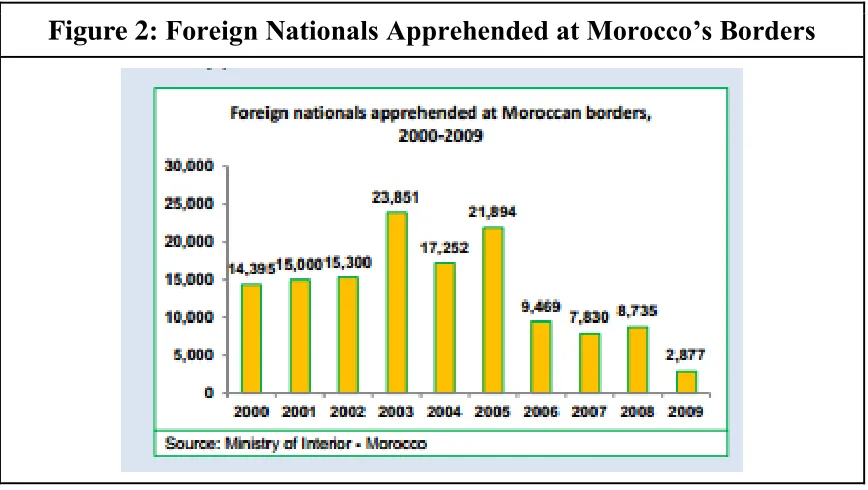
According to a 2013 report by the MPC titled, Migration Profile of Morocco, from 2000-2009 Morocco received an irregular migration flow of roughly 136,603 migrants coming from sub-Saharan countries and who were “apprehended” at Morocco’s borders (MPC, 2013). Below Graph: 1, provided by the Ministry of Interior- Morocco, shows over a 10 year period foreign nationals apprehended at Morocco’s borders:
Figure 2: Foreign Nationals Apprehended at Morocco’s Borders
coming in to morocco, about 79% of the migrants were male, had a mid-higher level of education (48.5%), single (82.2%), and were an average age of 27 years old (MPC, 2013).
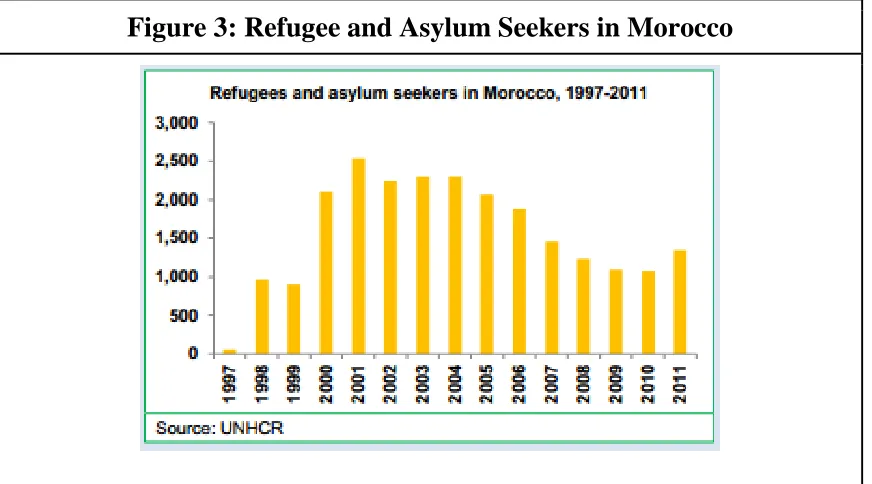
As stated before, Morocco is known to be a transit and immigration country for refugees and asylum seekers, mainly coming from sub-Saharan and Middle Eastern countries. Graph 2 below, provided by the UNHCR, shows refugees and asylum seekers in Morocco from 1997-2011.
Figure 3: Refugee and Asylum Seekers in Morocco
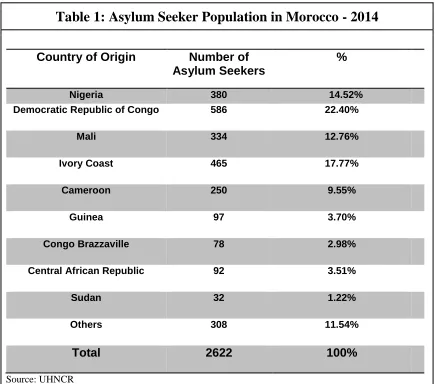
Three years later as of July 2014 and with the help of Iman Moussaoui at the UHNCR, I was able to obtain the most recent statistics in regards to Morocco’s current refugee and asylum seeker numbers. Tables 1 thru Table 3 and Chart A shows the country of origin and demographics of the asylum seeker profiles in Morocco.
Table 1: Asylum Seeker Population in Morocco - 2014
Country of Origin Number of
Asylum Seekers
%
Nigeria 380 14.52%
Democratic Republic of Congo 586 22.40%
Mali 334 12.76%
Ivory Coast 465 17.77%
Cameroon 250 9.55%
Guinea 97 3.70%
Congo Brazzaville 78 2.98%
Central African Republic 92 3.51%
Sudan 32 1.22%
Others 308 11.54%
Total 2622 100%
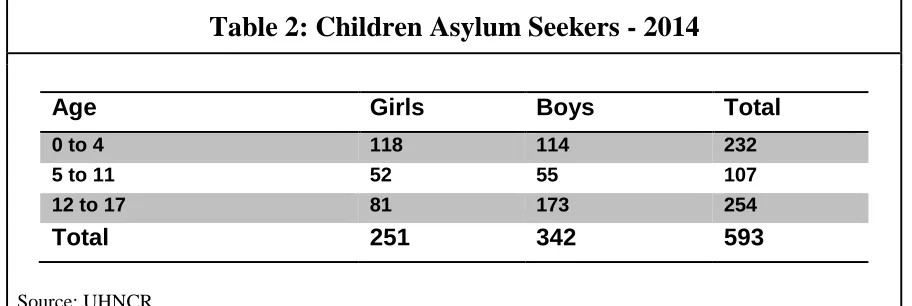
Table 2: Children Asylum Seekers - 2014
Age Girls Boys Total
0 to 4 118 114 232
5 to 11 52 55 107
12 to 17 81 173 254
Total 251 342 593
Source: UHNCR
Table 3: Women Asylum Seekers - 2014
Age Number
0 to 4 118
5 to 11 52
12 to 17 81
18 to 59 520
60 and more 5
Total 780
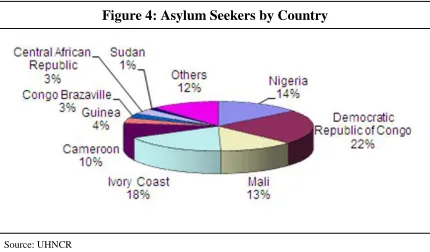
Figure 4: Asylum Seekers by Country
Source: UHNCR
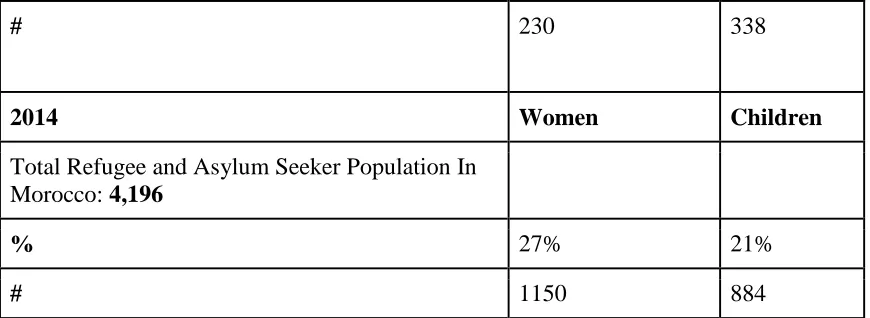
Table 1 and Chart A shows majority of the asylum seekers are originating from sub-Saharan countries and that the highest numbers of asylum seekers (22.40%) are coming from the Democratic Republic of Congo (DRC). Table 2 and Table 3 shows that of that percentage of refugees coming from the DRC, 22% are children and 30% of them are women.
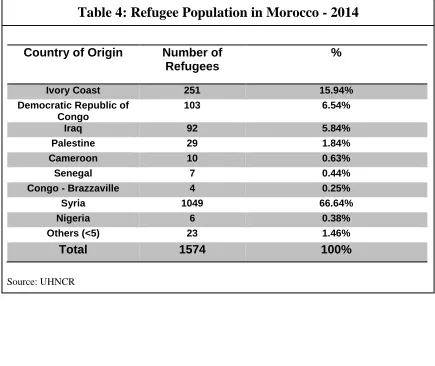
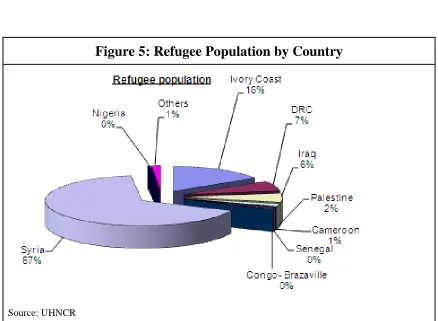
Table 4: Refugee Population in Morocco - 2014
Country of Origin Number of
Refugees
%
Ivory Coast 251 15.94%
Democratic Republic of Congo
103 6.54%
Iraq 92 5.84%
Palestine 29 1.84%
Cameroon 10 0.63%
Senegal 7 0.44%
Congo - Brazzaville 4 0.25%
Syria 1049 66.64%
Nigeria 6 0.38%
Others (<5) 23 1.46%
Total 1574 100%
Source: UHNCR
Table 5: Children Refugees - 2014
Age Girls Boys Total
0 to 4 50 59 109
5 to 11 64 49 113
12 to 17 26 43 69
Total 140 151 291
Table 6: Women Refugees - 2014
Age Number
0 to 4 50
5 to 11 64
12 to 17 26
18 to 59 219
60 and more 11
Total 370
Source: UHNCR