Address for correspondence
Dr. Mohammad Javad Yazdanpanah MD, Cutaneous Leishmaniasis Research Center, Mashhad University of Medical Sciences, Mashhad, Iran
E-mail: [email protected]
Original Article
Glucose tolerance test in patients with lichen planus
Introduction
Lichen planus is the prototype of the lichenoid
dermatitis group and it has a tendency to involve
the skin, mucous membranes, hair and nails.
Cutaneous lichen planus variants have been
observed in the adult population with a variable
incidence of about 1% to 0.22%.
1Pathogenesis
of lichen planus shows the role of the
cell-mediated immune system that causes damage to
the basal keratinocytes and, its associated
diseases, that indicate the role of the immune
system involvement in its pathogenesis, with
diabetes being an example.
2The prevalence of oral lichen planus in diabetes
type I (5.7%) and diabetes type II (2.8%) have
been reported.
3The role of the immune system
in diabetes type I is clear, but in diabetes type II
a direct link has not been observed, although in
some studies some involvement has been
indicated. In type II diabetes, immune system
regulation becomes impaired and this may be
grounds for disease manifestation.
4-7Many cases
of concurrent diabetes and or patients having
impaired glucose tolerance test results have been
reported in lichen planus,
8-12but this association
has not been supported in other studies.
13,14We
decided to evaluate the frequency of impaired
glucose metabolism in our population, and for
comparison we have used the study conducted
on a general population in Iran by Azizi
et al
.
15 Fakhrozaman Pezeshkpoor, Mohammad Javad Yazdanpanah, Robab Bigom Aboutorabi*, Mohammad Taghi Shakeri**, Rohalah Motedaen-Tosi#, Mohammad Hadi Foladi#Cutaneous Leishmaniasis Research Center, Mashhad University of Medical Sciences, Mashhad, Iran.
* Endocrine Research Center, Mashhad University of Medical Sciences, Mashhad, Iran. ** Department of Social Medicine, Mashhad University of Medical Sciences, Mashhad, Iran. # Health Center, Ghaem Hospital, Mashhad University of Medical Sciences, Mashhad, Iran.
Abstract
Objective To evaluate the prevalence of impaired glucose metabolism among patients with lichenplanus.
Methods Fifty-two patients with mucosal or cutaneous lichen planus disease were evaluated regarding disease characteristics, fasting blood sugar levels and glucose tolerance test (GTT) results.
Results Impaired glucose metabolism including impaired GTT and diabetes was observed in 15 (28.8%) patients with lichen planus, so there was not any significant difference in impaired glucose metabolism of patients with lichen planus compared to the general population.
Conclusion It seems that impaired glucose metabolism in lichen planus patients is not more frequent than general population.
Key words
Methods
This is a cross-sectional study that was
conducted on lichen planus cases that referred to
dermatology
clinic
of
Ghaem
Hospital,
Mashhad, Iran. Complete physical examination
of skin and buccal mucous membrane was
performed. Inclusion criteria were typical skin or
mucosal lesions of lichen planus, willingness to
participate in the study, and histopathological
diagnosis of lichen planus. Exclusion criteria
were consumption of drugs that might affect test
results
such
as
topical
or
systemic
corticosteroids and lack of full participation in
performing test or biopsy. Informed consent was
obtained from patients. During the study period,
52
patients
with
confirmed
pathological
diagnoses of lichen planus were enrolled in the
study. A glucose tolerance test was performed
on the patients and the results of fasting plasma
glucose and glucose tolerance test (GTT) were
interpreted according to the diagnostic criteria
for diagnosis of diabetes (
Box
).
16The data entry was done by SPSS software and
after coding and classification by the descriptive
menu the findings were presented as frequency
tables and graphs. The Fisher's exact test and
Mann-Whitney test were used for comparative
studies.
Results
Fifty-two patients, with an average age of
44.11±14.33 years (maximum 76 years and
minimum 15 years) consisting 27 females
(51.9%) and 25 males (48.1%), were included
the study. Among the 52 patients, 29 patients
had only cutaneous lichen planus, 9 patients had
mucosal lichen planus, and 14 patients had
cutaneous plus mucosal lichen planus. The mean
duration of the onset of the illness was 21.4 ±
29.75 months (maximum 12 years and minimum
2 months). The frequency of the different types
of skin and mucosal lesions is shown in
Table 1
and
2
. There was a history of diabetes in 9
(17.3%) patients, and 43 (82.7%) patients did
not have any history of diagnosed diabetes.
Based on the results of the fasting blood glucose,
out of 43 patients without diabetes, 6 (14%)
patients had impaired glucose metabolism and
37 (86%) patients were considered to be
normoglycemic based on the fasting blood
sugar.
Regarding the results of the oral glucose
tolerance test, of 43 patients without diabetes, 37
(86%)
patients
were
classified
as
normoglycemic (blood glucose levels less than
140 mg/dl) and in 5 (11.6%) patients, there was
impaired glucose tolerance (blood glucose levels
between 140 to 200 mg/dl) and one (2.3%)
Box Criteria for the diagnosis of diabetes mellitus
• Symptoms of diabetes plus random blood glucose concentration ≥ 11.1 mmol/L (200 mg/dL) or • Fasting plasma glucose ≥7.0 mmol/L (126 mg/dL)
or
• HbA1C ≥ 6.5% or
• Two-hour plasma glucose ≥11.1 mmol/L (200 mg/dL) during an oral glucose tolerance test
Table 1 Frequency of different types of lichen planus (n=52)
Type of skin lesions N (%)
Classic 28 (53.8)
Hypertrophic 7 (13.5)
Annular 2 (3.8)
Pigmented 1 (1.9)
No skin lesion 14 (26.9)
Table 2 Frequency of different types of mucosal lesions in lichen planus cases (n=52).
Mucosal lesion type N (%)
Reticular 7 (13.5)
White plaques 5 (9.6)
White papules 4 (7.7)
Atrophic 4 (7.7)
Erosive 3 (5.8)
Table 3 The mean and standard deviation of fasting blood glucose and blood glucose in oral glucose tolerance test (GTT) in nondiabetic case of lichen planus.
Mean (mg/dl) Standard deviation Minimum Maximum
Fasting blood glucose 89.51 16.69 39 122
Blood glucose 30 minute after GTT 151.56 43.31 87 279
Blood glucose 1 hour after GTT 143.28 51.24 62 252
Blood glucose 2 hour after GTT 105.63 35.65 52 203
Table 4 The prevalence of impaired glucose tolerance in patients above 20 years compared to patients with lichen planus in comparison with the general population
The Fisher Test Results Patients with lichen planus
General population Age
groups
(years) Total impairedGTT Percentage Total impairedGTT Percentage
P=0.173 16.6 1 6 3.1 56 1828 20-29 P=0.506 12.5 1 8 8.4 208 2474 30-39 P=0.149 - 0 13 15.1 254 1856 40-49 P=0.257 7.1 1 14 18.0 263 1468 50-59 P=0.302 33.3 2 6 19.8 223 1226 60-69 P=0.762 - 0 1 24.1 90 377 ≤70
GTT: glucose tolerance test.
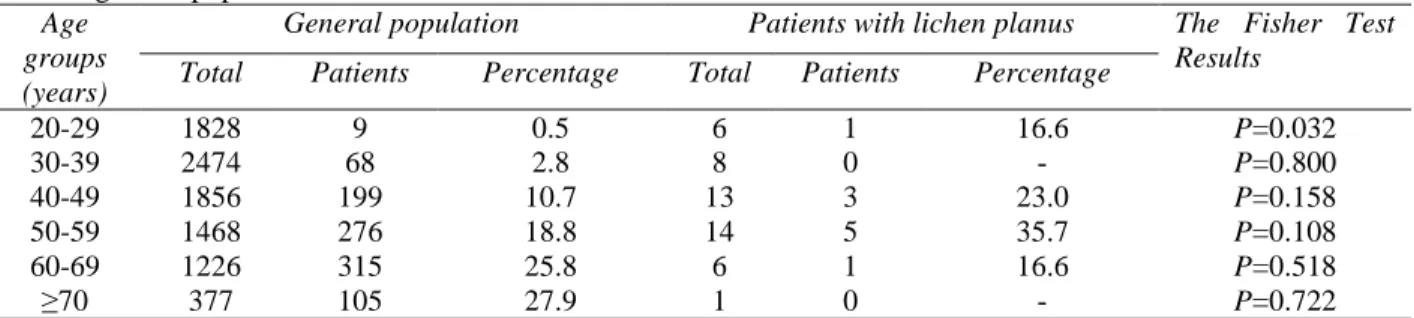
Table 5 The comparison of diabetes prevalence of patients 20 years of age in patients with lichen planus compared with the general population.
The Fisher Test Results
Patients with lichen planus General population
Age groups
(years) Total Patients Percentage Total Patients Percentage
P=0.032 16.6 1 6 0.5 9 1828 20-29 P=0.800 - 0 8 2.8 68 2474 30-39 P=0.158 23.0 3 13 10.7 199 1856 40-49 P=0.108 35.7 5 14 18.8 276 1468 50-59 P=0.518 16.6 1 6 25.8 315 1226 60-69 P=0.722 - 0 1 27.9 105 377 ≤70
patient was identified as a new case of diabetes
mellitus (blood glucose levels over 200 mg/dl),
(Table 3)
.
Comparing the prevalence of impaired glucose
tolerance and diabetes in patients with lichen
planus differentiated by gender, the Fisher's
exact test showed no significance (
P
=0.175),
although the prevalence of carbohydrate
metabolism disorders were more common in
women.
In addition, the Fisher's exact test did not show
any significance (
P
=0.602) in comparing the
prevalence of impaired glucose tolerance and
diabetes in patients with lichen planus
differentiated based on the type of disease
(cutaneous, mucosal, mucocutaneous).
The Mann-Whitney test did not show any
significance (
P
=0.123) in comparing the average
age of patients in the two groups with and
without carbohydrate metabolism disorders in
patients with lichen planus, the mean age in the
group with carbohydrate metabolism was
48.53±11.67 years and in the normoglycemic
group it was 42.32±15.5 years.
Discussion
metabolism of glucose did not seem to occur
more frequent in lichen planus cases.
We compared the findings of our study with the
study of Azizi
et al
.
16, which was conducted on
an Iranian population in Tehran, based on
information obtained on the frequency of
diabetes and impaired oral glucose tolerance
tests in patients with lichen planus. The
frequency of diabetes and impaired oral glucose
tolerance test were different based on age
groups, thus Fisher test was performed for each
age group of patients and the control group
(Table 4
and
5)
. Impaired oral glucose tolerance
tests in lichen planus cases in comparison with
general
population
were
not
statistically
different in each group. Prevalence of diabetes
mellitus in two groups was not statistically
different in each group (except in age group of
20-29 years). In this comparison, since there was
no information on the age group under 20 years
in the study by Azizi
et al.
16, the population
under 20 years was excluded in our study (Four
cases).
The frequency of diabetes in patients with lichen
planus in studies done by Lundström
et al.
17on
40 patients with oral lichen planus showed 28%
had diabetes. The recent study by Syhan
et al
.
in Turkey that was conducted on 30 patients,
indicated that 26.7% had diabetes, while the
frequency in the control group was 3.33%
(
P
=0.007). Impaired glucose tolerance test was
46.7% (diabetes mellitus + impaired glucose
tolerance) and 16.7% for the control group.
9Nigam
et al
.
8found impaired glucose tolerance
test in 30.3% of 56 cases of lichen planus. In
1990, Gibson
et al
.
18pointed out the
accompaniment of diabetes with oral lichen
planus in their study.
In another study in 1993, Brown
et al
.
19noted a
greater link between erosive and ulcerative
forms of lichen planus in patients with diabetes.
A study on 674 patients with oral lichen planus
did not show any significant relationship with
diabetes.
13Van Dis
et al.
14in 1995 also
evaluated the frequency of oral lichen planus in
273 patients with diabetes and observed lichen
planus in 4% patients and in the control group
this frequency was 3%, which did not show any
significant difference between the two groups.
14In 1992, Albrecht
et al
.
20pointed out that using
ant-diabetic drug can cause clinical lesions
similar to lichen planus.
Conte
et al
. in their
evaluation of 200 patients with lichen planus,
recorded 8% of patients had diabetes.
21In 1988, Petrou
et al
. also evaluated lichen
planus frequency in patients with diabetes. His
study consisted of 139 patients with diabetes
type I, 353 patients with diabetes type II and 274
patients as the control. Clinical evidence of
lichen planus in type I was 5.67%, in type II
2.83%, and in the control group was 1.82%.
These results indicated a special relationship
between lichen planus and type I diabetes, in
which both share a common immune mechanism
and the immune response of the cells play an
important role.
3As has been observed, association between
lichen planus and diabetes in different studies is
not the same. The reason for this dissimilarity
might relate to the genetic differences of
populations. The sample size in the study of
Azizi
et al.
15, used as a control group in our
study, was considerable, which increases the
accuracy of comparison in this study.
sample size in a case-control study may provide
more reliable results.
Acknowledgements
This project was supported by a grant from the
Vice Chancellor for Research of the Mashhad
University of Medical Sciences for thesis
prepared by Dr. Rohalah Motedaen-Tosi, Dr.
Mohammad Hadi Foladi with approval number
5987. We also appreciate the cooperation of
department of pathology and biochemistry in
performing laboratory examinations.
References
1. Shiohara T, Kano Y. Lichen planus and lichenoid dermatoses. In: Bolognia JL, Jorizzo JL, Rapini RP, editors. Dermatology. 2nd edn. Spain: Mosby Elsevier; 2008. p. 159-180. 2. Breathnach SM. Lichen Planus and Lichenoid
Disorders. In: Burns T, Breathnach S, Cox N, Griffiths C, editors. Rook’s Textbook of Dermatology. 8th ed. Oxford: Wiley-Blackwell; 2010. p. 17.1-17.55.
3. Petrou-Amerikanou C, Markopoulos AK, Belazi M, Karamitsos D, Papanayotou P. Prevalence of oral lichen planus in diabetes mellitus according to the type of diabetes. Oral Dis. 1998;4:37-40.
4. Kohn LD, Wallace B, Schwartz F, McCall K. Is type 2 diabetes an autoimmune-inflammatory disorder of the innate immune system? Endocrinology. 2005;146:4189-91. 5. Turina M, Fry DE, Polk HC Jr. Acute
hyperglycemia and the innate immune system: clinical, cellular, and molecular aspects. Crit Care Med. 2005;33:1624-33.
6. Kolb H, Mandrup-Poulsen T. An immune origin of type 2 diabetes? Diabetologia. 2005;48:1038-50.
7. Geerlings SE, Hoepelman AI. Immune dysfunction in patients with diabetes mellitus (DM). FEMS Immunol Med Microbiol. 1999;26:259-65.
8. Nigam PK, Sharma L, Agrawal JK, Singh G, Khurana SK. Glucose tolerance studies in
lichen planus. Dermatologica. 1987;175:284-9.
9. Seyhan M, Ozcan H, Sahin I, Bayram N, Karincaoğlu Y. High prevalence of glucose metabolism disturbance in patients with lichen planus. Diabetes Res Clin Pract. 2007;77:198-202.
10. Hornstein OP, Stühler C, Schirner E, Simon M Jr. Lichen ruber and diabetes mellitus--pathogenetic relations? Hautarzt. 1984;35:287-91.
11. Bussell SN, Smales FC, Sutton RB, Duckworth R. Glucose tolerance in patients with lesions of the oral mucosa. Br Dent J. 1979;146:186-8.
12. Jolly M. Lichen planus and its association with diabetes mellitus. Med J Aust. 1972;1:990-2. 13. Xue JL, Fan MW, Wang SZ, Chen XM, Li Y,
Wang L. A clinical study of 674 patients with oral lichen planus in China. J Oral Pathol Med. 2005;34:467-72.
14. Van Dis ML, Parks ET. Prevalence of oral lichen planus in patients with diabetes mellitus. Oral Surg Oral Med Oral Pathol Oral Radiol Endod. 1995;79:696-700. 15. Azizi F. Diabetes. In: Azizi F, editor. Tehran
lipid and glucose study (TLGS). Research center of endocrine and metabolism, Shahid Beheshti University, Tehran, 2001. p. 87-98. 16. Alvin C Powers. Diabetes Mellitus. In: Longo
DL, Fauci AS, Kasper DL, editors. Harrison’s Principles of Internal Medicine. 18th ed. USA: McGraw Hill; 2012. p.2968- 3003.
17. Lundström IM. Incidence of diabetes mellitus in patients with oral lichen planus. Int J Oral Surg. 1983;12:147-52.
18. Gibson J, Lamey PJ, Lewis M, Frier B. Oral manifestations of previously undiagnosed non-insulin dependent diabetes mellitus. J Oral Pathol Med. 1990;19:284-7.
19. Brown RS, Bottomley WK, Puente E, Lavigne GJ. A retrospective evaluation of 193 patients with oral lichen planus. J Oral Pathol Med. 1993;22:69-72.
20. Albrecht M, Bánóczy J, Dinya E, Tamás G Jr. Occurrence of oral leukoplakia and lichen planus in diabetes mellitus. J Oral Pathol Med. 1992;21:364-6.