THERMODYNAMIC PAIRING AND ITS INFLUENCE ON NUCLEAR LEVEL DENSITY
NGUYEN QUANG HUNG1
Tan Tao University, Tan Tao University Avenue, Tan Duc Ecity, Duc Hoa, Long An
DANG THI DUNG, TRAN DINH TRONG
Institute of Physics, VAST, 10 Dao Tan, Ba Dinh, Hanoi
Abstract. Thermodynamic properties and level densities of some selected even-even nuclei such as56Fe,60Ni,98Mo, and116Sn are studied within the Bardeen-Cooper-Schrieffer theory at finite
temperature (FTBCS) taking into account pairing correlations. The theory also incorporates the particle-number projection within the Lipkin-Nogami method (FTLN). The results obtained are compare with the recent experimental data by Oslo (Norway) group. Pairing correlations are found to have significant effects on nuclear level density, especially at low and intermediate excitation energies.
I. INTRODUCTION
Pairing correlations have important effects on the physical properties of atomic nuclei such as the binding and excitation energies, collective motions, rotations, level densities, etc. [1]. The finite-temperature Bardeen-Cooper-Schrieffer (BCS) theory [2] (FTBCS theory), a theory of superconductivity, has been widely employed to describe the pairing properties of finite systems such as atomic nuclei (see e.g. Refs. [3, 4]). The FTBCS theory predicts a collapsing of pairing gap at a given temperature TC or the
so-called critical temperature, which can be estimated as TC ≈ 0.568∆(0) [∆(0) is the
pairing gap at zero temperature T = 0] [4]. Consequently, there appears a sharp phase transition from the superfluid region, where the paring gap is finite, to the normal one, where the pairing gap is zero (the so-called SN phase transition). This prediction is in very good agreement with the experimental findings in infinite systems such as metallic superconductors. However, when applying to finite small systems such as atomic nuclei or small metallic grains, the FTBCS theory fails to describe the pairing properties of these systems. One of the reason is due to the violation of the particle-number conservation within the FTBCS theory. This conservation is negligible in infinite systems but it is significant in the finite ones. A simple method to resolve the particle-number problem of the FTBCS theory is to apply the particle-number projection (PNP) proposed by Lipkin-Nogami (LN) [5]. The LN method is an approximate PNP before variation, which has been widely used in nuclear physics. The goal of this work is to apply the FTBCS theory as well as the FTBCS with Lipkin-Nogami PNP to describe the thermodynamic properties and level densities of some selected even-even nuclei (the numbers of neutrons N and protons
Z are even) such as 56Fe, 60Ni, 98Mo, and116Sn.
II. FORMALISM
We considers a pairing Hamiltonian [6]
H=X
k
k(a†kak+a†−ka−k)−G
X
kk0
a†ka†−ka−k0ak0 (1)
which describes a system of N particles with single-particle energy k interacting via a
constant monopole force G. Here a†k andak denote the particle creation and annihilation
operators. The subscripts k are used to label the single-particle states |k, mk > in the
deformed basis with the positive single-particle spin projectionsmk, whereas the subscripts
−kdenote the time-reversal states |k,−mk>.
II.1. FTBCS equations
The FTBCS equations are derived based on the variational procedure to minimize the Hamiltonian HBCS = H −λNˆ, where ˆN = Pk
a†kak+a†−ka−k
is the particle-number operator andλis the chemical potential. At finite temperature, the minimization procedure is proceeded within the grand canonical ensemble (GCE) average [7]. The FTBCS equations for the paring gap ∆ and particle number N have the form as:
∆ =GX
k
τk; N = 2
X
k
ρk,
τk =ukvk(1−2nk); ρk= (1−2nk)vk2+nk, (2)
u2k= 1 2
1 +k−λ−Gv
2
k
Ek
; vk2= 1−u2k,
Ek =
q
(k−λ−Gvk2)2+ ∆2,
where the quasiparticle occupation numbernk is given in terms of the Fermi-Dirac
distri-bution of free quasiparticlenk= 1+e1βEk. The total (internal) energyEFTBCSand entropy
SFTBCS of the system are then given as
EFTBCS(T) = 2
X
k
kρk−
∆2
G −G
X
k
vk4(1−2nk), (3)
SFTBCS(T) =−2
X
k
[nklnnk+ (1−nk)ln(1−nk)]. (4)
II.2. FTBCS equations with Lipkin-Nogami particle-number projection (FTLN equations)
The FTLN equations are obtained by carrying out the variational calculations (within the GCE) to minimize the Hamiltonian HLN = H −λ1Nˆ −λ2Nˆ2, namely by
result, the FTLN equations for the pairing gap and particle number have the form as [8]
∆ =GX
k
τk; N = 2
X
k
ρk,
τk =ukvk(1−2nk); ρk= (1−2nk)vk2+nk,
u2k= 1 2
1 +
0
k−λ−Gvk2
Ek
; vk2= 1−u2k,
Ek =
q
(0k−λ−Gv2
k)2+ ∆2; nk =
1
1 +eβEk (5)
0 =k+ (4λ2−G)vk2; λ=λ1+ 2λ2(N + 1),
λ2= G
4 P
k(1−ρk)τk
P
k0ρk0τk0 −P
k(1−ρ2k)ρ2k
[P
k(1−ρk)ρk]
2−P
k(1−ρ2k)ρ2k
.
The FTLN total energy and entropy are then given as
EFTLN(T) = 2
X
k
kρk−
∆2
G −G
X
k
vk4(1−2nk)−λ2∆N2, (6)
SFTLN(T) =−2
X
k
[nklnnk+ (1−nk)ln(1−nk)], (7)
where ∆N2 = D ˆ
NE2−DNˆE2
is the particle-number fluctuation, whose explicit forms
can be found for example in Ref. [12].
II.3. Level density
Within the GCE, the density of state is calculated asω(E∗) = (2π)3/2eSD1/2 [9], where
S is the total entropy, which is the sum of the entropies for neutrons (N) and protons (Z), and D=
∂2Ω
∂α2 N
∂2Ω
∂αN∂αZ
∂2Ω
∂αN∂β
∂2Ω
∂αZ∂αN
∂2Ω
∂α2 Z
∂2Ω
∂αZ∂β
∂2Ω
∂β∂αN
∂2Ω
∂β∂αZ
∂2Ω
∂β2 , (8)
withα=βλ, and Ω being the logarithm of the grand partition function
Ω = ln h
tr(e−βH) i
=−βX
k
(k−λ−Ek) + 2
X
k
ln(1 +e−βEk)−β∆
2
G . (9)
Finally, the level density is defined as ρ(E∗) = ωσ(√E∗)
2π, where σ
2 = 1 2
P
km2ksech
2 1 2βEk is
the spin cut-off parameter. In the expressions of density of state as well as level density,
E∗ is the excitation energy, which is calculated by subtracting the ground-state (binding) energy from the total energy of the system
E∗(T) =E(T)−Eg.s(T = 0), (10)
whereEg.sis the ground-state (binding) energy, which is the sum of the FTBCS or FTLN
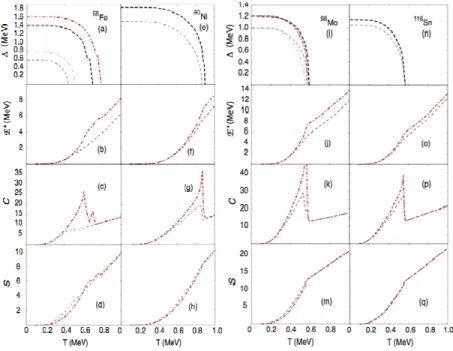
Fig. 1. Pairing gaps ∆ (neutron and proton), total (neutron + proton) excitation energyE∗, total heat capacityC, and total entropySas functions of temperature
T for56Fe, 60Ni,98Mo, and 116Sn. In Figs 1. (a), (e), (i) and (n) the thin and
thick dashed lines denote the neutron pairing gaps ∆N, whereas the thin and
thick dash dotted lines stand for the proton pairing gaps ∆Z. Here the thin lines
show the results obtained within the FTBCS, whereas the thick lines present the FTLN results. In Figs. 1 [(b) - (d)], [(f) - (h)], [(j) - (m)] and [(o) - (q)] the thin dashed and thick dash dotted lines depict the FTBCS and FTLN total (neutron + proton) results, respectively.
Edef
Eg.s(T = 0) =Eg.sFTBCS(FTLN)(T = 0) +EW igner+Edef. (11)
Here, for simplicity EW igner and Edef are estimated from the Hartree-Fock-Bogoliubov
(HFB) calculations with Skyrme BSk14 interaction [10].
III. NUMERICAL RESULTS AND DISCUSSIONS
We carried out the numerical calculations for some selected even-even nuclei, namely
56Fe, 60Ni, 98Mo, and 116Sn. The single-particle energies are calculated within the axial
deformed Woods-Saxon (WS) potential including the spin-orbit and Coulomb interactions [11]. The quadrupole deformation parameters β2 are chosen to be the same as that of
Ref. [12], namelyβ2 = 0.24 for56Fe andβ2= 0.17 for 98Mo, whereasβ2 for two spherical
100
101
102
103
104
101
102
103
104
101
103
105
107
101
103
105
107
ρ(MeV )
-1
ρ(MeV )
-1
ρ(MeV )
-1
ρ
(MeV )
-1
E + Wig E =3.34 MeVdef
2 4 6 8 10 12 14
E (MeV)
0
*
2 4 6 8 10 12 14
E (MeV)
0
*
E + Wig E =3.69 MeVdef
E + Wig Edef =2.75 MeV
E + Wig Edef =1.79 MeV
Fe 56
(a)
Ni 60
(b)
Mo 98
(c)
Sn 116
(d) FTBCS
FTLN
Δ = 0 Exp
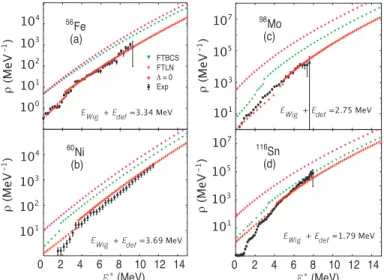
Fig. 2. Level densityρas function of total excitation energyE∗obtained within
the FTBCS (triangles), FTLN (crosses) and the case without pairing (∆ = 0) (rectangles) versus the experimental data (full circles with error bars) for 56Fe (a),60Ni (b),98Mo (c) and116Sn (d). The values of ground-state (binding) energy correctionsEW igner+Edef are shown in the figures..
so that the pairing gaps for neutron and proton obtained within the FTLN at T = 0 fits the experimental odd-even mass differences [13]. These values areGN = 0.312, 0.34, 0.193
and 0.17 MeV for neutrons andGZ = 0.437, 0.0, 0.314, 0.0 MeV for protons in56Fe,60Ni,
98Mo, and116Sn, respectively.
Shown in Figs. 1 are the thermodynamic quantities such as pairing gaps ∆, excita-tion energiesE∗, heat capacities C, and entropiesS obtained within the FTBCS (dashed lines) and FTLN (dash dotted line) for four nuclei under consideration. The FTBCS gaps (thin lines) are seen to decrease with increasing T and vanish at a given critical temper-ature T = TC. As the result, there appears a sharp peak in the heat capacity C at TC,
which is the signature of SN phase transition. Applying the PNP within the LN method results the FTLN pairing gaps atT = 0 (thick lines) which are always higher than that of the FTBCS. Consequently, the TC values obtained within the FTLN are higher than the
corresponding FTBCS ones. This feature means that the FTLN offers a pairing which is stronger and more correct than the FTBCS. The difference between the thermodynamic quantities obtained within the FTBCS and FTLN in light nuclei like56Fe is stronger than in heavy nuclei like 116Sn as seen in Figs. 1. This is well-known because of the fact that the particle-number fluctuation in the light systems is usually stronger than in the heavy ones.
results obtained within the non pairing case (∆ = 0) are quite far from the experimental data. The ground-state energy corrections by Wigner and deformation energies, which shift up the total excitation energy E∗ toward the right direction to the experimental data, are also important in present case. As the result, we can conclude that the pairing correlations together with the particle-number conservation within the Lipkin-Nogami method as well as the corrections for the ground-state energy due to the Wigner and deformation effects are all important for the description of nuclear level density.
IV. CONCLUSION
In present paper, we apply the finite-temperature BCS (FTBCS) theory as well as the FTBCS with the approximate PNP within the Lipkin-Nogami method (FTLN) to describe the thermodynamic properties as well as level densities of several selected even-even isotopes, namely 56Fe, 60Ni, 98Mo, and 116Sn. The results obtained show that the pairing correlation together with the binding energy correactions due to Wigner and deformation energies have significant effects on the nuclear level density, especially at low and intermediate excitation energies.
ACKNOWLEDGMENT
This work is supported by the National Foundation for Science and Technology Development (NAFOSTED) through Grant No. 103.04-2010.02.
REFERENCES
[1] D. J. Dean, M. Hjorth-Jensen,Rev. Mod. Phys.75(2003) 607. [2] J. Bardeen, L. Cooper, J. Schrieffer,Phys. Rev.108(1957) 1175. [3] L. G. Moretto,Phys. Lett. B40(1972) 1.
[4] A. L. Goodman,Nucl. Phys. A352(1981) 30;Phys. Rev. C29(1984) 1887.
[5] H. J. Lipkin,Ann. Phys. (NY) 9(1960) 272; Y. Nogami, I. J. Zucker,Nucl. Phys.60(1964) 203; Y. Nogami,Phys. Lett.15(1965) 4.
[6] N. Quang Hung, N. Dinh Dang,Phys. Rev. C78(2008) 064315. [7] N. Dinh Dang,Nucl. Phys. A784(2007) 147.
[8] N. Dinh Dang, N. Quang Hung,Phys. Rev. C77(2008) 064315.
[9] L. G. Moretto, Nucl. Phys. A 185(1972) 145; A. N. Behkami, J. R. Huizenga,Nucl. Phys. A 217 (1973) 78.
[10] S. Hilaire, S. Goriely,Nucl. Phys. A779(2006) 63; S. Goriely, S. Hilaire, A. J. Koning,Phys. Rev. C 78(2008) 064307.
[11] S. Cwioket al.,Comput. Phys. Commun.46(1987) 379.
[12] S. Liu, Y. Alhassid, Phys. Rev. Lett.87 (2001) 022501; K. Kaneko et al., Phys. Rev. C 74(2006) 024325.
[13] P. Ring, P. Schuck,The Nuclear Many-Body Problem, 1980 Springer-Verlag, New York.
[14] E. Melby et al.,Phys. Rev. Lett. 83(1999) 3150; A. Schilleret al., Phys. Rev. C63 (2001) 021306 (R); E. Alginet al.,Phys. Rev. C78(2008) 054321.
[15] M. Guttormsenet al.,Phys. Rev. C 62(2000) 024306; R. Chankovaet al.,Phys. Rev. C73 (2006) 034311.