Principles of Macroeconomics
Spring 2011
Midterm Exam 2
Statement of Academic Honesty:
This exam entirely reflects my own work. I have not given assistance to anyone, nor have I received assistance from anyone. I am not aware that any other students have done so.
Signature: __________________________________________________
Name: __________________________________________________
Multiple Choice – 50 points (2.5 points per question)
1. If the labor market is in equilibrium and then the labor supply curve shifts rightward
a. There will be a shortage of labor if the wage stays at the original level. b. The equilibrium wage will rise.
c. There will be a surplus of jobs at the new equilibrium wage.
d. There will be a surplus of labor if the wage stays at the original level.
2. Which of the following creates growth in labor productivity?
I. Growth in capital
II. Improvement in technology
III. Population growth
a. II only b. I only
c. Both I and III d. Both I and II
3. Suppose that the government changes their taxation policy from an income tax to a consumption tax. How is the interest rate affected?
a. The interest rate will rise. b. The interest rate will fall. c. The interest rate is not affected.
d. The change in interest rate is uncertain.
4. Suppose in the IS/LM model that the level of consumer spending a increases while the money supply M falls. Which statement is correct?
a. Y will increase b. Y will decrease c. r will increase
d. The changes in r and Y cannot be determined
5. What assumption is necessary to ensure that the IS curve is downward sloping but not vertical?
a. Investment falls as the interest rate rises.
b. The demand for money falls as the interest rate rises. c. The MPC is not equal to zero.
6. In the AD/AS model with wages and prices are flexible, what can be said about the government spending multiplier?
a. The multiplier is positive, but smaller than the IS/LM multiplier. b. The multiplier is negative.
c. The multiplier is 0.
d. The multiplier is positive, and larger than the IS/LM multiplier.
7. Suppose that demand for money does not depend on the interest rate (i.e. h=0). Then in the AD/AS model, if government spending rises
a. AD shifts to the right. b. AD shifts to the left.
c. AD shifts in an indeterminate direction. d. AD does not shift.
8. Countries with high rates of economic growth tend to have
a. Shorter workweeks
b. No business cycle fluctuations c. A labor force that is more productive d. A lower life expectancy
9. The development trap hypothesis asserts that poor countries
a. Cannot develop because they lack the ability to educate their workers. b. Cannot develop because of low consumption of goods and services.
c. Are unable to save and invest enough to accumulate capital stock and grow. d. Cannot develop because of bad political regimes.
10. An increase in the number of workers will lead to
a. A movement along the production function, but no shift.
b. A shift of the production function, but not a movement along it. c. Both a movement along and a shift in the production function. d. Neither a movement along nor a shift in the production function.
11. Which is a strategy in the IS/LM model that would increase investment?
a. Lower government spending
b. Lower taxes
c. Lower money supply
12. In the IS/LM model, if the price level P falls, then
a. The interest rate falls and GDP falls b. The interest rate rises and GDP rises c. The interest rate falls and GDP rises d. The interest rate rises and GDP falls
13. In the AD/AS model with flexible wages, suppose that the demand for labor rises. What is the impact on the model equilibrium?
a. Y rises; P falls; r rises
b. Y does not change; P falls; r falls c. Y rises; P falls; r falls
d. Y does not change; P rises; r rises
14. Referring to (13), what is the effect on consumption and investment spending?
a. Consumption and investment both rise b. Consumption and investment both fall c. Consumption rises but investment falls d. Consumption falls but investment rises
15. If the labor productivity in a coal mine is 0.5 tons per worker, then 500 workers will produce
a. 250 tons b. 500 tons c. 2500 tons d. 5000 tons
16. The demand for loanable funds is downward sloping because as the interest rate rises, the number of profitable investment projects a firm can undertake ___ and the quantity demanded of loanable funds ___
a. Falls…falls b. Rises…rises c. Falls…rises d. Rises…falls
17. Which of the following is an example of human capital?
a. A college education b. A computer
Question 18 refers to the diagram below.
18. Which of the following is consistent with the diagram above?
a. A recession lowers the profitability of new investments.
b. Technological change enhances the profitability of new investments. c. The government runs a budget surplus.
d. Households being to spend more and save less.
19. In a closed economy (net exports are zero), which of the following can be used to calculate investment?
a. C + G – T b. Y – T c. Y – C – T d. Y – C – G
20. If nominal wages are downward rigid in an AD/AS model then – if we make no assumptions about where the AD and the AS curves initially cross – what can we say about the effect of an increase in government spending?
a. It will increase output and the price level.
Problem 1 (10 points)
Consider the following Keynesian model.
AE= + + +C I G NX , with
1000 0.8
C= + Y
300 0.1
I = + Y
500
G=
100
NX = −
Notice the difference between this model and the standard model is that investment is not exogenous, but here rises when GDP rises.
a. Calculate the Keynesian equilibrium level of GDP.
Problem 2 (10 points)
Consider two different monetary policies in the context of an IS/LM model.
ECONOMY A: If the government changes G, the central bank takes no action.
ECONOMY B: If the government changes G, the central bank responds by adjusting the money supply in order to restore the original interest rate.
Problem 3 (15 points)
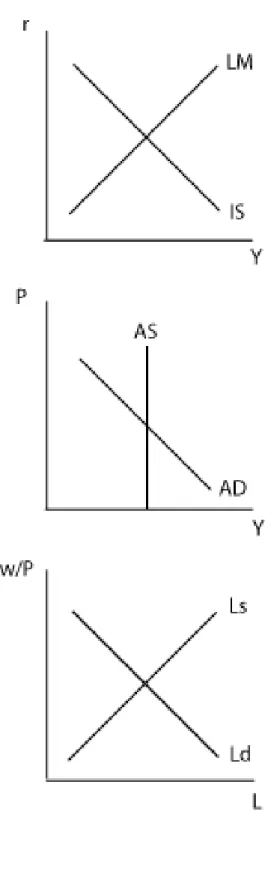
In the US right now, there are two broad trends: Productivity is rising significantly, which will increase the demand for labor. At the same time, political pressures are forcing the government to lower its spending. In this problem, you will consider the effect of these changes in an AD/AS model with flexible wages.
a. Illustrate the relevant changes on the diagram that appears on the next page. Be sure to label steps 1, 2 and 3 in your analysis.
b. What happens to GDP? _____
c. What happens to the interest rate? _____
d. What happens to the price level? _____
e. What happens to the unemployment rate? _____
f. What happens to private investment spending? _____
g. In terms of the change in GDP, does it matter whether the government increases spending or decreases spending? Explain briefly.
Problem 4 (15 points)
The following data are for the island nation of Pacifica. Pacifica is a closed economy with no imports or exports.
Total output $10 million
Total income $10 million
Consumption $6 million
Government spending $3 million
Taxes paid (net) $2 million
a. Find private savings in Pacifica. Show your work.
b. Find private investment in Pacifica. Show your work.
c. Suppose that consumers start spending more and saving less. Illustrate the impact on the diagram below and state what happens to the interest rate.
d. What happens to investment in new capital as a result of the change in (c)?