LDA, AN ECOFRIENDLY ALTERNATIVE TO NATURAL
AGGREGATE IN STRUCTURAL CONCRETE FOR
ENGINEERING CONSTRUCTIONS
Dr.B. P.Behera1 and Dr. R.R.Pattnaik2 1,2
Department of Agril. Structures, Civil & Environmental Engineering CAET, OUAT, Bhubaneswar-751003
Abstract
Low Density Aggregate (LDA) made from fly ash, a waste product from the thermal power plant was used to replace the natural aggregate which turn out to be an efficient effort for green concrete. The process of creating LDA uses above 90% fly ash as major raw material mixing with small volume additives, carbonaceous solid fuel and water. The additives are clay and the coal which contributes the carbon percentage depending on the particle size and loss of ignition in the fly ash. After agglomeration and palletisation, the green pellets are transferred to a sinter machine for sintering. The physical characteristic of LDA product is found to be a superior aggregate than the natural aggregates. In this study, at first the concrete cubes were made using cement, sand and natural aggregate by mixing water. The materials were poured inside the 100 mm cube mould for making the samples. Secondly, the same procedure was followed to replace natural aggregate with the LDA keeping cement and sand content as the same. The LDA was collected from IMFA, Choudwar of two grades, one 4mm to 8mm and another 8mm to 16mm. The two aggregates were used in proportion of 40% to 60% respectively of the total LDA percentage. After de-moulding of the concrete cubes with LDA and natural aggregate, the samples were kept in two different curing conditions. One kept for moist curing for 28 days and another kept 28days in air-curing. After 28 days, both the cases of cubes were subjected to the compression test. It was observed that the concrete cube with natural aggregates had ultimate strength of 20.36 MPa, and the cube with LDA showed the ultimate strength of 16.69 MPa under the moist curing for 28days. However, the concrete cubes in air curing showed 17.93 MPa with natural aggregate and 18.3 MPa with LDA. The LDA cubes without curing or air curing showed higher compressive strength than the LDA cube with moist curing which is a positive result for places where curing is difficult to undertake. It was also observed that the compressive strength of the LDA concrete was about 10% less compressive strength than the concrete with natural aggregates under the same cement and sand content. The compressive strength of LDA concrete can be increased by changing the grading of the LDA and adding other admixtures. Due to limitation of time, it is recommended that for future study the LDA concrete should be made with different grades of LDA, 50:50 LDA and natural aggregate replacement, and at different cement content to achieve best results out of LDA.
I. INTRODUCTION
Materials involved include cementations materials, fine aggregate (both normal- and low-density), coarse aggregate (both normal- and low-density), water for mixing and curing, and chemical admixtures. And lighter in weight than standard concrete, but just as strong, LDA offers significant dead load savings. This allows for long cantilevers, slimmer general sections and reduced foundations sizes, enabling designers to produce structures that would be very difficult to build in other materials.
Recycled aggregates are seldom utilized in structural applications; instead they have been used as fillers in road construction and in low-level applications due to material defects such as large water absorption capacity and their elongated and angular shape. The experimental results give an encouraging trend towards utilization of recycled aggregates from field demolished concrete by blending with natural aggregates in making recycled aggregate concrete for structural applications.
The compressive strength of recycled aggregate concrete generally decreases with increasing recycled aggregate contents. For a recycled aggregate replacement percentage equals 100%, the elastic modulus is reduced by 45% (Jianzhuang Xiaoa et al, 2004). The workability was good and can be satisfactorily handled for 0% recycled aggregate to 80% recycled aggregate and with more percentage replacement of recycled aggregate used in the concrete specimen, the percentage of tensile strength remained are gradually decreasing( Nelson, 2004).
Concrete made with recycled aggregate produced from construction and demolition waste has a compressive strength (28days) about 27% - 30% less than the strength of the concrete made with natural aggregates (Austin et al, 1995). Concrete results showed that 25MPA and 30MPA strength can be reached using recycled aggregate as a coarse material. Using more than 35% of fine recycled aggregate causes an obvious weakness in the concrete strength.
II. MATERIALS AND METHODS
Volume 03, Issue 9, [September- 2017] e-ISSN: 2394-5532, p-ISSN: 2394-823X
Figure. 1 & 2. Preparation of concrete mix and moulding
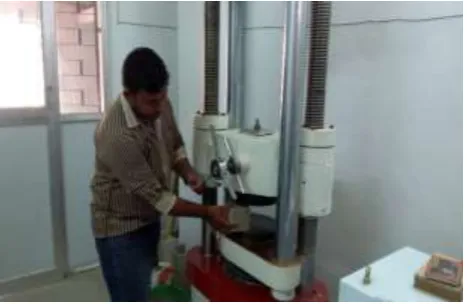
A thorough mix of the pre-sample was made by adding cement, sand and water in the ratio 1:2:3. The figures showed the mixing of sand, cement and water until proper proportion is achieved. Representative proportion of sample of concrete was taken for casting cubes. The concrete was filled into the moulds in layers appx. 5cm deep. It was distributed evenly and compacted either by vibration or by hand tampering. After the top layer has been compacted, the surface of concrete was levelled with the top of the mould using a trowel, and covered with glass plate to prevent evaporation.
The specimen was stored at site for 24+1/2h under damp matting or sack. After that, the samples were kept in clean water at 27+20 C, until the test time. The specimen was tested immediately after removal from water and still in wet condition. The bearing surface of the testing specimen was wiped clean and any loose material was removed from the surface. In the case of cubes, the specimen should be placed in the machine in such a manner that the load cube as cast, that is not to the top and bottom. Then the testing was done after aligning the specimen with the steel plates, and no packing was used.
The load was applied slowly without shock, and increased continuously at a rate of appx. 140kg/cm2/m till the resistance of the specimen to the increased load. Then it broke down and greater load could not be sustained. The maximum load applied to the specimen was recorded and the unusual factors marked at the time of failure. Each test specimen was a standard concrete cube (100mm3). A total of 12 no of cubes were made for testing. Concrete cubes were prepared using both natural aggregates and LDA. After filling of mould, it is subjected to vibrator table to eliminate air voids and homogeneous distribution, which indirectly affected the strength of the concrete.
After 24 hours, the cube was demoulded, and cured in lime water for 28 days and the air cured for at least another week at room temperature.
CEMENT 300 300
SAND 663 663
NA 0 1356
LDA(4-8mm) 336 0
LDA(8-16mm) 504 0
WATER 150 150
The specimens were subjected to moisture curing and another batch of same mix proportion specimens were subjected to air curing for both 14 days and 28 days. All the specimens were subjected to compression test and results were tabulated below.
Table.2.Moist curing:
14 Days (Mpa)
28Days (Mpa)
SAMPLES 1 2 3 1 2 3
NA 16.39 __ __ 19.71 19.64 20.36 LDA 13.93 __ __ 16.69 16.29 16.51
Table.3.Air curing: 28Days (Mpa)
SAMPLES 1 2
NA 17.94 18
LDA 16.11 18.3
Volume 03, Issue 9, [September- 2017] e-ISSN: 2394-5532, p-ISSN: 2394-823X
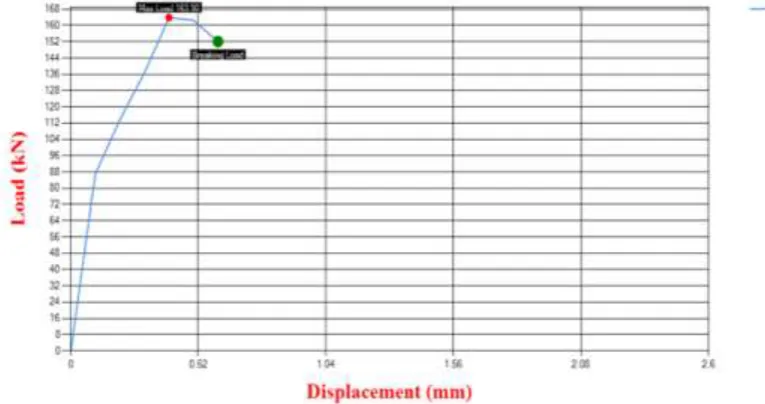
Figure.5.Graph showing the Load-Displacement variation of cube using natural aggregate (After 14days moist curing)
Figure.6.Graph showing the Load-Displacement variation of cube using low density aggregates (After 14 days moist curing)
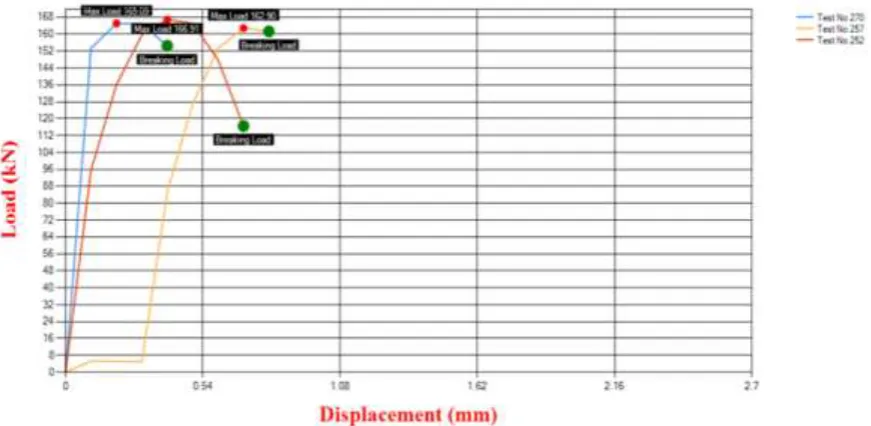
Figure .8.Graph showing the Load-Displacement of cube using low density aggregate (After 28 days moist curing)
Figure .9. Cubes after compression test
IV. CONCLUSION
Volume 03, Issue 9, [September- 2017] e-ISSN: 2394-5532, p-ISSN: 2394-823X
REFERENCES
[1] Murray M. A. Surface preparation for adhesives. Concrete International, 1989, 11, No. 9, 130–132.
[2] Rizzo E. M. and Sobelman M. B. Selection criteria for concrete repair materials. Concrete International, 1989, 11, No. 46–49.
[3] Saucier F. and Pigeon M. Durability of new-to-old concrete bonding. Proceedings of the ACI International Conference Evaluation and Rehabilitation of Concrete Structures and Innovations in Design, Hong Kong, 1991, Vol. 1, pp. 689–707
[4] Emmons P. H. Concrete Repair and Maintenance, Part Three: Surface Repair, Section 6: Bonding Repair Materials to Existing Concrete. R. S. Means Company, MA, 1994, pp. 154–163.
[5] Austin S., Robins P. and Pan Y. Tensile bond testing of concrete repairs. Materials and Structures, 1995, RILEM, 28,No. 179, 249–259.
[6] Ju´ lio E. S., Branco F. and Silva V. D. Structural rehabilitation of columns using reinforced concrete jacketing. Progress in Structural Engineering and Materials, 2003, 5, No. 1, 29–37.
[7] Garbacz A., Go´rka M. and Courard L. On the effect of concrete surface treatment on adhesion in repair systems. Magazine of Concrete Research, 2005, 57, No. 1, 49–60.
[8] American Concrete Pavement Association (ACPA) (1989), “Guidelines for Partial-Depth Repair”, Technical
Bulletin TB-003P, American Concrete Pavement Association ,Arlington Heights, Illinois.