The High Cost of Specialization: Labor Market Outcomes
Following Divorce
Michael Malcolm
West Chester University
Zainab Abdurrahman
University of Cambridge
October 2014
ABSTRACT
This article studies labor market transitions following divorce. Using US data, we show that absence from the labor force during marriage is associated with a lower probability of employment following divorce. For women, the effect is large initially – a 14.5% decline in probability of finding a job after divorce for each year out of the labor force during marriage. The effect dissipates over time, but there is long-run persistence. For men, the effect of comparable absences from the labor force is smaller and transitory. The presence of children also lowers labor market participation of women following divorce.
JEL Classification: D13, J22
I. Introduction
Absence from the labor force is known to be associated with future difficulties in finding a job. But married couples sometimes choose deliberately for one member of the household to leave the labor force in order to specialize in household production. The traditional arrangement is that women specialize in unpaid household production while men take responsibility for paid labor market activities. Becker (1981) rationalizes this traditional arrangement by arguing that such specialization increases total household utility and stabilizes marriage.
However, these mutual gains from trade may be compromised if the household dissolves. Investments in household production are not generally transferrable to the labor market. Thus, a divorced woman who needs to find a job may face difficulties entering the labor market if she specialized in household production during marriage. Our objective in this article is to study the effect of marital labor force absences on post-divorce labor market outcomes and to contrast the effect of comparable absences across genders.
absences from the labor force during marriage have significantly less impact on post-divorce labor market outcomes, and additionally these effects are transitory.
A secondary result is that the impact of children on labor market participation following divorce is strongly negative, and this effect actually intensifies in years subsequent to the divorce. Again, the cost to women is substantially higher than the cost to men.
There have been considerable changes in household arrangements over the past few decades, with large increases in both female labor force participation and in divorce. Figure 1 shows historical data on these series. The relationship between the two is complex and features bidirectional causality. In this article, we investigate one aspect of this relationship. Namely, our results suggest that specialization in household activities is an increasingly risky strategy for women as the probability of divorce rises. Other authors have examined the economic costs to women of divorce generally, and there is some work on poverty and income consequences associated with specialization, but this appears to be the first article that studies lack of mobility in employment outcomes.
<<INSERT FIGURE 1 HERE>>
II. Previous Literature
biological abilities form the basis of the gains from trade. Hyee and Robledo (2009) later argued that this specialization can arise endogenously. Even if spouses are identical, specialization can result from increasing returns to experience in the labor market.
Becker’s model remains controversial and his conclusions are not universally accepted. Sigle-Rushton (2010) questioned whether the gains from trade implied by Becker’s model actually exist in practice. In particular, she asserted that economic and social changes that have occurred in industrialized countries since Becker developed his model may have made specialization more costly and riskier for families. She found using UK data that, contrary to the predictions of Becker, the risk of divorce actually falls when men share in unpaid household work and childcare, regardless of their wives’ employment status. Similarly, Cooke (2004) found using data from Germany that the husband’s relative contribution to household production increases the couple’s chance of continuing to invest in the household by having a second child. For women, Poortman and Kalmijn (2002) found little evidence that female labor force participation leads to divorce.
article in another sense: there is a well-established link between unemployment and divorce, but research on the association in the other direction is sparse.
In summary, these are still open questions in the literature. Stevenson and Wolfers (2007) extensively documented the way in which institutional changes have altered incentives related to marriage and divorce. Given the rapidly changing institutions and norms with respect to family arrangements, there is no consensus on the extent to which gains in overall utility (for both partners) are created by specialization in marriage or even whether such gains still exist. Our article contributes to this literature by arguing that, from a life-cycle perspective, these gains from specialization for women may be compromised if they face a risk of divorce.
using more recent data from the Netherlands, but she found that the causality could run in the other direction, depending upon how unexpected the divorce is. Neither of these studies tracked respondents’ outcomes following divorce. By contrast, we compare the post-divorce labor market outcomes of women who participate and women who do not participate in the labor market while married.
Holden and Smock (1991) reviewed existing literature and found that divorce has a negative and prolonged effect on a woman’s economic well-being. The authors suggested multiple causative factors, specifically identifying unequal division of labor during marriage and lower wages paid to women both before and after marriage, but they did not estimate the magnitude of these effects. They also noted that female specialization in household activities might create deficiencies not only in labor market experience, but also in educational attainment.
III. Theory
Absences from the labor market during the current period are associated with both transitory and permanent reductions in future employment probability (Ruhm 1991). Fundamentally there are two aspects of this empirical regularity. First, there is a transition dynamic – people who are not currently in the labor force may have difficulty re-adjusting to entry into the paid labor force. Second, there are permanent effects – if some people are endowed permanently with characteristics that create difficulties securing and holding a job, then this manifests itself empirically as an association between employment statuses in various periods.
Because of these dual effects, we have to be careful in interpreting an association between past and future absences from the labor force as an impediment that was caused by past absences. If women who are not in the labor force during marriage have difficulty locating jobs after they are divorced, it might be due to permanent characteristics that created employability difficulties in both periods rather than to a difficulty created by home specialization during marriage. Econometrically, we can attempt to control for these variations in permanent employability characteristics to the extent possible, but there will surely be some residual that is unexplained. In other words, absence from the labor market during marriage can be associated with other factors besides specialization in household production, and these could potentially explain the strong correlation that we observe in the data.
by looking at the long-term trajectory of employment probability following divorce. A one-shot association between being out of the labor force during marriage and difficulty securing a job after divorce is difficult to interpret because of the concatenation of the effects discussed above. But a signature of the effect that we are trying to identify is a large initial impact of marital absences from the labor force on post-divorce employment probability, but one that dissipates over time. Such an effect would be due not to permanently bad employability characteristics of women who stayed at home while married, but to a transition dynamic
forward-rational decisions, choices while she is married must incorporate the risk of future divorce. If the assertion in this article is correct that specializing in household production is costly in terms of future employment potential, then a woman’s time allocated to household activities while married will be lower as her risk of divorce rises. This cost operates not only via a lower probability of locating a job, which is what we study in this article, but also via a lower wage. We do not study this latter aspect of labor market transitions, but Schonberg and Ludsteck (2007) argued that the effect for wages is both monotonic and convex.
Jacquemet and Robin (2012) developed a spousal matching and household choice model that allows both spouses to divide their time between labor, leisure and household production, and incorporates a risk of divorce. The model does not explicitly incorporate a future wage cost associated with home production.
Finally, from the perspective of the household welfare problem, Ott (1992) showed that strategic considerations lead to inefficiencies at the household level that arise out of sub-optimal investment in household public goods. Hyee and Robledo (2009) argued that this problem could be solved if the man could commit up front to a sizeable transfer to his wife upon divorce, but that the inefficiency remains because of a commitment problem.
IV. Data and Empirical Methods
basis. The dataset includes panel data on labor market experience, human capital and other socioeconomic variables.
We studied labor market outcomes one year after divorce, and then two, four and six years following divorce. Because the survey was conducted only biennially after 1994, this restricted us to observations with a divorce in the years mentioned above. As mentioned earlier, eliminating the one-year time frame would have given us more data, but at the cost of significant information loss since one of our most important results is to contrast transitory and long-term effects.
The dependent variable is a dummy with unit value if the individual is employed. We set it equal to one if the individual is employed or on active duty with the armed forces and set it equal to zero if the individual is unemployed or out of the labor force. We then applied a probit model to our sample of divorced individuals four successive times, separately for men and women, in order to study the determinants of their employment status after divorce.
The independent variable of interest is employment during marriage. Specifically, the NLSY79 collects information on the number of weeks an individual has worked in the past calendar year. Our key independent variable is the number of weeks worked in the three years prior to divorce. A longer time frame would have led to data loss by truncating the sample for earlier years. Our hypothesis is that this coefficient should be positive. We would expect that labor market participation during marriage is associated with a higher probability of employment after divorce.
We also controlled for the level of monetary assets held by the individual. People with large amounts of assets have higher reservation wages for entering the labor force; economic theory suggests that this coefficient is negative. Furthermore, total number of children born to the individual is an important determinant of labor supply decisions, especially for divorced women. Here, the effect is theoretically ambiguous. A larger number of children creates a more pressing need for labor-market income, but children can also be an impediment to employment in various ways: taking children to school or being the only caretaker in the event of a child’s illness.
Income from wages and salaries is also an important determinant of labor force participation. Gonzalez (2004) argued that the ability to earn higher wages is associated with increased probability of accepting a job. Finally, education is certainly linked to employment outcomes, and we expect higher levels of education to be positively correlated with probability of employment. We measured education as the number of years the individual completed in school.
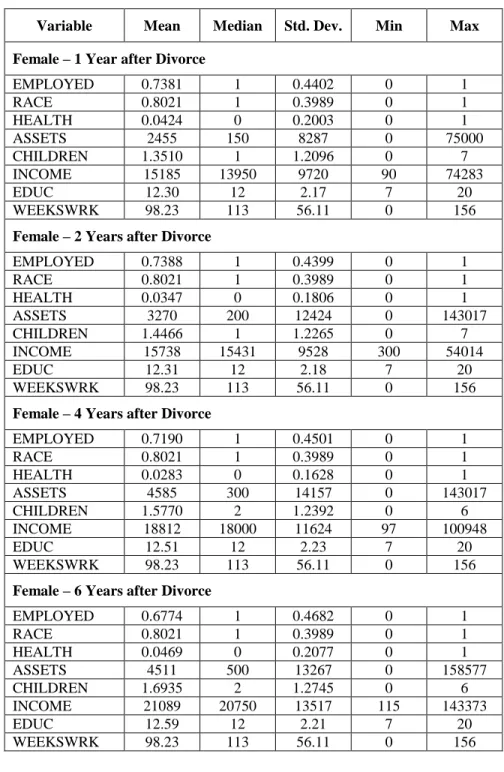
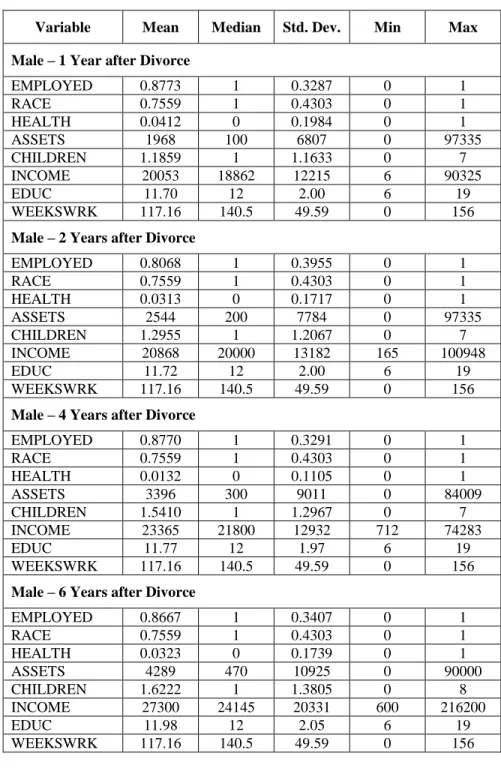
It is useful to contrast the pre-divorce labor force participation with post-divorce labor force participation for men and women separately. For men, 77.6% are in the labor force three years prior to divorce, and 87.7% are in the labor force in the year after their divorces. For women, the difference is much larger. Only 56.8% are in the labor force three years prior to divorce, but 73.8% are in the labor force in the year after divorce. Separation increases labor force participation for both men and women. This is not surprising since risk-sharing in marriage can shield partners who experience job separations from being forced to locate a new job immediately. But the difference is stronger for women than for men. This suggests a point that we made earlier, in contrasting men and women – many women who are unemployed during marriage are doing so by deliberate choice to stay at home, and then seek to reenter the labor market after divorce. We want to investigate empirically whether these marital absences create a barrier for employment after divorce.
The reduced-form probit model is as follows. Here, Φ(⋅) is the CDF of the standard normal distribution and 𝑢𝑖 is stochastic error:
Pr(𝐸𝑚𝑝𝑙𝑜𝑦𝑒𝑑) = Φ(𝛽0+ 𝛽1⋅ 𝑅𝐴𝐶𝐸 + 𝛽2⋅ 𝐻𝐸𝐴𝐿𝑇𝐻 + 𝛽3⋅ 𝐴𝑆𝑆𝐸𝑇𝑆 + 𝛽4⋅ 𝐶𝐻𝐼𝐿𝐷𝑅𝐸𝑁 + 𝛽5⋅
𝐼𝑁𝐶𝑂𝑀𝐸 + 𝛽6⋅ 𝐸𝐷𝑈𝐶 + 𝛽7⋅ 𝑊𝐸𝐸𝐾𝑆𝑊𝑅𝐾 + 𝑢𝑖)
The key variable of interest is 𝑊𝐸𝐸𝐾𝑆𝑊𝑅𝐾, which measures the number of weeks worked in the three years prior to divorce.
<<INSERT TABLE 3 HERE>>
V. Results
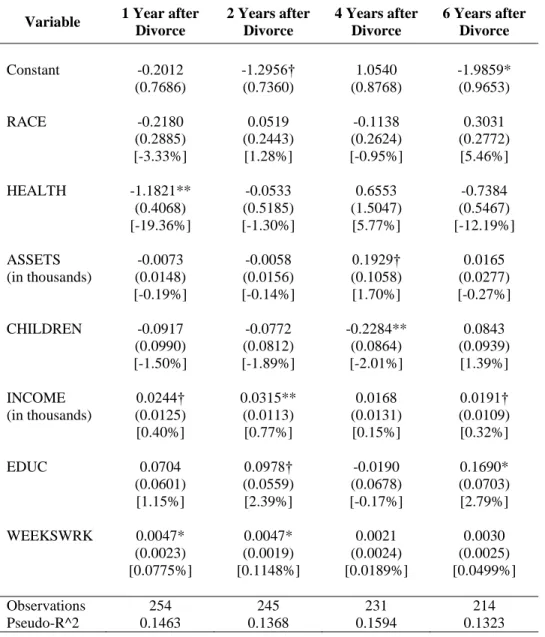
Tables 4 and 5, respectively for men and for women, present parameter estimates for the probit regression over all individuals in the sample at one, two, four and six years after divorce. We give the estimated parameters and their standard errors along with the marginal effect of a 1-unit increase in each variable on the estimated probability of employment. All marginal effects were evaluated at the mean.
<<INSERT TABLE 4 HERE>> <<INSERT TABLE 5 HERE>>
The coefficients on the variable of interest are significant at the 𝛼 = 0.01 level in all cases for women. Furthermore, all have the expected positive sign. Working during marriage is associated with higher probability of employment following a divorce. For men, the coefficient measuring the impact of weeks worked during the marriage on employment following divorce is significant at the 𝛼 = 0.05 level only at one and two years following divorce. At four and six years following divorce, the coefficient is not significant at conventional levels.
force for one year, her probability of being employed one year after divorce is 14.5% lower than an otherwise identical divorced woman who was fully employed for that year.
For women, there is a statistically significant effect of these marital absences that
continues to persist for at least six years following the divorce. However, the marginal impact of these absences is strongest at one year following divorce and then weakens as time goes on. Compared to a fully employed woman, an otherwise identical woman who stayed at home for a full year has a 14.5% lower chance of being employed one year following divorce, a 10.2% lower chance of being employed two years following divorce, a 6.4% lower chance of being employed four years following divorce and an 8% lower change of being employed six years following divorce (the fit for the model of employment outcomes six years after divorce is substantially weaker than for shorter intervals following divorce). In summary, for divorced women there is a very large transitory effect of not working during marriage, but the magnitude of this effect falls rapidly following divorce. However, a residual long-term effect remains.
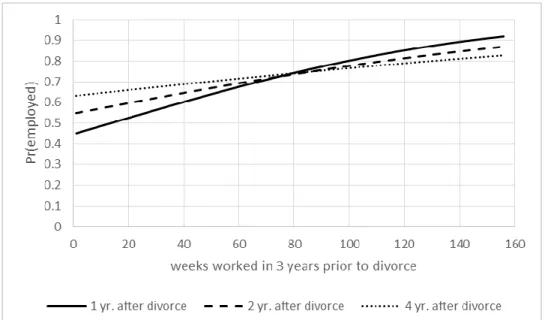
Since the underlying model is not linear, it is useful to examine the estimated probability functions, which are plotted in figure 2 as a function of the independent variable of interest. Mean values are used for the control variables. A woman who is fully employed for the three years prior to divorce is about twice as likely to be employed after divorce than a woman who did not work at all, but observe that the function successively flattens in years following divorce.
For men, a full year of absence from the labor force during marriage is associated with a much smaller decline in probability of employment following divorce. Specifically, each year of absence from the labor force during marriage is associated with a 4% decline in the probability of employment one year following divorce and a 5.9% decline in the probability of employment two years following divorce. Recall that the same marginal impacts for women are 14.5% and 10.2%. At four years and six years following divorce, the estimated coefficients are still positive but are not significant at conventional levels. In summary, for divorced men, absence from the labor force during marriage has an impact on post-divorce labor market outcomes one year and two years following divorce that is much smaller than the comparable impact for women. Furthermore, we see neither the statistically significant rapid dissipation nor the residual permanent effect four and six years after divorce that we observe for women.
If we take a time frame shorter than three years prior to divorce, the correlation between pre-divorce and post-divorce labor market outcomes is even stronger. For example, each week in the labor force across the three years prior to divorce is associated with a 0.2787% increase in the probability of employment one year after divorce. However, each week in the labor force in the
a better indication of the link between what a woman is doing during marriage and her post-divorce labor market status.1
Another interesting observation is the marginal effect of children on employment prospects after divorce. The presence of an additional child consistently reduces the probability of employment for both men and women at years subsequent to divorce. However, the effect is again much stronger for women than for men. The presence of children decreases a woman’s probability of employment to a greater extent than a man’s probability of employment, and in fact for women this effect is stronger at two years and four years following divorce than it is at one year following divorce.
The other control variables, where significant, have the expected signs. Individuals who report that health limits the amount of work they can do are less likely to be employed. Higher income is associated with higher probability of employment. Similarly, educational attainment is associated with higher probability of employment, especially for women. In addition, the marginal effect of an increase in assets on probability of employment is negative.
As a sensitivity check, we estimated the model using logistic regression rather than probit regression. The results were almost the same. The relevant coefficients are significant, and their signs match with our probit estimates. Figure 3 shows the estimated probability functions using the logit link function. It displays the same successive flattening pattern as in the probit model – for women, marital absences from the labor force have a much stronger impact on employment immediately following divorce than they do further out from the divorce. We also tried estimating
the model using time dummies in order to control for macroeconomic fluctuations and since female labor force participation is increasing generally. The results were almost the same and the time dummies were mostly insignificant. This is presumably because of the short period under consideration. Interested readers are invited to obtain the full results of these sensitivity checks directly from the author.
<<INSERT FIGURE 3 HERE>>
VI. Interpretation and Discussion
As discussed earlier in the article, the fact that absences from the labor force in one year are correlated with lack of employment in future years is well-established in the literature. Our results measure the magnitude of the association between the two, which is useful from a policy perspective, but it is also interesting to think about the causal impact of female specialization. We can learn about this causal impact by looking at gender differences and by looking at the long-term trajectory.
difficulties locating a job in the future than men with comparable absences from the labor force is due to a difference in ease of transition rather than to unobserved selection problems.
In addition to cross-gender differences, a second identification strategy is to examine the level of persistence in these marginal effects over the long-term. For women, the marginal effect of marital absences from the labor force on employment probability one year after marriage is large. Two years after marriage, this marginal effect falls by 30%. Four years after marriage, the marginal effect falls by an additional 37%. All of these results are statistically significant. For men, the initial effect is much smaller, and is actually slightly larger two years after divorce than it is one year after divorce. At four years after divorce, the marginal effect can no longer be measured with statistical significance. A large initial effect that dissipates rapidly is precisely an indicator of a unique shock to labor market outcomes created by specialization in household activities that reduces in magnitude as time goes on after the divorce for otherwise employable women, in contrast to a selection effect. Women lose a lot initially in terms of future employment prospects, but they are also able to rebuild their labor market skills following divorce that replace their marital-specific human capital. This build-up is significant and clear in our data.
The gender differences in the marginal effect of children are also interesting. The fact that they are negative is consistent with the general idea that marriage-specific investments reduce employment prospects after divorce. But children are a special case because, while marital-specific human capital can be replaced by labor market capital following divorce, the presence of children is permanent. It makes sense that this effect is stronger for men than for women because women are more likely to become the primary caretaker after divorce. Indeed, the National Center for Health Statistics reported in 1995 that 72% of divorces with children involved resulted in a custody award to the mother. The fact that this negative effect actually strengthens to some extent over time demonstrates the point above – labor-market skills can be re-accumulated, so the effect of previous household specialization diminishes as time goes on, but the same cannot be said of children, where there is a lasting negative effect on employment probability. The presence of children may actually reinforce the problem by making it difficult for the mother to accumulate labor market skills. Takada (2011) provided additional empirical evidence for this negative association. Kennelly (1999) suggested that the reason may be discrimination in the labor market, where single mothers are often stereotyped as poor and unstable workers.
In terms of policy, one implication of the findings in our article is that policies aimed at strengthening labor market capital for divorced mothers may be an important step in improving poverty outcomes for these families. Van Damme et al. (2009) argued that raw income transfers are not a good solution, as they induce a negative employment effects. On the other hand, they argued that public provision of childcare is an important element of increasing employment for single mothers.
VII. Conclusion
The findings of this article present further evidence regarding some of the impediments that women face later in their lives as a consequence of gendered specialization in household arrangements while married. Specializing in household production may put the household on the utility-maximizing frontier during the marriage, but such specialization can create costs for women if they divorce. In this article, we investigated one aspect of these costs and showed that a woman’s probability of employment following a divorce drops precipitously if she was absent from the labor force while married. The effect of these absences dissipates as time goes on, suggesting that women are able to re-accumulate a sizeable amount of this lost labor market capital following divorce, although there is a residual long-lasting effect. Comparable absences for men create smaller and largely transitory effects on their labor market outcomes following divorce. The presence of children creates additional difficulties for employment prospects, again stronger for women than for men, and this effect actually intensifies slightly following divorce.
is critical to economic development. Goldin (1994) argued that growth in standard of living past some threshold point is strongly correlated with female labor force participation. Entry of women into the workforce has constituted a large structural change to the labor market in the last few decades. Given the reality of an increasingly dynamic marriage market, the relationship between the two deserves close attention. While the Becker model suggests that investing less in household production may lead to instability within marriages, the results in this article and others imply conversely that a higher risk of divorce feeds back to less time invested in household production for agents who are forward-rational.
Research that relates changes in family structure to changes in labor supply is also important to inform policy that addresses economic outcomes for families, especially for single-mother households. One aspect of this policy is institutional change related to marriage, divorce, child support and alimony laws. Another aspect is the structuring of welfare and childcare provision for low-income households, where again the relationship between labor supply choices, benefit structure and household structure is of interest to policymakers.
References
Becker, G. S. (1981). A treatise on the family. Cambridge, MA: Harvard University Press. Blau, F. D., Ferber, M. A., & Winkler, A. E. (2006). The economics of women, men, and work. Englewood Cliffs, NJ: Prentice Hall.
Bremmer, D., & Kesselring, R. (2004). Divorce and female labor force participation: Evidence from times-series data and cointegration. Atlantic Economic Journal, 32(3), 175-190.
Bureau of Labor Statistics. Various years. Labor Force Participation Rate – Women. Washington DC: US Department of Labor.
Chiappori, P., & Weiss, Y. (2006). Divorce, remarriage and welfare: A general equilibrium approach. Journal of the European Economic Association, 4(2), 415-426.
Chiswick, B. R. (1986). Labor supply and investment in child quality: A study of Jewish and non-Jewish women. The Review of Economics and Statistics, 68(4), 700-703.
Cooke, L.P. (2004). The gendered division of labor and family outcomes in Germany. Journal of Marriage and Family 66(5), 1246-1259.
Eliason, M. (2012). Lost jobs, broken marriages. Journal of Population Economics, 25(4), 1365-1397.
Fan, M. (1997). Health, disease, and labor market performance. (Unpublished doctoral dissertation). Northern Illinois University, DeKalb, IL.
Fernandez, R., Fogli, A., & Olivetti, C. (2004). Mothers and sons: Preference formation and female labor force dynamics. The Quarterly Journal of Economics, 119(4), 1249-1299. Goldin, C. (1994). The U-shaped female labor force function in economic development and economic history (No. w4707). National Bureau of Economic Research.
Gonzalez, L. (2004). Single mothers and work. Socio-Economic Review, 2(2), 285-313. Heckman, J. J., & Masterov, D. V. (2007). The productivity argument for investing in young children. Applied Economic Perspectives and Policy, 29(3), 446-493.
Holden, K., & Smock, P. (1991). The Economic costs of marital dissolution: Why do women bear a disproportionate cost? Annual Review of Sociology, 17, 51-78.
Jacquemet, N., & Robin, J. (2012). Assortative matching and search with labor supply and home production. (Working paper).
Jensen, P., & Smith, N. (1990). Unemployment and marital dissolution. Journal of Population Economics, 3(3), 215-229.
Jalovaara, M. (2003). The joint effects of marriage partners’ socioeconomic positions on the risk of divorce. Demograhpy, 40(1), 67-81.
Johnson, W.R., & Skinner, J. (1986). Labor supply and marital separation. The American Economic Review, 76(3), 455-469.
Kennelly, I. (1999). “That single-mother element”: How white employers typify black women.
Gender and Society, 13(2), 168-192.
Kraft, K. (2001). Unemployment and the separation of married couples. KYKLOS, 54(1), 67-88. McManus, P.A., & DiPrete, T.A. (2001). Losers and winners: The financial consequences of separation and divorce for men. American Sociological Review, 66(2), 246-268.
National Center for Health Statistics. (1995). Advance report of final divorce statistics, 1989 and 1990. (Monthly Vital Statistics Report vol. 43 no. 9). Hyattsville, MD: National Center for Health Statistics.
National Center for Health Statistics. Various years. National Vital Statistics Reports. Hyatsville, MD: National Center for Health Statistics
Olivetti, C. (2006). Changes in women's hours of market work: The role of returns to experience. Review of Economic Dynamics, 9(4), 557-587.
Ott, N. (1992). Intrafamily bargaining and household decisions. Berlin: Springer-Verlag. Poortman, A., & Kalmijn, M. (2002). Women’s labor market position and divorce in the Netherlands: Evaluating economic interpretations of the work effect. European Journal of Population, 18(2), 175-202.
Poortman, A. (2005). Women’s work and divorce: A matter of anticipation? European Sociological Review, 21(3), 301-309.
Schonberg, U., & Ludsteck, J. (2007). Maternity leave legislation, female labor supply and the family wage gap. (IZA Discussion Paper no. 2699). Institute for the Study of Labor.
Sigle-Rushton, W. (2010). Men’s unpaid work and divorce: Reassessing specialization and trade in British families. Feminist Economics, 16(2), 1-26.
Smock, P. (1993). The Economic Costs of Marital Disruption for Young Women over the Past Two Decades. Demography, 30(3), 353-371.
Stevenson, B. (2007). The impact of divorce laws on marriage-specific capital. Journal of Labor Economics, 25(1), 75-94.
Stevenson, B., & Wolfers, J. (2007). Marriage and divorce: Changes and their driving forces.
Journal of Economic Perspectives, 21(2), 27-52.
Takada, S. (2011). Factors determining the employment of single mothers. The Japanese Economy, 38(2), 105-123.
Turner, M.A., Fix, M., & Struyk, R.J. (1991). Opportunities denied, opportunities diminished: Discrimination in hiring. Washington DC: Urban Institute Press.
Figure 1: Female Labor Force Participation Rate and Divorce Rate2
Figure 2: Probability Employed for Divorced Females – Probit Estimates
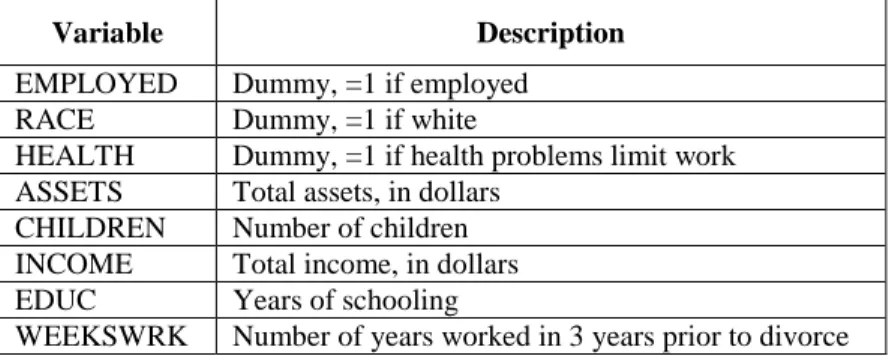
Variable Description
EMPLOYED Dummy, =1 if employed RACE Dummy, =1 if white
HEALTH Dummy, =1 if health problems limit work ASSETS Total assets, in dollars
CHILDREN Number of children INCOME Total income, in dollars EDUC Years of schooling
WEEKSWRK Number of years worked in 3 years prior to divorce
Variable Mean Median Std. Dev. Min Max
Female – 1 Year after Divorce
EMPLOYED 0.7381 1 0.4402 0 1
RACE 0.8021 1 0.3989 0 1
HEALTH 0.0424 0 0.2003 0 1
ASSETS 2455 150 8287 0 75000
CHILDREN 1.3510 1 1.2096 0 7
INCOME 15185 13950 9720 90 74283
EDUC 12.30 12 2.17 7 20
WEEKSWRK 98.23 113 56.11 0 156
Female – 2 Years after Divorce
EMPLOYED 0.7388 1 0.4399 0 1
RACE 0.8021 1 0.3989 0 1
HEALTH 0.0347 0 0.1806 0 1
ASSETS 3270 200 12424 0 143017
CHILDREN 1.4466 1 1.2265 0 7
INCOME 15738 15431 9528 300 54014
EDUC 12.31 12 2.18 7 20
WEEKSWRK 98.23 113 56.11 0 156
Female – 4 Years after Divorce
EMPLOYED 0.7190 1 0.4501 0 1
RACE 0.8021 1 0.3989 0 1
HEALTH 0.0283 0 0.1628 0 1
ASSETS 4585 300 14157 0 143017
CHILDREN 1.5770 2 1.2392 0 6
INCOME 18812 18000 11624 97 100948
EDUC 12.51 12 2.23 7 20
WEEKSWRK 98.23 113 56.11 0 156
Female – 6 Years after Divorce
EMPLOYED 0.6774 1 0.4682 0 1
RACE 0.8021 1 0.3989 0 1
HEALTH 0.0469 0 0.2077 0 1
ASSETS 4511 500 13267 0 158577
CHILDREN 1.6935 2 1.2745 0 6
INCOME 21089 20750 13517 115 143373
EDUC 12.59 12 2.21 7 20
WEEKSWRK 98.23 113 56.11 0 156
Variable Mean Median Std. Dev. Min Max
Male – 1 Year after Divorce
EMPLOYED 0.8773 1 0.3287 0 1
RACE 0.7559 1 0.4303 0 1
HEALTH 0.0412 0 0.1984 0 1
ASSETS 1968 100 6807 0 97335
CHILDREN 1.1859 1 1.1633 0 7
INCOME 20053 18862 12215 6 90325
EDUC 11.70 12 2.00 6 19
WEEKSWRK 117.16 140.5 49.59 0 156
Male – 2 Years after Divorce
EMPLOYED 0.8068 1 0.3955 0 1
RACE 0.7559 1 0.4303 0 1
HEALTH 0.0313 0 0.1717 0 1
ASSETS 2544 200 7784 0 97335
CHILDREN 1.2955 1 1.2067 0 7
INCOME 20868 20000 13182 165 100948
EDUC 11.72 12 2.00 6 19
WEEKSWRK 117.16 140.5 49.59 0 156
Male – 4 Years after Divorce
EMPLOYED 0.8770 1 0.3291 0 1
RACE 0.7559 1 0.4303 0 1
HEALTH 0.0132 0 0.1105 0 1
ASSETS 3396 300 9011 0 84009
CHILDREN 1.5410 1 1.2967 0 7
INCOME 23365 21800 12932 712 74283
EDUC 11.77 12 1.97 6 19
WEEKSWRK 117.16 140.5 49.59 0 156
Male – 6 Years after Divorce
EMPLOYED 0.8667 1 0.3407 0 1
RACE 0.7559 1 0.4303 0 1
HEALTH 0.0323 0 0.1739 0 1
ASSETS 4289 470 10925 0 90000
CHILDREN 1.6222 1 1.3805 0 8
INCOME 27300 24145 20331 600 216200
EDUC 11.98 12 2.05 6 19
WEEKSWRK 117.16 140.5 49.59 0 156
Variable 1 Year after Divorce
2 Years after Divorce
4 Years after Divorce
6 Years after Divorce
Constant -0.9495 (0.6242) -1.2028* (0.6094) 0.6539 (0.5824) -0.5353 (0.5699)
RACE 0.0043
(0.2142) [0.12%] 0.1509 (0.1971) [4.75%] -0.0913 (0.1973) [-2.87%] -0.1191 (0.1873) [-4.10%]
HEALTH -0.6552†
(0.3630) [-18.62%] 0.4195 (0.4876) [12.81%] -0.5972 (0.4677) [-19.06%] -0.2316 (0.3649) [-8.12%] ASSETS (in thousands) -0.0063 (0.0099) [-0.18%] -0.0075 (0.0062) [-0.23%] -0.0055 (0.0054) [-0.18%] 0.0046 (0.0074) [0.16%]
CHILDREN -0.2284** (0.0752) [-6.49%] -0.2329*** (0.0726) [-7.11%] -0.3474*** (0.0733) [-11.09%] -0.0789 (0.0669) [-2.77%] INCOME (in thousands) 0.0247* (0.0107) [0.70%] 0.0052 (0.0098) [0.16%] 0.0074 (0.0090) [0.24%] 0.0033 (0.0072) [0.17%]
EDUC 0.0643
(0.0443) [1.83%] 0.1187** (0.0445) [3.62%] 0.0122 (0.0412) [0.39%] 0.0587 (0.0398) [2.06%]
WEEKSWRK 0.0098*** (0.0016) [0.2787%] 0.0065*** (0.0015) [0.1970%] 0.0039** (0.0015) [0.1240%] 0.0044** (0.0015) [0.1540%]
Observations 348 334 315 290
Pseudo-R^2 0.2576 0.1815 0.1428 0.0690
Table 4: Female Determinants of Employment 1, 2, 4 and 6 Years after Divorce
Variable 1 Year after Divorce
2 Years after Divorce
4 Years after Divorce
6 Years after Divorce
Constant -0.2012 (0.7686) -1.2956† (0.7360) 1.0540 (0.8768) -1.9859* (0.9653)
RACE -0.2180
(0.2885) [-3.33%] 0.0519 (0.2443) [1.28%] -0.1138 (0.2624) [-0.95%] 0.3031 (0.2772) [5.46%]
HEALTH -1.1821**
(0.4068) [-19.36%] -0.0533 (0.5185) [-1.30%] 0.6553 (1.5047) [5.77%] -0.7384 (0.5467) [-12.19%] ASSETS (in thousands) -0.0073 (0.0148) [-0.19%] -0.0058 (0.0156) [-0.14%] 0.1929† (0.1058) [1.70%] 0.0165 (0.0277) [-0.27%]
CHILDREN -0.0917 (0.0990) [-1.50%] -0.0772 (0.0812) [-1.89%] -0.2284** (0.0864) [-2.01%] 0.0843 (0.0939) [1.39%] INCOME (in thousands) 0.0244† (0.0125) [0.40%] 0.0315** (0.0113) [0.77%] 0.0168 (0.0131) [0.15%] 0.0191† (0.0109) [0.32%]
EDUC 0.0704
(0.0601) [1.15%] 0.0978† (0.0559) [2.39%] -0.0190 (0.0678) [-0.17%] 0.1690* (0.0703) [2.79%]
WEEKSWRK 0.0047* (0.0023) [0.0775%] 0.0047* (0.0019) [0.1148%] 0.0021 (0.0024) [0.0189%] 0.0030 (0.0025) [0.0499%]
Observations 254 245 231 214
Pseudo-R^2 0.1463 0.1368 0.1594 0.1323
Table 5: Male Determinants of Employment 1, 2, 4 and 6 Years after Divorce