'
...
...
....
-·
_... ' , -:. .'
..
I ! ..
- :. - f.'":
- .. ~ 'i
...
·~
.
,,~ . '
' ' -~ .. ' '
-, • •"ti:'!,,,. 1'..
.
..
,
..
"
• .c: •o1:.r '"' - •··
...
• : .. "Ii. - :
.
··.REBTRIOl'ED
Becwity lxdouuatiou
Copy No. _ _ _NATIONAL SECURITY AGENCY
MILITARY CRYPTANALYSIS
Part I
4th Edition
By
WILLIAM
F. FRIEDMANRevised and enlcrged by
LAMBROS D. CALLIMAHOS
NOTICE: This document contains information affecting the national defense
of the United States within the meaning of the Espionage Laws, Title 18, U.S.C.,
Sections 793, 794 and Title 50, U.S.C., Sections 46, 46a and 46b. Its trans·
mission or the revelation of its cohtents in any manner to an unauthorized person
is prohibited by law •
National Security Agency Washington 25, D. C.
December 1952
- .... -.· J
....
,_ :" ~';. -~ ...-RES'f'RIC'f'ED
i
SECTION VII
MULTILITERAL SUBSTl'l.1UTION WITH SINGLE-EQUIVA.Imrr CIPHER ALPIIABETS
I
(In preparation)
REF ID:A56B95
RElS'f'RIG'FED
(BLANK)
:RES'FFtlG'i'BD
SECTION VIII
MUIII'ILITERAL SUBSTITUTION WITH VARIANTS
(In preparation)
REF ID:A56895
RESTRICTED
-
.
RES'F:RIG'FEDRES'fRIO'fED
REF ID:A56895
SECTION IX
POLYGRAPHIC SUBSTITUTION SYSTEMS
REF ID:A56895
RES'fRIC'f Ef)
_...---~---~·
REF ID:A56895
REB'i'RfC'i'ED
RES'f'RIC'f'ED
SECTION X
CONCLUDING REMARKS
REF ID:A56895
RBS'f'HfC'f':J!:D
(J3LANK)
:RBSTHIG'fED
lli!STHIG'f ElD
APPENDIX l
GLOSSARY(In preparation)
-REF ID:A56895
ftES'f'RIC'f ED
(BLANK)
HES':FRIO'f'E!D
APPENDIX
5
\u:irrER FREQUENCY DATA - FOREIGN LANGUAGES
APPENDIX
6
LIST OF FREQUENT WORDS - ENGLISH A\'ID FOREIGN LANGUAGES
(In preparation)
REF ID:A56895
REiS'f'RiC'f
f!:f)RESTRICTED
APPENDIX 7
CRlP.rOGRAPHIC SUPPLEMJmr
REF ID:A56895
RElS'i'RIC'f ED
:RES'FRIC'f'ED
APPENDIX 8
LESTER S. HILL ALGEBBAIC ENCIPHEBMEN!'
(In preparation)
REF ID:A56895
RES'PRlC'PE:lD
(BLANK)
RES'fRIC'fED
APPENDIX
9
OPEN CODES AND CONCEAI.MEM SYSTEMS
(In preparation)
REF ID:A56895
REB'i'RIC'f ED
(BLANK)
RES'FRIC'PEiD
:RHBTRIO'f'ED
APPENDIX 10
COMMUNICATION INTELLIGENCE O:PERATIONS
APPENDIX 11
PRINCIPLES OF COMMUNICATION SECURITY
REF ID:A56895
&E8TRIC'FElD
(BLANK)
RE8TIUC'FElD
RE:!f3':P.RfC'fED
APPENDDC 12
BIBLIOGRAPBY; RECOMMENDED READING
REF ID:A56895
RESTRICTED
(BLANK)
RES'f'RfC'f'Ef>
RES'f'RfC'f'ED
. . .1
.APJ?ENDIX 13
PROBIEMS - MILITARY CRYP.rANALYSIS, P.A.Rr I
REF ID:A56895
(BLANK)
RBSTHIC'fED
FtElB'FHIGTEt>
•
APPENDIX 14
FOREIGN LANGUAGE PROBtEMS
REF ID:A56895
RElS'f'RIC'f' EID
(BLANK)
RESTRICTED
Seemity
111.fmnmtioll
NATIONAL SECURITY AGENCY
MILITARY CRYPTANALYSIS
Part I
4th Edition
By
WILLIAM F. FRIEDMAN
Revised and enlarged by
LAMBROS D. CALLIMAHOS
National Security Agency
Washington 25, D. C.
REF ID:A56895
The Golden Guess
Is Moming·Star lo the full round of Truth.
··Tennyson.
Preface to the 4th Edition
This edition represents an extensive expansion and revision of the original text, in both scope and content, necessitated by the considerable advancement made in the art since the publication of the previous editions.
I wish to express grateful acknowledgment for Mr. Friedman's generous assistance and invaluable collaboration in the preparation of this edition.
•• L. O. C.
ftES'fRIC'f'ED
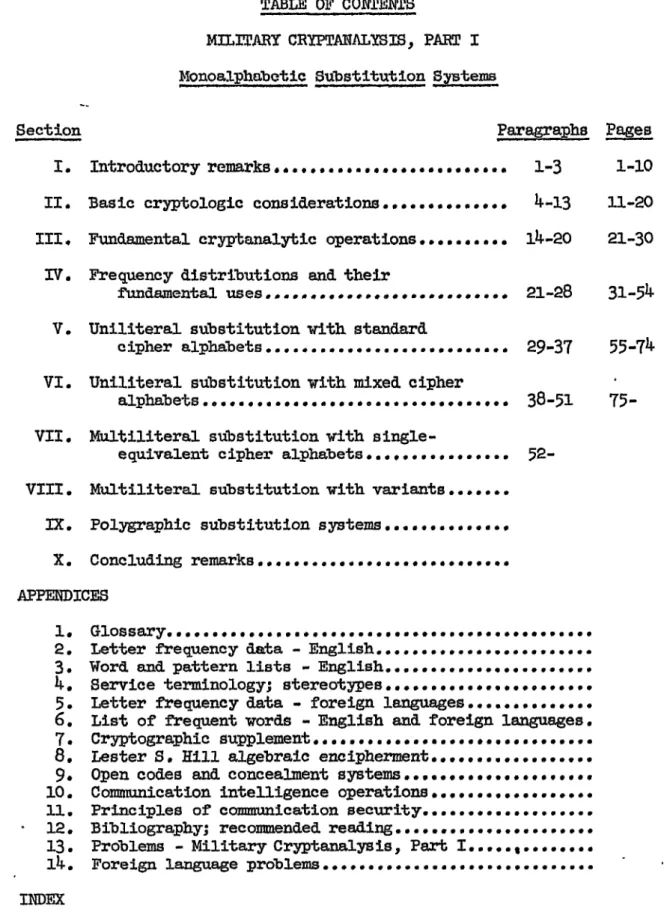
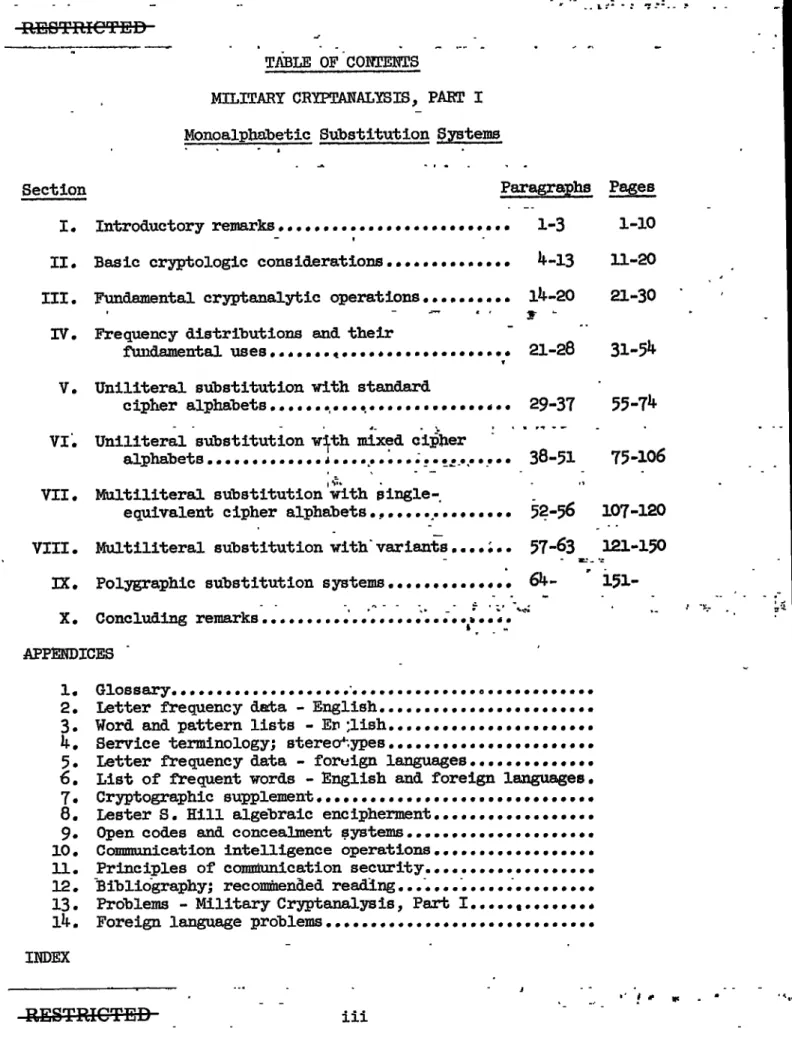
TABLE OF CONTENTS
MILITARY CRYPTANALYSIS, PART I Monoalphabctic Substitution Systems
Section Paragraphs Pages
I. Introductory remarks••••••••••••••••••••••••••
II. Basic cryptologic considerations ••••••••••••••
III. Fundamental cry:p-tanalytic operations ••••••••••
rl. Frequency distributions and their
:f'undamental uses•••••••••••••••••••••••••••
V. Uniliteral substitution with standard
cipher alphabets•••••••••••••••••••••••••••
VI. Uniliteral substitution with mixed cipher
alphabe·t;s •••••••••••••••••• e • • • • • • • • • • • • • • •
VII. Multiliteral substitution with
single-equivalent cipher alphabets ••••••••••••••••
VIII. Multiliteral substitution with variants •••••••
IX. Polygraphic substitution systems ••••••••••••••
X. Concluding remarks••••••••••••••••••••••••••••
APPENDICES
1-3
4-13
14-20
21-28
29-37
38-51
52-1. Glossary •••••••••••••••••••••••••••••••••••••••••••••••
2. Letter frequency data - English ••••••••••••••••••••••••
3.
Word and pattern lists - English•••••••••••••••••••••••4.
Service terminology; stereotypes•••••••••••••••••••••••5.
Le·tter frequency data - foreign languages ••••••••••••••6.
List of frequent words - English and foreign languages •7.
Cryptographic supplement•••••••••••••••••••••••••••••••8.
Lesters.
Hill algebraic encipherment••••••••••••••••••9.
Open codes and concealment systems••••••••••••••••••••• 10. Communication intelligence operations •••••••••••••••••• 11. Principles of communication security ••••••••••••••••••• 12. Bibliography; reconnnended reading•••••••••••••••••••••• 13. Problems - Military Cryptanalysis, Part I ••••• , •••••••• 14. Foreign language problems••••••••••••••••••••••••••••••INDEX
RE!S'f'illC'f'BD
iii1-10
11-20
21-30
31-54
55-74
75-\
l
RE~':PRIO'f1ED l,
\
REF ID:A56895
(BLANK)
I
.
I
•
•
RES'f'RIG'l'ED
SIDTION I
INTRODUCTORY REMARKS
Paragraph
Scope of this text...
1
Mental equipment necessary for cryptanalytic work... 2 Validity of results of cryptanal~is...
3
1. Scope of this text. --e . This text constitutes the first of a series of six basic textsl on the a.rt of cryptanalysis. Although most of the information contained herein is applicable to cryptograms of various types and sources, special emphasis will be laid upon the principles and methods of solving mili tary2 cryptograms • Except for an introductory discussion of fundamental principles underlying the science of cryptana-lytics, this first text in the series will deal solely with the principles and methods for the analysis of monoa1phabetic substitution ciphers.
Even with this limitation it will be possible to discuss only a few of the many variations of this one type that are met in practice; but with a firm grasp upon the general principles few difficulties should be expe-rienced with any modifications or variations that maybe encountered.
b. This and some of' the succeeding texts will deal only with basic types-of cryptosystems not because they maybe encountered unmodified in military operations but because their study is essential to an under-standing of the principles underlying the solution of the modern, very mu.ch more complex types of codes, ciphers, and certain encrypted trans-mission systems that are likely to be employed by the larger governments of today in the conduct of their military affairs in time of war.
c • It is presupposed that the student has no prior background in the field of cryptology; therefore cryptography is presented concurrently with cryptanalysis. Basic terminology and preliminary cryptologic consi-derations are treated in Section II; other terms are usually defined upon their first occurrence, or they maybe found in the Glossary (Appendix l).
d. The cryptograms presented in the exanrples embrace messages from hypothetical air, ground, and naval traffic; thus, the student will have the opportunity to familiarize himself With the language and phraseology of all three Services comprising the Armed Forces of the United States.
1 Each text has its accompanying course in cryptanalysis, so that the student may test his learning and develop his skill in the solution of the types of cryptograms treated in the respective texts. The problems which pertain to this text constitute Appendix 13.
2 The word 11
military'' is here used in its broadest sense. In this connection see subpar. _!!, below.
REF ID:A56895
Ri:~TRIC'FElD
2. Mental c ui nent necessary for er tano.l ic work.--,!. Captain Parker Ilitt, in the first United Stat.es Army manual deo.ling with cryp-tology, opens the first chapter of hls valuable treatise with the following sentence:
"Success in dealing with unknown ciphers is measured by ·these four things in the order nallled: perseverance, careful methods of analysis,
intuition, luck."
These words arc as true today as they were then. There is no royal road to success in the solution or cryptograms. Hitt goes on to say:
"Cipher worlt will have little permanent attraction for O"le who •
expects results at once, without labor, for there is a vast ~nount of purely routine labor in the preparation of frequency tables, the rearrange-ment of ciphers for examination, and the trial and fitting of letter to
lel.te.r befo1·e the message begins to appear."
The present author deems it advisable to add that the kind of work involved in solving cr;yJ?tograms is not at all similar to that involved in solving crossword puzzles, for example. The wide vogue 1..he latter have had and continue to have is due to the appeal they make ~;o the quite cmmnon interest in mysteries of one sort or another; but in solvill8 a crossword puzzle there is usually no necessity for performing any preli-minary labor, and palpable results become evident after the first minute or two of attention. This successful start spurs the crossword "ad.diet" on to complete the solution, which rarely requires more than an hour's time. Furthermore, crossword puzzles are all alike in basic principles and once understood, there is no more to learn. Skill comes largely from the cmbellisbment of one's vocabulary, though, to be sure, constant prac-tice and exercise of the imagination contribute to the ease and rapidity with uhich solutions are generally reached. In solving cryptograms 1
however, many principles must be learned, for there a.re many different systems of varying degrees or complexity. Even some of the simpler varieties Tequire the prepara~ion or tabulations of one sort or another, which ma.ny people find irksome; moreover, it is only toward the very close
of the sol11tion that results in the form of intelligible text become evident. Oft~nr indeed, the student will not even know whether he is on the right ·~racJ~ until he has performed a large a.mount of prel:lmina.ry "spade wor~:" involving many hours of labor. Thus, without at least a willingnesr to pursue a fair amount of theoi·etical study, and a more than
avcrag~unt of EntienE~ud perseverance, little skill and experience ca.n be gained in the rather difficult a.rt of cryptanalysis. General Givicrge, the author of an excellent treatise on cr;yJ?tanalysis, remarks
in this connection:4
"The cryptanalyst's att:J.tude must be that of William the Silent: No need to hope in order to undertake, nor to succeed in o~der to persevere."
3
Hitt, Capt. Parkor, Mr..nual for the Solution of Military Ci'phers • .Army Service Schools Press"( Fort Leavenworth, Kansas,1916.
2d Edition~1918.
(Both out or print.J4
Givicre;e, G6n6r.o.l ?-~eel, Coura de Cryptoe;raphie, Paris,1925,
p.301.
I
'
RE-M:'RICtfED
b. As regards Hitt's reference to carefUl methods of ana.lyais, before one can be said to be a crypta.na.lyat worthy of the name it is
necessary that one shouJ.d have, firstly, a. sound knowledge of the be.sic principles of cryptanalysis, and secondly, a long, varied, and active practical experience in the successful. application of those principles. It is not sufficient to have read treatises on this subject. One month's actual practice in solution is worth a whole year's mere reading of
theoretical principles~
An
exceedingly important element of success in solving the more intricate cryptosystems is the possession of the rather unusual. mental. faculty designated in general. terms as the power of in-ductive and dein-ductive reasoning. Probably this is an inherited rather than an acquired faculty; the best sort or training for its emergence, if latent in the individual, and for its development is the study of the natural sciences, such as chemistry, physics, biology, geology, and the like. Other sciences such as linguistics, archaeology, and philology are also excellent.c. Aptitude in me.thematics is quite important, more especially in the solution of ciphers and enciphered codes than in codebook reconstruc-· tion, which latter is purely and simply a linguistic probl.em. Al.though in the early days of the emergence of the science of crypta.nalytics little thought was given to the applications of mathematics in this field, mny
branches of mathematics and, in particular 1 probability and statistics,
have now found cryptologic applications. Those portions of mathematics and those mathematical. methods which have cryptologic applications5 are known collectively as cry;ptomathematics.
5 tt is quite important to stress at this point that in professional crl'Ptologic work the science of cr;ypte.nalytics is subordinated to the
a.rt
of cryptanalysis, just as in ;the world of music the technical virtu-OSity of a great violinist is adjuvant to the expression of music, that is, the virtuosity is a "tool" for the recovery of the complete Dlllsical "plain text" conceived by the composer. Since the practice of cryptana-lysis is an art, mathematical approaches cannot always be expected to yielda
solution in cryptology, because art can and must transcend the cold logic of' scientific method. By way of' exa.m;ple, an experienced Indian guide can usually find his way out of a dense forest more rsadily than a surveyor equipped with all the refined apparatus and techniques of his profession. Likewise, an experienced cryptanalyst can general.ly find his way through a cryptosystem more readilythan
a pure mathematician equipped merely with the techniques of his field no matter how abstruse or refined they may be. A cryptomathematician of repute once stated that "the only effect of /Jefined mathematical technique.!7 is frequently to discourage one so much that one does nothing e.t all and some umno..the-ma.tical ignoramus then gets the problem out in some very unethical way. This is intensely irritating." See also in this connection the remarks ma.de in subpar. 27e in reference to the validity of statistical testsin cryptanalysis •
REF ID:A56895
REB'i'RIC'i'ED
~· An active imagination, or perhaps what Ritt and 9ther writers call intuition, is essential, but mere ima.gi~tion uncontrolled by a judicious spirit will be more often a hindrance
than
a
heip. In pr9.c-tical cryptanalysis the imaginative or intuitive faculties must, in other words, be guided by good judgme~t, by practical experience, and by as thorough a knowledge of the general situation or extraneous circumstances that led to the sending of the cryptogram as is possible to obtain. In this respectthe many
cryphograms exchanged between cor~espondents whose identities and general affairs, cgmmercial, social, or political, erelmown are far Jl!.Ore reaiiily solved: than are isolated cryptograms exchanged between unknown correspondents, dealing with unknown subjects.
It
is obvious thnt in the former case there's.re good data upon which the intu-itive powe:rn of the cryp·banalyst can be brought to bear, whereas in the latter cas11 no such dq.t.a a.re a.vailabl~. Conse,quently, in the absence of' suchdata, no
matter how good the imagination and intuition ofthe
cryp-tanalyst, these powers are of no particular service to him. Some writers, however, regs.rd the intuitive spirit as valuable from still anotherviewpoint, as may be noted in the following: 1
"Intuition, like a fleish of lightning, las1;s only for
a
second.It
generally comes when one is tormented by a difficult decipherment andwhen one reviews in his mind the fruitless experiments already tried. Suddenly the light breaks through and one finds after a few minutes what previous days of labor were unable to reveal."
· This, too, is true, but unf'ortunately there is no way: in which the intuition may be sunnnoned at will, when it is most need.ed.8 There a.re certain authors who regs.rd as indispensable the possession of a somewhat
6
The application in practical, operational cry_ptana.lysis of "probable words" or "cribs", i.e., plain text assumed or known to be present in a cryptogram, is developed in time of war into a refinement the extent and usefulness of which cannot be appreciated by the uninitiated. Even as great a thinker as Volta.ire found the subject oi' cryptanalysis stretching his credulity to the point that he said:"Those wll.o boast that they can decipher a letter without knowing its subject matter, and without preliminary aid, are greater charlatans than those who would boast of understanding a language which they have never learned."--Dictionna.ire Philosophique, under the article ."Pc;>!,te".
7
Lange et Scud.a.rt, TrS:it~ de. Cr;y;ptographie, Libra.ire r'li~ Alca.n,Paris, 1925, p. 104.
~~-8
The following ext]"a.cts are of i~terest in this coI1D.e~tton:"'fhe fact that the scientific investigator works 50 per cent of hie time by non-rational means Is, it seems, quite insufficiently recognized. There fs without the least doubt an instinct for research, and often the most successful invcstign.tors of nature nre quite unable to give ,an acco}ln~2f their reaspns_ f~r doing such and such :m experi-ment, or for placing side by aide two apparently unrelated facts. Again, one of tl1e most salient traits IP the character or (he SllCCt'SSfUl scientific worker is the capacfty for knowfog that a point is proved when it would not nppc.>11.r to be pro\·ed to an outside intelligence functioning in a purely rational manner; thus the in\·estigo.tor feels thnt some pl'oposition is true, and proceeds at once to the next set or experiments without waiting and wasting time in the cln.born.tion of the fo1m11.l proof of the point which heavier minds would need. Questionle11s such a scientific intuition mny and docs sometimes lead investigators astray, but it Is quite certain that if they did not widely 1n11.kc use or it, they would not get a quarter as far as they do. Experiments confirm each other, and a.
RES'f'RIC'f'E:iD
rare, ra.th<?r niysterious faculty that they desianate by the word "flair", or by the expression 11
cipher brains". Even so excellent; an authority as General Givierge,9 in referring to this mental faculty, uses ·the fol-lowing words:
"Over
and above perseverance and this aptitude of mind which some authors consider a special gi~, and which they call intuition, or even, in its hi_ghest manifestation, clairvoyance, cr;yptographic studies will continue more and more to demand the qualities of orderliness and memory."6 AlthouBh the present author believes a special aptitude for the
work
is
essential to cryptanalytic success,he is
sure there isnothing
mysterious about the matter at all. Special aptitude is prerequisite tosuccess in all fields of endeavor. There are, for example, thousands of physicists, hundreds of excellent ones, but only a handful of world-wide fame. Should it be said, then, that a physicist who has achieved very notable success in his field has done so because he is the fortunate possessor of a !!V,Sterious faculty? That he is fortunate in possessing a special. aptitude for his subject is granted, but that there is anything mysterious about it, partaking of' the nature of clairvoyance (if, indeed, the latter is a reality} is not granted. While the ultimate nature of any mental process seems to be as comp:i..a+,e a. mystery today as it has ever been, the present author would like to see the superficial veil of mystery removed from a subject that has been shrouded in mystery from even before the Middle Ages down to our mm times. (The principal and readily understandable reason for this is that governments ha.ve always closely guarded cryptographic secrets and anything so guarded soon becomes "mysterious".) He would, rather, have the student approach the subject as he might approach any other science that can stsnd on its
own
merits with other sciences, because cryptanal;ytics, like other sciences, has a practical importance in human a.f'f'airs. It presents to the inquiring mind an interest in its own right as a branch of lmowledge,; it, too, holds forth many difficulties and disappointments, and these are all the morefalse step is usually soon discovered. And not only by this partial replacement of reason by intuition does the work of science go on, but also to the born scientific worker-and emphatically they cannot be made--the struc-ture of the method of research is as it were given1 he cannot explain it to you, though he may be brought to agree
a posteriori to a formal logical presentation of the way the method worke".-Exce1'Pt from Needham, Joseph,
The Scepticat Biologist, London, 1929, p. 79.
"The essence of scientific method, quite simply, is to try to see how data arrange themselves into causal configurations. Scientific problems are so]ved by collecting data and by 11
thinking about them all the time." We need to look a.t strange things until, by the appearance of known configurations, they seem familiar, and to look at familiar things until we see novel configurations which make them appear strange. We must look at events until they become luminous. That is scientific method • • • Ineig4t is the touchstone • • • The appli-cation of insight as the touchstone of method enables us to evaluate properly the role of imagination in scientific method. The scientific process is akin to the artistic process: it is a process of selecting out those elements of experience which fit together and recombining them in the mind. Much of this kind of research is simply a cease-less mulling over, and even the physical scientist hRB considerable need of an armchair . . • Our view of scien-tific method as a. struggle to obtain insight forces the admission that science is half art • • • Insight is the
unknown quantity which has eluded students of scientific method".-Excerpte from an article entitled Insight and
Scientific Method, by Willard Waller, in The American Journal of Sociology, Vol. XL, 1934:
9
Op.
cit.,
P•
302.
REF ID:A56895
ai:8TRlCRED
keenly fel~ when the nature.of these difficult~es is not understood by
those unfamiliar with the special circumstances that very often a.re the real f'ac·t01•s
that
led to success in other cases. Finally, just as inthe other sciences wherein men labor long a.nd earnestly for the true satisfaction
and
pleasure thatcomes
from.work welldone,
so themental
pleaaure tha·t the successful cryptanalyst derives from his
accomplish-ments is very often the only reward for much of the drudgery that he must do in his daily work. General Givierge 'SJ words in this connection are well worth quoting:lO
"Some studies will last for years before bearing fruit. In the case of othero . t-r;yptanaly-a11s undertakinc them na .. , er get any result. But, for a cryptanc I 'TFJt who 1111..es the work, the Joy of discoveries effaces the memory
or
bis hoUL"s of doub·t and impatience. 11c. \lil.,h his usual deft touch, Hitt says of the element of luck, as
regards the role
it
plays in analysis:"As to luck, there is the old miners' proverb: 'Gold is where you find it.'"
The cryptanalyst is lucky when one of the correspondents whose cryp-tograms he is studying makes a blunder that gives
the
necessary clue; or when he finds two c~tograms identical in text but in different keys in the same system; or when he finds two cryptograms identical in text butin different systems, and so o.il. The element of luck is there, to be sure, but the cryptanalyst must be on the alert; if he is to prof it by
these lucky "breaks 11 • • • - • ·
-f. I.f' 'the present author were asked to state, :ln view of the pro-gress-in the field since 1916, what element13 might be added to the four ingredients Hitt thought ess_ential to cry,ptana.J.ytic suacess, he would be inclined
to
mention ·&he "loll.awing: ·-(l) A broad, general education, embodying interests covering as many fields of practical knowledge as possible. This is useful because the cryptanalyst is often called upon to solve messages dealing with
the most varied _ r htlllllm actitfities, and the moi·e he knows about these activities, tlJe easier his
.
.
task.(2) Access< iio a. large library of current literature, and wide and'
direct contacts "W'ith sources of collateral information. These often· afford clues o.s to the contents o.f' specific messages. For exa.Iiq)le ,. 1fo be able insttil'ltly to have at his disposal a newspaper report or a personal repoi-t of events described or referred to in a message under
investigation goes a long way toward simplifying or facilitating
solution. Government crypta.nalysts are sometimes fortunately situated in this respect, especially where various agencies work in harmony.
(3) Pro1>er coordination of' effort. This includes the organization
of cr;ypta.11alytic personnel into harmonious, efficient tea.ms of cooperating individuals.
10 Op. ci~., p. 301.
REl8'£RIC'£ElD 6
..
I
RE8TRIGTED
(q) Under mental equipn~nt he would also include the faculty or being e.'ble to concen·bro.tc on a. problem for rather long periods or time, irithout distraction, nervous irritability, and impo.tie-ncc. The strain undor ~hich cryptanalytic studies
are
necessarily conducted is quite severe ,nnd too long-continued application has the ef'i'eC'l;or
draining nervous e~ergy to an unwholesome degree, so that a word or two of caution ma.y not here be out of' place • One ahould continue at work only so longas a
peaceful, calmspirit prevails,
whether the work isfruitful
or not. Butjust as
soonas
the mind becomes wearied with the exertion, orjust
as soon us a feeling of hopelessness or mental fatigue intervenes, i·t is better to stop completely a.nd turn to other activities, rest, or play.
It
is essentio.J. to remark that systematization and orderliness of work are aids in reducing nervous tension and irritability. On this account it iG better to take the time to prepa.re the data carefully, rewrite thetext
if necessary, and so on, rather than work with slipshod, incomplete, or improperly arro.nged material.(5)
A retentive memory is an im;porta.nt asset to cryptanalytic skill, especially in the solution of codes. The ability to remembGr individual groups, their approximate locations in other messages, the associations they form with other groups, their peculiarities and similarities, saves much wear and tear of the mental machinery, -as well as much time in looking up these groups in indexes •-(6) The assistance of' machine aids in cr;ypta.nalysis. The im,portance
and value of these aids cannot be overemphasized in their bearing on prac-tical, operational. cryptanalysis, especially in the large-scale effort that would be ma.de in time of' war on complex, high-grade cryptosystems at
a. theater headquarters or in the zone of the interior. These a.ids, under the
general
category of rapid analytical machines, comprise both punched-card tabulating machinery and certain other general .. and special-purpose high-speed electrical and electronip devices • Some of the more compact equipment may be enq>loyed by lower echelons within a theater of' operations to facilitate the cryptanalysis of medium-grade cryptosystems found in tactical communications.g. It may be advisable to add. a word or two at this point to prepare the student to expect slight mental jars and tensions which irill a.1D10st inevitably come to him in the conscientious study of' :t;his and the sub-sequent texts • The present author is well aware of the complaint oi' students that authors of texts on cr;ypta.no.lysis base much of their expla-nation upon their foreknowJ.edge of the "answer" --which the student does
not lmow while be is attempting to follow the solution with an unbiased
mind. They canq>lain, too, that these authors use such expressions as 11
it is obvious that", 11na.tura.lly", "of course", "it is evident that", and
so on, when the circmistances seem not at all to lrarrant their use. There is no question that this sort of treatment is apt to discourage the student, especially when the point elucidated becomes clear to him only after many hours ' labor, whereas, according to the book, the author noted the weak spot at the first moment's inspection. The present
author can only promise to try to avoid making the steps aJ?]?eo.r to be much more sinr.Ple than they really are, and to suppress glar:l.ng instances
REF ID:A56895
RE8TRIO'Fl3D
oi' unjustifiable "jumping a.t conclusions". At the same time he must indicate that for pedagogical reasons in many cases a message has been consciously "manipulated" so as to allow certain principles to become more obvious in the illustrative examples than they ever are in practical work. During the course oi' some of the explanations attention will ·even be directed to cases of unjustified inferences • Furthermore,
of'
the student who is quick in observation and deduction, the author -will only ask that he bear in mind that ii' the elucidation of certain principles seems prolix and occupies more space than necessary, this is occasioned by the author's des ire to carry the explanation forward in very short,easily-com;prehended, and plainly-described steps, for the benefit of ~
students who a.re perhaps a bit slaver to grasp but who, once they under-stand, are able to retain and apply principles slowly learned .1ust as
well, if not better than the students who learn more quickly.11
3.
Validity of results of cryptanalysis .--Valid or authentic cryptanalytic solutions cannot and do not represent "opinions" of the cryptanalyst. They are valid only so far as they are wholly objective, and are susceptible of demonstration and proof, employing authentic, objective methods. It should hardly be necessary (but an attitude fre-quently encountered among laymen makes it advisable) to indicate that the validity of the results achieved by any serious cryt'ltana.lytic studies on authentic material rests upon the same sure foundations and arereached by the same general steps a.s the results achieved by any other scientific studies; viz., observation, hypothesis, deduction and induction, and confirmatory experiment. Implied in the latter is the possibility
that two or more quaJ_ified investigators, each worlting independe!J.tly upon the same material, will achieve identical (or practic1Uly identical) results--there is one and only one (valid) solution to a cr~togra.m. Occasionally a "would-be" or pseudo-cryptanalyst offers "solutions" which cannot withstand such tests; a second, unbiased, investigator working independently either cannot consistently apply the methods alleged to have been applied by the pseudo-cryptanalyst, or else, if he can apply
11 In connection with the use of the word "obvious", the following extract is or
interest:
"?row the word 1 obvious ' is a rather da.rigerous one • There is an incident, irhich has become somethine; of a legend in mathematical circles1
that illustrates this danger. A certain famous mathematir:ian was lee- ·.
turing to a. group of students and had occasion to use a formula which he
wrote down with the remark, 'This statement is obvious.' Then he pa.used and loolted rather hesitantly at the formula. 'Wait a momant,' he said.
'Ia it obvious? I think it's obvious.' More hesitation, and then, 'Pardon me, gentlemen, I shall return.' Then h-e left the room. 'l.'hirl:iy-i'ive minutes later he returned; in his hands was a shear of papers covered with calculations, on his face a loo1t of quiet so.tis faction.
'I was rie;hli, gentlemen. It is obvious,' he said, and proceeded w-ith his lecture." --Excerpt from The Anatomy of Mathematics by Kershner and Wilcox.
Ilew York, 1950.
im8TRlC'i'ED
them a.t all, the results (plaintext tro.nslations) are far different in the two cases. The l"cason for this is that in such cases it is generally found that the "methods".are not clear.:cut, stra.igh:tf'orward or mathema-tical in character. Instead, they often involve the making of judgments on matters too tenuous
t6
measur'e, weigh, or otherwise subject to careful scrutiny. Often, too, they involve the "correction" of an inordinate number of "errors" which the pseudo-cryptanalyst assumes to be present and which he "corrects" in order to make his "solution" intelligible. Andsometimes the pseudo-cryptana.J.yst offers as a "solution" plain text which is intelligible only to him or which he makes intelligible by expanding what he alleges to be abbreviations, and so on. In all such cases, the conclusion to which the unprejudiced observer is forced to come is that the a1leged "solution" obtained by the pseudo-cryptanalyst is purely
subjective.12 In nearly a.11 cases where thfs has happened (and. they occur from time to time) there has been uncovered nothing which can in anyway
12 A mathematician is often unable to grasp the concept behind the ex-pression "subjective solution" as used in the cryptanalytic field, since the idea is foreign to the basic philosophy of mathematics and thus the expression appears to him to represent a contradiction in terms. As an illustration, let 116 consider a situation in which a would-be cr;y:ptanalyst
offers a solution to a cryptogram he alleges to be a simple monoalphabetic substitution cipher. His so-called solution, however, requires that he assume the presence of, let us say, approximately
5r:Jfa
garbles (which he claims to have been introduced by cipher clerks' errors, faulty radio reception because of adverse weather conditions, etc.). That is, the "plain text" he offers as the "solution" involves bis making helter-skelter many "corrections and emendations", which, one may be sure, will be based on what pis subconscious mind expects or desires to find in the cleartext message, Unfortunately, another would-be cryptanalyst working upon the same cryptogram and hypothesis independently might conceivably"dega.rble" the cryptogram in different spots a.nd produce an entirely dissimilar "plain }ext11
as his 11
solution11
• Both "solutions" would be
inve.J.id because they are based upon an erroneous h;ypothesis--the crypto-gram actually happ~ns to be a. polyalphabetic substitution cipher which when correctly analyzed requires on the part of unbiased observers no assumption of garbles to a degree that strains their credulity. The last phrase is added here because in professional crypta.na.J.ytic work it is very often necessary to ma.kc a few corrections for errors but it is rarely the case that the garble rate exceeds more than a 'few· percent oi'
the characters of thp 4;1jiiPtogram, say
5
to l~ at the outside. It is to be noted, however, that occasionally the solution to a cryptogr8Jll may involve the correc\;ion of more than this percentage of' errors, but the solution would be regarded as valid only if the errors can be shown to be systematic in some significant respect' or can otherwise beexplained by objective rationalization.
REF ID:A56895
be used ·to impugn the integrity of the pse1;.do-"'!ryptE na.J.yst. ~~he worst that can be said of him io that 'i~a har3 bec0.cne a victim of a special o.,: peculiar form of self-delusion, and
that
his desire to solve the problem, usually in accord with some previously-formed opinion, or notion,has
over-baJ.a.nced, or undermined, his judgment and good sense.13
1
3
Specific reference can be made to the following typical "casehistories":
Donnelly, Ignatius, The Great Crn>togram. Chicago,
1888.
Owen, Orville W., Sir Francis Bacon 1 s Cipher Story. Detroit,
1895.
Gallup, Elizabeth Wells, Francis Bacon's Biliteral Cipher.
Det1~01t, 1900.
Arensborg., 'Walter Conrad, The Cr;y;ptograEhY of Shakespeare. Los Angeles, 1922.
The Shakespearean MYf:!tery. Pittsburgh, 1928 • The Baconian Keys. Pittsburgh,
1928.
Mergoliouth, D. S., The Homer of Aristotle. Oxford, ~923.
\
Newbold, W'i1.1.iam Romaine, The Ci;pher of Roger 'Bacon. 'Philadelphia.,
1928.
~(For a scholarly and conq>lete demolition of Professor Newbolll's work, see an article entitled Roger Bacon and the Voynich 'MSl by John M. Manly, in Speculum, Vol. VI, No.3,
July
1931.J
Feely, Joseph Martin, The Shakespearean C;y:pher. Rochester, N.
Y.,
1931.
Deci:Phering Shakespeare. Rochester, N. Y., 1934.
Roger Bacon's C;y;pher: the right key found. Rochester, ·N. Y., i9lt.3.
Wolff, Werner, D~chiffrement de l 'Ecriture Maya. Paris.,
11938.
Strong, Leonell
c .,
Anthony Askham, the author of the VoKO§'Ch manuscript, in Science, Vol.101,
June 15,1945,
pp.-9.
RElS'i?RIC'f' ED 10
.
•
.
RES"f'RlC'fEf>
SECTION II
BASIC CR1PTOLOGIO COl'JSIDEBA.'rIOllS
Par~b.
Ceyptology; c01Dll1Ullicat1on :t.n.telligence
1 &l1dcomD1W1icati!31l
. .
securit:y...
-~Secret conmunication...
$
Plain
text
and
e:nc~ted texb•••••••••••••••••••••••••••••••••••••~•
·
~
6
Cryptograpb1, encrypting,
anddearJPtillg...
T
Codes,
ciphers,
andenciphered code•••••••••••••••••••••••••••••••••'
.8.
GenersJ. s;ystem, specific
key-
18X1d c:t7,Ptos;ystem...
9
Cl'Jl>tanalytic1
and
c:reyptana.1.yais...
10
Transpo11t1on
and
substitution... 11
Nature of
alphabets••••••••••••••••••••••••••••••••••••••••••••••••• -
12
'1!1,pea of alpbabets •••••••••••••••••• o ••••••• , ••• • •• • • • ,·., • • • • • • • • • • • •
13
4.
C
tolo
c01IIJl1Wliaa.tion
:Lntelli
nae
andcOIDllLUl1icaticm.
1ecur~.
occas o
or frequeu nee
or secrecy
o
:u.ct
ot
1"1rl!>or ~t affairs has been recognized from time immemorial. ID the cue of diplomacy and orga.uized im.n.'83."e 1ih11 need is eepec:lallJ' :l.mporta.t 111 · :regm.ed
to commun1cationa. Howeft1', !when such
comnmnications are
'fntanll•mitted
bye1ectrical meani
1they can
behea.'l'd
andcopied
'byunauthoJ.ti-4
persona. Tb.e protection resulting
from allm.ea.smre•
4e11gnedto
de11J'
to \Ul&Uthorized
persons
int'ormation of value'Which_,.
be de:L"iwa.:rrom.
aucb. comrmmications
11 called
communication
aec'UZ'!.K;
'l.'l1eevaluated
:lnto.rmation
conceming the elle'rq 1deriwd
princip from a1tu<11"
of1dl
electrical communications, is called communicat:ton :tntell:tsen.ce. b
ooi.,
lectiw
term.
including all phases of cormmmicationliitillisence
anA c~mmication aecuritJ' is
omto10~.1 Or,stated
1nbroad terms, crJ,PtoloSt
:Ls
that
branah
of knowledge'Wb!c
treats
of biMen,4iaguiaea.
1or aeoret2
comm.un:l.cat:l.Ol18.
0 •
i
Fr:the
Greek k;t'n>tos (hidden)
+
1ogoa
(1e&'l!'ZtlrJsl•
~prefix
"Cl"Wto-"
:tn compound wordspertains to
Hcr:vptoiogic" 1"dn>tosra.phic"
1tn
"cl7Pta:o.al.Tbic
111
depeJldirls
~onthe use
at
the pa:rticular:mrd u
defined.
2
In
this
text
the
term "secret"
v.Ul. beused
in:lta ordil:larJ' sense
as given :ln the
a.:tctiona:ey-.
Wheneftr the dea:lgoation :laused
in tba monrestricted sense
~the
aecur:LtJ" claesif:lcation as de:r1m4
inotticial.
regulations,
it
willbe ciq>1ta11zea..
'!'hereare
incurrent ue
tbefour
clasaificatiozr.a Restricted, Confidential, Seoret,
aZJd 'J!opSecret, 1iate4
:ln ascendiDg order
Ofdegree.
REF ID:A56895
5.
Secre·b conn.nunication ...-a.
COl11Dl1lllicat1on 11J.Ecy' be conducted by 8DY'means susceptible
Of'
Ultima-te
:lnter,pretat1onw
ona of
thefive
senses 1 but those 1110st commonly used ere 11ight ena. hea:ring. Aside from.
the
wse
ot simple T.Lsual
and
auditor.ysignal.a for
c01JID1Ul11cat1onover
relativel:y short aista.nces, the usual method of commun:lcat:t.on between
al! among individuals rsepa:rated
trom.
one an.other by relativel.)r long di&•tances involves,
atone stage or another,
the
act
ofwriting
or
at
speekiIJg over a telephone.
b. Privacy
or
secrecy in communication b7 teleph011e can be obtained by usli:Jg equipment 'Which affects the electrical. currents 1nvol"Ved inte•
lephoey so
that
the conversations cen be understood only by persona fP'O• T.l.ded with suitable equipment proper;cy arraJJged for the purpose. Thesame
thing ietrue
inthe
case of'
electrical.transmission
of'
pictures, dra'Wings 1 ~s 1 and television images• However 1 this text will not treatof these aspects3 of crypto1og;r.
a. Writing 111&:1 be either "fisible or invisible. In the former, the characters are inscribed with ordina:t'Y' v i Ung materials and can be seen
'With the naked eye J in the
latter
1 the characters Q'e inscribed b7 meansor methods which make the writing 1 uv1s1ble
to
the naked eye. Invisible'Wl'i ting can be prepared w:L th certa.1ll chemicals cel1ed invisible,
£!1t8.'!"
thetic,
or secret
:l.Dks1and
inorder to
"devel.op"such
'Writing, tis,
iii8ke it
T.Lsib1e
1 special. processes 111USt wsua.1.l.y be 1qJ;p11ed. There are also methodsot
producing writing 'Which is in'V'1aible to the naked qebecause
the
chm'actereare of
microscopicsiEe,
thus
requ:lring
specialphotographic or
microsc0,pioapparatus to
makesuch wr1t111g
"fisibleto the
naked eye.
d. Invisible writing and unintelligib1e visible writil:lg constitute
,secret
'Writing.6.
Plain text
andencrypted text.-a.
Visible 'Writingwhich ia
:lntelligible 1that
is
1conveys a more or I'eaa
1Dlderstandab1e ar sensiblem.eamng
(inthe
language in 'Which 'Written) end 'Which ~1not
intendedto
convey a hidden m.ee.n1ng1 is said
to
be 1n plain text. A mssage :f.nplain text
:ts termed a
plaintextmessage, a
cl.ea:rtext message, ora
W'1!11!18§! in clear.3 These aspects
at
cry,ptology a:renow
known as ciphon;y' (from !!,Pb.er+
telepho&)i c:l.fa.x
(from St>her
+~:I.mile);8114
civision(f'rom. !!!_Pb.er+
teJ.evJ.sionJ.
4
Visible writing may be intelligible but the D!aning itobT.l~
conveys may not be its real meaning, that is, the mean:1ng intended to be conveyed. ~ quote a simple exaug;ileot
an !R>Bl'ently innOcent me111age contaim:ng a secretas:
bidden meaning, prep8.1'ed with the intentionor-
es-caping censorship 1 thesentence
nsem born today" mq mean "Threetrai:IB--'
ports 1ett
tod.a.7 •"
Messagesat
this tn>e a:re sa:tdto
be in gpen code. -· Secret communication methods or artifices al this sort (concealment 8J'll•tems) are impractical. 'for 'fie1d mili
ta.'17
use but aTea.rten
encountered:tn e151>:t,onage
and
counter-espionage activities.RE8'FRIO'FED
b.
V:te~.ble writingwhich conveya no intelligible
meard.ng in ~recognized language5
6
1a said to be 1n
~n~;tlit~dtexj:,
and auchwrit:lni
i i te:rmed a crlJ2toara11!•t•
oFotogra;J?~ enci.1'.t1tJgt anddecmt:tP;S.--a.
c~t~:t.1 . ,
that rancof
C%'Y.J?0 ogyifditreats'otTaiioue \lleanS
ImetJis;
iiidapparatus for converting or transforming plaintext messages into ceypto ..
grams
andfor reconverting the cryptograms into their original plaintexb
. forms by a simple :reversal ofthe
steps uae4 in their traws:rormation.b. To encrfcit is to convert
ar
transform a
p1aintextmessage
into
a
ceyptogram
'by
Ollowingcer·te.in rules,
steps,
or processes
conati
tuting ·the k.SZ
or;:zs
andagreed
~on 1nadvance
by
oorrespori.dents,
or fUrniahe4
them
y hi er autll.ori ty.'
.
c.
Todecr!Et is to reconvert or to transform. a
cryptogram into
the
orii:tiial.equliilen:E'
plaintext message-f't
a directre-ve1•sal
of theen--cryptin§ R;oces!.
1that
is,
bya.:PP].y'inS
o
tlii
cr;)'Ptogram-=tbi key
or
ke19
( ueue.J.ly a reverst; 01"2.~
J
_~~ea. in ~oducing the_cgptogram.
!•
A
person.
~il.led ii].the-ar:t of-encrypting aDd
deceypting,
or
one
who his
e.
part
indevising
a
Cl"'3ptographicsystem is called a
c~tographer _; a clerk 'Who encrypts and decrypts, or who assists in
sue
'WOl'k:,tis
Cllied
a ~1IJ?~O£aih!_2_c~._
8.
Cod.eE!.zci11hers.z
and enci~hered code ... a.. Encrypting andde-cr;yp·1;1ng are
accompiishedby means
co1leQtlvely-designe.ted
as codes
and ciphers. Such means are used for either or both oftwo
purposes: (1) se-crecy;--and ( 2) econOtrcy" or b1"evi't7.
Secrecy usually is fa:r more illq)Ortaut ·· · ~ in military c17P·tograpby than economy or brevity. In ciphers or cipherB.1.!!tems, CrJPtograms are produced by applying the cryptographic treatment
to
individual letters of the plaintext messages 1 "Whereas 1 1n codes or codesystems,
crypt"Ogre.msare
produced byapplying the
ceyptographictreatment
\oentl"re
words, ;ebrasest and sentences of'
the
plaintextmessages.
ThespeciaJ.izea meanings of lie
terms
~-and cipher are e:x;ple.ined 1n detaillater.
b. A
crY,Ptogram produced
bymeans of a.
ciphersystem is said to
bein c1Pher and is c~d a eipher mess!§~ or sometimes simply a cipher.
S
act or
_operation
of enc1'Y,Ptillg a. cip
r
message is called e11e1Pbei'11lg,
5
~";
is a certain twe
ot
writing
whichia
considered by its authorsto
be intelligible, but 'Which is either completely unintelligibleto
theWide TB.l'iety of readers or else requires considerable mental struggle OD
their part to make
it
intelligible.Reference
is bare made to so-called "modern literature" aud "UX>d.ern verse", productsor
suchwriters
asE. E. Cummings,, Gertrude Stein, James Joyce, et
al.· 6
FromkrJlt2!.
+
gramma(that
which is written). AnaJ.ogousterm.inol~
org would c a plaintei'E messagea.
p_hanerogram {fba.ueroB=
Visible,
manifest, open).REB'fRIC'fED
REF ID:A56895
RES'fftiC'fED
and the enciphered version of
the
plain text, as well asthe
act or pro-cess itseli'1 is o:ften referred to as the encipherment. The c:eyptograph:lc clerk whoperforms
theprocess
serves as an encii>herer. The correspondingterms
applicableto the deceypting of
cipher messagesare dec1pher1Dg
1deci~herment, and decipherer. A clerk Who serves as both an encipherer
ana
ecipherer
of messages is cal1ed a cipher clerk.c.
A ci£d' device is a relatively silt!Plemecbanical.
contrivance for encipherment decipherment, usue.l.l.y "hand-a,pera.ted"or
manipulated bythe
fingers,as for e:xampl.e a
device 'Withconcentric rings of al.phabets
1 manually poweredJ a cipher machine is a relatively complex apparatus or mechanism f'or enciphermentand
decipherment, usually equipped With a typewriter keyboa:rd
and often requiring an external power source.d. A c:eyptogram produced by means of a code system is said to be in code
and
is called a code message• The text; Ofthe cr,ptogram.
is referredtoas
codete:x:t.
This act or
operation of enceypting is called encodipg1 and theencOded
version of the plai~ text;,as
wellas the act
or process itself 1is
referred to as theenaC?fement.
The cl.erk whoperforms the
pro-cess
serves as an
encoder.'11he
correspondingterms
applicable to thedecrypting
ofcode
messagesa:re
decod~,decod.ement,
e.tld decoder.A
cryptographicclerk 'Who serves as bot
an
encOder a.Ud decoaerOf
messages
is
calleda
code clerk.e.
Sometimes,
forspecial. purposes {usua:u.Y increased security),
the code
text ofa ceyptogram undergoes a -further step
in conceal.ment involvingsuperencmtion,
thatis, encipherment of'
thecba.racters
com-prising the codetext,
thus
producing 'What is ce.lled an enci;phered-code~e, or enciphered code.
Encoded
c;l,pher 1 that is 1the
case &rethe
f
crY,Ptogra.m is prOduaed by enciphering the plain text and then en-coding the ciphertext
obtainedfrom.
the :f'irst operat~9n1is
also
possible,but
ra:re.• General. s
stem
s eci:f'ic ke and c tos tem.--a. There area
great many 1 erentme
s of
enceyptingmessages, so
that
correspon-dentsmust
first of all bein
complete agreement as to which ofthem
willbe used
in their secret communications, or in differenttypes
or classes of such communications. Furthermore, it is to be understood that all the detailed ruJ.es, processes, or steps comprising the c:eyptograpb.y' agreedupon
will be invariant, that is, constant or unvarying in theiruse
in a given set of communications. The totality- of these basic 1 invariablerules, processes, or
stepsto
befollowed
in encrY,pting a message according to the agreed methodconstitutes
the general Cr./Ptographicsystem
or, more brief'ly1 the general. system.b. It is usually the case tbat the
general system operates incon-nection with
or under the control o:f' a number, agroup
of letters, a word, a phrase, or sentence whichis
used as akhy
1 that is, the element 'Which, specifica.l.ly governs the manner in which t egeneral system
will be applied in a Jll)ecific message, orthe
exactsetting
of a cipher device or a ciphermachine at the :Initial. point
ofencipherment
ordecipherment
at
a:
specificftEB'fRlC'f'E1D
--message. 'l'fiis elem.ent--usually of a variable nature or
changeable
at
the v:ll1 of the correspondents 1 or prearranged for ·!=hem by higher authority--is calledthe
~cific ~ez. The specific keymay
also involve theuse
of
a
setof
speci~y preparedtables, a
special. document,or
evena book.
c. The term cryptosystem7
isused 'When
it is
desiredto
designateor refer
to all the cr;yptomateria.l (device / machine / instructions foruse
1key lists /
etc.) as a unit to provide a single /complete
system andmeans
for
secret
communication.10. ~ta.nalz!:ics end cry;pte.ne.ll,!i&.••!.• In theOl'J' fm'1'
cryptosystem
(except
oile)
can be
11broken", 1.e., sol.ved
1 i f enough time,
labor,
andskill a.re devoted to 1t
1 and if'the volume of
trei'f'ic:(n
thatsystem is
-large enough. Tb.is can be done even if
the
general system
and the speci• f:tc key Q'e tmknown atthe
start. In milite.'ey'operations theoretical
rules
must usually give wayto
practical. considerations. Howthe
theo-retical rule in thiscase
is affec·ted. by practicalconsiderations
willbe
discussed 1nAppendix ll.
'
b.
That
branch of ceyptology which deals with the principles /method's,
andmeans
e~loyed inthe
solutionor
a.nel.ysisof ceyptosystems
:l.s called
cmta.na.J.rtics.
c. The steps
and
operations performed inapplying
the principlesat
ceyptina.l.ytics constitute £mta.nalysi;!. To ~mtanalzzea c17Ptogram
is
to solve it by Cl'3'Pta.na.J.ysis.a..
A personskilled
inthe
a:rt of cry,ptane.J.ysisis
calle~tCI:!ftit,
anda clerk 'who
assistsin
such 'WOJ.'kis called a c m i c
c
erk.ll.
Tran~sitionand substitution.--a.
Technical.l;ythere are
onl.7
two
distlnctes of treatment
which
may'6'e app1itJd
to w.ritten plain text to convert it intosecret text,
;yielding two d~erent classesot
cryptograms.
In
thefirst, called transposition, the elements
or units
of the plain text retain their
original
identities and mereiY Undergo some change in their relativepositions,
With the result that theoriginal
text becomes unintelligible. In the second, called
substitution,
the elementsof
the
plai~text
retain their original. :reiitivepositions
butare replaced
byother
elements with different values or meani.Dgs1 with the result that the original text becomes unintelligible.Thus,
1n the case Of' transposition ciphers, the unintelligibility is brought aboutmerely
by a change inthe
original sequence ofthe
elements or unitsof
- 7
The term. cffitosystem is
used in preferenceto
c~tographic
system
so
as to permit 1 a use in designating secret comrmmicaion
systemsinvo1ving means
other thanwr1tillg
1such as c1pb.on1'
andcifa.x.
a ..
The exception is the "one-time" system. in whichthe
key is usedcml.7
onc.e and in itse1fmu.st
have no systematic construction, derivation, or meaning.RB8'FRIO'f'ED
REF ID:A56895
the
plain
text; inthe
case ofsubstitution
ciphers,the
unintelligi-bilityis
broughtabout
bya change
inthe
e1ementsor units
themselves, 'Withouta change
intheir
relativeorder.
b.
It 1spossible to enceypt a message
bya
substitution method
audthen
to
e;ppl:ya
transpositionmethod. to
the subst1 tution text,or
TJ.ce versa. such combined trans,pos1 tion-substi tut1on methods dO not f'orm a third classOf
methods. They are occasional.l.y encountered in mil:f.t81'1'C17Ptog:rap~, but the "tnlea
ot
combinations tb.e.t 8.'t'e au:ff'icientl:y 1!111\Pleto
be
pre.etica.b1e for f'ie1d use are very 11m:t ted.9 _c. Under eaoh
ofthe
twoprincipe.t classes
ot
cryptograms as
out-lined-above, a :t'urther classif'ication can. be ma.de based uponthe
ntmiberot
characters
composingthe textual.
elementsar
units 'lm.dergoixlg
ccypto-gra;phic treatment.These
textual unitsare
composedot
(1) 1nd1v1dua.lJ.etters, (2)
combinationsof J.etters
inreguJ.ar g:rou;pings
1(3)
combina-tions of letters in irregu1ar,
more
orless eu;phonious grotqlings ca.ll.ed
syllables 1 and (4)
comp1etewrds
1phrases
1end
sentences.
Methods which deal. with the first-cype
of unitse:re
called monogra;phicmethods;
those
'Which deal. withthe
second typeere called
pol.ygraphic (digrapb1c1tr:t-gra;pbic 1 etc.); those 'Which deal. 'With the third type 1 ar syllables 1 a.re
called syllabic; and, :rinally1 those
'Which
deal. withthe fourth type
&'t'e called 1ex:LcaJ. {of orperta:l.nit'lg
towrds).
d. It is necesse:ry
to
indicate tha.t the foregoing cl.assification of cryptographic methods is more ar less artificial. in nature 1 andis
estab-lished farpurpose
of convenience only. No sharp line Of demarcation can be drawn in every case, f'or occasiona.1.ly a. given system 1DS\Y' combine me-thodsof
treating single letters,reguls:r or
irregala.r-lengthgroupings
Ofletters
1 syllables 1words, phrases
1 and complete sentences. 'When ina single system the cryptographic treatment is u;pplied to teitual units
ot
regular length, usuaJ.J.y monographic ar digraphic(and
seldom lcmger 1 or intermixed 'P!ODOgraphic and digraphic) 1 the system. is call.ed a ciphersystem.
L:J.kewise 1 'When in a single system. the cry,Ptograpbic treatment 111 a;ppJ.iedto
textualunits
Of irreguJ.a.rlength,
usue..U.y sylla.bles,'Whole
wras,
phrases,and sentences,
andis onJ.:y exceptionall.y
appliedto
1!11ngl.e letters ar regul.er groupings of letters, the system. is cel.J.ed a codes;ystem and general.lY' invol.ves the use of a code book.10
-12. Nature of alpbabets.--a. One Of
the
s11qplest kinds of nubstitu-tionciphers
isthat
which isJaiown
in crn>tologic literature as Julius Ce.esar•s Cipher, but tlbich1es
a. matter of fact,·ws
a favorite lODg before his day. In this ciphereach
letter ofthe
text
Of a message is rep1aced by the letter stending the third to the right Ofit
in the9 One notab1e exception is the .ADFGVX system, used extensive:cy- b7 the Germans in World War I. See in this comiection the Cryptogra;ph1c
Supplement (.AppendiX
7) •
-10 A list of'
single
letters, frequentdigraphs,
trigraplis1SJ"llabl.9ii,
8lld wrds is often called a syllaba:t'Y; ceyptograpbic treatment ofthe
'mli ta of