STUDENT No XXX
Dissertation submitted in partial fulfilment of the requirements of the
BA (HONS) LEADERSHIP AND MANAGEMENT BY PART TIME STUDY
of Northumbria University
NAME XXX
DEGREE BA (Hons) Leadership and
Management
SUPERVISOR Paul Leonard
TITLE Assessing & developing
organisational culture within an Organisation undergoing service transformation.
DATE August 2011
DECLARATIONS
I declare the following:-
(1) that the material contained in this dissertation is the end result of my own work and that due acknowledgement has been given in the bibliography and references to ALL sources be they printed, electronic or personal.
(2) the Word Count of this Dissertation is: 10,645
(3) that unless this dissertation has been confirmed as confidential, I agree to an entire electronic copy or sections of the dissertation to being placed on Blackboard, if deemed appropriate, to allow future students the opportunity to see examples of past dissertations. I understand that if displayed on Blackboard it would be made available for no longer than five years and that students would be able to print off copies or download. The authorship would remain anonymous.
(4) I agree to my dissertation being submitted to a plagiarism detection service, where it will be stored in a database and compared against work submitted from this or any other School or from other institutions using the service.
In the event of the service detecting a high degree of similarity between content within the service this will be reported back to my supervisor and second marker, who may decide to undertake further investigation which may ultimately lead to disciplinary actions, should instances of plagiarism be detected.
(5) I have read the University Policy Statement on Ethics in Research and Consultancy and the Policy for Informed Consent in Research and Consultancy and I declare that ethical issues have been considered and taken into account in this research.
SIGNED: 1 ...
DATE: ...
ACKNOWLEDGMENTS
I would like to acknowledge and thank my Project Supervisor, Paul Leonard for the
continued support, guidance and direction he has provided throughout the duration
of the Professional Project.
I would also like to acknowledge and thank the academic team within the Corporate
Management Development Centre at Newcastle Business School for their on-going
support and guidance in relation to the development of this Professional Project.
Within XXX I would like to acknowledge the support and guidance received from
EXECUTIVE SUMMARY
STUDENT NAME XXX
DEGREE BA (Hons) Leadership and Management
DISSERTATION SUPERVISOR Paul Leonard
DISSERTATION TITLE Assessing & developing organisational culture within an organisation undergoing service transformation.
DATE August 2011
KEYWORDS Organisational Culture
Organisational Change Culture Management Environmental Climate
Organisational culture is an important and emerging area within modern leadership
and management practice, playing an integral role in the way organisations operate
and perform both operationally and strategically through the culture dynamics and
overall collectiveness that exists. The process is diverse and dynamic, with Deal and Kennedy (1982) defining culture simply as ‘the way we do things around here’.
The research seeks to assess and develop organisational culture within an
organisation environment which is undergoing transformation. The overall aim being
to identify the existing and potential prevailing culture within the operational service
area and ascertain whether the culture can be adapted to meet future operational
and strategic business plans, whilst increasing quality, productivity, cost savings and
service delivery.
Within the fast paced and competitive healthcare operating environment, people are
always central to the operational and strategic focus of the business. However, during times of change the workforce ‘buy-in’ is significantly minimised due to low
morale and negativity, this indicator and potential barrier increases the emphasis for
The author endeavours to provide the reader with awareness and understanding of
organisational culture within the public sector, particularly within the context of a
drastically changing XXX. Whilst also exploring the future possibilities and
opportunities for developing organisational culture through effective service
improvement recommendations.
The author researched and explored theory that surrounds culture, focusing on what culture ‘really is’ and its meaning in the corporate context, in support, Marshall and
McClean (1988) states organisational culture represents a collection of traditions,
values, policies, beliefs and attitudes that constitute a persuasive context for
everything we do and think in an organisation. Culture exists within every
organisation and contributes to the way an organisation operates and its employees
perform. In contrast, the author acknowledges that the visible characteristics and
dynamics of an organisation can reveal high levels of insight into how it operates and
performs in its given operating environment and market, Louis (1983) claims culture
determines what will be noticed and what will be excluded from perception. The
literature review allowed the author to confirm the wider awareness that culture
relates to the intangible aspects of the way employees relate to and experience
different situations and change within an organisation.
The origins of culture are diverse and often unidentifiable and can often originate
from many sources that exist internally and externally, furthermore, the author
explored culture management hand the role of culture during organisational change,
exploring key literature from Holbeche and Stacey. In contrast, the author reviewed
literature associated with performance, commitment, external influences and also the
wider environmental climate, Williams (1995) argues that culture is partly
unconscious, historically based and learned. In summary, the author developed
interest specifically in researching how leaders and managers have a strong and
influential role to play in ensuring organisational culture is managed and developed
effectively in accordance with organisational requirements.
The methodology gave an appropriate structure and approach to the research,
including integrating critical evaluation and reflection of alternative research
The way research is philosophically considered and approached is integral to ensure
that research is relevant and appropriate, in support, Saunders et al (2008, pp. 600)
define philosophy as development of knowledge and the nature of that knowledge,
the extraction of meaningful and accurate findings to support improvement
recommendations was essential.
The importance of comprehensive research holds significant relevance in developing
leadership and management practice, Tranfield and Starkey (1998) state research
should complete a virtuous circle of theory and practice. The author selected a
combination of quantitative and qualitative questioning, additionally an awareness
and knowledge and opinion and attitude data focus was linked to the qualitative
questioning. The use of stratified sampling was applied in the analysis process to
maintain consistency and diversity within the sample population. The research
philosophy had a critical role in shaping the perception of research topic and
additionally resulting in the adoption of an approach which allowed the creation of a
suitable methodology.
The area of culture is diverse and dynamic, although culture has a strong
philosophical foundation, the findings identified meaningful and realistic evidence
which could be reviewed and analysed.
The application of quantitative questioning demonstrates a set of specific findings,
firstly culture is well considered in XXX with evidence of consistent agreement
suggesting the underlying culture is strong, supported by Marshall and McClean
(1988). However, evidence suggests that many factors influenced the culture within
XXX and the associated complex operating models and environment, additionally;
the author considered that culture is rarely managed effectively or consistently in operational and strategic business areas, linking directly to Rollinson’s (2008) theory.
Finally, the findings realised that the organisation is a complex operating model to
In contrast, qualitative questioning was effective in realising that support and
development is evident in XXX corporate environment, however theory by Smircich
(1983) emphasises the need for relevant and timely responses within the corporate
context. In contrast, it was highlighted that performance and commitment are
generally very weak, similarly, findings focused on employee opinion and their
insight into workforce relations and service delivery are consistently negative.
As XXX operates in a dynamic operating environment, the ability to react and
foresee factors which influence operational and strategic activity is essential for
service delivery. The awareness that leaders and managers possess of key priorities
and initiatives is poor, especially relating to XXX and the XXX guidance, therefore
the author recommends that awareness must be significantly increased through the
use of effective communication, drawing upon theory from Holbeche and Schien.
Similarly, the general approach to change within XXX is unstructured and lacks
objective, especially during localised change programmes and initiatives. The Trust
has an absence of employee consultation before and during transformation and development projects, which decreases the level of workforce ‘buy-in’ to the projects underlying philosophy and aims. The author intends to introduce a ‘change
consultation’ charter to develop awareness and structure within the culture.
In contrast, the findings report culture management appears to be reactively focused,
dealing with workforce culture issues when they arise. The author intends to focus
culture management approaches on preventative thinking and introduce an
awareness workshop for first line managers in the organisation, with the core aim of
increasing understanding. Additionally, the author intends to integrate discussion on
culture origins into multi-disciplinary focus groups and management meetings to
TABLE OF CONTENTS
Page
Title Page 1
Declaration and Word Count 2
Acknowledgements 3
Executive Summary 4
Contents Page 8
List of Figures / Tables 10
CHAPTER 1 - INTRODUCTION AND ACADEMIC OBJECTIVES
1.1 Project Rationale 13
1.2 Organisation Introduction 14
1.3 Current Situation 15
1.4 Academic Aims and Objectives 16
1.5 Outline of Chapters 17
CHAPTER 2 - LITERATURE REVIEW
2.1 Introduction to Literature Review 19
2.2 What is Organisational Culture? 19
2.3 Importance of Organisational Culture 20
2.4 What factors influence Organisational Culture? 21
2.5 Culture Management and Communicating Strategic Vision 22
2.6 The role of Organisational Culture in Organisational Change 24
2.7 Organisational Culture in the Corporate Context 26
2.8 Organisational Culture and High Performance / Commitment 28
2.9 Diagnosing the Organisational Climate and Environmental Context 30
2.10 Conclusion of Key Themes 30
2.11 Literature Review Chapter Summary 32
CHAPTER 3 - METHODOLOGY
3.1 Introduction to Methodology 34
3.2 Defining Research 34
3.3 Research Philosophy and Approach 35
3.4 Research Strategy and Data Collection 38
3.5 Research Methods and Techniques 39
3.6 Research Sampling and Piloting 40
3.7 Data Analysis 41
3.8 Research Validity 42
3.9 Research Limitations 42
3.10 Research Ethics 43
CHAPTER 4 - FINDINGS AND ANALYSIS
4.1 Introduction to Findings and Results 45
4.2 Initial Assessment of Findings and Results 45
4.3 Q 1 Analysis – Importance of Organisational Culture 46
4.4 Q 2 Analysis – Factors Influencing Organisational Culture 48
4.5 Q 3 Analysis – Culture Management and Communication 50
4.6 Q 4 Analysis – Organisational Culture during Organisational Change 52 4.7 Q 5 Analysis – Organisational Culture in Corporate Context 54 4.8 Q 6 Analysis – Organisational Culture and Performance / Commitment 56
4.9 Q 7 Analysis – Organisational and Environmental Climate 58
4.10 Q 8 Analysis – Culture Origins within XXX 60
4.11 Q 9 Analysis – Workforce Influences on Organisational Culture 62
4.12 Q 10 Analysis – Supporting Workforce Views / Feedback 64
4.13 Findings and Analysis Chapter Summary 64
CHAPTER 5 - SYNTHESIS AND CONCLUISIONS
5.1 Introduction to Synthesis and Conclusion 66
5.2 Review of Project Objectives 66
5.3 Discussion of Findings 66
5.4 Key Themes and Conclusions Summary 67
5.5 Research Process Limitations Summary 69
5.6 Future Research Reflection 69
5.7 Future Research Applications 69
5.8 Synthesis and Conclusions Chapter Summary 70
CHAPTER 6 - RECOMMENDATIONS
6.1 Introduction to Recommendations 72
6.2 Organisational Improvement Approach 72
6.3 Organisational Recommendations – Culture Influences 73
6.4 Organisational Recommendations – Culture Change 74
6.5 Organisational Recommendations – Culture Management 74
6.6 Implementation of Recommendations 75
6.7 Application of Recommendations 76
6.8 Recommendations Chapter Summary 76
References 77
Bibliography 82
APPENDICES - 84
A) Reflective Statement B) Research Questionnaire
C) Recommendation Commercial Plan D) Recommendation Implementation Plan E) Recommendation Risk Management Plan F) MCI Competence Self Assessment Tool G) Johari Adjective List Self Assessment Tool H) Personal Development Plan
LIST OF FIGURES & TABLES
FIGURES
Reference & Description Page
Figure 1 – XXX Strategic ‘Pyramid’ 15
Figure 2 – Leadership & Management Focus Model 23
Figure 3 – Change & Disruption Recovery Model 25
Figure 4 – Schein’s Organisational Culture Model 27
Figure 5 – Research Onion 36
Figure 6 – Sample Population Response Analysis Graph 45
Figure 7 – Question 1 Workforce Results Graph 46
Figure 8 – Question 1 Staff Group Breakdown Results Graph 47
Figure 9 – Question 2 Workforce Results Graph 48
Figure 10 – Question 2 Staff Group Breakdown Results Graph 49
Figure 11 – Question 3 Workforce Results Graph 50
Figure 12 – Question 3 Staff Group Breakdown Results Graph 51
Figure 13 – Question 4 Workforce Results Graph 52
Figure 14 – Question 4 Staff Group Breakdown Results Graph 53
Figure 15 – Question 5 Workforce Results Graph 54
Figure 16 – Question 5 Staff Group Breakdown Results Graph 55
Figure 17 – Question 6 Workforce Results Graph 56
Figure 18 – Question 6 Staff Group Breakdown Results Graph 57
Figure 19 – Question 7 Workforce Results Graph 58
Figure 20 – Question 8 Workforce Results Graph 60
Figure 21 – Question 9 Workforce Results Graph 62
Figure 22 – Change Kaleidoscope Framework 72
Figure 23 – Lewin’s Change Management Model 75
TABLES
Reference & Description Page
Table 1 – Quantitative and Qualitative Approaches Comparison Table 37
Table 2 – Deductive and Inductive Approaches Comparison Table 37
Table 3 – Research Data Type Comparison 38
Table 4 – Benefits & Limitations: Interviewing / Focus Groups 39
Table 5 – Benefits & Limitations: Questionnaires 40
Table 6 – Benefits & Limitations: Stratified Sampling 41
Table 7 – Sample Population Response Breakdown 45
Table 8 – Question 1 Primary Research Data Results 46
Table 9 – Question 2 Primary Research Data Results 48
Table 10 – Question 3 Primary Research Data Results 50
Table 11 – Question 4 Primary Research Data Results 52
Table 12 – Question 5 Primary Research Data Results 54
Table 13 – Question 6 Primary Research Data Results 56
Table 14 – Question 7 Primary Research Data Results 58
Table 15 – Question 8 Primary Research Data Results 60
Table 16 – Question 9 Primary Research Data Results 62
CHAPTER 1
CHAPTER 1 – INTRODUCTION
1.1 Project Rationale
This research seeks to assess and develop organisational culture within XXX. It aims
to identify the existing and potential prevailing culture within a service area and
whether the culture can be adapted to match the operational and strategic business
plans, whilst increasing quality, productivity, cost savings and service delivery.
The author endeavours to provide the reader with awareness and understanding of
organisational culture within the public sector, particularly a changing organisational
environment. Whilst exploring the possibilities and opportunities for developing
organisation culture through effective improvement recommendations.
Organisational culture is a significant underpinning factor within any organisation;
playing a huge part in the way an organisation operates and performs both
operationally and strategically through the internal culture that exists. Deal and Kennedy (1982) define culture simply as ‘the way we do things around here’.
However the formation of an underlying and prevailing culture is linked to a belief
that culture is to an organisation what personality is to an individual. It is the
distinctive collection of beliefs, values, work styles and relationships that distinguish
one organisation from another, Harrison and Stokes (1992).
The process of organisational change has significant influence over an
organisation’s culture, often change is the most likely factor for culture change.
Kotter (1990, p. 26) confirms that leadership practices inevitably produce change,
however the leadership style and approach which leads and implements the change
is critical to maintaining and developing an organisational culture fit for purpose.
Organisational change in contrast, can create a range of contributing factors which
influence culture in a positive and negative light.
Although it is known that culture has a strong effect on people’s behaviour, management’s interest is less likely to be promoted by curiosity about why this
performance of an organisation, according to Rollinson (2008, p. 600). Luthans
(1995) argues that cultural strength is a function of two factors; sharedness of core
organisational values and beliefs and intensity to the commitment of the shared
values and beliefs.
The importance of culture within the public sector is a contemporary area for
consideration, especially as current comprehensive business reviews, change and
reductions are taking place. Reigle (2001) considers culture as an important factor in
innovation, job satisfaction, organisational success and overall team effectiveness.
Reigle also summaries the importance of culture within the corporate environment,
however the importance of a positive organisational; culture spans beyond just
individuals and teams. Mullins (1993) confirms organisational culture, consisting of
values; beliefs and attitudes have a significant impact on the effectiveness of
organisational processes.
1.2 Organisation Introduction
XXX (TTT ) is an organisation with an operating budget of £270 million, over 7000
employees, 350,000 patient contacts annually and also covers the largest
geographical area nationally than any other trust, this presents significant challenges
in relation to organisational culture.
The Medicine & Emergency Care Business Unit incorporates the Psychiatry of Old
Age Service, providing inpatient, community and day based assessment, monitoring
and treatment of elderly patients aged over 65 years. The service is at the start of a
large scale development. The service development involves the whole service,
including community, day care, in-patient and specialist teams, overall 250 staff will
be affected by the change and it is therefore essential that a transformational based
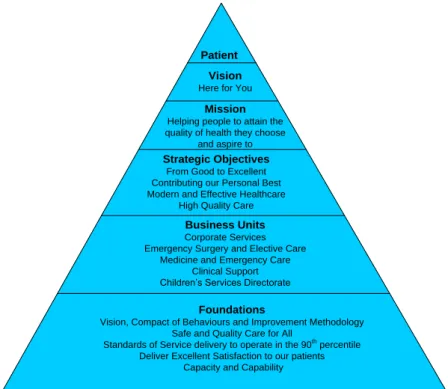
Patient
Vision Here for You
Mission Helping people to attain the quality of health they choose
and aspire to Strategic Objectives
From Good to Excellent Contributing our Personal Best Modern and Effective Healthcare
High Quality Care Business Units Corporate Services Emergency Surgery and Elective Care
Medicine and Emergency Care Clinical Support Children’s Services Directorate
Foundations
Vision, Compact of Behaviours and Improvement Methodology Safe and Quality Care for All
Standards of Service delivery to operate in the 90th percentile
Deliver Excellent Satisfaction to our patients Capacity and Capability
Figure 1 – TTT Strategic ‘Pyramid’ Source: TTT Annual Report (2008)
1.3 Current Situation
The sector is under increasing pressure to change at a rapid pace due to
environmental and political factors such as XXX Review was commissioned by the
XXX in 2007, the principal aim being to transform the XXX into a organisation fit for
the twenty first century, resulting in rigorous and comprehensive reviews of working
practices to achieve performance outcomes relating to high quality patient centred
care and service delivery. The programme of change has created significant levels of
mandatory change for the XXX in a short space of time, for an institution which was
often viewed as slow to react to change. Elsmore (2001, p. 7) confirms anguish and
resistance is evidenced in uncertainty and change about the future.
The Transforming programme was commissioned by the Department of Health in
2010 outlined the complete re-configuration of the XXX . Within TTT ; this has resulted in the absorption of two Primary Care Trust’s, doubling the organisations
revenue, number of employees and resource base. This significant change produced
several key challenges, the Transforming Community Services report: enabling new
be engaged and consulted throughout, this is a key theme in organisational culture,
as organisations are abolished or / and merged, or alternatively downscaled or / and
restructured.
Deal and Kennedy (1999) admit that downsizing, outsourcing or mergers have
characterised, what was once effective leadership and management practice, into
ineffective and undermined relationships and trust which has led to significant
changes in organisational culture.
The on-going transformation is integral to enable patient centered services to be
delivered effectively in the long term. Subsequently, the requirement for effective
assessment and management of culture is essential to ensure successful
transformation and also long term continuity of positive organisational culture can be
maintained to enable excellent patient care, where there are both organisational and
political drivers.
1.4 Academic Aims and Objectives
The aim of this study is principally to assess and develop organisational culture
within an XXX Trust undergoing service transformation.
The research seeks to achieve the following objectives:
1. Undertake critical review and evaluation of literature relating to organisational
culture, specifically within the public sector organisations with relevance
during organisational change;
2. Discuss using a range of literature the importance of organisational culture
including benefits and limitations;
3. Using primary and secondary research methods, incorporating qualitative and
quantitative approaches to diagnose and assess culture within a functional
area undergoing transformation;
4. Formulate conclusions from key themes identified and create SMART
recommendations relating to developing culture within the organisation.
Literature Review makes a critical evaluation of, and demonstrate theories, frameworks and principles applicable to the author’s professional project using a
wide range of literature sources.
Methodology supplies information regarding the planning, execution and evaluation
of research methods to collect primary and secondary data and information. This
chapter will also underpin ethical issues associated with research practices directly
associated with this project.
Findings and Analysis provides an account of primary research findings, compared
and contrasted against secondary research. The findings will then be analysed to
demonstrate and prove awareness and understanding of the facts and principles
acquired from the research process.
Synthesis and Conclusion combines relevant theories with data gathered to
demonstrate awareness, understanding and application of the topic. The research
project will be concluded by outlining key themes identified.
Recommendations clearly and concisely provides comprehensive and relevant
recommendations for the planning, development and improvement of the named
CHAPTER 2
CHAPTER 2 – LITERATURE REVIEW
2.1 Introduction to Literature Review
The literature review aims to make a critical evaluation of, and demonstrate
application of the project to the relevant theories, frameworks and principles that
exist. This academic insight underpins the aims and objectives, ensuring that review
and evaluation can occur to support findings and inform recommendations.
2.2 What is Organisational Culture?
Organisational culture exists within every organisation and contributes to the way an
organisation operates and its employees perform. The topic of organisational culture
is diverse and intangible, and subsequently there is no universally accepted
definition. Deal and Kennedy (1982) define culture simply as ‘the way we do things around here’; organisational culture is progressively becoming an ever emerging and
apparent area within modern leadership and management practice.
The visible characteristics and dynamics of an organisation can reveal high levels of
insight into how it operates and performs in its given operating environment and
market. Marshall and McClean (1988) state that organisational culture represents a
collection of traditions, values, policies, beliefs and attitudes that constitute a
persuasive context for everything we do and think in an organisation. In comparison,
Hofstede (1991) states that organisational culture represents the collective
programming of the mind which distinguishes the member of one organisation from
another. Similarly, both perspectives suggest that the constitution of individuals and
the process in which the organisation operates has significant influence over culture
within the organisation.
Within a corporate environment, organisational culture is widely viewed as a factor
heavily influenced by behaviour. Williams (1995) confirms that culture is partly
unconscious, historically based and learned. Similarly, Louis (1983) claims culture
determines what will be noticed and what will be excluded from perception. This
to the formation of organisational culture through unconscious behaviour. The
underlying assumption can be linked to the four stages of learning model developed by Maslow in the 1940’s, in which employees awareness and engagement levels at
varying degrees of competency and consciousness have an effect on the
surrounding culture.
The most accepted and widely recognised definition of culture is by Schein (1992, p.9), he states that organisational culture is a pattern of basic assumptions –
invented, discovered or developed by a given group as they learn to cope with
problems of external adaptation and internal integration, that has worked well
enough to be considered valuable and, therefore, to be taught to new members as
the correct way to perceive, think and feel in relation to those problems. In summary,
Schein outlines that culture is rooted into the organisation by groups of individuals,
and their actions and behaviours which influence others.
2.3 Origins and Importance of Organisational Culture
The theory organisational culture originates from many factors that exist internally
and externally, which are tangible and intangible. Holbeche (2006, p.177)
demonstrates that culture is created during the course of social interactions and
situations that occur in the organisation and its operating environment. Similarly,
culture also has underpinning psychological and sociological origins, Watson (1987)
suggests that how individuals cope with, or adapt to, problems and situations at work
are part of maintaining his or her identity.
In contrast, Holbeche (2006, p.177) states culture is shaped by many factors,
including mainly the societal culture in which organisations operate, its technologies,
strategy, markets and competition. This view suggests that although social factors
are the underpinning origins of culture, other competing factors within the internal
and external operating environment provide different cultural influences over the way
Furthermore, Trompennars (1994) outlines that the corporate culture that exists
potentially originates from national cultures, this is particularly evident in
transnational corporations where business operating methods are modified to suit
the requirements of the country. However it is widely viewed that the corporate
culture would be more dominant, Hofstede (1980) supports this and suggests that
this approach give localised branch offices of a transnational corporation a familiar
atmosphere with shared cultural values business-wide.
The importance of organisational culture is becoming an increasingly vital
consideration for leaders and manager of today. Holbeche (2006, p.177) also
confirms that an organisational culture provides an employee with continuity, this
should not be underestimated, particularly when undergoing organisational
transformation or change programmes. Mullins (1993) confirms the process of
management takes place not in a vacuum, but within the context of the
organisational setting, this raises the requirement for person centred leadership and
management culture to be applied. In summary, the importance of creating and
maintaining an organisational culture that is suited to the individual circumstances of
the organisation and its employees is paramount.
2.4 Understanding Organisational Culture
Organisational culture is commonly theorised as a pervasive, eclectic, layered and
socially constructed phenomenon that is generated through values, artefacts,
structures and behaviour suggests Silvester et al (1999).
According to Schein (1992), the two main reasons why cultures develop in
organisations are external adaptation and internal integration. External adaptation
reflects an evolutionary approach to organisational culture, suggesting that cultures
develop and persist by allowing organisations to survive. If the culture is valuable,
then it holds the potential for generating sustained competitive advantage in the long
term. Additionally, internal integration is an important function as social structures
are required for organisations to exist. Organisational practices and processes are
realised and learned through socialisation in the workplace, Schein focuses the basis
Pettigrew (1990) outlines a powerful meaning of culture, however the underlying
philosophical values that the culture was originally based upon can easily become
overpowered or discounted within everyday operations, and this is a common
occurrence within the public sector. Similarly, Meyer (1982) believes that
organisational culture ideologies are manifested and sustained by beliefs, stories,
language and ceremonial acts.
In contrast, French and Bell (1995) visually represent culture as an iceberg, with
formal aspects such as goals, technology, structure, policies, procedures and
resources being overt, with more informal aspects such as attitudes, feelings, beliefs
and informal interactions being covert, beneath the surface. This theory outlines a
wider meaning of organisational culture, from a practical and philosophical approach.
However, in comparison Waterman (1982) believes that the emphasis on sharing
values makes the difference between excellent and merely successful organisations,
Nadler and Tushman (1989) support this view and make the link between values,
culture and the norms of behaviour, but values are sometimes vague and norms are expected behaviours. Nadler and Tushman’s confirm Waterman’s views however support French and Bell’s view that culture is embedded with value based factors in
addition to practical based norms such as procedure.
In summary, the key theme of organisational culture is deeply imprinted within
organisations, and constructed through internal and external influences and factors,
which have a significant influence on leadership and management practice.
2.5 Culture Management and Communicating Strategic Vision
The management of culture within an organisation is an important influence on the
overall success of the business, Rollinson (2008) defines culture management as
maintaining and making slight modifications to fine-tune an existing culture. The idea
of culture management is essential and is integral that contemporary leaders and
The process of managing changes within organisational culture is both challenging and diverse, Rollinson (2008) states that this is because culture is so ‘deep rooted’
and creates high resistance to change. In comparison, Balbridge (1971) confirms
that if a social system is fragmented by divergent values and conflicting interest
groups, cultural changes become more predictable.
The significant challenge facing leaders and managers is how to understand cultural
dynamics of organisations, which includes developed sub-cultures. Ogbonna (1993)
states that while some behavioural changes result from culture change initiatives, it
is highly unlikely to change deeper historical values and ethics. This suggests that
although the culture is underpinned within the environment, it is inflexible and can
present as a difficult area to augment without full understanding.
In comparison, Holbeche (2006, p. 178) states that the link between culture and
power distribution in organisations usually means that power groups with vested
interests within the organisation may be unwilling to abandon those beliefs and
assumptions without consistent challenge. This behaviour and resistance is
particularly evident during times of mass culture change, Ray (1986) confirms that
one of the main functions of a culture may well be to enable people to resist change.
These occurrences are evident when external economic and social environmental
factors such as recessions occur, and create increased leadership and management
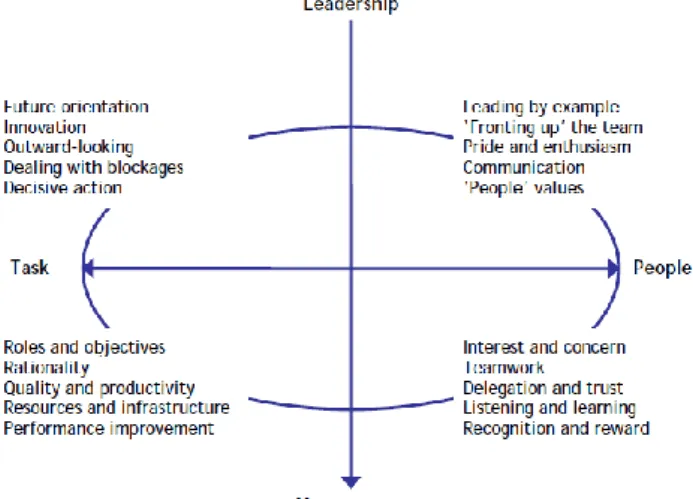
challenges which require practical solutions, the author has referred to the below
focus model.
The corporate risks associated with culture change are high due to lack of
understanding and structured implementation. Woodall (1996) argues that many
attempts at cultural change are badly conducted and delivered and result in
degradation of the workforce and raise questions about this ethical and moral basis
of these initiatives. However, in contrast, Wilkins (1978) argues that leaders
communicating the strategic vision provide substantial organisational energy and
integrates operational functions towards one vision. This emphasises the need for
clear communication throughout culture management, in addition to ensuring that the
workforce and stakeholders understand the rationale through clear communication
streams for culture change to support wider change programmes.
2.6 The role of Organisational Culture during Organisational Change
The constant requirement and pressure for organisations of all sizes to change and
adapt to the external environment and competition is increasingly apparent. The role
of organisational culture during change management programmes is influential,
Holbeche (2006, p. 194) states that culture is the arena in which change effort is
acted out.
The process of organisational change is a regular and consistent occurrence in
many organisations; this is because of pressures and requirements that emerge
within the external environment, recently the main driver is economical pressure for
continued efficiencies. With any type of change, the culture is affected, Holbeche
(2006, p. 194) states that culture change involves employees adapting and changing
their behaviour. The requirement to incorporate and consider organisational culture
is vital as the basis of organisational culture is underpinned by the workforce and
planned organisational changes will impact upon them directly in many instances as
individuals and groups. In support, Stacey (1999) confirms that change is happening
in some form, at all times within organisational networks. The individual networks
promote innovation and change through formal and informal dialogue and
The consequences of failing to incorporate culture into programmes of organisational
change are significant, the change process must be managed effectively and take
into consideration the current and proposed culture. Holbeche (2006, p. 195) states that ‘deliberate’ or ‘forced’ change can be difficult to achieve; this is mainly because
the rationale for the change appears to be unjustified or poorly communicated.
However, a contributing factor to organisational change failure is also outlined by
Holbeche (2006, p. 197) who states that many of the attitudes and behaviours of
leaders and managers are critical. This results in less awareness and interest from
the workforce, which impacts negatively on the proposed change model. In
comparison, Hawk (1995) suggests that reward must be linked to change, as failure
to do so communicates mixed messages to different individuals and groups.
Managing culture effectively during change is a critical part of leadership and
management practice during organisational change. Increasingly, fast paced change
without informed views and opinions of workforce and stakeholders can create
several barriers such as resistance, low morale and negativity. Kotter (1990) states
that increasing peoples willingness to change is less about increasing the pressure
for change, and more focused on removing obstacles to allow for change, the author
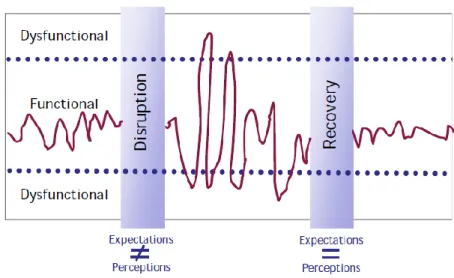
has referred to the below model to demonstrate to understand the workforce
disruption and recovery culture of change programmes.
The process of managing any type or size of change is not an enviable task, Kotter
and Heskett (1992) also suggest that such change is complex, takes time and
requires leadership, which is something quite different from management. This is
supported by Waterman (1994) who states that visible leadership and management
and what they focus on can get things done. Organisational culture change can be
managed using a four step process developed by Silverweig and Allen (1976):
1. Analyse Existing Culture – consists of an extensive survey and consultation
with individuals to establish objectives for culture change.
2. Experiencing the Culture – opportunities to examine the existing culture and
then participate in identifying the desired culture type.
3. System Installation – this is where the change process occurs, active
participation of leaders is vital, as well as engagement and communication.
4. Ongoing Evaluation – the degree of change is assessed and other methods
are used to reinforce the desired change.
Implementing communication and engagement initiatives during change can have a
positive impact on culture, Holbeche (2006 p. 194) states that culture does lend itself
to an approach that develops managers and staff as individuals, but collectively as a
workforce which develops the organisation as a whole. This theory suggests that
communication and engagement during change can enhance outcomes. Similarly,
Cameron and Quinn (1998) support the view of implementing symbolic change as well as substantive change, as this can signal a ‘new future’. In summary, Seel
(2000) suggests that leaders should move away from trying to change organisations
and instead look at how we might help prepare for the change.
2.7 Organisational Culture in the Corporate Context
The application and understanding of organisational culture within the corporate
context has influence on whether the culture is persuasive enough to influence the
workforce. Organisational culture consists of shared values in an organisation - the
beliefs and norms that affect every aspect of work life, from how people greet each
The strength of culture determines how to behave in the organisation. The strength
of culture can be linked to how identifiable it is, Hofstede (1998) believes there are
no shared values at the core of a culture. Similarly, Smircich (1983) argues that organisations can change only the ‘variables’ that they possess, e.g. mission
statements and corporate branding, not what the organisation ‘is’. In contrast, Senge (1999) suggests the development of values as ‘co-creating’, defining the values is
only one part of the process, integrating them into day to day practice is the real
challenge. This suggests that although in corporate environments cultural values and
beliefs are not always apparent, integration is equally as significant.
The role of individuals within culture is significant, Rollinson (2008, p. 592) states the culture dynamics and information is carried in people’s minds, and they may be
unaware they are doing so, however they are utilising information to interpret
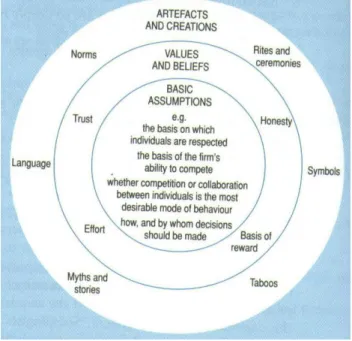
surroundings and reacting accordingly. In response, Schein (1990) developed a conceptualised model to demonstrate a ‘layered’ phenomenon to culture;
Basic Assumptions – the innermost core of culture, a fundamental area
taken for granted as people subscribe to the assumptions unconsciously.
Values & Beliefs – the layer which demonstrates consciously held reasons or justifications for individual’s behaviour.
Artefacts and Creations – the most highly visible area of culture, this is
normally tangible factors such as office building and employees appearance.
Culture consists of the shared values of an organisation, the beliefs and norms that
effect work life and the wider environment, including how they react and behave in
everyday situations and challenges. Handy (1993) developed a theory that
organisation can be broadly classified into one of four types of culture, the formation
of the culture depends upon many factors, however includes the organisations
history, founders, size and market share.
Power – individual’s activities and behaviour are strongly influenced by a
dominant central figure, e.g. a CEO or Chairman.
Role – individuals activities and judgements are strongly influenced by clear
and detailed job descriptions and other formal signal processes.
Task – the focus of activity is towards individuals completing a task or project
using whatever resources and means are most appropriate.
Person – individuals activity is strongly influenced by the wishes of the
individuals who are part of the organisation, employee satisfaction is high.
2.8 Organisational Culture and High Performance / Commitment
The existence of an effective culture can have a strong impact upon workforce
behaviour, which leads to increased productivity and efficiency, resulting in
increased performance on an individual and organisational basis. Deal and Kennedy (1982) confirm that the impact of a strong culture on productivity is ‘amazing’.
Throughout leadership and management practice cultural barriers arise and create
challenges in raising performance; especially relevant in times of change with
unstable cultures. The Management Agenda (2003) by Holeche and McCartney
states the symptoms of cultural barriers to high performance levels include:
Lack of Shared Values – creates a lack of trust at all levels, which
incorporates a lack of clear strategic vision and direction.
Lack of Leadership – not considering the needs of employees seriously and
offering little time to coach and support others within the organisation.
Staff – lack of workforce diversity composition, and decrease in shared
Inappropriate Systems – use of performance management processes which
can restrict the learning and development process, as well as internal
communications.
Harrison and Stokes (1992) consider that the concept of ‘changing’ organisational
culture is limiting and restricting, however they suggest that strengthening and
balancing the culture to be more effective, especially in terms of raising and
maintaining levels of performance is increasingly more effective. Killman et al (1985)
states three underpinning reasons for increased risk relating to high performance on
the basis of organisational culture;
Cultural Direction – the extent to which the culture helps achieve goals. Cultural Pervasiveness – the homogeneity of the organisational culture. Cultural Strength – the influence of culture on behaviour of individuals.
The cultural mix that is conducive to high performance is key to unlocking high levels
of performance states Holbeche (2006, p. 201), in comparison effective leadership
and management styles also play a significant role in strengthening and balancing
the culture to enable high performance at all levels. In support, Kotter (1992) argues
that leadership must be guided by a realistic vision of what kind of culture enhances
performance. Similarly, Goldstein (1994) suggests that when self-organisation
occurs it can release high performance in the corporate environment. This approach
includes allowing individuals and groups to explore and understand boundaries in
the work environment.
In summary, the culture that is created, developed and managed must have
relevance and flexibility to meet the needs of the organisation. Killman et al (1985)
states that to have an effect on performance, a culture needs to be appropriate to
what the organisation seeks to achieve in the future. Similarly, Miller (1994) confirms
that the characteristics of culture need to be structured and objectively linked to
future performance, rather than the characteristics associated and linked to past
organisational performance. This is a key consideration for constructing and
2.9 Diagnosing the Organisational Climate and Environment Context
The diversity and complexity of organisations presents many challenges that leaders
and managers must appreciate and understand, Rollinson (2008, p. 689) defines
organisational climate as how people experience and react to surroundings.
Individuals within organisations are aware of multiple culture characteristics and
attributes, meaning climate is a multidimensional phenomenon. The three theoretical
models which are popular in the analysis of organisational climate were developed
by Litwin and Stinger (1968), Payne and Phesey (1971) and Dastmalchian (1986).
The key perceptions in the analysis of organisational climate include:
Rules Orientation – whether behaviour is governed by rules and legislation. Sociability – the extent to which a team spirit exists.
Rewards Orientation – whether effort is linked with reward and recognition. Questioning Authority – whether it is permissible to question judgement.
The above dimensions are used by individuals to describe and evaluate the
organisation and its environment, the key factor in organisational climate is how
individuals experience collective membership of the organisation in a rewarding and
stimulating way.
2.10 Conclusion and Key Themes
In conclusion, organisational culture relates to the intangible aspects of the way that
employees relate to and experience different situations and change within an
organisation. It is widely accepted that organisational culture is the process that
surrounds the life of an organisation.
Leaders and managers have a strong and influential role to play in ensuring that
organisational culture managed and developed effectively in accordance with
In comparison, organisational culture deals with diverse organisational dynamics, in
much the same way that self awareness and emotional intelligence deals with an individual’s personality. The specific subject themes that were identified are
summarised by the author below:
Organisational culture should be vital of importance for leaders and
managers, and must be suited to individuals and organisational
circumstances; this allows organisational members and stakeholders to
influence the culture.
Organisational culture is deep rooted within organisations and consists of
internal and external influences, understanding of the current and proposed
culture and its link to leadership and management practice is paramount.
The process of culture management in corporate environments is challenging,
meaning communication, engagement and consultation with individuals and
other stakeholders about key issues is integral.
Organisations can be difficult and complex to change; leaders and mangers
should prepare organisations for change, and not radically or regularly
augment. The change culture should be linked to visible leadership.
Organisational culture in the corporate context is a critical factor in maintaining
and developing a forward thinking organisational culture, the appropriate
culture type should be identified and evaluated regularly.
Organisations with high levels of performance are likely to be characterised by
shared values and beliefs, the relevance and application of these values to
the future operational and strategic requirements and targets is paramount.
In conclusion, the significance of organisational culture is an important factor in leadership and management practice. Schein (1993) confirms ‘the bottom line for
leaders is that if they do not become conscious of cultures in which they are embedded, those cultures will manage them’. Leaders can shape and influence
culture through the language that they use and the way they behave and react to
2.11 Literature Review Chapter Summary
In summary, the literature review has allowed critical evaluation and reflection of
core theories, frameworks and principles relating to organisational culture and its
importance in leadership and management practice. Furthermore, several identified
key themes support the formation of a methodology and in the later stages of the
CHAPTER 3
CHAPTER 3 – METHODOLOGY
3.1 Introduction to Methodology
The methodology details how the research process was undertaken, Saunders et al
(2003, pp. 595) described the term methodology as the theory of how research
should be undertaken, including the theoretical and philosophical assumptions upon
which research is based and the implications of these for the research method or
methods adopted.
The chapter outlines the author’s chosen approach and rationale for the
methodology including critical evaluation and reflection of alternative research
strategies and methods. The methodology explores and demonstrates research
limitations and validity, and additionally ethical considerations that were applied and
considered throughout the project. In summary, the methodology provides a
structured plan for approaching and managing the research process.
3.2 Defining Research
Research allows the understanding of basic everyday phenomena that occurs in
business situations. Saunders et al (2009) define research as a process that people
undertake in order to find out things in a systematic way, thereby increasing
knowledge. In contrast, Maylor and Blackmon (2005) underpin research as a
process that consists of a specific set and sequence of activities, with tangible and
intangible inputs and outputs, such as information, time, resources and knowledge.
The ever changing nature of leadership and management practice requires sound
judgement and decision making, Sekaran (1992) confirms that forward thinking
organisations are increasingly undertaking systematic research to handle their
operational and strategic activities. Similarly, Ghauri and Gronhaug (2010, pp.9)
emphasise that decisions on important organisational issues cannot be made unless
the information has been deeply researched to make an informed decision.
Furthermore, Ghauri and Gronhaug (2010, pp.9) also argue that without research it
The importance of comprehensive research holds significant relevance in developing
leadership and management practice, Tranfield and Starkey (1998) state that
research should complete a virtuous circle of theory and practice.
The application and evaluation of structured research allows for a sustained and
increased level of organisational insight which results in sound awareness, workforce
information and organisational improvement recommendations.
3.3 Research Philosophy and Approach
The way research is philosophically considered and approached was an integral
consideration throughout the project to ensure that research is relevant and
appropriate. Saunders et al (2008, pp. 600) define philosophy as development of
knowledge and nature of that knowledge.
The research philosophy adopted contained important assumptions about how the
author viewed the application and wider context of the topic; these assumptions
underpinned the chosen strategy and associated research methods. Johnson and
Clark (2006) confirm that awareness must be developed of the philosophical
commitments made through the selection of a research strategy which has an impact
on what we do and what we understand is being investigated.
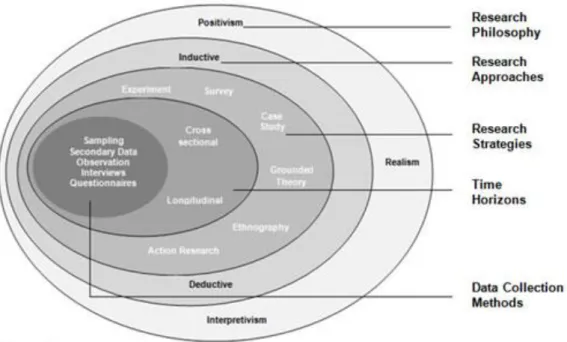
This theory is heavily embedded in the authors chosen research topic and has
strong underpinning philosophical elements which are unique to the given corporate
situation; this is demonstrated within the Research Onion (below). Similarly, the
author acknowledged and understood the outcomes would be more relevant and
measurable if understanding was gained that assumptions must be examined and
Figure 5 – Research Onion Source: Saunders et al (2009)
The approach selected to conduct the research is an important element of research
methodology, the level of clarity and direction within the early stages of the project
provides an early indicator into the design of the research project. The author applied
a 60/40 combination of quantitative and qualitative questioning to balance the
findings and results generated from respondents.
Initially, the quantitative approach was applied, Saunders et al (2009) define
quantitative data as numerical or quantified data, Crowther and Lancaster (2009)
state this type of data is more objective and scientific than its qualitative counterpart,
allowing statistical comparisons and benchmarking. However qualitative focused
questioning was used in the later stages of the questionnaire to assess the views
and opinions of the sample group.
In contrast, Saunders et al (2009) define qualitative data as a non-numerical and
non-quantified method, similarly, Crowther and Lancaster (2009) confirm qualitative
data is therefore associated with phenomena that cannot be, or is difficult to quantify,
Crowther and Lancaster (2009) considered the outputs of qualitative research to be
Thejustification for the above outlined approach balance allowed for underpinning of
numerical data, supported by individual views and opinions of the workforce sample
to gain increased insight and understanding into the culture that existed within the
sample zone of the organisation, this approach proved beneficial when informing and
augmenting future leadership and management practice.
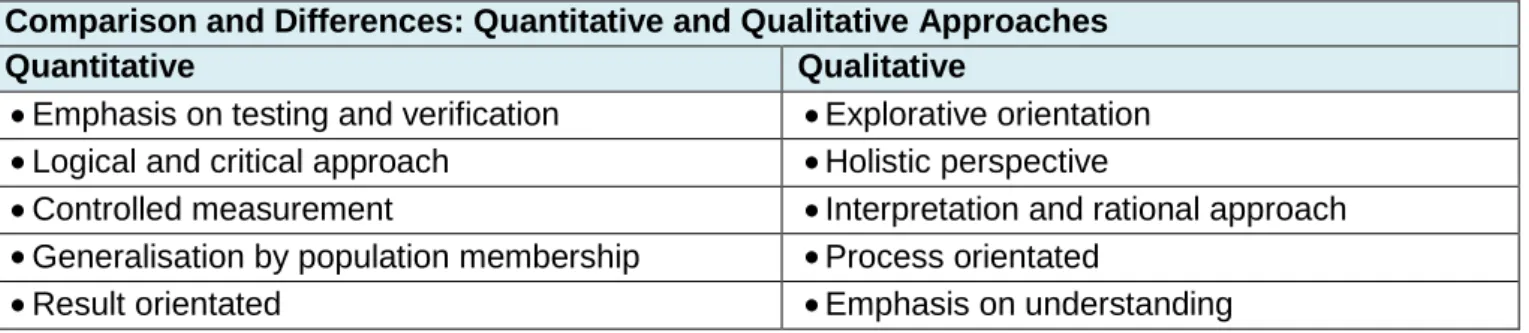
Comparison and Differences: Quantitative and Qualitative Approaches Quantitative Qualitative
Emphasis on testing and verification Explorative orientation
Logical and critical approach Holistic perspective
Controlled measurement Interpretation and rational approach
Generalisation by population membership Process orientated
Result orientated Emphasis on understanding
Table 1 – Quantitative and Qualitative Approaches Comparison Table Source: Ghauri and Gronhaug (2010)
The author’s primary aim was to develop and enhance culture, this suggested an
inductive approach was potentially more productive, and Saunders et al (2009)
define this as an approach where data is collected to develop theory. In contrast, a
deductive approach was not suitable as no new theory was being created. However,
the utilisation of deductive elements was incorporated to underpin and test the
already existent hypotheses surrounding organisational culture.
Comparison and Differences: Deductive and Inductive Approaches Deductive Inductive
Scientific principles Close understanding of the research context
Moving from theory to data Understanding of human aspects of event
The collection of quantitative data The collection of qualitative data
A highly structured approach Less concern with the need to generalise
Research independence around identified topic Realisation of researcher inclusion The operationalisation of concepts for clarity Flexible structure to permit changes
Table 2 – Deductive and Inductive Approaches Comparison Table Source: Ghauri and Gronhaug (2010)
In summary, the research philosophy had a critical role in shaping the perception of
research topic and additionally resulting in the adoption of an approach which
allowed the creation of a suitable methodology which is directly linked to the
3.4 Research Strategy and Data Collection
The author acknowledged that organisational culture is a unique and often complex
theory which is heavily embedded philosophically, this presents as a challenge to
use the limited existing research information and data in the subject area. The
research process in a practical context is diverse and required a clear and consistent
research strategy.
The author used primary data as the core method for collection, analysis and review
to support the research; Saunders et al (2009) defined primary data as data
collected specifically for the research being undertaken. The primary data collection
allowed a more structured research approach, through the design and
implementation of customised data collection.
Although secondary data is a powerful mechanism in many research areas, the
method did not suit the aims and circumstances of the author as a researcher and would provide limited insight and findings into TTT ’s culture. Saunders et al (2009)
defined secondary data as data used for a research project that was originally
collected for another purpose.
Benefits & Limitations of Primary & Secondary Research Data
Method Benefits Limitations
Primary Data
Specific to project and research topic Broadens opportunity for findings Increased knowledge and insight Tailored research outcomes and results
Limits international research process Heavy application of procedures Quality and scope of information Heavy time and resource requirement
Secondary Data
Efficiency savings in time and money Facilitates international research Suggestion of data / research handling Broadens opportunities for conclusions
Differing study aims and objectives Uncertainty of accuracy of research Validity of conclusions and quality Accuracy of research and data
Table 3 – Research Data Type Comparison Source: Ghauri and Gronhaug (2010)
The author indentified that the questionnaire should be linked to specific two primary data types; ‘attitude / opinion’ and also ‘awareness / knowledge’ to allow linkage
between research and theory relating to culture, focusing on behaviour and
The multi-method research approach enabled triangulation, which gave the
methodology significant strength and the flexibility to capture the diverse views and
opinions of a range of staff, through effective cross examination, which underpinned
the workforce perceptions. In support, Saunders et al (2009) confirmed different
research strategies are appropriate for different research objectives. Triangulation
gave the strategy credibility in terms of the objectives set, and potential outcomes to
form sound analysis and recommendations later in the project.
3.5 Research Methods and Techniques
The author considered primary research methods as the main research approach
which was inductively focused and required the author to develop existing theory,
instead of creating new theory.
The research method of interviewing and focus groups is a useful mechanism for
research, this method would increase interaction and insight, the interviewing
process would need to be semi-structured to allow for maximum participation and
contribution which is interviewee orientated.
Benefits & Limitations: Interviewing / Focus Groups
Benefits Limitations
Provides rich information and data Absence of influence due to interview bias
Highly relevant to research topic Lack of confidence to express views / ideas
Customised research method and approach Can become very personalised and lose focus Produces original research findings Negativity can produce limitations in group
Table 4 – Benefits & Limitations: Interviewing / Focus Groups Source: Easterby Smith et al (2008)
The author evaluated the above research method and considered it unsuitable for
investigating organisational culture due to the complexity and diversity associated
with the philosophical elements of the topic. Additionally, the author considered
interviewing to have significant planning and time commitments, potentially reducing
the sample size. The author further acknowledged that complex and rich qualitative
based information could be extracted from respondents through questionnaires;
The research method of questionnaires isa productive mechanism for gaining
understanding and identifying information, often for comparative purposes. The
research method can be specifically targeted at individuals within the sample
population, producing quantifiable and non-quantifiable factors and information.
Benefits & Limitations: Questionnaires
Benefits Limitations
Provides a quantitative and qualitative response mix Restrictive in terms of gauging individual views
Enhances recommendations credibility Non-compliance in completion process
Provides rich primary data and info for analysis Internal and external bias can be evident
Customised approach to achieving outcomes Often diverse range of responses due to sample Table 5 – Benefits & Limitations: Questionnaires
Source: Easterby Smith et al (2008)
The author evaluated the above research method and considered it highly suitable
for increasing insight and findings when investigating organisational culture. Simons
(1987) confirms that questionnaires can test theory by taking logic into the field to
understand relationships and behaviour. The design and development of a
self-administered questionnaire allowed underpinning through quantitative data,
additionally, demonstration and identification of qualitative workforce comments. The
author acknowledged that beneficial and realistic findings can be achieved from a
larger sample population through the application of a questionnaire.
3.6 Research Sampling and Piloting
The research method was piloted and sampled internally within the Psychiatry of Old
Age Service within TTT , referred to as the sample frame. The sampling procedure is
non-probability based, and as is judgement focused to gain a representative sample
of the population from the above named frame.
The questionnaire was initially piloted to assess the suitability of the research
instrument; this was given to two individuals independent of the research
investigation to seek verbal feedback on the design, content, clarity and easiness of
the document. This feedback proved beneficial in identifying any development areas
The probability sample procedure adopted was stratified sampling, Ghauri and
Gronhaug (2010) define this sample method as a part of sub-division of the
population. The sample size was chosen at thirty, which is 10% of the overall
workforce within the service area, which was then sub-divided and distributed
equally into three distribution groups which are representative to the workforce to
include; clinical (doctors and nurses), non-clinical (administrative and support) and
other (research and students).
Benefits & Limitations: Stratified Sampling
Benefits Limitations
Provides structured and balanced sample mix Difficult to analyse if sub-groups are different Increases diversity in results from sample group Often restrictive sample groups
Balances the sample population proportionately Minimises freedom to customise questioning Allows for increased insight from wider workforce Difficult in indentifying strata.
Table 6 – Benefits & Limitations: Stratified Sampling Source: Ghauri and Gronhaug (2010)
The sampling method adopted by the author balanced the potential mix of views
from respondents and allowed increased insight, as well as aiming to maximise the
return rate within the sample population. Robson (2002) confirms that with
standardised questioning and sampling, such as the above, the researcher can be
confident that all content will be interpreted in the same manner.
3.7 Data Analysis
The completion of research within the selected sample group allowed the results and
data to be compiled and prepared for data collation and analysis. The core
consideration in the early stages of the data analysis was to remain flexible and
aware of possible links to theory through the identification of common themes.
The data analysis process included compiling responses to quantitative questions
and applying data reduction techniques and utilising software (Excel) to compile data
tables and convert to graphs. Furthermore, the analysis process for qualitative
responses in the later stages of the questionnaire required identification of trends