Chapter 8
Communication Skills
Chapter 8
Communication Skills
•
Section 8.1 Defining Communication
•
Section 8.2 Elements of Speech and Writing
•
Section 8.1 Defining Communication
Defining Communication
Objectives
• Define effective verbal and nonverbal
communication
• Explain the role of listening
• Explain why awareness of cultural differences is
important in communication
• Define reading for meaning Key Terms communication channels/ media feedback barriers setting distractions emotional barriers jargon
Defining Communication
Graphic Organizer
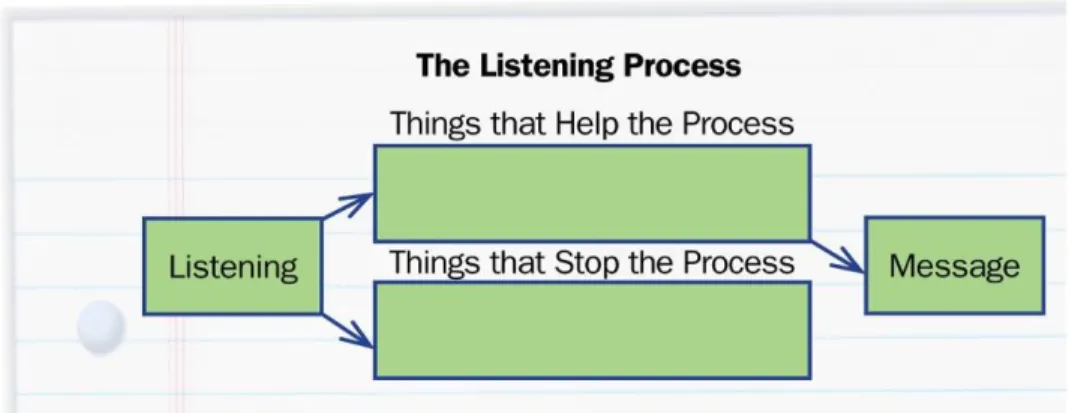
Copy the following chart and use it to take notes about the listening process.
The Communication Process
Communication X is the process of exchanging
messages between a sender and a receiver. These messages can be about:
• Information
• Ideas
• Feelings communication
The process of exchanging messages between a sender and a receiver.
The Communication Process
The skills used to send and receive these
messages are called communication skills. They include:
• Listening and reading
• Writing and speaking
The Communication Process
Effective communication is vital in every aspect of business, including:
• Developing job skills
• Training employees
• Working as a team
• Marketing products
Channels or Media
Channels X, or media X, are the avenues through
which messages are delivered, such as:
• Conversations and phone calls
• Memos letters, and e-mails channels The avenues through which messages are delivered. media The avenues through which messages are delivered; also known as channels.
Feedback
A receiver’s response to a message is known as feedback X. It allows participants to clarify the
message and make sure that all parties gave the message the same meaning.
feedback
A receiver’s response to a message.
Barriers
Barriers
X to communication are obstacles
that interfere with the understanding of a
message. They can be:
•
Verbal - language differences
•
Cross-cultural - different dialects and
traditions
barriers
Obstacles that interfere with the understanding of a message.
Setting
The setting X is the circumstances under which
communication takes place. Factors that affect the setting include:
• Place and time
• Sights and sounds setting The circumstances under which communication takes place.
Listening
Listening is critical to many areas of marketing and business, such as:
• Handling customer complaints
• Understanding feedback
• Recognizing customers’ needs
• Following directions
Techniques for Effective Listening
The following techniques will improve your listening skills:
• Identify the purpose
• Look for a plan
• Give feedback
• Search for a common interest
Techniques for Effective Listening
• Evaluate the message - View the message from
the speaker’s point of view to further understand and judge it.
• Listen for more than verbal content - What is
communicated by the speaker’s speed, pitch, and volume?
Techniques for Effective Listening
• Listen for a conclusion - The conclusion is the
final impression the speaker wants to make. How does it affect you?
• Take notes - Structured notes help you not only
understand the message, but remember it as well.
Barriers to Listening for
Understanding
A barrier to receiving a message can be
environmental, like a plane flying overhead, or it may involve attitudes and characteristics of the listener. Common barriers include:
• Distractions X - Things that compete for the
listener’s attention.
distractions
Things that
compete for the listener’s
attention.
Barriers to Listening for
Understanding
Emotional barriers
X Biases against the
sender’s opinions that prevent a listener from
understanding.
• Planning a response - A person cannot focus on
the message and plan a response at the same time. emotional barriers Biases against the sender’s opinions that
prevent a listener from
understanding.
Reading
Reading skills are essential to any job, and are particularly needed when you are applying for a job.
Know the Purpose of Your Reading
Good readers know why they are reading. It determines how they read.
Reading for Meaning
Reading for meaning requires that a person:
• Read carefully
• Figure out the meaning of new words
• Search for answers
• Analyze and evaluate information
Reading for Meaning
These strategies help improve reading:
• Focus your mind
• Summarize as you read
• Make connections
• Form mental pictures
• Build your vocabulary
Reading for Meaning
In job-related reading, you may come across
jargon X, specialized vocabulary used by members
of a particular group. These words may not be in standard dictionaries.
jargon
Specialized
vocabulary used by members of a particular group.
SECTION 8.1 REVIEW
-Elements of Speech and Writing
Objectives
• Explain how to organize and present your
ideas
• Demonstrate professional telephone
communication skills
• Explain how to write effective business letters
and persuasive messages
Key Terms
persuade enumeration generalization
Elements of Speech and Writing
Graphic Organizer
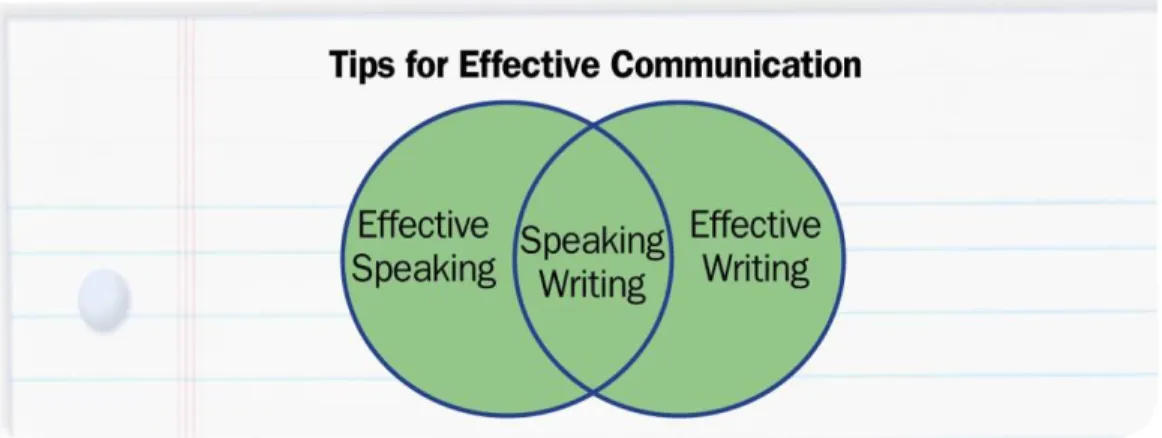
Use this chart to write tips for effective speaking in one circle, and tips for effective writing in the
other circle. Write tips that apply to both in the space that overlaps.
Speaking
Whether over the phone, on the sales floor, or in a meeting, speaking is an
important part of most jobs in business and marketing. It is
important to know how to speak effectively.
Show respect
When handling a customer complaint or
addressing a coworker at a meeting, you should maintain a cordial tone.
Know the Purpose
In most business situations, speaking is done to:
• Inform
• Persuade X - convince someone to change a
perception in order to get him or her to do what you want
• Entertain persuade
The process used to convince
someone to change a perception in order to get
them to do what you want.
Using Your Voice and
Nonverbal Cues
Good communicators use their voices effectively, modulating tone and pace to improve delivery. Nonverbal cues can enhance a presentation. They include:
• Body language
• Eye contact
Speaking Formally
A good speech has a formal structure, which uses four basic patterns:
• enumeration
• generalization with examples
• cause and effect
• compare and contrast
Speaking Formally
Enumeration X is listing items in order.
A generalization X is a statement that is accepted
as true by most people.
enumeration
Listing items in order.
generalization
A statement that is accepted as true by most people.
Speaking Formally
When you present an issue in terms of cause and effect, you attempt to demonstrate that one event or situation is the cause of another.
In the compare and contrast pattern, new
concepts are explained by showing how they are similar to or unlike those listeners already know.
Speaking on the Telephone
On the telephone, messages are communicated solely by voice, so a pleasant voice is important. Be sure to:
• Enunciate and speak loudly
• Convey all necessary information
• Never interrupt the other speaker
Writing
Writing is necessary in business for matters including:
• Presenting large amounts of material
• Permanently recording communication
• Describing company policy
• Letters confirming terms of a deal
Basic Considerations in Writing
The three basic considerations in writing are:
1. Know your audience
2. Know your purpose
3. Know your subject
Developing a Writing Style
In business writing, it is generally best to use a direct yet respectful conversational style, whether writing to:
• Inquire
• Inform
• Persuade
Developing a Writing Style
Your writing should be crisp, clear, and easy to read. Be sure to have:
• Correct grammar
• Understandable vocabulary
• Proper spelling
Developing a Writing Style
Pay attention to the words and phrases used by your clients, vendors, and associates. If they are different from yours, translate your ideas and feelings into language that makes sense to them.
Developing a Writing Style
Construct your persuasive message into three parts:
• Opening paragraph • Persuasive body • Closing paragraph
Forms of Written Communication
Most business writing takes the form of:
• Letters • E-mail • Memos • Reports
• Company Publications
Forms of Written Communication
• Letters - These are more formal and are used
for official announcements, thank yous, and transaction confirmations.
Forms of Written Communication
• E-mail – A business e-mail should have:
• An informative subject title
• A traditional (not personal) greeting
• A concise, clearly stated body
• A formal closing and signature
Forms of Written Communication
• Memos - Brief messages to someone in the
company that covers one subject.
• Business reports - Messages covering lengthy
topics. These reports can go to anyone in the company, and incorporate almost all of the speech techniques.
Forms of Written Communication
• Company publications - Companies can
produce internal publications, such as employee handbooks, and external
publications including promotional brochures.
Meetings and Parliamentary
Procedure
Parliamentary procedure is a structure for holding group meetings and making decisions.
A quorum is a proportion of the membership needed to conduct official business.
Meetings and Parliamentary
Procedure
The standard procedure for a meeting is as follows:
1. Call to order
2. Minutes of the meeting
3. Treasurer’s report
Meetings and Parliamentary
Procedure
4. Committee reports
5. Old business
6. New business
7. Adjournment
Meetings and Parliamentary
Procedure
During a meeting, the chairperson must permit a member to speak. To make a proposal, a member must make a motion. It must be seconded by
another member before it can be discussed.
SECTION 8.2 REVIEW
-Section 8.1
• The global economy has brought new pressures on
companies to communicate with customers and vendors around the world.
• As the volume of information increases, reading
for meaning is becoming an important business skill.
Section 8.2
• Most business and marketing jobs require the
ability to communicate a message clearly, concisely, and courteously.
• Persuasion is used to convince others of the value
or importance of an idea or thing.
This chapter has helped prepare you to meet the following DECA performance indicators:
• Handle telephone calls in a businesslike manner.
• Orient new employees.
• Explain the nature of effective verbal
communication.
• Conduct a staff meeting.