The Effect of Class Size on the Teaching
of Pupils Aged 7 – 11 Years
Peter Blatchford
*
, Anthony Russell, Paul Bassett,
Penelope Brown, and Clare Martin
Institute of Education, University of London, UK
(Received 26 May 2006; accepted 7 September 2006)
There is still little consensus on whether and how teaching is affected by small and large classes, especially in the case of students in the later primary years. This study investigated effects of class size on teaching of pupils aged 7 – 11 years. We used a multimethod approach, integrating qualitative information from teachers’ end-of-year accounts and data from case studies with quantitative information from systematic observations. Results showed that there was more individual attention in smaller classes, a more active role for pupils, and beneficial effects on the quality of teaching. It is suggested that teachers in both large and small classes need to develop strategies for more individual attention but also recognize the benefits of other forms of learning, for example, group work.
Introduction
This paper reports on the effect of class size on teaching in English primary schools of pupils aged 7 – 11 years, called Key Stage 2 (KS2). Data are drawn from a more general study of class size differences and pupil-adult ratios. The study was funded because there was very little knowledge about class size effects beyond Key Stage 1 (5 – 7 years) and little understanding of the longer term effects of class size differences through the primary years. Overall, the Class Size and Pupil Adult Ratio (CSPAR) Project aimed to provide, for the first time in the UK, a full analysis of the educational effects of class size and adult-child ratio differences over the whole of KS1 and KS2. Results from the Reception and KS1 stage of the study have been reported in a number of publications (Blatchford, 2003a, 2003b; Blatchford, Bassett,
*Corresponding author. School of Psychology and Human Development, Institute of Education, University of London, 25 Woburn Square, London WC1H 0AA, UK. Email: [email protected]
Vol. 18, No. 2, June 2007, pp. 147 – 172
ISSN 0924-3453 (print)/ISSN 1744-5124 (online)/07/020147–26
Ó2007 Taylor & Francis
Goldstein, & Martin, 2003; Blatchford, Moriarty, Edmonds, & Martin, 2002). In this paper, we concentrate on one possible effect of class size differences at KS2.
There has been a vigorous and widely reported debate over the educational consequences of class size differences. In the USA, the debate has centered on the efficacy and cost effectiveness of class size reduction initiatives, while in the UK the debate has been more about the negative effects of large classes. However, much of the research and debate on class size has been about relationships between class size and academic outcomes and has little to say about classroom processes that might explain the effects found (Anderson, 2000; Finn & Achilles, 1999; Grissmer, 1999). The situation in the UK is much worse, in the sense that there is little research to guide debate on class size effects, and such research as does exist is limited in terms of research methods (Goldstein & Blatchford, 1998). We need, therefore, accounts of ways in which classroom processes are altered as a result of class size differences, and in this paper, we examine the connections between class size and teaching.
In the UK, the policy context for an interest in class size differences has recently changed. In response to concerns about large classes, the Government introduced a maximum of 30 to a class for children in the first 3 years of school (5 – 7 years) in England and Wales. However, this has caused concern about class sizes over the rest of the primary school stage, that is, for pupils aged 7 – 11 years, where no limits of any sort have been introduced. In 2004, official Government data showed that about a quarter of pupils in England were in classes with more than 31 pupils. There are concerns that class sizes of this magnitude will have a negative effect on teaching. However, there have been no UK studies that have studied the effects of class size differences on teacher and pupil behaviour at this stage. In this paper, we seek to establish whether the effects of small class sizes on teaching found in the earlier Reception and KS1 study are still evident in the later years of primary education (pupils aged 7 – 11 years).
Research on teaching has a long and varied history. Reviews of this research show that there are different and often conflicting paradigms of research (Shulman, 1986), but a central tenet of many studies is the importance of maximizing teaching time and instructional support for children’s learning. This is expressed most obviously in the process – product tradition, which has stressed the importance of maximizing students’ academically engaged time in classrooms, and the important influence of teacher instructional time and active teaching (Creemers, 1994). This has been supported by more recent research on effective teaching, more allied to effective schools research (see Creemers, 1994; Galton, Hargreaves, & Pell, 1996). A quite different approach to teaching, with roots more in cognitive psychology and post-Vygotskian approaches, and which stresses notions like scaffolding and contingent learning environments (see Tharp & Gallimore, 1991; Wood, 1998), also gives a central place to maximizing adult instructional behaviour.
Logically, it seems likely that the number of children in a class will increase the amount of time that teachers spend in procedural matters and, conversely, decrease the amount of time that can be spent on instruction and dealing with individual children. This is consistent with teachers’ views (Bennett, 1996; Pate-Bain, Achilles,
Boyd-Zaharias, & McKenna, 1992) and some previous research (Cooper, 1989; Glass, Cahen, Smith, & Filby, 1982). Achilles (1999) found, in a systematic observation study of two schools matched on background factors, that teachers in small kindergarten – Grade-2 classes (about 14 students) engaged in more on-task behaviour over the year, while teachers in large classes (about 24 students) engaged in more off-task behaviour over the year. A study of pupil-adult ratios suggested that the most important classroom process affected by reduced class size is individualization of teaching (Molnar et al., 1999). Other research on pupil-adult ratios suggested that there is a tendency for teachers to devote less time to group instruction and more to individual instruction in smaller classes (Betts & Shkolnik, 1999). Anderson (2000) set out a comprehensive model of possible factors linking class size to student achievement, which included aspects connected to teaching: greater knowledge of students, more instructional time, greater student engage-ment, and more ‘‘in-depth’’ treatment of content in smaller classes. However, Finn, Pannozzo, and Achilles (2003) concluded, on the basis of their review, that the effects of class size in the elementary grades are more in terms of student engagement than effects on teaching, although there is some evidence that teachers’ interpersonal styles benefit from small class reductions. Most famously, Shapson, Wright, Eason, and Fitzgerald (1980) found no statistically significant differences between class sizes for most teacher activities, and teachers did not alter the proportion of time spent interacting with the whole class, with groups, or with individuals. Worryingly, they found that these observation results were at odds with teachers’ own views.
The CSPAR Reception and KS1 Research Findings
As part of an earlier study, we examined relationships between class size and teaching (Blatchford, 2003a, 2000b; Blatchford et al., 2002). Results from the systematic observation component of the study seemed clear. There was consistent evidence that in small classes children were more likely to interact with their teachers, more one-to-one teaching took place, children were more often the focus of a teacher’s attention, more teaching took place overall, and children more often attended to their teachers. The trend toward individualization in small classes did not seem to be indicative of a passive role for children; the opposite seemed more likely, that is, children in large classes spend less time actively interacting with the teacher in terms of responding or initiating. Results from completed end-of-year teacher questionnaires and case studies provided a more qualitative version of connections between class size and teaching, more grounded in experiences in individual classrooms. These components suggested that class size affected the amount of individual attention, the immediacy and responsiveness of teachers to children, the sustained and purposeful nature of interaction between teachers and children, the depth of a teachers’ knowledge of children in their classes, and sensitivity to individual children’s particular needs. Overall, we proposed that in smaller classes there was more likelihood of what we called teacher support for learning.
It might be argued that one solution to the teacher’s difficulties in contacting children in large classes would be to alter their approach, so that there is more teaching to larger groups or to the whole class. However, there was no evidence that teaching to the whole class increased in larger classes, and this ran contrary to expectation. However, this result might have owed much to teachers of such young children feeling uncomfortable about increasing the amount of whole class teaching. It is possible that such an adaptation to large classes is more likely with older children and changing curriculum demands over the next stage of primary education. In England, there is now clear curriculum guidance on mathematics, literacy, and science and a strong pressure on schools, especially in Years 5 and 6 (9 – 11 years old), to prepare pupils for Government set end of KS tests (SATs). There are also major developmental changes in children over the years from 7 to 11, which are likely to have profound consequences for learning and teaching, and possibly the effect of class size on teaching.
In this paper, we therefore report on a study of relationships between class size and teaching when the pupils were in KS2 (7 – 11 years). In common with the earlier work, we concentrate on interactive aspects of teaching drawing on multiple methods of data collection. We ask two questions:
1. Do teachers in large and small classes differ in time spent on teaching or instructional activities overall, time in individual, group, and class contexts, and amount of teacher – child contact and individual attention from teachers? Data to answer these questions came from systematic observations in classrooms. 2. Apart from these more obviously quantitative dimensions, do teachers in
large and small classes differ in more qualitative dimensions of teaching, concentrating particularly on interactions between teachers and children? Data to answer this question drew on teachers’ own experiences and detailed case studies.
Method
The research approach adopted for the KS2 study was similar to that used in the Reception and KS1 stage of the study. It is often assumed that the problems of survey research on class size effects are best overcome by the use of experimental research or randomized controlled trials. This is one reason for the great attention paid to the Tennessee STAR project (Finn & Achilles, 1999), where the aim was to assign teachers and pupils at random to small (around 17 pupils), regular (around 23 students), and regular with a teacher aide classes within the same school. However, as we have argued elsewhere (Goldstein & Blatchford, 1998), there are reasons why randomized designs are questionable, theoretically in terms of the validity and generalizability of results, and also in terms of their usefulness for policy recommendations. In this study, we employed a longitudinal research design to capture effects of naturally occurring differences in class size and pupil-adult ratios. A feature was the use of sophisticated multilevel statistical modeling to
examine connections between class size and pupil attainment (for KS1 see Blatchford et al., 2003; for KS2 see Blatchford, Bassett, Brown, Martin, & Russell, 2004) and also relationships with other classroom processes, such as student engagement, within-class grouping, and peer relations (for KS1 see Blatchford, 2003a; for KS2 see Blatchford et al., 2004; Blatchford, Bassett, & Brown, 2005). However, in this paper, we concentrate only on results concerning class size and teaching.
There are limitations to the methods used in previous research on relations between class size and teaching. One problem is the diversity of research methods that have been used. Studies have used various research techniques, including teacher report and interviews (Pate-Bain et al., 1992), questionnaires completed by teachers (Molnar et al., 1999), teacher accounts of time spent (Betts & Shkolnik, 1999; Rice, 1999), and systematic observation studies (Shapson et al., 1980), and it is not always clear that these studies cover the same phenomena. Another problem concerns the quality of research methods used in particular studies (Goldstein & Blatchford, 1998). Much is anecdotal and based on teacher report and the reported experience of individual teachers. Although valuable, these methods raise questions about validity and generalizability, especially given the finding by Shapson et al. (1980) of discrepancies between teacher reports and classroom observation data. Large-scale secondary analyses, such as those in Betts and Shkolnik (1999) and Rice (1999), are more reliable but have involved relatively crude, easily quantified, retrospective judgements of time allocation, and usually involve pupil-adult ratios, not class size as such.
For the Reception and KS1 study, we felt that a multimethod approach would help advance understanding of the connections between class size and teaching, and such an approach was also used in the KS2 study (Blatchford, 2005). We collected quantitative information from systematic observations in large and small classes that would enable us to address basic questions on teaching time and teacher and pupil interactions. However, we also wanted a more qualitative assessment of relationships between teaching and class size, through the use of teacher reports of their experience of the effect of class size on teaching methods, and through detailed case studies on large and small classes drawing on observations, interviews, and professional judgements. The aim was to draw on these methods in such a way as to provide an integrated account of the effects of class size on teaching.
Sample
The Reception and KS1 stage of the CSPAR Project followed for 3 years a large cohort of pupils who entered Reception classes during 1996/1997. The research design involved a random selection of schools within the participating LEAs. The KS2 phase of the research followed for a further 3 years a large cohort of pupils from Year 4 to Year 6 (children aged 8 – 11 years). Because of research grant timing and the time required to locate samples of pupils, it was not possible to obtain data on children in Year 3. The KS2 sample comprised 75 schools who were
part of the KS1 study, 17 schools not previously part of the research but now attended by pupils who were part of the KS1 study, and 110 new schools not previously involved with the study chosen by stratified random sampling. This paper was based on data collection from systematic observations, questionnaires, and case studies, and details on samples used for these three components are now described.
Data Collection
Data collection was similar to KS1, and involved a number of measures at the class and child level, as well as information from teachers, headteachers, teaching assistants (TAs), and pupils. This paper draws on three of these methods of data collection:
Systematic observation study of year-6 classes.The systematic observation study involved a subsample of children in small (25 or under) and large (31 and over) Year-6 classes. The methods and procedures were similar to the systematic observation study carried out when the pupils were in the 1st, Reception, year (4/5 years old), as described in Blatchford (2003a, 2003b) and Blatchford et al. (2002). Small and large classes were selected from class size information supplied by the school, but the class size actually used in the analysis was the number of children actually present during the time of observation, what we call the ‘‘experienced’’ class size. There were 42 classes in all, 16 small and 26 large. In some Year 5 and 6 classes, although children spend time in their normal registration classes, they are also now allocated for some of their school day to ‘‘sets,’’ that is, classes formed of pupils of similar ability, usually for the teaching of the core subjects mathematics and literacy, and sometimes science. To have restricted observations just to nonsetted classes would have reduced our sample and would have biased the sample to small schools, where setting is likely to be less common. Class size, therefore, referred to the number of pupils in the class at the time of the observation, whether the pupils were in mixed ability classes or sets (we actually found very few differences between sets and classes in classroom behaviour).
Sample of pupils.Teachers were asked to select nine pupils, three from each ability range—low, medium, and high. Six of these were then chosen by the researcher, two from each ability band, one girl and one boy. Any child absent for more than a day was replaced by a reserve drawn from the nine. There were observations on 257 children in all.
Organization of observations. The basic principle was to observe when classroom-based activities could have taken place. The aim was to observe each child over 2 days. Observations were conducted in blocks of 10-s time intervals, with gaps of 10 s between observations to allow recording of what took place in the previous 10 s. After each block of 10 observations, attention switched to the next pupil on the
list. There were 22,312 observations in total, with an average of 87 observations per child.
Observation categories. The schedule comprised categories that provided a description of time spent in different work settings (individual, pupil group, teacher-led group, or whole class), different school subject areas (language, mathematics, science, and ‘‘other,’’ e.g., history, geography, religious education), and a description of how children behaved when in three social ‘‘modes’’—with their teachers, other children, and when not interacting. Within each of these three ‘‘modes’’ were categories that covered work, procedural, social, and off-task activity. The categories referred to the ‘‘target’’ child; teachers and other children were observed only when they came into contact with them. The schedule employed a form of predominant activity sampling, with those behaviours selected within sets of behaviours (e.g., social modes) which occurred for the longest period within the 10-s interval. In order to examine the effect of class size, selected categories were chosen on conceptual grounds and on the basis of relatively high frequency of occurrence. Brief definitions of these categories are in the Appendix.
Observers. There were four observers. They were all experienced researchers who were familiar with working in schools and able to explain the research and put teachers and pupils at their ease.
Reliability checks. Reliability coefficients for the main sets of mutually exclusive categories were high. Setting, subject, teacher – child ‘‘social setting,’’ ‘‘child role,’’ ‘‘teacher content,’’ child to teacher ‘‘child contribution,’’ ‘‘child content,’’ and ‘‘not interacting’’ all had reliability coefficients (k) greater than .80. k for child – child content was .77.
Statistical methods and analysis. The observation variables took the form of binary variables, in the sense of each either being performed or not being performed during one time interval. Multilevel models were required, as it is likely that observations from pupils in the same class will be more similar than two observations from pupils in different classes. Similarly, two observations from the same pupil are more likely to be similar than two observations from differing pupils. If this clustering of observations is not taken into account, then estimates of relationships between variables can be affected. The basic structure involved three-level models with repeat observations nested within pupils, which were contained within classes. However, the observations were made in groups, and it is likely that two observations from a pupil within the same group will be more similar than observations from different groups. This adds a fourth level to the model, and so these were used for the majority of the analysis. The exception is for the work setting categories (individual, group, or whole class). Within each group of observations, the pupils were always performing the same type of work. Therefore, data for these variables were analyzed at the group level, with one observation per group.
More details on the observation methodology and statistical analysis can be found in Blatchford, Bassett et al. (2005).
Teacher questionnaires. Questionnaires completed by teachers of pupils in the study were part of the data collection process from the start, and their use has continued into the KS2 phase of the work. These were done in the 3 school years 2001 – 2003. There were 486 questionnaires returned altogether, 206 in Year 4, 184 in Year 5, and 96 in Year 6.
In each year, teachers were asked to comment on how the number of children in their class had affected their teaching that year. The Year-6 responses were used to devise a coding frame for application across the 3 years. Two members of the research team analyzed the responses independently, and drew up a set of categories to act as the coding frame. As with the KS1 analysis, the categories referred to the effects of both small and large classes, for example, that large classes presented problems but small classes possibilities when seeking to maximize individual attention to pupils. The two sets were compared, and a high level of agreement was found. Once the frame was finalized, the same two researchers applied it independently to the Year-6 data, and again high agreement was found. These codes were then used to code the responses from Years 4 and 5. Frequencies and percentages of teachers and responses for each code were then calculated.
This report concentrates on answers that relate most directly to relationships between class size and teaching, especially interactive aspects of teaching. Verbatim quotes from the questionnaires, contrasting the experience of teachers in small and large classes, are used to illustrate the categories.
Case studies. Case studies were carried out when the pupils were in Years 5 and 6. They were conducted in 20 classes in all across England, 10 in Year 5 and 10 in Year 6, and in both years there were five small (25 pupils or less) and five large (31 pupils or more) classes. Classes were selected at random from the list of class sizes for that year.
The aim of the case studies was to provide a complementary and more detailed portrayal of individual classes, which would provide the basis for a more interpretive and grounded analysis of factors relating to class size differences and adult deployment in classes. The methodology was similar to that used in the KS1 stage of the study. Selected aspects of classroom learning and experience expected to be connected to class size differences were defined in advance and then, on the basis of field visits, were refined into headings, including grouping practices, tasks and curriculum, and teacher – pupil interactions. The method comprised whole class and selected child observations in terms of event sampling of significant events, semi-structured interviews with teachers, TAs, and pupils, end of session/day comments and judgements by the field worker, and summative judgements by the field worker, all organized in terms of the main headings. This component made use of experienced teachers as field workers. Quite deliberately, the aim was to marry
aspects of systematic observation (which emphasizes the objectivity of data) with professional and interpretative judgements by experienced teachers. For further details see Blatchford et al. (2002).
Each visit involved a whole day of classroom nonparticipant observation, followed the next day by interviews with the class teacher, classroom assistant (where present), and the three pupils who were targeted during the classroom observation. The interviews for each of the three groups (teachers, other adults, and pupils) followed schedules of questions prepared previously, and the conversations were taped for later transcription.
Reports were completed separately for Years 5 and 6 and separately for small and large classes. These comprised a full analysis of extracts from interviews and observations, but in this section we provide a summary of the evidence. We concentrate here just on teaching in classrooms.
Results
Systematic Observations
The next section examines how the number of pupils in the class influenced the occurrence of each observation variable. However, in order to set these results in context, we look first at how pupils in general spend their time in these Year-6 classrooms. A general picture emerges from comparison of the three main setting categories. Pupils spent most of their time in two main ways: 51% of their time was spent in ‘‘individual settings,’’ that is, they were working on their own, while a further 40% of their time was spent in teacher-led whole class settings. Pupils spent very little time (only 5% of observations) in group work, not led by the teacher. In terms of curriculum areas, most time was spent on English (41% of observations), followed by mathematics (30%), science (11%), and all other subjects, for example, geography and history (19%). When in interaction with their teachers, pupils were only rarely the focus of the teacher’s attention (7% of interactions with the teacher)—attention was much more likely to be to another pupil or the whole group or class.
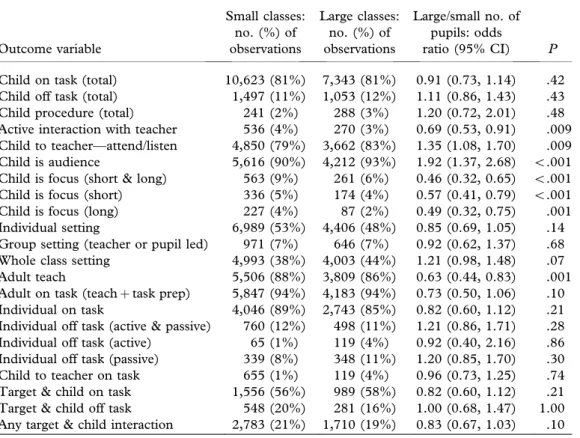
Number of pupils in the classroom. The results of the statistical analyses examining the effects of the number of pupils on all the observation variables listed above are summarized in Table 1. It reports the number and percentage of observations taking each value for small and large classes (as a percentage of the total of each subset of codes). Please note that these statistics give an idea of the basic differences between small and large classes but do not give an entirely fair comparison, as the number of observations per child varied, both within each observation session and in total. A more accurate reflection of the size of differences between small and large classes is obtained from the multilevel analyses, as these take into account which class, pupil, and observation session each observation was measured in. We therefore also give odds ratios taken from the multilevel analysis, that is, the odds of each outcome
occurring for a child in a large class relative to a child in a small class. An odds ratio
41 means that the outcome is more likely in a large class, whilst an odds ratio51 means that the likelihood of the outcome occurring is less likely in a large class. The odds ratios are informative about the exact differences observed between large and small classes (with corresponding confidence intervals). Also given is a confidence interval for each odds ratio, and aPvalue indicating the significance of each result. The results showed clear differences between small and large classes in teacher – pupil interactions. Two allied behaviours were more common in large classes: child to teacher—listen/attend and child is audience. The first category denotes times when the child’s contribution to interactions with the teacher is passive; they are simply listening to the teacher. Child audience refers to times when they are not the focus of the teacher, that is, they are not singled out by the teacher, either on a one-to-one basis or in a group or whole class situation; they are one of the crowd. Both, therefore, describe a passive role in contact with the teacher, and this is more likely in larger classes.
Conversely, in smaller classes, we find that pupils have a more active role in contact with teachers. We see this in the greater likelihood of active forms of behaviour in contact with teachers, that is, initiating and responding to them and sustained contact with them. We also see this in the greater likelihood of times when the child is the
Table 1. The effect of number of pupils on pupil and teacher behaviour in Year 6
Outcome variable
Small classes: no. (%) of observations
Large classes: no. (%) of observations
Large/small no. of pupils: odds
ratio (95% CI) P
Child on task (total) 10,623 (81%) 7,343 (81%) 0.91 (0.73, 1.14) .42 Child off task (total) 1,497 (11%) 1,053 (12%) 1.11 (0.86, 1.43) .43 Child procedure (total) 241 (2%) 288 (3%) 1.20 (0.72, 2.01) .48 Active interaction with teacher 536 (4%) 270 (3%) 0.69 (0.53, 0.91) .009 Child to teacher—attend/listen 4,850 (79%) 3,662 (83%) 1.35 (1.08, 1.70) .009 Child is audience 5,616 (90%) 4,212 (93%) 1.92 (1.37, 2.68) 5.001 Child is focus (short & long) 563 (9%) 261 (6%) 0.46 (0.32, 0.65) 5.001 Child is focus (short) 336 (5%) 174 (4%) 0.57 (0.41, 0.79) 5.001 Child is focus (long) 227 (4%) 87 (2%) 0.49 (0.32, 0.75) .001 Individual setting 6,989 (53%) 4,406 (48%) 0.85 (0.69, 1.05) .14 Group setting (teacher or pupil led) 971 (7%) 646 (7%) 0.92 (0.62, 1.37) .68 Whole class setting 4,993 (38%) 4,003 (44%) 1.21 (0.98, 1.48) .07 Adult teach 5,506 (88%) 3,809 (86%) 0.63 (0.44, 0.83) .001 Adult on task (teachþtask prep) 5,847 (94%) 4,183 (94%) 0.73 (0.50, 1.06) .10 Individual on task 4,046 (89%) 2,743 (85%) 0.82 (0.60, 1.12) .21 Individual off task (active & passive) 760 (12%) 498 (11%) 1.21 (0.86, 1.71) .28 Individual off task (active) 65 (1%) 119 (4%) 0.92 (0.40, 2.16) .86 Individual off task (passive) 339 (8%) 348 (11%) 1.20 (0.85, 1.70) .30 Child to teacher on task 655 (1%) 119 (4%) 0.96 (0.73, 1.25) .74 Target & child on task 1,556 (56%) 989 (58%) 0.82 (0.60, 1.12) .21 Target & child off task 548 (20%) 281 (16%) 1.00 (0.68, 1.47) 1.00 Any target & child interaction 2,783 (21%) 1,710 (19%) 0.83 (0.67, 1.03) .10
focus of a teacher’s attention, and this is evident in terms of both short and long periods of interaction, as well as the two added together. It can also be seen that pupils experience more teaching, in the strict sense of contacts involving the substantive content of a subject, in small classes compared with large.
Interestingly, although teaching is more common in small classes, there was little evidence that times when the teacher was addressing the whole class (which could cover all types of contact, including procedure/routine) were more likely in large classes. This suggests that, in contrast to their colleagues in KS1, teachers in KS2 do adapt to large numbers by engaging in more whole class teaching. It further indicates a more passive role for pupils in larger classes.
It might be asked whether there were any differential effects of class size on observation outcomes for different groups of pupils, for example, boys and girls, or pupils from different attainment groups. In other papers, we do address these possible interaction effects (e.g., Blatchford, Bassett et al., 2005). Several pupil group factors were entered into regression models along with class size to see if there were any main effects for these variables and also any interactions between class size and the background factors in effects on observation outcomes. Though there are some main effects for some variables (e.g., regarding gender and prior attainment, which in the interests of space we do not present here), there were no interactions between these and class size in relation to observation outcomes. This, therefore, suggests that effects did not vary between different types of pupils.
We might also ask if there are any other factors that could be connected to whether a pupil is in a small or large class, which might have affected the observation results. The most obvious possibility is that the allocation of pupils to classes is nonrandom, for example, that children with more difficulties at school are more likely to be found in small classes. In order to assess whether some bias had been introduced, two things would have to have happened: (i) there was a difference in characteristics between groups; (ii) pupil characteristics had a significant effect upon outcomes. While there is some evidence of lower attainment scores and a higher proportion of pupils eligible for free school meals and with special needs in smaller classes, these pupil characteristics were not found to have a significant effect on the observation outcomes. As these factors were not important in influencing the outcomes, we can conclude that no bias was introduced into the comparison of small versus large classes.
The Effects of Class Size on Teaching in Years 4 – 6: Teachers’ questionnaire responses
In this section, we concentrate on the most common codes and those most concerned with interactive features of teaching related to class size. Teachers could give more than one response and so frequencies for each of the main categories are given in terms of number and percentage of responses and also of teachers.
Meeting the needs of all pupils.This was the single most frequently recorded category, mentioned by 284 teachers across the 3 years—about one in two teachers and one in four of all responses (teachers could give more than one response). The main worry is
that, with more children in the class, it becomes more and more difficult to meet the needs of all children, and give as much individual attention as teachers would like.
However well organized a class is, number of children is the most important factor, in my opinion, to the quality of teaching and learning. It affects how much time you spend with individuals and groups. (Y4)
Having a large class (35 children) can make you feel that you are not always meeting the needs of all the children in the class adequately. It can be hard to find time to focus on individuals . . . as often as you would like to. (Y6) (emphasis in original)
The relationship between class size and individual attention is evident in several subcategories, which are now described.
Class size affects the frequency and length of support, and their personalized nature.
The smaller number of children has allowed me to give more individual attention to the children . . . . Each child can have more 1 to 1 contact with me. I often have a chance to ‘‘talk’’ on a personal footing because I’m not rushed trying to cope with larger numbers. (24 pupils) (Y4)
Teachers see the necessity for regular interactions with each pupil, ideally on a daily basis. This becomes more difficult as the class gets bigger: ‘‘I worry about making sure I speak to each child individually each day—I want them to know that I care about them, not just their group or their class’’ (32 pupils) (Y5).
A connected point to come from teachers’ comments is that they feel there is a moral imperative operating at the heart of their work: Every child has the right to the attention and support which they need. This is difficult to attain under all circumstances and creates a tension for the teacher, which increases as class size grows. Another manifestation of individual attention, more difficult in large classes, is being able to spot difficulties early and offer helpful feedback to pupils. Immediate feedback is easier with fewer children.
Teachers try to treat all pupils equally but find that in large classes some groups can miss out. Perhaps most commonly, teachers worry that the extremes of the attainment range, both the more able and the less able, tend to be neglected as the class size increases and only the ‘‘middle’’ of the class have their needs adequately met: ‘‘Because of the greater number of children . . . you feel that you are not stretching the brighter ones or giving enough time and support to the less able ones’’ (Y6).
However, some teachers felt that one or other ‘‘end’’ of the range loses out when numbers are high. The least or more able are perceived to be vulnerable to lack of teacher time and reserved or quiet pupils are also felt to be at a disadvantage when classes are big.
It is very difficult to get around and see on a one to one basis each child when you have a class above 25. Children with learning difficulties and slow learners do not get a fair deal, especially if they receive little or no additional support. (Y4)
The most able tend to be the ones who lose out the most. The least able always receive extra support. (Y6)
Teaching benefits if the targets set for individuals can be discussed with them personally. Small classes make this a possibility, whilst large classes make it increasingly difficult: ‘‘There is less time to set individual targets, to discuss these and their work with them’’ (36 pupils) (Y5).
Teachers’ professional satisfaction with their own work. Failure to achieve the ideal of meeting every pupil’s needs produces negative feelings towards their own work. The size of the class contributes to the severe criticism which some teachers express about their own teaching. In a sense, once the class size passes a certain point, the teachers are bound to ‘‘fail’’ because the demands on their time cannot be met: ‘‘Increased stress as your time is shared out between too many pupils’’ (35 pupils) (Y5).
Group learning and teaching.This was the second most frequently mentioned aspect of teaching to be affected by class size (123 responses; 25% of teachers and 12% of responses). The virtues of small groups are clearly appreciated by the teachers quoted above. When the class size is small enough, they are able to keep the groups small and feel that they are attending to all the children. Conversely, when the groups become large, teachers feel that some pupils can be neglected or can ‘‘freewheel.’’
Time to mark, plan, and assess.This received 114 mentions; 23% of teachers and 11% of responses. Marking pupils’ work takes up more and more time as the class size rises. When the class size gets beyond a certain point, the teachers feel the time spent on marking becomes disproportionate, and there are doubts about the value of it. Those with small classes are very appreciative of the reduced marking load and have a sense of freedom and control which their colleagues with larger classes do not have.
Marking time has been much reduced leaving more energy to actually teach. (22 pupils) (Y5)
Great stress! Cannot manage to mark up to 5 sets of 34 books each day. Cannot keep up with target setting and assessment records/tasks. (34 pupils) (Y5)
Teachers feel that proper assessment of pupils is both time consuming and essential for maximization of their pupils’ learning. Larger classes threaten this process. Certain types of work need to be assessed in process as well as in product, and large numbers make this very problematic: ‘‘More children equals longer to mark work and record keeping—longer to assess during lessons’’ (32 pupils) (Y4).
With all the pressures on time identified by teachers in large classes, some admitted to attempting to control the flow of work that they have to then assess. This is clearly a reasonable survival strategy, but it carries implications for the teaching.
Having 37 in the class, I think twice about the work I plan for the children, such as practical activities. I also have to consider the quantity of work the children are given as the marking becomes unreasonable—if it is to have any real value. (37 pupils) (Y6)
The lack of time arising from large classes is also seen as having a deleterious effect on the planning of effective lessons, leading in turn to a lowering of quality in their teaching. A smaller class can allow more focused planning, suited to the various needs of the individual pupils.
Resources: space and equipment.This received 88 mentions; 18% of teachers and 9% of responses. It is difficult for the supply of expensive items, such as computers, to match rises in class sizes, and teachers worry that pupil learning is affected by these shortages. Book-based learning can also suffer when there are inadequate supplies and teachers are forced to spend more of their own time to remedy the situation: ‘‘The class is not resourced for 35 children so even with sharing there are not enough books. This means I have to spend longer finding appropriate work in other schemes’’ (35 pupils) (Y5).
Primary teachers often prefer to have areas in their classrooms which are devoted to displays, location of resources, or set aside for particular activities, such as practical work or quiet, individual tasks. Teachers want to arrange the room to facilitate learning but are constrained by the size of the class in relation to the size of the room. They have to compromise.
30 is manageable—just! My room is very small so I can’t arrange furniture and working areas best suited for maximum learning potential. (Y5)
Large number of children—relatively small classroom—children have to sit in rows—no room to group tables for small group work. So much ‘‘stuff’’ in such a small space. (34 pupils) (Y4)
As a result of lack of space, some teachers find that they engage in less active, practical approaches to teaching and learning.
Control/management of behaviour.This received 85 mentions; 17% of teachers and 8% of responses. ‘‘Crowd control’’ becomes more of an issue in large classes. As numbers rise and space per pupil falls, the level of misbehaviour rises, caused, in part at least, by the pupils’ closer proximity. More arguments and less opportunity to physically separate disruptive individuals contribute to the problems of managing and controlling large classes. With smaller classes, more attention can be paid to the teaching/learning process: ‘‘Less time has been spent controlling, organizing and disciplining pupils, so better use has been made of teaching time’’ (22 pupils) (Y5).
Teaching is more or less effective.This received 74 mentions; 15% of teachers and 7% of responses. One expression of this code is that class size can affect styles of
teaching: ‘‘Smaller classes equals less problems with resources, therefore more adventurous teaching!’’ (28 pupils) (Y5). This teacher feels that a small class allows her the freedom to experiment with more ‘‘adventurous’’ teaching. With a large class, however, there are constraints and less flexibility, and to maintain attention teachers are forced to adopt styles of teaching to cope with more pupils: ‘‘Have to adopt a teaching style that will interest a wide range of children’’ (35 pupils) (Y5). Class size and the quality of teaching are linked in the minds of some teachers: ‘‘. . . the quality of my teaching is better when you are not constantly feeling overwhelmed by the marking or the demands that 30þchildren make’’ (24 pupils) (Y5).
Case Studies of Small and Large Classes
As described above, reports were completed separately for each year and for small and large classes, but in this section we concentrate on a selective account of teaching in classrooms and organize this by an analysis of the main themes that emerged in the interview and observation data for each school.
Classroom layout. In the case study schools, the main way of organizing classrooms was in terms of tables organized as blocks for groups of pupils. We found that one large class in Year 5 and one in Year 6 had the tables in rows and that two sets in schools in Year 6 with large classes also had this arrangement. One Year-6 teacher felt that she was forced into using rows as the only viable layout with so many children in the classroom. However, in general, classroom layout seemed to be more attributable to teachers’ preferences; larger classes did not lead inevitably to more formal or traditional groupings of tables in rows.
Class size was related to use of classroom space in one respect. All the small classes sat on the carpet at some point in the day, whereas none of the large classes did so. The space in large classes is more limited, and this seems to control the use of whole class sessions on the carpet.
Organization of pupils for teaching.Records were made of time spent in the three main forms of organization for learning: whole class teaching, individual work and group work, and teaching to the group. They are similar to the systematic observation results presented above. Although classes varied to some extent, the main contexts for learning were whole class teaching and individual work. Whole class teaching was characterized by the teacher talking, more or less without interruption, whilst the pupils sat passively listening. This was more likely in large classes—an average of 158 min compared to 126 min. The case study visits showed examples of extremely well-presented and handled whole class teaching sessions with a clear focus, a high level of pupil engagement, and clear curriculum objectives. These could occur in large and small classes:
The pattern of the work was the same . . . with the class teacher introducing the tasks to the whole class and then paired or individual work, based on worksheets and/or shared
textbooks. The teacher used the OHP to good effect, sometimes projecting the page from the pupils’ text/worksheet, and at other times her own material. Pupils interacted with the OHP on occasions, either filling in (e.g., coordinates), or telling the teacher what to write. At other times the class read from the text/worksheet and the teacher recorded the main points on the OHP. This approach was versatile and a great aid to focusing the pupils’ attention on the task. There was no ‘‘talk only’’ introduction or teaching. (Field worker notes, large class)
Individual work was also common, even though in most classes, as we have seen, the tables are in blocks, with pupils facing one another. This did not seem to vary between large and small classes. Collaborative group work was rarely observed in the case studies. When it did occur, it did not appear to be affected by size of class, indicating that it is not being used by teachers in large classes as a way of making more effective use of pupil and teacher time.
Interviews with the pupils indicated that, regardless of class size, most preferred working with small groups rather than on their own, and they shared the same reasons for this preference, mostly to do with the benefits in terms of help from others, but also social reasons. Most pupils preferred small groups to large groups, because of the problems that could arise in the latter.
Teachers linked the size of group and the amount of time they could give to pupils. Increasing the number of groups is seen as more damaging to pupil progress, and also more demanding on the teacher, who would find it increasingly difficult to get round to all the groups. Larger groups allow more off-task behaviour to occur and pupils’ needs to be overlooked. This reinforces results from the teacher questionnaires, presented above.
Tasks and curriculum. There was no apparent difference in the curriculum found in these schools, regardless of class size. This seems to be because the curriculum in Years 5 and 6 is heavily dominated by the prescribed coverage of literacy, mathematics, and science and the preparation for end of KS2 SATs in these subjects. All classes had daily sessions for mathematics and English, and these were dominated by whole class teaching, as we have seen.
All teachers shared the view that larger classes would mean a change in the tasks and organization of the work but not in the curriculum as such. Teachers believed that practical tasks would become less common, teacher demonstrations would increase, and pupils would have less ‘‘hands on’’ experience. So, although curriculum coverage would remain the same, the tasks through which it is experienced would be different and in some ways more superficial.
The nature of teacher to pupil interactions.Some aspects of teacher – pupil interactions did seem affected by size of class. All agreed that, as the class size increased, the number of interactions with individual pupils decreased, and this adversely affected pupils’ progress. This was in line with results from the end-of-year questionnaires and the systematic observations. It was also supported by observations conducted for the case studies. In the small classes, all 15 observed pupils had interactions with their
teachers, while in the large classes there were three who did not. It was in a large class that a pupil suffered most obvious neglect by the teacher.
All teachers and TAs agreed that discipline would become more difficult and more of an intrusion into the teaching and learning process in larger classes. Some teachers in both small and large classes also felt that relationships with pupils, particularly the shy ones, suffered as the class became larger. The large class teachers also thought the quality of teaching was damaged, and the TAs agreed with them. Another difference between large and small classes was the level of formality which teachers established with their classes, but given the sample size it was difficult to deduce to what extent this was affected by size of class. It was noticeable that two large class teachers were formal and impersonal. One teacher seemed to adopt this style as a way of coping with pupil misbehaviour, using threats and reprimands throughout the day as a way of maintaining control.
However, there were some ways in which teaching did not vary between small and large classes and indications that teachers did not always take advantage of the opportunities afforded by having small classes. In one small class, for example, there were unnecessarily long introductions to tasks, combined with loss of focus at times, which contributed to pupil restlessness and teacher interventions to regain control. The pace of work was affected as a consequence, and the high attainers were not sufficiently challenged for most of the day. With such low numbers, even in the sets for literacy and numeracy, the teacher might have given pupils differentiated work; this would have encouraged more interest and brought out more from the pupils. The teacher could have monitored and supported the work in the group contexts more effectively than in the whole class approach which she was using. The numbers and the space allowed alternative arrange-ments, so they were not the constraining factors.
There were main features of teacher – pupil interaction that appeared standard, whatever the size of class. Interactions in all classes were almost all brief, seconds rather than minutes, apart from the teacher to whole class interactions, which went on for a very long time in all but one class. Pupils all used the convention of ‘‘hands up’’ as the way of requesting help.
Discussion and Conclusions Class Size and Curriculum Coverage
In these KS2 classrooms, the curriculum is heavily dominated by the prescribed coverage of literacy, mathematics, and science, especially in Y5 and Y6, in preparation for the end of KS2 SATs. As a consequence, there did not, therefore, appear to be any obvious effect of size of class on the coverage of main subjects. However, all teachers shared the view that larger classes would mean a change in the tasks and organization of the work, although not in curriculum coverage as such. Practical tasks become less common, teacher demonstrations increase, and pupils have less ‘‘hands on’’ experience. So, although the curriculum coverage remains the
same, the tasks through which it is experienced are different and in some ways more superficial. However, this possible linkage between types of task and class size is mainly based on suggestions from the case studies, and needs more thorough testing.
Whole Class Teaching
The systematic observations and case studies showed that all classes had daily sessions for mathematics and English, and these were dominated by whole class teaching in both small and large classes. The systematic observation study showed that whole class sessions were found in 4 of 10 of all observations in the systematic observation study. These long periods of interaction were virtually all in one direction—teacher to pupil—with information and questions followed by brief replies from pupils. In contrast to the results for Reception classes (Blatchford, 2003b), there is a suggestion from the systematic observations and case studies of more whole class teaching in larger classes, suggesting that this is one way that teachers adapt to having more pupils in their class. This is also supported by other data from the project based on Year-6 teacher time estimates, where it was found that time devoted to whole class teaching increased from 43% for the smallest classes (n¼15) to 60% in the largest classes (n¼35). It needs to be said that observers witnessed many impressive examples of whole class teaching: they could be extremely well presented and handled, with a clear focus, a high level of pupil engagement, and clear curriculum objectives. However, teachers seemed unsatisfied with the reliance on whole class teaching and felt that effectiveness in teaching was not expressed in this way. None of the teachers suggested that whole class teaching is an acceptable alternative to individual support of pupils’ learning.
Class size also affected the overall amount of teaching. There was more teacher to pupil talk in smaller classes that is directly concerned with the substantive content of subject knowledge, communicating concepts, facts or ideas, and so forth (‘‘adult teach’’). This is line with Achilles’ (1999) results.
Individual Attention
The systematic observation study showed that pupils in Year 6 were engaged in individual work in 50% of all observations. Overall though, individual pupils received very little individual attention. Results from the end-of-year questionnaires and case studies were consistent in showing the importance teachers attached to individual attention as the basis for effective teaching and how this could suffer in larger classes. But the results were clear in showing an effect of class size on individual attention that did take place. In small classes, there was more chance that pupils would be the focus of a teacher’s attention. Conversely, in a large class, there was more chance that a pupil would be in ‘‘audience’’ mode, that is, listening to the teacher address all pupils equally or another pupil. Small classes, therefore, seem to allow more individual attention, while in large classes children are more likely to be
one of the crowd. This reinforces results from the earlier Reception study (Blatchford, 2003b) and extends the results to pupils at the end of the primary stage (10/11 years old).
Class Size and the Quality of Teaching
There were a number of suggestions, from the questionnaires and case studies, concerning ways in which class size could affect the quality and effectiveness of teaching. In smaller classes, it can be easier for teachers to spot problems and give feedback, identify specific needs and gear teaching to meet them, set individual targets for pupils, and be more flexible and adventurous in the use of different styles of teaching. There was a suggestion that teachers in large classes were more formal and less personalized in their style of teaching and were forced to use different teaching methods to cope with pupils with different abilities. Other findings were also in line with results from the KS1 case studies (Blatchford et al., 2002). Pupil discipline was seen to be more difficult in large classes and more of an intrusion into the teaching and learning process. In smaller classes, there was more time to mark work, assess pupils in terms of process as well as product, and plan work. Some teachers in both small and large classes also felt that relationships with some groups of pupils, particularly the shy ones, would suffer as the class became larger. Finding time for marking, planning, and assessment is more of a problem in large classes. Teachers saw this as a direct threat to the quality of their teaching. Overall, the results indicate that what we called ‘‘teacher support for learning’’ (Blatchford et al., 2002), when analyzing effects of class size and teaching over KS1, also appears to be affected by size of class over the KS2 stage of primary education.
Passive Versus Active Pupil Role
The systematic observation, case study, and questionnaire results showed that the role of the pupil in classroom learning has by Years 5 and 6 become a passive one. Although there is no test for this, the suggestion is that this has much to do with increased pressures to cover a prescribed curriculum in literacy, mathematics, and science and to prepare pupils for the end of KS2 SATs. However, class size is again important, because pupils in larger classes were found to have a more passive role in contact with the teacher. The systematic observation study showed that two allied behaviours were more common in large classes: times when the child is simply listening to the teacher and times when they are not singled out by the teacher, either on a one-to-one basis or in a group or whole class situation; they are one of the crowd. Both, therefore, described a passive role in contact with the teacher, and this is more likely in larger classes. Conversely, in smaller classes, pupils were more likely to interact in an active way with teachers. This was seen in the greater likelihood of initiating and responding to teachers and sustained contact with them.
Group/Peer Interaction
Class size and grouping of pupils in the classroom are closely linked. As the size of the class increases, the size and/or number of groups increases. As we found in the KS1 stage of the project, group size can have effects on teaching through the amount of teacher – pupil interaction (see Blatchford, Baines, Kutnick, & Martin, 2001). Larger groups can result in more off-task behaviour, and mask the particular needs of individuals within them and allow some to ‘‘freewheel.’’ Some groups can miss out on a teacher’s attention.
In common with many other studies, we found that, although pupils are often seated in groups, they only infrequently engage in collaborative work. In contrast to the Reception and KS1 results, there was no evidence that children in large classes interacted more with each other. There is, therefore, no evidence at all that group- or peer-based learning is being used by teachers of large classes to help compensate for reduced contact with individual pupils.
Physical Elements of the Classroom Context
The case studies showed that larger classes did not seem to lead inevitably to more formal or traditional groupings of tables in rows. However, the space in large classes is more limited, and this seems to control the use of whole class sessions on the carpet. As other researchers have found, although the classroom layout may suggest group work, the tasks demand individual work. The questionnaires and case studies indicated that the physical elements of the classroom context can impinge on the effectiveness of teaching and their effects can magnify as the class size rises. Space and equipment become less available as the numbers increase and both can adversely affect planning and choice of tasks (e.g., less active, practical tasks in large classes). Teachers are forced to abandon their ‘‘ideal,’’ in terms of the approaches they use and the activities they prepare. The effectiveness of their teaching can be thus weakened, through having to adopt methods and arrangements which they know are not effectively supporting pupils’ understanding and skills.
Teachers’ Professional Satisfaction
Teaching in Years 5 and 6 classrooms is, therefore, heavily prescribed by the national curriculum and preparation for the KS2 SATs, accompanied by a heavy dependence on whole class size teaching and a relatively undifferentiated curriculum, and accompanied by passive, but hopefully attentive, pupils. There is an inevitable tension for teachers because of their belief that learning is best served by maximizing individual attention to pupils and by the tradition of supporting work to be done individually by pupils (even when the work is not differentiated between pupils). This creates considerable professional concern, and this is exacerbated when they are allocated larger class sizes. It is difficult to escape the
view that this arrangement is less than satisfactory, and small wonder that teachers, especially those with large class sizes, are exhausted and pupils’ learning needs are not always fulfilled.
Pedagogy, Curriculum and Classroom Contexts: An alternative pedagogy?
The results from the Class Size Study raise questions about traditional ways of viewing the effects of teaching and instruction. These have tended to be viewed in terms of a direct model, where teachers’ actions towards pupils are seen as having effects on pupils’ learning or attainments. Our results, however, support a contextual approach, within which class size differences have effects on both teachers and pupils. The roots of this view can be found in Bronfenbrenner (1979) and the ecological psychology approach of Kounin and Gump (1974). The basic idea is that within the ‘‘microsystem’’ of the school there will be smaller contexts, especially the classroom, which have qualitatively different sets of relationships, rules, and dynamics (Pellegrini & Blatchford, 2000). Different numbers of children may well—to use the terms of Kounin and Gump—exert different forces or ‘‘signals’’ which pull events and participants along with them.
However, we need to consider class size in an even wider context. We can think of class size as one type of classroom contextual factor, along with other relatively fixed features, such as classroom size and seating arrangements. These factors provide the classroom conditions and can be conceived as existing in dynamic relation with two other important factors: first, the curriculum and assessment arrangements; second, teachers’ pedagogy. Our study indicates that these three can be in conflict and that this is exacerbated by large classes. There is an inevitable tension for teachers because of their belief that learning is best served by maximizing individual pupil attention and by the tradition of supporting work on an individual basis. This belief also conflicts with curriculum and assessment demands which include a prescribed syllabus, more difficult to cover in practical and more abstract forms in larger classes. It is understandable that one outcome of heavy curriculum demands and large classes is a reliance on whole class teaching, accompanied by attentive but passive pupils. Given the size of class commonly experienced, it seems that the teacher’s preferred pedagogy is necessarily compromised and that they are unsatisfied.
It might be noted that it is likely that the relationship between the three key factors will vary in different countries and cultures. The curriculum will vary between countries, although there has probably been more convergence around a centrally controlled curriculum in recent years. However, as Alexander (2000) has shown, pedagogies differ between countries; for example, in some countries, such as Russia, there is more emphasis on the collective, in terms of pedagogy and learning rather than the individual, and so the nature of the relationship between the three factors, and their outcomes, will vary.
Given the possible conflict between the three factors, it seems important to rethink each. This is not the place to review curriculum and assessment arrangements, and,
with regard to UK policy on class sizes, there is little expectation of a commitment to reduced class sizes at KS2. This leaves pedagogy, and we feel it would be helpful to think more strategically about the best ways of teaching with classes of a different size. A recurring theme of this paper has been the value teachers attach to individualization of instruction and the way this is compromised by large classes. However, it needs to be pointed out, again, that there is, in reality, very little individual instruction in these classes in KS2; whole class teaching and individual work dominate. We found that in smaller classes, there was more individualization of teaching, but this still constitutes a small part of pupils’ experience of teaching, which for the most part is in whole class teaching contexts. This might account for why the effects of class size on teaching are not obviously affecting pupil attainments (Blatchford et al., 2004). This suggests that, if teachers are serious about implementing a more individualized pedagogy, we need to think through ways of maximizing individual attention. Smaller classes would help, and the present study indicated several other ways in which small classes seemed to affect teaching in predictable ways, which included easier classroom control, more time for marking, assessments and planning, and less teacher stress.
However, we have also seen in the case studies, supported by previous research (Evertson & Randolph, 1989), that teachers do not always adapt their teaching to take advantage of small classes. Some teachers in small classes relied a good deal on whole class teaching, with very brief interactions with individuals, and did not take advantage of the possibilities of increased individualization. We have also noted that teachers do not always seem to adapt the physical layout of the classroom to make the best use of the number of pupils relative to teaching methods and classroom size (especially in setting up group work; Blatchford, Kutnick, Baines, & Galton, 2003). We feel that there could be a place in teacher training and professional development work for a close consideration of classroom contextual features, of which the number of children in the class is one. It is flexibility in the face of changing classroom contexts that seems important. Our results suggest several other ways in which smaller classes allow opportunities for teaching, although these flow less obviously from less children in the class. The first is maximizing individualization and differentiation by teaching to small groups. This would have the benefits of interactive whole class teaching but would be potentially more focused and better differentiated in terms of pupil ability. It is perhaps here that one might seek to maximize the effectiveness of individual attention. Other areas have been couched in terms consistent with Anderson’s (2000) model and include: personalized, appropriate instruction; more adventurous teaching that extends the teaching repertoire; and a more active (less passive) role for pupils, which includes more opportunities for help seeking.
However, one danger to be warned against is to see all the benefits of smaller classes in terms of increased opportunities for individualized teaching. We need to be careful not to overlook the benefits that can stem from other contexts for learning. So, it is worth asking if there are other solutions that might help teachers, especially those with large classes, and better serve pupil learning. One solution would be to make more strategic use of a third context for learning, that is, pupils learning together with
a deliberate attempt to minimize the teacher’s input, where pupils have more control over the learning that takes place. We have seen that pupils are often seated in groups but rarely work as groups, with undifferentiated individual work predominating. The size of group is now more important because this can affect the quality of learning that takes place. In general, smaller groups are preferable (Blatchford, Kutnick et al., 2003). We suggest that there is a case for much more truly collaborative group work, although this needs careful development and training for both teachers and pupils (Blatchford, Galton, Kutnick, & Baines, 2005). In particular, there is no guarantee that smaller classes will automatically lead to more productive work in groups. We found, if anything, less cooperative group work in smaller classes at KS1 (Blatchford et al., 2001). The promise is that it has benefits for pupil learning and can also help teachers, especially those with large numbers of pupils, in terms of maximizing the time with other pupils and encouraging independence in learning. It would also help teachers lucky enough to have small classes: As Betts and Shkolnik (1999) found, teachers could make better use of small classes if they did not reduce group instruction.
References
Achilles, C. A. (1999).Let’s put kids first, finally: Getting class size right.Thousand Oaks, CA: Corwin Press.
Alexander, R. (2000).Culture and pedagogy: International comparisons in primary education.Oxford, UK: Blackwell.
Anderson, L. W. (2000). Why should reduced class size lead to increased student achievement? In M. C. Wang & J. D. Finn (Eds.),How small classes help teachers do their best (pp. 3 – 24). Philadelphia, PA: Temple University Center for Research in Human Development.
Bennett, N. (1996). Class size in primary schools: Perceptions of head teachers, chairs of governors, teachers and parents.British Educational Research Journal,22, 33 – 55.
Betts, J. R., & Shkolnik, J. L. (1999). The behavioral effects of variations in class size: The case of math teachers.Educational Evaluation and Policy Analysis,21, 193 – 213.
Blatchford, P. (2003a). The class size debate: Is small better? Maidenhead, UK: Open University Press.
Blatchford, P. (2003b). A systematic observational study of teachers’ and pupils’ behavior in large and small classes.Learning and Instruction,13, 569 – 595.
Blatchford, P. (2005). A multi-method approach to the study of school class size differences. International Journal of Social Research Methodology: Theory and Practice,8(3), 195 – 205. Blatchford, P., Baines, E., Kutnick, P., & Martin, C. (2001). Classroom contexts: connections
between class size and within class grouping. British Journal of Educational Psychology, 71, 283 – 302.
Blatchford, P., Bassett, P., & Brown, P. (2005). Teachers’ and pupils’ behavior in large and small classes: A systematic observation study of pupils aged 10/11 years. Journal of Educational Psychology,97(3), 454 – 467.
Blatchford, P., Bassett, P., Brown, P., Martin, C., & Russell, A. (2004).The effects of class size on attainment and classroom processes in English primary schools (Years 4 to 6) 2001 – 2003,Research Brief no. RB605. London: DfES. Retrieved May 11 2007 from http://www.dfes.gov.uk/ research/data/uploadfiles/RBX13-04.pdf.
Blatchford, P., Bassett, P., Goldstein, H., & Martin, C. (2003). Are class size differences related to pupils’ educational progress and classroom processes? Findings from the Institute of Education Class Size Study of children aged 5–7 years.British Educational Research Journal, 29, 709 – 730.
Blatchford, P., Galton, M., Kutnick, P., & Baines, E. (2005).Improving the effectiveness of groups in classrooms (SPRinG Project), Final Report to ESRC L139251046.Swindon, UK: Economic and Social Research Council (ESRC).
Blatchford, P., Kutnick, P., Baines, E., & Galton, M. (2003). Toward a social pedagogy of classroom group work.International Journal of Educational Research,39, 153 – 172.
Blatchford, P., Moriarty, V., Edmonds, S., & Martin, C. (2002). Relationships between class size and teaching: A multi-method analysis of English infant schools. American Educational Research Journal,39, 101 – 132.
Bronfenbrenner, U. (1979).The ecology of human development.Cambridge, MA: Harvard University Press.
Cooper, H. M. (1989). Does reducing student-to-teacher ratios affect achievement?Educational Psychologist,24, 79 – 98.
Creemers, B. (1994).The effective classroom.London: Cassell.
Evertson, C. M., & Randolph, C. H. (1989). Teaching practices and class size: A new look at an old issue.Peabody Journal of Education,67, 85 – 105.
Finn, J. D., & Achilles, C. M. (1999). Tennessee’s Class Size Study: Findings, implications, misconceptions.Educational Evaluation and Policy Analysis,21, 97 – 109.
Finn, J. D., Pannozzo, G. M., & Achilles, C. M. (2003). The ‘‘why’s’’ of class size: Student behavior in small classes.Review of Educational Research,73, 321 – 368.
Galton, M., Hargreaves, L., & Pell, A. (1996).Class size, teaching and pupil achievement.Leicester, UK: Leicester University/National Union of Teachers.
Glass, G., Cahen, L., Smith, M. L., & Filby, N. (1982). School class size. Beverley Hills, CA: Sage.
Goldstein, H., & Blatchford, P. (1998). Class size and educational achievement: A review of methodology with particular reference to study design.British Educational Research Journal,24, 255 – 268.
Grissmer, D. (1999). Class size effects: Assessing the evidence, its policy implications, and future research agendas.Educational Evaluation and Policy Analysis,21, 231 – 248.
Kounin, J. S., & Gump, P. V. (1974). Signal systems of lesson settings and the task-related behavior of pre-school children.Journal of Educational Psychology,66, 554 – 562.
Molnar, A., Smith, P., Zahorik, J., Palmer, A., Halbach, A., & Ehrle, K. (1999). Evaluating the SAGE program: A pilot program in targeted pupil – teacher reduction in Wisconsin. Educational Evaluation and Policy Analysis,21, 165 – 177.
Pate-Bain, H., Achilles, C. M., Boyd-Zaharias, J., & McKenna, B. (1992). Class size makes a difference.Phi Delta Kappan,74, 253 – 256.
Pellegrini, A., & Blatchford, P. (2000). The child at school: Interactions with peers and teachers. London: Edward Arnold.
Rice, J. K. (1999). The impact of class size on instructional strategies and the use of time in High School mathematics and science courses.Educational Evaluation and Policy Analysis,21, 215 – 229.
Shapson, S. M., Wright, E. N., Eason, G., & Fitzgerald, J. (1980). An experimental study of the effects of class size.American Educational Research Journal,17, 144 – 152.
Shulman, L. S. (1986). Paradigms and research programs in the study of teaching. In M. C. Wittrock (Ed.),Handbook of research on teaching.New York: Macmillan.
Tharp, R., & Gallimore, R. (1991). A theory of teaching as assisted performance. In P. Light, S. Sheldon, & M. Woodhead (Eds.),Learning to think(pp. 42 – 61). London: Routledge. Wood, D. (1998).How children think and learn(2nd ed.). Oxford: Blackwell.