The Global Information
Technology Report 2014
Rewards and Risks of Big Data
The Global Information
Technology Report 2014
Rewards and Risks of Big Data
Beñat Bilbao-Osorio,
World Economic Forum
Soumitra Dutta,
Cornell University
Bruno Lanvin,
INSEAD
a special project within the framework of the World Economic Forum’s Global Competitiveness and Benchmarking Network and the Industry Partnership Programme for Information and Communication Technologies. It is the result of collaboration between the World Economic Forum and INSEAD.
Professor Klaus Schwab Executive Chairman Espen Barth Eide
Managing Director, Centre for Global Strategies
EDITORS
Beñat Bilbao-Osorio, Associate Director and Senior Economist, Global Competitiveness and Benchmarking Network, World Economic Forum
Soumitra Dutta, Dean, Samuel Curtis Johnson Graduate School of Management, Cornell University
Bruno Lanvin, Executive Director, European Competitiveness Initiative, INSEAD
GLOBAL COMPETITIVENESS AND BENCHMARKING NETWORK
Jennifer Blanke, Chief Economist, Head of the Global Competitiveness and Benchmarking Network Ciara Browne, Associate Director
Roberto Crotti, Quantitative Economist Gemma Corrigan, Project Associate
Attilio di Batista, Junior Quantitative Economist Gaëlle Dreyer, Project Associate
Margareta Drzeniek-Hanouz, Director, Senior Economist, Head of Competitiveness Research
Thierry Geiger, Associate Director, Economist Tania Gutknecht, Community Manager Caroline Ko, Economist
Cecilia Serin, Senior Associate
INFORMATION AND COMMUNICATION TECHNOLOGY INDUSTRIES TEAM
Alan Marcus, Senior Director, Head of Information and Communication Technology Industries
Aurélie Corre, Team Coordinator, Telecommunication Industry
Aurélien Goutorbe, Senior Content Manager, Telecommunication Industry
Qin He, Associate Director, Telecommunication Industry William Hoffman, Associate Director, Head of Personal
Data Initiative
Dimitri Kaskoutas, Senior Community Associate, Telecommunication Industry
Danil Kerimi, Director, Government Affairs, Information and Communication Technology Industries
Elena Kvochko, Manager, Information Technology Industry
Derek O’Halloran, Associate Director, Head of Information Technology Industry
Michele Petruzziello, Senior Partnership Development, Global Leadership Fellow
Alexandra Shaw, Senior Community Associate, Information Technology Industry
Bruce Weinelt, Director, Head of Telecommunication Industry
Geneva
Copyright © 2014
by the World Economic Forum and INSEAD All rights reserved. No part of this publication may be reproduced, stored in a retrieval system, or transmitted, in any form or by any means, electronic, mechanical, photocopying, or otherwise without the prior permission of the World Economic Forum.
ISBN-13: 978-92-95044-63-0 ISBN-10: 92-95044-63-0
This report is printed on paper suitable for recycling and made from fully managed and sustainable forest sources. Printed and bound in Switzerland by SRO-Kundig. Visit The Global Information Technology Report page at www.weforum.org/gitr
We thank Hope Steele for her excellent editing work and Neil Weinberg for his superb graphic design and layout. The terms country and nation as used in this report do not in all cases refer to a territorial entity that is a state as understood by international law and practice. The terms cover well-defined, geographically self-contained economic areas that may not be states but for which statistical data are maintained on a separate and independent basis.
Contents
Preface
v
Jennifer Blanke and Alan Marcus (World Economic Forum)
Foreword
vii
John Chambers (Cisco Systems)
Foreword
ix
Cesare Mainardi (Booz & Company)
Executive Summary
xi
Beñat Bilbao-Osorio (World Economic Forum), Soumitra Dutta (Cornell University), and Bruno Lanvin (INSEAD)
The Networked Readiness Index Rankings
xix
Part 1: The Current Networked
1
Readiness Landscape and Rewards
and Risks of Big Data
1.1 The Networked Readiness Index 2014:
3
Benchmarking ICT Uptake in a World
of Big Data
Beñat Bilbao-Osorio and Roberto Crotti (World Economic Forum), Soumitra Dutta (Cornell University), and Bruno Lanvin (INSEAD)
1.2 The Internet of Everything: How
35
the Network Unleashes the Benefits
of Big Data
Robert Pepper and John Garrity (Cisco Systems)
1.3 Big Data Maturity: An Action Plan
43
for Policymakers and Executives
Bahjat El-Darwiche, Volkmar Koch, David Meer, Ramez T. Shehadi, and Walid Tohme (Booz & Company)
1.4 Big Data: Balancing the Risks and
53
Rewards of Data-Driven Public Policy
Alex Pentland (MIT)
1.5 Managing the Risks and Rewards
61
of Big Data
Matt Quinn and Chris Taylor (TIBCO)
1.6 Rebalancing Socioeconomic
67
Asymmetry in a Data-Driven Economy
Peter Haynes (Atlantic Council) and M-H. Carolyn Nguyen (Microsoft)
1.7 Building Trust: The Role of
73
Regulation in Unlocking the Value
of Big Data
Scott Beardsley, Luís Enríquez, Ferry Grijpink, Sergio Sandoval, Steven Spittaels, and Malin Strandell-Jansson (McKinsey & Company)
1.8 From Big Data to Big Social
81
and Economic Opportunities: Which
Policies Will Lead to Leveraging Data-
Driven Innovation’s Potential?
Pedro Less Andrade, Jess Hemerly, Gabriel Recalde, and Patrick Ryan (Public Policy Division, Google, Inc.)
1.9 Making Big Data Something
87
More than the “Next Big Thing”
Anant Gupta (HCL Technologies)
Part 2: Country/Economy Profiles
95
How to Read the Country/Economy Profiles ...97 Index of Countries/Economies ...99 Country/Economy Profiles ...100
Part 3: Data Tables
249
How to Read the Data Tables ...251 Index of Data Tables ...253 Data Tables ...255
Technical Notes and Sources
323
About the Authors
329
Partner Institutes
335
The 13th edition of
The Global Information Technology
Report
is released at a time when economies need
to solidify the recovery of the past year and leave the
worst financial and economic crisis of the past 80
years behind. Developed economies need to sustain
their incipient economic recovery and find new areas
of growth and employment creation; emerging and
developing economies need to build their resilience
against turbulence in the markets and foster their
innovation potential in order to sustain the rapid
economic growth they experienced in the past decade.
Against this backdrop, information and
communication technologies (ICTs)—in their role as
key enablers of innovation and new employment
opportunities—are drawing more attention than ever
before. As the benefits of ICTs increasingly materialize
into tangible assets, building and strengthening digital
ecosystems becomes increasingly important.
The GITR series has been published by the World
Economic Forum in partnership with INSEAD since
2002. The
Report
has accompanied and monitored ICT
progress for more than a decade and raised awareness
of the importance of ICTs for long-term competitiveness
and well-being. Through the lens of the Networked
Readiness Index (NRI), the driving factors and impacts
of networked readiness and ICT leveraging have been
identified, highlighting the joint responsibility of all social
actors—individuals, businesses, and governments.
The Global Information Technology Report 2014
features the latest results of the NRI, offering an overview
of the current state of ICT readiness in the world. This
year’s coverage includes a record number of 148
economies, accounting for over 98 percent of global
GDP. In addition, it features a number of essays that
inquire into the rewards and risks accruing from big
data, an unprecedented phenomenon in terms of the
volume, velocity, and variety of sources of the creation
of new data. These essays also advise on the changes
that organizations, both public and private, will need to
adopt in order to manage, make sense of, and obtain
economic and social value from this vast quantity of
newly generated data. In addition, the
Report
presents
a wealth of data, including detailed profiles for each
economy covered and data tables with global rankings
for the NRI’s 54 indicators.
We would like to convey our sincere gratitude to
the industry and academic organizations’ experts who
contributed outstanding chapters. We also wish to thank
the editors of the
Report
—Soumitra Dutta at the Samuel
Curtis Johnson Graduate School of Management at
Cornell University, Bruno Lanvin at INSEAD, and Beñat
Bilbao-Osorio at the World Economic Forum—for
their leadership in this project, together with the other
members of the GITR team: Roberto Crotti, Danil Kerimi,
and Elena Kvochko. Appreciation also goes to members
of the Global Competitiveness and Benchmarking
Network team: Ciara Browne, Gemma Corrigan, Attilio
di Batista, Gaëlle Dreyer, Margareta Drzeniek-Hanouz,
Thierry Geiger, Tania Gutknecht, Caroline Ko, and Cecilia
Serin. Last but not least, we would like to express our
gratitude to our network of over 160 Partner Institutes
around the world and to all the business executives who
participated in our Executive Opinion Survey. Without
their valuable input, the production of this
Report
would
not be possible.
Preface
JENNIFER BLANKE and ALAN MARCUS
Foreword
JOHN CHAMBERSChairman and Chief Executive Officer, Cisco Systems
I never cease to be amazed by the speed of innovation.
Change is the only true constant, and each year the
pace of change only accelerates. Transitions that once
took place over three or five years now happen in 12 to
18 months.
I believe we are currently experiencing the biggest
fundamental change the world has seen since the initial
development of the Internet as people, processes,
data, and things become increasingly connected.
We call this the Internet of Everything (IoE), and it is
having a profound impact on individuals, businesses,
communities, and countries. According to analysis
conducted by Cisco, the Internet of Everything
represents a US$19 trillion global opportunity to create
value over the next decade through greater profits for
businesses as well as improved citizen services, cost
efficiencies, and increased revenues for governments
and other public-sector organizations.
Several major transitions in technology—each
important in its own right—are combining to make
the Internet of Everything possible. These include the
emergence of cloud and mobile computing, the growth
of big data and analytics, and the explosive development
of the Internet of Things (IoT). These transitions are
changing the role of information technology (IT), with
Internet protocol (IP) networks playing an increasingly
central part by seamlessly connecting disparate IT
environments. Cisco’s contribution to this edition of
The
Global Information Technology Report
focuses on the
how IP networks facilitate new information flows through
the interaction between two of these transitions: IoT and
data analytics.
The explosive expansion of IoT, or connections
between context-aware machines and other physical
objects, is changing how we utilize devices to improve
our daily lives. And the shift in data and analytics—
from being centralized, structured, and static to being
distributed, mixed structured and unstructured, and
real-time—is leading to a new era of real-time processing and
decision-making.
More industries are moving their systems and
processes to IP networks, and the rapid growth of
IP-connected devices is driving exponential increases in
data traffic. The migration to IP networks and the ability
to turn “big data” into valuable, actionable information
have demonstrable benefits—both economic and
social—as well as positive financial impacts for firms.
In our 30-year history, our success has been based
on our ability to see around corners, identify market
transitions, and make big bets on what is next—such as
the emergence of the Internet of Everything. We have
seen this before, in the transitions from bridged networks
to routed networks, shared networks to switched ones,
circuit switching to packet switching, fixed connectivity to
mobile connectivity, dedicated resources to virtual ones,
data traffic to voice and video traffic, PC connections to
any-device connections, and physical data centers to the
cloud.
We see the network as the critical accelerator
and enabler in all of these transitions, transforming
processes to increase efficiency and decrease costs. In
data centers, for example, the network is the common
element for intelligence, scale, and flexibility. Data
centers have evolved as more intelligence has been built
into the network—from networking virtual machines and
developing a platform optimizing computing to scaling
applications and decoupling them from the server or
data center in which they live.
The network also facilitates the growth of
applications, a key driver of the Internet of Everything.
Applications already provide an integral way that
consumers experience the Internet of Everything, with
the number of applications growing from 10 billion
downloads in 2010 to 77 billion by 2014.
As this trend continues, we expect the Internet of
Everything to drive massive gains in efficiency, business
growth, and quality of life, helped along by thousands
of new IoT applications. These applications will require
building new end-to-end IoT infrastructures, which will
enable the deployment of even more IoT applications.
We are pleased to collaborate again with the World
Economic Forum and INSEAD to produce
The Global
Information Technology Report
and the Networked
Readiness Index (NRI). The NRI provides policymakers,
business leaders, and concerned citizens with valuable
insights into current market conditions and the state
of connectivity across the world, and helps to identify
where more can be done to accelerate the Internet of
Everything’s positive impact on the world in which we
live.
Foreword
CESARE MAINARDIChief Executive Officer, Booz & Company
The report in your hands is a compilation of wisdom
about the relationship between digitization and corporate
strategy. This is a relationship of enormous promise,
because digitization—the mass adoption of connected
digital services by consumers, enterprises, and
governments—provides dramatic power and reach to the
companies that understand it.
But there is also enormous tension in the
relationship between digitization and strategy. Digital
media and technologies are inherently subject to change.
A company’s strategy, its way of winning in the market,
is most effective when it is tied to its identity. And
corporate identities—and the capabilities and cultures
that go with them—are by nature slow to change. It
takes years to develop the kind of proficiency that no
other company can easily master.
We have found in our research on capable
companies that the most consistently successful are
those that master this tension. They base their strategies
on their distinctive capabilities: the things they do
better than any other company. These are consistent
throughout their lifetimes. Apple competes on its unique
approach to design, which no other company can
match; IKEA on its unparalleled prowess in making and
selling low-priced but appealing home furnishings; and
Haier on its remarkable ability to translate its customers’
needs into innovative new appliances. These successful
companies then learn to adapt to new challenges and
opportunities within the context of their constant identity.
They become rapid innovators, able to shift to new
products, markets, and geographies, but they adapt only
when their existing capabilities can give them the right to
win.
For most companies, digitization is a great enabler.
But it is also a great disruptor. It enables competitors as
well, including competitors from other sectors who might
enter your business arena. This can present a threat that
can often turn a company’s advantage into a weakness.
Digitization is also distracting: it can present a
bewildering array of potential opportunities, all of which
look compelling. But pursuing them all is both financially
unfeasible and strategically distracting. It leads to
incoherence, which can lead an enterprise into decline.
How then do capable companies handle the
opportunities and challenges of digitization? They are
rigorously and prudently selective. They invest in those
areas that are in line with their chosen way to play in the
market—the distinctive way they create value for their
customers.
Consider, for example, the threats, distractions,
and benefits of one current element of digitization: big
data. This is comprised of large datasets often gathered
in unstructured forms from the behavior of people and
groups. For example, as individuals search online, shop,
express their opinions, communicate with each other,
and move from one place to another, their aggregate
behavior can be tracked and inferences drawn from it.
New technologies, such as analytic engines and
cloud-based storage, have made it possible to gather these
data in unprecedented amounts and interpret them in
novel ways. Insights from old forms of market research,
such as asking customers what they liked or did not
like in a commercial transaction, now become part of
a larger pattern of awareness, with both the scale and
granularity to give business people a much clearer view
of their market.
In capable companies, big data is aligned with their
strategies. They invest only in the data gathering that
gives them privileged access to the customers they care
about, or that contributes to the capabilities that make
them distinctive. Without that discipline, companies
can be overwhelmed by big data. They can collect a
huge volume of information without any predetermined
purpose, and then struggle to make sense of it. In short,
the prevalence of massive amounts of new information
has only highlighted the importance of the old strategic
verity: to change successfully, you must stay true to your
identity and seek the customers who you can serve well.
The next few years will see many companies
struggling to resolve the tension between change and
identity. Those who master the new digital technologies
in a disciplined way, in the service of their focused
strategies, will become more successful in the market—
and the economies around them will thrive accordingly.
Executive Summary
BEÑAT BILBAO-OSORIO, World Economic Forum
SOUMITRA DUTTA, Cornell University
BRUNO LANVIN, INSEAD
When
The Global Information Technology Report
(GITR)
and the Networked Readiness Index (NRI) were created
more than 13 years ago, the attention of decision
makers was focused on how to develop strategies that
would allow them to benefit from what
Time Magazine
had described as “the new economy”: a new way of
organizing and managing economic activity based on
the new opportunities that the Internet provided for
businesses.
1At present, the world is slowly emerging
from one of the worst financial and economic crises
in decades, and policymakers, business leaders, and
civil society are looking into new opportunities that
can consolidate growth, generate new employment,
and create business opportunities. Information and
communication technologies (ICTs) continue to rank high
on the list as one of the key sources of new opportunities
to foster innovation and boost economic and social
prosperity, for both advanced and emerging economies.
For more than 13 years, the NRI has provided
decision makers with a useful conceptual framework
to evaluate the impact of ICTs at a global level and
to benchmark the ICT readiness and usage of their
economies.
EXTRACTING VALUE FROM BIG DATA
Data have always had strategic value, but with the
magnitude of data available today—and our capability to
process them—they have become a new form of asset
class. In a very real sense, data are now the equivalent
of oil or gold. And today we are seeing a data boom
rivaling the Texas oil boom of the 20th century and the
San Francisco gold rush of the 1800s. It has spawned
an entire support industry and has attracted a great deal
of business press in recent years.
This new asset class of big data is commonly
described by what we call the “three Vs.” Big data is
high volume, high velocity, and includes a high variety of
sources of information. Next to those traditional three Vs
we could add a fourth: value. This is what everyone is
looking for, and this is why big data today gets so much
attention. In the quest for value, the challenge facing us
is how to reduce the complexity and unwieldiness of big
data so that it becomes truly valuable.
Big data can take the form of structured data such
as financial transactions or unstructured data such as
photographs or blog posts. It can be crowd-sourced or
obtained from proprietary data sources. Big data has
been fueled by both technological advances (such as the
spread of radio-frequency identification, or RFID, chips)
and social trends (such as the widespread adoption of
social media). Our collective discussions, comments,
likes, dislikes, and networks of social connections are
now all data, and their scale is massive. What did we
search for? What did we read? Where did we go? With
whom do we associate? What do we eat? What do
we purchase? In short, almost any imaginable human
interaction can be captured and studied within the realm
of big data.
Big data has arrived. It is changing our lives and
changing the way we do business. But succeeding
with big data requires more than just data. Data-based
value creation requires the identification of patterns from
which predictions can be inferred and decisions made.
Businesses need to decide which data to use. The
data each business owns might be as different as the
businesses themselves; these data range from log files
and GPS data to customer- or machine-to-machine
data. Each business will need to select the data source
it will use to create value. Moreover, creating this
value will require the right way of dissecting and then
analyzing those data with the right analytics. It will
require knowing how to separate valuable information
from hype.
This world of big data has also become a source
of concern. The consequences of big data for issues
of privacy and other areas of society are not yet fully
understood. Some prominent critics, such as Jaron
Lanier,
2call on us to be cautious about readily believing
any result created by the “wisdom of the crowd.”
Moreover, applications of big data in military intelligence
have created a growing concern for privacy around the
world.
Indeed, we are now living in a world where anything
and everything can be measured. “Data” could become
a new ideology. We are just at the beginning of a long
journey where, with the proper principles and guidelines,
we should be able to collect, measure, and analyze more
and more information about everyone and everything
in order to make better decisions, individually and
collectively.
PART 1: THE CURRENT NETWORKED
READINESS LANDSCAPE
Part 1 of this
Report
presents the latest findings of
the NRI, offering a comprehensive assessment of the
present state of networked readiness in the world.
Furthermore, a number of expert contributions inquiring
into the role of big data and how to extract value from it
are also included. These contributions relate to (1) how
the network unleashes the benefits of big data; (2) how
and why policymakers and business executives need
to develop action plans to extract value from big data;
(3) balancing the risks and rewards of big data from a
public policy perspective; (4) managing these risks and
rewards; (5) rebalancing socioeconomic asymmetry in a
data-driven economy; (6) the role of regulation and trust
building in unlocking the value of big data; (7) turning the
potential of big data into socioeconomic results; and (8)
defining organizational change to take full advantage of
big data.
Insights from the NRI 2014 on the world’s
networked readiness
Chapter 1.1 provides an overview of the networked
readiness landscape of the world as assessed by the
NRI 2014. It presents the results of the top 10 performers
and selected countries by region, in the following order:
Europe and the Commonwealth of Independent States,
Asia and the Pacific, Latin America and the Caribbean,
sub-Saharan Africa, and the Middle East and North
Africa.
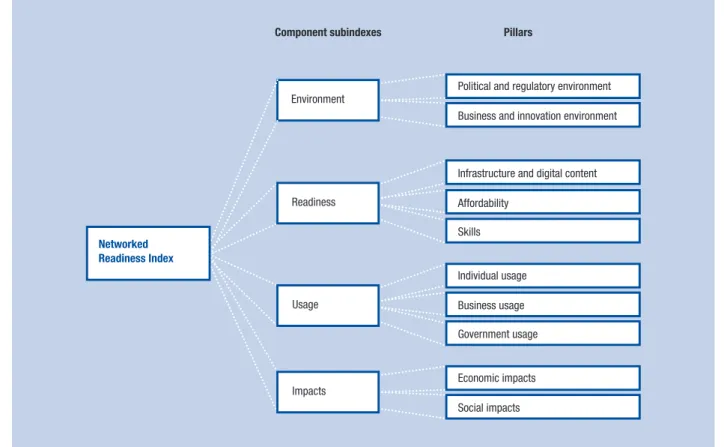
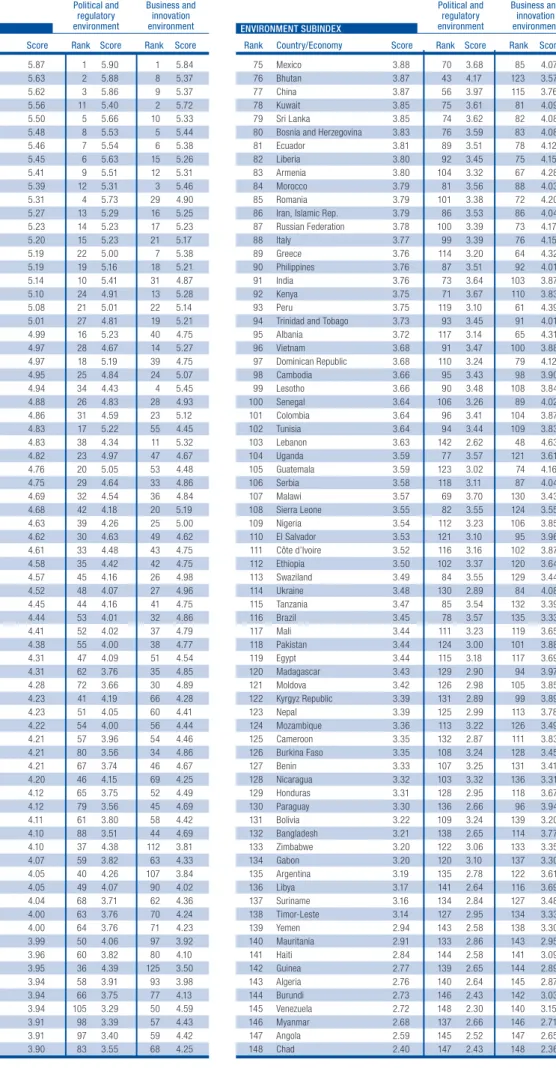
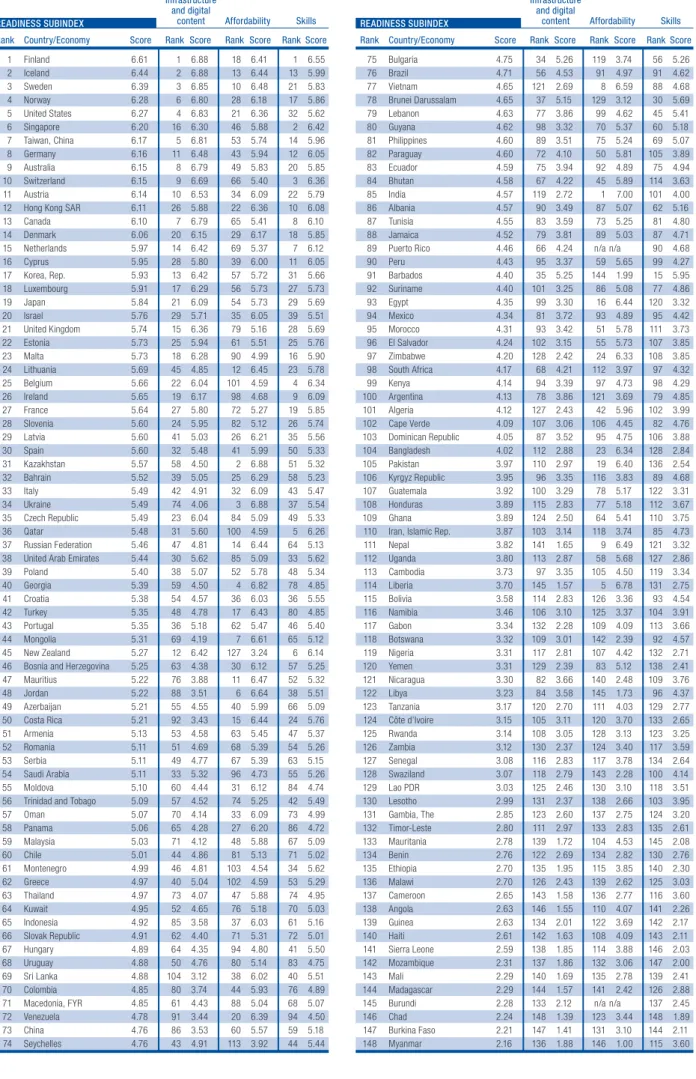
Tables 1 through 5 report the 2014 rankings for
the overall NRI, its four subindexes, and its 10 pillars. In
addition, the Country/Economy Profile and Data Tables
sections at the end of the
Report
present the detailed
results for the 148 economies covered by the study and
the 54 indicators composing the NRI. To complement
the analysis of the results, Box 1 presents a classification
of countries based on their NRI 2014 scores and the
change rate of this Index over a two-year period; Box
2 assesses the nature of the digital divide in Europe;
and Box 3 discusses the challenges large emerging
economies must overcome if they are to keep moving
forward in integrating ICTs into more robust innovation
ecosystems that could help them transition from what
appears to be a mid-life crisis toward a
knowledge-based society. Finally, Appendix A of Chapter 1.1 details
the structure of the NRI and describes the method of
calculation.
Top 10
The top 10 spots continue to be dominated by Northern
European economies, the Asian Tigers, and some of
the most advanced Western economies. Three Nordic
economies—Finland, Sweden, and Norway—lead the
rankings and are positioned among the top 5. Denmark
and Iceland, the remaining two Nordic economies,
also perform strongly, and despite small slips this
year they feature among the top 20. Overall, their
performance in terms of ICT readiness, with excellent
digital infrastructures and robust innovation systems,
allows them to score very highly both in ICT use—with
almost universal Internet use, for example—and in
innovation performances. The Asian Tigers—composed
of Singapore, Hong Kong SAR, the Republic of Korea,
and Taiwan (China)—also perform very strongly, all of
them positioned at the forefront of the NRI and with
Singapore, Hong Kong SAR, and Korea featuring among
the top 10. All these economies continue to boast
outstanding business and innovation environments that
are consistently ranked among the most conducive to
entrepreneurship in the world. Finally, the top 10 includes
some of the most advanced Western economies—the
Netherlands, Switzerland, the United States, and the
United Kingdom—that have recognized the potential of
ICTs to embark in a new economic and social revolution,
and thus have substantially invested in developing their
digital potential.
In evolutionary terms, this year the rankings remain
very stable, with no movement in the top 6 and negligible
changes in the rest, with the exception of the significant
improvement by six positions of Hong Kong SAR, which
climbs to 8th place.
For a second consecutive year, Finland tops
the rankings with a strong performance across the
board. It ranks 1st in the readiness subindex thanks
to an outstanding digital ICT infrastructure—the best
in the world—and 2nd in both the usage and impact
subindexes, with more than 90 percent of its population
using the Internet and high levels of technological and
non-technological innovation. The country also comes
in 3rd in the environment subindex, with a very robust
innovation system. Singapore continues to follow
closely in the rankings, remaining in 2nd place. With
the best pro-business and pro-innovation environment
worldwide, the city-state continues to obtain the top rank
in terms of ICT impacts, notably on the social dimension.
Supported by a government with a clear digital strategy
that offers the best online services in the world, an ICT
infrastructure that is relentlessly being improved over
time (16th), and one of the highest quality educational
systems in the world (3rd), notably in terms of math and
science (1st), Singapore has become one of the most
knowledge-intensive economies globally (2nd) and is an
ICT-generation powerhouse. Sweden (3rd) maintains
its position this year despite a slight improvement in its
overall score, unable to regain the top position it held
two editions ago. Overall, the very strong performance
of Sweden reflects its world-class, affordable (11th) ICT
infrastructure (3rd) and a stable and pro-business and
innovation environment (15th), despite its high tax rate
(123rd). These strengths result in outstanding uptake
and use of ICTs by individuals (1st), businesses (3rd), and
government (7th) and one of the highest technological
and non-technological innovation performances in the
world (2nd), making Sweden a truly knowledge-based
society.
The United States moves up two positions to
7th place, thanks to slight improvements in many
areas of the Index. These include the country’s already
good business and innovation environment (7th) and
improvements in its ICT infrastructure (4th), notably in
terms of wider access to international Internet bandwidth
per user. Overall, the country exhibits a robust uptake
of ICTs by all major stakeholders—businesses (9th),
government (11th), and individuals (18th)—who manage
to leverage well one of the best and more affordable
(20th) ICT infrastructures (4th). Coupled with a
pro-business and pro-innovation environment (7th), these
result in a strong innovation capacity (5th) and significant
ICT-related economic impacts (9th). The ranking of the
United States, the largest economy in the world, in the
top 10 shows that fully leveraging ICTs is not dependent
on small or medium-sized economies, but instead
depends on undertaking the right investments and
creating the right condition for it. Despite a drop of two
places, the United Kingdom continues to exhibit a very
strong performance in 9th position. As a service-based
economy, the country early recognized the importance
of ICTs to support its innovation and competitiveness
performance. As a result, it has managed to build a
well-developed ICT infrastructure (15th), exhibiting one of the
highest population uptakes (8th) and a well-developed
e-commerce (1st), which, coupled with a strong
pro-business environment, has resulted in solid economic
(14th) and social (9th) impacts.
Regional results
Europe has been at the forefront of developing a digital
ecosystem as a key ingredient that fosters innovation
and competitiveness. As a result, several European
countries lead the NRI rankings, with six European
economies—Finland, Sweden, the Netherlands,
Norway, Switzerland, and the United Kingdom—in the
top 10. In addition, in order to maximize the positive
impacts of ICTs throughout the European Union and
create synergies and positive spillover effects, the
European Commission has developed its Digital Agenda
as one of seven flagship initiatives under its growth
strategy Europe 2020. Despite these efforts, important
differences remain across European economies,
with Southern and Central and Eastern European
economies continuing to lag behind. A deeper analysis
of the root causes of these differences shows that, in
general, ICT infrastructure and individual uptake is more
homogeneous across EU Member States. However, less
favorable conditions for innovation and entrepreneurship
across European countries result in starker disparities in
terms of the economic impacts—for example, innovation
performance—accruing from their use, which illustrates
the changing nature of the digital divide in Europe and
in the rest of the world. The digital divide should not be
regarded only in terms of access to ICT infrastructure,
but also in terms of the impacts that using ICTs can
provide for the economy and society in general. Within
the Commonwealth of Independent States, several
countries improve their performances, reflecting the
key importance and hopes they have placed on ICTs to
diversify their economies and lead them toward more
knowledge-intensive activities.
With three economies from the region in the top
10 of the NRI rankings and several countries showing
improvement, Asia and the Pacific is very dynamic
and active in developing its ICT agenda. Yet a significant
digital divide persists between the most advanced
economies—such as the Asian Tigers and Japan—
and emerging economies and other trailing countries.
Regardless of their position on the development ladder,
however, all Asian economies have much to gain from
increased networked readiness. It will allow populations
of the least advanced among them to gain access to
much-needed basic services, to improve government
transparency and efficiency, and—for the most
advanced—it will contribute to boosting their innovation
capacity and allow them to attain higher levels of
competitiveness.
Improving the connectivity of Latin America and
the Caribbean continues to represent one of the
region’s main challenges despite the recent efforts
of many countries to develop and update their ICT
infrastructures. Countries such as Chile, Panama,
Uruguay, and Colombia have made significant progress
in developing and ensuring more and better access to
ICT infrastructure, ensuring higher ICT usage across
stakeholders. However, persistent weaknesses in
the broader innovation system hinder the overall
capacity of the region to fully leverage ICTs to foster its
competitiveness potential, highlighting the rise of the
new digital divide—that is, the divide between countries
that are achieving positive economic and social impacts
related to the use of ICTs and those that are not.
Sub-Saharan Africa slowly continues to develop
its ICT infrastructure, especially by expanding the share
of the population covered by, and having access to,
mobile telephony and by expanding the number of
Internet users, which in some countries—such as South
Africa—has almost doubled. These improvements have
led to many important innovations that provide more
and better services that were previously unavailable,
such as financial services. Notwithstanding this
progress, the region overall continues to suffer from a
relatively poor ICT infrastructure, which remains costly to
access, although some notable exceptions exist. More
importantly, severe weaknesses persist in the region’s
business and innovation ecosystems, which result in very
low positive economic and social impacts. Addressing
these weaknesses, not only by developing a more solid
ICT infrastructure but also by improving the framework
conditions for innovation and entrepreneurship, will be
crucial to avoid the emergence of a new digital divide
that will be evident in a disparity of the economic and
social impacts associated with what has been called the
digital revolution.
As in previous years, the Middle East and North
Africa depicts a highly diversified outlook in terms of
the capacity of countries to leverage ICTs to boost
competitiveness and well-being. On the one hand,
Israel and several Gulf Cooperation Council states
have continued their efforts to improve ICT uptake
and integrate ICTs better in more robust innovation
ecosystems in order to obtain higher returns. On the
other hand, many countries in North Africa continue
to lag behind and suffer from important weaknesses
in their framework conditions and overall innovation
capacity that prevent them from fully leveraging ICTs and
obtaining higher returns.
The Internet of Everything: How the Network
Unleashes the Benefits of Big Data
Chapter 1.2, contributed by Robert Pepper and John
Garrity from Cisco Systems, details how Internet protocol
(IP) networks underpin the concept of the Internet
of Everything (IoE) and explores how IP networks
accelerate big data’s transformational impact on
individuals, businesses, and governments around the
world.
As exabytes of new data are created daily, a rising
share of this data growth is flowing over IP networks
as more people, places, and things connect to the IoE.
Proprietary networks are increasingly migrating to IP,
facilitating the growth of big data, and networks are fast
becoming the key link among data generation, analysis,
processing, and utilization.
The authors highlight four major trends driving
data growth over IP networks and detail how networks
are central to maximizing analytical value from the
data deluge. The chapter identifies critical technology
and public policy challenges that could accelerate,
or encumber, the full impact of big data and the IoE
including standards and interoperability, privacy and
security, spectrum and bandwidth constraints,
cross-border data traffic, legacy regulatory models, reliability,
scaling, and electrical power.
Big Data Maturity: An Action Plan for Policymakers
and Executives
In Chapter 1.3, Bahjat El-Darwiche, Volkmar Koch,
David Meer, Ramez T. Shehadi, and Walid Tohme of
Booz & Company argue that big data has the potential
to improve or transform existing business operations
and reshape entire economic sectors. Big data can
pave the way for disruptive, entrepreneurial companies
and allow new industries to emerge. The technological
aspect is important, but technology alone is insufficient
to allow big data to show its full potential and to prevent
companies from feeling swamped by this information.
What matters is to reshape internal decision-making
culture so that executives base their judgments on data
rather than hunches. Research already indicates that
companies that have managed this are more likely to be
productive and profitable than their competition.
Organizations need to understand where they are in
terms of big data maturity, an approach that allows them
to assess progress and identify necessary initiatives.
Judging maturity requires looking at environment
readiness, determining how far governments have
provided the necessary legal and regulatory frameworks
and ICT infrastructure; considering an organization’s
internal capabilities and how ready it is to implement big
data initiatives; and looking also at the many and more
complicated methods for using big data, which can
mean simple efficiency gains or revamping a business
model. The ultimate maturity level involves transforming
the business model to become data-driven, which
requires significant investment over many years.
Policymakers should pay particular attention to
environment readiness. They should present citizens
with a compelling case for the benefits of big data.
This means addressing privacy concerns and seeking
to harmonize regulations around data privacy globally.
Policymakers should establish an environment that
facilitates the business viability of the big data sector
(such as data, service, or IT system providers), and
they should take educational measures to address the
shortage of big data specialists. As big data becomes
ubiquitous in public and private organizations, its use will
become a source of national and corporate competitive
advantage.
Balancing the Risks and Rewards of Data-Driven
Public Policy
Alex “Sandy” Pentland from the Massachusetts Institute
of Technology (MIT) highlights in Chapter 1.4 that we
are entering a big data world, where governance is
far more driven by data than it has been in the past.
Basic to the success of a data-driven society is the
protection of personal privacy and freedom. Discussions
at the World Economic Forum have made substantial
contributions to altering the privacy and data ownership
standards around the world in order to give individuals
unprecedented control over data that are about
them, while at the same time providing for increased
transparency and engagement in both the public and
private spheres.
We still face the challenge that large organizations,
and in particular governments, may be tempted to abuse
the power of the data that they hold. To address this
concern we need to establish best practices that are in
the interests of both large organizations and individuals.
This chapter suggests one path by which potential
abuses of power can be limited, while at the same time
providing greater security for organizations that use
big data. The key policy recommendations for all large
organizations, commercial or government, are that:
1. Large data systems should store data in a
distributed manner, separated by type (e.g.,
financial vs. health) and real-world categories (e.g.,
individual vs. corporate), managed by a department
whose function is focused on those data, and
with sharing permissions set and monitored by
personnel from that department. Best practice
would have the custodians of data be regional
and use heterogeneous computer systems. With
such safeguards in place, it is difficult to attack
many different types of data at once, and it is more
difficult to combine data types without authentic
authorization.
2. Data sharing should always maintain provenance
and permissions associated with data and support
automatic, tamper-proof auditing. Best practice
would share only answers to questions about the
data (e.g., by use of pre-programmed SQL queries
known as “Database Views”) rather than the
data themselves, whenever possible. This allows
improved internal compliance and auditing, and
helps minimize the risk of unauthorized information
leakage.
3. Systems controlled by partner organizations, and
not just a company’s own systems, should be
secure. External data sharing should occur only
between data systems that have similar local
control, permissions, provenance, and auditing,
and should include the use of standardized legal
agreements such as those employed in trust
networks. Otherwise data can be siphoned off at
either the data source or the end consumer, without
the need for attacking central system directly.
4. The need for a secure data ecosystem extends to
the private data of individuals and the proprietary
data of partner companies. As a consequence, best
practice for data flows to and from individual citizens
and businesses is to require them to have secure
personal data stores and be enrolled in a trust
network data sharing agreement.
5. All entities should employ secure identity credentials
at all times. Best practice is to base these
credentials on biometric signatures.
6. Create an “open” data commons that is available
to partners under a lightweight legal agreement,
such as the trust network agreements. Open data
can generate great value by allowing third parties to
improve services.
Although these recommendations might at first
glance seem cumbersome, they are for the most part
easily implemented with the standard protocols found
within modern computer databases and networks. In
many cases, the use of distributed data stores and
management are already part of current practice, and
so the entire system will be simpler and cheaper to
implement than a centralized solution: all that is really
new is the careful use of provenance, permissions, and
auditing within a legal or regulatory framework such as a
trust network. Most importantly, these recommendations
will result in a data ecosystem that is more secure and
resilient, allowing us to safely reap the advantages of
using big data to help set and monitor public policy.
Managing the Risks and Rewards of Big Data
In Chapter 1.5., Matt Quinn and Chris Taylor from TIBCO
argue that expert handling of big data brings the reward
of being able to react to world-changing events, both
big and small, at an unprecedented rate and scope.
Epidemics can be tracked and miracle drugs developed,
for example, but at the same time, big data brings risks
that require balancing those benefits against privacy
concerns raised by the potentially unsettling correlation
of personal information.
Organizations are awakening to the reality that an
overwhelming amount of high-volume, wide-variety, and
high-velocity data creates three key trends:
• Big data leverages previously untapped data
sources to liberate information from places where it
was previously hidden.
• Big data management requires automation wherever
possible, because volume and complexity eliminate
the ability of humans to intervene and reprogram
processes in real time.
• Big data forces us to create adaptable, less
fragile data systems because the sheer variety of
structured and unstructured data breaks the old
computational and transactional ways of writing
logic.
These trends create two main challenges:
• Big data holds unseen patterns, which need to be
visualized using analytics tools and techniques.
Insights gained must be used at the right time, in
the right context, and with the right approach.
• The challenge of systematically discovering,
capturing, governing, and securing ever-larger
amounts of data is much more complicated than the
relatively simple problem of marshaling storage and
computational resources.
These elements are the driving forces behind
making use of big data in increasingly sophisticated
ways. The chapter cites examples in healthcare,
logistics, and retail where big data is being tackled
with a systems approach that takes into consideration
information streaming constantly as well as what is found
in historical databases that cut through the mystique of
big data and get to the core of understanding big data’s
risks and rewards.
Rebalancing Socioeconomic Asymmetry in a
Data-Driven Economy
Chapter 1.6, contributed by Peter Haynes of the
Atlantic Council and M-H. Carolyn Nguyen at Microsoft,
explains that an increasing amount of data is being
generated by individuals who are handing potentially
valuable information to commercial enterprises in
exchange for “free” services. Moreover, they are doing
this without realizing—or being recompensed for—their
data’s monetary value, and with little or no control over
its immediate or future use. These socioeconomic
asymmetries in the broad data ecosystem are a potential
threat to the emerging data-driven economy, since
they may reduce overall output as more and more
economic activity is predicated on the use, exchange,
and analytics of data. The authors argue the need for a
data ecosystem based on fair value exchange and the
ability of users to control the use of data related to them.
The chapter also considers potential technology and
policy approaches by which this might be achieved, and
present the need for significant additional research and
new thinking, in both technology and policy, to enable a
sustainable data-driven economy.
Building Trust: The Role of Regulation in Unlocking
the Value of Big Data
In Chapter 1.7, Scott Beardsley, Luís Enríquez, Ferry
Grijpink, Sergio Sandoval, Steven Spittaels, and Malin
Strandell-Jansson from McKinsey & Company highlight
the expectation that big data will create great benefit
for society, companies, and individuals in the coming
years. For this to fully materialize, however, a number of
factors must be in place. There must be robust
high-speed Internet networks, an educated workforce, and
consumer trust in the services, especially regarding the
protection of personal data and privacy.
The increasing importance of protecting personal
data and privacy is being recognized by countries and
organizations across the world. There are, however, a
range of diverging views about how to tackle the issue.
These range from the light-touch approach of the United
States, which leaves the issue mainly to the industry
to solve, to the strict ex ante regulatory framework as
advocated by the European Union.
No matter which approach is taken, a few issues
remain unclear across the frameworks. These issues
might hamper public trust in big data applications and
companies and hinder the development of big data to
its full potential. The issues of concern include how to
define personal data, how to treat anonymous data,
whether to allow the right to be forgotten, and the need
to clarify the relevant jurisdictions and liabilities between
parties.
The chapter outlines a few suggestions for
regulators and companies about how to tackle these
issues, and suggests that regulators should work closely
with industry stakeholders and across regions to achieve
technology-neutral high-level regulatory principles that
last and promote industry self-regulation.
Companies should, after an initial assessment,
implement necessary changes into their organization and
cooperate with the regulators and industry stakeholders.
Key, however, is to empower the customer. With clear
and transparent privacy policies outlining practices,
enabled services, and trade-offs, consumers are
empowered to make their own choices while the trust of
the industry is preserved.
From Big Data to Big Social and Economic
Opportunities: Which Policies Will Lead to
Leveraging Data-Driven Innovation’s Potential?
Chapter 1.8, contributed by Pedro Less Andrade, Jess
Hemerly, Gabriel Recalde, and Patrick Ryan at Google,
focuses on the social and economic value of data,
but from the point of view of use and purpose rather
than volume. As it has become axiomatic that more
data are produced every year, commentators have
been driven to call this revolution the “age of big data.”
However, what is commonly known as “big data” is
not a new concept: the use of data to build successful
products and services, optimize business processes,
and make more efficient data-based decisions already
has an established history. Moreover, the term
big data
is ambiguous: the main features of big data (quantity,
speed, variety) are technical properties that depend
not on the data themselves but on the evolution of
computing, storage, and processing technologies. What
is important about big data is not its volume but how it
may contribute to innovation and therefore be used to
create value. This is why this chapter uses data-driven
innovation to frame the discussion.
High-value solutions that may not have quantifiable
economic value are being developed using data, and
many sectors, from businesses to governments, benefit
from data-driven innovation. Apart from producing
and using data for better policymaking processes, the
public sector can also play its part in promoting and
fostering data-driven innovation and growth throughout
economies by (1) making public data accessible through
open data formats, (2) promoting balanced legislation,
and (3) supporting education that focuses on data
science skills.
Making Big Data Something More than the “Next Big
Thing”
In Chapter 1.9., Anant Gupta, Chief Executive Officer at
HCL Technologies Ltd, argues that big data analytics is
not a passing fad. It will be a central means of creating
value for the organization of tomorrow—almost literally,
tomorrow. It represents a major change in the way that
businesses and other organizations will operate, and
using it successfully will require a new mind-set and
new capabilities. Given that, many organizations are
struggling to even know where to start in becoming
big-data competent. A step-by-step approach can make the
transition seem less daunting and minimize the stumbles
that are bound to occur along the way.
PARTS 2 AND 3: COUNTRY/ECONOMY PROFILES
AND DATA PRESENTATION
Parts 2 and 3 of the
Report
feature comprehensive
profiles for each of the 148 economies covered this
year as well as data tables for each of the 54 variables
composing the NRI, with global rankings. Each part
begins with a description of how to interpret the data
provided.
Technical notes and sources, included at the end
of Part 3, provide additional insight and information on
the definitions and sources of specific quantitative
non-Survey data variables included in the NRI computation
this year.
NOTES
1 Alexander 1983.
2 See Lanier 2010; see also Kakutani 2010.
REFERENCES
Alexander, C. P. 1983. “The New Economy.” Time Magazine, May 30. Available at http://content.time.com/time/magazine/ article/0,9171,926013,00.html.
Kakutani, M. 2010. “A Rebel in Cyberspace, Fighting Collectivism.” Books of the Times, January 14. The New York Times. Available at http://www.nytimes.com/2010/01/15/books/15book.html?_r=0. Lanier, J. 2010. You Are Not a Gadget. New York: Vintage Books,
The Networked
Readiness Index
Rankings
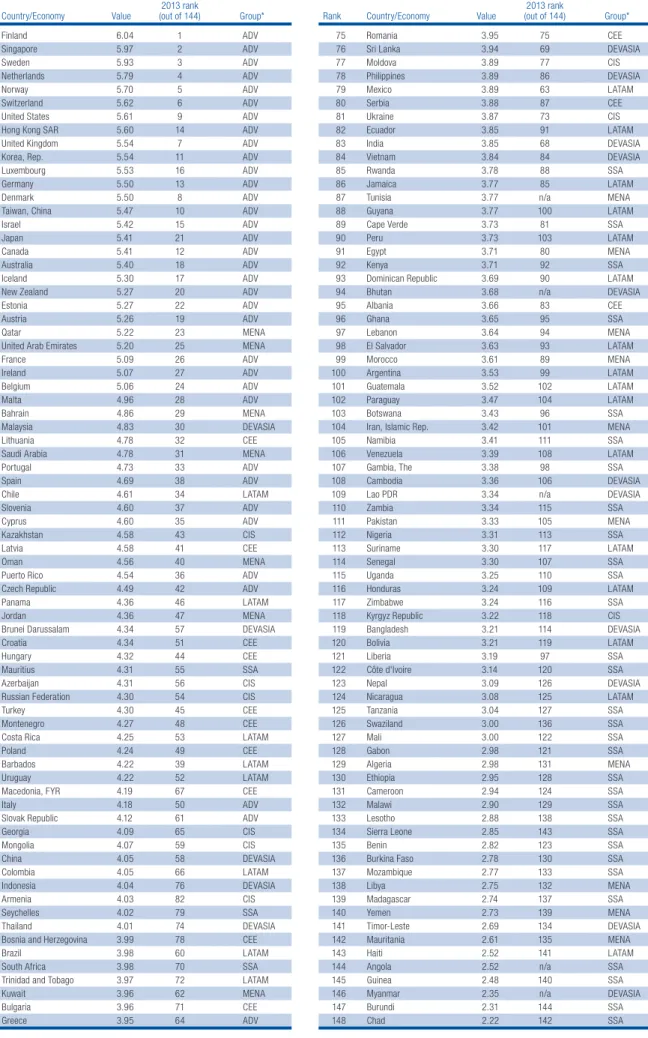
Rank Country/Economy Value (out of 144)2013 rank
1 Finland 6.04 1 2 Singapore 5.97 2 3 Sweden 5.93 3 4 Netherlands 5.79 4 5 Norway 5.70 5 6 Switzerland 5.62 6 7 United States 5.61 9 8 Hong Kong SAR 5.60 14 9 United Kingdom 5.54 7 10 Korea, Rep. 5.54 11 11 Luxembourg 5.53 16 12 Germany 5.50 13 13 Denmark 5.50 8 14 Taiwan, China 5.47 10 15 Israel 5.42 15 16 Japan 5.41 21 17 Canada 5.41 12 18 Australia 5.40 18 19 Iceland 5.30 17 20 New Zealand 5.27 20 21 Estonia 5.27 22 22 Austria 5.26 19 23 Qatar 5.22 23 24 United Arab Emirates 5.20 25 25 France 5.09 26 26 Ireland 5.07 27 27 Belgium 5.06 24 28 Malta 4.96 28 29 Bahrain 4.86 29 30 Malaysia 4.83 30 31 Lithuania 4.78 32 32 Saudi Arabia 4.78 31 33 Portugal 4.73 33 34 Spain 4.69 38 35 Chile 4.61 34 36 Slovenia 4.60 37 37 Cyprus 4.60 35 38 Kazakhstan 4.58 43 39 Latvia 4.58 41 40 Oman 4.56 40 41 Puerto Rico 4.54 36 42 Czech Republic 4.49 42 43 Panama 4.36 46 44 Jordan 4.36 47 45 Brunei Darussalam 4.34 57 46 Croatia 4.34 51 47 Hungary 4.32 44 48 Mauritius 4.31 55 49 Azerbaijan 4.31 56 50 Russian Federation 4.30 54 51 Turkey 4.30 45 52 Montenegro 4.27 48 53 Costa Rica 4.25 53 54 Poland 4.24 49 55 Barbados 4.22 39 56 Uruguay 4.22 52 57 Macedonia, FYR 4.19 67 58 Italy 4.18 50 59 Slovak Republic 4.12 61 60 Georgia 4.09 65 61 Mongolia 4.07 59 62 China 4.05 58 63 Colombia 4.05 66 64 Indonesia 4.04 76 65 Armenia 4.03 82 66 Seychelles 4.02 79 67 Thailand 4.01 74 68 Bosnia and Herzegovina 3.99 78 69 Brazil 3.98 60 70 South Africa 3.98 70 71 Trinidad and Tobago 3.97 72 72 Kuwait 3.96 62 73 Bulgaria 3.96 71 74 Greece 3.95 64
Rank Country/Economy Value (out of 144)2013 rank
75 Romania 3.95 75 76 Sri Lanka 3.94 69 77 Moldova 3.89 77 78 Philippines 3.89 86 79 Mexico 3.89 63 80 Serbia 3.88 87 81 Ukraine 3.87 73 82 Ecuador 3.85 91 83 India 3.85 68 84 Vietnam 3.84 84 85 Rwanda 3.78 88 86 Jamaica 3.77 85 87 Tunisia 3.77 n/a 88 Guyana 3.77 100 89 Cape Verde 3.73 81 90 Peru 3.73 103 91 Egypt 3.71 80 92 Kenya 3.71 92 93 Dominican Republic 3.69 90 94 Bhutan 3.68 n/a 95 Albania 3.66 83 96 Ghana 3.65 95 97 Lebanon 3.64 94 98 El Salvador 3.63 93 99 Morocco 3.61 89 100 Argentina 3.53 99 101 Guatemala 3.52 102 102 Paraguay 3.47 104 103 Botswana 3.43 96 104 Iran, Islamic Rep. 3.42 101 105 Namibia 3.41 111 106 Venezuela 3.39 108 107 Gambia, The 3.38 98 108 Cambodia 3.36 106 109 Lao PDR 3.34 n/a 110 Zambia 3.34 115 111 Pakistan 3.33 105 112 Nigeria 3.31 113 113 Suriname 3.30 117 114 Senegal 3.30 107 115 Uganda 3.25 110 116 Honduras 3.24 109 117 Zimbabwe 3.24 116 118 Kyrgyz Republic 3.22 118 119 Bangladesh 3.21 114 120 Bolivia 3.21 119 121 Liberia 3.19 97 122 Côte d'Ivoire 3.14 120 123 Nepal 3.09 126 124 Nicaragua 3.08 125 125 Tanzania 3.04 127 126 Swaziland 3.00 136 127 Mali 3.00 122 128 Gabon 2.98 121 129 Algeria 2.98 131 130 Ethiopia 2.95 128 131 Cameroon 2.94 124 132 Malawi 2.90 129 133 Lesotho 2.88 138 134 Sierra Leone 2.85 143 135 Benin 2.82 123 136 Burkina Faso 2.78 130 137 Mozambique 2.77 133 138 Libya 2.75 132 139 Madagascar 2.74 137 140 Yemen 2.73 139 141 Timor-Leste 2.69 134 142 Mauritania 2.61 135 143 Haiti 2.52 141 144 Angola 2.52 n/a 145 Guinea 2.48 140 146 Myanmar 2.35 n/a 147 Burundi 2.31 144 148 Chad 2.22 142
Part 1
The Current Networked
Readiness Landscape
and Rewards and Risks
of Big Data
The Networked Readiness
Index 2014: Benchmarking
ICT Uptake in a World of
Big Data
BEÑAT BILBAO-OSORIO, World Economic Forum
ROBERTO CROTTI, World Economic Forum
SOUMITRA DUTTA, Cornell University
BRUNO LANVIN, INSEAD
and the Networked Readiness Index (NRI) were created
more than 13 years ago, the attention of decision
makers was focused on how to develop strategies that
would allow them to benefit from what
Time Magazine
had described as “the new economy”: a new way of
organizing and managing economic activity based on
the new opportunities that the Internet provided for
businesses.
1At present, the world is slowly emerging
from one of the worst financial and economic crises
in decades, and policymakers, business leaders, and
civil society are looking into new opportunities that
can consolidate growth, generate new employment,
and create business opportunities. Information and
communication technologies (ICTs) continue to rank
high on the list as one of the key sources of new
opportunities to foster innovation and boost economic
and social prosperity, for both advanced and emerging
economies.
For more than 13 years, the NRI has provided
decision makers with a useful conceptual framework
to evaluate the impact of ICTs at a global level and
to benchmark the ICT readiness and usage of their
economies.
EXTRACTING VALUE FROM BIG DATA
Data have always had strategic value, but with the
magnitude of data available today—and our capability to
process them—they have become a new form of asset
class. In a very real sense, data are now the equivalent
of oil or gold. And today we are seeing a data boom
rivaling the Texas oil boom of the 20th century and the
San Francisco gold rush of the 1800s. It has spawned
an entire support industry and has attracted a great deal
of business press in recent years.
As explained in more detail in Chapter 1.3, this
new asset class of big data is commonly described by
what we call the “three Vs.” Big data is high volume,
high velocity, and includes a high variety of sources
of information. Next to those three Vs we could add a
fourth: value. This is what everyone is looking for, and
this is why big data today gets so much attention. In the
quest for value, the challenge facing us is how to reduce
the complexity and unwieldiness of big data so that it
becomes truly valuable.
Big data can take the form of structured data such
as financial transactions or unstructured data such as
photographs or blog posts. It can be crowd-sourced or
obtained from proprietary data sources. Big data has
been fueled by both technological advances (such as the
spread of radio-frequency identification, or RFID, chips)
and social trends (such as the widespread adoption of
social media). Our collective discussions, comments,
likes, dislikes, and networks of social connections are
now all data, and their scale is massive. What did we
search for? What did we read? Where did we go? With
whom do we associate? What do we eat? What do
we purchase? In short, almost any imaginable human
interaction can be captured and studied within the realm
of big data.
Big data has arrived. It is changing our lives and
changing the way we do business. Some examples
include the following:
• Google uses big data to predict the next wave of
influenza.
2• IBM uses data to optimize traffic flow in the city of
Stockholm,
3and to get the best possible air quality.
• Dr. Jeffrey Brenner, a physician in New Jersey, uses
medical billing data to map out hot spots where
you can find his city’s most complex and costly
healthcare cases as part of a program to lower
healthcare costs.
4• The National Center for Academic Transformation
is using data mining to help understand which
college students are more likely to succeed in which
courses.
5But succeeding with big data requires more than
just data. Data-based value creation requires the
identification of patterns from which predictions can be
inferred and decisions made. Businesses need to decide
which data to use. The data each business owns might
be as different as the businesses themselves; these
data range from log files and GPS data to customer- or
machine-to-machine data. Each business will need
to select the data source it will use to create value.
Moreover, creating this value will require the right way
of dissecting and then analyzing those data with the
right analytics. It will require knowing how to separate
valuable information from hype. Chapter 1.7 provides
guidelines for businesses to make this transition. To a
large extent, mastering big data can also be compared
to irrigation. It is not enough to “bring water” to where it
can create fertility and value. Flooding can destroy crops
and even drive precious nutrients away. Mastering water
resources requires the delicate management of how
much is needed and when, and often requires complex
and interconnected systems of channels, levees, and
regulation. Success with these resources is what made
ancient Egypt a brilliant civilization and turned China into
a unified country. The stakes are not dissimilar when
applied to big data, but this is a resource that could
benefit the entire planet instead of just one country.
For many, “data-driven” has become the new
management philosophy. The Economist Intelligence
Unit released survey data showing that approximately
two-thirds of executives feel that big data will help find
new market opportunities and make better decisions.
6Nearly half of the surveyed respondents feel big data will
increase competitiveness, and more than a third believe
it will boost financial performance.
This world of big data has also become a source
of concern. The consequences of big data for issues
of privacy and other areas of society are not yet fully
understood. Some prominent critics, such as Jaron
Lanier,
7call on us to be cautious about readily believing
any result created by the “wisdom of the crowd.”
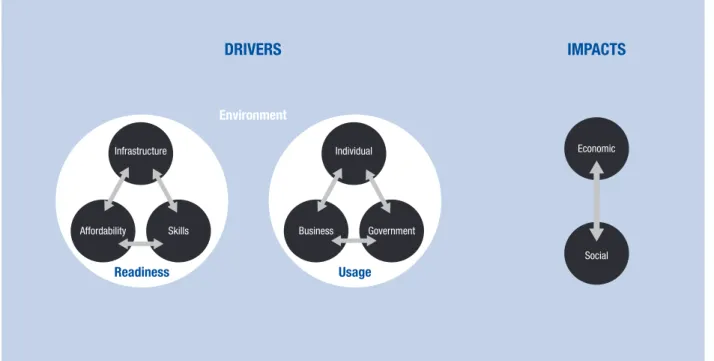
Infrastructure Affordability Skills
Individual
Environment
DRIVERS
Business Government
IMPACTS
Economic
Social