Contents lists available atScienceDirect
Behavioural Processes
j o u r n a l h o m e p a g e :w w w . e l s e v i e r . c o m / l o c a t e / b e h a v p r o c
Testing the social dog hypothesis: Are dogs also more skilled than
chimpanzees in non-communicative social tasks?
Victoria Wobber
a,∗, Brian Hare
baDepartment of Anthropology, Harvard University, 11 Divinity Ave, Cambridge, MA 02138, United States
bDepartment of Evolutionary Anthropology, Duke University, 104 Biological Sciences Drive, Durham, NC 27708, United States
a r t i c l e i n f o
Article history:Received 16 December 2008
Received in revised form 31 March 2009 Accepted 3 April 2009
Keywords: Dogs Chimpanzees Reversal learning Social cognition
a b s t r a c t
Relative to non-human primates, domestic dogs possess a number of social skills that seem exceptional—particularly in solving problems involving cooperation and communication with humans. However, the degree to which dogs’ unusual skills are contextually specialized is still unclear. Here, we presented dogs with a social problem that did not require them to use cooperative–communicative cues and compared their performance to that of chimpanzees to assess the extent of dogs’ capabilities relative to those of non-human primates. We tested the abilities of dogs and chimpanzees to inhibit previously learned responses by using a social and a non-social version of a reversal learning task. In contrast to previous findings in cooperative–communicative social tasks, dogs were not more skilled on the social task than the non-social task, while chimpanzees were significantly better in the social paradigm. Chim-panzees were able to inhibit their prior learning better and more quickly in the social paradigm than they were in the non-social paradigm, while dogs took more time to inhibit what they had learned in both versions of the task. These results suggest that the dogs’ sophisticated social skills in using human social cues may be relatively specialized as a result of domestication.
© 2009 Elsevier B.V. All rights reserved.
1. Introduction
Recent research has shown that domestic dogs possess social skills that in numerous ways surpass those of other animals (Cooper et al., 2003; Hare and Tomasello, 2005; Miklosi, 2008; Udell and Wynne, 2008). Dogs are sensitive to the attentional state of a human, look to humans for help when faced with a problem they cannot solve, and at least in exceptional cases are capable of “fast mapping” and iconically representing objects (Call et al., 2003; Bräuer et al., 2004; Miklosi et al., 2003; Kaminski et al., 2004, in press). Perhaps the best studied of these abilities is dogs’ use of human social cues. Dogs utilize these cues to find hidden food in ways that even non-human primates do not (Hare and Tomasello, 2005). When a human hides food in one of two locations and then indicates the location of the hidden food, dogs are able to flexibly use a number of cues such as human gaze and pointing gestures to locate the food (controls rule out the use of olfactory cues). In addi-tion, dogs are capable of using completely novel cues, do not simply respond to the motion involved in making the cue, and show little evidence for change within a test session in their ability to use vari-ous cues (Agnetta et al., 2000; Hare et al., 1998; Miklosi et al., 1998;
∗ Corresponding author.
E-mail addresses:[email protected](V. Wobber),[email protected] (B. Hare).
Riedel et al., 2006; Soproni et al., 2001, 2002). Cross-sectional and longitudinal studies have shown that dog puppies do not require extensive exposure to humans to develop the ability to exploit basic human social cues (i.e. point and gaze) while wolf pups do require this exposure—though dogs’ performance can be amplified by fur-ther training (Hare et al., 2002; Bentosela et al., 2008; Riedel et al., 2008; Udell and Wynne, 2008; Viranyi et al., 2008). This suggests that while both wolves and dogs are able to read conspecific social cues (Hare and Tomasello, 1999; Miklosi, 2008), domestication has caused dogs to be motivated to do so in a cooperative context, even early in development (Hare et al., 2005; Hare and Tomasello, 2005; Miklosi, 2008).
As a result of this early predisposition to interact cooperatively with humans, dogs may then develop other social problem-solving skills (in an analogous way to what is argued for the development of human social cognition in children;Tomasello, 1999). Importantly this is not to say that wolves cannot, like a number of non-human primates tested on similar tests, learn to use human cues with extensive exposure or explicit training (although we do not yet know how flexible they are in the use of such learned cues;Miklosi et al., 2003; Viranyi et al., 2008; Udell et al., 2008). Regardless, pre-vious research has shown overall that dogs have versatile abilities that allow them to use human cooperative–communicative signals more skillfully than non-human primates and their close canid rel-ative the wolf, and that these skills likely evolved as a result of domestication.
0376-6357/$ – see front matter © 2009 Elsevier B.V. All rights reserved. doi:10.1016/j.beproc.2009.04.003
Though the evidence discussed above comes from multiple sources and test paradigms, the degree to which dogs’ social skills are specialized is unclear. Do their unusual social skills extend beyond a context in which they must cooperate and communi-cate with humans? Or, do these abilities represent a relatively narrow specialization, implying that beyond this context dogs’ social skills are unremarkable? In favor of the latter hypothesis, research has shown that dogs are better at using human social cues than chimpanzees, but chimpanzees are far superior when making non-social causal inferences (Bräuer et al., 2006). While
Bräuer et al. (2006)suggest that dogs’ exceptional skills may be lim-ited to the social domain, the majority of research comparing dogs to non-human primates within this domain has required subjects to interpret humans’ cooperative–communicative signals (a con-text that may not elicit non-human primates’ most sophisticated problem-solving abilities;Hare et al., 2001; Hare and Tomasello, 2004; Gomez, 2005). However, social skills extend beyond delib-erate communication; individuals may exploit information from observing others’ behavior, without those other individuals will-ingly communicating anything. For example, chimpanzees have been shown to be sensitive to humans’ attention when they intend to steal food from that human, modifying their actions based on whether the human can hear or see them (Melis et al., 2006a). Therefore, there is a great deal of information in the social domain beyond the cooperative–communicative context, and the scope of dogs’ skills in these other contexts is currently unknown. Here, we aim to understand the extent of dogs’ abil-ities to reason about the social world, specifically by comparing chimpanzees and dogs in a social context that does not involve cooperative communication.We investigated this by employing a non-social and a social version of a well-established comparative test of inhibitory control: reversal learning (Gonzalez et al., 1966; Rumbaugh and Pate, 1984; Durlach and Mackintosh, 1986). In the reversal learning test, the subject chooses between two options, one of which is rewarded and the other of which is not. Tradition-ally, these two options are containers, lights, or symbols of some sort. Once the subject has learned the association between one of the objects and the reward, this association is switched—the unrewarded object now produces the reward, while the originally rewarded object no longer does. The dependent measure is how quickly subjects are able to inhibit choosing the once-rewarded location.
We utilized a standard non-social version of the paradigm, where subjects chose between two differently colored objects, and designed a novel adaptation of this paradigm in which two different humans concealing potential food were used as the dis-criminanda. Thus in our social version of the reversal learning test, the subject chooses between two people (instead of two non-human objects), one of whom is holding a reward. Though this social reversal learning test requires subjects to form an associa-tion between one individual and the potential reward, it does not require the subject to interpret any cooperative–communicative cues from that individual. It is a distinctly social task in com-parison to the paradigm utilizing two non-human objects, in that subjects must extract social information from an individ-ual’s behavior (whether or not they provide food) to succeed. In humans, placing a problem in a social context has been shown to augment performance compared to when that problem is pre-sented in a non-social context (the Wason card selection task, described inTooby and Cosmides (1992)). Therefore, chimpanzees and dogs may also be better able to learn when information is presented in a social paradigm. If neither species showed a dif-ference between the two contexts, this would suggest that the ability to inhibit prior learning is independent of the stimuli being learned. However, if chimpanzees showed increased performance in the social task, this would create two alternative outcomes for
the dogs. If dogs’ exceptional social skills extend beyond the use of cooperative–communicative contexts, they should show rel-atively more skill in the social reversal learning task than the non-social task. If, however, their skills are limited to interpreting human signals, they should show no distinction between the two tasks.
Importantly, these two alternatives both concern a within-species difference between conditions rather than any comparison of absolute performance across the two species. We did not predict that dogs should do better or worse than chimpanzees, but rather that dogs in one condition should do better than dogs in another condition with the control that chimpanzees should show a dis-tinction between conditions. Accordingly, we performed statistical analyses separately for each species.
2. Methods
2.1. Subjects
The subjects for this experiment were 22 chimpanzees (11 males and 11 females, average age 9.8 years old) and 24 dogs (14 males and 10 females, average age 3.9 years old), with an equal number of individuals assigned to the social and non-social condition in each species (11 and 12, respectively). This represented a between-subjects design where individuals received either the social or the non-social condition, but not both. These 46 individuals were those that completed the entire test; other subjects that began the task but that did not successfully learn the initial reward-human/object association (2 chimpanzees, 5 dogs) are not included in this fig-ure; nor are individuals who lost motivation either during the initial association trials or in the reversal, according to the criterion described below (6 chimpanzees, 1 dog). Thus the data presented here are only for these successful 22 chimpanzees and 24 dogs; no partial data is presented for these other individuals as they were considered too unmotivated to provide a valid test of their skills.
Chimpanzees were tested at the Tchimpounga Chimpanzee Sanctuary in the Congo Republic. These individuals are semi-free-ranging, living in forest enclosures but being provisioned by and having daily interaction with humans. The dogs were tested at the Max Planck Institute for Evolutionary Anthropology in Leipzig, Ger-many. All dogs were pets, with no special training.
2.2. Apparatus
We used a standard object choice procedure, where the subject was presented with a choice between two objects or two humans, with the potential for one or both of those options (depending on the condition) to hold the reward. The two potential locations of the reward (object or human) were located 2 m apart, with subjects centered prior to each trial so that they were equidistant from the two options. For the social condition, two human experimenters were used as positions of the potential food reward. For the non-social condition, two cups (chimpanzees) or bowls (dogs) were used to conceal the potential food reward.
For the chimpanzees, subjects were separated from the human experimenters by a metal mesh, with the bars of the mesh spaced widely enough so that the chimpanzees could reach their hands or arms out to touch the experimenters or cups when making a choice. When the chimpanzees were being centered between the two options before a trial, they were fed a piece of food at this mesh at a point equidistant between the two objects/humans between which they were choosing. For dogs, subjects were held by their owner or an experimenter at a point equidistant from the two humans/objects between which they were choosing, 2 m from the midpoint between the two humans/objects.
2.3. Design
Each subject received one test session. This session was com-posed of four types of trials: familiarization trials, baseline trials, trials with the initial reward association, and reversal trials, all presented in sequence. Some chimpanzees received familiarization trials (depending on their level of ease with the test paradigm), then all chimpanzees received 10 baseline trials, a variable number of trials of the initial association until they learned this association to the criterion of 84% correct, then 20 trials of the reversal where the reward-object association was reversed. Dogs all received 2 famil-iarization trials, 4 baseline trials, initial association trials until they reached 84% correct, then 20 reversal trials. The exact procedure of these trials is described below.
The familiarization trials served to acquaint subjects with the paradigm of approaching the two choice options and touching the option where they hoped to find the reward. These trials were only given to chimpanzees who did not readily choose between the two options presented—this was the case for two subjects. Prior to the baseline, these two chimpanzees received 6 familiarization trials, within which they needed to choose the rewarded option once on each side before moving on to the baseline trials. Because of this dif-ficulty with the chimpanzees, the procedure was changed slightly with the dogs so that all subjects received at least 2 familiarization trials before proceeding to the baseline, with the same criterion that they needed to choose the rewarded option once on each side. All dogs met this criterion within 6 trials, with an average of 2.8 trials to reach this criterion across the 24 subjects.
The baseline trials were used to determine any pre-existing pref-erence a subject might have for one of the humans or cups between which the discriminations took place. Both options were rewarded in these trials, thus performance was solely based on any inher-ent preferences the subject might have for one individual or cup. To ensure that subjects’ test performance was not augmented by such a preference, whichever cup or person the subject chose fewer times during the baseline was set as the initial reward in the test trials. If the subject chose both options an equal number of times in the baseline, the reward location was chosen to optimize between-subject counterbalancing.
After the baseline trials, subjects continued on to the initial asso-ciation test trials. The first initial assoasso-ciation trial that subjects received was not included in the computation of their percent-age correct, following previous work (Rumbaugh and Pate, 1984), since in this trial subjects have no prior information about where the reward is located. Other than performance not being incorpo-rated into the calculation of the learning criterion, this first trial was identical to the others. Subjects received trials with the initial reward-object/human association until they reached a criterion of 84% correct. As perRumbaugh and Pate (1984), percentage correct choices in the initial association was assessed after 10 trials (9 or more out of 10 correct), 15 trials (13 or more correct), and 20 tri-als (17 or more correct); after 20 tritri-als, subjects were required to have obtained 17 correct out of the most recent 20 trials in order to qualify for reversal (Rumbaugh and Pate, 1984). Subjects received at maximum 60 of these initial association trials, as prior work has demonstrated that beyond this number of trials subjects are con-sidered unmotivated and show abnormal patterns in their reversal performance (Rumbaugh and Pate, 1984).
Once this criterion was met in the initial association, sub-jects proceeded directly to the reversal trials, where the reward was switched to the location that had previously been unre-warded. Subjects received 20 trials where their performance was recorded—similar to the initial association trials, their performance in the first trial of the reversal was not included in the measure of their success, as this trial simply served to signal the reversal. Thus subjects received a total of 21 reversal trials, though their
perfor-mance on only the latter 20 trials was counted as their measure of success. Again, this first trial was identical to the other reversal trials.
2.4. General procedure
Across all types of trials, in both the social and non-social con-ditions for each species, two reward locations were used. The positions of the two reward locations (two bowls or two humans) were kept constant throughout each subject and were counterbal-anced across subjects. Thus for a given subject, one experimenter always sat or stood in a fixed position on the right side while the other sat or stood on the left side, throughout the familiarization, baseline, initial association, and reversal trials. The same was true with the non-social stimuli—if the red cup was located on the left for a given subject, it remained on the left throughout the session. For the next subject the positions of the experimenters or cups were switched.
In both the social and non-social conditions, there was an abort criterion in place for subjects that lost interest in the test. If the subject did not choose either option within 30 s, this trial was coded as a “no choice.” If a subject had more than 3 “no choice” trials throughout the session, or completely stopped participating and refused to approach after attempting 3 presentations, the session was ended and that subject did not continue in the experiment. As mentioned above, data for the 6 chimpanzees and 1 dog for whom this abort criterion was met are not included in the results reported here, nor are they included in the total of 22 chimpanzee and 24 dog subjects.
2.5. Procedure—social
In the social conditions, the two reward locations were the hands of two unfamiliar individuals (two female experimenters, constant within each species). Each trial (familiarization, baseline, initial association, and reversal) began by the two experimenters han-dling a visible bag of peanuts (chimpanzees) or container of Frolic dog treats (dogs) so that the subject knew that each individual had the potential to be holding the reward. With the chimpanzees, the two experimenters stood at the back of the room and both handled the bag of peanuts, subsequent to one another, before approaching the mesh that separated them from the subject. With the dogs, the two experimenters handled the container of Frolic treats, located at the back of the room behind the testing area, subsequent to one another. After this handling, they resumed their positions.
Once the two experimenters moved to their positions 2 m apart, the subject was centered using the means described above. After the subject was centered, the experimenters each lifted one arm toward the subject, to allow the subject to choose one of their hands as a potential location of food. A chimpanzee could make a choice by pointing with a finger or tool (i.e. a piece of straw) through the mesh toward one of the experimenters while looking at her, while a dog could choose by simply touching one human or the other. The two experimenters agreed on a subject’s first choice before giving the subject food; if the subject’s choice was ambiguous the trial was repeated.
During the familiarization trials, either the first experimenter (E1) or the second experimenter (E2) took a reward upon manip-ulating the container. Upon raising their arms toward the subject, E1 and E2 opened their hands to show the subject which individ-ual was holding the reward. The subject was then allowed to take food from one of the two individuals. This procedure was repeated 6 times (for 1 chimpanzee), or anywhere from 2 to 6 times (with 12 dogs).
The baseline trials were the same as the familiarization trials, but both E1 and E2 took food rewards. The experimenters again
pre-sented their open hands, but the subject was only allowed to take food from one individual—thus reflecting any potential bias they might have toward one experimenter. This procedure was repeated for 10 trials (chimpanzees) or 4 trials (dogs).
The procedure of the test (initial association and reversal) trials was similar to that of these previous trials except that instead of the experimenters presenting open hands, they presented the subject with closed fists. Thus, the location of the reward was unknown to the subject. Further, only one individual (the one less chosen during the baseline) was holding food—though both still appeared to take food from the bag/container before each trial. If the sub-ject chose the correct individual it was given the food, while if it chose incorrectly it was shown that the other experimenter held the reward. Subjects were not able to directly perceive the location of the food reward from the experimenters handling the bag/container of food (i.e. the food reward was taken into the hand while the hand remained inside the bag and the rewards were small and were easily concealed), as evidenced by their choosing incorrectly on numer-ous trials. No direct control was needed for this because if subjects could directly view the location of the food, they should never have chosen incorrectly. Thus, the fact that they did so was taken as evi-dence for their being unable to discern the food’s location from unintentional cues.
2.6. Procedure—non-social
These trials were similar to the social trials, except that instead of using human experimenters as reward locations, the rewards were hidden under two cups or bowls: blue and red cups for the chimpanzees, and white and red bowls for the dogs (to create more contrast between light and dark, though it has been shown that dogs see red;Miklosi, 2008). The trial procedure was similar to that of the social trials, with the experimenter reaching into a bag of peanuts/container of Frolic treats that was centrally located (in the same position as described for the social conditions, distant from the subject) to start the trial. She then baited or sham-baited the cups (depending on the trial type), centered the subject as described above, and returned to her position sitting or standing equidistant between the two cups staring straight ahead before the subject was allowed to make a choice. The cups/bowls rested upside down on top of tables or the floor, depending on the testing facility (this varied within chimpanzees by the dormitory in which subjects were housed, but an equal number of subjects received the floor and table versions of the test. All dogs received the test with the bowls on the floor).
During the familiarization trials, the experimenter first reached into the reward container, then put food on top of one of the cups/bowls, visible to the subject. After being centered, the sub-ject was allowed to choose one of the two cups (using the same choice criteria as described above). This procedure was repeated 6 times (for 1 chimpanzee), or anywhere from 2 to 6 times (with 12 dogs).
In the baseline trials, the experimenter pulled out two rewards from the bag/container; she then put one reward on top of the left cup/bowl then the other reward on top of the right cup/bowl (the order of baiting was always the same, left to right, and the location of the two colors of container was counterbalanced across subjects). This procedure was repeated for 10 trials (chimpanzees) or 4 trials (dogs).
The test (initial association or reversal) trials were similar to these previous trials, except that the rewards were hidden under the cups rather than sitting on top of them. Further, only one option was rewarded—the experimenter would pretend to hide food in both containers, starting with the left and then the right, on every trial, but only actually hide food under one cup. Thus the subject knew that the reward was hidden under one of the cups but did not
know under which one. After the experimenter finished baiting and the subject was centered, it was then allowed to choose one of the two cups. If the subject chose correctly it received the reward; if it chose incorrectly it was shown where the food was located but not given the reward.
3. Results
Nonparametric statistics were used because the data were not normally distributed. Allp-values reported are 2-tailed. The anal-yses were performed independently for the two species since our hypothesis was not that one species should do better than the other, but regarded the within-species performance on social versus non-social conditions.
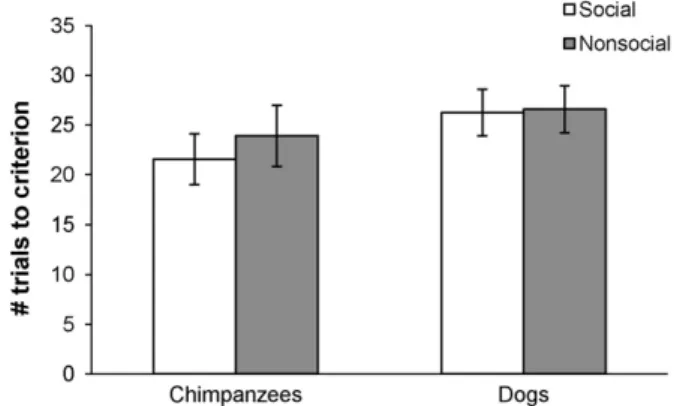
In both chimpanzees and dogs, there was no significant differ-ence in how quickly subjects learned the initial association in the social and non-social conditions (Mann–WhitneyU) (Fig. 1). Thus this suggests that in both species, subjects comprehended the social and non-social paradigms equally.
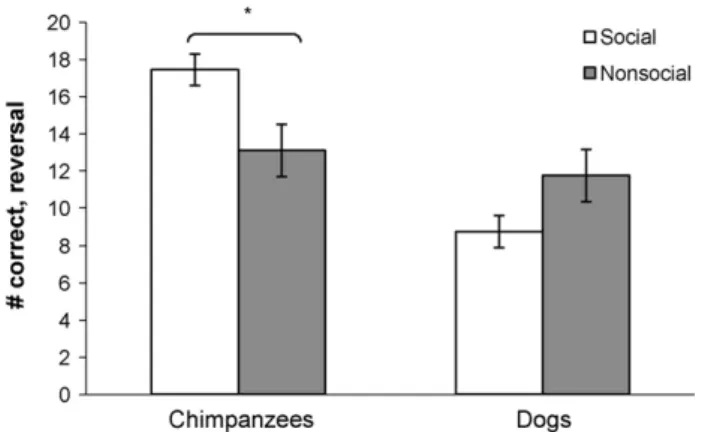
In the measure of how many trials out of 20 subjects chose cor-rectly on the reversal, there were significant differences between the conditions in chimpanzees: namely, chimpanzees performed significantly better on the reversal in the social condition than in the non-social condition (Mann–WhitneyU,Z= 2.33,p= 0.02). In contrast, in dogs, there was no significant difference between con-ditions in performance on the reversal (Mann–WhitneyU) (Fig. 2). Finally, this difference between conditions in the chimpanzees was also apparent in how quickly reversal performance was attained (Figs. 3 and 4). In chimpanzees, where there was a significant difference in overall performance between the social and non-social conditions, there was also a difference between conditions in improvement from the first 10 to the last 10 trials of the reversal. In the social condition, there was no improvement—subjects performed quite well even in the first 10 trials of the reversal (Wilcoxon matched pairs test). In the non-social condition, subjects performed significantly better on the last 10 trials than on the first 10 trials (Wilcoxon matched pairs test,
Z= 2.93,p= 0.003). Thus, chimpanzees were able to attain similar performance in the non-social reversal as they had in the social task, it simply took them more trials to do so (Fig. 3). This sug-gests, like the initial criterion results above, that it was not a lack of comprehension that led to the differential reversal performance across conditions; rather, chimpanzees were able to more quickly inhibit their past learning in the social paradigm as opposed to the non-social paradigm.
Fig. 1.Performance on the initial association for chimpanzees and dogs. They-axis denotes how many trials it took subjects in a given group on average to reach the cri-terion of 84% of trials correct. A higher number indicates that subjects took longer (more trials) to reach this criterion. No differences were found in either species between the social and non-social conditions in this measure. Error bars show stan-dard error of the mean.
Fig. 2. Performance in the reversal trials for chimpanzees and dogs. They-axis denotes how many trials out of a total of 20 that subjects in a given group on average chose the correct location in the reversal trials. There was a significant dif-ference between the social and non-social conditions in chimpanzees (p= 0.02), but no significant difference between dogs in this measure.
Fig. 3.Performance across the 20 trials of the reversal for chimpanzees. Performance is divided into two categories, the first 10 trials and the last 10 trials of the reversal. They-axis denotes how many out of these 10 trials subjects on average chose cor-rectly in the two conditions. Chimpanzees improved significantly in the non-social task (p= 0.003), but not in the social where they had already reached a near ceiling level in their performance in the first 10 trials.
In dogs, there was no difference between the social and non-social conditions in this measure—dogs improved from the first 10 to the last 10 trials of the reversal in both conditions (Wilcoxon matched pairs test, social:Z= 2.65,p= 0.008; non-socialZ= 3.06,
p= 0.002) (Fig. 4). This again demonstrated that for the dogs the two conditions were equivalent, and suggests that dogs had difficulty inhibiting their prior learning across conditions regardless of the stimuli involved.
Fig. 4.Performance across the 20 trials of the reversal for dogs. Performance is divided into two categories, the first 10 trials and the last 10 trials of the reversal. The y-axis denotes how many out of this 10 trials subjects on average chose correctly in the two conditions. Dogs improved significantly in both conditions (social:p= 0.008 and non-social:p= 0.002), with no distinction between the two.
4. Discussion
The findings of this comparison support the hypothesis that dogs’ unusual social abilities are specific to contexts involving cooperation and communication with humans. Contrary to the hypothesis that dogs are more skilled with social problems on the whole, we found that dogs were not more skillful at inhibit-ing their previously learned responses in a social reversal learninhibit-ing task than in a more conventional non-social version of the same task. In contrast, chimpanzees were more successful in the social paradigm than in the non-social one. Perhaps most striking, during the reversal trials of the social task, chimpanzees quickly reversed their response showing no change in performance in the first and second half of the session and choosing correctly on nearly all trials. In contrast, in the reversal trials of the non-social task chimpanzees improved quickly but only after making mistakes in the inhibition of their response. Dogs also showed the latter pattern, but did so in both conditions, having difficulty in successfully reversing their response in both the non-social and social tasks.
Overall then, it is chimpanzees, not dogs, that seem to have proficient social skills in the social reversal learning task. This is in contrast to dogs’ superior performance in numerous cue-following tasks relative to non-human primates (Hare et al., 2002; Gomez, 2005; Miklosi, 2008). Based on this pattern of findings, we propose that in social tasks where attribution of cooperative–communicative intentions is not required, as in the present social test, chimpanzees are more skillful than dogs, as might be expected based on their performance in a wide range of social tasks in other domains (e.g.Melis et al., 2006b; Warneken and Tomasello, 2006; Herrmann et al., 2007). In the case of this specific task it may be that chimpanzees utilized skills of reputation forma-tion, in tracking past behavior of other individuals, to excel in the social condition (Tomasello and Call, 1997; Melis et al., 2006b). To our knowledge, studies have not yet demonstrated this capability in dogs so it is possible that they do not monitor an individual’s behavior and assign a dispositional state to that individual in the way that chimpanzees, human children, and rhesus macaques do (Hamlin et al., 2007a,b).
While the difference between the two species’ performance seems robust, it is possible that dogs in our test did not perceive the social paradigm as “social” at all. It may be that for dogs, simply hav-ing two humans as discriminanda does not provide enough social information for them to utilize. As a result, dogs may have inter-preted the non-social and social tasks similarly, as a non-social food finding task, rather than encoding the humans as relevant social cues in this setting. If anything, dogs performed slightly worse in the social task, suggesting that they may have been distracted from learning the correct response by the presence of multiple humans in the test situation. Thus this test likely did not elicit dogs’ capa-bilities for reputation formation, if they do possess such skills at all. But, it is important to note that this task was sufficient to elicit a difference in chimpanzees’ behavior, so even if it is the case that dogs did not perceive the situation as social, the species difference suggests that chimpanzees are more sensitive than dogs to subtle changes in social situations. Therefore, even if we had employed multiple social and non-social tasks with multiple reversals, it is unlikely that this would demonstrate a distinction in dogs since the difference between social and non-social conditions in chim-panzees was present in this single reversal. However, this is in an empirical question that is addressable with future research.
Notably, neither species differed between conditions in the number of trials required to reach the initial criterion when learn-ing the first reward-stimulus association. This suggests that both the social and non-social tasks were valid measures of learning abil-ity in both species and that both species were motivated to solve the food finding problem. Further, this indicates that the
distinc-tion between condidistinc-tions (or lack thereof) was in fact linked to the reversal and the difficulty of inhibiting prior learning, rather than variation in the difficulty of learning associations at all in either paradigm. Another possibility is that subjects did not learn based on the non-social or social stimuli involved, but attended primar-ily to location since the position of the reward remained constant. However, if chimpanzees were using only location to remember the reward-stimulus association, then they should have shown no difference between conditions where the stimuli differed. Instead, our results suggest that they did in fact attend to the stimuli asso-ciated with the reward, with a distinction between the social and non-social discriminanda. It is possible that dogs only used cues of location to learn the pattern being presented, but if this is the case, it is interesting that they did not perceive any difference between the social and non-social conditions where chimpanzees did. Future work can control for the role of location in dogs’ learning abilities. In summary, our results do not contradict the hypothesis that dogs have unusual social problem-solving abilities. Currently, all evidence points to the effect of domestication on enhancing the social skills of dogs in cooperative–communicative tasks involv-ing humans (Hare et al., 2005; Hare and Tomasello, 2005; Miklosi, 2008; although seeUdell et al., 2008). Instead, our finding may sim-ply caution researchers when characterizing the social skills of dogs relative to other animals—it seems likely that the ability of dogs to cooperate and communicate with humans is somewhat specialized even if within this category of social problems dogs show unusual flexibility. Therefore, future work should continue to explore the range of social skills that dogs possess that are distinct from those of their close canid relatives and other socially sophisticated species such as non-human primates, so that we might fully characterize the changes in their problem-solving abilities that occurred as a result of domestication.
Acknowledgements
Thanks to Kathrin Schumann and Dennis Golm for help in run-ning the experiments with the dogs. Thanks to Rebeca Atencia, Lisa Pharoah, David Greer, and Keith Brown for making research pos-sible at Tchimpounga, and to the caretakers at Tchimpounga for helping with the chimpanzee research. The research of B.H. was supported by a Sofja Kovalevskaja award received from The Alexan-der von Humboldt Foundation and the German FeAlexan-deral Ministry for Education and Research.
References
Agnetta, B., Hare, B., Tomasello, M., 2000. Cues to food location that domestic dogs (Canis familiaris) of different ages do and do not use. Animal Cognition 3, 107–112. Bentosela, M., Barrera, G., Jakovcevic, A., Elgier, A., Mustaca, A., 2008. Effect of rein-forcement, reinforcer omission and extinction on a communicative response in domestic dogs (Canis familiaris). Behavioural Processes 78, 464–469. Bräuer, J., Kaminski, J., Riedel, J., Call, J., Tomasello, M., 2006. Making inferences
about the location of hidden food: social dog, causal ape. Journal of Comparative Psychology 120, 38–47.
Bräuer, J., Call, J., Tomasello, M., 2004. Visual perspective taking in dogs (Canis famil-iaris) in the presence of barriers. Applied Animal Behaviour Science 88, 299–317. Call, J., Bräuer, J., Kaminski, J., Tomasello, M., 2003. Domestic dogs (Canis famil-iaris) are sensitive to the attentional state of humans. Journal of Comparative Psychology 117, 257–263.
Cooper, J., Ashton, C., Bishop, S., West, R., Mills, D., Young, R., 2003. Clever hounds: social cognition in the domestic dog (Canis familiaris). Applied Animal Behaviour Science 81, 229–244.
Durlach, P., Mackintosh, N., 1986. Transfer of serial reversal learning in the pigeon. Quarterly Journal of Experimental Psychology 38B (1), 81–95.
Gomez, J.C., 2005. Species comparative studies and cognitive development. Trends in Cognitive Sciences 9, 118–125.
Gonzalez, R., Berger, B., Bitterman, M., 1966. Improvement in habit-reversal as a function of amount of training per reversal and other variables. The American Journal of Psychology 79 (4), 517–530.
Hamlin, K., Santos, L., Wynn, K., Bloom, P., 2007a. Attribution of dispositional states by rhesus macaques. In: Poster Presented at the Society for Research in Child Development Biennial Meeting, March 29–April 1st, Boston.
Hamlin, K., Wynn, K., Bloom, P., 2007b. Social evaluation by preverbal infants. Nature 450 (7169), 557–559.
Hare, B., Brown, M., Williamson, C., Tomasello, M., 2002. The domestication of social cognition in dogs. Science 298, 1634–1636.
Hare, B., Call, J., Tomasello, M., 1998. Communication of food location between human and dog (Canis familiaris). Evolution of Communication 2 (1), 137–159. Hare, B., Call, J., Tomasello, M., 2001. Do chimpanzees know what conspecifics know?
Animal Behaviour 61, 139–151.
Hare, B., Plyusnina, I., Ignacio, N., Schepina, O., Stepika, A., Wrangham, R., Trut, L., 2005. Social cognitive evolution in captive foxes is a correlated by-product of experimental domestication. Current Biology 15, 226–230.
Hare, B., Tomasello, M., 1999. Domestic dogs (Canis familiaris) use human and con-specific social cues to locate hidden food. Journal of Comparative Psychology 113 (2), 173–177.
Hare, B., Tomasello, M., 2004. Chimpanzees are more skilful in competitive than in cooperative cognitive tasks. Animal Behaviour 68, 571–581.
Hare, B., Tomasello, M., 2005. Human-like social skills in dogs? Trends in Cognitive Sciences 9, 439–444.
Herrmann, E., Call, J., Hernandez-Lloreda, M., Hare, B., Tomasello, M., 2007. Humans have evolved specialized skills of social cognition the cultural intelligence hypothesis. Science 317, 1360–1366.
Kaminski, J., Call, J., Fischer, J., 2004. Word learning in a domestic dog: evidence for “fast mapping”. Science 304, 1682–1683.
Kaminski, J., Tempelmann, S., Call, J., Tomasello, M., in press. Domestic dogs compre-hend human communication with iconic signs. Developmental Science. Melis, A.P., Call, J., Tomasello, M., 2006a. Chimpanzees (Pan troglodytes) conceal visual
and auditory information from others. Journal of Comparative Psychology 120 (2), 154–162.
Melis, A.P., Hare, B., Tomasello, M., 2006b. Chimpanzees recruit the best collabora-tors. Science 311, 1297–1300.
Miklosi, A., 2008. Dog Behaviour, Evolution, and Cognition. Oxford University Press, Oxford.
Miklosi, A., Kubinyi, E., Topal, J., Gacsi, M., Viranyi, Z., Csanyi, V., 2003. A simple reason for a big difference: wolves do not look back at humans, dogs do. Current Biology 13, 763–766.
Miklosi, A., Polgardi, R., Topal, J., Csanyi, V., 1998. Use of experimenter-given cues in dogs. Animal Cognition 1, 113–121.
Riedel, J., Buttelmann, D., Call, J., Tomasello, M., 2006. Domestic dogs (Canis familiaris) use a physical marker to locate hidden food. Animal Cognition 9, 27–35. Riedel, J., Schumann, K., Kaminski, J., Call, J., Tomasello, M., 2008. The early ontogeny
of human–dog communication. Animal Behaviour 75, 1003–1014.
Rumbaugh, D., Pate, J., 1984. The evolution of cognition in primates: a compara-tive perspeccompara-tive. In: Roitblat, H., Bever, T., Terrace, H. (Eds.), Animal Cognition. Lawrence Erlbaum Associates, Hillsdale, NJ, pp. 569–587.
Soproni, K., Miklosi, A., Topal, J., Csanyi, V., 2002. Dogs’ (Canis familiaris) respon-siveness to human pointing gestures. Journal of Comparative Psychology 116, 27–34.
Soproni, K., Miklosi, A., Topal, J., Csanyi, V., 2001. Comprehension of human commu-nicative signs in pet dogs (Canis familiaris). Journal of Comparative Psychology 115, 122–126.
Tomasello, M., 1999. The human adaptation for culture. Annual Review of Anthro-pology 28, 509–529.
Tomasello, M., Call, J., 1997. Primate Cognition. Oxford University Press, New York. Tooby, J., Cosmides, L., 1992. The psychological foundation of culture. In: Barkow, J.,
Cosmides, L., Tooby, J. (Eds.), The Adapted Mind: Evolutionary Psychology and the Generation of Culture. Oxford University Press, Oxford, pp. 19–136. Udell, M., Dorey, N., Wynne, C., 2008. Wolves outperform dogs in following human
social cues. Animal Behaviour 76, 1767–1773.
Udell, M., Wynne, C., 2008. A review of domestic dogs’ (Canis familiaris) human-like behaviors: or why behavior analysts should stop worrying and love their dogs. Journal of the Experimental Analysis of Behavior 89, 247–261.
Viranyi, Z., Gasci, M., Kubinyi, E., Topal, J., Belenyi, B., Ujfalussy, D., Miklosi, A., 2008. Comprehension of human pointing gestures in young human-reared wolves (Canis lupus) and dogs (Canis familiaris). Animal Cognition 11, 373–387. Warneken, F., Tomasello, M., 2006. Altruistic helping in human infants and young