Available online 3 October 2005
Abstract
This paper reports the results of a repeated all-pay auction game. The auction form used is the simplest possible, complete information, perfect recall and common value. Our main findings are that in such an auction, over-bidding is quite drastic, and the seller’s revenue depends strongly on the number of bidders in early stages. However, after a few rounds of play, this dependence completely disappears and the seller’s revenue becomes independent of the number of participants. The results are confronted with two solution concepts of economic theory, the Nash-equilibrium and the symmetric Logit equilibrium.
© 2005 Published by Elsevier B.V.
Keywords:All-pay; Auction; Revenue; Nash-equilibrium; Symmetric Logit equilibrium
1. Introduction
Many economic allocations are decided by competition for a prize on the basis of costly activities. Some well-known examples for such competitions are research and development (R&D) races, political campaigns, awarding of monopoly licenses, selling franchises, and so on. In such contests, participants’ efforts are quite costly, and losers are not compensated for these efforts. To model such situations, in which competition involves real expenditures, or ‘rent seeking’ behavior, researchers find the all-pay auction quite appealing.
In an all-pay auction, the winner is determined according to the highest bid, and all players pay a fraction of their bid. The logic of using the all-pay auction to model such competitions is rooted in the assumption, commonly used in the rent seeking literature (e.g.,Tullock, 1980),
∗Corresponding author. Tel.: +1 773 834 8198.
E-mail addresses:[email protected] (U. Gneezy), [email protected] (R. Smorodinsky). 1 Tel.: +972 4 8294422, fax: +972 4 829445688.
0167-2681/$ – see front matter © 2005 Published by Elsevier B.V. doi:10.1016/j.jebo.2004.09.013
that the probability of winning the prize is an increasing function of the efforts. An all-pay auction is a limiting case in which the prize goes to the competitor who exerts the highest effort.
One well-known phenomenon observed in empirical studies of rent seeking activities is over-dissipation. It turns out that in a variety of cases where rent-seeking behavior is exercised, total efforts exceed the value of the prize.Krueger (1974), for example, estimates that annual welfare costs induced by price and quantity controls in India are approximately 7% of gross national product. In Turkey, the figures are estimated as somewhat higher.
This paper reports the results of an experiment in the simplest form of an all-pay auction. First, participants’ efforts are actually equal bids in the experiment. Second, the game we use is one of complete information and perfect recall,1and the prize we use is one of common value (making the game symmetric). Focusing on such a reduced form of the all-pay auction is an attempt to differentiate between patterns of behavior induced by the mechanism itself and patterns induced by the complexity that is usually found in a ‘real-world’ environment where there is an inherent asymmetry among players and where complete information as well as perfect recall may be lacking.
Our findings show that indeed the all-pay auction mechanism, without the extra ‘real world’ complications, is sufficient to induce irrational (in the expected utility sense) behavior. Our main findings are that subjects tend to over-bid, and in most rounds of the experiment the auctioneer’s revenues (i.e., total bids) reached twice to three times the value of the prize, even after a few rounds of play. At the early stages of the game the quantitative nature of the over-bidding phenomenon depends strongly on the number of bidders participating in the auction. However, in later rounds of play, the overbidding is quite independent of the number of bidders.
We compare our results with two theoretical solution concepts, Nash equilibrium, which is based on the assumption that players are fully rational, and the symmetric Logit equilibrium, suggested byAnderson et al. (1998), which is based on a model of bounded rationality of the players. It turns out that neither model can fully account for the actual behavior of our subjects in the experiment. The Nash equilibrium, on the one hand, either fails to predict the excessive over-bidding observed or assumes that players are risk loving in an implausible manner. On the other hand, the symmetric Logit equilibrium can explain behavior in early stages of the experiment, assuming a relatively large noise factor, but fails to account for the independence of the seller’s revenue with respect to the number of bidders at the later stages.
The study of auctions has a long tradition in experimental economics (seeKagel, 1995for a survey of this literature). However, the number of experimental studies of all-pay auctions is quite limited. Most of these are designed to test Tullock’s model of efficient rent seeking. Consequently, the experiments take on a relatively complicated form, and the allocation of the prize is determined by a lottery where each player’s probability of winning is an increasing function of his bid. To the best of our knowledge,Millner and Pratt (1989)were the first to test this model experimentally. They found large dissipation, contradicting the Nash equilibrium forecast. However,Shogren and Baik (1991)observed behavior much closer to the Nash equilibrium prediction.
The closest work related to our experiment is that ofDavis and Reilly (1998).
In their paper, they report the result of an experiment of an all-pay auction with four players. This experiment was run as part of a general scheme to understand the consequences of introducing
1The game design is such that all the information on past play, in particular the history of bids of all individuals, is at the players’ disposal.
whether the over-dissipation observed results from the special form of the auction mechanism or whether other ‘obscuring’ factors, such as complication of the mechanism or asymmetric information, contributes to this. Furthermore, we study the impact of the number of players participating in the auction (auction size). There are two reasons to study this last factor. First, since the Logit equilibrium solution predicts an increase in dissipation with the number of bidders, one should study the impact of the auction size, in order to validate this solution.2Second, in the spirit of the search for optimal auctions (from the seller’s perspective), motivated by the increasing number of auction houses on the internet (e.g., OnSale atwww.onsale.comand uBid atwww.ubid.com), it is natural to ask whether control on the auction size can increase sellers’ revenues.3
Section2describes the formal model (the game form) of the all-pay auction. In Section3, we describe the experimental procedure. Section4is dedicated to the results of the model followed by an analysis, and Section5compares the observed results with various solution concepts of the game. Section6provides a descriptive model of our results, based on a two stage Logit equilibrium model, and Section7concludes.
2. The game
The game we study is a repetition of a stage game of all-pay first-price auction. In each round, allNplayers (called bidders) submit a bid that is a non-negative number. All bids are publicly announced, in an anonymous way, and the player who submitted the highest bid then gets (also anonymously) a prize of 1. All players pay their bid to the auctioneer whether they won the prize or not. Note that the game described is a game of perfect recall and complete information. Also, note that the value of the prize is similar for all players.
The stage game of the all-pay auction is the followingN-person game: LetR+be each player’s strategy space, and letUi:RN+ →Rbe playeri’s utility, defined by
Ui(bi)=
1
M(˜b)−bi if bi ≥bj for all j=i
−bi otherwise ,
whereM(˜b) denotes the number of maximal elements in the set ˜b= {b1, b2, . . . , bN} ∈RN. Note that by choosing the action 0, each player can guarantee a payoff of at least 0. Also, note that any actionbi≥1 guarantees a non-positive payoff.
2 This is also suggested explicitly byAnderson et al. (1998)who advocate the use of the Logit equilibrium for modelling behavior in all-pay auctions.
In any Nash equilibrium of this game, risk-neutral players play a mixed strategy and the expected revenues to the seller (i.e., total bids) are equal the prize. A more detailed description of the Nash equilibrium solution is provided in Section5.1.
3. Experiment procedure
The experiment was run in three distinct experimental treatments, which we entitled T4, T8, and T12. In each treatment we kept the number of participants fixed,N= 4, 8, 12 (as reflected in the titles of the treatments). All other components of the experiments were equal for the various treatments.
In each treatment, we ran 5 sessions of the experiment, amounting to 15 sessions and 120 participants. For the participants in the experiment, the number of players was common knowledge. The participants were undergraduate economics students, recruited in their classes.
At the beginning of the experiment, the participants were seated far away from each other and were given an introduction to the experiment.4Specifically, they were told that the experiment would take about 30 min during which they would be asked to make some decisions. Also, they were told that at the end of the experiment, they would be paid according to the decisions they themselves made, as well as the decisions made by their fellow participants. After reading the introduction, participants were asked to choose an envelope out of a box. Each envelope contained a number: 1, 2,. . .,N, whereNdenotes the number of participants (which was either 4, 8 or 12). This number was private information and was used as a participant’s “ID number”. At the end of the experiment, participants identified themselves with their ID number, so we were able to pay them discretely. An extra envelope with the note “Assistant” in it determined which of the students would help us during the experiment. This student was paid the average payoff of all other students.5
After checking the envelopes, the instructions were distributed and were read aloud (Appendix B). After reading the instructions, participants were given a short quiz (seeAppendix C) that was used to verify understanding of the instructions. Participants were told that failure of the quiz would mean that they could not participate in the experiment (however, in practice, none of the participants failed). During the experiment, accounting for the payoff was done with points instead of real money. The conversion rate used was 20 points = 1 New Israeli Shekel (NIS),6and this was known to all participants. At the beginning of the experiment, each participant received a credit of 1000 points. The experiment consisted of 10 rounds. In round 1, we auctioned 100 points. Each participant was asked to write his/her ID number and bid for this round on a note, to be collected by the assistant. The bids were restricted to be between zero and the credit line.7The participant was also asked to keep track of his bids on a personal form. After collecting all the bids, the assistant took one note at a time and read aloud the ID number and the bid. This information was written on the blackboard. The winner in the auction (i.e., the participant who won the 100 points) was the participant who submitted the highest bid. It was made clear that all participants must pay their bid, regardless of whether they won or lost. In case of ties, the 100 points were
4SeeAppendix Aof this article, which can be found in the JEBO website.
5Note that although the assistant has an incentive to help players collude, she has no means of doing so in our set-up. 6At the time of the experiment, NIS 3.7 = $ 1.
7The budget constraint imposed on the players was negligible, and in reality, no player ever reached his/her credit line. Moreover this budget constraint has no implications on the theoretical results we cite, i.e., the Nash equilibrium and the Logit equilibrium.
Fig. 1. Seller’s revenues.
distributed equally among all players with highest bid. Note that at this point each player knows how well he did, but has no information on any other specific participant. Specifically, all players but the winner have no knowledge of the identity of the winner.
Round 2 then followed in a similar fashion. Now players could place bids based on the infor-mation of round 1, namely the distribution of bids, and specifically the winning bid. At the end of round 2 we continued, in a similar fashion, to rounds 3, 4, and so on. After the tenth round the participants submitted their personal forms, in private, the points were converted to NIS, and the participants were paid.
4. Results
In this section, we present the processed results of the experiment and highlight the more interesting observations. The raw data from the experiment can be found inAppendix D.
4.1. Seller’s revenues
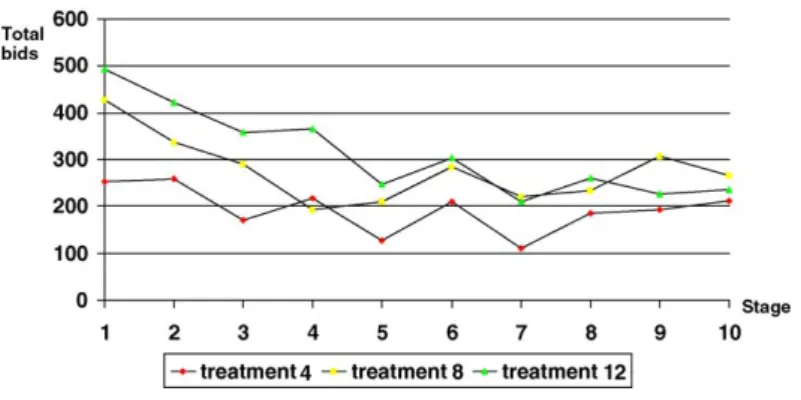
The most anecdotal evidence from the experiment is that Seller’s revenues repeatedly exceeded the prize (seeFig. 1) so the auctioneer revenues were more than the cost (we shall refer to this as the ‘over-bidding’ phenomenon).
This happened in almost all rounds of the game (141 out of a total of 150 rounds, in all treatments added up), and for all treatments.8Specifically, when there were 8 players or more the over-bidding occurred in all 100 rounds of the experiment but one. In the tenth and last round, seller’s revenue still averaged between twice and three times more than the prize value. It is quite interesting that similar ratios were observed by Davis and Reilly.9
The seller’s revenue in the first round of each treatment is monotonic increasing withN,the number of players, whereas this phenomenon disappears at the end of the experiment. Moreover, the seller’s revenue at the last round is quite similar for all three treatments and seems quite independent ofN.In fact, a pair-wise comparison between the treatments, using a non-parametric
8 These observations are in major conflict with the Nash equilibrium forecasts that predicts that the probability of over-bidding is approximately 0.5 (seeBaye et al., 1999).
Table 1
Pair-wise comparisons of seller’s revenue and average bids in the different treatments for the first and last rounds of play
4 vs. 8 4 vs. 12 8 vs. 12
Seller’s revenue (first round) z= 2.60*(p= 0.01) z= 1.78*(p= 0.08) z= 0.94 (p= 0.35) Bids (first round) z= 1.15 (p= 0.25) z= 1.98*(p= 0.05) z= 1.68*(p= 0.09) Seller’s revenue (last round) z= 1.36 (p= 0.17) z= 0.37 (p= 0.72) z= 0.31 (p= 0.75) Bids (last round) z= 0.73 (p= 0.46) z= 2.61*(p= 0.01) z= 2.61*(p= 0.01) The numbers in the cells are thez-statistics and thep-value of the Wilcoxon test. An asterisk indicates significant differences.
Fig. 2. Average bid.
Wilcoxon test, verifies that the differences in results of the last round seller’s revenue for the different treatments (such as different number of players) are insignificant; seeTable 1.10
4.2. Experience
Another phenomenon that appears in our results is that as players become more experienced (and perhaps even have a better understanding of the game), the seller’s revenue decreases. Although this is true for all treatments, it is more significant for the larger treatments (N= 8, 12). Note that forN= 4 the seller revenue decreases from 250, on average, in the first round to 205, on average, in the tenth round (a decrease of 20%). On the other hand, with N= 12, the revenue decreases from 490, on average, in round 1 to 240, on average, in round 10 (a decrease of 50%). A similar phenomenon was observed by Davis and Reilly.
4.3. Bids
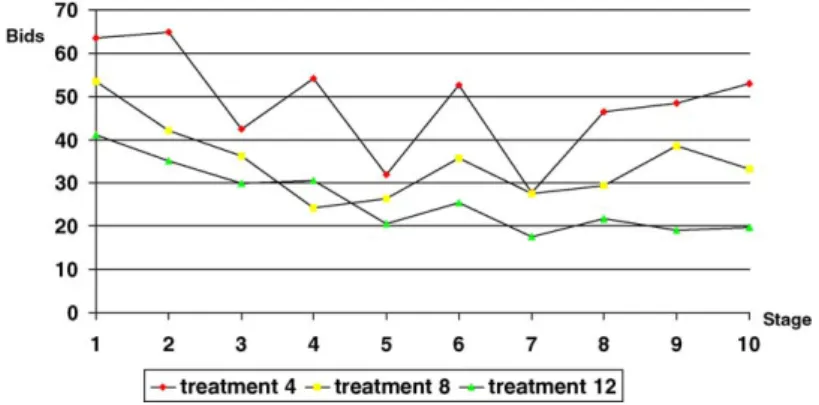
An intuitive assumption is that players’ bids will, on average, increase as the size of the popu-lation decreases. This is not true at the first stage, as our results show. However, this monotonicity does emerge at the last stages of the game (seeFig. 2). According to a Wilcoxon test there is
10The non-parametric Wilcoxon test, also known as a Mann–WhitneyU-test based on ranks, is used to investigate whether two samples (of gains) come from the same distribution. SeeSiegel (1956).
Fig. 3. Actual bids (c.d.f.).
Fig. 4. Winning probability of bid (N−1 power ofc.d.f.).
a significant difference between bids in the smaller treatments (N= 4, 8) and those of the larger treatment (N= 12). This can be seen inTable 1above.11
4.4. Bidding strategy
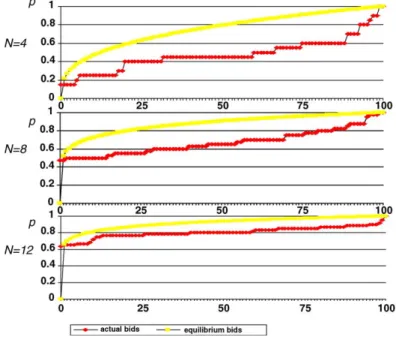
In order to understand the bidding behavior of players in a one-shot auction we focus on the results from the last round of play in each treatment, when no far-sighted considerations are relevant.Fig. 3depicts the cumulative distribution function of players’ bids in this round.
In Section5, we compare these results with some theoretical forecasts. FromFig. 3we can compute the winning probability of each bid for the various treatments. This is done by taking theN−1 power of the cumulative distribution at each bid (seeFig. 4).
Note the resemblance of the graphs inFig. 4for the various treatments. This result tells us that for a given arbitrary bid, the probability of winning is independent of the number of bidders in the auction.
4.5. Winning bid
The winning bid was, for most rounds, quite close to the value of the prize. In fact, in 129 of the 150 rounds of play, the winning bid was 90 or more. Moreover, in 33 out of 150 rounds, the winning bid was equal to 100, and in 8 rounds out of 150, the winning bid was strictly greater than 100. It is of interest to note that the average winning bid depicted inFig. 4, is quite similar for all 3 treatments. In fact the average winning bid, over all 10 rounds, was 91.2, 87.2, 95.3, for
N= 4, 8, 12, respectively.
4.6. Number of participants
The number of players who submit a non-zero bid (active participants) at the first round of each treatment is monotonic increasing withN.ForN= 4 there are 3.5 active participants on average, whereas forN= 12 there are more then 7. However, this monotonicity vanishes in later rounds of play. At the last round, for example, the average number of active participants is non-monotonic and is between 3.3 and 4.5 for all treatments.
4.7. Profiting players
Only 4 out of a total of 120 players left the experiment with a profit. Even then, profit was negligible (1, 5, 6.8 and 19 points after 10 rounds). Another 14 players made zero profit and 102 players incurred actual losses.
5. Theoretical forecasts
In this section, we compare the results of our experiment to two forecasts based on two different theories. First, we consider the standard fully rational approach and compare the results to the Nash equilibrium forecasts. Second, we consider the Logit equilibrium model, studied byAnderson et al. (1998), as a representative of the boundedly rational approach. As we demonstrate in the sequel both theories fail to describe our results completely, nevertheless both theories convey some intuition regarding the comparative statics we observe in the experiments.
In this section, we restrict attention to theories regarding behavior in the stage game. Con-sequently, the results of the experiment we focus on are those of the last (tenth) round in each experiment when no long run strategic considerations apply.
5.1. Nash equilibrium
Obviously, in order to study the Nash equilibria of a game, one must know the utility functions of players. In the absence of these we shall consider two possibilities, first, that all players are risk neutral, and second, that players are risk loving and have a logarithmic utility function.
5.1.1. Risk neutrality
The Nash equilibrium of the all-pay auction has been studied byBaye et al. (1996). We recall some of their results. The game in study has multiple equilibria. One property that is common to all of these equilibria is that the expected seller’s revenue is equal to the (common) value of the prize. This stands in complete contrast to the results of the experiment (seeFig. 1).
Fig. 5. Nash equilibrium bidding strategy (c.d.f.).
However, in terms of comparative statics, the (unique) symmetric Nash equilibrium of the game does have some predictive power. In such an equilibrium players’ strategies are fully mixing and are given by
F(b)=
b 100
1/N−1
for 0≤b≤100,
whereF(b) denotes thec.d.f.of the equilibrium strategy. This function is depicted inFig. 5for variousN. Note that asFis fully mixing, an occurrence of a tie has zero probability.
We compare these forecasts with the actual cumulative distribution of the players, at the tenth round, as depicted in theFig. 3.Fig. 6compares the Nash equilibrium strategies and the actual strategies for each treatment separately.
Table 2
Probabilities for near zero bids in experiment and in equilibrium
No. of players Experiment Equilibrium
N= 4 0.2 0.2
N= 8 0.5 0.5
N= 12 0.66 0.63
Table 3
Arrow–Pratt risk coefficients and implied certainty equivalents for the various treatments
No. of players A CE
N= 4 −8.5 93
N= 8 −7.3 92
N= 12 −31 97.9
This comparison shows that a number of the qualitative properties of the equilibrium do show up in the experiment. First, an increase in the number of players shifts thec.d.f. to the left. Namely thec.d.f. forNplayers first order stochastically dominates thec.d.f. forMplayers whenN<M.12 Second, the probabilities for giving ‘near-zero’ bids (bids which are, say, less than 5) are quite close to the equilibrium forecast. These probabilities, which can be inferred fromFig. 6, are also given in theTable 2,
5.1.2. Love of risk
One plausible explanation for the results of the experiment is that players view the all-pay auction as a gamble and, consequently, seek risk. In this case, one can compute the Arrow–Pratt coefficient of relative risk aversion. In order to do this we first need some assumptions on the form of the players’ utility function. Following the work ofMankiw and Zeldes (1991)13and others, we chose, for simplicity, to assume that this function takes on the isoelastic form
U(x)= x1−A
1−A,
where xis an amount of “points” and A denotes the Arrow–Pratt coefficient of relative risk aversion.14
From equilibrium analysis we know that when there areNplayers and the value of the prize is 100, each player should bid, in equilibrium,U(100)/Nutils, on average.
This gives us an equation from which the value ofAcan be derived.15These results are depicted inTable 3.
Do these values make sense? To answer this consider the following simple gamble: a player can take a gamble for which he receives 50 points with probability one half or 100 points with probability half. The certainty equivalent (CE) of this gamble for risk neutral players (i.e.,A= 0) is clearly 75, whereas it is higher for risk loving players. Using the Arrow–Pratt coefficients we
12We say that thec.d.f. F
1first order stochastically dominates thec.d.f. F2ifF1(b)≤F2(b) for anyb. 13See alsoWakker et al. (1997).
14Note that this implies that players have a constant relative risk aversion.
15The method we suggest for calibratingAis based on first moments. Mankiw and Zeldes use an approach based on first order conditions.
framework, their belief on opponents’ behavior), and second, the beliefs comply with the truth. The Logit equilibrium, on the other hand, only maintains the second assumption, namely compatibility of beliefs and truth. This solution concept assumes players are boundedly rational. Bid decisions are assumed to be determined by expected payoffs via a Logit probabilistic choice rule. Decisions with higher expected payoffs are more likely to be chosen, but are not chosen with certainty (as in a Nash equilibrium).
We can now compare our laboratory results with the predictions ofAnderson et al. (1998)for the case of symmetric equilibrium strategies with a common value. In this scenario, Anderson et al. provide a closed form solution for the logit equilibrium as follows. LetF(b) denote a player’s cumulative distribution function for his Logit equilibrium strategy, then
F(b)N−1= a VΓ(−1)
1−exp(−b/a) 1−exp(−B/a)Γ
V
a, 1 N−1
,N1−
1
,
whereVdenotes the common value,Bdenotes the maximal bid allowed,Γ andΓ(−1)denote the incomplete gamma function and its inverse, respectively, (i.e.,Γ(x, y)=f0xty−1exp(−t)dt), and 0 <a< 1 is an ‘error’ parameter.16
5.2.1. Over-bidding
As is clearly seen in our results players overbid. This phenomenon is, qualitatively, projected by the Logit equilibrium (see Proposition 6 in Anderson et al., who refer to this as ‘net rent’). The data from our experiment allows for a quantitative analysis. In our experiment, we witness that total revenues range from twice to five times the value of the prize. Thus, the net rent to the auctioneer ranges between 100 (at the last round with four players) and 400 (in first round with 12 players). Computing the seller’s revenues, according to the Logit equilibrium forecast, as a function of the noise factor,a, yields the following diagram:
We now compare actual overbidding (as presented inFig. 1) with the Logit prediction (Fig. 7). In the first period of the experiment, the overbidding as well as the difference between treatments is consistent with the Logit equilibrium with a relatively large noise factor (a> 0.3). In the earlier rounds the over-bidding is also monotone with the numbers of players, as predicted by the Logit equilibrium.
In the later round, we notice two phenomenons. First, the seller’s revenue decreases, which can be explained by a decrease of the noise factora. The decrease inais a plausible and appealing learning model for Logit players.
16 Note that as the value of the noise factor,a, converges to zero, the Logit equilibrium converges to the Nash equilibrium and players put mass 1 on their best reply. However asaconverges to 1, players reply randomly.
Fig. 7. Overbid in Logit equilibrium.
Fig. 8. Non-participation probability (probability of bids less or equal 5).
The second phenomenon undermines the Logit equilibrium model for the later stages of the game. In later rounds overbidding ceases to be monotone in the number of participants (seller’s revenue is marginally higher for theN= 8 than for theN= 12 in the last round).17 This can be intuitively explained in a model where some players actually best reply as they learn, while others keep choosing their replies according to the Logit function (we elaborate in the next section).
To summarize, the Logit equilibrium forecast has proven a suitable model to explain our results in the early round. However, in later rounds, after players become experienced, the Logit equilibrium model fails to project the results of our experiment.
6. A Descriptive model of behavior
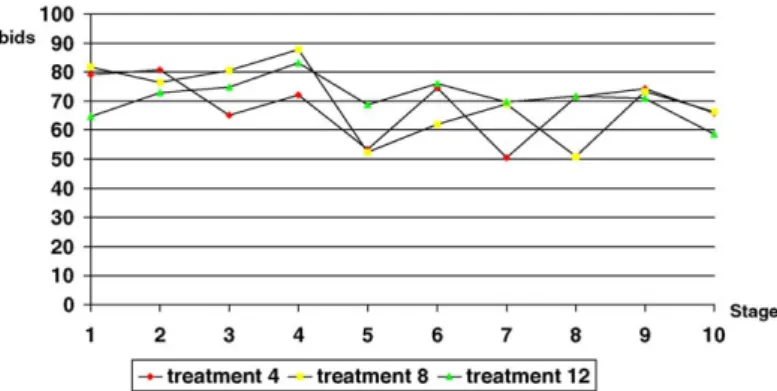
One model that can explain subjects’ bidding patterns in our experiment is a two-stage decision problem. Assume players in the auction decide on their bidding as follows, first, they decide whether to participate or not, and second, given a decision to participate they decide on the bid. To test such an hypothesis we look at the following two figures.Fig. 8demonstrates the probability
17In fact, Anderson et al. recommend, in their conclusion, to test their theory in laboratory experiments by studying whether over-dissipation increases with the number of players.
Fig. 9. Average participating bid (average over all bids greater than 5).
(percent) of non-participation for each round. As in Section4, non-participation refers to bids that are less than or equal to 5.18
InFig. 9, we compare the conditional bidding strategy of participating players. This comparison is done vis-`a-vis their expectations.19
We derive three conclusions fromFigs. 8 and 9:
• Players’ decision on whether to participate in an auction depends on the number of bidders in the auction. Moreover, probability of non-participation increases with the number of players. In fact, the number of participants, after the initial learning stage, becomes quite similar for all treatments. On average the number of participants is 3, 4 and 3.6 for N= 4, 8 and 12 correspondingly.
• The non-participation probability is quite steady forN= 4, whereas forN= 12 this probability increases from 0.35 in round one to 0.7 in round 5, where it settles. As forN= 8, results are not clear, and perhaps one can detect some learning from round one (where probability equals 0.35) to round three (after which the probability settles around 0.5).
• Players’ conditional strategies, after deciding on participation, is independent of the number of players. Moreover, these strategies do not change with time (i.e., no learning occurs). In other words, an explanation that is consistent with our findings is that in the early stages of the game, results are consistent with the Logit equilibrium prediction with a high noise factor (as described in the previous section) yet some sort of learning occurs as the game progresses. However, such learning is different across the various treatments. ForN= 12 most players learn to reply best by not bidding at all, which can be interpreted as a decrease of the noise factor to zero. ForN= 4 there is also a decrease in the noise factor, but not as drastic.
Why is learning different as the number of players,N, varies? One explanation is through reinforcement learning models (e.g.,Erev and Roth, 1998; Camerer and Ho, 1999) that predict that the speed of learning will be responsive to the cost of mistakes. In particular, such models
18 The results would be quite similar for any other cut-off point between zero and 10.
19 In order to make the exposition clear, we chose not to compare the conditional strategies vis-`a-vis the cumulative distributions but rather by expectations.
predict that the higher the costs, the faster the learning, which is exactly the case in our experiment asNincreases from 4 to 12.
Anderson et al. (2002)have recently proposed a variation of the Logit model that is sensitive to the asymmetric costs associated with deviations from the Nash equilibrium. Although their model studies cost asymmetry within games, we believe that a similar argument can be made for cost asymmetry between games.
In fact, such a two-stage explanation can account for both phenomena observed. On the one hand, over-dissipation is explained by the Logit reaction functions. On the other hand, as the number of participants is quite similar for the various treatments (after an initial learning stage), the amount of over-dissipation becomes constant.
7. Conclusion
The all-pay auction has been widely studied because it is often used as an allocation mechanism in competitions for a prize where players’ effort involves the expenditure of resources. Examples of such competitions are lobbying, research and development (R&D) competitions, monopoly licenses, franchises and others (e.g.,Hillman and Samet, 1987andHillman, 1988).
In laboratory experiments of complete information all-pay auctions, players tend to over-bid. In fact, even after 10 rounds of play, the seller’s revenue amounts to between 2 and 3 times the value of the prize. Furthermore, the seller’s revenue is almost independent of the number of players.
The observations reported here lack a complete theoretic foundation. The fully rational approach does not explain the over-bidding phenomenon or, alternatively, assumes quite implau-sible risk loving coefficients. The Logit equilibrium model, which assumes that players are boundedly rational, is suitable for explaining behavior in earlier rounds (assuming large noise factors) but does not account for the independence of the seller’s revenue with respect to the number of players in later rounds.
One potential ad hoc explanation of the results is that players make their decisions in two stages, first, they decide whether to participate in the auction depending on the number of participants and on past experience (i.e., on learning), and second, conditional on participating, players choose a bid independently of the number of participants and past experience (i.e., no learning).
Acknowledgements
We thank Mike Baye, Dan Levine, Lana Volokh and Stanislav (Sta) Rozenfeld and anonymous referees for their comments. Financial support of the Technion VP of Research fund and by the Joint Research Foundation of the University of Haifa and the Technion is gratefully acknowledged.
Appendix A. Introduction form
You are about to participate in an experiment in decision-making. At the beginning, we will explain to you the procedure of the experiment and then you will be asked to answer a questionnaire checking your understanding of the instructions. In the experiment, which is scheduled to take 30 min, you will be asked to make some decisions. During the experiment, you will be earning “points”. These points will be converted to NIS at the end of the experiment, at the rate of 20 points = 1 NIS. In other words 1000 points = 50 NIS. The exact amount you will earn depends on your decisions, as well as the decisions made by other participants. The money you earn will be paid to you at the end of the experiment, privately and in cash.
Any questions?
Appendix B. Instructions form
Each participant has a credit of 1000 points in the beginning. The experiment is composed of 10 rounds. At each round, we shall “sell” 100 points in an auction. At the beginning of each round, we shall ask each participant to write down his registration number as well as an amount of points on one of the notes you received. This amount is called a “bid” and will be deducted automatically from your credit.
The assistant will collect the notes of all participants, and will read aloud the registration number and bid of each participant. We will write these bids on the blackboard, and indicate which was the highest bid. The participant whose bid was the highest will “win” 100 points, and so he will add them to his credit. In case of tie, we shall split the 100 points equally between all the highest players. Note that even if you do not win, your bid is nevertheless deducted from your credit.
At the end of round 1, we will continue to round 2, when your credit at round 2 depends on the consequences of round one. Similarly for the following rounds.
Note: Please complete at the end of each round the form entitled “credit form”; your bid, the amount you win and your remaining credit. We also ask that your bid will never exceed your credit.
Appendix C. The quiz
Following are 6 multiple-choice questions designed to check your understanding of the instruc-tions. Please check only one answer for each question. Only students who will reply correctly to all questions are entitled to participate in the experiment.
1. Assume that in the first round your bid is 70 and you win: (a) You gain 30 in the first round
(b) You gain 70 in the first round (c) You gain 130 in the first round (d) You loose 30 in the first round
2. Assume that in the first round your bid is 20 and you do not win: (a) You loose 20 in the first round
(b) You gain 80 in the first round (c) You loose 120 in the first round (d) You loose 100 in the first round
3. Assume that in the first round your bid is 0 and you do not win: (a) You loose 100 in the first round
(b) You gain 100 in the first round (c) You neither gain nor loose (d) Bidding 0 is not allowed
4. Assume that in the first round your bid is 90 and you do not win: (a) Your credit at the end of round 1 is 1090
(b) Your credit at the end of round 1 is 1010 (c) Your credit at the end of round 1 is 990 (d) Your credit at the end of round 1 is 910
5. Assume that in the first round your bid is 90 and you do win: (a) Your credit at the end of round 1 is 1090
(b) Your credit at the end of round 1 is 1010 (c) Your credit at the end of round 1 is 990 (d) Your credit at the end of round 1 is 910
6. Assume that in the first round your bid is 0 and you do not win: (a) Your credit at the end of round 1 is 1100
(b) Your credit at the end of round 1 is 1000 (c) Your credit at the end of round 1 is 900 (d) None of the above
Appendix D. Experiment results
Plug in Word document of all results of experiment.
4/1 Round #
1 2 3 4 5 6 7 8 9 10
1 4 4 0 0 0 0 0 0 0 32
2 100 0 0 20 22 99.9 30 30 35 60
3 99.7 100.2 1.5 0 99.1 5 99.995 1 55.5 6
4 30 100 10 20 0 10 15 0 2 20
Total 233.7 204.2 11.5 40 121.1 114.9 145 31 92.5 118
Average 58.4 51.1 2.9 10 30.3 28.7 36.2 7.8 23.1 29.5
4/2 Round #
1 2 3 4 5 6 7 8 9 10
1 80 60 60 50 40 30 0 0 20 20
2 0 99 90 95 0 90 0 95 95 96
3 20 60 60 95 0 0 0 0 40 0
4 50 90 90 95 0 50 90 80 0 0
Total 150 309 300 335 40 170 90 175 155 116
4/4 Round #
1 2 3 4 5 6 7 8 9 10
1 0 25 0 35 0 5 0 75 0 5
2 93 99 100 0 0 33 0 90 97 99
3 74 99 100 100 105 90 22 85 93 18
4 97 85 0 101 80 85 47 70 0 99
Total 264 308 200 236 185 213 69 320 190 221
Average 66 77 50 59 46.3 53.3 17.3 80 47.5 55.3
4/5 Round #
1 2 3 4 5 6 7 8 9 10
1 100 95 100 101 50 99 0 28 90 93
2 100 100 100 105 66 90 100 60 94 97
3 80 0 7 7 7 80 15 80 86 89
4 55 28 0 0 8 0 35 40 0 75
Total 335 223 207 213 131 269 150 208 270 354
Average 83.8 55.8 51.8 53.3 32.8 67.3 37.5 52 67.5 88.5
8/1 Round #
1 2 3 4 5 6 7 8 9 10
1 0 15 25 0 46 0 0 0 0 15
2 36 97 99.9 0 0 95 0 10 22 70
3 93 0 0 0 0 0 0 15 0 0
4 99 99.5 54 60 0 80 55 0 71 95
5 0 0 0 0 77 40 57 101 80 0
6 5 3 0 0 0 0 0 0 0 0
7 52 66 0 100 30 100 35 100 95 85
8 97 0 95 0 0 59 0 65 0 29
Total 382 280.5 273.9 160 153 374 147 291 268 294
Appendix D (Continued)
8/2 Round #
1 2 3 4 5 6 7 8 9 10
1 0 0 0 0 0 0 0 0 0 95
2 0 0 0 0 0 0 0 0 0 0
3 33 0 0 0 32 0 0 15 0 0
4 45 101 101 25 56 98 90 71 99 89
5 99 85 99 0 94 84 100 0 0 0
6 100 97 90 0 85 30 100 96 99 0
7 70 0 95 0 17 50 0 65 55 70
8 0 0 0 0 0 0 0 0 0 0
Total 347 283 385 25 284 262 290 247 253 254
Average 43.4 35.4 48.1 3.1 35.5 32.8 36.3 30.9 31.7 31.8
8/3 Round #
1 2 3 4 5 6 7 8 9 10
1 0 0 0 0 99.1 0 95 0 99.1 0
2 90 50 1 99 90 83 0 0 51 2
3 93 0 0 0 0 0 87 0 0 40
4 90 95 100 99 99 39 2 37 80 90
5 99.9 99 0 0 0 20 0 25 90 57
6 0 0 0 0 0 0 0 40 0 0
7 99 99.9 99 0 0 0 0 25 90.9 46
8 0 0 0 0 23 0 0 77 0 0
Total 471.9 343.9 200 198 311.1 142 184 204 411 235
Average 59 43 25 24.8 38.9 17.8 23 25.5 51.4 29.4
8/4 Round #
1 2 3 4 5 6 7 8 9 10
1 100 60 0 100 43 47 0 29 99 76
2 99 95 0 0 37 65 61 7 67 17
3 0 18 53 91 0 56 66 69 93 0
4 5 76 90 0 5 11 23 33 0 95
5 45 0 57 0 0 0 0 0 0 0
6 0 0 0 0 0 81 0 0 0 0
7 99 25 0 0 25 25 25 25 25 27
8 99 99 99 99 35 45 55 55 55 55
Total 447 373 299 290 145 330 230 218 339 270
8 95 100 0 0 53 0 0 0 38 0
Total 489 403 292 293 161 319 253 214 270 275
Average 61.1 50.4 36.5 36.6 20.1 39.9 31.6 26.8 33.8 34.4
12/1 Round #
1 2 3 4 5 6 7 8 9 10
1 90 30 50 0 100 60 0 60 0 10
2 17 0 0 0 0 0 0 0 0 0
3 30 30 35 60 60 0 2 5 5 5
4 100 90 0 50 60 1 90 20 30 59
5 51 18 0 0 0 99 0 3 0 0
6 99 0 0 0 0.1 0 0 0 0 0
7 0 0 0 0 0 0 0 0 0 0
8 91 0 0 0 0 0 0 0 0 9
9 99 0 0 0 0 0 0 0 0 0
10 95 0 98 99 0 90 1 95 99.5 99.8
11 0 0 0 0 0 0 0 0 0 0
12 0 0 0 99.5 0 99.1 0 99 99 99.6
Total 672 168 183 308.5 220.1 349.1 93 282 233.5 282.4
Average 56 14 15.3 25.7 18.3 29.1 7.8 23.5 19.5 23.6
12/2 Round #
1 2 3 4 5 6 7 8 9 10
1 69 100 0 101 0 98 89 95 0 99
2 0 0 0 0 0 0 0 0 0 0
3 0 0 0 0 0 0 0 0 0 0
4 29 0 0 0 0 0 0 0 0 0
5 7 0 55 0 0 32 0 0 17 0
6 17 17 17 101 0 99 99 90 98 98
7 0 0 0 0 0 0 0 0 0 0
8 0 99 0 0 25 0 0 30 70 80
9 99 100 100 100 25 91 0 0 0 0
10 95 99 27 0 0 0 18 0 0 26
11 0 0 0 0 0 0 0 0 0 0
12 11 19 11 21 31 90 80 11 35 11
Total 327 434 210 323 81 410 286 226 220 314
Appendix D (Continued) 12/3 Round #
1 2 3 4 5 6 7 8 9 10
1 90 90 0 0 0 0 0 0 0 0
2 50 0 78 90 0 0 0 0 0 0
3 0 0 0 100 100 0 10 0 0 0
4 99 0 0 99 10 0 0 101 0 1
5 0 0 0 0 0 0 0 0 0 0
6 0 80 90 90 91 90 90 0 0 0
7 60 60 0 100 100 100 100 100 100 100
8 0 0 0 0 0 0 0 0 0 0
9 0 55 80 0 0 0 0 0 105 10
10 0 100 0 99 0 0 0 0 0 0
11 0 99 0 0 0 0 0 0 0 0
12 92 0 0 0 0 0 0 0 0 0
Total 391 484 248 578 301 190 200 201 205 111
Average 32.6 40.3 20.7 48.2 25.1 15.8 16.7 16.8 17.1 9.3
12/4 Round #
1 2 3 4 5 6 7 8 9 10
1 0 0 0 0 0 0 0 0 0 0
2 17 91 101 36 0 0 0 5 10 11
3 23 0 0 0 0 0 101 87 0 0
4 99 79 0 0 0 0 0 0 0 0
5 90 100 91 71 15 15 0 85 0 88
6 77 93 0 0 0 27 0 0 95 67
7 16 26 36 46 86 96 100 53 100 40
8 5 0 0 0 0 99 0 0 0 0
9 77 77 77 77 77 0 89 0 0 95
10 0 0 0 0 0 0 0 0 0 0
11 87 0 100 95 60 95 0 65 0 0
12 0 0 0 0 0 0 0 0 0 0
Total 491 466 405 325 238 332 290 295 205 301
Average 41 38.9 33.8 27.1 19.8 27.7 24.2 24.6 17.1 25.1
12/5 Round #
1 2 3 4 5 6 7 8 9 10
1 0 92 95 0 0 100 0 0 0 0
2 90 0 99 0 0 0 1 91 0 99
3 86 93 95 99 99 31 35 47 0 13
4 75 60 97 0 100 100 40 60 80 60
5 10 90 90 0 0 0 70 0 90 0
6 53 91 0 0 0 0 0 0 0 0
7 40 0 0 98 0 0 0 0 0 0
8 0 0 0 0 0 0 0 99 0 0
References
Anderson, S.P., Goeree, J.K., Holt, C.A., 1998. Rent seeking with bounded rationality: an analysis of the all-pay uction. Journal of Political Economy 106, 828–853.
Anderson, S.P., Goeree, J.K., Holt, C.A., 2002. The Logit equilibrium: a perspective on intuitive behavioral anomalies. Southern Economic Journal 69, 21–47.
Baye, M.R., Kovenock, D., de Vries, C.G., 1996. The all-pay auction with complete information. Economic Theory 8, 291–305.
Baye, M.R., Kovenock, D., de Vries, C.G., 1999. The incidence of over dissipation in rent seeking contests. Public Choice 99, 439–454.
Camerer, C., Ho, T.H., 1999. Experience-weighted attraction learning in normal form games. Econometrica 67, 827–874. Davis, D., Reilly, R.J., 1998. Do too many cooks always spoil the stew? An experimental analysis of rent-seeking and the
role of a strategic buyer. Public Choice, 89–115.
Ellingsen, T., 1991. Strategic buyers and the social cost of monopoly. American Economic Review 81, 648–657. Erev, I., Roth, A.E., 1998. Predicting how people play games: reinforcement learning in experimental games with unique,
mixed strategy equilibria. American Economic Review 88, 848–881.
Hillman, A.L., 1988. The Political Economy of Protectionism. Har-wood, New York.
Hillman, A.L., Samet, D., 1987. Dissipation of contestable rents by small numbers of contenders. Public Choice 54 (1), 63–82.
Kagel, J.H., 1995. Auctions: a survey of experimental research. In: Kagel, J.H., Roth, A.E. (Eds.), The Handbook of Experimental Economics. Princeton University Press, Princeton, N.J, pp. 501–585.
Krueger, A.O., 1974. The Political economy of the rent seeking society. American Economic Review 64, 291–303. Lopez, G., 1995. “Quantal Response Equilibria for Models of price Competition.” Ph.D. dissertation, University of
Virginia.
Mankiw, N.G., Zeldes, S.P., 1991. The consumption of stockholders and nonstockholders. Journal of Financial Economics 29, 97–112.
McKelvey, R.D., Palfrey, T.R., 1996. A statistical theory of equilibrium games. Japanese Economic Review 47, 186–209. Millner, E.L., Pratt, M.D., 1989. Risk aversion and rent-seeking: an extension and some experimental evidence. Public
Choice 69, 81–92.
Siegel, S., 1956. Nonparametric Statistics for the Behavioral Sciences. McGraw-Hill Book Company.
Shogren, J.F., Baik, K.H., 1991. Reexamining efficient rent-seeking in laboratory markets. Public Choice 69, 69–79. Tullock, G., 1980. Efficient rent seeking. In: Buchanan, J.M., Tollison, R.D., Tullock, G. (Eds.), Toward a Theory of the
Rent Seeking Society. College Station: Texas A&M University Press, pp. 97–112.