Open access publishing
Developing an Effective
Market for Open Access
Article Processing Charges
Bo-Christer Björk and David Solomon
March 2014
Developing an Effective Market for
Open Access Article Processing Charges
Final Report to a consortium of research funders comprising Jisc, Research Libraries UK, Research Councils UK, the Wellcome Trust, the Austrian Science Fund, the Luxembourg National Research Fund and the Max Planck Institute for Gravitational Physics
Acknowledgements
We are pleased to submit this final report for the study titled “Developing an Effective Market for Open Access Article Processing Charges” and appreciate the opportunity to address this
challenging and important task. The study was commissioned by a consortium of funding agencies comprising Jisc, Research Libraries UK, Research Councils UK, the Wellcome Trust, the Austrian Science Fund (FWF), the Luxembourg National Research Fund (FNR) and the Max Planck Institute for Gravitational Physics. We would like to thank the members of the Steering Group for their thoughtful feedback throughout the project.
Funding group representatives:
David Carr – Wellcome Trust
Geraldine Clement-Stoneham – MRC (representing Research Councils UK) Olga de Brito – Fonds National de la Recherche Luxembourg (FNR)
Neil Jacobs – Jisc
Robert Kiley – Wellcome Trust
Falk Reckling – Austrian Science Fund (FWF)
Bernard Schutz – Max Planck Institute of Gravitational Physics
Phil Sykes – University of Liverpool (representing Research Libraries UK)
Invited experts:
Stephen Curry – Imperial College London Salvatore Mele – CERN
The purpose of this report is to stimulate discussion and debate. It is important to emphasize that there is no implication that either the individual members of the Steering Group, or the
organizations they represent, endorse or support all of the models proposed.
We would especially like to thank David Carr and Robert Kiley for their attention and support in guiding this project. We also thank the 13 interviewed professionals who shared their expertise and experiences with us. Their perspective has been extremely valuable in developing this report. In Espoo, Finland and Haslett, Michigan, USA
Bo-Christer Björk, Dr. Tech. David J Solomon, PhD
Professor Professor
Hanken School of Economics Michigan State University
Helsinki, Finland E Lansing, MI USA
Contents
Executive summary ... 3
1
Introduction ... 7
1.1
Objectives ... 7
1.2
Methodology ... 7
1.3
Use of the findings ... 8
2
Literature review ... 9
2.1
Scientific publishing from a business perspective ... 9
2.2
The level of APCs ... 11
2.3
Transition scenarios ... 12
2.4
The “double dipping” issue ... 12
2.5
Mechanisms for funding and paying APCs ... 13
2.6
Discussion ... 16
3
Current status of the APC market ... 18
3.1
Full OA journals ... 18
3.1.1
Growth in APC charges for established OA journals ... 18
3.1.2
Creation of new OA journals by the leading subscription publishers ... 19
3.1.3
Mega journals ... 21
3.1.4
Low quality journals from “predatory” OA publishers ... 22
3.2
Hybrid OA journals ... 23
3.3
Summary ... 25
4.
Potential policy options for funding agencies ... 27
4.1
The scenarios ... 27
4.1.1
Hybrid journal scenarios ... 28
4.1.2
Full OA journal scenarios ... 29
4.2
Proposed minimum quality standards for eligibility for funding ... 30
4.3
Analysis of combined scenarios ... 31
4.3.1
Scenario A: APCs are refunded at list prices, with mechanisms at the local level for hybrid articles to ensure savings in subscription costs for a specific institution [H4 and F1] ... 31
4.3.2
Scenario B: APCs are funded according to multi-tier, value based price caps [H6 and F3] ... 33
4.3.3
Scenario C: The funders cover a fixed percentage of the APCs above a maximum value whilst universities (or the authors) cover the remaining portion through other sources [H5 and F2] ... 37
5.
Conclusions ... 39
Appendixes ... 41
Appendix A: Glossary of terms ... 42
Appendix B: List of interviews ... 45
Appendix C: Scenarios for hybrid and full OA APC payments ... 47
Appendix D: Description of data sets ... 60
Appendix E: Methodology for the study of the current APC market ... 61
Appendix F: Current and proposed mega journals ... 62
Appendix G: Effects of scenarios A and B on the APC expenditure of Wellcome Trust ... 63
Executive summary
This report was commissioned by a consortium of European research funding organizations led by the Wellcome Trust. The study was undertaken to stimulate thinking among research funders who have set up, or are considering setting up, mechanisms for direct “earmarked” funding of article processing charges (APCs) in open access (OA) journals.
The report covers both full OA journals (referred to in the report as “full OA”, such as those published by Biomed Central and PLOS) and subscription journals which offer authors the possibility of making their individual articles OA by paying an APC. This latter category is known as “hybrid OA”.
There are many full OA journals that are funded by means other than APCs and the term “gold OA” also includes these journals. When they are included in the discussion this will be make clear, the focus of the report is however on the segment of gold OA funded by APCs.
Current status of the APC market
The APC OA market is evolving rapidly and growing at about 30% a year.1 The overall APC
revenue was estimated to be approximately 182 million USD in 2012 and growing at about 34% a year, though the rate of growth is expected to tail off to about 20% over the next 5 years.2
Among the established OA publishers with journals listed in Scopus, the average APC grew by about 5% a year over the last two years. This increase was, however, attributed to a relatively small proportion of journals: the price of most journals remained unchanged. The current APC
averaged about 1,418 USD. This estimate is higher than many others (including our earlier work3)
because in this study we focused on established journals (at least two years old) that were indexed in Scopus.
Mega journals are the fastest growing segment of the OA market.4 While pricing varies, the more
successful mega journals generally have followed PLOS ONE’s lead with APCs in the range of 1,350 USD.
Subscription publishers have in the last couple of years rapidly expanded the number of journals that offer the hybrid option, though uptake of this option continues to remain low. Some subscription publishers are moving away from a standard APC pricing of around 3,000 USD in order to make their hybrid offerings more competitive. Overall though, the average APC for publication in hybrid journals is 2,727 USD.5
The traditional subscription publishers are also entering the OA journal market, by creating their own full OA journals (e.g. Chemistry Open, from Wiley); by acquiring existing full OA publishers (e.g. NPG acquired Frontiers); and, in some cases, flipping subscription journals to OA (e.g. Stem Cell Research, published by Elsevier). As of August 2013 the average APC, levied by the five major subscription publishers studied, who offer a full OA journal publishing option, is 2,097 USD (i.e. on average 679 USD higher than the APC levied by “born digital” OA publishers, such as BMC and
1 Extrapolation from data in Laakso M, Björk B-C. Anatomy of open access publishing: a study of
longitudinal development and internal structure. BMC Medicine 2012, 10:124 doi:10.1186/1741-7015-10-124.
2 Outsell: Open Access: Market Size, Share, Forecast, and Trends, Report, 2013.
3 Solomon DJ, Björk B-C. (2012) A Study of Open Access Journals Using Article Processing Charges. Journal
of the American Society for Information Science and Technology 63(8):1485–1495.
4 For example see http://tinyurl.com/ozcwvvg
PLOS). At the same time, many subscription publishers have also started to limit author self-archiving, for instance by lengthening embargo periods.
Type Average APC
Full OA journal – published by “non-subscription” publishers 1,418 USD Full OA journal – published by “subscription” publishers 2,097 USD Hybrid journal – published by “subscription” publishers 2,727 USD
Proposed scenarios for funder APC policies
The primary goal of the project was to study how research funders, via their own policy choices, could encourage the development of a transparent, competitive and reasonably priced APC funded OA market. One of the key questions therefore, was how to create mechanisms where funders (and indirectly authors in some scenarios) have to factor in the APC price level against the service provided by the journal in question, thus putting competitive pressure on publishers to lower price.
Thus far, we believe that for full OA journals, author sensitivity to the levels of APCs has been working effectively in creating pressure to moderate the price of APCs. The fact that APCs
correlate significantly with journal impact factors is also an indication that not only price but also perceived quality matters.
In contrast, hybrid OA articles are significantly more expensive than their full OA counterparts and the price level is an important factor in inhibiting uptake of the hybrid option. Other factors influencing hybrid uptake include how permissive publishers are for self-archiving in the journals in question; whether publisher or institutional OA mandates push authors into using the hybrid option; and whether the author has access to earmarked funding for paying the hybrid charges.
Developing mechanisms by which funders can help to make the hybrid OA market less dysfunctional is a key aspect of this study.
The hybrid OA market is fundamentally different from the full OA market in a number of important ways. One key difference is the risk of publishers charging twice for the same articles (often referred to as “double dipping”). Subscription publishers collect hybrid fees for making articles OA at little additional cost to the publisher, without adjusting their licence fees for the corresponding decrease in subscription only content. This dilemma can be addressed globally or locally. Subscriptions can be lowered to all institutions (globally) reflecting hybrid earnings, or locally rebating the cost of hybrid APCs in, for example, lower subscription costs to the institution that paid the APCs.
The local approach addresses the problem where research-intensive institutions face a substantial rise in their total cost of journal access with the combination of subscriptions and APC payments. Several interviews conducted during the study showed the difficulties in getting agreements with publishers on these issues and the concern of librarians (faced with limited budgets and the potential of a significant rise in costs to their university) of covering APCs without a concurrent drop in subscription fees.
We initially considered four full OA scenario and eight scenarios for hybrid journals. Several scenarios overlap. These are all idealized cases. In practice, elements from different scenarios could be combined to create individualized funder policies.
Based on our analysis we selected three combined (full OA and hybrid) scenarios that we believe are the most likely to be beneficial for achieving a reasonably priced, transparent and competitive market for APC-funded OA publishing. These are summarized below.
Scenario A: APCs are refunded at list prices, with mechanisms at the local level for hybrid articles to ensure savings in subscription costs for a specific institution.
The full OA APC market is relatively moderately priced at less than 1,500 USD and there are clear signs that in many cases authors consider the price of an APC in choosing where to publish. At this point it seems acceptable to continue to pay list prices for APCs of full OA journals. Given the APC market is changing rapidly, and there is a risk of further price inflation, this option, however, would need to be re-evaluated at regular intervals.
In the case of hybrid articles this scenario would be appropriate providedthat mechanisms are put in place to ensure on the local level that “double dipping” does not occur. That is, institutions paying hybrid APCs must be reimbursed through rebates on subscriptions paid to that publisher to limit the increased costs of paying APCs along with subscriptions.
Only journals which put in place mechanisms to lower subscription costs at the local level should be eligible to receive APC funding at the prices the publishers ask (either individual list prices or discounted prices in bundled deals).
In the case of hybrid OA this scenario would be most appropriate for research-intensive
institutions. It is also important to note that the adoption of this scenario is more problematic for research funders who pay APCs, but are not also responsible for paying subscriptions.
Scenario B: APCs are funded according to multi-tier, value-based price caps.
In this model, a maximum APC-price cap a funder is prepared to pay is set for each journal, based on some measure of its relative ‘value’.
Citation rates provide one generally-available metric which could be used as a proxy for value. We recognize, however, that there would be significant concerns over the notion of basing tiered caps solely on citation related journal-level indicators, especially given the current emphasis by funders on moving away from using impact factors. As such, we recommend that any system to measure value would need in reality to be based on quality of service (taking into account factors such as publication times, streamlined peer review service, repository deposit and so forth).
As metrics for these aspects of quality are not yet in place, for modeling purposes only, we have used a three-tier system of caps with maximum payments of 1,000, 2,000 and 3,000 USD and used SNIP values as an approximation of quality6.
The rationale for the model is that APCs would be tied to some aspects of the value provided by the journal, thus creating a level of transparency in cost and to limit funder payments for journals that provide relatively little value compared to their cost. It would also encourage authors to consider cost in their choice of a journal to publish.
In the case of full OA, our modeling suggests that the existing competitive market is currently achieving this goal and that the vast majority of journals are currently priced below the price caps corresponding to their SNIP-based quality level that we used for this study. For the hybrid market the majority of journals are currently priced above the price caps we used and hence this choice of funding scheme would put pressure on publishers to reconsider and differentiate their pricing.
6 Source Normalized Impact per Paper (SNIP) is a statistical weighting procedure designed to control for
Scenario C: The funders cover a fixed percentage of the APCs above a maximum value whilst universities (or the authors) cover the remaining portion through other sources.
By having the institution or researcher bear part of the cost of the APC, there would be an
incentive for authors to consider the price of an APC as one of the factors in choosing a journal to publish.
The goal here would be to provide an incentive for keeping the APC market, both full OA and hybrid, competitive and reasonably priced. We suggest the fixed percentage would only be applied to APC costs above a certain maximum (for example 1,500 USD). This would minimize the
administrative overhead and the burden on authors of applying this scenario.
Conclusions
It should be noted that these scenarios could be combined in different ways by funding agencies and in all cases authors (or their institutions) could choose to pay the difference between what a funder is willing to pay under the scenario and the list price of the APC of the journal they wish to publish in.
It was clear to us that there is no single best scenario. Different funding agencies and universities interested in funding APC have different needs and goals. We see these proposed scenarios as a starting point for further discussion and development and it is likely that a combination of strategies will be needed to promote a competitive reasonably priced market for APC funded scholarly publishing.
1
Introduction
1.1
Objectives
The primary aims of this report are:
1. To review the current market for Article Processing Charge (APC) funded open access, analyze emerging trends in the UK and internationally, and identify the key current and future drivers that will serve to determine costs.
2. To identify and appraise policy options for funders and other stakeholders, through which they can help ensure a competitive and transparent market for scholarly journal APCs that supports the continued development of innovative new approaches.
As noted in the request for proposals for this research, a mixed economy of fully Open Access (OA) journals, hybrid articles in subscription journals and green (self-archiving) is likely to exist for quite some time. OA journals, funded through APCs (what we shall term “full OA7”), are
becoming an increasingly important segment of this economy, growing at about 30% per year.8
A number of funding agencies as well as universities and other organizations, both public and private, have made a policy decision to support the costs of publication in APC funded full OA journals and, potentially, in hybrid OA journals as a central channel for disseminating the research they fund. Funders are rightly concerned that the funding they provide for this purpose is well spent and that the APC funded OA market is transparent, competitive and reasonably priced. In a rapidly evolving market with a significant influx of funding, this is a very challenging problem.
The goal of this report is to assess the strengths, weaknesses, opportunities and threats of various approaches or scenarios funding agencies may employ to help achieve a well-functioning market for APC funded OA publication, both full OA journals and hybrid articles. It is important to note that in addition to APC funded full OA journals, gold OA encompasses traditional subscription journals which make their electronic versions free of charge as well as electronic only journals which are free to the authors and fund their operations via subsidies, use of open source IT platforms and voluntary work. Such alternative publishing models are more common in the social sciences and humanities and in particular regions like Latin America. Funding agencies could also play a role in supporting such journals but this was not within the scope of this study.
1.2
Methodology
We employed three strategies to assess the state of the market for APC-funded OA: a
comprehensive literature review, consultations with experts, and a series of small focused studies of the current OA market.
The literature review analyzed peer-reviewed journal articles, news stories, government reports, blogs and other material. We identified key material from our experience in researching the development of the OA market, suggestions from the Steering Group members and interviewees, literature searches and references from the literature reviewed.
7 In general, the term “full OA” will in this report refer to journals funded by APCs, although such journals
are a subset of all full OA journals.
8 Laakso M, Björk B-C. Anatomy of open access publishing: a study of longitudinal development and
We interviewed 13 experts with a range of perspectives. A full list of the interviewees is appended at Appendix B. In some cases multiple experts were interviewed jointly and some interviewees were interviewed multiple times. Most of the interviews lasted about one hour, a few were in person but most were via phone. The interviews were used to gain background information, to explore the perspectives of different stakeholders in academic publishing and to obtain feedback on the proposed scenarios once they were developed. Since many of the interviews were fairly informal and a few address confidential material, we have chosen not to summarize them
individually. The information gained from these interviews was extremely helpful and has shaped many aspects of this report.
The APC funded scholarly publishing market is evolving very quickly and even the most recent published reports are somewhat out of date. For this reason we conducted a series of small studies, most of which were based on retrieving systematic data from publisher web sites. We also used publicly available data from the Scopus citation database on citation rates and to determine the discipline of specific journals. Peter Binfield generously provided us with extensive and up-to-date information on the growth of “mega journals” and Robert Kiley provided us with
information on the journals in which grantees from the Wellcome Trust published in 2012. We also used data from an extensive study of APC charges we conducted earlier as baseline data to determine the growth of full OA journals and the increase in their APC charges over a recent two year period.
Based on what we learned from the review of the current state of OA scholarly publishing and the interviews, we developed eight potential strategies or scenarios for hybrid articles and four for full OA journals. Funding hybrid OA poses somewhat different and more complex challenges than full OA journals hence the need to consider additional scenarios. We evaluated the scenarios on 10 criteria based on the literature, our research, feedback from the experts we interviewed and where no other information was available, we used our judgement.
Based on this review we chose three combinations of full OA and hybrid scenarios as the ones we felt most promising for funding agencies in addressing the goals of this project. We analyzed these in more detail using a SWOT format. We modeled two of these scenarios over a five year period using the 2012 publication data from Wellcome Trust researchers as a baseline. We felt these data provided a good model for researchers funded by other major biomedical funding agencies. We were unable to locate good data for modeling the impact of these scenarios in other disciplines.
1.3
Use of the findings
This report is intended for research funding organizations and policy makers. It should also be of interest to university administrators who are considering providing internal funding to support OA, as well as university librarians. It may also be of interest to publishers and individual academics interested in the OA phenomenon.
This report attempts to provide a clearer picture of the current state of the OA market and trends in full OA and hybrid journals as well as the state of publisher policies for author self-archiving. It also provides a set of proposed strategies or scenarios as a starting point for discussion on how funding agencies might influence the APC market to encourage transparency and competition. It is also clear that successfully implementing an APC funding model requires stakeholders to address a much broader set of issues – such as developing effective payment and tracking systems and determining what the minimum requirements are that publishers must meet in order to qualify for receiving payments. We hope what follows can be a useful in furthering the discussion of these very complex issues.
2
Literature review
2.1
Scientific publishing from a business perspective
Many sources have argued that scientific journal publishing based on the subscription revenue model is a dysfunctional market. In particular two articles by Stuart Shieber9 make a clear analysis
of the situation in microeconomic terms.
Shieber discusses the market for subscription access to scholarly journals. He notes that different journals in economic terms are complements rather than substitutes and hence do not compete. Second, he notes that providing journal access is a monopolistic good, meaning that leading publishers, who control large numbers of important journals, have been able to extract monopolistic rents for these journals. The very high profit levels of the leading commercial
publishers provide tangible evidence of this fact.10 This situation has been further cemented by the
bundling of journals made possible by electronic site licences, in which the price is controlled at the bundle level through individual contracts or “big deals” tailor-made for each subscribing institution. In summary, Shieber describes this market as highly dysfunctional due to the lack of competition, and one in which smaller society publishers in particular are disadvantaged
compared to the major commercial ones.
Shieber characterizes the market of providing open-access dissemination services to authors as one where different journals are substitutes for each other, in contrast to the subscription market where they are complements. In the OA market, an author can usually choose between publishing in a handful of relevant journals, which are clear alternatives to each other. This provides a much more competitive situation. Combined with much lower barriers of entry for new innovative publishers, this model has led to a situation where market equilibrium between supply and demand seems to have been reached at an average price level of around 1,500 USD per article for higher quality full OA journal APCs.11 This compares to a revenue level of around 5,000 USD per
published article in the subscription market.12
Also Jacobs13 discusses a set of attributes for achieving a well-functioning competitive market, and
applies these to APC funded OA. He in particular mentions low barriers to market entry and exit, including low transaction costs as well as price signals that are relevant to producers and
consumers.
Estimates of the growth of full OA in recent empirical studies14,15 are in line with each other and
show a continuous growth over the past decade of over 20% per year. Eleven percent of all articles
9 Shieber SM (2009) Equity for Open-Access Journal Publishing. PLoS Biol 7(8): e1000165.
doi:10.1371/journal.pbio.1000165 and Shieber, Stuart (2013). Why open access is better for scholarly societies, The Occasional Pamphlet on scholarly communication, January 29th, 2013,
http://blogs.law.harvard.edu/pamphlet/2013/01/29/why-open-access-is-better-for-scholarly-societies/
10 For example in 2011 the operating profit margins of the three leading STM publishers Informa, Elsevier
and Wiley ranged between 35.9 % and 42.5 %. Informal communication from a business analyst.
11 Based on a market analysis presented later in this report.
12 Odlyzko A. Open Access, library and publisher competition, and the evolution of general commerce.
arXiv:1302.1105v1.
13 Jacobs N, Gold OA: attributes of a well-functioning market, 01.04.2013, unpublished position paper.
14 Laakso M, Björk B-C, 2012. Anatomy of open access publishing - a study of longitudinal development and
internal structure, BMC Medicine, 10:124, doi: 10.1186/1741-7015-10-124.
15 Science-Metrix, 2013. Proportion of Open Access Peer-Reviewed Papers at the European and World
indexed by Scopus were published in full OA journals (APC funded and others).16 Delayed OA
journals add another 5% as well as perhaps 1% in hybrid journals. Extrapolating these data to 2014, we can estimate a share of almost 15% for gold OA, which would increase to around 20% if delayed OA journals were to be added.
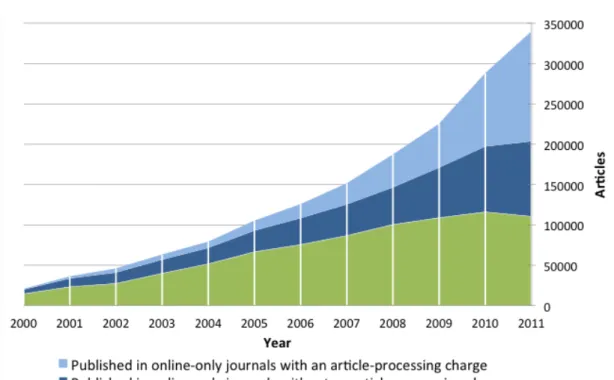
The following graph from Laakso and Björk 2012 (Figure 1) shows the growth and internal distribution of gold OA articles in three major categories over the years. Based on current trends, we would expect the number of OA articles published in 2013 to have grown to around 500,000.
Figure 1: The development of gold OA articles 2000-2011
A key feature of the growth is that the APC-funded revenue model has increased its share of OA publications, from around 10% in 2003 to 50% OA in 2013.17
A recent report on the OA market by Outsell18 strives to give a comprehensive overview of the
APC funded OA market, from a business-oriented view of the total revenue for publishers. It makes an interesting split of the market into traditional APC journals, mega journals, hybrid OA and institutional memberships, with traditional OA journals and mega journals dominating in terms of revenue. The estimated overall OA revenue was 81 million GBP for 2011 and 113 million GBP for 2012. Outsell calculated a 34% growth in revenue between 2011 and 2012, and in their growth forecast through 2015 they predict a decrease from 34% to 21% in the growth rate.19 If these
estimates are accurate this would result in global revenue of 214 million GBP for 2015, roughly three times that of five years earlier.
16 Solomon DJ, Björk B-C. (2012) A Study of Open Access Journals Using Article Processing Charges. Journal
of the American Society for Information Science and Technology 63(8):1485–1495.
17 Solomon DJ, Laakso M, Björk B-C. (2013) A longitudinal comparison of citation rates and growth among
open access journals. Journal of Informetrics 7 642– 650. doi:10.1016/j.joi.2013.03.008.
18 Outsell: Open Access: Market Size, Share, Forecast, and Trends, Report, 2013.
2.2
The level of APCs
Different studies have produced different estimates of the average level of APCs in full OA journals.
Outsell’s overall estimate for an average APC is as low as 660 USD for 2011. They predict that this would increase to 950 USD by 2015, mainly due to the increasing emergence of more highly priced offerings from traditional brand publishers.
Our own empirical study20 of the level of APCs in 2010 provides a baseline for a study discussed
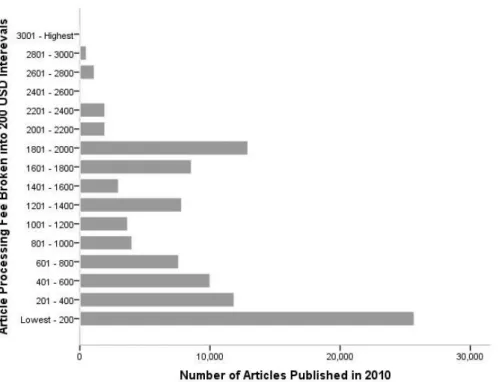
later in this report. We believe the figures are the most comprehensive currently available. The overall average is 906 USD, calculated over more than 100,000 articles. The results are also broken down by scientific discipline and other journal attributes showing the highest averages in biomedicine and the lowest in arts and humanities. Figure 2 below shows the distribution of articles over different APC levels.
Figure 2: Distribution of APCs of full OA journals in 2010
Other studies, often when developing scenarios for the economics of gold and green OA21,22, have
used much higher figures, for instance based on average APCs paid by grantees from particular funders. It must be remembered that such grant recipients (for instance from the Wellcome Trust) often tend to publish a higher proportion of their work in more prestigious, and hence also more highly priced journals in biomedicine.
20 Solomon D, Björk B-C, 2012. A study of open access journals using article processing charges. Journal of
the American Society for Information Science and Technology, Volume 63, Issue 8, pages 1485–1495.
21 Swan A, Houghton J. Going for gold, 2013. report,
http://www.ucml.ac.uk/sites/default/files/pages/131/Modelling_gold_Open_Access_for_institutions_-_final_draft3.pdf
22 Jubb M, Cook J, Hulls D, Jones D, Ware M. 2012. Costs, risks and benefits in improving access to journal
2.3
Transition scenarios
The question of how established subscription journals could transition to APC funding has been the focus for a number of articles. As early as 2003, David Prosser described how hybrid OA could be used to build a transition path from subscription only access to full OA.23 The key parameter in
Prosser’s scenario was to set the hybrid charge at the level of the average production price per article from the very start, so that if there would be large scale migration to hybrid, the journal would end up getting the same overall income from APC as from subscriptions. This idea was implemented by Springer in 2004 in its Open Choice programme with a one-price fits all of 3,000 USD24 and other big publishers have followed-up with similar programmes.
Björk and Hedlund25 continued along the same lines as Prosser and proposed two ways in which
publishers can convert journals to OA: a drastic one-time flip and a gradual transition using hybrid OA, in which the hybrid APCs for a whole university are bundled with the subscription costs. Under this model the total income to the publisher remains at the same level throughout the transition. This latter approach comes close to the proposals about avoiding “double dipping” on the local level, discussed later in the scenario part of this report.
A very important recent development has been the transition of a number of scholarly journals in High Energy Physics (HEP) to OA, through the SCOAP3 initiative led by CERN in partnership with the research funders in the field and a worldwide alliance of libraries.26 A price-per-article is
derived from a competitive call for tender for existing subscription journals to “flip” to OA, and existing OA journals to provide services free of charge to authors. A capped overall budget envelope is used, resulting in average APCs (including journal growth) below 1,200 EUR per article. Journals are no longer selling subscriptions, and publishers are reducing costs to libraries worldwide. In turn, at a national level, these funds are used to offset a national contribution into a common SCOAP3 fund. The fund is used by CERN, for the benefit of SCOAP3, to pay for APCs. Ten journals (co-)published by 11 publishers, including Elsevier and Springer, are participating. This approach also avoids the “double dipping” issue.
This initiative is an important pioneer for the conversion of a full field of science to OA. However, the infrastructure and traditions of HEP are unique and especially well-suited for such an
innovative approach for transitioning to full OA. In addition, HEP is a specialized field with relatively few journals and publishers. Implementing this approach would be much more difficult in a discipline such as biomedicine with thousands of journals and dozens of very diverse
publishers. On the other hand, most of the libraries and funding agencies which have successfully converted their subscriptions into APCs are not specific to HEP, and the SCOAP3 project provides a valuable model for future innovations in the broader conversion to a fully open access scholarly publishing system.
2.4
The “double dipping” issue
With the hybrid option, publishers could in principle receive subscription as well as APC income for the same article, at least in the initial stages of transition when there are low hybrid uptake
23 Prosser D. From here to there: a proposed mechanism for transforming journals from closed to open
access, Learned Publishing, Volume 16, Number 3, 1 July 2003 , pp. 163-166.
24 Peter Binfield who was involved in the hybrid development process at Springer confirmed that the 3,000
USD price was based on their estimate of the price necessary to replace subscription revenue.
25 Björk B-C, Hedlund T 2009. Two Scenarios for How Scholarly Publishers Could Change Their Business
Model to Open Access, Journal of Electronic Publishing, Vol 12, No 1, http://dx.doi.org/10.3998/3336451.0012.102
levels. This phenomenon has often been termed “double dipping.” Although there are some costs to processing APCs, these costs are minimal compared with the typical hybrid APC. This has a potential of increasing publishers’ profits and creating higher costs to funders or universities willing to pay hybrid charges.
This is seen as a serious potential problem both in the literature27,28 and by a number of the
experts we interviewed, particularly for research intensive institutions that pay for both
subscription fees and hybrid payments for their researchers. We use the term double dipping in the discussion of this issue below but do so with no specific negative connotations intended.
2.5
Mechanisms for funding and paying APCs
Authors have often had to combine a number of sources of funding to pay for an APC (both in full OA and hybrid journals). These sources include allowable costs from grants, institutional
dedicated APC funds, general overhead money and even personal funds. This has meant that authors are often sensitive to APC price level.29 In microeconomic terms, the price elasticity of
demand has been high.
A couple of studies have explored what level of APCs authors have been willing to pay and how they have funded the charges. The European SOAP study30 found that for 28% of researchers grant
money was used, in 55% of cases overhead funding from grants or the department was used, and in only 12% of cases the researchers paid themselves (with 5% other). Unfortunately, it is difficult from the answers given to know how many combined money from multiple sources. The results from a similar survey by Solomon and Björk31 show approximately the same distribution, with
around 30% of researchers in industrialized countries using grant funding. The picture is different for developing nations, where 39% of the funding came from personal funds.
Both of the above studies also asked authors what level of APC they would be willing to pay for publication in an OA journal, giving the authors a range of choices.32 While the results indicate a
clear price elasticity, the results must be interpreted with caution. For instance Solomon and Björk report on the answers to the question “If there were a journal in which you had a strong desire to publish, what would be the maximum APC you would be willing to pay?” The responses ranged from 0 to 5,000 USD with an average amount of 649 USD and a standard deviation of 749 USD. There is a risk that many respondents interpreted the question to mean the amount they would pay “out of pocket” rather than the actual APC they would be willing to pay from whatever source was available.
27 House of Commons, Business, Innovation and Skills Committee, 2013. Open Access, Report, Volume I:
Report, together with formal minutes, oral and written evidence,
http://www.publications.parliament.uk/pa/cm201314/cmselect/cmbis/99/9902.htm
28 http://www.scienceeurope.org/uploads/PublicDocumentsAndSpeeches/SE_OA_Pos_Statement.pdf
29 In other cases authors are able to draw funding from accounts with no specific limits and may not be as
sensitive to the price of an APC.
30 Dallmeier-Tiessen S, Goerner B, Darby R, Hyppoelae J, Igo-Kemenes P, Kahn D, Lambert S, et al: Open
access publishing - models and attributes. Max Planck Digital Library/Informationsversorgung; 2010. http://edoc.mpg.de/478647
31 Solomon D, Björk, B-C, 2012, Publication Fees in Open Access Publishing: Sources of Funding and Factors
Influencing Choice of Journal, Journal of the American Society for Information Science and Technology, 63(1):98–107, 2012, DOI: 10.1002/asi.21660.
32 Dallmeier-Thiessen et al: The SOAP Symposium – III Open Access Publishing Today: What scientist do
and why, presentation at the SOAP Symposium, January 13th, 2011, Berlin, slides 21-27.
In a survey with authors who had published in the prestigious Proceedings of the National Academy of Sciences (PNAS), editor Cozzarelly asked authors about their willingness to pay an extra charge for making their article immediately open access33. It should be noted that PNAS
articles are made OA after a delay of 6 months in any case, and that the journal levies page charges for all articles, meaning that there would be no extra effort to pay the hybrid OA charge.
According to the survey half of the authors were willing to pay the extra charge, and the share of those willing to pay different levels showed a steep price elasticity (79% at 500 USD, 15% at 1,000 USD, 4% at 1,500 USD and 2% at 2,000 USD). The actual high uptake of the paid hybrid option is actually in line with this “feasibility study” study. At a regular price of 1,300 USD and a discounted price of 975 USD for authors from institutions with site licences to PNAS (probably the majority), the uptake in the five year period 2006 to 2011 was between 17 and 23%.
The uptake levels of different hybrid OA journals also demonstrate how sensitive authors are to the price. Björk34 has shown uptake levels of 2% or less for publishers charging around 3,000 USD.
The few “success stories” of hybrid journals that have achieved uptake levels of around 10% seem mostly to be due to much lower APCs or big discounts for society members, in combination with the journals being leading publications in their scientific fields. A notable exception is Nature Communications, which despite an APC price of 5,200 USD has managed to get significant hybrid uptake, most likely because of the high impact factor and the brand of the publisher. It is also worth noting that a significant share of the hybrid articles in Springer journals has come through bundled deals linking APCs with subscription licences. This has been limited to a few select universities or consortia.35
Against this background, it is understandable why some funders, like the Wellcome Trust and the Austrian Research Fund, have started to provide dedicated funds for paying APCs as a way of increasing uptake, by insulating authors from the APCs.
Pinfield and Middleton36 report the extent to which UK universities have established centralized
funds and mechanisms for the handling of APCs (only 13% of responding universities had such systems in 2011). They also describe a case study of an institutional fund at the University of Nottingham. The mean cost paid through that fund in 2010-2011 was 1,216 GPB (1,997 USD), that is slightly less than the average for Wellcome Trust funded APCs, but clearly higher than the world average in our study. This can partly be explained by the fact that the vast majority of journals were in medicine or biomedicine.
A major focus of the debate in the UK in the past couple of years has been the mechanisms of funding APCs and their consequences. The Finch report37created a lot of discussion in the
different OA camps and has been very influential on later developments in the UK. A key concern of the report is the balanced transition towards more OA, it states that:
it seems likely that the transition towards open access will accelerate in the next few years. The Group’s aim is to support that process, but to ensure that policies are implemented in
33 Cozzarelli N, Fulton K, Sullenberger D. (2004). Results of a PNAS author survey on an open access option
for publication, PNAS 2004 101(5), 1111. doi:10.1073/pnas.0307315101
34 Björk, B-C, 2012. The hybrid model for open access publication of scholarly articles – a failed experiment?
Journal of the American Society of Information Sciences and Technology, Volume 63, Issue 8, pages 1496– 1504.
35 Interviews with Ivy Anderson, California Digital Libraries, Ralf Schimmer, MPDL.
36 Pinfield S, Middleton C, 2012, Open access central funds in UK universities, Learned Publishing, Volume
25, Number 2, pp. 107-116.
37 Finch J. (2012). Accessibility, sustainability, excellence: how to expand access to research publications.
ways that do not disrupt the essential features of a high-quality and continuously-developing research publishing ecology, or the high performance and standing of the UK research community.
The report puts much emphasis on simplifying the mechanisms for funding APCs in both full OA and hybrid OA journals. It points out that, in addition to the publication charges themselves, the transaction costs for handling the payments can be considerable – both for publishers and the institutions of the authors. Like many other earlier studies, the report tries to model the short-term economic effects of open access assuming different levels of average APCs and OA uptake. The report highlights several important issues related to the funding and payment of APCs, including how costs associated with multi-author articles and articles which have not been funded via specific grants should be provisioned. It also discusses the mechanisms that universities are starting to set up to centrally deal with APC funding.
A later House of Commons select committee (BISCOM) report38 voices strong criticism of the
Finch report and its follow-up in the form of the Research Councils UK (RCUK) OA policy. It puts much more stress on green self-archiving as the preferred route to OA and is highly critical of the current RCUK policy. Among the concrete recommendations two are note-worthy. First, it
suggests that the allowed maximum embargoes for green OA should be shortened to 6 months for STM and 12 months for the social sciences and humanities. Second, it recommends that: “If RCUK and the Government continue to maintain their preference for gold, they should amend their policies so that APCs are only paid to publishers of pure gold rather than hybrid journals.” Recently the Finch committee issued a review of progress one year after the original report39,
based partly on written input from 25 stakeholders. One central observation was that few
universities had added internal funding to the APC-funds set up using the earmarked lump sums given to them by RCUK. In contrast to the BISCOM report, The Finch committee recommends that hybrid OA should be funded, although it highlights the problems involved in ensuring that the sum total of APC and subscription cost doesn’t grow too much for research intensive universities.
A further input into this discussion was provided by the UK Government response to the House of Commons report40. A central position statement is:
Government does not consider it appropriate for publishers to rely on retrospectively amortising their APC revenue to discount global subscription rates, as some now do. This may address 'double-dipping' in one sense, (no increase in total revenue to the publisher) but it does nothing to address the concerns of research intensive individual institutions, wherever they are located around the world. Such institutions paying APCs for gold OA publication in particular journals should see some related and proportional discount in their total subscription fees, with the same publisher, to avoid them disproportionately funding the translation to gold OA.
38 House of Commons, Business, Innovation and Skills Committee, 2013. Open Access, Report, Volume I:
Report, together with formal minutes, oral and written evidence,
http://www.publications.parliament.uk/pa/cm201314/cmselect/cmbis/99/9902.htm
39 Accessibility, Sustainability, Excellence: How to Expand Access to Research Publications. A Review of
Progress in Implementing the Recommendations of the Finch Report, October 2013. http://www.researchinfonet.org/wp-content/uploads/2013/02/Final-version.pdf
40 House of Commons, Open Access: Responses to the Committee's Fifth Report of Session 2013-14 -
2.6
Discussion
The full OA market so far appears to be competitive. New entrants have created a niche for themselves by offering value with relatively low APCs. The leading companies have now been in business for around a decade and seem to be profitable at their current APC levels. Acquisitions by major subscription publishers of OA companies such as BMC (by Springer) and Frontiers (by Nature Publishing Group) are also indications that the market is functioning well.
The hybrid market on the other hand is highly dysfunctional with very low uptake for most hybrid journals and a relatively uniform price in most cases without regard to factors such as discipline or impact. Growth in the last few years has mainly been in the total number of journals for which the option has become available. Offering the hybrid option is low risk and inexpensive to set up for the publishers. Since publishers are not dependent on the hybrid income stream they have not been motivated to lower the prices to what most customers are willing to pay.
Both the full OA and hybrid market demonstrate that the uptake of APC funded OA is highly dependent on the price elasticity of the authors’ willingness to pay certain levels of APCs. This is especially the case where the authors have had to meet these costs from their own or their
university’s limited discretionary funds as well as from “allowable project costs” in research grants. We believe that this is a major reason why hybrid OA, which usually has been priced at around 3,000 USD, has had such a low uptake. It is nevertheless important to bear in mind that the hybrid market functions differently from the full OA market, in the sense that the decision to pay the hybrid charge is usually taken long after the journal has already been chosen, and is usually optional, since the author can in most cases self-archive the work at no cost or simply allow their article to remain behind a subscription paywall. In that situation, price sensitivity can also vary a lot depending on discipline. For some authors it is not the price that hinders them in using the hybrid option as much as the extra effort of getting permissions from superiors and carrying out the payment.
If earmarked APC funding starts to become more available (for instance in the form of university-wide funds) there is likely to be far less pressure on authors to be price conscious in choosing where to publish their research. Making decisions about rationing the use of this resource will then fall on the administrators of such funds, given that there is likely to be a scarcity of money to meet all requests. One way of dealing with such scarcity would be the use of price caps, but hardly any of the reports in this literature review discuss this possibility. Another option is for these funds to cover only a portion of the APC and require authors to locate funds from other sources for the remaining portion of the APC. We consider both of these options in the scenarios we set out in Chapter 6.
Most publishers offering hybrid OA pledge that they don’t engage in “double-dipping” and that they will reduce subscription prices to journals proportionally as the uptake of the hybrid option increases. Unfortunately, subscription prices to individual titles from the larger commercial publishers are more or less meaningless, due to the dominance of bundled electronic licences. Such big deals are multiyear contracts, which are usually the result of long negotiations and often covered by non-disclosure clauses.
Consequently, it is almost meaningless to ask if a hybrid uptake of 1-2% for the publisher in question has had any marginal effect on the price level of the deal. Several of our interviewees confirmed this to be the situation. The situation might change if hybrid uptake becomes more noticeable, say around 10%.
There is also the issue that addressing “double dipping” on a global scale by across-the-board reductions in subscription prices puts a significant financial burden on those institutions that are willing to pay hybrid APCs, diluting any benefit from reduced subscription fees for them to the point where it does little to cover the expenses of paying hybrid APCs. Many (including the recent UK government statement) advocate that double dipping must be addressed at a local level where reimbursements for hybrid payments would be directed back to the institutions that actually made the payments.
The fact that raising the funding and paying the APCs is a non-trivial task has been discussed in some studies, and was raised in several interviews with both OA publishers and librarians. This involves dealing with difficult issues - such as articles with authors from many institutions and countries, articles published outside the time limits of the grants they stemmed from, and rules for waivers for authors without access to funds to pay.
Processes for handling APC payments have in large part been extremely challenging and inefficient causing a great deal of frustration for both publishers and librarians. While intermediaries would seem to be a good solution for addressing these problems, neither
publishers nor librarians (including those interviewed for this study) seem to feel that efforts to date have been very effective. The lack of effective administrative and work-flow structures for payments appears currently to be a serious impediment to a wide scale conversion from subscription to APC funded OA publication.
It is also important to note that implementing changes to a complex publishing ecology can be extremely challenging. The history of the publishing agreements between the Max Planck Institutes (as well as a number of universities) and Springer around 2007 is instructive. These agreements provided subscription access to Springer journals and allowed researchers covered by the agreements to publish articles as hybrid OA in Springer’s Open Choice journals at no
additional cost. While these agreements were attempts in good faith both by Springer and the sponsoring institutions to implement a programme to provide hybrid OA options for authors, they were ultimately not successful and were terminated after a few years. Even though there was no additional cost to publish OA, the uptake of the hybrid option by MPG authors was extremely low due to a variety of factors that involved changes in workflows, communication to authors and confusion about the programme.41
One could speculate what the APC market would look like if it worked on similar terms as the subscription market. Under such a model, we posit that individually paid APCs would be very expensive (as is the subscription model with an estimated cost of 5,000 per article). Consequently those publishers who controlled big portfolios of APC funded OA journals would make bundled deals with universities and funders, which would result in seemingly lower APCs per article if they committed to paying the publisher a fixed sum per annum, a sort of APC “subscription”. The price differential when compared to individually paid APCs would be large enough to effectively push universities to predominantly pay for APCs via these deals, and thus tie up their earmarked APC funds. Such deals would also streamline the administrative effort to pay APCs which further increases their attractiveness. This would result in a loss of transparency and would be very detrimental to smaller OA publishers and innovative companies wishing to break into the market.
3
Current status of the APC market
This chapter presents an analysis of the current status of APC-funded OA publishing in both full OA and hybrid journals.
The first part of this chapter discusses the full OA journal market. We update a previous study conducted in late 2011 concerning the APCs charged by 1,370 OA journals publishing over 100,000 articles annually. We then review the growth of newly founded full OA journals published by the major traditional subscription publishers and the growth over the last few years in what are often termed mega journals. We also briefly discuss the problems caused by commercial low-quality journals from so-called “predatory publishers”.
The second part of this chapter discusses the current situation in the hybrid market, and how this has changed over the last two years.
3.1
Full OA journals
3.1.1 Growth in APC charges for established OA journals
For this analysis we used baseline data from a previous study referenced above of full OA journals, which charge authors an APC and were registered in the Directory of Open Access Journals (DOAJ) in August 2011.42
The goal was to assess the increase in APC pricing and the growth in article volumes in
established OA journals over the past two years. We assessed the growth in the number of articles and the change in APC prices based on a sample of 187 journals included in our original study, which was weighted towards the larger and higher quality publishers. The detailed description of the methodology used can be found at Appendix E.
From 2010 to 2012, the average number of articles published per journal per year increased from 107 to 188. If PLOS ONE is removed from the sample, the average increased from 71 articles a year to 110 articles a year, which is a growth of 55% or approximately 24.5% per year.
This finding is consistent with both the literature and data about the total article volume growth from the larger publishers in the Open Access Scholarly Publishers Association (OASPA), as can be seen in Figure 3 below. It is evident that the article volumes of established OA journals are
approaching the average of subscription journals.
From 2011 to 201343 the average APC of the sampled journals increased from 1,292 USD to 1,418
USD, about 10%, or 5% per year (although most of the journals had not changed their APC charge during this period). The difference between the average APC in this study (1,292 USD) and the 906 USD in our original study can be explained by the fact that the subsample of journals used in this study were from more prestigious and well established journals.
For comparison, the Periodicals Price Survey 201344 suggests the overall inflation in serial pricing
during this period was about 6% per year. Virtually all of the journals we sampled are in the
42 Solomon DJ, Björk B-C. (2012) A Study of Open Access Journals Using Article Processing Charges. Journal
of the American Society for Information Science and Technology 63(8):1485–1495.
43 The time span for number of articles per journal was based on the last complete year at the time of data
collection (2010 and 2012). For the APC the time span needed to be the date of data collection hence 2011 and 2013.
Scientific, Technical and Medical (STM) area, where the inflation rate has been around 9% per year suggesting the inflation in APCs is somewhat less than the price inflation in equivalent subscription journals. This however does not take into account the increase in the number of articles published in these subscription journals.
Figure 3: Article volume growth for major OASPA member publishers45
3.1.2 Creation of new OA journals by the leading subscription publishers
The OA publishing options for six of the major traditionally subscription publishers were evaluated. These included Elsevier, Wiley, Nature, Sage, Taylor & Francis, and Wolters Kluwer. This analysis was conducted separately from the study above, using information found on publisher web pages, since many of these new journals are not yet included in the DOAJ index. • Elsevier has summarized its OA policies and journals on its web pages.46 As of the end of
August 2013 Elsevier had 46 fully OA journals across a range of scientific of scientific and medical fields. By early December 2013, the number had grown to 72. A few, such as FEBS Open Bio and EuPA Open Proteomics, are society journals that are published by Elsevier. Elsevier also recently “flipped” seven existing journals to OA.47 Two of these were part of the
SCOAP3 contract but the other journals were the result of independent decisions to convert to APC funded full OA journals.
• Wiley currently has 28 fully OA journals48 most with affiliated societies.
• Nature Publishing Group publishes 17 OA journals including the mega journal Scientific
Reports, which is discussed in more detail below. In the spring of 2013, Nature Group acquired the Swiss OA publisher Frontiers which published over 5,000 articles in 201249.
45 Growth of Open Access - Major Publishers. Cameron Neylon, OASPA. figshare.
http://dx.doi.org/10.6084/m9.figshare.650799
46 http://www.elsevier.com/about/open-access/open-access-journals
47 http://online.wsj.com/article/PR-CO-20131217-903941.html?dsk=y
48 http://www.wileyopenaccess.com/details/content/12f25e0654f/Publication-Charges.html
49
• Sage currently publishes 15 fully open journals.50 • Taylor & Francis has 18 fully OA journals.51
• Wolters Kluwer acquired Medknow, a large OA publisher based in India in 2011.52
While these full OA journals represent a small fraction of the thousands of journals published by major traditionally subscription publishers, many appear to be rapidly expanding into the full OA publishing market by either acquiring existing OA publishers (e.g. NPG’s acquisition of Frontiers), creating new fully OA journals (e.g. Chemistry Open from Wiley) or, to a much smaller degree at present, converting their subscription journals to full open access (e.g. Stem Cell Research published by Elsevier). This trend began when Springer launched Springer Open in 2010 after acquiring BioMed Central in 2008.
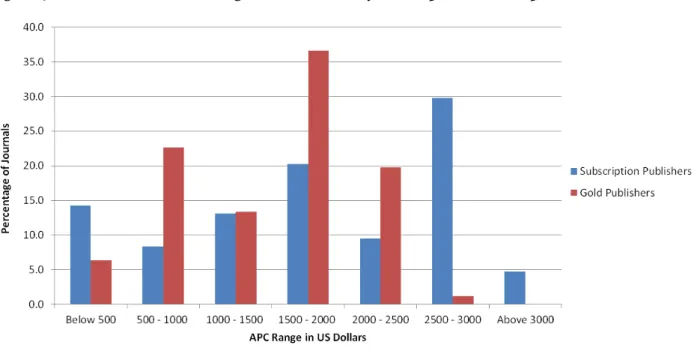
Unlike the hybrid market, publishers have tended to diversify their full OA journal prices and set them more competitively. But still, on average, APCs are higher than those charged by the full OA publishers included in the analysis above. Figure 4 below compares the distribution in APC prices between these two groups of publishers. The comparison is between the current APC prices of the 187 fully OA journals in the study above with 102 journals identified as being published by the traditionally subscription publishers. These data were collected in August 2013.53
The APCs of the new fully OA journals published by subscription publishers are, on average, 679 USD higher than the prices levied by the more established “born digital” full OA publishers. The distribution of the APCs in these two groups of journals can be seen in Figure 4 below.
Figure 4: Distribution of APC charges for traditionally subscription and full publishers
Many of the new, full OA journals have little or no content at this point in time and a significant portion are not charging an APC as the publishers attempt get these journals established. With
50 http://www.sagepub.com/openaccess.sp
51 http://www.tandfonline.com/page/openaccess/openjournals
52
http://www.stm-assoc.org/industry-news/wolters-kluwer-health-acquires-leading-open-access-stm-journal-publisher-medknowin-india/
53 The journals did not include those acquired from purchasing existing fully OA publishers. We included
their considerable resources, brand name recognition and expertise, these large publishers could quickly become a major force in the full OA publishing market.
3.1.3 Mega journals
Following the success of PLOS ONE a growing number of publishers have created journals often termed “mega journals” that have largely emulated the PLOS ONE model. These journals
normally have:
1. very broad scopes generally encompassing a whole discipline or multiple disciplines; 2. a review process that focuses exclusively on whether the methodology is sound and the
research and publication followed acceptable ethical standards without regard to the importance of the research topic or results; and
3. an accelerated review and publication process.
A listing of 19 mega journals, the number of articles published and their launch year along with eight journals with tentative launch dates in 2014 is provided at Appendix F.
Mega journals are becoming an established form of peer reviewed publication. Based on the success of PLOS ONE, most of the other journals were launched starting around 2011. Their success in attracting submissions has varied significantly as can be seen in Appendix F. A few, like BMJ Open (published by BMJ) and Scientific Reports (published by the Nature Publishing Group) are growing exponentially. The effect of the strong brand name of the publisher, plus the fact that both have recently been accepted for indexing in ISI, meaning they will soon get impact factors, could have contributed to their success in attracting submissions.
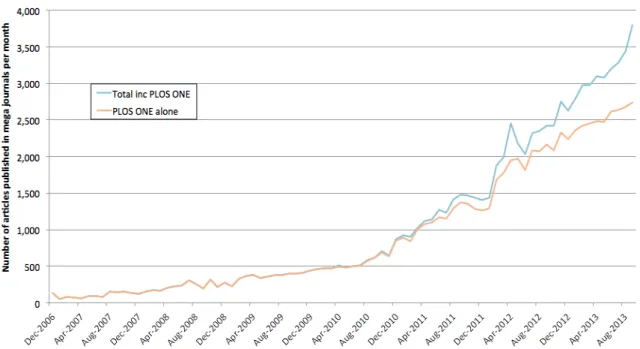
PeerJ is a mega journal that is using a new approach to OA publishing, based on a membership model. The membership fees are a one-time charge and allow authors to publish articles for life. However, all authors of a paper must meet the membership requirements. The base membership Is 99 USD for one publication a year. Launched in early 2013, PeerJ has published around 220 articles in the first nine months of operation. It is not clear at this point if the journal will scale up to a level that will make it financially sustainable but it offers an innovative funding model. The growth in mega journals can be seen in Figure 5 below54. What is interesting is that the
increase in articles from new mega journals contributes to a continuing exponential growth in the total numbers of articles published, despite the growth in PLOS ONE articles having slowed down somewhat. It appears that authors who are interested in publishing in the mega journal format are starting to take advantage of the variety of options available.
The APC of 1,350 USD set by PLOS ONE has become a rough pricing standard, although there are a number of exceptions. More detailed information is provided in Appendix F. The operating costs for a journal with an efficient model and the relatively high acceptance rates (common with mega journals) could, potentially, be far less than the typical APC of 1,350 USD, making this a very lucrative publishing model and suggesting that publishers could reduce their APC charges and still remain profitable.55 With the rapid growth of PLOS ONE, Scientific Reports and BMJ Open, it
seems unlikely at this point that at least these publishers will lower the APCs since authors are willing to pay the current price level.
54 Data and graph supplied by Peter Binfield (http://tinyurl.com/ozcwvvg). More detailed information is
supplied in the Appendix.
55 Van Noorden R. Open access: The true cost of science publishing. Nature News. 27 March 2013.