Chapter
1
Group Theory
Most lectures on group theory actually start with the definition of what is a group. It may be worth though spending a few lines to mention how mathe-maticians came up with such a concept.
Around 1770, Lagrange initiated the study of permutations in connection with the study of the solution of equations. He was interested in understanding solutions of polynomials in several variables, and got this idea to study the be-haviour of polynomials when their roots are permuted. This led to what we now call Lagrange’s Theorem, though it was stated as [5]If a functionf(x1, . . . , xn)
of n variables is acted on by all n! possible permutations of the variables and these permuted functions take on onlyr values, then r is a divisior ofn!. It is Galois (1811-1832) who is considered by many as the founder of group theory. He was the first to use the term “group” in a technical sense, though to him it meant a collection of permutations closed under multiplication. Galois theory will be discussed much later in these notes. Galois was also motivated by the solvability of polynomial equations of degree n. From 1815 to 1844, Cauchy started to look at permutations as an autonomous subject, and introduced the concept of permutations generated by certain elements, as well as several nota-tions still used today, such as the cyclic notation for permutanota-tions, the product of permutations, or the identity permutation. He proved what we call today Cauchy’s Theorem, namely that if p is prime divisor of the cardinality of the group, then there exists a subgroup of cardinalityp. In 1870, Jordan gathered all the applications of permutations he could find, from algebraic geometry, num-ber theory, function theory, and gave a unified presentation (including the work of Cauchy and Galois). Jordan made explicit the notions of homomorphism, isomorphism (still for permutation groups), he introduced solvable groups, and proved that the indices in two composition series are the same (now called Jordan-H¨older Theorem). He also gave a proof that the alternating groupAn
is simple for n >4.
In 1870, while working on number theory (more precisely, in generalizing
Kummer’s work on cyclotomic fields to arbitrary fields), Kronecker described in one of his papers a finite set of arbitrary elements on which he defined an abstract operation on them which satisfy certain laws, laws which now correspond to axioms for finite abelian groups. He used this definition to work with ideal classes. He also proved several results now known as theorems on abelian groups. Kronecker did not connect his definition with permutation groups, which was done in 1879 by Frobenius and Stickelberger.
Apart permutation groups and number theory, a third occurence of group theory which is worth mentioning arose from geometry, and the work of Klein (we now use the term Klein group for one of the groups of order 4), and Lie, who studied transformation groups, that is transformations of geometric objects. The work by Lie is now a topic of study in itself, but Lie theory is beyond the scope of these notes.
The abstract point of view in group theory emerged slowly. It took some-thing like one hundred years from Lagrange’s work of 1770 for the abstract group concept to evolve. This was done by abstracting what was in commun to permutation groups, abelian groups, transformation groups... In 1854, Cayley gave the modern definition of group for the first time:
“A set of symbols all of them different, and such that the product of any two of them (no matter in what order), or the product of any one of them into itself, belongs to the set, is said to be a group. These symbols are not in general con-vertible [commutative], but are associative.”
Let us start from there.
1.1
Groups and subgroups
We start by introducing the object that will interest us for the whole chapter.
Definition 1.1. A group is a non-empty set G on which there is a binary operation (a, b)7→absuch that
• ifaandb belong toGthenab is also inG(closure), • a(bc) = (ab)cfor alla, b, cinG(associativity),
• there is an element 1∈Gsuch thata1 = 1a=afor alla∈G(identity), • ifa∈ G, then there is an element a−1 ∈G such that aa−1 =a−1a= 1
(inverse).
One can easily check that this implies the unicity of the identity and of the inverse.
A group G is called abelian if the binary operation is commutative, i.e., ab=ba for alla, b∈G.
Remark. There are two standard notations for the binary group operation: ei-ther the additive notation, that is (a, b)7→ a+b in which case the identity is
1.1. GROUPS AND SUBGROUPS 7
denoted by 0, or the multiplicative notation, that is (a, b)7→ab for which the identity is denoted by 1.
Examples 1.1. 1. Zwith the addition and 0 as identity is an abelian group. 2. Z with the multiplication is not a group since there are elements which
are not invertible inZ.
3. The set of n×n invertible matrices with real coefficients is a group for the matrix product and identity the matrixIn. It is denoted byGLn(R)
and called thegeneral linear group. It is not abelian for n≥2.
The above examples are the easiest groups to think of. The theory of algebra however contains many examples of famous groups that one may discover, once equipped with more tools (for example, the Lie groups, the Brauer group, the Witt group, the Weyl group, the Picard group,...to name a few).
Definition 1.2. Theorder of a groupG, denoted by |G|, is the cardinality of G, that is the number of elements inG.
We have only seen infinite groups so far. Let us look at some examples of finite groups.
Examples 1.2. 1. Thetrivial groupG={0}may not be the most exciting group to look at, but still it is the only group of order 1.
2. The groupG={0,1,2, . . . , n−1}of integers modulonis a group of order n. It is sometimes denoted byZn (this should not be confused withp-adic
integers though!).
Definition 1.3. A subgroupH of a groupGis a non-empty subset ofGthat forms a group under the binary operation ofG.
Examples 1.3. 1. If we consider the groupG=Z4={0,1,2,3}of integers
modulo 4,H={0,2} is a subgroup ofG.
2. The set of n×n matrices with real coefficients and determinant of 1 is a subgroup ofGLn(R), denoted by SLn(R) and called thespecial linear
group.
At this point, in order to claim that the above examples are actually sub-groups, one has to actually check the definition. The proposition below gives an easier criterion to decide whether a subset of a groupGis actually a subgroup.
Proposition 1.1. Let G be a group. LetH be a non-empty subset of G. The following are equivalent:
1. H is a subgroup ofG.
2. (a) x, y ∈H impliesxy∈H for allx, y. (b) x∈H impliesx−1∈H.
3. x, y∈H impliesxy−1∈H for allx, y. Proof. We prove that 1.⇒3.⇒2.⇒1.
1.⇒3. This part is clear from the definition of subgroup.
3.⇒2. Since H is non-empty, let x ∈ H. By assumption of 3., we have that xx−1 = 1 ∈ H and that 1x−1 ∈ H thus x is invertible in H. We now
know that forx, y∈H, xandy−1 are inH, thusx(y−1)−1=xy is inH.
2.⇒1. To prove this direction, we need to check the definition of group. Since closure and existence of an inverse are true by assumption of 2., and that associativity follows from the associativity inG, we are left with the existence of an identity. Now, ifx∈H, thenx−1∈H by assumption of
2., and thus xx−1 = 1∈H again by assumption of 2., which completes
the proof.
We will often use the last equivalence to check that a subset of a groupGis a subgroup.
Now that we have these structures of groups and subgroups, let us intro-duce a map that allows to go from one group to another and that respects the respective group operations.
Definition 1.4. Given two groupsGandH, agroup homomorphismis a map f :G→H such that
f(xy) =f(x)f(y) for all x, y∈G.
Note that this definition immediately implies that the identity 1G of G is
mapped to the identity 1H of H. The same is true for the inverse, that is
f(x−1) =f(x)−1.
Example 1.4. The map exp : (R,+)→(R∗,·), x 7→exp(x) is a group homo-morphism.
Definition 1.5. Two groupsGandH areisomorphicif there is a group homo-morphismf :G→H which is also a bijection.
Roughly speaking, isomorphic groups are “essentially the same”.
Example 1.5. If we consider again the groupG=Z4={0,1,2,3}of integers
modulo 4 with subgroup H ={0,2}, we have thatH is isomorphic to Z2, the
group of integers modulo 2.
A crucial definition is the definition of the order of a group element.
Definition 1.6. Theorder of an elementa∈Gis the least positive integer n such thatan= 1. If no such integer exists, the order ofais infinite. We denote
1.2. CYCLIC GROUPS 9
Note that the critical part of this definition is that the order is the least positive integer with the given property. The terminologyorderis used both for groups and group elements, but it is usually clear from the context which one is considered.
1.2
Cyclic groups
Let us now introduce a first family of groups, the cyclic groups.
Definition 1.7. A groupGiscyclicif it is generated by a single element, which we denote byG=hai. We may denote byCn a cyclic group ofnelements.
Example 1.6. A finite cyclic group generated byais necessarily abelian, and can be written (multiplicatively)
{1, a, a2, . . . , an−1}withan= 1 or (additively)
{0, a,2a, . . . ,(n−1)a}withna= 0.
A finite cyclic group withnelements is isomorphic to the additive groupZn of
integers modulon.
Example 1.7. Annth root of unity is a complex numberzwhich satisfies the equation zn = 1 for some positive integer n. Letζ
n = e2iπ/n be an nth root
of unity. All the nth roots of unity form a group under multiplication. It is a cyclic group, generated byζn, which is called a primitive root of unity. The
term “primitive” exactly refers to being a generator of the cyclic group, namely, annth root of unity is primitive when there is no positive integerksmaller than nsuch thatζk
n= 1.
Here are some properties of cyclic groups and its generators.
Proposition 1.2. IfGis a cyclic group of orderngenerated bya, the following conditions are equivalent:
1. |ak|=n.
2. kandnare relatively prime.
3. k has an inverse modulo n, that is there exists an integer s such that ks≡1 modulon.
Proof. Before starting the proof, recall that sinceageneratesGof ordern, we have that the order of ais nand in particular an = 1. The fact that|ak|=n
means in words that the order ofak is alson, that is,akis also a generator ofG.
1.⇒2. Suppose by contradiction thatk and n are not relatively prime, that is, there exists s > 1 such that s|k and s|n. Thusn =ms and k = sr for somem, r≥1 and we have
(ak)m=asrm=anr= 1.
Now sinces >1,m < n, which contradicts thatnis the order ofak.
2.⇒1. Suppose that the order ofak is notn, then there exists m < nsuch that
(ak)m = 1 and thusn|km sincen is the order of a. If k and n were to
be relatively prime, thennwould dividem, which is a contradiction since m < n.
2.⇒3. If k and n are relatively prime, then by Bezout identity, there exist r, s such that 1 =kr+nsand thuskr≡1 modulon.
3.⇒2. Ifkr≡1 modulonthen 1 =kr+nsfor somesand the greatest common divisor ofkandnmust divide 1, which showskandnare relatively prime.
Corollary 1.3. The set of invertible elements modulo n forms a group un-der multiplication, whose orun-der is the Euler function ϕ(n), which by definition counts the number of positive integers less thannthat are relatively prime ton.
Example 1.8. Consider the group Z6 = {0,1,2,3,4,5}, the group Z∗6 of
in-vertible elements inZ6isZ∗6={1,5}. We have thatϕ(6) =ϕ(2)ϕ(3) = 2.
1.3
Cosets and Lagrange’s Theorem
Definition 1.8. LetH be a subgroup of a group G. Ifg ∈G, the right coset ofH generated bygis
Hg={hg, h∈H} and similarly theleft cosetofH generated byg is
gH={gh, h∈H}.
In additive notation, we getH+g (which usually implies that we deal with a commutative group where we do not need to distinguish left and right cosets).
Example 1.9. If we consider the group Z4 = {0,1,2,3} and its subgroup
H ={0,2}which is isomorphic toZ2, the cosets ofH inGare
0 +H =H, 1 +H ={1,3}, 2 +H =H, 3 +H ={1,3}. Clearly 0 +H = 2 +H and 1 +H= 3 +H.
We see in the above example that while an element ofg∈Gruns through all possible elements of the groupG, some of the left cosetsgH (or right cosets Hg) may be the same. It is easy to see when this exactly happens.
1.3. COSETS AND LAGRANGE’S THEOREM 11
Lemma 1.4. We have that Ha= Hb if and only if ab−1 ∈ H for a, b ∈ G. Similarly, aH=bH if and only ifa−1b∈H fora, b∈G.
Proof. If two right cosets are the same, that isHa=Hb, sinceH is a subgroup, we have 1∈H anda=hbfor someh∈H, soab−1=h∈H.
Conversely, if ab−1 =h ∈ H, then Ha = Hhb = Hb, again since H is a
subgroup.
While one may be tempted to define a coset with a subset ofGwhich is not a subgroup, we see that the above characterization really relies on the fact that H is actually a subgroup.
Example 1.10. It is thus no surprise that in the above example we have 0+H = 2 +H and 1 +H = 3 +H, since we have modulo 4 that 0−2 ≡2 ∈H and 1−3≡2∈H.
Saying that two elements a, b ∈ G generate the same coset is actually an equivalence relation in the following sense. We say that a is equivalent to b if and only if ab−1 ∈ H, and this relation satisfies the three properties of an
equivalence relation:
• reflexivity: aa−1= 1∈H.
• symmetry: ifab−1∈H then (ab−1)−1=ba−1∈H.
• transitivity: ifab−1∈H andbc−1∈H then (ab−1)(bc−1) =ac−1∈H.
Theequivalence classof ais the set of elements in Gwhich are equivalent toa, namely
{b, ab−1∈H}.
Sinceab−1∈H ⇐⇒ (ab−1)−1=ba−1∈H ⇐⇒ b∈Ha, we further have that
{b, ab−1∈H}=Ha, and a coset is actually an equivalence class.
Example 1.11. Let us get back to our example with the groupZ4={0,1,2,3}
and its subgroupH ={0,2}. We compute the first coset 0 +H =H, and thus we now know that the equivalence class of 0 isH, and thus there is no need to compute the coset generated by 2, since it will give the same coset. We then compute the coset 1 +H = {1,3} and again there is no need to compute the one of 3 since it is already in the coset of 1. We thus get 2 cosets, and clearly they partitionZ4:
Z4={0,2} ⊔ {1,3}=H⊔(1 +H).
It is important to notice that the right (resp. left) cosets partition the group G (that the union of all cosets is Gis clear since we run through all elements of Gand H contains 1, and it is easy to see that ifx∈Haand x∈Hb then Ha=Hb).
Example 1.12. ConsiderRas an additive group with subgroupZ. Every real number up to addition by an integer looks like a number in [0,1). Thus
R=∪0≤x<1(x+Z),
and the cosets ofZpartition R.
Furthermore, since the maph7→ha,h∈H, is a one-to-one correspondence, each coset has|H|elements.
Definition 1.9. Theindexof a subgroupH inGis the number of right (left) cosets. It is a positive number or∞and is denoted by [G:H].
If we think of a groupG as being partitioned by cosets of a subgroup H, then the index ofH tells how many times we have to translateH to cover the whole group.
Example 1.13. In Example 1.12, the index [R:Z] is infinite, since there are infinitely many cosets ofZinR.
Theorem 1.5. (Lagrange’s Theorem). IfH is a subgroup ofG, then|G|= |H|[G : H]. In particular, if G is finite then |H| divides |G| and [G : H] = |G|/|H|.
Proof. Let us start by recalling that the left cosets ofH forms a partition ofG, that is
G=⊔gH,
where gruns through a set of representatives (one for each coset). Let us look at the cardinality ofG:
|G|=| ⊔gH|=X|gH|
since we have a disjoint union of cosets, and the sum is again over the set of representatives. Now
X
|gH|=X|H|
since we have already noted that each coset contains |H| elements. We then conclude that
|G|=X|H|= [G:H]|H|.
Example 1.14. ConsiderG=Z,H = 3Z, then [G:H] = 3.
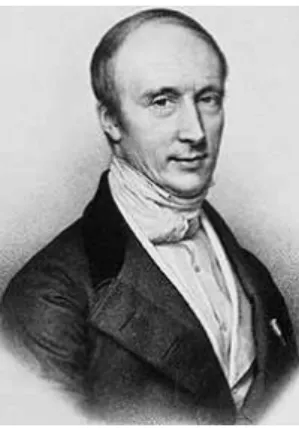
Of course, Lagrange did not prove Lagrange’s theorem! The modern way of defining groups did not exist yet at his time. Lagrange was interested in polynomial equations, and in understanding the existence and nature of the roots (does every equation has a root? how many roots?...). What he actually proved was that if a polynomial in n variables has its variables permuted in all n! ways, the number of different polynomials that are obtained is always a
1.3. COSETS AND LAGRANGE’S THEOREM 13
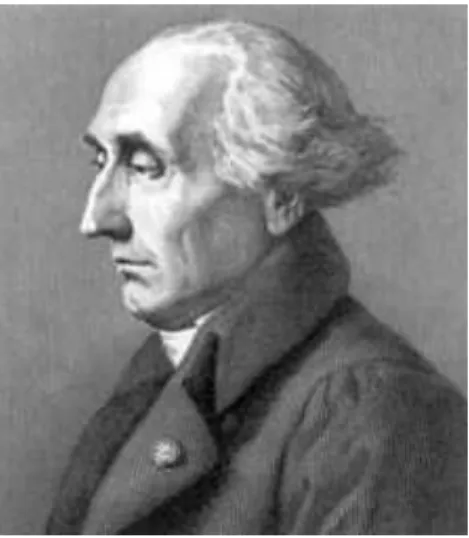
Figure 1.1: Joseph-Louis Lagrange (1736-1813)
factor ofn!. Since all the permutations of nelements are actually a group, the number of such polynomials is actually the index in the group of permutations ofnelements of the subgroupHof permutations which preserve the polynomial. So the size of H divides n!, which is exactly the number of all permutations of n elements. This is indeed a particular case of what we call now Lagrange’s Theorem.
Corollary 1.6. 1. LetGbe a finite group. Ifa∈G, then|a|divides|G|. In particular,a|G|= 1.
2. IfGhas prime order, then Gis cyclic.
Proof. 1. Ifa∈Ghas order saym, then the subgroupH ={1, a, . . . , am−1}
is a cyclic subgroup ofGwith order|H|=m. Thusmdivides|G|by the theorem.
2. Since |G|is prime, we may take a6= 1 in G, and since the order ofahas to divide|G|, we have |a| =|G|. Thus the cyclic group generated by a coincides withG.
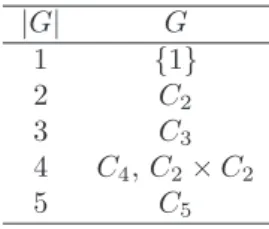
Example 1.15. Using Lagrange’s Theorem and its corollaries, we can already determine the groups of order from 1 to 5, up to isomorphism (see Table 1.1). If|G|is prime, we now know thatGis cyclic.
Let us look at the case where Gis of order 4. Let g ∈G. We know that the order of g is either 1,2 or 4. If the order ofg is 1, this is the identity. IfG contains an element g of order 4, then that means that g generates the whole group, thusGis cyclic. If nowGdoes not contain an element of order 4, then
|G| G 1 {1}
2 C2
3 C3
4 C4,C2×C2
5 C5
Table 1.1: Groups of order from 1 to 5. Cn denotes the cyclic group of ordern.
apart the identity, all the elements have order 2. From there, it is easy to obtain a multiplication table forG, and see that it coincides with the one of the group
Z2×Z2={(x, y)|x, y∈Z2}
with binary operation (x, y) + (x′, y′) = (x+x′, y+y′). This group is called the Klein group, and it has several interpretations, for example, it is the group of isometries fixing a rectangle.
Remark. The above example also shows that the converse of Lagrange’s Theo-rem is not true. If we take the groupG=C2×C2, then 4 divides the order of
G, however there is no element of order 4 inG.
Once Lagrange’s Theorem and its corollaries are proven, we can easily deduce Euler’s and Fermat’s Theorem.
Theorem 1.7. (Euler’s Theorem). If a andn are relatively prime positive integers, with n≥2, then
aϕ(n)≡1 mod n.
Proof. Since aand n are relatively prime, we know from Proposition 1.2 that a has an inverse modulo n, and by its corollary that the group of invertible elements has orderϕ(n). Thus
aϕ(n)≡1 mod n by Lagrange’s Theorem first corollary.
Corollary 1.8. (Fermat’s Little Theorem). If p is a prime and a is a positive integer not divisible by p, then
ap−1≡1 modp.
This is particular case of Euler’s Theorem when n is a prime, since then ϕ(n) =p−1.
1.4. NORMAL SUBGROUPS AND QUOTIENT GROUP 15
1.4
Normal subgroups and quotient group
Given a groupGand a subgroupH, we have seen how to define the cosets ofH, and thanks to Lagrange’s Theorem, we already know that the number of cosets [G:H] is related to the order of H andG by|G|=|H|[G: H]. A priori, the set of cosets of H has no structure. We are now interested in a criterion onH to give the set of its cosets a structure of group.
In what follows, we may writeH ≤GforH is a subgroup of G.
Definition 1.10. Let Gbe a group and H ≤G. We say that H is a normal subgroup ofG, or thatH isnormalinG, if we have
cHc−1=H, for allc∈G.
We denote itHEG, or H⊳Gwhen we want to emphasize thatH is a proper subgroup ofG.
The condition for a subgroup to be normal can be stated in many slightly different ways.
Lemma 1.9. Let H ≤G. The following are equivalent: 1. cHc−1⊆H for allc∈G.
2. cHc−1=H for allc∈G, that iscH =Hc for allc∈G.
3. Every left coset ofH inGis also a right coset (and vice-versa, every right coset ofH inG is also a left coset).
Proof. Clearly 2. implies 1., now cHc−1 ⊆ H for all c ∈ G if and only if
cH⊆Hc. Letx∈Hc, that isx=hcfor someh∈H, so that x= (cc−1)hc=c(c−1hc) =ch′
for someh′∈H sincecHc−1⊂H for allcand thus in particular forc−1. This
shows that Hcis included incH or equivalently thatH⊆cHc−1.
Also 2. clearly implies 3. Now suppose that cH = Hd. This means that c belongs to Hd by assumption and to Hc by definition, which means that Hd=Hc.
Example 1.16. LetGLn(R) be the group ofn×nreal invertible matrices, and
letSLn(R) be the subgroup formed by matrices whose determinant is 1. Let us
see thatSLn(R)⊳GLn(R).
For that, we have to check thatABA−1∈SL
n(R) for all B∈SLn(R) and
A∈GLn(R). This is clearly true since
det(ABA−1) = det(B) = 1.
Proof. Let us first define a binary operation on the cosets: (aH, bH)7→(aH)(bH) = {(ah)(bh′), ah∈aH, bh′∈bH}. We need to check that the definition of group is satisfied.
• closure. This is the part which asks a little bit of work. SincecH =Hc for allc∈G, then
(aH)(bH) =a(Hb)H =a(bH)H =abHH =abH.
Note that this product does not depend on the choice of representatives. • Associativitycomes fromGbeing associative.
• Theidentityis given by the coset 1H =H. • Theinverseof the coset aH isa−1H.
Definition 1.11. The group of cosets of a normal subgroup N ofG is called thequotient groupofGbyN. It is denoted by G/N.
Let us finish this section by discussing the connection between normal sub-groups and homomorphisms. The first normal subgroup of interest will be the kernel of a group homomorphism.
Recall that iff :G→His a group homomorphism, thekerneloffis defined by
Ker(f) ={a∈G, f(a) = 1}. It is easy to see that Ker(f) is a normal subgroup ofG, since
f(aba−1) =f(a)f(b)f(a)−1=f(a)f(a)−1= 1 for allb∈Ker(f) and alla∈G.
The converse is more interesting.
Proposition 1.11. LetGbe a group. Every normal subgroup ofGis the kernel of a homomorphism.
Proof. Suppose thatNEGand consider the map π:G→G/N, a7→aN.
To prove the result, we have to show that π is a group homomorphism whose kernel isN. First note thatπis indeed a map from group to group since G/N is a group by assuming thatN is normal. Then we have that
π(ab) =abN = (aN)(bN) =π(a)π(b)
where the second equality comes from the group structure ofG/N. Finally Ker(π) ={a∈G|π(a) =N}={a∈G|aN =N}=N.
1.4. NORMAL SUBGROUPS AND QUOTIENT GROUP 17
Definition 1.12. LetNEG. The group homomorphism π:G→G/N, a7→aN is called thenatural orcanonicalmap or projection.
Recall for further usage that for f a group homomorphism, we have the following characterization of injectivity: a homomorphism f is injective if and only if its kernel is trivial (that is, contains only the identity element). Indeed, iff is injective, then Ker(f) ={a, f(a) = 1}={1}sincef(1) = 1. Conversely, if Ker(f) ={1} and we assume thatf(a) =f(b), then
f(ab−1) =f(a)f(b)−1=f(a)f(a)−1= 1 andab−1= 1 implying thata=band thusf is injective.
Terminology.
monomorphism=injective homomorphism epimorphism=surjective homomorphism isomorphism=bijective homomorphism
endomorphism=homomorphism of a group to itself automorphism=isomorphism of a group with itself
We have looked so far at the particular subgroup ofG which is its kernel. The proposition below describes more generally subgroups ofGandH.
Proposition 1.12. Let f :G→H be a homomorphism.
1. If K is a subgroup of G, then f(K) is a subgroup of H. If f is an epi-morphism andK is normal, then f(K)is normal.
2. IfKis a subgroup ofH, thenf−1(K) ={x∈G, f(x)∈K}is a subgroup
ofG. IfK is normal, so isf−1(K).
Proof. 1. To prove thatf(K) is a subgroup ofH, it is enough to show that f(a)f(b)−1∈f(K) by Proposition 1.1, which is clear from
f(a)f(b)−1=f(ab−1)∈f(K).
If K is normal, we have to show that cf(K)c−1 = f(K) for all c ∈ H.
Sincef is an epimorphism, there existsd∈Gsuch thatf(d) =c, so that cf(K)c−1=f(d)f(K)f(d)−1=f(dKd−1) =f(K)
2. As before, to prove that f−1(K) is a subgroup of G, it is enough to showing that ab−1 ∈ f−1(K) for a, b ∈ f−1(K), which is equivalent to
show that f(ab−1) ∈ K. This is now true since f(ab−1) = f(a)f(b)−1
witha, b∈f−1(K) andK a subgroup.
For the second claim, we have to show that cf−1(K)c−1=f−1(K) or equivalently
f(cf−1(K)c−1) =K, c∈G. Forc∈Ganda∈f−1(K), then
f(cac−1) =f(c)f(a)f(c)−1∈K sinceK is normal.
1.5
The isomorphism theorems
This section presents different isomorphism theorems which are important tools for proving further results. The first isomorphism theorem, that will be the second theorem to be proven after the factor theorem, is easier to motivate, since it will help us in computing quotient groups.
But let us first start with the so-called factor theorem. Assume that we have a group G which contains a normal subgroup N, another group H, and f : G → H a group homomorphism. Let π be the canonical projection (see Definition 1.12) fromGto the quotient groupG/N:
G H
G/N ?
π
-f
¯ f
We would like to find a homomorphism ¯f :G/N →H that makes the diagram commute, namely
f(a) = ¯f(π(a)) for alla∈G.
Theorem 1.13. (Factor Theorem). Any homomorphism f whose kernelK contains N can be factored through G/N. In other words, there is a unique homomorphism f¯:G/N →H such thatf¯◦π=f. Furthermore
1. f¯is an epimorphism if and only if f is. 2. f¯is a monomorphism if and only ifK=N.
1.5. THE ISOMORPHISM THEOREMS 19
3. f¯is an isomorphism if and only iff is an epimorphism andK=N. Proof. Unicity. Let us start by proving that if there exists ¯fsuch that ¯f◦π=f, then it is unique. Let ˜f be another homomorphism such that ˜f ◦π =f. We thus have that
( ¯f ◦π)(a) = ( ˜f◦π)(a) =f(a) for alla∈G, that is
¯
f(aN) = ˜f(aN) =f(a).
This tells us that for all bN ∈G/N for which there exists an element b in G such that π(b) = bN, then its image by either ¯f or ˜f is determined by f(b). This shows that ¯f = ˜f by surjectivity ofπ.
Existence. LetaN ∈G/N such thatπ(a) =aN fora∈G. We define ¯
f(aN) =f(a).
This is the most natural way to do it, however, we need to make sure that this is indeed well-defined, in the sense that it should not depend on the choice of the representative taken in the coset. Let us thus take another representative, say b∈aN. Since a andb are in the same coset, they satisfya−1b ∈N ⊂K,
where K= Ker(f) by assumption. Sincea−1b∈K, we havef(a−1b) = 1 and thusf(a) =f(b).
Now that ¯f is well defined, let us check this is indeed a group homomorphism. First note thatG/N is indeed a group sinceNEG. Then, we have
¯
f(aN bN) = ¯f(abN) =f(ab) =f(a)f(b) = ¯f(aN) ¯f(bN) and ¯f is a homomorphism.
1. The fact that ¯f is an epimorphism if and only iff is comes from the fact that both maps have the same image.
2. First note that the statement ¯f is a monomorphism if and only ifK=N makes sense since K = Ker(f) is indeed a normal subgroup, as proved earlier.
To show that ¯f is a monomorphism is equivalent to show that Ker( ¯f) is trivial. By definition, we have
Ker( ¯f) = {aN ∈G/N, f¯(aN) = 1}
= {aN ∈G/N, f¯(π(a)) =f(a) = 1} = {aN ∈G/N, a∈K= Ker(f)}.
So the kernel of ¯f is exactly those cosets of the formaN witha∈K, but for the kernel to be trivial, we need it to be equal toN, that is we need K=N.
We are now ready to state the first isomorphism theorem.
Theorem 1.14. (1st Isomorphism Theorem). If f : G → H is a homo-morphism with kernel K, then the image off is isomorphic to G/K:
Im(f)≃G/Ker(f). Proof. We know from the Factor Theorem that
¯
f :G/Ker(f)→H
is an isomorphism if and only if f is an epimorphism, and clearly f is an epi-morphism on its image, which concludes the proof.
Example 1.17. We have seen in Example 1.16 thatSLn(R)⊳GLn(R).
Con-sider the map
det :GLn(R)→(R∗,·),
which is a group homomorphism. We have that Ker(det) = SLn(R). The 1st
Isomorphism Theorem tells that
Im(det)≃GLn(R)/SLn(R).
It is clear that det is surjective, since for all a∈R∗, one can take the diagonal matrix with all entries at 1, but one which isa. Thus we conclude that
R∗≃GLn(R)/SLn(R).
The 1st Isomorphism Theorem can be nicely illustrated in terms of exact sequences.
Definition 1.13. LetF, G, H, I, . . . be groups, and letf, g, h, . . .be group ho-momorphisms. Consider the following sequence:
· · · F f //G
g
/
/H
h
/
/I · · ·
We say that this sequence is exact in one point(sayG) if Im(f) = Ker(g). A sequence isexact if it is exact in all points.
Ashort exact sequenceof groups is of the form
1 i //F
f
/
/G
g
/
/H
j
/
/1 wherei is the inclusion andj is the constant map 1.
Proposition 1.15. Let
1 i / /F
f
/
/G
g
/
/H
j
/
1.5. THE ISOMORPHISM THEOREMS 21
be a short exact sequence of groups. ThenIm(f)is normal inGand we have a group isomorphism
G/Im(f)≃H, or equivalently
G/Ker(g)≃H.
Proof. Since the sequence is exact, we have that Im(f) = Ker(g) thus Im(f) is a normal subgroup ofG. By the first Isomorphism Theorem, we have that
G/Ker(g)≃Im(g) =H. since Im(g) = Ker(j) =H.
The formulation in terms of exact sequences is useful to know, since it hap-pens very often in the literature that an exact sequence is given exactly to be able to compute such quotient groups.
Let us state the second and third isomorphism theorem.
Theorem 1.16. (2nd Isomorphism Theorem). If H andN are subgroups of G, withN normal in G, then
H/(H∩N)≃HN/N.
There are many things to discuss about the statement of this theorem. • First we need to check thatHN is indeed a subgroup ofG. To show that,
notice thatHN =N H sinceN is a normal subgroup ofG. This implies that forhn∈HN, its inverse (hn)−1=n−1h−1∈Gactually lives inHN,
and so does the product (hn)(h′n′) =h(nh′)n′.
• Note that by writingHN/N, we insist on the fact that there is no reason forN to be a subgroup ofH. On the other hand,N is a normal subgroup ofHN, since for allhn∈HN, we have
hnN n−1h−1=hN h−1⊆N
sinceN is normal inG.
• We now know that the right hand side of the isomorphism is a quotient group. In order to see that so is the left hand side, we need to show that H∩N is a normal subgroup ofH. This comes by noticing thatH∩N is the kernel of the canonical mapπ:G→G/N restricted toH.
Now that all these remarks have been done, it is not difficult to see that the 2nd Isomorphism Theorem follows from the 1st Isomorphism Theorem, as does the 3rd Isomorphism Theorem.
Theorem 1.17. (3rd Isomorphism Theorem). If N and H are normal subgroups ofG, withN contained inH, then
1.6
Direct and semi-direct products
So far, we have seen how given a group G, we can get smaller groups, such as subgroups ofGor quotient groups. We will now do the other way round, that is, starting with a collection of groups, we want to build larger new groups.
Let us start with two groupsH andK, and letG=H×Kbe the cartesian product ofH andK, that is
G={(h, k), h∈H, k∈K}.
We define a binary operation on this set by doing componentwise multiplication (or addition if the binary operations ofH andK are denoted additively) onG:
(h1, k1)(h2, k2) = (h1h2, k1k2)∈H×K.
ClearlyGis closed under multiplication, its operation is associative (since both operations onH andKare), it has an identity element given by 1G= (1H,1K)
and the inverse of (h, k) is (h−1, k−1). In summary, Gis a group.
Definition 1.14. LetH,Kbe two groups. The groupG=H×Kwith binary operation defined componentwise as described above is called theexternal direct productofH andK.
Examples 1.18. 1. Let Z2 be the group of integers modulo 2. We can
build a direct product ofZ2with itself, namelyZ2×Z2with additive law
componentwise. This is actually the Klein group, also writtenC2×C2.
This group is not isomorphic toZ4!
2. LetZ2be the group of integers modulo 2, andZ3be the group of integers
modulo 3. We can build a direct product ofZ2 and Z3, namelyZ2×Z3
with additive law componentwise. This group is actually isomorphic to
Z6!
3. The group (R,+)×(R,+) with componentwise addition is a direct product. Note thatGcontains isomorphic copies ¯H and ¯K of respectivelyH andK, given by
¯
H ={(h,1K), h∈H}, K¯ ={(1H, k), k∈K},
which furthermore are normal subgroups of G. Let us for example see that ¯H is normal inG. By definition, we need to check that
(h, k) ¯H(h−1, k−1)⊆H,¯ (h, k)∈G.
Let (h′,1K)∈H¯, we compute that
(h, k)(h′,1k)(h−1, k−1) = (hh′h−1,1k)∈H,¯
sincehh′h−1∈H. The same computation holds for ¯K.
1.6. DIRECT AND SEMI-DIRECT PRODUCTS 23
• by definition,G= ¯HK¯ and ¯H∩K¯ ={1G},
• by what we have just proved, ¯H and ¯K are two normal subgroups ofG. This motivates the following definition.
Definition 1.15. If a groupGcontains normal subgroupsH andK such that G=HK andH∩K={1G}, we say thatGis the internal direct productofH
andK.
Examples 1.19. 1. Consider the Klein groupZ2×Z2, it contains the two
subgroups H = {(h,0), h ∈ Z2} and K = {(0, k), k ∈ Z2}. We have
that bothH andK are normal, because the Klein group is commutative. We also have that H ∩K = {(0,0)}, so the Klein group is indeed an internal direct product. On the other hand,Z4only contains as subgroup
H={0,2}, so it is not an internal direct product!
2. Consider the groupZ2×Z3, it contains the two subgroupsH={(h,0), h∈
Z2} andK={(0, k), k∈Z3}. We have that both H andK are normal,
because the group is commutative. We also have thatH∩K={(0,0)}, so this group is indeed an internal direct product. AlsoZ6 contains the
two subgroupsH ={0,3} ≃Z2 andK ={0,2,4} ≃Z3. We have that
both H and K are normal, because the group is commutative. We also have thatH∩K={0}, so this group is indeed an internal direct product, namely the internal product ofZ2 and Z3. This is in fact showing that
Z6≃Z2×Z3.
The next result makes explicit the connection between internal and external products.
Proposition 1.18. If Gis the internal direct product of H and K, then Gis isomorphic to the external direct product H×K.
Proof. To show thatGis isomorphic toH×K, we define the following map f :H×K→G, f(h, k) =hk.
First remark that if h∈ H and k∈K, then hk =kh. Indeed, we have using that bothK andH are normal that
(hkh−1)k−1∈K, h(kh−1k−1)∈H implying that
hkh−1k−1∈K∩H ={1}.
We are now ready to prove thatf is a group isomorphism. 1. This is a group homomorphism since
2. The map f is injective. This can be seen by checking that its kernel is trivial. Indeed, iff(h, k) = 1 then
hk= 1⇒h=k−1⇒h∈K⇒h∈H∩K={1}.
We have then thath=k= 1 which proves that the kernel is{(1,1)}. 3. The mapf is surjective since by definitionG=HK.
Note that the definitions of external and internal product are surely not re-stricted to two groups. One can in general define them forngroupsH1, . . . , Hn.
Namely
Definition 1.16. IfH1, . . . , Hn are arbitrary groups, theexternal direct
prod-uctofH1, . . . , Hn is the cartesian product
G=H1×H2× · · · ×Hn
with componentwise multiplication.
If G contains normal subgroups H1, . . . , Hn such that G =H1· · ·Hn and
each g can be represented as h1· · ·hn uniquely, we say thatG is theinternal
direct product ofH1, . . . , Hn.
We can see a slight difference in the definition of internal product, since in the case of two subgroups, the condition given was not that each g can be represented uniquely as h1h2, but instead that the intersection of the two
subgroups is{1}. The next proposition shows the connection between these two points of view.
Proposition 1.19. Suppose that G = H1· · ·Hn where each Hi is a normal
subgroup ofG. The following conditions are equivalent. 1. Gis the internal direct product of theHi.
2. H1H2· · ·Hi−1∩Hi={1}, for alli= 1, . . . , n.
Proof. Let us prove 1. ⇐⇒ 2.
1.⇒2. Let us assume thatGis the internal direct product of theHi, which means
that every element inGcan be written uniquely as a product of elements inHi. Now let us takeg∈H1H2· · ·Hi−1∩Hi ={1}. We have that g∈
H1H2· · ·Hi−1, which is uniquely written asg=h1h2· · ·hi−11Hi· · ·1Hn,
hj ∈ Hj. On the other hand, g ∈ Hi thus g = 1H1· · ·1Hi−1g and by unicity of the representation, we havehj = 1 for allj andg= 1.
2.⇒1. Conversely, let us assume thatg∈Gcan be written either g=h1h2· · ·hn, hj∈Hj,
1.6. DIRECT AND SEMI-DIRECT PRODUCTS 25
or
g=k1k2· · ·kn, kj ∈Hj.
Recall that since allHj are normal subgroups, then
hihj =hjhi, hi∈Hi, hj∈Hj.
(If you cannot recall the argument, check out the proof of Proposition 1.18). This means that we can do the following manipulations:
h1h2· · ·hn=k1k2· · ·kn
⇐⇒ h2· · ·hn = (h−11k1)
| {z }
∈H1
k2· · ·kn
⇐⇒ h3· · ·hn = (h−11k1)(h−21k2)k3· · ·kn
and so on and so forth till we reach
hnk−n1= (h−11k1)· · ·(h−n−11kn−1).
Since the left hand side belongs toHn while the right hand side belongs
toH1· · ·Hn−1, we get that
hnk−n1∈Hn∩H1· · ·Hn−1={1},
implying thathn =kn. We conclude the proof by iterating this process.
Let us get back to the case of two groups. We have seen above that we can endow the cartesian product of two groupsH andKwith a group structure by considering componentwise binary operation
(h1, k1)(h2, k2) = (h1h2, k1k2)∈H×K.
The choice of this binary operation of course determines the structure ofG= H ×K, and in particular we have seen that the isomorphic copies of H and K in Gare normal subgroups. Conversely in order to define an internal direct product, we need to assume that we have two normal subgroups.
We now consider a more general setting, where the subgroup K does not have to be normal (and will not be in general), for which we need to define a new binary operation on the cartesian productH×K. This will lead us to the definition of internal and external semi-direct product.
Recall that an automorphism of a groupH is a bijective group homomor-phism fromH toH. It is easy to see that the set of automorphisms ofHforms a group with respect to the composition of maps and identity element the identity map IdH. We denote it by Aut(H).
Proposition 1.20. Let H andK be groups, and let ρ:K→Aut(H), k7→ρk
be a group homomorphism. Then the binary operation
(H×K)×(H×K)→(H×K), ((h, k),(h′, k′))7→(hρ
k(h′), kk′)
endowsH×K with a group structure, with identity element (1,1). Proof. First notice that the closure property is satisfied.
(Identity). Let us show that (1,1) is the identity element. We have (h, k)(1,1) = (hρk(1), k) = (h, k)
for allh∈H,k∈K, sinceρk is a group homomorphism. We also have
(1,1)(h′, k′) = (ρ1(h′), k′) = (h′, k′)
for all h′ ∈ H, k′ ∈ K, since ρ being a group homomorphism, it maps 1
K to
1Aut(K)= IdH.
(Inverse). Let (h, k)∈H×K and let us show that (ρk−1(h−1), k−1) is the
inverse of (h, k). We have
(h, k)(ρ−k1(h−1), k−1) = (hρk(ρ−k1(h−
1)),1) = (hh−1,1) = (1,1).
We also have
(ρ−k1(h−1), k−1)(h, k) = (ρ−k1(h−1)ρk−1(h),1) = (ρk−1(h−1)ρk−1(h),1) using that ρ−k1=ρk−1 sinceρis a group homomorphism. Now
(ρk−1(h−1)ρk−1(h),1) = (ρk−1(h−1h),1) = (ρk−1(1),1) = (1,1) using that ρk−1 is a group homomorphism for allk∈K.
Associativity. This is the last thing to check. On the one hand, we have [(h, k)(h′, k′)](h′′, k′′) = (hρk(h′), kk′)(h′′, k′′)
= (hρk(h′)ρkk′(h′′),(kk′)k′′),
while on the other hand
(h, k)[(h′, k′)(h′′, k′′)] = (h, k)(h′ρk′(h′′), k′k′′)
= (hρk(h′ρk′(h′′)), k(k′k′′)).
Since K is a group, we have (kk′)k′′ = k(k′k′′). We now look at the first component. Note that ρkk′ =ρk◦ρk′ using that ρis a group homomorphism,
so that
hρk(h′)ρkk′(h′′) =hρk(h′)ρk(ρk′(h′′)).
Furthermore,ρk is a group homomorphism, yielding
hρk(h′)ρk(ρk′(h′′)) =hρk(h′ρk′(h′′))
1.6. DIRECT AND SEMI-DIRECT PRODUCTS 27
We are now ready to define the first semi-direct product.
Definition 1.17. LetH andKbe two groups, and let
ρ:K→Aut(H)
be a group homomorphism. The setH×Kendowed with the binary operation ((h, k),(h′, k′))7→(hρ
k(h′), kk′)
is a group Gcalled anexternal semi-direct productofH andK byρ, denoted byG=H×ρK.
Example 1.20. Let us consider the group Z2 of integers modulo 2. Suppose
we want to compute the semi-direct product ofZ2 with itself, then we need to
first determine Aut(Z2). Since an automorphism ofZ2 must send 0 to 0, it has
no other choice than send 1 to 1, and thus Aut(Z2) is only the identity map,
in which case the semi-direct product is just the direct product, sinceρk is the
identity for every k. To have a bigger automorphism group, let us consider H =Z3. In that case, apart the identity map, we also have the mapx7→x−1,
that is 07→0, 1 7→2, 2 7→1. Thusρ(0) =ρ0 is the identity,ρ(1) =ρ1 is the
inverse map, and we can form the external semi-direct productG=Z3×ρZ2.
In fact, this example holds forZn,n≥3.
Example 1.21. LetH =Zn be the group of integers modn, K=Z2 be the
group of integers mod 2, and let ρ:K→Aut(H) be the homomorphism that sends 0 to the identity, and 1 to the inverse map ofH, given byx7→x−1, which
is indeed a group homomorphism of H sinceH is abelian. Since the subgroup of Aut(H) generated by the inverse map is of order 2, it is isomorphic to K. We can thus define the external semi-direct productG=Zn×ρZ2.
We can make observations similar to what we did for direct products. Namely, we can identify two isomorphic copies ¯H and ¯K of respectivelyH andK, given by
¯
H ={(h,1K), h∈H}, K¯ ={(1H, k), k∈K},
and look at the properties of these subgroups.
• The subgroup ¯H ={(h,1), h∈H}is normal inH×ρK, this can be seen
by writing down the definition of normal subgroup. (We cannot claim the same for ¯K!).
• We have ¯HK¯ = H ×ρK, since every element (h, k) ∈ H ×ρ K can be
written as (h,1)(1, k) (indeed (h,1)(1, k) = (hρ1(1), k) = (h, k)).
• We have ¯H∩K¯ ={1G}.
Definition 1.18. LetGbe a group with subgroupsH andK. We say thatG is theinternal semi-direct productofH andK ifH is a normal subgroup ofG, such thatHK =GandH∩K={1G}. It is denoted by
G=H⋊K.
Example 1.22. The dihedral groupDn is the group of all reflections and
ro-tations of a regular polygon withnvertices centered at the origin. It has order 2n. Letabe a rotation of angle 2π/nand letbbe a reflection. We have that
Dn ={aibj, 0≤i≤n−1, j= 0,1},
with
an =b2= (ba)2= 1.
We thus have thathai=Cn and hbi=C2, whereCn denotes the cyclic group
of ordern.
The geometric interpretation ofDnas symmetries of a regular polygon with
n vertices holds for n ≥3, however, note that when n = 2, we can still look at the relations defined above: we then have a2 = b2 = (ba)2 = 1, thus D
2
contains only 4 elements, the identity and 3 elements of order 2, showing that it is isomorphic to the Klein groupC2×C2.
To prove, forn≥3, that
Dn≃Cn⋊C2,
we are left to check that hai ∩ hbi = {1} and that hai is normal in Dn. The
former can be seen geometrically (a reflection cannot be obtained by possibly successive rotations of angle 2π/n,n≥3). For the latter, we first show that
bab−1∈ hai,
which can be easily checked, since (ba)2 =baba= 1, thus bab =a−1 =bab−1
using that b2= 1. This also shows thatba=a−1bfrom which we have:
ba2b−1=baab−1=a−1(bab−1)∈ hai, similarly
ba3b−1=baa2b−1=a−1(ba2b−1)∈ hai.
Again similarly to the case of direct products, these assumptions guarantee that we can write uniquely elements of the internal semi-direct product. Let us repeat things explicitly.
Lemma 1.21. Let G be a group with subgroupsH andK. Suppose that G= HK andH∩K={1G}. Then every element g ofGcan be written uniquely in
the formhk, for h∈H andk∈K.
Proof. Since G=HK, we know that g can be written as hk. Suppose it can also be written as h′k′. Thenhk =h′k′ so h′−1h = k′k−1 ∈ H ∩K = {1}.
1.6. DIRECT AND SEMI-DIRECT PRODUCTS 29
The internal and external direct products were two sides of the same objects, so are the internal and external semi-direct products. If G = H×ρK is the
external semi-direct product of H and K, then ¯H = H × {1} is a normal subgroup of G and it is clear that G is the internal semi-direct product of H× {1}and{1} ×K. This reasoning allows us to go from external to internal semi-direct products. The result below goes in the other direction, from internal to external semi-direct products.
Proposition 1.22. Suppose that G is a group with subgroups H andK, and G is the internal semi-direct product of H and K. Then G ≃H×ρK where
ρ:K→Aut(H)is given by ρk(h) =khk−1,k∈K,h∈H.
Proof. Note that ρk belongs to Aut(H) since H is normal.
By the above lemma, every elementg ofG can be written uniquely in the form hk, with h∈H andk∈K. Therefore, the map
ϕ:H×ρK→G, ϕ(h, k) =hk
is a bijection. It only remains to show that this bijection is a homomorphism. Given (h, k) and (h′, k′) inH×ρK, we have
ϕ((h, k)(h′, k′)) =ϕ((hρk(h′), kk′)) =ϕ(hkh′k−1, kk′) =hkh′k′=ϕ(h, k)ϕ(h′, k′).
Thereforeϕis a group isomorphism, which concludes the proof.
In words, we have that every internal semi-direct product is isomorphic to some external semi-direct product, whereρis the conjugation.
Example 1.23. Consider the dihedral groupDn from the previous example:
Dn≃Cn⋊C2.
According to the above proposition,Dnis isomorphic to an external semi-direct
product
Dn ≃Cn×ρC2,
where
ρ:C2→Aut(Cn),
maps to the conjugation in Aut(Cn). We have explicitly that
17→ρ1= IdCn, b7→ρb, ρb(a) =bab
−1=a−1.
In fact, we are back to Example 1.21!
Before finishing this section, note the following distinction: the external (semi-)direct product of groups allows to construct new groups starting from different abstract groups, while the internal (semi-)direct product helps in ana-lyzing the structure of a given group.
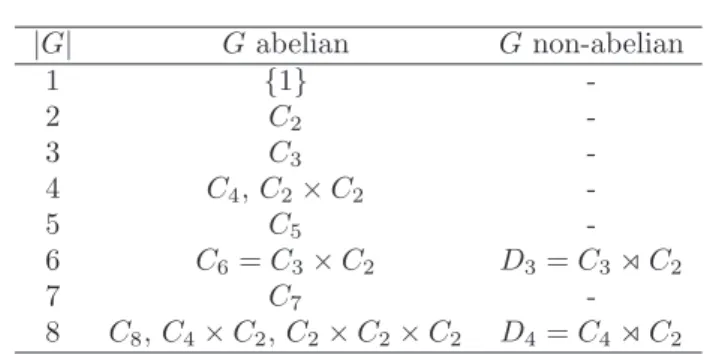
|G| Gabelian Gnon-abelian
1 {1}
-2 C2
-3 C3
-4 C4,C2×C2
-5 C5
-6 C6=C3×C2 D3=C3⋊C2
7 C7
-8 C8,C4×C2,C2×C2×C2 D4=C4⋊C2
Table 1.2: Cn denotes the cyclic group of order n,Dn the dihedral group
Example 1.24. Thanks to the new structures we have seen in this section, we can go on our investigation of groups of small orders. We can get two new groups of order 6 and 4 of order 8:
• C3×C2is the direct product ofC3andC2. You may want to check that
it is actually isomorphic toC6.
• The dihedral group D3 =C3⋊C2 is the semi-direct product ofC3 and
C2. We get similarlyD4=C4⋊C2.
• The direct product C4×C2 and the direct product of the Klein group
C2×C2 withC2.
The table actually gives an exact classification of groups of small order (ex-cept the missing non-abelian quaternion group of order 8), though we have not proven it. The reason why the quaternion group of order 8 is missing is exactly because it cannot be written as a semi-direct product of smaller groups (see Exercises).
1.7
Permutations and Group action
Since we introduced the definition of group as a set with a binary operation which is closed, we have been computing things internally, that is inside a group structure. This was the case even when considering cartesian products of groups, where the first thing we did was to endow this set with a group structure.
In this section, we wonder what happens if we have a group and a set, which may or may not have a group structure. We will define a group action, that is a way to do computations with two objects, one with a group law, not the other one.
As a first result, we will prove the so-called Cayley’s theorem, whose proof will motivate the introduction of group action. Since the statement of this theo-rem uses permutation groups, we start by recalling the necessary definitions. We will give enough background on permutations to define the alternating group, a group which is useful as an illustration of many concepts!
1.7. PERMUTATIONS AND GROUP ACTION 31
Definition 1.19. A permutation of a set S is a bijection on S. The set of all such functions (with respect to function composition) is a group called the symmetric grouponS. We denote by Sn the symmetric group onnelements.
Example 1.25. Consider the symmetric group S3 of permutations on 3
ele-ments. It is given by (note here that by ab we mean that we first apply the permutationb, thena)
e : 123→123 or () a : 123→213 or (12)
b : 123→132 or (23) ba : 123→312 or (132) ab : 123→231 or (123) aba : 123→321 or (13)
One can check that this is indeed a group. The notation (132) means that the permutation sends 1 to 3, 3 to 2, and 2 to 1.
We can generally write a permutation onm elements as (i1, . . . , im), which
is called a cycle notation. The permutation (i1, . . . , im) is called an m-cycle.
When m = 2, a 2-cycle is called a transposition. Note that several different cycles can represent the same permutation (e.g., (132) = (321) = (213)), and not every permutation is a cycle. For example, if we consider 1 7→ 2, 2 7→ 1, 3 7→ 4, 4 7→ 3, this permutation is not a cycle. However, it is clearly the product of two disjoint cycles, namely (12)(34). Formally, we say that two cycles (i1, . . . , is) and (j1, . . . , jt) are disjoint if and only if{i1, . . . , is} ∩ {j1, . . . , jt}is
empty. Such a decomposition of a permutation into product of disjoint cycles is true in general.
Proposition 1.23. Every element ofSn can be expressed uniquely as a product
of disjoint cycles, up to ordering of the cycles, and notational redundancy within each cycle. Furthermore, every cycle can be written as a product of transposi-tions.
Proof. Let σ be an element of Sn. Choose any index i1 ∈ {1, . . . , n}. By
applyingσrepeatedly oni1, we construct a sequence of elements of{1, . . . , n}:
i1, i2, . . ., whereij=σ(ij−1) forj≥2. If we letjgrow, this sequence necessarily
contains repetitions: suppose that thekth term is the first one which is repeated, that isik =ij withj < k. But this means that bothik−1 andij−1are mapped
to ik by σ, and since σ is a bijection, two elements cannot be mapped to ik,
thus it must be that ik =i1 (the only element which has not yet a preimage).
We then see that σdefines ak−1-cycle (i1, . . . , ik−1).
Ifk−1 =n, we are done. If not, we takei′
1 another index not covered by the
first cycle, and iterate. This second cycle has to be disjoint from the first one, sinceσis a bijection. We then obtain a disjoint cycle representation forσ.
Now take anl-cycle (i1, . . . , il).It can be rewritten as
(i1, . . . , il) = (i1 i2)(i2 i3)· · ·(il−1 il).
Indeed, start with the right hand-side: ilandil−1are swapped. Thus (i1, . . . , il)
is mapped to anl-tuple whose last 2 terms areil, il−1. The next transposition
is (il−2, il−1), thus both terms are swapped, and we now have as last 3 terms
il−1, il, il−2. The next swap will yield
il−2, il−1, il, il−3
and by iterating this process, we reach the last swap (i1, i2), that is
i2, i3, . . . , il, i1
as we wanted to prove.
The representation has a product of transpositions is not unique, for example (2,5,3,6) = (2,6)(2,3)(2,5) = (5,2)(3,5)(6,3) = (1,7)(2,6)(2,3)(2,5)(1,7). We can however define an invariant of a permutation, called the parity.
Definition 1.20. An element ofSn is said to beevenif it can be expressed as
a product of an even number of transpositions. It is saidoddotherwise. For this definition to make sense, parity of an element ofSnshould be unique,
which it is.
Theorem 1.24. Forn≥2, every element of Sn has a unique parity, even or
odd.
Proof. To prove this, we need to introduce some ordering on the permutations. We call the switching number of a permutationσ the number of ordered pairs (i, j) with i < j but σ(i) > σ(j). The switching number is an invariant of a permutation. Let t be the switching number of σ, and let τ be an arbitrary transposition, sayτ = (i j). Without loss of generality, we may assume that i comes beforej in the permutation
σ(1), . . . , σ(n).
By applying τ toσ, we switch iandj, and the picture now looks like (1,2, . . . , σ−1(i), . . . , σ−1(j), . . . , n)−→σ (σ(1), σ(2), . . . , i, . . . , j, . . . , σ(n))
τ
−→(σ(1), σ(2), . . . , τ(i), . . . , τ(j), . . . , σ(n))
(where the first vector is ordered, but not the second and the third).
To understand the effect of the transpositionτ on the switching number of σ(that is we are computing the switching number of τ σand see how it differs from that of σ), we need to remember that we are looking at all the ordered pairs (k, l),k < l, in (1,2, . . . , n):
1.7. PERMUTATIONS AND GROUP ACTION 33
1. For the ordered pair (σ−1(i), σ−1(j)), when applying σ, either (a) the ordering is preserved (i.e., i < j), the switching number thus does not change, however when applying τ, the ordering is reversed, and thus t increases by 1, or (b) the ordering is changed, but τ changes again the ordering, so thatt decreases by 1.
2. Let us now assume that i < j (if not do the same with j > i). Then for every index l such i < l < j, we can look at the non-ordered pairs (i, l) and (l, j). It might be thatσ−1(i) is either greater or smaller than
σ−1(l), yielding one ordered pair or the other, and similarly forσ−1(j) and
σ−1(l). Thus each ordered pair might or not contribute to the switching
number ofσ, but after τ is applied, i and j are reversed, and thus both (i, l) and (l, j) are changed at once. Thus the switching number increases by 2, decreases by 2, or does not change. We can write down the cases explicitly:
(σ−1(i), σ−1(l)),(σ−1(l), σ−1(j))−→σ (i, l),(l, j)−→τ (j, l),(l, i), i < l < j thus the switching number ofσis tincluding no switch for these 2 pairs, and that ofτ σhas two switches for these 2 paires, thus is oft+ 2.
(σ−1(i), σ−1(l)),(σ−1(j), σ−1(l))−→σ (i, l),(j, l)−→τ (j, l),(i, l), i < l < j and the switching number of σ is here t including one switch for the second pair, and that ofτ σhas one switch for the first pair, but none for the second, thus a total oft. The case (σ−1(l), σ−1(i)),(σ−1(l), σ−1(j))
also givest, and finally
(σ−1(l), σ−1(i)),(σ−1(j), σ−1(l))−→σ (l, i),(j, l)−→τ (l, j),(i, l), i < l < j has a switching number oftforσincluding two switches for these 2 pairs, andτ σhas no switch, thus a total oft−2.
3. All the non-ordered pairs (k, l), where l < i < j and k < l or k > l, or l > j > iandk < lork > l(that is all the cases not conisdered so far) do not induce any change in the switching number, since by swappingi and j, we do not change the ordering of the pairs.
This shows that given a permutationσwith switching numbert, composing with one transposition always changes the parity of the switching number. Since the switching number is invariant, this means that it always takes an even number of transpositions applied toσto have a chance to keep the same switching number. This establishes that the parity of a permutation is either even or odd, but not both.
Definition 1.21. The set of even permutations forms a subgroup ofSn called
Note that ifτ is any odd permutation, then the coset τ An consists entirely
of odd permutations, and conversely, if σis an odd permutation, thenτ−1σ is
even, soσ∈τ An. This shows that|An|=|Sn|/2.
We will encounter the alternating group in the future, but for now, we only need to recall the definition of the symmetric groupSn to prove Cayley’s
The-orem.
Theorem 1.25. (Cayley’s Theorem.) Every group is isomorphic to a group of permutations.
Proof. Let SG be the group of permutations of G. We will prove that every
group is isomorphic to a subgroup ofSG. The idea is that each elementg ∈G
corresponds to a permutation ofG, namely we need to define a map fromGto SG:
λ:G→SG, g7→λ(g) =λg
and sinceλg is a bijection onG, we need to define whatλg does:
λg :G→G, λg(x) =gx.
For justifying that λg is indeed a bijection, it is enough to see that g−1 exists
sinceGis a group (try to write down the definition of injection and surjection). We are left to check thatλis an injective group homomorphism. Injectivity again comes from Gbeing a group, for if λg(x) =λh(x) for all x∈G, then it
has to be true thatgx=hxwhenx= 1. Now
(λ(a)◦λ(b))(x) = (λa◦λb)(x) =a(bx) =λab(x) =λ(ab)(x)
for allx, so thatλ(a)◦λ(b) =λ(ab) which concludes the proof.
Examples 1.26. 1. Consider the group {0,1} of integers modulo 2. The group element 0 corresponds to the identity permutation, while the group element 1 corresponds to the permutation (12).
2. Let us consider the group{0,1,2}of integers modulo 3 to get a less simple example. Again 0 corresponds to the identity permutation, 1 corresponds to the permutation (123), and 2 to the permutation (132). To see that it makes sense, you may want to check that the arithmetic works similarly on both sides. For example, we can say that 1 + 1 = 2 on the one hand, now on the other hand, we have (123)(123) = (132).
3. One can check that the dihedral group D3 of order 6 is isomorphic toS3
(this can be done for example by working out the multiplication table for each group).
The key point in the proof of Cayley’s Theorem is the way the functionλg
1.7. PERMUTATIONS AND GROUP ACTION 35
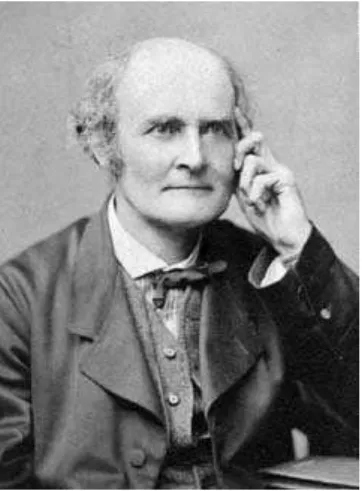
Figure 1.2: Arthur Cayley (1821-1895): he was the first to define the concept of a group in the modern way. Before him, groups referred to permutation groups.
Definition 1.22. The group G actson the set X if for all g ∈ G, there is a map
G×X →X, (g, x)7→g·x such that
1. h·(g·x) = (hg)·xfor allg, h∈G, for allx∈X. 2. 1·x=xfor allx∈X.
The first condition says that we have two laws, the group law between ele-ments of the group, and the action of the group on the set, which are compatible.
Examples 1.27. Let us consider two examples where a groupGacts on itself. 1. Every group acts on itself by left multiplication. This is called the regular
action.
2. Every group acts on itself by conjugation. Let us write this action as
g·x=gxg−1.
Let us check the action is actually well defined. First, we have that
h·(g·x) =h·(gxg−1) =hgxg−1h−1= (hg)xg−1h−1= (hg)·x. As for the identity, we get
Similarly to the notion of kernel for a homomorphism, we can define the kernel of an action.
Definition 1.23. Thekernelof an actionG×X →X, (g, x)7→g·xis given by
Ker ={g∈G, g·x=xfor allx}.
This is the set of elements of Gthat fix everything in X. When the group G acts on itself, that is X=Gand the action is the conjugation, we have
Ker ={g∈G, gxg−1=xfor allx}={g∈G, gx=xgfor allx}. This is called thecenter ofG, denoted byZ(G).
Definition 1.24. Suppose that a group Gacts on a setX. TheorbitB(x) of xunder the action ofGis defined by
B(x) ={g·x, g∈G}.
This means that we fix an elementx∈X, and then we letgact onxwheng runs through all the elements ofG. By the definition of an action,g·xbelongs toX, so the orbit gives a subset ofX.
It is important to notice that orbits partition X. Clearly, one has that X = ∪x∈XB(x). But now, assume that one element x of X belongs to two
orbits B(y) and B(z), then it means that x = g·y = g′ ·z, which in turn implies, due to the fact thatGis a group, that
y=g−1g′·z, z= (g′)−1g·y.
In words, that means thatybelongs to the orbit ofz, and vice-versa,zbelongs to the orbit ofy, and thusB(y) =B(z). We can then pick a set of representatives for each orbit, and write that
X =⊔B(x),
where the disjoint union is taken over a set of representatives.
Definition 1.25. Suppose that a group Gacts on a set X. We say that the action is transitive, or that Gacts transitivelyonX if there is only one orbit, namely, for all x, y∈X, there existsg∈Gsuch thatg·x=y.
Definition 1.26. Thestabilizer of an elementx∈X under the action of Gis defined by
Stab(x) ={g∈G, g·x=x}.
Given x, the stabilizer Stab(x) is the set of elements of G that leave x fixed. One may check that this is a subgroup of G. We have to check that if g, h∈Stab(x), thengh−1∈Stab(x). Now
1.7. PERMUTATIONS AND GROUP ACTION 37
by definition of action. Since h ∈ Stab(x), we have h·x= xor equivalently x=h−1·x, so that
g·(h−1·x) =g·x=x,
which shows that Stab(x) is a subgroup ofG.
Examples 1.28. 1. The regular action (see the previous example) is tran-sitive, and for allx∈X =G, we have Stab(x) ={1}, sincexis invertible and we can multiplyg·x=xbyx−1.
2. Let us consider the action by conjugation, which is again an action of G on itself (X =G): g·x=gxg−1. The action has no reason to be transitive
in general, and for allx∈X =G, the orbit of xis given by B(x) ={gxg−1, g∈G}.
This is called theconjugacy classofx. Let us now consider the stabilizer of an elementx∈X:
Stab(x) ={g∈G, gxg−1=x}={g∈G, gx=xg}, which is thecentralizerofx, that we denote by CG(x).
Note that we can define similarly the centralizerCG(S) whereS is an
arbi-trary subset ofGas the set of elements ofGwhich commute with everything in S. The two extreme cases are: ifS ={x}, we get the centralizer of one element, ifS=G, we get the centerZ(G).
Theorem 1.26. (The Orbit-Stabilizer Theorem). Suppose that a groupG acts on a setX. LetB(x)be the orbit ofx∈X, and letStab(x)be the stabilizer of x. Then the size of the orbit is the index of the stabilizer, that is
|B(x)|= [G: Stab(x)]. If Gis finite, then
|B(x)|=|G|/|Stab(x)|.
In particular, the size of an orbit divides the order of the group.
Proof. Recall first that [G: Stab(x)] counts the number of left cosets of Stab(x) in G, that is the cardinality of
G/Stab(x) ={gStab(x), g∈G}.
Note that cosets of Stab(x) are well-defined since we saw that Stab(x) is a subgroup of G. The idea of the proof is to build a function between the sets B(x) and G/Stab(x) which is a bijection. That the cardinalities are the same will then follow.
Takey∈B(x), that is y=g·xfor some g∈G. We define a map f :B(x)→G/Stab(x), y=g·x7→gStab(x).
Before checking that this map is a bijection, we need to check that it is well defined. Indeed, for a giveny, there is no reason for the choice ofgto be unique (there is in general no bijection between GandB(x)). Suppose that
y=g1·x=g2·x
then
g−21g1·x=x ⇐⇒ g1Stab(x) =g2Stab(x).
The equivalence is the characterization of having two equal cosets. This is exactly what we wanted: the image by f does not depend on the choice ofg, and if we choose two different g’s, their image falls into the same coset.
The surjectivity off is immediate.
We conclude the proof by showing the injectivity. Let us assume thatf(y1) =
f(y2) fory1=g1·x∈B(x),y2=g2·x∈B(x). Thus
g1Stab(x) =g2Stab(x) ⇐⇒ g2−1g1∈Stab(x) ⇐⇒ g2−1g1·x=x ⇐⇒ g1·x=g2·x.
LetGbe a finite group. We consider again as action the conjugation (X = G), given by: g·x=gxg−1. Recall that orbits under this action are given by
B(x) ={gxg−1, g∈G}.
Let us notice that xalways is in its orbitB(x) (takeg = 1). Thus if we have an orbit of size 1, this means that
gxg−1=x ⇐⇒ gx=xg
and we get an elementxin the centerZ(G) ofG. In words, elements that have an orbit of size 1 under the action by conjugation are elements of the center.
Recall that the orbitsB(x) partitionX: X =⊔B(x)
where the disjoint union is over a set of representatives. We get |G| = X|B(x)|
= |Z(G)|+X|B(x)| = |Z(G)|+X[G: Stab(x)],
where the second equality comes by splitting the sum between orbits with 1 element and orbits with at least 2 elements, while the third follows from the Orbit-Stabilizer Theorem. By remembering that Stab(x) = CG(x) when the
action is the conjugation, we can alternatively write |G|=|Z(G)|+X[G:CG(x)].
1.7. PERMUTATIONS AND GROUP ACTION 39
Example 1.29. Consider the dihedralD4of order 8, given by
D4={1, s, r, r2, r3, rs, r2s, r3s},
with s2 = 1, r4 = 1 and srs =r−1. We have that the center Z(D
4) of D4 is
{1, r2}(just check thatr2s=sr2). There are three conjugacy classes given by
{r, r3}, {rs, r3s},{s, r2s}. Thus
|D4|= 8 =|Z(D4)|+|B(r)|+|B(rs)|+|B(s)|.
The following result has many names: Burnside’s lemma, Burnside’s count-ing theorem, the Cauchy-Frobenius lemma or the orbit-countcount-ing theorem. This result is not due to Burnside himself, who only quoted it. It is attributed to Frobenius.
Theorem 1.27. (Orbit-Counting Theorem). Let the finite groupGact on the finite setX, and denote by Xg the set of elements ofX that are fixed by g,
that is Xg={x∈X, g·x=x}. Then
number of orbits= 1 |G|
X
g∈G
|Xg|,
that is the number of orbits is the average number of points left fixed by elements of G.
Proof. We have
X
g∈G
|Xg| = |{(g, x)∈G×X, g·x=x}|
= X
x∈X
|Stab(x)|
= X
x∈X
|G|/|B(x)| by the Orbit-Stabilizer Theorem. We go on:
X
x∈X
|G|/|B(x)| = |G|X
x∈X
1/|B(x)| = |G| X
B∈set of orbits
X
x∈B
1 |B| = |G| X
B∈set of orbits 1
which concludes the proof. Note that the second equality comes from the fact that we can writeX as a disjoint union of orbits.