TECHNICAL UNIVERSITY OF CLUJ-NAPOCA
ACTA TECHNICA NAPOCENSIS
Series: Applied Mathematics, Mechanics, and Engineering Vol. 62, Issue II, June, 2019
STUDY OF AN ELASTIC BEAM, IN CENTRIFUGAL FIELD, USING
FINITE ELEMENT METHOD
Maria Luminiţa SCUTARU, Eliza CHIRCAN, Marin MARIN
Abstract: The finite element method (FEM) has been applied mainly to the study of the behavior of different elastic bodies, whether static or dynamic. The case of rigid motion of bodies analyzed with MEF, involving new terms due to the effects of inertia and relative motions, has not yet been incorporated into the classic MEF software. Papers to analyze this behavior arose in the 70's for the plane beam and later for a three-dimensional general motion. The present paper aims to develop models previously studied by other researchers and study the influences that the geometric parameters of the bar can have on the dynamic response. The case study is that of a moving bar in a rotation around a fixed axis. The shape functions used are of degree five.
Key words: Finite Element Method, beam, eigenvalues, eigenmodes, rotation, centrifugal 1. INTRODUCTION
The study of elastic elements with a rigid general motion using MEF was begun in the 1970s. The development of the domain was made gradually, first for a single beam using third degree interpolation functions, then for a plane mechanism. The method was developed using degree five interpolation polynomials. From the plane motion to the three-dimensional motion of a beam was used, using the third degree polynomials, then the five-degree polynomials. The finite element used in all these cases was the one-dimensional finite element[2],[3],[5],[22]. The theoretical model for which internal energy was calculated was the Bernoulli model, then went to the Rayleigh model and finally to the Timoshenko model [29]-[34]. The method used to write motion equations was Lagrange's equations and Hamilton's equations method. From one-dimensional finite elements, the researchers passed to the two- and three-dimensional finite elements[23]-[26]. However, the results that contributed to the theoretical development of the field did not lead to the development of the finite element software in this direction, by incorporating the obtained results, due to the
difficulties of modeling the respective mechanical systems[1],[4],[6]-[13],[20],[21]. The problems that can solved by this method also involve a previous analysis to determine the velocity and acceleration field, so the use of multibody systems (MBS) models.
In this paper we propose the development of a finite beam model using the five degree shape functions to study the behavior of a beam in a centrifugal field.
2. MODEL AND SHAPE FUNCTIONS
For the present study, a one-dimensional finite element is used, related to an Oxy mobile (local) reference system. The rotation is related to a fixed (global) O'XYZ reference system, around the O'Z axis.
The boundary conditions for the axial displacement u, if the linear shape functions are chosen, lead to the equations:
2 2 1 1 2 1 1
)
( N u N u
l x u l x u x
u + = +
−
= .
Using the notation l x
=
ζ the shape functions
are: 1=1− =1−ζ
l x
N ; = =ζ
l x
Fig. 1. Model of an one-dimensional finite element
Using the notation l x
=
ζ the shape functions
are: 1 =1− =1−ζ l x
N ; = =ζ
l x
N2 . (1)
For the transverse motion, a polynomial of degree 5 is chosen. It is considered, in this case, the displacement of the ends, the rotation of the cross sections and the curvatures at the ends. Writing the end conditions, it will be obtained:
( )
v1N3 v2N4 1N5 2N6 m1N7 m2N8v
ζ
= + +θ
+θ
+ +(2) with:
5 4 3
3=1−10
ζ
+15ζ
−6ζ
N ;
5 4 3
4=10
ζ
−15ζ
+6ζ
N ;
(
3 4 5)
5 =l
ζ
−6ζ
+8ζ
−3ζ
N ;
(
3 4 5)
6 =l−4
ζ
+7ζ
−3ζ
N ;
(
2 3 4 5)
2
7 3 3
2
ζ
−ζ
+ζ
−ζ
=l
N ;
(
3 4 5)
2
8 2
2
ζ
−ζ
+ζ
=l N . It results:
( )
= ∂ ∂ = ∂ ∂ = ζ ζ θ l v x v ′ + ′ + ′ + ′ + ′ + ′=v1N3 v2N4
θ
1N5θ
2N6 m1N7 m2N8 ;(3)
( )
= ∂ ∂ = ∂ ∂= 22 2 2 2 ζ ζ l v x v m ″ + ″ + ″ + ″ + ″ + ″
=v1N3 v2N4
θ
1N5θ
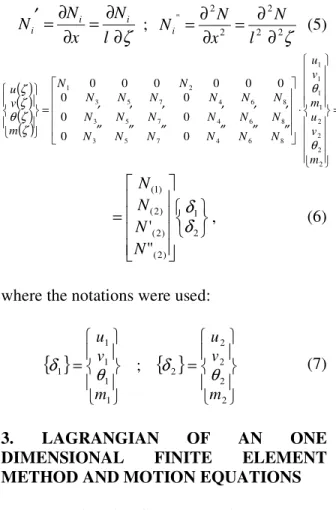
2N6 m1N7 m2N8 ,(4) where:
ζ
∂ ∂ = ∂ ∂ = ′ l N x NN i i
i ;
ζ 2 2 2 2 2 " ∂ ∂ = ∂ ∂ = l N x N
Ni (5)
( ) ( ) ( ) ( ) = ⋅ ″ ″ ″ ″ ″ ″ ′ ′ ′ ′ ′ ′ = 2 2 2 2 1 1 1 1 8 6 4 7 5 3 8 6 4 7 5 3 8 6 4 7 5 3 2 1 0 0 0 0 0 0 0 0 0 0 0 0 m v u m v u N N N N N N N N N N N N N N N N N N N N m v u θ θ ζ ζ θζ ζ , " ' 2 1 ) 2 ( ) 2 ( ) 2 ( ) 1 (
= δδ
N N N N
(6)
where the notations were used:
{ }
{ }
= = 2 2 2 2 2 1 1 1 1 1 ; m v u m v u θ δ θδ (7)
3. LAGRANGIAN OF AN ONE
DIMENSIONAL FINITE ELEMENT
METHOD AND MOTION EQUATIONS
Lagrange's function for the beam is:
d c i
c E W W
E
L= − + + (8)
where Ec is the kinetic energy of the bar, Ei the
internal energy, Wc+Wd the work of
concentrated and distributed forces.
The position vector of an arbitrary point of the deformed fiber is:
{ } { }
[ ]
+[ ]
⋅ = ⋅ + =′ r R l R uv
rM
0
0 ζ
{ }
[ ]
ζ +[ ] [ ] { }
⋅ ⋅ δ ⋅ +
= r R l R N
0
0 . (9)
The velocity of this point is:
′ = + ⋅ 0 +
⋅ ⋅ + ⋅ ⋅ (10) where the matrix
[ ]
R is:[ ]
−
= cossinθθ cossinθθ
R ; = − −
− !
where = (the angular velocity of the rigid motion of the beam).
The kinetic energy for a beam element dm is: "# =$%& ' ()1 ′ *⋅ ′ + +, *%. 0
(13)
where: *= + = + 2%3 ′⋅ .
(14)
If the calculus are made for kinetic energy, it obtains:
"# =12 6 1
')2 * + 2 *
0
+ 2 * +
+2 * + 7 0 *
0 +
+2 0 *
+ 2 0 * +
+ * * *
+ 2 * * * +
+ * * * 3 0 +
+$%&1 '+,2 %+ 2 2%3 ′ + *
2%3 ′ *
2%3 ′ 3 0 (15) If Lagrange equations are written [14]-[19], [27],[28]:
898:;:<−:<:;= 0, (17) the motion equations are obtained as:
2 => + =? 3 @ + 2 2 =%$ − =$% 3 +
[ ] [ ]
[ ]
(
[ ] [ ]
)
(
[ ] [ ]
)
[
+ + +ε − −ω 11+ 22]
{ }
δ =2 12
21 m m m
m k k
ki a eG =
− % =
$A *+ @ * =B>C * +
+D2 =>>C *+ =%A *3 + * =B>C *3. (18) 4. INFLUENCE OF GEOMETRIC PARAMETERS ON
EIGEN-FREQUENCIES
Using the previously obtained equations (18), a study was performed to see how the eigenvalues of the elastic beam is affected by the geometrical parameters. This is practically useful as it is found that for some sets of parameters, the system becomes unstable. The lengths of the element and its diameter have varied (the circular section from the beam is considered to reduce the number of parameters defining the
bar geometry), the concentrated mass that can be applied to the end of the bar and the angular speed of the beam. The results are presented in the following figures (Fig.2-10)
Fig.3. Beam with L=0.7m in a centrifugal field
Fig.4. First ten eigenfrequencies, L variable, d variable
Fig.6. Beam with d=0.03 m, L variable
Fig.7. Beam with d=0.02 m, L variable
Fig.8. The first eigenfrequency, L variable, d variable, endmass variable. Logaritmic scale.
Fig.10. The first eigenfrequency, L variable, d variable, end mass variable. Linear scale.
Fig.10. The first eigenfrequency, L variable, d variable, endmass variable. Logaritmic scale.
5. CONCLUSION
In this paper, the motion equations for a beam in a rotary motion were established, being considered fifth-degree shape functions. After determining these equations, it was determined how different parameters defining the properties of the bar can influence the beam eigenfrequencies. There is a problem in the sense that, in a certain range of values, the beam may enter into an unstable response. It determines the eigenfrequencies variation of the beam if the diameter varies, its length changes or the concentrated mass at the end of the bar is varied. All these parameters can influence their eigenfrequencies and, for some values, instability phenomena can be reached.
6. REFERENCES
[1] Deu, J.-F., Galucio, A.C., Ohayon, R., Dynamic
responses of flexible-link mechanisms with
passive/active damping treatment. Comput.
Struct. 86(35), 258–265, 2008.
[2] Erdman, A.G., Sandor, G.N., Oakberg, A., A general method for kineto-elastodynamic
analysis and synthesis of mechanisms. J. Eng.
Ind. ASME Trans. 94(4), 1193–1203, 1972. [3] Fanghella, P., Galletti, C., Torre, G., An explicit
independent-coordinate formulation for
equations of motion of flexible multibody
systems. Mech. Mach. Theory 38, 417–437,
2003.
[4] De Falco, D., Pennestri, E., Vita, L., An investigation of the influence of pseudoinverse matrix calculations on multibody dynamics by
means of the Udwadia–Kalaba formulation. J.
Aerosp. Eng. 22(4), 365–372, 2009.
[5] Gerstmayr, J., Schberl, J., A 3D finite element
method for flexible multibody systems.
Multibody Syst. Dyn. 15(4), 305–320, 2006. [6] Hou, W., Zhang, X., Dynamic analysis of flexible
linkage mechanisms under uniform
temperature change. J. Sound Vib. 319(12),
570–592, 2009.
[7] Ibrahimbegovic, A., Mamouri, S., Taylor, R.L., Chen, A.J., Finite element method in dynamics of flexible multibody systems: modeling of holonomic constraints and energy conserving
integration schemes. Multibody Syst.
Dyn. 4(2–3), 195–223, 2000.
[8] Khang, N.V., Kronecker product and a new
matrix form of Lagrangian equations with
multipliers for constrained multibody systems.
Mech. Res. Commun. 38(4), 294–299, 2011. [9] Khulief, Y.A., On the finite element dynamic
analysis of flexible mechanisms. Comput.
Methods Appl. Mech. Eng. 97(1), 23–32, 1992.
[10] Marin, M., Oechsner, A., The effect of a dipolar structure on the Holder stability in
Green-Naghdi thermoelasticity, Contin Mech
Thermodyn, 29(6) 1365-1374, 2017.
[11] Marin, M., Cesaro means in thermoelasticity of
dipolar bodies, Acta Mech, 122(1-4),
155-168, 1997.
[12] Marin, M., Öchsner, A., Complements of Higher
Mathematics. Springer, Cham (2018)
[13] Mayo, J., Dominguez, J., Geometrically non-linear formulation of flexible multibody systems in terms of beam elements: geometric
stiffness. Comput. Struct. 59(6), 1039–1050,
1996.
[14] Negrean I., New Formulations in Analytical
Dynamics of Systems, Acta Technica
Napocensis, Series: Applied Mathematics, Mechanics and Engineering, Vol. 60, Issue I, pp. 49-56, 2017.
[15] Negrean I., Mass Distribution in Analytical
Dynamics of Systems, Acta Technica
Napocensis, Series: Applied Mathematics, Mechanics and Engineering, Vol. 60, Issue II, pp. 175-184, 2017.
[16] Negrean I., Generalized Forces in Analytical
Dynamics of Systems, Acta Technica
Napocensis, Series: Applied Mathematics, Mechanics and Engineering, Vol. 60, Issue III, pp. 357-368, 2017.
[17] Negrean I., Advanced Notions in Analytical
Dynamics of Systems, Acta Technica
Napocensis, Series: Applied Mathematics, Mechanics and Engineering, Vol. 60, Issue IV, pp. 491-502, 2017.
[18] Negrean I., Advanced Equations in Analytical
Dynamics of Systems, Acta Technica
Napocensis, Series: Applied Mathematics, Mechanics and Engineering, Vol. 60, Issue IV, pp. 503-514, 2017.
[19] Negrean I., New Approaches on Notions from
Advanced Mechanics, Acta Technica
Napocensis, Series: Applied Mathematics, Mechanics and Engineering, Vol. 61, Issue II, pp. 149-158, 2018.
[20] Neto, M.A., Ambrosio, J.A.C., Leal, R.P.,
Composite materials in flexible multibody
systems. Comput. Methods Appl. Mech.
Eng. 195(5051), 6860–6873, 2006.
[21] Öchsner, A., Computational Statics and
Dynamics: An Introduction Based on the
Finite Element Method. Springer, Singapore,
2016.
[22] Piras, G., Cleghorn, W.L., Mills, J.K., Dynamic finite-element analysis of a planar high speed, high-precision parallel manipulator with
flexible links. Mech. Mach. Theory 40(7),
849–862, 2005.
[23] Shi, Y.M., Li, Z.F., Hua, H.X., Fu, Z.F., Liu, T.X., The modelling and vibration control of
beams with active constrained layer damping.
J. Sound Vib. 245(5), 785–800, 2001.
[24] Simeon, B., On Lagrange multipliers in flexible
multibody dynamic. Comput. Methods Appl.
Mech. Eng. 195(50–51), 6993–7005, 2006.
[25] Sung, C.K., An experimental study on the
nonlinear elastic dynamic response of linkage
mechanism. Mech. Mach. Theory 21, 121–
[26] Thompson, B.S., Sung, C.K., A survey of finite element techniques for mechanism design.
Mech. Mach. Theory 21(4), 351–359, 1986.
[27] Vlase, S., A Method of eliminating
Lagrangian-Multipliers from the Equation of Motion of
Interconnected Mechanical Systems. Journal
of Applied Mechanics-Transactions of the ASME, Vol. 54, Issue: 1, pp: 235-237, 1987.
[28] Vlase, S., Elimination of Lagrangian
multipliers. Mech. Res. Commun. 14(1), 17–
22, 1987.
[29] Vlase, S., Teodorescu, P. P., Elasto-Dynamics of a Solid with a General "Rigid" Motion using FEM Model Part I. Theoretical Approach.
Romanian Journal of Physics, Vol. 58, 7-8, pp. 872-881,2013.
[30] Vlase, S., Teodorescu, P. P., Itu, C. et al.,
Elasto-Dynamics of a Solid with a General "Rigid" Motion using FEM Model Part II.
Analysis of a Double Cardan Joint. Romanian
Journal of Physics, Vol. 58, 7-8, pp. 882-892,2013.
[31] Vlase, S., Marin, M., Öchsner, A. et al. Motion equation for a flexible one-dimensional element used in the dynamical analysis of a
multibody system. Continuum Mech.
Thermodyn. 31: 715. https:// doi.org/10.1007 /s00161-018-0722-y, 2019.
[32] Vlase, S., Finite element analysis of the planar
mechanisms: numerical aspects. Appl.
Mech. 4, 90–100, 1992.
[33] Vlase, S., Dynamical response of a multibody system with flexible element with a general
three-dimensional motion. Rom. J.
Phys. 57(3–4), 676–693, 2012.
[34] Vlase, S., Danasel, C., Scutaru, M.L., Mihalcica, M., Finite element analysis of two-dimensional linear elastic systems with a
plane rigid motion. Rom. J. Phys. 59(5–6),
476–487, 2014.
Studiul unei bare elastice într-un câmp centrifugal, utilizând metoda elementelor finite
Rezumat. Metoda elementelor finite a fost aplicată, cu precădere, la studiul comportării diferitelor corpuri elastic, în caz static sau dynamic. Cazul mișcărilor de rigid ale corpurilor analizate cu MEF, care implică termeni noi, datorați efectelor inerției și a mișcărilor relative nu a fost încă incorporate în softul clasic de MEF. Lucrări care să analizeze această comportare au apărut în anii 70, pentru bara cu mișcare plană și, mai apoi, pentru corpuri cu mișcarea general, tridimensională. Lucrarea de față își propune dezvoltarea unor modele studiate anterior de alți cercetători și studiul influențelor pe care parametrii geometrici ai barei le poate avea asupra răspunsului dinamic al barei. Cazul studiat este acela al unei bare în mișcare de rotație cu axă fixă. Funcțiile de interpolare utilizate sunt cele de gradul cinci.
SCUTARU Maria Luminiţa, Prof.Dr.hab.Eng.,Transylvania University of Brașov, Department of
Mechanical Engineering, [email protected],Office phone:+40-268-418992,29,B-dul Eroilor,500036, Brașov.
CHIRCAN Eliza, Ph.D. student, Transylvania University of Brașov, Department of Mechanical
Engineering, [email protected], Office phone: +40-268-418992, 29, B-dul Eroilor, 500036, Brașov.
MARIN Marin, Prof. Dr.hab., Transylvania University of Brașov, Department of Mathematics,