Emerging Science Journal
Vol. 3, No. 2, April, 2019
Studies on Synthesis, Characterization of Modified Phenol
Formaldehyde Resin and Metal Adsorption of Modified Resin
Derived From Lignin Biomass
S. Arasaretnam
a,*, T. Kirudchayini
aa Department of Chemistry, Faculty of Science, Eastern University, Vantharumoolai, Chenkalady, Sri Lanka
Abstract
This study was related to development of economically viable method of extraction of lignin from saw dust in order to produce lignin modified phenolic resin and ecofriendly adhesives (bio-based resin). This study cover to improve the mechanical properties by modification of phenol formaldehyde resole resin using some additives such as boric acid, sulfuric acid and lignin biomass. The synthesis and metal adsorption capacity of resin derived from lignin biomass were explored. Lignin sample was extracted from sawdust of Acacia sp. collected from Batticaloa region by alkali extraction method called delignification process. Qualitative tests were carried out on the extracted alkali lignin and it was used to prepare modified resin. Resin synthesized by using lignin substitution phenol and allowed to condensation reaction in the presence of sodium hydroxide. Boron-modified phenol formaldehyde resin was prepared by using boric acid with formalim method. The above reaction was performed for four hours by refluxing with toluene. Which was produced a high viscous massive resin with 90% yield. The absorbtion peak of B-O bond at 1362cm-1 was observed at IR spectra. Rise in solid mass
content leads to produce smooth resin surface without causing cracks and bubbling. Phenol formaldehyde resin was modified into their sulfonated forms to increase their ion exchange capacity, since the ion exchange capacity of virgin resin was found to be zero. Conductivity property shown by sulfonated resin(121mS/cm). The synthesized Lignin based PF resin was used to study the metal adsorption capacity of Cd2+ in aqueous solution. The adsorption capacity of heavy metal Cd2+ ion
shown by lignin modified resin (55%) and lignin (86%). In this study sawdust lignin could be best substitution for phenol in synthesis of Phenol-Formaldehyde resin. It’s better due to their sustainability, environmental control, low production cost and their ability to adsorb heavy metals. Phenolic resin was modified with boric acid to improve thermal resistance property and to get smooth resin surface.
Keywords:
Phenol Formaldehyde Resin (PFR); Lignin;
Boron Modified Phenolic Resin (BPFR); Lignin Based Phenolic Resin (LPFR); Adsorption Capacity.
Article History:
Received: 21 January 2019
Accepted: 30 March 2019
1- Introduction
The progress of new and modified polymers and their applications leads to improve the manufacture of new products. Polymers differ in their individualities because of their unique structural complexities [1]. Even though polymers are generally classified as elastomers, plastics and fibers, the individuality of the above group vary widely in the sense of arrangement of the monomeric units, change in the conditions for the reaction and type of catalysts [2]. For the last five decades researchers have been extensively exploring all possibilities to discover novel polymers. But now a large amount of work is to directed for the modification of existing polymers [3]. This can be achieved by the addition of modifiers in the initial stage and the reinforcement technique [4].
Plastics are generally classified as thermoplastics and thermosetting plastics [5]. Thermo setting plastics cured into permanent shape through the irreversible crosslinking. This usually occurs under the heat and catalyst it produces three
*CONTACT: [email protected]
DOI: http://dx.doi.org/10.28991/esj-2019-01173
dimensional cross-linked harden structure. The load-bearing capacity of plastics improved by reinforced with fibers. This could be a better replacement for the traditional building materials like wood and steel due to high strength, chemical resistant withstand ability properties [4, 5]. The phenol-formaldehyde (PF) resol formed by crosslinking of phenol and formaldehyde in the presence of alkali. It could be used extensively due to their low cost, comfort of processing, enduring thermal and chemical resistance, greater dimensional stability and viscosity. Phenolic resins which having low molecular weight are used in laminating paper to reduce the water adsorption. High molecular weight resins commonly used in ply wood glue, thermal insulators and moldings [6].
PF resin with improved thermal stability could be prepared by introducing flame retardant element like bromine to the polymerization reaction [7]. Recent research result shown that Boron modified phenolic resin had lower degree of polymerization than virgin PF in laboratory. The curing kinetics and molecular structure varies depending on the type of boron modifier [8]. The recent growth in industrialization leads to increase petrochemical consumptions. This extreme usage will enhance environmental pollution. So that ecofriendly alternatives for the petrochemicals are essential [7]. PF resins used in wood industrials as their excellent water resistance and heat resistance, [9] but their usage limited by higher cost production and their toxicity. Hence modifications with biomass are essential to overcome these limitations. Nowadays, polymers from renewable resources have the great attention as their environment control, sustainability and low cost for manufacture.
Acacia species are found to be a most specific species in tropical region. They are used in wood industries and the large amount of saw dust threw as waste. Saw dust is the good source of lignin [9]. Hence, the use of Acacia wood powder could be used as a raw material of lignin with the eco-friendly concern. [10, 11] Recent survey shows that the aromatic property of lignin and its ability to participate in radical mediated cross linking and ability to form thermoplastic, make it attractive as a modifier to polymers to enhance physico-chemical properties [12-14].
In this course work, saw dust was used as a raw material for lignin extraction. Extracted alkali lignin was used to prepare P-F resin. Thermal stability and the desired properties were characterized for the modified resins and moreover, the cadmium ion adsorption capacity also investigated for the novel, extracted lignin and bio based resin.
2- Materials and Methods
2-1- Preparation of PF Resol Resin
An alkaline catalyst and a molar excess of formaldehyde were used to make resol resins. Resols of varying F: P molar ratios were Synthesized, via. 1.5:1, 2:1 and 2.5:1 and designate as R1.5, R2.0 and R2.5 resins respectively. Phenol and sodium hydroxide were taken into a two necked round bottomed flask. 0.25 mol% of sodium hydroxide was placed on a phenol basis. The two necked RB flask was provided with a mechanical stirrer and a reflux condenser. Whole system was kept in a water bath and maintained at 90°C.
Formaldehyde was added at a constant rate with stirring. After the commencement of the reaction a few drops of the reaction mixture was taken at regular intervals of five minutes and added to water until permanent turbidity was obtained, at that stage the mixture was taken out from the water bath and allowed to cool. Alkaline resin was poured into the beaker and neutralized with glacial acetic acid until the pH reached ~ 7.0. The condensate was kept overnight.
2-2- PF Novolac Resins
An acidic catalyst and a molar excess of phenol to formaldehyde were used to prepare novolac resins. A 5 ml of glacial acetic acid and 2ml of formaldehyde solution (40%) were and 2g of phenol was added in to it. Beaker was wrapped by a cloth. A few ml of concentrated hydrochloric acid was added into the mixture carefully and heated slightly. Within five minutes, a large mass of pink plastic was formed. The residue obtain was washed with water, filtered, then dried and determined the product yield. Novolac on heating with formaldehyde undergoes cross linking to form infusible solid mass called Bakelite.
2-3- Preparation of Boron Modified Phenol Formaldehyde Resin
Modified resol was prepared at the molar ratio of 1.2 formaldehyde /phenol in the presence of Sodium hydroxide catalyst. Setup was placed into round bottomed flask with electrical mechanical stirrer and reflux condenser for 1 hour at 70°C. followed that boric acid (0.3 mol) was added and heated for 30 min. after that dehydration was performed under vacuum at 100°C until the total extraction of water. The synthesized resin was cured at 170oC in the oven for 1 h. Boron
modified PF resols were prepared using different amount of boron modifiers as 0.3, 0.5 and 0.8 mol.
2-4- Preparation of Sulfonated Phenol-Formaldehyde Resin
neck by using pipettes. Then the system was operated, while the stirrer was adjusted to appropriate speed and the temperature was raised, which was maintained between 100-120 oC for two hours. After that the system was stopped
and cooled slowly, then placed in ice path, 0.12 moles of Formaldehyde was added by using pipettes, a fizzing and bubbling were occurred, the temperature was cooled to 35oC then below 22oC by stirring with glass rod. Stirring was
continued until a viscose solid mass was obtained. The product was left overnight. pH was examined by using indicator paper and NaOH solution drops were added until over saturation was reached to high pH, a few drops of H2SO4 was
added for equilibrium reach until pH=7.
2-5- PF Resole Modified with Lignin
2-5-1- Preparation of Sawdust for Extraction
Sawdust was obtained from the local timber mill and shifted through the sieve having mesh size of 1mm and dried in an oven at temperature of 105oC during 1-2 days until obtained constant weight. Saw dust sample was boiled with
hot water during 4 hrs. and filtered to remove the water soluble matters such as tannins, gums, sugars and colorants. Solid residue was dried in oven at 105oC during 1-2 days until achieved constant weight.
2-5-2- Extraction of Lignin
Lignin is extract from sawdust by alkali extraction method. 50g of prepared saw dust was placed into a beaker and 300 ml of NaOH (5M) solution was poured into it then heated about140oC for 7 hours. Then the content was filtered
and washed with NaOH 2-3 times. It was heated to evaporate the solvent at 100oC during 2 days, to isolate the lignin
from liquid part. And the precipitate was dried in oven at 105oC during 2 days.
2-5-3- Lignin Purification
Extracted lignin sample was refluxed with acetic acid for 4 hours, to remove impurities. Then it was filtered and washed with acetic acid for 2-3 times. Then the solution was heated at 100oC for 2 days. Lignin precipitate was cured
in an oven at 105oC for 2 days.
2-5-4- Lignin Identification
Lignin was analysed by qualitative methods as, Lignin was treated with phenol and HCl, and greenish blue colour was obtained. Then lignin was treated with aniline sulphite then it was turned to yellow colour.
2-5-5- Synthesis of Lignin Based PF Resin
20 ml of phenol, 15 ml formaldehyde, 0.5 g of extracted alkali lignin and 0.5 g of sodium hydroxide were placed in
a beaker equipped with a mechanical stirrer. It was heated at 80 ºC for 45 minutes. Setup wascooled to 40 ºC in order
to stop the reaction. Finally, resin was cured at 110 ºC for 3 hour in an oven.
2-6- Analysis of Synthesized Resin
Mechanical properties were quantified.
Conductivity of the resin was determined by conductivity meter.
Density was determine by Mass of unit volume
Total solid content (TSC)
An accurately weighed sample (about 0.5g) was evaporated to dryness at 170°C for 30 min
Gel time
A weighed amount of resin was filled into a test tube and dipped into an oil bath at 130°C.
The increase in viscosity was identified with a glass rod used like a piston. The gel point of the resin was identified as the instant when the glass rod gets stuck in the resinous mass.
Swelling test
A piece of Rubber was placed in a stoppered bottle containing toluene sufficient quantity to cover the rubber piece.
Swell percentage =Wafter swelling− Winitial
Winitial
(1)
Characterization of resin in Fourier transform infrared spectroscopy (FTIR) analysis
2-7- Metal Adsorption Capacity of Prepared Lignin Based Resin
In order to investigate the metal adsorption capacity, 2 grams of resins were mixed with 10 ml solution of cadmium ion (Cd2+). The mixture was incubated for 24 hour at room temperature with constant stirring. Mixture was filtered after
24 hours. Amount of metal adsorption was determined by using Atomic Absorption Spectrometer. Adsorption capacity at equilibrium state was determined according to the Langmuir equation [15].
𝑞𝑒 =𝐶𝑜 − 𝐶𝑒
𝐷 (2)
Where, 𝐶𝑜- initial metal concentration in solution; 𝐶𝑒- equilibrium metal concentration in solution; 𝐷- Sample dose.
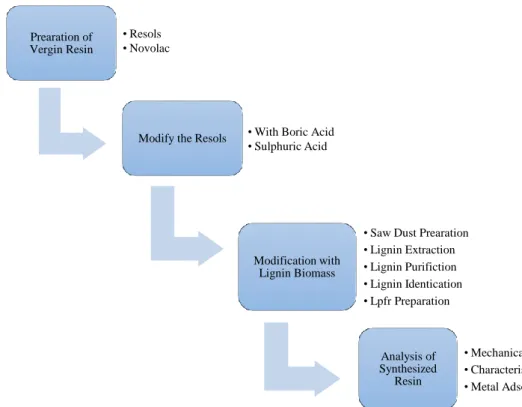
A summary of research methodology displayed in Figure 1.
Figure 1.Flow chart for the research methodology
3- Results and Discussion
3-1- Uncured and Cured Phenolic Resin
At the end of the reaction at 90°C, a solutions having high viscosity was obtained for all resin. Alkaline medium with molar excess formaldehyde used to form resols resins. This condensation Reaction leads to the three dimensional network product having high molecular weight. It causes the resin to gel which is attributed to the high viscosity of the solution. The free hydroxyl groups of the phenol in the resin are mildly acidic and dissociate partially in water. But in the presence of the base (NaOH) they form alkoxide salts (of Sodium). These salts are ionic and completely dissociate in water due to the strong ion-dipole bonding leads water soluble resin. However when the medium is acidified with HCl the free hydroxyl groups are regenerated, restrict the resin soluble in water. Eventually the resin solidifies and separates out of the solution as a precipitate.
The synthesised resin showed a variation in colour and strength. Virgin phenol formaldehyde resols (PFR), that had no additives, displayed a cream colouration. And pure phenol formaldehyde novolac resin (PFN) displayed a pink colouration. Resoles were exhibit more rigidity than Novolac resin.
3-2- Analysis of the Boron Modified Phenolic Resin
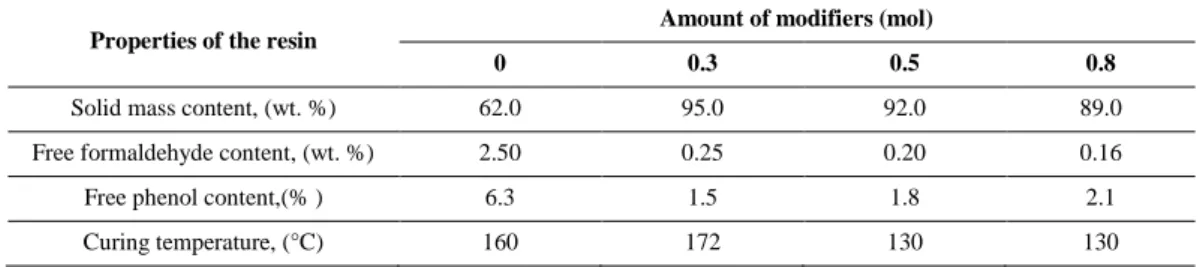
Boron containing phenol Formaldehyde resin synthesized using formalin method, as the reaction form alcohol followed with the addition of boric acid. Boric acid modified resin displays some advantageous properties given below (Table 1). Solid mass content of modified resins diverse in the range of 90-96 w/w%, Content of free formaldehyde was about ten times lower in assessment with virgin resin. Free phenol content was also decreased compare to unmodified resin. The higher Solid mass content indicates that a less amount of water and low molecular weight components. Hence, presence higher solid mass content undesirably affects the curing process which cause bubbling and form cracks on the surface.
Prearation of Vergin Resin
• Resols • Novolac
Modify the Resols • With Boric Acid• Sulphuric Acid
Modification with Lignin Biomass
• Saw Dust Prearation • Lignin Extraction • Lignin Purifiction • Lignin Identication • Lpfr Preparation
Analysis of Synthesized
Resin
• Mechanical Properties • Characterisation
Table 1. Characterization of phenol-formaldehyde resoles modified by boric acid
Properties of the resin
Amount of modifiers (mol)
0 0.3 0.5 0.8
Solid mass content, (wt. %) 62.0 95.0 92.0 89.0 Free formaldehyde content, (wt. %) 2.50 0.25 0.20 0.16
Free phenol content,(% ) 6.3 1.5 1.8 2.1 Curing temperature, (°C) 160 172 130 130
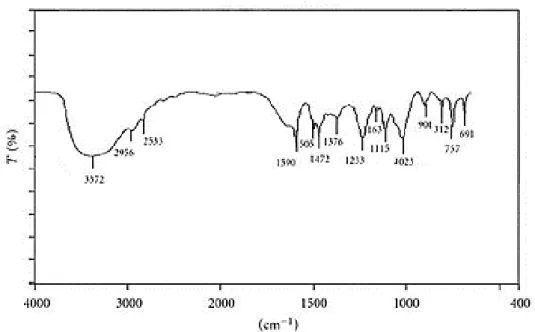
According to the Figure 2, the typical absorption band of Ar-CH2-OH observed at 1039 cm-1, modified resin shortened
the peak compare to virgin. B-O absorption peak was appeared at 1362 cm-1. . The main bands are in agreement with the
bands coming from boron and the alcohol. The region at 3381 cm-1 shows characteristic bands for-OH group of alcohol
and acid. Boric acid (B-OH) has a strong and characteristic band at 1515 cm-1.
3-3- Sulfonated Phenolic Resols
As a result of refluxing with concentrated H2SO4, sulfonated resols were obtained, displayed an orange colouration.
Resols substituted strong ion exchanger sulfonic acid groups. These sulfonated resins are bi-functional since they contain sulfonic (strong acidic) and hydroxyl (week acidic) groups directly attached to the aromatic rings. Sulfonated Phenol Formaldehyde Resol (SPFR) was completely insoluble in water due to the increased molecular weight.
Figure 2. FT-IR spectrum of the Borated phenolic resin
3-4- Analysis of Lignin Based PF Resin
3-4-1-Extraction of Lignin
Lignin molecules are large and possess several reaction sites, formation of three dimensional networks would be the possible end product. Extraction carried out by delignification process, and Soda lignin was obtained from black liqueur as shown in Figure 2.
3-4-2- Qualitative Analysis of Extracted Lignin
Greenish blue colouration obtained from lignin treated with phenol and HCl. And Yellow colouration obtained from lignin treated with aniline sulphite.
3-4-3- Quantitative Analysis
𝐿𝑖𝑔𝑛𝑖𝑛, % =𝐴 × 100
𝑊 (3)
Where: A = weight of lignin, g; W = oven-dry weight of extractive-free sawdust, g, So the yield percentage of isolated lignin was 33%.
5g
15g× 100 = 33.33%
3-4-5- UV Spectral Analysis of LPFR
UV spectrum had an absorption maximum at wavelength of 210 nm, and the second maximum was at 278 nm. The appearance of two characteristic peaks in the lignin spectrum originated from non-condensed phenolic groups (aromatic ring) in lignin. Small portion of unsaturated aliphatic units contained in lignin molecule also results in peak. Therefore, the absorbance maximum value at short wavelength was higher than that at long wavelength. The absorbance of UV spectra is directly proportional to the purity level of lignin.
3-4-6- FTIR Analysis of Acacia Saw Dust Lignin Based Resin
Adsorption peaks was observed around at 3372 cm-1, which characterizes hydroxyl groups (-OH) of lignin. The peak
at 2956cm-1 characterizes C-H vibration of methylene groups and at 2553 cm-1 characterizes C-H vibration of methoxy
groups as displayed in Figure 4.
The characteristic peaks of lignin attributed at 1590 cm-1, resembles to the aromatic skeleton of lignin. Peak at 1472
cm-1 attributed to the methylene groups (C-H) and the C-O ether band displayed at 1233 cm-1.
Figure 4. FTIR analysis of lignin based Phenol formaldehyde resole
3-4-7- Metal ion Adsorption Capacity of Lignin Based PF
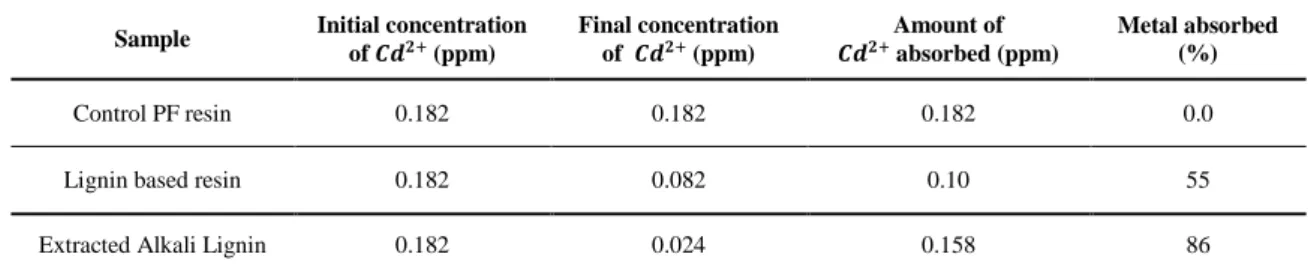
Polyphenols have the capacity to form complexes with heavy and transition metals. Thus, synthesized lignin based resin as well as lignin also showed that the ability to adsorb Cd2+ ion as shown in Table 2. These are the good adsorbers
Table 2. Metal ion absorption capacity of lignin based phenolic resin
Sample Initial concentration of 𝑪𝒅𝟐+ (ppm) Final concentration of 𝑪𝒅𝟐+ (ppm) 𝑪𝒅𝟐+ absorbed (ppm)Amount of Metal absorbed (%)
Control PF resin 0.182 0.182 0.182 0.0
Lignin based resin 0.182 0.082 0.10 55
Extracted Alkali Lignin 0.182 0.024 0.158 86
Initial and final concentration of Metal ion in prepared ionic solution was determined by Atomic Absorption Spectroscopy. Lignin is a highly cross-linked aromatic compound. The highest metal adsorption capacity was offered by alkali lignin as related to lignin based resin. This could be feasible because of their large porous. The adsorption of
𝐶𝑑2+ion was formed through the electro static interaction of 𝐶𝑑2+ion with the resin mass.
3-5- Mechanical Properties of Modified Resins
As shown in Table 3; Conductivity, the ion exchange property was observed in Sulfonated PF resin. The gelation time of the phenolic resole decreases with increase in the F/P molar ratio. This is due to the progressive increase in the methylol groups as the amount of formaldehyde increases. The increase in the number of methylol groups speeded up the crosslinking reaction and resulted in an early attainment of the gel point [9].The TSC is seen to remain almost constant for resins with various F: P molar ratios. Variations in the TSC lead to a decrease or increase in the dimensions of the castings. Thermal stability was analyzed by gel time. If the gel time increases, the thermal stability proportionally increase. Boron and lignin modified PF resoles were more thermally stabilized than virgin PF resole.
Table 3. The variation of physical properties Table for modified resins
Property Phenol Formaldehyde resole (PF)
Boron modified PF resole (BPFR)
Sulfonated PF resole (SPFR)
Lignin modified PF resole (LPFR)
Conductivity (mS/cm) 0 0 121 0
TSC (total solid content) % 52.72 55.32 42.31 48.45
Gel time (sec.) 472 1072 2008 842
Swell percentage (%) 20 15 31 25
4- Conclusion
Modified resins were prepared for improve mechanical properties. Acacia sp lignin was effectively suited for the modification of PF resin with the effective environmental control. The Acacia sp lignin based resin has similar characteristics as observed for the virgin phenol-formaldehyde resin. FTIR study displays that lignin-PF resin interaction. Lignin modified resin found to be a highly thermally stabilized than virgin PF resin as the gel time of LPFR is higher than virgin PFR. Rather than that, the lignin based resin showed increased heavy metal adsorption capacity. PF resins used in timber industrials as their excellent wetting and heat resistance, thus there are some limitations due to expenses and hazardous. Hence, the modifications with biomass are essential to overcome these limitations. This could be efficient alternative for the PF resin with the eco-friendly manner and due to bearing strength. Moreover, Lignin based phenolic resins suggested to install in the heavy metal polluted areas to adsorb pollutants as an environmental friendly manner. And also LPFR suggested using in wood industries as eco-friendly Bonding glue. The use of boric acid as a modifier in Phenol Formaldehyde resin leads to decrease the free monomers and increase the solid mass, which leads to produce smooth resin surface without causing cracks and bubbling. Boric acid modification resulted non-toxic resin compositions and increase in thermal resistance so their flammability becomes smaller. Boron modified resins suggested to use in burning products, electrical goods manufacturing field.
5- Data Availability
The data used to support the findings of this study are available from the corresponding author upon request.
6- Funding and Acknowledgements
7- Conflict of Interest
The authors declare no conflict of interest.
8- References
[1] Parameswaran, P. S., and Eby Thomas Thachil. “Influence of Ether Linkages on the Properties of Resol Phenolic Resin.” International Journal of Polymeric Materials and Polymeric Biomaterials 56, no. 2 (November 23, 2006): 177–185. doi:10.1080/00914030600773602.
[2] Żihorska-gotfryd, Anna. "Phenol-formaldehyde resols modified by boric acid." Polimery 51, no. 5 (2006).
[3] Glasser, and Wolfgang G. Studies of low molecular weight lignin sulfonates. Vol. 1. For sale by the Supt. of Docs., US Govt. Print. Off., 1974.
[4] Nada, Abda‐Alla M. A., Hussein Abou‐Youssef, and Souad E. M. El‐Gohary. “Phenol Formaldehyde Resin Modification with Lignin.” Polymer-Plastics Technology and Engineering 42, no. 4 (January 9, 2003): 689–699. doi:10.1081/ppt-120023103. [5] Mankar, S. S., A. R. Chaudhari, and I. Soni. "Lignin in phenol-formaldehyde adhesives." International Journal of Knowledge
Engineering, ISSN (2012): 0976-5816.
[6] Yang, Guangyu, and Pirjo Jaakkola. "Wood chemistry and isolation of extractives from wood." Literature study for BIOTULI project-Saimaa University of Applied Sciences (2011): 10-22.
[7] Masram, Dhanraj T., K. P. Kariya, and N. S. Bhave. "Electrical conductivity study of resin synthesized from salicylic acid, butylenediamine and formaldehyde." Archives of Applied Science Research 2, no. 2 (2010): 153-161.
[8] Jablonský, M., J. Kočiš, A. Ház, and J. Šima. "Characterization and comparison by UV spectroscopy of precipitated lignins and commercial lignosulfonates." Cell. Chem. Technol 49, no. 3-4 (2015): 267-274.
[9] Chai, Yubo, Junliang Liu, Yong Zhao, and Ning Yan. “Characterization of Modified Phenol Formaldehyde Resole Resins Synthesized in Situ with Various Boron Compounds.” Industrial & Engineering Chemistry Research 55, no. 37 (September 12, 2016): 9840–9850. doi:10.1021/acs.iecr.6b02156.
[10] Strap, Galyna, Olena Astakhova, Olexander Lazorko, Oleh Shyshchak, and Michael Bratychak. "Modified phenol-formaldehyde resins and their application in bitumen-polymeric mixtures." (2013).
[11] Keshaw Ram Aadil, Rajan Jha, Harit Jha. “Synthesis, characterization and metal adsorption capacity of Acacia lignin based resin.” Asian Journal of Biological and Life Sciences 5, no. 1: 40–45.
[12] Li, Jiongjiong, Wenjie Zhu, Jizhi Zhang, Shifeng Zhang, Qiang Gao, Jianzhang Li, and Wei Zhang. “Curing Properties of High-Ortho Phenol-Formaldehyde Resins with Co-Catalysis.” Journal of Applied Polymer Science 136, no. 12 (November 23, 2018): 47229. doi:10.1002/app.47229.
[13] Kalami, Somayyeh, Nusheng Chen, Hamid Borazjani, and Mojgan Nejad. “Comparative Analysis of Different Lignins as Phenol Replacement in Phenolic Adhesive Formulations.” Industrial Crops and Products 125 (December 2018): 520–528. doi:10.1016/j.indcrop.2018.09.037.
[14] Zhi, Maoyong, Xiantao Chen, Quanyi Liu, and Jingyun Jia. “Improved Mechanical Properties and Thermal Stability of Phenol Formaldehyde Resin by Incorporating Poly(vinyl Alcohol)-Grafted Reduced Graphene Oxide Nanohybrid.” Materials Research Express 5, no. 9 (August 10, 2018): 095306. doi:10.1088/2053-1591/aad6c2.