R E S E A R C H
Open Access
Association of thrombocytosis with COPD
morbidity: the SPIROMICS and COPDGene
cohorts
Ashraf Fawzy
1*, Nirupama Putcha
1, Laura M. Paulin
1, Carrie P. Aaron
2, Wassim W. Labaki
3, MeiLan K. Han
3,
Robert A. Wise
1, Richard E. Kanner
4, Russell P. Bowler
5, R. Graham Barr
2, Nadia N. Hansel
1and for the SPIROMICS
and COPDGene Investigators
Abstract
Background:Thrombocytosis has been associated with COPD prevalence and increased all-cause mortality in patients with acute exacerbation of COPD (AECOPD); but whether it is associated with morbidity in stable COPD is unknown. This study aims to determine the association of thrombocytosis with COPD morbidity including reported AECOPD, respiratory symptoms and exercise capacity.
Methods:Participants with COPD were included from two multi-center observational studies (SPIROMICS and COPDGene). Cross-sectional associations of thrombocytosis (platelet count≥350 × 109/L) with AECOPD during prior year (none vs. any), exertional dyspnea (modified Medical Research Council (mMRC) score≥2), COPD Assessment Test (CAT) score≥10, six-minute-walk distance (6MWD), and St. George Respiratory questionnaire (SGRQ) were modeled using multivariable logistic or linear regression. A pooled effect estimate for thrombocytosis was produced using meta-analysis of data from both studies.
Results:Thrombocytosis was present in 124/1820 (6.8%) SPIROMICS participants and 111/2185 (5.1%) COPDGene participants. In meta-analysis thrombocytosis was associated with any AECOPD (adjusted odds ratio [aOR] 1.5; 95% confidence interval [95% CI]: 1.1–2.0), severe AECOPD (aOR 1.5; 95% CI: 1.1–2.2), dyspnea (mMRC≥2 aOR 1.4; 95% CI: 1.0–1.9), respiratory symptoms (CAT≥10 aOR 1.6; 95% CI: 1.1–2.4), and higher SGRQ score (β2.7; 95% CI: 0.5, 5). Thrombocytosis was also associated with classification into Global Initiative for Chronic Obstructive Lung Disease (GOLD) group D (aOR 1.7 95% CI: 1.2–2.4).
Conclusions:Thrombocytosis was associated with higher likelihood of prior exacerbation and worse symptoms. Platelet count, a commonly measured clinical assay, may be a biomarker for moderate-severe COPD symptoms, guide disease classification and intensity of treatment. Future longitudinal studies investigating the role of platelets in COPD progression may be warranted.
Trial registration:ClinicalTrials.gov: NCT01969344 (SPIROMICS) and NCT00608764 (COPDGene).
Keywords:Exacerbations, Dyspnea, Quality of life, Platelet count
* Correspondence:[email protected]
1Division of Pulmonary and Critical Care Medicine, Johns Hopkins University
School of Medicine, 1830 E Monument St. 5th Floor, Baltimore, MD 21287, USA Full list of author information is available at the end of the article
Background
Chronic obstructive pulmonary disease (COPD) is the third leading cause of death in the United States with multiple systemic manifestations and a disease trajectory affected by comorbid conditions, including cardiovascu-lar (CV) disease [1, 2]. Platelets, long implicated in CV disease [3], are multifunctional and play a role in many pathophysiologic processes beyond hemostasis [4]. The pathogenesis of sustained platelet count elevation (thrombocytosis) involves either a myeloproliferative dis-order or occurs as a reactive process secondary to an underlying neoplasm, chronic infection, inflammation, or physiologic stress [5]. Reactive thrombocytosis is a consequence of inappropriately elevated levels of throm-bopoietin, which is up-regulated by the inflammatory cytokine interluk6, and has been associated with in-creased soluble markers of platelet activation [5, 6]. Previ-ous animal studies have documented the role of platelets and platelet activation in bronchoconstriction, bronchial reactivity, airway inflammation, and remodeling and have corroborated clinical studies suggesting a role of increased platelet activity in allergic and non-allergic asthmatics [7].
In COPD, thrombocytosis and markers of platelet activa-tion have been associated with disease prevalence and, re-cently, thrombocytosis has been associated with increased all-cause mortality in patients with acute exacerbation of COPD (AECOPD) [8–12]. Notably, prior research suggests that the platelet-mortality association is independent of cardiovascular outcomes suggesting an alternate patho-physiologic mechanism [10]. However, the role of platelets in COPD morbidity has not been explored. This study investigates the association of thrombocytosis with AECOPD, exercise capacity and patient reported respira-tory symptoms and quality of life. The main hypothesis of this study is that thrombocytosis is associated with worse COPD morbidity. The large, well-characterized cohorts of the Subpopulations and Intermediate Outcome Measures in COPD Study (SPIROMICS) and the Genetic Epidemi-ology of COPD study (COPDGene®) are ideal populations in which to test this hypothesis.
Methods
Participants with COPD (post-bronchodilator ratio of forced expiratory volume in 1 s to forced vital capacity [FEV1/FVC] < 70%) were selected from the SPIROMICS
and COPDGene studies, two multi-center observational cohorts with mutually exclusive recruitment. SPIROMICS enrolled current and former smokers (≥20 pack-years) and nonsmokers (≤1 pack-year) aged 40–80 years from twelve clinical sites in the US with the goal of identifying inter-mediate outcome measures that predict long-term clinical endpoints of morbidity [13]. COPDGene enrolled self-identified non-Hispanic whites or African-Americans aged 45–80 years from twenty-one clinical sites throughout the
US with ≥10 pack-year smoking history with the goal of identifying genetic factors associated with COPD [14].
In SPIROMICS, cross-sectional analysis of baseline data on complete blood count (CBC), symptoms, and re-call of events from the year prior to the baseline visit were ascertained. In COPDGene, CBC was collected at a five-year follow-up visit and thus outcome data collected at the 5-year visit (current as of September 2016) were analyzed cross-sectionally. Thrombocytosis was defined as platelet count of≥350 × 109/L, a definition previously used in the literature [15–17]. All CBCs were performed at certified laboratories at respective sites.
Outcomes
The primary outcome of interest was patient-reported AECOPD during the previous 12 months. Any AECOPD included events treated with antibiotics or oral corticoste-roids as well as severe AECOPD, defined as symptoms re-quiring an emergency department visit or hospitalization. Secondary outcomes of interest included dyspnea (modi-fied Medical Research Council questionnaire, mMRC) [18], COPD health status (COPD Assessment Test™, CAT) [19], exercise capacity (6-min walk distance in meters, 6MWD) [20], respiratory-specific quality of life (St George’s Respiratory Questionnaire, SGRQ) [21], and COPD disease burden based on Global Initiative for Chronic Obstructive Lung Disease (GOLD) criteria for symptom categories A-D [22]. Classification into GOLD group D, indicative of the largest symptom burden and highest risk for future exacerbations, was defined as at least one severe exacerbation or≥2 exacerbations during the prior year and mMRC score≥2 or CAT score≥10.
Statistical analysis
Differences in participant demographics, respiratory func-tion, comorbid conditions, and univariate outcomes by presence of thrombocytosis were assessed using chi-squared test or Fisher’s exact test for proportions and t-test for continuous variables. Cross-sectional analyses were performed using multivariable logistic regression to model the relationship of thrombocytosis (dichotomized at platelet count≥350 × 109/L) with dichotomous outcomes including at least one AECOPD within the prior year, at least one se-vere AECOPD within the prior year, mMRC score≥2, CAT score≥10 and classification into GOLD group D. Multivariable linear regression was used to model the rela-tionship of thrombocytosis with 6MWD and SGRQ score. SPIROMICS and COPDGene were analyzed separately then combined by meta-analysis using inverse variance weighting to produce a pooled effect estimate.
FEV1(continuous) [23], smoking status (current vs former
smokers), ambulatory hypoxemia (oxygen saturation after 6-min walk≤90%), inhaled corticosteroid use (ICS), body mass index (BMI; categorical: underweight <18.5 kg/m2vs normal/overweight 18.5 - <30 kg/m2vs obese≥30 kg/m2), anemia (dichotomous using gender-specific cutoffs of hemoglobin), and CV comorbidities (hypertension, coron-ary artery disease, congestive heart failure, diabetes, and stroke) using a change in the effect estimate ≥10% be-tween the crude and bivariate models of the association between thrombocytosis and each outcome as criteria for inclusion in models [24, 25]. Age, gender, education, FEV1, smoking status, ambulatory hypoxemia, ICS use,
anemia, diabetes, congestive heart failure, and hyperten-sion met criteria for at least one outcome in either study and were included as covariates in all models. Because there is no standard definition for reactive thrombocytosis, sensitivity analysis was performed dichotomizing platelet count at 400 × 109/L to test the robustness of the analysis. In a subset of SPIROMICS participants who had bio-markers measured concurrently with platelet count, the relationship of C-reactive protein (CRP) with thrombocy-tosis was explored using the Kruskal-Wallis test.
All analyses were conducted using SAS 9.4 (Carey, NC) except for the meta-analysis which was performed using Stata version 13/SE (College Station, TX). SPIROMICS and COPDGene were approved by the institutional review boards at each center and all participants provided written informed consent (ClinicalTrials.gov: NCT01969344 (SPIROMICS) and NCT00608764 (COPDGene)).
Results
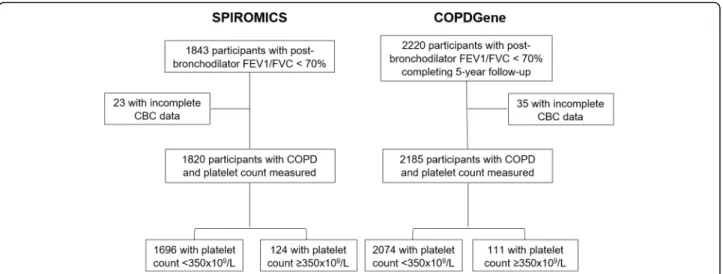
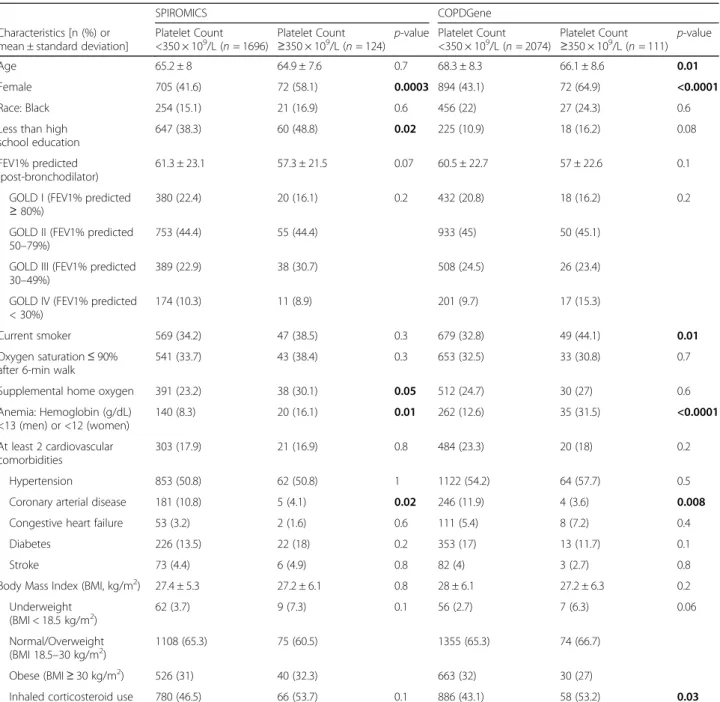
In SPIROMICS, Thrombocytosis was detected in 124 (6.8%) of 1820 SPIROMICS participants and 111 (5.1%) of 2185 COPDGene participants with COPD (Fig. 1). Se-verity of lung disease, smoking status, supplemental oxy-gen use, and BMI were similarly distributed between COPDGene and SPIROMICS, although COPDGene par-ticipants were slightly older with higher prevalence of some comorbidities including anemia, hypertension, congestive heart failure, and diabetes. In both cohorts, compared to participants with platelet count <350 × 109/ L, participants with thrombocytosis were more likely to be female, have anemia and less likely to have coronary artery disease. In SPIROMICS, participants with throm-bocytosis were also more likely to have less than a high school education and use supplemental oxygen while in COPDGene they were younger and more likely to be current smokers. Each of these trends was present but non-statistically significant in the other cohort (Table 1).
In unadjusted analysis in both cohorts, participants with thrombocytosis were significantly more likely to report an AECOPD (SPIROMICS: 43.6% vs. 30.7%,p= 0.003; COPD-Gene: 37.8% vs. 27.5%, p = 0.02) or a severe AECOPD
(SPIROMICS: 24.2% vs. 15.5%,p= 0.01; COPDGene: 23.4% vs. 14.6%, p = 0.01) in the past year compared to the group with lower platelet count. Those with thrombocytosis were also significantly more likely to have worse dyspnea (mMRC score≥2), functional status, quality of life (CAT score≥10 and higher St. George Respiratory Questionnaire score), and more likely to be classified as GOLD group D compared to the group with lower platelet count (Table 2). Six-minute walk distance was reduced among participants with thrombocytosis in both cohorts but was statistically significant only in SPIROMICS.
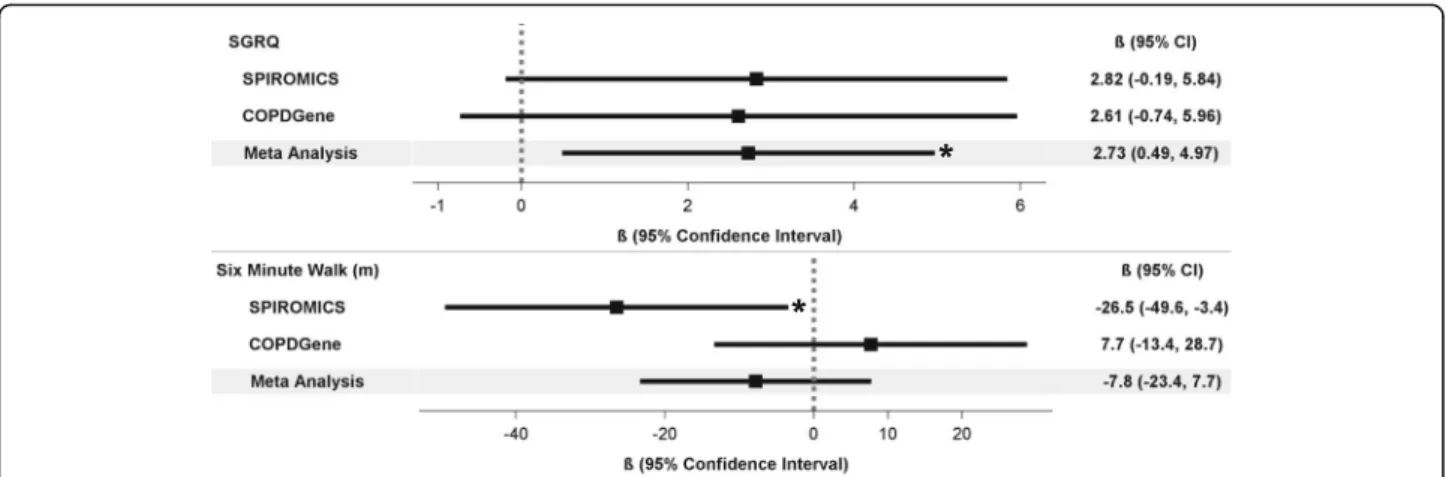
In adjusted analysis, compared with platelet count <350 × 109/L, participants with thrombocytosis were 1.6 times more likely to report any AECOPD (95% confidence interval [CI]: 1.0–2.4) and severe AECOPD (95% CI: 1.0– 2.7) in SPIROMICS, while results lost statistical signifi-cance in COPDGene for any AECOPD (adjusted odds ra-tio [aOR] 1.3; 95% CI: 0.8–2.1) and severe AECOPD (aOR 1.4; 95% CI: 0.9–2.4). Thrombocytosis was significantly as-sociated with GOLD group D classification in COPDGene and with borderline significance in participants from SPIROMICS. Thrombocytosis was also significantly asso-ciated with mMRC ≥2 and reduced 6MWD in SPIRO-MICS. Among those with thrombocytosis, poorer health status and worse quality of life were present in both SPIROMICS and COPDGene, but differences between groups did not reach statistical significance (Figs 2 and 3).
In meta-analysis combining both cohorts, participants with thrombocytosis had a 1.5-fold increased odds of reporting any AECOPD (95% CI: 1.1–2.0) or severe AECOPD (95% CI: 1.1–2.2) during the preceding year, 1.4-fold increased odds of moderate-severe dyspnea (mMRC≥2; 95% CI: 1.0– 1.9), 1.6-fold increased odds of reporting worse COPD health status (CAT score≥10; 95% CI: 1.1–2.4), and were more likely to be classified as GOLD group D (aOR 1.7; 95% CI: 1.2–2.4) (Fig. 2). Thrombocytosis was associated with worse respiratory-specific quality of life (2.7 points higher SGRQ score; 95% CI: 0.5, 5) but not 6MWD (Fig. 3).
Sensitivity analysis defining thrombocytosis as ≥400 × 109/L (SPIROMICS n= 38, COPDGenen = 39) produced similar results for any and severe AECOPD, CAT ≥10, GOLD group D classification, and SGRQ, with results for mMRC ≥2 of similar magnitude to the main analysis but losing statistical significance (Table 3). Among SPIROMICS participants who had platelet count and CRP measured at baseline (n = 1041) participants with thrombocytosis had significantly higher median CRP (4.6 vs. 3.0,p= 0.01).
Discussion
was associated with increased odds of having AECOPD or severe AECOPD during the prior year, increased dys-pnea, poorer health status, and worse respiratory-specific quality of life. Participants with thrombocytosis were also more likely to be classified in GOLD symptom category D. These findings, which persisted after adjust-ment for degree of airflow obstruction, CV disease, and other comorbid chronic diseases, suggest that platelet count, a routinely measured clinical assay, represents an objective measure associated with recent AECOPD and respiratory morbidity that may help guide treatment in-tensity in patients with stable COPD.
Elevated platelet levels have previously been shown to be more prevalent in patients with stable COPD [8], correlated with increasing airflow obstruction [26], all-cause mortality [10], and may be a surrogate for platelet activation [27]. In a study of 109 patients with stable COPD, platelet count was significantly higher than that of 51 healthy controls and did not differ by smoking status [8]. A strong correl-ation between platelet count and elevated levels of P-selectin, a glycoprotein expressed and secreted by activated platelets, has been reported [27], and a few studies have re-ported increased platelet activation in stable COPD mea-sured directly as platelet-monocyte aggregates or as soluble markers of platelet activation [9, 28–30]. A recent study of patients hospitalized for AECOPD found that thrombocy-tosis was associated with increased risk of in-hospital and 1-year mortality independent of cardiovascular events and correlated with respiratory failure and exacerbation severity [10]. Among 452 individuals with stable COPD, mean platelet count increased with increasing severity of airflow obstruction [26]. Despite these few studies, there has been limited data to date evaluating whether platelet levels are associated with other measures of COPD morbidity.
Findings from this study show that thrombocytosis is linked to several respiratory outcomes in patients with
COPD, including increased prevalence of exacerbations and worse dyspnea and respiratory-specific quality of life. Inclusion of CV comorbidities as a covariate in models did not eliminate or substantially change the association be-tween platelet count and outcomes and thus is likely not a major mediator of the association. These findings further support the likelihood that the pathophysiologic mechan-ism underlying the association of platelets and COPD morbidity is independent of increased cardiac risk. In addition, some prior studies have reported higher platelet counts among smokers compared to non-smokers, how-ever findings have been inconsistent [8, 31–33]. Approxi-mately one-third of the study participants reported actively smoking and thrombocytosis was associated with smoking status only in COPDGene. However, inclusion of smoking status as a covariate in all models implies that the association of thrombocytosis with COPD morbidity does not simply reflect increased COPD morbidity among current smokers.
and COPD morbidity. It remains unclear whether AECOPD elicit a reactive thrombocytosis leading to in-flammation through increased platelet activation and cyto-kine release or if systemic inflammation precedes reactive thrombocytosis and AECOPD.
Additionally, pulmonary endovascular abnormalities are prevalent in COPD and are present even in mild disease [38]. Studies have shown endothelial dysfunction, intimal thickening, as well as reduced and narrowed vasculature in COPD, leading to impaired relaxation and gas exchange and promotion of platelet rolling and aggregation [39–41].
Platelets also play a role in angiogenesis, maintaining vascu-lar integrity, and release vasoactive substances [37]. Prior studies reported increased platelet count among hypoxic patients with airflow obstruction [42], possibly due to in-creased interaction and activation of platelets driven by compromised endothelium. The present study demon-strates that thrombocytosis was independently associated with AECOPD after controlling for ambulatory hypoxemia. While this may suggest that the association of platelets with morbidity is independent of endothelial dysfunction, hypox-emia is multifactorial and only one of several physiologic Table 1Baseline characteristics and outcomes of SPIROMICS and COPDGene participants by platelet count
SPIROMICS COPDGene
Characteristics [n (%) or mean ± standard deviation]
Platelet Count
<350 × 109/L (n= 1696) Platelet Count≥350 × 109/L (n= 124) p-value Platelet Count<350 × 109/L (n= 2074) Platelet Count≥350 × 109/L (n= 111) p-value
Age 65.2 ± 8 64.9 ± 7.6 0.7 68.3 ± 8.3 66.1 ± 8.6 0.01
Female 705 (41.6) 72 (58.1) 0.0003 894 (43.1) 72 (64.9) <0.0001
Race: Black 254 (15.1) 21 (16.9) 0.6 456 (22) 27 (24.3) 0.6
Less than high school education
647 (38.3) 60 (48.8) 0.02 225 (10.9) 18 (16.2) 0.08
FEV1% predicted (post-bronchodilator)
61.3 ± 23.1 57.3 ± 21.5 0.07 60.5 ± 22.7 57 ± 22.6 0.1
GOLD I (FEV1% predicted ≥80%)
380 (22.4) 20 (16.1) 0.2 432 (20.8) 18 (16.2) 0.2
GOLD II (FEV1% predicted 50–79%)
753 (44.4) 55 (44.4) 933 (45) 50 (45.1)
GOLD III (FEV1% predicted 30–49%)
389 (22.9) 38 (30.7) 508 (24.5) 26 (23.4)
GOLD IV (FEV1% predicted < 30%)
174 (10.3) 11 (8.9) 201 (9.7) 17 (15.3)
Current smoker 569 (34.2) 47 (38.5) 0.3 679 (32.8) 49 (44.1) 0.01
Oxygen saturation≤90% after 6-min walk
541 (33.7) 43 (38.4) 0.3 653 (32.5) 33 (30.8) 0.7
Supplemental home oxygen 391 (23.2) 38 (30.1) 0.05 512 (24.7) 30 (27) 0.6
Anemia: Hemoglobin (g/dL) <13 (men) or <12 (women)
140 (8.3) 20 (16.1) 0.01 262 (12.6) 35 (31.5) <0.0001
At least 2 cardiovascular comorbidities
303 (17.9) 21 (16.9) 0.8 484 (23.3) 20 (18) 0.2
Hypertension 853 (50.8) 62 (50.8) 1 1122 (54.2) 64 (57.7) 0.5
Coronary arterial disease 181 (10.8) 5 (4.1) 0.02 246 (11.9) 4 (3.6) 0.008
Congestive heart failure 53 (3.2) 2 (1.6) 0.6 111 (5.4) 8 (7.2) 0.4
Diabetes 226 (13.5) 22 (18) 0.2 353 (17) 13 (11.7) 0.1
Stroke 73 (4.4) 6 (4.9) 0.8 82 (4) 3 (2.7) 0.8
Body Mass Index (BMI, kg/m2) 27.4 ± 5.3 27.2 ± 6.1 0.8 28 ± 6.1 27.2 ± 6.3 0.2
Underweight (BMI < 18.5 kg/m2)
62 (3.7) 9 (7.3) 0.1 56 (2.7) 7 (6.3) 0.06
Normal/Overweight
(BMI 18.5–30 kg/m2) 1108 (65.3) 75 (60.5) 1355 (65.3) 74 (66.7)
Obese (BMI≥30 kg/m2) 526 (31) 40 (32.3) 663 (32) 30 (27)
Inhaled corticosteroid use 780 (46.5) 66 (53.7) 0.1 886 (43.1) 58 (53.2) 0.03
GOLDGlobal Initiative for Chronic Obstructive Lung Disease. Boldface indicates statistical significance atp< 0.05. Platelet count was measured at baseline in
manifestations of endothelial abnormalities. More precise and direct measures of endothelial dysfunction are required to elucidate platelet-endothelial interactions in COPD.
There are limitations to this study. Given the cross-sectional nature of this investigation, it is not possible to
determine temporality and it remains unclear whether thrombocytosis is a risk factor for or physiologic reaction to AECOPD or disease severity. Without a clear clinical cut-off for defining thrombocytosis, misclassification based upon the chosen value is possible, however, any misclassifi-cation would attenuate the associations described in this
Fig. 2Association of thrombocytosis (platelet count≥350 × 109/L) with COPD morbidity (dichotomous outcomes). aOR: adjusted odds ratio; mMRC: modified medical research council questionnaire; CAT: COPD assessment test; GOLD: Global Initiative for Chronic Obstructive Lung Disease. Statistical significance (p< 0.05) denoted by asterisk
Table 2Univariate associations of thrombocytosis (platelet count≥350 × 109/L) with COPD morbidity
Outcomes [% or mean ± standard deviation] SPIROMICS COPDGene
Platelet Count
<350 × 109/L Platelet Count≥350 × 109/L p-value Platelet Count<350 × 109/L Platelet Count≥350 × 109/L p-value
Any Acute Exacerbation of COPD during the prior year 30.7% 43.6% 0.003* 27.5% 37.8% 0.02*
Severe Acute Exacerbation of COPD during the prior year 15.5% 24.2% 0.01* 14.6% 23.4% 0.01*
Modified Medical Research Council (mMRC) Questionnaire score≥2
31.4% 47.5% 0.0002* 52.9% 64% 0.02*
COPD Assessment Test (CAT) score≥10 72.4% 86.2% 0.001* 66.4% 77.5% 0.02*
GOLD symptom group D 20% 33% 0.0009* 19.4% 33.3% 0.0004*
6-min walk distance in meters 395 ± 128 352 ± 134 0.007a 371 ± 124 358 ± 118 0.3a
St. George Respiratory Questionnaire score 38 ± 20 44 ± 19 0.0002a 32 ± 22 38 ± 24 0.005a
GOLDGlobal Initiative for Chronic Obstructive Lung Disease. *chi-squared test;a
study toward the null. Furthermore, these findings were ro-bust to a sensitivity analysis using a higher cutoff for defin-ing thrombocytosis, even though analysis of mMRC score lost statistical significance owing to the low prevalence (ap-proximately 2%) of platelet count greater than 400 × 109/L. In a substudy of SPIROMICS participants (n= 98) under-going repeat baseline evaluation 2–4 weeks from the ori-ginal visit a change in exacerbation history recall of the previous year occurred in 30% and 13% of participants reporting total and severe exacerbations respectively, with repeatability of other measures ranging from fair (mMRC) to excellent (SGRQ) [43].
Conclusions
Thrombocytosis was independently associated with worse COPD morbidity, including higher likelihood of prior ex-acerbation, worse patient reported outcomes, and GOLD group D classification. While the mechanism behind this association remains unclear and requires additional inves-tigation, increased platelet activation perpetuating local and systemic inflammation may play a prominent role in COPD morbidity. These study results suggest that platelet count, a routinely measured clinical assay, may be an important biomarker associated with AECOPD and re-spiratory morbidity in patients with previously stable COPD that can aid in classification of disease severity and treatment intensity.
Abbreviations
6MWD:Six-minute-walk distance; 95% CI: 95% confidence interval; AECOPD: Acute exacerbation of chronic obstructive pulmonary disease; aOR: Adjusted odds ratio; CAT: COPD Assessment Test; COPD: Chronic obstructive pulmonary disease; COPDGene: Genetic Epidemiology of COPD study; CRP: C-reactive protein; FEV1: Forced expiratory volume in 1 s; GOLD: Global Initiative for Chronic Obstructive Lung Disease; mMRC: Modified Medical Research Council questionnaire; SGRQ: St. George Respiratory questionnaire; SPIROMICS: Subpopulations and Intermediate Outcome Measures in COPD Study
Acknowledgements
The authors thank the SPIROMICS participants and participating physicians, investigators and staff for making this research possible. More information about the study and how to access SPIROMICS data is at www.spiromics.org. We would like to acknowledge the following current and former
investigators of the SPIROMICS sites and reading centers: : Neil E Alexis, PhD; Wayne H Anderson, PhD; Igor Barjaktarevic, MD, PhD; R Graham Barr, MD, DrPH; Eugene R Bleecker, MD; Richard C Boucher, MD; Russell P Bowler, MD, PhD; Elizabeth E Carretta, MPH; Stephanie A Christenson, MD; Alejandro P Comellas, MD; Christopher B Cooper, MD, PhD; David J Couper, PhD; Gerard J Criner, MD; Ronald G Crystal, MD; Jeffrey L Curtis, MD; Claire M Doerschuk, MD; Mark T Dransfield, MD; Christine M Freeman, PhD; MeiLan K Han, MD, MS; Nadia N Hansel, MD, MPH; Annette T Hastie, PhD; Eric A Hoffman, PhD; Robert J Kaner, MD; Richard E Kanner, MD; Eric C Kleerup, MD; Jerry A Krishnan, MD, PhD; Lisa M LaVange, PhD; Stephen C Lazarus, MD; Fernando J Martinez, MD, MS; Deborah A Meyers, PhD; Wendy C Moore, MD; John D Fig. 3Association of thrombocytosis (platelet count≥350 × 109/L) with COPD morbidity (continuous outcomes). SGRQ: St. George Respiratory Questionnaire. Statistical significance (p< 0.05) denoted by asterisk
Table 3Sensitivity analysis: the association of thrombocytosis with COPD morbidity using platelet count cutoff of 400 × 109/L
SPIROMICS COPDGene Meta-analysis
Dichotomous Outcomes
[adjusted odds ratio (95% confidence interval)]
Any Acute Exacerbation of COPD
1.7 (0.8–3.7) 1.8 (0.8–3.8) 1.8 (1.0–3.0)
Severe Acute Exacerbation of COPD
1.6 (0.7–3.8) 2.7 (1.3–5.8) 2.2 (1.2–3.8)
mMRC Score≥2 1.5 (0.7–3.2) 1.5 (0.6–3.5) 1.5 (0.9–2.6)
CAT Score≥10 1.9 (0.6–6.8) 3.0 (1.0–9.2) 2.5 (1.1–5.7)
GOLD Group D 2.3 (1.0–5.1) 2.2 (1.0–4.8) 2.3 (1.3–3.9)
Continuous Outcomes [β(95% confidence interval)]
Six-minute walk
distance (meters) − 12.5 (−53.8, 28.9) −
12.7
(−47.2, 21.7) − 12.6 (−39.1, 13.8)
St. George Respiratory Questionnaire score
5.7 (0.4, 11.1)
2.1 (−3.5, 7.7)
4.0 (0.12, 7.8)
Boldface indicates statistical significance atp< 0.05.mMRCModified Medical
Newell Jr., MD; Laura Paulin, MD, MHS; Stephen Peters, MD, PhD; Cheryl Pirozzi, MD; Elizabeth C Oelsner, MD, MPH; Wanda K O’Neal, PhD; Victor E Ortega, MD, PhD; Robert Paine, III, MD; Nirupama Putcha, MD, MHS; Sanjeev Raman, MBBS, MD; Stephen I. Rennard, MD; Donald P Tashkin, MD; J Michael Wells, MD; Robert A Wise, MD; and Prescott G Woodruff, MD, MPH.
Funding
AF: NIH NHLBI T32HL007534. SPIROMICS was supported by contracts from the NIH/NHLBI (HHSN268200900013C, HHSN268200900014C,
HHSN268200900015C, HHSN268200900016C, HHSN268200900017C, HHSN268200900018C, HHSN268200900019C, HHSN268200900020C), and supplemented by contributions made through the Foundation for the NIH and the COPD Foundation from AstraZeneca/MedImmune; Bayer; Bellerophon Therapeutics; Boehringer-Ingelheim Pharmaceuticals, Inc..; Chiesi Farmaceutici S.p.A.; Forest Research Institute, Inc.; GlaxoSmithKline; Grifols Therapeutics, Inc.; Ikaria, Inc.; Nycomed GmbH; Takeda Pharmaceutical Company; Novartis Pharmaceuticals Corporation; ProterixBio; Regeneron Pharmaceuticals, Inc.; Sanofi; and Sunovion. COPDGene was supported by Award Number R01 HL089897 and Award Number R01 HL089856 from the National Heart, Lung, and Blood Institute. The content is solely the responsibility of the authors and does not necessarily represent the official views of the National Heart, Lung, and Blood Institute or the National Institutes of Health.
Availability of data and materials
The data that support the findings of this study are available from the authors upon reasonable request and with permission from the SPIROMICS and COPDGene study groups.
Authors’contributions
AF, NP, and NNH contributed to the conception and design of the study, interpretation of results, drafting and revising the manuscript. MKH, RW, REK, RPB, RGB, and NNH contributed to the acquisition of the data. LMP, CPA, WWL, MKH, RW, REK, RPB, and RGB contributed to interpretation of the results and revisions of the manuscript for critically important intellectual content. All of the authors approved this version of the manuscript to be published and agree to be accountable for all aspects of the work.
Ethics approval and consent to participate
SPIROMICS and COPDGene were approved by the institutional review boards at each center and all participants provided written informed consent.
Consent for publication Not applicable.
Competing interests
The authors declare that they have no competing interests.
Publisher’s Note
Springer Nature remains neutral with regard to jurisdictional claims in published maps and institutional affiliations.
Author details
1Division of Pulmonary and Critical Care Medicine, Johns Hopkins University
School of Medicine, 1830 E Monument St. 5th Floor, Baltimore, MD 21287, USA. 2Department of Medicine, Columbia University College of Physicians and
Surgeons, New York, NY, USA.3Division of Pulmonary and Critical Care Medicine, University of Michigan, Ann Arbor, MI, USA.4Division of Respiratory, Critical Care and Occupational Medicine, University of Utah Health Sciences Center, Salt Lake City, UT, USA.5Department of Medicine, National Jewish Medical and Research Center, Denver, CO, USA.
Received: 21 November 2017 Accepted: 8 January 2018
References
1. Huiart L, Ernst P, Suissa S. Cardiovascular morbidity and mortality in COPD. Chest. 2005;128(4):2640–6.
2. Sin DD, Man SF. Chronic obstructive pulmonary disease as a risk factor for cardiovascular morbidity and mortality. Proc Am Thorac Soc. 2005;2(1):8–11. 3. Davì G, Patrono C. Platelet activation and atherothrombosis. N Engl J Med.
2007;357(24):2482–94.
4. Ghoshal K, Bhattacharyya M. Overview of platelet physiology: its hemostatic and nonhemostatic role in disease pathogenesis.
TheScientificWorldJOURNAL. 2014;2014:781857.
5. Schafer AI. Thrombocytosis. N Engl J Med. 2004;350(12):1211–9.
6. Viallard J-F, Solanilla A, Gauthier B, Contin C, Déchanet J, Grosset C, Moreau J-F, Praloran V, Nurden P, Pellegrin J-L. Increased soluble and platelet-associated CD40 ligand in essential thrombocythemia and reactive thrombocytosis. Blood. 2002;99(7):2612–4.
7. Kornerup K, Page C. The role of platelets in the pathophysiology of asthma. Platelets. 2007;18(5):319–28.
8. Biljak VR, Pancirov D, Cepelak I, Popovic-Grle S, Stjepanovic G, Grubisic TZ. Platelet count, mean platelet volume and smoking status in stable chronic obstructive pulmonary disease. Platelets. 2011;22(6):466–70.
9. Ferroni P, Basili S, Martini F, Vieri M, Labbadia G, Cordova C, Alessandri C, Gazzaniga PP, Soluble P. Selectin as a marker of platelet hyperactivity in patients with chronic obstructive pulmonary disease. J Investig Med. 2000;48(1):21–7. 10. Harrison MT, Short P, Williamson PA, Singanayagam A, Chalmers JD,
Schembri S. Thrombocytosis is associated with increased short and long term mortality after exacerbation of chronic obstructive pulmonary disease: a role for antiplatelet therapy? Thorax. 2014;69(7):609–15.
11. Maclay JD, McAllister DA, Macnee W. Cardiovascular risk in chronic obstructive pulmonary disease. Respirology. 2007;12(5):634–41. 12. Onder I, Topcu S, Dokmetas HS, Turkay C, Seyfikli Z. Platelet aggregation
size and volume in chronic obstructive pulmonary disease. Materia medica Polona Polish journal of medicine and pharmacy. 1997;29(1–4):11–3. 13. Couper D, LaVange LM, Han M, Barr RG, Bleecker E, Hoffman EA, Kanner R,
Kleerup E, Martinez FJ, Woodruff PG, et al. Design of the Subpopulations and Intermediate Outcomes in COPD study (SPIROMICS). Thorax. 2014;69(5):491–4. 14. Regan EA, Hokanson JE, Murphy JR, Make B, Lynch DA, Beaty TH,
Curran-Everett D, Silverman EK, Crapo JD. Genetic epidemiology of COPD (COPDGene) study design. Copd. 2010;7(1):32–43.
15. Hannisdal E, Tveit KM, Theodorsen L, Høst H. Host markers and prognosis in recurrent rectal carcinomas treated with radiotherapy. Acta Oncol. 1994; 33(4):415–21.
16. Sandelin M, Holgersson G, Janson C, Ekman S, Bergqvist M. The prognostic value of anemia, thrombocytosis and leukocytosis at time of diagnosis in patients with non-small cell lung cancer. In: Eur Respiratory Soc. 2011; 17. Digklia A, Voutsadakis IA. Thrombocytosis as a prognostic marker in stage III and
IV serous ovarian cancer. Obstetrics & gynecology science. 2014;57(6):457–63. 18. Bestall JC, Paul EA, Garrod R, Garnham R, Jones PW, Wedzicha JA. Usefulness
of the Medical Research Council (MRC) dyspnoea scale as a measure of disability in patients with chronic obstructive pulmonary disease. Thorax. 1999;54(7):581–6.
19. Jones PW, Harding G, Berry P, Wiklund I, Chen WH, Kline Leidy N. Development and first validation of the COPD assessment test. Eur Respir J. 2009;34(3):648–54. 20. Holland AE, Spruit MA, Troosters T, Puhan MA, Pepin V, Saey D, McCormack
MC, Carlin BW, Sciurba FC, Pitta F, et al. An official European Respiratory Society/American Thoracic Society technical standard: field walking tests in chronic respiratory disease. Eur Respir J. 2014;44(6):1428–46.
21. Jones PW, Quirk FH, Baveystock CM, Littlejohns P. A self-complete measure of health status for chronic airflow limitation. The St. George's respiratory questionnaire. Am Rev Respir Dis. 1992;145(6):1321–7.
22. Vestbo J, Hurd SS, Agusti AG, Jones PW, Vogelmeier C, Anzueto A, Barnes PJ, Fabbri LM, Martinez FJ, Nishimura M, et al. Global strategy for the diagnosis, management, and prevention of chronic obstructive pulmonary disease: GOLD executive summary. Am J Respir Crit Care Med. 2013;187(4):347–65. 23. Miller MR, Hankinson J, Brusasco V, Burgos F, Casaburi R, Coates A, Crapo R,
Enright P, van der Grinten CP, Gustafsson P, et al. Standardisation of spirometry. Eur Respir J. 2005;26(2):319–38.
24. Maldonado G, Greenland S. Simulation study of confounder-selection strategies. Am J Epidemiol. 1993;138(11):923–36.
25. Greenland S. Modeling and variable selection in epidemiologic analysis. Am J Public Health. 1989;79(3):340–9.
26. Cakmak G, Saglam Z, Saler T, Yenigun M, Ataoglu E, Temiz L, Demir T. Platelets: indicator of inflammation in COPD. International Journal of Medicine and Medical Sciences. 2009;1(5):227–9.
27. Semenov AV, Romanov YA, Loktionova SA, Tikhomirov OY, Khachikian MV, Vasil’ev SA, Mazurov AV. Production of soluble P-selectin by platelets and endothelial cells. Biochemistry Biokhimiia. 1999;64(11):1326–35. 28. Davi G, Basili S, Vieri M, Cipollone F, Santarone S, Alessandri C, Gazzaniga P,
chronic obstructive pulmonary disease. The chronic obstructive bronchitis and Haemostasis study group. Am J Respir Crit Care Med. 1997;156(6):1794–9. 29. Maclay JD, McAllister DA, Johnston S, Raftis J, McGuinnes C, Deans A,
Newby DE, Mills NL, MacNee W. Increased platelet activation in patients with stable and acute exacerbation of COPD. Thorax. 2011;66(9):769–74. 30. Shigeta A, Tada Y, Tatsumi K. High concentration of plasma soluble CD40
ligand is associated with impaired lung function and alveolar structural destruction. Am J Respir Crit Care Med. 2012;185:A4555.
31. Erikssen J, Hellem A, Stormorken H. Chronic effect of smoking on platelet count and platelet adhesiveness in presumably healthy middle-aged men. Thromb Haemost. 1977;38(3):606–11.
32. Butkiewicz A, Kemona-Chetnik I, Dymicka-Piekarska V, Matowicka-Karna J, Kemona H, Radziwon P. Does smoking affect thrombocytopoiesis and platelet activation in women and men? Advances in medical sciences. 2006; 51:123–6.
33. Suwansaksri J, Wiwanitkit V, Soogarun S. Effect of smoking on platelet count and platelet parameters: an observation. Clin Appl Thromb Hemost. 2004; 10(3):287–8.
34. Gan WQ, Man SF, Senthilselvan A, Sin DD. Association between chronic obstructive pulmonary disease and systemic inflammation: a systematic review and a meta-analysis. Thorax. 2004;59(7):574–80.
35. Hurst JR, Perera WR, Wilkinson TM, Donaldson GC, Wedzicha JA. Systemic and upper and lower airway inflammation at exacerbation of chronic obstructive pulmonary disease. Am J Respir Crit Care Med. 2006;173(1):71–8. 36. Perera WR, Hurst JR, Wilkinson TM, Sapsford RJ, Müllerova H, Donaldson GC,
Wedzicha JA. Inflammatory changes, recovery and recurrence at COPD exacerbation. Eur Respir J. 2007;29(3):527–34.
37. Arman M, Payne H, Ponomaryov T, Brill A. Role of Platelets in Inflammation. In: Kerrigan, SW, Moran N, editors. The Non-Thrombotic Role of Platelets in Health and Disease. InTech; 2015. https://doi.org/10.5772/60536. 38. Ferrer E, Peinado VI, Díez M, Carrasco JL, Musri MM, Martínez A,
Rodríguez-Roisin R, Barberà J. Effects of cigarette smoke on endothelial function of pulmonary arteries in the guinea pig. Respir Res. 2009;10(1):76. 39. Yu N, Wei X, Li Y, Deng L, Jin C-W, Guo Y. Computed tomography
quantification of pulmonary vessels in chronic obstructive pulmonary disease as identified by 3D automated approach. Medicine. 2016;95(40) 40. Peinado VI, Barberà JA, Ramírez J, Gómez FP, Roca J, Jover L, Gimferrer JM,
Rodriguez-Roisin R. Endothelial dysfunction in pulmonary arteries of patients with mild COPD. American Journal of Physiology-Lung Cellular and Molecular Physiology. 1998;274(6):L908–13.
41. Barberà JA, Riverola A, Roca J, Ramirez J, Wagner PD, Ros D, Wiggs BR, Rodriguez-Roisin R. Pulmonary vascular abnormalities and ventilation-perfusion relationships in mild chronic obstructive pulmonary disease. Am J Respir Crit Care Med. 1994;149(2):423–9.
42. Wedzicha JA, Cotter FE, Empey DW. Platelet size in patients with chronic airflow obstruction with and without hypoxaemia. Thorax. 1988;43(1):61–4. 43. Anderson WH, O'Neal WK, Doerschuk CM, Carretta EE, Couper DJ, Tashkin D,
Paine I, Robert CCB, Bleecker ER, Barr R. Short-term stability of pulmonary function and clinical measures in COPD using a cohort from Spiromics (subpopulations and intermediate outcome measures in COPD study). Am J Respir Crit Care Med. 2016:A3515–5.
• We accept pre-submission inquiries
• Our selector tool helps you to find the most relevant journal
• We provide round the clock customer support
• Convenient online submission
• Thorough peer review
• Inclusion in PubMed and all major indexing services
• Maximum visibility for your research
Submit your manuscript at www.biomedcentral.com/submit