GENRE AND/AS DISTINCTION:
THE MARS VOLTA AND THE SYMBOLIC BOUNDARIES OF PROGRESSIVE ROCK
R. Justin Frankeny
A thesis submitted to the faculty at the University of North Carolina at Chapel Hill in partial fulfillment of the requirements for the degree of Master of Arts in Musicology in the School of
Music.
Chapel Hill 2020
Approved by:
Aaron Harcus
Michael A. Figueroa
ABSTRACT
R. Justin Frankeny: Genre and/as Distinction: The Mars Volta and the Symbolic Boundaries of Progressive Rock
(Under the direction of Dr. Aaron Harcus)
In the early 2000’s, The Mars Volta’s popularity among prog(ressive) rock fandom was,
in many ways, a conundrum. Unlike 1970s prog rock that drew heavily on Western classical
music, TMV members Omar Rodriguez-Lopez and Cedric Bixler-Zavala routinely insisted on
the integral importance of salsa music to their style and asserted an ambivalent relationship to
classic prog rock. This thesis builds on existing scholarship on cultural omnivorousness to assert
that an increase in omnivorous musical tastes since prog rock’s inception in the 1970s not only
explains The Mars Volta’s affiliation with the genre in the early 2000s, but also explains their
mixed reception within a divided prog rock fanbase. Contrary to existing scholarship that
suggests that the omnivore had largely supplanted the highbrow snob, this study suggests that the
snob persisted in the prog rock fanbase during progressive rock’s resurgence (ca. 1997-2012), as
distinguished by their assertion of the superiority of prog rock through discourses of musical
complexity adapted from classical music.
Drawing on Pierre Bourdieu’s theorization of the “fields of cultural production” and
research in musical border studies (especially that of Alejandro L. Madrid), this thesis studies the
social distinctions that occur both within (between the snobs and the omnivores), as well beyond
the genre of progressive rock (between prog rock and other genres). Building on Jack Hamilton’s
work on race in rock music, it suggests that progressive rock originated in the 1970s as a genre in
upper-class, which informed prog snobs’ claims to cultural superiority. By the late 1990s,
however, omnivorous listening practices had become the dominant mode of appreciating
progressive rock, and the principle of snobbish exclusion lost ground to a concern for cultural
diversity, identifiable by performed omnivorousness. Online fan forums and reviews that discuss The Mars Volta demonstrate that the snobs and omnivores struggled for dominance during the
prog resurgence. While the omnivores understood sonic and visual signifiers of
Rodriguez-Lopez’s and Bixler-Zavala’s Puerto Rican and Chicano heritage (respectively) as social progress
within the historically non-diverse context of progressive rock, the snobs understood these
signifiers as noise. Both positions have the effect of essentializing The Mars Volta’s identities, which are better understood fluidly through the descriptor “border kids.” This thesis concludes
that, while the struggles between the snobs and omnivores result in symbolic boundaries at the
intersection of race, class, gender expression, and geographic origin both within and beyond
progressive rock, these struggles also contributed to the resurgence of progressive rock as a
ACKNOWLEDGEMENTS
I think it’s only fitting to begin by thanking my friend and peer Sophia Maria
Andricopulos, whose research on the reception of Carlos Santana inspired the first manifestation
of this paper in Dr. Aaron Harcus’s graduate seminar “Musical Genres and Interpretive Practices
in Popular Music.” My sincerest thank you also to Aaron on account of offering two separate
seminars that allowed me to develop this research and for overseeing and advising the
development of this project from the very beginning. I left every conversation uplifted,
motivated, and with a sense of direction even at the most difficult of junctures. Thank you to Dr.
David Garcia and Dr. Mike Figueroa not only for helping to advance this thesis by encouraging
the incorporation of border studies, but also remaining patient throughout the numerous setbacks
caused by the current global pandemic. Finally, I would like to thank my partner Nora Kupiec for
her support as I have worked through this thesis from home in the midst of this pandemic. Your
TABLE OF CONTENTS
LIST OF FIGURES ... ix
LIST OF TABLES ... x
LIST OF MUSICAL EXAMPLES ... xi
INTRODUCTION: THE SNOB, THE OMNIVORE, AND THE MUSIC OF THE MARS VOLTA ... 1
Literature Review: Genre and/as Distinction ... 11
Methodology ... 20
Chapter Outline ... 24
CHAPTER 1: THE GENESIS OF PROGRESSIVE ROCK AND THE PROG SNOB ... 28
The Evolution of the Prog Rock Dinosaurs ... 30
Raising the Brow in Classic Prog ... 34
Close Enough for Jazz? ... 39
The Extinction of the Prog Dinosaurs ... 42
The Snob Rock Resurgence ... 46
CHAPTER 2: PERFORMING PROGRESS IN THE MUSIC OF THE MARS VOLTA ... 53
The Mars Volta: Bringers of New Prog ... 57
The Omnivorous Diet of The Mars Volta ... 59
Performing Social Progressivism in the Fanbase... 70
Postlude ... 76
Rhythmic, Modal, and Intervallic Noise ... 85
Instrumental and Ambient Noise ... 92
Vocal and Visual Noise ... 100
Conclusion: Prog Rock of Ages? ... 104
CONCLUSION ... 107
REFERENCES ... 113
LIST OF FIGURES
Figure 1. Graphic representation of progressive rock within the fields of
cultural production ... 15
Figure 2. Graphic representation of the symbolic boundaries between snobs
LIST OF TABLES
Table 1. Omnivorous and snobbish tendencies of fans versus non-fans of
LIST OF MUSICAL EXAMPLES
Example 1. Four measures (0:51-1:00) of the recording “L’Via L’Viaquez”
from Frances the Mute, along with an implied, but not present, 3-2 son clave rhythm ... 66
Example 2. Omar Rodriguez-Lopez’s guitar solo in “L’Via L’Viaquez”
from 5:51-6:10 ... 88-89
Example 3. Guitar excerpt (0:15-0:19) from “Larks’ Tongues in Aspic,
Part Two” by King Crimson ... 89
Example 4. Excerpts of Larry Harlow’s clavinet solo in “Quíen Lo Tumbe”
INTRODUCTION: THE SNOB, THE OMNIVORE, AND THE MUSIC OF THE MARS VOLTA
One of the most controversial bands on ProgArchives.com is The Mars Volta. On a site
dedicated to a musical genre often said to have died in the late 1970s, a newly formed
“progressive rock” band active in the twenty-first century was bound to ruffle the feathers of the
fanbase’s old guard. Forum user Mirror Image, one of these old guard fans, provoked a debate by
responding to user Thatfabulousalien’s praise of The Mars Volta in 2017 as “currently my
favorite band, truly mesmerizing, trippy, complex, experimental prog rock”:
[Mirror Image]: I never have liked them as their music just sounds completely chaotic with no rhyme or reason. I’ve become increasingly interested in music that tells some kind of story and everything I’ve heard from The Mars Volta hasn’t really given me any kind of narrative other than “Hey, let’s just play a bunch of nonsense and hope somebody into noise will enjoy it."1
[Thatfabulousalien]: Dude, their first four albums are heavily conceptual, first three are concept albums telling very surreal stories. They're not nonsense or even extreme in that way, lol They have a connection to psychedelic rock in their roots, they like sound scapes, unconventional musical shapes, harmonies, rhythms, melodies. I can’t say I ever see you listening to any avantgarde prog, so perhaps this music is a little outside your comfort zone? which is fine
[Mirror Image]: My point is I don’t hear anything remotely resembling a melody, any interesting chordal ideas...yeah, they’re just not my cup of tea. I’m an old fart when it comes to progressive rock as I like Genesis, Steve Hackett, Pink Floyd (NOT their early psychedelic stuff), Yes, King Crimson, Anthony Phillips, and Emerson, Lake, &
Palmer. . . . Even in my own songwriting, I seem to be stuck in another time and place or so I’m told.2
1 All fan forum posts in this thesis are quoted verbatim: spelling, punctuation, and emoticons appear as in the
original post. As discussed below, many of these stylistic choices are specific to fan forum culture. Due to the proliferation of spelling and punctuation “mistakes” according to the standards of academic English, the [sic] designation will largely not be used within fan forum quotations.
2 Thatfabulousalien and Mirror Image, “Mars Volta Fans!” Prog Archives (PA), posted May 22, 2017, http://www
At first glance the above debate may seem to boil down to nothing more than
generational differences in musical taste, a commonly-discussed phenomenon both in
scholarship and casual conversations about music.3 A closer reading of these two users’ presence
on Prog Archives, however, reveals starkly different musical values that inform their reception of
The Mars Volta and progressive rock more broadly.
Mirror Image, the “old fart,” listens only to progressive rock, classical music and jazz,4
and generally asserts the supremacy of these three genres over lesser genres of any era. For
instance, when one user posted albums by Boney M. (a Euro-Caribbean disco and reggae vocal
group) and Eric Clapton (English rock and blues guitarist) as some of their favorites, Mirror
Image responded, “Oh, look another spammer. Get out of here!”5 To Mirror Image, these artists
were not worth discussing at all, despite the fact that they were all active in the 1970s—the era
that is supposedly more representative of Mirror Image’s “old fart” musical tastes. Mirror Image
strongly favors the “classic” progressive rock of groups such as Genesis, Yes, and King
Crimson, and tends to criticize progressive rock bands that deviate stylistically from the
classics—including The Mars Volta.
3 Torn W. Smith, “Generational Differences in Musical Preferences,” Popular Music & Society 18, no. 2 (July
2008): 43-59; Omar Lizardo and Sara Skiles, “Musical Taste and Patterns of Symbolic Exclusion in the United States 1993-2012: Generational Dynamics of Differentiation and Continuity,” Poetics 53 (September 2015): 9-21.
4 “Here are my loves: classical, jazz, and progressive rock. That's about it.” Mirror Image, “Grateful Dead?” PA,
posted May 12, 2014, http://www.progarchives.com/forum/forum_posts.asp?TID=98076&KW= &PID=4986014#4986014.
5 To which another user responded, “Maybe the worst sort of spammer is the one that doesn't allow for the
In contrast, Thatfabulousalien describes progressive rock as only one facet of their
eclectic musical tastes.6 Thatfabulousalien often cites a diversity of genres as a demonstration of
their musical knowledge, as can be seen in their description of John Zorn: “His music in some
projects are very proggy, some bands are grindcore jazz, Klezma, surf rock, CLASSICAL, you
name it! ”7 While Thatfabulousalien is not a fan of all musical genres—for example, they
dislike Christian rock8—they are generally hostile toward other users who are not as open to
genre diversity, such as Mirror Image in the above exchange.
Mirror Image and Thatfabulousalien represent two contrasting dispositions toward
progressive rock: the snob and the omnivore, respectively. The musical snob, a remnant of
traditional highbrow/lowbrow distinctions, is a high-status individual that willfully rejects music
that they view as culturally inferior. Lawrence Levine argues that, with the emergence of the
highbrow/lowbrow dichotomy in the late nineteenth-century United States, (predominantly
white) snobs asserted the cultural superiority of classical music as a means either to distinguish
themselves from cultural or ethnic others or assimilate them into their values.9 Beginning in the
1950s, another genre gradually emerged as a highbrow music worthy of snobbish distinction
6 In an effort to be gender-inclusive toward the anonymous users in a predominantly cisgender male-dominated
genre, I employ the gender-neutral pronoun they in relation to all forum users.
7 Thatfabulousalien, “John Zorn’s Alchemists,” PA, posted December 4, 2016, http://www.progarchives.com/
forum/forum_posts.asp?TID=109591&KW=John+zorn&PID=5404065#5404065.
8 “But in general I find modern christian music to be... .” Thatfabulousalien, “Are Non-Christians Able to
Enjoy Neal Morse Music?” PA, posted December 28, 2016, http://www.progarchives.com/forum/forum _posts.asp?TID=109789&PN=1.
9 Lawrence W. Levine, Highbrow/Lowbrow: The Emergence of Cultural Hierarchy in America (Cambridge, MA:
among aficionados: jazz.10 And for a short time in the 1970s, I will argue, so did rock—
specifically, a sub-genre of rock now known as progressive rock. With their use of irregular time signatures, thematic or conceptual albums, extended musical forms, and other instrumental or
harmonic borrowings from European classical music, the “big six” progressive rock bands—Pink
Floyd; Yes; Genesis; King Crimson; Jethro Tull; and Emerson, Lake, and Palmer—seemed next
in line to join the ranks of classical music and jazz as an institutionalized highbrow art. Until the
genre’s fall from grace in the late 1970s, snobbism adapted from the other “high arts” became
increasingly prevalent among the fans and practitioners of progressive rock.
At the same time, sociologists began to observe the gradual emergence of a different
disposition among high-status individuals: that of the omnivore.11 In contrast to snobs,
omnivores are open to consuming a wide variety of traditionally lowbrow musical genres in
addition to highbrow ones. Sociologists Richard A. Peterson’s and Roger M. Kern’s quantitative
study on musical omnivorousness suggests that, by 1992, the omnivores had largely supplanted
the snobs as the dominant disposition among high-status U.S. Americans, both due to
generational replacement and changing tastes of older generations.12 Similar findings were later
10 Scott DeVeaux, “Constructing the Jazz Tradition: Jazz Historiography,” Black American Literature Forum 25, no.
3 (Autumn 1991): 544-546; Roderick Graham, “Jazz Consumption Among African Americans from 1982-2008,”
Journal of Black Studies 42, no. 6 (September 2011): 993-1018.
11 Paul Dimaggio and Michael Useem, “Social Class and Arts Consumption: The Origins and Consequences of
Class Differences in Exposure to the Arts in America,” Theory and Society 5, no. 2 (March 1978): 156; Richard A. Peterson, “Understanding Audience Segmentation: From Elite and Mass to Omnivore and Univore,” Poetics 21 (1992): 243-258; Richard A. Peterson and Roger M. Kern, “Changing Highbrow Taste: From Snob to Omnivore,”
American Sociological Review 61, no. 5 (October 1996): 900-907; Gabriel Rossman and Richard A. Peterson, “The Instability of Omnivorous Cultural Taste Over Time,” Poetics 52 (2015): 139-153.
12 For Peterson and Kern, high-status individuals are those who appreciate “highbrow” music (classical music and
reported in other countries such as Australia, Japan, and several countries in Europe.13 The
omnivores distinguish themselves from univores: low-status individuals who like only a limited range of traditionally lowbrow genres, such as country and gospel.14 Yet, if omnivores had
largely supplanted snobs as Peterson and Kern suggest, what explains the presence of snobbish
musical discourse articulated by actors such as Mirror Image? Peterson’s theory of
omnivorousness would suggest two possible answers: Mirror Image is a low-status individual
and therefore a univore, or Mirror Image is an anomaly. However, further analysis reveals that
both explanations fall short.
Peterson and Kern operationalize “highbrow” as “liking both classical music and opera,
and choosing one of these forms as best-liked from among all kinds of music.”15 While Mirror
Image does not distinguish between classical and opera in their tastes, they nonetheless note that
their appreciation of classical music at least equals that of jazz and prog rock, at times surpassing
them.16 Thus, according to Peterson and Kern’s definition, Mirror Image is a highbrow.
Furthermore, based on the high frequency and quality of Mirror Image’s participation in the
forum, it is likely that Mirror Image maintains the financial stability characteristic of a
high-status individual that permits this level of access and participation.17 The inherent anonymity of
Prog Archives (and forums in general) prevents one from knowing any demographic information
13 For a review of this literature, see Romain Brisson, “Back to the Original Omnivore: On the Artefactual Nature of
Peterson’s Thesis of Omnivorousness,” Poetics 76 (2019): 1-2.
14 Ibid, 901, 905-06.
15 Ibid, 900-01.
16 Mirror Image, “Why Do you prefer Prog over other music genres?” PA, posted July 11, 2014,
http://www.progarchives.com/forum/forum_posts.asp?TID=98890&KW=Prog+over+other+music+genres&PN=4.
17 Lincoln Dahlberg, “The Internet and Democratic Discourse: Exploring the Prospects of Online Deliberative
on any one individual, but based on the aforementioned evidence, Mirror Image is a high-status
prog snob. And Mirror Image is not alone: while they may not be in the majority, snobs are nonetheless a prominent faction of the userbase. Dormant or even repressed in certain contexts,
their snobbish dispositions come to the fore in threads such as “Why Do you prefer Prog over
other music genres?”, with claims like, “I just think I like music for the mind” and, “The only
thing I prefer more than prog is The Symphony, and that is no faint praise coming from me!”18
Using the reception of The Mars Volta as a case study, in this thesis I argue that the
longstanding highbrow aspirations of prog created conflict among high status individuals during
the prog rock resurgence. Beginning with progressive rock’s origins in the 1970s, I trace the prog
snob into the genre’s “death” in the late 70s and later into its resurgence in popularity in the
1990s. While prog snobbism was generally looked down upon by the time of the prog rock
resurgence, it nonetheless continued to shape the musical values of a large part of the fanbase.
Formed in 2001 amidst the prog rock resurgence, The Mars Volta (colloquially known as TMV
for short) quickly became one of the leading progenitors of newly-written progressive rock at the
time, despite some key differences that marked them as anomalies in the genre: notably, their El
Paso, Texas origins, their Chicano and Puerto Rican identities, and their asserted ambivalence
toward “classic” prog rock. As demonstrated in Table 1, Prog Archives users who like the music
of The Mars Volta tend to demonstrate more omnivorous dispositions. Conversely, prog fans
who dislike The Mars Volta tend toward snobbish dispositions. Thus, considering disagreements
over the music of The Mars Volta as a site where these two dispositions meet and conflict, I
examine these discourses in order to understand how these two sides of the fanbase relate. While
these dispositions exist on a spectrum, I operationalize the snob as disliking more genres than
liking (excluding progressive rock, jazz, and classical) and the omnivore as liking more genres
than disliking.
Users that like The Mars Volta Users that don’t like The Mars Volta
User # of
genres liked # of genres disliked Composite score
User # of
genres liked # of genres disliked Composite score
Thatfabulousalien 14 1 13 Mirror
Image
0 1 -1
Moatilliatta 13 1 12 Hercules 2 13 -11
BroSpence 5 1 4 Salmacis 2 7 -5
Anthony H. 7 4 3 moshkito 1 4 -3
Figglesnout 4 5 -1 Dim 5 3 2
Table 1. Omnivorous and snobbish tendencies of fans versus non-fans of The Mars Volta in Prog Archives.The number of genres liked or disliked are pulled from definitive statements these users make about genre (including subgenres) in their participation in the “General Music
Discussions” forum.19 A higher integer positive number in the composite score represents a
higher tendency toward omnivorousness, while a higher integer negative number correlates to snobbism.
Sociologist Michèle Ollivier suggests that omnivores, in their performance of openness
toward musical diversity, are expressing an openness to cultural diversity.20 As for snobs, Levine
suggests that they maintain cultural exclusion through their exclusive musical tastes.21 If this is
19 Closely related genres to prog, such as psychedelia, progressive metal, and krautrock were excluded from the
genre count, as were jazz and classical. Statements about liking only some of a particular genre were also excluded. With the exception of Mirror Image, users whose responses yielded less than five genres in either category were deemed inconclusive and thus were excluded. Additionally, while a number of these users made statements about appreciating various artists, some of whom may not be considered prog, I refrained from making judgments as to which genres these artists belonged. Thus, statements about individual artists are excluded.
20 Michèle Ollivier, “Modes of Openness to Cultural Diversity: Humanist, Populist, Practical, and Indifferent,”
Poetics 36 (2008): 120-147.
true, how do prog snobs maintain cultural exclusion through their rejection of The Mars Volta?
In other words, following sociologist Bethany Bryson, what are the “symbolic boundaries” that
separate the tastes of the prog snobs versus prog omnivores as made known through
disagreements over The Mars Volta?22 I ultimately conclude that these symbolic boundaries
demarcate conflicting understandings of the word progressive and its implications for the intersection of age, class, race, geographic origin, and gender expression. While the snobs
maintain these symbolic boundaries by labeling music deemed incompatible with classic prog
values as “noise,” the omnivores reciprocate through what I will term performed
omnivorousness, or the ability to cite a variety of genres.
Progressive rock is an excellent case study in omnivorousness for several reasons. As a
short-lived subgenre of rock in the 1970s, prog rock has a fairly stable meaning in retrospect,
which enables comparisons between the music and fan dispositions in the classic prog (ca.
1969-1978) and prog resurgence (ca. 1997-2012) eras. Additionally, progressive rock’s birth, death,
and resurgence from the 1970s to the 2010s provides an ample time period against which to test
the findings of Peterson et al.’s studies in omnivorousness, which covers the time period of 1982
to 2008. Finally, while existing studies in omnivorousness tend to emphasize classical music
(and to a lesser extent, jazz) as the traditionally highbrow music, progressive rock’s oft-noted
influence from classical music and associated highbrow discourses allow for an analysis of
highbrow snobbishness in a novel, emergent historical context: that of rock.
This thesis offers a fresh perspective on the literature on omnivorousness by capturing the
intricacies of how snobs and omnivores relate and struggle for dominance in the context of a
22 Bethany Bryson, “’Anything but Heavy Metal’: Symbolic Exclusion and Musical Dislikes,” American
genre case study. While my findings in this research, overall, support the notion that the
omnivore has largely supplanted the snob as the dominant mode of distinguishing highbrow taste, nonetheless, I also argue that the snob never truly died. That the omnivore represents the
dominant taste pattern of highbrows can be seen in how Thatfabulousalien maintains their high
ground in the exchange that opens this chapter: on the basis of openness. Not only are they open to more music than Mirror Image (to whom The Mars Volta is “outside [their] comfort zone”),
but they are also open to the idea that other people will not like as much music as they do
(“which is fine”).
As a case study into the values and struggles within progressive rock, the theorization of
genre as a relatively stable site of discourse at a given point in time is integral to my thesis. This
is not to suggest that progressive rock is, or ever has been, a static grouping of empirically
verifiable, similar-sounding musical texts—to the contrary, the idea of musical change over time
is built into the very nature of the genre through the idea of progress. Rather, following David Brackett, I understand genre in this thesis as “associations of texts whose criteria of similarity
may vary according to the uses to which the genre labels are put.” The primary “use” of the
progressive rock genre label with which I contend is what Brackett calls the discursive level of
the “critic-fan genre”: genre specificity as a site of discourse and struggle among critics and the
fanbase.23
Furthermore, rather than theorizing genre as an exclusive entity in which some texts can
be said to belong to the genre while others do not, drawing on border studies, I theorize
progressive rock as an epistemological border which understands genre as a “fluid give-and-take
23 David Brackett, Categorizing Sound: Genre and Twentieth-Century Popular Music (Oakland: University of
[area] where complexity, negotiation, and hybridity are everyday constants.”24 The notion of
genre as border zone is especially salient here due to TMV’s El Paso “border kid” identities, the
musical and social consequences of which will be discussed in Chapter 2. This theorization
recognizes both “limits and connecting tissue,” “discontinuities and continuities,” and “margins
and . . . centers” inherent within genre, any or all of which are very real to the participants within
the genre depending on their position.25 For participants in the genre of progressive rock, the
border zone serves as a liminal space in which both individual identity (as prog snob, prog
omnivore, or most commonly, somewhere in between) and genre identity (e.g. whether TMV is
or is not truly progressive rock) are constantly negotiated through processes of inclusion,
exclusion, and power dynamics.
My deployment of the term “progressive rock” to designate the entirety of that which
may be described as prog rock through the 2010s may be fairly contentious or even
presumptuous. Many fans, and even some scholars such as Edward Macan,26 may not consider
newly composed progressive rock after the 1990s as progressive rock proper. Nonetheless, as I
will demonstrate below, this tension around the boundaries of the genre is integral to the genre’s
maintenance. When distinctions are necessary, however, I employ the term “new prog” to denote
prog rock composed by bands formed after the year 1990 and “classic prog” to refer to that
composed during the so-called golden years of prog rock in the 1960s-70s.
24 Alejandro L. Madrid, Nor-tec Rifa!: Electronic Dance Music from Tijuana to the World (New York: Oxford
University Press, 2008), 3-4.
25 Ibid.
26 Macan groups this music under “post-progressive.” Edward Macan, Rocking the Classics: English Progressive
Literature Review: Genre and/as Distinction
While evidence of omnivorous tastes was found in 1978 by Paul Dimaggio and Michael
Useem and even as early as 1948 by Karl F. Schuessler,27 Richard A. Peterson first theorized the
highbrow trend toward omnivorousness in 1992. In contrast to Pierre Bourdieu’s findings in
Distinction: A Social Critique of the Judgment of Taste that class distinction occurs along the lines of cultural snobbism in 1960s France,28 Peterson argued that in the 1980s U.S., high-status
individuals distinguished themselves from those of low status by virtue of an openness to musical diversity.29 In 1996, Peterson and Kern provided the first quantitative data for this
theory, utilizing studies conducted in 1982 and 1992.30 Peterson and his interlocutors’ theory has
had a tremendous impact on twenty-first century musicological studies. Most significantly, their
theorizing of omnivorousness has contributed to studies on connections between musical taste,
neoliberalism, and postmodernism in the late twentieth and early twenty-first centuries.31
This work on omnivorousness, however, is founded on several theoretical issues and
limitations. In the first place, the survey data is restricted by a limited range of seemingly static
musical genres. They list “country music, bluegrass, gospel, rock, and blues” under “lowbrow”
27 Karl F. Schuessler, “Social Background and Musical Taste,” American Sociological Review 13, no. 3 (June,
1948): 330–35.
28 Pierre Bourdieu, Distinction: A Social Critique of the Judgment of Taste, trans. Richard Nice (Cambridge, MA:
Harvard University Press, 1984).
29 Peterson, “Understanding Audience Segmentation,” 254-56.
30 Peterson and Kern, “Changing Highbrow Taste,” 900-07.
31 See, for instance, Chapter 7 on constructing individual identity through neoliberalist consumption in the age of
omnivorousness in Jeffrey T. Nelson, I’m Not Like Everybody Else: Biopolitics, Neoliberalism, and American
genres; “mood/easy listening, Broadway musicals, and big band music” under “middle-brow;”
and “classical music and opera” as “highbrow.”32 While such a limited characterization of genre
was necessary to maintain variables throughout their longitudinal study, it nonetheless fails to
account for the cultural trajectory of these genres over time. For instance, while rock is labelled
as lowbrow in their study, it does not account for different iterations of the genre, like prog rock,
which distinguishes a highbrow subgenre. As such, a pure prog snob filling out this survey in
1992 would be labeled as a lowbrow univore under their theorization. A 2015 repeat study by
Rossman and Peterson found that, based on the existing genre variables, omnivorousness had
declined between 2002 and 2008. While the authors suggest that omnivorousness may have been
a peaking fad, these results may also be explained in part by the instability of genres over time,
as well as the persistence of the highbrow snob that I posit in this study.33
As noted by Bethany Bryson, the surveys conducted by Peterson et al. also fail to account
for musical dislikes. Her study clarifies that, while omnivores may be defined by an openness to musical diversity, often this openness stops short of a select few genres, such as country, rap, and
metal. She argues that these musical dislikes represent a “symbolic exclusion” between high
status U.S. Americans and groups of people they do not like who are signified through these
musical genres.34 Furthermore, Will Atkinson argues that distinctions and symbolic exclusions
occur within every genre, citing progressive rock as one such distinction within the genre of
32 Peterson and Kern, “Changing Highbrow Taste,” 900-01.
33 Rossman and. Peterson, “The Instability of Omnivorous,” 139.
rock.35 Justin Williams’ study on how jazz rap became high art within the genre of hip hop can
be understood as one manifestation of Atkinson’s argument.36
Douglas B. Holt notes that Peterson and his associates’ work is founded on
misinterpretations about the specificity of Pierre Bourdieu’s theorization of taste, especially in
regard to capital and class distinctions. While Peterson et al. assume Bourdieu’s theories and
findings are specific to 1960s France, Holt points out that, for Bourdieu, the way distinction is
produced and correlated to cultural capital varies from culture to culture. In other words,
Bourdieu’s theories in Distinction do not reduce to his specific, culturally- and
historically-situated empirical findings. Holt argues that Peterson et al. focused on the objectified state of
cultural capital, but the embodied state is more useful in delineating taste and class distinctions in
the contemporary United States. As such, while Peterson et al. study objectified cultural capital
in the form of openness to the consumption of a variety of different genres, their studies do not
account for the cultural capital associated with musical taste in its embodied form: how music is consumed, instead of what is consumed.37
Following Holt, in this thesis I draw on Bourdieu’s “fields cultural production” in order
to determine how consumption of progressive rock has and continues to shape distinctions of
prog rock fandom, both within and beyond the genre. To do this, I will be drawing on several
35 Will Atkinson, “The Context and Genesis of Musical Tastes: Omnivorousness Debunked, Bourdieu Buttressed,”
Poetics 39 (2011): 177. Atkinson’s argument may provide counterevidence to my thesis that progressive rock is uniquely positioned as popular music genre with highbrow aspirations due to its associations with classical music. I hypothesize, however, that progressive rock, due in part to the genre’s age, is more exclusionary than most other “intellectual” popular music genres. Such a hypothesis would require more evidence in comparing prog snobbism to that in other popular music subgenres, which is beyond the scope of this thesis.
36 Justin Williams, Rhymin’ and Stealin’: Musical Borrowing in Hip-Hop (Ann Arbor, MI: University of Michigan
Press, 2013), 66.
37 Douglas B. Holt, “Does Cultural Capital Structure American Consumption?” Journal of Consumer Research 25,
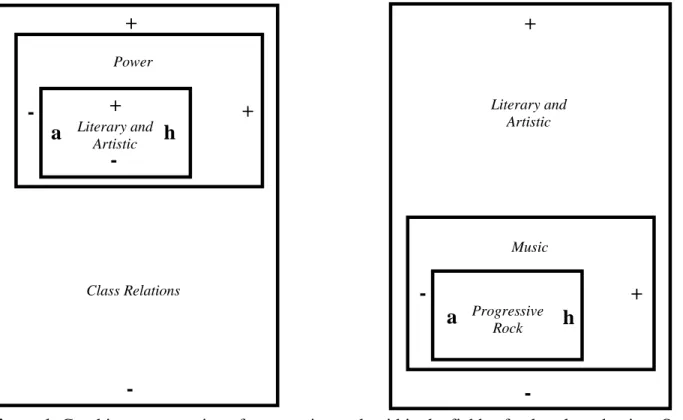
key concepts from Bourdieu’s theories.38 A field is the space of positions and position-takings,
which is structured by the distribution of forms of capital specific to the field. As demonstrated
by Figure 1, fields are multiple and hierarchical; some examples that I will discuss in this thesis
include the field of progressive rock, which is within the field of music, itself within the broader
literary and artistic field. In a given field, a position is the status that an individual occupies within this hierarchy, while position-takings are the manifestations of an individual in trying to change their position. A position is defined by the amount of cultural, social, and/or economic capital that the agent possesses. A given field is defined by the forces or struggles of the various position-takings within it, with individuals trying to achieve or maintain control over these types
of capital.
Economic capital is the universe of mercantile exchanges oriented toward the maximization of profit. While Bourdieu builds on this traditionalist economic theory, he
nonetheless deems it an inadequate representation of capital in its entirety.39 This is where social
and cultural capital come in. Social capital describes the capital acquired by an agent’s affiliation with more or less institutionalized social networks, as well as the ability to mobilize these
relationships when necessary.40 Finally, cultural capital refers to an agent’s ability in a particular
field to operationalize distinctive tastes, skills, knowledge, and practices unique to that field. It
occurs in three forms: embodied (“long-lasting dispositions of the mind and body”), objectified
38 I draw these theories primarily from Pierre Bourdieu, “The Field of Cultural Production, or: The Economic World
Reversed” in The Field of Cultural Production: Essays on Art and Literature, ed. Randall Johnson, trans. Richard Nice (New York: Columbia University Press, 1993), 29-73; and Pierre Bourdieu, “The Forms of Capital,” in
Handbook of Theory and Research for the Sociology of Education, ed. J. Richardson, trans. Richard Nice (Westport, CT: Greenwood, 1986), 241-58.
39 Bourdieu, “Forms of Capital,” 15.
Figure 1. Graphic representation of progressive rock within the fields of cultural production. On the right is the field of progressive rock in 2010 nested hierarchically within the fields under
which it is subsumed, and on the left is a recreation of Bourdieu’s original figure from “The Field of Cultural Production.” The “+” end of each field designates a dominant position within
that field, while the “–” designates a dominated position. The “a” and “h” ends of the progressive rock and literary and artistic fields represent the autonomous and heteronomous principles of
hierarchization, respectively.41
(“in the form of cultural goods . . . which are the trace or realization” of embodied cultural
capital), and institutionalized (embodied cultural capital that is accrued and can be conferred by existing institutions such as universities).42 Following Holt, of these three types, cultural capital
is the most pertinent to this research, especially in its embodied form, since I will be analyzing
the enactment of musical taste by prog rock fans made known through their internet presence.
41 Bourdieu, “Field of Cultural Production,” 38. The field of music is not limited to popular or classical music, but
broadly inclusive of both. Music occupies a dominated position in the modern literary and artistic field due to the extent that the author feels that literary artistic values tend to dominate the values of the arts at large—an issue not entirely relevant for the purposes of this thesis. Progressive rock occupies a dominated position within the field of music due to the narrative of the genre’s “death” (discussed below) and that narrative’s implications for the genre’s lack of contemporary value or significance.
42 Ibid, 16-21.
+
-
+
-
+
-
-
+
a
+
-
h
a
h
Institutionalized cultural capital plays an important secondary role in these analyses, as the
cultural capital accumulated and conferred by institutions (fan forums, music review websites or
journals) factors strongly into these actors’ curated representations of their tastes.
Cultural capital is specific to its given field, and as such each field has its own prevailing
laws for the struggles that define it. A field governed entirely by its own internal logic or cultural
capital (e.g. aesthetics and artistic prestige) is said to be autonomous, while one that is governed entirely by the fields that subsume and surround it is heteronomous. No field is purely one or the other; every field contains a mixture of both autonomous and heteronomous principles
(represented in Figure 1 by the “a” and “h” ends of progressive rock field). For instance,
progressive rock is heteronomous to the extent that it draws on the prevailing laws from both the
field of rock music and the field of classical music, but autonomous to the extent that it persists
in institutions such as fanzines and fan forums largely free of the market values that structure the
economic field.
Finally, the habitus is a system of dispositions held by agents in the field. For the agents in the field of prog rock, the snob is one manifestation of a habitus. The agents with a more
omnivorous habitus hold a higher position in this field, which allows them to control the
distribution of capital within the field. And, although the snobs and omnivores are two distinct
habitus within the field, snobs still often feel compelled to use the dominant language and value
system of omnivorous discourse as a means to attain more cultural capital. For instance, user
Salmacis tends toward a snobbish habitus based on a greater number of genre dislikes over likes,
has written, “I personally think it's a little unhealthy to just listen to one type of music, whatever
that might be. I think you get a bit too 'blinkered' doing that...”43
In order to critically evaluate the various actors and types of actors in progressive rock, I
consider the genre on two levels: as a field itself and as a position within larger fields. By
investigating the position of progressive rock in relation to the broader field of music, I seek to determine the cultural capital claimed (or not) when an agent within the field of music invokes
prog rock. I take this approach especially in Chapter 1, as I explain the trajectory of prog rock as
high art. As its own distinct field, progressive rock is a “space of possibilities” in which the
snobs and omnivores struggle for a dominant position in the field. These agents compete for
capital both within and between prog rock and related genres. In other words, taking progressive rock as a position, associated position-takings use genre as a means of hierarchical distinction. Taking progressive rock as a field, distinctions still occur within: genre and distinction.
There are several existing studies of musical genre that utilize aspects of Bourdieu’s
theories. One of the earliest applications can be found in Simon Frith’s Performing Rites, in which Frith draws on Bourdieu’s concept of cultural capital to introduce three discursive
practices, or “value discourses,” through which people value music: bourgeois/high art,
commercial, and folk. While this model may be useful for observing genres and artists’ positions
in the marketplace, it nonetheless focuses on the objectified forms of cultural capital in music,
such as classical/art music in the bourgeois/high art category, music industry in commercial, and
emphasis on tradition in folk.44 Frith’s work is thus subject to Holt’s same criticism of Peterson
43 Salmacis, “Embarrassing Taste,” PA, posted January 24, 2008, http://www.progarchives.com
/forum/forum_posts.asp?TID=45631&KW=&PID=2752340#2752340.
44 Simon Frith, Performing Rites: On the Value of Popular Music (Cambridge, MA: Harvard University Press,
et al.’s work, and as such will not play a prominent role in my thesis, which focuses more on the
embodied and institutional forms of cultural.
In his analysis of hip hop, Ewoodzie draws on Bourdieu and the sociologist Andrew
Abbott’s work to account for the boundary formations and sites of difference that gave rise to hip
hop as a distinct genre in the Bronx. Ewoodzie, however, focuses more on the external
boundaries that help distinguish hip hop from other cultures, rather than the internal struggles
that structure the field of hip hop.45 Similarly, Brackett draws on Bourdieu’s concept of the field
to demonstrate the extent to which musical genres only exist relationally to other genres.46 While
both studies are useful as models for delimiting the boundaries and formations of a genre field,
they nonetheless only briefly consider how the struggles within a genre actually structure the internal logic of the field.
“The End(s) of Genre” by Eric Drott is perhaps the closest extant example to my
conceptualization of genre and/as distinction in this thesis. In arguing against the common
misconception that genre is dead for Western art music in the twentieth century, Drott draws on
Bourdieu’s social fields to demonstrate how struggles and relational boundaries of genre are, in
fact, necessary to the maintenance of genre. By studying genre as “something that is enacted and
not a given a priori,” Drott discusses genre in its multiplicity of levels and meanings as an arena
that continues to be fruitful for analysis. Taking as his example Gérard Grisey’s composition Les espaces acoustiques, Drott argues that a listener is never free of generic contexts. Les espaces acoustiques, for instance, operates within the genre of spectralism, which stands in opposition to
45 Joseph C. Ewoodzie Jr., Break Beats in the Bronx: Rediscovering Hip-Hop’s Early Years (Chapel Hill: University
of North Carolina Press, 2018), 7-11.
serialism, both of which are subsumed under European avant-garde, etc.47 Drott’s article,
however, generally does not account for the importance of position and hierarchy to the struggles
that define fields. It would seem that the decision to exclude positions was intentional, as Drott
criticizes Bourdieu for tending to “assume the existence of relatively stable social fields that
stand above individuals and shape their conduct.”48 The existence of positions (and
consequently, hierarchy) without the possibility of position-takings would do just that. But by simultaneously excluding position-takings—the agency of individuals in seeking to change their
position and the structure of the field—Drott actually fails to account for agency inherent in
Bourdieu’s social fields (exactly what he argues is missing) while ignoring the fact that
hierarchies are ever-present and ever-changing within and between genres.
Recent literature in the burgeoning field of border studies provides a corrective to many
of the extant issues in the aforementioned exclusivist readings of Bourdieu’s fields of cultural
production. In response to the mainstream understanding of national borders as dichotomies of
nationality (e.g. U.S. American/Mexican) and legality/illegality, Alejandro L. Madrid argues for
a theorization of borders as liminal spaces of fluidity and becoming.49 Epistemologically, the
theories of border studies applied to Bourdieu’s fields of cultural production allow for an
understanding of genre as a liminal space in which oppositional dichotomies are present but are
neither exclusive nor all-encompassing. Donald Henrique’s study of mariachi aesthetics and
identity among Mexican Americans provides an excellent example by demonstrating how
47 Eric Drott, “The End(s) of Genre,” Journal of Music Theory 57, no. 1 (Spring 2013): 3-4, 23. 48 Ibid, 4.
49 Alejandro L. Madrid, “Transnational Musical Encounters at the U.S.-Mexico Border: An Introduction,” in
contemporary mariachi both participates in and transcends the dichotomy of high/low art.50 The
present study seeks to contribute to this literature by foregrounding how forces of opposition
contribute to the formation of a genre as an epistemological border zone.
Methodology
The majority of evidence supporting this thesis derives from deep textual analyses of
discourses in fan forums and fanzines, interviews, and reviews, all found online. The resources
surveyed range from 1965 to 1980 for classic prog, and 1995 to 2020 for the prog rock
resurgence. Evidence for classic prog bands derives primarily from contemporaneous reviews
and interviews,51 with sociological information on the fanbase coming primarily from Frith’s Sociology of Rock and Macan’s Rocking the Classics.52 As for the prog rock resurgence, I draw
on reviews and interviews with The Mars Volta, while using fan forums to gather information
about the fanbase at large. Prog Archives serves as the primary site for information, but these
analyses are also informed by comparisons to fanzines and fan forums dedicated to specific prog
bands, such as The Comatorium (The Mars Volta), A New Day (Jethro Tull), and Elephant Talk
(King Crimson).53
50 Donald Henriques, “Mariachi Reimaginings: Encounters with Technology, Aesthetics, and Identity,” in
Transnational Encounters: Music and Performance at the US-Mexico Border, ed. Alejandro L. Madrid (New York: Oxford University Press, 2011), 84-110.
51 These resources are drawn primarily from the online database Rock’s Backpages.
52Simon Frith, The Sociology of Rock (London: Constable, 1978); Macan, “A Sociology of Progressive Rock,” in
Rocking the Classics, 144-166.
53 My selection of material from each of these sites derives primarily from keyword searches for relevant
information. For instance, “Mars Volta” was a common keyword search in Prog Archives’ search functionality, as was “noise” for Chapter 3. For the sake of transparency, many of these searches are still visible in the links that accompany the forum citations. A general survey of TMV-centric threads was attempted on Prog Archives, but no attempt was made at a comprehensive survey the entirety discussions of any of these sites. As such, the
Two existing studies on progressive rock have also drawn on fan contributions to Prog
Archives: Jarl A. Ahlkvist’s 2011 study uses fan-written album reviews to study their role in
“shaping expectations” about the prog rock genre and its boundaries, and Chris Anderton’s 2010
study utilizes “lay definitions” of the Prog Archives fanbase to describe progressive rock as a
“meta-genre” encompassing a variety of European progressive styles and subgenres.54 My
approach to Prog Archives differs substantially from both Ahlkvist and Anderton in that I do not
use fan contributions towards the end of defining or describing genre. Furthermore, neither study
explicitly makes use of forum contributions for the purposes of textual analysis. Kevin Prouty’s research on the “virtual jazz community” of the forum “All About Jazz” is one of the closest
methodological precedents to my use of fan forums, however his study focuses more on
community formation and less on hierarchies both within and beyond the field of struggle that is
enabled by these online communities.55 Additionally, while Prouty describes his work as drawing
on “unique ethnographic moments,”56 my work stops short of “virtual fieldwork” in that I do not
actively participate in these discussions.57
Formed in 2003, Prog Archives strives to be “the most complete and powerful
progressive rock source.” About one-third to one-half of the site userbase lives in the United
States and United Kingdom, with the rest primarily from South America and other North
54 Jarl A. Ahlkvist, “What Makes Rock Music ‘Prog’?: Fan Evaluation and the Struggle to Define Progressive
Rock,” Popular Music and Society 34, no. 5 (2011): 639-660; Chris Anderton, “A Many-Headed Beast: Progressive Rock as European Meta-Genre,” Popular Music 29, no. 3 (October 2010): 417-435.
55 Ken Prouty, Knowing Jazz: Community, Pedagogy, and Canon in the InformationAge (Jackson: University Press
of Mississippi, 2011), 115-150.
56 Ibid, 119.
57 Timothy J. Cooley, Katherine Meizel, and Nasir Syed, “Virtual Fieldwork: Three Case Studies,” in Shadows in
the Field: New Perspectives for Fieldwork in Ethnomusicology, 2nd ed., ed. Gregory Barz and Timothy J. Cooley
American and European countries.58 While the forum makes up a majority of the activity that
occurs within this site, other services offered by Prog Archives include “Prog Rock Guides” for
an introduction to prog rock, albums reviews, and prog band biographies.59 Members of the site
are welcome to initiate and post within forum threads, but can also contribute beyond the forum
in the form of album reviews or biographies. The “New Members Guide” in the site guidelines
explicit states, “unlike other sites, we do not restrict the posting of reviews to a chosen few
‘expert’ reviewers, we value your opinion.” Part of the incentive for producing reviews is to
acquire cultural capital and improve one’s position in Prog Archives. Depending on the quality
or quantity of user engagement, users can attain the status of (from highest to lowest): founders,
admin team, special collaborator, prog reviewer, forum senior member, or newbie.60 Although
this cultural capital acquired from one’s status is restricted to the field of Prog Archives due to
the site’s anonymity of users, certain skills attained on one’s way to achieving this status, such as
the ability to write reviews, are transferable to broader fields. As such, I will often consider the
status of the users I study as one manifestation of capital at work within the broader field of prog
rock.
In their study of online communication factors, psychologists Noam Lapidot-Lefler and
Azy Barak observed what they and other scholars of virtual human behavior have called the
“disinhibition effect,” in which the anonymity, invisibility, and lack of eye-contact in virtual
58 Geographic statistics drawn from “The ‘Where You At’ Poll,” PA, created January 13, 2007, https://www
.progarchives.com/forum/forum_posts.asp?TID=33165&KW=where&PID=2338343#2338343; and “Where ‘ya from?” PA, created June 26, 2006, https://www.progarchives.com/forum/forum_posts.asp?TID=25031&KW= where&PID=2036680#2036680.
59 “Home,” PA, accessed March 11, 2020, http://www.progarchives.com/.
60 “New Members Guide,” PA, created April 3, 2008, http://www.progarchives.com/forum/forum
spaces disinhibit toxic behaviors, such as “flaming.” Lapidot-Lefler and Barak define flaming as
“the use of hostile expressions toward others in online communication” which “typically
includes the use of a variety of textual elements, such as aggressive and hostile language,
swearing, derogatory names, negative comments, threats, and sexually inappropriate comments.”
Textual evidence of flaming includes the use of capital letters, excessive question marks and
exclamation points, mixture of letters and numbers, and use of color.61
While the disinhibition effect may provide evidence for the lack of truth to the claims of
cultural snobbism in Prog Archives, there are nonetheless certain safeguards in place that prevent
flaming, such as the ability to report offensive behaviors and fan forum moderators, which may
ultimately lead to ejection of users.62 Lincoln Dahlberg describes these types of safeguards as
“self-management,” which help guide users to more respectful discourses that may ultimately
have the effect of influencing the public sphere beyond the forum itself.63 This is especially
pertinent to Prog Archives, as the more cultural capital a user attains in the forum, the more
influence they are likely to have beyond the forum, such as simple Google searches for album
reviews. Nonetheless, some instances of flaming and trolling slip through the cracks. In these
cases, I have used the above guidelines to identify instances of flaming and exclude them from
the evidence for this project so as not to skew the results.64
A large part of this project pertains to reconstructing the field of prog rock, especially the
“habitus” (plural) that make up the dispositions of the various members of the field. This is no
61 Noam Lapidot-Lefler and Azy Barak, “Effects of Anonymity, Invisibility, and Lack of Eye-Contact on Toxic
Online Disinhibition,” Computers in Human Behavior 28 (2012): 434-435.
62 “Site rules and guidelines,” PA, created October 14, 2005, http://www.progarchives.com/forum/forum_posts
.asp?TID=13083.
63 Dahlberg, “Internet and Democratic Discourse,” 625.
easy or obvious task, as noted by Bourdieu: “one of the major difficulties of the social history of
philosophy, art or literature is that it has to reconstruct these spaces of original possibles which
. . . were part of the self-evident givens of the situation.”65 Nonetheless, in studying the field and
symbolic boundaries of prog rock, it is necessary that I seek to reconstruct these “self-evident”
dispositions of the snob and omnivore. Arturo Arriagada argues for the existence of a “digital
habitus” that is distinct from in-person relations.66 In this project, however, I make the case that
these users’ digital habitus sustain and manifest their everyday habitus. For instance, while a user
may feel less inclined to speak about their snobbish dispositions in everyday conversation, the
anonymity and group of like-minded individuals of Prog Archives allows for a space in which
their snobbism can come more to the fore—an instance in which the “disinhibition” of online
interaction can actually serve as an impetus for more truthful expressions.
Finally, all fan forum posts in this thesis are quoted verbatim, with spelling, punctuation,
and emoticons appearing as in the original post. Although “academic English” factors
prominently into the performance of status for many of these users, certain language styles and
demonstrate affluency in language specific to the site or fan forums more generally.67 Chapter Outline
In Chapter 1, I trace the historical lineage of prog rock as a position within the broader
fields of music and class relations in order to demonstrate its highbrow tendencies. The
progressive in this context, I argue, may have begun as politically progressive activism against
65 Bourdieu, “Field of Cultural Production,” 31.
66 Arturo Arriagada, “Unpacking the ‘Digital Habitus’ of Music Fans in Santiago’s Indie Music Scene,” in The
Production and Consumption of Music in the Digital Age, eds. Brian J. Hracs, Michael Seman, and Tarek E. Virani (New York and London: Routledge, 2016), 225.
67 For instance, the Prog Archives site guidelines specifically encourage the use of “emoticons to convey your
certain conservative policies in the United States and United Kingdom, but it ultimately came to
be received as progressing toward the status of a higher art form. Most of this chapter will focus on the purported birth (late 60s) and death (late 70s) of prog rock, as well as the genre’s
reception in the United States. It is amidst this transatlantic exchange that I will argue
progressive rock took on an unmarked backdrop of white, male, high-status authenticity.
Furthermore, drawing on contemporaneous reviews, interviews, and sociological studies (the
only contemporaneous study being Frith’s Sociology of Rock), I examine the struggles that
defined the field of prog rock in the 70s and argue for the existence of the prog snob. After the
genre’s death in the late 70s, however, the field of progressive rock ceased to exist as such, and
what was left of progressive rock after its death was a position against which other artists, fans,
or genres could position themselves in the broader field of popular music. Thus, I argue that the
death of prog narrative was essential to the genre’s stabilization during its resurgence in the
1990s. Finally, I examine the state of snobbism in post-90s prog rock resurgence and argue that,
while it still persists as a remnant of classic prog fandom, it nonetheless holds a dominated
position in relation to the omnivores.
Chapter 2 traces the emergence of The Mars Volta as a progressive rock band. I argue
that their association with the genre, to which they have asserted an ambivalent relationship, is
due both to the factor of the prog resurgence, as well as increasing concern with omnivorousness
among certain members of the prog rock fanbase and beyond. Drawing on interviews with
members Omar Rodriguez-Lopez and Cedric Bixler-Zavala, I demonstrate the extent to which a
performance of omnivorousness is integral to their brand, which I relate to their El Paso “border kid” identities and the fluid and hybrid manifestations of identity that this entails. Furthermore, I
white-washing tendency of progressive rock, and even rock music at large. Finally, drawing on
album reviews and discourses within a Mars Volta-centered fanbase The Comatorium, I
demonstrate that omnivorousness plays a critical role in their reception. Following the work of
Michéle Ollivier, who suggests that openness to musical diversity is often coded as openness to
cultural diversity,68 I suggest that the “progressive” in prog rock for these omnivores represents a social progressivism, which values an increase in ethnic and racial diversity in the genre. In addition to simply expressing an openness to diversity, this performance of social progressivism,
based on one’s ability to cite a variety of genres, enables fans and reviewers to enact cultural
capital in the field of music, in which omnivores hold the dominant position.
Finally, in Chapter 3 I focus my analyses on disagreements over The Mars Volta in Prog
Archives in order to demonstrate the extent to which implicit symbolic exclusions of age, race,
gender expression, class, and geography continue to manifest within the snobbish habitus. These
disagreements, I argue, are rooted in conflictual values of “progressivism” between the two
groups, with the snobs valuing the lack of diversity found in classic prog and the omnivores a
more diverse future of prog. Drawing on Jacques Attali and Alex E. Chavez’s theorization of
noise as a site of disjuncture and incomprehensibility, I describe several different types of noise
in dissents to The Mars Volta, such as rhythmic, modal, intervallic, ambient, instrumental, vocal,
and visual noise as sites in which different types of exclusions are enacted. In an attempt to resist
the essentializing of The Mars Volta’s identities that occur as a result of these symbolic
exclusions, I present an interpretation of their music and brand focused around violence, in which The Mars Volta both participate in and exceed the stylistic expectations of a number of genres. I
ultimately conclude that, while symbolic exclusions of age are most explicit in moments of
dissent, they often serve as coded language for other implicit exclusions of ethnicity, gender,
CHAPTER 1: THE GENESIS OF PROGRESSIVE ROCK AND THE PROG SNOB
The “progressive” of progressive rock has troubled artists, fans, and scholars alike since
the genre’s inception. It seems that, with each definition comes a counter-definition, with each
genre label, a genre rejection. Nonetheless, a progressive rock canon has formed around a core of
bands such as Yes, Genesis, Jethro Tull, King Crimson, Gentle Giant and Van Der Graaf
Generator, also colloquially known as the “big six,” which in turn has canonized affiliated
conceptions of progressivism. What values and circumstances allowed for these bands’
canonization as progressive? What values structured these progressive rock bands’ conception
and reception both then and now?
In this chapter, I delve into the early history (ca. 1969-78) and resurgence of classic
progressive rock (ca. 1997-2017) and suggest two meanings of progressivism integral to the
genre’s reception: political progressivism and status progressivism. I argue that in the 1970s,
progressive rock began as politically progressive dissent to military pursuits of the United States and United Kingdon in Asia and Africa, but ultimately came to be received as progressing
toward a higher status. Through this latter definition, I demonstrate that the genre of prog rock was founded on principles of elitist snobbism. This rethinking of the history of classic prog rock
will contextualize the conflictual values of progressivism during the prog rock resurgence that I
explore in the next two chapters via the reception of The Mars Volta.
Drawing on the work of David Brackett, I discuss the genre of progressive rock from a
“genealogical approach” that focuses on “how a particular idea of a category emerges and
institutions,” rather than “what constitutes the contents of a musical category.”1 Putting this
genealogical approach in dialogue with Madrid’s work in musical border studies,2 I use Prog
Archives to distinguish between the “center” and “margins” of the progressive rock canon that
only stabilized in retrospect. This demonstrates how only a select few British rock bands came to
constitute the purest of progressive rock style, while other closely-related (primarily U.S.
American) bands and artists are often relegated to the marginal status of subgenre. Focusing
primarily on the aforementioned “big six” classic prog bands as the “center” of this canon, I
interrogate progressive rock’s position in the various fields in which it operates. I focus on the
emergence and “death” of prog rock in an attempt, through this genealogical approach, to
demonstrate that the “progress” in classic prog rock attempted to raise its status position, like
jazz before it, relative to Western classical music.
Furthermore, drawing on Bourdieu’s “fields of cultural production,” I trace the trajectory
of prog rock by analyzing it as both a field itself, as well as a position within the fields of music
and class relations. Within the field of music, progressive rock’s position-takings (such as album
releases demarcated as prog and general practices of prog snob elitism) sought to elevate itself to
a dominant position similar to that occupied by classical music. Within the field of class
relations, progressive rock continued in the trajectory of psychedelia in seeking to elevate the
formerly low-status position of rock to a position in which it could be respected by high status
individuals. As a field itself, the struggles that define prog rock include dialectical relationships
between rock and classical music, between commercial success and aesthetic autonomy, and
between artist and critic-fan understandings of the genre. With the death of prog these struggles
ceased to exist, and until the prog resurgence all that was left of prog was a position against
which other artists, fans, or genres could position themselves in the field of music.
I begin by tracing the emergence of prog rock and its associated transition from political
to status progressivism—one that is tied up in notions of unmarked white, male, high-status
authenticity. In doing so, I also briefly discuss the perceived stylistic borrowings from classical
music and jazz, arguing that the former contributed to its reception as elitist, while the latter was
minimal and mostly legible to fans and scholars retrospectively due to their similar status
trajectories. Furthermore, by engaging with contemporaneous reviews, interviews, and
sociological studies, I examine the different positions of the fans within the field and conclude
that the snobs held a dominant position within the 1970s field of prog rock. Simon Frith’s
Sociology of Rock demonstrates that in the 1970s, prog rock was not quite the stable entity that fans understand it to be today. I argue that the death of prog narrative was essential to the genre’s
stabilization during its resurgence in the 1990s. Finally, I examine the state of snobbism in the
post-millenium prog rock resurgence and argue that, while it still persists as a remnant of classic
prog fandom, it nonetheless holds a dominated position among the omnivores.
The Evolution of the Prog Rock Dinosaurs
Progressive rock is normally said to have originated in late 1960s England. Most scholars
describe the genre’s emergence as an offshoot of counterculture, psychedelia, and the British
invasion.3 The album that supposedly bridged the pre- and post-counterculture demographics
was The Beatles’ 1967 album Sergeant Pepper’s Lonely Hearts Club Band.4 With its stylistic
3 See, for instance, Macan, Rocking the Classics, 15-22; Ahlkvist, “What Makes Rock,” 640; Anderton, “A
Many-Headed Beast,” 422-23.
4 Robert G. H. Burns, Experiencing Progressive Rock: A Listener’s Companion (Lanham, MD: Rowman and