Prevalence and Predictors of Substance Use Disorders Among
HIV Care Enrollees in the United States
Bryan Hartzler1•Julia C. Dombrowski2• Heidi M. Crane2•Joseph J. Eron3,4• Elvin H. Geng5•W. Christopher Mathews6•Kenneth H. Mayer7,8•
Richard D. Moore9,10,11•Michael J. Mugavero12•Sonia Napravnik3• Benigno Rodriguez13•Dennis M. Donovan1,14
Published online: 13 October 2016
Abstract Prior efforts to estimate U.S. prevalence of substance use disorders (SUDs) in HIV care have been undermined by caveats common to single-site trials. The current work reports on a cohort of 10,652 HIV-positive adults linked to care at seven sites, with available patient data including geography, demography, and risk factor indices, and with substance-specific SUDs identified via self-report instruments with validated diagnostic thresh-olds. Generalized estimating equations also tested patient indices as SUD predictors. Findings were: (1) a 48 % SUD prevalence rate (between-site range of 21–71 %), with 20 % of the sample evidencing polysubstance use disorder; (2) substance-specific SUD rates of 31 % for marijuana, 19 % alcohol, 13 % methamphetamine, 11 % cocaine, and 4 % opiate; and (3) emergence of younger age and male gender as robust SUD predictors. Findings suggest high rates at which SUDs occur among patients at these urban
HIV care sites, detail substance-specific SUD rates, and identify at-risk patient subgroups.
Resumen Los esfuerzos previos para estimar la preva-lencia de los trastornos por uso de sustancias (TUS) de Estados Unidos en la atencio´n del VIH han sido socavados por los problemas comunes de la investigacio´n realizada en un solo sitio. Este documento informa sobre un estudio de una cohorte de 10,652 adultos con VIH que reciben aten-cio´n en siete sitios, con los datos del paciente disponibles sobre la geografı´a, la demografı´a y los ı´ndices de factores de riesgo, y con trastornos por uso de sustancias para sustancias especı´ficas identificadas con los instrumentos de autoinforme con umbrales de diagno´stico que han sido validado. Ecuaciones de estimacio´n generalizadas tambie´n evaluaron los ı´ndices de pacientes como predictores de TUS. Los resultados fueron: 1) una tasa de prevalencia de
& Bryan Hartzler
1 Alcohol & Drug Abuse Institute, University of Washington,
Box 354805, 1107 NE 45th Street, Suite 120, Seattle, WA 98105-4631, USA
2 Division of Allergy and Infectious Disease, University of
Washington, Seattle, WA, USA
3 Department of Medicine, University of North Carolina,
Chapel Hill, NC, USA
4 Department of Epidemiology, University of North Carolina,
Chapel Hill, NC, USA
5 School of Medicine, University of California, San Francisco,
CA, USA
6 Department of Medicine, University of California, San Diego, CA, USA
7 School of Medicine, Harvard University, Boston, MA, USA
8 School of Public Health, Harvard University, Boston, MA, USA
9 Department of Medicine, Johns Hopkins University,
Baltimore, MD, USA
10 Department of Epidemiology, Johns Hopkins University, Baltimore, MD, USA
11 Center for Global Health, Johns Hopkins University,
Baltimore, MD, USA
12 Department of Medicine, University of Alabama, Birmingham, AL, UK
13 Department of Medicine, Case Western Reserve University,
Cleveland, OH, USA
14 Psychiatry and Behavioral Sciences, University of
TUS de 47 % (entre-ubicacio´n gama de 21 a 71 %), con 20 % de la muestra que demuestra un trastorno que implica mu´ltiples sustancias; 2) las tasas SUD por sustancia espe-cı´fica de 31 % para la marihuana, 19 % para el alcohol, 13 % de la metanfetamina, 11 % de la cocaı´na, y 4 % de los opia´ceos; y 3) el surgimiento de menor edad y el sexo masculino como predictores robustos de los trastornos por uso de sustancias. Los resultados sugieren que los pacientes en las clı´nicas urbanas VIH tienen altas tasas de TUS, describen las tasas de sustancias especı´ficas, e identifican subgrupos de pacientes en situacio´n de riesgo.
Keywords HIV care settingsSubstance use disorders Patient demographyUnited States
Introduction
Prior reports suggest 80 % of HIV?Americans effectively engaged in care reach viral suppression [1, 2], though consequent optimism is tempered as this applies to a subset of those living with HIV. Estimates suggest 14–21 % of HIV?Americans are unaware of their status, and up to half of those linked to care ineffectively engage in services [3]. While health policies, delivery systems, and providers may all influence patient engagement in HIV care [4], clinical attributes of the HIV?population also play a key role. One such attribute is substance use disorders (SUDs), defined by a set of adverse physiological and behavioral consequences (i.e., tolerance, withdrawal, role failure, craving, unsuc-cessful quitting). Increased care access among persons with SUD due to the Affordable Care Act [5,6] and strong inter-rater reliability for the singular DSM-V conceptualization of SUD [7] are recent developments suggesting this as an opportune time for reporting SUD prevalence estimates among HIV care enrollees.
From a public health perspective, SUDs and HIV comprise a health syndemic for which deleterious impacts are observed throughout the HIV Care Continuum [8]. With regard to HIV transmission, effectiveness of universal
test-and-treat approaches is diminished among persons with SUD [9, 10]. Post-diagnosis linkage to care occurs less often among persons with SUD [11], likely due to a complex mix of system, provider, and patient factors [12]. Even after care linkage, persons with SUD visit clinic inconsistently, initiate antiretroviral medication at later stages of illness, and display poor adherence [13–18]. Though definitions of HIV care retention may vary [4,19], research suggests the presence of an SUD has a detrimental influence [20–22]. Comparatively less effective HIV diagnosis, care linkage, antiretroviral medication adher-ence, and retention in services would be expected to diminish likelihood of eventual viral suppression; however,
those with SUD respond no differently to antiretroviral medication when regimens are followed [23]. Further, adherence and consequent viral suppression are achievable if appropriate health services are in place [24,25]. Thus, clarity of the scope of SUD prevalence may inform service needs of substance-using populations along the HIV Care Continuum.
To date, nearly all efforts to estimate SUD prevalence in U.S.-based HIV care have been limited to single-site trial data. Inherent geographic isolation and selection bias common to such trials contribute to diverse estimates, ranging from 21 to 65 % [26–45]. Caveats are compounded by a lack of diagnostic specificity, as trial sample sizes have typically precluded substance-specific examination even as individual substances of abuse pose differential risk in HIV transmission, course, and outcome [15,46–49]. Alternative data sources, if generated via continuous and coordinated multisite collection, may address apparent gaps in extant literature to offer more comprehensive, detailed estimation of SUD prevalence. Patient geography and demography (i.e., age, gender, race/ethnicity, sexual identity) predict both substance use among HIV care enrollees [50–52] and SUD rates in community sampling [53,54], and therby merit inclusion in such analytic work. The Center for AIDS Research Network of Integrated Clinical Systems (CNICS) [55] is a U.S.-based data source offering a multi-regional, continuous cohort of HIV care enrollees, with demographic information and capacity to delineate substance-specific SUDs.
Aims of the current work were to report prevalence estimates for SUDs among HIV care enrollees, and identify demographic predictors that increase likelihood that an SUD is present. Corresponding examination of a 10,000? cohort, drawn from seven urban university-affiliated care centers, enabled derivation of multiregional, substance-specific SUD prevalence estimates. Patient geography, demography, and HIV transmission risk factors were explored as potential SUD predictors, in effort to identify patient subgroups at greater consequent risk to prematurely disengage from HIV care. Increased understanding of the scope of the SUD-HIV syndemic may spur implementation of addiction-focused services that respond to needs of HIV care enrollees.
Methods
Data Sources
for multiple substances. Models testing patient indices as predictors utilized a binary outcome (any SUD, no SUD).
Participants
The aggregate sample (N=10,652) were HIV? adults linked to care at one of seven urban sites who completed a patient-reported outcome assessment between 01/01/2007 and 12/31/2014. Site locations were at Harvard University, Johns Hopkins University, University of Alabama-Birm-ingham, University of California-San Diego, University of California-San Francisco, University of North Carolina-Chapel Hill, and the University of Washington. All patients were aged 18? years, provided demography/background information upon clinic enrollment, and completed a patient-reported outcome assessment at a routine clinic visit. Per CNICS policy, persons deemed medically unstable, appearing intoxicated, evidencing significant cognitive impairment, or unable to speak English or Spanish did not complete the assessment.
Analytic Strategy
Descriptive rates of alcohol UD, cocaine UD, marijuana UD, methamphetamine UD, and opioid UD were computed for the aggregate sample and by CNICS site. Preliminary review of distributional properties for demography data prompted decisions to: (1) create five age groups (18–29, 30–39, 40–49, 50–59, 60?years), (2) transform race and ethnicity to a single categorical ‘race/ethnicity’ variable (non-Hispanic Caucasian, non-Hispanic Black, Hispanic, Other) as in prior CNICS reporting [57], (3) retain trans-gender status for descriptive analyses only, given low base rate of affirmative response, and (4) retain sexual orienta-tion for descriptive analyses only, as preliminary analyses revealed poor subsample representativeness.
In this multisite design, generalized estimating equa-tions (GEEs) examined population-average models for a binary logistic outcome (any SUD, no SUD). This approach describes change in this target outcome due to variance in patient demography and HIV risk factor indi-ces, while accounting for nonindependence in observations within sites [60]. Initial bivariate models defined categor-ical patient-based indices as independent variables, with specification of robust covariance structure due to the large aggregate sample size. Preliminary models examined geographic and historical clustering of SUDs, with respective dummy-coding of CNICS site and assessment timing. Though SUD rates did not vary as a function of assessment timing, site was a robust predictor (as later detailed) and was consequently a covariate in subsequent bivariate models respectively testing age-group, gender, race/ethnicity, IDU history, and MSM history (the latter explorequestionsnotreadilyaddressedbysamplingbiases
and surrogate endpoints inherent in clinical trials [56]. Availabledataincludeinformationdocumentedbystaffat clinicvisits,standardHIV-relatedriskfactordataobtained at enrollment, medication/laboratory data from electronic medical records, and patient-reported outcomes collected since 2007 by personal computer or touch-screen tablet [55]. Approval of a university-based institutional review board (IRB) at each CNICS site governs data collection, andthe University of Washington IRBapproved analytic procedureswithde-identifieddataprovidedtotheprincipal investigatorbythe CNICSDataManagement Core.
The current work is restricted to patient demography/ backgroundindicesaswellasthepatient-reportedAlcohol Use Disorders Identification Test-Version C (AUDIT-C [57]) and Alcohol, Smoking, and Substance Involvement Test(ASSIST[58]).Demography/backgroundindiceswere patients’ CNICS enrollment site, age, gender, ethnicity, race,transgender status, andsexual orientation (the latter collected among recent enrollees at three CNICS sites). Two HIV risk factor indices were examined, based on clinicalnotationkeptatCNICSsites:ahistoryofinjection druguse (IDU), andahistoryof men whohave sexwith men(MSM).
The AUDIT-C is governed by a ‘past 12months’ reportinginterval,forwhichasummaryscoreisgenerated for which a diagnostic threshold identified alcohol use disorder.In anationalsample,Dawsonetal.[59] demon-strateditsutilityasadiagnosticscreeninginstrumentwith 84%sensitivityand83%specificityforDSM-Vdiagnosis derived in clinical interviews. The CNICS assessment battery limits ASSIST measurement to four drug cate-gories: cocaine, marijuana, methamphetamine, and non-prescriptionopioids. The ASSIST is governed by a ‘past 3months’ reporting interval, and results in an ‘involve-mentscore’for eachdrug category.Humeniuket al.[58] documented cross-cultural utility of the ASSIST as a diagnosticscreeninginstrument,withthe four CNICS-rel-evant involvement score thresholds demonstrating 91–97% sensitivityand87–96% specificityfor DSM-IV diagnoses of the four corresponding SUDs in clinical interviews.
SUDIdentifications
Applying AUDIT-C [59] and ASSIST [58] diagnostic thresholds,caseswereidentifiedforfivesubstance-specific SUDs (hereafter referenced as alcohol UD, cocaine UD,
model restricted to the 8882 male patients in the aggregate sample) as SUD predictors. Patient-based indices identified as SUD predictors in the aggregate sample were included as independent variables in an eventual multivariable model, with similar inclusion of CNICS site as a covariate and model specification of robust covariance structure.
Results
In the aggregate sample, age ranged from 18 to 84 years (M=43.7, SD=10.6). Table1 lists SUD prevalence of patient subgroups defined by age, gender, race/ethnicity, transgender status, and IDU history. Prevalence of SUD is also noted for MSM history among males (n=8882), and for sexual orientation among the persons for whom this self-report data was available (n=1716).
Prevalence of Substance-Specific SUDs
Prevalence of SUD in the aggregate sample was 48 %, ranging from 21 to 71 % at the seven CNICS sites. Sub-stance-specific SUD prevalence was: 31 % for marijuana UD (site-specific range 4–52 %); 19 % for alcohol UD (site-specific range 13–27 %), 13 % for methamphetamine UD (site-specific range 1–21 %), 11 % for cocaine UD specific range 7–18 %), and 4 % of opiate UD (site-specific range 1–8 %). Multiple diagnostic thresholds were met by 20 % of the aggregate sample (site-specific range 3–37 %), commensurate with polysubstance UD. Table2
lists site-specific rates of any SUD and each substance-specific SUD, with de-identification of individual CNICS-affiliate care sites (as stipulated by institutional review board agreements).
Modeling Patient-Based Predictors of SUD Prevalence
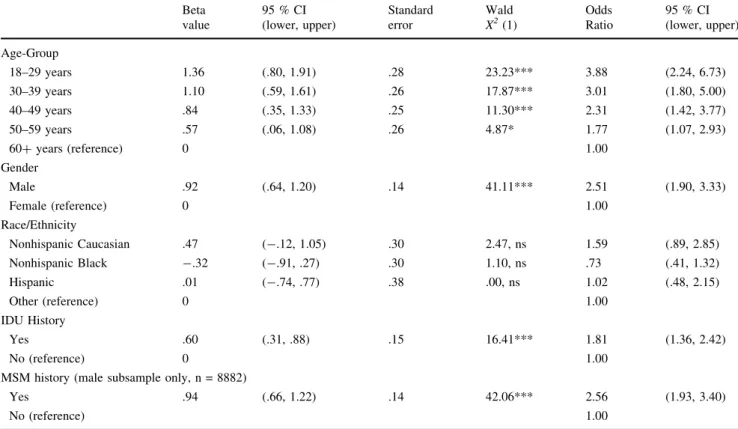
An initial bivariate GEE model identified substantial between-site variability in SUD prevalence, Wald X2
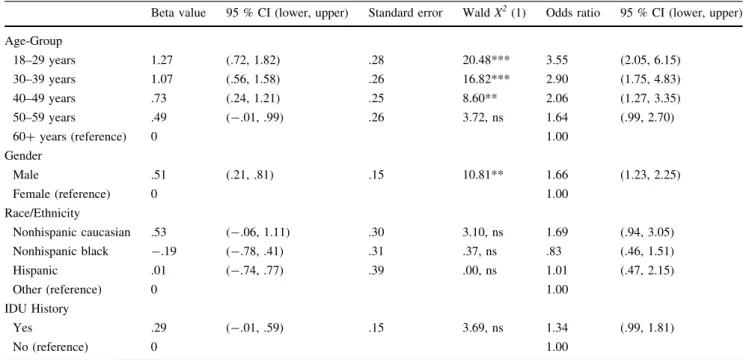
(6)=723.71, p\.000. This prompted inclusion of site as a covariate in all subsequent models, for which Tables3
and4present beta values with 95 % confiden interval (CI) limits as well as the corresponding standard errors, Wald
X2values, their statistical significance, and odds-ratios with 95 % CI limits for comparison to the referent group.
For age-group, model statistics noted significant pre-diction of SUD prevalence, WaldX2(4)=35.31, p\.000 (see Table3). The age-group X site interaction was non-significant, Wald X2(4) =.55, p=.968. Relative to ref-erent 60? year-olds, SUD prevalence was progressively greater in younger groups: 59 % among 18–29 year-olds, 54 % among 30–39 olds, 48 % among 40–49
year-olds, 41 % among 50–59 year-year-olds, and 30 % among 60? year-olds.
For gender, model statistics indicated significant pre-diction of SUD prevalence, WaldX2(1)=41.11, p\.000 (see Table3). The gender X site interaction was signifi-cant, Wald X2 (1) =6.83, p\.01. Relative to referent females, SUD prevalence was more likely among males (50 vs. 36 %) with the gender X site interaction prompting site-level examination. At two sites, SUD prevalence among males and females was not appreciably different, but was greater among males than females at the remaining five sites.
For race/ethnicity, model statistics suggested significant prediction of SUD prevalence, Wald X2 (3)=49.86, p\.000 (see Table3). However, the race/ethnicity X site interaction failed to reach statistical significance, Wald X2
(3) =4.91, p=.178. Further, subgroup comparisons to those of the referent ‘Other’ race/ethnicity failed to reach statistical significance. In descriptive terms, SUD preva-lence was 54 % among non-Hispanic Caucasians, 48 % among both Hispanic and ‘Other’ race/ethnicity subgroups, and 39 % among non-Hispanic Blacks.
For IDU history, model statistics noted significant pre-diction of SUD prevalence, WaldX2(1)=16.41, p\.000 (see Table3). The IDU history X site interaction was significant, WaldX2(1)=53.64, p\.000. Relative to no IDU history referents, prevalence was greater among those with IDU history (58 vs. 46 %) with the IDU history X site interaction prompting site-level examination. Prevalence of SUD among those with an IDU history did not appreciably differ from that of those without an IDU history at a single site, but was higher among those with IDU history than those without an IDU history at the remaining six sites.
Finally, MSM history was examined in the subsample of 8882 male patients. Model statistics revealed significant prediction of SUD prevalence, Wald X2 (1)=42.06, p\.000 (see Table3). The MSM history X site interaction was significant, WaldX2(1) =12.77, p\.000. Relative to no MSM history referents, prevalence was greater among those with MSM history (53 vs. 41 %). The MSM history X site interaction prompted site-level examination, revealing inconsistent direction of effects. Prevalence of SUD did not appreciably differ between males with versus without MSM history at one site, was greater among males with MSM history at four sites, and was greater among males without MSM history at the remaining two sites.
females. Specific subgroup differences were not indicated in SUD prevalence for race/ethnicity or IDU history.
Discussion
Utilizing CNICS to estimate SUD prevalence at seven HIV care sites in the U.S., the current work advances under-standing of the corresponding health syndemic. Study findings include: (1) 48 % SUD prevalence, encompassing substantial geographic variability (21–71 %); (2) Table 1 Substance use disorder
UD prevalence by patient demography and HIV risk factors
Subsample size (%) ‘Any SUD’ prevalencea(%)
Aggregate Sampleb 10,652 (100 %) 48
Patient demography
Age-Group
18–29 years 1254 (12 %) 59
30–39 years 2310 (22 %) 54
40–49 years 3901 (36 %) 48
50–59 years 2535 (24 %) 41
60?years 652 (6 %) 30
Gender
Male 8882 (83 %) 50
Female 1770 (17 %) 36
Race/ethnicity
Non-hispanic white 5278 (49 %) 54
Non-hispanic black 3632 (34 %) 39
Hispanic 1270 (13 %) 48
Other 472 (4 %) 48
Sexual orientation (subsample n=1716)c
Lesbian, gay, or homosexual 1280 (75 %) 59
Straight or heterosexual 278 (16 %) 52
Bisexual 95 (6 %) 65
‘Something else’ 34 (2 %) 76
‘Don’t know’ 29 (2 %) 41
Transgender
Yes 87 (1 %) 52
No 10,565 (99 %) 48
HIV Risk Factorsd
History of MSM (subsample of n=8882)
Yes 7039 (79 %) 53
No 1843 (21 %) 41
History of IDU
Yes 1718 (16 %) 58
No 8934 (84 %) 46
a ‘Any SUD’ identification based on substance-specific diagnostic thresholds from the AUDIT-C (alcohol
UD) and the ASSIST (cocaine UD, marijuana UD, methamphetamine UD, opioid UD) b Sample consists of HIV?persons enrolling in services 01/01/2007–12/31/2014
c Patient-reported sexual orientation collected only at three CNICS sites since 2012
d MSM history and IDU history per chart notation at CNICS care sites
substance-specific prevalence topped at 31 % for marijuana UD, 19 % for alcohol UD, 13 % for methamphetamine UD, 11 % for cocaine UD, and 4 % for opioid UD; and (3) emergence of younger age and male gender as robust SUD predictors in a multivariable model. Collective study findings offer multiregional prevalence estimates for sub-stance-specific SUDs at these urban HIV care sites, identify
patient subgroups at greater relative risk for evidencing an SUD, and lay groundwork for future comparative investi-gation of SUD as an influence on virologic outcomes, clinical processes, and indices of health and well-being.
The 48 % SUD prevalence rate in CNICS falls amid an aforementioned range of prior single-site estimates. The lone multisite study to previously estimate SUD prevalence Table 2 Substance use disorder prevalence by geographic site
Site #1 (818) (%)
Site #2 (852) (%)
Site #3 (2580) (%)
Site #4 (3179) (%)
Site #5 (1161) (%)
Site #6 (706) (%)
Site #7 (1356) (%)
Aggregate (10,652) (%)
Any SUD 60 21 39 48 71 34 61 48
Alcohol UD 27 13 16 18 21 14 22 19
Cocaine UD 13 7 11 8 17 7 18 11
Marijuana UD 36 4 26 29 52 24 42 31
Methamphetamine UD 14 1 4 17 31 2 21 13
Opioid UD 3 1 3 3 8 1 7 4
Site de-identification stipulated by institutional review board of one or more CNICS university-affiliate care sites
Corresponding sample/subsample sizes listed in parentheses
SUD identification based on substance-specific diagnostic thresholds from the AUDIT-C (alcohol UD) and the
ASSIST (cocaine UD, marijuana UD, methamphetamine UD, opioid UD)
Table 3 Bivariate prediction of substance use disorders by patient demography and HIV risk factors
Beta value
95 % CI (lower, upper)
Standard error
Wald X2(1)
Odds Ratio
95 % CI (lower, upper)
Age-Group
18–29 years 1.36 (.80, 1.91) .28 23.23*** 3.88 (2.24, 6.73)
30–39 years 1.10 (.59, 1.61) .26 17.87*** 3.01 (1.80, 5.00)
40–49 years .84 (.35, 1.33) .25 11.30*** 2.31 (1.42, 3.77)
50–59 years .57 (.06, 1.08) .26 4.87* 1.77 (1.07, 2.93)
60?years (reference) 0 1.00
Gender
Male .92 (.64, 1.20) .14 41.11*** 2.51 (1.90, 3.33)
Female (reference) 0 1.00
Race/Ethnicity
Nonhispanic Caucasian .47 (-.12, 1.05) .30 2.47, ns 1.59 (.89, 2.85)
Nonhispanic Black -.32 (-.91, .27) .30 1.10, ns .73 (.41, 1.32)
Hispanic .01 (-.74, .77) .38 .00, ns 1.02 (.48, 2.15)
Other (reference) 0 1.00
IDU History
Yes .60 (.31, .88) .15 16.41*** 1.81 (1.36, 2.42)
No (reference) 0 1.00
MSM history (male subsample only, n = 8882)
Yes .94 (.66, 1.22) .14 42.06*** 2.56 (1.93, 3.40)
No (reference) 1.00
Analyses based on aggregate sample (N=10,652), except where otherwise indicated, and include enrollment site as a covariate
SUD identification based on substance-specific diagnostic thresholds from the AUDIT-C (alcohol UD) and the ASSIST (cocaine UD, marijuana UD, methamphetamine UD, opioid UD)
alcohol UD, community prevalence was 14 % [53], whereas 19 % is noted of this CNICS cohort. When drug-based UDs were aggregated across the four CNICS drug categories plus sedatives/tranquilizers, solvents/inhalants, hallucinogens, and club drugs, community prevalence was 4 % [54]. In the CNICS cohort—with measurement limited to cocaine, marijuana, methamphetamine, and opioids as well as a ‘past 90-day’ reporting interval [58]—29 % prevalence is noted. These comparatively elevated rates of alcohol and (particularly) drug-based UDs hold preventa-tive implications. A high SUD prevalence broadens trans-mission pathways among HIV? persons involving the sharing of drug injection equipment, intoxicated involve-ment in unprotected sex, and sexual violence and victim-ization. These pathways are amplified among those with SUD—whether due to unawareness of HIV? status, unsuppressed viral load, or both [8]. As earlier noted, these are among the continual and recursive challenges that presence of an SUD poses for patients along the HIV Care Continuum.
Multivariable model findings—specifically, regional differences and greater relative risk of SUD among males and young adults—broadly replicate HCSUS patterns of two decades ago [51,52]. Replication of HCSUS findings, as well as those of national epidemiological studies Table 4 Multivariable prediction of substance use disorders by patient demography and HIV risk factors
Beta value 95 % CI (lower, upper) Standard error WaldX2(1) Odds ratio 95 % CI (lower, upper)
Age-Group
18–29 years 1.27 (.72, 1.82) .28 20.48*** 3.55 (2.05, 6.15)
30–39 years 1.07 (.56, 1.58) .26 16.82*** 2.90 (1.75, 4.83)
40–49 years .73 (.24, 1.21) .25 8.60** 2.06 (1.27, 3.35)
50–59 years .49 (-.01, .99) .26 3.72, ns 1.64 (.99, 2.70)
60?years (reference) 0 1.00
Gender
Male .51 (.21, .81) .15 10.81** 1.66 (1.23, 2.25)
Female (reference) 0 1.00
Race/Ethnicity
Nonhispanic caucasian .53 (-.06, 1.11) .30 3.10, ns 1.69 (.94, 3.05)
Nonhispanic black -.19 (-.78, .41) .31 .37, ns .83 (.46, 1.51)
Hispanic .01 (-.74, .77) .39 .00, ns 1.01 (.47, 2.15)
Other (reference) 0 1.00
IDU History
Yes .29 (-.01, .59) .15 3.69, ns 1.34 (.99, 1.81)
No (reference) 0 1.00
Analyses based on aggregate sample (N=10,652), except where otherwise indicated, and include enrollment site as a covariate
SUD identification based on substance-specific diagnostic thresholds from the AUDIT-C (alcohol UD) and the
ASSIST (cocaine UD, marijuana UD, methamphetamine UD, opioid UD)
Odds-ratios reflect the likelihood of SUD relative to the reference category; *** p\.001, ** p\.01, * p\.05
was a cross-sectional HIV Cost and Services Utilization Study(HCSUS)of2864adultscompletinganHIV-focused health visit in a two-month period in 1996. Based on clinical interviews (albeit with incomplete diagnostic questioning), HCSUS estimated prevalence of ‘heavy drinking’ at 15% [52] and ‘drug dependence’ at 12% [51].The current workidentifiedahighercollectiveSUD rate—and did so in this much larger, continuous, and multiregional CNICS cohort via SUD screening instru-mentswithconcurrentvalidity establishedforDSM diag-noses [58,59]. Giventhe university affiliation of CNICS sitesandtheirurbanlocationinlargeU.S.cities,definitive report of SUD prevalence in HIV care in the U.S. may require future recruitment of a nationally-representative sample of patients receiving services from the HIV care community.
[53,54], in this CNICS cohort lends credence to emphases given such predictors in SUD detection efforts. With respect to age, available CNICS data precluded examina-tion of SUD chronicity in this cohort. Nevertheless, per-sistent substance abuse among aging HIV? persons is a progressive risk for mortality [63, 64]. While improved clinical management of HIV infection has contributed to domestic decline in deaths due to AIDS-related causes, substance-related causes of death (i.e., drug overdose, mental disorders resulting from substance abuse) continue to increase among HIV? persons of all ages [65]. Less robust race/ethnicity findings in this CNICS cohort coin-cide with equivocal HCSUS reporting in this area [51,52]. Weak SUD prediction by patient IDU history may reflect effective use of harm reduction strategies, historically promoted among HIV?populations [66]. Likewise, SUD prediction by MSM history in the CNICS male subsample, albeit with site differences in strength and direction, sug-gests context may be critical to interpret how this risk factor for HIV transmission influences the prevalence of SUDs [67].
Strengths and caveats of this work bear further mention. The former include: a large, multiregional cohort of HIV care enrollees; inclusion of established SUD screening instruments with validated diagnostic thresholds; and use of secure, private means to collect patient-reports of recent substance use behavior. One noteworthy caveat is setting representativeness, given the prominent size, resources, university affiliation, and urban location of the seven CNICS sites. Definitive reporting of SUD prevalence among domestic HIV care enrollees awaits future study with a nationally-representative sample. Regarding this cohort of 10,652 patients, potential selection bias is acknowledged given enrollment of 32,000?persons since CNICS inception [68]. The reported 48 % SUD prevalence may reflect an underestimation, due to: (1) omission of licit (i.e., tobacco) and illicit (i.e., sedatives/tranquilizers, sol-vents/inhalants, hallucinogens, club drugs) substance cat-egories in the abbreviated CNICS version of the ASSIST, and (2) CNICS data collection policy precluding comple-tion of the assessment battery by patients appearing intoxicated. Despite these paired caveats of measurement and sampling, SUD prevalence in this cohort is safely within the range of prior published estimates for U.S.-based HIV care samples. Another caveat relates to potential influences of unassessed 3rd-variables, like socioeconomic (i.e., employment, income, education) and historical (i.e., family history of SUD, exposure to sexual trauma/victim-ization) patient background indices. Socioeconomic indices may interact with SUD and other health conditions to influence course and outcome of HIV infection [69], whereas historical indices are linked in HIV?populations
to substance use, treatment failure, morbidity, and mor-tality [70,71].
Conclusions
Caveats notwithstanding, the current study advances understanding of the scope of the American SUD-HIV syndemic. Nearly half of a large, multiregional CNICS cohort met diagnostic threshold for an SUD, and 20 % met thresholds for two or more of five substance categories evaluated. Given detrimental impacts that SUDs have on patient care throughout the HIV Care Continuum [3], more effective disease control efforts may derive through arming of HIV care settings with greater capacity to offer their patients addiction-focused services. In addition to estab-lished pharmacotherapies for alcohol UD (i.e., acam-prosate, naltrexone) and opioid UD (i.e., buprenorphine, methadone, extended release naltrexone), behavior thera-pies offer a useful response to many clinical challenges posed by persons with SUD. For example, efficacy to improve antiretroviral medication adherence among sub-stance-misuing patients has been demonstrated in multiple randomized controlled trials for cognitive-behavior therapy [72, 73], contingency management [74, 75], and motiva-tional interviewing [76, 77]. Further, the considerable empirical support documented for each of these behavior therapies in the addictions field has prompted recommen-dation of their broad application across adult patient pop-ulations and substances of abuse [78]. As in other health settings, a key to effective implementation of these behavior therapies may be in maximizing their compati-bility with existing service provisions in HIV care. Find-ings reported herein suggest there is need for addiction-focused services in U.S.-based HIV care settings, and specify young adults and men as patient subgroups for whom they will most often be applicable.
Acknowledgments The funding source for this analytic work was National Institute on Drug Abuse R03DA039719 (Informing Dis-semination of Behavior Therapies to Enhance HIV Care Among Substance Abusers,Hartzler PI). The authors thank the CNICS sites for contributing data to this endeavor. CNICS is funded by R24 AI067039 with sites at University of Alabama at Birmingham (P30 AI027767), University of Washington (P30 AI027757), University of California San Diego (P30 AI036214), University of California San Francisco (P30 AI027763), Case Western Reserve University (P30 AI036219), John Hopkins University (P30 AI094189, U01 DA036935), Fenway Health/Harvard (P30 AI060354), and University of North Carolina Chapel Hill (P30 AI50410).
Compliance with Ethical Standards
University of Washington from Genentech, ELITech, Melinta Ther-apeutics, Curatek Pharmaceuticals, Quidel, and Hologic. Among the authorship group, no other conflicts of interest were declared.
Disclaimer The content of this report is solely the responsibility of the authors and does not necessarily represent the official views of the National Institute of Health.
Ethical Approval All procedures involving human participants were in accordance with institutional review boards at the CNICS-affiliate universities, and with the 1964 Helsinki Declaration and its later amendments or comparable ethical standards.
Informed Consent Informed consent was obtained from all indi-viduals during their initial enrollment in CNICS.
References
1. Moore RD, Bartlett JG. Dramatic decline in the HIV-1 RNA level over calendar time in a large urban HIV practice. Clin Infect Dis. 2011;53:600–4.
2. Althoff KN, Buchacz K, Hall HI, et al. U.S. trends in antiretro-viral therapy use, HIV RNA plasma antiretro-viral loads, and CD4 T-lymphocyte cell counts among HIV-infected persons. Ann Intern Med. 2012;157:325–35.
3. Gardner EM, McLees MP, Steiner JF, del Rio C, Burman WJ. The spectrum of engagement in HIV care and its relevance to test-and-treat strategies for prevention of HIV infection. Clin Infect Dis. 2011;52(6):793–800.
4. Mugavero MJ, Amico KR, Horn T, Thompson MA. The state of engagement in HIV care in the United States: from cascade to continuum to control. Clin Infect Dis. 2013;57(8):1164–71. 5. McLellan AT, Woodworth AM. The affordable care act and
treatment for ‘substance use disorders’: implications of ending segregated behavioral healthcare. J Subst Abuse Treat. 2014;46:541–5.
6. McCance-Katz EF, Rabiner CA, Rivers JLA. The affordable care act: implementation and implications for addiction specialty care. The American Journal on Addictions. 2014;23:429–30. 7. Denis CM, Gelernter J, Hart AB, Kranzler HR. Inter-observer
reliability of DSM-5 substance use disorders. Drug Alcohol Depend. 2015;153:229–35.
8. Hall HI, Holtgrave DR, Tang T, Rhodes P. HIV transmission in the United States: considerations of viral load, risk behavior, and health disparities. AIDS Behav. 2013;17:1632–6.
9. Dieffenbach WW, Fauci AS. Universal voluntary testing and treatment for prevention of HIV transmission. JAMA. 2009; 301:2380–2.
10. Granich RM, Gilks CF, Dye C, De Cock KM, Williams BG. Universal voluntary HIV testing with immediate antiretroviral therapy as a strategy for elimination of HIV transmission: A mathematical model. Lancet. 2009;373:48–57.
11. Giordano TP, Visnegarwala F, White ACJ, Troisi CL, Fran-kowski RF, Hartman CM, et al. Patients referred to an urban HIV clinic frequently fail to establish care: Factors predicting failure. AIDS Care. 2005;17(6):773–83.
12. Meyer JP, Althoff AL, Altice FL. Optimizing care for HIV-in-fected people who use drugs: evidcence-based approaches to overcoming healthcare disparities. Clin Infect Dis. 2013;57(9): 1309–17.
13. DeLorenze GN, Weisner C, Tsai AL, Satre DD, Quesenberry CP Jr. Excess mortality among HIV-infected patients diagnosed with sub-stance use dependence or abuse receiving care in a fully integrated medical care program. Alcohol Clin Exp Res. 2011;35(2):203–10.
14. Arnsten JH, Demas PA, Grant RW, et al. Impact of active drug use on antiretroviral therapy adherence and viral suppression in HIV-infected drug users. J Gen Intern Med. 2002;17(5):377–81. 15. Chander G, Lau B, Moore RD. Hazardous alcohol use: a risk factor for non-adherence and lack of suppression in HIV infec-tion. J Acquir Immune Defic Syndr. 2006;43(4):411–7. 16. Reback CJ, Larkins S, Shoptaw S. Methamphetamine abuse as a
barrier to HIV medication adherence among gay and bisexual men. AIDS Care. 2003;15(6):775–85.
17. Pence BW, Miller WC, Gaynes BN, Eron JJ Jr. Psychiatric illness and virologic response in patients initiating highly active antiretroviral therapy. J Acquir Immune Defic Syndr. 2007;44(2): 159–66.
18. King WD, Larkins S, Hucks-Ortiz C, et al. Factors associated with HIV viral load in a respondent driven sample in Los Angelos. AIDS Behav. 2009;13(1):145–53.
19. Giordano TP, Gifford AL, White ACJ, et al. Retention in care: a challenge to survival with HIV infection. Clin Infect Dis. 2007; 44:1493–9.
20. Torian LV, Wiewel EW. Continuity of HIV-related medical care, New York City, 2005–2009: do patients who initiate care stay in care? AIDS, Patient Care, STDs. 2011;25:79–88.
21. Hall HI, Gray KM, Tang T, Li J, Shouse L, Mermin J. Retention in care of adults and adolescents living with HIV in 13 U.S. areas. J Acquir Immune Defic Syndr. 2012;60:77–82.
22. Rebeiro P, Althoff KN, Buchacz K, Gill J, Horberg M, Krentz H, et al. Retention among North American HIV-infected persons in clinical care, 2000–20008. J Acquir Immune Defic Syndr. 2013; 62(3):356–62.
23. Werb D, Mills EJ, Montaner JS, Wood E. Risk of resistance to highly active antiretroviral therapy among HIV-positive inject-ing drug users: a meta-analysis. Lancet Infect Dis. 2010;10: 464–9.
24. Malta M, Strathdee SA, Magnanini MM, Bastos FI. Adherence to antiretroviral therapy for human immunodeficiency virus/ac-quired immune deficiency syndrome among drug users: a sys-tematic review. Addiction. 2008;103:1242–57.
25. Roux P, Carrieri MP, Cohen J, Ravaux I, Poizot-Martin I, Del-lamonica P, et al. Retention in opioid substitution treatment: a major predictor of long-term virological success for HIV-infected injection drug users receiving antiretroviral treatment. Clin Infect Dis. 2009;49(9):1433–40.
26. Malee KM, Mellins CA, Huo Y, Tassiopoulos K, Smith R, Sirois PA, et al. Prevalence, incidence, and persistence of psychiatric and substance use disorders among mothers living with HIV. J Acquir Immune Defic Syndr. 2014;65(5):526–34.
27. Rabkin JG, McElhinney MC, Ferrando SJ. Mood and substance use disorders in older adults with HIV/AIDS: Methodological issues and preliminary evidence. AIDS. 2004;18(Supplement #1): S43–8.
28. Rosenberg SD, Drake RE, Brunette MF, Wolford GL, Marsh BJ. Hepatitis C virus and HIV co-infection in people with severe mental illness and substance use disorders. AIDS. 2005;19(Sup-plement #3):S26–33.
29. Gaynes BN, Pence BW, Erron JJ, Miller WC. Prevalence and comorbidity of psychiatric diagnoses based on reference standard in an HIV? patient population. Psychosom Med. 2008;70(4): 505–11.
30. Pence BW, Miller WC, Whetten K, Erron JJ, Gaynes BN. Preva-lence of DSM-IV-defined mood, anxiety, and substance use dis-orders in an HIV clinic in the southeastern United Staes. J Acquir Immune Defic Syndr. 2006;42(3):298–306.
32. Dew MA, Becker JT, Sanchez J, Caldararo R, Lopez OL, Wess J, et al. Prevalence and predictors of depressive, anxiety, and sub-stance use disorders in HIV-infected and uninfected men: a longitudinal evaluation. Psychol Med. 1997;27:395–409. 33. Perry S, Jacobsberg LB, Fishman B, Frances A, Bobo J,
Jacob-sberg BK. Psychiatric diagnosis before serological testing for the human immunodeficiency virus. Am J Psychiatry. 1990;147: 89–93.
34. Catalan J, Klimes I, Bond A, Day A, Garrod A, Rizza C. The psychosocial impact of HIV infection in men with haemophilia: controlled investigation and factors associated with psychiatric morbidity. J Psychosom Res. 1992;36:409–16.
35. Catalan J, Klimes I, Day A, Garrod A, Bond A, Gallwey J. The psychosocial impact of HIV infection in gay men: a controlled investigation and factors associated with psychiatric morbidity. Br J Psychiatry. 1992;161:774–8.
36. Chuang HT, Jason GW, Pajurkova EM, Gill MJ. Psychiatric morbidity in patients with HIV infection. Can J Psychiatry. 1992;37:109–15.
37. Williams JB, Rabkin JG, Remien RH, Gorman JM, Ehrhardt A. Multidisciplinary baseline assessment of homosexual mena with and without human immunodeficiency virus infection: standard-ized clinical assessment of current and lifetime psychopathology. Arch Gen Psychiatry. 1991;48:124–30.
38. Brown GR, Rundell JR, McManis SE, Kendall SN, Zachary R, Temoshok L. Prevalence of psychiatric disorders in early stages of HIV infection. Psychosom Med. 1992;54:588–601.
39. Lipsitz JD, Williams JB, Rabkin JG, Remien RH, Bradbury M, el Sadr W, et al. Psychopathology in male and female intravenous drug users with and without HIV infection. Am J Psychiatry. 1994;151:1662–8.
40. Rosenberger PH, Bornstein RA, Nasrallah HA, Para MF, Whi-tacre CC, Fass RJ, et al. Psychopathology in human immunode-ficiency virus infection: lifetime and current assessment. Compr Psychiatry. 1993;34:150–8.
41. Maj M, Strarace F, Sartorius N. Mental disorders in HIV-I infection and AIDS. In: Sartorius N, Prilipko LL, editors. WHO expert series on biological psychiatry. Seattle: Hogrefe & Huber Publishers; 1993.
42. Lyketsos CG, McHugh PR, Hanson A, Treisman GJ, Fishman M. Screening for psychiatric morbidity in a medical outpatient clinic for HIV infection: the need for a psychiatric presence. Int J Psychiatry Med. 1994;24:103–13.
43. Bix BC, Glosser G, Holmes W, Ballas C, Meritz M, Hutelmeyer C, et al. Relationship between psychiatric disease and neurolog-ical impairment in HIV seropositive individuals. J Int Neu-ropsychol Soc. 1995;1:581–8.
44. Johnson JG, Williams JB, Rabkin JG, Goetz R, Remien RH. Axis I psychiatric symptoms associated with HIV infection and per-sonality disorder. Am J Psychiatry. 1995;152:551–4.
45. Summers J, Zisook S, Atkinson JH, Sciolla A, Whitehall W, Brown S, et al. Psychiatric morbidity associated with acquired immune deficiency syndrome-related grief resolution. J Nerv Ment Dis. 1995;183:384–9.
46. Sohler NL, Wong MD, Cunningham WE, Cabral H, Drainoni ML, Cunningham CO. Type and pattern of illicit drug use and access to health care services for HIV-infected people. AIDS Patient Care STDs. 2007;21(Supplement 1):S68–76.
47. Rondinelli AJ, Ouellet LJ, Strathdee SA, Latka MH, Hudson SM, Hagan H, et al. Young adult injection drug users in the United States continue to practice HIV risk behaviors. Drug Alcohol Depend. 2009;104(1–2):167–74.
48. Engstrom M, Shibusawa T, El-Bassel N, Gilbert L. Age and HIV sexual risk among women in methadone treatment. AIDS Behav. 2011;15(1):103–13.
49. Strathdee SA, Sherman SG. The role of sexual transmission of HIV infection among injection and non-injection drug users. J Urban Health. 2003;80(Supplement 3):iii7–14.
50. Mimiaga MJ, Reisner SL, Grasso C, Crane HM, Safren SA, Kitahata MM, et al. Substance use among HIV-infected patients engaged in primary care in the United States: findings from the Centers for AIDS research network of integrated clinical systems cohort. Am J Public Health. 2013;103(8):1457–67.
51. Bing EG, Burnam MA, Longshore D, et al. Psychiatric disorders and drug use among human immmunodeficiency virus-infected adults in the United States. Arch Gen Psychiatry. 2001;58(8):721–8. 52. Galvan FH, Bing EG, Fleishman JA, et al. The prevalence of
alcohol consumption and heavy drinking among people with HIV in the United States: results from the HIV cost and services uti-lization study. J Stud Alcohol. 2002;63(2):179–86.
53. Grant BF, Goldstein RB, Saha TD, Chou C, Jung J, Zhang H, et al. Epidemiology of DSM-5 alcohol use disorder: results from the National Epidemiologic Survey on Alcohol and Related Conditions III. JAMA Psychiatry. 2015;72(8):757–66.
54. Grant BF, Saha TD, Ruan WJ, Goldstein RB, Chou SP, Jung J, et al. Epidemiology of DSM-5 drug use disorder: Results from the National Epidemiologic Survey on Alcohol and Related Conditions III. JAMA Psychiatry. 2016;73(1):39–47.
55. Kitahata MM, Rodriquez B, Haubrick R, Boswell S, Mathews WC, Lederman MM, et al. Cohort profile: The Centers for AIDS Research Network of Integrated Clinical Systems. Int J Epi-demiol. 2008;37:948–55.
56. Hughes MD. Initial treatment of HIV infection: randomized trials with clinical endpoints are still needed. J Infect Dis. 2006; 194:542–4.
57. Dombrowski JC, Kitahata MM, Von Rompaey SE, Crane HM, Mugavero MJ, Eron JJ Jr, et al. High levels of antiretroviral use and viral suppression among persons in HIV care in the United States, 2010. JAIDS. 2013;63(3):299–306.
58. Humeniuk R, Ali R, Babor TF, Farrell M, Formigoni ML, Jitti-wuikarn J, et al. Validation of the alcohol, smoking, and sub-stance involvement screening test (ASSIST). Addiction. 2008;103(6):1039–47.
59. Dawson DA, Smith SM, Saha TD, Rubinsky AD, Grant BF. Comparative performance of the AUDIT-C in screening for DSM-IV and DSM-5 alcohol use disorders. Drug Alcohol Depend. 2012;126:384–8.
60. Hubbard AE, Ahern J, Fleischer NL, Van der Laan M, Lippman SA, Jewell N, et al. To GEE or not to GEE: Comparing popu-lation average and mixed models for estimating the associations between neighborhood risk factors and health. Epidemiology. 2010;21:467–74.
61. Hasin DS, Kerridge BT, Saha TD, Huang B, Pickering RP, Smith SM, et al. Prevalence and correlates of DSM-5 cannabis use disorder, 2012–2013: findings from the National Epidemiologic Survey on Alcohol and Related Conditions-III. Am J Psychiatry. 2016;173(6):588–99.
62. Grucza RA, Agrawal A, Krauss MJ, Cavazos-Rehg PA, Bierut LJ. Recent trends in the prevalence of marijuana use and asso-ciated disorders in the United States. JAMA Psychiatry. 2016;73(3):300–1.
63. Reif S, Pence BW, Hall I, Hu X, Whetten K, Wilson E. HIV diagnoses, prevalence, and outcomes in nine southern states. J Community Health. 2015;40(4):642–51.
64. Cima M, Parker RD, Ahmed Y, Cook S, Dykema S, Dukes K, et al. Cause of death in HIV-infected patients in South Carolina (2005–2013). Int J STD AIDS. 2016;27(1):25–32.
66. Remien RH, Goetz R, Rabkin JG, Williams JB, Bradbury M, Ehrhardt A, et al. Remission of substance use disorders: gay men in the first decade of AIDS. J Stud Alcohol. 1995;56:226–32. 67. Santos GM, Do T, Beck J, Makofane K, Arreola S, Pyun T, et al.
Syndemic conditions associated with HIV risk in a global sample of men who have sex with men. Sex Transm Dis. 2014;90(3): 250–3.
68. CNICS. CFAR Network of Integrated Clinical Systems. University of Alabama-Birmingham; 2016 [cited 16 May 2016]. www.uab.edu/cnics.
69. Oldenburg CE, Perez-Brumer AG, Reisner SL. Poverty matters: contextualizing the syndemic condition of psychological factors and newly diagnosed HIV infection in the United States. AIDS. 2014;28(18):2763–9.
70. Pence BW. The impact of mental health and traumatic life experiences on antiretroviral treatment outcomes for people liv-ing with HIV/AIDS. J Antimicrob Chemother. 2009;63:636–40. 71. Kalichman SC, Sikkema KJ, DiFonzo K, Luke W, Austin J.
Emotional adjustment in survivors of sexual assault living with HIV-AIDS. J Trauma Stress. 2002;15(4):286–96.
72. Parsons JT, Rosof E, Punzalan JC, Di Maria L. Integration of motivational interviewing and cognitive behavioral therapy to improve HIV medication adherence and reduce substance use
among HIV-positive men and women: results of a pilot project. AIDS Patient Care STDs. 2005;19(1):31–9.
73. Safren SA, O’Cleirigh CM, Bullis JR, Otto MW, Stein MD, Pollack MH. Cognitive behavioral therapy for adherence and depression (CBT-AD) in HIV-infected injection drug users: a randomized controlled trial. J Consult Clin Psychol. 2012;80(3): 404–15.
74. Petry NM, Weinstock J, Alessi SM, Lewis MW, Dieckhaus K. Group-based randomized trial of contingencies for health and absti-nence in HIV patients. J Consult Clin Psychol. 2010;78(1):89–97. 75. Rosen MI, Dieckhaus K, McMahon TJ, Valdes B, Petry N,
Cramer JA, et al. Improved adherence with contingency man-agement. AIDS Patient Care STDs. 2007;21(1):30–40.
76. Diiorio C, McCarty F, Resnicow K, McDonnell-Holstad M, Soet J, Yeager K, et al. Using motivational interviewing to promote adherence to antiretroviral medications: a randomized controlled study. AIDS Care. 2008;20(3):273–83.
77. Williams AB, Fennie KP, Bova CA, Burgess JD, Danvers KA, Dieckhaus K. Home visits to improve adherence to highly active antiretroviral therapy: A randomized controlled trial. JAIDS. 2006;42(3):314–21.