Sakda Sathirareuangchai, M.D.*, Somboon Thamtakernkit, M.D.*, Lertpong Somcharit, M.D.**, Wanchai Wongkornrat, M.D.**
*Department of Forensic Medicine, **Department of Surgery, Faculty of Medicine Siriraj Hospital, Mahidol University, Bangkok 10700, Thailand.
Delayed Death from Complete Aortic Transection:
Case Report
Correspondence to: Sakda Sathirareuangchai E-mail: [email protected]
Received 15 June 2016 Revised 14 February 2017 Accepted 14 February 2017 doi:10.14456/smj.2017.60
ABSTRACT
Blunt chest trauma is a common cause of morbidity and mortality in road traffic accident. One of the life-threatening injuries is traumatic aortic injury. The authors reported a case of delayed death from blunt chest trauma in a young Thai male, who had a traffic accident 2 weeks prior to his death. The autopsy revealed complete transection of thoracic aorta at the isthmus and false aneurysm formation. The clinical findings and mechanism of traumatic aortic injury are reviewed. Traumatic aortic injury is a fatal blunt chest trauma in which the victims rarely survive to the hospital. Prompt diagnosis and early surgical treatment can decrease morbidity and mortality.
Keywords: Traumatic aortic injury; aortic transection (Siriraj Med J 2017;69: 310-314)
INTRODUCTION
Blunt chest trauma is a common cause of morbidity and mortality in road traffic accidents. The mechanisms causing injury from blunt trauma are either direct impact injury or acceleration/deceleration injury. In case of acceleration/deceleration mechanism, the injury to the internal organs is usually overlooked because the soft tissue of the thoracic region might not have any obvious trauma. Thus, careful history taking and comprehensive physical examination are warranted.
The goal of initial approach to trauma patient or primary survey is to exclude immediate life threatening injuries, which are airway obstruction, tension pneumothorax, open pneumothorax, severe flail chest, massive hemothorax, and exsanguination. After immediate life threatening injuries are excluded, attention should be on the secondary survey to seek for any potential life threatening injuries. In case of blunt chest trauma, these injuries are simple pneumothorax, hemothorax, pulmonary contusion, cardiac injury, traumatic aortic injury, tracheobronchial injury, esophageal rupture, and/or diaphragmatic injury.
The authors reported a case of delayed death from
blunt chest trauma in a young Thai male, who had a traffic accident 2 weeks prior to his death.
CASE HISTORY
A body of a 26-year-old male was sent to Siriraj Hospital for forensic autopsy. The following clinical information was gathered from medical record at a private hospital and the police officer. Thirteen days prior to his death, the deceased was involved in a car accident with unclear mechanism. His family mentioned that it was a car crash with the patient being a driver. He was later admitted to a private hospital with the diagnosis of closed fracture left femur. Open reduction and internal fixation of left femur was performed during the admission, and no postoperative complication was noted. The deceased was discharged from the hospital 12 days after injury.
pulse rate was 120 /min, and oxygen saturation at room air was 95%. Intravenous bolus crystalloid was given and his blood pressure rose to 116/70 mmHg, but tachycardia still persisted (pulse rate 114 /min).
The deceased later told that he had experienced chest pain for 1 week, the pain increased with chest movement, with no shortness of breath noted. Physical examination at the emergency department revealed young adult who was moderately pale, with mild dyspnea. Decreased breath sound was noted at left chest. Cardiovascular, abdomen, and neurological examinations were within normal limits. His lower extremities had equal circumference. There was no pitting edema, and Homans sign was negative.
Laboratory investigation revealed to be anemic (hematocrit = 27%, pre-operative hematocrit was 43%, hemoglobin = 8.9 mg/dL, white cell count = 23,620 / mm3, N = 81%, L = 13%, platelet count = 340,000 /mm3),
with normal coagulogram (PT = 12.4 sec, aPTT = 24.2 sec).
Initial chest x-ray revealed left hemothorax. Intercostal drainage (ICD) was inserted, and 900 mL of serosanguinous fluid with partially hemolyzed blood clot was noted. Bedside ultrasonography showed loculated fluid collection in the left chest. Non-contrast CT brain was also performed during the admission, and no intracranial lesion was found. The patient had cardiac arrest and passed away on the 12th hour of admission, and cumulative hemothorax
from left ICD was 2,400 mL. The forensic autopsy was requested to determine whether the cause of death was
unnatural death and related to the traffic accident or not.
Autopsy finding
The forensic autopsy was performed on the next day. The body was noted to be asthenic build. Multiple old abrasions and contusions were spotted on the face and the extremities. Surgical scar from orthopedic surgery was found on his left hip.
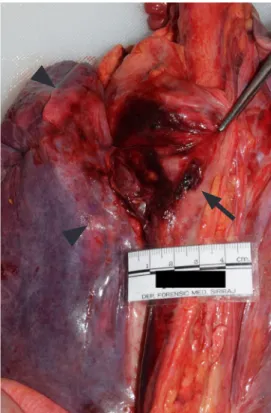
Internal examination revealed 100 mL left hemothorax. False aneurysm was located at the isthmus of aorta, measuring 5 cm, in diameter. The aneurysm wall consisted of the adventitial layer of the aorta and granulation tissue. The rupture site could be identified on the aneurysm causing left hemothorax. The aorta was found to have complete transection or full circumferential tear. Adjacent pleura was thickened. Other internal organs were unremarkable. The toxicological screening yielded negative result.
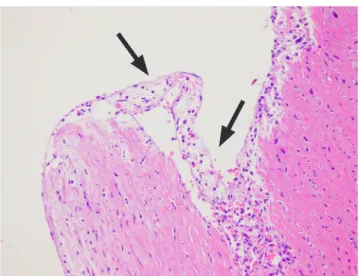
The microscopic examination of the aorta revealed granulation tissue which consisted of fibroblast and young capillaries from the process of neovascularization (Fig 3 & 4). The evidence of previous hemorrhage was also noted. The pleura located adjacent to the aneurysm also displayed the same features (Fig 5). The cause of death was pronounced as left hemothorax due to complete aortic transection.
DISCUSSION
Aortic injury can be clinically divided in 4 types, based on imaging findings, ranging from intimal tear, intramural hematoma, pseudoaneurysm, and rupture.1
Aortic transection is the most severe blunt aortic injury, falling into type 4 injury. It can be either incomplete, where a part of aortic tissue is still intact, or complete
Fig 1. Aortic aneurysm located at the isthmus (arrow), with compressed
lung tissue (arrowhead) Fig 2.
Fig 3. Granulation tissue at the rupture site of the aorta (arrow), H&E staining.
Fig 4. Granulation tissue on the tunica adventitia (arrow), H&E staining.
Fig 5. Thickened pleura and neovascularization as a component of granulation tissue (asterisk), H&E staining.
*
*
circumferential tear. However, as shown in our case, pseudoaneurysm or false aneurysm may form. The clinical presentation might be delayed due to delayed rupture. The microscopic findings, including granulation tissue
confirmed the duration of the injury to be 2 weeks post injury.
American college of surgeon committee on trauma had a recommendation in 2011 considering triage decision in order to determine any severe occult injury.2 If any
of the following are identified (Table 1)2, the patient
should be transported to trauma center.
This triage guideline corresponded with the study by Parmley in 1958 that 30% of the patients with traumatic aortic injury might not have any external injury.3 This
was also demonstrated by the autopsy of the current case, where pectoral muscles were unremarkable for any evidence of blunt trauma.
Death from traumatic aortic injury is a common cause of death from motor vehicle accidents in the USA second to head trauma.4 The largest autopsy report from
Burkhart in 2001 reported the most common mechanism of traumatic aortic injury to be driver/passenger in motor vehicle crash in 68% of cases, followed by pedestrian versus motor vehicle, and motorcycle, respectively.5
The patients with traumatic aortic injury usually present with chest pain, dyspnea, back pain, hoarseness, dysphagia, and cough.6 The physical examination may
show different blood pressure between arm and leg (higher blood pressure at the upper limb), systolic murmur over the base of the heart or between the scapulae.6 Woodring
reported the chest x-ray findings of traumatic aortic injury in 1990 that 7.3% of the patients with TAI had a normal mediastinum on initial chest x-ray.7 However, 92.7% of the
patients might had mediastinal abnormalities, shown in Table 2.7 Other imaging options include transesophageal
echocardiography (TEE) and computed tomography (CT) of the chest. Chest CT is a highly sensitive and specific test for thoracic aortic injury and is the diagnostic test of choice.8 Thoracic aortography is no longer recommended,
since chest CT is more effective and has higher sensitivity.9
Chest CT findings of traumatic aortic injury are listed in Table 3.10
Previous autopsy studies showed traumatic aortic injury was usually located at the aortic isthmus.5,11
The lesion mainly consisted of a transverse tear in the wall of the aorta.4 The damage may vary from partial
circumferential tear in the intima without involvement of the media, the false lumen created by blood forcing into the media, or rupture of the adventitial layer causing life-threatening hemopericardium or hemothorax.4 The
TABLE 1. Mechanism of injury those might cause severe occult injury (adapted from reference 2)
• Falls
Adults: >20 feet (one story = 10 feet)
Children: >10 feet or two to three times the height of the child • High-risk auto crash
Intrusion, including roof: >12 inches occupant site; >18 inches any site Ejection (partial or complete) from automobile
Death in same passenger compartment
Vehicle telemetry data consistent with a high risk for injury
• Automobile versus pedestrian/bicyclist thrown, run over, or with significant (>20 mph) impact; or • Motorcycle crash >20 mph
TABLE 2. Radiographic signs associated with traumatic aortic injury and accessory findings (adapted from reference 7)
Common Signs
Widened upper mediastinum Indistinct or enlarged aortic knob Obturation of aortopulmonary window
Downward displacement of left main bronchus Deviation of trachea to the right of midline Widened right paratracheal stripe Widened paraspinal interfaces Apical cap
Left hemothorax Uncommon signs
Right lateral displacement of superior vena cava Displaced intimal calcification in aorta
Enlarged heart secondary to hemopericardium Anterior displacement of trachea on lateral view Obscuration of the azygos vein
Accessory signs
Sternal fracture
First or second rib fracture
TABLE 3. Chest CT findings indicating traumatic aortic injury (adapted from reference 10)
Intimal flap
Periaortic hematoma Luminal filling defect Aortic contour abnormality Pseudoaneurysm Contained rupture Vessel wall disruption
Delayed presentation of complete aortic transection is very rare especially in the 2nd week after trauma. Nearly
half of the victims died at the scene.5 To our knowledge,
only Misumi et al have reported a case of 46-year-old female with complete rupture of thoracic aorta which was detected on the 12th day after trauma in 1992.12
Currently, a guideline provided by the European Society of Cardiology (ESC) in 2014 recommends that the thoracic endovascular aortic repair (TEVAR) might be considered.13 However, lack of prospective study
and biased favorable result report made its efficacy and safety still questionable.14 While another guideline by
the Society for Vascular Surgery preferred the treatment by endovascular stent over open surgery with low quality of evidence.1
CONCLUSION
Blunt traumatic aortic rupture is a commonly missed injury at the emergency department since external injury might not be visible on the physical examination. The triage process using mechanism of injury as the screening tool is warranted. Chest x-ray is a valuable initial investigation. Prompt diagnosis could decrease morbidity and mortality by means of surgical treatment.
REFERENCES
1. Lee WA, Matsumura JS, Mitchell RS, Farber MA, Greenberg RK, Azizzadeh A, et al. Endovascular repair of traumatic thoracic aortic injury: clinical practice guidelines of the Society for Vascular Surgery. J Vasc Surg. 2011;53(1):187-92.
2. Sasser SM, Hunt RC, Faul M, Sugerman D, Pearson WS, Dulski T, et al. Guidelines for field triage of injured patients: recommendations of the National Expert Panel on Field Triage, 2011. MMWR Recomm Rep. 2012;61(RR-1):1-20.
3. Parmley LF, Mattingly TW, Manion WC, Jahnke EJ, Jr. Nonpenetrating traumatic injury of the aorta. Circulation. 1958;17(6):1086-101.
4. Richens D, Field M, Neale M, Oakley C. The mechanism of injury in blunt traumatic rupture of the aorta. Eur J Cardiothorac Surg. 2002;21(2):288-93.
5. Burkhart HM, Gomez GA, Jacobson LE, Pless JE, Broadie TA. Fatal blunt aortic injuries: a review of 242 autopsy cases. J Trauma. 2001;50(1):113-5.
6. O’Conor CE. Diagnosing traumatic rupture of the thoracic aorta in the emergency department. Emerg Med J. 2004;21(4): 414-9.
7. Woodring JH. The normal mediastinum in blunt traumatic rupture of the thoracic aorta and brachiocephalic arteries. J Emerg Med. 1990;8(4):467-76.
8. Kram HB, Appel PL, Wohlmuth DA, Shoemaker WC. Diagnosis of traumatic thoracic aortic rupture: a 10-year retrospective analysis. Ann Thorac Surg. 1989;47(2):282-6.
9. Hunink MG, Bos JJ. Triage of patients to angiography for detection of aortic rupture after blunt chest trauma: cost-effectiveness analysis of using CT. AJR Am J Roentgenol. 1995;165(1):27-36.
10. Mirvis SE, Shanmuganathan K, Miller BH, White CS, Turney SZ. Traumatic aortic injury: diagnosis with contrast-enhanced thoracic CT--five-year experience at a major trauma center. Radiology. 1996;200(2):413-22.
11. Nikolic S, Atanasijevic T, Mihailovic Z, Babic D, Popovic-Loncar T. Mechanisms of aortic blunt rupture in fatally injured front- seat passengers in frontal car collisions: an autopsy study. Am J Forensic Med Pathol. 2006;27(4):292-5.
12. Misumi T, Ohkura M, Horinouchi H, Maenaka Y. A case of complete circumferential aortic rupture due to blunt chest trauma. Nihon Kyobu Geka Gakkai Zasshi. 1992;40(10):1918- 22.
13. Erbel R, Aboyans V, Boileau C, Bossone E, Bartolomeo RD, Eggebrecht H, et al. 2014 ESC Guidelines on the diagnosis and treatment of aortic diseases: Document covering acute and chronic aortic diseases of the thoracic and abdominal aorta of the adult. The Task Force for the Diagnosis and Treatment of Aortic Diseases of the European Society of Cardiology (ESC). Eur Heart J. 2014;35(41):2873-926.