Development of a Speaker Diarization
System for Speaker Tracking in Audio
Broadcast News: a Case Study*
Janez
Zibert, Bo
ˇ
ˇ
stjan Vesnicer and France Miheli
c
ˇ
Faculty of Electrical Engineering, University of Ljubljana, Slovenia
A system for speaker tracking in broadcast-news audio data is presented and the impacts of the main components of the system to the overall speaker-tracking performance are evaluated. The process of speaker tracking in con-tinuous audio streams involves several processing tasks and is therefore treated as a multistage process. The main building blocks of such system include the compo-nents for audio segmentation, speech detection, speaker clustering and speaker identification. The aim of the first three processes is to find homogeneous regions in continuous audio streams that belong to one speaker and to join each region of the same speaker together. The task of organizing the audio data in this way is known as a speaker diarization and plays an important role in various speech-processing applications. In our case the impact of speaker diarization was assessed in a speaker-tracking system by performing a compara-tive study of how each of the component influenced the overall speaker-detection results. The evaluation experiments were performed on broadcast-news audio data with a speaker-tracking system, which was capa-ble of detecting 41 target speakers. We implemented several different approaches in each component of the system and compared their performances by inspecting the final speaker-tracking results. The evaluation re-sults indicate the importance of the audio-segmentation and speech-detection components, while no significant improvement of the overall results was achieved by additionally including a speaker-clustering component to the speaker-tracking system.
Keywords: speaker diarization, speech detection, au-dio segmentation, speaker clustering, auau-dio indexing, speaker recognition, speaker tracking
1. Introduction
With the increasing availability of audio data de-rived from various multimedia sources comes an increasing need for efficient and effective means
for searching through and indexing this type of information. Searching or tagging speech based on who is speaking is one of the more ba-sic components required for dealing with spo-ken documents collected in large audio-data archives, such as recordings of broadcast news or recorded meetings. In this paper we focus on the indexing and searching of speakers in audio broadcast news(BN).
The audio data of BN shows present a typi-cal multi-speaker environment. The goal when searching and indexing target speakers in such an environment is to find and identify the re-gions in the audio streams that belong to the target speakers and produce an efficient way for accessing these regions in the audio-data archives. The task of finding such speaker-defined regions is known as a speaker diariza-tion task and was first introduced in the Rich Transcriptionproject in’Who spoke when’ eval-uations,[8]. The task of identifying the regions associated with particular speakers is known as a speaker-tracking task and was defined during a 1999 NIST Speaker Recognition evaluation, [16]. While diarization and tracking procedures serve for the detection of speakers in audio data, the purpose of speaker indexing is the organiza-tion of audio data according to detected speak-ers for efficient speaker-based audio-retrieval. In this paper we present approaches of speaker diarization and tracking in multi-speaker audio BN data and measure their influences to the overall speaker-tracking performance.
∗This work was supported by the Slovenian Research Agency(ARRS), development project M2-0210(C)entitled “AvID:
The paper is organized as follows. In Section 2 we describe in more detail a system for speaker diarization, that is composed of several compo-nents, which include procedures for audio seg-mentation, speech detection, speaker clustering and speaker identification. In the following sub-sections we give an overview of all of the above procedures and provide more details of the ap-proaches that were implemented to build a sys-tem for speaker tracking in BN shows. Each component of the system was separately tested and different approaches were compared. In Section 3 we present experiments and evaluate the results for the Slovenian audio BN database, where we explore the impact of each of the pro-cedures on the overall speaker-tracking results. Finally, discussion of results and conclusions are given in the last sections.
2. Speaker Diarization in Continuous Audio Streams
Speaker diarization is the process of partitioning input audio data into homogeneous segments according to the speakers’ identities. The aim of speaker diarization is to improve the read-ability of an automatic transcription by struc-turing the audio stream into speaker turns, and, in cases when it is used together with speaker-identification systems, to provide the speaker’s true identity. Such information is of interest for several speech- and audio-processing appli-cations. For example, in automatic speech-recognition systems, the information can be used for unsupervised speaker adaptation [1, 17], which can significantly improve the perfor-mance of speech recognition in large-vocabulary continuous-speech-recognition (LVCSR) sys-tems [11, 33, 4]. This information can be also applied for the indexing of multimedia docu-ments, where homogeneous speaker or acous-tic segments usually represent the basic units for indexing and searching in large archives of spoken audio documents, [15]. The outputs of a speaker-diarization system are also used in speaker-identification and speaker-tracking sys-tems, [6, 22], which was also the case in our presented application.
Most speaker-diarization systems for the detec-tion of speakers in continuous audio streams have a similar general architecture,[3, 31]. First,
the signal is chopped into homogeneous seg-ments. The segment boundaries are located by finding the acoustic changes in the signal, with each segment expected to contain speech from just one speaker. Those segments that do not represent speech data are additionally detected and discarded from any further processing. The resulting segments are then clustered according to speakers, i.e., all segments of one speaker are grouped in a cluster. During the final stage, each cluster is labeled with a corresponding speaker-identification name, or it is left unlabeled if the speech data in the cluster do not correspond to any of the previously enrolled target speakers. As such, speaker diarization in continuous au-dio streams is a multistage process made up of four main modules: audio segmentation, speech detection, speaker clustering and speaker iden-tification.
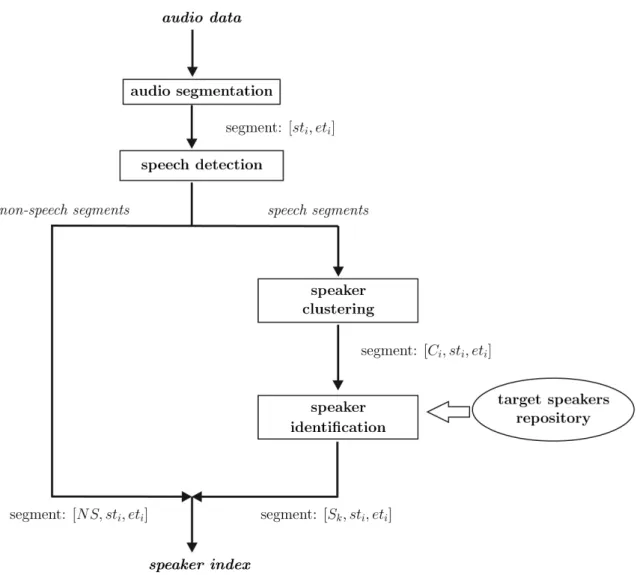
The baseline speaker-indexing system architec-ture, that was followed in this study, is shown in Figure 1. First, the audio signal is processed in anaudio-segmentationmodule, where time-stamps are produced at the locations of the de-tected acoustic changes. Audio data are thus partitioned into small homogeneous segments labeled with the starting and ending times of each segment(segments: [sti,eti]in Figure 1).
It is expected that each such segment contains data from just one acoustic source, i.e., the speech from one speaker or non-speech data corresponding to music, silence or another non-speech source. Therefore, the obtained seg-ments should be additionally divided into those containing either speech or non-speech data; this procedure requires aspeech-detection mod-ule. The non-speech segments are marked as [NS,sti,eti]in Figure 1 and are discarded from
further processing. Only the speech segments are then passed through thespeaker-clustering module. The aim of speaker clustering is to merge the speech segments from each speaker together. Here, a major problem is that the information about the speakers and the actual number of speakers are unknown a priori and need to be automatically determined. At this stage, onlyrelativespeaker labels are produced and segments are marked with automatically derived cluster names(segments[Ci,sti,eti]in
Figure 1.Main building blocks of a typical speaker-diarization system. Most systems have modules to perform speech detection, audio segmentation, speaker clustering and speaker identification, which may include a component
for gender detection.
verification of each cluster is performed. A speaker-identification module is capable of rec-ognizing just those speakers, who are present in the repository of target speakers and are previ-ously enrolled in the system. The speech data from clusters that do not correspond to any of the speakers in the target group should be marked asunknown-speakerdata. At the end, a speaker index is derived, which is used as a basis for searching and tracking speakers in the audio database.
In our speaker-based indexing system all of the components of the system were implemented in such a way that in each processing task different approaches could be applied. In the following subsections each component of the system is described in more details.
2.1. Audio Segmentation
We implemented two different audio-segmenta-tion procedures, which both aimed to find time-stamps in audio streams at changes between dif-ferent speakers or acoustic environments and were both based on the Bayesian Information Criterion(BIC),[5].
When the BIC is used as a model selection criterion for the audio segmentation, a prob-lem of change detection is reformulated as a model selection task between two competing models and is defined as follows. If we as-sume that each acoustically homogeneous seg-ment, which is represented by a sequence of frame-based acoustic feature vectors, i.e., Z = x1, . . .xt, . . . ,xN, can be modeled as one
detection of change points can be presented as a model selection problem between the following two nested models[5]:
M1: Z =x1, . . .xt, . . . ,xN ∼N(μZ,ΣZ)
and M2: X =x1, . . .xt ∼N(μX,ΣX);
Y =xt+1, . . .xN ∼N(μY,ΣY).
The first modelM1assumes that all data are
de-rived from a single Gaussian process, while the model M2 assumes that the data to pointt are
drawn from one Gaussian, while the last N−t data samples are drawn from another Gaussian. One of the possible measures for choosing the model that better suits to the given data presents a difference in BIC values between these two models that is computed as:
ΔXBIC,Y(t) = 12Nlog|ΣZ| −tlog|ΣX|
−(N−t)log|ΣY|
−λ2d+1
2d(d+1)
logN,(1)
where ΣX, ΣY and ΣZ are full-covariance
ma-trices of the Gaussian distributions, estimated from the data X, Y and Z, respectively. d is a dimension of the features vectors xi. While
the first term in(1)corresponds to a difference in log-likelihoods of models M2 and M1, the
second term presents a difference in number of parameters of both models. The first term ac-counts for the quality of the match between the model and the data, while the second one is a penalty for the model complexity withλ allow-ing the tunallow-ing of the balance between the two terms.
In the first segmentation procedure a standard approach of finding acoustic-change detection points was followed, which was first proposed in [5] and improved in [32]. This procedure processed the audio data in a single pass while searching for change points within a window using the ΔBIC measure, defined in (1).
Can-didates for segment boundaries were points t, where ΔXBIC,Y(t) > 0, and among them a point with the highest ΔXBIC,Y score was selected as a change point. In this case, the window was moved to that position, while the length of the window was set to the initial size, and the com-putation ofΔBIC continued within the new
win-dow. If there were no change points in the initial window(ΔXBIC,Y(t)<0 for all pointstwithin the window), a window was increased by additional
length, and the computation ofΔBICwas redone
on the extended window. These steps were re-peated until there were no more data for pro-cessing. The threshold, which was implicitly included in the penalty term of the BIC score, had to be given in advance and was in our case estimated from the training data.
This procedure is widely used in most of the current audio-segmentation systems[31, 8, 27, 35, 13, 38].
The alternative procedure, which was also tested in our system, was based on a DISTBIC ap-proach,[7]. A segmentation with this approach was done in two passes. In the first pass, can-didate points for change detections were com-puted, while in the second pass a validation of these candidates was done. The segmentation in this case was performed in three main steps: 1. a symmetric Kullback-Leibler (KL2) distance
[28] was computed for each point in an au-dio stream in the following way: the KL2 distance for one point was computed from two adjacent fixed-length analysis windows surrounding that point; and such calculation was performed for every frame in an audio stream. Additionally, a frame-skip was in-troduced to speed up the calculation process. 2. segment-boundary candidates were produ-ced by finding the peaks in the distance function: segment boundaries were selected at time locations, where KL2 values ex-ceeds a pre-determined threshold chosen on a development data. Additional smoothing of the distance function and elimination of the smaller neighboring peaks within a cer-tain minimum duration was applied to pre-vent over-generation of segment candidates at true boundaries.
3. validation of segment-boundary candidates were performed by using theΔBIC measure:
a candidate point at time tiwas accepted as
a segment boundary, if ΔXBIC,Y(ti) > 0. The
ΔXBIC,Y(ti) was computed on X = xti−1, ...,xti
andY =xti+1, ...,xti+1by using the formula,
defined in (1), where ti−1 and ti+1
corre-sponded to the times of previous and next candidate, respectively.
The outputs of the audio-segmentation modules in both cases were acoustic-change detection points, which defined basic audio segments for further processing.
2.2. Speech Detection
Since the audio stream was already segmented into homogeneous regions of audio data based on acoustic changes, the speech-detection mod-ule had to distinguish which segments corre-spond to either speech or non-speech data. A general approach, that was also followed in our speaker-diarization system, is a maximum-likelihood classification with Gaussian Mixture Models (GMMs), which are trained on manu-ally labeled training data[34, 21, 9, 27, 12, 29]. The main issue in such classification is how to adequately represent speech and non-speech data.
We implemented three different representations: 1. a standard acoustic representation of au-dio signals: mel-frequency cepstral coeffi-cients(MFCCs)were computed in the same manner as they are produced in the stan-dard speech-recognition systems. Several GMMs were estimated to represent vari-ous acvari-oustic speech and non-speech events (normal/telephone speech, music, silences, background noises, etc.).
2. phoneme-recognition features, based on con-sonant-vowel pairs(CV)obtained from sim-ple phoneme speech recognizers: this repre-sentation is more suitable for speech/ non-speech classification as shown in [39, 19]. Here, just two GMMs were trained, one model for speech and the other for non-speech data.
3. fusion of acoustic and phoneme-recognition features: both representations were joined in a fusion classification system also with just two GMMs,[39].
The standard MFCC-based representations are very common in systems, where a speech de-tection is used as a front-end for further pro-cessing of speech data, e.g. in speech- and speaker-recognition systems, where the same set of features can be used in later processing stages. However, a modeling of speech and non-speech data with just acoustic representa-tions causes less robust performances of such
systems, since several models have to be built to cover various acoustic phenomena, that are expected when processing audio data. To over-come these limitations we implemented a high-level representation of audio signals, based on phoneme-recognition features, which was first proposed in [39]and extensively tested on BN audio data in[19, 40].
The speech detection in all cases was performed by classifying each segment in an audio stream to speech or non-speech according to GMM that produced the highest likelihood from the given data, whereas in the phoneme-recognition and in the fusion case just two GMMs were used. The detected speech segments were sub-sequently passed to a speaker-clustering mod-ule, while the non-speech segments were dis-carded from any further processing.
2.3. Speaker Clustering
The purpose of this stage is to associate or clus-ter together segments from the same speaker. In ideal case, such clustering should be produced where all segments of each speaker are grouped in a single cluster.
The general method, that was also implemented in our system, is to perform agglomerative clus-tering using a bottom-up approach, [30], with the BIC measure as a merging criterion. Such clustering can be described in three main steps: 1. initialization:
each segmentCi present one cluster;
intial clustering isC0={Ci|i =1, ...,N}
2. merging procedure: Repeat:
• Among all possible pairs of clusters(Cr,
Cs)inCt−1find the one, say(Ci,Cj), such
that
ΔBIC(Ci,Cj) =maxΔBIC(Cr,Cs) (2)
• Define Cq = Ci ∪Cj and produce new
clusteringCt = (Ct−1− {Ci,Cj})∪ {Cq}
3. stopping criterion:
The merging procedure is repeated until in
Ctexists such pairs(Cr,Cs), for which
ΔBIC(Cr,Cs)>0.0. (3)
BIC score among all the possible pair-wise com-binations of clusters. The BIC measure was the same as the one used for the audio segmenta-tion, that is defined in (1), but it needed to be reformulated in the following way: the ΔBIC
score was in the segmentation case computed from the Gaussians, estimated from the dataX, Y, which presented the segment of dataX∪Y, divided at timet. In the clustering case, the data were constructed from the data of the current processing clustersCr andCs, i.e.,X =Cr and
Y = Cs, where a dividing point at time t was
obsolete. Therefore ΔBIC(Cr,Cs) was defined
asΔBIC(Cr,Cs):=ΔCBICr,Cs(.)without the timet.
The merging process was stopped when the highest BIC score was lower than a specified threshold, which was in our case set to 0.0. The output of the speaker-clustering module produced relative segment labels (for example ’spk1’), which corresponded to speaker clus-ters.
At this stage several improvements can be made to increase the performance of the speaker di-arization, like joint segmentation and clustering [18] and/or cluster re-combination[36], but in our speaker-tracking system we found no ad-ditional improvement in the performance when applying some of these methods. Note that this is also the final stage of the speaker-diarization process.
2.4. Speaker Identification
Since speaker-diarization systems only produce relative speaker labels, additional modules for speaker identification have to be included in the system, when the true identities of the speakers are needed. We decided to follow the standard approach of building speaker models for peo-ple who are likely to be in the news broadcasts (such as prominent politicians or main news an-chors and reporters)and including these models in the last stage of our speaker-tracking system. A speaker-identification component was adopted from a speaker-verification system that was orig-inally designed for the detection of speakers in conversational telephone speech, [16]. The speaker-verification system was based on the standard Gaussian Mixture Model – Universal Background model (GMM-UBM) approach, [26].
The speaker models, which are needed in the speaker-identification component, were built in
the enrolment stage, following the classical MAP adaptation approach [10, 26]. First, the UBM was trained from the pooled data of large number of different speakers, using the max-imum likelihood criterion. After that, speech data from each target speaker was used to build the speaker models by adapting the means of all Gaussian components of the UBM,[26]. In thespeaker-identification stagefor each clus-terCiit had to be decided, to which speakerSj,
from the set of known speakers S, the cluster Ci belongs. This decision was based on the
maximum likelihood criterion:
Sj =arg max Sk∈S
logp(XCi|MSk) (4)
where XCi represents all the data (i.e., the set
of acoustic feature vectors)from the clusterCi
andMSk is a GMM model of the hypothesized
speakerSk. To account for the possibility that
the clusterCidid not belong to any speaker from
the set of known speakers, the final decision was made after comparing the likelihood of the win-ning model to the likelihood of the unknown-speaker model, which was represented by the UBM.
We additionally applied feature warping [23] and t-norm score normalization[2] techniques in all of our experiments to compensate for dif-ferent channel effects. However, less efforts were taken to explicitly verify the effectiveness of these methods in the tested speaker-tracking system, since our research was more focused on measuring the impacts of speaker-diarization tasks to the speaker-identification process. The results of this module were audio seg-ments with the true speaker identification labels. Those segments that included the data which did not belong to any of the enrolled speakers got empty labels corresponding to ’unknown’ speakers. These results presented the final out-puts of our system. Audio streams equipped with such information can be further used for re-trieving of speakers in various speaker-tracking applications.
3. Evaluation Experiments
hours were used for an estimation of all the open parameters in all the components of our diariza-tion system, and the remaining 12 hours served for the assessment of the system’s performance. A tuning of the open parameters in audio-seg-mentation, speech-detection and speaker-clus-tering modules corresponded to optimizing the overall speaker-diarization performance on the training data.
In the audio-segmentation module, we had to tune open parameters of both implemented seg-mentation procedures. In the first — standard BIC — approach a threshold in the BIC mea-sure and the parameters of the analysis windows had to be estimated. Setting the parameters of analysis windows included determining an initial window length, an extension parameter and a maximum window duration. An initial window was set to 2.0 s, an extension para-meter to 1.0 s and a maximum window size was 10.0 s. A threshold was determined by set-ting the penalty factor λ of the ΔBIC measure
in (1). It was set so as to detect as many true change-detection points in the audio streams, while, at the same time, to preserve a low rate of miss-detected segment boundaries. The em-phasis was put more on the detection of true segment boundaries, even if additional segment boundaries were falsely detected. As a re-sult, over-segmented audio streams were pro-duced, but they had almost no influence on the overall speaker-diarization results when using them as inputs for the speaker-clustering mod-ule. In the case of under-segmented audio data, it was found that they could severely degrade the speaker-diarization and tracking performance. In the case of theDISTBICapproach, we had to set several open parameters for finding change-detection candidates in the first and second steps of the approach and, in the last step, a penalty factor λ had to be determined in the
ΔBIC measure. A length of the adjacent
win-dows in the first step was fixed to 2.0 s, while the frame-skip for calculating the KL2 mea-sure was set to 0.1 s. In the second step, ad-ditional parameters needed to be assigned to find appropriate local-maximum points for the segmentation-boundary candidates. The mini-mum duration between two consecutive local-maxima was set to 1.0 s, while the threshold, above which the local-maximum points were appointed as segment-boundary candidates, was adjusted based on the development data. A
tun-ing of theλin the last step was done in the same manner as in the previous approach.
In the speech-detection module, a classifica-tion framework was based on the GMMs and three different audio signal representations were tested. In all the approaches, a set of GMMs were trained on speech and non-speech data from the training part of the SiBN database. In the first approach the GMMs were trained based on the acoustic features, implemented by the first 12 MFCCs and a short-term en-ergy with their first derivatives. By using such features several different GMMs for detecting speech and non-speech were produced trained on: broadband and telephone speech, silences, music, and noisy background data.
In the second approach, we tested our proposed representation based on the phoneme-recogni-tion features. In this approach, a parametriza-tion was made from four phoneme features[39], derived from detected consonant-vowels(CV) pairs. Therefore, we had to implement a simple phoneme recognizer to detect CV from audio signals. The recognizer was built in a stan-dard way, using HMMs trained on Slovenian data. For this approach only two GMMs were trained, one for each class.
In the third approach we joined both represen-tations in a fusion system. The fusion was achieved by using a state synchronous two-stream GMMs,[24].
In the bottom-up clustering approach in the speaker-clustering module just a penalty fac-torλ in theΔBIC measure from(2)was tuned.
chosen to optimize a speaker-tracking perfor-mance, rather than optimizing a speaker diariza-tion.
In a speaker-identification module the true de-tection of speakers was carried out. There-fore, the GMM of each target speaker had to be provided. They were built from UBM, which were trained on the speech data of the training part from the SiBN database. All the mod-els were constituted from 1024 Gaussian mix-tures, which were estimated using the Baum-Welch Expectation-Maximization (EM) algo-rithm. The GMM model for each target speaker was derived from the UBM using the MAP adaptation technique in a standard way, [26]. The evaluated system was capable of detect-ing 41 target speakers extracted from the train-ing data in the enrollment phase. In the test phase, the data from each cluster were com-pared against all of the models from the target-speakers repository by using criterion defined in (4). Note that no additional score thresh-old was proposed, since we tried to evaluate the system across the whole range of all possible operating points.
3.1. Evaluation Results
Since several modules were included in the speaker-tracking system of BN shows, a series of experiments was performed to measure the impact of each module on the overall speaker-tracking results.
The evaluated speaker-tracking system was ca-pable of detecting 41 target speakers from the audio data, which included 551 different speak-ers. The performance of the evaluated system was assessed by including all target speakers with the addition of non-speech segments. Three groups of experiments were conducted. In each group the impact of one component of the system was explored by comparing the final speaker-tracking performance. The over-all speaker-tracking results were produced in terms of the false-acceptance (FA) and false-rejection(FR)rates computed at different oper-ating points and presented in the form of Detec-tion Error Trade-off (DET) curves, [16]. This evaluation measure is commonly used for the as-sessment of speaker-recognition systems [25], where FA and FR rates are computed on the basis of speaker’s utterances. In the case of
speaker tracking in continuous audio streams, the FA and FR rates have to be derived on the audio segments. Thus, a generalization of the DET measure have to be applied, which com-putes the FA and FR rates at the time(frame) level.
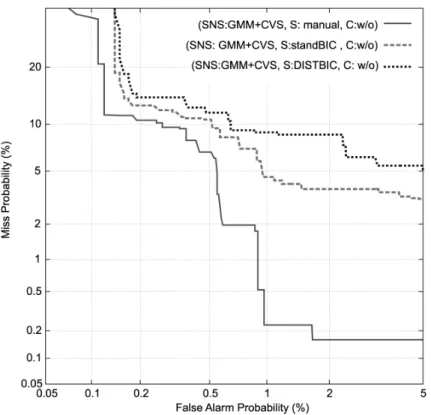
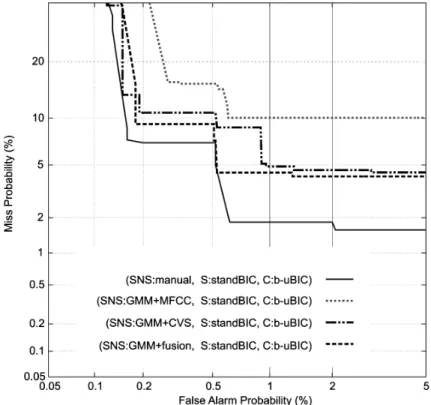
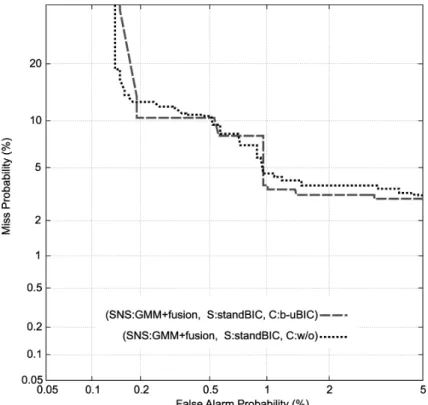
Figures 2, 3 and 4 present speaker-tracking re-sults from the evaluated system, where different versions of the system’s components were com-bined. The speaker-identification module was the same for all the evaluations, while in the components for audio-segmentation, speech-detection and speaker-clustering different ap-proaches were applied. The experiments were planned so, that the evaluation of each com-ponent took place in such order to follow the processing stages of a general speaker-tracking system. In this case the best approach of the cur-rent evaluated component could be used in the experiments of the next evaluated component. In Figures 2, 3 and 4, a speech-detection mod-ule is marked asSNS, an audio segmentation is referred to as S and a speaker clustering to as C. Since the speaker-identification procedure was always the same, no legend names for that module are provided. In addition to that, the FA and FR rates in all figures correspond to false alarm probabilities and miss probabilities, respectively.
Figure 2.The overall speaker-tracking results of the evaluated system, where different audio-segmentation procedures were applied. Lower DET values correspond to better performance.
BIC measure (referred to S:standBIC in Fig-ure 2). The other was the DISTBIC approach, which is marked asS:DISTBICin Figure 2. As can be seen from the results in Figure 2, the manual segmentation outperforms the au-tomatic versions by more than 3% across the whole range of operating points. Since the seg-mentation procedure is usually applied in the first steps of speaktracking systems, the er-rors from the segmentation have an impact on all subsequent procedures. In our case, the er-rors in detecting change points in continuous audio streams produced non-homogeneous seg-ments, which caused the unreliable detection of speech/non-speech regions and the unreliable detection of target speakers as well. Accord-ingly, both types of errors were, therefore, addi-tionally integrated into the overall results of the evaluated systems.
The same phenomenon can be observed by in-specting both automatic versions of segmenta-tion procedures. During the evaluasegmenta-tion phases we also tested their performances in a segmen-tation task alone. The segmensegmen-tation results obtained by using the F-measure [14] spoke in favor of the standBIC approach, where a
segmentation accuracy of 74% was achieved, in comparison to DISTBIC approach, where a segmentation accuracy was 70%. Nearly the same difference can be observed in the over-all speaker-tracking results in Figure 2. This confirms our previous observations that a good segmentation could greatly reduce the overall speaker-tracking error rates.
Another evaluation perspective present the re-sults in Figure 3. Here, different speech-detec-tion procedures were tested in a system where audio-segmentation and speaker-clustering mo-dules stayed the same through all the evalu-ation experiments. We explored the impacts of three speech/non-speech segmentation ap-proaches and compared them to the manually labeled segments. The manual speech/ non-spe-ech segmentation is referred to as the SNS:ma-nual approach in Figure 3. A legend name
SNS:GMM+MFCC presents the approach
Figure 3.The overall speaker-tracking results of the evaluated system, where different speech-detection procedures were applied. Lower DET values correspond to better performance.
Here, the audio segmentation module was im-plemented by the standBIC approach (legend name S:standBIC), since it performed best among all tested segmentation methods from the previous evaluation. For speaker clustering we implemented an approach from Section 2.3, that is marked asC:b-uBICin Figure 3). By comparing the evaluation results of all tested systems we can draw the same conclusions as in the audio-segmentation case. The bet-ter speech/non-speech-segmentation procedure works, the lower speaker-tracking error is achie-ved. The best DET results correspond to manual speech detection, next are methods where pho-neme-recognition features were introduced, and the last is a standard approach where just acous-tic(MFCC)features were used. The same order of the performance was obtained by compar-ing these procedures in the speech/ non-speech-segmentation task alone [19, 39]. Another im-portant issue reveals these results, which was also observed in [40]. The impact of a speech detection in speaker-diarization and tracking systems is direct and indirect. Since non-speech data are treated as data from one of the speak-ers in the speaker-tracking system, speech de-tection errors directly influence the
Figure 4.The overall speaker-tracking results of the evaluated system, where a speaker-clustering procedure was tested. Lower DET values correspond to better performance.
clustering. Our tracking results with automatic clustering show that just a marginal gain could be obtained. This indicates that in our case the speaker-tracking system could not benefit from speaker clustering. The same was shown in a study of speaker tracking for radio broad-cast news in[20], where it was concluded that speaker identification could help to improve the speaker-clustering performance, and not vice versa.
4. Conclusion
A system for speaker tracking in BN audio data was presented. We gave an overview of the four main building blocks of such a system and provided an extensive evaluation of the im-pacts of each of the system’s components to the overall speaker-tracking performance. We implemented different approaches of audio seg-mentation, speech detection and speaker clus-tering, and measured their impacts to the over-all speaker-tracking results. The comparison of the evaluation results of different versions of the speaker-tracking system provides valu-able insights into how the system works and
which components of the system have greater impact on the overall performance. It was found that the most critical component of the system is the audio-segmentation module. If the seg-mentation procedure produces too many non-homogeneous segments due to improperly de-tected change points in an audio stream, this causes unreliable performance of the speech-detection and the speaker-identification mod-ules, and thus degrades the overall performance of the system. The same can be concluded for the speech-detection module, where an erro-neous speech/non-speech classification caused explicit errors in the evaluated speaker-tracking system and had further influence on the speaker-clustering and identification performance. As far as the speaker clustering is concerned, it was shown that we could not gain any improvement in the overall performance of the system when using clustering or not.
try to increase the robustness of the critical sys-tem’s components in the same manner as we did in the speech-detection module, by intro-ducing phoneme-recognition features for repre-sentations of audio signals, which proved to be more discriminative and less sensitive to differ-ent training and unseen conditions.
References
[1] T. ANASTASAKOS, ET AL., A Compact Model for
Speaker-adaptive Training. Presented in the Pro-ceedings of International Conference on Spo-ken Language Processing (ICSLP1996), (1996) Philadelphia, PA, USA.
[2] R. AUCKENTHALER, ET AL., Score normalization for text-independent speaker verification system. Digital Signal Processing, 10(2000), pp. 42–54. [3] C. BARRAS,ET AL., Multistage Speaker Diarization
of Broadcast News.IEEE Transactions on Speech, Audio and Language Processing, Special Issue on Rich Transcription, 14(2006)), pp. 1505–1512. [4] P. BEYERLEIN, ET AL., Large vocabulary
continu-ous speech recognition of Broadcast News. The Philips/RWTH approach.Speech Communications, 37(2002), pp. 109–131.
[5] S. S. CHEN, P. S. GOPALAKRISHNAN, Speaker,
envi-ronment and channel change detection and cluster-ing via the Bayesian information criterion. Presented in theProceedings of the DARPA Speech Recogni-tion Workshop,(1998)Lansdowne, Virginia, USA. [6] P. DELACOURT, ET AL., A Speaker Tracking
Sys-tem Based on Speaker Turn Detection for NIST Evaluation. Presented in the Proceedings of In-ternational Conference on Acoustics, Speech, and Signal Processing (ICASSP2000),(2000)Istanbul, Turkey.
[7] P. DELACOURT, C. J. WELLEKENS, DISTBIC: A
speaker-based segmentation for audio data indexing. Speech Communication, 32(2000), pp. 111–126. [8] J. FISCUS,ET AL., Results of the Fall 2004 STT and
MDE Evaluation. Presented in theProceeedings of the Fall 2004 Rich Transcription Workshop,(2004) Palisades, NY, USA.
[9] J.-L. GAUVAIN,ET AL., Partitioning and
Transcrip-tion of Broadcast News Data. Presented in the Proceeedings of the International Conference on Spoken Language Processing (ICSLP98), (1998) Sydney, Australia, pp. 1335–1338.
[10] J. L. GAUVAINC.-H. LEE, Maximum a posteriori
estimation for multivariate Gaussian mixture obser-vations of Markov chains.IEEE Trans. Speech, and Audio Processing, 2(1994)), pp. 291–298.
[11] J. L. GAUVAIN,ET AL., The LIMSI Broadcast News transcription system. Speech Communications, 37 (2002)), pp. 89–108.
[12] T. HAIN,ET AL., Segment Generation and Clustering
in the HTK Broadcast News Transcription System. Presented in theProceeedings of the 1998 DARPA Broadcast News Transcription System,(1998) Lans-downe, VA, USA.
[13] D. ISTRATE,ET AL., Broadcast News Speaker Track-ing for ESTER 2005 Campaign. Presented in the Proceedings of Interspeech 2005 — Eurospeech, (2005)Lisbon, Portugal.
[14] T. KEMP,ET AL., Strategies for Automatic
Segmen-tation of Audio Data. Presented in theProceedings of the IEEE International Conference on Acous-tic Signal and Speech Processing, ICASSP 2000, (2000)Istanbul, Turkey.
[15] J. MAKHOUL,ET AL., Speech and language
technolo-gies for audio indexing and retrieval.Proceedings of the IEEE, 88(2000), pp. 1338–1353.
[16] A. MARTIN, ET AL., The NIST speaker recogni-tion evaluarecogni-tion — overview, methodology, systems, results, perspectives.Speech Communications, 31 (2000), pp. 225–254.
[17] S. MATSOUKAS,ET AL., Practical Implementations
of Speaker-adaptive Training. Presented in the Pro-ceedings of the 1997 DARPA Speech Recognition Workshop,(1997)Chantilly VA, USA.
[18] S. MEIGNIER,ET AL., Evolutive HMM for
Multi-speaker Tracking System. Presented in the Proceed-ings of IEEE International Conference on Acous-tics, Speech and Signal Processing (ICASSP 2000), (2000)Istanbul, Turkey.
[19] F. MIHELICˇ, J. ZˇIBERT, Robust speech detection
based on phoneme recognition features. Presented in the Proceedings of Text, Speech and Dialogue (TSD 2006),(2006)Brno, Czech Republic. [20] D. MORARU,ET AL., Experiments on speaker
track-ing and segmentation in radio broadcast news. Presented in theProceedings of Interspeech 2005 — Eurospeech,(2005)Lisbon, Portugal.
[21] P. NGUYEN,ET AL., Rich Transcription 2002 Site Report. Panasonic Speech Technology Laboratory (PSTL). Presented in theProceeedings of the 2002 Rich Transcription Workshop,(2002)Vienna, VA, USA.
[22] B.NEDIC,ET AL., The Elisa’99 Speaker Recognition and Tracking Systems. Presented in the Proceed-ings of IEEE Workshop on Automatic Advanced Technologies,(1999).
[23] J. PELECANOS, S. SRIDHARAN, Feature warping for
robust speaker verification. Presented in the Pro-ceedings of the Speaker Odyssey Workshop,(2001) Crete, Greece.
[24] G. POTAMIANOS, ET AL., Audio-visual Automatic
[25] M. A. PRZYBOCKI, A. F. MARTIN, NIST Speaker
Recognition Evaluation Chronicles. Presented in theProceedings of the Speaker Odyssey Workshop 2004,(2004)Toledo, Spain.
[26] D. A. REYNOLDS,ET AL., Speaker verification using adapted Gaussian mixture models. Digital Signal Processing, 10(2000), pp. 19–41.
[27] D. A. REYNOLDS, P. TORRES-CARRASQUILLO, The MIT Lincoln Laboratory RT-04F Diarization Sys-tems: Applications to Broadcast Audio and Tele-phone Conversations. Presented in the Proceeed-ings of the Fall 2004 Rich Transcription Workshop, (2004)Palisades, NY, USA.
[28] M. SIEGLER,ET AL., Segmentation, Classification
and Clustering of Broadcast News Data. Presented in theProceedings of the DARPA Speech Recogni-tion Workshop,(1997)Chantilly, VA, USA.
[29] R. SINHA,ET AL., The Cambridge University March 2005 speaker diarisation system. Presented in the Proceedings of Interspeech 2005 — Eurospeech, (2005)Lisbon, Portugal.
[30] S. THEODORIDIS, K. KOUTROUMBAS,Pattern Recog-nition (2nd edition). Academic Press, 2003.
[31] S. TRANTER, D. REYNOLDS, An Overview of
Auto-matic Speaker Diarisation Systems.IEEE Transac-tions on Speech, Audio and Language Processing, Special Issue on Rich Transcription, 14 (2006)), pp. 1557–1565.
[32] A. TRITSCHLER, R. GOPINATH, Improved speaker
segmentation and segments clustering using the Bayesian information criterion. Presented in the Proceedings of Eurospeech 99, (1999) Budapest, Hungary.
[33] P. C. WOODLAND, The development of the HTK
Broadcast News transcription system: An overview. Speech Communications, 37(2002), pp. 47–67.
[34] C. WOOTERS,ET AL., Towards Robust Speaker
Seg-mentation: The ICSI-SRI Fall 2004 Diarization System. Presented in theProceeedings of the Fall 2004 Rich Transcription Workshop, (2001) Pal-isades, NY, USA.
[35] B. ZHOU, J. HANSEN, Unsupervised Audio Stream
Segmentation and Clustering via the Bayesian In-formation Criterion. Presented in theProceedings of International Conference on Spoken Language Processing (ICSLP 2000),(2000)Beijing, China.
[36] X. ZHU,ET AL., Combining Speaker Identification
and BIC for Speaker Diarization. Presented in the Proceedings of Interspeech 2005 — Eurospeech, (2005)Lisbon, Portugal.
[37] J. ZˇIBERT, F. MIHELICˇ, Development of Slovenian
Broadcast News Speech Database. Presented in the Proceedings of the International Conference on Language Resources and Evaluation (LREC 2004), (2004)Lisbon, Portugal.
[38] J.ZˇIBERT,ET AL., The COST278 Broadcast News
Segmentation and Speaker Clustering Evaluation — Overview, Methodology, Systems, Results. Pre-sented in theProceedings of Interspeech 2005 — Eurospeech,(2005)Lisbon, Portugal.
[39] J. ZˇIBERT, ET AL., Speech/Non-Speech
Segmen-tation Based on Phoneme Recognition Features. EURASIP Journal on Applied Signal Processing, 6 (2006)), 1–13.
[40] J. ZˇIBERT, ET AL., Novel Approaches to Speech
Detection in the Processing of Continuous Audio Streams. Robust Speech Recognition and Under-standing, M. Grimm, K. Kroschel (Eds.), I-Tech Education and Publishing, 2007, 23–48.
Received:June, 2007
Revised:February, 2008
Accepted:February, 2008
Contact address:
JanezZibertˇ Faculty of Electrical Engineering University of Ljubljana Trzaˇska 25, SI-1000 Ljubljana, Sloveniaˇ
e-mail:[email protected]
JANEZZˇIBERTwas born in 1974. He received the B.Sc. degree in mathematics in 1998 from the Faculty of Mathematics and Physics and the M.Sc. and the Ph.D. degrees in electrical engineering from the Faculty of Electrical Engineering, University of Ljubljana in 2001 and 2006, respectively. He is currently working as a research associate at the Laboratory of Artificial Perception, Systems and Cybernetics, at the Faculty of Electrical Engineering, University of Ljubljana. His research interests include audio signal processing, automatic speech and speaker recognition and audio information retrieval. JanezZibert is a memberˇ of the International Speech Communication Association and a mem-ber of the Slovenian Pattern Recognition Society and of the Slovenian Language Technologies Society.
BOˇSTJANVESNICERwas born in 1976. He received the B.Sc. and M.Sc. degrees in electrical engineering in 2000 and 2003, respectively, both from the University of Ljubljana, Slovenia. Until recently he worked on statistical speech synthesis at the Laboratory of Artificial Percep-tion, Systems and Cybernetics, Department of Electrical Engineering, University of Ljubljana, where he holds a research position. Currently he is preparing a Ph.D. thesis on channel compensation techniques for speaker recognition. Boˇstjan Vesnicer is a member of the Slovenian Pat-tern Recognition Society and of the Slovenian Language Technologies Society.