Applying Dynamic Co-occurrence
in Story Link Detection
Hua Zhao
1and Tiejun Zhao
21College of Information Science and Engineering, Shandong University of Science and Technology,
Huangdao, Qingdao, Shandong Province, Heilongjiang Province, P. R. China
2School of Computer Science and Technology, Harbin Institute of Technology, P. R. China
Story link detection is part of a broader initiative called Topic Detection and Tracking, which is defined to be the task of determining whether two stories, such as news articles or radio broadcasts, are about the same event, or linked. In order to mine more information from the contents of the stories being compared and achieve a more high-powered system, motivated by the idea of the word co-occurrence analysis, we propose our dynamic co-occurrence, which is defined to be a pair of words that satisfy certain relation restriction. In this paper, relation restriction refers to a set of features. This paper evaluates three features: capital, location and distance. We use dynamic co-occurrence in the similarity computation when we apply it in the story link detection system. Experimental results show that the story link detection systems based on the dynamic co-occurrence perform very well, which testifies the great capabilities of the dynamic co-occurrence. At the same time, we also find that relation restriction is critical to the performance of dynamic co-occurrence.
Keywords: topic detection and tracking, story link de-tection, word co-occurrence, dynamic co-occurrence, relation restriction, detection cost
1. Introduction
Topic Detection and Tracking (TDT) is a new line of research pursued by the National In-stitute of Standards and Technology (NIST), which embraces a variety of technical chal-lenges for information retrieval: Story Segmen-tation, Topic Tracking, Topic Detection, First Story Detection and Story Link Detection. This paper focuses on the story link detection, which is defined to be the task of determin-ing whether two stories, such as news arti-cles or radio broadcasts, are about the same event, or linked. In TDT, an event is defined
as “something that happens at some specific time and place" [1,2]. For example, a story about an earthquake in Japan in October and another story about an earthquake in Japan in May should not be classified as linked because they are about different events, although they both fall under the same general “topic" of nat-ural disasters. Story link detection is thought of as the basis for other event-based topic analysis tasks, such as topic tracking, topic detection, and first story detection[1].
Because the story link detection task is focused on the streams of news stories where new events occur relatively frequently, and comparisons of interest are focused on events that are not known in advance. One consequence of this is that the prior knowledge we can use is poor, so in order to achieve a high-powered story link detection system, we must make the best of the content of the stories being tested, and mine more informa-tion from them. To do so, motivated by the idea of the word co-occurrence analysis, we propose our dynamic co-occurrence, which refers to a pair of words appearing in a story at the same time and satisfy certain relation restriction. In this paper, relation restriction is defined to be a set of features.
experimental results and analyses. Section 7 gives the conclusions inferred from our work.
2. History and Related Work
2.1. Concise History of TDT
The basic idea for TDT originated in 1996, when the Defense Advanced Research Projects Agency(DARPA)realized that it needed tech-nology to determine the topical structure of news streams without human intervention. The domain of the TDT’s interest is all broadcast news, i.e., written and spoken news stories in multiple languages(English, Chinese and Ara-bic).
The TDT tasks and evaluation approaches were developed by a joint effort between DARPA, the University of Massachusetts’ Center for Intel-ligent Information Retrieval, Carnegie Mellon’s Language Technology Institute, and Dragon Sys-tems. In 1997, a pilot study laid the essential groundwork, producing a small corpus and es-tablishing feasibility. Between 1998 and 2004, TDT research blossomed, with new and more challenging tasks, many more participating sites, and considerably larger multilingual corpora
(adding Chinese data in 1999 and Arabic data in 2002).
LDC provided five corpora to support TDT re-search. These are namely the TDT Pilot pus, the TDT2, TDT3, TDT4 and TDT5 cor-pora. These corpora are collections of news, including both text and speech, from a num-ber of sources and languages. Each story in the TDT2, TDT3, and TDT4 corpora is tagged according to whether it discusses each of the defined topics.
2.2. Related Work
A number of research groups have developed story link detection systems. The best current technology for link detection relies on the use of Cosine similarity between document terms vectors with TF-IDF term weighting[3,4,5]. In a TF-IDF model, the frequency of a term in a document(TF)is weighted by the inverse doc-ument frequency(IDF), the inverse of the num-ber of documents containing a term. UMass has
examined a number of similarity measures in the link detection task[6,7], including weighted sum, language modeling and Kullback-Leibler divergence, and found that the cosine similar-ity produced the best results. Motivated by the performance improvement observed in the clas-sifier combination[8], Francine Chen explored the combination of similarity measures for im-proving story link detection system[4]. In order to make the best of the content of stories, Ying-Ju Chen applied many NLP and IR approaches to monolingual and multilingual story link de-tection, which include story expansion, topic segmentation, and so on[9].
Because story link detection is the basis for other event-based TDT tasks, some other re-searchers research into the relations between story link detection task and other TDT tasks
[10,11,12].
Word co-occurrence analysis has been widely used in various forms of research concerning the domains of content analysis, text mining, construction of thesauri and query expansion, etc. [13]. In general, its aim is to determine related word or terms and to find similarities of meaning between word pairs.
In order to mine more information from the contents of the stories, motivated by the perfor-mance improvements of the word co-occurrence analysis, we explored the dynamic co-occurrence in the story link detection.
3. The Basic Model for Story Link Detection
3.1. Basic Architecture
Our basic story link detection algorithm is shown as follows.
• Pre-processing to create a vector with TF-IDF weighting to represent each story in a given pair;
• Using the Cosine function to compute the similarity between two stories;
3.2. Pre-processing and Story Model
Before a story is modeled, we apply pre-proces-sing to it, which includes removing stopwords and lemmatizationb.
In the basic model, stories are expressed by Vector Space Model (VSM). Suppose S is a story which has been pre-processed, andterm1, term2, ..., termk are distinct words that
ap-pear in S. Then S can be expressed by S = (term1,w1;term2,w2;...;termk,wk), where wi
is the weight oftermiin S and is calculated by
the incremental TF-IDF method showed in(1):
wi=tfi×log(N
ni +0.01) (1)
Wheretfiis the frequency oftermiin S,Nis the
total number of stories seen so far, andniis the
document frequency of termi in all the stories seen so far.
3.3. Similarity Measure
We use classical Cosine function to compute the similarity between two stories in a pair. As-sumews11,ws12, ...,ws1nandws21,ws22, ...,ws2n
are weights of features δ1,δ2, ...,δnin storyS1
and topic S2, respectively. Then the similarity betweenS1 andS2 is calculated as follows:
Cos(S1,S2) =
n
k=1ws1k×ws2k
n
k=1w2s1k×
n k=1w2s2k
(2)
4. Dynamic Co-occurrence
The motivation for proposing dynamic co-occur-rence is to mine more information from the tents of the stories and make the best of the con-tents of the stories, as a result of which we will gain a more portable story link detection system with better performance. In this paper, dynamic co-occurrence is defined as follows:
Definition 1 A Dynamic Co-occurrence (DC) is a pair of words which appear in a story and satisfy certain relation restriction. A DC can be formalized as a three-tuplesW1,W2,RR,
where W1 and W2 represent the words, and RR denotes the relation restriction satisfied by W1 and W2.
Definition 2Relation Restriction is a set of fea-tures, and can be formalized as∅or{f1,f2, ...}, wheref1 andf2 denote features.
When RR = ∅, any pair of words is a DC, as a result of which is that we get lots of DC, but many of these DC are redundant. On the other hand, from [14] we can conclude that a news story tends to focus on the important words and phrases to distinguish between different news events. So, in order to capture these useful dy-namic co-occurrences successfully, we evaluate the performance of the following features in our experiments:
• Capital: In English news stories, the initials of names(people, location and organization)
are usually capital, and these names are the key words to differentiate the similar topics
[15,16]. Based on this, this paper chooses “capital" as a feature used in the relation re-striction. In the experiments, we use C to denote “Capital".
• Location: News stories have the top-heavy, inverse-pyramidal structure, and usually put the important content in the former part. So we think that the words in the former part of the story are more important than those in the latter part. So we choose “location" as a feature, and use L to denote it in the experiments.
• RR = {C}: Each pair of words whose ini-tials are capital forms a DC;
• RR = {D}: Each pair of words within cer-tain distance forms a DC, and the distance can be specified by the parameter D. In our experiment,D =α means that the distance between two words is equal to α, where 1 ≤ α ≤ ω −2, and ω is the length of the story.
• RR = {L}: Each pair of words located in a certain former part of the story forms a DC, and the certain part can be specified by the parameter L. In the experiment,L = β means that the words appear in the formerβ part of the story, where 1 ≤ β ≤ ω, andω is the length of the story.
• RR = {C,D}: Each pair of words within certain distance, and the initials of which are capital, forms a DC.
• RR = {C,L}: Each pair of words located in a certain former part of the story, and the initials of which are capital, forms a DC. • RR={D,L}: Each pair of words located in
a certain former part of the story, and within certain distance, forms a DC.
• RR={C,D,L}: Each pair of words located in a certain former part of the story, within
certain distance and the initials of which are capital, forms a DC.
In this paper, we remove stop-words before ex-tracting dynamic co-occurrence.
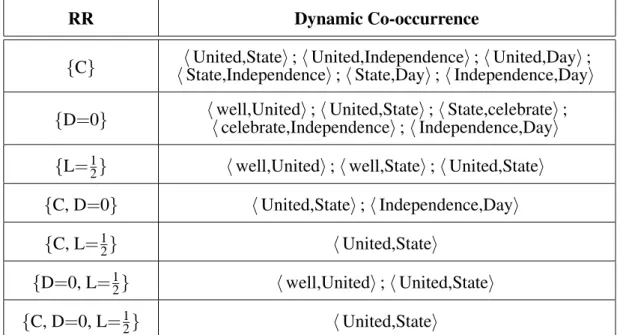
In order to explain the definition in more de-tail, we give the following example: for the story content after pre-processing : well United State celebrate Independence Day, the dynamic co-occurrence under each relation restriction is listed in Table 1. In order to save space, we only give the words in the dynamic co-occurrences, and the relation restrictions are listed in the first column all together.
5. Story Link Detection Based on Dynamic Co-occurrence
5.1. Using Dynamic Co-occurrence
We use dynamic co-occurrence information in the similarity computation. Suppose DC(S1)
and DC(S2) are the numbers of the dynamic co-occurrences in the storyS1 and storyS2 re-spectively, and SameDC(S1,S2)is the number of the mutual dynamic co-occurrences between storyS1 and storyS2. The similarity based on the dynamic co-occurrence between story S1
RR Dynamic Co-occurrence
{C} State,IndependenceUnited,State;United,Independence;State,Day;Independence,Day;United,Day;
{D=0} well,Unitedcelebrate,Independence;United,State;Independence,Day;State,celebrate;
{L=1
2} well,United;well,State;United,State
{C, D=0} United,State;Independence,Day
{C, L=12} United,State
{D=0, L=1
2} well,United;United,State
{C, D=0, L=1
2} United,State
and storyS2,DCSim(S1,S2), is as follows:
DCSim(S1,S2) = 2DC∗SameDC(S1) +DC(S1(,SS22)) (3)
5.2. Link Detection System Based on Dynamic Co-occurrence
The architecture of story link detection system based on the dynamic co-occurrence is shown as follows:
• Pre-processing to create a vector with TF-IDF weighting to represent each story (S1 andS2)in a given pair;
• Extracting the dynamic co-occurrences ap-pearing in storyS1 and storyS2, respectively. • Measuring the similarity betweenS1 andS2 based on Cosine and dynamic co-occurrence, respectively.
• Computing the final similarity between S1 andS2 as follows:
FinalSim(S1,S2) =Cos(S1,S2)
+DCSim(S1,S2) (4)
• Employing a predefined threshold to decide whetherS1 andS2 discuss the same topic or not.
6. Experiments
6.1. Corpora
We manually created the training corpora and the test corpora from the TDT Pilot Corpus. The TDT Pilot Corpus, covering the period from July 1, 1994 to June 30, 1995, was the
first benchmark evaluation corpus for TDT re-search. This corpus contains 15,863 English stories which are represented as a stream of text. A set of 25 target topics are defined, which span a variety of topic types and cover a subset of all the topics discussed in the corpus stories. There are about 43 stories per topic on the average. Each story is assigned a label of YES, NO or BRIEF for each of the 25 topics.
We use only the topic 1 to topic 8 to create the corpora for the story link detection evaluation, where topic 1 to topic 5 is adopted to create the training set, and topic 6 to topic 8 is used to create the test set. The creation process of the corpora is as follows: (1)Every two stories which are related(the label is YES)to the same topic are a linked pair; (2) Every two stories which are related (the label is YES) to differ-ent topics are a un-linked pair. As a result, the training set and the test set are listed in Table 2.
6.2. Evaluation Measures
We adopt the evaluation methodology defined in TDT to evaluate our system performance. The cost function for the task defined by TDT is shown as follows. The better story link de-tection, the lower detection cost. In this paper, all experimental results are evaluated by this metric.
CDet =CMiss×PMiss×Ptarget
+CFA×PFA×Pnon−target (5)
Where PMiss is the probability of missing a
story; PFA is the probability of a false alarm; Ptarget is the probability of seeing a new story
in the stream;CMissis the cost of missing a new
story;Pnon−targetis the probability of seeing an
old story,Pnon−target = 1−Ptarget; CFA is the
cost of a false alarm. A miss occurs when a linked story pair is not identified as linked by
Training Set Test Set
Number of the Linked Pairs 1545 2644
Number of the Un-Linked Pairs 4126 2816
Total 5671 5460
the system. A false alarm occurs when a pair of stories that are not linked are identified as linked by the system. In our experiments, we followed TDT’s tradion,CMiss,CFA, andPtarget
are set to 1.0, 0.1, and 0.02, respectively. The cost for each topic is equally weighted and normalized so that for a given system,“(CDet)Norm
can be no less than one without extracting in-formation from the source data”[1].
(CDet)Norm
= min(CMiss×PtargetCDet,CFA×Pnon
−target)
(6)
6.3. Experimental Results and Analysis
We firstly evaluate the basic model of the story link detection, which gains the results: PMiss=
0.0783, PFA = 0.0071, (CDet)Norm = 0.1131.
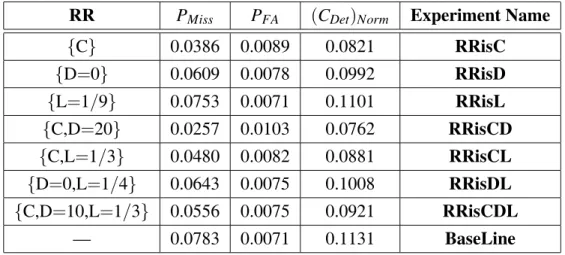
Then, in order to evaluate the performance of dynamic co-occurrence, we do several exper-iments on the link detection system based on dynamic co-occurrence with different relation restriction. All the parameters are trained using the training corpora. Table 3 listed the experi-mental results.
All the performances of the story link detection based on the dynamic co-occurrence are bet-ter than those of the baseline, which proves the validity of dynamic co-occurrence.
In order to compare the performance of the fea-tures used in this paper in more detail, we give
the following two figures: Figure 1 and Figure 2, where D and L are set to different values.
Figure 1.Performance of RRisD and RRisCD under different D.
Figure 2.Performance of RRisL and RRisCL under different L.
From all the above results, we can see:
• From the performances of theRRisC,RRisD
andRRisL, we can see that the features used in the relation restriction are very successful;
RR PMiss PFA (CDet)Norm Experiment Name
{C} 0.0386 0.0089 0.0821 RRisC
{D=0} 0.0609 0.0078 0.0992 RRisD
{L=1/9} 0.0753 0.0071 0.1101 RRisL
{C,D=20} 0.0257 0.0103 0.0762 RRisCD
{C,L=1/3} 0.0480 0.0082 0.0881 RRisCL
{D=0,L=1/4} 0.0643 0.0075 0.1008 RRisDL
{C,D=10,L=1/3} 0.0556 0.0075 0.0921 RRisCDL
— 0.0783 0.0071 0.1131 BaseLine
• From contrast betweenRRisDandRRisCD, as well asRRisLand RRisCL, we can see that the capital feature is more useful. This is because the initials of names(people, loca-tions and organizaloca-tions)are usually capital, these names are the key words to differenti-ate similar topics;
• From the results, we can conclude that the location feature is not as good as the capital feature and the distance feature. We think that the reason is the dynamic evolution of the topic[17].
7. Conclusions and Future Work
In order to mine more information from tested stories, we propose a new technology, dynamic co-occurrence, which is defined to be a pair of words satisfying some relation restrictions. Experimental results indicate that dynamic co-occurrence is a useful method in the story link detection. We also find that the features used in the relation restriction is very important. This paper uses capital, location and distance as the features which are tested to be successful. An obvious extension to the current work would find more helpful features in the creation of rela-tion restricrela-tion, and research into more effective usage of the dynamic co-occurrence.
References
[1] The 2003 Topic Detection and Tracking Task Defi-nition and Evaluation Plan, April, 2003.
http://www.nist.gov/speech/tests/tdt/tdt 2003/-evalplan.htm
[2] CHARLESL. WAYNE, Multilingual Topic Detection and Tracking: Successful Research Enabled by Cor-pora and Evaluation. Presented in theProceedings of the Language Resources and Evaluation Con-ference (LREC), Athens,Greece, pp. 1487–1494, 2000.
[3] RALFD. BROWN, THOMASPIERCE, YIMINGYANG, JAIMEG. CARBONELL, Link Detection – Results and
Analysis, 2000.
http://www.nist.gov/speech/tests/tdt/ tdt99/-papers/cmu sld/
[4] FRANCINE CHEN, AYMAN FARAHAT, THORSTEN
BRANTS, Multiple similarity measures and
source-pair information in story link detection. Presented
in the Proceedings of Human Language Technol-ogy Conference of the North American Chapter of the Association for Computational Linguistics (HLT-NAACL 2004), Boston, Massachusetts, pp. 313–320, 2004.
[5] RALFD. BROWN, Dynamic Stopwording for Story
Link Detection. Presented in theProceedings of the Second International Conference on Human Lan-guage Technology Research, San Diego, California, pp. 190–193, 2002.
[6] JAMES ALLAN, VICTOR LAVRENKO, DAVID FREY,
VIKAS KHANDELWAL, UMass at TDT2000.
Pre-sented in theProceedings of Topic Detection and Tracking Workshop, 2000.
[7] JAMESALLAN, VICTORLAVERNKO, RAMESHNAL -LAPTI, UMass at TDT2002. Presented in the Pro-ceedings of the Topic Detection and Tracking Work-shop, 2002.
[8] JOSEF KITTLER, MOHAMADHATEF, ROBERT P. W. DUIN, JIRIMATAS, On Combining Classifiers.IEEE Transactions on Pattern Analysis and Machine In-telligence, 20(3), pp. 226–239, 1998.
[9] YING-JUCHEN, HSIN-HISCHEN, NLP and IR Ap-proaches to Monolingual and Multilingual Link Detection. Presented in theProceedings of the 19th International Conference on Computational Lin-guistics (COLING 2002), Taipei, Taiwan, 2002.
[10] OLIVIERFERRET, Using collocations for topic
seg-mentation and link detection. Presented in the Pro-ceedings of the 19th International Conference on Computational Linguistics (COLING 2002), Taipei, Taiwan, pp. 1–7, 2002.
[11] FRANCINE CHEN, AYMAN FARAHAT, THORSTEN
BRANTS, Story Link Detection and New Even Detection are Asymmetic. Presented in the Pro-ceedings of Human Language Technology Confer-ence (HLT-NAACL 2003), Edmonton, Canada, pp. 13–15, 2003.
[12] AYMAN FARAHAT, FRANCINE CHEN, THORSTEN
BRANTS, Optimizing Story Link Detection is not
Equivalent to Optimizing New Event Detection. Presented in the Proceedings of the 41st Annual Meeting of the Association for Computational Lin-guistics(ACL03), Sapporo, Japan, pp. 232–239, 2003.
[13] JINGBAI, JIAN-YUNNIE, GUIHONGCAO, Content-Dependent Term Relations for Information Re-trieval. Presented in the Proceedings of the 2006 Conference on Empirical Methods in Natural Lan-guage Processing (EMNLP2006), pp. 551–559, 2006.
[14] JAMES ALLAN, VICTOR LAVRENKO, RON PAPKA,
Event Tracking. University of Massachusetts, Com-puter Science Department CIIR Technical Report IR-128, January 1998.
[15] JUHA MAKKONEN, HELENA AHONEN-MYKA,
MARKOSALMENKIVI, Applying Semantic Classes
in Event Detection and Tracking. Presented in the
[16] ZHAO HUA, ZHAO TIEJUN, ZHANG SHU, WANG
HAOCHANG, Topic detection research based on content analysis. Journal of Harbin Institute of Technology, 38(10), pp. 1740-1743, 2006.
[17] ZHAO HUA, ZHAOTIEJUN, YUHAO, ZHANGSHU,
Dynamic evolvement-oriented topic detection re-search.Chinese high technology letters, 16(12), pp. 1230–1235, 2006.
Received:July, 2007
Accepted:March, 2009
Contact addresses:
Ms. Hua Zhao College of Information Science and Engineering Shandong University of Science and Technology 579 Qianwangang Road Huangdao, Qingdao 266510 Shandong Province, P. R. China e-mail:[email protected]
Prof. Tiejun Zhao School of Computer Science and Technology Harbin Institute of Technology Harbin Province, P. R. China
MS. HUAZHAOreceived her Bachelor’s degree in computer science and technology from Liao Cheng University, China, in 2001, the Master’s Degree in computer science and technology from Harbin Institute of Technology(HIT), China, in 2003, and the Doctor’s degree in HIT in 2008. She currently is a lector at the College of Information Science and Engineering, Shandong University of Science and Technology, China. Her research interests include topic detection and tracking, natural lan-guage processing, machine learning.