Retracted per author's request
*Correspondence to Author: Dr. Ahmad Hamza Al Cheikha Dep. of Mathematical Science, Col-lege of Arts-science and Education, Ahlia Uni., Manama, Bahrain
How to cite this article:
Ahmad Hamza Al Cheikha.Gen-erating New Orthogonal Binary Sequences Using Quotient Rings Z/pm Z. Research Journal of Math-ematics and Computer Science,
2018; 2:11. .
eSciPub LLC, Houston, TX USA. Website: http://escipub.com/
Research Journal of Mathematics and Computer Science
(ISSN:2576-3989)
Research Article RJMCS (2018) 2:11
Generating New Orthogonal Binary Sequences Using Quotient
Rings Z/
p
mZ
Orthogonal Sequences (as M-Sequences, Walsh Sequences, …) are used widely at the forward links of communication channels to mix the information on connecting to and at the backward links of these channels to sift through this information is transmitted to reach the receivers this information in a correct form, especially
in the pilot channels, the Sync channels, and the Traffic channel.
This research is useful to generate new sets of orthogonal se-quences (with the bigger lengths and the bigger minimum dis-tance that assists to increase secrecy of these information and increase the possibility of correcting mistakes resulting in the channels of communication) from quotient rings Z/pmZ, where Z is the integers and p is prime, replacing each event number by zero and replacing each odd number by one.
Keywords: Walsh Sequences, M-sequences, Additive group,
Coefficient of Correlation, Orthogonal sequences, Quotient ring.
Dr. Ahmad Hamza Al Cheikha
Dep. of Mathematical Science, College of Arts-science and Education, Ahlia Uni., Manama, Bahrain
Retracted per author's request
I. IntroductionShannon's classic articles, 1948-1949, were followed by many research papers on the question of finding successful ways to encode a successful encoding of the media to allow it to be transmitted correctly through jammed channels. [16]
The main obstacle to encoding and decoding is the complexity of decoding and decoding. For this reason, efforts have been made to design cryptographic and decoding methods in an easy way. The works of Hocquenghem in 1959, Reed Solomon 1960, Chaudhuri and Bose in 1960, BCH codes or Bose–Chaudhuri– Hocquenghem codes and others as Goppa, and Petrson 1961 were a new starting point for solving this issue. [1-7]
In all stages of encoding and decoding the orthogonal sequences play the main role in these processes n all stages of encoding and decoding, the orthogonal sequences play the main role in these processes, including: the sequences with maximum period M-Sequences, the Walsh sequences, the Reed-Solomon sequences, and the other. [8-11]
Orthogonal Sequences are used widely at the forward links of communication channels to sift
through this information is transmitted to reach the receivers this information in a correct form,
especially in the pilot channels, the Sync channels, and the Traffic channel.[12-16]
II. Research method and Material
Definition 1. The complement of the binary vector X (x1,x2,...,xn),xiF2{0,1}is the vector
X (x1,x2,...,xn), where:
1 0 0 1 i i i x if x if
x . [1,2]
Definition 2. Supposex (x0,x1,...,xn1)
and y(y0,y1,...,yn1)are binary vectors of
length n on GF(2)={0,1}. The coefficient of
correlations function of x and y , denoted by
Rx,y,
is: ) 1 ( ) 1 ( 1 0 ,
n i y x yx i i
R
Where xi + yi is computed mod 2. It is equal to the number of agreements components minus
the number of disagreements corresponding to components or if xi,yi{1,1}(usually, replacing in binary vectors x and y each “1”
by “-1” and each “0” by “1”) then
1 0 , n i i i yx x y
R , [1,2],[13-18] (2)
[3-5] [8,9]
Definition 3. Supposex(x0,x1,...,xn1)
and y(y0,y1,...,yn1)are binary vectors of
length n on GF(2)={0,1}, or components belong to {1, -1}, is said strictly orthogonal or
briefly orthogonal if Rx,y 0, (Usually, said orthogonal if Rx,y {1,0.1} ). [5-7],[11-13]
Definition 4. Suppose G is a set of binary vectors of length n:
; ( 0, 1,..., 1), 2 {0,1}, 0,1,..., 1
X X x x x x F i n
G n i
Let’s 1*= -1 and 0* =1, The set G is said to
be orthogonal if the following two conditions are
Satisfied: . 0 , 0 , .
1 ,0
1 0 x n i
i or R
x G X (3) ) 4 ( . 0 0 ), ( , . 2 , 1 0 y x n i i
i y or R
x Y X G Y X
That is, the absolute value of "the number of agreements minus the number of disagreements"
Retracted per author's request
III. Results and DiscussionThe best method for getting binary representation of the multiplication table of quotient ring
) /(p Z
Z m , where Z is the integers and p is prime, is replacing each event number by “0” and replacing each odd number by “1’, by this way each row of the table , except the multiplies
of p, contains (pm1)/2of “0.s’ and (pm1)/2of
“1.s” and Ri is the complement of R(pm-i) or
) 11 ( i R
Ri except the first entry . We searching between these rows about comfortable subset of rows which with the null row form an additional subgroups achieve the number of “0.s” and the number of “1.s” or
orthogonal conditions in the vector space 2(pm), where the addition is performed by mod 2.
First step: For p = 3
1. For the quotient ringZ
32 : The following table1 showing the multiple in the ring Z 32Z:
Table 1: Multiplication Table of Z 32Z
* 0 1 2 3 4 5 6 7 8
R0 0 0 0 0 0 0 0 0 0 0
R1 1 0 1 2 3 4 5 6 7 8
R2 2 0 2 4 6 8 1 3 5 7
R3 3 0 3 6 0 3 6 0 3 6
R4 4 0 4 8 3 7 2 6 1 5
R5 5 0 5 1 6 2 7 3 8 4
R6 6 0 6 3 0 6 3 0 6 3
R7 7 0 7 5 3 1 8 6 4 2
R8 8 0 8 7 6 5 4 3 2 1
Table 2 showing the binary representation of table1, when in table 1 each even num-ber
replaced by “0” and each odd number replaced by “1”:
Table 2: Binary Representation of Z 32Z
* 0 1 2 3 4 5 6 7 8
R0 0 0 0 0 0 0 0 0 0 0
R1 1 0 1 0 1 0 1 0 1 0
R2 2 0 0 0 0 0 1 1 1 1
R3 3 0 1 0 0 1 0 0 1 0
R4 4 0 0 0 1 1 0 0 1 1
R5 5 0 1 1 0 0 1 1 0 0
R6 6 0 0 1 0 0 1 0 0 1
R7 7 0 1 1 1 1 0 0 0 0
R8 8 0 0 1 0 1 0 1 0 1
From the table 2:
• All entries in the R0 are “0” And does not meet the conditions of orthogonal.
Retracted per author's request
• Each of the rows of the set} 8 , 7 , 5 , 4 , 2 , 1
{R R R R R R contains (32 +1)/2 of
“0.s” , (32-1) of “1.s” and the first condition
of orthogonal is verified and:
R1+R8 = R2+R7=…=R4+R5=
[011111111].
• The following table 3 showing the addition between some of the rows in the set where Ri + Rj denoted by Ri+j.
Table 3: Addition between some of the rows{R1, R2, …,R8}
R1+2 0 1 0 1 0 0 1 0 1 R1+4 0 1 0 0 1 1 0 0 1 R2+4 0 0 0 1 1 1 1 0 0 R1+5 0 0 1 1 0 0 1 1 0 R2+5 0 1 1 0 0 0 0 1 1 R4+5 0 1 1 1 1 1 1 1 1 R1+7 0 0 1 0 1 1 0 1 0 R2+7 0 1 1 1 1 1 1 1 1 R1+8 0 1 1 1 1 1 1 1 1
We can see that Span{R1, R2, R4}= {R1, R2, R4, R1+2,R1+4, R2+4} is a maximum closed orthogonal set contained in F32and the number
of these maximum closed orthogonal sets is at
most 20
3 6
sets. 2. For the quotient ring
Z
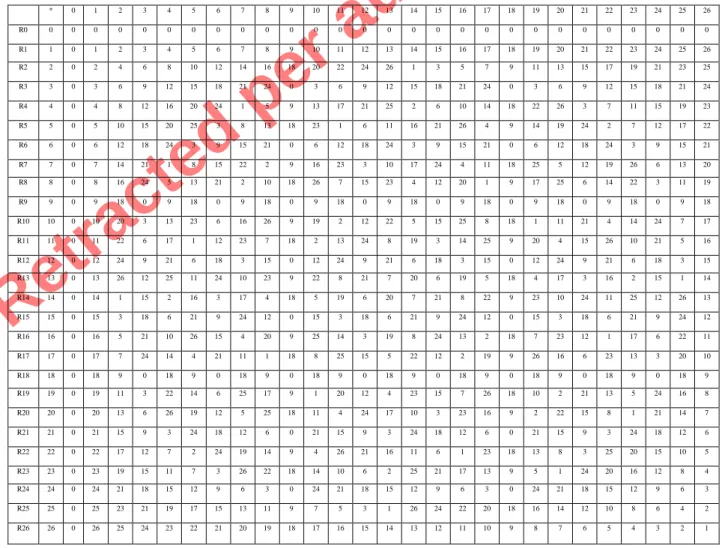
Z/33 : The multiplication table of Z 33Zis the following:
Table 4: Multiplication Table of Z 33Z
Retracted per author's request
The binary representation of the table 5 is:Table 5: Binary Representation of Multiplication table of Z 33Z
* 0 1 2 3 4 5 6 7 8 9 10 11 12 13 14 15 16 17 18 19 20 21
22
23 24 25 26
R0 0 0 0 0 0 0 0 0 0 0 0 0 0 0 0 0 0 0 0 0 0 0 0 0 0 0 0 0
R1 1 0 1 0 1 0 1 0 1 0 1 0 1 0 1 0 1 0 1 0 1 0 1 0 1 0 1 0
R2 2 0 0 0 0 0 0 0 0 0 0 0 0 0 0 1 1 1 1 1 1 1 1 1 1 1 1 1
R3 3 0 1 0 1 0 1 0 1 0 0 1 0 1 0 1 0 1 0 0 1 0 1 0 1 0 1 0
R4 4 0 0 0 0 0 0 0 1 1 1 1 1 1 1 0 0 0 0 0 0 0 1 1 1 1 1 1
R5 5 0 1 0 1 0 1 1 0 1 0 1 1 0 1 0 1 0 0 1 0 1 0 0 1 0 1 0
R6 6 0 0 0 0 0 1 1 1 1 0 0 0 0 0 1 1 1 1 0 0 0 0 0 1 1 1 1
R7 7 0 1 0 1 1 0 1 0 0 1 0 1 1 0 1 0 0 1 0 1 1 0 1 0 0 1 0
R8 8 0 0 0 0 1 1 1 0 0 0 0 1 1 1 0 0 0 1 1 1 1 0 0 0 1 1 1
R9 9 0 1 0 0 1 0 0 1 0 0 1 0 0 1 0 0 1 0 0 1 0 0 1 0 0 1 0
R10 10 0 0 0 1 1 1 0 0 0 1 1 0 0 0 1 1 1 0 0 1 1 1 0 0 0 1 1
R11 11 0 1 0 0 1 1 0 1 1 0 0 1 0 0 1 1 0 1 1 0 0 1 0 0 1 1 0
R12 12 0 0 0 1 1 0 0 1 1 0 0 0 1 1 0 0 1 1 0 0 0 1 1 0 0 1 1
R13 13 0 1 0 0 1 1 0 0 1 1 0 0 1 1 0 0 1 1 0 0 1 1 0 0 1 1 0
R14 14 0 0 1 1 0 0 1 1 0 0 1 1 0 0 1 1 0 0 1 1 0 0 1 1 1 0 1
R15 15 0 1 1 0 0 1 1 0 0 0 1 1 0 0 1 1 0 0 0 1 1 0 0 1 1 0 0
R16 16 0 0 1 1 0 0 1 0 0 1 1 0 1 1 0 0 1 0 0 1 1 0 1 1 0 0 1
R17 17 0 1 1 0 0 0 1 1 1 0 0 1 1 1 0 0 0 1 1 0 0 0 1 1 1 0 0
R18 18 0 0 1 0 0 1 0 0 1 0 0 1 0 0 1 0 0 1 0 0 1 0 0 1 0 0 1
R19 19 0 1 1 1 0 0 0 1 1 1 1 0 0 0 1 1 1 0 0 0 0 1 1 1 0 0 0
R20 20 0 0 1 0 0 1 0 1 1 0 1 0 0 1 0 1 1 0 1 0 0 1 0 1 1 0 1
R21 21 0 1 1 1 1 0 0 0 0 0 1 1 1 1 0 0 0 0 0 1 0 1 1 0 0 0 0
R22 22 0 0 1 0 1 0 0 1 0 1 0 0 1 0 1 0 1 1 0 1 0 1 1 0 1 0 1
R23 23 0 1 1 1 1 1 1 0 0 0 0 0 0 0 1 1 1 1 1 1 1 0 0 0 0 0 0
R24 24 0 0 1 0 1 0 1 0 1 0 0 1 0 1 0 1 0 1 0 0 1 0 1 0 1 0 1
R25 25 0 1 1 1 1 1 1 1 1 1 1 1 1 1 0 0 0 0 0 0 0 0 0 0 0 0 0
R26 26 0 0 1 0 1 0 1 0 1 0 1 0 1 0 1 0 1 0 1 0 1 0 1 0 1 0 1
We can see: R1+R26 = R2+R25= … = R13+R14= [01 1 1 1 1…1]27
2 1 R
R , Contains 13 of “0.s” and 14 of “1.s”.
4 1 R
R , Contains 15 of “0.s” and 12 of “1.s”. 5
1 R
R , Contains 16 of “0.s” and 11 of “1.s”.
• R1R7, Contains 14 of “0.s” and 13 of
“1.s”.
8 1 R
R , Contains 13 of “0.s” and 14 of “1.s”.
10 1 R
R , Contains 15 of “0.s” and 12 of “1.s”.
11 1 R
R , Contains 16 of “0.s” and 11 of “1.s”.
• R1R13, Contains 14 of “0.s” and 13 of
“1.s”. 14 1 R
R , Contains 12 of “0.s” and 15 of “1.s”.
16 1 R
R , Contains 11 of “0.s” and 16 of “1.s”.
17 1 R
R , Contains 12 of “0.s” and 15 of “1.s”.
• R1R19, Contains 14 of “0.s” and 13 of
“1.s”.
20 1 R
R , Contains 13 of “0.s” and 14 of “1.s”.
22 1 R
R , Contains 11 of “0.s” and 16 of “1.s”.
23 1 R
R , Contains 12 of “0.s” and 15 of “1.s”.
• R1R25, Contains 14 of “0.s” and 13 of
“1.s”.
26 1 R
R , Contains 1 of “0.s” and 26 of “1.s”.
Such any two rows from the set {R1, R7, R13,R19,R25} are orthogonal:
R1 0 1 0 1 0 1 0 1 0 1 0 1 0 1 0 1 0 1 0 1 0 1 0 1 0 1
R7 0 1 0 1 1 0 1 0 0 1 0 1 1 0 1 0 0 1 0 1 1 0 1 0 0 1
R13 0 1 0 0 1 1 0 0 1 1 0 0 1 1 0 0 1 1 0 0 1 1 0 0 1 1
R19 0 1 1 1 0 0 0 1 1 1 1 0 0 0 1 1 1 0 0 0 0 1 1 1 0 0
Retracted per author's request
But:• R7R13, Contains 14 of “0.s” and 13 of
“1.s”.
19 7 R
R , Contains 10 of “0.s” and 17 of “1.s”.
• R7R25, Contains 14 of “0.s” and 13 of
“1.s”.
• R13R25, Contains 14 of “0.s” and 13 of
“1.s”.
We have the set of four rows {R1, R7, R13, R25} and any two rows of them are orthogonal.
R1 1 0 1 0 1 0 1 0 1 0 1 0 1 0 1 0 1 0 1 0 1 0 1 0 1 0 1
R7 7 0 1 0 1 1 0 1 0 0 1 0 1 1 0 1 0 0 1 0 1 1 0 1 0 0 1
R13 13 0 1 0 0 1 1 0 0 1 1 0 0 1 1 0 0 1 1 0 0 1 1 0 0 1 1
R25 25 0 1 1 1 1 1 1 1 1 1 1 1 1 1 0 0 0 0 0 0 0 0 0 0 0 0
Thus we can find the following table 6 is the Span of these rows{R1, R7, R13, R25}:
Table 6: Span of { R1, R7, R13, R25}
R1 0 1 0 1 0 1 0 1 0 1 0 1 0 1 0 1 0 1 0 1 0 1 0 1 0 1
R7 0 1 0 1 1 0 1 0 0 1 0 1 1 0 1 0 0 1 0 1 1 0 1 0 0 1
R1+7 0 0 0 0 1 1 1 1 0 0 0 0 1 1 1 1 0 0 0 0 1 1 1 1 0 0
R13 0 1 0 0 1 1 0 0 1 1 0 0 1 1 0 0 1 1 0 0 1 1 0 0 1 1
R1+13 0 0 0 1 1 0 0 1 1 0 0 1 1 0 0 1 1 0 0 1 1 0 0 1 1 0
R7+13 0 0 0 1 0 1 1 0 1 0 0 1 0 1 1 0 1 0 0 1 0 1 1 0 1 0
R1+7+13 0 1 0 0 0 0 1 1 1 1 0 0 0 0 1 1 1 1 0 0 0 0 1 1 1 1
R25 0 1 1 1 1 1 1 1 1 1 1 1 1 1 0 0 0 0 0 0 0 0 0 0 0 0
R1+25 0 0 1 0 1 0 1 0 1 0 1 0 1 0 0 1 0 1 0 1 0 1 0 1 0 1
R7+25 0 0 1 0 0 1 0 1 1 0 1 0 0 1 1 0 0 1 0 1 1 0 1 0 0 1
R13+25 0 0 1 1 0 0 1 1 0 0 1 1 0 0 0 0 1 1 0 0 1 1 0 0 1 1
R1+7+25 0 1 1 1 0 0 0 0 1 1 1 1 0 0 1 1 0 0 0 0 1 1 1 1 0 0
R1+13+25 0 1 1 0 0 1 1 0 0 1 1 0 0 1 0 1 1 0 0 1 1 0 0 1 1 0
R7+13+25 0 1 1 0 1 0 0 1 0 1 1 0 1 0 1 0 1 0 0 1 0 1 1 0 1 0
R1+7+13+25 0 0 1 1 1 1 0 0 0 0 1 1 1 1 1 1 1 1 0 0 0 0 1 0 1 1
From this table we can see the following:
• Any two rows of { R1, R7, R13, R25} are orthogonal.
• Sum any three rows of { R1, R7, R13, R25} contains 13 of “0.s” and 14 of “1.s”. • Sum all rows of { R1, R7, R13, R25} contains 11 of “0.s” and 16 of “1.s”, this means: if
there are four people sent their messages m1,m2,m3,m4according to the lines R1, R7,
R13, R25 respectively then then the decoder may not be able to specify each of these
Messages separately but for any three of them, the decoder can identify each one of them.
• Thus, B = Span{R1, R7, R13} is a closed orthogonal set and the number of as theses sets
is at most 816 3
18
sets.
Second step: For p = 5
1. For the quotient ringZ/5Z: The following
Retracted per author's request
Table7: Multiplication table of Z/5Z with binary representation* 0 1 2 3 4 * C0 C1 C2 C3 C4 * C0 C1 C2 C3 C4 0 0 0 0 0 0 R0 0 0 0 0 0 R0 0 0 0 0 0 1 0 1 2 3 4 R1 0 1 0 1 0 R1 0 1 0 1 0
2 0 2 4 1 3 R2 0 0 0 1 1 R2 0 0 0 1 1 3 0 3 1 4 2 R3 0 1 1 0 0 R1+2 0 1 0 0 1 4 0 4 3 2 1 R4 0 0 1 0 1 R4 0 0 1 0 1
From this table we can see thatSpan{R1,R2}is
} , 2 , 1
{R R R12 , where R12R1R2, and
) 1 0 0 1 0 (
2 1
R don’t belong to the rows set of
table and each of the rows contains three of “0.s” and two of the “1.s” but R123(0000)and:
R1+R4 = R2+R3 = [0 1 1 1 1].
From this simple example we can see, there are only four closed orthogonal sets are:
} 2 , 1 {R R
Span , Span{R1,R3}, Span{R2,R4}, and
} 4 , 3 {R R
Span , and 6
2 4 4
.
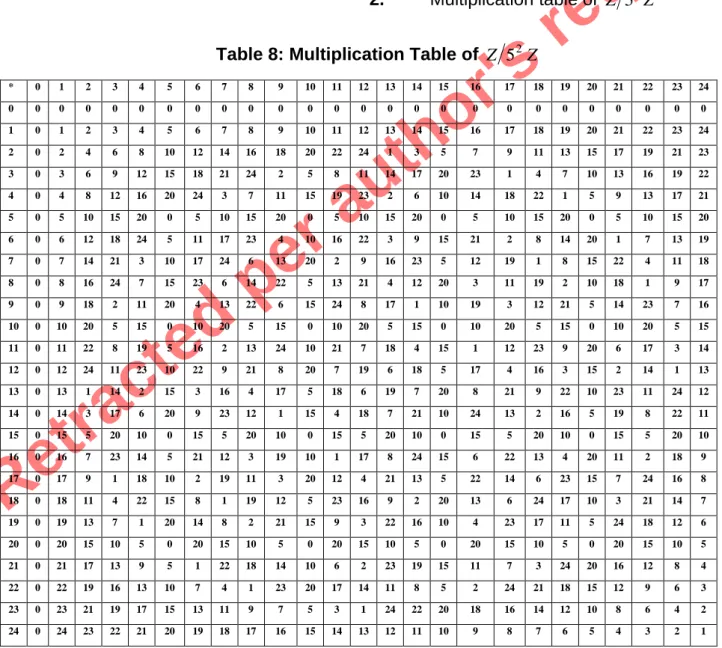
2. Multiplication table of Z 52Z
Table 8: Multiplication Table of Z 52Z
* 0 1 2 3 4 5 6 7 8 9 10 11 12 13 14 15 16 17 18 19 20 21 22 23 24 0 0 0 0 0 0 0 0 0 0 0 0 0 0 0 0 0 0 0 0 0 0 0 0 0 0 1 0 1 2 3 4 5 6 7 8 9 10 11 12 13 14 15 16 17 18 19 20 21 22 23 24 2 0 2 4 6 8 10 12 14 16 18 20 22 24 1 3 5 7 9 11 13 15 17 19 21 23 3 0 3 6 9 12 15 18 21 24 2 5 8 11 14 17 20 23 1 4 7 10 13 16 19 22 4 0 4 8 12 16 20 24 3 7 11 15 19 23 2 6 10 14 18 22 1 5 9 13 17 21 5 0 5 10 15 20 0 5 10 15 20 0 5 10 15 20 0 5 10 15 20 0 5 10 15 20 6 0 6 12 18 24 5 11 17 23 4 10 16 22 3 9 15 21 2 8 14 20 1 7 13 19 7 0 7 14 21 3 10 17 24 6 13 20 2 9 16 23 5 12 19 1 8 15 22 4 11 18 8 0 8 16 24 7 15 23 6 14 22 5 13 21 4 12 20 3 11 19 2 10 18 1 9 17 9 0 9 18 2 11 20 4 13 22 6 15 24 8 17 1 10 19 3 12 21 5 14 23 7 16 10 0 10 20 5 15 0 10 20 5 15 0 10 20 5 15 0 10 20 5 15 0 10 20 5 15 11 0 11 22 8 19 5 16 2 13 24 10 21 7 18 4 15 1 12 23 9 20 6 17 3 14 12 0 12 24 11 23 10 22 9 21 8 20 7 19 6 18 5 17 4 16 3 15 2 14 1 13 13 0 13 1 14 2 15 3 16 4 17 5 18 6 19 7 20 8 21 9 22 10 23 11 24 12 14 0 14 3 17 6 20 9 23 12 1 15 4 18 7 21 10 24 13 2 16 5 19 8 22 11 15 0 15 5 20 10 0 15 5 20 10 0 15 5 20 10 0 15 5 20 10 0 15 5 20 10 16 0 16 7 23 14 5 21 12 3 19 10 1 17 8 24 15 6 22 13 4 20 11 2 18 9 17 0 17 9 1 18 10 2 19 11 3 20 12 4 21 13 5 22 14 6 23 15 7 24 16 8 18 0 18 11 4 22 15 8 1 19 12 5 23 16 9 2 20 13 6 24 17 10 3 21 14 7 19 0 19 13 7 1 20 14 8 2 21 15 9 3 22 16 10 4 23 17 11 5 24 18 12 6 20 0 20 15 10 5 0 20 15 10 5 0 20 15 10 5 0 20 15 10 5 0 20 15 10 5 21 0 21 17 13 9 5 1 22 18 14 10 6 2 23 19 15 11 7 3 24 20 16 12 8 4 22 0 22 19 16 13 10 7 4 1 23 20 17 14 11 8 5 2 24 21 18 15 12 9 6 3 23 0 23 21 19 17 15 13 11 9 7 5 3 1 24 22 20 18 16 14 12 10 8 6 4 2 24 0 24 23 22 21 20 19 18 17 16 15 14 13 12 11 10 9 8 7 6 5 4 3 2 1
Retracted per author's request
Table 9: Binary Representation of Multiplication table of Z 52Z
* C0 C1 C2 C3 C4 C5 C6 C7 C8 C9 C10 C11 C12 C13 C14 C15 C16 C17 C18 C19 C20 C21 C22 C23 C24
R0 0 0 0 0 0 0 0 0 0 0 0 0 0 0 0 0 0 0 0 0 0 0 0 0 0 R1 0 1 0 1 0 1 0 1 0 1 0 1 0 1 0 1 0 1 0 1 0 1 0 1 0 R2 0 0 0 0 0 0 0 0 0 0 0 0 0 1 1 1 1 1 1 1 1 1 1 1 1 R3 0 1 0 1 0 1 0 1 0 0 1 0 1 0 1 0 1 1 0 1 0 1 0 1 0 R4 0 0 0 0 0 0 0 1 1 1 1 1 1 0 0 0 0 0 0 1 1 1 1 1 1
R5 0 1 0 1 0 0 1 0 1 0 0 1 0 1 0 0 1 0 1 0 0 1 0 1 0 R6 0 0 0 0 0 1 1 1 1 0 0 0 0 1 1 1 1 0 0 0 0 1 1 1 1 R7 0 1 0 1 1 0 1 0 0 1 0 0 1 0 1 1 0 1 1 0 1 0 0 1 0 R8 0 0 0 0 1 1 1 0 0 0 1 1 1 0 0 0 1 1 1 0 0 0 1 1 1 R9 0 1 0 0 1 0 0 1 0 0 1 0 0 1 1 0 1 1 0 1 1 0 1 1 0 R10 0 0 0 1 1 0 0 0 1 1 0 0 0 1 1 0 0 0 1 1 0 0 0 1 1 R11 0 1 0 0 1 1 0 0 1 0 0 1 1 0 0 1 1 0 1 1 0 0 1 1 0 R12 0 0 0 1 1 0 0 1 1 0 0 1 1 0 0 1 1 0 0 1 1 0 0 1 1 R13 0 1 1 0 0 1 1 0 0 1 1 0 0 1 1 0 0 1 1 0 0 1 1 0 0 R14 0 0 1 1 0 0 1 1 0 1 1 0 0 1 1 0 0 1 0 0 1 1 0 0 1 R15 0 1 1 0 0 0 1 1 0 0 0 1 1 0 0 0 1 1 0 0 0 1 1 0 0 R16 0 0 1 1 0 1 1 0 1 1 0 1 1 0 0 1 0 0 1 0 0 1 0 0 1 R17 0 1 1 1 0 0 0 1 1 1 0 0 0 1 1 1 0 0 0 1 1 1 0 0 0 R18 0 0 1 0 0 1 0 1 1 0 1 1 0 1 0 0 1 0 0 1 0 1 1 0 1 R19 0 1 1 1 1 0 0 0 0 1 1 1 1 0 0 0 0 1 1 1 1 0 0 0 0 R20 0 0 1 0 1 0 0 1 0 1 0 0 1 0 1 0 0 1 0 1 0 0 1 0 1 R21 0 1 1 1 1 1 1 0 0 0 0 0 0 1 1 1 1 1 1 0 0 0 0 0 0 R22 0 0 1 0 1 0 1 0 1 1 0 1 0 1 0 1 0 0 1 0 1 0 1 0 1 R23 0 1 1 1 1 1 1 1 1 1 1 1 1 0 0 0 0 0 0 0 0 0 0 0 0 R24 0 0 1 0 1 0 1 0 1 0 1 0 1 0 1 0 1 0 1 0 1 0 1 0 1
From this table we can see that each row in the table contains 13 of “0.s” and 12 of “1.s” except the rows R0, R5, R10, R15, and R20 and each row of R5, R10, R15, and R20 contains 15 of “0.s” and 10 of “1.s” and: R1+R24 = R2+R23 =…. = R12+R13 = [0 1 1 1 1…1]25.
a. Using the rows of the set A = {R1, R2, R4} as a basis, we can find Span {A} as an
orthogonal closed set of rows which with the R0 form an additional subgroup in the vector
space2(2m). Table 10 showing elements Span {A} as an orthogonal closed set and each row contains 13 of “0.s” and 12 of “1.s”. Elements Span {A} don’t belong to the
table 3.
Table 10: Span {A} as orthogonal closed set
* C0 C1 C2 C3 C4 C5 C6 C7 C8 C9 C10 C11 C12 C13 C14 C15 C16 C17 C18 C19 C20 C21 C22 C23 C24
R1 0 1 0 1 0 1 0 1 0 1 0 1 0 1 0 1 0 1 0 1 0 1 0 1 0
R2 0 0 0 0 0 0 0 0 0 0 0 0 0 1 1 1 1 1 1 1 1 1 1 1 1
R1+2 0 1 0 1 0 1 0 1 0 1 0 1 0 0 1 0 1 0 1 0 1 0 1 0 1
R4 0 0 0 0 0 0 0 1 1 1 1 1 1 0 0 0 0 0 0 1 1 1 1 1 1
R1+4 0 1 0 1 0 1 0 0 1 0 1 0 1 1 0 1 0 1 0 0 1 0 1 0 1
R2+4 0 0 0 0 0 0 0 1 1 1 1 1 1 1 1 1 1 1 1 0 0 0 0 0 0
R1+2+4 0 1 0 1 0 1 0 0 1 0 1 0 1 0 1 0 1 0 1 1 0 1 0 1 0
Retracted per author's request
• From the following representation of rows R1, R3 and R1+R3 showing:R1 6 1 0 1 0 1 0 1 0 1 0 1 0 1 0 1 0 1 0 1 0 1 0 1 0
R3 0 1 0 1 0 1 0 1 0 0 1 0 1 0 1 0 1 1 0 1 0 1 0 1 0
+ 0 0 0 0 0 0 0 0 0 1 1 0 1 1 1 1 1 0 0 0 0 0 0 0 0
Thus R1+R3 contains 18 of “0.s” and 7 of “1.s” then these rows R1 and R3 can’t be in one basis.
• For the same reason R2, R6 as showing in the following representation:
R2 0 0 0 0 0 0 0 0 0 0 0 0 0 1 1 1 1 1 1 1 1 1 1 1 1
R6 0 0 0 0 0 1 1 1 1 0 0 0 0 1 1 1 1 0 0 0 0 1 1 1 1
+ 0 0 0 0 0 1 1 1 1 0 0 0 0 0 0 0 0 0 1 1 1 0 0 0 0
R2 = R6 contains 18 of “0.s” and 7 of “1.s” and R6 can’t be in one basis with R2.
• The following representation of R4, R7 and R4+R7:
R4 0 0 0 0 0 0 0 1 1 1 1 1 1 0 0 0 0 0 0 1 1 1 1 1 1
R7 0 1 0 1 1 0 1 0 0 1 0 0 1 0 1 1 0 1 1 0 1 0 0 1 0
+ 0 1 0 1 1 0 1 1 1 0 1 1 0 0 1 1 0 1 1 1 0 1 1 0 1
Showing: R4+R7 contains 9 of “0.s” and 16 of “1.s” and R4,R7 can’t be in one basis.
• By the same ways the sets {R1,R2,R4,R8}, }
9 , 4 , 2 , 1
{R R R R can’t find biggest orthogonal set of
rows.
The result study of Span{B}, where
} 11 , 4 , 2 , 1
{R R R R
B , showing in the table 11, the all
rows of Span{B}satisfies the orthogonal
conditions except R12411Which contains 17 of “0.s” and 8 of “1.s” as showing in table 11
.
Table 11: Showing rows of Span {B}
* C0 C1 C2 C3 C4 C5 C6 C7 C8 C9 C10 C11 C12 C13 C14 C15 C16 C17 C18 C19 C20 C21 C22 C23 C24
R1 0 1 0 1 0 1 0 1 0 1 0 1 0 1 0 1 0 1 0 1 0 1 0 1 0
R2 0 0 0 0 0 0 0 0 0 0 0 0 0 1 1 1 1 1 1 1 1 1 1 1 1
R1+2 0 1 0 1 0 1 0 1 0 1 0 1 0 0 1 0 1 0 1 0 1 0 1 0 1
R4 0 0 0 0 0 0 0 1 1 1 1 1 1 0 0 0 0 0 0 1 1 1 1 1 1
R1+4 0 1 0 1 0 1 0 0 1 0 1 0 1 1 0 1 0 1 0 0 1 0 1 0 1
R2+4 0 0 0 0 0 0 0 1 1 1 1 1 1 1 1 1 1 1 1 0 0 0 0 0 0
R1+2+4 0 1 0 1 0 1 0 0 1 0 1 0 1 0 1 0 1 0 1 1 0 1 0 1 0
R11 0 1 0 0 1 1 0 0 1 0 0 1 1 0 0 1 1 0 1 1 0 0 1 1 0
R1+11 0 0 0 1 1 0 0 1 1 1 0 0 1 1 0 0 1 1 1 0 0 1 1 0 0
R2+11 0 1 0 0 1 1 0 0 1 0 0 1 1 1 1 0 0 1 0 0 1 1 0 0 1
R4+11 0 1 0 0 1 1 0 1 0 1 1 0 0 0 0 1 1 0 1 0 1 1 0 0 1
R 1+2+11 0 0 0 1 1 0 0 1 1 1 0 0 1 0 1 1 0 0 0 1 1 0 0 1 1
R1+4+11 0 0 0 1 1 0 0 0 0 0 1 1 0 1 0 0 1 1 1 1 1 0 0 1 1
R2+4+11 0 1 0 0 1 1 0 1 0 1 1 0 0 1 1 0 0 1 0 1 0 0 1 1 0
R1+2+4+ +11
0 0 0 1 1 0 0 0 0 0 1 1 0 0 1 1 0 0 0 0 0 1 1 0 0
• The following representation of R4, R12 and R4+R12:
R4 0 0 0 0 0 0 0 1 1 1 1 1 1 0 0 0 0 0 0 1 1 1 1 1 1
R12 0 0 0 1 1 0 0 1 1 0 0 1 1 0 0 1 1 0 0 1 1 0 0 1 1
+ 0 0 0 1 1 0 0 0 0 1 1 0 0 0 0 1 1 0 0 0 0 1 1 0 0
Retracted per author's request
• The following representation of R4, R13 and R4+R13:R4 0 0 0 0 0 0 0 1 1 1 1 1 1 0 0 0 0 0 0 1 1 1 1 1 1
R13 0 1 1 0 0 1 1 0 0 1 1 0 0 1 1 0 0 1 1 0 0 1 1 0 0
+ 0 1 1 0 0 1 1 1 1 0 0 1 1 1 1 0 0 1 1 1 1 0 0 1 1
Showing: R4+R12 contains 9 of “0.s” and 16 of “1.s” and R4,R13 can’t be in one basis.
• The following representation of R1+2+4+14
R2+4 0 0 0 0 0 0 0 1 1 1 1 1 1 1 1 1 1 1 1 0 0 0 0 0 0
R1+14 0 1 1 0 0 1 1 0 0 0 1 1 0 0 1 1 0 0 0 1 1 0 0 1 1
+ 0 1 1 0 0 1 1 1 1 1 0 0 1 1 0 0 1 1 1 1 1 0 0 1 1
Showing: R1+2+4+14 contains 9 of “0.s” and 16 of “1.s” and R1, R2, R4, R14 can’t be in one basis.
• The following representation of R2+4+16
R2+4 0 0 0 0 0 0 0 1 1 1 1 1 1 1 1 1 1 1 1 0 0 0 0 0 0
R16 0 1 1 0 0 1 1 0 0 0 1 1 0 0 1 1 0 0 0 1 1 0 0 1 1
+ 0 1 1 0 0 1 1 1 1 1 0 0 1 1 0 0 1 1 1 1 1 0 0 1 1
Showing: R2+4+16 contains 9 of “0.s” and 16 of “1.s” and R2, R4, R16 can’t be in one basis.
• The following representation of R1, R17 and R1+R17:
R1 0 1 0 1 0 1 0 1 0 1 0 1 0 1 0 1 0 1 0 1 0 1 0 1 0
R17 0 1 1 1 0 0 0 1 1 1 0 0 0 1 1 1 0 0 0 1 1 1 0 0 0
+ 0 0 1 0 0 1 0 0 1 0 0 0 0 0 0 0 0 1 0 0 1 0 0 1 0
Showing: R1+R17 contains 19 of “0.s” and 6 of “1.s” and R1,R17 can’t be in one basis.
• The following representation of R4, R18 and R4+R18:
R4 0 0 0 0 0 0 0 1 1 1 1 1 1 0 0 0 0 0 0 1 1 1 1 1 1
R18 0 0 1 0 0 1 0 1 1 0 1 1 0 1 0 0 1 0 0 1 0 1 1 0 1
+ 0 0 1 0 0 1 0 0 0 1 0 0 1 1 0 0 1 0 0 0 1 0 0 1 0
Showing: R4+R18 contains 17 of “0.s” and 8 of “1.s” and R4,R18 can’t be in one basis.
• The following representation of R2, R19 and R2+R19:
R2 0 0 0 0 0 0 0 0 0 0 0 0 0 1 1 1 1 1 1 1 1 1 1 1 1
R19 0 1 1 1 1 0 0 0 0 1 1 1 1 0 0 0 0 1 1 1 1 0 0 0 0
+ 0 1 1 1 1 0 0 0 0 1 1 1 1 1 1 1 1 0 0 0 0 1 1 1 1
Showing: R2+R19 contains 9 of “0.s” and 16 of “1.s” and R2,R19 can’t be in one basis.
• The following representation of R4, R21 and R4+R21:
R4 0 0 0 0 0 0 0 1 1 1 1 1 1 0 0 0 0 0 0 1 1 1 1 1 1
R21 0 1 1 1 1 1 1 0 0 0 0 0 0 1 1 1 1 1 1 0 0 0 0 0 0
+ 0 1 1 1 1 1 1 1 1 1 1 1 1 1 1 1 1 1 1 1 1 1 1 1 1
Showing: R4+R21 contains only one “0.” and 24 of “1.s” and R4,R21 can’t be in one basis.
• The following representation of R1, R22 and R1+R22:
R1 0 1 0 1 0 1 0 1 0 1 0 1 0 1 0 1 0 1 0 1 0 1 0 1 0
R22 0 0 1 0 1 0 1 0 1 1 0 1 0 1 0 1 0 0 1 0 1 0 1 0 1
+ 0 1 1 1 1 1 1 1 1 0 0 0 0 0 0 0 0 1 1 1 1 1 1 1 1
Showing: R1+R22 contains only 9 of “0.s” and 16 of “1.s” and R1,R22 can’t be in one basis.
Retracted per author's request
R2 0 0 0 0 0 0 0 0 0 0 0 0 0 1 1 1 1 1 1 1 1 1 1 1 1R23 0 1 1 1 1 1 1 1 1 1 1 1 1 0 0 0 0 0 0 0 0 0 0 0 0
+ 0 1 1 1 1 1 1 1 1 1 1 1 1 1 1 1 1 1 1 1 1 1 1 1 1
Showing: R2+R23 contains only one of “0.s” and 24 of “1.s” and R2,R23 can’t be in one basis.
• The following representation of R1, R24 and R1+R24:
R1 0 1 0 1 0 1 0 1 0 1 0 1 0 1 0 1 0 1 0 1 0 1 0 1 0
R24 0 0 1 0 1 0 1 0 1 0 1 0 1 0 1 0 1 0 1 0 1 0 1 0 1
+ 0 1 1 1 1 1 1 1 1 1 1 1 1 1 1 1 1 1 1 1 1 1 1 1 1
Showing: R1+R24 contains only one “0.” and 24 of “1.s” and R1, R24 can’t be in one basis. Thus the biggest orthogonal closed set contains at most 3 rows and the number of these sets is
at most 1140 3
20
.
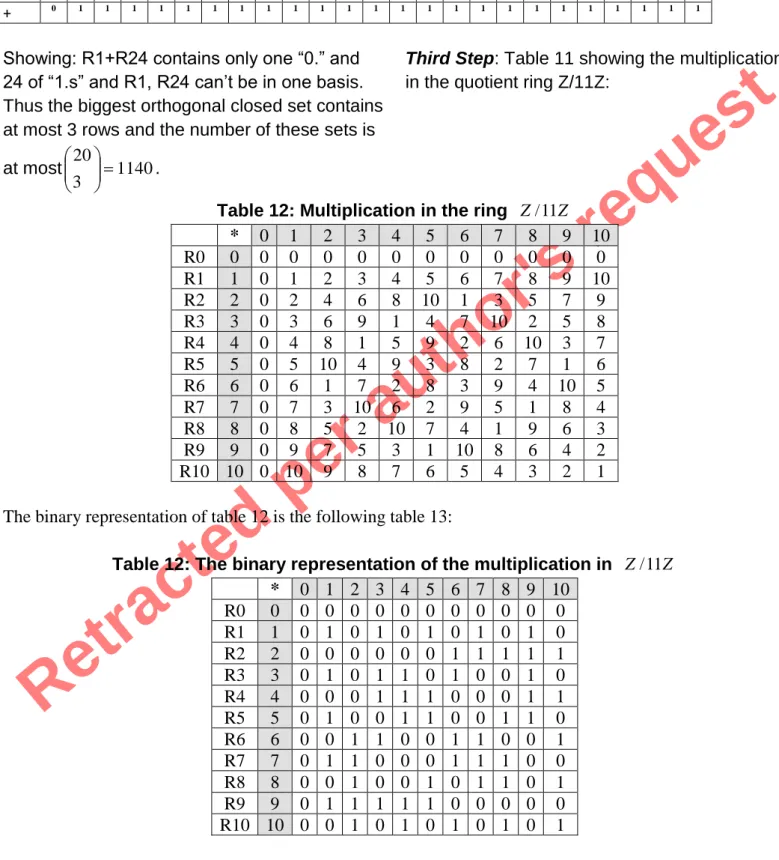
Third Step: Table 11 showing the multiplication in the quotient ring Z/11Z:
Table 12: Multiplication in the ring Z/11Z
* 0 1 2 3 4 5 6 7 8 9 10
R0 0 0 0 0 0 0 0 0 0 0 0 0 R1 1 0 1 2 3 4 5 6 7 8 9 10 R2 2 0 2 4 6 8 10 1 3 5 7 9 R3 3 0 3 6 9 1 4 7 10 2 5 8 R4 4 0 4 8 1 5 9 2 6 10 3 7 R5 5 0 5 10 4 9 3 8 2 7 1 6 R6 6 0 6 1 7 2 8 3 9 4 10 5 R7 7 0 7 3 10 6 2 9 5 1 8 4 R8 8 0 8 5 2 10 7 4 1 9 6 3 R9 9 0 9 7 5 3 1 10 8 6 4 2 R10 10 0 10 9 8 7 6 5 4 3 2 1
The binary representation of table 12 is the following table 13:
Table 12: The binary representation of the multiplication in Z/11Z
* 0 1 2 3 4 5 6 7 8 9 10 R0 0 0 0 0 0 0 0 0 0 0 0 0 R1 1 0 1 0 1 0 1 0 1 0 1 0 R2 2 0 0 0 0 0 0 1 1 1 1 1 R3 3 0 1 0 1 1 0 1 0 0 1 0 R4 4 0 0 0 1 1 1 0 0 0 1 1 R5 5 0 1 0 0 1 1 0 0 1 1 0 R6 6 0 0 1 1 0 0 1 1 0 0 1 R7 7 0 1 1 0 0 0 1 1 1 0 0 R8 8 0 0 1 0 0 1 0 1 1 0 1 R9 9 0 1 1 1 1 1 0 0 0 0 0 R10 10 0 0 1 0 1 0 1 0 1 0 1
Each row in the table 12 except R0 contains 6 of the “0.s” and 5 of the “1” and Ri is the complement of R(11-i) or Ri R(11i)except
Retracted per author's request
First we will search about this big orthogonal closed set which contains R1.• R1+R2 contains 5 of “0.s” and 6 of “1.s” and satisfies the orthogonal condition. R1+R3 contains 7 of “0.s” and 4 of “1.s” and don’t satisfies the orthogonal condition and R3 can’t be with R1 in one basis.
R1+R4 contains 7 of “0.s” and 4 of “1.s” and don’t satisfies the orthogonal condition and R4 can’t be with R1 in one basis.
R1+R5 contains 7 of “0.s” and 4 of “1.s” and don’t satisfies the orthogonal condition and R5 can’t be with R1 in one basis.
• R1+R6 contains 5 of “0.s” and 6 of “1.s” and satisfies the orthogonal condition but R2+R6 contains 7 of “0.s” and 4 of “1.s” thus R2 and R6 can’t be in one basis. • R1+R7 contains 5 of “0.s” and 6 of “1.s”
and satisfies the orthogonal condition but R2+R7 contains 7 of “0.s” and 4 of “1.s” thus R2 and R7 can’t be in one basis. • R1+R8 contains 5 of “0.s” and 6 of “1.s”
and satisfies the orthogonal condition thus R8 can be with R1 in one basis. R2+R8 contains 7 of “0.s” and 4 of “1.s” and don’t satisfies the orthogonal condition thus R8 can’t be with R1 in one basis.
R1+R9 contains 7 of “0.s” and 4 of “1.s” and don’t satisfies the orthogonal condition thus R9 can’t be with R1 in one basis.
R1+R10 contains 10 of “0.s” and only one of “1.s”and don’t satisfies the orthogonal condition thus R9 can’t be with R1 in one basis.
There are Span {R1, R2}, Span {R1, R6}, Span
{R1, R7}, and Span {R1, R8} are orthogonal closed sets in the space 11
2 .
Thus in the quotient ring Z/11Z there are at
most 4(10) = 40 (and 45
2 10 40 ) 10 (
4
)
orthogonal closed sets as Span{R1,R2}.
R1 + R10 = R2 + R8 = … = R5 + R6 = [0 1 1 1 1 1 1 1 1 1 1].
Conclusions
1. In binary representation of Z/ pmZ, the
length of each row is pm, started by zero, and has
(pm 1)/2of “0.s”, (pm1)/2of “1.s” except
the rows that are multiple of p.
2. In each rows R1, R2, … , R(pm-1) is
satisfies the relation: Ri R(pm i)except the first entry
is zero or: R1+ R(pm-1) = R2+ R(pm-2) = … = R((pm-1)/2)+ R((pm+1)/2) = [0 1 1 1…1]
Pm. 3. Number of the biggest orthogonal closed sets (in the space 2p ) which we can get them from
the quotient ring Z/pZ is less than or equal
2 1 p .
4. Number of the biggest orthogonal closed sets (in the space 2p ) which we can get them from
the quotient ring Z/p2Z is less than or
equal
3 2 p p .
5. Number of the biggest orthogonal
closed sets (in the space 2(p2) ) which we can get them
from the quotient ring Z/ p3Z is less than or
equal
3 2 3 p p .
6. In the First Step, Table 6, The row R(1+7+13+25) contains 11 of “0.s” and 16 of “1.s” this
means: if there are four people sent their messages m1,m2,m3,m4according to the lines R1,
Retracted per author's request
R7, R13, R25 respectively then then thedecoder may not be able to specify each of these
Messages separately but for any three of them, the decoder can identify each one of them.
7. From 4 to 6 we can guess that number of the biggest orthogonal closed sets (in the space
2(pm)) is less than or equal
1 1
m p
pm m
Acknowledgment: The author express their
gratitude to Prof. Abdulla Y Al Hawaj, President
of Ahlia University for all the support
Reference
[1] Al Cheikha A. H. (July, 2017). Compose M-Sequences. Australian Journal of Business,
Social Science and Information Technology. AJBSSIT. Vol.3, Issue 3. Pp. 119- 126.
[2] Al Cheikha A. H. (2017). Compose Binary Matrices.
American Journal of Computer
sciences and Applications. AJCSA. Vol.1, Issue 2. Pp. 0001- 0017.
[3] Al Cheikha A. H. (September,2014). Some Properties of M-Sequences Over Finite Field
Fp. International Journal of Computer Engineering &Technology. IJCER. Vol.5, Issue 9.
Pp. 61- 72.
[4] Al Cheikha A. H. (September,2014). Composed Walsh Sequences and M-Sequences.
International Journal of Computers & Technology. IJCT. Vol.15, Issue 7. Pp. 6933- 6939.
[5] Al Cheikha A. H. (2017). Composed Reed Solomon Sequences Generated by ith Partial
Sum of Geometrical Sequences. American Journal of Computer sciences and Applications.
AJCSA. Vol.1, Issue 1. Pp. 0001- 000116.
[6] Byrnes, J.S.; Swick.“Instant Walsh Functions” , SIAM Review., Vol. 12 1970, pp.131.
[7] David, J., “Introductory Modern Algebra, ”Clark University USA, 2008.
[8] Jong-Seon No, Solomon W. & Golomb,“ Binary Pseudorandom Sequences For period 2n-1
with Ideal Autocorrelation,”IEEE Trans. Information
Theory, Vol.44 No 2,1998, PP 814-817.
[9] Lee J.S &Miller L.E, ”CDMA System Engineering Hand Book, ”Artech House.
Boston, London,1998.
[10] Lidl, R.& Pilz,G., ”Applied Abstract Algebra,”
Springer–Verlage New York, 1984.
[11] Lidl, R.& Nidereiter, H., “Introduction to Finite Fields and Their Application,”
Cambridge University USA, 1994.
[12] Mac Wiliams, F.G& Sloane, N.G.A., “The Theory of Error- Correcting Codes,”
North-Holland, Amsterdam, 2006.
[13] Sloane, N.J.A., “An Analysis Of The Stricture and Complexity Of Nonlinear
Binary Sequence Generators,” IEEE Trans. Information Theory Vol. It 22 No
6,1976,PP 732-736.
[14] Thomson W. Judson, “Abstract Algebra: Theory and Applications , ” Free
Software Foundation,2013.
[15] Yang S.C,”CDMA RF System Engineering, ”ArtechHouse.Boston-London,1998.
[16]Sakrison D.J. Communication Theory: Transmission of Waveforms and Digital