VOLUME 15 ISSUE 1 (2017), Page 151 - 162
ARCHITECTURAL INFLUENCES OF ISTANA LAMA SERI MENANTI, NEGERI SEMBILAN
Nurdiyana Zainal Abidin1, Raja Nafida Raja Shahminan2, & Fawazul Khair Ibrahim3
1
Faculty of Built Environment, UNIVERSITI TEKNOLOGI MALAYSIA
2, 3
Center for the Study of Built Environment in the Malay World (KALAM), UNIVERSITI TEKNOLOGI MALAYSIA
Abstract
Traditional Malay Royal Palaces in Malaysia are monumental buildings representing the rich architecture, heritage, traditions and expertise of the Malays. The architecture of these palaces differs from one another to demonstrate the identities of the vernacular architecture as timber palaces were representations of Traditional Malay Houses on an exaggerated scale. One example of this is Istana Lama Seri Menanti in Kuala Pilah which is a four-storey timber palace built in the 20th century by Malay carving experts. Another factor to consider is the rich cultural acceptance of the Minangkabau as they have been around in Negeri Sembilan since the 15th Century. Hence, this paper aims to determine the architectural identity of Istana Lama Seri Menanti through the influences on the palace architecture and the factors affecting these influences. The research methods undertaken include case studies, interviews with experts, and document and historical analysis of subjects about palaces. The findings conclude that the key element of ‘atap bergonjong’ cannot be found in Istana Lama Seri Menanti which has the more common modest curve of the roof ridges found in houses of Negeri Sembilan. Furthermore, Chinese influences on the woodcarvings of the palace can be seen on the columns and beams of the exterior of the palace. In conclusion, there are many influences on the architectural identity of Istana Lama Seri Menanti such as Chinese influences and British’s political influences on the design of the palace.
Keyword: Architecture, heritage, traditional Malay royal palaces
INTRODUCTION
Palaces belonging to royalties were built as representations of the power, wealth and influence the royal families had over their subjects and ruling states (Abdul Rahman, 1999). Considerable thoughts and ideas were put into the design of a palace. Hence, palaces are architectural identities of the royal families and the culture of the area it is located in (Fuh et al., 1993). Therefore, it can be said that palaces represent the symbol of the Malay rulers because palaces act as buildings of residence, administration and venue of royal functions (Fuh et al., 1993). Traditional Malay royal palaces can be considered as a replica of a traditional Malay house on a larger and grander scale (Gibbs, 1987). Due to the nature of the Malay culture as a very nature-associated society, the architecture of the Royals was also a reflection of the ideologies and beliefs of the traditional Malays (Megat Latif & Abdullah, 2008). Hence, the architectural elements of traditional Malay royal palaces which included design allowance for environmental factors, privacy and safety of residents and also gender segregations of male and female members of the families (Haja Bava Mohidin, Ismail & Megat Abdullah, 2012).
Gender segregation is important in Adat Perpatih as it relates back to the Islamic teachings it is rooted in. Therefore, it is an important design element in traditional Malay houses in Negeri Sembilan as many of the houses include gender segregated spaces to allow for female family members to have their areas within the house. This design can be found in the abundant number of houses in Negeri Sembilan which includes attic designs and have houses which are more than one storey high (Haja Bava Mohidin, Mohd Razif & Kadikon, 2012). Figure 1 below illustrates a key design element of Traditional Malay Houses in Negeri Sembilan which includes an attic.
It is important to understand the vernacular architecture of Traditional Malay Houses in Negeri Sembilan because the architecture relates back to the palace architecture of Istana Lama Seri Menanti which will be discussed in this paper. The same design element can also be found in the palace which communicates the local building practices and culture of Adat Perpatih practised by the locals. As much as Adat Perpatih influences the daily activities and customs of Negeri Sembilan residents, it is important to identify the influences on the architecture of Istana Lama Seri Menanti and determine the architecture of the vertically designed timber palace.
RESEARCH METHODOLOGIES
The research methodologies undertaken in this research are case studies and precedent studies of timber palaces in Malaysia and interviews of experts on the knowledge of architectural heritage. Seven case studies were used as subjects for this research about the architecture of Istana Lama Seri Menanti. Table 1 illustrates the case studies used in this research to identify the similarities and differences of timber palaces around the years that Istana Lama Seri Menanti was built.
Table 1 Traditional Malay Royal Palaces in Late 1800s-early 1900s.
NO PALACE YEAR LOCATION
1 Istana Balai Besar
1842 Kelantan
2 Istana Ampang Tinggi
3 Istana Sultan Ismail
1870 Perak
4 Istana Tengku Nik
1881 Terengganu
5 Istana Jahar
1887 Kelantan
6 Istana Lama Seri Menanti
1908 Negeri Sembilan
7 Istana Sri Terentang
8 Istana Kenangan
1926 Perak
The case studies were selected based on the construction materials used which were timber and the year they were built in which was during the late 1800s-early 1900s. These factors will adequately determine the factors behind the construction of Istana Lama Seri Menanti and the architecture seen in the palace. However, not all of the palaces can still be found today as the palaces have either been demolished or have deteriorated.
TRADITIONAL MALAY ROYAL PALACES
Timber was commonly used by the traditional Malays for the construction of buildings such as houses, mosques and even palaces (Massart, Meuter & Van Begin, 2008). The availability of timber was a major factor in determining timber as the choice of construction materials. The durability and robustness of timber also made it the prime material for construction. Hence, the expertise of the locals in using timber increased with the construction of bigger buildings such as mosques and palaces. These experts known locally as Tukang were not only carpenters but were also woodcarvers. Tukang of palaces were appointed by the Sultan or Raja, and in the case of Negeri Sembilan the Yang Dipertuan Besar and were known as Tukang Raja (Md. Nazuan, 2005). The Tukang also acts as a Pawang or Shaman as beliefs in the mistics were still prevalent during the olden days and as a Pawang, it is important that the future site of the palace is selected carefully and any negative energy were cast out (Md. Nazuan, 2005).
Architecturally, traditional Malay royal palaces can be divided into two typologies which are single-type building and multiple-type building (Md. Nazuan, 2005). These typologies mean that palaces can be built as a free-standing building on its own and gated within an area or as a part of a complex of multiple different buildings within an enclosed area. Figure 2 below illustrates an image of Istana Ampang Tinggi as a single-type palace building in Negeri Sembilan. The Palace is a residential building as is a stand-alone building.
Figure 2 Single-type Palace Building of Istana Ampang Tinggi in Negeri Sembilan
A multiple-type building is a complex of buildings which include the main Rumah Ibu, separate halls and bedrooms for the royalties (Md. Nazuan, 2005). For example, Figure 3 below is an example of a multiple-type palace which was once part of a complex of palace buildings in Terengganu. Istana Satu was the Rumah Ibu and acts as the main building within the complex.
Figure 3 Istana Satu was part of a Multiple-Type Palace Complex in Terengganu
the sporadic design layout where the palace building spread out over a large area of Palace reserves. However, there is the less common spatial design of building vertically with palaces that are more than one storey high (Abdul Aziz, Remaz Ossen & Idid, 2010). These types of spatial layout vary from one state to another, but none has been built more than two storeys high using timber except for Istana Lama Seri Menanti.
ISTANA LAMA SERI MENANTI
In Negeri Sembilan, the earliest known traditional Malay royal palace was Istana Barong-Barong which was located in Ampang Tinggi (Raja Shahminan, 2010). Istana Pulih was then built during the reign of Yamtuan Antah (1875-1888) but was burnt down by British troops during the Bukit Putus War in 1875 (Sheppard, 1969). Istana Baroh was later built to replace the burnt-down palace and was used as a residential palace for the royal family (Raja Shahminan, 2010; Saw & Raja Barizan, 1991). In 1902, Tuanku Muhammad who was the 7th Yang Dipertuan Besar Negeri Sembilan instructed the building of a new palace in Seri Menanti as the new residential palace (Muhammad, 2011).
Figure 4 Istana Lama Seri Menanti before Being Turned into a Royal Museum
The timber used for the construction of the palace were locally known as Penak or Cengal, and were taken from nearby forests in Negeri Sembilan. A study by Saw & Raja Barizan (1991) plots the Cengal forest distribution in Peninsular Malaysia including Cengal forests in Negeri Sembilan. Figure 5 below illustrates the Cengal forests found in Peninsular Malaysia while specifically highlighting those in Negeri Sembilan.
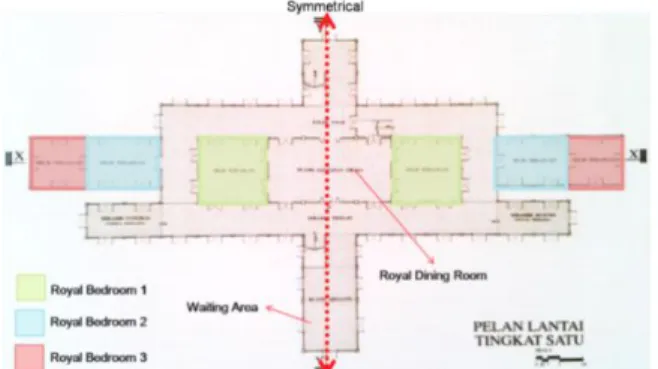
The spatial layout of Istana Lama Seri Menanti is vertically planned throughout the four storeys where the spaces are segregated according to functions. The ground floor of the palace is dedicated to the palace staff and is a public domain (Abdul Aziz, Remaz Ossen & Idid, 2010). The first floor of the palace is a semi-public area where royal functions such as Majlis Menghadap are held at the serambi where a special raised platform is built for the Yamtuan. The first floor is also a place for meeting delegates and making public summonses. The floor also includes four bedrooms and a dining/reception area for the royal families. The second floor of the palace is dedicated to only the royal families as three bedrooms are located on this floor. The third and fourth floor are private spaces for the Yamtuan and hold his room and a storage area on the highest floor for family heirlooms. Figure 6 below illustrates the vertical planning of Istana Lama Seri Menanti.
Figure 6 The Vertical Plan of Istana Lama Seri Menanti
Figure 7 Istana Lama Seri Menanti in Negeri Sembilan
FINDINGS
Findings of the research demonstrated that Istana Lama Seri Menanti was built with the skills and expertise of the local Tukang as vernacular architecture in Negeri Sembilan were commonly found to be more than one storey high. Hence, the construction of a vertical timber palace was plausible with their expertise and skills in Negeri Sembilan and not found elsewhere in Malaysia. Furthermore, Chinese contractors were hired to help with the construction. Thus some Chinese influences could be found in the design of the palace particularly some of the woodcarvings found on the beams of the palace. Figure 8 below illustrates the images of a mythical creature carved on the beams of the palace’s entrance.
Figure 8 Woodcarvings of Mythical Creatures on the Beams of the Palace
could be used in different functions and for different purposes according to the needs of the users. Hence, the segregation of spaces and dedicated rooms to specific activities is very Western-like and could prove the existence of British influences on the palace.
Figure 9 The First-Floor Plan Shows Symmetry and Balance
CONCLUSION
In conclusion, Istana Lama Seri Menanti which was constructed using only timber without the reinforcements of nails is a unique 20th century traditional Malay royal palace. While other timber palaces were built earlier in the 1800s, Istana Lama Seri Menanti was built as a permanent palace of residence for the royalties during which masonry palaces were already being built extensively around Malaysia.
The palace which was designed to be symmetrical throughout is another unique factor which separates it from other timber palaces in Malaysia. The verticality of the palace’s image provides a grandeur architecture which can be seen from afar and differentiates itself from any other traditional Malay royal palaces. More information is needed in determining the influences on the architecture of Istana Lama Seri Menanti. This research is still ongoing, and further findings will be developed into more discussions in the future.
ACKNOWLEDGEMENTS
This work was supported by MyBrain15 under the MyPhd scholarship given by the Ministry of Higher Education Malaysia (MoHE).
REFERENCES
Abdul Aziz, Z. A., Remaz Ossen, D., & Idid, S. Z. A. (2010). The Islamic Malay traditional towns: learning through the attributes - special emphasis on Johor Bahru, Malaysia. First International Conference on Urban & Architecture Heritage in Islamic Countries: It’s Role in Cultural & Economic Development.
Riyadh, Saudi Arabia.
Daud, N. I. M. K., Arbi, A., & Faisal, M. (2012). Pengaplikasian ukiran kayu melayu dalam seni bina di Malaysia. Journal of Design and Built Environment, 11, 1-14.
Fuh, K. C. et. al. (1993). Istana Seri Menanti. Measured Drawings. Skudai: Universiti Teknologi Malaysia.
Gibbs, P. (1987). Building a Malay house. Singapore: Oxford University Press.
Haja Bava Mohidin, H., Ismail, A. S., & Megat Abdullah, A. (2012). A Study of styles classification and influences on administration buildings in Malaysia (15th-21st Century). Seminar of International Convention: Bridging Between Old & New 2012. Johor Bahru, Malaysia.
Haja Bava Mohidin, H., Mohd Razif, F., & Kadikon, S. (2012). Pengaruh Islam dalam politik dan senibina pentadbiran pada Zaman Kesultanan Melayu Melaka.
Jurnal Teknologi, 58, 85-88.
Harun, N. Z., & Said, I. (2009). The changing roles of public spaces in Malaysia. National
Landscape Seminar 2009 (UMRAN09) - Healing the World, Gombak, Selangor.
Massart T., Meuter C., & Van Begin L. (2008). On the complexity of partial order trace model checking. Information Processing Letter, 106(3), 120-126.
Md. Nazuan, N. M. (2005). Istana Baroh, Negeri Sembilan. Measured drawings. Skudai: Universiti Teknologi Malaysia.
Megat Latif, H., & Abdullah, C. A. (2008). Islam dalam perlembagaan Malaysia: kewajarannya berdasarkan faktor Kesultanan Melayu. Journal of Ethics, Legal
and Governance (REKAYASA), 4, 1-12.
Muhammad, S. A. (2011). The relationship between the socio-culture of royalty and the architecture of Istana Sepahchendera. Warisan Nusantara dan Bicara Kraf
Warisan 2011. Sabah: Universiti Malaysia Sabah.
Noor, F. A., & Khoo, E. (2003). Spirit of wood: the art of Malay woodcarving. Singapore: Tuttle Publishing.
Raja Shahminan. R. N. (2010). Seri Yang Menanti. Retrieved Dec. 15, 2015 from http://nagariperpatih.blogspot.my/2010/02/seri-yang-menanti.html.
Saw, L. G. & Raja Barizan, R. S. (1991). Directory of plant genetic resources in Malaysia.
Research Pamphlet 109/1991, 1-161.