Aliso: A Journal of Systematic and Evolutionary Botany
Volume 12 | Issue 4
Article 4
1990
The Genera of Asteraceae Endemic to Mexico and
Adjacent Regions
Jose Luis Villaseñor
Rancho Santa Ana Botanic Garden
Follow this and additional works at:
http://scholarship.claremont.edu/aliso
Part of the
Botany Commons
Recommended Citation
Villaseñor, Jose Luis (1990) "The Genera of Asteraceae Endemic to Mexico and Adjacent Regions,"Aliso: A Journal of Systematic and
Evolutionary Botany: Vol. 12: Iss. 4, Article 4.
ALISO
\diagnostic
~tween the
J.
Arts Sci.rays in the
1 , 259 p.
nperforate
1origins in I ~ew York.
'tion. Bot.
i
Bot. Gaz.
elements
ALISO 12(4), 1990, pp. 685-692
THE GENERA OF ASTERACEAE ENDEMIC TO MEXICO AND ADJACENT REGIONS
JOSE LUIS VILLASENOR
Rancho Santa Ana Botanic Garden Claremont, California 91711
ABSTRACT
The flora of Mexico includes about 119 endemic or nearly endemic genera of Asteraceae. In this study, the genera are listed and their distribution patterns among the floristic provinces of Mexico analyzed. Results indicate strong affinities of the endemic genera for mountainous and arid or semiarid regions. Since its first appearance in Mexico, the Asteraceae diversified into these kinds of habitats, which were produced mostly by recurrent orogenic and climatic phenomena. The specialized tribes Heliantheae and Eupatorieae are richly represented, a fact that places Mexico as an important secondary center of diversification for the Asteraceae.
Key words: Asteraceae, Mexico, Southwestern United States, Guatemala, endemism, floristic analysis.
INTRODUCTION
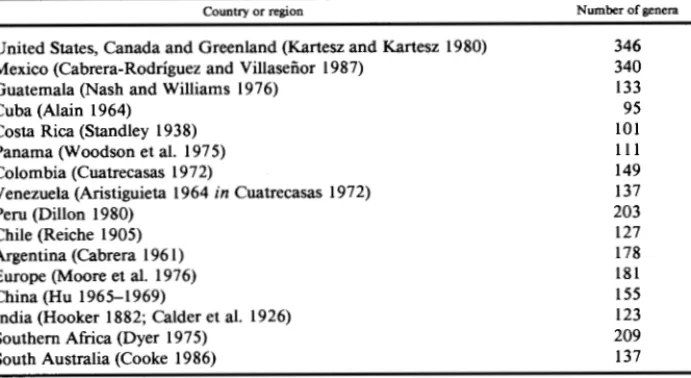
The Asteraceae contribute greatly to the floristic richness of Mexico. Of the estimated 30,000 species of vascular plants occurring in Mexico (Toledo 1988), perhaps more than 3000 belong to Asteraceae and more than 1300 of these are endemic. The generic diversity of Asteraceae in Mexico greatly exceeds that of most other areas of the world (Table 1). A concise summary of the Composite flora of Mexico at the generic level is available (Cabrera-Rodriguez and Villasenor 1987). However, the data presented there may change rather quickly during the oncoming years, due to further systematic work and discoveries in many yet unexplored areas of the country. The aim of this paper is to summarize what is known about the endemic genera of Asteraceae of Mexico with regard to their geographical distributions, and to present plausible explanations for the generic richness found in the region.
THE GENERA OF ASTERACEAE ENDEMIC AND NEARLY ENDEMIC TO MEXICO
't''
686
Table l. Genera of Asteraceae in the floras of several countries or regions.
Country or region
United States, Canada and Greenland (Kartesz and Kartesz 1980) Mexico (Cabrera-Rodriguez and Villasenor 1987)
Guatemala (Nash and Williams 1976) Cuba (Alain 1964)
Costa Rica (Standley 1938) Panama (Woodson et al. 197 5) Colombia (Cuatrecasas 1972)
Venezuela (Aristiguieta 1964 in Cuatrecasas 1972) Peru (Dillon 1980)
Chile (Reiche 1905) Argentina (Cabrera 1961) Europe (Moore et al. 1976) China (Hu 1965-1969)
India (Hooker 1882; Calder et al. 1926) Southern Africa (Dyer 1975)
South Australia (Cooke 1986)
ALISO
Number of genera
346 340 133
95
101 111 149 137 203 127 178 181
155
123 209 137
Guatemala, and their geographical correspondence beyond Mexico is imprecise, this paper also includes "nearly endemic" genera, those which occur in floristic provinces in Mexico as well as neighboring areas, but do not extend beyond.
Genera included in this paper as "near endemics" would be found at the limits of Rzedowski's floristic provinces. Most of these near-endemic genera occur in California, south ofthe Sierra Nevada and the Transverse ranges, in a region that closely approximates the geographic distribution of creosote bush (Larrea triden-tata (DC.) Coville). These near endemics also have a natural limit just south of
the Mogollon Escarpment in central Arizona and generally are not found north of Albuquerque, New Mexico, an area that is roughly defined by Socorro and Guadalupe Counties. In Texas, the near-endemic genera are usually restricted to the vegetational areas defined by Correll and Johnston (1970) as the Rio Grande Plains, Edwards Plateau, and Trans-Pecos; in Guatemala they generally are found in the mountain regions west of the Department of Huehuetenango. A "near endemic" must occur in Mexico to be included in this analysis; at least 31 genera of Asteraceae with limited distributions in the peripheral states fail to meet this condition.
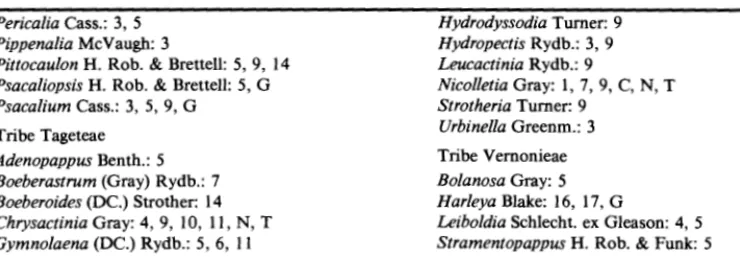
Recent estimates indicate the presence of about 340 genera of Asteraceae in Mexico (Cabrera-Rodriguez and Villasenor 1987). This figure varies from 330 to 370 depending on the use of narrower or broader taxonomic criteria. A narrower generic concept than that used previously (Cabrera-Rodriguez and Villasenor 1987) is followed in this paper. Accordingly, 78 endemic genera are recognized (Table 2), about one-fourth of the Composite genera in the flora. Inclusion of 41 near-endemic genera, which extend their geographic ranges slightly beyond Mex-ico, brings the total to 119 genera (Table 2), about one-third of the Composite genera in the flora.
Table 2 indicates the distribution patterns of endemic genera of Asteraceae in the 17 floristic provinces of Mexico proposed by Rzedowski (1978) and indicates which genera range farther into adjacent territories. Several regions are especially
VOL
\
Fig. I ofMexi• found w
indicate into thes
rich in-ranges • Madre Desert; and 5) togethe: and 33 ~
ALISO
1
fwnber
of genera346 340 133 95
101
Ill 149
137 203 127 178 181
!55 123
209
137
imprecise,
in floristic
A "near 31 genera meet this
VOLUME 12, NUMBER 4
~~ California (1/7)
Guadalupe Island (1/1) (not shown in the map)
0
Sierra Madre Occidental (6/30)lllilJ
Sierra Madre Oriental (4/13)[]} Meridional ranges (10/54)
miJl
Trans-Isthmic ranges (0/16)[!]
Baja California (6/13) ~ Northwestern coastal plain (1/7)Itt}
Mexican high plateau (10/48) \ I·~i
\
•·
i
f ·'
~ Northeastern coastal plain (1/6) ~~ Tehuacan-Cuicatlan Valley (1/8)
~ Pacific coast (2/8)
@]
Revillagigedo islands (0/1)0
Balsas basin (2/12) • Soconusco (SE Chiapas) (0/1)0
Gulf coast of Mexico (0/1)~ Yucatan peninsula (2/3)
687
Fig. I Rzedowski's floristic provinces ofMexico. Figures between parentheses indicate the number of Mexican-endemic genera of Asteraceae that are restricted to the province, followed by the total found within the province. Figures for Arizona, California, New Mexico, Texas, and Guatemala indicate the number of genera of Asteraceae nearly endemic to Mexico that have range extensions into these areas (redrawn from Rezdowski 1978).
Digitac-688 ALISO
Table 2. Genera of Asteraceae endemic to Mexico and adjacent regions and their distribution. 1
Tribe Astereae
Dichaetophora Gray: 9, T
Geissolepis B. L. Rob.: 9
Gymnosperma Less.: 9, 11, 14, A, N, T, G Olivaea Sch. Bip. ex Benth.: 3, 5, 9 Osbertia Greene: 4, 5, 6, G Stephanodoria Greene: 9
Xanthocephalum Willd.: 3, 5, 8, 9, A, T Tribe Eupatorieae
Ageratella Gray ex S. Wats.: 3, 5 Alomia Kunth: 5, 14
Amolinia King & H. Rob.: 6, G
Asanthus King & H. Rob.: 3, 9, A, N
Barroetea Gray: 5, 9, 11, 14 Carphochaete Gray: 5, 9, 14, A, N, T
Carterothamnus King: 7
Cronquistia King: 3 Decachaeta DC.: 3, 5, 12
Dyscritogyne King & H. Rob.: 5
Erythradenia (B. L. Rob.) King & H. Rob.: 5
Flyriella King & H. Rob.: 4, 9, 10, T
Jaliscoa S. Wats.: 3, 5, 12
Kyrsteniopsis King & H. Rob.: 5, 9
Malperia S. Wats.: 1, 7, C
Matudina King & H. Rob.: 12
Metastevia Grashoff: 5, 14
Mexianthus B. L. Rob.: 5, 12
Microspermum Lag.: 3, 5, 14
Neohintonia King & H. Rob.: 5
Oaxacania B. L. Rob.: 11
Phanerostylis (Gray) King & H. Rob.: 4, 5, 9
Piptothrix Gray: 3, 5, 6, G Piqueriopsis King: 5
Pseudokyrsteniopsis King & H. Rob.: 6, G
Revealia King & H. Rob.: 5
Sartorina King & H. Rob.: 5
Shinnersia King & H. Rob.: 9, T
Steviopsis King & H. Rob.: 5
Tamaulipa King & H. Rob.: 10
Trichocoronis Gray: 1, 5, 7, 9, 10, C, T
Viereckia King & H. Rob.: 4
Tribe Heliantheae
Achyropappus Kunth: 5, 9
Adenothamnus Keck: 1
Agiabampoa Rose ex Hoffm.: 8
Alvordia Brandeg.: 7
Amauria Benth.: 1, 7 Amblyolepis DC.: 9, T Arnicastrum Greenm.: 3, 5 Axiniphyllum Benth.: 3, 5 Baeriopsis Howell: 2 Bartlettia Gray: 9 Chromolepis Benth.: 3, 5 Clappia Gray: 9, 10, N, T
Coreocarpus Benth.: 3, 7, 8, 13, 14, A Correlia Powell: 3
Coulterella Vasey & Rose: 7
Damnxanthodium Strother: 3
Dicranocarpus Gray: 9, T
Dugesia Gray: 5, 9, 11
Dyscritothamnus B. L. Rob.: 9
Eryngiophyllum Greenm.: 12 Euphrosyne DC.: 5, 9 Eutetras Gray: 5, 9
Faxonia Brandeg.: 7
Goldmanella Greenm.: 17 Greenmaniella Sharp: 4
Guardiola Cerv. ex Humb. & Bonpl.: 3, 4, 5, 8,
9, 12, 14, A
Haploesthes Gray: 9, N, T
Henricksonia Turner: 9 Hybridella Cass.: 3, 5, 9
Hymenothrix Gray: 1, 3, 7, 8, 9, 14, C, A, N, T
Iostephane Benth.: 3, 5, 9
Loxothysanus B. L. Rob.: 4, 5, 6
Oteiza La Llave: 4, 5, 6, G Oxypappus Benth.: 3, 5, 12 Parthenice Gray: 7, 8, 9, A
Perymeniopsis H. Rob.: 4
Philactis Schrader: 5, 6, 12, 15, G Plagiolophus Greenm.: 17 Plateilema (Gray) Cockerell: 9
Plummera Gray: 9, A
Pseudoclappia Rydb.: 9, N
Rojasianthe Standi. & Steyerm.: 6, G
Sartwellia Gray: 9, N, T
Squamopappus Janzen et al.: 6, G
Stuessya Turner & Davies: 14
Tetrachyron Schlecht.: 4, 5, 6, 11, G
Trichocoryne Blake: 3
Trigonospermum Less.: 3, 5, 9, G
Varilla Gray: 9, 10, T
Venegasia DC.: 1, C
Vigethia Weber: 4
Tribe Inuleae
Gnaphaliothamnus Kirp.: 3, 5, 6, G
Pelucha S. Wats.: 7
Pseudognaphalium Kirp.: 5, 6, G Tribe Lactuceae
Marshalljohnstonia Henrickson: 9
Pinaropappus Less.: 3, 5, 8, 9, 11, A, N, T, G Tribe Liabeae
Liabellum Rydb.: 5, 9 Tribe Senecioneae Digitacalia Pippen: 5, 6
Nelsonianthus H. Rob. & Brettell: 6, G
Odontotrichum Zucc.: 3, 5, 6, 9, A
VOLL Tab_ Perical. Pip per! Pittoca. Psacalt. Psacali Tribe 1
Adena]:. Boeber. Boeber~ Chrysa. Gym
no-1 F1or
[1]; 3-: Trans-I= high pia. coast [8=
Gulf co~ [5];A-_
ALISO
fdistribution. 1
1
~4,A
. 3, 4, 5, 8,
C,A,N,T
G
N,T,G
G
VOLUME I2, NUMBER 4
Table 2. Continued.
Pericalia Cass.: 3, 5 Pippenalia McVaugh: 3
Pittocaulon H. Rob. & Brettell: 5, 9, 14
Psaca/iopsis H. Rob. & Brettell: 5, G
Psacalium Cass.: 3, 5, 9, G Tribe Tageteae
Adenopappus Benth.: 5 Boeberastrum (Gray) Rydb.: 7 Boeberoides (DC.) Strother: 14 Chrysactinia Gray: 4, 9, 10, II, N, T Gymnolaena (DC.) Rydb.: 5, 6, II
Hydrodyssodia Turner: 9 Hydropectis Rydb.: 3, 9 Leucactinia Rydb.: 9
Nicolletia Gray: I, 7, 9, C, N, T Strotheria Turner: 9
Urbinella Greenm.: 3 Tribe Vernonieae Bolanosa Gray: 5 HarleyaB!ake: 16, 17,G
Leiboldia Schlecht. ex Gleason: 4, 5 Stramentopappus H. Rob. & Funk: 5
689
1 Floristic provinces of Mexico [total genera per province]: !-California [7]; 2-Guadalupe island
[I]; 3-Sierra Madre Occidental [30); 4-Sierra Madre Oriental [13]; 5-Meridional ranges [54]; 6-Trans-Isthmic ranges [16]; 7-Baja California [13]; 8-Northwestern coastal plain [7]; 9-Mexican high plateau [48]; 10-Northeastern coastal plain [6]; 11-Tehuacan-Cuicatlan valley [8]; I2-Pacific coast [8]; 13-Revillagigedo islands [I]; I4-Balsas basin [I2]; I5-Soconusco (SE Chiapas) [I]; I6-Gulf coast [3]; I7- Yucatan peninsula [3]. Adjacent regions [total genera per region]: C-California [5); A-Arizona [II]; N-New Mexico [II]; T- Texas [I7]; G-Guatemala [17].
alia, Greenmaniella, Leiboldia, Loxothysanus, Microspermum, Pippenalia, and Piptothrix. The endemic genera found in semiarid and arid environments include Adenothamnus, Alvordia, Amauria, Chrysactinia, Dicranocarpus, Dugesia, Dys-critothamnus, Geissolepis, Gymnosperma, Haploesthes, Malperia, Marshalljohn-stonia, Nicolletia, Oaxacania, Sartwellia, Stephanodoria, Varilla, and Venegasia.
About a third of the endemic genera show a broader pattern of distribution, and are found on both montane and semiarid to arid environments.
GEOHISTORICAL SCENARIO
Of great importance in understanding current distribution patterns of Asteraceae in Mexico are the geohistorical events that have occurred since the Cretaceous. At the end of the Paleozoic, the Mexican region experienced extensive tectonic activity (De Cserna 1974), cresting uplifts that provided the varied habitats where the rich Mexican flora evolved.
The Sierra Madre Oriental in eastern Mexico was uplifted at the end of the Cretaceous and the beginning of the Tertiary (Guzman and De Csema 1963; Maldonado-Koerdel11964; De Csema 1974). By the Middle Tertiary, the Sierra Madre del Sur of southern Mexico was formed. At the end of the Oligocene and during the Miocene, the Sierra Madre Occidental was uplifted in northwestern Mexico. At the end of the Miocene the Gulf of California was formed, thus separating the peninsula of Baja California from the mainland. Finally, the phys-iography of Mexico reached its present condition in the Pliocene with the ap-pearance of the Eje Volcani co Transversal in central Mexico and with the elevation of the Yucatan peninsula.
690 ALISO
family was present by the Middle Miocene in southern California as a member of the Madro-Tertiary Geoflora (Axelrod 1958). Orogenesis had taken place in both eastern and western Mexico by this time, as well as in southern Mexico. Continuing volcanic activity may have been an important isolating factor in the evolution of the family, fragmenting populations and producing many of the apparent vicariant taxa ofthe Mexican flora (Ramamoorthy and Lorence 1987). In the Asteraceae, some of the vicariant genera are Agiabampoa and Alvordia; Hofmeisteria Walp, Carterothamnus, and Oaxacania; and Arnicastrum, James-ianthus Blake & Sherif, and Arnica L. The last two genera are found only in North America.
Paleoclimatic data (Dorf 1960) suggest for the Upper Miocene a prevailing warm climate in Mexico; lowlands were dominated mainly by tropical or sub-tropical vegetation. Asteraceae are not richly represented in modem sub-tropical for-ests (Rzedowski 1972); however, temperate forfor-ests of fir and oak are documented for middle and higher elevations (Graham 1976). And a semiarid climate was already present in northwestern Mexico, where a distinctive, mostly microphyllous or sclerophyllous flora developed (Axelrod 1958). Temperate forests and semiarid or arid lands are at present, and presumably also in the past, among the most favored plant communities for members of Asteraceae (Rzedowski 1972).
The Asteraceae therefore found, after their arrival in Mexico, two oftheir most favored environments. Vulcanism cleared many areas, making them suitable for aggressive invaders by producing an innumerable array of microhabitats where a rich generic flora could evolve. It formed, with the elevation of mountain ranges, the many endorheic basins (basins with only interior drainage,) found mainly in northern Mexico, which are host to a great number of endemics. One example is the Bolson de Cuatro Cienegas Region in Coahuila, an area floristically studied by Pinkava (1979-1981).
Glacial events in the Quaternary allowed boreal forests to achieve a broader distribution. The desert conditions that developed during the Quaternary, as in, for example, the Chihuahuan Desert (Wells 1974) or the Tehuacan-Cuicatlan Valley (Brunet 1967), confirm again the presence in recent epochs of habitats especially suitable for the diversification of the Asteraceae. According to Brunet (1967), the Tehuacan-Cuicatlan Valley floristic province did not form until the Quaternary, when the erosion and rupture of the Sierra Madre Oriental (caused by the Rio Santo Domingo, a tributary of the Rio Papaloapan) drained a former lake. This lake had occupied what is now most of the floristic province. The eventual drainage of the lake was caused by subsidence of the underground water reservoirs. The rain shadow caused by the Sierra Madre Oriental aided this pro-cess. Floristically, the province harbors at least 238 species of Asteraceae (Villa-senor 1982), approximately 29% ofwhich are endemic to the province. The high percentage of endemism shown in this area exemplifies the great capability of the Asteraceae to thrive and diversify explosively when suitable environments are available.
The large number of genera belonging to the tribes Heliantheae and Eupatorieae suggests that, if not the center of origin for the Asteraceae, Mexico played a very significant role in the explosive evolution of the family, as a most important secondary center of diversification.
V•
a• sc
A:
A:
Br Cc
Ca
Ca
Ca
Co
ClL
De
Dil
Do_ Dyo
Grc
Gu;;
Hoc
Hu,
Kar
Maj.
Malo
Moa
AUSO
'a member
E
tor in the~~~c:.
any of the~nee 1987).
~ Alvordia; ~m, James-tlyin North
VOLUME 12, NUMBER 4 691
ACKNOWLEDGMENTS
I thank T. Barkley, T. Elias, L. Lenz, A. Liston, R. Thome, S. Zona, and an anonymous reviewer for their helpful comments on earlier versions of this manu-script.
UTERATURE CITED
Alain, Hermano (E. E. Loigier). 1964. Aora de Cuba. Torno V. Publicacion de Ia Asociacion de Estudiantes de Ciencias Biologicas. La Habana, pp. 175-362.
Axelrod, D. I. 1958. Evolution of the Madro-Tertiary Geoflora. Bot. Rev. 24:433-509.
Brunet, J. 1967. Geologic studies, pp. 66-90. In D. S. Byers [ed.], The prehistory of the Tehuacan Valley. Vol. I. Environment and subsistence. Univ. of Texas Press, Austin, Tex.
Cabrera, A. L. 1961. Compuestas Argentinas. Clave para Ia determinacion de los generos. Rev. Mus. Arg. Ci. Nat. "Bernardino Rivadavia" 2:291-362.
Cabrera-Rodriguez, L., and J. L. Villasenor. 1987. Revision bibliografica sobre el conocimiento de Ia familia Compositae en Mexico. Biotica 12:131-147.
Calder, C. C., V. Narayanaswami, and M.S. Ramaswami. 1926. List of species and genera oflndian phanerogams not included in Sir J. D. Hooker's Aora of British India. Records of the Botanical Survey oflndia II:I-157.
Cooke, D. A. 1986. Compositae (Asteraceae), pp. 1423-1658. In J.P. Jessop and H. R. Toelken [eds.], Aora of South Australia. Part III. South Australian Government Printing Division, Adelaide.
Correll, D. S., and M. C. Johnston. 1970. Manual of the vascular plants of Texas. Texas Research Foundation, Renner, Tex. 1881 p.
Cuatrecasas, J. 1972. Algo sobre Compositae en Ia flora de Colombia. I Congreso Latinoamericano y V Mexicano de Botanica. Memorias de Symposia, pp. 157-166.
De Cserna, Z. 1974. La evolucion geologica del panorama fisiografico actual de Mexico, pp. 21-56. In EI escenario geografico. Introduccion eco16gica (primera parte). I.N.A.H. Departamento de Prehistoria. Mexico, D.F.
Dillon, M. 0. 1980. Family Compositae: Part I. Introduction to family, pp. 12-21. In J. F. MacBride and collaborators, Aora of Peru. Fieldiana, Bot. New Series. No.5. Pub!. No. 1314. Dorf, E. 1960. Climatic changes of the past and present. Amer. Sci. 48:341-364.
Dyer, R. A. 1975. The genera of Southern African flowering plants. Vol. I. Dicotyledons. Department of Agricultural Technical Services, Republic of South Africa, Pretoria. 756 p.
Graham, A. 1976. Studies in Neotropical paleobotany. II. The Miocene communities of Veracruz, Mexico. Ann. Missouri Bot. Gard. 63:787-842.
Guzman, E. J., and Z. De Cserna. 1963. Tectonic history of Mexico, pp. 113-129. In The backbone of the Americas. Tectonic history from Pole to Pole. A symposium. Memoir No. 2. The Amer. Assoc. of Petroleum Geologists.
Hooker, J.D. 1882. The flora of British India. Vol. III. L. Reeve & Co., Ashford, Kent, pp. 219-419.
Hu, S. 1965-1969. The Compositae of China. Quart. J. Taiwan Mus. 18:1-136, 233-333; 19:1-73, 203-301; 20:1-77, 283-339; 21:1-52, 127-179; 22:1-56.
Kartesz, J. T., and R. Kartesz. 1980. A synonymized checklist of the vascular flora of the United States, Canada, and Greenland. The biota of North America. Vol. II. The Univ. of North Carolina Press, Chapel Hill. 500 p.
Major, J. 1988. Endemism: a botanical perspective, pp. 117-146. In A. A. Myers and P. S. Giller [eds.], Analytical biogeography. Chapman and Hall, New York.
Maldonado-Koerdell, M. 1964. Geohistory and paleogeography of Middle America, pp. 3-32. In R. C. West [ed.], Natural environment and early cultures. Univ. of Texas Press, Austin, Tex. Vol. I.
Moore, D. M., T. G. Tutin, and S. M. Walters [eds.]. 1976. Compositae, pp. 103-410. In Aora Europaea. Vol. IV. Cambridge Univ. Press, London.
692 ALISO
Nash, D. L., and L. 0. Williams. 1976. Compositae. In flora of Guatemala. Fieldiana, Bot. 24(Part XII):l-603.
Pinkava, D. J. 1979-1981. Vegetation and flora of the Bolson ofCuatro Cienegas region, Coahuila, Mexico. Parts 1-111. Bol. Soc. Bot. Mexico 38:35-74; 39:107-127; 41:127-151.
Ramamoorthy, T. P., and D. H. Lorence. 1987. Species vicariance in the Mexican flora and de-scription of a new species of Salvia (Lamiaceae). Bull. Mus. Hist. Nat. (Paris), Series IV, 9: 167-175.
Raven, P. H., and D. I. Axelrod. 1974. Angiosperm biogeography and past continental movements. Ann. Missouri Bot. Gard. 61:539-673.
Reiche, C. 1905. La distribuci6n geografica de las Compuestas de la flora de Chile. Anales Mus. Nac. Chile, Segunda Secci6n, Botanica. Entrega No. 17. 45 p.
Rzedowski, J. 1972. Contribuciones ala fitogeografia floristica e hist6rica de Mexico. III. Algunas tendencias en la distribuci6n geogra!ica de las Compositae Mexicanas. Ciencia (Mexico) 27:
123-132.
- - - . 1978. Vegetaci6n de Mexico. Ed. Limusa, Mexico. 432 p.
Standley, P. C. 1938. flora of Costa Rica. Publ. Field Mus. Nat. Hist., Bot. Ser. 18:1418-1538. Toledo, V. M. 1988. La diversidad biol6gica de Mexico. Ciencia y Desarrollo (Mexico) 81:17-30. Villasenor, J. L. 1982. Las Compositae del Valle de Tehuacan-Cuicatlan. flora generica. Bachelor's
Thesis. U.N.A.M. Fac. de Ciencias. Mexico, D.F. 174 p.
Wells, P. V. 1974. Post-glacial origin of the present Chihuahuan Desert less than 11,500 years ago, pp. 67-83. In R. H. Wauer and D. H. Riskind [eds.], Transactions of the symposium on the biological resourccts of the Chihuahuan Desert region, United States and Mexico. Sui Ross State Univ., Alpine, Tex.
Woodson, R. E., R. W. Schery, and collaborators. 1975. Compositae. In flora of Panama. Part IX. Ann. Missouri Bot. Gard. 62:835-1322.
Me.
Califc inflor besce: appar conflL Keyvo
In disco Cour: popu_ of th au the Serpe popul appe~::
ultrar
Mona