Generating an Automated Test Suite
by Variable Strength Combinatorial
Testing for Web Services
Yin Li, Zhi-an Sun and Jian-Yong Fang
Jiangsu Institute of Automation, Lianyungang, ChinaTesting Web Services has become the spotlight of software engineering as an important means to as-sure the quality of Web application. Due to lacking of graphic interface and source code, Web services need an automated testing method, which is an important part in efficiently designing and generating test suite. However, the existing testing methods may lead to the redundancy of test suite and the decrease of fault-de-tecting ability since it cannot handle scenarios where the strengths of the different interactions are not uni-form. With the purpose of solving this problem, firstly the formal tree model based on WSDL is constructed and the actual interaction relationship of each node is made sufficient consideration into, then the combina-torial testing is proposed to generate variable strength combinatorial test suite based on One-test-at-a-time strategy. At last test cases are minimized according to constraint rules. The results show that compared with conventional random testing, the proposed approach can detect more errors with the same amount of test cases which turning out to be more ideal than existing ones in size.
ACM CCS (2012) Classification: Software and its en-gineering → Software creation and management → Software verification and validation → Software de-fect analysis → Software testing and debugging Keywords: testing Web Services, automated testing, combinatorial testing, WSDL, constraint rules
1. Introduction
As a type of implementation technologies for Service-Oriented Architecture (SOA), Web Ser-vices (WS) have provided an interoperability distributed application platform using the stan-dard Web protocol, to implement the features such as open standard-based platform, loosely coupled platform and cross-platform. With the
popularity of this technology, the requirement of quality and correctness is more and more crit-ical, however, guaranteeing the Web Services software quality and reliability has become a tough issue in software engineering field.
Software testing is an important means of en-suring software quality. However, in order to guarantee the quality of Web Services, it must be tested in detail. Because of the complexity of Web Services technology specification, the variability of running state, if different ser-vices are tested one by one with similar func-tions, this work would be very repetitive and easily lead to human errors. Meanwhile, Web Services are invoked via service interface and not equipped with a visual graphic user inter-face which makes manual testing more diffi-cult. Therefore, traditional test cases approach by handwork will not meet the requirement of testing, in order to test it in detail, the automatic approach is needed.
Therefore this study aims to propose an auto-matic test data generating approach based on combinatorial testing and data constraints rules in order to obtain optimal test cases for a single operation of Web Service. As Figure 1 shows, in the overall approach, firstly, a formal type model for XML schema is constructed by in-put/output elements of the single operation in WSDL file. Secondly, test suite is obtained on the basis of the model built by previous step, then the test data is optimized by the means of combinatorial testing, and finally the statements or paths for Web Services could be covered by the optimal test cases.
This paper is organized as follows. In addi-tion to Secaddi-tion 1 menaddi-tioned above, Secaddi-tion 2 presents the background and related works in the area of testing Web Services automatically. Section 3 demonstrates models and their defi-nitions. Section 4 studies the generation of test data based on the model. Section 5 shows how to obtain the optimal test cases. An application example and conclusion are presented in Sec-tion 6 and SecSec-tion 7 separately.
2. Background and Related Works
Service-Oriented Architecture (SOA) is not a new concept which has got wide attentions and applications in the recent years. As one of the implemented technologies for this architecture, automatic test for Web Services has become an important research in software testing area [1], [2]. Some researchers divide Web Services into stateless and stateful services and then separate them into three levels, namely, testing the sin-gle operation of Web Services, the operations sequence of Web Services and composite Web Services [2]-[5].
As the development of Web Services testing, some approaches have been proposed to gen-erate test cases for single operation of Web Services through WSDL-based files. Tsai et al. [6] showed an approach by extending WSDL in order to support testing Web Services that incorporates with sequence specifications as well as input-output dependencies. Bai et al. [7] proposed an approach to generate test cases for Web Services from WSDL, which consisted
methods, some limitations still exist in this re-search area. On the basis of paper [6]-[9], our study hereby constructs a formal model of the type tree by analyzing the WSDL document and taking full account of the actual interactions be-tween factors. From a new perspective of test-ing, this paper provides a concept of test suite reduction combing variable strength combina-torial testing and data constraints model, which ultimately could reduce test cost and improve test efficiency.
3. Model and Definition
3.1. WSDL Language
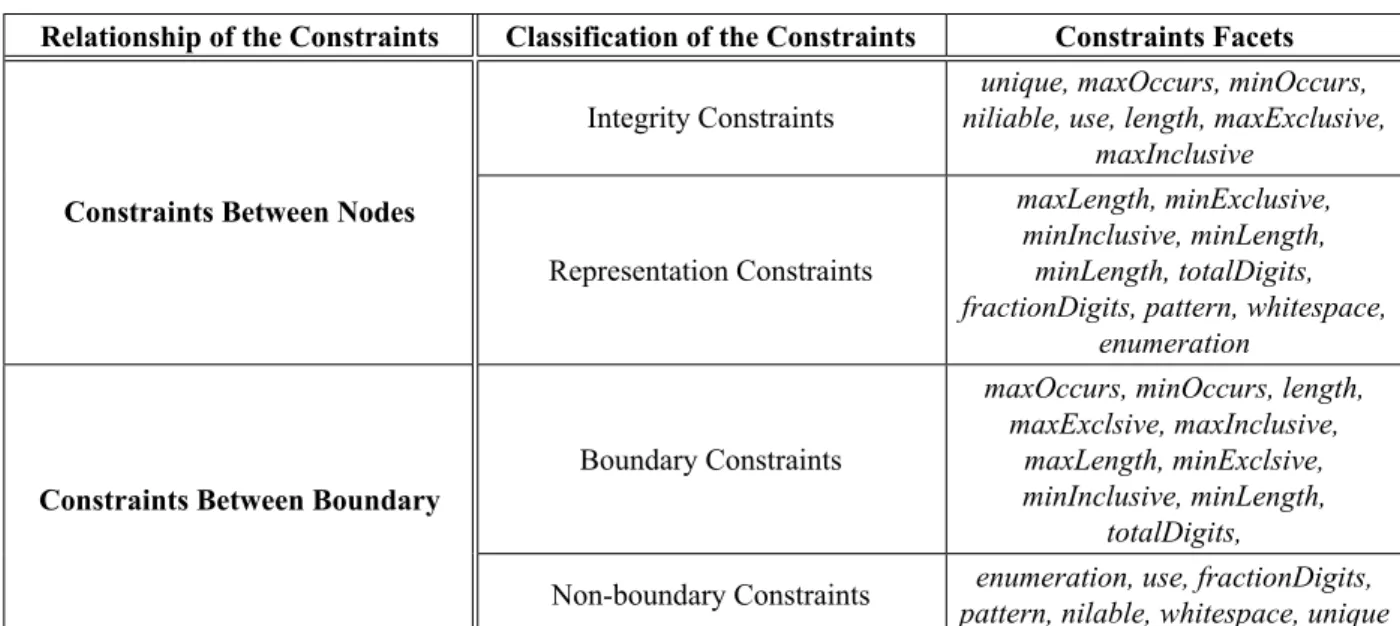
Web Services Description Language (WSDL) is an XML-based language which used to describe the location of the service, operations, methods and service information involved in it. Tsai [6] presented an extension to WSDL, added the constraint conditions, involved constraint infor-mation and semantic inforinfor-mation. The extended WSDL files include built-in data types, simple data types and complex data types. Simple data types are defined with the element <xs:sim-pleType> which has representation constraints with built-in data types. Complex data types are defined with the element <xs:complexType> which has integrity constraints with the sub-ele-ment. There are three indication relationships among the sub-elements, such as Sequence, Choice and All. Sequence means that sub-ele-ments may appear in the same order as they are defined in the schema file. Choice means that only one of sub-elements must appear (similar as enumeration). All means that sub-elements may appear in any order while the constraining facets maxOccurs cannot be greater than 1 [19]. According to the relationships between pairs of nodes and between nodes and data types, XML Schema classifies constraints as integrity con-straints and representation concon-straints, these constraints can be classified as boundary con-straints and non-boundary concon-straints as well, the detailed classification of these elements is shown in Table 1.
of test data generation, test operation genera-tion, operation flow generation and test spec-ification. [8] firstly proposed the concept to construct abstract model through WSDL doc-ument. Subsequently, [9] presented the formal type tree on the basis of his work, they consid-ered the data structure of complex data types, combined the sub-elements in complex data types and finally generated test data based on this model. Due to lack of consideration on test cases reduction in generation phase, test data tends to result in a combinatorial explo-sion by Cartesian method, it is not conductive to carry out large-scale testing. Moreover, some researchers proposed mutation testing technol-ogy [10]-[13], Xu and Offutt used data pertur-bation based on XML data type to generate test data for Web services. Siblini and Mansour [12] realized the testing for Web Services by docu-ment mutation. In China, Jiang [13] proposed the generation method of Web Services testing data based on contract mutation which can au-tomatically generate initial random test data via using WSDL documents and select test data on the basis of contract mutation. While mutation testing needs a lot of computer resource, and the quality of test cases depends on the mer-its of the mutation operator, it is not a regular means of Web Services testing.
In combinatorial testing area, after analyzing the fault-reporting record of Moliza browser, Kuhn and Reilly [14] found there were more than 70% of the errors caused by the interac-tion of the two parameters and over 90% of the errors caused by the interaction of three pa-rameters. Furthermore, Kuhn and Wallace [15] studied the availability of combinatorial testing applied into large-scale distributed systems and found that failures triggered in such system were generally cased by 4-6 interaction param-eters at most. Schroeder [16] demonstrated that the error detection ability of N-dimensional combinatorial testing is much higher than the same size of random testing. Currently, combi-natorial testing is widely used in compatibility testing, GUI testing and Web application test-ing [17], [18].
Therefore this study aims to propose an auto-matic test data generating approach based on combinatorial testing and data constraints rules in order to obtain optimal test cases for a single operation of Web Service. As Figure 1 shows, in the overall approach, firstly, a formal type model for XML schema is constructed by in-put/output elements of the single operation in WSDL file. Secondly, test suite is obtained on the basis of the model built by previous step, then the test data is optimized by the means of combinatorial testing, and finally the statements or paths for Web Services could be covered by the optimal test cases.
This paper is organized as follows. In addi-tion to Secaddi-tion 1 menaddi-tioned above, Secaddi-tion 2 presents the background and related works in the area of testing Web Services automatically. Section 3 demonstrates models and their defi-nitions. Section 4 studies the generation of test data based on the model. Section 5 shows how to obtain the optimal test cases. An application example and conclusion are presented in Sec-tion 6 and SecSec-tion 7 separately.
2. Background and Related Works
Service-Oriented Architecture (SOA) is not a new concept which has got wide attentions and applications in the recent years. As one of the implemented technologies for this architecture, automatic test for Web Services has become an important research in software testing area [1], [2]. Some researchers divide Web Services into stateless and stateful services and then separate them into three levels, namely, testing the sin-gle operation of Web Services, the operations sequence of Web Services and composite Web Services [2]-[5].
As the development of Web Services testing, some approaches have been proposed to gen-erate test cases for single operation of Web Services through WSDL-based files. Tsai et al. [6] showed an approach by extending WSDL in order to support testing Web Services that incorporates with sequence specifications as well as input-output dependencies. Bai et al. [7] proposed an approach to generate test cases for Web Services from WSDL, which consisted
methods, some limitations still exist in this re-search area. On the basis of paper [6]-[9], our study hereby constructs a formal model of the type tree by analyzing the WSDL document and taking full account of the actual interactions be-tween factors. From a new perspective of test-ing, this paper provides a concept of test suite reduction combing variable strength combina-torial testing and data constraints model, which ultimately could reduce test cost and improve test efficiency.
3. Model and Definition
3.1. WSDL Language
Web Services Description Language (WSDL) is an XML-based language which used to describe the location of the service, operations, methods and service information involved in it. Tsai [6] presented an extension to WSDL, added the constraint conditions, involved constraint infor-mation and semantic inforinfor-mation. The extended WSDL files include built-in data types, simple data types and complex data types. Simple data types are defined with the element <xs:sim-pleType> which has representation constraints with built-in data types. Complex data types are defined with the element <xs:complexType> which has integrity constraints with the sub-ele-ment. There are three indication relationships among the sub-elements, such as Sequence, Choice and All. Sequence means that sub-ele-ments may appear in the same order as they are defined in the schema file. Choice means that only one of sub-elements must appear (similar as enumeration). All means that sub-elements may appear in any order while the constraining facets maxOccurs cannot be greater than 1 [19]. According to the relationships between pairs of nodes and between nodes and data types, XML Schema classifies constraints as integrity con-straints and representation concon-straints, these constraints can be classified as boundary con-straints and non-boundary concon-straints as well, the detailed classification of these elements is shown in Table 1.
of test data generation, test operation genera-tion, operation flow generation and test spec-ification. [8] firstly proposed the concept to construct abstract model through WSDL doc-ument. Subsequently, [9] presented the formal type tree on the basis of his work, they consid-ered the data structure of complex data types, combined the sub-elements in complex data types and finally generated test data based on this model. Due to lack of consideration on test cases reduction in generation phase, test data tends to result in a combinatorial explo-sion by Cartesian method, it is not conductive to carry out large-scale testing. Moreover, some researchers proposed mutation testing technol-ogy [10]-[13], Xu and Offutt used data pertur-bation based on XML data type to generate test data for Web services. Siblini and Mansour [12] realized the testing for Web Services by docu-ment mutation. In China, Jiang [13] proposed the generation method of Web Services testing data based on contract mutation which can au-tomatically generate initial random test data via using WSDL documents and select test data on the basis of contract mutation. While mutation testing needs a lot of computer resource, and the quality of test cases depends on the mer-its of the mutation operator, it is not a regular means of Web Services testing.
In combinatorial testing area, after analyzing the fault-reporting record of Moliza browser, Kuhn and Reilly [14] found there were more than 70% of the errors caused by the interac-tion of the two parameters and over 90% of the errors caused by the interaction of three pa-rameters. Furthermore, Kuhn and Wallace [15] studied the availability of combinatorial testing applied into large-scale distributed systems and found that failures triggered in such system were generally cased by 4-6 interaction param-eters at most. Schroeder [16] demonstrated that the error detection ability of N-dimensional combinatorial testing is much higher than the same size of random testing. Currently, combi-natorial testing is widely used in compatibility testing, GUI testing and Web application test-ing [17], [18].
3.2. A Formal Model of Type Tree
This paper focuses on the test data generation for a single operation of Web Service and then defines the formal model of type tree based on the model proposed in Ma et al. [9] research as shown in Figure 2. However, the model can de-scribe all the data input elements in the single operation of Web Service completely.
A formal model of type tree can be defined as follows:
Definition 1. An input element type model of the operation can be modeled as a formal tree set T (N, S, B, nr, IC, RC, EE, ED), where:
N is a finite set of all the sub-elements in the complex data types; S is a finite set of simple data types nodes in the input element type def-inition; B is a set of built-in data type nodes in input element type definition; nr is a set of root nodes; IC is a finite set of constraints between complex data type and its root nodes and be-tween complex data type and its sub-elements,
namely integrity constraints defined in WSDL file. RC is a finite set of facet constraints be-tween simple data type and built-in data type, namely representation constraints defined in WSDL file; EE is a finite set of edges: ∀ e ∈
EE, denoted as e (p, x, c), p ∈ N ∪ nr, c ∈ N, x ∈ IC ∪ {∅}; ED is a finite set of edges: ∀ e ∈
ED, denoted as e (p, x, c), p ∈ N ∪ S, c ∈ B, x
∈ RC ∪ {∅}.
According to the definition of model T in Defi-nition 1, the construct algorithm is presented as follows:
3.3. Variable Strength Combinatorial Model
According to the papers [20]-[22], combinato-rial testing model is defined as follows:
Let the software under testing (SUT) have n
parameters, and each factor fi has ai(1 ≤ i ≤ n) discrete values. Let F = {f1, f2, ..., fn} denote the set of factors, and Vi = {1, 2, ..., ai } (1 ≤ i ≤ n) denote the value set of factor fi.
Definition 2. Combinatorial testing test case set Let n-tuple
test = (v1, v2, ..., vn) (v1∈ V1, v2∈ V2, ..., vn ∈ Vn)
Algorithm 1. Obtaining formal model of type tree T.
Input: WSDL document
Output: A type tree formal model of a single operation in WSDL:
T (N, S, B, nr, IC, RC, EE, ED)
Initial:
N =∅, S = ∅, B = ∅,nr = ∅, IC = ∅, RC = ∅, EE = ∅, ED = ∅
// Initialize all data type sets in T model nr∪ {n};
// Get new data type node n by analyzing the WSDL document Generate_T(n); // Generate data type model of Node n
Generate_T(n): // The algorithm of construct data type model of node n
Switch (n)
Case Complex data type: // if n is Complex data type
N = N ∪ {m}, EE = EE ∪ {e}, n = m;
// m is one of the key words, such as sequence, choice, all, generate edge e (n, x, m), x = ∅, take new node m as parent node
For each SubElement in n
N = N ∪ {m}, EE = EE ∪ {e}, IC = IC ∪ {x}, n = m;
// Generate edge e (n, x, m) and restriction facet set IC, take new node m as parent node Generate_T(SubElement) // iteration traversal every sub-element
Case Simple data type: // n is simple data type If (n has restriction constraints)
// whether simple data type n contains restriction constraints {
S = S ∪ {n}, ED = ED ∪ {e}, RC = RC ∪ {x}, n = m;
// m is the next node of n, and the built-in data type. This algorithm generates edge e (n, x, m) and user defined restriction constraints set RC as well as take new node m as parent node
} else {
B = B ∪ {m}, ED = ED ∪ {e}, RC = RC ∪ {x};
// m is the next node of n, is built-in data type, algorithm generates edge e (n, x, m) and default restriction constraints set RC
}
Case built-in data type: // n is built-in data type B = B ∪ {m}, ED = ED ∪ {e}, RC = RC ∪ {x};
// m is the next node of n, and is built-in data type, algorithm generates edge e (n, x, m) and default restriction constraints set RC
End for;
Output the T model of single operation
Table 1. Data Constraints Relationship.
Relationship of the Constraints Classification of the Constraints Constraints Facets
Constraints Between Nodes
Integrity Constraints niliable, use, length, maxExclusive, unique, maxOccurs, minOccurs, maxInclusive
Representation Constraints
maxLength, minExclusive, minInclusive, minLength,
minLength, totalDigits, fractionDigits, pattern, whitespace,
enumeration
Constraints Between Boundary Boundary Constraints
maxOccurs, minOccurs, length, maxExclsive, maxInclusive,
maxLength, minExclsive, minInclusive, minLength,
totalDigits,
Non-boundary Constraints pattern, nilable, whitespace, uniqueenumeration, use, fractionDigits,
3.2. A Formal Model of Type Tree
This paper focuses on the test data generation for a single operation of Web Service and then defines the formal model of type tree based on the model proposed in Ma et al. [9] research as shown in Figure 2. However, the model can de-scribe all the data input elements in the single operation of Web Service completely.
A formal model of type tree can be defined as follows:
Definition 1. An input element type model of the operation can be modeled as a formal tree set T (N, S, B, nr, IC, RC, EE, ED), where:
N is a finite set of all the sub-elements in the complex data types; S is a finite set of simple data types nodes in the input element type def-inition; B is a set of built-in data type nodes in input element type definition; nr is a set of root nodes; IC is a finite set of constraints between complex data type and its root nodes and be-tween complex data type and its sub-elements,
namely integrity constraints defined in WSDL file. RC is a finite set of facet constraints be-tween simple data type and built-in data type, namely representation constraints defined in WSDL file; EE is a finite set of edges: ∀ e ∈
EE, denoted as e (p, x, c), p ∈ N ∪ nr, c ∈ N, x ∈ IC ∪ {∅}; ED is a finite set of edges: ∀ e ∈
ED, denoted as e (p, x, c), p ∈ N ∪ S, c ∈ B, x
∈ RC ∪ {∅}.
According to the definition of model T in Defi-nition 1, the construct algorithm is presented as follows:
3.3. Variable Strength Combinatorial Model
According to the papers [20]-[22], combinato-rial testing model is defined as follows:
Let the software under testing (SUT) have n
parameters, and each factor fi has ai(1 ≤ i ≤ n) discrete values. Let F = {f1, f2, ..., fn} denote the set of factors, and Vi = {1, 2, ..., ai } (1 ≤ i ≤ n) denote the value set of factor fi.
Definition 2. Combinatorial testing test case set Let n-tuple
test = (v1, v2, ..., vn) (v1∈ V1, v2∈ V2, ..., vn ∈ Vn)
Algorithm 1. Obtaining formal model of type tree T.
Input: WSDL document
Output: A type tree formal model of a single operation in WSDL:
T (N, S, B, nr, IC, RC, EE, ED)
Initial:
N =∅, S = ∅, B = ∅,nr = ∅, IC = ∅, RC = ∅, EE = ∅, ED = ∅
// Initialize all data type sets in T model nr∪ {n};
// Get new data type node n by analyzing the WSDL document Generate_T(n); // Generate data type model of Node n
Generate_T(n): // The algorithm of construct data type model of node n
Switch (n)
Case Complex data type: // if n is Complex data type
N = N ∪ {m}, EE = EE ∪ {e}, n = m;
// m is one of the key words, such as sequence, choice, all, generate edge e (n, x, m), x = ∅, take new node m as parent node
For each SubElement in n
N = N ∪ {m}, EE = EE ∪ {e}, IC = IC ∪ {x}, n = m;
// Generate edge e (n, x, m) and restriction facet set IC, take new node m as parent node Generate_T(SubElement) // iteration traversal every sub-element
Case Simple data type: // n is simple data type If (n has restriction constraints)
// whether simple data type n contains restriction constraints {
S = S ∪ {n}, ED = ED ∪ {e}, RC = RC ∪ {x}, n = m;
// m is the next node of n, and the built-in data type. This algorithm generates edge e (n, x, m) and user defined restriction constraints set RC as well as take new node m as parent node
} else {
B = B ∪ {m}, ED = ED ∪ {e}, RC = RC ∪ {x};
// m is the next node of n, is built-in data type, algorithm generates edge e (n, x, m) and default restriction constraints set RC
}
Case built-in data type: // n is built-in data type B = B ∪ {m}, ED = ED ∪ {e}, RC = RC ∪ {x};
// m is the next node of n, and is built-in data type, algorithm generates edge e (n, x, m) and default restriction constraints set RC
End for;
Output the T model of single operation
Table 1. Data Constraints Relationship.
Relationship of the Constraints Classification of the Constraints Constraints Facets
Constraints Between Nodes
Integrity Constraints niliable, use, length, maxExclusive, unique, maxOccurs, minOccurs, maxInclusive
Representation Constraints
maxLength, minExclusive, minInclusive, minLength,
minLength, totalDigits, fractionDigits, pattern, whitespace,
enumeration
Constraints Between Boundary Boundary Constraints
maxOccurs, minOccurs, length, maxExclsive, maxInclusive,
maxLength, minExclsive, minInclusive, minLength,
totalDigits,
Non-boundary Constraints pattern, nilable, whitespace, uniqueenumeration, use, fractionDigits,
call a test case for SUT, and the set consists of these test cases called test case set for SUT. Definition 3. N dimensional combinatorial coverage
Given A = (ai,j)m×n is m × n array, where jth col-umn denotes the factor fi of SUT and all ele-ments of this column come from the finite set
Vi = {1, 2, ..., n}, that is ai,j ∈ Vj. If every
m ∙ n (2 ≤ N ≤ n) sub-arrays contain all value combinations of such N columns (or factors), then A is an N-way fixed strength covering array or a fixed strength covering array with strength N, and it could be denoted as CA (m : N : F).
Definition 4. Interaction relation set
A subset rk∈ R (k = 1, 2, ..., t) could be named as interaction coverage requirement, or cover-age requirement for short. And the collection R
could be named as the interaction relationship of SUT.
Given A = (ai,j)m×n is m × n array, where jth col-umn denotes the factor fi of SUT and all ele-ments of this column come from the finite set
Vi = {1, 2, ..., n}, that is ai,j ∈ Vj. For a coverage requirement rk∈ R, if the sub-array consists of all factors, then A satisfies rk, if A satisfies all coverage requirements in an interaction rela-tionship R, then A is a variable strength cover-ing array for R and it could be denoted as VCA
(m, F, R).
Accordingly, the variable strength covering array for R should cover all combinations in the set:
1
t
k k
CombSet CombSet
=
=
where the CombSetk (k = 1, 2, ..., t) covers the coverage requirement rk:
CombSetk = {(vk,1, vk,2, ..., vk,nk)|
vk,1 ∈ Vk,1, vk,2 ∈ Vk,2, ..., vk,nk ∈ Vk,nk}.
3.4. Data Constraints Model
This paper improves the constraints model which was proposed by Hou et al. [23]. Firstly, we construct a new constraints model for the constraints relationship of simple and
com-plex data types derived from WSDL document, in order to express the constraint relationship among data accurately. Secondly, we transform the existing test cases set built in the previous steps, and minimize the test cases as well as en-hance the error detection capability of existing test cases. There are three kinds of constraints:
Cardinality constraints, ValueRange constraints and Rules. The constraints models for simple data types and complex data types are defined as follows:
Definition 5. Data constraints model
SimpleDataConstrain =
<Cardinality, ValueRange, Rules>
ComplexDataConstrain =
<Cardinality, ValueRange, innerRules, Rules>
Cardinality and ValueRange define the con-straints relationship of data attributes. Cardinal-ity refers to the constraints of number, including maximum, minimum and fixed cardinality con-straints, corresponding to the minOccurs and
maxOccurs attributes in the WSDL file.
ValueRange refers to a range of constraints by object restriction, corresponding to the Restric-tion attribute in the WSDL file. Rules refers to the complex constraints relationship between the attribute in object restriction. According to the range, the constraints relationship can be subdivided into two types: the constraints re-lationship called innerRules for the same data between different attributes, and another one called Rules for the different data between at-tributes. The above constraints relationship can be described by the rule language Semantic Web Rule Language (SWRL) [24].
4. Test Data Generation Based
on T Model
4.1. Test Process Instance
The proposed steps for initial test data genera-tion based on the model above are as follows: Step 1. At first, derive service operation and pa-rameter information by WSDL URL, and then a formal model of type tree of Section 3.2. will be constructed by the input element of a single operation of Web Service.
Step 2. Generate the data constraints model of Section 3.4. according to the facet constraints
relationships and user-defined rules of a single operation of Web Service.
Step 3. Divide the input domain by equivalence partitioning based on the formal model of type tree and data constraints model constructed by previous steps. Then select a few representative data as a test case from data subset and divide them into valid and invalid equivalence classes. Step 4. Obtain built-in data types set, including
int, double, string, decimal and other original input data types, and select factors boundary based on representation constraints, such as: (1) Minimum and maximum values of the data
type; (2) Minimum and maximum length of String; (3) True and false of Boolean.
Step 5. According to the equivalence classes and boundary values for each data partition, select boundary value, abnormal value, null value, normal value and other factors, and then obtain the initial test suit completely based on integrity constraints.
4.2. Test Data Generation
According to the formal model of type tree, test data generation algorithm is presented as fol-lows:
Algorithm 2. Initial test data generation.
Input: A formal model of type tree of single operation in WSDL: T (N, S, B, nr, IC, RC, EE, ED), data constraints set Constraints
Output: initial test data set TestData TestData = ∅; // Initialize TestData
GetTestData(T): // Test data generation algorithm for T
For each node ‘m’ in B and e (n, x, m) // Traversal each root node in the T model GetData (n, Constraints);
End for;
GetData (n, Constraints): // Test data generation algorithm
TD= ∅; // Initial test suite for sub-element in complex data If (Constraints = = SimpleConstraint)
{
While (x ≠ ∅) {
According to the domain constraints in data constraints set Constraints, generate test data TestData through equivalence class and boundary partition, and put it into factors set F;
m = n;
GetData (n, Constraints);} }
else {
For each SubElement in n
TD.add (GetData (SubElement, Constraints)) d = GetStructure(x) // derive data structure If (d = = sequence)
{TestData = GetSequenceData (TD);
// Generate test data using equivalence classes and boundary partition based on sequence rule and data constraint model Constraint, and put it into factors set F;}
else
if (d = = choice)
{TestData = GetChoiceData (TD); // As in the above case, generate test data based on Choice}
else {TestData = GetAllData(TD) // As in the above case, generate test data based on All}
call a test case for SUT, and the set consists of these test cases called test case set for SUT. Definition 3. N dimensional combinatorial coverage
Given A = (ai,j)m×n is m × n array, where jth col-umn denotes the factor fi of SUT and all ele-ments of this column come from the finite set
Vi = {1, 2, ..., n}, that is ai,j ∈ Vj. If every
m ∙ n (2 ≤ N ≤ n) sub-arrays contain all value combinations of such N columns (or factors), then A is an N-way fixed strength covering array or a fixed strength covering array with strength N, and it could be denoted as CA (m : N : F).
Definition 4. Interaction relation set
A subset rk∈ R (k = 1, 2, ..., t) could be named as interaction coverage requirement, or cover-age requirement for short. And the collection R
could be named as the interaction relationship of SUT.
Given A = (ai,j)m×n is m × n array, where jth col-umn denotes the factor fi of SUT and all ele-ments of this column come from the finite set
Vi = {1, 2, ..., n}, that is ai,j ∈ Vj. For a coverage requirement rk∈ R, if the sub-array consists of all factors, then A satisfies rk, if A satisfies all coverage requirements in an interaction rela-tionship R, then A is a variable strength cover-ing array for R and it could be denoted as VCA
(m, F, R).
Accordingly, the variable strength covering array for R should cover all combinations in the set:
1
t
k k
CombSet CombSet
=
=
where the CombSetk (k = 1, 2, ..., t) covers the coverage requirement rk:
CombSetk = {(vk,1, vk,2, ..., vk,nk)|
vk,1 ∈ Vk,1, vk,2 ∈ Vk,2, ..., vk,nk ∈ Vk,nk}.
3.4. Data Constraints Model
This paper improves the constraints model which was proposed by Hou et al. [23]. Firstly, we construct a new constraints model for the constraints relationship of simple and
com-plex data types derived from WSDL document, in order to express the constraint relationship among data accurately. Secondly, we transform the existing test cases set built in the previous steps, and minimize the test cases as well as en-hance the error detection capability of existing test cases. There are three kinds of constraints:
Cardinality constraints, ValueRange constraints and Rules. The constraints models for simple data types and complex data types are defined as follows:
Definition 5. Data constraints model
SimpleDataConstrain =
<Cardinality, ValueRange, Rules>
ComplexDataConstrain =
<Cardinality, ValueRange, innerRules, Rules>
Cardinality and ValueRange define the con-straints relationship of data attributes. Cardinal-ity refers to the constraints of number, including maximum, minimum and fixed cardinality con-straints, corresponding to the minOccurs and
maxOccurs attributes in the WSDL file.
ValueRange refers to a range of constraints by object restriction, corresponding to the Restric-tion attribute in the WSDL file. Rules refers to the complex constraints relationship between the attribute in object restriction. According to the range, the constraints relationship can be subdivided into two types: the constraints re-lationship called innerRules for the same data between different attributes, and another one called Rules for the different data between at-tributes. The above constraints relationship can be described by the rule language Semantic Web Rule Language (SWRL) [24].
4. Test Data Generation Based
on T Model
4.1. Test Process Instance
The proposed steps for initial test data genera-tion based on the model above are as follows: Step 1. At first, derive service operation and pa-rameter information by WSDL URL, and then a formal model of type tree of Section 3.2. will be constructed by the input element of a single operation of Web Service.
Step 2. Generate the data constraints model of Section 3.4. according to the facet constraints
relationships and user-defined rules of a single operation of Web Service.
Step 3. Divide the input domain by equivalence partitioning based on the formal model of type tree and data constraints model constructed by previous steps. Then select a few representative data as a test case from data subset and divide them into valid and invalid equivalence classes. Step 4. Obtain built-in data types set, including
int, double, string, decimal and other original input data types, and select factors boundary based on representation constraints, such as: (1) Minimum and maximum values of the data
type; (2) Minimum and maximum length of String; (3) True and false of Boolean.
Step 5. According to the equivalence classes and boundary values for each data partition, select boundary value, abnormal value, null value, normal value and other factors, and then obtain the initial test suit completely based on integrity constraints.
4.2. Test Data Generation
According to the formal model of type tree, test data generation algorithm is presented as fol-lows:
Algorithm 2. Initial test data generation.
Input: A formal model of type tree of single operation in WSDL: T (N, S, B, nr, IC, RC, EE, ED), data constraints set Constraints
Output: initial test data set TestData TestData = ∅; // Initialize TestData
GetTestData(T): // Test data generation algorithm for T
For each node ‘m’ in B and e (n, x, m) // Traversal each root node in the T model GetData (n, Constraints);
End for;
GetData (n, Constraints): // Test data generation algorithm
TD= ∅; // Initial test suite for sub-element in complex data If (Constraints = = SimpleConstraint)
{
While (x ≠ ∅) {
According to the domain constraints in data constraints set Constraints, generate test data TestData through equivalence class and boundary partition, and put it into factors set F;
m = n;
GetData (n, Constraints);} }
else {
For each SubElement in n
TD.add (GetData (SubElement, Constraints)) d = GetStructure(x) // derive data structure If (d = = sequence)
{TestData = GetSequenceData (TD);
// Generate test data using equivalence classes and boundary partition based on sequence rule and data constraint model Constraint, and put it into factors set F;}
else
if (d = = choice)
{TestData = GetChoiceData (TD); // As in the above case, generate test data based on Choice}
else {TestData = GetAllData(TD) // As in the above case, generate test data based on All}
5. Obtain the Optimal Test Cases
According to the previous algorithm in Section 4.2., the initial test data will be generated for single operation of Web Service while the test data is redundant. Additionally, we propose a test set optimization approach based on com-binatorial testing and data constraints rules to solve this problem. The workflow is shown in Figure 3.
5.1. Test Case Generation Based on Combinatorial Testing Through One-Test-at-a-Time
According to variable strength the combinato-rial testing model proposed in Section 3.3., on the basis of the data factors F derived from ini-tial test data from previous work, in this section test suite is obtained on the basis of combinato-rial testing through One-test-at-a-time strategy. This paper defines set CombSet generated by factors set F and interaction relationship R in SUT and makes it contain the value of a collec-tion among all the factors that need to be
cov-ered by the test suite. Through the end, the test suite is obtained by generating every test case using One-test-at-a-time strategy proposed in [21] as shown in algorithm 3.
Algorithm 3. One-test-at-a-time strategy. Input: Set F of factors and set R of interaction relationship in a single operation in WSDL document
Output: Test suit based on variable strength combinatorial testing
Initial:
CombSet = ∅
Initialize T[0..0][1…n]; // initialize a matrix T as test suite;
Generate set CombSet based on F and R;
UncovCombSet = CombSet; While (UncovCombSet = ∅);
Generate a test case called test, add it into test suite T;
Update UncovCombSet, delete the
combination covered by test; End while
Due to the particularity of the formal model of type tree, we should generate variable strength
test suite in the complex data type firstly, after-wards regard the complex data type as a new element, and perform the test suite approach again, based on the interaction relationship. This process is shown as follows:
Step 1. At first, generate subfactors set and in-teraction relationship based on type tree formal model.
Step 2. Generate test suite based on combinato-rial testing through One-test-at-a-time strategy for each complex data type.
Step 3. Regard the whole test suite generated in step 2 as a new data factor by equivalence classes and boundary values for each data par-tition. Then add it into set F and delete the sub -elements in complex data types in test suite T0.
Step 4. After each set for complex data type is transferred as a new element, generates the test suite through One-test-at-a-time strategy itera-tively.
5.2. Reform the Test Suite Based on Constraints
In this section, the test suite T created by pvious section through constraints rules is re-formed with the purpose of obtaining optimal test suite. Test data generation has been con-sidered by combinatorial testing above and test cases have been dramatically minimized, but there are still some limited combinations of fac-tors in the software which have been considered in Section 3.4. If there are strength constraints, the error detection ability of the test data would be influenced. Regarding the reduction with limited composition relationships, error detec-tion capability of test cases will be improved. The steps are shown as follows:
Step 1. Firstly, obtain the limited combination of existing test suite through constraints rela-tionship
Step 2. Clone the existing test cases including limited combinations
Step 3. Reform the positions of limited com-binations for test suite from clone, and make them no longer limited
This approach will refrain from limited combi-nations, without affecting the coverage of valid combination by test cases.
6. Case Study
In this section, there is a chosen type of ship command and control system which was de-veloped based on Service Oriented Architec-ture as tested service and treated as verification example of software testing. Then this section verifies the effectiveness, efficiency and practi-cality in data generation for single operation of Web services by our approach.
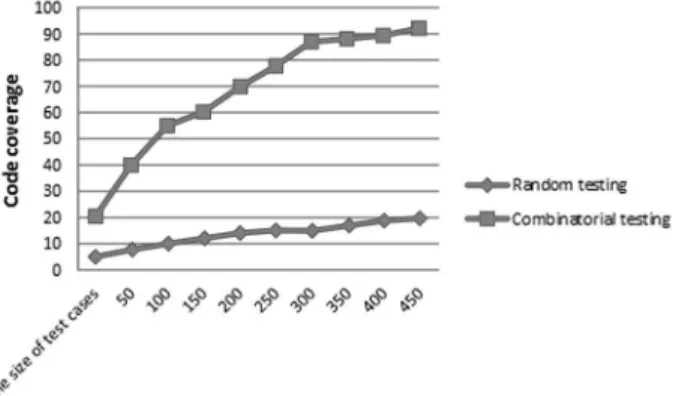
The sub-function in operational command mod-ule software is selected. After deriving the ser-vice description WSDL document, the T model and data constraints based on Section 3 are con-structed at first; then the interaction between el-ements in T model by source code and the test cases based on combinatorial testing are gener-ated separately; finally the final test suite based on the constraints rules between data types is achieved. Here, on the basis of comparing the proposed approach with random test case gen-eration approach by monitoring and obtain cov-erage of source code, the results show that our approach gets a better code converge, specifi-cally shown in Figure 4.
Figure 4. Comparison of code coverage rate between datasets.
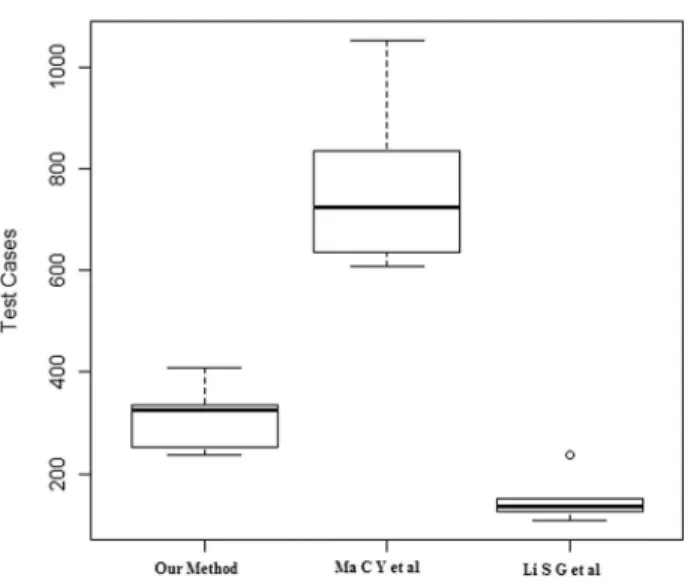
For the validation of the advantages of test cases in size, with some existing methods, the test cases for some operations in tested service are generated; the results are shown in Figure 5. Meanwhile, Table 2 shows the detected re-sults for multiple operations in the tested Web services with the generated test cases, including the detected faults and execution time.
5. Obtain the Optimal Test Cases
According to the previous algorithm in Section 4.2., the initial test data will be generated for single operation of Web Service while the test data is redundant. Additionally, we propose a test set optimization approach based on com-binatorial testing and data constraints rules to solve this problem. The workflow is shown in Figure 3.
5.1. Test Case Generation Based on Combinatorial Testing Through One-Test-at-a-Time
According to variable strength the combinato-rial testing model proposed in Section 3.3., on the basis of the data factors F derived from ini-tial test data from previous work, in this section test suite is obtained on the basis of combinato-rial testing through One-test-at-a-time strategy. This paper defines set CombSet generated by factors set F and interaction relationship R in SUT and makes it contain the value of a collec-tion among all the factors that need to be
cov-ered by the test suite. Through the end, the test suite is obtained by generating every test case using One-test-at-a-time strategy proposed in [21] as shown in algorithm 3.
Algorithm 3. One-test-at-a-time strategy. Input: Set F of factors and set R of interaction relationship in a single operation in WSDL document
Output: Test suit based on variable strength combinatorial testing
Initial:
CombSet = ∅
Initialize T[0..0][1…n]; // initialize a matrix T as test suite;
Generate set CombSet based on F and R;
UncovCombSet = CombSet; While (UncovCombSet = ∅);
Generate a test case called test, add it into test suite T;
Update UncovCombSet, delete the
combination covered by test; End while
Due to the particularity of the formal model of type tree, we should generate variable strength
test suite in the complex data type firstly, after-wards regard the complex data type as a new element, and perform the test suite approach again, based on the interaction relationship. This process is shown as follows:
Step 1. At first, generate subfactors set and in-teraction relationship based on type tree formal model.
Step 2. Generate test suite based on combinato-rial testing through One-test-at-a-time strategy for each complex data type.
Step 3. Regard the whole test suite generated in step 2 as a new data factor by equivalence classes and boundary values for each data par-tition. Then add it into set F and delete the sub -elements in complex data types in test suite T0.
Step 4. After each set for complex data type is transferred as a new element, generates the test suite through One-test-at-a-time strategy itera-tively.
5.2. Reform the Test Suite Based on Constraints
In this section, the test suite T created by pvious section through constraints rules is re-formed with the purpose of obtaining optimal test suite. Test data generation has been con-sidered by combinatorial testing above and test cases have been dramatically minimized, but there are still some limited combinations of fac-tors in the software which have been considered in Section 3.4. If there are strength constraints, the error detection ability of the test data would be influenced. Regarding the reduction with limited composition relationships, error detec-tion capability of test cases will be improved. The steps are shown as follows:
Step 1. Firstly, obtain the limited combination of existing test suite through constraints rela-tionship
Step 2. Clone the existing test cases including limited combinations
Step 3. Reform the positions of limited com-binations for test suite from clone, and make them no longer limited
This approach will refrain from limited combi-nations, without affecting the coverage of valid combination by test cases.
6. Case Study
In this section, there is a chosen type of ship command and control system which was de-veloped based on Service Oriented Architec-ture as tested service and treated as verification example of software testing. Then this section verifies the effectiveness, efficiency and practi-cality in data generation for single operation of Web services by our approach.
The sub-function in operational command mod-ule software is selected. After deriving the ser-vice description WSDL document, the T model and data constraints based on Section 3 are con-structed at first; then the interaction between el-ements in T model by source code and the test cases based on combinatorial testing are gener-ated separately; finally the final test suite based on the constraints rules between data types is achieved. Here, on the basis of comparing the proposed approach with random test case gen-eration approach by monitoring and obtain cov-erage of source code, the results show that our approach gets a better code converge, specifi-cally shown in Figure 4.
Figure 4. Comparison of code coverage rate between datasets.
For the validation of the advantages of test cases in size, with some existing methods, the test cases for some operations in tested service are generated; the results are shown in Figure 5. Meanwhile, Table 2 shows the detected re-sults for multiple operations in the tested Web services with the generated test cases, including the detected faults and execution time.
Figure 5. Comparison of test case size among different methods.
Table 2. Comparison of detected errors.
Data Generation
method
Number
of errors descriptionError Execution time (s)
Our Method 12 Boundary exception, null values, combination of data processing error and so
on
230
Ma et al.
[9] 13
Partly Functional
error 995
Li [25] 5 boundary Partly
error 125
The approach proposed by Ma et al. is good at error detection [9]. If the system is too compli-cated, it will obtain the largest amount of test cases, at the same time resulting in a combina-torial explosion which also costs the highest ex-ecution time. Although the approach proposed by Li [25] generates the least test cases, the results show that it cannot meet the test ade-quacy requirement with poor error detection capability. Therefore, the proposed algorithms could leverage the execution effectiveness and optimality of size of generated test suite.
7. Conclusion
Testing Web Services is one of the hot debates in software testing area today while test data generation for Web services has become an important part of Web services testing. In sum-mary, this paper proposes an automatic test case generated approach, integrating combinatorial testing with data constraint rules technology. In particular, this study minimizes the test suite, ultimately solves the problem of test data re-dundancy and enhances the relevance of testing and improves test efficiency.
There is a workflow mentioned above for gen-erating the test cases for Web services based on combinatorial approaches. Furthermore, testing Web services is very labor-intensive and time-consuming because SOAP message must be sent to invoke Web Service for each test case which uses a lot of resources. Accordingly, it is necessary to enhance our work by developing an automated tool to support our approach. In the future work, more attentions should be paid to research on other levels of Web Services exhaustively, including testing the operations sequence and composite Web Services as well as further raise the automation of Web Services tests.
References
[1] H. He (2003, Sep). What is Service-Oriented Architecture? [Online]. Available: http://webser-vices.xml.com/pub/a/ws/2003/09/30/soa.html [2] G. Canfora and M. Di Penta, "Testing services
and service-centric systems: challenges and op-portunities", IT Professional, vol. 8, no. 2, pp. 10–17, 2006.
http://dx.doi.org/10.1109/MITP.2006.51
[3] D. Brenner et al., "Strategies for the Run-Time Testing of Third Party Web Services", in IEEE International Conference on Service-Oriented Computing an Applications (SOCA'07), June 2007, pp. 114–121.
http://dx.doi.org/10.1109/SOCA.2007.43
[4] A. Sinha and A. Paradkar, "Model Based Func-tional Conformance testing of web services oper-ating on persistent data", in Proceedings of 2006 workshop on Testing, analysis, and verification of Web services and application, ACM., New York, NY, USA, 2006, pp. 17–22.
http://dx.doi.org/10.1145/1145718.1145721
[5] C. Keum et al., "Generating test cases for Web services using extended finite state machine", Lecture Notes in Computer Science, Springer Berlin/Heidelberg, pp. 103–117, 2006.
http://dx.doi.org/10.1007/11754008_7
[6] W. T. Tsai et al., "Extending WSDL to Facilitate Web Services Testing," in Proceedings of IEEE HASE, 2002, pp. 171–172.
http://dx.doi.org/10.1109/hase.2002.1173119 [7] X. Y. Bai et al., "WSDL-Based automatic test
case generation for Web services testing", in Pro-ceedings of the 2005 IEEE International Work-shop on Service-Oriented System Engineering (SOSE'05), Washington: IEEE Computer Society, 2005, pp. 207–212.
[8] H. Samer and M. Malcolm, "An approach for specification-based test case generation for Web Services", in Computer Systems and Applica-tions, AICCSA '07, IEEE/ACS International Con-ference on 13–16 May 2007, pp. 16–23.
[9] C. Y. Ma et al., "WSDL-Based automated test case generation for Web service", in Proceedings of the Computer Science and Software Engineer-ing, Washington, 2008, pp. 731–737.
[10] J. Offutt and W. Xu, "Generating Test Cases for Web Services Using Data perturbation", ACM SIGSOFT, Software Eng. Notes, vol. 29, no. 5, pp. 1–10, 2004.
http://dx.doi.org/10.1145/1022494.1022529 [11] W. Xu and J. Offutt, "Testing Web Services by
XML perturbation", in Software Reliability En-gineering, ISSRE 2005, 16th IEEE International Symposium, 8–11 Nov. 2005, pp.1–10.
[12] R. Siblini and N. Mansour, "Testing Web Ser-vices", in 2005 ACS/IEEE International Con-ference on Computer Systems and Applications (AICCSA 2005), Cairo, Egypt, 2005.
http://dx.doi.org/10.1109/AICCSA.2005.1387124 [13] Y. Jiang, "A Method of automated test data gen-eration for web service", Chinese journal of com-puters, vol. 28, no. 4, Apr. 2005.
[14] D. R. Kuhn and M. J. Reilly, "An investigation of the applicability of design of experiments to soft-ware testing", in Proceedings of the 27th NASA/ IEEE Software Engineering Workshop, NASA Goddard Space Flight Center, 2002, pp. 91–95. [15] D. R. Kuhn and D. R. Wallace, "Software fault
interaction and implication for software testing", in IEEE Transactions on Software Engineering, 2004, pp. 1–4.
[16] P. J. Schroeder et al., "Comparing the fault de-tection effectiveness of n-way and random test suite", in Proceedings of the 2004 International Symposium on Empirical Software Engineering (ISESE2004), Redondo Beach, Califorrnia, 2004, pp. 49–59.
http://dx.doi.org/10.1109/isese.2004.1334893
[17] S. Sampath et al., "Prioritizing user-session-based test cases for web application testing", in The 1st International Conference on Software Testing, Verification, and Validation, 2008, pp. 141–150. http://dx.doi.org/10.1109/icst.2008.42
[18] X. Yuan et al., "Covering array sampling of input event sequences for automated GUI testing", in The 22nd International Conference on Automated Software Engineering, 2007, pp. 405–408. http://dx.doi.org/10.1145/1321631.1321695 [19] W3C. (June, 2007). Web Services Description
Language (WSDL)Version 2.0 [Online]. Avail-able: http://www.w3.org/TR/2007/REC-wsdl20-primer-20070626
[20] Z. Y. Wang et al., "Survey of combinatorial test generation", Journal of Frontiers of Computer Science and Technology, vol. 2, no. 6, pp. 571– 588, 2008.
[21] Y. Lei, "In-parameter-order: a test generation strat-egy for pairwise testing", in Proceedings of the 3rd IEEE International Symposium on High-As-surance Systems Engineering (HASE1998), Washington, USA, 1998, pp. 254–261.
[22] W. Z. Yuan et al., "Generating variable strength combinatorial test suite with one-test-at-a-time strategy", Chinese Journal of computers, vol.12, no. 35, 2012.
[23] K. J. Hou et al., "Web service test Data Genera-tion Using Interface Semantic Contract", Journal of Software, vol. 24, no. 9, pp. 2020–2041, 2013. [24] I. Horrocks et al., (2004). SWRL:A semantic web
rule language combining OWL and RuleML [On-line]. Available:
http://www.w3.org/ Submission/SWRL
[25] S.-G. Li, "A method of automatic test data gen-eration based on extended WSDL", M.S. thesis, Dept. Computer Science. Southwest University, Chongqing, China, 2010.
Received: June 2015
Revised: June 2016
Accepted: July 2016
Contact addresses: Yin Li Jiangsu Institute of Automation Jiangsu, Lianyungang, Xin Pu Qu Hailian E Rd, 42, 222006 China e-mail: [email protected]
Zhi-an Sun Jiangsu Institute of Automation Jiangsu, Lianyungang, Xin Pu Qu Hailian E Rd, 42, 222006 China e-mail: [email protected]
Figure 5. Comparison of test case size among different methods.
Table 2. Comparison of detected errors.
Data Generation
method
Number
of errors descriptionError Execution time (s)
Our Method 12 Boundary exception, null values, combination of data processing error and so
on
230
Ma et al.
[9] 13
Partly Functional
error 995
Li [25] 5 boundary Partly
error 125
The approach proposed by Ma et al. is good at error detection [9]. If the system is too compli-cated, it will obtain the largest amount of test cases, at the same time resulting in a combina-torial explosion which also costs the highest ex-ecution time. Although the approach proposed by Li [25] generates the least test cases, the results show that it cannot meet the test ade-quacy requirement with poor error detection capability. Therefore, the proposed algorithms could leverage the execution effectiveness and optimality of size of generated test suite.
7. Conclusion
Testing Web Services is one of the hot debates in software testing area today while test data generation for Web services has become an important part of Web services testing. In sum-mary, this paper proposes an automatic test case generated approach, integrating combinatorial testing with data constraint rules technology. In particular, this study minimizes the test suite, ultimately solves the problem of test data re-dundancy and enhances the relevance of testing and improves test efficiency.
There is a workflow mentioned above for gen-erating the test cases for Web services based on combinatorial approaches. Furthermore, testing Web services is very labor-intensive and time-consuming because SOAP message must be sent to invoke Web Service for each test case which uses a lot of resources. Accordingly, it is necessary to enhance our work by developing an automated tool to support our approach. In the future work, more attentions should be paid to research on other levels of Web Services exhaustively, including testing the operations sequence and composite Web Services as well as further raise the automation of Web Services tests.
References
[1] H. He (2003, Sep). What is Service-Oriented Architecture? [Online]. Available: http://webser-vices.xml.com/pub/a/ws/2003/09/30/soa.html [2] G. Canfora and M. Di Penta, "Testing services
and service-centric systems: challenges and op-portunities", IT Professional, vol. 8, no. 2, pp. 10–17, 2006.
http://dx.doi.org/10.1109/MITP.2006.51
[3] D. Brenner et al., "Strategies for the Run-Time Testing of Third Party Web Services", in IEEE International Conference on Service-Oriented Computing an Applications (SOCA'07), June 2007, pp. 114–121.
http://dx.doi.org/10.1109/SOCA.2007.43
[4] A. Sinha and A. Paradkar, "Model Based Func-tional Conformance testing of web services oper-ating on persistent data", in Proceedings of 2006 workshop on Testing, analysis, and verification of Web services and application, ACM., New York, NY, USA, 2006, pp. 17–22.
http://dx.doi.org/10.1145/1145718.1145721
[5] C. Keum et al., "Generating test cases for Web services using extended finite state machine", Lecture Notes in Computer Science, Springer Berlin/Heidelberg, pp. 103–117, 2006.
http://dx.doi.org/10.1007/11754008_7
[6] W. T. Tsai et al., "Extending WSDL to Facilitate Web Services Testing," in Proceedings of IEEE HASE, 2002, pp. 171–172.
http://dx.doi.org/10.1109/hase.2002.1173119 [7] X. Y. Bai et al., "WSDL-Based automatic test
case generation for Web services testing", in Pro-ceedings of the 2005 IEEE International Work-shop on Service-Oriented System Engineering (SOSE'05), Washington: IEEE Computer Society, 2005, pp. 207–212.
[8] H. Samer and M. Malcolm, "An approach for specification-based test case generation for Web Services", in Computer Systems and Applica-tions, AICCSA '07, IEEE/ACS International Con-ference on 13–16 May 2007, pp. 16–23.
[9] C. Y. Ma et al., "WSDL-Based automated test case generation for Web service", in Proceedings of the Computer Science and Software Engineer-ing, Washington, 2008, pp. 731–737.
[10] J. Offutt and W. Xu, "Generating Test Cases for Web Services Using Data perturbation", ACM SIGSOFT, Software Eng. Notes, vol. 29, no. 5, pp. 1–10, 2004.
http://dx.doi.org/10.1145/1022494.1022529 [11] W. Xu and J. Offutt, "Testing Web Services by
XML perturbation", in Software Reliability En-gineering, ISSRE 2005, 16th IEEE International Symposium, 8–11 Nov. 2005, pp.1–10.
[12] R. Siblini and N. Mansour, "Testing Web Ser-vices", in 2005 ACS/IEEE International Con-ference on Computer Systems and Applications (AICCSA 2005), Cairo, Egypt, 2005.
http://dx.doi.org/10.1109/AICCSA.2005.1387124 [13] Y. Jiang, "A Method of automated test data gen-eration for web service", Chinese journal of com-puters, vol. 28, no. 4, Apr. 2005.
[14] D. R. Kuhn and M. J. Reilly, "An investigation of the applicability of design of experiments to soft-ware testing", in Proceedings of the 27th NASA/ IEEE Software Engineering Workshop, NASA Goddard Space Flight Center, 2002, pp. 91–95. [15] D. R. Kuhn and D. R. Wallace, "Software fault
interaction and implication for software testing", in IEEE Transactions on Software Engineering, 2004, pp. 1–4.
[16] P. J. Schroeder et al., "Comparing the fault de-tection effectiveness of n-way and random test suite", in Proceedings of the 2004 International Symposium on Empirical Software Engineering (ISESE2004), Redondo Beach, Califorrnia, 2004, pp. 49–59.
http://dx.doi.org/10.1109/isese.2004.1334893
[17] S. Sampath et al., "Prioritizing user-session-based test cases for web application testing", in The 1st International Conference on Software Testing, Verification, and Validation, 2008, pp. 141–150. http://dx.doi.org/10.1109/icst.2008.42
[18] X. Yuan et al., "Covering array sampling of input event sequences for automated GUI testing", in The 22nd International Conference on Automated Software Engineering, 2007, pp. 405–408. http://dx.doi.org/10.1145/1321631.1321695 [19] W3C. (June, 2007). Web Services Description
Language (WSDL)Version 2.0 [Online]. Avail-able: http://www.w3.org/TR/2007/REC-wsdl20-primer-20070626
[20] Z. Y. Wang et al., "Survey of combinatorial test generation", Journal of Frontiers of Computer Science and Technology, vol. 2, no. 6, pp. 571– 588, 2008.
[21] Y. Lei, "In-parameter-order: a test generation strat-egy for pairwise testing", in Proceedings of the 3rd IEEE International Symposium on High-As-surance Systems Engineering (HASE1998), Washington, USA, 1998, pp. 254–261.
[22] W. Z. Yuan et al., "Generating variable strength combinatorial test suite with one-test-at-a-time strategy", Chinese Journal of computers, vol.12, no. 35, 2012.
[23] K. J. Hou et al., "Web service test Data Genera-tion Using Interface Semantic Contract", Journal of Software, vol. 24, no. 9, pp. 2020–2041, 2013. [24] I. Horrocks et al., (2004). SWRL:A semantic web
rule language combining OWL and RuleML [On-line]. Available:
http://www.w3.org/ Submission/SWRL
[25] S.-G. Li, "A method of automatic test data gen-eration based on extended WSDL", M.S. thesis, Dept. Computer Science. Southwest University, Chongqing, China, 2010.
Received: June 2015
Revised: June 2016
Accepted: July 2016
Contact addresses: Yin Li Jiangsu Institute of Automation Jiangsu, Lianyungang, Xin Pu Qu Hailian E Rd, 42, 222006 China e-mail: [email protected]
Zhi-an Sun Jiangsu Institute of Automation Jiangsu, Lianyungang, Xin Pu Qu Hailian E Rd, 42, 222006 China e-mail: [email protected]
Yin Li was born in 1988. He received the MS degree from Soochow
University in 2014. He is an engineer master at Jiangsu Institute of Au-tomation. His research interests include data mining, software testing.
Zhi-an Sun was born in 1966. He received the MS degree from
Bei-jing University of Aeronautics and Astronautics. He is a researcher at Jiangsu Institute of Automation. His research interests include software reliability, software testing.
Jian-Yong Fang was born in 1982. He received the MS degree from