Avoid These Six Implementation Pitfalls
To Achieve EHR Success
Executive Summary
If you’re reading this white paper, chances are you’re either:
1. (a) about to purchase your first EHR, or
2. (b) ensuring you do it right the second or third time around.
Either way you probably have serious trepidations about this technology you’re about to adopt – so rest assured, you’ve come to the right place for information. The goal of this white paper is to help you avoid six common pitfalls that can lead to failure of your EHR implementation. By navigating around these pitfalls, you increase the likelihood of a successful implementation.
EHRs aren’t going away, so don’t let any negative hype discourage you. Instead, use any frightening stories or statistics you come across as guidance.
According to the 2014 Exclusive EHR Study conducted by the MPI Group and Medical Economics, 70 percent of clinicians said their EHR investment has not been worth the effort, resources, and costs.1
Remember that number to keep a proactive frame of mind in your approach to EHR adoption, but also remember this hard truth: you have t control throughout this process, so success or failure of your EHR implementation is up to you.
This whitepaper details the following six implementation pitfalls, and how to avoid them:
Number Pitfall
1 Choosing the wrong EHR
2 Underestimating the importance of an implementation plan
3 Not enough training prior to go-live 4 Underestimating the importance of HIPAA
Compliance
5 Falling behind on universal policies
6 Getting stuck on how you used to do things
Pitfall #1: Choosing the wrong EHR
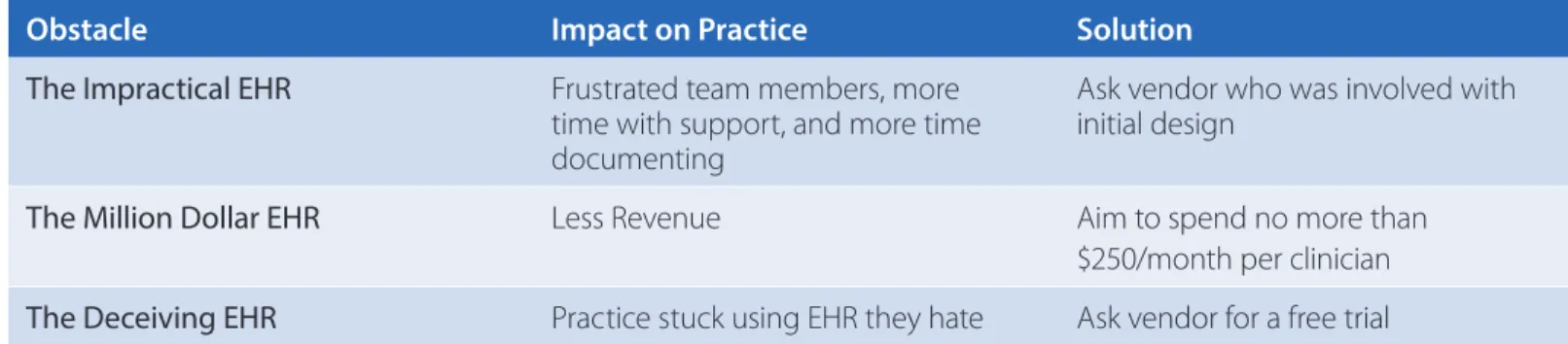
There are a wide variety of EHRs in the market to choose from, making the selection process a difficult one. Selecting the wrong EHR is a mistake that is all too easy to make. Be sure to avoid these types of EHRs:
Obstacle Impact on Practice Solution
The Impractical EHR Frustrated team members, more time with support, and more time documenting
Ask vendor who was involved with initial design
The Million Dollar EHR Less Revenue Aim to spend no more than
$250/month per clinician The Deceiving EHR Practice stuck using EHR they hate Ask vendor for a free trial
“The Impractical EHR”
The intuitiveness of your EHR will affect every area of your practice. If you don’t consider yourself to be technologically savvy, an intuitive solution should be at the top of your list. (After all, presumably you’re a clinician, not an IT expert!)
According to the 2014 EHR study mentioned above, 67 percent of clinicians report they plan to switch EHRs because of dissatisfaction with their current EHR’s functionality.2
Ask potential vendors if a clinician was involved with the development of their EHR system. If a clinician wasn’t involved, chances are your idea of “usable” won’t line up with the vendor’s.
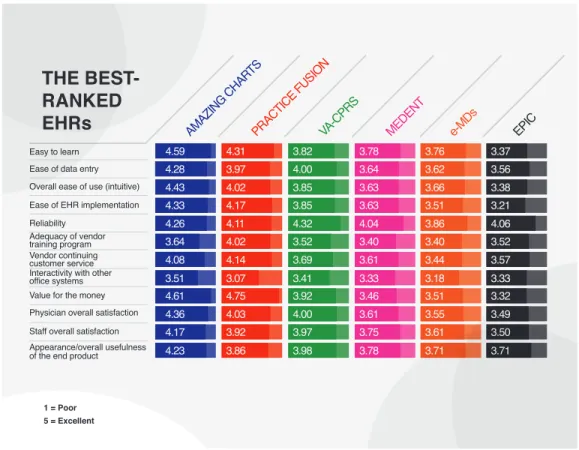
Figure 1 below shows a portion of the findings from Medscape’s 2012 EHR Report, where over 20,000 Medscape readers were surveyed on their EHR system.3 Note that the best-ranked EHRs have high scores in the “Easy to learn” portion of the
study - implying that usability plays a significant role in EHR satisfaction.
2 Page 19, http://medicaleconomics.modernmedicine.com/sites/default/files/images/MedicalEconomics/DigitalEdition/Medical-Economics-February-10-2014.pdf 3 http://www.medscape.com/features/slideshow/EHR2012#1
Figure 1. The Best Ranked EHRs
Easy to learn Ease of data entry
Reliability
Value for the money Overall ease of use (intuitive) Ease of EHR implementation Adequacy of vendor training program Vendor continuing customer service Interactivity with other office systems
Physician overall satisfaction Staff overall satisfaction Appearance/overall usefulness of the end product
The “Million Dollar EHR”
EHRs vary widely in cost and performance. There is a very real danger that you will overpay for your EHR, so you need to be cautious. Analyzing costs is an easy way to reduce the list of vendors for consideration.
According to the 2014 Exclusive EHR Study conducted by the MPI Group and Medical Economics, “Nearly half of all physicians surveyed (45%) reported having spent more than $100,000 on implementing an EHR system.”4
A survey of the market conducted by KLAS Research shows that there are several high performing EHRs available at a reasonable cost (refer to Figure 2 below).5
Bottom line: you should aim to spend no more than $250 per month per clinician on an EHR.
4 http://ehrintelligence.com/2014/02/10/what-has-physicians-so-dissatisfied-with-their-ehr-systems/
5 2013 Ambulatory EMR Performance (1-10 Physicians): The Quest for Value Amid Rising Expectations,” September2013. © 2013 KLAS Enterprises, LLC. All rights reserved. http://www.KLASresearch.com
Figure 2. Money’s Worth VS. Product Performance
9.0
AVERAGE
PRODUCT WORKS AS PROMOTED
MONEY’S WOR TH 1 2 3 4 5 6 7 10 12 13 14 15 16 17 18 19 20 21 22 23 24 25 26 27 11 9 8 1. AdvancedMD 2. Allscripts Professional 3. Amazing Charts 4. Aprima 5. athenahealth 6. Bizmatics 7. Cerner 8. CompuGroup 9. CureMD 10. eClinicalWorks 11. e-MDs 12. GE Healthcare 13. Greenway 14. Henry Schein MicroMD 8.0 7.0 6.0 5.0 4.0 4.0 5.0 6.0
LARGE MARKET SHARE MEDIUM MARKET SHARE SMALL MARKET SHARE
7.0 8.0 9.0
MONEY’S WORTH VS. PRODUCT PERFORMANCE
15. McKesson Practice Partner
16. MIE 17. MTBC 18. NextGen 19. OptumInsight* 20. PCC [Pediatrics Only] 21. Practice Fusion 22. Quest Diagnostics 23. simplifyMD 24. SOAPware 25. SRSsoft 26. Vitera
27. Waiting Room Solutions* * DOES NOT MEET MINIMUM KLAS KONFIDENCE LEVEL
Although you don’t want to spend too much on an EHR, be sure to do your research before doing the opposite: implementing a “free” EHR. There are several red flags waving over free EHRs, some of which include: hidden costs, cumbersome designs, HIPAA compliance issues, not knowing what your data is being used for, etc. You might not have to pay hard dollars for a free EHR, but you’ll likely pay in several other ways, including being forced to look at pharma ads. Finally, determine if you’re willing to enter into any long-term contracts, and if so, for how long. Find out if the vendors you’re considering meet the parameters you’ve set.
“The Deceiving EHR”
The last thing you want to have happen is to select an EHR based upon preconceived notions that turn out to be false. As with any major software purchase in any industry it’s important to take steps to reduce the risk of selecting the wrong system.
What better way is there to determine whether or not an EHR will be a good fit for your practice than actually using it in your office? Simply ask the vendor if you can have a FREE trial of the actual EHR software (not a canned demo) prior to purchasing. If the vendor doesn’t offer a trial, then make sure to watch video tutorials, attend webinars, and shadow another clinician using the EHR. Do everything in your power to expose yourself to the software prior to buying it.
Pitfall #2: Underestimating the importance of an implementation plan
Selecting the right one is critical, but once you’ve purchased the right EHR – now what?Obstacle Impact on Practice Solution
Unsure of the steps to take
after purchasing Disorganized and unsuccessful implementation Implementation plan
This is where an implementation plan comes in. The implementation plan will introduce you to your new EHR and also help you identify specific questions to ask the vendor. Your EHR vendor will likely have one to give you – just ask!
A useful implementation guide should tell you how to do the following:
• Create user profiles
• Set clinician schedules
• Set up test patients
• Set CPT codes/fee schedules
• Set up and activate e-prescribing
• Access your prescription writer
• Import demographics
• Manually enter patient information
Pitfall #3: Not enough training prior to go-live:
This pitfall goes hand-in-hand with not having an implementation guide;
ensuring you and your staff are fully trained prior to go-live is essential to a successful EHR implementation.Obstacle Impact on Practice Solution
Neglect Training Frustrated employees and decrease in
practice efficiency Designate time for training and create and use daily activity lists for guidance
Tweet from October 16, 2013, https://twitter.com/LowesRobert/ status/390508387168817152
Robert Lowes, former senior editor of Medical Economicsand journalist
for Medscape explains it best:
“ A $30,000 electronic medical record system is like a $30,000 grand piano. Whether you play the equivalent of Beethoven’s ‘Moonlight’ sonata or ‘Chopsticks’ depends on your level of training. Sadly, too many practices end up playing ’Chopsticks’ because they didn’t do the homework needed to make EMR training effective. In the worst-case scenario, they try to learn too much too quickly while juggling a full load of patients.”
To ensure proper training, first you should designate some time - either set time aside time during work hours, or assign training to your staff as “homework.” Rest assured, the time invested for training will pay off during go-live.
Next, ask each team member to create a list of their daily activities (and don’t forget to make one for yourself). Advise them to customize the list to fit their role and to also use it as guidance for the training they’ll need.
Finally, use the daily activity lists to assess each team member’s knowledge of the EHR. Do not go live until each member of your team is able to complete each of their daily activities using the new system. Once everyone is comfortable using the EHR, use a “Dummy” patient to run through the new workflow.
If you’re transitioning from paper, keep in mind that going paperless should be a gradual process. Avoid uploading all patient information at once or asking a team member to start at “A” and work through the patient panel alphabetically. Instead, import the patient information a day prior to them coming in. For example, be sure to pull the
demographics (or Continuity of Care Documents, if available) for all patients on the business day before their scheduled visit. Not only will doing this increase the efficiency of the implementation, but it also won’t take a toll on you and your staff.
NOTE: “Dummy” patients should be your practice’s best friend during training!
Pitfall #4: Underestimating the importance of HIPAA Compliance
HIPAA, the “The Health Insurance Portability and Accountability Act of 1996”, was instituted partly in response to the rise of technology in medical practices.
Obstacle Impact on Practice Solution
Not taking measures to ensure
practice is HIPAA compliant Risk failing MU audit and getting a fine Create and use HIPAA compliance checklist It’s critical you have policies and procedures in place for HIPAA compliance – here’s why:
1. To ensure you’re acting in the best interest of your patients
2. To protect yourself during a potential Meaningful Use audit (regarding Core 15, the Privacy and Security Measure)
3. To avoid the hefty fines (up to $1.5 million6) that come along with a HIPAA violation
Create and use a compliance checklist to ensure your practice is taking every necessary measure to become and remain HIPAA compliant. You’re likely to discover areas that need work, and you can confirm and document that you’re doing everything you need to do to ensure compliance.
Pitfall #5: Falling behind on HealthIT policies
Obstacle Impact on Practice Solution
Lack of preparation for universal
policy changes Employees feel stressed as deadlines approach, no incentive money, and fines
Create and use and action plan that can be applied to all universal policies
Creating an action plan that can be used repeatedly will keep you organized and eventually you’ll follow the plan without even realizing it.
First, identify who will take the lead on ensuring your practice is aware of upcoming changes, so you’ll be prepared to handle these changes. The policy lead will be responsible for getting a detailed understanding of the topic and educating the rest of your staff on what he/she has learned.
The policy lead must also stay on top of upcoming universal policy changes by developing a menu of resources for your practice. Here are a few informative resources to utilize:
• Medical Societies – i.e. the AMA, state medical societies, and/or specialty medical societies (ex. the American Academy of Family Physicians).
• EHR Blogs – Once you find a reputable blogger, follow their posts like a hawk! The top EHR bloggers aren’t biased and they’re on top of the industry-related latest and greatest. Here are a few good ones: John Lynn, EMRandHIPAA.com; Tom Sullivan, HealthcareITNews.com; and Kevin Pho, KevinMD.com.
6 http://www.ama-assn.org//ama/pub/physician-resources/solutions-managing-your-practice/coding-billing-insurance/hipaahealth-insurance-portability-accountability-act/hipaa-violations-enforcement.page
NOTE: Documenting all efforts regarding HIPAA compliance is critical.
• Your EHR vendor
–User Bulletin Boards – Nine times out of ten there are a number of tech-savvy users that are always ahead of the game – chances are these users will be active on bulletin boards and will be more than happy to share what they know. Make sure to take advantage of this great resource if your EHR vendor has one.
–Emails from vendor – Your EHR vendor likely sends out emails regarding universal policy updates. Pay attention to these – the more you know, the less time you’ll be spending tracking down issues with their support staff.
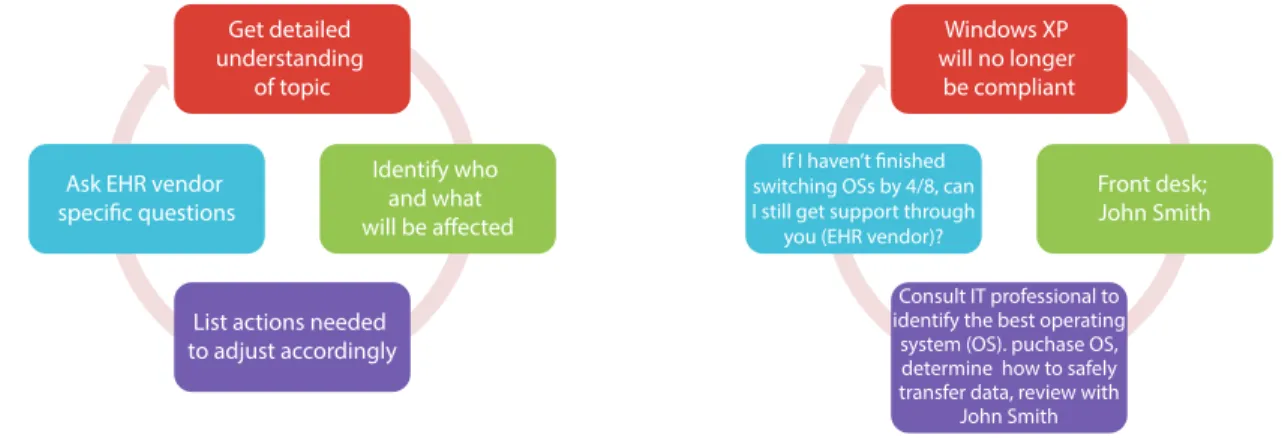
Once you’ve gotten a detailed understanding of the topic, you’ll need to identify who and what will be affected, list the actions needed to adjust your workflow accordingly, and check with your EHR vendor on specific questions (process illustrated below in Figure 3, with example).
Figure 3. Dealing With Universal Policy Changes (with example)
Get detailed understanding
of topic
List actions needed to adjust accordingly Ask EHR vendor
specific questions Identify who and what will be affected Windows XP will no longer be compliant Consult IT professional to identify the best operating
system (OS). puchase OS, determine how to safely transfer data, review with
John Smith If I haven’t finished
switching OSs by 4/8, can I still get support through
you (EHR vendor)?
Front desk; John Smith
By systematically dealing with universal policy changes, you can avoid any last-minute problems and make the process of change go much more smoothly for your practice.
Pitfall #6: Getting stuck on how you used to do things
It is human nature to resist change, and falling into old patterns is a tendency we all have at times. However, when implementing a new EHR, it’s important to embrace the change; minor aspects may prove initially annoying, but overall a good EHR implementation will make day-to-day workflow much easier.
Obstacle Impact on Practice Solution
“ It was much easier when we
used to…” Failed implementation Embrace working with a new system
“Out with the old and in with the new.” You should repeat this cliché over and over as you transition to your new EHR. Here are some not-so-obvious ways to make letting go of your old workflow easier:
• Reach out to fellow users in your area. Other users are a great resource for learning real-world tips and best practices. Practice workflows are not one-size-fits-all, but hearing experiences from others will help you tailor the new system to your own practice. Connecting with other users can also give you access to other organizational resources, such as information management expertise, experience with past process changes, and financial resource revenue management.
• Attend user conferences. Not only can you connect with other users, but your EHR vendor will likely update you on their product roadmap and other new developments.
• Read Health IT publications – You can stay on top of the last regulatory and industry news, get tips and best practices, and learn what’s coming in the future so you can be prepared.
Conclusion
Underestimating these implementation pitfalls can turn an EHR implementation into a nightmare; avoiding them will allow your practice to thrive from your EHR investment. If you approach your EHR implementation with the same perseverance, attention to detail, and optimism that you bring to your medical practice, your transition should be a smooth and