IBM Global Security Kit
Version 7.0.4.11
Security Target
Document Version: 1.7
Status: Final
Last Update: 2007-07-26
atsec is a trademark of atsec GmbH.
IBM, IBM logo, GSKit, iKeyman and ICC are trademarks or registered trademarks of International Business Machines Corporation in the United States, other countries, or both.
BSAFE is a trademark of RSA in the United States, other countries, or both.
Sun Solaris is a trademark of Sun Microsystems, Inc., in the United States, other countries, or both.
Microsoft Windows 95, Microsoft Windows 98, Microsoft Windows ME, Microsoft Windows NT, Microsoft Windows 2000, Windows 2000 Professional and Advanced Server, and Microsoft Windows XP are trademarks of Microsoft in the United States, other countries, or both.
HP-UX is a trademark of Hewlett Packard, in the United States, other countries, or both. Linux is a registered trademark of Linus Torvalds.
This document is provided AS IS with no express or implied warranties. Use the information in this document at your own risk.
This document may be reproduced or distributed in any form without prior permission provided the copyright notice is retained on all copies. Modified versions of this document may be freely distributed provided that they are clearly identified as such, and this copyright is included intact.
Document History
Version Date Changes Summary Author
1.7 2007-07-26 See Summary Removed confidentiality labels and confidential parts of the document history. Clarified build number in section 1.1.
Table of Content
1 Introduction ...8
1.1 ST Identification...8
1.2 CC Conformance Claim...8
1.3 Strength of Function...8
1.4 ST and TOE Overview...8
1.5 Structure...9
1.6 Terminology ...9
2 TOE Description ... 11
2.1 Product Type... 12
2.2 Summary of Security Features ... 12
2.2.1 Secure Channel... 12
2.2.2 Cryptographic operations ... 13
2.2.3 Self-tests ... 15
2.2.4 Key Management ... 15
2.3 Software and Guidance ... 15
2.4 Security Environment TOE Boundary... 17
2.4.1 Overview ... 17
2.4.2 TOE and User Interfaces ... 17
2.4.3 Operating Systems and TOE Security Architecture ... 18
2.4.4 Certificates... 19
2.4.5 iKeyman, and Keystore ... 19
2.4.6 CRLs ... 20
2.4.7 OCSP ... 20
2.4.8 Crypto Modules... 20
3 TOE Security Environment... 21
3.1 Introduction... 21
3.2 Threats... 21
3.2.1 Threats countered by the TOE ... 21
3.2.2 Threats to be countered by measures within the TOE environment... 21
3.3 Organizational Security Policies ... 22
3.4 Assumptions ... 22
4 Security Objectives... 23
4.1 Security Objectives for the TOE ... 23
4.2 Security Objectives for the TOE Environment ... 23
4.2.1 TOE Operational Environment ... 23
5 Security Requirements ... 25
5.1.2 User Data Protection (FDP) ... 29
5.1.3 Identification and Authentication... 32
5.1.4 Security Management (FMT)... 32
5.1.5 Protection of the TSF (FPT)... 33
5.1.6 Trusted Path/Channels (FTP) ... 35
5.2 Security Functional Requirements for the Operational Environment... 35
5.2.1 Cryptographic Support (FCS) ... 36
5.2.2 User Data Protection (FDP) ... 38
5.2.3 Identification and Authentication (FIA) ... 38
5.2.4 Protection of the TSF (FPT)... 40
5.2.5 TOE Access (FTA) ... 40
5.3 TOE Security Assurance Requirements... 40
6 TOE Summary Specification ... 42
6.1 TOE Security Functions... 42
6.1.1 Introduction ... 42
6.1.2 Key Management (KEYMAN) ... 42
6.1.3 Cryptographic Algorithms (CRYPTO)... 44
6.1.4 Secure Channels (SECCHAN)... 46
6.1.5 Self-tests and Failure Handling (STATE) ... 51
7 Rationale... 53
7.1 Security Objectives Rationale ... 53
7.1.1 Security Objectives Coverage ... 53
7.1.2 Security Objectives Sufficiency... 54
7.2 Security Requirements Rationale ... 56
7.2.1 Explicit Security Functional Requirements Rationale... 56
7.2.2 Security Functional Requirements Rationale ... 57
7.2.3 Security Requirements Dependency Rationale ... 60
7.2.4 Appropriateness of TOE security assurance requirements... 67
7.3 Strength of function Rationale... 67
[CC] Common Criteria for Information Technology Security Evaluation. Part 1-3. August 2005. Version 2.3.
[CEM] Common Methodology for Information Technology Security Evaluation. August 2005. Version 2.3. [DOD] Global Security Kit Delivery Procedure Additional Guidance, Version 7.0 as of 2006-07-20
[PD-0108] CCEVS Precedence PD-0108: FTP_ITC.1.3 Specifies The Functions For Which A Trusted Channel Is Provided, Effective Date: 2004-07-19, Last Modified Date: 2004-08-26.
[RI 58] Final Interpretation for RI # 58 - Confusion over refinement, 07/31/2001 [TARGET] Global Security Kit V7d Security Target (this document)
[EPRAND] EUROPEAN PATENT APPLICATION EP 1 081 591 A2, Random number generator, Application number: 00114754.5, Date of publication: 07.03.2001 Bulletin 2001/10.
[FIPS46-3] FIPS PUB 46-3: DATA ENCRYPTION STANDARD (DES), October 25, 1999.
[FIPS81] FIPS PUB 81: DES MODES OF OPERATION, Issued December 2, 1980, including CHANGE NOTICES 2 and 3
[FIPS140-2] FIPS PUB 140-2: SECURITY REQUIREMENTS FOR CRYPTOGRAPHIC MODULES, Issued May 25, 2001, including CHANGE NOTICES (12-03-2002)
[FIPS140IG] Implementation Guidance for FIPS PUB 140-2 and the Cryptographic Module Validation Program, Initial Release: March 28, 2003, Last Update: July 26, 2004
[FIPS180-2] FIPS PUB 180-2: Specification for the SECURE HASH STANDARD, including Change Notice to include SHA-224, August 1, 2002
[FIPS186-2] FIPS PUB 186-2: DIGITAL SIGNATURE STANDARD (DSS), including Change Notice, January 27, 2000
[FIPS197] FIPS PUB 197: Specification for the ADVANCED ENCRYPTION STANDARD (AES), November 26, 2001.
[FIPS198] FIPS PUB 198: The Keyed-Hash Message Authentication Code (HMAC), March 6, 2002. [GSKCAPI] IBM Global Security Kit GSKCapiCmd User’s Guide GSKit Version 7d Edition March 4, 2005 [GSKCCMODE] Global Security Kit Common Criteria Mode Operating Guidance for Version 7d Edition March 10,
2005
[GSKTRUST] IBM Global Security Kit Certificate Validation and Trust Policy Design for version 7c, May 30, 2006
[GSKKEY] IBM Global Security Kit Key Management for C Programmer's Guide Version 7c, Edition February 23, 2005.
[GSKINST] IBM Global Security Kit Global Security Kit Install and Packaging Guide, Version 7c, March 6, 2005.
[GSKPLI] Performing GSKit Local Installations, Version 7.0 as of 2006-08-03.
[GSKSSL] IBM Global Security Kit, Secure Socket Layer for C Programmer’s Guide, Version 7c, Edition March 9, 2005
[ICC] IBM Crypto for c (ICC) Version 1.2 Design Document Version 0.7 – December 29, 2004 [ICCDESIGN] IBM Crypto for C (ICC) Version 1.4 Design Document Version 1.4 – March 10,2007
[ICCSEC] IBM Crypto for C (ICC) Version 1.4.4 FIPS 140-2 Non-Proprietary Security Policy, version 0.7 October 4, 2006.
[GUIDE] ISO/IEC PDTR 15446 Title: Information technology – Security techniques – Guide for the production of protection profiles and security targets, ISO/IEC JTC 1/SC 27 N 2449, 2000-01-04. [PKCS#11-2.10] PKCS #11 v2.10: Cryptographic Token Interface Standard. RSA Laboratories, December 1999. [PKCS#11-2.20] PKCS #11 v2.20: Cryptographic Token Interface Standard. RSA Laboratories, 28 June 2004.
[PKCS#12] PKCS 12 v1.0: Personal Information Exchange Syntax, RSA Laboratories, June 24, 1999.
[RFC1319] RFC 1319: The MD2 Message-Digest Algorithm, including the Erratum for RFC 1319, April 1992 [RFC1321] RFC 1321: The MD5 Message-Digest Algorithm, including the Erratum for RFC 1321, April 1992 [RFC2313] RFC 2313: PKCS#1: RSA Cryptography Specification, Version 1.5, March 1998.
[RFC2401] RFC 2401: HMAC-Keyed-Hashing for Message Authentication, February 1997. [RFC2437] RFC 2437: PKCS #1: RSA Cryptography Specifications, Version 2.0, October 1998.
[RFC2560] RFC 2560: X.509 Internet Public Key Infrastructure Online Certificate Status Protocol – OCSP. June 1999
[RFC2986] RFC 2986: PKCS #10: Certification Request Syntax Specification, Version 1.7, November 2000 [RFC3280] RFC 3280: Internet X.509 Public Key Infrastructure - Certificate and Certificate Revocation List
(CRL), obsoletes RFC 2459, April 2002.
[SSLv3] Alain O. Freier, Philip Karlton, Paul C. Kocher: The SSL Protocol, Version 3; IETF Memo, Internet Draft, November 1996.
[TLSv1] T. Dierks, C.Allen: The TLS Protocol Version 1.0; RFC 2246, January 1999.
[TLS_AES] P. Chown: Advanced Encryption Standard (AES) Ciphersuites for Transport Layer Security (TLS); RFC 3268, June 2002.
[X.509] ITU-T RECOMMENDATION X.509 | ISO/IEC 9594-8: INFORMATION TECHNOLOGY - OPEN SYSTEMS INTERCONNECTION - THE DIRECTORY: PUBLIC-KEY AND ATTRIBUTE CERTIFICATE FRAMEWORKS.
1
Introduction
This document is the security target for the CC evaluation of Global Security Kit (GSKit). The version number 7d is used alternately throughout this document. 7d refers generically to all 7.0.4.x versions, where the x is a specific build number. For this evaluation, the complete version and build number is identified in section 1.1 below.
1.1
ST Identification
ST Title: IBM Global Security Kit Version 7.0.4.11 Security Target
ST Version: 1.7
ST Date: 2007-07-26
TOE Identification: The TOE comprises the Global Security Kit (GSKit) Version 7.0.4.11, including the SSL API and Key Management API and CLI. GSKit encapsulates the IBM Crypto for C (ICC) Version 1.4.5 as an algorithm factory.
Keywords: GSKit, SSL, TLS, ICC, OCSP, PKCS#11, PKCS#12.
1.2
CC Conformance Claim
This ST is CC Part 2 extended [CC] and CC Part 3 conformant [CC], with a claimed Evaluation Assurance Level of EAL4. No conformance to a Protection Profile is claimed.
1.3
Strength of Function
The overall strength of function claim for this TOE is SOF-high.
1.4
ST and TOE Overview
This security target documents the security characteristics of the Global Security Kit (GSKit) Version 7d. GSKit is a set of tools and C/C++ programming interfaces that can be used to add secure channels using the SSLv3 and TLSv1 protocols to TCP/IP applications (products). It provides the cryptographic functions, the protocol implementation and key generation and management functionality for this purpose. GSKit ships only compiled object code and header files.
The TOE consists of GSKit, containing
o SSL and TLS functionality which offers an API (called SSL API) for SSLv3 (as defined in [SSLv3]) and TLSv1 (as defined in [TLSv1] with [TLS_AES]) connections and
o key and certificate generation and management functionality which offers an API (called Key Management API), and a command line interface (CLI). Key data is stored in a so-called keystore. A keystore is
implemented as access controlled files in the TOE environment. The TOE can be configured to be in Common Criteria (CC) mode which ensures that the integrity and, where appropriate, the confidentiality of the data stored in the keystore is protected. Alternatively, PKCS#11 devices can be used for key and certificate storage. CC-mode must be used in the evaluated configuration.
Furthermore, GSKit encapsulates the IBM Crypto for C (ICC) component, which provides cryptographic functions. The ICC module is validated under the Federal Information Processing Standard (FIPS) 140-2 for an overall Security level 1 [FIPS140-2].
It is possible to configure the TOE such that
only SSLv3 and TLSv1 are allowed, other versions of SSL are disabled,
only SSL/TLS ciphersuites whose cipherspec parts consist of cryptographic algorithms that are FIPS-approved (as listed in Annex 1 of FIPS 140-2 [FIPS140-2]) and/or NIST-recommended and
the FIPS-approved and/or NIST-recommended random number generator
are used. This approved mode of configuration is called FIPS mode. Please note that the cryptographic algorithms used for key exchange are not affected by these restrictions.
The product that deploys the TOE must initialize and use the TOE in FIPS mode and in CC mode.
The underlying operating systems for the evaluated configuration are identified in section 2.4.3. Operating systems running the TOE have to be configured to prevent remote login (by disabling all services that offer remote login) since this is required by the FIPS 140-2 security policy for ICC [ICCSEC].
The environment must provide reliable timestamps for certificate and CRL verification and an OCSP responder, if the TOE is configured to make use of these services.
The processing resources of the TOE must be located within controlled access facilities.
The evaluation assumes the operation of the GSKit in an environment that controls the access to the TOE. The TOE services, the GSKit software, TSF data, and the keystore must be protected. This also includes an appropriate protection of backup copies.
The use of OCSP responders in the IT environment is supported. Alternatively, the use of certificate revocation lists (CRLs) for certificate validation is available. The TOE can retrieve a CRL using LDAP, flat files or HTTP, check that the signatures are valid, and, if they are, will use this CRL for certificate validation. If CRLs are to be retrieved via LDAP or HTTP, an LDAP client and an LDAP server or, alternatively, an HTTP server must be available in the TOE environment to provide a current CRL containing all revoked certificates.
The TOE in the evaluated configuration must not use
non-FIPS approved cryptographic functions of ICC for the cipherspec part of SSL/TLS ciphersuites, SSL versions prior to 3 (due to known weaknesses),
“total anonymity mode” for SSL/TLS (i.e. server authentication is mandatory), BSAFE cryptographic library (by RSA).
The optional iKeyman GUI that is installed along with GSKit is not part of the TOE. It may be used as a key and certificate management interface within the product using the TOE (see Figure 1). So if it is to be used, it will be part of the TOE environment.
1.5
Structure
The structure of this document is as defined in the following. Section 1 is the introduction.
Section 2 is the TOE description.
Section 3 provides the statement of the TOE security environment. Section 4 provides the statement of security objectives.
Section 5 provides the statement of security requirements.
Section 6 provides the TOE summary specification which includes the detailed specification of the IT Security Functions.
Section 7 provides the rationale for the security objectives, security requirements, and the strength of function claim.
Section 8 resolves the abbreviations used.
1.6
Terminology
This section contains definitions of technical terms that are used with a meaning specific to this document. Terms defined in the [CC] are not reiterated here, unless stated otherwise.
GSKit: This term serves as an abbreviation for Global Security Kit Version 7d, which is the target of this evaluation. Key Management API and CLI: GSKit API and CLI used by programs that want to deploy the key/certificate generation and management functionality of GSKit.
Keystore: A keystore is a collection of flat files in the IT environment (on the underlying system) managed by the TOE to provides secure storage for key and certificate data.
OCSP: Online Certificate Status Protocol, defined in [RFC2560].
SHA-2: Common denominator for the SHA-224, SHA-256, SHA-384 and SHA-512 hash algorithms. SSL: Secure Sockets Layer; this protocol is implemented by the GSKit and available through the SSL API. SSL API: GSKit API used by programs that want to deploy the functionality of SSL or TLS.
TLS: Transport Layer security; this protocol is implemented by the GSKit and available through the SSL API.
Target of Evaluation (TOE): The TOE is defined as the GSKit Version 7d, running and tested in the environment specified in this Security Target.
User: A user is a human or a product/application using the TOE or the TOE environment, e.g. a system user uses the underlying operating system, a TOE user the TOE.
2
TOE Description
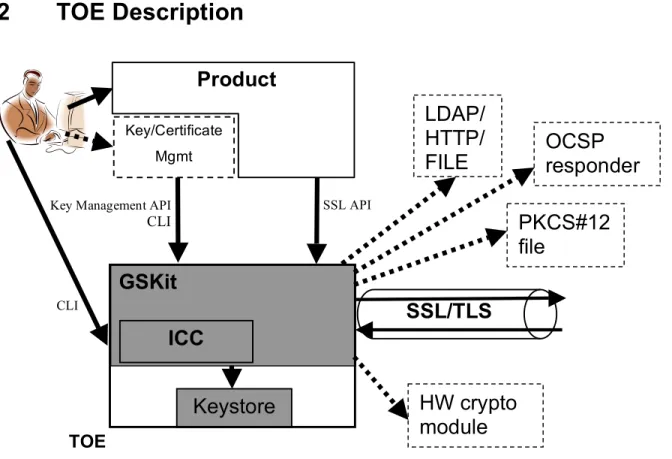
Figure 1: GSKit Overview The TOE consists of the IBM Global Security Kit (GSKit).
The TOE’s main function is to provide a secure channel to another trusted IT-product. This is shown in Figure 1. Optional components have been drawn with dotted lines and white components are part of the TOE environment. The TOE components have been colored dark grey and the box surrounding them shows the TOE boundary. The secure channel set up by the TOE is depicted as a pipe named SSL/TLS.
The following interfaces are offered to the user:
SSL API: this is the main API for the product is the SSL API of the GSKit. For the evaluated configuration of the TOE, only secure connections using SSLv3 and TLSv1 are supported by the TOE in FIPS mode.
Key management API and command line interface (CLI): through this API and the CLI, key and certificate generation and management functionality (like validation or deletion of certificates) can be accessed. A product that uses the TOE shall access the keystore through these interfaces only.
The TOE encapsulates ICC for software-based cryptographic functions and key generation.
Certificate validation may be done with the help of OCSP or CRLs. If CRLs are to be used for certificate validation, LDAP or HTTP resources or a flat file containing the revocation list must be provided by the TOE environment. Likewise, for the usage of OCSP, an OCSP responder must be provided by the environment.
Key management tools other than the CLI, e.g., iKeyman, are not part of the TOE. The classification of the different data types is given in the following:
User data: User Data is information stored in TOE resources that can be operated upon by users in accordance with the TSP and upon which the TSF places no special meaning. In this category falls all data that is not listed under TSF data since according to the CC, all data is either user or TSF data.
TSF data: TSF data is information used by the TSF in making TSP decisions; for this TOE it is
o critical security parameters,
key data,
GSKit
ICC
SSL/TLS
Product
Keystore
TOE
Boundary
LDAP/
HTTP/
FILE
Key/Certificate Mgmt SSL API Key Management APICLI CLI
PKCS#12
file
OCSP
responder
HW crypto
module
random number seed,
random numbers used for cryptographic operations,
passwords
o configuration parameters,
o certificates,
o CRLs,
o OCSP responses, and
o the security attributes given below for the objects they belong to:
for the TOE: the configuration parameters FIPS mode and CC mode,
for SSL/TLS connection: ciphersuite used, session keys, mode (client mode or server mode), in server mode: authentication type (whether client authentication is required or not), and whether CRLs are used for certificate verification,
for the keystore: the password and the hash value,
for hardware crypto modules accessed via PKCS#11: the PIN,
for PKCS#12 formatted files: the password,
for communication partners: the public key certificate,
for certificates: the trust status.
2.1
Product Type
GSKit is a library that can be used as a component within a larger product; it is intended to be integrated into such a product to provide this product with the capability to use an SSL- or TLS-protected communication channel to another product, providing authentication of the communication partners and protection against disclosure or undetected modification of the data transferred over this trusted channel. Furthermore, GSKit offers a command line interface which can be used for accessing key generation and management functions of GSKit, for example by a human user rather than by a program. For (optional) client and (mandatory) server authentication, X.509 [X.509] certificates are used. These certificates can be imported from the environment. In addition to that, GSKit offers certificate generation and management functionality. GSKit requires the product it is integrated into and the underlying operating system to provide the protection of the GSKit executables, security attributes and data, especially cryptographic keys and certificates. This includes a correct
configuration of the TOE and that the processing resources of the TOE must be located within controlled access facilities.
2.2
Summary of Security Features
The security features provided by GSKit are described in the following paragraphs.
2.2.1
Secure Channel
The TOE offers a secure channel for the confidentiality and integrity protection of data transmitted over that channel. The secure channel functionality of the TOE is available through the TOE’s SSL API. The TOE environment is responsible to limit access to this API to the users and roles in the TOE environment authorized to use those functions.
When demanded by the product that integrates the TOE, the secure channel is established by GSKit using the SSLv3 (as defined in [SSLv3]) or TLSv1 (as defined in [TLSv1] with [TLS_AES]) protocols. Where these standards leave several options, the TOE does not always provide all possible options. These restrictions are described as follows.
Earlier versions of the SSL protocol have been excluded from the TOE since they have known weaknesses. The use of only SSLv3 and TLSv1 is ensured by initializing the TOE in FIPS mode. This has to be done by the TOE environment.
The SSL and TLS connections support mandatory server authentication and optional (configurable as mandatory) client authentication. Total anonymity mode as defined in SSLv3 or TLSv1, meaning that not even the server of the connection has to authenticate, cannot be used in the evaluated configuration.
For authentication, X.509 [X.509] certificates are used; version 1, 2, and 3 certificates are supported for root and end user certificates, and version 3 certificates are supported for intermediate CA certificates.
The following ciphersuites are supported by the TOE (see chapter 2.2.2 for further details on cryptographic algorithms): a) SSL and TLS:
CipherSuite SSL_RSA_FIPS_WITH_3DES_EDE_CBC_SHA = { 0xFE,0xFF } b) TLS:
CipherSuite TLS_RSA_WITH_3DES_EDE_CBC_SHA = { 0x00,0x0A } CipherSuite TLS_RSA_WITH_AES_128_CBC_SHA = { 0x00, 0x2F } CipherSuite TLS_RSA_WITH_AES_256_CBC_SHA = { 0x00, 0x35 }
If no common ciphersuite is found, no SSL/TLS connection is set up, i.e. a session with the ciphersuite SSL_NULL_WITH_NULL_NULL is not supported.
For key agreement and authentication, only RSA is supported (i.e. FORTEZZA and Diffie-Hellman are not supported). The check that a certificate is valid and has not been revoked can be done with the help of CRLs or OCSP. CRLs have to be conformant to X.509 [X.509], version 1 and 2 CRLs are supported. The use of CRLs is not mandatory but recommended in [SSLv3] and [TLSv1]. If CRLs are used, the environment has to provide an LDAP client and LDAP server, or an HTTP server, or the CRL via a flat file available on the underlying system. Current and correct CRLs must be provided by the environment. If CRLs are used and no CRL can be retrieved, the validation check will fail and the certificate’s revocation status will be considered undetermined.
As an alternate means to CRL validation, the TOE can use OCSP as defined in [RFC2560] to obtain the revocation status of a certificate. The TOE can be configured to use CRL checking as a fall-back if no valid OCSP response can be obtained from the IT environment.
The use of CRL checking and/or OCSP responses in CC mode is optional.
2.2.2
Cryptographic operations
The TOE offers generation of symmetric keys, generation of asymmetric key pairs, symmetric encryption/decryption, asymmetric encryption/decryption,generation/verification of digital signatures, data authentication, secure message digest algorithms, and random number generation. These cryptographic services are provided by the ICC component and are used by the TOE for SSL/TLS.
The ICC module is FIPS 140-2 level 1 [FIPS140-2] validated. A subset of its cryptographic algorithms used within the TOE are FIPS-Approved and/or NIST-recommended; these algorithms are listed in table 2-1 as FIPS approved algorithms. The TOE uses only FIPS-Approved and/or NIST-recommended cryptographic algorithms for the cipherspec part of the SSL/TLS ciphersuites and uses non-FIPS approved algorithms for other functions, like key exchange for an SSL/TLS session, when operated in compliance with this Security Target.
The TOE’s RSA encryption and decryption, MD5, and MD2 are not FIPS 140-2 [FIPS140-2] approved. RSA
encryption/decryption and MD5 are required for key exchange during the setup of TLSv1/SSLv3 sessions. MD5 and MD2 are used for the verification of certificates that have not been generated by the TOE. None of these functions is part of the cipherspecs of the SSL/TLS ciphersuites.
The use of only FIPS-Approved and/or NIST-recommended cryptographic algorithms for the cipherspecs of SSL/TLS ciphersuites (which leads to the supported ciphersuites listed in chapter 2.2.1) is assured by initializing the TOE in FIPS mode. This initialization has to be done by the TOE environment. The TOE then only provides the ciphersuites listed above and initializes its ICC component also in FIPS mode which assures that only the FIPS approved random number generator is used.
The algorithms used by the TOE and whether they are FIPS-Approved and/or NIST-recommended is shown in the following table.
Alternatively to using the cryptographic mechanisms implemented in the TOE, the TOE is able to use cryptographic hardware modules in the TOE environment via PKCS#11 for cryptographic primitives.
Table 2-1: GSKit Cryptographic Algorithms implemented by the TOE Algorithms implemented by the TOE Cryptographic operation
FIPS 140-2 validated Non-FIPS 140-2 validated
Asymmetric key generation RSA; 1024 and 2048 Bits as
defined in RFC 2313 [RFC2313] Symmetric data encryption /
decryption
TDEA with three independent keys (also called Triple DES or 3 key Triple DES) – CBC mode as defined in FIPS 46-3 [FIPS46-3] (TDEA) and FIPS 81 [FIPS81] (CBC mode)
AES – CBC mode ; 128 and 256 Bits as defined in FIPS 197 [FIPS197]
Asymmetric data encryption/decryption
RSA as defined in RFC 2437 [RFC2437] and RFC 2313
[RFC2313]; used by the TOE only for the key exchange of session keys as defined in SSLv3 and TLSv1
Digital signature generation/ verification
DSA with SHA-1 as defined in FIPS 186-2 [FIPS186-2] and FIPS 180-2 [FIPS180-2] (SHA-1) for signature verification only. RSA with SHA-1 as defined in RFC 2437 [RFC2437] and RFC 2313 [RFC2313] (RSA) and FIPS 180-2 [FIPS180-2] (SHA-1, SHA-2)
RSA with MD5 as defined in RFC 2437 [RFC2437] and RFC 2313 [RFC2313] (RSA) and RFC 1321 [RFC1321]; only signature
verification is used by the TOE (for the validation of certificates that are signed using RSA with MD5)
RSA with MD2 as defined in RFC 2437 [RFC2437] and RFC 2313 [RFC2313] (RSA) and RFC 1319 [RFC1319] (MD2); only signature verification is used by the TOE (for the validation of certificates that are signed using RSA with MD2)
RSA with SHA-224, SHA-256, SHA-384 or SHA-512 as defined in RFC 2437 [RFC2437] and RFC 2313 [RFC2313] (RSA) and FIPS 180-2 [FIPS180-2] (SHA-1, SHA-2) Digest (Hashfunction) SHA-1 as defined in FIPS 180-2
[FIPS180-2]
MD5 as defined in RFC 1321 [RFC1321]
Data authentication RSA as defined in RFC 2437 [RFC2437] and RFC 2313 [RFC2313] (RSA) HMAC SHA-1 as defined in FIPS 198 [FIPS198] (HMAC) and FIPS 180-2 [FIPS180-2] (SHA-1)
Random number generation Universal Software Base True Random Number Generator algorithm as invented by IBM, pseudo-randomizes in accordance with FIPS 186-2 [FIPS186-2]
2.2.3
Self-tests
GSKit offers self-tests for the ICC component: some of ICC’s cryptographic functions and the integrity of ICC can be tested. The self-tests have been analyzed as part of the FIPS 140-2 level 1 [FIPS140-2] validation.
The ICC self-tests are automatically executed upon the first call to the SSL environment initialization command of the TOE. This command (function) must be called by the application that deploys the TOE to initialize the environment before setting up a trusted channel.
2.2.4
Key Management
GSKit provides a local command line interface and an API for key generation and management of asymmetric key pairs as well as generation and management of certificates. For the generation of certificates, certificate requests conformant to PKCS #10 [RFC2986] are used.
The TOE environment is responsible for limiting access to the TOE functions (CLI and API) for key/certificate generation and management to the users and roles in the TOE environment authorized to perform those management functions. Furthermore, users must protect the password of the keystore and PINs for PKCS#11 devices.
GSKit uses a keystore to store key data, or alternatively a PKCS#11 device. The key data stored in the keystore consists of private keys, certificates, certificate request data, and a HMAC-SHA-1 hash of the keystore using the password as the HMAC Key. Stored with each certificate is its trust status, i.e. a security attribute that tells whether a certificate is trusted or not. If a certificate is not trusted, it is neither considered a valid CA nor a valid end user certificate. This security attribute is used for certificate management by the TOE users to validate or invalidate certificates.
GSKit may make use of hardware keystore and acceleration devices in the IT environment providing that the device being used is FIPS 140-2 certified. In CC mode GSKit may only use certificates held on PKCS#11 FIPS 140-2 certified devices that have the CKA_TRUSTED attribute set. If the PKCS#11 Device does not support this Certificate Object Attribute then the GSKit keystore is the only source of trusted certificates allowed. If the crypto module in the IT environment requires a PIN, GSKit can temporarily store the user-supplied PIN in memory during run-time and hand it down to the module when required.
The TOE supports the im- and export of private keys and public key certificates based on PKCS#12-formatted files. In GSKit’s own keystore, each certificate, certificate/private key pair, or request key pairs with PKCS #10 [RFC2986] certificate request data is stored in one so-called data record. Private keys are stored in encrypted form only; certificates and certificate request data are stored unencrypted for faster access. Encryption is done using TDEA (Triple DES) with three independent keys. For integrity protection, a HMAC-SHA-1 hash is generated by hashing all records using the password as the HMAC Key. This hash is also stored in the keystore, in a special record that exists once per keystore file, a so-called header record. In this header record, also the HMAC-SHA-1 hash of the keystore header record using the password as the HMAC Key is stored.
The TOE may be initialized in a mode that affects the behavior of the GSKit-provided keystore:
Non Common Criteria (non-CC) mode: the keystore has optional password protection. An additional feature in this mode is the use of a “stashfile” which is a file where the password is stored in plain text to allow the unattended operation and restart of a product using GSKit.
Common Criteria (CC) mode: the keystore is password protected and private keys are encrypted with the TDEA algorithm, using the password to generate the key. The password is checked against a defined password quality policy when entered the first time to ensure that a secure password has been chosen. No stashfile is allowed in this mode of operation.
The evaluated configuration has to initialize the TOE in CC mode; non-CC mode must not be used. This has to be set by the user deploying the TOE.
2.3
Software and Guidance
The Target of Evaluation is based on the following system software: GSKit
The following documents form the TOE guidance: [GSKCAPI]: GSKCapiCmd User’s Guide
[GSKCCMODE]: Global Security Kit Common Criteria Mode Operating Guidance [GSKKEY]: IBM Global Security Kit Key Management for C Programmer's Guide [GSKINST]: Global Security Kit Install and Packaging Guide
[GSKSSL]: IBM Global Security Kit – Secure Socket Layer for C Programmer’s Guide [GSKTRUST]: IBM Global Security Kit Trust Policy Design for GSKit
[GSKPLI]: Performing GSKit Local Installations
[DOD]: Global Security Kit Delivery Procedure Additional Guidance The following ICC documentation from IBM is not part of the TOE guidance:
[ICC]: IBM Crypto for C Users Guide
[ICCDESIGN]: IBM Crypto for c (ICC) Design
[ICCSEC]: IBM Crypto for C (ICC) FIPS 140-2 Non-Proprietary Security Policy
Further referenced documents, such as the standards and RFCs, are not part of the TOE guidance either.
GSKit is only for IBM internal use and is not offered for sale as a standalone product, i.e., it is designed for the use in other IBM products. There is a formal process in place by which GSKit binaries, header files and documentation can be requested within IBM. After approval, permissions to access the TOE software and guidance over an IBM internal secured network connection are given and the TOE can be securely retrieved by the product team.
2.4
Security Environment TOE Boundary
2.4.1
Overview
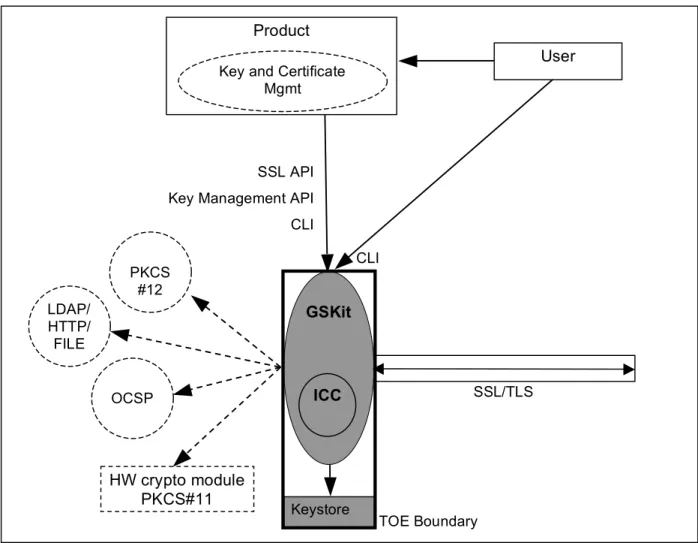
The following figure provides an overview of the TOE within its intended environment. Dotted lines mark optional components which may be left out. White boxes show components that are part of the environment. The TOE components have been colored dark grey and the box surrounding them shows the TOE boundary. The secure channel set up by the TOE is the box named SSL/TLS. The TOE can use either its internal ICC software crypto module or an external hardware module in the IT environment for cryptographic operations, and in lieu of the TOE keystore again the external hardware module can be used for key and certificate storage.
Figure 2: TOE Interfaces and Boundaries
2.4.2
TOE and User Interfaces
GSKit offers three interfaces to the user: the Key Management API and CLI for key and certificate management functions as well as the SSL API. The CLI is the only interface to human users. The APIs and also the CLI are used by IT products (applications) that want to integrate and use the functions of the TOE.
The SSL API is used by an IT product in the TOE environment to request the TOE to setup or to use a SSLv3 or TLSv1 connection. A SSL/TLS connection goes from the TOE to a remote trusted IT product allowing them to exchange data over this trusted channel. The setup of a SSL/TLS connection can be initiated either by the TOE (then the TOE is in client mode and the remote trusted IT product in server mode) or by the remote trusted IT product (then the TOE is in server mode and the remote trusted IT product in client mode).
The Key Management API and the CLI are for key and certificate generation and management.
GSKit
ICC
Keystore SSL API Key Management API CLI
Product
Key and CertificateMgmt
User
TOE Boundary LDAP/ HTTP/ FILE SSL/TLS CLI OCSP PKCS #12HW crypto module
PKCS#11
GSKit implements the LDAP API to access a TOE external LDAP client as an optional part of its certificate management functions (to retrieve a current and correct CRL). The LDAP client used for this purpose is not part of the TOE but an optional part of the TOE environment. The interface to the LDAP client is not offered to the user; the information needed by the LDAP client to connect to the correct LDAP server is specified in the function calls of the SSL API. Likewise, GSKit can issue HTTP requests to web servers to retrieve CRLs or interpret a FILE URI to locate a CRL in the file system of its host system.
The TOE uses interfaces to the underlying operating system to store TSF data in the keystore (files in the operating system’s filesystem), retrieve the system time and to access the TCP/IP stack. The TCP/IP stack is accessed using one of two
methods controlled by the product using GSKit. In the first method, the application program passes a file descriptor directly to GSKit for use in writing and reading to the TCP/IP stack. In the second method, the application program passes a pointer to callback routines for reading and writing.
2.4.3
Operating Systems and TOE Security Architecture
The operating system is not part of the TOE. It provides identification and authorization for TOE users, and a time source to be used by the TOE for certificate validation. The operating system is also responsible to protect the access to TOE services, the GSKit software, TSF data, and the keystore. As such, it provides significant support for the security of the TSF and TSF data: the TOE itself has only limited ability to protect against the corruption of TSF (i.e. the ICC module implements basic self-checks to satisfy FIPS 140-2 requirements). The underlying operating system is responsible for preventing bypass of the TSF or compromise of the TOE and its data by restricting access to authorized users only.
The TOE is provided in form of multiple binaries that have been compiled for the different operating systems supported by GSKit and the hardware architectures these operating systems run on. The TOE does not interface hardware directly, but receives direct support for its security functions from the operating system. A direct dependency of the TSF on the underlying operating system is for the provision of a reliable time source for certificate validation. Indirect dependencies exist as elaborated above.
The table below identifies the GSKit binaries that are part of the evaluated configuration, and for each of them the operating system versions they have been tested on and the additional operating system versions that the evaluation results can be extended to. For each GSKit binary, the operating system versions listed for a binary in the “Compatibility” column have been found to provide the necessary support functions in the same way as the operating system version that is actually used for testing (column “Test Environment”) during the evaluation. Compatibility is claimed in accordance with CCEVS Precedent PD-0084.
TOE binary version Test Environment Compatibility Sun Solaris 32-bit, running on Sparc and
Ultrasparc
Solaris 9 with 111712-08 Solaris 7, 8, 9, 10
Sun Solaris 64-bit, running on Ultrasparc Solaris 9 with 111712-08 Solaris 7, 8, 9, 10 HPUX 32-bit, running on PA-RISC1 and
PA_RISC2 architectures
HPUX 11i with PHSS26946, PHSS_33033
HPUX 11.0, 11i, 11iV2, 11iv3
HPUX 64-bit, running on PA-RISC2 architectures.
HPUX 11i with PHSS26946, PHSS_33033
HPUX 11.0, 11i, 11iV2, 11iv3
IBM AIX 32-bit, running on PPC32 & PPC64 architectures
AIX 5.2 patch level 5200-04 xlC.aix50.rte.6.0.0.3 or later
AIX 4.3.3, 5.1, 5.2, 5.3
IBM AIX 64-bit, running on PPC64 architectures
AIX 5.2 patch level 5200-04 xlC.aix50.rte.6.0.0.3 or later
AIX 5.2, 5.3
Microsoft Windows 32-bit, running on IA32 architectures
Windows Server 2003 SP1 Windows NT, XP, 2000, 2003, Vista, and future version
Microsoft Windows 64-bit, running on AMD x86_64 architectures
Windows Server 2003 SP 1 Windows 2003, Vista
RedHat Enterprise Linux 32-bit, running on IA32 architectures
RHEL 4.0 AS
compat-gcc-32-c++-3.2.3-46.1.i386.rpm
UL 1.0 RHEL 2.1 AS, WS; RHEL 3.0 AS, ES, WS; RHEL 4.0 ES; RHEL 5.0
TOE binary version Test Environment Compatibility
compat-gcc-32-3.2.3-46.1.i386.rpm
compat-libstdc++-33-3.2.3-46.1.i386.rpm
RedHat Enterprise Linux 32-bit, running on PPC32 & PPC64 architectures
RHEL 4.0 AS UL 1.0 RHEL 3.0 AS, ES, WS; RHEL
4.0 AS RHEL 5.0 RedHat Enterprise Linux 32-bit, running on
s390/zSeries architectures
RHEL 4.0 AS UL 1.0 RHEL 3.0 AS; RHEL 4.0 AS
RHEL 5.0 RedHat Enterprise Linux 64-bit, running on
AMD x86_64 architectures
RHEL 4.0 AS UL 1.0 RHEL 3.0 WS, AS; RHEL 4.0
WS, AS, ES; RHEL 5.0 RedHat Enterprise Linux 64-bit, running on
PPC64 architectures
RHEL 4.0 AS RHEL 3.0 AS, ES, WS; RHEL 4.0 AS
RHEL 5.0 RedHat Enterprise Linux 64-bit, running on
zSeries architectures
RHEL 4.0 AS UL 1.0 RHEL 3.0 AS; RHEL 4.0 AS
RHEL 5.0 SUSE Linux Enterprise Server 32-bit,
running on IA32 architectures
SLES 9.1 UL 1.0 SLES 8, 9, 10
SUSE Linux Enterprise Server 32-bit, running on PPC32 & PPC64 architectures
SLES 9.1 UL 1.0 SLES 8, 9, 10
SUSE Linux Enterprise Server 32-bit, running on s390/zSeries architectures
SLES 9.0 UL 1.0 SLES 8, 9,10
SUSE Linux Enterprise Server 64-bit, running on AMD x86_64 architectures
SLES 8.0 UL 1.0 SLES 8, 9, 10
SUSE Linux Enterprise Server 64-bit, running on PPC64 architectures
SLES 9.1 SLES 8, 9, 10
SUSE Linux Enterprise Server 64-bit, running on zSeries architectures
SLES 9.0 SLES 8, 9, 10
The underlying operating system has to be configured to disallow remote login (by disabling all services that provide remote login). This is due to the FIPS 140-2 level 1 security policy [ICCSEC]. It is the consumer’s responsibility to ensure that the evaluated configuration of GSKit is only executed on operating systems that have been covered by the FIPS 140-2 validation of GSKit’s ICC module.
2.4.4
Certificates
Certificates are either provided by the TOE environment or generated by the TOE. Even though the TOE is normally not used for implementing a PKI, using a self-generated certificate for testing or for an application in a closed environment is a needed functionality. Further needed certificate management functionality, especially the generation of CRLs if used for certificate validation or functions needed by the product deploying the TOE, has to be provided by the TOE environment.
2.4.5
iKeyman, and Keystore
With GSKit Version 7d, iKeyman can be used as a GUI for key/certificate generation and management. iKeyman is not part of the TOE; instead the Key Management API and CLI are offered to the user. If iKeyman is to be used, it will be as part of the TOE environment, i.e. of the product that integrates the TOE into itself.
The password-protected keystore can be used by the TOE for the storage of key data. The password used to protect the keystore must be generated by the TOE; user-defined passwords must not be used. The TOE checks the password when it is entered for the first time against a quality metric but that metric does not test the randomness of the password. The password
must not be revealed to anyone. In order to ensure the secure operation of the keystore, the TOE has to be configured by the product deploying it to be in CC mode (see chapter 2.2.4 for an explanation of CC mode).
The files used to implement the keystore are located in the operating system. The TOE environment is responsible for ensuring that all access to these files is mediated via the GSKit Key Management API and for protecting these files from unauthorized access.
2.4.6
CRLs
CRLs can be used for certificate validation. If CRLs are used for certificate validation, it is the responsibility of the TOE environment to provide a current and correct CRL.
CRLs can be retrieved using an LDAP client and server, an HTTP server, or a flat file in the TOE environment. For LDAP or HTTP, an LDAP client and server, or an HTTP server, must be provided by the TOE environment. In case of LDAP, the TOE accesses the LDAP client via the LDAP client’s API. Then the LDAP client establishes a TCP/IP connection to the LDAP server, retrieves the CRL, and passes this CRL back to the TOE. In case of HTTP, the TOE issues HTTP requests to the web server. In case of flat files, the TOE retrieves the CRL from the underlying system’s file system. The retrieved CRL is finally used for certificate validation.
The connection between the LDAP client and the LDAP server, or between the TOE and the HTTP server, must be an internal communication link within a trusted network since this is done over an unprotected TCP/IP connection. This is needed in order to avoid DoS attacks or replay attacks.
2.4.7
OCSP
GSKit supports the Online Certificate Status Protocol as specified in RFC 2560 [RFC2560] to query a responder in the IT environment for the revocation status of a certificate. If OCSP is used for certificate validation, it is the responsibility of the TOE environment to provide a trusted OCSP responder.
2.4.8
Crypto Modules
In addition to its own cryptographic software module, ICC, GSKit also provides support for the use of hardware crypto modules (e. g. IBM 4758) via PKCS#11 for the execution of cryptographic primitives and the storage of keys and certificates. Such modules must be validated according to FIPS 140-1 or 140-2 and must be operated in their Approved mode of operation. The cryptographic operations accessed via PKCS#11 are the same as provided by ICC (see section 2.2.2).
GSKit implements PKCS#11 version 2.10 [PKCS#11-2.10] augmented with the AES mechanism definition and support specified in PKCS#11 version 2.20 [PKCS#11-2.20].
It is also possible to use the BSAFE library with GSKit; however this is not allowed for the evaluated configuration. Furthermore, the use of the Microsoft Crypto API is prohibited in the evaluated configuration.
3
TOE Security Environment
3.1
Introduction
The statement of TOE security environment describes the security aspects of the environment in which the TOE is intended to be used and the manner in which it is expected to be deployed.
To this end, the statement of TOE security environment identifies the list of assumptions made on the operational environment (including physical and procedural measures) and the intended method of use of the product, defines the threats that the product is designed to counter, and gives the organizational security policies with which the product is designed to comply.
3.2
Threats
The assumed security threats are listed below.
The IT assets to be protected comprise the information stored, processed or generated by the TOE. This information contains key data, data for cryptographic operations (like for example seeds for random data needed for key generation) as well as the data to be transferred over the trusted channel.
The purpose of the TOE is to provide a secure channel between itself and a remote trusted IT product. This secure channel is used by a product (application) of the TOE environment. Threats concerning information confidentiality and integrity of the TOE code and TSF data are mainly countered by the TOE environment; the TOE only has to provide a correct
implementation of the secure channel such that the data transmitted over it is protected and to secure the data that is to be stored in the keystore.
The threat agents can be categorized as either:
1. A user (not a user of the TOE) who gets access to data communicated over unprotected networks (“remote attacker”). This person has no access to the TOE interfaces and no access to the system the TOE is integrated into.
2. A user (not a user of the TOE) who gets access to the TOE code, TSF data, or the keystore (e. g. on a backup tape or by getting access to the disk where it is stored on).
3. An authorized user of the TOE environment who has been granted the right to access the TOE using one or many of the interfaces (SSL API, command line interface, Key Management API).
In the first and second cases, the users are assumed to be potentially hostile with a clear motivation to get access to the data. The threat TE.BYPASS deals with threat agents of category 1, the threat TE.ACCESS with threat agents of category 2. The authorized user is a user allowed to use the TOE. Authorized users (i.e. human users or products deploying the TOE) are assumed to be trustworthy and they will not attempt to subvert or bypass the TOE security functions. An administrator of the TOE or TOE environment is also included in this category. An administrator is assumed to be competent and trustworthy. Authorized users do not pose a threat.
3.2.1
Threats countered by the TOE
Due to the nature of the TOE, the security functionality is derived from organizational security policies the TOE enforces. Therefore no threats to be countered by the TOE are listed.
3.2.2
Threats to be countered by measures within the TOE environment
The following threats to the system need to be countered in the TOE environment:
TE.ACCESS TOE functions, TOE code, and security attributes may be accessible for unauthorized modification and user data or TSF data may be accessible for unauthorized disclosure, access, and modification (for example modification of the TOE or cryptographic data) by users that have gained local access to the system the TOE is integrated to or to backup data.
TE.BYPASS CRLs may be transmitted from LDAP or HTTP servers to the TOE over unprotected
communication channels such that they may be modified or deleted by a remote attacker. No trusted channel can be set up if no CRL can be retrieved or the retrieved CRL is corrupted (i.e. not current or broken). If with a replay attack a technically still valid CRL that does not contain all revoked certificate information is resent, a trusted channel might be established for a revoked certificate.
3.3
Organizational Security Policies
The TOE complies with the following organizational security policies:
P.MODE FIPS mode and CC mode must be set for the TOE. This also ensures that the TOE shall be operated in a configuration compliant to the FIPS validated configuration of the ICC component described in the FIPS 140-2 level 1 security policy for ICC [ICCSEC].
P.KEYSTORE Private keys must be protected from unauthorized disclosure when they are stored in the keystore. In addition to that, a mechanism against undetected modification of the whole of the key data stored in the keystore must be provided.
P.SECCHANNEL The TOE shall offer a product of the TOE environment the functionality to communicate with a remote trusted IT product using a cryptographically secured trusted channel that protects the confidentiality and integrity of data being transmitted over this channel and provides the ability to authenticate the communication partners before transmitting user data that requires protection. User data and secret TSF data of a session must be protected such that they are not available to other sessions.
P.SELFSEC The TOE shall implement self-tests for cryptographic modules and failure detection with preservation of a secure state for the trusted channel component
P.TRANSFER The TOE shall be able to exchange TSF data with entities in the TOE environment.
3.4
Assumptions
This section indicates the minimum physical and procedural measures required to maintain the security of the TOE. A.ADMIN Those responsible for the administration of the TOE and the TOE environment are competent
and trustworthy individuals, capable of managing the TOE and the TOE environment and the security of the information it contains.
A.CERTIFICATES The TOE environment is responsible for the management and generation of the certificates. A.INTEGRATE Those who integrate the TOE as part of a larger product or system are assumed to follow the
guidance provided with the TOE with respect to the configuration of the TOE, the use of TOE functions and interfaces and the protection of the TOE code and data. They are trustworthy and do not try to subvert or bypass TOE security functions.
A.LDAP If a CRL is required by the TOE, the TOE environment must provide a valid, current CRL. A.OCSP OCSP responders used by the TOE are trustworthy.
A.PASSWORD Users knowing the password to protect the keystore will apply high protection measures that prohibit unauthorized access to or disclosure of password information.
4
Security Objectives
This section defines the security objectives of the TOE and its operational and development environment. Security
objectives for the operational environment are either categorized as IT security objectives or as non-IT security objectives. The intent of the security objectives is to counter all identified threats and to comply with the given assumptions and organizational security policies.
4.1
Security Objectives for the TOE
O.KEYSTORE The TOE must protect private keys stored in the keystore from unauthorized disclosure. In addition to that, the whole of the data stored in the keystore must be protected against undetected
modification.
O.SECCHANNEL The TOE shall offer a product in the TOE environment the functionality to communicate with a remote trusted IT product using a trusted channel that protects the confidentiality and integrity of user data being transmitted over this channel and provides the ability to authenticate the
communication partners before transmitting user data that requires protection.
O.SELFSEC The TOE must implement self-tests for cryptographic modules and failure detection with preservation of a secure state for the trusted channel component.
O.SESSIONDATA The TOE must protect secret TSF data (private/secret keys, session keys, and critical security parameters) of its individual trusted channel sessions and must ensure that no such data is made available to other trusted channel sessions also provided by the TOE.
O.TRANSFER The TOE must be able to consistently interpret TSF data that is exchanged with entities in the IT environment via PKCS#11, PKCS#12.
4.2
Security Objectives for the TOE Environment
4.2.1
TOE Operational Environment
4.2.1.1
IT Security Objectives
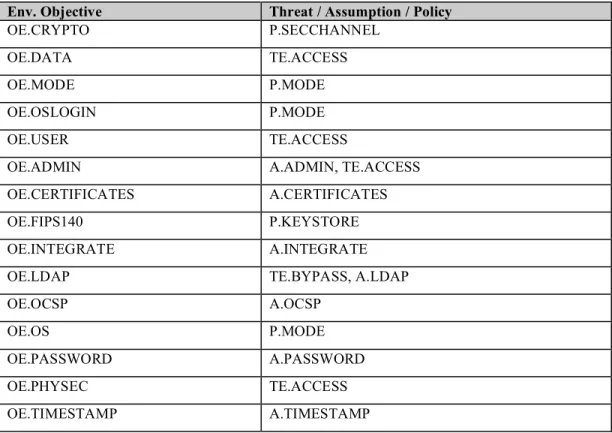
OE.CRYPTO If the TOE is configured to use a hardware crypto module in the IT environment for the storage of cryptographic keys and certificates and/or the provision of cryptographic operations, the environment must provide such a hardware module accessible via PKCS#11. The hardware module must authenticate GSKit before granting access to stored key material.
OE.DATA The TOE environment (e.g. the operating system) must protect the TOE code from unauthorized modification and user data and TSF data from unauthorized disclosure, access, and
modification. This includes also the protection of the TOE against other applications in the TOE environment.
OE.MODE The TOE must be initialized to operate in FIPS mode and CC mode.
OE.OSLOGIN Remote login to the operating system must be disabled (by disabling all services that offer remote login).
OE.TIMESTAMP The environment must provide reliable timestamps.
OE.USER The environment must only allow authorized users to access the TOE.
4.2.1.2
Non-IT Security Objectives
OE.ADMIN Those responsible for the administration of the TOE must be trained such that they are capable of managing the TOE and the security of the information it contains; this includes making sure that any backup copies of TSF data are appropriately protected. Administrators are trustworthy. OE.CERTIFICATES The TOE environment is responsible for the management and generation of the certificates.
OE.FIPS140 If hardware crypto modules are employed in the IT environment, they must be FIPS 140-1 or 140-2 validated and operated in their Approved mode of operation.
OE.INTEGRATE Those who integrate the TOE as part of a larger product or system are following the guidance provided with the TOE with respect to the configuration of the TOE, the use of TOE functions and interfaces and the protection of the TOE code and data. They are trustworthy and do not try to subvert or bypass TOE security functions.
OE.LDAP If a CRL is required by the TOE, the TOE environment must provide a valid, current CRL. If CRLs are provided via LDAP client and server or HTTP server, then the TCP/IP connection to the server must be an internal communication link within a protected network. CRLs provided are valid, current CRLs conformant to [X.509].
OE.OCSP If OCSP is to be used, those responsible for the TOE operations must ensure that only trustworthy OCSP responders are used to provide certificate status to the TOE.
OE.OS On the server the TOE is running, only operating systems that are covered by the FIPS 140-2 level 1 certificate for the ICC component may be used.
OE.PASSWORD Users knowing the password to protect the keystore must apply protection measures that prohibit unauthorized access to or disclosure of password information.
OE.PHYSEC The processing resources of the TOE must be located within controlled access facilities such that they are protected against unauthorized physical access.
5
Security Requirements
5.1
TOE Security Functional Requirements
This section gives the security functional requirements (SFRs) of the TOE. The SFRs FPT_TST_WEAK.1 and
FPT_ETT_GSK.1 have been defined in the style of [CC] part 2 and the SFR FTP_ITC.1 has been replaced by an explicitly stated SFR, FTP_ITC_PD-0108.1, as described in [PD-0108]. All other SFRs are taken from [CC] part 2.
The following formatting styles have been used for the SFRs: Assignments and selections: bold text
Refinements: bold and italic text
Explicit SFRs: italic text; to identify assignments and selections in explicit SFRs, bold and italic text is used; to identify refinements, bold and non-italic text is used.
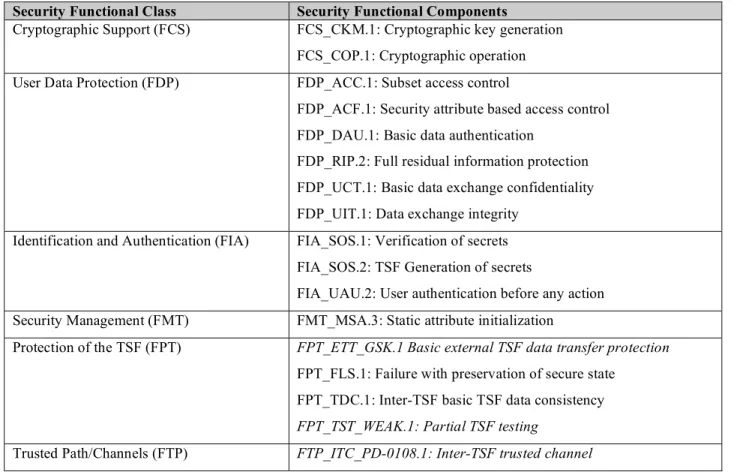
Table 5-1: Security Functional Requirements of the TOE Security Functional Class Security Functional Components
Cryptographic Support (FCS) FCS_CKM.1: Cryptographic key generation FCS_COP.1: Cryptographic operation User Data Protection (FDP) FDP_ACC.1: Subset access control
FDP_ACF.1: Security attribute based access control FDP_DAU.1: Basic data authentication
FDP_RIP.2: Full residual information protection FDP_UCT.1: Basic data exchange confidentiality FDP_UIT.1: Data exchange integrity
Identification and Authentication (FIA) FIA_SOS.1: Verification of secrets FIA_SOS.2: TSF Generation of secrets
FIA_UAU.2: User authentication before any action Security Management (FMT) FMT_MSA.3: Static attribute initialization
Protection of the TSF (FPT) FPT_ETT_GSK.1 Basic external TSF data transfer protection FPT_FLS.1: Failure with preservation of secure state
FPT_TDC.1: Inter-TSF basic TSF data consistency FPT_TST_WEAK.1: Partial TSF testing
Trusted Path/Channels (FTP) FTP_ITC_PD-0108.1: Inter-TSF trusted channel
Three explicit security functional requirements are defined in this Security Target: FPT_ETT_GSK.1 Basic external TSF data transfer protection
FPT_TST_WEAK.1 Partial TSF testing FTP_ITC_PD-0108.1 Inter-TSF trusted channel
The following section provides the definitions. The rationale for those explicit security functional requirements is given in chapter 7.2.1.
FPT_ETT_GSK.1 Basic external TSF data self-protection Hierarchical to: No other components.
FPT_ETT_GSK.1.1
The TSF shall protect [assignment: list of TSF data] from [selection: disclosure, undetected modification] when it is transmitted outside of the TSC.FPT_ETT_GSK.1.2
The TSF shall use [assignment: list of standards that are applicable]. Dependencies: No dependenciesThere are no actions identified that should be auditable if FAU_GEN Security audit data generation is included in the PP/ST.
The following actions could be considered for the management functions in FMT:
a) The management of the list of types of TSF data that must be protected when it is transmitted outside of the TSF; b) management of the types of modification against which the TSF should protect;
c) management of the mechanism used to provide the protection of the data transmitted outside of the TSC.
FPT_TST_WEAK.1 Partial TSF testing
FPT_TST_WEAK.1 Partial TSF testing Hierarchical to: No other components.
FPT_TST_WEAK.1.1
The TSF shall run a suite of self tests [selection: during initial start-up, periodically during normal operation, at the request of the authorised user, at the conditions [assignment: conditions under which self test should occur]] to demonstrate the correct operation of [selection: [assignment: parts of TSF], the TSF].FPT_TST_WEAK.1.2
The TSF shall provide authorised users with the capability to verify the integrity of [selection: [assignment: parts of the TSF data], the TSF data].Dependencies: FPT_AMT.1 Abstract machine testing
The following actions should be audited if FAU_GEN Security audit data generation is included in the PP/ST: a) Basic: Execution of the TSF self tests and the results of the tests.
The following actions could be considered for the management functions in FMT:
a) Management of the conditions under which TSF self testing occurs, such as during initial start-up, regular interval, or under specified conditions;
b) management of the time interval if appropriate.
FTP_ITC_PD-0108.1 Inter-TSF trusted channel
FTP_ITC_PD-0108.1 Inter-TSF trusted channel Hierarchical to: No other components.
FTP_ITC_PD-0108.1.1
The TSF shall provide a communication channel between itself and a remote trusted IT product that is logically distinct from other communication channels and provides assured identification of its end points and protection of the channel data from modification or disclosure.FTP_ITC_PD-0108.1.2
The TSF shall permit [selection: the TSF, the remote trusted IT product] to initiate communication via the trusted channel.FTP_ITC_PD-0108.1.3
The TSF shall use a trusted channel for the following functions [assignment: list of functions for which a trusted channel is required].Dependencies: No dependencies
a) Minimal: Failure of the trusted channel functions.
b) Minimal: Identification of the initiator and target of failed trusted channel functions. c) Basic: All attempted uses of the trusted channel functions.
d) Basic: Identification of the initiator and target of all trusted channel functions. The following actions could be considered for the management functions in FMT:
a) Configuring the actions that require trusted channel, if supported.
Note: Use of the explicitly specified requirement replacement does not imply a responsibility for the TSF under evaluation to ensure that a remote TSF performs a particular action; rather, the TSF under evaluation is only required to use the channel for the indicated purpose if the channel is initiated. There is no requirement for the evaluator to verify that the remote TSF initiates the channel.
Note: When this modified version of FTP_ITC.1.3 is used, there should also be an accompanying note that explains that the rationale for this explicit requirement is that it corrects an error identified by CCEVS in the requirement and an interpretation is being created by NIAP to correct the offending wording.
5.1.1
Cryptographic Support (FCS)
5.1.1.1
Cryptographic key generation (FCS_CKM.1(a))
FCS_CKM.1.1
The TSF shall generate symmetric cryptographic keys in accordance with a specified cryptographic key generation algorithma) SSLv3 symmetric key and secret generation, b) TLSv1 symmetric key and secret generation and specified cryptographic key sizes
a) 168 Bits (three independent TDEA keys), b) 128 and 256 Bits (AES key),
c) 160 Bits (HMAC SHA-1 secret) that meet the following:
a) conformant to SSLv3 [SSLv3] (SSLv3 symmetric key and secret generation), b) conformant to RFC 2246 [TLSv1] with RFC 3268 [TLS_AES] (TLSv1 symmetric
key and secret generation).
5.1.1.2
Cryptographic key generation (FCS_CKM.1(b))
FCS_CKM.1.1
The TSF shall generate asymmetric cryptographic keys in accordance with a specified cryptographic key generation algorithm RSA and specified cryptographic key sizes 1024 and 2048 Bits that meet the following:conformant to RFC 2313 [RFC2313].
5.1.1.3
Cryptographic operation (FCS_COP.1 (a))
FCS_COP.1.1
The TSF shall perform symmetric encryption and symmetric decryption in accordance with a specified cryptographic algorithma) TDEA with three independent keys (CBC mode) , b) AES (CBC mode)
b) 128, 256 Bits (AES) that meet the following:
a) conformant to FIPS 46-3 [FIPS46-3] (TDEA), conformant to FIPS 81 [FIPS81] (CBC mode), b) conformant to FIPS 197 [FIPS197] (AES, CBC mode),
and FIPS 140-2 [FIPS140-2] approved.
5.1.1.4
Cryptographic operation (FCS_COP.1(b))
FCS_COP.1.1
The TSF shall perform digest generation and verification in accordance with a specified cryptographic algorithma) SHA-1 b) MD5
and cryptographic key sizes none that meet the following:
a) conformant to the Secure Hash Standard (SHS) as defined in FIPS 180-2 [FIPS180-2] and FIPS 140-2 [FIPS140-2] approved (SHA-1),
b) conformant to RFC 1321 [RFC1321] (MD5).
5.1.1.5
Cryptographic operation (FCS_COP.1(c))
FCS_COP.1.1
The TSF shall perform data authentication in accordance with a specified cryptographic algorithm HMAC SHA-1 and cryptographic key sizes 160 Bits (HMAC SHA-1) that meet the following conformant to FIPS 198 [FIPS198] (HMAC) and FIPS 180-2 [FIPS180-2] (SHA-1).5.1.1.6
Cryptographic operation (FCS_COP.1(d))
FCS_COP.1.1
The TSF shall perform encryption and decryption of session key related data in accordance with a specified cryptographic algorithm RSA and cryptographic key sizes 1024 or 2048 Bits that meet the following:conformant to RFC 2437 [RFC2437] and RFC 2313 [RFC2313] (RSA) and
encryption/decryption of session key related data as defined in The SSL Protocol, Version 3 [SSLv3] and RFC 2246 [TLSv1].
5.1.1.7
Cryptographic operation (FCS_COP.1(e))
FCS_COP.1.1
The TSF shall perform generation of random numbers in accordance with a specified cryptographic algorithm Universal Software Base True Random Number Generator algorithm andcryptographic key sizes none that meet the following:
the requirements in FIPS 186-2 [FIPS186-2], Appendix 3.2 as required in FIPS 140-2 annex C [FIPS140-2] and FIPS 140-2 level 1 [FIPS140-2] approved.
Application note: The Universal Software Base True Random Number Generator (Universal Base TRNG) algorithm has
been invented by IBM. It is patented in Europe [EPRAND] and the patent is pending in the US.
Application note: The random number generator uses timing jitter as entropy source.
5.1.1.8
Cryptographic operation (FCS_COP.1(f))
FCS_COP.1.1
The TSF shall perform digital signature generation in accordance with a specified cryptographic algorithm RSA with SHA-1 message digest and cryptographic key sizes 1024 or 2048 Bits (RSA) that meet the following:conformant to RFC 2437 [RFC2437] and RFC 2313 [RFC2313] (RSA) and FIPS 180-2 [FIPS180-2] (SHA-1).