Effects of patient load and travel distance on
HIV transmission in rural China: Implications
for treatment as prevention
M. Kumi Smith1*, William C. Miller2, Huixin Liu3, Chuanyi Ning4, Wensheng He5, Myron S. Cohen4, Ning Wang6
1 Department of Epidemiology, University of North Carolina Chapel Hill, Chapel Hill, North Carolina, United
States of America, 2 Ohio State University College of Public Health, Columbus, Ohio, United States of America, 3 Department of Clinical Epidemiology, Peking University People’s Hospital, Beijing, People’s Republic of China, 4 University of North Carolina Institute for Global Health and Infectious Diseases, University of North Carolina, Chapel Hill, North Carolina, United States of America, 5 Zhumadian City Centers for Disease Control, Zhumadian, Henan, People’s Republic of China, 6 National Centre for AIDS/STD Control and Prevention, China Centers for Disease Control and Prevention, Beijing, People’s Republic of China
Abstract
Background
Sustained viral suppression through ART reduces sexual HIV transmission risk, but may require routine access to reliable and effective medical care which may be difficult to obtain in resource constrained areas. We investigated the roles of patient load and travel distance to HIV care clinic on transmission risk in HIV serodiscordant couples in Henan Province, China.
Methods
Cox proportional hazard models were used to compare HIV transmission events across couples living near, medium, or farther distances from their assigned HIV care clinics, as well as those attending clinics where clinicians bore high versus low patient loads.
Results
Most (844%) of the 3695 serodiscordant couples lived within 10 kilometers of their assigned HIV clinic, and most (735%) attended clinics with patient-to-provider ratios of at least 100:1. In adjusted Cox models, attending clinics where clinicians bore average patient loads of 100 or more elevated HIV transmission risk (aHR, 150, 95% CI, 100–484), an effect amplified in vil-lage tier clinics (aHR = 155; 95% CI, 123–678). Travel distance was associated with HIV transmission only after stratification; traveling medium distances to village clinics (5-10km) in-creased transmission risk (aHR = 183, 95% CI, 104–321) whereas traveling longer distances to township or county level clinics lowered transmission risk (aHR = 010, 95% CI, 001–075).
Conclusion
Higher patient loads at HIV clinics was associated with risk of HIV transmission in our popu-lation, particularly at village level clinics. Farther travel distance had divergent effects based a1111111111
a1111111111 a1111111111 a1111111111 a1111111111
OPEN ACCESS
Citation: Smith MK, Miller WC, Liu H, Ning C, He
W, Cohen MS, et al. (2017) Effects of patient load and travel distance on HIV transmission in rural China: Implications for treatment as prevention. PLoS ONE 12(5): e0177976.https://doi.org/ 10.1371/journal.pone.0177976
Editor: Linda A. Selvey, University of Queensland,
AUSTRALIA
Received: June 16, 2016
Accepted: May 6, 2017
Published: May 31, 2017
Copyright:©2017 Smith et al. This is an open access article distributed under the terms of the Creative Commons Attribution License, which permits unrestricted use, distribution, and reproduction in any medium, provided the original author and source are credited.
Data Availability Statement: This data is property
on clinic tier, suggesting unique mechanisms operating across levels of resource availabil-ity. The resource intensity of long-term HIV treatment may place significant strains on small rural clinics, for which investments in additional support staff or time-saving tools such as point-of-care laboratory testing may bring about impactful change in treatment outcomes.
Introduction
Universal antiretroviral therapy (ART) coverage is a central pillar of the global HIV agenda, [1–3] fueled by the twin goals of equitable drug access and HIV disease eradication through transmission prevention.[4] ART coverage rates continue to improve on a global scale;[5] yet access remains uneven resulting in higher transmission rates and poorer treatment outcomes in lower income and more socially marginalized HIV patients. The success of a global treat-ment as prevention strategy will depend on its ability to adapt to diverse geographies, health-care environments, and resource availability.
“Implementation science” is a multidisciplinary field that seeks to close the gap between interventions proven to work in trial settings and effective delivery of these tools in the real world.[6] Past research on HIV treatment outcomes in community settings have found that patient access to routine healthcare is a key determinant sustained viral suppression, suggest-ing these factors may also shape the efficacy of ART as a means of prevention. Reports from the US and sub-Saharan Africa, for example, find that weaker patient-provider relationships [7–9] or poorer physical access to care clinics[10–13] predict greater loss of HIV patient fol-low-up and poorer treatment adherence in treated patients. Similarly in China, tier of HIV care (village clinics versus township or county level hospitals) has predicted higher rates of virological failure[14] and drug resistance.[15,16]
Such findings underscore the importance of the treatment environment in determining HIV transmission patterns in settings where ART coverage is already quite high.[17] To explore the relationship between treatment access and transmission in such settings, we used available data from a well-studied cohort of HIV serodiscordant couples[18–20] in China, where ART is free and universal.[21] By measuring the impact of factors such as patient load and travel distance on the risk of sexual HIV transmission between partners, this analysis pro-vides a better understanding of the role of the healthcare environment in the preventive utility of ART.
Methods
Study setting and population
The study cohort arises from a population of HIV infected individuals in central China where regional blood selling scandals in the 1990’s led to mass HIV transmission of up to 30,000 people, mostly poor farmers, through unsanitary blood collection practices.[22] In response, the national government established a free national ART program in 2002, in which HIV in-fected individuals are eligible to receive, free of charge, the following: first-line ART, annual viral load and quarterly CD4 testing, and coverage for a predetermined list of essential medi-cines for common opportunistic infections associated with HIV [17]. The program has been noted for its rapid roll out and success—mortality in treated HIV patients fell from 393 to 142 deaths per 100 person-years between 2000 and 2009.[17] Within Henan province, the epi-center of the blood selling HIV epidemic, over one-third of HIV-infected persons live in the prefecture of Zhumadian, where the data used in this analysis were collected.[23]
Funding: This work was supported by Chinese
Government grant under the 12th Five-Year Plan (2012ZX10001-002) and the National Institute of Allergy and Infectious Disease (T32 AI007001; T32 AI102623). MKS was also supported by the Fulbright-Hayes Fellowship for Dissertation Research Abroad.
Competing interests: The authors have declared
Success of China’s ART program has been attributed to its exploitation of the existing three-tier healthcare system (Table 1), in which a subset of facilities in each county is desig-nated to specialize in HIV care based on the geographical distribution of patients.[24] Patients access free ART and related medical care at their assigned HIV care clinics, which may be a village, town, or county level site depending on their county’s delivery strategy. Severe cases may be transferred up the chain of referral if more specialized care is needed; however, rates of government subsidization fall significantly for care received at each tier above the patient’s assigned care clinic. Independent care seeking outside of this referral net-work is possible; however, patients who do so bear the entirety of incurred medical costs themselves.
Following a mass HIV screening campaign in 2004, local disease control centers identified what were thought to be the majority of HIV infected persons in the study prefecture, and began follow-up of those with uninfected spouses in order to monitor HIV transmission events. Eligible couples must meet the following criteria:1) registered residents living in the study prefecture of Zhumadian, 2) over 16 years of age (the age of legal consent in China), 3) in a stable marriage (no separation or divorce), 4) one partner confirmed to be HIV seroposi-tive and the other seronegaseroposi-tive, and 5) willing to provide informed consent. HIV status of both partners is confirmed at enrollment through enzyme-linked immunosorbent assay (ELISA, Lizhu, Zhuhai, Guangdong Province; Xinzhuang, Xiamen, Fujian Province) conducted by county-level CDC’s, and positive test results are confirmed by western blot assay (Ou’ya, Hangzhou, Zhejiang Province). This analysis considered all visits made between October 2006 and September 2012.
Enrolled cohort members participate in annual surveys with trained staff from county level disease control centers. Each partner takes part in separate face-to-face interviews to provide information on demographic characteristics and HIV-related risk factors including sexual behaviors within and without the primary partnership, history of ever having a diagnosis for sexually transmitted infections, and history of having ever injected drugs, donating blood, or undergoing a blood transfusion. Initially infected (or index) partners provide updated infor-mation on ART treatment and incidents of opportunistic infection.
Exposure, outcome and other covariates
We assessed two primary exposures of interest: average patient load at each HIV care clinic and distance in kilometers (km) from couples’ home villages to their assigned clinics. Relevant clinic-specific information was solicited from a written survey administered to county health officials in September 2013, which collected data on numbers of medical staff and HIV/AIDS patients in follow-up at each clinic. Average patient load was then calculated as the ratio of patients to clinicians—nurses, non-physician clinicians (staff who are not trained as physicians but who are capable of many of the diagnostic and clinical functions of medical doctors), and Table 1. Feature of the three tiers of healthcare entities providing HIV care in Zhumadian.
Village clinic Township health center County level hospital-based clinics
Services Basic health services including physical examination and drug dispensation by non-physician clinicians.
Primary healthcare and supervision of village clinics. Full time pharmacists.
Larger medical center with referral and specialty services. Full time pharmacists.
Medical Staff One full-time or several part-time non-physician clinicians.
Several full time physicians. Full time physician clinicians; usually staffed within an infectious disease ward. Laboratory
testing capacity
No on site laboratory; all lab samples are transported to higher level laboratories for testing.
Some CD4 cell count monitoring capacity; no VL monitoring capacity.
Full CD4 and VL monitoring capacity.
physicians—at each HIV care clinic. Each type of coding for patient load—continuous, cate-gorical, and quadratic spline—was plotted against predicted risk of HIV transmission to inform its final coding as a three-category variable of low (<50), medium: (50 and<100) and high (100) patients per clinician.
Distance was measured from patients’ home villages to their assigned HIV care clinics by using addresses reported in the study dataset or, where missing, from the national surveillance databases. The names of the assigned HIV care clinics were obtained from the same survey administered to county officials in 2013. Three coders (authors MKS, HXL, and CYN) used web-based geomapping software (Gaode Ditu:http://ditu.amap.com/) to manually enter ori-gin (patient’s home village) and destination (assigned clinic) addresses in order to estimate the length in km of the most likely pedestrian path traveled between the two points. Each distance was measured by two coders, between which discrepancies of greater than 10km were resolved through discussion and remeasurement by the two coders. In all other cases the shorter dis-tance was used. Coding of the disdis-tance variable was explored using a similar approach as with patient load, which informed our final coding as near (<5km), medium (5km and<10km), and far (10km).
The primary outcome of interest was HIV transmission, assessed from HIV antibody screening of non-index partners at annual visits. Those who screened positive were contacted for confirmatory testing, post-test counseling, and evaluation for treatment eligibility. Sero-conversion was calculated as the midpoint between the date of the last HIV-negative or inde-terminate test, and three months before the date of the first HIV-positive test to provide an average window period for seroconversion. Couples experiencing the outcome were censored in the interval in which estimated seroconversion occurred; those who remained discordant throughout the study were censored on the date of their last HIV-negative test date.
Statistical analyses
Analysis was restricted to couples in which the index partner was treatment naïve at their ini-tial visit, but who initiated ART at some point over the course of follow-up. This minimized potential bias induced by under-ascertainment of higher transmission risk earlier in patients’ treatment course, due to say, incomplete viral suppression in new ART users, and from the inability to control for baseline factors such as CD4 that are themselves affected by the treat-ment.[25]
Hazard ratios to assess associations between healthcare access and HIV transmission risk were estimated using Cox proportional hazard models. Plots of the hazards over time stratified by distance subgroups were examined to confirm proportionality of hazards over time, and we used directed acyclic graphs to identify the minimally sufficient set of potential confounders of the association between healthcare exposures and HIV transmission.[26] Statistical analyses were conducted in SAS 93 (SAS Institute Inc, Cary, NC, USA) and maps were created in Arc-GIS 103 (Environmental Systems Research Institute, Redlands, CA, USA).
Results
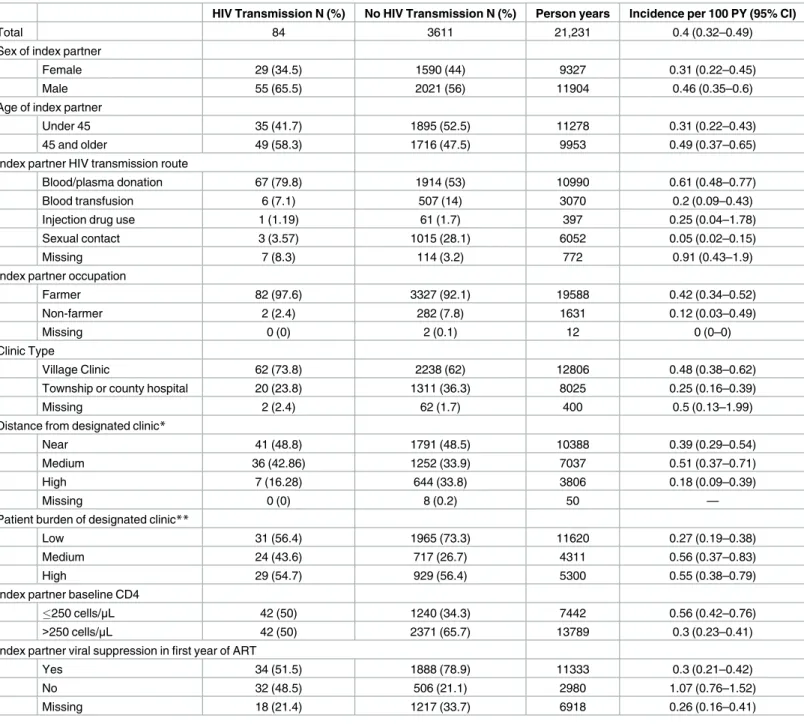
Overall, 3695 treated HIV patients and their spouses contributed 21,231 person-years (PY) (Table 2). Most (844%) of the 3695 serodiscordant couples lived within 10 kilometers of their assigned HIV clinic, and most (735%) attended clinics with patient-to-provider ratios of at least 100:1. Median age of index partners was 44 years (range, 18–78) more than half (562%) of whom were male. About half (53.6%) of index partners (56.6% of whom were male and
Table 2. Characteristics of the 3965 HIV serodiscordant couples included in the final analysis.
HIV Transmission N (%) No HIV Transmission N (%) Person years Incidence per 100 PY (95% CI)
Total 84 3611 21,231 0.4 (0.32–0.49)
Sex of index partner
Female 29 (34.5) 1590 (44) 9327 0.31 (0.22–0.45)
Male 55 (65.5) 2021 (56) 11904 0.46 (0.35–0.6)
Age of index partner
Under 45 35 (41.7) 1895 (52.5) 11278 0.31 (0.22–0.43)
45 and older 49 (58.3) 1716 (47.5) 9953 0.49 (0.37–0.65)
Index partner HIV transmission route
Blood/plasma donation 67 (79.8) 1914 (53) 10990 0.61 (0.48–0.77)
Blood transfusion 6 (7.1) 507 (14) 3070 0.2 (0.09–0.43)
Injection drug use 1 (1.19) 61 (1.7) 397 0.25 (0.04–1.78)
Sexual contact 3 (3.57) 1015 (28.1) 6052 0.05 (0.02–0.15)
Missing 7 (8.3) 114 (3.2) 772 0.91 (0.43–1.9)
Index partner occupation
Farmer 82 (97.6) 3327 (92.1) 19588 0.42 (0.34–0.52)
Non-farmer 2 (2.4) 282 (7.8) 1631 0.12 (0.03–0.49)
Missing 0 (0) 2 (0.1) 12 0 (0–0)
Clinic Type
Village Clinic 62 (73.8) 2238 (62) 12806 0.48 (0.38–0.62)
Township or county hospital 20 (23.8) 1311 (36.3) 8025 0.25 (0.16–0.39)
Missing 2 (2.4) 62 (1.7) 400 0.5 (0.13–1.99)
Distance from designated clinic*
Near 41 (48.8) 1791 (48.5) 10388 0.39 (0.29–0.54)
Medium 36 (42.86) 1252 (33.9) 7037 0.51 (0.37–0.71)
High 7 (16.28) 644 (33.8) 3806 0.18 (0.09–0.39)
Missing 0 (0) 8 (0.2) 50 —
Patient burden of designated clinic**
Low 31 (56.4) 1965 (73.3) 11620 0.27 (0.19–0.38)
Medium 24 (43.6) 717 (26.7) 4311 0.56 (0.37–0.83)
High 29 (54.7) 929 (56.4) 5300 0.55 (0.38–0.79)
Index partner baseline CD4
250 cells/μL 42 (50) 1240 (34.3) 7442 0.56 (0.42–0.76)
>250 cells/μL 42 (50) 2371 (65.7) 13789 0.3 (0.23–0.41)
Index partner viral suppression in first year of ART
Yes 34 (51.5) 1888 (78.9) 11333 0.3 (0.21–0.42)
No 32 (48.5) 506 (21.1) 2980 1.07 (0.76–1.52)
Missing 18 (21.4) 1217 (33.7) 6918 0.26 (0.16–0.41)
*Near:<5km; Medium:5km and10km; Far:>10km
**Low:<50 patients; Medium:50 and100 patients; Far:>100 patients
43.4% of whom were female) reported blood or plasma selling as their initial route of HIV infection.
Overall, 84 HIV transmission events occurred during the study (incidence rate 040 cases per 100 person years; 95% confidence intervals [CI], 032–049). In unadjusted bivariable anal-yses, HIV transmission rates were higher for couples whose index partners had the following characteristics: male sex, infected with HIV through blood/plasma selling, had a baseline CD4 cell count below 250 cells/mm3, and were assigned to an HIV care clinic with more than 50 patients per clinician.
Clinic tier and distribution varied widely by county (Fig 1). Most HIV care clinics in our study settings were township level healthcare clinics (N = 90), as opposed to village clinics (N = 65) or clinics based out of county hospitals (N = 4;Table 3). Median patient load per cli-nician varied greatly by tier of care, with the greatest load borne by clicli-nicians at village clinics (median 481 patients per clinician), with similarly lower loads borne by clinicians at township and county level clinics (median 286 and 239 patients per clinician, respectively). The patient volume of hospital-based clinics was similar to village clinics, but larger staff at these upper tier centers diluted the patient load (hospital-based clinics had median staff counts of 45 versus 1.4 at village clinics). Patients in our cohort also lived a wide range of distances from their assigned clinics, with most (844%) living within 10km and a small minority (176%) living
Fig 1. Map of the 10 counties of Zhumadian, a prefectural level city, showing county-level HIV prevalence (units: Cases per 10,000) averaged over the entire study period.
10km or more away. Average distances traveled nearly doubled for each increase in tier of care (from 63 to 120 to 241 km), though distances varied the most among the subset traveling to county level hospital-based clinics (Fig 2).
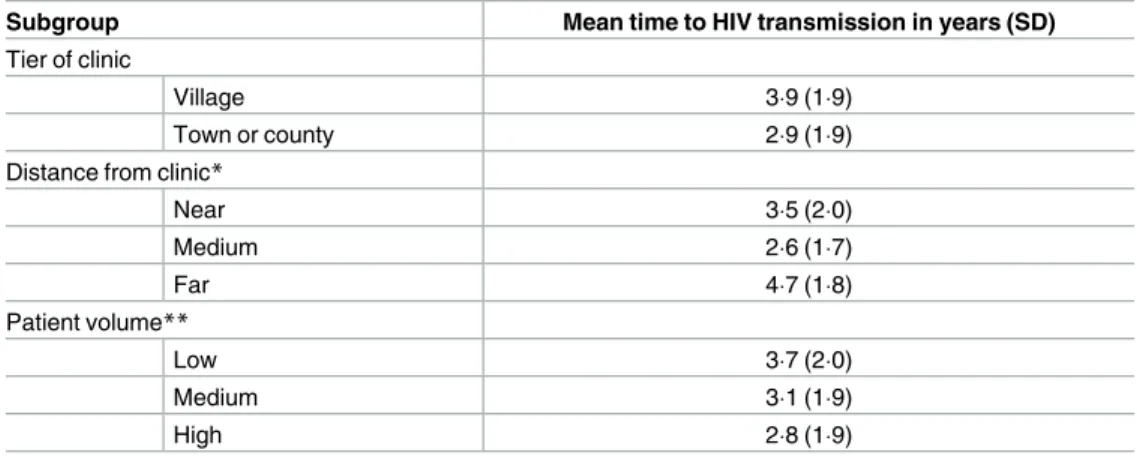
Mean times to transmission (Table 4) varied across healthcare access exposures, and were shorter among couples assigned to HIV care at non-village clinics (29 versus 39 years), those living a medium distance from their care clinics (26 versus 35 or 47 years), and those assigned to clinics where clinicians faced average patient loads greater than 100 (28 versus 31 or 37).
Effects of patient load of HIV care clinics on HIV transmission
Analysis of the overall population found that couples assigned to HIV care clinics with 50 to 100 patients or more than 100 patients per clinician had about 30% higher rate of transmission (unadjusted HR = 131, 95% CI, 121–352; HR = 129, 95% CI, 131–361, respectively) as com-pared to those at clinics where clinicians had lower patient loads (Table 5). After adjustment the effect in each level of patient load on HIV transmission rates increased (aHR = 146, 95% CI, 093–412; aHR = 150, 95% CI, 100–484, respectively), though measures became less precise.
When stratified by clinic tier, unadjusted models of the impact of patient load per clinician on HIV transmission produced rate estimates that were 45% and 40% higher in mid-level and Table 3. Characteristics of village, township, and county-level HIV clinics in Zhumadian City.
Village clinic Township health center County level hospital-based clinic
(N = 65) (N = 90) (N = 4)
Mean (median)
Number of treated patients per clinic 877 (500) 464 (345) 885 (730)
Number of medical staff per clinic 14 (10) 17 (20) 45 (30)
Number of patients per clinician 481 (320) 286 (240) 239 (236)
Distance traveled to clinic 63 (56) 120 (35) 241 (255)
https://doi.org/10.1371/journal.pone.0177976.t003
Fig 2. Maps of Zhumadian City showing A) median patient-to-provider ratios and B) median distance from patient homes to clinic.
high patient loads, respectively, in those assigned to village clinics (HR = 145, 95% CI, 147– 637; HR = 140, 95% CI, 154–572). A similar pattern followed in patients at township/county level clinics, though these measures of effect lacked precision. Following adjustment for con-founding, transmission risk in each exposure category and across both tiers of care increased; however, only the measure among village level patients treated at the clinics with highest patient loads (100 or more patients per clinician) retained statistical significance (aHR = 155, 95% CI, 123–678;Table 5A).
Effects of distance from HIV care center on HIV transmission
In analyses of the overall population, unadjusted Cox models showed that relative to living near (within 5 km) one’s assigned HIV clinic, those living between 5 and 10km had elevated rates of HIV transmission (HR = 135, 95% CI, 086–211) whereas those farthest away (over 10 km away) had lower rates (HR = 046, 95% CI, 021–102). Neither of these results was sta-tistically significant. Following adjustment the effects of living a medium or farther distance from one’s assigned clinic only slightly moved each estimates closer towards the null (aHR = 122, 95% CI, 077–193; aHR = 050, 95% CI, 022–112, respectively).
Stratification by tier of care revealed differences in direction and magnitude of these effects. Whereas unadjusted models estimated that those living medium and farther distances from their village level clinics had elevated rates of HIV transmission (HR = 160, 95% CI, 091– 279; HR = 111, 95% CI, 044–278); this same association was reversed among those assigned to township/county clinics (HR = 020, 95% CI, 003–150; HR = 010, 95% CI, 001–075). Only the protective effect of living beyond 10 km from one’s township/county clinics was sta-tistically significant. Adjustment did not substantially alter stratified estimates, except in the case of those living medium distances from their village clinics among whom HIV transmis-sion risk was 83% higher than those living close to their village clinics (HR = 183, 95% CI, 104–321;Table 5B).
Discussion
We observed that patients assigned to HIV care clinics where clinicians faced high patient loads (>100 per person) had a higher risk of HIV transmission; this effect was enhanced at Table 4. Mean time to transmission among couples across sub-categories of the exposures.
Subgroup Mean time to HIV transmission in years (SD)
Tier of clinic
Village 39 (19)
Town or county 29 (19)
Distance from clinic*
Near 35 (20)
Medium 26 (17)
Far 47 (18)
Patient volume**
Low 37 (20)
Medium 31 (19)
High 28 (19)
SD: standard deviation
*Near:<5km; Medium:5km and10km; Far:>10km
**Low:<50 patients; Medium:50 and100 patients; High:>100 patients
village clinics but less prominent at township and county clinics. Those treated at clinics with medium patient loads (10 to 50 patients per clinician) also had slightly elevated transmission risk, though this measure lacked precision. Regarding overall effects of travel distance, living at medium distances (between 5 and 10 km) from one’s assigned clinic increased HIV transmis-sion risk, whereas living far (over 10 km) from one’s clinics wasprotective against transmis-sion. Stratification identified even more extreme effects within tiers: the harmful effects of traveling medium distances were even more so when traveling to village clinics; similarly, pro-tective effects of farther distances were even more beneficial when traveling to township or county level clinics.
The impact of high patient load on HIV transmission suggests that clinic resources and ade-quate visit time with clinicians play an important role in helping patients sustain viral suppres-sion, especially in lower tier clinics. Adequate visit time is a vital to building stronger patient-provider relationships, a factor that has been linked to better health outcomes in HIV patients in the US.[7–9] Our finding that high patient load was even more detrimental against HIV pre-vention in village sites suggests that the burden of too many patients is experienced even more acutely by village doctors, who often work with fewer physical resources and training.
Distance decay, or the worsening of health outcomes with longer travel distance, is evident in the fact that those traveling medium distances faced higher transmission risk than those traveling the shortest distances. That this effect was amplified in patients traveling to village clinics suggests that geographical access to routine care may be as important as the quality of Table 5. Assessment of the impact of healthcare access across tiers of care. Hazard ratios in Table A compare risk of transmission between couples
assigned to clinics in which clinicians on average have between 50 and 100 (medium) or more than 100 patients (high), versus fewer than 50 patients. Hazard ratios in Table A compare risk of transmission among couples living between 5 and 10 km (medium) and more than 10 km (far), versus those living less than 5 km from their assigned clinic.
A. Effect of the patient load per clinician at assigned clinic
Exposure class* Overall Village tier Town/County tier
Crude HR (95% CI)
Low 100 100 100
Medium 131 (121–352) 145 (147–637) 156 (093–535)
High 129 (131–361) 140 (154–572) 433 (004–1389)
Adjusted HR†(95% CI) Low 100 100 100
Medium 146 (093–412) 164 (082–573) 169 (078–612)
High 150 (100–484) 155 (123–678) 445 (005–1575)
B. Effect of distance to assigned clinic
Exposure class‡ Overall Village tier Town/County tier
Crude HR (95% CI)
Near 100 100 100
Medium 135 (086–211) 160 (091–279) 020 (003–150)
Far 046 (021–102) 111 (044–278) 010 (001–075)
Adjusted HR†(95% CI) Near 100 100 100
Medium 122 (077–193) 183 (104–321) 019 (002–140)
Far 050 (022–112) 113 (045–283) 010 (001–075)
HR: hazard ratio; CI: confidence interval
*Low:<50 patients; Medium:50 and100 patients; High:>100 patients
†Adjusted models included variables for clinic type, distance from clinic (if not already included as the exposure), patient volume (if not already included as the exposure), age, sex, and occupation. Stratified analyses show results of the unadjusted and adjusted models using interaction terms for clinic type (village level vs. town or county level).
‡ Near:<5km; Medium:5km and10km; Far:>10km
the care received once there. Reasons why those travelingmore than10 km for care at higher tier clinics had lower HIV transmission risk are unclear, but patients may value care from higher tier clinics differently, travel to which may be perceived as less of a burden. Although we did not formally assess respondents’ perceptions of care quality, other studies have found that Chinese HIV patients valued care from urban hospitals more than that from rural clinics, [27] and that distance was less of a burden to patients with concerns about the quality of care. [28,29] The link between patients’ confidence in their healthcare system and their tolerance for travel may therefore be a key mediator in predicting their treatment outcomes.
Two key features of this analysis inform interpretation of our results. First, distance was measured from patients’ homes to theirdesignated—but not necessarily preferred—HIV care clinic. Distances for any patients seeking care at other clinics would therefore be mis-mea-sured, though the direction of this bias or the extent of this problem is not assessable. Anec-dotal evidence suggests that preferential clinic seeking outside of the referral chain is relatively uncommon in this study setting, likely due to the prohibitive cost burden of doing so. Second, we hypothesized that regular access to quality healthcare plays a reinforcing role in helping HIV patients sustain viral suppression through greater exposure to adherence counseling, ear-lier identification of virological failure, treatment of opportunistic infections, and maintenance of optimal drug regimens. We could not validate this hypothesis, however, because we lacked viral load data to link to our measures of healthcare access—patient volume and travel dis-tance—with the outcome of HIV transmission risk. A final limitation in our assessment of association is potential for confounding bias residual from incomplete adjustment in our models.
Findings from this analysis support several modest recommendations in our study prefec-ture and other geographically similar regions. First, system wide improvements to reduce virological failure (and therefore HIV transmission events) would benefit from targeting of resources—additional support staff or specialized tools such as point-of-care viral load testing [30]—in particular for high volume, lower-tier clinics. Second, the outsized role of patients’ perceptions of care quality on their health outcomes could mean strategies to alter their per-ceptions, such as the aforementioned injection of resources into lower tier clinics, or through field visits or clinician trainings conducted by prominent HIV physicians, might not only improve care quality but also signal stronger intent by health officials to narrow disparities in quality.
As China’s rapidly developing healthcare system generates greater inequities in healthcare access,[31] emerging treatment as prevention programs may do well to prioritize attainable short term goals such as more responsive management of human resources and investment in specialized clinical technologies to streamline care. In ensuring that rural Chinese HIV patients attain the minimum standards intended by WHO treatment guidelines, we may do more to move the epidemic closer towards eradication by treatment.
Acknowledgments
Author Contributions
Conceptualization: MKS WCM HL NW MSC.
Data curation: MKS WH NW HL.
Formal analysis: MKS.
Funding acquisition: NW.
Methodology: MKS WCM HL.
Project administration: NW.
Resources: NW WH.
Supervision: MKS.
Validation: MKS HL CN.
Visualization: MKS.
Writing – original draft: MKS.
Writing – review & editing: MKS WCM HL NW.
References
1. Department of Health and Human Services, Health D, Department of Health, Services H. Panel on Anti-retroviral Guidelines for Adults and Adolescents. Guidelines for the use of antiAnti-retroviral agents in HIV-1-infected adults and adolescents.aidsinfo.nih.gov. 2013;
2. British HIV Association. British HIV Association guidelines for the treatment of HIV-1-positive adults with antiretroviral therapy 2012. HIV Med. 2014; 15 Suppl 1(July 2012):1–85. Available from:http:// www.ncbi.nlm.nih.gov/pubmed/24330011
3. World Health Organization. Consolidated Guidelines on the Use of Antiretroviral Drugs for Treating and Preventing HIV Infection: Recommendations for a Public Health Approach. 2013. Available from:http:// apps.who.int/iris/bitstream/10665/85321/1/9789241505727_eng.pdf?ua=1
4. Granich R, Williams B. HIV treatment: time to lean forward. Lancet. 2016; 387(10013):27.https://doi. org/10.1016/S0140-6736(15)01293-3PMID:26766341
5. Joint United Nations Programme on HIV/AIDS (UNAIDS). AIDS by the numbers. World AIDS Day Report. 2015. Available from:http://www.unaids.org/sites/default/files/media_asset/AIDS_by_the_ numbers_2015_en.pdf
6. Lambdin BH, Cheng B, Peter T, Mbwambo J, Apollo T, Dunbar M, et al. Implementing implementation science: an approach for HIV prevention, care and treatment programs. Curr Hiv Res. 2015; 13(3):244– 9.https://doi.org/10.2174/1570162X1303150506185423PMID:25986374
7. Roberts KJ. Physician-patient relationships, patient satisfaction, and antiretroviral medication Adher-ence among HIV-infected adults attending a public health clinic. AIDS Patient Care STDS. 2002; 16 (1):43–50.https://doi.org/10.1089/108729102753429398PMID:11839218
8. Beach MC, Keruly J, Moore RD. Is the quality of the patient-provider relationship associated with better adherence and health outcomes for patients with HIV? J Gen Intern Med. 2006; 21(6):661–5.https:// doi.org/10.1111/j.1525-1497.2006.00399.xPMID:16808754
9. Davis-michaud M, Yurk R, Lansky D, Asch S, Wu AW. Quality Care for People with HIV / AIDS: Patients’ Perspectives. 2004; 5(6):406–15.https://doi.org/10.1310/GQ98-PGK7-0T97-47XHPMID:
15682354
10. Conley NJ, Pavlinac PB, Guthrie BL, Mackelprang RD, Muiru AN, Choi RY, et al. Distance from home to study clinic and risk of follow-up interruption in a cohort of HIV-1-discordant couples in Nairobi, Kenya. PLoS One. 2012; 7(8):e43138.https://doi.org/10.1371/journal.pone.0043138PMID:22937017 11. Siedner MJ, Lankowski AJ, Tsai AC, Muzoora C, Martin JN, Hunt PW, et al. GPS-measured distance to
12. Lankowski AJ, Siedner MJ, Bangsberg DR, Tsai AC. Impact of geographic and transportation-related barriers on HIV outcomes in sub-Saharan Africa: a systematic review. AIDS Behav. 2014 Jul; 18 (7):1199–223.https://doi.org/10.1007/s10461-014-0729-8PMID:24563115
13. Tanser F, Gijsbertsen B, Herbst K. Modelling and understanding primary health care accessibility and utilization in rural South Africa: An exploration using a geographical information system. Soc Sci Med. 2006; 63(3):691–705.https://doi.org/10.1016/j.socscimed.2006.01.015PMID:16574290
14. Ma Y, Zhao D, Yu L, Bulterys M, Robinson M, Zhao Y, et al. Predictors of virologic failure in HIV-1-infected adults receiving first-line antiretroviral therapy in 8 provinces in China. Clin Infect Dis. 2010 Jan 15; 50(2):264–71.https://doi.org/10.1086/649215PMID:20017637
15. Xing H, Wang X, Liao L, Ma Y, Su B, Fu J, et al. Incidence and associated factors of HIV drug resistance in Chinese HIV-infected patients receiving antiretroviral treatment. PLoS One. 2013; 8(4):e62408.
https://doi.org/10.1371/journal.pone.0062408PMID:23638072
16. Liu H, Ma Y, Su Y, Smith MK, Liu Y, Jin Y, et al. Emerging Trends of HIV Drug Resistance in Chinese HIV-Infected Patients Receiving First-Line Highly Active Antiretroviral Therapy: A Systematic Review and Meta-Analysis. Clin Infect Dis. 2014 Jul 22;1–8.
17. Zhang F, Dou Z, Ma Y, Zhang Y, Zhao Y, Zhao D, et al. Effect of earlier initiation of antiretroviral treat-ment and increased treattreat-ment coverage on HIV-related mortality in China: a national observational cohort study. Lancet Infect Dis. 2011 Jul; 11(7):516–24. https://doi.org/10.1016/S1473-3099(11)70097-4PMID:21600849
18. Smith MK, Westreich D, Liu H, Zhu L, Wang L, He W, et al. Treatment to Prevent HIV Transmission in Serodiscordant Couples in Henan, China, 2006 to 2012. Clin Infect Dis. 2015; 61(1).
19. Wang L, Wang L, Smith MK, Li L, Ming S, Lu J, et al. Heterosexual transmission of HIV and related risk factors among serodiscordant couples in Henan province, China. Chin Med J (Engl). 2013; 126 (19):3694–700.
20. Wang L, Ge Z, Jing L, Shan D, Gao X, Ding G, et al. HIV transmission risk among serodiscordant cou-ples: a retrospective study of former plasma donors in Henan, China. J Acquir Immune Defic Syndr. 2010; 55(2):232–8.https://doi.org/10.1097/QAI.0b013e3181e9b6b7PMID:21423851
21. Wu Z, Sullivan S, Wang Y, Rotheram-Borus M, Detels R. Evolution of China’s response to HIV/AIDS. Lancet. 2007 Feb 24; 369(9562):679–90.https://doi.org/10.1016/S0140-6736(07)60315-8PMID:
17321313
22. Wu Z, Rou K, Detels R. Prevalence of HIV infection among former commercial plasma donors in rural eastern China. Health Policy Plan. 2001 Mar; 16(1):41–6. PMID:11238429
23. Wang L. Overview of the HIV/AIDS epidemic, scientific research and government responses in China. AIDS. 2007 Dec; 21 Suppl 8:S3–7.
24. Ma Y, Zhang F, Zhao Y, Zang C, Zhao D, Dou Z, et al. Cohort profile: the Chinese national free antiretro-viral treatment cohort. Int J Epidemiol. 2010 Aug; 39(4):973–9.https://doi.org/10.1093/ije/dyp233
PMID:19556327
25. Ray WA. Evaluating Medication Effects Outside of Clinical Trials: New-User Designs. Am J Epidemiol. 2003; 158(9):915–20. PMID:14585769
26. Greenland S, Pearl J, Robins JM. Causal diagrams for epidemiologic research. Epidemiology. 1999 Jan; 10(1):37–48. PMID:9888278
27. Chen W- T, Starks H, Shiu C-S, Fredericksen-Goldsen K, Simoni J, Zhang F, et al. Chinese HIV-Posi-tive Patients and Their Healthcare Providers: Contrasting Confucian versus Western Notions of Secrecy and Support. Adv Nurs Sci. 2007; 30(4):329–42.
28. Qian D, Pong RW, Yin A, Nagarajan K V, Meng Q. Determinants of health care demand in poor, rural China: the case of Gansu Province. Health Policy Plan. 2009 Sep; 24(5):324–34.https://doi.org/10. 1093/heapol/czp016PMID:19429698
29. Lei P, Jolibert A. A three-model comparison of the relationship between quality, satisfaction and loyalty: an empirical study of the Chinese healthcare system. BMC Health Serv Res. BMC Health Services Research; 2012 Jan; 12(1):436.
30. Wilson DP, Keiluhu a K, Kogrum S, Reid T, Seriratana N, Ford N, et al. HIV-1 viral load monitoring: an opportunity to reinforce treatment adherence in a resource-limited setting in Thailand. Trans R Soc Trop Med Hyg]. 2009 Jun; 103(6):601–6.