1
A modern reception of Pride and Prejudice in Dutch
Do Dutch readers prefer a modernized translation?
Yvette van Diggele s0924784
MA Linguistics: Translation in Theory and Practice Supervisor: Katinka Zeven
2
Table of Contents
Chapter 1: Introduction ... 3
Chapter 2: Translation theories on 'modernization' ... 7
Chapter 3: Life in the era of Jane Austen ... 16
Chapter 4: Modernization in Dutch translations of Pride and Prejudice ... 21
4.1: Research question 1 ... 21
4.1.1: Excerpts and words and phrases from the two translations ... 21
4.1.2: Test 1 ... 26
4.1.3: Test 2 ... 28
4.1.4: Research question 1 answered ... 32
Chapter 5: the survey ... 34
5.1: The results from the survey in absolute numbers ... 35
5.2: Excerpt A ... 36
5.3: Excerpt B ... 42
5.4: Excerpt C ... 47
5.5: Excerpt D ... 52
5.6: Excerpt E ... 57
Chapter 6: Conclusion ... 63
Appendix ... 67
Part A: Screenshots of the results from the Corpus Hedendaags Nederlands ... 67
Part B: Screenshots of the online survey ... 77
Part C: Pie charts of the respondents’ answers ... 81
3
Chapter 1: Introduction
Should a translation of an archaic text be modernized to make the text more accessible to contemporary readers? Or should the feel of the time period of such a text be recreated by the translator? These questions posed by Brisset (344) are at the heart of this thesis. Brisset wonders if the works of authors such as Dante, Shakespeare or Chaucer should be translated into archaic language. This question could also be asked with regard to Jane Austen's work:
Is it possible to translate Austen’s characters from their spatial and temporal
locations in late eighteenth-century and early nineteenth-century England? Should one even try? There is an additional complicating layer of interpretative material for foreign readers and translators of Austen to navigate that seems to apply less to translations of other English authors. Her presumed inability to travel into other languages is felt to be because of her inherent Englishness, and seems to be linked to biographical certainties about the author herself. The portrait of the quiet Hampshire-loving spinster who never left the southern counties of England in life,or in her fiction, and who never spoke other languages than her own, has had a lasting legacy: as T.E. Kebbel put it in 1885, ‘Miss Austen could hardly be appreciated by anyone not thoroughly English.’ The question of how best to handle the ‘Englishness’ of the
author has been a continually vexed one when Pride and Prejudice is translated. In terms of translation theory, this has major implications. Here, the twenty-first-century scholar of Austen holds a different viewpoint from her nineteenth-twenty-first-century predecessors. Translation theorists now tend to view the purpose of translation as to provide a guide to the original, by which I mean an accurate sense of the ‘foreignness’ of the source text. The ‘foreignizing translation’ ethics of the influential scholar Lawrence Venuti insists on a model of translation that preserves the ‘strangeness’ of
the source language: to adopt any other model, Venuti argues, is to commit
ethnocentric violence. Nineteenth-century practitioners – the first translators of Pride and Prejudice – saw things somewhat differently. All early translations adopted the domesticating model of translation, in which the source text is made to fit the horizon of expectations of the reader in the target language. Through this translation model, Austen’s characters become less English, and more like characters who would be
4
English as he would himself have spoken, if he had been born in England, and in this present age’. Similarly, the anonymous Franco-Swiss translators in the Bibliothèque
Britannique made Austen speak such French as she would have spoken had she been born in Geneva in the early nineteenth century. This naturally affects Austen’s
language and style – it is a rare nineteenth-century translator who is able to deal effectively with Austen’s irony. It also affects her characterisation, giving us an Elizabeth and a Darcy who are quite unlike their English originals. (Dow 124 – 125)
In my thesis I will investigate the two different approaches a translator may take with regards to an older source text: source-oriented translation or target-oriented translation. A target-oriented translation focuses on its reception by the target readership and is adapted accordingly, while a source-oriented translation reproduces the original text as much as possible. As will be discussed in chapter 2 of this thesis, Holmes differentiates between retentive and recreative translations, which can be compared to source-oriented and target-oriented translations respectively. He considers historicizing translations retentive, as they retain historical aspects of the source text, and modernizing translations recreative. These terms will be explained more elaborately in chapter 2. I will look at two Dutch translations of Pride and Prejudice: Waan en Eigenwaan from 1980, and Trots en Vooroordeel from 2009. Based on general assumptions, I would expect to find translations that are mainly source-oriented, but with some target-oriented adaptations. If I read a translation of this 200-year-old novel I would expect that translation to reproduce the source text as much as possible, in order to retain the atmosphere of that period. I would expect my reading experience to be as close as possible to that of Austen's intended readership, nineteenth-century English readers (chapter 3 of this thesis will provide some background information on the values of Austen's era). However, I would also expect that the language use would be slightly more modern than in the source text, because I would not want the dated language to hinder my reading of the story.
mid-5
1990s (starting with the BBC's stupendously successful Pride and Prejudice)' (Harman 7). As Juliette Wells describes in her book on Austen's popularity, before this 1990s surge she only came into contact with Austen's work through her high-school and college curriculum. But when she first saw the Sense and Sensibility film, she became fascinated with Jane Austen (Wells 2 – 3).
As Harman puts it:
[Austen] is now a truly global phenomenon, known as much through film and
television adaptations of her stories as through the books themselves, revered by non-readers and scholars alike. Her influence reaches from the decoration of tea-towels to a defence of extreme pornography, and her fans have included Queen Victoria, E.M. Forster, B.B. King ('Jane Austen! I love Jane Austen!') and the editor of the lad-mag Nuts. As the title of one Austen blog has it, 'Jane Austen – She's Everywhere!',
endlessly referenced and name-dropped and part of today's multinational, multilingual, multicultural single currency. (Harman 2)
When the 1980 translation came out, Austen was not at all part of popular culture the way she is now. Readers of this translation would mostly have been students or scholars, or people who were interested in Austen's work. This readership would probably have been interested in Austen's original text. I therefore expect that this translation would be mainly source-oriented: staying close to the source text, reproducing it as closely as the target language allowed, preventing the 'ethnocentric violence' of a domesticating approach as described by Venuti.
The 2009 translation is a very different story. I expect this translation to be more adapted to a contemporary audience, since this audience would comprise people who
discovered Jane Austen through the many TV adaptations and movies inspired by her novels since the 1990s, including, for example, Bridget Jones' Diary or Becoming Jane. The
translation would likely have moved away from the source text and have been adapted for the contemporary audience in order to create a better understanding of the classic novel. In this way the 'book of the movie' (Harman 256), would be more accessible to the broad readership that reads Jane Austen nowadays.
In my thesis, I will investigate whether my expectations regarding the different approaches (a source-oriented approach in the 1980 Dutch translation of Pride and
6
7
Chapter 2: Translation theories on 'modernization'
Leena Laiho describes how the translation theorist Hans Vermeer argues that literary translation has the aim (or the 'skopos') of 'fidelity':
According to [Vermeer], translation has to be looked at as an action, and like any human action, translation, too, has an aim, a skopos, including literary translation. To the objection that “not every translation can be assigned a purpose, an intention”, i.e.
be goal-oriented, Vermeer answers by referring to the “fidelity” to the source text as one possible goal of translation. According to Vermeer, this is often the case with literary translators: they aim for a “maximally faithful imitation of the original”. (Laiho 307)
Out of the two translation approaches as discussed in chapter 1, which are the source-oriented and target-source-oriented translation approaches, Vermeer's 'fidelity' resembles the first most. In a source-oriented translation, the translator aims to reproduce the 'original' text as much as s/he possibly can. Source text features such as historical references or lexical,
stylistic or syntactical features are retained in the translation, in order to bring the reader close to the contents of the text as originally written by its author. A target-oriented translation does the opposite. In such a translation the translator focuses on how the translation will be
received by its target audience, and is adapted to the target reader. The translator does not try to alter as little as possible, but makes changes that s/he deems necessary for a successful reception in the target culture.
Lawrence Venuti has created the terms 'foreignization' and 'domestication' for these two opposite approaches. He describes foreignization as 'an ethnodeviant pressure on those (cultural) values to register the linguistic and cultural difference of the foreign text, sending the reader abroad' and domestication as 'an ethnocentric reduction of the foreign text to target-language cultural values, bring the author back home,' (Venuti 20).
Venuti's terms are based on Schleiermacher's distinction between two strategies: 'either the translator leaves the writer in peace as much as possible and moves the reader toward him, or he leaves the reader in peace as much as possible and moves the writer toward him,' (Munday 29).
8
features such as those mentioned above, with regards to source-oriented translation, are omitted . This approach truly brings the writer towards the reader, since the dated language use that might have stood in the way of the reader's enjoyment or understanding of the text has been abandoned. As James Holmes explains in one of his articles on translating dated poetry:
[T]he choice in each individual case may be to attempt to retain the specific aspect of the original poem, even though that aspect is now experienced as historical rather than as directly relevant today; this approach might be called “historicizing translation” or
“retentive translation”. Or the choice may be to seek “equivalents” (which are, of course, always equivalent only to a greater or lesser degree” to “re-create” a
contemporary relevance, an approach that could be called “modernizing translation” or “re-creative translation”. (Holmes 37)
Holmes also mentions that translating often involves the use of both approaches:
Both my experience as a translator of poetry and the study and analysis of a large number of verse translations by others have convinced me that such “pure culture” translations [either “all exoticizing and historicizing, with an emphasis on re-tention,
or all naturalizing and modernizing, with an emphasis on re-creation”] are rarely if ever actually made. In practice, translators […] perform a series of pragmatic choices,
here retentive, there re-creative, at this point historicizing or exoticizing, at that point modernizing or naturalizing […]. (Holmes 48)
Holmes distinguishes between retentive and recreative translations, which can be compared to source-oriented and target-oriented translations. He makes a further distinction between 'exoticizing and historicizing, with an emphasis on retention' and 'naturalizing and
modernizing, with an emphasis on re-creation,' (48). 'Exoticizing' seems to be very similar to 'foreignization', Holmes defining it as retaining source-language syntax, source-literature verse form and source-culture symbols and images, while 'naturalizing' resembles
9
'domestication' and foreignization' can be compared to target-oriented and source-oriented translation, and historicizing is part of source-oriented translation and modernizing is part of target-oriented translation. A historicized translation leaves the original, dated text in peace by using historic language in the translation as well, while the modernized translation is adapted for the modern target audience, making the translation less archaic than its source text is. Mathijssen, a Dutch translator of Shakespeare, confirms this view: 'In general, modernisation implies suiting something to the taste, style, or demands of the modern age (i.e. the present). It is another term for 'domesticating' as opposed to 'foreignising' with regard to the
socio-cultural situation. In the community of the theatre, the term 'modernisation' is closely related to the concept of actualisation (Dutch: “actualiseren”), which refers to the decision to adapt to
the actual or topical present' (Mathijssen 51).
The translator of a dated text will usually prefer to use either the historicizing or the modernizing approach, and this preferred approach will be visible in the translation:
The translator of older works […] is astride the past and the present: s/he serves two
masters, and travels not only between two languages but between two periods – the time of the text and that of its reception. S/he can take a historical approach or can modernize the text, choosing to root it more firmly in one period or the other. In a majority of cases, the translator takes a clear stand in relation to two apparently antithetical options: distance or proximity, remoteness or closeness. Over and above lexicological choices – [the translator] sets up a plan, which may or may not be deliberate, of how it will relate to the history of the language. There are basically two tendencies. Either the text is anchored in antiquated language, or the old text is
rendered in the most contemporary language possible. One can accentuate the author's time, or the [readership]'s time. This choice calls for an analysis of the text's
relationship with the past. The historic approach emphasizes what is over, what is unique and discontinued. Transposing the text into contemporary language, on the contrary, emphasizes underlying affinities; it underlines things that are permanent, and describes history as the return of the past, in a different guise. (Déprats 66-7)
In other words, while a historicized translation only stresses the text's antiquity, a modernized translation of a dated text stresses how the text is still relevant today and keeps this text accessible to present-day readers.
10
could be expected, translation theorists have not reached a conclusion on this subject. There is something to say for both approaches, and which of the two is better depends on the aim of the translator.
As Jean-Michel Déprats puts it:
The desire to translate Shakespeare into language that would correspond to century English is a legitimate one. What could be more honest than leaving the work to rest in its original linguistic and cultural environment, and keeping intact the threads that bind it to its epoch and historical context? […] The translator, a messenger of the past, cares more about the history of the language than anyone else. Translating can be perceived as the inaugural gesture for the survival of a work. The translator is the teacher of what has been lost, and takes on the role of curator for the history of the language. (Déprats 67)
Historicizing seems to be a rather important task of the translator then. The dated text is treated like a rare object from a lost time period, containing out-of-date language that needs to be preserved in modern times. Yet when Déprats introduces an example of a supporter of the historicizing translation approach, he seems rather doubtful while discussing its
practicality:
It remains to be seen what means can be used for this resurrection, for making this utopian prospect viable, so to speak. The 1899 translation of Hamlet by Eugène
Morand and Marcel Schwob provides an interesting example. Schwob objects strongly to modernized translation: “The critics here have not reflected on the fact that
sixteenth-century style is no longer the one at hand. Putting Shakespeare's language in today's mode would be about of the same order as wanting to translate a page from Rabelais into Voltaire's language. We have to keep in mind that Shakespeare was thinking and writing during the reigns of Henri IV and Louis XIII.” (Morand and
Schwob, Hamlet, Jacket Copy, my translation). (Déprats 68)
11
stage, but in so doing, however, it tends to deny us access to the text,' (71). He argues that:
Translating Dante or Shakespeare into fourteenth- or sixteenth-century French
inevitably means creating a period piece. […] Translating Shakespeare into “fictitious”
French from the end of the sixteenth century is an attempt to reproduce the
relationship of a present-day English speaker to a work that antedates him/her by four centuries. The contemporary aspect being aimed at in such a translation is that of the translation, the author, and the original recipients of the work. It risks, however, creating such a distance between its object and contemporary readers or spectators that it threatens to destroy the living relationship that exists between them and the text. (71)
Even if the translator were able to create a translation in perfect sixteenth-century French, which seems like an expert's task, it might still not be appreciated by the readers or spectators.
Creating a distance between the text and the reader to the extent that the text is no longer appreciated, is not the effect a translator aims for. It is certainly the opposite of the modernizing translator's aim: the successful reception of the translation in the target culture. Déprats gives us examples of translators who agree on the disadvantages of historicizing:
“The great problem in philological translation,” writes Antoine Berman, “is that it has
no horizon. By that I mean, not only in terms of principles of translation, but it is not anchored in the language and the literature of the culture into which it is being translated. The starting point for one's translation is always a certain state in one's language and culture.” (Antoine Berman, “La Traduction et la lettre ou l’auberge du lointain,” in Les Tours de Babel (Mauvezin: Trans-Europ-Repress, 1985), 134 (my
translation)). When Yves Bonnefoy was asked about his translation of Hamlet directed by Patrice Chéreau in 1988, he agreed: “A text has to be translated into the language
that is spoken today: there is nothing more dangerous than dreaming of translating Shakespeare […] in an imitation of our own language at the turn of the sixteenth century.” (“Un acte de poésie,” La Croix/L’Evénement (Sunday 10-Monday 11 July
1988), 5 (my translation). (Déprats 71)
12
opinion on the modernizing approach is the following:
The primary objective of the modern translation – more precisely, the deliberately modern translation – is to stay in touch, to fill the physical and mental gap that separates the public from the actors, and the text from its readership. The modern translation is not devoid of an initial falsehood either. The text that is presented to be heard or read must give the impression that it was written today. The historicity of the original text has been occluded and short-circuited. This is the way that most
translations are done, and it is for this reason that they must be redone every ten years. (72)
Because the translator creates a translation that comes across as modern, omitting the historic elements of the text, retranslations are an inevitable necessity with the modernizing approach. Compared to the historicized translation that needs no retranslation, the
modernizing approach is a never-ending process that needs to be updated every decade and involves much more work and cost. However, it seems a better choice than a historicized translation that does not even appeal to its readers because of its archaic language.
Rui Carvalho Homem summarizes Déprats' view on the matter of modernizing versus historicizing as follows:
For Déprats, the translator is always defined by a liminal situation, and when his/her text belongs to an already remote period that liminality finds him/her wavering between the pastness of the text and the presentness of the translator's circumstance and audience, and perpetually faced with the dilemma of whether to try and historicise or to modernise his/her linguistic medium. As Déprats shows, both attitudes have undeniable shortcomings, but the persuasiveness of his exposure of the specific pretence of archaisiation, and his identification of the rhetorical processes which buttress that artifice, leave little doubt as to which of the two possibilities he considers the lesser evil: archaising [= historicizing] translation, he eventually tells us, “tends to
deny us access to the text. Its only horizon is scholarly erudition; its only literary affinity is the pastiche.” Conversely, a modernised translation of Shakespeare can
wield the advantage, when its effect is compared to the conditions in which
13
when the original (source) text is presented to a contemporary audience. Déprat's critical consideration of the modernising option, though, is also alert to the losses involved in eliding the historical marks of the text or features of its cultural scope of reference, as well as to the overall rhetorical impoverishment effected by many modern translations. Ultimately, there is no escaping the historicity of the text(s), including that which situates and dates any one translation, the translation of that moment and circumstance, in all its contingency and ephemerality. (Homem 13-14)
Déprats thus believes modernization to be the better approach out of the two, but he holds that even a modernized translation must allow for historic elements that cannot be omitted.
Déprats argues that modernized translations need to be retranslated often. Mathijssen explains what retranslation entails: 'the term 'retranslation' refers to “subsequent translations of a text or part of a text, carried out after the initial translation that introduced this text to the 'same' target language” (Susam-Saraeva, 2003: 2). Generally, retranslations are associated
with the 'ageing' of translated texts. Dutch publisher Mark Pieters (2004) claims that after fifty years a translation can be considered obsolete,' (Mathijssen 17).
The two translations that I will be looking at in my thesis are both retranslations; as Gillian Dow informs us in her essay on the translation of Pride and Prejudice, the first Dutch Pride and Prejudice was published in 1946 (Dow 128). These retranslations could indeed have been published from the point of view that there was a need for modernized translations. My research, to be discussed later on in this thesis, will reveal whether the retranslations were modernized or historicized and which approach readers prefer.
Mathijssen expands on the concept of retranslation:
'introduction-14
translation'. Others will note, however, how retranslations render the source text more accessible to the reader of the day (Rodriguez, 1990; Gambier, 1994). Hence an emphasis on the time factor: there is a continuous necessity for retranslation because earlier translations need to be updated. At first sight, the latter hypothesis – closely connected to Bassnett's hypothesis on the ageing of texts – seems to be better suited to explain the repeated creation of retranslations, as they would follow the market of a changing target culture. (17)
From Mathijssen's explanation we can deduct that retranslations are indeed issued because there is a need for a modernized, updated version of the target text. Déprats' view that retranslations should be published every ten years, corresponds to the publisher Pieters' claim that translations become obsolete after fifty years. There is clearly a demand for modern retranslations, whether they are actually modernized or not.
It will become clear if the two Dutch translations of Pride and Prejudice that will be compared in my thesis were created from the viewpoint of the different translation
approaches. I expect to find out that Trots en Vooroordeel from 2009 is a generally modernized translation and that Waan en Eigenwaan from 1980 is a mainly historicized translation.
Whichever of the two approaches turns out to have been employed in either one of the translations, there is really something to say for both approaches:
Translation […] is indeed a mark of the past, transformed by the subjectivity of
another period and the sensitivity of the present that gives it shape. If we regard translation more as a relationship than as a transfer or a means of transport, archaism and modernism are no longer antinomic terms: they merely express two ways in which the present can establish its links with the past. Archaization is an imaginary
construction which builds up a certain image of the past. Modernization is another form of memory, out of which a different relationship is forged with the past, but it can escape neither from history nor from a historical context. In both cases, the truth of the translation must be envisaged, not in terms of adequacy, but in terms of
manifestation. (Déprats 78)
15
16
Chapter 3: Life in the era of Jane Austen
This chapter will provide some background information to give a better understanding of the historical context and themes that are present in the novel, such as social class and the role of conversations.
Jane Austen was born on 16 December 1775 in Steventon, a small village in
Hampshire, England. Her father, the Reverend George Austen, was a rector who had received an Oxford education and her mother was Cassandra Austen, from the aristocratic Leigh family. Austen was born into a large family, with five older brothers, one older sister and a younger brother.
The Austens were country gentry. This put them well beneath the British aristocracy and a niche below most baronets and squires of the wealthy landed gentry. Mr Austen lacked money and a good estate, but as an Oxford-educated clergyman he hovered at the gentry's lower fringes,' (Honan 29-30). Jane Austen's chances in life were similar to those of Elizabeth Bennet and her sisters, who are described by Markley as belonging to the 'emerging,
‘bourgeois’, upper-middle class; a minor branch of a social elite; or members of the ‘pseudo gentry’, or what we might call the aspirational gentry' (Markley 83). As Markley points out, in
Pride and Prejudice Elizabeth tells Lady Catherine that she belongs to the same class as Darcy: 'He is a gentleman; I am a gentleman’s daughter; so far we are equal' (Pride and
Prejudice 287). 'Elizabeth’s implied definition of a ‘gentleman’ is inclusive rather than exclusive, and it is this larger sense of accommodations among the gentry, nobility and well-bred merchant classes that the narrator ultimately endorses. […] Elizabeth’s status is in question only because her father’s estate is entailed to Mr Collins, severely limiting what she
can expect as a dowry or as independent settlement. (Markley 83-84)
In Austen's lifetime, an entail was a common means of keeping an estate within the family, and the original donor could decide the fate of many generations of heirs after his death. The landowner 'must take care of a property that his immediate descendants may not inherit' (Markley 85). This is the exact situation of Pride and Prejudice, where the estate will no longer be in the immediate family after Mr Bennet's death, but will be inherited by a cousin. The fact that the estate will pass out of the Bennet family harms Elizabeth's social status. As Markley explains, 'entails are not just legal instruments to preserve male lines of descent, but a means to impose restrictions on the property, incomes and indeed social status of future generations,' (85).
17
era's society and the doubtful position of women in this society. For example, 'women writers, as Austen well knew, were paid less than their male counterparts' (Markley 80). Marriage was an important means for women to climb the social ladder, 'since women were assumed to take their status from their husbands' (McMaster 115). When Elizabeth's best friend Charlotte decides to marry Mr Collins she acts in order to escape the fate of an old spinster with no fortune or status of her own.
Although Elizabeth cannot understand her friend would agree to marry an insufferable man, she knows that her own chances in marriage are limited:
Prospective husbands would have to be either rich aristocrats who do not have to worry about money or status (like Darcy); well-off merchants or attorneys willing to use marriage to buy their way into the gentry (like Bingley); or clergymen or army officers willing to marry without the prospect of being made rich by their wives. Elizabeth’s lack of a sizeable dowry explains, in part, her initial fascination with
George Wickham. (Markley 93)
Money was one of life's most important factors in Austen's time, and as Tandon puts it, 'it could almost be considered as a character in itself – a powerful and largely invisible off-stage presence that nevertheless exerts an extraordinary force on everyone and everything on-stage' (73). Austen playfully shows us just how important money is by conecting Darcy's high income to the speed at which everyone at the Netherfield ball has been informed of it: 'Mr. Darcy soon drew the attention of the room by his fine, tall person, handsome features, noble mien; and the report which was in general circulation within five minutes after his entrance, of his having ten thousand a year,' (Pride and Prejudice 12) (Tandon 73-4).
Had Darcy not made a very bad impression on Mrs Bennet, she would have
considered him a very fine party for one of her daughters to marry. As was mentioned before, Austen describes how 'the business of [Mrs Bennet's] life was to get her daughters married' (Pride and Prejudice 7). This description, with the use of the term 'business', sounds exaggerated and slightly ridiculous. However, as Tandon explains:
18
female line), dealing with five unmarried daughters would indeed merit the title of a serious ‘business’. (75)
Status was also very important, as Wickham's behaviour shows. He wishes to marry into a rich gentry family, first by trying to elope with Darcy's sister and later by trying to marry Miss King (Markley 83). The grand Lady Catherine de Bourgh, the daughter of an earl, clearly believes that everyone of lower status should treat her reverently because of her status. She is rude to people like Elizabeth, who she describes as being 'of inferior birth, of no
importance in the world, […] without family, connections or fortune' (Pride and Prejudice
286-7). A marriage between Elizabeth and Darcy would be a scandal in her opinion, as becomes clear from her exclamation 'are the shades of Pemberley thus to be polluted?' (Pride and Prejudice 288).
Those who were highborn showed their position in society by all sorts of means, such as 'manner, speech, deportment, dress, liveried equipage, size of house and household, the kind and quantity of the food they ate. (H. Perkin, The Origins of Modern English Society, 1780-1800, (1969) 24-25)' (Page 147). In Austen's novels speech is the most prominent marker of a person's status. Except for Lady Catherine, who simply deems herself too grand to bother with conversational etiquette, most characters in Pride and Prejudice know how to perform well in a conversation. Lady Catherine is very dominant in conversations and forces her guests to answer all sorts of questions without apologising for her impertinence (Morini 85-6). Such impoliteness cannot be found among other characters in Pride and Prejudice.
In Austen's time there were very clear ideas on what could be said and done in
conversations. There were several manuals that advised people and explained to them the do's and don'ts. 'In his ‘Essay on Conversation’, Fielding wrote that ‘A well-bred man … will not take more of the discourse than falls to his share’ (Fielding 1743: 150); [...] Lord Chesterfield felt it almost unnecessary to point out what ‘every child knows’, that ‘It is a great piece of ill-manners to interrupt any one when speaking, by speaking yourself’ (Trusler 1775: 34)'
19
raised of how much fictional conversation reflects real oral interaction – whatever the conversation manuals may say' (Morini 90).
These conversational rules seem strange in modern times, but in Austen's era
conversation played an important role in daily life. As Page explains, 'in the social world of this novel, where the characters belong to a leisured class, talk is a major occupation, often seeming to fill a place in their lives which for the less privileged would be taken up by earning their bread' (25). Talking was a highly important activity, and being accomplished in making conversation was a valued skill.
In such a society, the appearance of a fresh topic, such as the arrival of a letter or a stranger, tends to assume an importance that may strike us as exaggerated. [...] Furthermore, the society described is one in which relationships, particularly those between men and women, can have little opportunity for development save in the setting of the formal or semi-formal social occasion – the ball, the dinner-party or the morning visit. On such occasions talk becomes a major social activity, only
temporarily interrupted by dancing or listening to a song or a pianoforte solo: it is through conversation that relationships come into existence, grow and flourish or decline. (Page 26)
Another very important rule of conversation was that certain topics were acceptable and others should not be touched upon, except in private conversations. Matters such as money and estates should not be mentioned. 'Restraint in discussing these questions, particularly between the sexes, is a mark of good breeding' (Markley 91). 'In Austenland, there are a number of universally acceptable topics, ranging from the intellectual and social qualities of individuals to such general themes as sense, sensibility, morality, professions, female accomplishments, improvements, poems, and novels' (Morini 87). Speaking openly of unacceptable topics meant showing one's 'unawareness of such invisible boundaries' and proving oneself to be 'socially-conversationally inept' (Morini 87).
20
through dialogue is presented in letter-form. A letter can thus be seen as a form of 'speech to the absent', and a correspondence as a prolonged conversation or debate' (Page 32).
It has been acknowledged that one of Austen's novels must have been an epistolary novel. Austen's niece Caroline believed that Sense and Sensibility was the one in epistolary form, but we cannot be sure of this since she was only a child at the time when Jane Austen rewrote some of her novels before they were published. The idea has emerged that 'a better candidate for epistolary origins is Pride and Prejudice, which turns on letters as vehicles of narrative or agents of plot at several crucial junctures, and contains almost five times as much verbatim epistolary text as Sense and Sensibility' (Keymer 4). Pride and Prejudice was first written under the title First Impressions, and in 1797 Jane Austen's father offered the
manuscript to a publisher, who rejected it. Years later, in 1811, Jane Austen started to rewrite First Impressions drastically and in 1813 the novel was published under the title Pride and Prejudice. When Jane's father offered the manuscript in 1797, he compared it to Burney's novel Evelina. Although he referred to the manuscript as being of approximately the same length, he might also have meant that his daughter's manuscript was written in the same epistolary form as Burney's novel (Keymer 4-5).
The letters that occur in Pride and Prejudice are, in form, very similar to dialogues between characters. With regard to a source-oriented or target-oriented translation approach, letters can therefore be treated in the same manner as dialogue in the source text. The
translation approach will depend on the language that is used in each letter: if the language is very archaic it can either be modernised, or its archaic features can be retained. However, letters in the source text are beyond the scope of this thesis and its translations will not be discussed, as will become clear in the following chapters.
Themes such as class and status that are present in the source text are primarily
expressed plotwise. An example of this in the novel is the decision of Miss Bingley (Bingley's sister) to persuade Bingley not to return to Netherfield but to spend the winter season in London. She hopes by this means to prevent a marriage between Bingley and Miss Bennet, the latter being too poor in her opinion to marry into the Bingley family. With regard to a source-oriented or target-oriented translation approach these dated concepts can either be explained by the translator for the modern reader, or the archaic concepts can be translated using archaic equivalents. Such a source-oriented approach provides the reader of the translation with no more extra information than the reader of the original text. In the
21
Chapter 4: Modernization in Dutch translations of
Pride and Prejudice
In this thesis I aim to discover whether Dutch readers prefer a source-oriented translation approach or a target-oriented one regarding the dated language of Pride and Prejudice. Before the Dutch readers' preference can be established, it needs to be proved that the two
translations employ the opposite translation approaches. These matters can be narrowed down to two research questions that will be answered in this chapter and the following ones. These two questions can be found below:
1) Have the Dutch translators of Pride and Prejudice used a source-oriented, historicizing approach in the 1980 translation Waan en Eigenwaan and a target-oriented, modernizing approach in the 2009 translation Trots en Vooroordeel? 2) Which approach do the readers prefer?
The first research question will be answered in section 4.1.4. In section 4.1 the methodology used for the first research question will be explained. This research question will be answered by means of two different tests. The first test will be described in section 4.1.2 and the second test in section 4.1.3. In chapter 5, research question 2 will be taken into account. In order to answer this question I conducted a survey, which will be explained in this chapter.
4.1: Research question 1
4.1.1: Excerpts and words and phrases from the two translations
In order to answer research questions 1, I selected five excerpts from both Dutch translations of Pride and Prejudice. In my opinion these excerpts from the different translations all showed a great contrast in their use of contemporary or archaic language. In order to answer the first research question I subjected pairs of words and phrases from these excerpts to two tests that would determine whether they were contemporary or archaic. The first test was to ask a panel of language experts to decide if the words and phrases were modern or
old-fashioned. The second test was to look up the words and phrases in a corpus of Dutch texts, to discover if they had been used much in recent years or not. By means of these two tests I wished to establish, based on the lexical items used in the translations, whether a source-oriented, historicizing approach was indeed used for Waan en Eigenwaan and a target-oriented, modernizing approach for Trots en Vooroordeel.
22
the contrast between the archaic and modern lexicon would be an outstanding feature in these short excerpts, and most likely to be noted by the respondents of the survey. However, as can be seen in chapter 5, the respondents of the survey were allowed to comment on any feature they noticed and could therefore also comment on such matters as sentence structure or style. For the sake of brevity my first research question is limited to lexical items, since research into all features of the translations such as historical references, grammatical, stylistic or syntactical features, would be beyond the scope of this thesis.
The excerpts that I selected from both translations are the following:
Excerpt A:
Translation 1
Toen zij hoorde dat haar broer het tegen juffrouw Bennet over een bal had, wendde ze zich plotseling tot hem en zei: 'O, tussen haakjes, Charles, meen je dat serieus, dat je overweegt om een bal te geven op Netherfield? Ik zou je aanraden, voor je ertoe besluit, eerst eens na te gaan wat de wensen van de hier aanwezigen zijn; ik moet me sterk vergissen als sommigen van ons een bal niet eerder een straf zouden vinden dan een genoegen.'
Trots en Vooroordeel, 2009 (p. 53)
Translation 2
Toen ze haar broer tegen juffrouw Bennet hoorde gewagen van een bal, keerde ze zich met een ruk tot hem en zei: 'Apropos, Charles, overweeg jij in alle ernst hier op
Netherfield een bal te geven? Neem mijn raad aan en raadpleeg de wensen van de aanwezigen hier, eer je een beslissing neemt. Tenzij ik me schromelijk vergis zijn er hier in de kamer voor wie een bal eerder een straf dan een genoegen zou betekenen.' Waan en Eigenwaan, 1980 (p. 47)
Excerpt B:
Translation 1
Toen de heer Wickham de kamer betrad vond Elizabeth dat de bewondering waarmee ze naar hem gekeken en sedertdien aan hem gedacht had, allerminst overdreven was. De officieren van het regiment stonden in doorsnee aangeschreven als een
23
Wickham overtrof alle anderen verre in verschijning, in voorkomen en kranige gang, wel even ver als die anderen de breedgekaakte, duffe oom Philips overtroffen die in een walm van port de rij sloot.
Waan en Eigenwaan, 1980 (p. 63)
Translation 2
Toen mijnheer Wickham de kamer binnentrad, besefte Elizabeth dat de bewondering die ze had gevoeld toen ze hem de vorige dag had gezien en waarmee ze sindsdien over hem had gedacht, in geen enkel opzicht overdreven was. De officieren van het regiment waren in het algemeen gesproken een groep echte, respectabele heren en de beste van hen waren hier aanwezig, maar mijnheer Wickham was net zo ver boven hen allen verheven in gestalte, gelaatstrekken, houding en manier van voortbewegen, als zíj superieur waren aan hun stijve oom Philips met zijn grove gezicht en zijn portlucht, die achter hen de kamer betrad.
Trots en Vooroordeel, 2009 (p. 72-73)
Excerpt C:
Translation 1
'Wat, heeft ze minnaars van jou weggejaagd? Arme kleine Lizzy! Maar daarom niet getreurd. Jongens die zo kieskeurig zijn dat ze er niet tegen kunnen om geassocieerd te worden met een beetje absurditeit, die zijn het niet waard dat je om ze treurt. Kom, laat me de lijst van zielige kerels zien die op een afstand zijn gebleven door het dwaze gedrag van Lydia.'
Trots en Vooroordeel, 2009 (p. 213-214)
Translation 2
'Nee maar, heeft ze een paar van jouw vrijers kopschuw gemaakt? Arme kleine Lizzy. Maar kom, daarom niet getreurd. Kieskeurige melkmuilen die bang zijn familie te worden van een zotte bakvis zijn jouw kniezen niet waard. Geef me dat lijstje van blode knapen maar eens die door Lydia's bokkesprongen op een afstand zijn gehouden.'
Waan en Eigenwaan, 1980 (p. 180-181)
24
Translation 1
'Kom, Darcy,' zei hij, 'jij moet ook dansen. Ik vind het helemaal niks om je hier zo suf in je eentje te zien staan. Kom toch dansen.'
'Nee, ik pas ervoor. Je weet wat een hekel ik eraan heb, tenzij ik mijn partner heel goed ken. Op zo'n feest als dit hier zou het een bezoeking zijn. Je zusters zijn bezet en er is geen enkele andere vrouw in de zaal met wie ik het niet een straf zou vinden om te dansen.'
'Ik zou niet graag zo kieskeurig zijn als jij,' riep Bingley, 'voor geen goud! Op mijn woord, ik heb van mijn leven nog niet zoveel leuke meisjes ontmoet als vanavond en er zijn er een paar bij die buitengewoon aantrekkelijk zijn.'
Trots en Vooroordeel, 2009 (p. 12-13)
Translation 2
'Vooruit, Darcy, zei hij. 'Ik sta erop dat je gaat dansen. Het bevalt me niets jou zo in je eentje landerig te zien omhangen. Waarom maak je niet een dansje?'
'Ik denk er niet over. Je weet hoe ik daar het land aan heb, tenzij ik mijn partner persoonlijk ken. Op een bal als dit zou het een bezoeking zijn. Jouw zusters hebben een partner en in de hele zaal is geen andere vrouw met wie dansen geen penitentie zou zijn.'
'Nog voor geen koninkrijk zou ik zo kieskeurig als jij willen zijn,' riep Bingley. 'Waarachtig, ik heb van mijn leven niet zoveel aardige meisjes bij elkaar gezien als vanavond en een aantal van hen is ontaard knap, dat moet je toegeven.'
Waan en Eigenwaan, 1980 (p. 13)
Excerpt E:
Translation 1
Elizabeth had al spoedig ontdekt dat deze grote dame, ook al had ze geen zitting in het scheidsgerecht voor haar graafschap toch in haar eigen kerspel optrad als vrederechter met een heel drukke praktijk, doordat ze van neef Collins de meest onnozele zaakjes aangedragen kreeg. Een pachter hoefde maar tekenen van vechtlust, ontevreden of te grote armoede te vertonen en zij zeilde het dorp binnen om hun geschillen te
beslechten, hun klachten te smoren en hen net zo lang de les te lezen tot alles weer pais en vree was en botertje tot de boom.
25
Translation 2
Elizabeth kwam er al spoedig achter dat deze edele dame, hoewel ze niet behoorde tot de vrederechters van het graafschap, een zeer actieve magistraat was in haar eigen parochie, waaruit de allerkleinste kwesties haar via mijnheer Collins bereikten; als er dorpelingen waren die geneigd waren ruzie te zoeken, ontevreden te zijn of te arm, trok ze het dorp binnen om hun geschillen bij te leggen, hen tot zwijgen te brengen over hun klachten en tekeer te gaan tot er eendracht en overvloed heerste.
Trots en Vooroordeel, 2009 (p. 159)
From these excerpts I selected corresponding pairs of words and phrases from the two
translations, which in my opinion all contained an archaic word or phrase and a contemporary one (for instance 'blood' and 'zielig'). The pairs of words or phrases can be seen below. From each excerpt two or three words or phrases were selected, which resulted in a list of 24 words and phrases.
The word/phrase pairs: Blood – Zielig
Botertje tot de boom – Overvloed Kerspel – Parochie
Puikje – Beste
Ontaard – Buitengewoon Sedertdien – Sindsdien Gewagen – Het hebben over Kopschuw maken – Wegjagen
Het land hebben aan – Een hekel hebben aan Landerig – Suf
Apropos – Tussen haakjes
Kranige gang – Manier van voortbewegen
For the first test I put these words and phrases in a random order, ensuring it would not be clear that they occurred in pairs. Otherwise the words and phrases could be compared to their counterparts, instead of judged as isolated items. The resulting list can be seen below.
26
1. Zich ergens van gewagen 2. Buitengewoon knap 3. Tussen haakjes 4. Suf ergens staan 5. Het land hebben aan 6. De beste
7. Blode knapen 8. Sedertdien 9. Parochie 10. Kranige gang 11. Kranige gang 12. Wegjagen 13. Het puikje
14. Een hekel hebben aan 15. Apropos (als tussenwerpsel) 16. Landerig omhangen
17. Zielige kerels 18. Kopschuw maken 19. Overvloed
20. Kerspel
21. Manier van voortbewegen 22. Sindsdien
23. Ontaard knap
24. Botertje tot de boom
4.1.2: Test 1
27
(M) vindt? Het gaat hierbij niet om register; woorden/frases die formeel zijn hoeven niet ouderwets te zijn.'
Word/phrase My answers Katinka Zeven Lettie Dorst Tony Foster
Zich ergens van gewagen
O O O O
Buitengewoon knap
M M M M
Tussen haakjes M M M M
Suf ergens staan M M M M
Het land hebben aan
O O O O
De beste M M M M
Blode knapen O O O O
Sedertdien O O O O
Parochie M M M M
Kranige gang O O O O
Het ergens over hebben
M M M M
Wegjagen M M M M
Het puikje O O O O
Een hekel hebben aan
M M M M
Apropos (als tussenwerpsel)
O O O O
Landerig omhangen
O O O O
Zielige kerels M M M O
Kopschuw maken O M O O
Overvloed M M M M
Kerspel O O O O
Manier van voortbewegen
M M M M
Sindsdien M M M M
Ontaard knap O O O O
Botertje tot de boom
O O O O
28
The results from this first test are almost unanimous. The table belows shows the words and phrases from Waan en Eigenwaan and their counterparts from Trots en Vooroordeel, and the number of votes they received for either old-fashioned or mordern language use. The table clearly shows that almost without exception, the words and phrases from Waan en Eigenwaan were judged as old-fashioned and those from Trots en Vooroordeel as modern.
Waan en Eigenwaan
(1980)
Old-fashioned
Modern Trots en Vooroordeel
(2009)
Old-fashioned
Modern
Blood 4 0 Zielig 1 3
Botertje tot de boom
4 0 Overvloed 0 4
Kerspel 4 0 Parochie 0 4
Puikje 4 0 Beste 0 4
Ontaard 4 0 Buitengewoon 0 4
Sedertdien 4 0 Sindsdien 0 4
Gewagen 4 0 Het hebben
over
0 4
Kopschuw maken
3 1 Wegjagen 0 4
Het land hebben aan
4 0 Een hekel
hebben aan
0 4
Landerig 4 0 Suf 0 4
Apropos 4 0 Tussen haakjes 0 4
Kranige gang 4 0 Manier van
voortbewegen
0 4
Table 2
4.1.3: Test 2
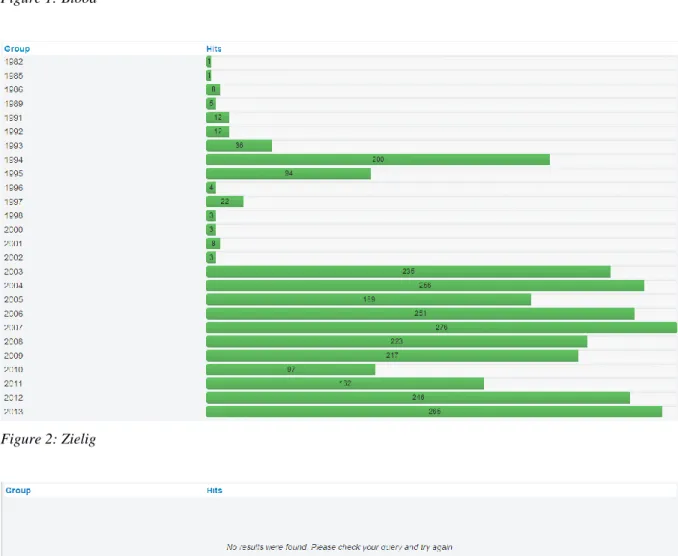
This first test comprizes people's opinions and the results are therefore subjective. In order to discover in an objective manner if the words and phrases from Waan en Eigenwaan are indeed more old-fashioned than those from Trots en Vooroordeel, I looked them up in the 'Corpus Hedendaags Nederlands', an online corpus of contemporary Dutch language. By means of this second test it will become clear if the words and phrases from Trots en
Vooroordeel were used more often in recent years than the words and phrases from Waan en Eigenwaan.
29
looking for a word form, only this form of the word will be found by the corpus. If one searches the word form 'konijn', the corpus will not show the plural 'konijnen' or the
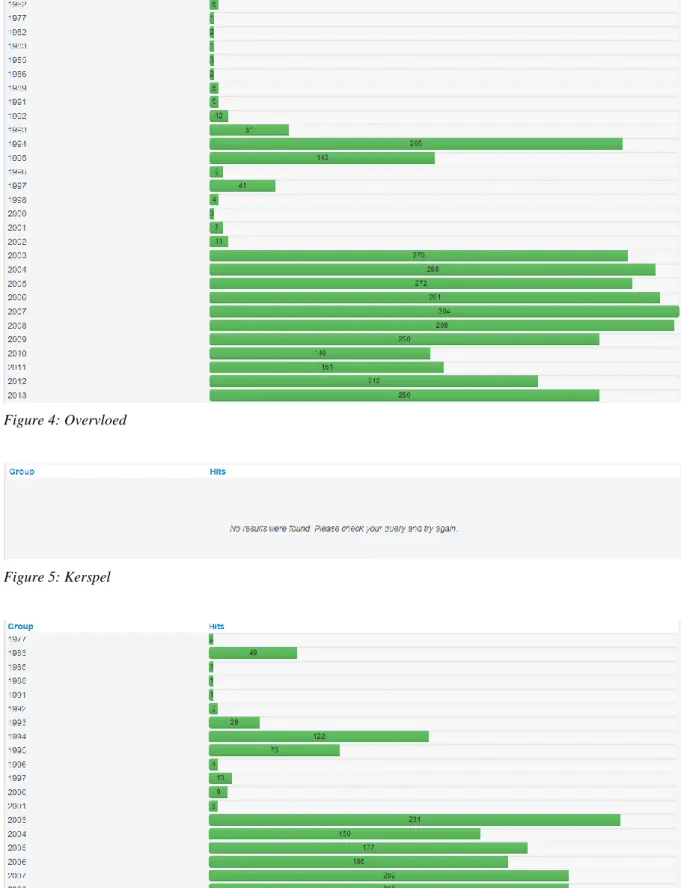
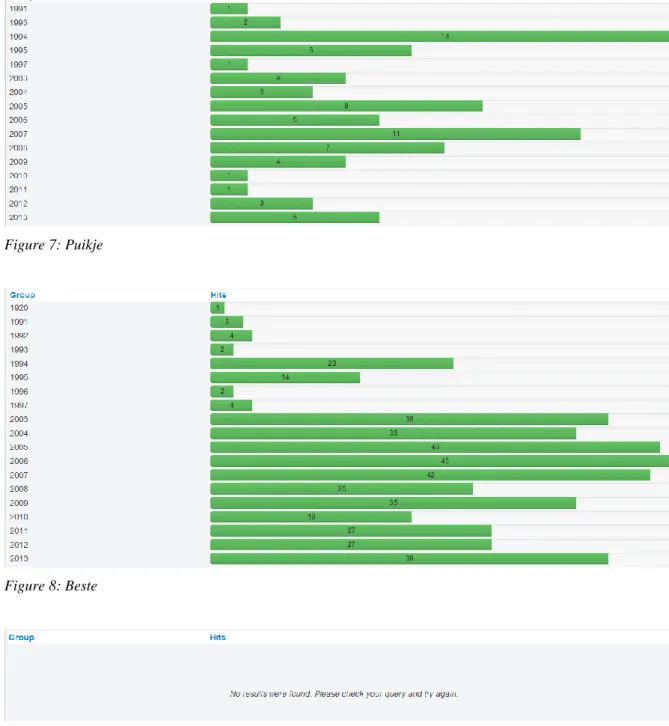
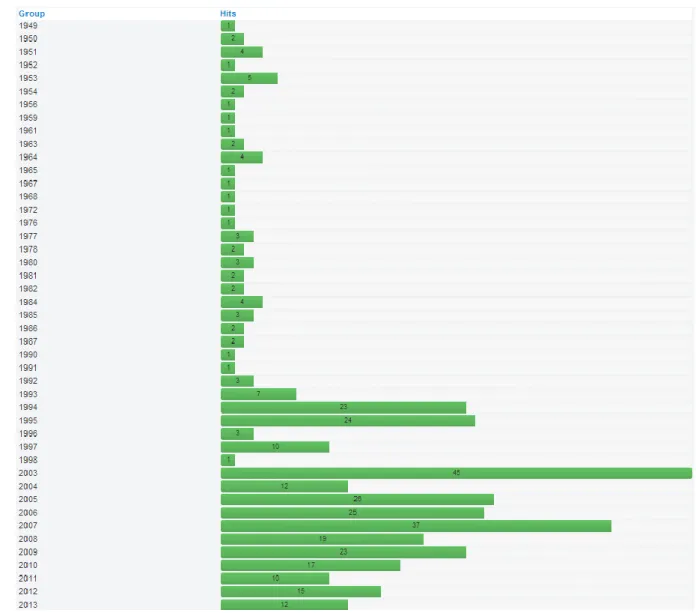
diminutive 'konijntje'. I did not use the word form search option, because I wanted to find all possible word forms instead of only the lemma. By typing the lemma (for example 'konijn') into the lemma search box, all word forms of this lemma are shown by the corpus. For this reason I have always used the lemma search box. Sometimes it was also necessary to filter the results by using the Part of Speech search box, as is described in those specific cases. In part A of this thesis’ appendix, screenshots of the corpus can be found for each word and phrase,
showing the number of hits per year.
The words and phrases below are all grouped in pairs, the first word or phrase
occurring in the older translation Waan en Eigenwaan, and its following counterpart in Trots en Vooroordeel.
- 'Blood' (W & E) = 3 hits. The Part of Speech tag 'AA*' (= adjective or adverb) was used, since otherwise the English noun 'blood' was shown. The three hits occurred in 2003, 2009 and 2013.
- 'Zielig' (T & V) = 2829 hits. This word first occurred once in 1982, with not many
occurrances until 2003, with the exception of the years 1994 and 1995. From 2003, it occurs at least 97 times each year and often more than 200 times a year.
- 'Botertje tot de boom' (W & E) = 0 hits. There were also no hits for the noun 'botertje' on its own.
- 'Overvloed' (T & V) = 3298 hits. This word first occurred once in 1913, and did not reappear until in 1962. There are not many occurrances until 2003, with the exception of the years 1994 and 1995. From 2003, it occurs at least 140 times each year and often more than 200 times a year.
- 'Kerspel' (W & E) = 0 hits.
30
- 'Puikje' (W & E) = 76 hits. This word occurred most often in 1994, but even then only 14 times. It first occurred in 1991, but only 1 time.
- 'Beste' (T & V) = 427 hits. The word first occurred once in 1920, but only resurfaced after a time span of 71 years in 1991. It occurred most often from the year 2003, with least
occurances in 2010 (19 hits) and most occurances in 2006 (45 hits).
- 'Ontaard' (W & E) = 0 hits when the Part of Speech tag 'ADV*' (for 'adverb') is used.
Without this tag there are 523 hits. However, the corpus also shows all word forms of the verb 'ontaarden', including the past participle 'ontaard' which can be used as an adjective as well (for example 'het in een bloedbad ontaarde conflict'), any verb forms of 'ontaarden', and the adjective 'ontaard' (for example 'ontaarde zonen'). In the phrase 'ontaard knap' 'ontaard' is an adverb, but the Part of Speech tag 'ADV*' (for 'adverb') results in 0 hits. (Another tag that could be used is 'AA*', which shows both adjectives and adverbs. This option still does not filter out the adjectives and is therefore not useful either.)
- 'Buitengewoon' (T & V) = 14077 hits. This word actually occurred several times throughout the nineteenth century, starting in 1814. It never occurred more often than 14 times in this century. It was still rare in the first half of the twentieth century, with the great exception of the year 1947 when it occurred no fewer than 561 times. After this year there was a decrease again. The word still occurred every year, varying from 6 to 243 occurrances throughout the second half of the twentieth century. In 1994 there was an enormous surge with 1221 hits in this year.
- 'Sedertdien' (W & E) = 366 hits. This word was rarely used until into the eighties and it never occurred more than 24 times a year throughout the nineties. In 1998 it occurred only once and the word was then not used again until the year 2003, in which there were 45 hits. The next years the word occurred between 10 and 37 times a year.
- 'Sindsdien' (T & V) = 23397 hits. This word was quite rare up until the nineties. In 1994 it was used 1407 times, almost 1200 more hits than in 1993. From 2003 onwards it always occurred more than 1000 times, with 2316 hits in 2007.
31
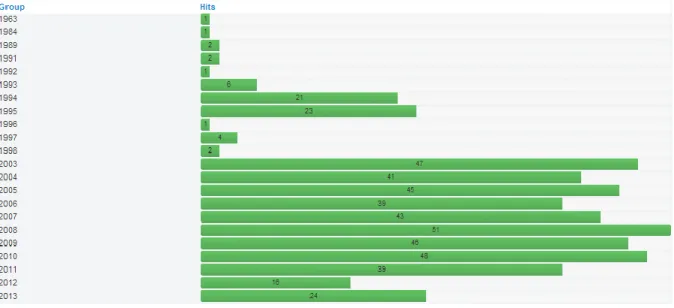
occurred 21 times in 1994 and 23 times in 1995. From 2003 to 2011 there were between 39 and 51 hits each year. In 2012 there were only 16 hits and in 2013 24 hits.
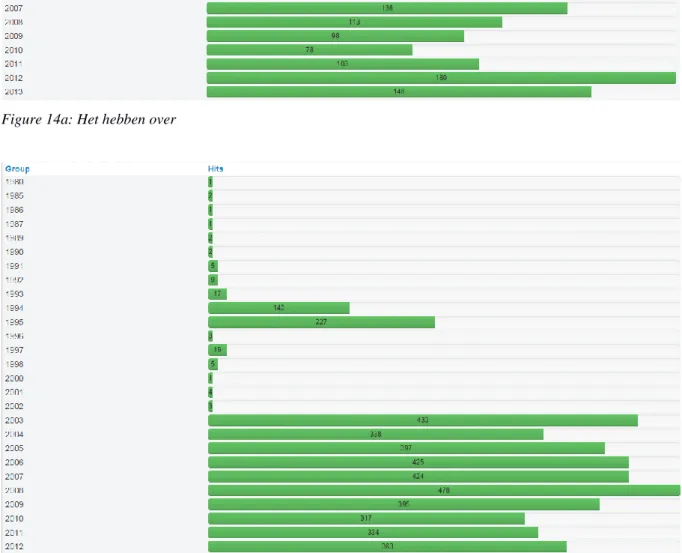
- 'Het hebben over' (T & V) = 1524 hits. Hebben het over = 4740 hits. Both phrases had most nineties hits in 1994 and 1995, with 72 and 83 hits respectively for 'het hebben over' and 140 and 227 hits for 'hebben het over'. From the year 2003 they both occurred more often. 'Het hebben over' occurred between 78 and 180 times a year, and 'hebben het over' between 317 and 478 times a year. In total there were 6264 hits.
- 'Kopschuw maken' (W & E) = 39 hits. 'Maken kopschuw' = 1 hit. These phrases were always rare, never occurring until 1994 and with no more than 7 hits a year. In total there were 40 hits.
- 'Wegjagen' (T & V) = 940 hits. This word barely occurred until into the nineties. There were 50 hits in 1994. From 2003 the word occurred more often, with the number of hits varying between 50 and 91 hits a year.
- 'Het land hebben aan' (W & E) = 9 hits. 'Hebben het land aan' = 11 hits. 'Het land hebben aan' never occurred more than 3 times a year, and 'hebben het land aan' never more than 5 times a year. In total there were 20 hits.
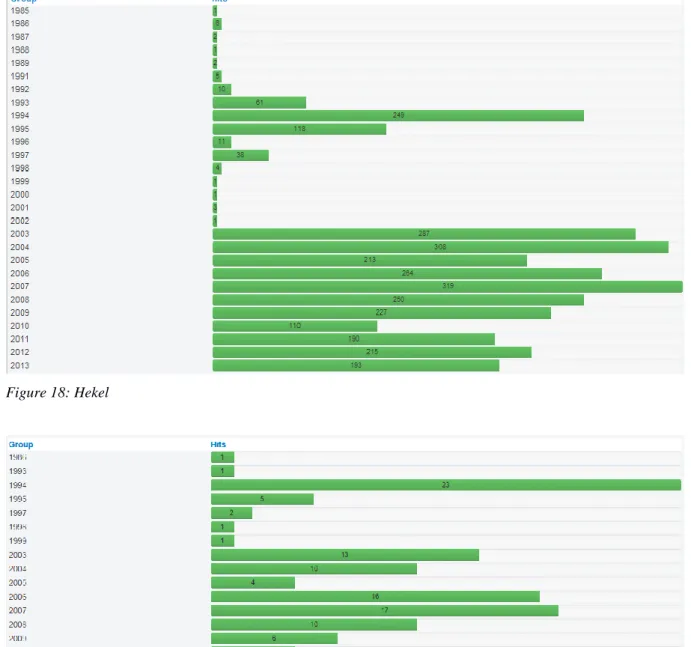
- 'Een hekel hebben aan' (I looked up the word 'hekel'.) (T & V) = 3090 hits. It first occurred in 1985 with 1 hit. There were more hits in the nineties, with 249 hits in 1994. From 2003 until 2013 there were more than 100 hits each years, varying from 110 to 319 hits.
- 'Landerig' (W & E) = 133 hits. This word never occurred more than 23 times a year.
- 'Suf' (T & V) = 1232 hits. There were 76 hits in 1994, and from 2003 the number of hits varied between 45 and 144 hits a year.
- 'Apropos' (W & E) = 2 hits as an interjection. Other occurances were 'apropos' as a noun, like in the phrase 'van zijn apropos brengen'.
32
but language found in newspapers, magazins, newscasts and legal documents. 'Tussen haakjes' would probably occur more often in spoken language.
- 'Kranige gang' (W & E) = 0 hits.
- 'Manier van voortbewegen' (T & V) = 19 hits. There were never more than 3 hits a year for this phrase.
4.1.4: Research question 1 answered
As can be deducted from the numbers above, the word or phrase that was used in Trots en Vooroordeel always had more hits than its counterpart from Waan en Eigenwaan. Sometimes these numbers were very far apart, for example with 'sedertdien' (366 hits) and 'sindsdien' (23397 hits). The only exception is the phrase 'tussen haakjes' for which there were no hits, while there were 2 hits for 'apropos'. However, this could be due to the fact that the corpus only contains formal written language and 'tussen haakjes' is too informal to be used in the genre.
Considering the results from both small tests discussed in this paragraph, it can be concluded that the words and phrases that occur in Waan en Eigenwaan are indeed old-fashioned, or rarely used in current Dutch, while the words and phrases from Trots en Vooroordeel are modern and frequently used in Dutch during recent years.
The first research question was the following:
1) Have the Dutch translators of Pride and Prejudice used a source-oriented, historicizing approach in the 1980 translation Waan en Eigenwaan and a target-oriented, modernizing approach in the 2009 translation Trots en Vooroordeel?
33
34
Chapter 5: the survey
In this chapter I aim to answer the second research question of this thesis. This research question is:
2) Which approach do the readers prefer?
An online survey will be used to discover whether respondents prefer the source-oriented translation approach of Waan en Eigenwaan, with mostly archaic words and phrases, or the target-oriented approach of Trots en Vooroordeel that uses more modern words and phrases.
However, the respondents did not know the focus was on modern or archaic language. They were only told the excerpts were from two translations of the book Pride and Prejudice, which was published in 1813. By this means I hoped to discover whether respondents noticed the difference between the archaic and modern language and if they preferred the excerpts from Trots en Vooroordeel for this reason. Since the respondents were not informed of this specific difference I expected them to comment on other features of the texts as well, such as punctuation and sentence structure. These other features might influence their choice.
Respondents might choose the archaic excerpt despite its dated language, simply because they prefer the overall style used by the translator. In sections 5.2 to 5.6 the answers given by the respondents will be discussed and it will become clear what the respondents deemed most appealing in the translations.
The survey was an online survey I created on the website
www.studenten-onderzoek.be. It was filled out by 50 respondents. They were asked to tell their age and sex and if Dutch was their native language. All respondents were native speakers of Dutch and of a university or pre-university level of education. There were 25 people aged 35 or younger, and 25 people that were 36 years or older. Below, it will become clear if there is a significant difference between the answers that were given by both age groups. Since language changes over the years, it would be interesting to see if an older generation has no problem with certain words or phrases that are not known by younger people. I will not compare the results of the survey based on sex, since this factor would be beyond the scope of this thesis.
35
Excerpt: Translation 1 Translation 2
A Modern Archaic
B Archaic Modern
C Modern Archaic
D Modern Archaic
E Archaic Modern
Table 3
The respondents were asked to indicate for each excerpt which translation they preferred. This was a multiple-choice question. Then for each excerpt an open question followed, asking the respondents to explain their choice in their own words by providing at least two examples from the translation.
In part B of the appendix, screenshots of the entire survey can be found.
5.1: The results from the survey in absolute numbers
The tables below show in absolute numbers how many respondents chose one translation or the other in the survey.
Excerpt A Translation 1 (modern) Translation 2 (archaic)
All ages (50 respondents) 34 16
Age 18-35 (25 respondents) 16 9
36+ (25 respondents) 18 7
Table 4
Excerpt B Translation 1 (archaic) Translation 2 (modern)
All ages (50 respondents) 10 40
Age 18-35 (25 respondents) 5 20
36+ (25 respondents) 5 20
Table 5
Excerpt C Translation 1 (modern) Translation 2 (archaic)
All ages (50 respondents) 34 16
Age 18-35 (25 respondents) 16 9
36+ (25 respondents) 18 7
36
Excerpt D Translation 1 (modern) Translation 2 (archaic)
All ages (50 respondents) 46 4
Age 18-35 (25 respondents) 22 3
36+ (25 respondents) 24 1
Table 7
Excerpt E Translation 1 (archaic) Translation 2 (modern)
All ages (50 respondents) 6 44
Age 18-35 (25 respondents) 3 22
36+ (25 respondents) 3 22
Table 8
In part C of the appendix, pie charts can be found with the percentages instead of absolute numbers. These show more clearly which translations were preferred by all respondents and by the different age groups, and what the percentages are for each excerpt.
Below the results of the survey per excerpt will be discussed.
5.2: Excerpt A
Excerpt A:
Translation 1
Toen zij hoorde dat haar broer het tegen juffrouw Bennet over een bal had, wendde ze zich plotseling tot hem en zei: 'O, tussen haakjes, Charles, meen je dat serieus, dat je overweegt om een bal te geven op Netherfield? Ik zou je aanraden, voor je ertoe besluit, eerst eens na te gaan wat de wensen van de hier aanwezigen zijn; ik moet me sterk vergissen als sommigen van ons een bal niet eerder een straf zouden vinden dan een genoegen.'
Trots en Vooroordeel, 2009 (p. 53)
Translation 2
Toen ze haar broer tegen juffrouw Bennet hoorde gewagen van een bal, keerde ze zich met een ruk tot hem en zei: 'Apropos, Charles, overweeg jij in alle ernst hier op
37
hier in de kamer voor wie een bal eerder een straf dan een genoegen zou betekenen.' Waan en Eigenwaan, 1980 (p. 47)
Translation 1 is the modern one out of the two according to the tests I conducted before. As can be seen in part 3 of the appendix, translation 1 was chosen by 68% of all respondents. The respondents between the ages of 18 and 35 chose the archaic translation slightly more often than those above the age of 36.
No fewer than 31 respondents noticed the fact that one translation was more archaic or modern than the other, even though no mention of this factor was made anywhere in the survey. This means that the modern or archaic language was striking enough to the
respondents to be recognized and taken into account in their judgment of the two translations. Out of these 31 respondents, 26 preferred translation 1 and 5 respondents opted for translation 2. Many of the 31 respondents also gave examples of words or phrases occurring in
translation 2 that they deemed archaic. ‘Gewagen’ was considered an archaic word by 16 respondents. ‘Apropos’ was described as old-fashioned 15 times and ‘schromelijk’ 12 times.
Other words and phrases that were deemed archaic by some respondents are ‘eer’, ‘raadpleeg de wensen van de aanwezigen hier’, ‘in alle ernst’ and ‘zijn er hier in de kamer voor wie’. Five respondents described ‘tussen haakjes’ from translation 1 as modern language.
Out of the 31 respondents who made any mention of old-fashioned or modern
language, 26 preferred the excerpt from Trots en Vooroordeel, which was translation 1 in the survey. The five respondents who preferred the excerpt from Waan en Eigenwaan all
38
'apropos' is a word still known by many people nowadays, but that 'gewagen' is too antique. She disapproves of the subordinate clause in the second sentence of translation 1.
The respondents who presume that translation 2 is closer to Austen's original text in fact believe that this translation is source-oriented, reproducing the original text as much as possible. None of the respondents preferred translation 2 because of the archaic language only. Sometimes they even write that they prefer translation 2 despite its archaic language. The sentence structure of translation 2 and the perception that it is closer to the source text are the main reasons for these respondents to choose translation 2.
The 26 other respondents who remarked on archaic or modern language all chose translation 1 from Trots en Vooroordeel. 16 of these respondents only wrote about the archaic language in translation 2 or the modern language in translation 1. For these respondents, the archaic language in translation 2 or the modern language in translation 1 was probably the main reason they preferred translation 1. One respondent over the age of 35 notes that there are no old-fashioned words in translation 1. Translation 1 is described as more modern or contemporary 5 times, while translation 2 is called old-fashioned or archaic 12 times. One respondent belonging to the younger age group remarks that words such as 'gewagen' and 'apropos' make translation 2 harder to read. Another respondent from this age group mentions that the more modern language of translation 1 makes this text more enjoyable to read. Yet another respondent between the ages of 18 and 35 notes that the words 'gewagen' and
'apropos' are not used anymore nowadays. A respondent over the age of 36 deems translation 2 very old-fashioned and slightly exaggerated. One respondent between the ages of 18 and 35 remarks that the more contemporary language in translation 1 makes this translation easier to read. However, both translations are not very easy to read in her opinion and she would rather read the original text.
39
respondent over the age of 36 observes that the words 'gewagen' and 'apropos' in translation 2 are not used anymore nowadays, and that the use of these words makes the conversation sound very unnatural. A respondent in the younger age group mentions that there are many old-fashioned words in translation 2 she does not even know, such as 'gewagen' and
'schromelijk'. She also prefers translation 1 because there are more punctuation marks in this translation that improve the readability. Another respondent in this age group prefers
translation 1 because of the more modern language and the clear sentence structure. A respondent over the age of 35 remarks that the words in translation are more contemporary and that the word order in translation 2 makes the sentences harder to understand. He suspects that translation 2 is closer to the source text. Another respondent from the older age group thinks that translation 2 sounds archaic or even Flemish. In his opinion neither of the translations is satisfactory and both sound unnatural. He suspects translation 1 is probably a more direct translation. Another respondent over the age of 35 thinks the archaic language in translation 2 suits the original better, but is not that enjoyable to read today. Another
respondent from this same age group notes that translation 2 is somewhat archaic, although this suits the nature and era of the novel. Nevertheless, he prefers translation 1 because it is more enjoyable to read.
Eight other respondents besides the 4 mentioned above also commented on translations being close to the source text. They did not write anything about archaic or