ENDOGENOUSLY CLUSTERED FACTOR APPROACH TO MACROECONOMICS
OZGE SAVASCIN
A dissertation submitted to the faculty of the University of North Carolina at Chapel Hill in
partial ful…llment of the requirements for the degree of Doctor of Philosophy in the Department
of Economics.
Chapel Hill
2012
ABSTRACT
OZGE SAVASCIN: Endogenously Clustered Factor Approach to Macroeconomics
(Under the direction of Neville R. Francis)
This dissertation constructs a novel factor approach to study the comovements of
macro-economic variables and introduces its two practical applications.
Factor models have become useful tools for studying international business cycles.
Block factor models can be especially useful as the zero restrictions on the loadings of some
fac-tors may provide some economic interpretation of the facfac-tors. These models, however, require
the econometrician to prede…ne the blocks, leading to potential misspeci…cation. In my
coau-thored paper, we propose an alternative model in which the blocks are chosen endogenously.
The model is estimated in a Bayesian framework using a hierarchical prior which allows
series-level covariates to in‡uence and explain how the series are grouped. Using similar international
business cycle data as Kose, Otrok, and Whiteman (2005) we …nd our country clusters di¤er in
important ways to those identi…ed by geography alone. In particular, we …nd that similarities
in institutions – e.g., legal systems, language diversity – may be just as important as physical
proximity for analyzing business cycle comovements.
TABLE OF CONTENTS
LIST OF TABLES...ix
LIST OF FIGURES...x
Chapter
I. INTRODUCTION...1
II. AN ENDOGENOUSLY CLUSTERED FACTOR APPROACH
TO INTERNATIONAL BUSINESS CYCLES...7
Empirical Model...11
Estimation...13
The Sampler...14
The Prior...14
Preliminaries...15
Generating
;
j
;;
F;
Y
...16
Generating
F
j
;
Y
...17
The E¤ect of Misspeci…cation...18
Incorporating Prior Beliefs of Cluster Membership...19
Adding a prior for cluster membership...20
Augmenting the Sampler...21
Generating
j
; ; ;
F;
Y
...22
Data...23
Results...25
Conclusion...29
Tables and Figures...30
III. THE DYNAMICS OF COMMODITY PRICES:
A CLUSTERING APPROACH...37
Motivation...42
Literature Review...46
Empirical Model and Estimation Methodology...50
Model Selection...54
Bayesian Linear Estimation on Factors...55
Data...56
Empirical Results...58
The Optimum Number of Clusters via Bayesian Model Selection...58
Results for the Optimal Model...58
Inclusion Probabilities...58
Variance Decompositions...61
Characterizing Factors...63
Conclusion...70
Tables and Figures...71
APPENDICES...79
A. Appendix for Chapter 2...79
Technical Details...79
Generating
j
;
F;
Y
...80
Generating
F
j
; ;
Y
...81
Computing the Bayes Factors...83
Data...85
Full Posterior Distributions...86
B. Appendix for Chapter 3...91
Estimation Details...91
The Prior Distributions...92
Notation...93
The Sampler...95
Generating
j
;
F;
Y
...95
Generating
2j
2;
F;
Y
...96
Generating
;
j
;;
F;
Y
...96
Generating
j
;
F;
Y
...99
Generating
'
j
;
F;
Y
...100
Generating
F
j
;
Y
...100
Implementation of Chib’s Bayes factor algorithm...104
Calculation of the posterior ordinate
p
b
(
j
Y
)
...105
Calculation of the posterior ordinate
b
p
2j
Y;
...106
Calculation of the posterior ordinate
p
b
j
Y;
;
2...106
Calculation of the posterior ordinate
p
b
;
j
Y;
;
2;
...107
Calculation of the log likelihood evaluated at
...107
Calculation of the prior evaluated at
...108
Generating
$
j
2F;
...109
Generating
2j
$
;
F;
...109
Data...109
LIST OF TABLES
Table
1. Priors for estimation - I...30
2. Cluster Misspeci…cation...30
3. Covariate Data...30
4. Model Choice...31
5. Logistic Coe¢ cients...31
6. Variance Decompositions - Posterior Means...32
7. BMI Estimation - Model Selection...71
8. Model Comparison. ...71
9. Inclusion Probabilities Across Clusters...72
10. Variance Decompositions Across Clusters...72
11. Variance Decompositions for Grains, Oils and Meat...73
12. Variance Decompositions for All Commodities...73
13. Quarterly Regression Results...74
14. Annual Regression Results...75
15. Country Listing...85
16. Posterior Means and Coincidence Intervals for Cluster Loadings - I...86
17. Posterior Means and Coincidence Intervals for Cluster Loadings - II...87
18. Posterior Means and Coincidence Intervals for Parameters - I...88
19. Posterior Means and Coincidence Intervals for Parameters - II...89
20. Cluster Probabilities - Posterior Means...90
LIST OF FIGURES
Figure
1. Global Factor...33
2. Cluster 1 Factor...34
3. Cluster 1 Combination...34
4. Cluster 2 Factor...35
5. Cluster 2 Composition...35
6. Cluster 3 Factor...36
7. Cluster 3 Composition...36
8. Supply Growth...76
9. Commodity Price Indexes...76
10. Cross Correlations...77
11. Estimated Median Global Factor...77
12. Estimated Median Cluster-1 ("Timber")...77
13. Estimated Median Cluster-2 ("Grains, Oil")...78
14. Estimated Median Cluster-3 ("Mixed")...78
CHAPTER 1
INTRODUCTION
In many aspects of science, natural grouping arises in many situations. An individual
who lives in a certain location, in a certain country and belongs to a certain social group
possesses characteristics distinct that come from that certain location, country and social group.
Living styles for an individual may be similar to those who belong to the same social group
even though they live in di¤erent locales. Likewise, di¤erent industries are a¤ected by their
nation’s policies as well as by the things speci…c to their particular market.
The world consists of countries with similar legal backgrounds, language or geography.
These aspects may present commonalities among economic measures such as gross domestic
product, consumption, and prices. These economic measures with similar dynamics can form
a cluster and may also have distinct properties compared to other groups of variables. In
particular, similar dynamics (or comovements) of economic variables can be due to something
general to the economy or due to something speci…c for some particular groups of variables.
Speci…cation of layers is the keystone in analyzing measures with these kinds of hierarchical
structures. In my dissertation, I develop a model for speci…cation of these layers or groups in
investigating the comovements of macroeconomic variables.
underlying sources, measures or factors, as unknowns. Therefore one does not need any tight
assumptions or structural models to describe commonalities of variables. The drawback of basic
factor models is that they neglect additional sources of ‡uctuations that may be o¤ interest.
Foerster et al. (2011) point this out in their paper where they investigate cross sectional
industrial production data. They show that additional cross correlations of any kind could
contaminate the global factor, and if not taken into account can lead to overestimation of the
true nature and the contribution of common factors in explaining cross-product comovements.
A way to introduce these additional cross correlations is to form a block factor model as
it provides a straightforward framework that allows a number of less pervasive factors
(depend-ing on the question these factors could be de…ned as regional or sector-speci…c) that account
for possible correlations that are con…ned within particular groups of series. This technique
however requires the knowledge of these groupings prior to the analysis at hand. For example,
Kose Otrok and Whiteman (KOW, 2005) study international business cycles and de…ne regions
based on geographical con…guration. Their model basically assumes that European countries
form one group and their basic aggregates; gross domestic product, consumption and
invest-ment levels, move together due to a European factor. Likewise, all Latin American countries
form another and share a common cycle; Mexico, USA and Canada are grouped as the North
American cluster and are assumed to exhibit similar patterns, etc. On another paper, Kose
Otrok and Prasad (2008) rely on income distributions to de…ne the regions of a wider set of
country series.
et al. (1992), Pindyck and Rotemberg (1993)), or simply according to industry a¢ liations
(Brooks and Del Negro, 2005). Statistical agencies also report subgroups of price indexes based
on industrial similarities. Consumer Price Index has food, beverages, energy and transportation
listed as major subgroups. Commodity prices are grouped similarly as well. The reason we
form indexes is to see what is going on within a market, and as argued by King (1966), a
good index would be the one that is highly correlated within some set of products. However,
some seemingly unrelated products can also be correlated (Pindyck Rotemberg, 1993). This
may cause the market indexes to be contaminated by the spillovers from other industries; hence,
they may no longer represent the general dynamics that are speci…c to that market. Given these
kind of intercorrelations among variables, the factor models that use straightforward industry
de…nitions to introduce industry speci…c factors may fall into potential misspeci…cation which
can alter their results signi…cantly.
Overall, there are many ways a researcher can specify countries into "regions" or
prod-ucts into "industries". The natural question to ask is how we can be so sure that the way we
group our data is the "best" in practice? Relying on the researcher to group the data is a tricky
issue as di¤erent researchers will invariably have di¤erent criteria when forming these groups.
One approach to avoid the researcher-biases with the group assignment would be to form every
possible group and then employ a model selection criterion to determine the best cluster
com-bination. However, with many time series this grid search procedure would be ine¢ cient and
possibly infeasible. The avenue in …nding a model that gives us a tool to select clusters has not
been taken within a factor framework. My dissertation attempts to …ll this gap.
a purely data-driven way. Speci…cally, my approach to study synchronicity in economic
vari-ables refrains from imposing any prior belief on which groups of varivari-ables ought to comove and
instead allow the data to form its own ex-post groupings. If indeed countries are grouped by
continents than we should see those countries grouping together. Or if all food products share
the same industry source, then data is free to form its clusters that way. The structure of the
factor model is similar to the block factor models with the addition of a membership indicator
determining which block a series belongs to. I estimate this indicator parameter using Bayesian
techniques namely Metropolis Hastings within Gibbs sampling.
In my …rst paper, I study the synchronized dynamics of commodity prices. The past
decade has witnessed a substantial comovement of commodity prices with di¤erent
character-istics that raised several discussions and possible explanations in regards to what has been
deriving these synchronized commodity price movements. A single price increase of a
commod-ity would not be re‡ective on the overall economy but if the commodities exhibit persistent
price increases all together, they can pass through to the core in‡ation rate and create a need
for action by the monetary authorities.
From a large dataset of non-energy commodity prices, I extract the fundamental sources
behind the price dynamics and …nd that the commodity price comovements are mostly a result
of sparse cluster factors that represent correlations of some groups of commodities. In particular,
I …nd four main groups of products; "Timber", "Co¤ee", "Grains&Oils" and "Mixed". The
latter of these is a highly correlated cluster of commodities consisting of seemingly unrelated
products such as metals, agricultural materials and some food products. Additional analysis
to characterize these correlations indicate the importance of federal funds rate, world demand,
crude oil prices, and speculation in …nancial markets in deriving these common movements.
Vegetable oils and grain prices react to the oil and fertilizer prices while timber industry seems
to be signi…cantly a¤ected by the Chinese demand which could be related to the fact that
Chinese buyers turned to the U.S. and Canada for wood after 2007 since Russia imposed higher
tari¤s on its logs.
In my coauthored paper, we study international business cycles by examining their
re-lationships across countries. Characteristics such as industrial similarity, proximity, language,
trade and coordinated monetary policies can lead some countries’business cycles to be
corre-lated. Empirical models comparing business cycles generally take a block factor approach that
builds on the assumption that countries within a block have cycles which are correlated through
the block factor. As discussed previously, geographic proximity has been widely used to de…ne
county groupings. Perhaps sensible at a …rst glance, this is incomplete at best. For instance,
U.S. and Mexican economies may not be better candidates for synchronous cycles just because
they share a border.
grouped. We use measures to account for the legal and linguistic di¤erences among countries,
degree of openness, industrialization and trade. Using annual GDP data growth rates for
60 countries our …ndings suggest some evidence against the prevailing belief that geographic
proximity is a major determinant of cross-country comovements. We …nd that one cluster
represents a set of mostly industrialized nations (U.S., U.K., Australia, Canada, New Zealand,
Denmark, and India). Outside of Denmark, one might interpret this cluster’s comovement as
a re‡ection of trade patterns perhaps spawned by commonalities attributable to being former
British Commonwealth countries. Other regional clusters estimated in this paper suggest some
geographic ties but there are still some countries that contradict this result. In particular, we
identify a cluster which includes much of Europe and Japan; and another cluster which includes
most of South America, Mexico, Norway, and Iceland. Our hierarchical prior covariate data
suggests that linguistic diversity and legal institutions signi…cantly determines these "regional"
clusters.
CHAPTER 2
AN ENDOGENOUSLY CLUSTERED FACTOR APPROACH TO INTERNATIONAL
BUSINESS CYCLES
The nature of business cycles is an issue central to macroeconomics.
One way to
better understand business cycles is to examine their relationships across countries, which has
prompted several studies to consider common movements in business cycles across countries.
1A related question asks what determines which countries share common movements in their
business cycles.
In particular, we might ask whether some characteristics (e.g., industrial
similarity, proximity, language, trade) lead some countries’ business cycles to be correlated.
For example, Norrbin and Schlagenhauf (1996) estimated the role of industrial similarities in
international business cycles but …nd a limited role for industry-speci…c shocks in explaining
the forecast error variance of output across countries. Alternatively, coordinated (systematic)
policies may be the impetus behind
any
synchronicity in business cycles across countries.
McK-innon (1982) suggested coordinated monetary policies as a factor for synchronous cross-country
business cycles.
2Finally, correlation between macroeconomic aggregates across countries could
be due to unobservable innovations – e.g., common international shocks or country-speci…c
1
The relationship between business cycles across countries is not restricted to simple correlation. For example, Engle and Kozicki (1993) studied a number of common features across country pairs in the G7 and found common serial correlation. Clark (1998) and Clark and Shin (2000) …nd that region-speci…c shocks are important sources of comovement.
2This conclusion was reached after …nding data consistent with the substitutability of national monies. In
particular, McKinnon found that domestic money demand functions are unstable when no controls are made
for foreign exchange rates. Additionally, in an empirical test of the role of borders in the synchronization of
shocks having spillover e¤ects. Using structural vector autoregressions, Ahmed, Ickes, Wang,
and Yoo (1993) conclude that spillovers from country-speci…c labor supply shock are more
important than common shocks in generating international business cycles.
Empirical models comparing business cycles across countries generally take one of two
approaches: (1) Country cycles are estimated separately and then compared or (2) Cycles are
estimated jointly with numerous assumptions made on the correlation structure. For the most
part, these approaches are motivated by the need to reduce complexity and potential parameter
proliferation. The former leaves the country combinations unrestricted (i.e., any two countries’
cycles can be correlated), while the latter explicitly excludes this. Which approach is taken can
depend both on the question to be answered and the econometric techniques used to compute
the cycle. For example, the …rst approach might de…ne a country’s cycle based on a
Markov-switching or a trend-cycle decomposition, methods typically reserved for smaller systems of
equations.
3The second approach might de…ne a common cycle via a factor model, where the
factor loadings re‡ect the degree of correlation between country cycles [e.g., Bai (2003); Bai and
Ng (2002); Forni, Hallin, Lippi, and Reichlin (2000, 2005); and Stock and Watson (2002a,b)].
In a series of recent papers, Kose, Otrok, and Whiteman (2003, 2008; henceforth KOW)
propose a factor model with a block structure for the factor loadings.
4This block structure
provides a straightforward interpretation that may be lacking in standard factor models.
Coun-tries within a block have cycles which are correlated through a regional factor, while counCoun-tries
in di¤erent blocks are correlated only through a (set of) global factor(s). The standard factor
model can emulate a block factor model if the loadings on the regional factors are close to
3Exceptions are Hamilton and Owyang (2009) and Kaufmann (2010) which use similar approaches to this paper
in a Markov-switching environment.
4
zero. Even in that case, however, the factors will produce some cross country correlation for
countries outside its block. The signi…cant advantage of the block factor model is that it allows
a larger number of less pervasive (regional) factors, only a few of which a¤ect any particular
country. Thus, correlations across small numbers of countries may be identi…ed in block factor
models but missed in standard factor models in which the correlation is swamped by the large
cross-section. The disadvantage of the block factor structure is that the blocks (or clusters) are
predetermined, meaning we must make signi…cant
ex ante
assumptions about which countries’
cycles are correlated.
In this paper, we take the block factor approach but relax the assumption that the
blocks are known
ex ante
.
By being agnostic about block membership, we allow the data to
cluster based on both their business cycle features and on country-speci…c characteristics. For
example, countries could form groups based on their proximity, coordinated policies, and/or
structural innovations. In this sense, we are not a priori guided by any one particular theoretical
model. However, once the
ex post
country groupings are determined, potential commonalities
within groups could aid in determining important features that any successful model of the
international business cycle would need to possess.
For example, if we …nd that common
language is a better determinant of cross-correlation than physical distance, models of trade
may consider language rather than geography as the determinant of iceberg costs.
The model has the block factor structure with an additional membership indicator
determining which block a country belongs to. We assume block membership is a multinomial
choice –i.e., a country cannot belong to more than one block. This multinomial approach to the
block structure lends itself to estimation with Bayesian methods.
5In the simplest execution of
the multinomial approach, we can assume either a uniform or Dirichlet prior on the membership
indicator, giving the model the appearance of a clustering algorithm.
For the uniform prior,
cluster membership depends solely on the business cycle characteristics of the country’s data as
compared to the other members of the cluster. For the Dirichlet prior, the size of the cluster
determines the
ex ante
probability a country is sorted to it.
Another approach we explore
is the use of a multinomial logistic prior on cluster membership [see also Frühwirth-Schnatter
and Kaufmann (2008); Hamilton and Owyang (2009)]. The use of the logistic prior allows us
to incorporate country-speci…c characteristics (e.g., location, industrialization, trade patterns)
and enables us to test competing hypotheses about what in‡uences which countries comove.
In Monte Carlo experiments with simulated data, we draw an obvious conclusion:
em-pirical results, their economic interpretation, and the degree of con…dence we place in them
depend greatly on the speci…cation of the block structure. For the case in which the clusters
are known (and correct), the standard block factor model performs well.
However, we …nd
that small misspeci…cations of the block structure can lead to deviations from the true model
and reductions in …t.
determinants of this “regional” clustering.
We also …nd that allowing the data to determine
the clustering leads to higher contribution of the cluster (or regional) factor to the overall
volatility of output.
The balance of the paper is as follows: Section
presents the endogenous clustered
factor model.
Section outlines the Bayesian techniques we use to estimate the model.
In
this section, we focus on estimation of the model with a uniform prior on cluster membership.
Section presents some Monte Carlo evidence showing how well our algorithm identi…es the
clusters and the consequences of exogenously misidentifying them. Section extends the model
and the sampler with a multinomial logistic prior.
Section presents results from the model
with international business cycle data. Section summarizes and concludes.
1.1 Empirical Model
Suppose that we are presented with a panel of
N
series,
y
n= [
y
n1; :::; ynT]
, each of
length
T
. We are interested in movements common across the series; these movements can be
sorted into those which a¤ect all series and those which a¤ect only a few series. We will refer
to the former as global factors and we will refer to the latter as cluster factors. Suppose there
is but a single global factor and there are
M
clusters for which a series
y
nbelongs to a single
cluster
i
.
6That is, at each period,
y
ntcan be expressed as the sum of the global factor
f
t; a
single cluster factor
F
it; an intercept
n0; and an error term,
"
nt:
y
nt=
n0+
nGf
t+
niF
it+
"
nt;
(1)
i
= 1
; : : : ; M; t
= 1
; : : : ; T; n
= 1
; : : : ; N
and
M
N:
Where
nGand
niare the factor
loadings.
The restriction that each series can belong only to one cluster is equivalent to zero
restrictions on the factor loadings in a panel description of
(1)
, giving it a block structure with
which the factors can be “identi…ed” as regions.
7If we believe that some shocks are global –
i.e., a¤ect all of the series of interest – but some remain con…ned to the region or sector from
which they originate, the model provides a framework with which we can perform
regionally-or industrially-di¤erentiated analysis [see Moench, Ng, and Potter (2009)].
In
(1)
, we have
imposed
that series
n
belongs to cluster
i
, meaning that it is in‡uenced by the
i
th cluster
factor – in other words, a series’ cluster is predetermined.
But what if we are unsure which
series should move together? KOW impose that the countries on the same continent comove;
Moench, Ng, and Potter impose that sectoral data comove.
While geographic proximity or
industrial similarity may be a reason for two countries comovement, other causes –e.g., trade,
demographics, level of industrialization – may also determine comovement.
We, therefore,
augment
(1)
to allow the clusters to be determined endogenously.
In endogenous clustering, the data choose the groupings. We de…ne a cluster indicator,
ni
=
f
0
;
1
g
, which signi…es whether series
n
belongs to cluster
i
, retaining the restriction that
a series can belong only to a single cluster –i.e.,
P
Mi ni= 1
. Then, we have
y
nt=
n0+
nGf
t+
MX
i
ni ni
F
t+
"
nt:
(2)
The model preserves the restrictions on the comovement of the series –series in di¤erent
7Exclusivity can be relaxed but would require modi…cations to the estimation algorithms presented below. These
clusters comove only through the global factor, while series within the same cluster can comove
apart from the global factor. However, in contrast to
(1)
, we can now estimate the membership
indicator,
ni, thereby allowing the data to determine the composition of the clusters.
We allow the error terms,
"
nt, to be serially correlated, following an AR
(
p
")
process:
"
nt=
n(
L
)
"
nt 1+
nt;
where
ntN
0
;
2nand
E
[
nt mt] = 0
for all
m
6
=
n
.
The diagonality of the
variance-covariance matrix implies that comovements between series not in the same cluster arise solely
from the global factor.
Series within the same cluster, on the other hand, can comove via the global factor or
the cluster factor. We assume that each factor (including the global factor) follows an AR
(
p
F)
process of the form:
F
it=
i(
L
)
F
it 1+
e
it;
(3)
where
i(
L
)
is a polynomial in the lag operator and
e
itN
0
; !
2i, where we normalize
!
2i= 1
as is common in the literature.
1.2 Estimation
determine the …nal cluster composition via some model selection criteria. However, this would
mean estimating and comparing a very large number of possible models. The optimal number of
clusters (and, thus, the number of factors) are obtained by computing the marginal likelihoods
for models with di¤erent numbers of clusters [see also Ghosh and Dunson (2008)].
81.2.1 The Sampler
The sampler is an MCMC algorithm which draws from the conditional distributions
of each parameter block conditional on the previous draws from the remaining parameters.
The sequence of draws from the conditional distributions converges to the joint posterior. Let
Y
represent the data,
represent the full set of model parameters, and
F
represent the
full set of factors.
The model parameters and factors can be drawn in …ve blocks: (1) the
group membership indicators,
, jointly with the intercept and the factor loadings,
, (2) the
innovation variances,
2; (3) the innovation autoregressive parameters,
; (4) the factors,
F
;
(5) and the set of factor autoregressive parameters,
.
After initializing the sampler, the
posterior distributions are computed with 10,000 iterations after 30,000 iterations discarded for
convergence.
1.2.1.1 The Prior
For each series, the prior for factor loadings is normal,
n= [
n0;
nG;
ni]
0N
(
b
0;
B
0)
,
and the innovation variances are inverse gamma,
n2(
0;
0)
. The factor and
measure-ment error AR parameters also have normal priors,
N
v0;
V
01and
N
w0;
W
01,
respectively. As a …rst pass, we assume the cluster membership over all clusters is uniform –
8
that is,
a priori
, a series is equally likely to belong to any cluster. In section , we modify the
sampler to incorporate country-speci…c characteristics into the cluster determination through
a logistic hierarchical prior. The factors are assumed to have unit innovation variances. The
hyperparameters for the prior distributions are given in Table 1. The draws of the variances
and both sets of autoregressive parameters are straightforward and included in the Appendix.
1.2.1.2 Preliminaries
Before discussing conditional distributions for each block, it will be useful to specify a
few key quantities.
Let
irepresent the variance-covariance matrix of the stacked vector of
p
Flags of the
i
th factor, which has elements given by
vec
(
i) = (
I
i i)
1vec u
0pFu
pF;
where
i=
2
6
6
4
0 iI
pF 10
pF 1 13
7
7
5
is the companion matrix associated with the
i
th factor, and
u
pFis a
(
p
F1)
vector with a
1
as the …rst element and zeros as the rest. De…ne
C
ias the Cholesky factor of
i,
i
=
2
6
6
6
6
6
6
6
6
6
6
4
ipF i1
1
0
0
0
ipF i1
1
0
..
.
..
.
. ..
. ..
. ..
. ..
. ..
..
.
0
0
ipF i11
S
i 1=
2
6
6
4
C
i 10
i
3
7
7
5
:
These quantities will be used to quasi-di¤erence the factors. Similar quantities can be
used to quasi-di¤erence the data.
For example, we could produce the analogue of
S
i 1, call
it
n1, for each series using the Cholesky factor of
n= (
I
i i)
1vec u
0p"u
p"and the
matrix
nformed with the AR parameters for the error terms. Then, we can use
S
i 1and
1
n
to quasi-di¤erence the data and the factors.
1.2.1.3 Generating
;
j
;;
F;
Y
For e¢ ciency reasons, we draw
nand
njointly for each
n
. The joint draw of
and
can be written as
q
(
n;
nj;
F
) =
q
(
nj n;
;
Y;
F
)
(
nj;
n;
Y;
F
)
;
where we draw a candidate
nfrom
q
(
nj n;
;
Y;
F
)
which may or may not depend on the
past (accepted) value of
n. Then, conditional on the candidate
n, we draw a candidate
nfrom its full conditional distribution
(
nj;
n;
Y;
F
)
.
This joint pair is then accepted or
rejected.
Formally, let
X
n= [
1
T;
f
;
F
e
n]
, where
1
Tis a
(
T
1)
vector of ones and
F
e
= [
F
1; :::;
F
M]
is the collection of cluster factors.
Let
X
nand
Y
nrepresent the quasi-di¤erence of
X
nand
Y
n.
9Then, the candidate
nis drawn from
9
nj n; n
;
n;
F;
Y
N
(
b
n;
B
n)
;
(4)
where
B
n=
B0
+
n2X
n0X
n 1,
b
n=
B
nB
01b0
+
n2X
n0Y
n.
Since we are drawing the
n’s from their full conditional densities –i.e., from
(
nj n;
;;
F;
Y
)
,
the value of
ndoes not appear in the acceptance probability.
10In this case, for each
n
,
ac-ceptance probability is
A
n;= min
(
1
;
j
B
nj1=2
j
B
nj
1=2exp
12b
nB
n 1b
nexp
12b
nB
n1b
n(
n)
(
n)
q
(
nj n)
q
(
nj n)
)
;
(5)
where
b
nand
B
nare de…ned as above and
b
nand
B
nare de…ned for
n, the value held over
from the past draw.
To close this portion of the algorithm, we need to supply a proposal density for
n.
We choose a symmetric density in which we draw a random element of
nand set this equal
to one (setting all other elements equal to zero). The choice of the symmetric proposal makes
the last term in
(5)
identically one.
111.2.1.4 Generating
F
j
;
Y
The set of factors are drawn recursively from the smoothed Kalman update densities
using the techniques as described in Kim and Nelson (1999). However, the sign of the factors
are not uniquely identi…ed from the loadings –e.g., switching the signs on both a factor and its
loading produces an observationally equivalent system. For identi…cation, KOW normalize the
1 0For a formal proof of this assertion, see Appendix 1 in Troughton and Godsill (1997).
1 1
Troughton and Godsill (1997) point out that the proposal density must allow some nonzero probability of
revisiting the same model. That is, the probability that the candidate is equal to the last iteration’s
sign of the …rst factor loading in each group. Unlike KOW, we cannot restrict the sign of the
…rst factor loading in each grouping as the clusters are not a priori known. We can, however,
impose a sign on the …rst element (period
1
) of each factor to resolve the sign identi…cation
issue.
In some cases, this is not su¢ cient to avoid label switching (i.e., cases in which the
sampler alternately draws
F
and
F
).
Thus, we also impose a normalization which selects
either
F
or
F
depending on which is closest to the previous draw in mean squared distance.
The draw of the factors is described in detail in the Appendix.
1.2.2 The E¤ect of Misspeci…cation
Allowing the data to determine the clusters rather than setting them in advance highlights
a tradeo¤ between the estimation uncertainty and potential misspeci…cation.
One would,
therefore, want to evaluate the potential risks of each before proceeding with the di¢ cult task
of estimating the clusters.
To this end, we perform a set of Monte Carlo (MC) experiments
designed to determine how badly the clusters need be misspeci…ed to outweigh the uncertainty
of estimating them. Our MC experiments give the best chance to pre-speci…cation by correctly
setting the number of clusters –that is, the only source of potential misspeci…cation is incorrectly
assigning a series
n
to the wrong cluster.
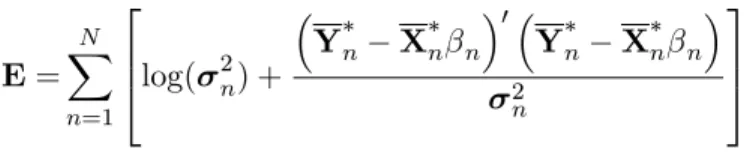
endogenously and compute an entropy measure:
E
=
N
X
n=1
2
6
4
log(
2n) +
Y
nX
n n 0Y
nX
n n 2n
3
7
5
for each case. Higher entropy scores re‡ect poorer performance with relative entropy related
to the familiar likelihood ratio statistic.
12Table 2 reports the results of the MC experiments. As expected, less misspeci…cation
is better than more misspeci…cation. Interestingly, knowing the truth (zero misspeci…cation)
is statistically equivalent to estimating the truth (endogenous clustering), with the di¤erences
in the entropy scores likely due to variations in the small sample performances.
Thus, we
conclude that, in cases in which the truth is known, imposing the cluster composition is …rst
best.
However, if the cluster composition is not certain, allowing the data to determine the
clusters reduces the risk of misspeci…cation.
It is important to keep in mind that, in these
experiments, we know with certainty the true number of clusters. If the number of clusters is
unknown, the potential for misspeci…cation increases dramatically.
1.3 Incorporating Prior Beliefs of Cluster Membership
In the previous section, we assumed a ‡at prior over cluster membership.
There
are cases, however, for which prior information could be useful in characterizing the clusters.
For example, similar industrial composition or geographic proximity could lead countries to
respond to the same common factor. In this section, we consider an alternative logistic prior
for the cluster membership indicator,
ni.
For this multinomial prior, we include additional
1 2The entropy measure is calculated for each Gibbs iteration and the mean over all iterations is reported. Each
blocks consisting of the hyperparameters
and
and the latent vector . As in Hamilton and
Owyang (2009), we can think of the prior hyperparameters as population parameters signifying
the clusters’relationships.
1.3.1 Adding a prior for cluster membership
Suppose there exists a vector,
z
ni, of variables which may in‡uence whether a series
n
belongs to cluster
i
. We assess the probability that series
n
belongs to cluster
i
as
Pr [
ni= 1
j
z
ni] =
8
>
>
<
>
>
:
exp
z
0ni i=
h
1 +
P
exp
z
0ni ii
i
= 1
; :::; M
1
1
=
h
1 +
P
exp
z
0ni ii
i
=
M
;
(6)
for
n
= 1
; :::; N
and where we have normalized
M= 0
for identi…cation. In the multinomial
framework, series
n
cannot be a¢ liated with more than one idiosyncratic cluster. Note also that
the vector,
z
ni, need not be composed of the same variables for each cluster
i
. The standard
approach to estimating the multinomial logistic is to augment the system in the spirit of Tanner
and Wong (1987) with a latent vector that has the characteristic that the nonnegative element
also re‡ects the cluster to which series
n
belongs. Formally, let
i= (
1i; :::;
N i)
0denote a set
of latent vectors such that
ni
0
if
ni= 1
ni<
0
otherwise
:
(7)
Suppose that
nihas the limiting distribution of the Kolmogorov-Smirnov test statistic:
p
(
ni) = 8
1X
j=1
( 1)
j+1j
2 niexp
2
j
2 2ni:
(8)
If
niKS
and
o
niN
(0
;
1)
, then
ni=
z
0
ni i
+ 2
nio
nihas a logistic distribution with mean
z
0ni iand unit scale parameter.
13The cluster probabilities can be rewritten in terms of the
new latent variables:
Pr (
ni>
0) =
exp
z
0ni i1 +
P
Mj=11exp
z
0nj j:
The following subsections demonstrate how to draw the hyperparameters governing the
cluster prior probabilities.
1.3.2 Augmenting the Sampler
The sampler outlined in Section can be augmented to account for the logistic prior
described above.
Conditional on the
ni’s, draws of most of the model parameters remain
unchanged. The change to the logistic prior does alter the acceptance probability in the joint
draw of
niand
nito the probability de…ned by
(6)
.
The only other modi…cation is in the
form of two additional blocks sampling the three prior parameters: covariate e¤ects,
; the
logistic variances,
; and the vector of latent variables, .
Each of these blocks is drawn by
iterating (jointly) over the
M
1
unnormalized clusters.
1 3
1.3.2.1 Generating
j
; ; ;
F;
Y
Conditional on
and
,
iare the slope coe¢ cients from a standard Normal regression
model for each of the form:
i
=
Z
i i+
v
i;
where
Z
i= [
z1
i; :::;
z
N i]
0,
v
iN
(
0;
i)
, and
i=
diag
[
1i; :::;
N i]
. We assume a normal prior
for the logistic slope parameters,
iN
(
d
i;
D
i)
.
Thus, the covariate e¤ects can be drawn
from the posterior
ij
Y;
;
F
N
(
d
i;
D
i)
, where
d
i=
D
i1+
Z
0i i 1Z
i1
D
i 1d
i+
Z
0i i 1 iand
D
i=
D
i 1+
Z
0i i 1Z
i1
:
1.3.2.2 Generating
and
j
; ;
F;
Y
If we condition on
ni, then
niwould be Normal,
nij i;
niN
(
m
ni;
ni)
, for the
i
= 1
; :::; M
1
unnormalized clusters.
The mean of the Normal distribution re‡ects this
normalization:
m
ni=
z
0
ni i
Without that conditioning but given
ni,
niis a truncated logistic with mean
m
ni.
The
truncation point is at zero, where
nidetermines the direction of the truncation:
ni0
if
ni
= 1
and
ni<
0
if
ni= 0
.
from a Generalized Inverse Gaussian distribution. The candidate,
^
ni, is accepted or redrawn
based on the algorithm described by Holmes and Held (2006).
1.4 Empirical Application
As an empirical application, we reconsider the model proposed in KOW in which
geography is the sole determinant of cross-country comovements. We include in the hierarchical
prior sets of variables which have been suggested to a¤ect trade between countries. In doing
this, we can assess the sources of business cycle comovements.
1.4.1 Data
Our measure of business cycle activity is the annual constant-price chain-weighted real
GDP growth rate (computed as the di¤erence in the log of real GDP) taken from the 6.3 version
of the Penn World Tables [Heston, Summers, and Aten (2009)].
14To maintain comparison, we
choose the same 60 countries located in seven regional blocks from KOW.
15In addition to the real GDP data, the use of the logistic prior requires covariate data,
Z
i.
Our covariate dataset includes domestic and international variables as well as indices of
institutional di¤erences.
We will focus on the di¤erences in legal and linguistic institutions.
We have a total of seven covariates that inform the logistic prior: (1) The degree of economic
openness, de…ned as the ratio of imports and exports to GDP; (2) Investment share of real
GDP; (3) An index of con‡ict resolution and sophistication of the legal system as captured
1 4
KOW’s business cycle data include other series in addition to real GDP, allowing them to estimate country
factors. We focus on the comovements across countries by restricting the model to a single business cycle
indicator. Extension to include country factors is left for future research.
1 5
by the manner in which lower courts facilitate landlords’collection of checks (and remedies for
bounced checks); (4) An index of language diversity within each country; (5) An index of
production dispersion relative to the rest of the world; (6) An index of export dispersion from
each country’s exporting partners;
and (7) A similar index of import dispersion from each
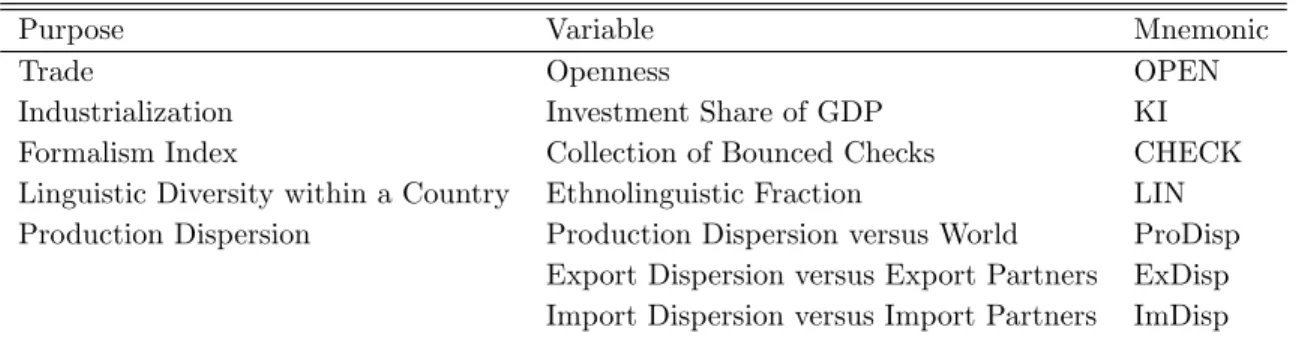
country’s importing partners. The covariate data are summarized in Table 3.
Openness measures the size of trade as a fraction of GDP. This variable proxies the
extent of a country’s dependence on foreign economies and exposure to external shocks,
with-out controls for the types of goods traded or the identities of trading partners, allowing us to
determine whether countries cluster based on the (relative) extent of their (direct) exposures
to international shocks.
Investment share of GDP is meant to capture the degree of
indus-trialization; similar levels of industrialization may make countries susceptible to similar shocks
inducing comovements.
The indices in (3) and (4) are included to test the extent to which institutions matter
for clustering.
Our institutional variables are the level of formality of the civil-court system
and the degree of linguistic-diversity. Djankov et al. (2003) construct the lower court system’s
formalism
index in (3) which
"measures substantive and procedural statutory intervention in
judicial cases at lower-level civil trial courts [p.469]"
. We hypothesize that trade ‡ow between
countries with similar con‡ict resolution processes in civil courts could be higher as individuals
may prefer to form relationships in countries with familiar legal set-ups.
The ethnolinguistic index in (4) is taken from La Porta et al. (1999) and measures the
degree of language diversity, the probability that two randomly selected individuals in a given
country speak di¤erent languages, are not speaking the o¢ cial language, or are not speaking
the most widely used language.
how the composition of a country’s production and trade di¤er from the rest of the world and
its trading partners. These indices are akin to variance measures, with the exception that the
export and import dispersions are weighted by sectoral export and import shares. A look at
the trade dispersion indices, (6) and (7), reveals that they capture both the strengths of trading
relations with di¤erent countries and the strength in the diversity of goods traded.
16Baxter
and Kouparitsas …nd that industrialized nations have dispersions similar to the rest of the world
(the average country) for all three indices while developing countries systematically have higher
values of dispersions. On the trade side, this is consistent with the fact that the bulk of trade
of an industrialized nation is with other industrialized nations, while developing nations have
trade relations more evenly spread across developed and developing nations.
By including
these indices, we are allowing for the possibility that countries cluster on the similarities in
their production structures (in terms of types of goods produced) and/or on the compositions
of their trade (both in terms of types of goods traded and the trading partners).
1.4.2 Results
We …rst determine the optimal number of country clusters which, for simplicity, we
compute with a ‡at hierarchical prior on cluster membership.
This allows us to determine
the optimal number of clusters based solely on the business cycle properties of GDP. With
‡at model priors, the Bayes factors are identically the posterior odds. Table 4 presents these
results.
The model with the highest probability is the model with three clusters.
Two and
six clusters have the next highest marginal likelihood; however either alternative require more
than 100 times higher prior likelihood to be preferred.
The model with seven clusters – the
speci…cation which nests the one estimated by KOW – has one of the lowest likelihood of the
1 6
alternatives tested.
17We now estimate the model using the logistic prior for the speci…cation with three
regional factors and one global factor.
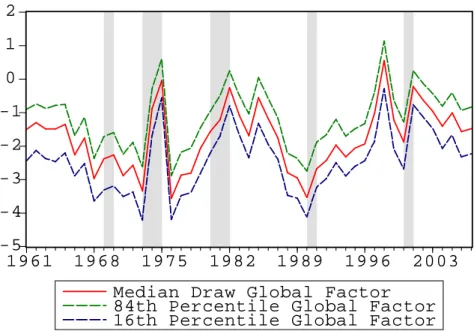
Figure 1 plots the median of the global factor along
with its 16th and 84th percentiles; the shaded areas show the NBER-de…ned recession dates
de…ned as a year in which any quarter was in recession. While the NBER recessions are de…ned
only for the U.S., they serve as reference points. The global factor roughly represents a global
cycle with most countries’ factor loadings being negative.
The global factor spikes around
1975, 1982, 1998, and 2001. With the exception of 1998, these periods are roughly associated
with U.S. NBER recessions.
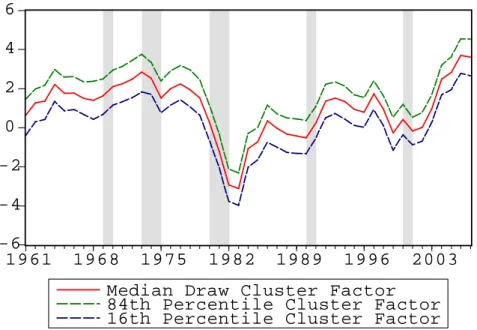
Figure 2 shows the …rst cluster factor along with its 68 percent probability bands and
the NBER recessions. Figure 3 shows the posterior inclusion probabilities for this cluster. Dark
blue indicates countries which are very likely to be included in this cluster. Yellow indicates
countries which are very likely not associated with the cluster.
Countries in white are not
included in our sample. Note, in particular, that this cluster does appear to demonstrate some
regional/geographic properties. The cluster includes, with high probability, Japan and many
of the countries in Europe. Some European countries –e.g., Iceland and Ireland –belong with
more than 50 percent probability. Brazil, Thailand, and Pakistan also belong with more than
50 percent probability.
Not all of the European countries, however, appear to belong to this
cluster. In particular, the U.K. and Denmark are excluded.
Figure 4 shows the second cluster factor. This factor clearly appears to decline around
NBER recessions. Figure 5 shows why.
The U.S. belongs to this cluster with probability 1;
the cluster also includes Australia, Canada, Hong Kong, India, Malaysia New Zealand, and the
1 7In this case, the algorithm chooses nearly empty clusters at some Gibbs iterations, suggesting that seven
U.K. with very high posterior probability. Also included in this cluster are Denmark and many
of the sub-Saharan African countries including South Africa.
Figure 6 shows the …nal factor and Figure 7 shows the composition of its cluster. Again,
the cluster displays some regional/geographic characteristics with some notable exceptions.
The cluster includes with high probabilities most of the countries in South America, with the
exception of Brazil. Mexico, the Philippines, and a few African countries also belong with high
probability.
As opposed to a purely continental approach such as KOW, our results suggest that a
country like Mexico is much more likely to belong have similar cycles to its common language
South American neighbors than its more geographically proximate neighbor, the U.S. These
results suggest that common culture – either through linguistic or legal similarities – matter
more for cyclical commonality than iceberg costs usually associated with geographic proximity.
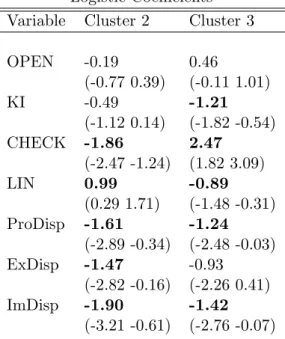
Table 5 shows the posterior means for the logistic covariates along with the 16th and 84th
percentiles of the posterior distributions. The level of industrialization proxied by the country’s
investment share of GDP is important in determining the clusters.
Also, similarities in the
countries’ legal systems and in their linguistic diversity also appear relevant.
This view is
consistent with the notion that trade ‡ows –and, therefore, business cycle comovements –are
more likely across countries with similar institutions.
more industrialized countries. Moreover, they conclude that the regional factors explain only
a very small portion of macroeconomic ‡uctuations (about 3.6 percent on average of the 60
countries’ output ‡uctuations).
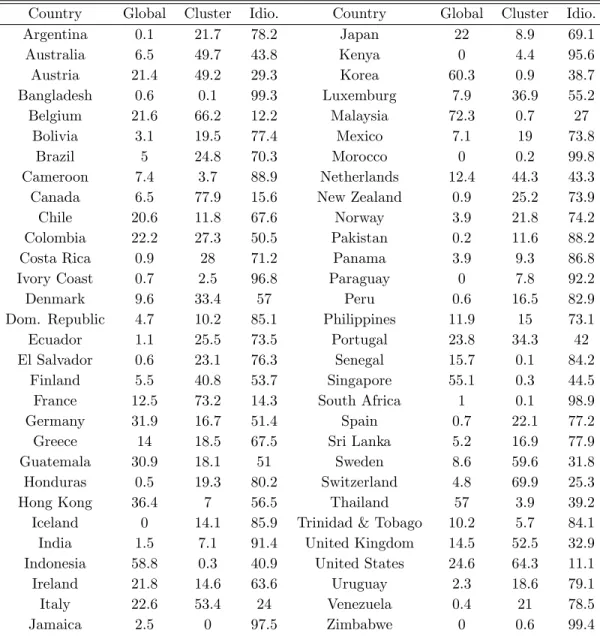
Our results suggest that there exists a much larger role for
the “regional”factor if region is estimated by the countries’cyclical commonality. In fact, our
cluster factors explain an average of 22.5 percent of the countries’output ‡uctuations.
There are a few reasons this di¤erence may not be surprising. First, KOW’s regional
factors are de…ned as the common component for three series for each country. The inclusion
of the additional two macroeconomic series could potentially contaminate their regional factor’s
ability to explain output ‡uctuations.
Second, imposing rather than estimating the regions
may lead to the same misspeci…cation discussed in the Monte Carlo experiments above. When
countries are included in a region with countries which it does not actually share a common
factor, the factor and the associated loadings may be biased.
1.5 Conclusions
A great deal of research has been done on measuring the comovement of business cycle
variables across countries. Limited by the potential proliferation of the estimated parameters,
these empirical models typically (1) compare business cycles which are estimated
country-by-country; (2) use models of relatively few countries (e.g., bilateral analyses); and/or (3) impose
the structure of the correlations
ex ante
.
One application of the latter, KOW, estimates a
factor model in which the correlation structure across countries is assumed to be determined
by geographic proximity – that is, countries which share a continent also share a common
unobserved factor.
1.6 Tables and Figures
Priors for Estimation - I
Parameter
Prior Distribution
Hyperparameters
n
N
(
b
0;
B
0)
b
0=
0
I
3;
B
0=
I
38
n
2
n 20
;
0
2 0
= 6 ;
0= 0
:
1
8
n
n
U
(
0)
or
Logistic
0=
M18
n
N
(
v0;
V
0)
v0
=
0
pF;
V0
=
1
2
I
pF8
i
N
(
w0;
W
0)
w0
=
0
p";
W0
=
1
2
I
p"8
n
i
N
(
d0;
D0
)
d0
=
0
I7
;
D0
=
2
I7
Table 1: Priors for Estimation - I. Notes: n denotes the series. i indicates the cluster, where
M is the total number of cluster factors. p’s are the maximum number of lags in the error and
factor lag polynomials.
Cluster Misspeci…cation
60%
40%
20%
6
:
7%
5%
3
:
4%
1
:
7%
N one
Endo
Entropy
3372.2 3339.4 3302.7 3299.76 3295.30 3291.49 3289.98 3288.80 3287.45Table 2: Cluster Misspeci…cation. Notes: The table reports the median for 1000 Monte Carlo
replications with sample size of 50 periods. Unless otherwise speci…ed, each sample contains 60
series, 5 cluster factors, and 1 global factor. The panel compares the results from the endogenous
cluster algorithm to the exogenous cluster algorithm for di¤erent degrees of missepci…cation.
The column headers indicate the percent of the series in the exogenous clusters are misallocated.
’None’speci…es the exogenously clustered model with known clusters. 1 misallocated series out
of 60 equates to 1.66 percent misspeci…cation, etc.
Covariate Data
Purpose Variable Mnemonic
Trade Openness OPEN
Industrialization Investment Share of GDP KI
Formalism Index Collection of Bounced Checks CHECK
Linguistic Diversity within a Country Ethnolinguistic Fraction LIN
Production Dispersion Production Dispersion versus World ProDisp
Export Dispersion versus Export Partners ExDisp
Import Dispersion versus Import Partners ImDisp
Model Choice
ln
f
(
Y
j
)
ln
(
)
ln
b
(
j
Y
)
ln
m
b
(
Y
)
Odds
f
= 2
-6772
-2173
211
-9157
-58
f
= 3
-6746
-2193
159
-9099
0
f
= 4
-6893
-2206
114
-9214
-115
f
= 5
-6999
-2221
91
-9312
-213
f
= 6
-6879
-2229
12
-9121
-22
f
= 7
-7008
-2236
55
-9301
-202
Table 4: Model Choice. Notes: The table shows the log marginal likelihood for model with
various numbers of clusters estimated with the empirical data. The third column shows the
di¤erence in the log marginal likelihoods between the best model and each other model. The
last column shows how much more likely the best model is compared to each other model.
Logistic Coe¢ cients
Variable
Cluster 2
Cluster 3
OPEN
-0.19
0.46
(-0.77 0.39)
(-0.11 1.01)
KI
-0.49
-1.21
(-1.12 0.14)
(-1.82 -0.54)
CHECK
-1.86
2.47
(-2.47 -1.24)
(1.82 3.09)
LIN
0.99
-0.89
(0.29 1.71)
(-1.48 -0.31)
ProDisp
-1.61
-1.24
(-2.89 -0.34)
(-2.48 -0.03)
ExDisp
-1.47
-0.93
(-2.82 -0.16)
(-2.26 0.41)
ImDisp
-1.90
-1.42
(-3.21 -0.61)
(-2.76 -0.07)
Variance Decompositions - Posterior Means
Country Global Cluster Idio. Country Global Cluster Idio.
Argentina 0.1 21.7 78.2 Japan 22 8.9 69.1
Australia 6.5 49.7 43.8 Kenya 0 4.4 95.6
Austria 21.4 49.2 29.3 Korea 60.3 0.9 38.7
Bangladesh 0.6 0.1 99.3 Luxemburg 7.9 36.9 55.2
Belgium 21.6 66.2 12.2 Malaysia 72.3 0.7 27
Bolivia 3.1 19.5 77.4 Mexico 7.1 19 73.8
Brazil 5 24.8 70.3 Morocco 0 0.2 99.8
Cameroon 7.4 3.7 88.9 Netherlands 12.4 44.3 43.3
Canada 6.5 77.9 15.6 New Zealand 0.9 25.2 73.9
Chile 20.6 11.8 67.6 Norway 3.9 21.8 74.2
Colombia 22.2 27.3 50.5 Pakistan 0.2 11.6 88.2
Costa Rica 0.9 28 71.2 Panama 3.9 9.3 86.8
Ivory Coast 0.7 2.5 96.8 Paraguay 0 7.8 92.2
Denmark 9.6 33.4 57 Peru 0.6 16.5 82.9
Dom. Republic 4.7 10.2 85.1 Philippines 11.9 15 73.1
Ecuador 1.1 25.5 73.5 Portugal 23.8 34.3 42
El Salvador 0.6 23.1 76.3 Senegal 15.7 0.1 84.2
Finland 5.5 40.8 53.7 Singapore 55.1 0.3 44.5
France 12.5 73.2 14.3 South Africa 1 0.1 98.9
Germany 31.9 16.7 51.4 Spain 0.7 22.1 77.2
Greece 14 18.5 67.5 Sri Lanka 5.2 16.9 77.9
Guatemala 30.9 18.1 51 Sweden 8.6 59.6 31.8
Honduras 0.5 19.3 80.2 Switzerland 4.8 69.9 25.3
Hong Kong 36.4 7 56.5 Thailand 57 3.9 39.2
Iceland 0 14.1 85.9 Trinidad & Tobago 10.2 5.7 84.1
India 1.5 7.1 91.4 United Kingdom 14.5 52.5 32.9
Indonesia 58.8 0.3 40.9 United States 24.6 64.3 11.1
Ireland 21.8 14.6 63.6 Uruguay 2.3 18.6 79.1
Italy 22.6 53.4 24 Venezuela 0.4 21 78.5
Jamaica 2.5 0 97.5 Zimbabwe 0 0.6 99.4