CREATING AN OSAGE FUTURE: ART, RESISTANCE, AND SELF-REPRESENTATION
Jami C. Powell
A thesis submitted to the faculty of the University of North Carolina at Chapel Hill in partial fulfillment of the requirements for the degree of Doctor of Philosophy in the Department of Anthropology.
Chapel Hill 2018
Approved by:
Jean Dennison
Rudi Colloredo-Mansfeld
Valerie Lambert
Jenny Tone-Pah-Hote
ABSTRACT
Jami C. Powell: Creating an Osage Future: Art, Resistance, and Self-Representation (Under the direction of Jean Dennison and Rudolf Colloredo Mansfeld)
Creating an Osage Future: Art, Resistance, and Self-Representation, examines the ways Osage
citizens—and particularly artists—engage with mainstream audiences in museums and other spaces
in order to negotiate, manipulate, subvert, and sometimes sustain static notions of Indigeneity. This
project interrogates some of the tactics Osage and other American Indian artists are using to imagine
a stronger future, as well as the strategies mainstream museums are using to build and sustain more
equitable and mutually beneficial relationships between their institutions and Indigenous
communities.
In addition to object-centered ethnographic research with contemporary Osage artists and
Osage citizens and collections-based museum research at various museums, this dissertation is
informed by three recent exhibitions featuring the work of Osage artists at the Denver Art Museum,
the Field Museum of Natural History, and the Sam Noble Museum at the University of Oklahoma.
Drawing on methodologies of humor, autoethnography, and collaborative knowledge-production,
this project strives to disrupt the hierarchal structures within academia and museums, opening space
for Indigenous and aesthetic knowledges. Although this research is grounded in an analysis of the
Osage Nation, its focus on the intersection of art and self-determination contributes to imperative
and timely interdisciplinary discussions about participatory research, decolonization, Indigenous
knowledge production, and museum representations with which Indigenous communities across the
ACKNOWLEDGEMENTS
This is probably the hardest section of this dissertation. So much of my own labor has gone
into this project, but I would never have completed it without the support of many folks. While
financial and research support were integral to my project, the time and energy people put into
visiting with me was also integral. Many conversations that were informal or unrecorded helped to
shape this project. Although I understand that there are certain “expectations” for the
acknowledgement sections of dissertations and manuscripts—one of which is that they should be
short—the abbreviation of this section fails to recognize how much labor actually goes into
completing a dissertation. Even still, I know there are people whose work has contributed to this
project, and I apologize if I have failed to acknowledge your contribution.
I would like to begin by thanking the Osage Nation, and particularly the artists and citizens
who allowed me to interview them, to talk with them, and to think with them. Although I cannot
possibly thank all of the folks who have shared their knowledge with me, I would like to thank
Norman Akers, Chris Pappan, Anita Fields, Yatika Fields, Charles Red Corn, Jeri Red Corn, Addie
Roanhorse, Anya Roanhorse, Ryan Red Corn, Veronica Pipestem, Dante Biss-Grayson, Jon Red Corn,
Wendy Ponca, Jim Gray, Moira Red Corn, Janet Emde, Arlandra Gray, Christina Mashunkaskey,
Dannette Daniels, Otto Hamilton, Chad Renfro, Julie O’Keefe, Terry Mason Moore, Mogri Lookout,
Sarah Elsberry, Margo Gray, Joe Don Brave, Alex Red Corn, Andrew Gray, Rock Pipestem, Robert
Warrior, Randolph Crawford, Paula Farid, Ben Jacobs, and Genevieve Simermeyer. I would also like to
thank the non-Osage artists and non-Indigenous folks who contributed their knowledge to this
Baldy, Monte Yellowbird, Christina Burke, Christina Kreps, Clyde Ellis, Earl Fenner, Faith Fenner, and
Jim Cooley.
I am also grateful to the Osage Nation Education Department and the Osage Nation
Foundation who supported my scholarship and research throughout my dissertation. From the
beginning of this project the Osage Nation Museum (ONM) has provided me with incredible research
support and a place to work while in Pawhuska. I am grateful for the ONM staff and particularly the
help and guidance of former ONM Director Kathryn Red Corn, as well as the current ONM Curator
Hallie Winter, and ONM staff Pauline Allred, Dawn Rewolinski, Kimberly McCauley, Lou Brock, and
James Elsbery. The Osage Nation Communications Department has also helped with filming
interviews for this research, and I am grateful for the support of Geneva HorseChief-Hamilton and
Dawn Haney.
Throughout my graduate work, I received support from the Graduate School at the University
of North Carolina at Chapel Hill (UNC) through the North Carolina Native American Incentive Grant,
the Penny and Howard Aldrich Summer Research Grant, the Werner Friederich Fellowship, and the
Sequoyah Fellowship. I am also grateful for the incredible financial and emotional support provided
by Kathy Wood at the Initiative for Minority Excellence.
While at UNC, I benefitted from the community and support of the American Indian and
Indigenous Studies Department and the American Indian Center who have created a community for
me and other Native students. I am particularly grateful to my fellow First Nations Graduate Circle
members Courtney Lewis, Liz Ellis, Brooke Bauer, Meredith McCoy and Marty Richardson who have
been incredible friends and collaborators throughout this process. I also want to thank my fellow
anthropology graduate students who made incredible sounding boards and co-thinkers: Maia
Orisanmi Burton, Maggie Morgan-Smith, Cassandra Hartblay, and others.
I am grateful for the institutional and curatorial support for this research from the Denver Art
Museum, the Field Museum, the Denver Museum of Nature & Science, the Sam Noble Museum of
Oklahoma Natural History, and the Metropolitan Museum of Art. During my dissertation I benefitted
from my participation in the Mellon Fellowship program at the Peabody Essex Museum, the
Newberry Consortium on American Indian Studies, the Otsego Institute at the Fenimore Art Museum,
as well as the Indigenous Fellowship Program at the Denver Museum of Nature & Science. I would
like to thank the following folks from the above institutions for their support and generosity during
my research: Carla Bradmon, Melissa Stoltz Bechhoefer, Stephen Nash, Bethany Williams, John
Lukavic, Eric Berkemeyer, Nancy Blomberg, Patricia Roy-Trujillo, Alaka Wali, Nina Cummings, Dan
Swan, Karen Kramer, Jennifer Himmelreich, Dan Monroe, Amanda Clark MacMullan, Rebecca
Ehrhardt, Austen Barron Bailey, Patricia Marroquin-Norby, Eva Fognell, Heather Igloliorte, Jolene
Rickard, Ruth Phillips, Janet Berlo, David Penny, Emil Her Many Horses, Aaron Glass, Sylvia Yount,
David Rhoads, and Christine Giutini.
While writing this dissertation, I have been living, writing, and teaching in Boston, and I’m
grateful to the Consortium of Studies in Race, Colonialism, and Diaspora and the American Studies
program at Tufts University. I have met some incredible colleagues at Tufts and the School for the
Museum of Fine Arts at Tufts, who have help shaped my dissertation. I am particularly grateful for my
colleagues, Cynthia Sanders, Matt Hooley, Adriana Zavala, Heather Curtis, Elana Jefferson-Tatum,
Jean Wu, Thomas Abowd, Kyle Kamaiopili, Rupa Pillai, Abigail Satinsky, Liz Canter, Dina Dietsch,
Eulogio Guzman, and Anthony Romero.
I am especially grateful for my “Issues in American Indian Studies” and “Indigenous
thank: Evie Bellew, Benjamin “Britt” Britt, Olivia Carle, Mia Lambert, Colette Midulla, Maya Pace,
Molly Tunis, Priya Vaishampayan, Julia Yun, Ana Sofia Amieva-Wang, Gabby Bonfiglio, Anna Del
Castillo, CeCe Fleury, Susan Janowsky, Meg Kenneally, Raveena Longia, Zoe Miller, Sara Otalora, and
Parker Breza.
During my time in Boston, I have also received incredible support from the Native American
and Indigenous Studies community across institutions. Shelly Lowe and Jason Packineau at the
Harvard University Native American Program have created a community space for Harvard students
and local Native folks. I am also grateful to other folks at Harvard and in the greater Boston area who
have created a sense of community throughout this process: Phil Deloria, Castle McLaughlin, Nick
Estes, Jordan Kennedy, Wade Campbell, Tristan Ahtone, Tim Robertson, Ellen Cushman, Nick Brown,
Kevin Bruyneel, Maria John, and Layla Bermeo.
Doing work in Native American and Indigenous Studies can be an isolating endeavor,
particularly when you are the only graduate student in your department working in that area.
Throughout my graduate studies and my participation in many of the fellowships and symposia listed
above, I have been able to build a “cohort” of colleagues and friends. I would like to acknowledge my
the folks who have formed my cohorts and helped me think through this work: Kristen Simmons, Nick
Estes, Melanie Yazzie, Timothy Vasko, Tiffany Hale, Anya Montiel, Michelle McGeough, heather
ahtone, Sandy Littletree, Gena Peone, Jennifer Juan, Erin Griffin, Kaylene Big Knife, Rachel Allen,
Felicia Garcia, Courtney Little Axe, Roo George-Warren, Jordan Dresser, Meranda Roberts, Hank
Cooper, Nick Barron, Alanna Hickey, Claudia Berrios Campos, Doug Kiel, Beatriz Reyes, Rebecca
Rosen, Juliette Larkin-Gilmore, Rose Miron, Amy Bergseth, Paula Menarick, Paulina Reeghan, Kristine
Ronan, Kyle Mays, Teresa Montoya, Jeneen Frei Njootli, Danyelle Means, and certainly others I’ve
willingness to push me to do better. They have helped to make my work more nuanced by
challenging me to dig deeper and pointing out my blind spots. They have ceded authority and given
me space to create a dissertation that truly reflects my research and my goals. Although at certain
points they cautioned me against doing certain things, and in many cases, they were correct to do so,
they allowed me to make mistakes, to learn from those experiences, and to experiment with new
methods. I am truly grateful for their support. Chip Colwell has been a part of my graduate journey
from the very beginning through helping with GRE prep, reviewing application materials, and going
out of his way to track-down UNC anthropologists during the American Anthropological Association
annual meeting so he could put in a good word in person. Even though we were separated by a
two-hour time difference throughout my dissertation, he continued to make himself available and provide
thoughtful feedback whenever I needed it. His mentorship is something I aspire to provide for the
students and colleagues in my future.
Throughout my coursework, fieldwork, and writing, Jenny Tone-Pah-Hote was an incredible
teacher who worked with me to refine and complicate my understandings of American Indian art and
material culture. I am so grateful for the amount of time and effort Jenny spent on reviewing my
drafts and providing nuanced and detailed feedback. Valerie Lambert’s enthusiastic and critical
support of my scholarship has also pushed this project—and my approach to research in general—to
reside in the messiness and complexity of Indigenous experiences.
From the beginning of my graduate work, I have learned a great deal about the discipline of
anthropology and research in art and material culture from Rudi Colloredo-Mansfeld. Throughout my
fieldwork and writing, Rudi has pushed me to situate my work within the broader history of
anthropology while simultaneously supporting the interdisciplinary and decolonizing theories and
fieldwork and defense. However, he also took a step back and provided space for me and Jean to
continue to work together. In fact, at my defense, he asked Jean to take the lead. Although these
things may seem minor, they chip away at the expectations and hierarchies established within
academic spaces.
Even though Jean left UNC after I finished my qualifying exams, she remained my advisor and
chair throughout the process. From my first visit to UNC, which included an amazing conversation
about Osage ribbon work and constitutional reform, I knew I wanted to work with Jean. I continued
to learn from her throughout my coursework and our weekly—and eventually monthly—check-ins.
The fact that I had an Osage anthropologist as my PhD advisor is still kind of mind boggling. In fact,
when I defended my MA thesis at UNC, I had a committee of all American Indian women with Jean,
Jenny (Kiowa), and Valerie (Choctaw). Although we never looked it up, we were certain it was a first
for UNC. Once again, while this may seem minor, it is an important means through which we are
creating space for Indigenous knowledge in academia.
As my advisor, Jean has made herself available not only to me, but to my larger network of
Indigenous graduate students, to folks in my cohorts mentioned above. As someone who has
experienced the isolation of being “the only” Indigenous person in a department as a graduate
student, Jean understands the importance of these larger networks. When my friends have reached
out to me to ask for advice about an issue with a committee member, negotiating a job offer, or how
to deal with the violence of being an Indigenous person within an inherently colonial institution, I
have often reached out to Jean on their behalf. She has exchanged emails and phone calls with these
folks, and after they speak with her, they often tell me how lucky I am to have her as an advisor. My
response is always, “I know.” In the future, I hope to pay forward Jean’s generosity, knowledge, and
brought on the full water works. Luckily for all of us, you are only able to see the text, and not the
ugly crying that is accompanying the words as I type. None of this work would have been possible
without the support of my family. This entire project began with my desire to learn more about by
Grandma Georgeann and her legacy. Nearly a decade later, this desire has culminated in my
co-theorizing with her in this work. My grandmother was able to do the work she did because of her
parents Jennie Garfield Gray and Clarence Gray, her siblings, and her husband Frank Robinson.
Grandpa Frank, or as we called him “Papa Cows” was not Osage, but he raised his children, Keith
Robinson and Jan Jacobs in an Osage home with my Grandma Georgeann. This is something they
have passed down and we continue today. Throughout my research, I have had the support of my
extended family and even the ability to work with them and to bring them into museum collections. I
am particularly grateful for the work I was able to do with my mother, Lisa Powell, my Aunt Jan, my
cousins Ben Jacobs and Genevieve Simermeyer, and numerous other aunties, uncles, and cousins.
When I found out I was pregnant my first year of grad school, I was certain that was the end
of my Ph.D. program. However, my son Grayson, who turns six this summer, has impacted my
research in the best ways possible. He, and later on his little brother, Callum, traveled with me
throughout my fieldwork and were so resilient with our changing schedules and routines. My children
have helped me think about the future in deeper and more meaningful ways. My “mom friends” who
have been a part of mine and my children’s lives have been so incredible, and they have supported
me throughout the process. I want to thank Faith Foote, Diane Carballo Allen, Bailey Pike for being
amazing friends. I especially want to thank Brittany Winland who sent me incredible care packages,
laughed about the awkward things our children do, and copy-edited draft after draft of my
summer breaks from being elementary school to help with my children, my in-laws Bill and Greta
Ryan and Karen and Stan Williams who used their vacation time to spend a week here and there with
the boys, so I could take research trips, and grandparents, aunts, and uncles Michael Powell, Melissa
Bennet, Taylor Powell, Hannah Basset, Maggie Ryan, Carlos Kjellander, Keith Robinson, and Sharon
Robinson who helped as well. As I was finishing my writing and my partner was living three states
away for work, my dad Kevin Powell took time off from work to come out and make sure I had the
time to focus on my writing. Most of all, I am grateful to my cousin/sister, Jessica Robinson, who has
moved out to live with us for a year (two separate times) to be our live-in nanny. Knowing that my
children were in the care of their aunt helped me get through this process.
My project is better because of the future I want to help build for my children, and none of
this work would have been possible without their father, my partner, Nick Ryan. Nick never once took
the bait when I threatened to quit graduate school. Marriage is not easy, particularly with a partner in
the military, a partner in grad school, a child with special needs, a child under two, and geographic
separation. The past few years have encompassed nearly every emotion possible, but I pulled
through, not on my own, but because of the support I received—in large ways and small—from the
PREFACE
Intersectionality, activism, and allyship
I grew up knowing and understanding that racism was wrong. Still, I witnessed a number of
my friends’ experiences with prejudice and racism. I have always passed for White, and although I
have always identified as Osage, I have certainly benefitted from White privilege.1 When I was a kid,
my father was in the Navy. We lived in a number of places and I was always surrounded by lots of
people from different racial and ethnic backgrounds. That being said, in my experience, a majority of
the folks who are in the military—either directly or through marriage—could be described as
somewhere between moderate and extremely conservative in terms of political and social “values.”
Even while we lived away from home, we would often spend summers in Oklahoma. Then, when I
was in junior high, my family moved to Lawrence, Kansas. The formative years of my childhood were
spent in red states—the Bible belt, specifically—where there was not a lot of intersectional diversity.
In fact, as I use the term intersectional, I realize this is not a concept I was introduced to until
I was a graduate student. Because I was raised within fairly conservative communities, I was simply
not exposed to other possibilities. My expectations for the ways people were supposed to be, and
look, and act, were extremely limited. In fact, when my “friends” would say things to me like, “you’re
not a real Indian, you’re way too smart,” I would chuckle uncomfortably and take the “compliment.”
Over the past decade, my understandings about diversity and its importance in our society have
shifted dramatically. Through my professional and interpersonal experiences with folks from different
1 For an important, thoughtful, and critical interrogation of this issue, see Mays, “The Souls of White-Indians: A Letter to My
about the difficulty and complexity of structural oppression in its various forms. This work is often
difficult, and as a White-passing, hetero-cis female, it can be uncomfortable to address these issues
and the ways I benefit from the systemic, historical, ongoing, and often unmarked oppression of
other groups of people.
I recently began teaching at Tufts University, a private school in New England that is known
for its civically-engaged students. On our first day of class, I had each of the students take name tags
and write their names as well as their preferred pronouns on them. I wanted to visualize their names
and pronouns, so it would be easier for me to remember both. We skimmed through the majority of
the syllabus, but spent several minutes talking about the section titled, “Creating a Climate of
Diversity and Inclusion.” As a student, I have experienced what it is like to be in a classroom with
someone speaking “as an expert” about the savagery, primitivism, and disappearance of Indigenous
peoples and practices. These are the narratives that continue to motivate me to this day and the
reason I strive to create an environment where all of my students from multiple and diverse
backgrounds and experiences feel comfortable asking tough questions, considering various
perspectives, and challenging the status quo. In my class, I also ask my students to recognize that
many of us are still in the process of learning about diverse perspectives and identities—myself
included—and if something was said in class that makes them uncomfortable to come and talk with
me about it.
About halfway through the semester, I got an email from a student about the fact that I had
been using the incorrect pronouns with some of their peers. Through my unintentional misgendering
of these students, I was failing to fully recognize their humanity and I was making their presence and
ability to learn in my class more difficult. As I read the email, I felt awful, particularly because I had
they could approach me with this information. On the other hand, I was embarrassed and concerned
about how to move forward. After talking with one of my colleagues—who mentioned she often
struggled with using the appropriate pronouns—I was relieved that I was not the only instructor who
was having difficulty with shifting these embodied practices.
The following week, I apologized to my class and asked them to help me as I continue to work
on using they series pronouns as well as people’s names more consistently. I explained that as
someone who had grown up where and when I had, my use of binary gender pronouns is deeply
embedded in the way I speak and think. I also explained that I am committed to doing better and
learning more, and that I would rely on their knowledge and experiences to help me. Ultimately, this
was an important lesson for all of us about the value in disrupting hierarchical power relations and
being a good ally. Although this was a difficult moment for me on a personal and professional level, it
was also a really transformative experience that helped me to understand how hard it can be to shift
our way of looking at and living in the world. Our upbringings and experiences, the places we live and
visit, the people we interact with, and the communities we are a part of shape and mediate
everything we do.
My dissertation research with Indigenous artists and community members, other scholars
and museum professionals—and particularly my conversations with Osage elders—have had a major
impact on the way I see activism within broader movements for social justice. When I began my
graduate studies, I had an unnerving sense of urgency about the work ahead of us. Some days, I still
fight that feeling. However, my conversations with people in communities and at institutions, along
with my research on activism in art as part of an ongoing legacy of Indigenous resistance, have made
me think more deeply about the multitude of strategies and perspectives that are necessary for this
TABLE OF CONTENTS
ABSTRACT ... III
ACKNOWLEDGEMENTS ... V
PREFACE ...XIII
INTERSECTIONALITY, ACTIVISM, AND ALLYSHIP... XIII
CHAPTER 1: INTRODUCTION ... 19
ON POSITIONALITY,PROFANITY, AND HUMOR ... 28
TERMINOLOGY AND TEXT ... 34
CONDUCTING RESEARCH AT THE INTERSECTIONS OF ART AND SOVEREIGNTY: COLLABORATION AND CREATIVE SELF-REPRESENTATION... 37
CHAPTER 2: AESTHETICS AND AMBIGUITY: ONGOING ENTANGLEMENTS OF OSAGE RIBBON WORK ... 57
RIBBON WORK IS THE DANCE AND THE DANCE IS RIBBON WORK: OSAGE AESTHETICS AS AN EMBEDDED PRACTICE ... 60
RIBBON WORK AS AN OSAGE PRACTICE... 74
EVERYTHING FROM THE BALLET TO THE IN-LON-SCHKA:COLLABORATION AT THE DENVER ART MUSEUM ... 89
THIS IS NOT A COSTUME… ENTANGLEMENTS WITH HOBBYISTS ... 113
OSAGE AESTHETICS AND SELF-REPRESENTATION ... 130
CHAPTER 3: A PILLAR OF THE FIELD: INSTITUTIONAL ENTANGLEMENTS AND FUTURE POSSIBILITIES ... 133
BUILDING A FOUNDATION: THE COLLECTIONS RACE & THE CONSTRUCTION OF RACE ... 138
DRAWING ON TRADITION:KANZA ARTIST CHRIS PAPPAN ... 178
SOCIAL MEDIA AND CONTEMPORARY ART COLLECTING IN THE NATURAL HISTORY MUSEUM ... 192
CHAPTER 4: GENEROSITY, NOT ROCKET SCIENCE: LONG-TERM COMMUNITY ENGAGEMENT AT THE SAM NOBLE MUSEUM ... 195
FROM HOBBYIST TO ANTHROPOLOGIST OF THE OSAGE ... 198
OSAGE WEDDING PROJECT... 204
CEDING AUTHORITY, COLLABORATING GENEROUSLY ... 207
FLUENT GENERATIONS:THE ART OF ANITA,TOM, AND YATIKA FIELDS ... 210
TOM FIELDS—PHOTOGRAPHY ... 213
YATIKA FIELDS—PAINTINGS ... 216
ANITA FIELDS—CERAMICS ... 224
IT’S A DIRECT VOICE:CONTEMPORARY ART AND NATURAL HISTORY MUSEUMS ... 229
CHAPTER 5: OSAGE ART IN OTHER SPACES ... 232
ADDIE ROANHORSE ... 250
NORMAN AKERS AND OSAGE PUBLIC ART... 258
OSAGE NATION MUSEUM RIBBON WORK DOCUMENTARY PROJECT ... 265
CHAPTER 6: CONCLUSION ... 269
CHAPTER 1: INTRODUCTION
When I arrived at the Field Museum for my first day as a research intern, I was nervous.
Actually, more than nervous, I was sweaty and gross. I was six months pregnant, and had walked
almost a mile in 95-degree weather from the bus stop. Luckily, I was there early enough to go to the
restroom and gather myself before meeting with the human resources department. As I walked into
the bathroom, I saw a display of American Indian items arranged to advertise the kinds of items that
could be purchased in the Museum’s gift shop. Shocked by the absurdity of this moment, I found
myself bent over laughing so hard I made myself snort. Another woman was washing her hands and
seemed quite confused about what had induced my hysteria. Luckily, I had reached the point in my
pregnancy where I had a free pass to laugh or cry whenever I wanted without people thinking too
much of it—one of the few perks of pregnancy, in my opinion.
After the woman left, I got out my phone to take a picture. As I snapped the photo, a wave of
emotions hit me and I began questioning my presence at the Museum, and a host of other issues:
What am I doing here? How can I expect an institution with dreamcatchers in a bathroom display case
to understand the importance of representing Indigenous peoples in more ethical ways? Why am I
laughing? Should I be upset? Is this real life?
Uncertain about whether or not I should say something, I consulted an American Indian artist
friend who happens to run an art gallery back in Oklahoma. Upon sending them the photo and
explaining my location, they responded with the following text: “Well, if there was ever a place for
shit, it's in the bathroom... which is why I always get a little offended when I find out people have hung
hard to tell from this picture, and are those dream catchers in the top?”1 Confused about what to do,
but excited about the possibility to title a chapter of my dissertation, “The Commode-ification of
Culture,” I continued along with my first day without mention.
Figures 1.1-1.2. Bathroom display case at Field Museum. Photo by author.
After filling out paperwork and getting my badge I received a brief tour of the massive building.
As we walked into Stanley Field Hall, I felt a sense of excitement and accomplishment. I had dreamed
about working at the Field Museum as a kid, and here I was. I looked up in awe at the incredible
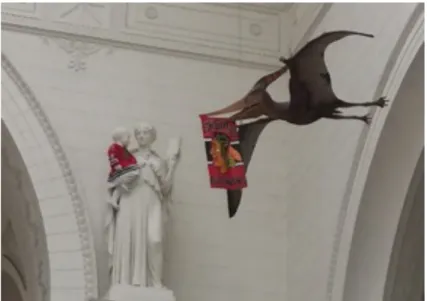
neoclassical elements of the building, and a spot of red caught my eye. As we walked closer, I began to
recognize the profile of the Chicago NHL mascot, which was on a flag, hanging from the mouth of a
pterodactyl. When I asked why in the world they would display something like that in the Museum, I
received a response about the Chicago NHL team’s Stanly Cup victory the month before my arrival. My
tour-guide informed me that this was something they did to support local sports teams, and that the
Museum’s brachiosaurus had, in previous years, sported a giant jersey. Unfortunately, they explained,
the jersey had been damaged and they were not able to use it this year.
Fig. 1.3. Pterodactyl with Chicago NHL team flag and baby statue wearing jersey in Stanley Field Hall. Photo by author.
When I again asked why an institution would endorse the use of a mascot that was so highly
contested and disparaging, my guide seemed confused about why anyone would be offended. They
went on to comment that if a Red Wings fan came into the museum and was offended by an
institutional display of support for their local community and its sports teams, that would be ridiculous.
Clearly, this person did not comprehend my question or the broader issues at stake with the prominent
display of this type of image within the space of such a renowned institution. Although, I guess
dinosaurs did eat Indians, and that’s how we went extinct. Yes, it’s a stretch, but it also illuminates the
problematic aspects of these kinds of representations within museums.
Once again, I took a deep breath and endeavored to continue my day with a positive outlook on
the work that was ahead of me. A bit later, I met with my supervisor to see my workspace and to chat
about my research plans for the summer. As we headed down the long, dimly lit hallway, passing the
Museum’s library, I could smell something awful. I asked what I was smelling, and she explained that we
had to pass by the ornithology department to get to the anthropology department. While she had
gotten used to the smell over time, my heightened olfactory perception—one of the worst aspects of
pregnancy, in my opinion— made me incredibly wary of my surroundings, and frankly, nauseous. We
walked further down, and I was struck by a display of beautifully artistic pictures of taxidermy bird
specimens (fig. 1.5). As we passed a corridor, there was another set of “artistic” photographs. However,
these weren’t bird specimens: they were Edward Curtis portraits of American Indians (fig. 1.6). I
couldn’t help but think about the connection of the dead birds and dead Indians I was seeing within the
broader context of The Field Museum and the collection of American Indians and American Indian
Fig. 1.5. Photographs of ornithology specimens in Staff Only area of Field Museum. Photo by author.
The images I confronted on my first day at the Field Museum are symbolic of the myriad
microaggressions American Indian peoples face in our daily lives, and do not exist at The Field
Museum alone. These experiences, and my reflections on them, have made me think more deeply
about the co-constitutive nature of pop-culture (mis)representations and the display of American
Indian “cultures” in museums and other well-respected educational institutions. The power relations
embodied within these images are deeply entangled and omnipresent within many of the spaces we
occupy each day. These are the kinds of visual representations that American Indian children—and
everyone else—see every single day. For Indian kids, these images limit the possibilities and
opportunities they see in their futures.2 In fact, there is scientific research confirming the damaging
effects of some of these images.3 Ultimately, these images work to dehumanize American Indian
peoples, which makes it easier for people to dismiss our problems, for the government to break our
treaties, and for courts to erode our sovereignty.
The debate around the use of American Indian mascots provides a well-known and timely
example of how popular media representations work to marginalize American Indian peoples and
how Indian peoples continue to push back and fight for the right to represent ourselves. Popular
representations are all too often constructed by non-Indians in ways that do not reflect the
multiplicity and complexity of our experiences. Movie and television characters like Pocahontas and
Tonto, mascots like Chief Wahoo, and hyper-sexualized Indian princess costumes circulate in the lives
of mainstream Americans more ubiquitously than representations created by Indian people
themselves. Even still, when Indian-made objects, images, and narratives are circulated to
mainstream audiences, they are often mediated by non-Indian curators or editors. These
representations define what it means to be an Indian within mainstream American society and limit
possibilities for contemporary Indian people to assert their rights or to imagine their own futures.
While it is important to critically engage with the various processes that contribute to the
marginalization and elimination of American Indians, it is even more important to examine the ways
American Indians have resisted, manipulated, upheld, and shifted these representations.
This dissertation project examines these acts of resistance—and in particular, acts of
resistance that employ artistic expression as a tool of creative self-representation—and the ways they
operate within broader movements for decolonization and self-determination. Focusing on Osage
artists and the interventions they are making within three mainstream museums as well as within
mainstream media and public spaces, this project interrogates the ways that some artists are creating
space for Osages and other American Indians to imagine stronger futures. I use colonial
entanglement as a frame to ground my analysis and to show how Osage artists have appropriated
“the colonizers’ tools” and reimagined them “as statements of empowerment” for building and
strengthening an Osage future.4 Colonial entanglement disrupts the binary of colonizer and colonized
and allows for a discussion of the complex and dynamic power relations that are interwoven into
issues of Indigenous self-representation, museum spaces, popular media, and the ways Osage art and
artists are working through and within myriad entanglements to shift (mis)representations.
In chapter two, “Aesthetics and ambiguity: The ongoing entanglements of Osage ribbon
work” I trace the importance of ribbon work and its use within Osage social practices as well as the
ways it is used as a visual language to express localized Osage knowledge and values. Ribbon work—
itself and as metaphor for colonial entanglement—is the thread that is woven throughout this
dissertation and throughout the works of many contemporary Osage artists. I also explore how
ribbon work emerged as a unique Osage practice through a series of historical, political, social, and
economic processes. The conversations about ribbon work within this chapter traverse geographic
boundaries, but the main research site within this chapter is the Denver Art Museum (DAM). Here, I
examine the ways that the formation of DAM collections was entangled with the non-Indian hobbyist
movement of the mid-twentieth century, and how the institution has built a legacy of working with
American Indian communities and artists. The entanglements of curators, non-Indian hobbyists,
Osages, and ribbon work culminate in the co-curated exhibition, Why We Dance, which is reviewed.
Through an analysis of research conducted in preparation for this exhibit, this chapter demonstrates
how art and object-centered ethnographic interviews within museum collections can help inform
future material culture research and create more equitable relationships between museums and
descendant communities.
Above all, the second chapter of this dissertation is about the complex web of colonial
entanglements that are interwoven throughout a great deal of Osage—as well as other American
Indian—art and material culture, collecting, and exhibition. One of the most complex entanglements
explored in this dissertation is the relationships between non-Indian hobbyists and some Osages over
the past sixty years. Like all communities, non-Indian hobbyist cannot be described as a homogenous
group without diversity and multiplicity. In order to better understand the spectrum of non-Indian
hobbyists, as well as the possibilities and limitations of their practices, this chapter examines more
deeply the relationships Osage ribbon worker—and my grandma—Georgeann Robinson formed with
hobbyists and what I call her methodology of generosity, a legacy that I wish to continue through this
and my future work.
While chapter two examines entanglements through material culture, chapter three, “A pillar
of ‘The Field’: institutional entanglements and future possibilities” examines the entanglements with
a particular focus on an institution—The Field Museum of Natural History. This chapter recognizes
audiences and shape the ways we see our world and the peoples in it. As one of the largest and most
popular natural history museums in the U.S., it has the power to shape mainstream expectations of
Indigenous peoples. However, this institution also has a complicated history that is entangled with
the founding of anthropology and the ethically questionable practices of collecting objects and
categorizing humans that characterized that era. Although a number of American Indians were
implicated and active in various ways through these processes, this chapter examines the
entanglements with a particular focus on the Osage Nation. Even still, this involves a conversation
about the 1893 Chicago World’s Fair, the 1904 Louisiana Purchase Exposition, George Amos Dorsey,
and social evolutionary theory.
After laying the groundwork for understanding the institutional entanglements, with which
the local urban-American Indian community and many other Indian peoples are familiar, I provide a
walkthrough of the American Indian Cultures exhibition space, “Hall 8.” This walk through is informed
by a number of conversations with Chicago-based Indian folks as well as published critiques of this
space. Drawing on my work identifying new acquisitions for the Field Museum’s collections as well as
a series of temporary exhibitions with contemporary artists Bunky Echo-Hawk, Rhonda Holybear, and
Chris Pappan, I suggest how contemporary art can and should inform the reinstallation of Hall 8,
which was announced in 2018.
Shifting from an institutional exploration of entanglements, chapter four, “‘Generosity, not
rocket science’: long-term community engagement at the Sam Noble Museum,” examines academic
and community-based work of anthropologist Daniel Swan. Swan is the Curator of Ethnology at the
Sam Noble Museum of Natural History in Norman, Oklahoma, and his work with the Osage Nation
began in the 1980s. In this chapter, I explore the personal entanglements that impact scholarly
research as something that can be used in productive ways through Swan’s involvement with the
examines two recent projects which Swan co-curated with Osages: A Giving Heritage: Wedding
Clothes and the Osage Community, a traveling show that opened in 2017, and Fluent Generations:
The Art of Anita, Tom, and Yatika Fields, a contemporary art show that opened in 2018. Taking a
closer look at the creative acts of self-representation curated by Osage ceramicist Anita Fields, her
husband, Creek and Cherokee photographer Tom, and their son, painter and muralist Yatika, Fluent
Generations reveals possibilities for thinking about art as activism and shifts expectations about what
kinds of exhibitions belong in natural history museums.
As these chapters will show, museum representations work to uphold, explore, and disrupt
the kinds of images of American Indians that are prevalent within mainstream society. In many ways,
these images are co-constitutive and inform one another in interesting ways. With that in mind,
chapter 5 examines the work of Osage artists who are working within mainstream media, the art
market, and public spaces. Beginning with an analysis of Ryan Red Corn’s activist performance art and
graphic design, this chapter interrogates how Red Corn and other artists are (re)appropriating media
(mis)representations as tools for self-representation. This chapter also examines the work of Addie
Roanhorse, a painter and mixed media artist as well as the graphic designer for the Osage Nation, and
interrogates the entanglements of her art practice and professional position. Norman Akers’ recent
mural explores the role of public art within ancestral Osage territory and his use of subversion as a
means to engage the public in conversation. Finally, this chapter returns to ribbon work and my
ongoing project with the Osage Nation to document this important practice within the Osage Nation
past, present, and future.
On Positionality, Profanity, and Humor
As a citizen of the Osage Nation and an anthropologist, my ability to conduct research with
scholars who have come before me.5 The growing body of Indigenous scholarship, and my own
conversations with some of these scholars about positionality, commitment, and false notions of
objectivity have given me the confidence to pursue my research project without hesitation. In 2012, I
was fortunate enough to have lunch with anthropologist K. Tsianina Lomawaima, a descendant of the
Muscogee (Creek) Nation. Her book They Called It Prairie Light: The Story of Chilocco Indian School
examines the creativity, adaptability, and resistance of American Indian children at this school. The
reminiscences, thoughts, and memories of her own father, Curtis Carr, who attended Chilocco in the
1920s and 1930s, anchor her narrative. During our conversation, I spoke with her about whether or
not a scholar can be "too close" to a research project. She told me that throughout her career, and
especially during her research on the Indian school her father attended, she was approached by many
people who thought she was "too close" to her research. She told me that there is nothing wrong
with Indian people studying their own communities and nations, and made the following comment
that has stayed with me throughout this project: “Michel Foucault is a white French Man, studying
white French men. People don’t question his research, so don’t let them question yours.”6 This type
of feedback and encouragement, which I have also received from various Indigenous mentors and
colleagues at UNC and beyond, has been incredibly helpful throughout my research.
In Decolonizing Methodologies, Maori scholar Linda Tuhiwai Smith concludes that in order for
an Indigenous scholar to conduct research on issues that are important within their own
communities, they must first situate their own perspective.7 Osage scholar Robert Warrior has talked
5 See Medicine, Learning to be an Anthropologist and Remaining Native; Ramirez, Native Hubs: culture, community, and
belonging in Silicon Valley and beyond and “Henry Roe Cloud: A Granddaughter’s Native Feminist Biographical Account”; Lomawaima, They called it Prairie Light: the story of Chilocco Indian School; Lambert, Choctaw Nation: A Story of American Indian Resurgence; Dennison, Colonial Entanglement: Constituting a Twenty-first-century Osage Nation; Deloria, Playing Indian, Indians in Unexpected Places, and “Thinking about Self in a Family Way.” In 2009, a special issue of American Indian Quarterly (vol. 33, no. 4) focused on “Working from Home in American Indian History,” which also speaks to these issues.
6 Personal communication, November 6, 2012.
about the ways these perspectives shape “the many versions of Indigenous studies.”8 For him, this
strategy allows him “to clearly and ambitiously define the scholarly tasks that drive my research,
thinking, and writing... [to] establish a basis for addressing the many tensions that typically confront
those of us working in Native and Indigenous studies.”9 Following Smith, Warrior, and others, I would
like to situate my perspective as an Osage citizen, nationalist, mother, teacher, and novice
ribbon-worker who believes in the incredible potential of the Osage Nation and its citizens.
Throughout the text, I have also included personal narratives that demonstrate how my own
experiences have influenced this research in various ways. In Blood Politics: Race, Culture, and
Identity in the Cherokee Nation of Oklahoma, anthropologist Circe Sturm examines the social and
political constructions of race and national identity within the Cherokee Nation. Throughout the text,
Sturm incorporates what she calls a “southern storytelling aesthetic.”10 This stylistic tool—marked in
her book with a line drawn down the page, adjacent to the text—allows Sturm, as she explains “to
present an angle on events, experiences, and even myself, that I otherwise could not.”11
Furthermore, this technique also highlights the “highly subjective nature of ethnographic writing,”
which Sturm describes as a form of non-fictionalized storytelling. In using this “narrative southern
voice,” Sturm conveys the “crafted, filtered, and subjective nature” of her descriptions in particular,
as well as the project of ethnographic writing more broadly.12
In addition to describing how subjectivity, anthropological theory, and the ethnographic gaze
permeate her research, Sturm also marks time as an important filter impacting the production of
8 Warrior, “Practicing Native American and Indigenous Studies,” 2010.
9 Warrior.
10 Sturm, Blood Politics.
knowledge. Similarly, Philip J. Deloria addresses this issue within his own work in his descriptions of
the complex connections between self and subject. Deloria recounts a story about his experience
riding the bus as a sixth grader near the Lummi reservation in Washington State; the story evokes
ideas about identity, race, culture, and space. Deloria, however, recognizes this particular history is
not the story of his sixth grade self, explaining, “I am certain I did not experience it in the way I have
recalled it.”13 This 2002 telling of an experience that occurred in 1971 is not incorrect, but rather, as
Deloria explains, “codified out of direct experience and then slowly altered with time.”14 The use of
personal stories raises important questions about the way the present engages with the past in
various ways and allows Deloria to situate himself and his subjects within his work.
Drawing upon these ideas, each chapter of this text begins with a personal narrative, which is
followed by a shift to a more formal academic narrative. As Sturm argues, “even though experience
has always been a great source of legitimization for anthropologists, I find it is more honest to
acknowledge these filters up front.”15 Agreeing with Sturm, I have placed these personal narratives at
the beginning of each chapter. It is my hope that the reader will be able to better understand this
project through my own situated—and internally unsettled—perspective.16 Furthermore, these
narratives are intended to foreground the experiences that have filtered and shaped my research.
Although they are most often located at the beginning of a chapter, these narratives are also woven
throughout the research. Most often, these moments signal spaces and moments where the
complexity of a situation is better conveyed through a narrative and not by forcing it to fit neatly into
an academic text.
13 Deloria, “Thinking about Self in a Family Way.” 27.
14 Ibid, 27.
15 Sturm, Blood Politics, xviii.
Throughout the personal narratives, I utilize humor and strikeout certain sections of the text.
These strikeouts signal my recognition of the "undesirable” or “inappropriate” inclusions of profanity,
discussions of motherhood, struggles with apprehension, and even the inclusion of candor within
certain institutional and academic spaces. Although I am particularly aware of the precariousness of
my position as a graduate student—and I certainly want a job—I see humor, profanity, and
admissions of uncertainty as important instruments for the larger project of decolonizing the
academy. More than a tool for decolonization, humor is also an essential aspect of Indigenous
survival, or rather, survivance.17 Survivance, as Gerald Vizenor describes, “is an active sense of
presence, the continuance of native stories, not a mere reaction, or a survivable name. Native
survivance stories are renunciations of dominance, tragedy, and victimry.”18 In Manifest Manners,
Vizenor goes on to describe strategic use of “trickster hermeneutics of liberation,” and reminds us
that “the uncertain humor and shimmer of survivance denies the obscure maneuvers of manifest
manners, tragic transvaluations, and the incoherence of cultural representations.”19 As s a creative
strategy, humor provides a “tribal counterpoise to the literature of dominance,”20 and as a
methodology, humor compliments other terminological and visual strategies used in this dissertation.
In using humor within my interviews, my writing, and in my classes, I also strive to convey
sincerity and to build a genuine rapport with my audience, students, and interlocutors. Furthermore,
researching and teaching within American Indian and Indigenous Studies is complicated, and the
issues American Indians and Indigenous communities throughout the globe continue to struggle
with—dispossession, violence, genocide, forced removal and assimilation—are difficult to confront. I
17 Vizenor, Manifest Manners: Narratives on PostIndian Survivance, vii.
18 Vizenor, vii.
find humor to be an effective strategy for making people feel at ease before diving into an
examination of the ongoing colonial and institutionalized violence that permeates the daily lives of
American Indians and other marginalized peoples.
My use of humor to open up space for dealing with the contradictions and constraints of
American Indian experiences builds upon the legacy of scholars and writers like Vine Deloria, Joy
Harjo, Leslie Marmon Silko, Paula Gunn Allen, Sarah Winnemucca Hopkins and Sherman Alexie—
among others—who have used humor, irony, and sarcasm as discursive strategies.21 However, if
there is one “truth” I learned during my fieldwork, it is that Osages and other Indian folks love to
laugh, and so we are always drawing on humor that emerges from within our communities, families,
and oral histories. While I often use humor or sarcasm to open a conversation or to work through the
absurdity of my research as an Osage anthropologist working on decolonizing inherently colonial
institutions, I also see the laughter within our communities as expressions of resilience, resistance,
and hope.
Lastly, this text utilizes humor and emphasizes irony as a decolonizing tool to convey the
humanity and contradictions that characterize American Indian lives.22 Above all, the continual,
contentious, and ever-changing aspects of Osage art and nationhood reflect and recognize the
diversity of the Osage Nation. As one Osage citizen asserted in a public forum during the Osage
constitutional reform process, “We are a nation—nations have diversity.”23 Reflecting the multiplicity
of Osage experience, Osage ideas about art, museums, society, and politics fundamentally resist
attempts at meaningful generalization.24 I have attempted to demonstrate the diversity and
21 Squint, “Choctawan Aesthetics, Spirituality, and Gender Relations”; Carpenter, “Choking Off That Angel Mother”;
Coulombe, “The Approximate Size of His Favorite Humor”; Andrews, “In the Belly of a Laughing God.”
22 See Smith, Everything You Know about Indians Is Wrong, 2009.
23 Dennison, Colonial Entanglement, 65.
complexity of Osage and American Indian experiences throughout this text. However, academic
writing is inherently limited and incomplete, and this examination is representative of my ongoing
research on the dynamic processes of creative self-representation, ongoing movements for greater
self-determination, and collaborative and decolonizing research methods.
Terminology and text
The majority of words used to describe Indigenous peoples and concepts are problematic in
some way or another. Recognizing the thorny nature of such language and elucidating the reasons for
using specific terminology contributes to decolonization. Therefore, I would like to make a few
clarifications about the terms I have chosen to use within this text. Even though there are numerous
American Indian and Indigenous artists who are making interventions in mainstream museums, this
project examines how artists from the Osage Nation are engaging in this work. Therefore, I will use
the term “Osages” most often. However, in some instances, this project speaks to broader issues
surrounding Indigenous communities throughout the United States and Canada. While there is no
term that remains unquestionable, I have chosen to use “American Indian” and the abbreviated form
“Indian”—the term most commonly used within Osage communities—in reference to these trends.
When speaking about more widespread issues of settler colonialism that pertain to the global
population of communities and people that reach beyond American Indians, I will use the term
“Indigenous.”
In my previous research, I have often used the words “tribe” and “member,” terms widely
used to describe American Indian polities and the people that belong to them. While these terms
remain important tools that contribute to the empowerment American Indian polities, particularly
within legal contexts, these terms work differently in the context of academic writing. Speaking of this
as tribes when you’re trying to build our nationhood or advance our sovereignty. Refer to us as
nations.”25 While Hale specifically references the use of the word “tribe,” the concept of
“membership” similarly works to undermine political authority. As Dennison argues, “citizens belong
to sovereign nations, while you can be a member of any number of clubs or groups with little real
authority.”26 In an effort to contribute to a scholarship that engages with decolonization and
advances the sovereignty of Indian nations, in almost all cases, I prefer to use the terms “nation” and
“citizen” in my own writing.
In 2010, the Osage Nation Congress passed a resolution (ONCR 10-30) that proposed, “the
Osage Nation Constitution be amended to replace all references to ‘membership’ with ‘citizenship’
and to replace ‘eligibility for membership’ with ‘right to citizenship.’”27 This legislation, sponsored by
Congressman William Supernaw, was enacted with eleven of the twelve members of the Osage
Nation Congress voting in favor of the resolution.28 ONCR 10-30 was one of seven proposed
Constitutional Amendments placed on the ballot for the June 4, 2012 General Election, and each of
the seven amendments failed to meet the required approval of 65% of the Osage electorate.29 ONCR
10-30 reflects the particularly complicated nature of using these four words, and the fact that each of
the terms is used within Osage communities. Therefore, while I have made the decision to use the
terms “nation” and “citizen” in my own writing, I also use direct quotes from other Osage citizens and
scholars who use the terms “tribe” and “member.”
25 Lemont, American Indian Constitutional Reform and the Rebuilding of Native Nations, 88–89.
26 Dennison, Colonial Entanglement, 13.
27 Resolution Number ONCR 10-30, November 8, 2010, 2nd Congress, 1st Session.
http://www.osagetribe.com/congress/info_sub_page.aspx?subpage_id=239
28 The twelfth Congressperson was absent for the voting on this piece of legislation. See ONCR 10-30.
29 Amendments to the Osage Nation Constitution must be approved by 65% of the Osage electorate, and only 47.6% of the
Lastly, in my discussion of the Washington D.C. NFL team, I make the choice not to use the
disparaging name of their mascot. I will instead refer to the R-word or the Washington NFL team. This
is not something that comes easy, as it is a term I have used throughout my life, although I have
always found it to be offensive. The goal of my refusal to write this word and its subsequent absence
from this text is to call attention to the violence and prejudice it signifies. My choice to use or refuse
specific words within this text enacts self-determination at the level of method and representation.30
As anthropologist Audra Simpson argues in Mohawk Interruptus, “sovereignty matters, as a
methodological issue in and of itself, because it speaks from jurisdictional authority: the right to
speak, and in this case, to not speak.”31 Here, Simpson links the dispossession and juridical control
over Indigenous lands to the control over texts and writing, and draws on what Robert Warrior refers
to as “literary sovereignty” to mark her ethnographic work—and the practice of ethnography itself—
not only as a political project, but as one that recognizes sovereignty.32
In addition to analyzing the textual data gathered during this research, I also utilize in-line
images of Osage art and material culture. The inclusion of these images as a key component of the
dissertation composition is my attempt to push back against text as the dominant narrative within
anthropological knowledge production.33 For too long, knowledge has been, “classified as 'western
scientific' discourse,” as Sonia Smallacombe explains, “and appropriated as the property of white
academics to enhance their careers.”34 However, just as knowledge has been wielded as a powerful
tool to deny future possibilities for Indigenous peoples, Indigenous researchers can also use it as a
30 Simpson, Mohawk Interruptus, 104.
31 Simpson, 104–5.
32 Simpson, 105; Warrior, Tribal Secrets: Recovering American Indian Intellectual Traditions, 98.
33 Schneider “Three Modes of Experimentation with Art and Ethnography.”
tool to open future possibilities.35 Within this dissertation, art is not simply aesthetic, but also
performs an ethnographic function through which the artist—author and producer of knowledge—
communicates and interprets the world through visual language.
Conducting research at the intersections of art and sovereignty: collaboration and creative self-representation
As many American Indian nations throughout the United States and Indigenous communities
throughout the world, the Osage Nation has a significant history of artistic expression and production.
The wide-ranging work of contemporary Osage artists is both compelling and diverse, and reflects the
multiplicity and complexity of the Osage Nation and its citizens. While Osage artists produce and
create works of art for a variety of reasons—as objects for aesthetic appreciation, as marketable
commodities, as expressions of individual or group identity, as reflections of physical and social
landscapes, or as objects to be used—their works are, above all, creative acts of self-representation
that resist static notions and expectations of Indigeneity. With this in mind, this project envisions a
new approach for examining Indigenous artistic expression within anthropology and other disciplines.
One of the challenges of producing academic work that resists rendering Indigenous
communities as static or homogenous is the problematic use of “culture” as an analytic category.
Even though diversity and heterogeneity are widely acknowledged as key characteristics of
nationhood, Indian nations are often expected to be homogenous entities, located in a mythical
past.36 The strategy of rendering the Indigenous population as “out of time and place” in
contemporary society have been used to justify the elimination of Indigenous peoples and the
appropriation of their lands. As Osage Congressman Otto Hamilton explains37:
35 Tuhiwai Smith, Decolonizing Methodologies, 3-4.
36 Dennison, Colonial Entanglement, 77.
There’s so many people involved ... when it comes to culture, culture means something different to each and every one of us, so one family might do it differently ... another family does it differently, then you have another district that does it differently. In my experience, the best way if you want to find something out and you want to learn about something is to go and ask them, don’t just use one source, because everyone does things differently.
For Hamilton, and other Osages, culture is an important part of community and nation-building, but
the meaning of culture varies between individuals, families, and districts, and changes over time. The
act of defining culture stifles its inherent fluidity and diversity.
Anthropologist Kirk Dombrowski has addressed this issue in his work, and argues for what he
terms “culturing,” which sets aside “the notion of culture as a fixed way of looking at the world” in
order to examine the processes by which people create, disseminate, and contest shared meanings.38
Dombrowski’s concept recognizes the contested and multiple meanings of “culture” and how it is
constructed through various social, historical, and political processes. However, in order to avoid
slippage between 1) the multiple, contested, and emic processes that are used to create “culture”
within the Osage Nation and 2) the analytic category of “culture” that can be used against the
decolonizing goal of this research, this project moves away from the analytical frame of “culture”
entirely. However, the terms “material culture” or “expressive culture,” which most often refer to
things made for use in specific Osage practices, are still used, as are quotes from interlocutors who
use the term in their own statements.
The primary focus of this project is to examine the ways that Osage art is used to imagine and
build an Osage future. Here, art is envisioned as playing an active and dynamic role in the ongoing
political movements for sovereignty and decolonization, not as a static representation of “culture.”
This project interrogates how Osage artistic expression emerged through, against, and entangled with
the settler colonial process, becoming a tool for Osage self-representation and resistance. Osage art
means different things to different people, and my research will explore some of these contested
meanings. Above all, Osage art exemplifies the ways that Osage people creatively engage with the
past as a means for serving present needs and securing an Osage future.
My examination of Osage art as entangled with Osage nation-building and settler colonialism
is informed by the work of other scholars who see the importance of recognizing Indigenous artistic
expression as key discourses that contribute to activism and movements for greater sovereignty. For
example, artist, curator, and visual historian Jolene Rickard places art within a narrative of
colonization and resistance. She examines how art operates within Indigenous nations by asking,
among other questions, “How does one articulate the relationship between art and sovereignty in
Native nation-building?”1 Rickard makes the significant point that examinations of Indigenous
resistance and expressions of nationalism have been limited to recognizable and straightforward
events like the occupation of Alcatraz, whereas examinations of Indigenous art focus on “‘traditional’
cultural expressions.”2 Working away from this, she introduces the concept of “retraditionalization,”
arguing that “even the most ‘traditional’ form like basket-weaving, is actually a demonstration of
Indigenous renewal, survival, and political and environmental awareness … the notion
of retraditionalization is tied to resistance.”3 For Rickard, artistic expression challenges colonization,
calls for self-determination, and “serves the larger goal of sovereignty.”4
Similarly, in her work on Indigenous and ethnographic filmmaking, literature and film studies
professor Michelle Raheja examines how the film Atanarjuat (The Fast Runner), directed and
produced by Inuit filmmakers, addresses a dual Inuit and non-Inuit audience. Raheja explores the
spaces within and between resistance and compliance in order to examine the ways Indigenous
filmmakers and actors engage with ethnographic film conventions while simultaneously “operating
within and stretching the boundaries” drawn by these conventions.5 For Raheja, the resistance
along a spectrum of political and social efficacy.”6 Calling her analytical approach “visual
sovereignty,” Raheja argues:
This strategy offers up not only the possibility of engaging and deconstructing white-generated representations of Indigenous people, but more broadly and importantly how it intervenes in larger discussions of Native American sovereignty by locating and advocating for Indigenous cultural and political power both within and outside of Western legal
jurisprudence.7
For Rickard and Raheja, creative acts of self-representation and resistance contribute to Indigenous
sovereignty and decolonization.
Drawing upon Indigenous visual studies, and the works of Raheja and Rickard in particular,
historian Jenny Tone-Pah-Hote demonstrates the ways that “Kiowa men and women” have used
expressive culture as a means of asserting their “national interests in public venues not traditionally
viewed through the lenses of Federal Indian law and policy.”39 By focusing on the contributions of
men and women, Tone-Pah-Hote speaks to the often-undervalued roles that women play in
Indigenous nation building. Looking specifically at the period between 1875 and 1939, Tone-Pah-Hote
further argues that, “Kiowa people engaged expressive culture as a way of articulating ideas about
their nation both for themselves, for other American Indian people in Oklahoma and elsewhere, and
for Euro-American audiences.”40 This research reveals the various expressive forms—such as dancing,
beading, peyote jewelry, and painting—Kiowa people have used to maintain their autonomy and
imagine Kiowa nationhood. Tone-Pah-Hote’s work provides an important example of the ways in
which American Indians use creative self-representation in nation-building projects. Tone-Pah-Hote’s
emphasis on the role that women play in imagining and articulating nationhood pushes us to look
more closely at the way gender operates within self-representation and self-determination.