Perceived Organizational/Institutional barriers to breastfeeding in Appalachia among lactation consultants, counselors and providers
by
Ruwaydah Sideek
Senior Honors Thesis
Department of Nutrition
University of North Carolina at Chapel Hill
2020
Approved:
Advisor: Dr. Stephanie Martin
2
Acknowledgements
I would first like to thank Dr. Stephanie Martin for her guidance on this project and for being an
excellent mentor to me these past two years at Gillings School of Global Public Health. I would
also like to thank Dr. Seema Agrawal for her support for this project. I am also very grateful to
the Appalachian Breastfeeding Network for their partnership and support I have received during
3
Table of Contents
Introduction and Study Aims………...4
Methods………..6
Results: Quantitative Analysis………...11
Results: Qualitative Analysis……….18
Discussion……….32
Strengths and Limitations………..34
Conclusion………35
References………36
Appendix 1………...39
4
Introduction
The US Centers for Disease Control and Prevention (CDC) and American Academy of
Pediatrics recommend exclusive breastfeeding for six months and continued breastfeeding for at
least 12 months because of its health benefits to children and women (CDC, 2019). Less
breastfeeding is associated with childhood infections, decreased intelligence, increased risk of
overweight and diabetes, breast/ovarian cancer prevention, and type 2 Diabetes (Victoria, et al
2016). One objective of the Healthy People 2020 was to increase proportion of infants who
breastfed at 6 months to 60.6%. Yet, this proportion is currently below the target at 57.6% (CDC,
2019). Despite increases in breastfeeding rates nationally, rural Appalachia has a lower
prevalence of breastfeeding of 57.5% compared to the rural national breastfeeding prevalence of
68.7% (Wiener & Wiener, 2011), leading to poor health outcomes. Appalachia includes 13 states
and 420 counties and has extensive health disparities, barriers to care, and various other
determinants including low access to healthcare, low income, high poverty rates etc. compared to
the nation as a whole (PDA, Inc et al 2017). Hospital practices such as those followed by baby
friendly hospitals are shown to improve breastfeeding practices (Munn et al 2016). Healthcare
providers, peer counselors and breastfeeding groups that counsel women about breastfeeding are
also shown to improve breastfeeding practices (Sinha et al 2015). However, accessing lactation
providers and support is particularly difficult in Appalachia (Ray et al 2018).
Lactation support can improve breastfeeding practices. Understanding the experiences of
those who provide lactation support is critical, yet there are few studies that have explored their
experiences. Although there are a limited number of studies that have explored perspectives of
lactation counselors in providing breastfeeding support in the U.S. (Anstey et al.,2017), a review
5 Lactation Consultants’ Perceived Barriers study that interviewed lactation consultants across
Florida, for example, identified a set of direct and indirect barriers such as institutional
constraints, lack of coordination, poor service delivery, limited social support, low self-efficacy,
social norms, and lack of breastfeeding knowledge and attitudes (Anstey et al.,2017). Because of
the unique characteristics and culture of the Appalachian region, it would be beneficial to
examine perspectives of lactation providers and supporters in the Appalachia to explore the low
rates of breastfeeding in this region. While the facilitators and barriers women have experienced
with regards to receiving breastfeeding support in 19 Appalachian counties was conducted
among 176 women that shared their experiences (Raffle, Ware, Borchardt, & Strickland, 2011),
research on the experience of providers is lacking. The goal of this study is to explore
experiences and perspectives of providers that support breastfeeding/lactation among women in
the Appalachia, with a focus on organizational/institutional and provider level barriers in this
area.
It is important to understand the experience of these providers to improve breastfeeding
rates in the Appalachian region. The purpose of the current implementation research study is to
examine the experience of providers supporting families with breastfeeding and lactation in
Appalachia. There is limited data about the organizational/institutional barriers to breastfeeding
in Appalachia. The critical period of hospital stays and mother and newborn experiences there
exert influence on early breastfeeding initiation and establishment of breastfeeding (CDC Guide
to Breastfeeding Interventions, 2005). Additionally, breastfeeding education as a part of prenatal
education in hospitals and clinic settings is found to be the most effective intervention for
6
Study objective and aims
The objective of this study was to explore organizational/institutional barriers that
lactation consultants, providers and counselors (LCPCs) face when providing breastfeeding
support to families in the Appalachian region.
Aim 1: Identify the key organizational/institutional barriers providers face when providing breastfeeding/lactation support in the Appalachian region through an online survey.
Aim 2: Examine provider experiences and perceptions of the organizational/institutional barriers to providing breastfeeding and lactation support to families in Appalachia through in-depth
phone interviews, and to gain a sense of changes LCPC’s would like to see in their communities.
Methods
Quantitative Methods Sample
The Appalachian Breastfeeding Network is a network of members interested in
supporting the work towards transformation of breastfeeding culture in Appalachia by providing
empowerment, education and accessibility to care. In partnership with the Appalachian
Breastfeeding Network (ABN), we invited members of the ABN listserv to participate in an
anonymous ‘Breastfeeding and Lactation Support in Appalachia’ Qualtrics survey. Participants
completed the survey between March-July 2019. An invitation with the survey link was sent out
to ABN members through an email listserv and posted on ABN social media platforms
(Facebook, Instagram, and Twitter). We utilized a convenience sample. We received 130
responses on the survey. Out of these responses, 88 participants do work related to breastfeeding
7 the survey and 29 respondents were people that work related to breastfeeding and lactation
outside of Appalachia or people that are interested in ABN’s mission. We examined responses
from participants to assess top challenges of providing breastfeeding/lactation support to clients
in the Appalachian region. Additionally, we also examined providers perceptions of key
challenges their clients experience related to breastfeeding/lactation.
Data Collection
Questions were formulated as multiple choice, ranking, and open ended on Qualtrics, and
were organized into three main sections: demographic characteristics, experience providing
breastfeeding and lactation support, and ABN initiatives.
Variable and Measures
Sociodemographic characteristics included age, gender, location of work, education,
self-identified ethnicity, employment status, and profession. The listed question and answer options
for the survey are included in Appendix 1.
Participants were also asked if they were health professionals and what kind of
professions they were involved in. We also asked participants whether their work with
breastfeeding/lactation was based in Appalachia. We asked participants to choose what setting
they provide breastfeeding and lactation in and any breastfeeding/lactation certifications they
possess.
The survey asked participants to choose all the challenges they face when providing
breastfeeding and lactation support to clients/patients/program participants. Program participants
8 asked them to choose the topmost challenge they faced in their communities. Participants were
also asked to identify all challenges related to breastfeeding that clients/patients/families in the
community experienced. Out of these challenges, participants chose the topmost challenge that
clients experienced related to breastfeeding in their communities. We included an open-ended
question at the end of the survey so LCPC’s could share anything else that was important.
At the end of the survey, participants were asked if they would be willing to participate in
a follow-up in-depth interview, and if so, to click on a link to a separate online form where they
could enter their contact information separate from their responses.
Analysis
Microsoft Excel was used to generate descriptive statistics.
Qualitative Methods
In order to gain a more comprehensive understanding of the experiences of LCPC’s who
support families in Appalachia with breastfeeding and lactation, and to explore some of the
challenges they experience, we used qualitative methods. We conducted in depth interviews over
the phone to gain an understanding of individual LCPC’s experiences and identify common
themes. We emailed $15 e-gift cards of choice to participants after the interview.
Design
We conducted this qualitative study using semi structured in-depth phone interviews with
9 The goal of the interviews was to hear about diverse perspectives from LCPCs working
in a range of different settings to gain a more complete picture of the perceived barriers and
difficulties in providing breastfeeding/lactation care in Appalachia. The main questions were
developed based on the survey responses and a review of the literature and focused around
factors that limited LCPC’s ability to provide support to families at the
organizational/institutional level, provider level, community/social level, and family level. We
also asked interviewees about changes they would like to see in their communities at each level.
This thesis will focus on barriers and suggested changes from LCPC’s at the organization,
institution and provider level.
Sample and Setting
All participants in this study did work or volunteering related to breastfeeding/lactation in
the Appalachian region. Participants were a subsample from the Qualtrics survey respondents
that showed interest in participating in an interview. The participants that conveyed interest in
participating in an interview from the Qualtrics survey sample were contacted by email to
schedule a time/date for the interview. Therefore, a convenience sample was used to recruit
interview participants. All participants were also connected to the Appalachian Breastfeeding
Network and were age 18 years or older and able to speak English.
Data Collection and Analysis
Two researchers (R.S. and G.F.) conducted the phone interviews. Interested participants
were contacted through email to set up phone interviews. Interviews were conducted from
10 is included in Appendix 2. A transcribing software called Recordator was used to record and
transcribe all the interviews. Before the interview, all participants gave verbal consent to being
recorded. We collected participant interview data anonymously by assigning each participant a
numerical identification (R1-R-11; G1-G9).
The transcribed interviews were coded in ATLAS.ti using a rapid qualitative analysis
approach and prespecified codes:
1. Factors that limit ability to provide support: Community/Social
2. Factors that limit ability to provide support: Family
3. Factors that limit ability to provide support: Organization/Institutional
4. Factors that limit ability to provide support: Other providers
5. Changes: community/social/family
6. Changes: Organizational/institutional/other providers
7. Main difficulty/barrier
For the purpose of this study, information pertaining to codes 3,4,6, and 7 were analyzed
to find common themes with organizational, institutional, provider, and policy level barriers that
LCPC’s have experienced and changes LCPC’s would like to see among organizations,
institutions and providers in their communities.
We collected participant characteristics including location (state), BF credentials, current
position, age, education, gender and race/ethnicity as part of the interview as well.
Ethical Review
The study was approved by the Institutional Review Board at the University of North
11 Appalachian Breastfeeding Network. All participants were asked permission to record the
interviews and interviewed anonymously. All interviews were conducted in English and
transcribed.
Results: Quantitative Analysis
Sample characteristics
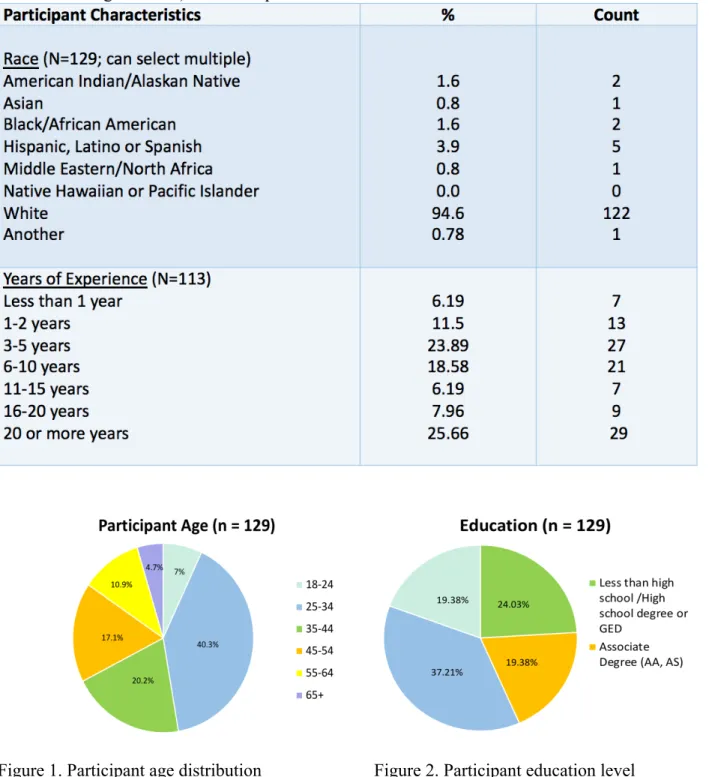
The survey was completed by 129 participants. Participant ages ranged of 18-65+ (figure
1). Most participants had a bachelor’s degree or a High School Diploma from the sample (Figure
2). About 58.9% of the participants were also Health professionals (Figure 3). The appendix lists
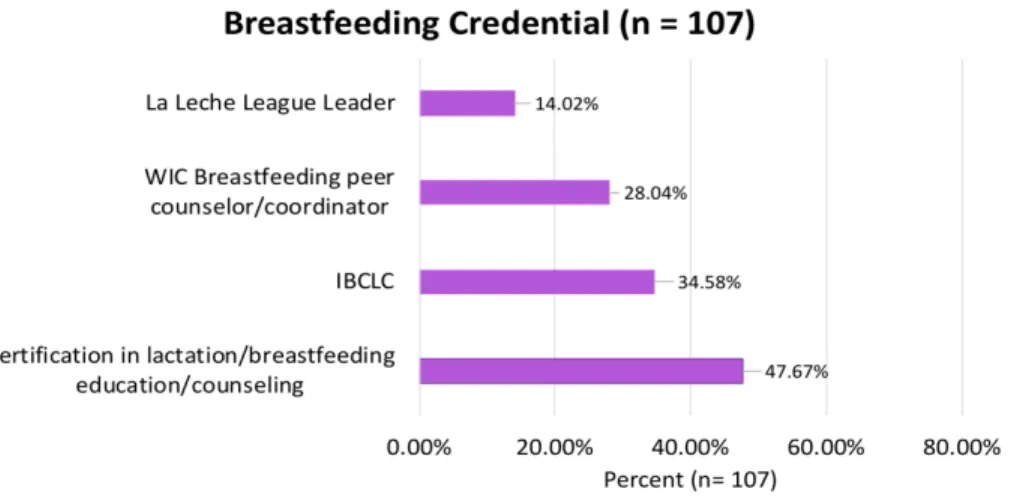
what careers are considered as health professions. The breastfeeding credentials of the LCPC’s
are displayed in figure 3. Interestingly, more than half of the sample worked at WIC or the
County Health Department (56.6%) and 26% worked at a hospital (Figure 5). The sample
consisted of a predominantly White population (94.6%) (Table 1). There was a wide range in the
number of years participants had been providing breastfeeding and lactation support; 24% of the
sample had 3-5 years of experience in breastfeeding and lactation support while 26% of the
sample had 20 or more years of experience, which helped us gain results from people with little
12
Table 1. Participant characteristics describing race and years of experience (doing work related to breastfeeding/lactation) of the sample
13 Figure 3. Participant breastfeeding credentials
*IBCLC - International Board-Certified Lactation Consultant
*WIC – The Special Supplemental Nutrition Program for Women, Infants and Children
Figure 4. Participant areas of work
14
All challenges faced by LCPCs
Participants were asked to choose all the organizational/institutional/provider level
challenges they faced while providing breastfeeding and lactation support from a comprehensive
list of challenges on the survey. Out of the selected challenges, they were prompted to choose the
topmost challenge in their respective communities. There were 81 participants that do
work/volunteer related to breastfeeding/lactation in Appalachia, that answered this particular
question.
In the first round, non-medically indicated supplementation was indicated as one of the
challenges that participants faced while providing support in Appalachia by 84% of the
participants. Hospital practices, policies and interventions during labor and delivery, was
indicated as a challenge by 79% of the participants. Lack of coordination among providers and
institutions, and Hospital Postpartum practices, were identified as a challenge by 76.5% of the
population (Table 2) These challenges were the top three organizational/institutional/provider
challenges identified by majority of the participants. Table 2 displays the rest of the
organizational/institutional/provider challenges identified by participants working in Appalachia.
In the second round, there was a lot of variation in the responses when participants were
asked to pick the biggest barrier that participants faced providing breastfeeding/lactation support.
The following organizational/institutional/provider level challenges were the most selected for
the topmost challenge:
1. Non-medically indicated supplementation – 19.8%
2. Hospital postpartum practices – 13.6%
3. Lack of coordination among other providers and institutions – 8.6%
15
5. Supporting clients with concerns about milk supply issues – 4.9%
Non-medically indicated supplementation is giving the recommendation/suggestion to provide
babies with formula with no appropriate medical reasoning. Hospital postpartum practices
includes lack of skin-to-skin contact, not rooming-in, swaddling, use of pacifiers, use of nipple
shields etc.
Table 2. Organizational/Institutional/Provider level challenges that participants identified among all the challenges they faced while providing breastfeeding/lactation support in Appalachia
Challenge # of
participants % of participants
Non-medically indicated supplementation 68 84%
Hospital practices, policies, or interventions during labor and delivery (Pitocin, epidurals, forceps, vacuum extractions, cesarean sections)
64 79%
Lack of coordination among other providers and institutions (including lack of referrals, lack of awareness of services by other providers, or delayed follow up, among others)
62 76.5%
Hospital postpartum practices (lack of skin-to-skin, not rooming-in, swaddling, use of pacifiers, use of nipple shields)
62 76.5%
Other health care providers are not supportive of breastfeeding
58 71.6%
Counseling clients around issues related to drug use
and lactation/breastfeeding 46 56.8%
Challenges connecting/reaching clients/participants for follow up or retaining clients/participants in programs and services
46 56.8%
Time constraints 35 43.2%
Inadequate staffing 31 38.3%
Supporting clients with infants who are preterm, low-birth weight, or have other health conditions
29 35.8%
16
Lack of administrative support 29 35.8%
Supporting clients who have health conditions that interfere with breastfeeding/lactation
29 35.8%
Lack knowledge/skills to support clients effectively 13 16%
*81 participants that do work related to breastfeeding in Appalachia answered this question
Provider perceptions of challenges faced by clients/families
Similar to LCPC barriers, participants were asked to choose all the challenges clients and
families in their communities faced related to breastfeeding/lactation. Influence of formula
industry was identified as one of the organizational/institutional/provider level challenges by
81.5% of participants working in Appalachia. Workplace policies that are not supportive of
breastfeeding/lactation was also identified as one of the challenges by 74% of the participants.
Lack of support after hospital discharge was identified as another popular challenge by 65.4% of
the participants (Table 3). These challenges were the top three
organizational/institutional/provider level challenges identified by majority of the participants.
Table 3 displays the rest of the commonly identified challenges among clients/families as per
LCPC's perception.
When LCPC’s were asked to choose the topmost organizational/institutional/provider
level challenge that clients/families faced related to receiving breastfeeding/lactation support in
their communities, there was considerable variation. A few of the common topmost challenges
that were selected included hospital policies and practices interference with breastfeeding
initiation (chosen by 4.9% of participants), high cost of lactation support (chosen by 2.5% of
17
Table 3. Provider perceptions of all Organizational/Institutional/Provider challenges that clients/families face related to breastfeeding/lactation
Challenge # of
participants % of participants
Influence of formula industry 66 81.5%
Workplace policies, other than parental leave, that are not supportive of
breastfeeding/lactation
60 74%
Lack of support after hospital discharge 53 65.4%
Health care providers are not supportive of
breastfeeding 52 64.2%
Routine supplementation in hospitals 50 61.7%
Hospital policies and practices interfered with
breastfeeding initiation 48 59.3%
Biased treatment from health providers 42 51.9%
Cost of lactation support 36 44.4%
*81 participants that do work related to breastfeeding in Appalachia answered this question
*Out of the 88 participants that work in Appalachia, only 81 completed these questions. The other 7 participants had incomplete surveys.
Additional Information
At the end of the survey, an open-ended question was asked “Is there anything else that
you would like to share with us?” Since the goal of this research is to explore challenges with
breastfeeding/lactation in the Appalachia at the organization/institutional level, the following
themes were seen in the results.
18 Participants stressed the importance of Hospital/provider support with breastfeeding to
encourage moms to initiate breastfeeding at the hospital. One provider mentioned that hospitals still have a long way to go with breastfeeding support despite the recent support.
“My second child was born at a different hospital that was NOT breastfeeding friendly and gave him a bottle without my consent which caused him to have issues with latching and it took about 2 weeks for us to overcome these issues.” – CLC from Virginia
“My oldest child is 16 years old, my middle almost 9 and my youngest is 3. I can see a huge difference in hospital practices in the last 16 years and am thankful that hospitals are more supportive of BF now but we still have a long way to go.” – WIC Breastfeeding Peer Counselor, CLC from West Virginia
“Hospital and pediatric support is lacking at hospital.” - Advanced Practice Nurse, IBCLC from West Virginia
“Support moms of NICU infants to provide breastmilk. It is very challenging!” -Advanced Practice Nurse, IBCLC from Ohio
Lactation education to LCPC’s
Increasing access to lactation education for hospitals, providers and LCPC’s was also another recurring theme in these responses
“Until the public, the medical profession in particular, is educated and supportive we have an up-hill climb.” -Lactation Consultant at Public Health Department, IBCLC from Ohio
“I work and live in Maryland, and most of my continuing Ed, policy development, mentor ship and teaching has been in Maryland, but I see great need throughout neighboring West Virginia and Southwestern PA. IBCLCs at my health department are often contacted by residents of surrounding areas looking for assistance. We have successfully “grown our own” by supporting staff with education and mentor ship to become IBCLCs. May be an idea to help other areas improve access to professional lactation support.” – IBCLC from Maryland
Results: Qualitative Analysis Sample characteristics
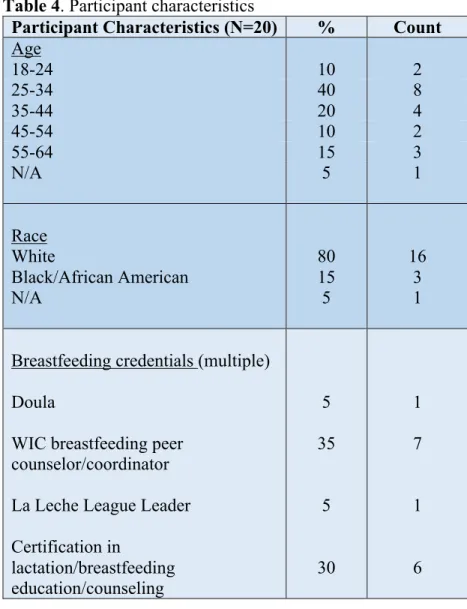
Twenty participants took part in the in-depth interviews. Participants ages ranged from
19 the participants have IBCLCs. 19 of the participants currently do work related to
breastfeeding/lactation in the Appalachian region. One participant previously did
breastfeeding/lactation work in Appalachia before moving elsewhere for work. The participant
population consisted of 80% White and 15% Black/African Americans (table 4). One participant
declined to answer age and race. Years of experience varied across the sample and is displayed
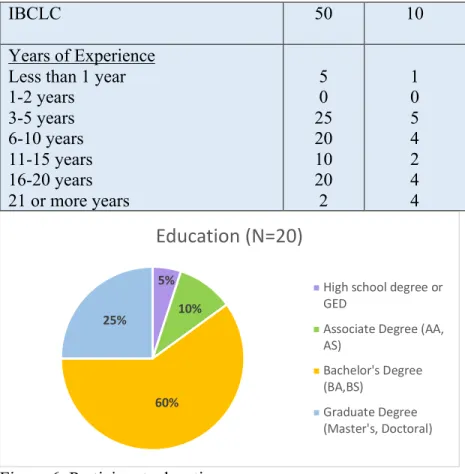
in table 4. Education level for the participants is displayed in figure 6, where 60% of the
participants have a bachelor’s degree. Figure 7 displays the states where participants work.
About 35% of the participants work in Ohio.
Table 4. Participant characteristics
Participant Characteristics (N=20) % Count
Age
18-24 10 2
25-34 40 8
35-44 20 4
45-54 10 2
55-64 15 3
N/A 5 1
Race White Black/African American N/A 80 15 5 16 3 1
Breastfeeding credentials (multiple)
Doula
WIC breastfeeding peer counselor/coordinator
La Leche League Leader
20 Figure 6. Participant education
Figure 7. States where participants work
Organizational/Institutional level barriers
Participants were asked to describe some of the organizational/institutional level barriers
that impact their ability to provide breastfeeding/lactation counseling and care. Three main 5%
10%
60% 25%
Education (N=20)
High school degree or GED
Associate Degree (AA, AS) Bachelor's Degree (BA,BS) Graduate Degree (Master's, Doctoral) 5% 20% 5% 5% 10% 20% 35%
0% 5% 10% 15% 20% 25% 30% 35% 40% Georgia Virginia Alabama North Carolina Kentucky West Virginia Ohio Percent (N=20)
IBCLC 50 10
Years of Experience
Less than 1 year 1-2 years
3-5 years 6-10 years 11-15 years 16-20 years 21 or more years
21 categories of barriers emerged under these results: poor service delivery, poor hiring strategies,
and institutional/policy constraints. All the themes under these categories are displayed in table 5
along with illustrative quotes.
Poor service delivery
Subthemes within poor service delivery include hospital postpartum practices, hospital’s
message about breastfeeding, counseling clients around issues related to drug use and
lactation//breastfeeding, lack of follow up with client, and less value given to LCPCs.
A participant expressed frustration with hospital postpartum practices because of the lack
of support for moms to breastfeed after delivery. The participant recollected an experience with a
mom who had a c-section that had very limited support at the hospital as the IBCLC took a while
to arrive and an electrical pump was not provided to the mom in the meanwhile. A participant
also mentioned that the hospitals put out mixed messages about breastfeeding to patients which
impacts their ability provide breastfeeding support. Getting the local hospital to get on board
with breastfeeding was considered an important step towards solving this problem. Another
participant explained that hospitals don’t allow moms that are on opioid addiction treatment to
breastfeed; allowing these moms to breastfeed can be a way to keep the moms from reverting to
past substance use. Another challenge that LCPCs identified was follow up with clients after
initial meeting. They stress the importance of prenatal education for early breastfeeding
initiation. Another challenge that was identified is the lack of value placed on LCPCs. One
participant mentioned that peer counselors aren’t valued enough, and low compensation can also
22 Poor hiring strategies
A common challenge identified under organizational/institutional barriers was poor
hiring strategies practiced among hospitals, clinics and other institutions. Participants pointed out
the lack of minority population representation among staff, inadequate staffing, and
restrictions/requirements to acquiring breastfeeding related jobs at hospitals, as some of the
common flaws with hiring and recruitment.
Participants were critical of the lack of inclusivity/representation of minority populations
among staff in hospitals and other organizations. According to one participant, hiring a diverse
team of staff is important to be welcoming to different races and provide opportunities to
minority populations. Two participants mentioned the need for more lactation staff and other
providers in hospitals and communities. One participant complained that the hospital needed to
hire full-time IBCLCs because moms’ postpartum hospital experience has the most crucial
influence on breastfeeding initiation. Another participant identified that hospitals typically look
for people with a RN license in addition to breastfeeding credentials (IBCLC, CLC etc.) instead
of separately hiring lactation staff, making it hard for people of color to acquire hospital jobs.
Institutional/policy constraints
Subthemes within institutional/policy constraints include low insurance coverage, time
constraints, and lack of breastfeeding education/training among hospitals/organizations.
Three participants identified low insurance coverage to be a major problem which
prevents them from providing the best breastfeeding support/counseling. One participant
expressed frustration with how Medicaid clients may not be at liberty of receiving proper
23 was also identified as a challenge since it prevents LCPCs from helping clients. Another
participant identified that non-WIC recipients are also at a disadvantage because insurance may
not cover certain lactation services. Participants were also frustrated with limited amount of time
available to them to see certain number of clients which can be hard to provide prenatal/postnatal
counseling within said time. Another participant identified that some WIC offices in Appalachia
are only open couple days a week which can be challenging to provide effective lactation
support.
Table 5. Factors that limit breastfeeding/lactation support at the organization/institutional level
Theme Illustrative quotes
Low Insurance Coverage prevents LCPCs/Hospitals from providing the best
support/counseling
“Certain populations are more hurt than others because non-Medicaid populations can pay out of pocket where often Medicaid populations cannot so they’re at the mercy to what's available around them and money being the difference is an issue for me” – Private lactation consultant, IBCLC from Ohio
“I mean obviously health insurance and costs of health care is a factor and sometimes your counseling and the parent is more stressed. They realize that for example, their co pay is a hundred dollars every time they come to the hospital. So, then they're stressed about wanting to come back and get the support to meet their goal, but they also feel financially strained.” -Speech Language Pathologist, IBCLC from North Carolina, Kentucky
Time Constraints
Hospital’s message about breastfeeding
Lack of breastfeeding education/training among hospital staff and other organizations
Lack of minority population representation among hospital staff
“Some of our WIC offices are only open one or two days a week and getting people there at the right time is a challenge. Maybe they can get there on Thursday
because the boyfriend is off on Thursday but maybe that office is only open on Wednesday” -WIC Breastfeeding Coordinator, IBCLC from West Virginia
“One of our local hospitals gives very mixed messages when it comes to breastfeeding” -Birth/Postpartum Doula from Kentucky
“They don't know that they're not supporting it because their staff aren’t educated on breastfeeding laws or their supervisors/HR are not educated on how they can support mom/dad to return to work while breast feeding. So, when that seed is not planted early for employees, they don't feel like they have an option.” -WIC Project Coordinator from Ohio
24 Table 5. (continued)
Theme Quotation example
Inadequate staffing (IBCLC’s, Physicians, breastfeeding support etc.)
Lack of follow up with client
Hospital postpartum practices
Restrictions/Requirements to acquiring breastfeeding related jobs at hospital
Counseling clients around issues related to drug use and lactation/breastfeeding
My lactation and breastfeeding expertise are not valued
“The hospital does not have any IBCLCs. Well they have a nurse who has minimal training. Then the other hospital has an IBCLC who is a nurse first so she has to finish nursing duties first before she can go see a family for breastfeeding support. There are no IBCLC office hours once the client has left the hospital. She does not have the time.” - Birth/Postpartum Doula, Kentucky
“So the most difficult would be subsequent contact with clients after the initial contact. They say I’m thinking about breast feeding and then I'm not going to see them again until they've delivered.” -WIC Breastfeeding Coordinator, IBCLC from West Virginia
“I remember the situation where she had a c-section…it took a while for the IBCLC to come around before I had gotten there so that’s a big thing: limited help at the hospital.” -ROSE Non-profit Volunteer, CLC from Georgia
“When you try to work in the hospital, they list you sometimes as P. R. N. as needed. They want you to have a RN license and they may have other nurses who are peer counselors or who have gone through breast feeding training mandated by a baby friendly designation. But you know they would ratherhave a nurse rather than a certified person teaching. That can be difficult.” -Private Lactation Counselor & Non-profit volunteer, CLC from Alabama
“I’m going to say that the moms that are in treatment (there’s so many now) that are on Subutex, Suboxone, Methadone etc., the hospital is not going to allow this mom to breastfeed and I find that a bit frustrating.” -WIC Breastfeeding
Coordinator, IBCLC from West Virginia
“Value isn’t really placed on a peer counselor. I think that the peer counselor position is so important because of building the relationship and peer counselors are able to do that more so than the other staff because we're available you know outside of those normal hours.” ROSE Non-profit Volunteer, CLC from Georgia
Provider level barriers
Participants were asked to describe some of the provider level barriers that impact their
ability to provide breastfeeding/lactation counseling and support. Two main categories of
barriers emerged under these results: negative/misleading perceptions and lack of breastfeeding
support. All the themes under these categories are displayed in table 6 along with illustrative
25 Negative/misleading perceptions
Subthemes within negative/misleading perceptions include biased treatment from health
providers, misinformation about formula feeding, and inconsistent implementation of policies
Participants conveyed their frustration about the bias shown towards patients by
providers. One participant mentioned that nurses at the hospital had bias towards people of color
with bigger breasts, with the assumption that they cannot breastfeed. Providers need training to
work with different body types and people of all backgrounds/conditions to remove any bias.
Another participant pointed the hidden bias towards Medicaid recipients as they were treated less
and given less support compared to private insurance recipients. Participants explained that
sometimes providers gave out wrong information about breastfeeding to moms. One participant
gave examples of healthcare providers giving inappropriate advice to mothers, suggesting them
to provide formula to the baby after breastfeeding just to fill up the baby. Participants also
complained that hospital policies were not followed consistently across providers which
influenced whether the mom exclusively breastfeed or used formula. One participant gave an
example of doctors setting their own blood sugar thresholds to decide whether the mom can
breastfeed, or use should use formula, which was very inconsistent with the hospital policy.
Lack of breastfeeding support
Subthemes within lack of breastfeeding support include lack of breastfeeding
education/training, support for clients with health conditions that interfere with
breastfeeding/lactation, providers not being supportive of breastfeeding, and providers not being
26 Participants reported that hospital staff and organizations need mandated breastfeeding
education/training. Participants gave examples of doctors and nurses not being as educated about
basic breastfeeding. Another participant found it frustrating that daycare providers were not
trained in breastfeeding so they’re more inclined to give a bottle to the baby. Another challenge
identified was lack of counseling for clients with health conditions that can interfere with
breastfeeding/lactation. One participant identified that lots of women in her community had
various medical conditions (thyroid, ovarian disease etc.) due to factory work exposure and that
these women also had insufficient milk supply. These participants need proper counseling from
providers. Five of the participants discussed problems with healthcare providers in their
communities not being supportive of breastfeeding. Participants gave examples of doctors
immediately suggesting mothers to give bottles/formula to the babies when they saw mothers
struggling, without providing the push and support for breastfeeding. Another participant
stressed the importance for the providers to ask more questions to moms regarding lactation
support as opposed to undermining their confidence. Three participants mentioned that providers
are not being openminded about breastfeeding and dealing with breastfeeding issues. They gave
examples of the doctors ‘not listening to people’ and being stuck with ‘few points of view’,
which can be a barrier. Another participant explained particularly how providers need to be more
openminded to diagnosing and treating mouth issues such as lip ties and tongue ties as that can
make it very difficult for the moms to breastfeed.
Table 6. Factors that limit breastfeeding/lactation support at the Provider level
Theme Illustrative quotes
Lack of breastfeeding
education/training among other providers
27 Table 6. (continued)
Theme Illustrative quotes
Other healthcare providers are not supportive of
breastfeeding
Inconsistent implementation of policies
Biased treatment from health providers
Providers not being open-minded about breastfeeding issues and breastfeeding in general
Misinformation about formula feeding
Supporting clients who have health conditions that interfere with breastfeeding/lactation
“Well locally health professional support is a big problem too. We still have a lot of physicians who aren't very supportive. When the very first road bump comes along, they say, “oh well, just quit breastfeeding and here's formula” and so clients don't necessarily get good support from their OBs or pediatricians.” -WIC Regional Breastfeeding Coordinator, IBCLC from Kentucky
“The biggest thing is for health care teams to ask more questions such as “do you want to breastfeed?” We have low breast feeding rates and I'm fine with that, I can work with that but more of the blatant, very obvious knocking down the confidence of moms, where they say just give formula as opposed to asking them do you want more lactation help?” -WIC Project Coordinator from Kentucky
“We have a policy that says that if the baby has a blood sugar of 35-39, then the mom can breastfeed to see if the blood sugar will come up in thirty minutes and if blood sugar is lower than 30 then obviously, they need to get an I. V. The policy says if blood sugar is 40 then it's fine, but I have some doctors that want it to be above 50. We have some that are okay with 40 and it's just depending on doctors on call that day whether the mom is going to be able to exclusively breastfeed or if she is going to have to use formula.” -Hospital provider, IBCLC from Virginia
“For example, people of color tend to have bigger breasts versus white women. If they're big breasted they're mostly augmented if that makes sense. We're talking about a woman of color, we're talking about G’s, double I’s. So, a lot of nurses I've worked with have it built in and say ‘omg her boobs are so big, she's going to suffocate her baby’… We need to tell her these are the positions that work best for her vs us talking about, ‘well I mean her boobs are really big, she cannot breastfeed.’” - Private Lactation Counselor & Non-profit volunteer, CLC from Alabama
“Providers need to be more open minded to corrections that need to be made if the child has any mouth issues. I mean there's just so many other issues that come with having tongue ties and lip ties. Having those changes to be made and then using that as a referral system to the dental doctors that can be beneficial.” -Health Department Home Visitor Lactation Consultant from West Virginia
“Healthcare providers are not supportive to the point where I found that they suggest to women that they can breastfeed, but to just make sure the baby is full after breastfeeding session, they suggest providing formula.” -Lactation
Consultant/Educator/Researcher, IBCLC from Ohio
28
Suggested changes: organizational/institutional/provider level
Participants were asked what changes they would like to see related to providing
breastfeeding and lactation support at the organizational/institutional and provider level. They
identified various different changes specific to their communities that fell under 15 themes that
are all displayed in Table 7.
The three most mentioned changes across participants was the need for more lactation
staff in OB/Peds offices, breastfeeding education/training for all providers, and physician
support. Four participants mentioned the need for hospitals and OB/peds clinics to hire
IBCLCs/licensed lactation staff to counsel mothers complemented with their prenatal/postnatal
appointments. Five participants identified the need for mandated breastfeeding education/training
for all hospital staff and providers as it is crucial for moms to get the positive message and
support for breastfeeding in the prenatal and postnatal periods from healthcare providers. One
participant emphasized that weight loss in newborns needs to be normalized because some
providers push for formula in the first few days to get the baby back to normal weight, which is
not an evidence-based method. Participants also explained how important it is for providers to
support breastfeeding in a more positive approach because patients give more weight to what a
doctor or nurse practitioner says compared to LCPCs.
Table 7. Suggested changes at the organizational/institutional/provider levels to optimize breastfeeding/lactation support
Theme Illustrative quotes
Workplace policies to support breastfeeding moms
More respect for I.B.C.L.C. advice/expertise
“We need to overhaul the health care system to allow extended paid maternity leave so clients can start the breastfeeding experience without that fear of added stress of ‘what am I going to do when I return to work?’ ‘how's it going to work?’ and ‘who will take care of my child?’ We need that, that's the highest end where we need change” -WIC Project Coordinator from Ohio
29 Table 7. (continued)
Theme Illustrative quotes
More lactation staff
(IBCLC’s) in OB/Peds clinics and hospitals
Support from physicians
Less restrictions on RN requirement for lactation jobs
Higher insurance
reimbursement and financial incentives
Breastfeeding friendly policies in hospital
More positive messages about breastfeeding
“We need to have IBCLCs on staff in pediatrician offices and the fact that we don't is really ridiculous. It should be a matter of mom comes in and when there's an issue when they come to the visit, providers say ‘okay now we are going to have you see our lactation consultant.’ That should just be a part of it. OBs should have them on staff too so that they can do the prenatal education.” -Breastfeeding Coordinator, IBCLC from Ohio
“They need to hire lactation staff. There's a lot of pediatricians who don't have the time to consult a mom on how to breastfeed but also don’t know how to get the mom to boost up milk so that baby is gaining weight. They just say ‘you're not making enough milk, baby is getting thin, you have to feed him something’ versus actually having somebody available to counsel them on how to boost the milk, to make sure they are getting enough milk and weighing the baby.” Private Lactation Counselor & Non-profit volunteer, CLC from Alabama
“I just don't want the providers to undermine what little confidence the moms have as soon as they say, ‘your milk is not in yet.’ If they could just not say that…I think they could change their language. If they could turn that around and say, ‘your baby needs to eat often because you have colostrum which is so perfect for your baby right now, but yeah she's going to eat every thirty minutes’.” -WIC Breastfeeding Coordinator, IBCLC from West Virginia
“What doctor or nurse practitioner says often is considered very important
information for the new parents so if they hear these positive breastfeeding messages from the health care providers, they are more likely to have a positive approach to breastfeeding.” - Lactation Consultant/Educator/Researcher, IBCLC from Ohio
“CLC's at the hospital that don't have to have RN credentials.” - ROSE Non-profit Volunteer, CLC from Georgia
“Insurance reimbursement in-patient and outpatient…If there was a financial incentive, then the hospital would do it. Pediatric offices would hire IBCLCs to see patients if we're going to get paid for it through insurance reimbursement. We would at least have freestanding outpatient lactation consultants because the big thing here is nobody wants to charge somebody a $150 for an hour consult.” -WIC Regional Breastfeeding Coordinator, IBCLC from Kentucky
“I would like to make policy changes in the hospital that are more breastfeeding friendly. It doesn't have to be that they need to become a baby friendly hospital, you can be breastfeeding friendly without having to go through that costly certification by putting more policies in place and more staff training. There's no reason why the nurses on the unit can't be more breastfeeding supportive.” -Hospital Provider, IBCLC from Virginia
30 Table 7. (continued)
Theme Illustrative quotes
State licensure for IBCLC.
Lactation staff representation in leadership
Restrictions on formula advertising
Availability of in-home visits from hospitals
Better coordination among providers
More support groups open to public
Breastfeeding
education/training for all hospital staff/providers
“Well I would like to see licensure for IBCLCs in my state and more states…I would like to see more colleges and universities having a set pathway for becoming a lactation consultant because you can't use financial aid if you're not in a program for a particular degree so that also is limiting the availability of the financial aid for the profession. I think that's a big issue…The standardized education and licensure in my state should make the transition to insurance coverage easier or even possible.” -Private Lactation Consultant, IBCLC from Ohio
“I would like to see as far as the higher up goes, whenever they are making changes in terms of staffing or how we do things on the unit, I would like them to consider having at least one person or representative from lactation so that we can tell them how these changes will affect the way we work on the unit with the mothers and babies.” - Hospital Provider, IBCLC from Virginia
“I do think that advertisements from formula companies become a problem, having the free formula that you can take as a coupon with groceries at times and they’ll think its free, ‘well yeah I'll try it a little bit of formula’. That’s already a problem so I wish there was a really better handle on the restriction on formula advertising.” - Lactation Consultant/Educator/Researcher, IBCLC from Ohio
“Hospital wise, I think it would be crucial to have more access to do
in-home visits especially if you can bill it, even if it was a couple of days a week. I don't think it would need to be anything crazy but just having the availability.” -Health Department Home Visitor Lactation Consultant from West Virginia
“They need to look at patients like a mother baby dyad. However, the OBGYN only treats mom and so she's not thinking about the baby and then pediatrician is only thinking of baby and not thinking about the mom and so you get
mismatched care. Yeah the community needs to get over it.” -WIC Project Coordinator from Ohio
“ If there was a way that we could get a support group once a week or have a hotline number for them to call saying, ‘Hey you know I really need some support’ and if we can get four to five participants that would participate in that, I feel like that would help. I feel that we should maybe try to open it up not only to WIC participants but also to the public.” -WIC Breastfeeding Counselor from Virginia
31
Main difficulties/barriers
Participants were asked to mention the main difficulties/barriers to providing
breastfeeding support in their communities and the following themes specific to
organizational/institutional challenges were noted: lack of hospital support, lack of follow up,
lack of breastfeeding knowledge among providers, lack of across the board lactation coverage for
Medicaid recipients, need for provider recognition of tongue ties/frenulum ties, and substance
abuse. One participant mentioned that the lack of hospital support can negatively impact
patient’s persistence to breastfeed regardless of the prenatal education they receive from LCPCs.
Another participant identified lack of follow up to be the biggest barrier, especially over the
phone where it is hard to subsequently contact clients. Participants also mentioned the lack of
breastfeeding support for preterm babies in the NICU. Another main challenge among
participants was lack of breastfeeding knowledge among providers. Doctors were giving out
misleading information to feed babies formula to gain weight, which made it harder for
participants to provide lactation support. Two participants identified lack of lactation coverage
under insurance. Participants gave examples of how Medicaid patients are much more limited
with lactation services available to them. Another participant specifically mentioned her
frustration that some insurance companies only covered basic pumps which were at limited
availability at many WIC offices. One other participant identified that providers at their hospitals
did not view and address tongue ties and upper frenulum ties as issues which has been a barrier
for LCPCs. Lastly, substance abuse was mentioned as the biggest barrier to breastfeeding in one
32
Discussion
The quantitative and qualitative results overlapped and had many common themes under
which participants identified organizational/institutional/provider level challenges while
providing breastfeeding/lactation support in Appalachia. Non-medically indicated
supplementation was identified as a challenge by a majority of the participants in the survey and
was also a recurring theme in the interviews under the themes of providers misinforming patients
about formula feeding, physicians not showing support for breastfeeding by suggesting formula
as a quick fix, and providers not following hospital breastfeeding policies consistently. This is
consistent with studies that noted that nonmedically indicated supplementation is common
(Boban & Zakarija-Grković, 2016; Rosin & Zakarija-Grković, 2016) and often formula is
recommended to mothers by healthcare providers that see it as a quick fix (Nelson, Perrine,
Scanlon, & Li, 2016).
Hospital practices, policies, interventions, postpartum practices and poor coordination
were also identified as very common challenges in the survey and interviews. Participants
identified subthemes such as lack of breastfeeding education/training among hospital staff, lack
of lactation staff in hospitals, lack of support for patients under substance abuse or other health
conditions, biased treatment, lack of hospital support groups, less availability of in-home visits,
providers not being open-minded about breastfeeding issues, and restrictions on acquiring
breastfeeding related jobs at hospital under this challenge. This is consistent with a study which
mentions that despite the WHO’s strong evidence that key hospital practices (WHO) impact
breastfeeding initiation and exclusivity in the hospital and breastfeeding during post-discharge,
breastfeeding friendly hospital practices are not widely implemented (Hawke, Bethany A, et al,
33 intervention for addressing this challenge. According to a study, clinicians reported feeling they
had insufficient breastfeeding knowledge and low levels of confidence and clinical competence
in the area (Renfrew, Mary J., et al. 2006). Therefore, this can be a very beneficial intervention
to increase breastfeeding among mothers. A majority of the participants also emphasized the
need for more lactation staff in OB/Peds offices, and a lack of follow up which fragmented the
continuity of care in breastfeeding support. This is consistent with a previous research study that
found discontinuity in breastfeeding care as a barrier in New York according to healthcare
professionals (Garner et al., 2016)
Institutional constraints also negatively influence proper delivery of lactation
support/counseling in healthcare settings and WIC for moms that need it. Participants from the
survey and interviews mentioned insurance coverage as a major barrier because of the lack of
lactation services covered under Medicaid and high copays that can make breastfeeding stressful
for low income people. This may explain why people with government assistance (Medicaid)
and low-income people have decreased rates of breastfeeding compared to privately insured
women in Appalachia (Wiener & Wiener, 2011). Participants mentioned the need for higher
insurance reimbursement for low income people and financial incentives so hospitals can hire
more lactation staff. Time constraints to counsel patients at WIC and hospitals were also
described as a major challenge. In fact, this supports a research study which found that
inadequate counseling time for breastfeeding mothers stands as a barrier for healthcare
professionals (Weddig, Baker, & Auld, 2011). Lack of follow up was listed as a challenge
among participants.
A concern for a commitment to diversity and inclusivity among hospital/organization
34 research study that correlated racial/ethnic diversity in health-care workforce with delivery of
quality care to minority populations (Betancourt 2006). Increasing underrepresented groups
within the workforce can help support diversity of values of the entire population and increase
cultural competency, according to participants.
State licensure for IBCLCs and higher insurance reimbursement for lactation support
were described as ways to address the institutional constraints and increase financial incentives
for hospitals/clinics to hire lactation staff. In fact, the American Academy of Pediatrics
recommends pediatricians to employ ≥1 breastfeeding personnel on staff, especially an IBCLC
(Meek, Younger, and Hatcher, 2017).
Strengths and Limitations
A strength of this study is the utilization of mixed methods which uses quantitative and
qualitative data to get a better understanding of the problem and gain more depth into the
complete picture. However, the study did have some limitations. Although the Appalachian
population is predominantly White, both the quantitative and qualitative sample populations
indicated a weakness in diversity as minorities make up 18.2% of the Appalachian population
(Pollard & Jacobsen, 2018) can be attributable to the use of convenience samples. Future
research should include perceptions of participants from a wide range of backgrounds/ethnicities
to capture greater range of experiences. Additionally, research in the future should also try to
capture participant experiences across different Appalachian states because a good amount of the
sample population was clustered in Ohio. Another limitation was the utilization of a rapid
analysis method to code the qualitative data which could have left out information that could
35 concern in this study as participants self-reported in the form of interviews and surveys. This
cognitive bias could have influenced responses of participants away from an accurate or truthful
response.
Conclusion
People that work or volunteer related to breastfeeding/lactation in the Appalachian region
are crucial to the overall effort to increase breastfeeding rates in the Appalachian region. It is
important to consider organizational, institutional, and provider level barriers to breastfeeding
mentioned in the study to identify appropriate interventions to implement at healthcare settings,
WIC, and other organizations. The results of this study can provide background for interventions
in the Appalachian region that are more integrative and supportive of the value of lactation
consultants, providers, and counselors in healthcare settings.
The first steps towards addressing these barriers should incorporate an intervention that
focuses on mandating breastfeeding education/training for hospital staff and all providers that
work with prenatal and postpartum people in order to include them in the efforts to spread
positive messages about breastfeeding and increase support for the mother-infant dyad. Second,
the Appalachian region needs more lactation staff in clinics and hospitals to counsel people on
breastfeeding/lactation. Third, it is also necessary to enhance diversity among hospital staff while
incorporating various interventions at the organizational/institutional levels.
In future research, it is important to gain a better understanding of how the changes
suggested by participants can ultimately improve breastfeeding rates in Appalachia. It is
important to evaluate interventions at the organizational/institutional level to measure their
36
References
Anstey, Erica H., et al. “Lactation Consultants' Perceived Barriers to Providing Professional Breastfeeding Support - Erica H. Anstey, Martha Coulter, Cecilia M. Jevitt, Kay M. Perrin, Sharon Dabrow, Lynne B. Klasko-Foster, Ellen M. Daley, 2018.” SAGE Journals, 18 Aug. 2017, journals.sagepub.com/doi/full/10.1177/0890334417726305.
Betancourt, Joseph. “Improving Quality and Achieving Equity: The Role of Cultural
Competence in Reducing Racial and Ethnic Disparities in Health Care.” Commonwealth Fund, 1 Oct. 2006,
www.commonwealthfund.org/publications/fund-reports/2006/oct/improving-quality-and-achieving-equity-role-cultural-competence. Boban, Marija, et al. “In-Hospital Formula Supplementation of Healthy Newborns: Practices,
Reasons, and Their Medical Justification.” PubMed, NCBI, 1 Nov. 2016,
www.ncbi.nlm.nih.gov/pubmed/27548367.
Dyson, L, et al. “Interventions for Promoting the Initiation of Breastfeeding.” The Cochrane Database of Systematic Reviews, U.S. National Library of Medicine, 18 Apr. 2005,
www.ncbi.nlm.nih.gov/pubmed/15846621.
Garner, Christine D, et al. “Discontinuity of Breastfeeding Care: ‘There's No Captain of the Ship.’” Breastfeeding Medicine : the Official Journal of the Academy of Breastfeeding Medicine, Mary Ann Liebert, Inc., 2016,
www.ncbi.nlm.nih.gov/pmc/articles/PMC4742991/.
Hawke, Bethany A, et al. “Improving Hospital Breastfeeding Policies in New York State: Development of the Model Hospital Breastfeeding Policy.” Breastfeeding Medicine : the Official Journal of the Academy of Breastfeeding Medicine, Mary Ann Liebert, Inc., Feb. 2013, www.ncbi.nlm.nih.gov/pmc/articles/PMC3568958/.
Meek, Joan Younger, and Amy J. Hatcher. “The Breastfeeding-Friendly Pediatric Office Practice.” American Academy of Pediatrics, American Academy of Pediatrics, 1 May 2017, pediatrics.aappublications.org/content/early/2017/04/13/peds.2017-0647.
Munn, Allison C, et al. “The Impact in the United States of the Baby-Friendly Hospital Initiative on Early Infant Health and Breastfeeding Outcomes.” Breastfeeding Medicine : the Official Journal of the Academy of Breastfeeding Medicine, Mary Ann Liebert, Inc., June 2016, www.ncbi.nlm.nih.gov/pubmed/27082284.
Marshall, Julie L, et al. “Health Disparities in Appalachia.” Creating a Culture of Health In Appalachia, PDA, INC., Aug. 2017,
37 “Nationwide Breastfeeding Goals.” Centers for Disease Control and Prevention, Centers for
Disease Control and Prevention, 28 Dec. 2019,
www.cdc.gov/breastfeeding/data/facts.html.
Pollard, Kevin, and Linda A Jacobsen. “The Appalachian Region: A Data Overview from the 2012-2016 American Community Survey.” Population Reference Bureau , Mar. 2018, www.arc.gov/research/researchreportdetails.asp?REPORT_ID=143.
Ray, Kristin N, et al. “Geographic Access to International Board-Certified Lactation Consultants in Pennsylvania.” PubMed, Journal of Human Lactation , 24 Aug. 2018,
www.rand.org/pubs/external_publications/EP67699.html.
“Recommendations and Benefits.” Centers for Disease Control and Prevention, Centers for Disease Control and Prevention, 4 Nov. 2019,
www.cdc.gov/nutrition/infantandtoddlernutrition/breastfeeding/recommendations-benefits.html.
Renfrew, Mary J., et al. “Addressing the Learning Deficit in Breastfeeding: Strategies for Change.” Wiley Online Library, John Wiley & Sons, Ltd, 21 Sept. 2006,
onlinelibrary.wiley.com/doi/full/10.1111/j.1740-8709.2006.00068.x.
“Results: Breastfeeding Rates.” Centers for Disease Control and Prevention, CDC, 31 Dec. 2019, www.cdc.gov/breastfeeding/data/nis_data/results.html
Rosin, Stefanie Inge, and Irena Zakarija-Grković. “Towards Integrated Care in Breastfeeding Support: a Cross-Sectional Survey of Practitioners' Perspectives.” International
Breastfeeding Journal, BioMed Central, 3 June 2016, www.ncbi.nlm.nih.gov/pmc/articles/PMC4891910/.
Shealy, Katherine R, et al. “The CDC Guide to Breastfeeding Interventions.” CDC, CDC Nutrition, U.S. Department of Health and Human Services, 2005,
www.cdc.gov/breastfeeding/pdf/breastfeeding_interventions.pdf.
Sinha, Bireshwar, et al. “Interventions to Improve Breastfeeding Outcomes: a Systematic Review and Meta‐Analysis.” Wiley Online Library, John Wiley & Sons, Ltd, 4 Nov. 2015,
onlinelibrary.wiley.com/doi/abs/10.1111/apa.13127.
“Ten Steps to Successful Breastfeeding.” World Health Organization, World Health
Organization, www.who.int/activities/promoting-baby-friendly-hospitals/ten-steps-to-successful-breastfeeding.
Victora, Cesar G, et al. “Breastfeeding in the 21st Century: Epidemiology, Mechanisms, and Lifelong Effect.” The Lancet, Elsevier, 29 Jan. 2016,
38 Weddig, Jennifer, et al. “Perspectives of Hospital‐Based Nurses on Breastfeeding Initiation Best
Practices.” Journal of Obstetric, Gynecologic & Neonatal Nursing, Elsevier, 16 Dec. 2015, www.sciencedirect.com/science/article/pii/S0884217515305402.
39
Appendix 1
4/22/2020 Qualtrics Survey Software
Supporting families in Appalachia with breastfeeding and lactation
Thank you for your interest in completing this survey!
The purpose of this research study is to learn about the experiences of people who support families in Appalachia with breastfeeding and lactation, and to explore some of the challenges they experience. You are being asked to take part in this research study because you support breastfeeding and lactation in the Appalachian Region.
Being in a research study is completely voluntary. You can choose not to be in this
research study. You can also say yes now and change your mind later.
If you agree to take part in this research, you will be asked to complete an online survey. Your participation in this study will take about 15-20 minutes. We expect that 200-300 people will take part in this research study.
You can choose not to answer any question you do not wish to answer. You can also choose to stop taking the survey at any time. You must be at least 18 years old to participate. If you are younger than 18 years old, please stop now.
The possible risks to you in taking part in this research are: Feeling uncomfortable
when thinking about challenges you face in your work or your experiences with
infant feeding.
To protect your identity as a research subject no identifiable information will be collected.
40 have questions or concerns about your rights as a research subject, you may
contact the UNC Institutional Review Board at 919-966-3113 or by email to [email protected].
I consent
41 Demographic Characteristics
What is your age?
Less than 18 years old
18-24 years old
25-34 years old
35-44 years old
45-54 years old
55-64 years old
65 years old or older
What is your gender?
Where do you live?
What is the highest degree or level of school you have completed? (If you're currently enrolled in school, please indicate the highest degree you have received)
Less than a high school diploma
High school degree or equivalent (e.g. GED)
Associate degree (e.g. AA, AS)
Bachelor's degree (e.g. BA, BS)
Master's degree (e.g. MA, MS, MSN, MPH)
Doctoral degree (e.g. DNP, MD, DDS JD, PhD, EdD, etc)
Which categories describe you? Select all boxes that apply. Note: You may select more than one group
American Indian or Alaska Native
42 Black or African American
Hispanic, Latino, or Spanish
Middle Eastern or North Africa
Native Hawaiian or Pacific Islander
White
Another race, ethnicity, or origin (please specify)
What is your current employment status?
Employed full time (40 or more hours per week)
Employed part time (up to 39 hours per week)
Unemployed and currently looking for work
Unemployed and not currently looking for work Student Retired Self-employed
Unable to work
Are you a health professional? (for example, work in medicine, nursing, or allied health)
Yes
No
If yes, are you a:
Advanced practice nurse (APN) such as a nurse practitioner or nurse midwife
Certified professional midwife (CPM)
Chiropractor
Community health worker CranioSacral therapist Doula Dentist Health educator
43 Occupational therapist
Physical therapist
Physician (MD, DO)
Physician Assistant (PA)
Registered Dietitian (RD)/Registered Dietitian Nutritionist (RDN)
Registered Nurse (RN)
Speech language pathologist
Other (list)
What is your profession?
Do you do work (paid or volunteer) related to breastfeeding and lactation?
Yes, currently employed related to breastfeeding and lactation Yes, currently volunteer related to breastfeeding and lactation
Yes, in the past have been employed related to breastfeeding and lactation Yes, in the past have volunteered related to breastfeeding and lactation No, have not worked or volunteered related to breastfeeding and lactation
How many years have you been working or volunteering related to breastfeeding and lactation?
Less than 1 year 1-2 years 3-5 years 6-10 years 11-15 years 16-20 years
20 or more years
Is the work that you do related to lactation and breastfeeding based in Appalachia?
44 No
Where do you work on breastfeeding and lactation?
Where in Appalachia do you work? (can select more than one)
Alabama Georgia Kentucky Maryland Mississippi New York North Carolina Ohio Pennsylvania South Carolina Tennessee Virginia West Virginia Other Do you:
Select all boxes that apply.
Provide direct lactation consulting, counseling, or support to individual clients/patients
Offer breastfeeding or lactation education, information, and promotion to patients, clients, or families
Manage or implement programs related to breastfeeding and lactation Conduct research related to breastfeeding and
lactation
Train other providers, program staff, or students in lactation and breastfeeding
Other (please specify) Do you:
Select all boxes that apply.
Provide direct lactation consulting, counseling, or support to individual clients/patients
Offer breastfeeding or lactation education, information, and promotion to patients, clients, or families
Manage or implement programs related to breastfeeding and lactation Conduct research related to breastfeeding and lactation
Train other providers, program staff, or students in lactation
and breastfeeding Other (please