Stadiums of Status: Civic Development, Race, and the Business of Sports in Atlanta, Georgia,
1966-2019
By
Joseph Loughran
Senior Honors Thesis
History
University of North Carolina at Chapel Hill
May 1, 2020
Approved:
___________________________________
Dr. Matthew Andrews, Thesis Advisor
Acknowledgements
I could not have completed this thesis without the overwhelming support from my mother
and father. Ever since I broached the idea of writing a thesis in spring 2019, they not only
supported me, but guided me through the tough times in order to create this project. From
bouncing ideas off you to using your encouragement to keep pushing forward, I cannot thank the
both of you enough. I would also like to thank my advisor, Dr. Matthew Andrews, for his
constant support, guidance, and advice over the last year. Rather than simply giving feedback or
instructions on different parts of my thesis, our meetings would turn into conversations, feeding
off a mutual love for learning about how sports impact history. While Dr. Andrews was an
advisor for this past year, he will be a friend for life. Thank you to Dr. Michelle King as well, as
her guidance throughout the year as the teacher for our thesis class was invaluable. Thank you
for putting up with our nonsense and shepherding us throughout this process, Dr. King. This
project was supported by the Tom and Elizabeth Long Excellence Fund for Honors administered
by Honors Carolina, as well as The Michel L. and Matthew L. Boyatt Award for Research in
History administered by the Department of History at UNC-Chapel Hill. Without their financial
support, I would have been unable to complete the firsthand research that makes this project
special. Finally, I would like to thank two peers that supported this project throughout. First, my
friend Teddy Batchelder, who completed his own Honors thesis in History and pushed me to
write one as well. Without his urging, I am not sure that I would have considered a thesis project
in the first place. Lastly, I would like to thank my girlfriend, Mary Elise, for her constant support
throughout the project and for occasionally reading drafts, despite her lack of passion for sports.
Table of Contents
Acknowledgements ……….. i
Table of Contents ……… ii
Introduction ……….. 1
Chapter 1 – The Hammer and the Pistol: Atlanta’s Introduction to Professional Sport ……... 13
The Coalition and Racial Politics in Atlanta ……… 14
White Flight in Atlanta ………. 20
The Teams Arrive ………. 22
The Braves Get Company ………. 33
Hammerin’ Hank ……….. 36
The Record ……… 40
Chapter 2 – Atlanta’s Golden Moment: Examining Atlanta’s Civic Message Through the 1996 Olympics ……… 47
Bidding Process ……… 49
Preparation for the World ………. 61
The Games ……… 74
Chapter 3 – Out of the Park: Different Plans for Stadium Construction in 21st Century Atlanta 84 Background ……….. 87
Mercedes-Benz Stadium (Falcons) ……….. 89
Truist Park (Braves) ……… 101
Conclusion ……….. 114
Appendix A: Transcript of Interview with Andrew Young ……… 120
Introduction
Filled with people in bombastic outfits and brightly colored cars, the streets of Atlanta
were buzzing. Prominent black individuals from all over the United States packed the Southern
city in the fall of 1970 to see the return of boxing champion Muhammad Ali to the ring. Black
celebrities such as Sidney Poitier, Henry Aaron, and members of The Supremes attended the
fight, as well as key civil rights figures like Coretta Scott King and Rev. Ralph Abernathy.1
Sports Illustrated’s Mark Kram called the crowd “the most startling assembly of black power
and black money ever displayed.”2 Los Angeles businessman Clarence Howard alleged that
“There was a greater collection of ‘players’ housed at the Regency Hyatt House in Atlanta…
then there are in the NFL.”3 Boxing historian Bert Sugar described the scene as “Gone with the
Wind turned upside-down.”4 The velvet, leather, and fur clothes combined with the custom, colorful limousines created a surreal scene in Atlanta.5 Ali’s comeback fight showed the
magnitude of black power in the new South to the nation in the immediate aftermath of the civil
rights movement.
The scene peaked on October 26, 1970, when Ali knocked out white boxer Jerry Quarry
in the third round in front of a packed house at Atlanta’s Civic Auditorium.6 The bout had added
significance for Ali because it marked his first fight in over three years. The champion boxer
refused to be drafted into the U.S. Armed Forces for the Vietnam War, citing religious and
1 Leigh Montville, Sting like a Bee : Muhammad Ali vs. the United States of America, 1966-1971, First edition. (New York: Doubleday, 2017).
2 Mark Kram, “Smashing Return of the Old Ali,” Sports Illustrated, November 2, 1970.
3 “Ali Fans Came Dressed to Kill for Days,” Los Angeles Sentinel (Los Angeles), October 29, 1970.
4 David Davis, “Knockout: An Oral History of Muhammad Ali, Atlanta, and the Fight Nobody Wanted,” Atlanta
Magazine, October 1, 2005.
political beliefs. Every state in the country systematically denied him a boxing license and every
sanctioned boxing commission stripped him of each of his heavyweight titles.7 So how did
Atlanta, a city in the heart of the deep South without a celebrated boxing past, manage to host a
fight featuring the world’s most famous and controversial athlete?8 Why did city leaders want to
host such a divisive fighter in a conservative area of the country?
While Ali is the focus of his fight against Quarry, those in charge of the Southern city
that hosted the fight aspired for the rest of the nation to recognize Atlanta as a “modern” city as it
attempted to move out of the Civil Rights era. The Ali fight was another example of civic leaders
in Atlanta using athletics to boost their city’s national profile. In the preceding five years, the city
welcomed three professional sports franchises and built a major, multi-sport municipal stadium
just south of downtown Atlanta. Business leaders and politicians, led by Atlanta Mayor Ivan
Allen Jr., partnered to attract teams to their city. All three major sports leagues – the National
Basketball Association, the National Football League, and Major League Baseball – chose
Atlanta to host their first franchises in the Deep South.
Atlanta’s unique demographics also allowed the fight to happen. The city’s population
was over 50% African American and featured a biracial governing coalition in 1970 that gave
African American legislators significant political clout. Leroy Johnson, the first African
American state senator in Georgia since Reconstruction, broached the idea of an Ali fight to
white Atlanta mayor Sam Massell. Georgia’s lack of a state boxing commission meant that Ali
did not need a license to fight in the state. The last remaining hurdle for the fight was the
7 “Muhammad Ali Refuses Army Induction,” History.com, accessed March 2, 2020,
https://www.history.com/this-day-in-history/muhammad-ali-refuses-army-induction.
approval of Governor and arch-segregationist Lester Maddox, who Massell managed to convince
based on Maddox’s belief in second chances.9 The lack of an organized boxing apparatus was
not the primary reason that Ali was able to fight in Atlanta, though. Johnson, Massell, and other
local politicians in Atlanta realized that they would not be voted out of office for hosting an Ali
fight due to his status as a hero among the black community in Atlanta and in America. The fight
would also continue to promote the economic ambitions of city leaders in Atlanta and blend
nicely with the city’s “A City Too Busy to Hate” marketing tagline. The slogan, created by
Mayor William Hartsfield in the 1950s, centered around the idea that the citizens of Atlanta put
racial conflict aside to focus on the common good of the city, specifically its economic ambition.
Atlanta’s political and economic elite have used sports to promote the city’s status on an
international scale from the mid-1960s to present day. Sports originally provided a way to boost
Atlanta’s national and international reputation as a major and modern city, which then helped
drive the city’s prospects for business and economic growth. However, the acquisition of these
sports teams and events has almost always had major tradeoffs. In return for the large-scale
municipal gain that sports can provide, Atlanta’s leaders used either public money or public land
to fund and build sports stadiums, housing for the Olympic Village, and other large-scale
projects. In several cases, teams promised to use their stadiums to develop the area around the
stadiums, only to leave those promises unfulfilled. This thesis will explore the relationship
between sports and economic development in the South’s most influential city since the Civil
Rights movement. Many other cities have used major sports to accomplish the same goals as
Atlanta. However, Atlanta’s racial dynamics and unique social structure have intertwined with
9 John Matthew Smith, “The Resurrection: Atlanta, Racial Politics, and the Return of Muhammad Ali,” Southern
sports in a variety of ways, which this paper will explore in depth. This thesis argues that
Atlanta’s political and business leaders have used major professional sports teams and events to
advance the city’s international reputation and business prospects, often without the input or
even to the detriment of the city’s impoverished, predominately black lower class. Frequently,
these leaders would even present major sports as beneficial to all Atlantans, when they would
often only directly help the city’s upper- and middle-classes.
The significance of this paper lies in both how Atlanta’s civic leaders have attempted to
position the city since the end of the Civil Rights era and in how the sports industry reveals the
true priorities and beliefs of both city officials and the city’s inhabitants. Large moments in the
sports industry serve as inflection points to Atlanta throughout the last 50+ years, as the scope of
the moments reveals the true priorities of the leaders involved in the process of making
decisions. While Atlanta has certainly had many important sporting moments on the field or on
the court, the racial, social, and economic factors surrounding the construction of each major
stadium and the arrival of each team makes the topic worth studying. These variables include the
influence of Atlanta’s business community, the goals of various local politicians, and the impact
on those living in impoverished, largely black neighborhoods that surrounded the events and
stadiums. While the leaders of other cities attempted to grow their national status and city’s
economic prospects through sports, Atlanta had the additional challenge of changing the
international opinion of the city. At the end of the Civil Rights movement, Atlanta had not
separated themselves from other major Southern cities such as Birmingham and Charlotte in the
eyes of many Americans. Atlanta’s civic leaders hoped that becoming a “Major League City,”
and eventually a global city with the Summer Olympics, would overcome a stigma of racism
events, those same city leaders demonstrated the lack of progress in ensuring that all Atlantans,
regardless of class or race, benefitted from the result of Atlanta’s civic blossoming. The sporting
events may not be altogether different from many other cities, but the opinions of those
observing Atlanta’s actions give insight into the progress of civic growth and race relations in
Atlanta throughout three distinct time periods over a transformative 50-year period.
Atlanta’s unique racial and social dynamics make it one of the most fascinating cities in
the country, if not the world. The mostly black city proper is surrounded by a heavily populated
ring of suburbs that are mostly white, creating a city-suburb dynamic that involves both race and
class. The city is also unique considering its broader surroundings. Outside of Atlanta, the state
of Georgia has just a few other major cities and is still largely conservative. However, the metro
Atlanta area makes up more than half of the population of Georgia, and the area’s influence over
state politics and decision making continues to grow.10 Atlanta is also fascinating to study
considering its national reputation. In 1966, the year the Braves moved to Atlanta, the city was a
regional economic center still navigating the Civil Rights era. Over the last 50 years, though,
Atlanta grew into the largest Southern city east of Texas and into a hotspot for American
business and multi-national corporations. By examining sporting events throughout this period in
Atlanta, we can gain insight into the true motivations of city leaders and examine how these city
leaders use sports to further their goals. Also, the reaction to these events can demonstrate
whether the civic leaders achieved these goals or whether the sporting events were popular with
Atlanta’s inhabitants. While Atlanta, like many other cities, used sports to foster civic growth,
10 “Atlanta, Georgia Population 2020 (Demographics, Maps, Graphs),” World Population Review, February 17,
their unique history with race turns the city’s interactions with sports into valuable insights about
Atlanta’s civic leadership and race relations.
Other scholarship considers the economic and social impact of certain sections of my
overall thesis, such as Allen’s construction of Atlanta-Fulton County Stadium, the deliberate
racial divide of the early Atlanta Hawks, and a wealth of academic literature on the 1996
Summer Olympic Games. However, there is very little academic research that ties together the
history of Atlanta’s big sporting moments since the 1966 breakthrough despite many similar
decisions from public officials and common themes throughout. Furthermore, the flurry of
stadium activity in the early 2010s is still relatively recent to the publishing of this paper, so this
will be the first academic study that evaluates the two different stadiums and the socioeconomic
implications of those decisions. I hope that this paper fills a void while accomplishing two
objectives: first, documenting the decisions based around sports that have been made by
prominent Atlanta politicians and businesspeople; and second, giving insight into the evolution
of Atlanta as a city through major sporting moments.
There have been histories of Atlanta sports since the arrival of the Braves in 1966, but
most of these pieces focus on the on-field accomplishments of these franchises and usually just
focus on one franchise at a time. Several academic pieces document the arrival of Atlanta’s three
professional sports teams in the mid-1960s. “Sports Page Boosterism,” by William B. Anderson,
examines the use of newspapers by Atlanta’s civic leaders to promote the capture of the Braves
from Milwaukee. Anderson’s piece, however, spends significant time exploring Milwaukee’s
role in the saga and does not discuss the Falcons or Hawks, focusing more on the team rather
than the city of Atlanta. “‘You’re in the New South, Brother’: The Atlanta Hawks and Race,
made roster decisions based on race rather than talent. Aiello’s piece only focuses on the Hawks,
though, rather than the city’s entire sports landscape.
The existing scholarship on the Atlanta Olympics is plentiful, as every Olympics gets
dissected through scholarly articles with a wide variety of subtopics or angles. There are
dissertations and books far longer than this paper on different parts of every modern Olympics.
For example, articles about the 1996 Centennial Summer Olympics in Atlanta include “Olympic
Strategy of Downtown Atlanta Business Elites,” by Tuna Bathuan; “Displacement and the Racial
State in Olympic Atlanta,” by Seth Gustafson; and “An Olympic Relay Race: Passing Atlanta’s
Public Housing to Public-Private Partnerships from the 1996 Olympic Games to Today,” by
William J. Diehl. However, this paper stands apart from these detailed articles, which are based
on specific subsets of Atlanta’s Games, because of how it utilizes the Olympic period. Rather
than do a deep dive into any one aspect of the Olympics, it devotes a chapter to properly placing
the Olympics within the larger history of public policy, urban development, race relations, and
civic growth through sports in Atlanta. Some articles explore these subjects in greater detail, but
this paper will directly contextualize them in Atlanta’s larger history.
Finally, the existing scholarship for my third chapter is almost nonexistent given the
relative recency of the events that this paper chronicles. This thesis will be completed in 2020,
and the new stadiums for both the Falcons and Braves were just completed in 2017. Most of the
sources in this thesis are primary newspaper articles, while the closest things to academic
scholarship are longform magazine articles and data analysis about the economic impact of the
new stadiums. This thesis hopes to be one of the first major scholarly pieces about the creation of
both Truist Park (formerly SunTrust Park) and Mercedes-Benz Stadium, positioning them as the
detailed scholarship about both stadiums in the future, this thesis will analyze the preliminary
results and contextualize their impact just a few years after opening.
The sources for my thesis are primarily newspaper articles, books, and scholarly articles.
I also conducted four firsthand interviews and did primary source research at Emory University’s
Stuart A. Rose Manuscript, Archives, and Rare Book Library in Atlanta in order to supplement
my research. The interviews include former Atlanta Mayor and United States Ambassador to the
U.N., Andrew Young; former member of the Atlanta Committee for the Olympic Games, Susan
Ayers Watson; head of security for the Atlanta Braves, Vernon Nix; and senior advisor for the
Atlanta Braves, Jim Williams. The main newspaper that I have drawn from is the Atlanta Journal-Constitution, two papers that merged in 2001. I also draw heavily from Atlanta-specific publications, such as the Atlanta Daily World, Atlanta Business Chronicle, Business Atlanta,
Atlanta Magazine, Curbed Atlanta, GPB News, ATL.com, WSB TV, and WABE Atlanta. I supplemented Atlanta-centric sources with large national newspapers and magazines, including
the Chicago Tribune, New York Times, Wall Street Journal, Washington Post, Los Angeles Times, USA Today, Sports Illustrated, Sun Sentinel, The Globe and Mail, Christian Science Monitor, CBC News, Ebony, and Forbes. I used digital sources such as Vice, Market Watch, the LA84 Digital Library, CNN.com, Sports Business Daily, Georgia Encyclopedia, Mental Floss,
Saporta Report, Pro Football Talk, FOX Sports, and ESPN.com. Finally, I supported my primary
research with several secondary sources, including books and scholarly articles.
The books split into the two types of historiography that this thesis focuses on – sports
Making of Modern Atlanta, by Andrew Young; Race and the Shaping of Twentieth-Century Atlanta by Ronald Bayor; Where Peachtree Meets Sweet Auburn: A Saga of Race and Family, by Gary Pomerantz; and White Flight: Atlanta and the Making of Modern Conservatism, by Kevin Kruse. The articles consist of “‘You’re in the New South Brother’: The Atlanta Hawks and Race,
1968-1970,” by Thomas Aiello in The Georgia Historical Quarterly and “Sports Page Boosterism,” in American Journalism by William B. Anderson.
The first chapter details the arrival of three major professional sports teams between 1966
and 1968 and how they indicated the desire of Atlanta’s civic leaders to launch their city into a
new era. However, the process of introducing pro sports to Atlanta also demonstrated how white
civic leaders could act quickly and unilaterally to make decisions for the city without much input
from nearby, adversely affected communities. The use of sports by Atlanta’s political and
business leaders for promotion of the city began when the Atlanta Braves of Major League
Baseball relocated from Milwaukee. The Braves were followed by the expansion Atlanta Falcons
of the National Football League later in 1966, as well as the arrival of Atlanta Hawks of the
National Basketball Association from St. Louis in 1968. Obtaining sports teams aligned with
Mayor Ivan Allen Jr’s pro-business, boosterism mindset, as he and other leading figures used
these teams to publicize Atlanta as a “major-league city.”
The acquisition of these franchises was not without a social cost, however. Allen used
land previously set aside for public housing to build Atlanta-Fulton County Stadium, the home of
the Braves and the Falcons, just south of downtown Atlanta. The stadium’s construction, along
with subsequent acres of concrete parking lots surrounding the building, furthered the economic
decline of Atlanta’s predominately African American Summerhill neighborhood that surrounded
for the area little time to interject to the building’s construction. The owner of the Atlanta Hawks
basketball team also dismantled a winning team to build a less talented, mostly white basketball
team because he believed that the team could not draw fans with black players in Atlanta. The
introduction of professional sports to Atlanta meant to demonstrate that the city was ready to
move out of the civil rights era but instead demonstrated that white business leaders and
politicians still made decisions with little regard for the city’s black population. However, the
first chapter also examines the ascent of Hank Aaron, the black outfielder for the Atlanta Braves,
as he became the city’s first superstar athlete. The first chapter explores reactions to the
establishment of the three teams and the construction of Atlanta’s first major stadium. It also
examines both how professional sports impacted the national opinion of Atlanta as well as how
Atlantans viewed these teams and events.
The second chapter covers the next significant wave of Atlanta sports activity in the late
1980s and 1990s, when a group of prominent Atlantans launched a bid to become the third U.S.
city to host the Summer Olympic Games. After using the Braves and other sports teams to help
establish Atlanta as a national city, a group of mostly white Atlanta business leaders and
politicians attempted to win the Olympics in order to demonstrate that Atlanta had become a
truly global, international city. Atlanta lawyer Billy Payne organized a group of civic boosters to
launch a bid for the 1996 Olympics. Despite Atlanta’s relatively unknown status around the
world, as well as the fact that they were competing against Athens for the Centennial Olympic
Games, Payne and company shocked the world to snatch the 1996 Games.
Atlanta’s Olympics received mixed reactions from around the world, despite financial
success and TV ratings that smashed existing records. The criticism came for the rampant
drudged up stereotypes that people related to Atlanta and the Southern United States. The city of
Atlanta and the Atlanta Committee for the Olympic Games (ACOG) dealt with criticism
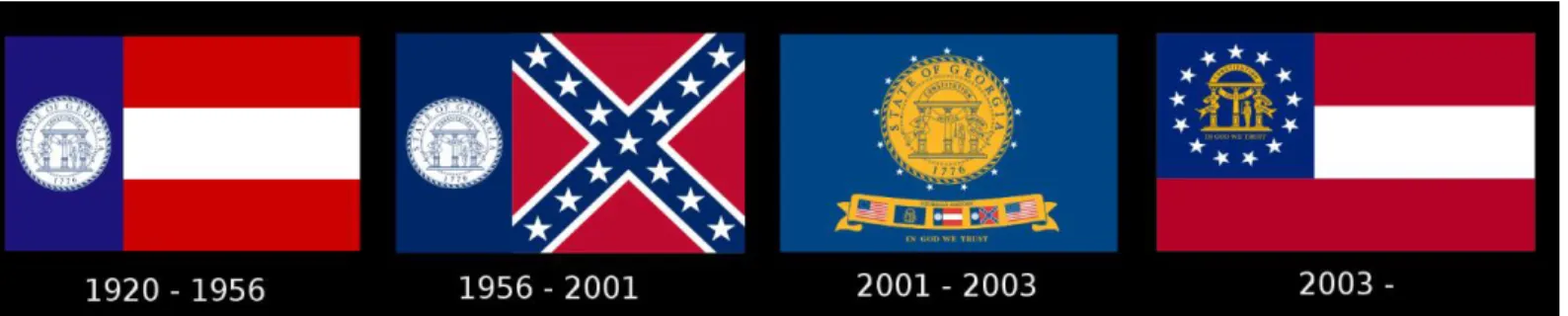
surrounding the Confederate portion of Georgia’s state flag, as well as the decision to hold
events at Stone Mountain given its carving of three Confederate generals. Stricter loitering laws
aimed at the homeless and one-way bus tickets out of Atlanta gave international media the
impression that Atlanta’s city officials forced impoverished citizens out of the city. Atlanta’s
housing authorities also tore down housing projects to build the Olympic Village. While Atlanta
became a city known around the world during the Olympics, the Games also demonstrated some
of the difficulties that the city faced in moving beyond its racial history and status as a regional
Southern city. Ultimately, the second chapter explores the Atlanta’s 1996 Olympics as a
referendum both on the relationship between civic leaders and Atlanta’s population, as well as on
how media from around the world viewed Atlanta’s attempts to reach a tier of top international
cities through a business- and event-centered approach.
Finally, the third chapter examines the next wave of Atlanta stadium building in the early
2010s, which demonstrated the lessons that team owners and local politicians learned on using a
stadium to create urban development in downtown Atlanta. The Atlanta Braves and Atlanta
Falcons both built sparkling new stadiums but took different approaches to do so. The new
stadiums also served as a reminder of the social and racial demographics by comparing the fan
bases of two major professional sports teams. The football Falcons and owner Arthur Blank
funded most of the new stadium’s construction costs, taking less public money from the city in
order to stay downtown. Blank also created community development programs for the
impoverished Vine City and English Avenue neighborhoods next to the stadium. The football
The baseball Braves took a stadium deal funded mostly by taxpayer money in Atlanta’s
suburbs where they could control and build a significant retail development around the stadium.
The Braves became the first professional team to play their home games outside of downtown, a
testament to the city’s unique metro area sprawl as well as a good demonstration of both the
racial demographics and evolving economic potential of that same metro area. Many critics also
related the Braves’ move to race, as they moved from their traditional location in the heart of the
largely black Summerhill neighborhood to the predominately white Cobb County. Furthermore,
the actions of Atlanta Mayor Kasim Reed and Cobb County Commissioner Tim Lee
demonstrated the shifting dynamics between city and suburbs. While Reed and Atlanta played
hardball in negotiations with the Braves, offering less public money for stadium renovations, Lee
and Cobb County offered the team a deal with mostly public funding and a higher level of
control over the area. Unlike Ivan Allen in the 1960s, Reed no longer felt like the city had to
make a bad deal to keep a sports team downtown, while the growth of the metro Atlanta area
Chapter 1
The Hammer and the Pistol: Atlanta’s Introduction to Professional Sport, 1964-1974
I. Introduction
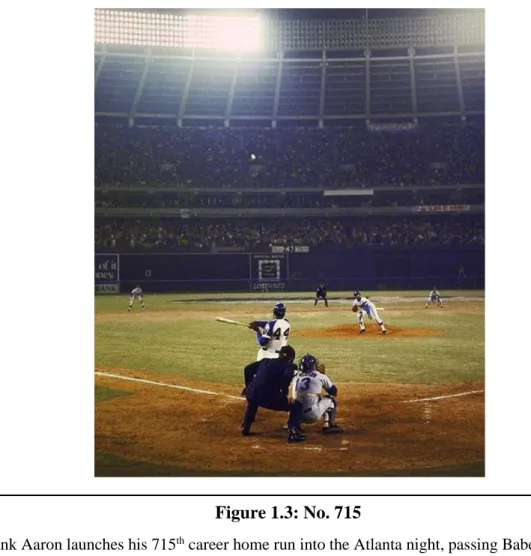
Over 50,000 people in attendance and millions more watching at home held their breath
collectively as Hank Aaron slammed Los Angeles Dodger Al Downing’s 1-0 pitch high into the
Atlanta night. As Aaron’s 715th career home run cleared the left-center field fence, the stadium
exploded into a cacophony of joy as the built-up tension left Atlanta-Fulton County Stadium.
Aaron rounded the bases slowly, joined by a few field-storming fans along his route home. When
he touched home plate, Aaron’s family and teammates swarmed Aaron along with members of
the press.11 On April 15, 1974, a man had finally hit more career home runs in the major leagues
than the legendary New York Yankee Babe Ruth. Vin Scully, the legendary announcer for the
Dodgers, captured the moment on his radio call. “What a marvelous moment for baseball. What
a marvelous moment for Atlanta and the state of Georgia. What a marvelous moment for the
country and the world. A black man is getting a standing ovation in the Deep South for breaking
a record of an all-time baseball idol.”12
Aaron may have broken Ruth’s record as a member of the Milwaukee Braves if not for
the civic boosterism of Atlanta’s local government and business leaders that brought the Braves
and two other major professional sports teams to the city in the late 1960s. Before 1966, the
biggest sport in Atlanta was the all-white Georgia Tech college football team, which played in
the heart of downtown Atlanta and did not racially integrate until 1970. Between 1966 to 1968,
11 “Vin Scully Calls Hank Aaron’s Historic 715th Home Run,” Major League Baseball, November 13, 2014, video,
though, Atlanta welcomed three new professional sports franchises from the country’s three
biggest leagues: Major League Baseball, the National Basketball Association and the National
Football League. This wave of team acquisitions reflected the growing economic ambitions of
the city’s leaders and their attempts to push Atlanta’s national image away from the South’s
unflattering history of racism and segregation. However, the implementation and early years of
Atlanta’s sporting experiment demonstrated the prioritization of white business and appearance
of improved race relations in the city at the expense of Atlanta’s impoverished black community.
II. The Coalition and Racial Politics in Atlanta
When all three major sports franchises arrived in the city, Atlanta still had a white mayor,
Ivan Allen Jr., and many influential white businessmen involved in city affairs. However, the
city’s base of black political power had grown steadily since the 1920s and played a key role in
Atlanta’s municipal politics. Black political power in the city traced back to the early 20th
century. The establishment of an Atlanta NAACP chapter in 1917 began to give the city’s black
population avenues for political expression. 13 In 1932, black Atlantans played a crucial role in
warding off a recall vote for Atlanta mayor James L. Key. The strength of Atlanta’s black
political base came from their ability to mobilize, as they consistently ran registration drives and
ensured the flow of information to all eligible black voters. The organization of black voters in
Atlanta thwarted efforts to repress the black vote that occurred frequently in other Southern
cities, consequently lowering the need for Atlanta’s black community to protest. In a 1966 New York Times article, referencing Birmingham’s history of violent racial conflict, one black civic leader said, “Atlanta has always been on the verge of being Birmingham. It has been very
different than Birmingham, but without Negro votes it wouldn’t have been,”.14 This black
political influence forced white politicians to campaign for black votes, beginning with William
Hartsfield’s second stint as mayor of Atlanta. During his first term as mayor, from 1937-1941,
Hartsfield routinely ignored the city’s black community.15 An Atlanta Journal report that black voters would be supporting Hartsfield’s opponent, Dan Bridges, even increased the white vote
for Hartsfield and helped him win back his position as mayor in 1942.
However, in 1944, the Supreme Court declared that a white primary in Texas was
unconstitutional, striking down a mechanism used by Georgia and many other Southern states to
repress African American votes. Never short on determination, Atlanta’s black citizens now had
legal backing to supplement their efficient organization and could begin to assert their opinion in
local elections. Hartsfield then recognized the potential growth of the voting power in Atlanta’s
black community, so throughout the remainder of the 1940s and the 1950s, Hartsfield set policy
with a key goal in mind: keep the favor of Atlanta’s black political opinion leaders and avoid the
race-based violence that plagued other Southern cities.16 While Atlanta’s governing coalition,
made up of whites from Atlanta’s Northside and older black opinion leaders, worked together to
grow the city’s economy, the racial tensions underneath the coalition always made it an uneasy
union. The city’s black leaders realized that white leaders such as Hartsfield and Coca-Cola
magnate Robert Woodruff were not focused on civil rights issues facing the city. While white
members of the committee recognized the importance of satiating the black voting base, black
leaders saw the legislature as a vessel for creating racial change.17 As historian Kevin Kruse
14 Reese Cleghorn, “Allen of Atlanta Collides With Black Power and White Racism: Allen of Atlanta,” New York
Times, (New York, NY), October 16, 1966.
15 Bayor, Race and the Shaping of Twentieth-Century Atlanta, 1996. 16 Bayor.
describes, “affluent whites… acquiesced to limited (racial) changes in hopes of presenting a
positive public image for themselves, their city, and, most importantly, their business interests.”18
The city’s white business leaders saw an opportunity to pitch racial change and progress to the
rest of the nation, despite any harbored racial sentiments. Even Mayor Hartsfield, who created
the “City Too Busy to Hate” tagline, was an innate segregationist who buried any preconceived
racial biases for success in the political arena.
The unique voting bloc made up of white and black community leaders entered the 1960s
on tumultuous ground due to a series of student-led protests over the city’s segregated policies.
On March 9, 1960, student leaders from six of Atlanta’s historical black universities wrote a
letter titled “An Appeal for Human Rights” to all major Atlanta newspapers. The letter
announced that Atlanta’s black youth would not “wait placidly for those rights which are already
legally and morally ours to be meted out to us once at a time.”19 The students also called out the
city’s segregated conditions and its political leaders, saying that they “cannot tolerate… the
discriminatory conditions under which the Negro is living today in Atlanta, Georgia- supposedly
one of the most progressive cities in the South.”20 Students such as Julian Bond and activists like
Martin Luther King, Jr. protested publicly against the segregation policy at the lunch counter at
Rich’s department store, a prominent Atlanta business.21 Atlanta police arrested many protestors,
including King, which led to turmoil around the city’s downtown economic hub.22 Ray Wilkins,
the executive secretary of the NAACP, blamed Southern political legislatures for the movement.
18 Kruse.
19 “An Appeal for Human Rights,” Atlanta Daily World (Atlanta, GA), March 9, 1960. 20 “An Appeal for Human Rights.”
21 Ronald H. Bayor, Race and the Shaping of Twentieth-Century Atlanta, 2nd Revised edition (Chapel Hill: The University of North Carolina Press, 1996).
22 Ernie Suggs, “GSA Plaque to Mark Rise of Atlanta Student Movement, King’s 1st Arrest,” Atlanta
“(The system) was sustained through restrictive legislation enacted by the southern state
legislatures and the ruthless application of economic and cultural force wielded by those whom
the system benefitted,” said Wilkins.23 While the protests took place throughout the South, their
spread to Atlanta demonstrated the discontentment that many African Americans felt about the
city’s conditions for its black citizens. However, the city’s older black political leaders ardently
opposed the protests, arguing that such radical action would hurt any ongoing negotiations to
change the policy. 24 In late 1961, the biracial governing coalition reached a deal to desegregate
the city’s lunch counters.25 Even still, student leaders and other activists like King opposed the
settlement deal because desegregation would not be enacted until 1962, a full year later. The
student protests certainly had an impact, though, as future mayor Ivan Allen Jr. admitted that he
didn’t “think that we would have ever gotten the action… had it not been for the
demonstrations.”26 The discontent of young black Atlantans demonstrated that the members of
the biracial governing coalition, both white and black, cared more about perceived racial
progressiveness than fixing racial issues in Atlanta.
As the Civil Rights movement gained momentum in the American South, Ivan Allen,
Jr.’s election to the office of mayor in 1961 continued Atlanta’s path of progressive policies and
economic growth. Allen followed Hartsfield’s direction of courting the coalition vote despite
racial discontent from the younger black community. In a 1961 mayoral run-off against
arch-segregationist and future Georgia governor Lester Maddox, Allen received 99.4% of the black
vote and only 47.9% of the white vote because Allen positioned himself as an agent for
23 “South To Blame For Sit-Ins, Wilkins Tells Clevelanders,” Atlanta Daily World, April 28, 1960. 24 Edward Hatfield, “Atlanta Sit-Ins,” New Georgia Encyclopedia, May 28, 2008,
https://www.georgiaencyclopedia.org/articles/history-archaeology/atlanta-sit-ins. 25 Hatfield.
harmonious race relations.27 Allen noted the impossibility of the city’s desired economic growth
without establishing a system that worked for both the black and white communities, citing Little
Rock, Arkansas as an example. Racial turmoil wrecked Little Rock in the late 1950s, as
population growth ground to a halt and business expansion to the city stopped due to the city’s
famous opposition to school integration.28 In order to advance the city’s economic standing,
Allen knew that he must appease the city’s black leaders in a period during which the civil rights
movement came to a head.
To the national public, Allen seemed to be a driving force for racial progress in a
prominent Southern city. After his death in 2003, The New York Times credited Allen “with helping Atlanta desegregate peacefully during the 1960s when other Southern cities erupted in
violence.”29 The Atlanta Journal-Constitution described Allen’s term as “a period when Atlanta became the quintessential thriving Sun Belt metropolis, displaying at least the illusion of racial
balance.”30 From Allen’s inauguration in 1962 to the arrival of the Braves in 1966, the mayor
and his office prioritized quelling racial tension despite the civil rights turmoil in the surrounding
region. Allen went about desegregating city facilities and hiring black citizens to public service
jobs in city government.31 Allen also famously avoided a public relations nightmare while
working with former Coca-Cola president Robert Woodruff and Coca-Cola CEO J. Paul Austin
to organize a dinner honoring Dr. Martin Luther King, Jr.’s Nobel Peace Prize award in 1964.
After almost nobody in Atlanta’s business community responded to invitations to the dinner,
Austin stated publicly that “Coca-Cola cannot stay in a city that is going to have this kind of
27 Bayor.
28 Bayor.
29 “Ivan Allen, Ex-Mayor of Atlanta, Dies at 92,” New York Times, July 2, 2003.
30 Tom Bennett, Ernie Suggs, “Shaper of Modern Atlanta: Ivan Allen Jr.: 1911 - 2003: Foundation Builder for the
reaction and not honor a Nobel Prize winner.”32 The event sold out soon after, in large part due
to the corporate pressure from the Coca-Cola magnates. Allen’s most public display of civil
rights activism came in 1963, when he made an impassioned speech in front of the United States
Congress in support of a “public accommodations” bill that would outlaw race-based
discrimination in private business.33 Years later, Atlanta mayor Andrew Young even lauded
Allen for his works as mayor, describing how he “built the Atlanta Fulton County Stadium…
without a vote. Without a contract, without a team and that’s true. When we get another Ivan
Allen, we’ll elect him mayor, I guarantee you.”34 Allen perfectly played the role of representing
a city that had apparently moved on from racial conflict as he continued to demonstrate Atlanta’s
progressive nature and potential for businesses.
While Allen attempted to project the image of racial progress in Atlanta, he also had
controversial personal beliefs on race in the past. In 1957, as he pondered a bid for Georgia’s
governorship, Allen spoke out vocally against school integration efforts. “State government
officials should call on business and agricultural leaders throughout the state immediately to
work with them in leading the fight against attempted integration,” said Allen.35 While Allen
didn’t ultimately run for the office, he spoke around the state in favor of segregation despite
recognizing the importance of racial peace in developing the state’s economy.36 Four years later,
though, Allen received such a large percentage of the mayoral vote precisely because he was not
32 “The Time Coca-Cola Got White Elites In Atlanta To Honor Martin Luther King, Jr.,” National Public Radio, April 4, 2015, https://www.npr.org/sections/codeswitch/2015/04/04/397391510/when-corporations-take-the-lead-on-social-change.
33 Ted Lippman, “Senator Hails Allen For Attacking Bias,” Atlanta Constitution, July 27, 1963.
34 Kristen Reed, “White Mayor Couldn’t Have Brought Olympics to Atlanta, Andrew Young Says,” WXIA News (Atlanta, GA), December 16,2017.
35 “Ivan Allen Warns of Bid to Integrate,” The Atlanta Constitution, September 24, 1957.
Maddox, the segregationist famous for chasing black restaurant-goers out of his Atlanta
restaurant with a pickax. In a New York Times profile from 1966, journalist Reese Cleghorn describes how Allen’s positions “are quite different from those he once took.”37 Cleghorn stated
that those close to Allen believe the change to be sincere, saying “those who know (Allen) best
see the change as sincere and genuine, and not just a calculated response to the complexion of
Atlanta electorate.” However, he also admits that “the fact is that without the Negro votes the
change in public posture would not have come.”38 Whether genuine or not, Allen seemingly won
over Atlanta’s black leadership base with his reformed approach. One senior black political
leader in Atlanta even stated that “we Negroes don’t like anybody better than a reconstructed
Southern white man,” when referring to Allen in Cleghorn’s article. Like Hartsfield before him,
Allen ultimately saw the value of posturing to Atlanta’s influential black community in order to
achieve his personal political ambitions and execute a bold economic plan for Atlanta. Allen’s
new stance on race relations demonstrated that Atlanta was an economically viable option for
businesses in the South.
III. White Flight in Atlanta
In order to understand Atlanta’s unique social and racial dynamics in the mid-1960s, it is
important to understand the geography of Atlanta and the high levels of “white flight” that
occurred immediately after the Civil Rights movement. While Mayors Hartsfield and Allen, Jr.
preached that Atlanta was a “City Too Busy to Hate,” white Atlantans fled from the center of the
city to the suburbs in order to avoid living in neighborhoods with black families. Kevin M.
Kruse, a graduate of the University of North Carolina at Chapel Hill, wrote “White Flight: The
37 Reese Cleghorn, “Allen of Atlanta Collides with Black Power and White Racism: Allen of Atlanta,” New York
Making of Atlanta and Modern Conservatism” in 2007.39 The book is the preeminent source on
the issue and describes how Atlanta’s white middle- and upper-classes fled to the suburbs during
a period in which Atlanta’s politicians presented the city as racially harmonious. Kruse argues
that white flight included the formation of a new kind of conservatism rather than just the
physical movement of the city’s white population. Kruse also claims that white conservatists had
to create a more subtle language based on freedom and individual rights instead of relying on
populist or racist rhetoric.40 White flight was an example of restructuring segregation. By moving
to the suburbs, creating middle-class communities, and leaving predominately African American
neighborhoods downtown, white Atlantans largely created racially homogenous schools,
neighborhoods, and businesses. Kruse also notes that while Atlanta has always been a “source of
African American strength” due to the figures and civil rights agencies that exist there, the city
has also seen segregationist resistance against the African American community.41 During Ivan
Allen, Jr.’s tenure as mayor, white Atlantans were in their last moments of power in the city of
Atlanta. Desegregation had finally reached the neighborhoods of upper-class white Atlantans
after affecting middle- and lower-class whites for most of the previous two decades. A liberal,
African American coalition would soon control the city’s government. However, white political
and economic power in Atlanta did not go away. Despite black politicians gaining control of city
government, white politicians still retained control at the state level and in the city’s growing
suburbs. Also, white business leaders still ran companies such as Coca-Cola that had
headquarters in downtown Atlanta. In order to understand this thesis, it is vital to look past the
African American control of Atlanta’s government to see the string of influential white business
39 Kruse, White Flight. 40 Kruse.
and political leaders that are heavily involved in Atlanta’s civic affairs. These leaders include
Ivan Allen, Jr. and Atlanta’s first major downtown stadium, the largely white organizers of
Atlanta’s Summer Olympic Games, and the white owners and politicians that would orchestrate
two new stadium deals in the 2010s. While black mayors such as Maynard Jackson, Andrew
Young, and Kasim Reed are key figures in the history of Atlanta sports, they were not the only
driving forces despite their lofty positions.
IV. The Teams Arrive
Under the auspices of Atlanta’s economic awakening, the political and business leaders
of Atlanta began to seek out professional sports franchises in order to bolster the city’s economy
and national status. Mayor Ivan Allen Jr. made it exceedingly clear that he wanted to lure
professional sports teams from the very beginning of his term as mayor. In his 1962 inaugural
address, he proclaimed that he would build “an auditorium-coliseum complex that [would] meet
the competition of other progressive cities,” despite not yet beginning negotiations with any
professional teams.42 Allen’s goal was always to bring franchises to the city at any economic
cost, believing that the teams would bolster Atlanta’s aggressive image makeover in the eyes of
the rest of the nation. This belief was a sharp departure from Hartsfield, who did not care about
sports and prioritized the construction of a state-of-the-art zoo over a sports stadium. Also,
Allen’s personal drive for sports brought a refreshing level of cohesion to Atlanta’s bid for
professional sports. Officials from Fulton County and Dekalb County, both in the Atlanta area,
attempted to build stadiums in the Atlanta area.43 However, a lack of cohesion across the city,
42 Glen Gendzel, “Competitive Boosterism: How Milwaukee Lost the Braves,” The Business History Review 69, no. 4 (1995): 530–66.
43 “Assault on the Impossible,” Atlanta Stadium Magazine: Special Dedication Edition, 1966, Clyde Partin papers,
county and state levels ultimately doomed these proposals. No other cities in the Deep South had
major professional sports teams, though, so Allen saw sports as another avenue through which to
become the “Southern headquarters” of the United States.
Ivan Allen’s goal of bringing major sports to Atlanta was about more than the economic
impact created by teams or civic pride associated with professional sports. Instead, Allen wanted
to reach an upper echelon of “major-league” cities in the United States, denoted by the presence
of a team in Major League Baseball. In his article “Competitive Boosterism: How Milwaukee
Lost the Braves,” historian Glen Gendzel describes how Allen and a series of Atlanta
businessmen made major civic decisions for Atlanta without much public input in order to
benefit the city’s greater good, in their eyes. As Gendzel describes, “Atlanta-Fulton County
Stadium symbolized more than the New South’s rebirth… it also trumpeted the arrival of a
Sunbelt metropolis demanding admission to the major-league club.”44 Every top city in the
United States in terms of commerce and size, whether New York, Chicago, or San Francisco,
had some sort of professional sports team. By capturing the Braves, Allen ensured that Atlanta
earned its place in that select club. Gendzel quotes historian Gene Burd, who argues that “in the
Sunbelt, ‘the winning team symbolizes the “big league status for emerging cities who use sports
imagery as a vehicle for civic rivalry and in competition for tourists, new industry, and the piracy
of old industry.”45 Once Allen had obtained professional sports in Atlanta, he also used the teams
to tout Atlanta’s status. “The Braves are a sign… we’re ‘major-league,’ as they say,” said Allen
in an October 1966 article.46 Allen also viewed the stadium not just as a symbol of Atlanta’s
growth, but an instrument of fostering that change. “(The stadium is) one of the greatest
44 Gendzel, “Competitive Boosterism.”
45 Gendzel.
stimulants, one of the greatest inspirations, that this city and state have ever had. It has been a
catalyst. It has changed our thinking, and the thinking of others around us,” said Allen in 1966.
47Allen and the rest of Atlanta’s rabid boosters wanted to enter this intra-city competition, both
on the baseball diamond and in the world of business.
While Atlanta’s civic boosters certainly pushed their city’s image in their attempt to
acquire major league teams, outsiders also viewed the city as a potential entry point for the major
leagues to the Deep South. Jim Williams, a senior advisor to the Atlanta Braves and a longtime
Turner Sports executive, described Atlanta’s burgeoning potential as a landing spot for teams:
“By the 1960s, everybody knew that the city that was going to be was Atlanta, as opposed to Birmingham or Memphis. The decision had been made that it was going to be Atlanta… It was the cradle of the civil rights movement and they could finally bring a baseball team to the South. Major League Baseball knew that going forward, they were going to have a market South of the curtain that lent itself to support for major league teams. The market was going to grow, and if baseball was going to grow, then it had to expand into those markets. They knew that baseball would have to go South, and when it did, Atlanta was the city.”48
After the major leagues expanded into California in the late 1950s, the Southeast became the
next major region without professional sports. The NFL and MLB expanded into the South in the
early 1960s with the Dallas Cowboys and Houston Astros, respectively, but did not have a team
east of Texas or south of Washington, D.C. A syndicated article from the Associated Press from 1965 properly summarized the rationale behind bringing sports to Atlanta. “In reality, Atlanta is
no different than any other boomtown. No magic was involved in bringing major league sports
here. It was just a matter of men like (Ivan) Allen presenting the story of Atlanta’s vast potential
to the proper people and then letting the area sell itself,” says the article.49 Given the South’s
47 “A New Image,” Atlanta Stadium Magazine: Special Dedication Edition, 1966, Clyde Partin papers, Stuart A.
Rose Manuscript, Archives, & Rare Book Library, Emory University, by author.
48 Jim Williams (special advisor to the Atlanta Braves) in discussion with the author, November 2019.
viability as a region, Atlanta was the obvious choice for leagues to expand. The Atlanta-Fulton
County Recreation Authority hired Eric Hill Associates, a planning firm, to do a feasibility study
on a potential Atlanta Stadium in March 1964. The study found that “Atlanta’s population and
economic growth derives considerable strength from its regional dominance… few urban centers
in the country so completely dominate so large an area.”50 Given Atlanta’s status as the home of
the civil rights movement, the city’s preeminent status among Southeastern cities, and the city’s
driven boosters, outsiders saw it as a clear major market for expansion.
From the day Allen took office in January 1962, he immediately made building a stadium
for athletics one of the top priorities of his time as mayor. In his inaugural address, he addressed
the several pressing issues, “including continued good race relations…and construction of a
stadium for professional football and other professional sports.”51 In order to rally public support
for his sporting goal, the Allen administration fed both major newspapers, the Atlanta Journal
and Atlanta Constitution, information about the sports acquisitions throughout the process of building a stadium and negotiating with teams. In exchange, the newspapers favorably covered
potential sports teams throughout the early years of his mayoral tenure. Jesse Outlar of the
Atlanta Constitution and Furman Bisher of the Atlanta Journal not only helped push Allen’s stadium agenda to the public, but also encouraged the mayor to proceed with his plans. Allen
even acknowledged Outlar for being the most crucial person behind the pursuit of a stadium,
noting that Outlar told Allen that “if a stadium is going to be built, then you’ve got to do it,” at
the beginning of his mayoral term.52 When the stadium was still just a campaign promise from
50 “The Atlanta Spirit,” Atlanta Stadium Magazine: Special Dedication Edition, 1966, Clyde Partin papers, Stuart A.
Rose Manuscript, Archives, & Rare Book Library, Emory University, by author.
51 Herman Hancock, “Ivan Allen Takes Helm Tomorrow,” The Atlanta Constitution (Atlanta, GA), January 1, 1962. 52 “Assault on the Impossible,” Atlanta Stadium Magazine: Special Dedication Edition, 1966, Clyde Partin papers,
Allen in February 1963, Atlanta Constitution sports editor Jesse Outlar chastised the Atlanta public for their “appalling lack of support (for a stadium).” Outlar also noted the potential of
building a stadium for the entire Southeast, describing the region as “virgin territory for pro
sports.”53 The erection of a stadium, Outlar argues, “would bring thousands of visitors and
dollars to Georgia.” Legendary Atlanta Journal sports editor Furman Bisher cited a vote to build a stadium in 1964 as “a great moment in sports in Atlanta, in civic progress, and in government
by the people.”54 Bisher also praised Allen’s “vigorous leadership” in fighting for the stadium,
despite admitting that the city did not yet have any teams that could call the stadium home. Like
Outlar, Bisher played an influential role in the process, as he was another confidant of Allen’s
and traveled with the mayor and several Atlanta businessmen around the country to pitch the city
to baseball franchise owners in July 1963.55
William Anderson, an assistant professor at Louisiana State University, described how
coordinated newspaper support helped the city’s leaders to entice the Braves to move to Atlanta.
In his paper, “Sports Page Boosterism: Atlanta And Its Newspapers Accomplish the
Unprecedented,” Anderson argues that “an analysis of the Atlanta Journal and the Atlanta
Constitution from 1963 to 1966 shows that the sports editors of these papers helped build support for the city leadership’s plan to build a stadium to attract the Braves baseball franchise.” 56 The
benefit for the sports reporters was clear as well, as both Outlar and Bisher would benefit greatly
from adding major league, professional sports to their beats. The two editors routinely covered
53 Jesse Outlar, “Stadium Wanted?,” The Atlanta Constitution (Atlanta, GA), February 2, 1963.
54 Furman Bisher, “Not a Hand Went Up,” The Atlanta Journal and the Atlanta Constitution, (Atlanta, GA), March 8, 1964.
55 “Assault on the Impossible,” Atlanta Stadium Magazine: Special Dedication Edition, 1966, Clyde Partin papers,
Stuart A. Rose Manuscript, Archives, & Rare Book Library, Emory University, by author.
the city leadership’s efforts to get teams and stadiums positively, rather than balancing the
positives and negatives that pro sports might bring.
Bringing a professional team to Atlanta was no easy measure, as Allen worked his entire
first term as mayor and negotiated with two separate baseball franchises before he finally
convinced one to move to Atlanta. Allen’s first courtship occurred in 1962, when he entered
talks with Kansas City Athletics’ owner Charles Finley about moving his team to Atlanta. Finley
was openly looking to relocate the A’s and visited Atlanta in 1963 at the invitation of Furman
Bisher to tour potential stadium sites with both Allen and Bisher. Finley even allegedly told
Allen that if the mayor built a stadium, he would “guarantee that Atlanta will get a major league
franchise.”57 With that pledge, along with the agreement of officials on the city, county and state
levels, Allen began preparations for stadium construction. When the other American League
owners voted against the Athletics’ move to Atlanta at the MLB All-Star Game in the summer of
1963, Allen had already started construction on the stadium and began to court other MLB
owners who might consider relocating. The lack of a tenant turned into a point of pride for Allen,
who would brag that he built the stadium “on ground we didn’t own with money we didn’t have
for clubs we had not yet signed.”58 Allen and the city broke ground on the stadium in April 1964
and finished construction in just under a year in April 1965, just in time for baseball season. The
multi-purpose stadium, situated in the heart of downtown Atlanta and outfitted to host both
baseball and football games, cost between $15-18 million to construct.59
57 Furman Bisher, “Unstable but Brilliant, Finley Helped Bring Baseball to Atlanta,” The Atlanta
Journal-Constitution, February 21, 1996. 58 Gendzel, “Competitive Boosterism.”
Allen had his stadium; now, he needed teams to play games there. He found his first
willing partner in Bill Bartholomay and the ownership group of the Milwaukee Braves, who
looked to move the team after buying it in 1962. The ownership group agreed to move the team
to Atlanta in in October 1964 if Allen could get his stadium ready for Opening Day in 1965.
However, the city of Milwaukee would not let the Braves out of the last year of their lease of
Milwaukee County Stadium in 1965, ultimately forcing the team to stay in Wisconsin for another
season.60 While Allen’s stadium was finished in time for the 1965 season, the minor-league
baseball Atlanta Crackers played the only games played that year in Atlanta-Fulton County
Stadium. Supplemental events such as exhibition football games and concerts taking place
throughout 1965, including a sold-out show by The Beatles. In 1966, though, Atlanta and Allen
were ready for major-league baseball. Allen penned an op-ed in the joint Sunday edition of the
Atlanta Journal and the Atlanta Constitution just two days before the Braves’ first game. The
mayor opened by proclaiming April 12 “a date of destiny for our city and all our growing
Southeastern region.”61Atlanta Journal editor Jack Spalding wrote an article in April 1966 titled “Status Symbol,” in which he romanticized the stadium by calling it “a new dimension to
(Atlantans’) lives” and “a symbol of the new city,” as well as pronouncing that the Braves’
arrival was “for the greater honor and glory of Atlanta.”62
While the stadium’s opening and the arrival of the Braves represented a triumph for Allen
and Atlanta’s national image, the process of constructing the stadium used land and public
money that came directly at the expense of Atlanta’s poor lower classes and neighborhoods.
Allen and city officials built the stadium on land just south of the city that had been designated
60 Jack Williams, “Mayor Allen Pleads in Vain Allen Confab Gets Nowhere: Milwaukee Group Refuses To Release
Braves for ’63,” The Atlanta Constitution, November 16, 1964.
for urban public housing.63 Despite this designation, according to historian David Goldfield, “the
city’s abundant poor required special appeals to secure what was left over” from the stadium’s
construction budget.64 The stadium helped inflate the pockets of local contractors, as bonuses
were paid out to expedite the construction. Allen even admitted to doing so in his 1966 op-ed,
saying that “the Atlanta Housing Authority and the Federal Housing and Home Finance Agency
amended the urban renewal project plans to take care of the stadium site.”65
63 Hank Aaron, I Had a Hammer: The Hank Aaron Story, (New York: Harper Perennial, 2007). 64 Gendzel, “Competitive Boosterism.”
65 Allen, Jr., “The Dirt Was Flying.”
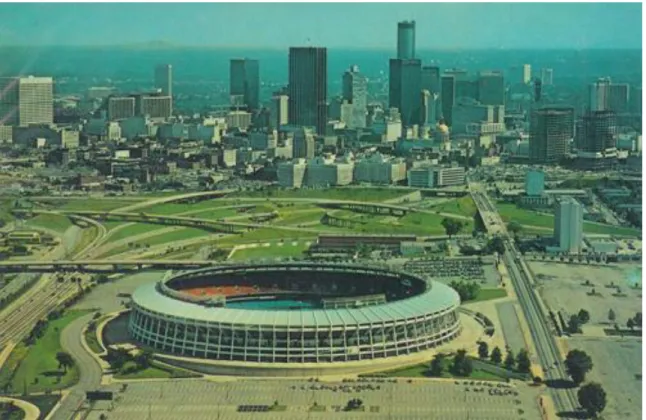
Figure 1.1: A Shining Jewel
Atlanta-Fulton County Stadium was not just a functional sports stadium, but a major landmark on Atlanta’s skyline. Here, the stadium sits just south of downtown Atlanta.
The sporting boosterism that existed in the “Sports” sections of Atlanta’s two major
newspapers also did not always carry over to other sections of the same papers, as writers for
each paper used the stadium to criticize Allen’s lack of actions to improve the situation of
Atlanta’s poor. Atlanta Constitution journalist J. Oscar McCloud called out Allen, saying that even though Atlanta had the “will to get a stadium and major league sports,” they were “not a
city which is too busy to hate” and did “not have the will to eliminate segregation and
discrimination by race or by class.”66 In an article detailing the failure of municipal government
to implement housing programs for the near-200,000 Atlantans living in slums, journalist Ted
Simmons described a family of seven living in a decrepit three-room house “just across the
South Expressway from Atlanta’s gleaming new stadium,” in the Sunday Journal-Constitution.67
Allen also built the stadium in the Summerhill neighborhood just south of the city’s
downtown business hub. Before World War II, Summerhill was a vibrant community home to
much of the city’s European immigrant population.68 By the 1950s, a black community emerged
in the neighborhood, creating a mixed-race and mixed-ethnicity area that still had a significant
retail sector. However, “redlining” was taking effect on the community and it trended downward
as more affluent families moved to the suburbs. By the end of the 1950s, the city of Atlanta had
displaced many residents from Summerhill. In the 1960s, the expressway built adjacent to the
neighborhood combined with Atlanta-Fulton County Stadium and the acres of parking lots
around it to effectively cripple the neighborhood’s economic prospects. The land used for the
stadium was originally designated for whites-only public housing, but African American leaders
66 J. Oscar McCloud, “The Problem of Racism,” The Atlanta Constitution, January 13, 1968.
67 Ted Simmons and Remer Tyson, “Thousands Live in Shacks,” The Atlanta Journal and the Atlanta Constitution, July 25, 1965.
68 Marni Davis, “Streetscape Palimpsest: A History of Georgia Avenue,” accessed March 6, 2020,
asked Allen to offer the housing to displaced black Atlantans. City leaders did not want black
public housing that close to downtown Atlanta, though, so Allen used the land for his stadium.69
The population of the area plummeted, and the previously diverse community became almost
entirely African American by 1970. In his 1966 article in The New York Times,Reese Cleghorn describes Summerhill as a “slum or semi-slum.”70 The number of businesses on Georgia Avenue,
the main street in Summerhill, dropped from 58 to 25 from 1960 to 1970. Cleghorn surmised the
problem in his article, saying that “much of Atlanta’s urban renewal clearance has been for
commercial projects and public facilities, such as the new stadium and convention
hall-auditorium, rather than for low-cost housing. As in many other cities, urban renewal has cleared
slums but often has only sent the displaced poor into other, more crowded slums.”71
Furthermore, the acres of parking lots that surrounded the new stadium effectively erased the
possibility of developing the area around the stadium. The creation of Atlanta-Fulton County
Stadium by local officials effectively destroyed the neighborhood’s economic potential without
much resistance or input from the area’s residents.
Both local and national newspapers covered racial and economic issues attached to the
Braves’ move to Atlanta. A Milwaukee newspaper, covering the move from the perspective of
the city that was losing the Braves, quoted the leader of Atlanta’s NAACP chapter, who
criticized the move by saying that “housing was still a major problem, school desegregation was
on, and the KKK and White Citizens Council were still active.”72 Furthermore, the stadium’s
funding came through public taxation, with the city paying two-thirds of the stadium’s yearly
69 Davis, “Streetscape Palimpsest.”
70 Cleghorn, “Allen of Atlanta Collides With Black Power and White Racism: Allen of Atlanta,” New York Times. 71 Cleghorn.
cost and Fulton County paying for the rest.73 By late 1966, the City of Atlanta asked Fulton
County to level a payroll income tax designed to help pay off the annual $750,000 in debt
towards stadium bonds.74 The tax did not pass, leaving with the city and county to shoulder the
substantial bill. Allen fails to mention any numbers associated to the stadium cost in his article
about how it came to be. Despite all of these issues, Allen told reporters once the Braves arrived
that “the Negro feels the stadium belongs to him,” as it was “the first new municipal building
erected since the Negro has had full citizenship.”75 Allen also said that “the Negro’s full
citizenship was one reason we were looked on with favor, and the Negro population swells our
potential.”76 This tone-death attribution of part of the stadium to Atlanta’s black community
shows both Allen’s love for the stadium project, either his misunderstanding of or indifference to
the issues facing Atlanta’s black community, and the lack of political voice for Atlanta’s
impoverished neighborhoods.
While city government shunned the plight of Atlanta’s impoverished black population
with their fixation on obtaining big-league sports, the clubs took some of the initiative to reach
out to the slighted members of the community and began to build inroads. Dick Cecil, who led
the Braves’ transition team during the move, appointed Hank Aaron’s brother-in-law and
Braves’ scout Bill Lucas as a liaison between the team and the city’s black community. Through
the Braves’ “Good Neighbor” program, Cecil and Lucas worked to provide fields, equipment,
and mentorship to the underserved areas of the Atlanta community.77 As Cecil noted, “We came
on a negative note in the black community, and we had to spend a lot of time there convincing
73 “City Acts to Finance Stadium, Runways,” The Atlanta Constitution, April 7, 1964.
74 Marion Gaines, “City Asks Legislators to Seek Payroll Tax Bill,” The Atlanta Constitution, December 16, 1966. 75 “Improved Racial Climate Had Big Role in Getting Braves to Atlanta, Ga.,” Philadelphia Tribune, April 26, 1966. 76 “Improved Racial Climate Had Big Role in Getting Braves to Atlanta, Ga.”