Association of Single Nucleotide
Polymorphisms in the
ST3GAL4
Gene with
VWF Antigen and Factor VIII Activity
Jaewoo Song
1,2, Cheng Xue
3, John S. Preisser
4, Drake W. Cramer
1, Katie L. Houck
1,
Guo Liu
5, Aaron R. Folsom
6, David Couper
4, Fuli Yu
3,7*
, Jing-fei Dong
1,8*
1BloodWorks Northwest Research Institute, Seattle, WA, United States of America,2Department of Laboratory Medicine, Yonsei University College of Medicine, Seoul, Korea,3Human Genome Sequencing Center, Molecular and Human Genetics Department, Baylor College of Medicine, Houston, TX, 77030, United States of America,4Department of Biostatistics, University of North Carolina, Chapel Hill, NC, United States of America,5Department of Otolaryngology-Head and Neck Surgery, West China Hospital of Sichuan University, Chengdu, China,6Division of Epidemiology & Community Health, School of Public Health, University of Minnesota, Minneapolis, MN, United States of America,7Institute of Neurology, Tianjin Medical University General Hospital, Tianjin, 300052, China,8Division of Hematology, Department of Medicine, University of Washington School of Medicine, Seattle, WA, United States of America
*[email protected](JFD);[email protected](FY)
Abstract
VWF is extensively glycosylated with biantennary core fucosylated glycans. Most N-linked
and O-linked glycans on VWF are sialylated. FVIII is also glycosylated, with a glycan
struc-ture similar to that of VWF. ST3GAL sialyltransferases catalyze the transfer of sialic acids in
the
α
2,3 linkage to termini of N- and O-glycans. This sialic acid modification is critical for
VWF synthesis and activity. We analyzed genetic and phenotypic data from the
Atheroscle-rosis Risk in Communities (ARIC) study for the association of single nucleotide
polymor-phisms (SNPs) in the
ST3GAL4
gene with plasma VWF levels and FVIII activity in 12,117
subjects. We also analyzed
ST3GAL4
SNPs found in 2,535 subjects of 26 ethnicities from
the 1000 Genomes (1000G) project for ethnic diversity, SNP imputation, and
ST3GAL4
hap-lotypes. We identified 14 and 1,714
ST3GAL4
variants in the ARIC GWAS and 1000G
data-bases respectively, with 46% being ethnically diverse in their allele frequencies. Among the
14
ST3GAL4
SNPs found in ARIC GWAS, the intronic rs2186717, rs7928391, and
rs11220465 were associated with VWF levels and with FVIII activity after adjustment for
age, BMI, hypertension, diabetes, ever-smoking status, and ABO. This study illustrates the
power of next-generation sequencing in the discovery of new genetic variants and a
signifi-cant ethnic diversity in the
ST3GAL4
gene. We discuss potential mechanisms through
which these intronic SNPs regulate ST3GAL4 biosynthesis and the activity that affects
VWF and FVIII.
a11111
OPEN ACCESS
Citation:Song J, Xue C, Preisser JS, Cramer DW,
Houck KL, Liu G, et al. (2016) Association of Single Nucleotide Polymorphisms in theST3GAL4Gene with VWF Antigen and Factor VIII Activity. PLoS ONE 11(9): e0160757. doi:10.1371/journal.pone.0160757
Editor:Amanda Ewart Toland, Ohio State University
Wexner Medical Center, UNITED STATES
Received:April 7, 2016
Accepted:July 25, 2016
Published:September 1, 2016
Copyright:© 2016 Song et al. This is an open
access article distributed under the terms of the
Creative Commons Attribution License, which permits unrestricted use, distribution, and reproduction in any medium, provided the original author and source are credited.
Data Availability Statement:All relevant data are
within the paper and its Supporting Information files.
Funding:This work is supported by Atherosclerosis
Introduction
Von Willebrand factor (VWF) in the subendothelium tethers platelets to the site of vascular
injury to initiate hemostasis, and protects coagulation factor VIII (FVIII) from enzymatic
deg-radation [
1
;
2
]. VWF also contributes to thrombosis at the site of a ruptured atherosclerotic
pla-que and to platelet aggregation induced by high fluid shear stress in the area of severe vascular
stenosis [
3
]. VWF and FVIII are synthesized primarily in endothelial cells [
4
–
8
]. Baseline levels
of VWF and FVIII vary considerably among individuals and are regulated by genetic and
envi-ronmental factors, including carbohydrate structures on the two molecules.
VWF and FVIII are extensively glycosylated. Each VWF monomer contains 13 potential
N-linked and 10 O-N-linked glycosylation sites, with 4 additional glycosylation sites in the
propep-tide [
9
]. Together, the carbohydrates account for ~20% of the molecular mass of a VWF
mono-mer [
10
] The complex types of biantennary core fucosylated glycans represent ~60% of the
glycans on VWF, as compared to 13% represented by ABO-related glycans [
11
–
13
] Most of
the N-linked and O-linked glycans on VWF are sialylated [
12
;
14
;
15
]. Enzymatically
desialy-lated VWF is more adhesive [
16
;
17
] has an altered rate of cleavage by the metalloprotease
ADAMTS-13 [
18
], and is rapidly cleared from the circulation through an asialoglycoprotein
receptor [
19
]. Hypo-sialylated VWF is detected in the plasma of patients with pre-capillary
pulmonary hypertension and those exposed to sialidase following microbial infection [
19
;
20
]
FVIII is also glycosylated, with complex-type biantennary core fucosylated oligosaccharides, of
which 80 to
>
90% carry at least one sialic acid [
21
–
23
] However, the functional importance of
FVIII sialylation remains poorly understood.
Golgi-resident sialyltransferases of the ST3GAL family are type II membrane enzymes that
catalyze the transfer of sialic acids in the
α
2,3 linkage to termini of N- and O-glycan chains. Six
genes encoding these sialyltransferases have been identified in the mammalian genome
(ST3GAL1-4) [
24
] Inactivating the murine St3gal4 sialyltransferase gene results in bleeding
associated with an autosomal-dominant reduction in plasma VWF levels, with a minimal
impact on VWF multimeric structures [
25
] The reactivity of the
β
-Gal-binding lectin RCA-I to
VWF is increased in plasma from St3gal4-null mice because of an increase in the exposure of
sub-terminal
β
-linked Gal on glycan branches [
25
] Similar results have been reported in rabbits
and humans [
26
] indicating an important role of ST3GAL4 sialyltransferase in the biogenesis
and survival of VWF and potentially of FVIII. The human
ST3GAL4
gene is located in the
q23.3-q24 of Chromosome 11 [
27
], a locus that has been associated with the development of
coronary artery disease [
28
] The gene spans more than 65 kilobases (kb), with 14 exons ranging
from 61 to 679 nucleotides [
27
] There are 9 alternately spliced transcripts in the coding region
of the human
ST3GAL4
gene, with tissue-specific patterns of expression [
29
]. The
ST3GAL4
RNA is widely expressed in cells and tissues, including megakaryocytes and platelets, with the
highest levels being found in the small intestine and colon [
25
]. Variations in the human
Key Point
1. Human
ST3GAL4
gene is highly polymorphic and many of these polymorphic
vari-ants are ethnically diverse in an analysis of the 1000 genomes project database.
2. Six clustered SNPs in the first intron of the
ST3GAL4
gene are associated with plasma
VWF level and FVIII activity.
Competing Interests:The authors have declared
ST3GAL4
gene remain undefined, and their influence on VWF, FVIII, and other sialylated
pro-teins is not known.
We analyzed genetic and phenotypic data from the Atherosclerosis Risk in Communities
(ARIC) study for the association of single-nucleotide polymorphisms (SNPs) in the human
ST3GAL4
gene with the plasma level of VWF and with activity of FVIII in 12,117 subjects. We
also analyzed
ST3GAL4
SNPs from 2,535 subjects of 26 ethnicities from the 1000 Genomes
(1000G) database, which has been interrogated with next-generation sequencing (NGS)
tech-nology for ethnic diversity, SNP imputation and construction of
ST3GAL4
haplotypes.
Materials and Methods
Study population
ARIC
(
https://www2.cscc.unc.edu/aric/desc
) is an ongoing prospective cohort study designed
to assess subclinical atherosclerosis and clinical atherosclerotic events [
30
] Baseline samples
were collected from 1987 to 1989, from 15,792 adults aged 45 to 64 who were selected using
probability sampling from Forsyth County, North Carolina; Jackson, Mississippi; the
north-western suburbs of Minneapolis, Minnesota; and Washington County, Maryland.
The 1000G
(
http://www.1000genomes.org/
) project is designed to identify genetic variants
that have frequencies of at least 1% in multi-ethnic populations using NGS. We analyzed
ST3GAL4
variants from the April 2012 Integrated Variant Set release of the 1000G project
(
ftp://ftp.1000genomes.ebi.ac.uk/vol1/ftp/release/20110521/ALL.wgs.phase1_release_v3.
20101123.snps_indels_sv.sites.vcf.gz
). The data were collected from 2,535 non-diseased
sub-jects of 26 ethnicities and from four continents. Exonic regions of the genomes were sequenced
at a high coverage rate (average
>
20X), and the whole genome was shotgun-sequenced at a
low coverage rate (2–6X). The false discovery rate was estimated at 1.6% for exonic SNPs, 1.8%
for non-coding SNPs, and
<
5% for insert-deletions (indels) [
31
]
VWF antigen and FVIII activity
VWF antigen was determined with a commercial ELISA kit from American Bioproducts
(Par-sippany, NJ) and reported as a percentage of the Universal Coagulation Reference Plasma
(Thromboscreen, Pacific Hemostasis, Curtin Matheson Scientific, Inc, Wooddale, IL) [
32
] The
VWF measurement was taken during the first visits of ARIC subjects when they were recruited,
from 1986 to 1989, and was, therefore, not defined as the international units widely used today.
FVIII activity was measured using a commercial kit (George King Biomedical Inc. Overland
Park, KA), defined as the ability of a testing plasma sample to correct the clotting time of
human FVIII-deficient plasma, and reported as a percentage of normal plasma [
33
] The
reli-ability coefficient (one minus intra-individual variance, divided by total variance), obtained
from repeated tests on the same individuals over several weeks, was 0.68 for VWF and 0.86 for
FVIII [
32
;
33
] The data were adjusted for covariates that are known to influence VWF and
FVIII [
33
–
35
] including age, race, gender, body mass index (BMI), hypertension, diabetes,
ever-smoking status, and ABO genotype.
ST3Gal4
SNPs and imputation
We analyzed
ST3GAL4
SNPs available from the ARIC GWAS and 1000G databases. The
1000G data allowed us to drastically increase the number of
ST3GAL4
SNPs to construct
hap-lotypes using Haploview (
http://www.broadinstitute.org/scientific-community/science/
program (
https://mathgen.stats.ox.ac.uk/impute/impute_v2.html
). The 1000G project
’
s phased
genotype data for Europeans (n = 379) and Africans (n = 246) (
https://mathgen.stats.ox.ac.uk/
impute/impute_v2.html#reference
) were used as references.
Data analysis
All data were analyzed using SAS Proc LIFETEST or SAS Proc PHREG. The association of
ST3GAL4
SNPs with VWF antigen, FVIII activity, and FVIII
–
VWF ratio were evaluated using
one-way ANOVA to test for mean differences among three genotypes of each SNP and for
each of the four groups defined by race and gender (EA male, EA female, AA male, and AA
female). A multiple linear regression model was used to define a relationship between genotype
and outcome before and after adjustments for the covariates. We also tested ABO blood type
by SNP interaction in the linear model in order to determine whether the association between
SNP and outcome differs significantly by blood type, as these conform to different
carbohy-drate structures on the H antigen. With a Bonferroni adjustment for the number of SNPs
tested, a p
<
0.0038 was considered to be statistically significant for the association of a given
genotype with VWF antigen and FVIII activity. A p-value between 0.05 and 0.0038 was
consid-ered to be nominally significant.
For each SNP, we also tested, through an additive model, to determine whether the number
of minor alleles was additive. We also determined the allelic dosing effect by calculating
whether having two copies of the allele had twice the effect of one copy (additive), larger than
would be predicted by twice the effect of one copy (
“
more than additive
”
) or smaller effect than
predicted by twice the effect of one copy (“below additive”). Finally, we also used HaploReg
(
http://www.broadinstitute.org/mammals/haploreg/haploreg.php
) to predict the effect of 13
non-coding variants in intron 1 of the
ST3GAL4
gene on the regulatory regions of the gene.
Results
Subjects included in the study
Of the 15,792 ARIC participants, 3,675 were excluded from analysis because they (1) were
nei-ther European American (EA) nor African American (AA) (n = 48), (2) did not give consent
for genetic studies (n = 45), or (3) randomly lacked the following data: FVIII activity, VWF
antigen, or both (n = 280);
ST3GAL4
SNPs (n = 2607), or ABO genotypes (n = 640). The final
analysis included 12,117 subjects.
Table 1
reports the observed means for VWF, FVIII and the
FVIII–VWF ratio by race and sex group for these subjects. Consistent with previous reports
[
35
;
36
] VWF levels and FVIII activities varied significantly among the four race-by-gender
groups. AA subjects had significantly higher VWF levels and FVIII activity than EA subjects
(p
<
0.001 and p
<
0.003, respectively). Females had slightly higher VWF levels and FVIII
activity than males. The ABO blood groups for the race-by-sex groups are listed in
S1 Table
.
Table 1. Mean (SD) of VWF antigen and FVIII activity by race and gender.
Overall (N = 12,117) EA-Female (N = 4914) EA-Male (N = 4320) AA-Female (N = 1800) AA-Male (N = 1082) pvalue (ANOVA)
Factor VIII (%) 130.0 (38.5) 127.2 (34.3) 122.7 (33.6) 149.0 (48.2) 140.9 (43.5) <0.0001 VWF (%) 117.0 (46.9) 110.9 (42.1) 113.5 (43.2) 134.2 (56.6) 130.1 (54.4) <0.001 FVIII-VWF ratio 1.19 (0.31) 1.22 (0.32) 1.15 (0.30) 1.20 (0.34) 1.16 (0.31) <0.001 EA: Americans of European descent and AA: Americans of African descent
ST3GAL4
SNPs and genotype imputation
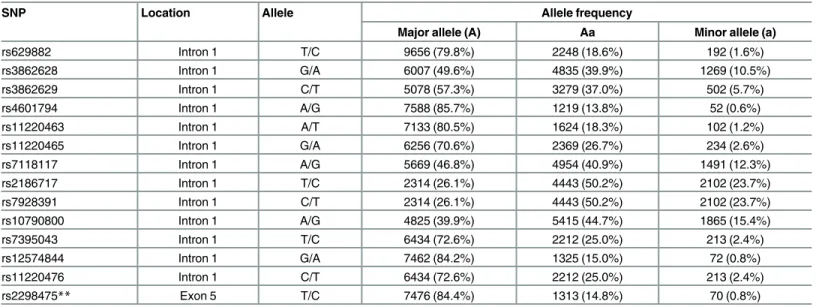
A total of 14 SNPs in the
ST3GAL4
gene (position: 126,355,645–126,652,917 on Chromosome
11) were identified in the ARIC GWAS database (
Table 2
; codes for the genotypes are listed in
S2 Table
). Among these, the SNPs rs2186717 and rs7928391 were completely linked (
S3
Table
). All 14 SNPs were genotyped in EA subjects, but only 4 SNPs were genotyped in AA
subjects, and the rest were imputed. Thirteen of these SNPs (92.9%) were intronic, located in
the first intron, and rs2298475 was exonic in exon 5.
To increase the number of
ST3GAL4
SNPs for association studies and to investigate their
ethnic diversity, we also examined the 1000G database, which includes genotype data from
2,535 subjects of 26 ethnicities sequenced with NGS [
37
] Studying the ethnic diversity may be
critical for causal effects of a given genetic variant as several studies [
38
;
39
], including our own
[
40
], have shown that some of known VWF mutations associated with the bleeding disorder
von Willebrand disease in EA subjects have minor allele frequencies of 10
–
20% in AA subjects,
making them unlikely to cause the disease in African Americans. The findings suggest that the
functional influence of a given variant can be enhanced or reduced by its association with
spe-cific haplotypes that are defined by ethnically diverse variations. We identified 1,714 variants
in the
ST3GAL4
gene, including 986 novel variants whose identifiers were yet to be assigned by
dbSNP. The locations of these SNPs in the
ST3GAL4
gene are shown in
Fig 1
. Eleven of the 14
ST3Gal4
SNPs from the ARIC GWAS database were found in the 1000G database.
Table 3
lists
allele frequencies of these 11 SNPs among 10 representative ethnicities from America, Asia,
Europe, and Africa, with 5 of them (46%) having significant ethnic diversity (
>
10-fold
differ-ence in allele frequencies among ethnicities, marked in grey).
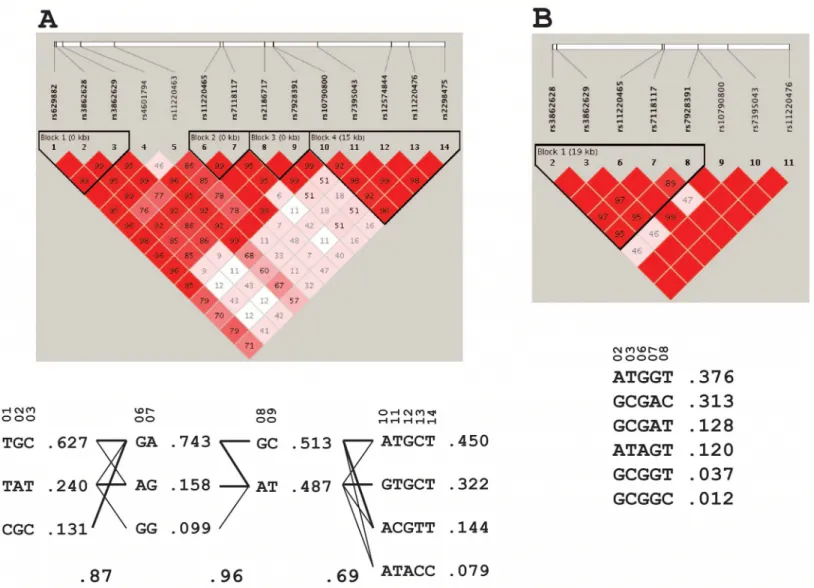
Haplotypes of the
ST3GAL4
SNPs were constructed separately for EA and AA subjects (
Fig
2
). The SNP rs629882 was removed from subsequent analyses because it failed
Hardy-Wein-berg equilibrium testing (p-value = 5.19 × 10
−6). We also used 1000G phased genotype data for
European (EUR, n = 379) and African subjects (AFR, n = 246) for genotype imputations. The
concordance rates defined by variations of alternative allele frequency between known
Table 2. Position*and Allele frequency ofST3GAL4SNPs in ARIC-GWAS.
SNP Location Allele Allele frequency
Major allele (A) Aa Minor allele (a)
rs629882 Intron 1 T/C 9656 (79.8%) 2248 (18.6%) 192 (1.6%)
rs3862628 Intron 1 G/A 6007 (49.6%) 4835 (39.9%) 1269 (10.5%)
rs3862629 Intron 1 C/T 5078 (57.3%) 3279 (37.0%) 502 (5.7%)
rs4601794 Intron 1 A/G 7588 (85.7%) 1219 (13.8%) 52 (0.6%)
rs11220463 Intron 1 A/T 7133 (80.5%) 1624 (18.3%) 102 (1.2%)
rs11220465 Intron 1 G/A 6256 (70.6%) 2369 (26.7%) 234 (2.6%)
rs7118117 Intron 1 A/G 5669 (46.8%) 4954 (40.9%) 1491 (12.3%)
rs2186717 Intron 1 T/C 2314 (26.1%) 4443 (50.2%) 2102 (23.7%)
rs7928391 Intron 1 C/T 2314 (26.1%) 4443 (50.2%) 2102 (23.7%)
rs10790800 Intron 1 A/G 4825 (39.9%) 5415 (44.7%) 1865 (15.4%)
rs7395043 Intron 1 T/C 6434 (72.6%) 2212 (25.0%) 213 (2.4%)
rs12574844 Intron 1 G/A 7462 (84.2%) 1325 (15.0%) 72 (0.8%)
rs11220476 Intron 1 C/T 6434 (72.6%) 2212 (25.0%) 213 (2.4%)
rs2298475** Exon 5 T/C 7476 (84.4%) 1313 (14.8%) 70 (0.8%)
*SNP positions were defined based on UCSC Genome Browser on Human Feb. 2009 (GRCh37/hg19) Assembly (http://genome.ucsc.edu)
**Synonymous SNP (Leu-Leu)
genotypes of the
ST3GAL4
SNPs in ARIC GWAS and their imputed results from 1000G were
96.8% and 97.9% for AA (
S4 Table
) and EA (
S5 Table
) subjects, respectively, indicating a high
imputation accuracy.
Association of
ST3GAL4
SNPs with VWF antigen
Eleven
ST3GAL4
SNPs were significantly associated with the plasma level of VWF antigen
before adjustments for age, BMI, hypertension, diabetes, ever-smoking status, and ABO
(
Table 4
). The association remained for two completely linked SNPs (rs2186717 and
rs7928391) after adjustment for these covariates. The SNPs rs11220465 and rs4601794 were
associated with VWF levels with nominal significance. The stratified analyses further showed
that only EA females had a statistically significant difference in mean VWF antigen levels
across genotypes for the two linked SNPs. Multiple linear regression modeling for the ABO
and SNP interaction suggested that the association between
ST3GAL4
SNPs and VWF was not
modified by ABO blood groups.
Fig 1. SNP density in theST3GAL4gene.SNPs were plotted based the 1000 genomes data. TheST3GAL4gene has a very large first intron, where an overwhelming majority of SNPs are located.
Association of
ST3GAL4
SNPs with FVIII activity
We also identified 11 SNPs that were significantly associated with FVIII activity across
geno-types before adjustment for the covariates (
Table 5
). The association with FVIII remained after
adjustment for the covariates for rs2186717, rs7928391, and rs11220465, which were also
asso-ciated with VWF after the adjustments. In addition, rs4601794 again showed nominally
signifi-cant association with FVIII. ABO was not adjusted because it has a very weak influence on
FVIII [
41
;
42
] None of the
ST3GAL4
SNPs had significant association with the FVIII–VWF
ratio across genotypes (data not shown), but the p-value for rs2186717 and rs7928391 was
0.007 before adjustment for environmental covariates.
Table 3. Ethnic allelic distribution (%) ofST3GAL4SNPs in 1000G*.
NP FIN TSI CEU YRI LWK ASW CHB JPT MXL CLM
rs629882 84.3 82.9 86.4 99.1 96.5 92.4 49.0 46.6 67.2 80.9
rs3862628 27.8 28.2 24.2 54.6 56.9 47.7 45.6 40.4 15.7 24.5
rs3862629 27.8 28.2 24.2 54.6 56.9 47.0 51.0 42.3 15.7 24.5
rs4601794 7.6 5.1 6.1 1.8 2.0 1.5 25.2 16.3 6.7 5.3
rs11220463 17.2 13.0 13.6 0.5 0.0 3.8 41.3 38.5 11.2 11.7
rs11220465 22.7 14.4 16.2 11.9 26.2 18.2 50.0 48.6 29.1 30.9
rs7118117 32.8 29.2 26.8 57.8 63.9 51.5 54.9 51.4 32.8 42.0
rs7928391 54.0 45.8 52.0 70.6 70.3 65.9 55.8 53.4 42.5 55.3
rs10790800 30.3 30.6 35.4 61.0 54.5 53.0 5.3 4.8 14.2 23.9
rs7395043 18.7 21.3 17.7 2.3 7.4 9.8 57.8 59.1 38.1 22.3
rs11220476 18.7 19.9 17.7 0.9 3.5 9.1 60.7 57.2 38.1 22.3
*This table lists reference alleles forFIN: Finnish from Finland;TSI: Toscani from Italy;CEU: Utah residents with Northern and Western European ancestry; YRI: Yoruba in Ibadan, Nigeria;LWK: Luhya in Webuye, Kenya;ASW:African Americans in Southwest US;CHB: Han Chinese from Beijing;JPT: Japanese from Tokyo;MXL: Mexican Ancestry in Los Angeles; andCLM: Colombian from Medellin Colombia.
doi:10.1371/journal.pone.0160757.t003
Fig 2. Linkage disequilibrium plot and haplotypes.Haplotypes and frequencies ofST3GAL4SNPs available in ARIC GWAS were analyzed separately for EA (A) and AA (B) samples.
We also measured allelic additive effects of these SNP for VWF antigen and FVIII activity
by counting the number of minor alleles for each SNP. We identified several SNPs that were
additive (
Table 6
). In addition, we also identified SNPs that were
“
more than additive
”
or
“below additive”, which indicate that the additive effect was greater or less than what would be
predicted by twice the effect of a single copy, respectively.
Discussion
We analyzed the ARIC database for association of
ST3GAL4
SNPs with VWF antigen and
FVIII activity. We also examined the 1000G database for genotype imputation and for ethnic
diversity among
ST3GAL4
SNPs. The rationale for the study was: (1) the
ST3GAL4
gene
encodes a sialyltransferase that adds sialic acids to termini of N- and O-glycan chains on a
gly-coprotein backbone, (2) VWF and FVIII contain biantennary core fucosylated glycans [
11
–
13
]
and are modified by sialyltransferases [
12
;
14
;
15
] (3) removing sialic acids from VWF alters its
biosynthesis and adhesive activity [
43
;
44
], and (4) inactivating the
ST3GAL4
gene results in a
reduction in circulating VWF antigen in mice due to accelerated clearance [
25
] In this
associa-tion study of two large adult samples, we made several novel observaassocia-tions.
First, 14 and 1,714
ST3GAL4
SNPs were identified in the ARIC GWAS and 1000G databases
respectively. The finding highlights the power of NGS for discovering new genetic variants.
Table 4. Association ofST3GAL4SNPs with VWF antigen (%) in ARIC*.
SNP Genotype P value1 P value2
AA Aa aa
rs7118117 106.9 (105.9,108.0) 108.8 (107.7,109.9) 114.3 (111.9,116.8) <.0001
109.2 (108.2,110.2) 107.9 (106.9,109.0) 108.1 (106.1,110.0) 0.23
rs2186717** 101.4 (99.8,103.1) 105.4 (104.2,106.5) 105.4 (103.8,107.0) 0.0002
101.6 (100.2,103.0) 105.3 (104.3,106.3) 105.3 (103.9,106.7) <.0001
rs7928391** 107.3 (105.8,108.8) 108.7 (107.6,109.8) 108.9 (107.5,110.4) 0.28
109.4 (108.0,110.8) 109.0 (108.1,110.0) 106.6 (105.4,107.8) 0.003
rs11220465 99.0 (94.6,103.6) 107.5 (106.0,108.9) 109.1 (108.2,110.1) <.0001
101.7 (97.7,105.9) 108.2 (106.9,109.6) 108.7 (107.9,109.5) 0.006
rs3862629 106.8 (105.8,107.9) 109.1 (107.9,110.4) 113.7 (111.1,116.4) <.0001
109.0(108.0,110.0) 108.0 (106.9,109.0) 107.4 (105.3,109.5) 0.26
rs3862628 113. 9(111.3,116.6) 109.1(108.0,110.3) 107.1(106.0,108.1) <.0001
107.8 (105.7,109.9) 108.0 (107.0,109.1) 109.1 (108.2,110.1) 0.25
rs4601794 109.2 (108.4,110.0) 102.9 (100.7,105.0) 91.6 (81.8,102.5) <.0001
108.6 (107.9,109.3) 106.9 (104.9,109.0) 98.7 (90.0,108.2) 0.04
rs7395043 109.0 (104.1,114.3) 105.5 (103.9,107.1) 109.2 (108.4,110.1) 0.0004
112.9 (107.9,118.1) 108.2 (106.7,109.7) 108.4 (107.6,109.1) 0.21
rs11220476 109.2 (108.4,110.1) 105.5 (103.9,107.1) 109.2 (104.3,114.5) 0.0004
108.3 (107.6,109.1) 108.2 (106.7,109.7) 113.2 (108.2,118.4) 0.17
rs11220463 109.3 (108.5,110.1) 103.9 (102.1,105.8) 102.3 (95.5,109.6) <.0001
108.6 (107.8,109.3) 107.7 (105.9,109.5) 105. 6 (98. 8,112.8) 0.49
rs10790800 106.7 (105.6,107.8) 109.4 (108.2,110.5) 111.3 (109.2,113.4) <.0001
108.8 (107.8,109.9) 108.8(107.8,109.8) 107.0 (105.3,108.7) 0.16
*Values presented are geometric means (95% confidence interval) and the shaded row for each SNP gives the adjusted values (N = 8,859 to 12,117 before and N = 8,790 to 12,006 after adjustment.
**RS2186717 and RS 7928391 are perfectly linked in EA, but data for RS2186717 is not available for AA subjects. P values1before and2after adjustment for race, sex, age, BMI, hypertension, diabetes, ever smoking status and ABO
The density of variants in the ~65 kb
ST3GAL4
gene is consistent with that of the whole
genome. However, the first intron, which contains approximately 75% of the nucleotides in the
human
ST3GAL4
gene [
27
], contains all but one of the 14 SNPs found in the ARIC GWAS
(
Table 2
) and an overwhelming majority of the SNPs found in the 1000G database (
Fig 1
). The
large number of
ST3GAL4
variants found in 1000G permitted the construction of specific
ST3GAL4
haplotypes and allowed imputation to increase the detectable variants in the ARIC
GWAS database. The study lays the foundations for studying more variations in the
ST3GAL4
gene and their associations with VWF biology and disease states when more data becomes
available from ARIC exome and whole-genome sequencing.
Second, rs2186717, rs7928391 SNPs, and rs11220465 (the first two are perfectly linked)
were associated with VWF levels and FVIII activity after adjustment for environmental
covari-ates (Tables
4
&
5
). The intronic SNPs rs2186717, rs7928391 SNPs, and rs11220465 are
clus-tered in a region of less than 4000 bp in the first intron (
<
2% of the human
ST3GAL4
gene).
The SNP rs4601794 shows a weak association, but it is close to the three clustered SNPs so that
their effects, while minor individually, can be additive with or enhanced by other SNPs in
spe-cific haplotypes. In fact, this additive effect was found in 5 SNP for VWF antigen and 6 SNPs
for FVIII activity (
Table 7
).
Table 5. Association ofST3GAL4SNPs with FVIII activity (%) in ARIC*.
SNP Genotype P value1 P value2
AA Aa aa
rs7118117 123.0 (122.1,123.9) 125.5 (124.5,126.5) 130.4 (128.4,132.4) <.0001
125.5 (124.6,126.4) 124.6 (123.7,125.5) 123.5 (121.8,125.3) 0.13
rs2186717 118.8 (117.4,120.1) 120.8 (119.9,121.7) 121.6 (120.2,122.9) 0.01
118.6 (117.3,119.9) 120.9 (120.0,121.8) 121.4 (120.1,122.6) 0.006
rs7928391 113.3 (111.6,121.3) 119.6 (118.6,120.6) 125.7(121.8,128.8) 0.0007
128.1 (123.4,133.0) 125.6 (124.2,127.0) 124.6 (124.0,125.3) 0.002
rs11220465 115.3 (112.0,118.7) 124.2 (122.9,125.4) 125.5 (124.7,126.2) <.0001
116.9 (113.3,120.7) 125.0 (123.8,126.2) 125.1 (124.4,125.8) 0.0002
rs3862629 123.0 (122.2,123.9) 125.8(124.8,126.8) 130.4 (128.1,132.6) <.0001
125.3 (124.4,126.2) 124.6 (123.7,125.6) 123.6 (121.7,125.5) 0.26
rs3862628 130.4 (128.2,132.7) 125.7 (124.7,126.7) 123.1 (122.3,124.0) <.0001
123.7 (121.9,125.6) 124.6 (123.7,125.6) 125.3 (124.5,126.2) 0.29
rs4601794 125.6 (124.9,126.3) 119.5(117.6,121.4) 108.9(101.1,117.3) <.0001
125.0 (124.4,125.6) 123.9 (122.1,125.8) 114.3 (106.4,122.9) 0.03
rs7395043 122.7 (118.5,127.1) 122.1 (120.8,123.4) 125.7 (124.9,126.4) <.0001
126.9 (122.5,131.5) 125.5 (124.1,126.8) 124.6 (124.0,125.3) 0.37
rs11220476 125.7 (124.9,126.4) 122.1 (120.8,123.4) 122.8 (118.5,127.1) <.0001
124.6 (124.0,125.3) 125.5 (124.1,126.8) 127.0 (122.6,131.6) 0.37
rs11220463 125.8 (125.1,126.5) 120.0 (118.5,121.6) 115.2 (110.0,120.6) <.0001
125.0 (124.3,125.6) 124.4 (122.8,126.1) 118.3 (112.3,124.6) 0.10
rs10790800 122.8 (121.9,123.8) 125.7 (124.8,126.7) 128.0(126.3,129.8) <.0001
124.9 (124.0,125.9) 125.3 (124.4,126.2) 123.6 (122.7,125.1) 0.17
*Values presented are geometric means (95% confidence interval) and the shaded row for each SNP gives the adjusted values (N = 8,859 to 12,117 before and N = 8,790 to 12,006 after adjustment.
**RS2186717 and RS 7928391 are perfectly linked in EA, but data for RS2186717 is not available for AA subjects.
P values1before and2after adjustment for race, sex, age, BMI, hypertension, diabetes, ever smoking status. ABO was not adjusted.
None of the SNPs is in a known intron-exon junction, so they unlikely affect RNA splicing.
However, they may regulate ST3GAL4 biosynthesis and activity through other mechanisms.
For example, rs2186717 is in a GT-rich sequence that is prone to homologous recombination
[
45
] and is a preferred sequence for binding human DNA strand exchange protein, which is
involved in the recombination process [
46
] Because of its location in the 5’-untranslated
sequence [
27
] the first intron may also contain binding sites for transcription factors. A GT
rich sequence has indeed been reported to be the substrate for the transcription factor Sp1 [
47
]
which is reported to be important for transcribing the
ST3GAL1
gene [
48
] Similarly, the
tran-scriptional regulation of the human
ST3GAL4
gene results in two mRNA species defined by
transcription-factor binding to sites in the non-coding first exon and first intron [
49
]. Finally,
using the in silico program HaploReg (
http://www.broadinstitute.org/mammals/haploreg/
haploreg.php
), we were able to predict the effect of 13 non-coding variants in intron 1 of the
ST3GAL4
gene as regulatory SNPs (SNP effect on regulatory motifs,
Table 6
). These 13 variants
can potentially modify at least one type of regulatory motif, suggesting that they are likely to
have regulatory functions in haplotype blocks.
The genotype and phenotype associations identified in this study suggest that these SNPs
influence the biogenesis and enzymatic activity of ST3GAL4 sialyltransferase, possibly causing
differential sialylation on VWF and FVIII. Both VWF and FVIII are major sialylated proteins
in the circulation, and their clearances are partly regulated by the asialoglycoprotein
receptor-mediated endocytosis [
19
;
25
;
50
] In addition,
ST3GAL4
SNPs may affect the synthesis and
sur-vival of FVIII indirectly by regulating VWF, which forms a protective complex with FVIII in
the circulation. As shown in Tables
4
&
5
, the impacts of the individual correlative SNPs on
VWF antigen and FVIII activity are small, but are probably additive because they are closely
clustered. The small effect of the
ST3GAL4
SNPs may also be attributed to the compensatory
activity of other homologous sialyltransferases and their alternative spliced forms.
In summary, we have identified novel SNPs in the
ST3GAL4
gene that are associated with
VWF levels and FVIII activity. Although predominantly intronic, these SNPs may influence
the synthesis and activity of ST3GAL4 sialyltransferase through different pathways. This
asso-ciation study lays the foundation for biological experiments to determine how these SNPs affect
Table 6. Allelic additive effects of theST3GAL4SNPs for VWF and FVIII*.
SNP Additive for VWF Additive for FVIII
RS7118117 Not additive Additive
RS2186717 More than additive Additive
RS7928391 Additive Additive
RS11220465 Below additive Below additive
RS629882 Not additive Not additive
RS3862629 Not additive Not additive
RS3862628 Not additive Not additive
RS4601794 Additive More than additive
RS7395043 Not additive Not additive
RS12574844 Additive Not additive
RS11220476 Not additive Not additive
RS11220463 Not additive Not additive
RS2298475 Additive Additive
RS10790800 Not additive Not additive
*After adjustments for confounding variables.
the expression and activity of the ST3GAL4 sialyltransferase. It will also be helpful to the study
of variations in other genes in this family of sialyltransferases (ST3GAL1-4) [
24
] and their
influence on the biogenesis and survival of VWF, FVIII, and other sialylated proteins.
Supporting Information
S1 Table. Frequencies (%) of ABO blood group by race and gender in ARIC.
(TIF)
S2 Table. Allele pairing codes for ARIC SNPs analyzed in the study.
(TIF)
S3 Table. Distribution of two completely linked SNPs.
(TIF)
S4 Table. Comparison of alternative allele frequencies (AAF) on
ST3GAL4
SNPs in AA
samples before and after imputation using 1000G AFR reference panel.
(TIF)
S5 Table. Comparison of alternative allele frequencies (AAF) on 14
ST3GAL4
SNPs in EA
samples before and after imputation using 1000G EUR reference panel.
(TIF)
Acknowledgments
The Atherosclerosis Risk in Communities Study is carried out as a collaborative study
sup-ported by National Heart, Lung, and Blood Institute contracts (HHSN268201100005C,
HHSN268201100006C, HHSN268201100007C, HHSN268201100008C,
HHSN268201100009C, HHSN268201100010C, HHSN268201100011C, and
HHSN268201100012C), R01HL087641, R01HL59367, R01HL086694; HL71895 and
HL085769; National Human Genome Research Institute contract U01HG004402; and
National Institutes of Health contract HHSN268200625226C. The authors thank the staff and
participants of the ARIC study for their important contributions. Infrastructure was partly
sup-ported by Grant Number UL1RR025005, a component of the National Institutes of Health and
NIH Roadmap for Medical Research.
Table 7. Predicted motifs changed by non-coding variants in theST3GAL4gene.
RS# Location Allele Motif change
rs629882 Intron 1 C/T Paired box 4, POU class 2 homeobox 2, SRY-related HMG-box
rs3862628 Intron 1 A/G 5 altered motifs
rs3862629 Intron 1 C/T 7 altered motifs
rs4601794 Intron 1 A/G Nuclear receptor subfamily 3 group C member 1
rs11220463 Intron 1 A/T B cell CLL/lymphoma, SINs transcription regulator family member 1
rs11220465 Intron 1 A/G 4 altered motifs
rs7118117 Intron 1 A/G Zincfinger E-box binding homeobox 1
rs2186717 Intron 1 C/T 5 altered motifs
rs7928391 Intron 1 C/T Runt related transcription factor 2
rs10790800 Intron 1 A/G Sine oculis-related homeobox 5, trans-acting transcription factor 1
rs7395043 Intron 1 C/T Transcription factor 12
rs12574844 Intron 1 A/G Growth factor independent 1B transcriptional repressor, RE1 silencing transcription factor
rs11220476 Intron 1 C/T B-cell CLL/lymphoma, estrogen receptorα-a, paired box 6
Author Contributions
Conceptualization:
JS ARF FY JFD.
Formal analysis:
CX JSP GL DC FY.
Funding acquisition:
JFD.
Investigation:
DWC GL KLH.
Methodology:
JS.
Resources:
JFD.
Software:
JSP.
Writing
–
original draft:
JS ARF DC FY.
Writing
–
review & editing:
JS KLH.
References
1. Vlot AJ, Koppelman SJ, van den Berg MH, Bouma BN, Sixma JJ. 1995. The affinity and stoichiometry of binding of human factor VIII to von Willebrand factor. Blood. 85:3150–3157. PMID:7756647
2. Lollar P, Hill-Eubanks DC, Parker CG. 1988. Association of the factor VIII light chain with von Willeb-rand factor. J. Biol. Chem 263:10451–10455. PMID:3134349
3. Sadler JE. 1998. Biochemistry and genetics of von Willebrand factor. Annu. Rev. Biochem. 67:395– 424.:395–424. PMID:9759493
4. Voorberg J, Fontijn R, Calafat J, Janssen H, van Mourik JA, Pannekoek H. 1991. Assembly and routing of von Willebrand factor variants: the requirements for disulfide-linked dimerization reside within the carboxy-terminal 151 amino acids. J. Cell Biol. 113:195–205. PMID:2007623
5. Isaacs NW. 1995. Cystine knots. Curr. Opin. Struct. Biol. 5:391–395. PMID:7583638
6. Wagner DD, Lawrence SO, Ohlsson-Wilhelm BM, Fay PJ, Marder VJ. 1987. Topology and order of for-mation of interchain disulfide bonds in von Willebrand factor. Blood 69:27–32. PMID:3539228
7. Everett LA, Cleuren AC, Khoriaty RN, Ginsburg D. 2014. Murine coagulation factor VIII is synthesized in endothelial cells. Blood. 123:3697–3705. doi:10.1182/blood-2014-02-554501PMID:24719406
8. Fahs SA, Hille MT, Shi Q, Weiler H, Montgomery RR. 2014. A conditional knockout mouse model reveals endothelial cells as the principal and possibly exclusive source of plasma factor VIII. Blood. 123:3706–3713. doi:10.1182/blood-2014-02-555151PMID:24705491
9. Canis K, McKinnon TA, Nowak A, Haslam SM, Panico M, Morris HR, et al. 2012. Mapping the N-gly-come of human von Willebrand factor. Biochem. J. 447:217–228. PMID:22849435
10. Titani K, Kumar S, Takio K, Ericsson LH, Wade RD, Ashida K, et al. 1986. Amino acid sequence of human von Willebrand factor. Biochemistry. 25:3171–3184. PMID:3524673
11. Sodetz JM, Paulson JC, McKee PA. 1979. Carbohydrate composition and identification of blood group A, B, and H oligosaccharide structures on human Factor VIII/von Willebrand factor. J. Biol. Chem. 254:10754–10760. PMID:315409
12. Matsui T, Titani K, Mizuochi T. 1992. Structures of the asparagine-linked oligosaccharide chains of human von Willebrand factor. Occurrence of blood group A, B, and H(O) structures. J. Biol. Chem. 267:8723–8731. PMID:1577715
13. Lenting PJ, Pegon JN, Christophe OD, Denis CV. 2010. Factor VIII and von Willebrand factor—too sweet for their own good. Haemophilia. 16 Suppl 5:194–9. doi:10.1111/j.1365-2516.2010.02320.x
PMID:20590881
14. Debeire P, Montreuil J, Samor B, Mazurier C, Goudemand M, van HH, et al. 1983. Structure determina-tion of the major asparagine-linked sugar chain of human factor VIII—von Willebrand factor. FEBS Lett. 151:22–26. PMID:6402380
15. Samor B, Michalski JC, Mazurier C, Goudemand M, De WP, Vliegenthart JF, et al. 1989. Primary struc-ture of the major O-glycosidically linked carbohydrate unit of human von Willebrand factor. Glycoconj. J. 6:263–270. PMID:2535488
17. De ML, Shapiro SS. 1981. Properties of human asialo-factor VIII. A ristocetin-independent platelet-aggregating agent. J. Clin. Invest. 68:321–328. PMID:6790574
18. McGrath RT, McKinnon TA, Byrne B, O'Kennedy R, Terraube V, McRae E, et al. 2010. Expression of terminal alpha2-6-linked sialic acid on von Willebrand factor specifically enhances proteolysis by ADAMTS13. Blood. 115:2666–2673. doi:10.1182/blood-2009-09-241547PMID:19965639
19. Grewal PK, Uchiyama S, Ditto D, Varki N, Le DT, Nizet V, et al. 2008. The Ashwell receptor mitigates the lethal coagulopathy of sepsis. Nat. Med. 14:648–655. doi:10.1038/nm1760PMID:18488037
20. Lopes AA, Ferraz de SB, Maeda NY. 2000. Decreased sialic acid content of plasma von Willebrand fac-tor in precapillary pulmonary hypertension. Thromb. Haemost. 83:683–687. PMID:10823262
21. Hironaka T, Furukawa K, Esmon PC, Fournel MA, Sawada S, Kato M, et al. 1992. Comparative study of the sugar chains of factor VIII purified from human plasma and from the culture media of recombinant baby hamster kidney cells. J. Biol. Chem. 267:8012–8020. PMID:1569060
22. Schilow WF, Schoerner-Burkhardt E, Seitz R. 2004. Charge analysis of N-glycans from human recom-binant coagulation factor VIII and human FVIII standards. Thromb. Haemost. 92:427–428. PMID:
15269842
23. Bovenschen N, Rijken DC, Havekes LM, van Vlijmen BJ, Mertens K. 2005. The B domain of coagula-tion factor VIII interacts with the asialoglycoprotein receptor. J. Thromb. Haemost. 3:1257–1265. PMID:15946216
24. Kono M, Ohyama Y, Lee YC, Hamamoto T, Kojima N, Tsuji S. 1997. Mouse beta-galactoside alpha 2,3-sialyltransferases: comparison of in vitro substrate specificities and tissue specific expression. Gly-cobiology. 7:469–479. PMID:9184827
25. Ellies LG, Ditto D, Levy GG, Wahrenbrock M, Ginsburg D, Varki A, et al. 2002. Sialyltransferase ST3Gal-IV operates as a dominant modifier of hemostasis by concealing asialoglycoprotein receptor ligands. Proc. Natl. Acad. Sci. U. S. A. 99:10042–10047. PMID:12097641
26. Sodetz JM, Pizzo SV, McKee PA. 1977. Relationship of sialic acid to function and in vivo survival of human factor VIII/von Willebrand factor protein. J. Biol. Chem. 252:5538–5546. PMID:301877
27. Kitagawa H, Mattei MG, Paulson JC. 1996. Genomic organization and chromosomal mapping of the Gal beta 1,3GalNAc/Gal beta 1,4GlcNAc alpha 2,3-sialyltransferase. J. Biol. Chem. 271:931–938. PMID:8557707
28. Schunkert H, Konig IR, Kathiresan S, Reilly MP, Assimes TL, Holm H, et al. et al 2011. Large-scale association analysis identifies 13 new susceptibility loci for coronary artery disease. Nat. Genet. 43:333–338. doi:10.1038/ng.784PMID:21378990
29. Grahn A, Larson G. 2001. Identification of nine alternatively spliced alpha2,3-sialyltransferase, ST3Gal IV, transcripts and analysis of their expression by RT-PCR and laser-induced fluorescent capillary elec-trophoresis (LIF-CE) in twenty-one human tissues. Glycoconj. J. 18:759–767. PMID:12441665
30. The ARIC investigators 1989. The Atherosclerosis Risk in Communities (ARIC) study: design and objectives. Am. J. Epidemiol. 129:687–702. PMID:2646917
31. Abecasis GR, Auton A, Brooks LD, DePristo MA, Durbin RM, Handsaker RE, et al. 2012. An integrated map of genetic variation from 1,092 human genomes. Nature. 491:56–65. doi:10.1038/nature11632
PMID:23128226
32. Papp AC, Hatzakis H, Bracey A, Wu KK. 1989. ARIC hemostasis study—I. Development of a blood col-lection and processing system suitable for multicenter hemostatic studies. Thromb. Haemost. 61:15– 19. PMID:2526384
33. Folsom AR, Wu KK, Shahar E, Davis CE. 1993. Association of hemostatic variables with prevalent car-diovascular disease and asymptomatic carotid artery atherosclerosis. The Atherosclerosis Risk in Communities (ARIC) Study Investigators. Arterioscler. Thromb. 13:1829–1836. PMID:8241104
34. Conlan MG, Folsom AR, Finch A, Davis CE, Sorlie P, Marcucci G, et al. 1993. Associations of factor VIII and von Willebrand factor with age, race, sex, and risk factors for atherosclerosis. The Atheroscle-rosis Risk in Communities (ARIC) Study. Thromb. Haemost. 70:380–385. PMID:8259533
35. Campos M, Sun W, Yu F, Barbalic M, Tang W, Chambless LE, et al. 2011. Genetic determinants of plasma von Willebrand factor antigen levels: a target gene SNP and haplotype analysis of ARIC cohort. Blood. 117:5224–5230. doi:10.1182/blood-2010-08-300152PMID:21343614
36. Campos M, Buchanan A, Yu F, Barbalic M, Xiao Y, Chambless LE, et al. 2012. Influence of single nucleotide polymorphisms in factor VIII and von Willebrand factor genes on plasma factor VIII activity: the ARIC Study. Blood. 119:1929–1934. doi:10.1182/blood-2011-10-383661PMID:22219226
37. Abecasis GR, Auton A, Brooks LD, DePristo MA, Durbin RM, Handsaker RE, et al. 2012. An integrated map of genetic variation from 1,092 human genomes. Nature. 491:56–65. doi:10.1038/nature11632
38. Bellissimo DB, Christopherson PA, Flood VH, Gill JC, Friedman KD, Haberichter SL, et al. 2012. VWF mutations and new sequence variations identified in healthy controls are more frequent in the African-American population. Blood. 119:2135–2140. doi:10.1182/blood-2011-10-384610PMID:22197721
39. Johnsen JM, Auer PL, Morrison AC, Jiao S, Wei P, Haessler J, et al. 2013. Common and rare von Will-ebrand factor (VWF) coding variants, VWF levels, and factor VIII levels in African Americans: the NHLBI Exome Sequencing Project. Blood. 122:590–597. doi:10.1182/blood-2013-02-485094PMID:
23690449
40. Wang QY, Song J, Gibbs RA, Boerwinkle E, Dong JF, Yu FL. 2013. Characterizing polymorphisms and allelic diversity of von Willebrand factor gene in the 1000 Genomes. J. Thromb. Haemost. 11:261–269. doi:10.1111/jth.12093PMID:23216583
41. Kamphuisen PW, Houwing-Duistermaat JJ, van Houwelingen HC, Eikenboom JC, Bertina RM, Rosen-daal FR. 1998. Familial clustering of factor VIII and von Willebrand factor levels. Thromb. Haemost. 79:323–327. PMID:9493584
42. Morange PE, Tregouet DA, Frere C, Saut N, Pellegrina L, Alessi MC, et al. 2005. Biological and genetic factors influencing plasma factor VIII levels in a healthy family population: results from the Stanislas cohort. Br. J. Haematol. 128:91–99. PMID:15606554
43. Bastida E, Monteagudo J, Ordinas A, De ML, Castillo R. 1988. Asialo von Willebrand factor enhances platelet adhesion to vessel subendothelium. Thromb. Haemost. 60:30–34. PMID:3263711
44. Federici AB, De RC, de Groot PG, Samor B, Lombardi R, d'Alessio P, et al. 1988. Adhesive properties of the carbohydrate-modified von Willebrand factor (CHO-vWF). Blood. 71:947–952. PMID:3128350
45. Tracy RB, Baumohl JK, Kowalczykowski SC. 1997. The preference for GT-rich DNA by the yeast Rad51 protein defines a set of universal pairing sequences. Genes Dev. 11:3423–3431. PMID:
9407034
46. Seitz EM, Kowalczykowski SC. 2006. Human Rad51 protein displays enhanced homologous pairing of DNA sequences resembling those at genetically unstable loci. Nucleic Acids Res. 34:2847–2852. PMID:16723430
47. Vindevoghel L, Chung KY, Davis A, Kouba D, Kivirikko S, Alder H, et al. 1997. A GT-rich sequence binding the transcription factor Sp1 is crucial for high expression of the human type VII collagen gene (COL7A1) in fibroblasts and keratinocytes. J. Biol. Chem. 272:10196–10204. PMID:9092567
48. Taniguchi A, Yoshikawa I, Matsumoto K. 2001. Genomic structure and transcriptional regulation of human Galbeta1,3GalNAc alpha2,3-sialyltransferase (hST3Gal I) gene. Glycobiology. 11:241–247. PMID:11320062
49. Taniguchi A, Kaneta R, Morishita K, Matsumoto K. 2001. Gene structure and transcriptional regulation of human Gal beta1,4(3) GlcNAc alpha2,3-sialyltransferase VI (hST3Gal VI) gene in prostate cancer cell line. Biochem. Biophys. Res. Commun. 287:1148–1156. PMID:11587543