36
THE CLIMATE CHANGE MITIGATION THROUGH AGRICULTURAL
BIOTECHNOLOGIES
BONCIU ELENA1*
1University of Craiova, Faculty of Agronomy, 19 Libertatii Street, Craiova, Romania
*Corresponding author email: [email protected]
Keywords: biotechnology, climate changes, effects, solutions
ABSTRACT
Climate changes are topical, and some of the changes observed are unprecedented. The impact of climate changes on the nature, economy and people's health varies across the world, depending on the region and territory, as well as the economic sector affected. Agriculture is one of the sectors most exposed to these changes because it is dependent on the weather conditions.
Agricultural biotechnologies play an important role in facilitating adaptation to climate changing conditions, and help farmers to adapt their production to this new challenge. Through biotechnology, agricultural crops have a higher productivity, plants have a higher resistance to pests and diseases and farmers use less energy. Also, the green biotechnology offers a solution to decrease greenhouse gases and therefore mitigates the climate changes effects. The biotechnology revolution is currently experiencing an unprecedented boom, and long-term food security has all the prerequisites to be ensured, even under the current climate change conditions.
INTRODUCTION
Climate change is currently recognized as one of the most serious environmental, social and economic challenges globally. As a result of human activities, a high concentration of greenhouse gases from the atmosphere intensifies naturally the greenhouse effect, thus increasing the temperature of the Earth. Globally, greenhouse gas concentrations, especially carbon dioxide (CO2), have increased by 70% compared to 1970 (http://madr.ro/docs/dezvoltare-rurala/rndr/buletine-tematice/PT9.pdf).
While the precise nature of these changes is uncertain, it is clear that these climate changes will alter global patterns of comparative agricultural advantage through changes in relative productivity and prices. In 2010, the best available estimates combining agronomic and economic modelling forecasts suggested that the aggregate impact of these effects will reduce global agricultural production with 6% by 2080 relative to expected
production in the absence of climate change (Barfoot and Brookes, 2014).
Any climate-related disturbance to food distribution and transport, internationally or domestically, may have significant impacts not only on safety and quality but also on food access. However, other stressors such as population growth may magnify the effects of climate change on food security. Drought is one of the ecological factors limiting crop production. One of the earliest responses of plants to drought is the accumulation of active oxygen species such as superoxide, hydroxyl radicals, hydrogen peroxide and singlet oxygen (Babeanu et al., 2008; Babeanu et al., 2010).
37 excessive nutrient intakes, improving flood management, maintaining and rehabilitating multifunctional landscapes, such as grasslands with an important natural value.
The promotion of forest
management techniques that give resistance to climate change, the biotechnological measures for soil management which aimed at preserving and storing the organic carbon, and permanent protection of fruit and vegetable crops are measures to mitigate the effects of climate change (Pandia and Saracin, 2009; Pandia and al., 2012; Pandia and al., 2016; Pandia and al.,
2018; Rosculete et al., 2018). Also, the climatic conditions of the region and the genetic source are important for the fruiting of the varieties, production and the quality of the fruit especially to the fruiting shrubs (Cichi, 2017).
In the last decades, worldwide food production has increased by new improved crop varieties, but also to an enhanced use of fertilizers and other agrochemicals (López-Arredondo et al., 2013; Rosculete E. and Rosculete C.A., 2014; Rosculete E. and Rosculete C.A., 2018; Rosculete C.A. and Rosculete E., 2014).
MATERIAL AND METHOD
This is a review study. Agriculture has a relevant relationship with climate as well as a unique role in economic development. It is main source of food and has significant potential for mitigation of global greenhouse gases emissions. Changes in the frequency of heat waves, drought and floods remain a key uncertain factor that may potentially affect agriculture. Climatic changes may lead to emergence of new pests and diseases.
This study briefly presents some of new biotechnologies will can mitigate the effects of climate change to environment in general and to agriculture in special.
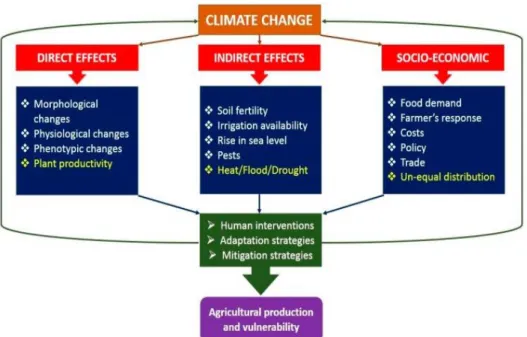
RESULTS AND DISCUSSIONS Climate change affects crop production by means of direct, indirect, and socio-economic effects (Raza et al., 2019). With expected hotter temperatures and changing precipitation patterns, the controlling of water supplies and improving irrigation access and efficiency will become increasingly important (Figure 1).
Climate change events are increased dramatically as reported by FAO (https://www.emdat.be). Farms and farmers are in the crosshairs of climate change. Though farmers have seen
negative impacts related to climate change for decades, these impacts have been exacerbated in recent years (Figure 2).
Even relatively small temperature increases are having significant impacts on farming (Figure 3), including accelerated desertification and salinization of arable land and crop losses due to high temperatures and flooding (https://www.grain.org/bulletin_board/entri es). The impact of climate change also need to be considered along with other factors that affect crop yields, such as specific biotic constrainers (pathogens) and its impact on the host-pathogen relationship (Paraschivu et al., 2015; Paraschivu et al., 2017; Cotuna et al., 2018).
Biotechnology industry can feed a hungry world, but not by itself. Productivity gains through biotechnology are increasingly important, considering the United Nations Food and Agriculture.
38
Fig. 1. Effects of climate change on agricultural production (Source: Ali Raza et al., 2019)
Fig. 2. Increasing number of extreme climate-related events
(Sources: FAO, https://www.emdat.be/; Ali Raza et al., 2019)
Fig. 3. Food and climate change
39 USDA report identifies the following trends (https://www.bio.org/articles):
- Grain and oilseed crops will mature more rapidly, but increasing temperatures up the risk of crop failures, particularly where precipitation decreases or becomes more variable;
- Horticultural crops such as tomatoes, onions and fruit respond to climate change to a greater degree than grains and oilseed crops because of the high sensitivity of their quality and appearance to climate factors;
- Livestock mortality will decrease with warmer winters. However, this will be greatly offset by higher mortality in hotter summers. Hotter temperatures will also result in reduced productivity of livestock and dairy animals because of changes in consumption and lower reproduction pregnancy rates;
- Weeds will grow more rapidly under elevated atmospheric CO2, extend their range northward and be less sensitive to herbicide applications;
- Disease and pest prevalence will escalate as a result of shorter, warmer winters, challenging crop, livestock and forest systems.
There are countless adaptive solutions, including biotechnical solutions, such as protecting orchards from frost damage, reducing water loss by improving irrigation practices or by recycling and storing water, efficient soil management by increasing water retention to maintain moisture in the soil, the introduction of heat-tolerant animal breeds and the adaptation of animal feeding regimes under conditions of heat
stress or the implementation of new possibilities offered by biotechnology.
Biotechnology and genetics contribute decisively to improving the production characteristics of animals (cows, in particular) but also bees (Colă and Colă, 2012) and poultry.
Essential steps for adapting to climate change can be assessing the needs and opportunities for crop and variety change, supporting agricultural research and supporting experimental production, so that be selected the best varieties and crops suited for the new climatic conditions (Olaru, 2009; Olaru et al., 2012; Olaru, 2019).
The effects of climate change on agriculture may depend not only on changing climate condition but also on the ability to adapt through changes in technology and demand for food. Biotechnology positively reduced the effects of climate change by using modern biotechnology. For example, herbicide tolerant biotech crops such as soybean and canola facilitate zero or no-till, which significantly reduces the loss of soil carbon (carbon sequestration) and CO2 emissions, reduce fuel use, and
significantly reduce soil erosion.
Insect resistant biotech crops require fewer pesticide sprays which results in savings of tractor/fossil fuel and thus less CO2 emissions.Modern
biotechnology through the use of genetically modified stress tolerant and high yielding transgenic crops also stand to significantly counteract the negative
effects of climate change
Climate change is very likely to affect food security at the global level. For example, projected increases in temperatures, changes in precipitation patterns, changes in extreme weather events, and reductions in water availability may all result in reduced agricultural productivity.
Agricultural crops can be modified faster through genetics and biotechnology than conventional crops, thus hastening their capacity to meet climatic changes
(Butnaru et al., 2004; Sarac, 2005; Baciu et al., 2009; Bonciu, 2012; Bonciu and Sarac, 2016; Bonciu and Sarac, 2017). Pest and disease resistant biotech crops have continuously developed as new pests and diseases emerge with changes in climate. Crops tolerant to various a biotech stresses have been developed in response to climatic changes.
Genetics and agricultural
40 water framework, reaction to outrageous climate occasions, advancement of versatile product assortments that endure temperature and precipitation stresses, and new or enhanced land utilize and administration practices.
Some of biotech crops adapted to climate changes are shown below (https://www.isaaa.org/resources).
- Salinity Tolerant Crops
Biotech salt tolerant crops have been developed and some are in the final field trials before commercialization. Some of the genes are expected to enhance tolerance to a range of abiotic stresses including drought, cold, salt and low phosphorous.
- Drought Resistant Crops
Transgenic crops carrying different drought tolerant genes are being developed in rice, wheat, maize, sugarcane, tobacco, tomato, potato, etc.
- Biotech Crops for Cold Tolerance
By using genetic and molecular approaches, a number of relevant genes have been identified and new information continually emerges.
- Biotech Crops for Heat Stress Expression of heat shock proteins (HSPs) has been associated with recovery of plants under heat stress and sometimes, even during drought.
The core challenge of climate change adaptation and mitigation in agriculture is to produce more food, more efficiently, under more volatile production conditions, and with net reductions in green gases emissions from food production and marketing. Agricultural biotechnologies will play a central role in enabling producers to meet these core challenges (Wakjira, 2018). However, while most technologies have climate implications, some of them are of particular relevance to developing country agriculture and climate change (Lybbert and Sumner, 2010).
Even if biotechnology and transgenesis have a higher contribution to reducing the negative effects of climate change, we must not forget the valuable approach of organic farming and modern
food processing. Organic food is better for the climate and for the environment, because organic farms promote genetic biodiversity, creates less water pollution and soil damage (Bonciu, 2016, 2017; (Bozhanska, 2018; Georgieva et al., 2018; Righi et al., 2018).
Agriculture biotechnology use and trade regulations must also be sufficiently flexible that they do not discourage the transfer or adoption of locally important innovations. In the future, socio-economic factors, competition, innovation and biotechnological development, together with modern plant breeding will determine the impact that agro-climatic changes will be have on the agricultural sector worldwide (Bonea and Urechean, 2015; Bonea, 2016a; Bonea, 2016b; Bostan et al., 2013; Butnariu, 2012; Ianculov et al., 2005; Samfira et al., 2013).
CONCLUSIONS
The impacts of climate change are not going to be the same for every developing country or even for each region inside a country.
Although there are many impacts expected from global climate change, one of the largest impacts is expected to be on agriculture. Quantifying these impacts provides important insights into how much to spend on mitigation.
41
BIBLIOGRAPHY
1. Babeanu, C., Paunescu, G., Popa,
D., Badita, A.A., 2008 - Changes of
some antioxidant enzyme activities in leaves of drought tolerant varieties of wheat from Oltenia during vegetation
stages, Bulletin of University of
Agricultural Sciences and Veterinary Medicine Cluj-Napoca. Agriculture, 65(1): 30-33.
2. Babeanu, C., Constantin, C.,
Paunescu, G., Popa, D., 2010 - Effects
of drought stress on some
oxidoreductase enzymes in five varieties
of wheat, Journal of Environmental
Protection and Ecology, 11(4): 1280-1284.
3. Baciu, A., Sărac, I., Mike, L., 2009 -
Genetica si ameliorarea cartofului
(Solanum tuberosum L.), Ed. Eurobit,
Timisoara.
4. Barfoot, P., Brookes, G., 2014 - Key
global environmental impacts of
genetically modified (GM) crop use
1996-2012, GM Crops and Food:
Biotechnology in Agriculture and the Food Chain, vol. 5(2): 149-160.
5. Bonciu, E., 2012 - Agricultural
biotechnologies, balance factor for the sustainable development of the
socio-economic system. Analele Universitatii
din Craiova, Seria Biologie, Horticultură, Tehnologia prelucrării produselor agricole, Ingineria Mediului, vol. 17(1): 69-74.
6. Bonciu, E., 2016 - Basic raw materials
used in processing of the snack food (ecological/non ecological) and their
expanding capacity, Annals of the
University of Craiova-Agriculture, Montanology, Cadastre Series, vol. 46(1): 42-47.
7. Bonciu, E., 2017 - Food processing, a necessity for the modern world in the
context of food safety: a Review, Annals
of the University of Craiova - Agriculture, Montanology, Cadastre Series, Vol. 47(1): 391-398.
8. Bonciu, E., Sărac, I., 2016 -
Implications of modern biotechnology in
the food security and food safety, Annals
of the University of Craiova - Agriculture,
Montanology, Cadastre Series, Vol. 46(1): 36-41.
9. Bonciu, E., Sărac, I., 2017 - Termeni și expresii din genetică, biotehnologie și
alte științe biologice, Ed. Eurobit
Timișoara.
10. Bonea, D., 2016 - Effect of the
aqueous extracts of Amoracia
rusticana L. on the seed germination and seedling growth of Zea mays L. under
drought stress, Annals of the University of
Craiova - Agriculture, Montanology, Cadastre Series, vol.46(1): 56-61.
11. Bonea, D., 2016 - The effect of climatic conditions on the yield and quality of maize in the central part of
Oltenia, Annals of the University of
Craiova - Agriculture, Montanology, Cadastre Series, vol.46(1): 48-55.
12. Bonea, D., Urechean, V., 2015 – The
evaluation of heterosis for Romanian
maize germplasm, Pakistan Journal of
Botany, vol. 47(6): 2387-2390.
13. Bostan, C., Butnariu, M., Butu, M., Ortan, A., Butu, A., Rodino, S., Parvu, C., 2013 - Allelopathic effect of Festuca
rubra on perennial grasses, Romanian
biotechnological letters, 18(2), 8190– 8196.
14. Bozhanska, T., 2018 - Botanical and
morphological composition of artificial grassland of bird's–foot–trefoil (Lotus Corniculatus L.) treated with lumbrical
and lumbrex, Banats Journal of
Biotechnology, IX(19), 12-19.
15. Butnariu, M., 2012 - An analysis of
Sorghum halepense's behavior in
presence of tropane alkaloids from
Datura stramonium extracts, Chemistry
Central Journal, 6, no 75.
16. Butnaru, G., Căpâlnăşan, I., Sărac, I., Jurca, M., Baciu, A., Popescu, C.,
Avramescu, A., 2004 - Cromosomii –
particularităţi morfo-funcţionale la plante
şi animale, Editura Mirton, Timișoara.
ISBN 973-661-288-0, 145 p.
17. Cichi, M., 2017 - Evaluation of some strawberry varieties in the southern area
of the country, Annals of the University of
42 18. Colă, F., Colă, M., 2012 - Protein feeding effect of stimulation of bee
families, Annals of the University of
Craiova-Agriculture, Montanology, Cadastre Series, vol. 42(2): 73-77.
19. Cotuna, O., Paraschivu, M.,
Paraschivu, M., Olaru, L., 2018
-Influence of crop management on the impact of Zymoseptoria tritici in winter wheat in the contex of climate change: an
overview, Research Journal of
Agricultural Science (ISSN 2066-1843), vol.50 (3), p. 69-76.
20. Ianculov, I., Palicica, R., Butnariu, M., Dumbrava, D., Gergen, I., 2005 -
Achieving the crystalline state of
chlorophyll of the Fir–tree (Abies alba)
and the pine (Pinus sylvestris), Revista
de chimie, 56(4), 441–443.
21. Georgieva, N., Nikolova, I.,
Naydenova, Y., 2018 - Possibility for
weed control by using of an organic
product with herbicidal effect, Banats
Journal of Biotechnology, IX(17), 40-49.
22. López-Arredondo, D.L.,
Leyva-González, M.A., Alatorre-Cobos
F., Herrera-Estrella, L., 2013 -
Biotechnology of nutrient uptake and
assimilation in plants, Int. J. Dev. Biol.
57: 595-610.
23. Lybbert, T., Sumner, D., 2010 -
Agricultural Technologies for Climate Change Mitigation and Adaptation in Developing Countries: Policy Options for
Innovation and Technology Diffusion.
Available on
https://www.files.ethz.ch/isn/117246/ 24. Olaru, A.L., 2009 - Îmbunătăţirea tehnologiei de cultivare a arahidelor pe
nisipurile irigate din stânga Jiului.
Tipografia Universitatii.
25. Olaru, L., 2019 - Studies and
research on the qualitative characteristics
of the Olt corn hybrid, Scientific Papers:
Management, Economic Engineering in Agriculture & Rural Development, vol. 19(2): 299-304.
26. Olaru, L.A., Paunescu, G., Oncica, F., 2012 - Comparative study between Romanian and Foreign winter wheat varieties regarding yield potential, during 2004-2011 period on the luvosoil from
Simnic, Annals of the University of
Craiova-Agriculture, Montanology, Cadastre Series, vol. 42(2): 203-207. 27. Pandia, O., Sărăcin, I., 2009 - The influence of the nitrogen and phosphorus doses on the production and the quality at
the Zea mays everta Perlat 625,
Research Journal of Agricultural Science,vol., 41(1): 84-89.
28. Pandia, O., Sărăcin, I., Sărăcin, A.I., 2018 - Management of agricultural culture
establishment works, Scientific Papers
Series Management, Economic
Engineering in Agriculture and Rural Development, vol. 18(2): 315-318.
29. Pandia, O., Sărăcin, I., Chiriac, A., Bozga, I., Oancea, M., Ticu, C., 2012 - Determination of NPK in some local populations of pepper in order to obtain adequate food compliant with the EU food
safety rules, Scientific Papers. Series A.
Agronomy, 55: 369-372.
30. Pandia, O., Sărăcin, I., Văduva, F., Oncioiu, I., Ștefan, M., Dobrotă, G., 2016 -Management coordinations on steel industry in the context of durable
development, Metalurgija, vol. 55(3):
519-522.
31. Paraschivu, M., Cotuna, O., Olaru, L., Paraschivu, M., 2017 – Impact of
climate change on wheat-pathogen
interactions and concerning about food
security, Research Journal of Agricultural
Science (ISSN 2066-1843), vol.49 (3), p.87-95.
32. Paraschivu, M., Cotuna, O.,
Paraschivu, M., Durau, C.C.,
Damianov, S., 2015 – Assesment of
Drechslera tritici repentis (Died.)
Shoemaker attack on winter wheat in different soil and climate conditions in
Romania, Journal of Biotechnology,
Volume 208, p. S113.
33. Raza, A., Razzaq, A., Mehmood,
S.S., Zou, X., Zhang, X., Lv, Y., Xu, J., 2019 - Impact of Climate Change on Crops Adaptation and Strategies to
Tackle Its Outcome: A Review, Plants
43
34. Righi, K., Assia Righi, F.,
Boubkeur, A., Boungab, K., Elouissi, A., Djendara, A.C., 2018 - Toxicity and repellency of three Algerian medicinal plants against pests of stored product:
Ryzopertha dominica (Fabricius)
(Coleoptera: Bostrichidae), Banats
Journal of Biotechnology, IX(17), 50-59. 35. Roșculete, C.A., Roșculete, E., 2018 - The use of chemical and organic fertilizers for sunflower culture on a sterile dump, Scientific Papers. Series A. Agronomy, Vol. LXI, No. 1, 117-124.
36. Rosculete, C.A., Rosculete E.,
Bonciu E., 2018 – The role of forests in
the sustainable development of Romania.
Annals of the University of Craiova-Agriculture, Montanology, Cadastre Series, Vol. 48(2): 140-149.
37. Roșculete, E., Roșculete, C.A.,
2014 – The energy balance for sunflower crops under irrigation and different doses
of fertilizers and basic soil operations,
Annals of the University of Craiova - Agriculture, Montanology, Cadastre Series, 44(1): 236-242.
38. Roșculete, E., Roșculete, C.A.,
2018 - The influence of the interaction of
some mineral fertilizers on the
accumulation of some nutritive elements
in wheat grains, Scientific Papers. Series
A. Agronomy, vol. LXI, No. 1, 386-391. 39. Samfira, I., Butnariu, M., Rodino, S., Butu, M., 2013 - Structural investigation of mistletoe plants from various hosts
exhibiting diverse lignin phenotypes,
Digest journal of nanomaterials and biostructures, 8(4), 1679–1686.
40. Sărac, I., 2005 - Genetica si
ameliorarea speciilor forestiere, Ed.
Mirton,Timisoara.
41. Wakjira, T., 2018 - Climate change
mitigation and adaptation through
biotechnology approaches: A review.
Cogent Food & Agriculture.
***https://www.bio.org/articles ***https://www.emdat.be
***https://www.grain.org/bulletin_board/ent
ries
***https://www.isaaa.org/resources ***
http://madr.ro/docs/dezvoltare-rurala/rndr/buletine-tematice/PT9.pdf
***https://www.ncbi.nlm.nih.gov/pmc/article