e-ISSN 2239-4303, DOI 10.2423/i22394303v3n1p25
© CASPUR-CIBER Publishing, http://caspur-ciberpublishing.it
VIRTUAL TECHNOLOGIES TO ENABLE NOVEL METHODS OF ACCESS TO LIBRARY
ARCHIVESMarcello Carrozzino*, Alexandra Angeletaki**, Chiara Evangelista*, Cristian Lorenzini*, Franco Tecchia*, Massimo Bergamasco*
* PERCRO, TECIP Institute, Scuola Superiore Sant'Anna, Pisa, Italy **
Norwegian University of Science and Technology (NTNU) University library, Gunnerus branch, Trondheim, Norway
Abstract
MUBIL is an international research project aiming at establishing a novel learning framework based on Virtual Environments technologies in order to disseminate the content of libraries archives, especially ancient manuscripts. The project, lead by the Gunnerus Library of Trondheim, Norway, and participated by the NTNU (Norway) and Scuola Sant’Anna (Italy), has the secondary objective of testing the extent to which distinctive features of Virtual Environment, such as immersion and interaction, impact on the involvement of the public, especially youngster, and therefore on the efficacy of the transmission of content, such as old books, traditionally challenging to disseminate to such a public. The framework includes three different levels of development, described in this paper, and is expected to establish a methodology for the evaluation of the achieved results in the last stages of the project, ending in October 2013.
Keywords
Libraries Archives, Virtual Environment, Immersion, Interaction, Learning
1. Introduction
The MUBIL1 project, an interdisciplinary cooperation partnered by the Gunnerus Library of
Trondheim, the Norwegian University of Science and Technology, and the PERCRO
laboratory of Scuola Superiore Sant’Anna, Pisa, deals with the creation of a hybrid exhibition
space where the content of the historical archives of the Library will be presented to a wider
public.
The aims of the project are to:
- develop a virtual learning space within the physical space of library/museum
taking particular care to stimulate the interest of children;
- demonstrate the potential of virtual technologies to engage visitors enabling their
interaction on several levels of growing immersion (Carrozzino, 2010);
- create dynamic linkages between the public and its collections and spread
knowledge.
Research on visiting historical archives as a space for participatory interaction is pretty new
(Hirsch & Silverman, 2000) and allows for the possibility of borrowing design strategies
from the sector of the museum/archive, a destination of dynamic social and cultural character
known of having a clear focus on facilitating learning (Hooper-Greenhill, 2000). It is claimed
that virtual reality can support experiential learning (Riva, 1999). Thus the idea of applying
3D technology for promoting the collections of museums and archives is not new but the
investigation of its influence on the visitor experience can create new possibilities.
The question posed by Champion of trying to determine "the weaknesses and strengths of a
virtual heritage environment 's ability to provide a cultural learning experience" is new and a
demanding one (Champion 2011:177). Some studies have looked into the role of social
conduct in mixed reality environments and the role of collaborative production of meaning in
a space of technological innovation in museums (Galani, 2003). That aspect involves cultural
learning in a social room which is defined as learning that occurs through observation,
instruction, trial and error in a context of interacting with other people or objects (Champion
2011:178). Evaluation methodology though, has been difficult to develop (Roussou,
2004).Studies have been borrowing ethnographic and phenomenological tools or usability
techniques (Champion, 2011) to evaluate the learning outcome based on visitor experience
and the result is often not of a universal value since it is closely connected to the particular
case and the technology used in a particular frame. In our study we assume that there might
be several aspects of the immersive experience that such a tool allows us to investigate when
users interact individually or in collaborating groups with 3D virtual images of physical
objects, as old manuscripts and books and their history. We believe that creating meaningful
content and interactive tasks that aim in cultural learning can make a difference in the use of
such tools.
2. Description of work
The project is articulated into different steps, each corresponding to a different level of
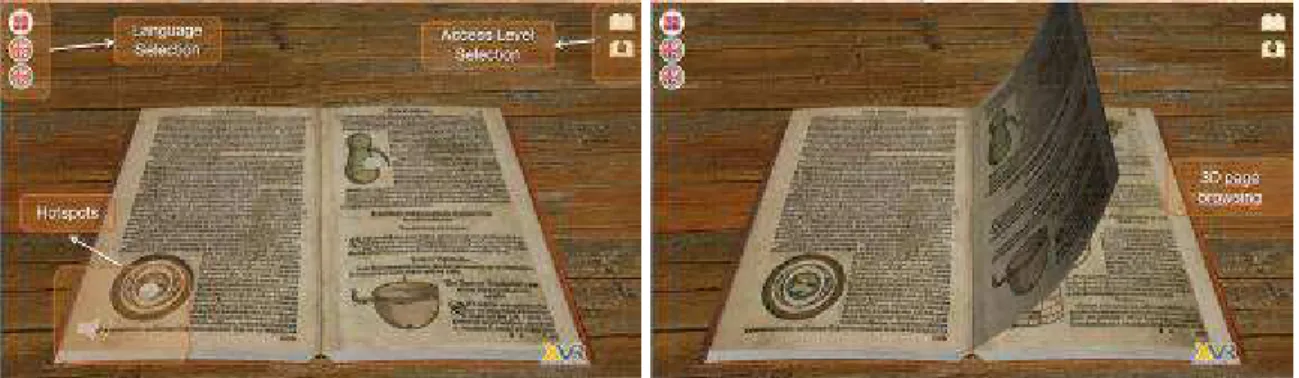
interaction and immersion with the digital content. In the first step (touch books), books are
presented as simple digital copies of the original manuscript. Users are allowed to interact
with the text via a series of hotspots placed on the pages which trigger additional overlaid
information related to the context. In the second step (augmented books) the same context is
enriched by explanatory images, videos, sounds and animated 3D models so as to improve
the user engagement. The third step (virtual laboratory) is based on a totally different
paradigm, where the book is part of a more complex activity involving the application of the
knowledge gathered in the previous steps.
Although the project aims to setup a consistent methodology in order to extend this modality
of fruition to any type of digital text complying with a defined format, the first prototypes
will refer to two books, belonging to the historical archives of the NTNU University Library
Gunnerus branch, selected based on their peculiar content and their suitability to be presented
in the described forms. The first one is a treatise on medicinal distillation, written by Adam
Lonicer (1528-1586). In this case the information provided, besides being referred to the text
itself and the author, will be related also to alchemy and science in general at that particular
historical period. The second book is a travel itinerary, written by an aristocrat from Bergen,
Hans H. Lilienskiold (1605-1703), describing his trip to Europe in 1670.
At present the Lonicer’s book has been implemented in two different flavours:
- Touch books, enabling users:
o to browse, zoom and pan the original pages of the book (fig.1);
o to access the transcription of the book pages in a more readable format,
together with the transposition into modern Norwegian and the English and
Fig. 1: Touch books
- Augmented books (fig.2), enabling users to experience an enriched version of the
book with all the content specified in a jointly agreed storyboard. In particular, in this
level it is possible to visualize 3D texts, images, 3D models, movies, audios. All of
these elements can be singularly used or combined in order to:
o render 3D animated objects;
o present pop-up captions related to multimedia elements;
o present the book, or parts of it, in audio/video format.
Fig. 2: Augmented books
Touch books can be considered as an entry level of augmented books, where features are
limited to different text layers that can be selected and/or overlaid to the original text.
Augmented books add several contextual information aimed at a better understanding of the
text, through the “immersion” in the book universe.
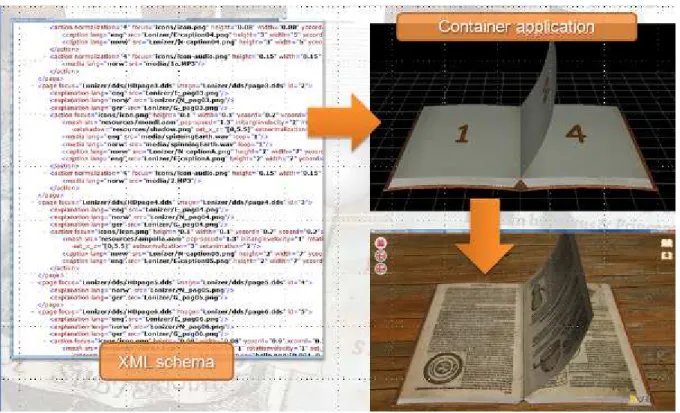
The proposed concept is adaptable to almost all books. To achieve this flexibility, the
architecture was since the beginning conceived in order to separate the concerns related to the
material). This has been achieved by making the software application able to read the book
configuration from an XML file (fig.3) where the content of each book page is specified in
terms of text, images, hotspots (position and triggered content), videos, 3D elements and
related modes of presentation and animation.
Fig. 3: Mubil high level architecture
This feature effectively allows the extension of the library of Touch/Augmented Books, being
this way the definition of the content independent from the container software application
which automatically complies with the specified information. Of course the realization of the
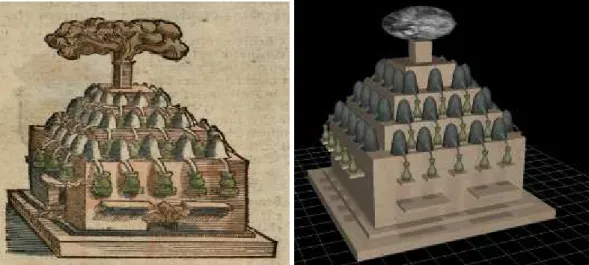
augmented data involves different levels of complexity, depending on content. 3d models,
notably, require a time-consuming process of manual 3D modeling and texturing starting
from the book images (fig.4).
Beyond being good programming practice, this flexibility has several different advantages:
– it is easy to reorganize content, being it decoupled from the container;
– it is easy to add new content;
– it is easy to adapt the container to new books;
Fig. 4: Sample illustration from Lonicer’s book (left) and corresponding 3D model (right)
The separation of concerns has been applied also to the interaction metaphors allowing to
interface users with the touch book (decoupled as much as possible from the devices, such as
mouse, joystick, Microsoft Kinect etc.) and to the visualization metaphors (adapting to
tablets, desktop PCs, immersive visualization systems).
Fig. 5: Lonicer in the Mini-CAVE with Kinect Interaction (left), on a tablet with touch interaction (right)
A 3D Graphical User Interface has been designed with the aim of reaching a good degree of
user-friendliness and clearness, and implemented in order to easily meet new emerging
requirements. Dedicated efforts have been made in order to make the software able to easily
has been conceived in order to improve the 3D effect even in absence of stereoscopy, for
instance making the 3D pop-up objects appear emerging more evidently in foreground with
an enhanced parallax, introducing textures baked with lighting information and self-shadows,
and using fading-to-black techniques to darken the book during pop-up, with additional
shadow casting able to increase the depth perception. The general 3D effect is clearly even
more perceivable on immersive viewers, such as Powerwalls and Mini-CAVE on which the
application was specifically adapted and tested.
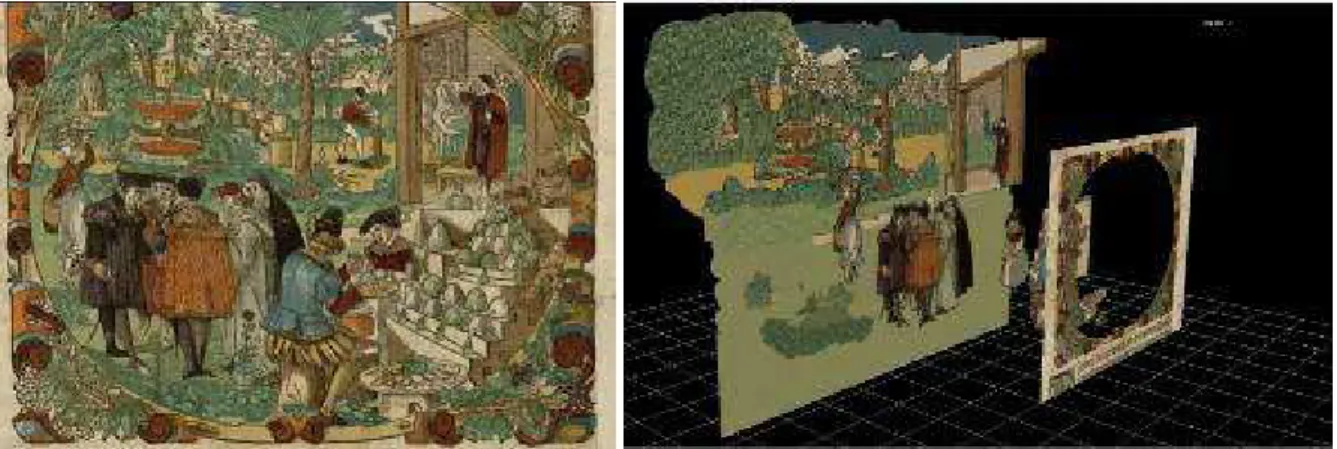
The framework has been also prepared in order to allow the insertion of narrative content,
both in terms of videos (for instance the first book illustration was transposed into 3D
through a series of depth layers as shown in fig. 6, and on top of this a movie was produced
where a specific narration synced with the 3D exploration of the resulting environment
described the place, the characters, the facts etc.) and of 3D animations. This feature, in
particular, was conceived in order to increase the application appeal especially to children;
further narrative elements, combined with playful elements, are provided by an animated
character who appears on the book on specified circumstances and guides children to the
discovery of the book and its content .
Fig. 6: Original illustration (left) and depth layers (right)
The same process has been applied to a subset of the Lilienskiold book (fig.7, left). However,
whilst the Lonicer book has plenty of beautiful colored illustrations which make it very
suitable for an enriched version, this book is mainly composed of text. On the other side, the
matter of the book is travel and many interesting places are vividly described. In order to
exploiting the concept of Information Landscapes (Ruffaldi, 2008). ILs are particular abstract
Virtual Environments - mainly made up of text and optionally enriched with 3D and
multimedia elements – which do not correspond to any real environment and exploit the
three-dimensional context to map spatial relationships into semantic relationship (i.e. the
landscape layout is itself a source of content). The Lilienskiold IL (fig. 7, right) centered on
the metaphor of the trip to Italy, puts the user in front of extracts of the book text, translated
in English and vocally narrated in Norwegian, immersed in an abstract environment, first, and
then, as the travel progresses, getting closer to a 3D map of Pisa, where the major
monuments, described by the author, are visually highlighted.
Fig. 7: Lilienskiold Touch Book (left) and Information Landscape (right)
The Virtual Laboratory level, specifically conceived for the two selected books, is aimed to
connect the previous levels and allow readers to “apply” the concepts learned in the previous
levels. A narrative, specifically created for this to realize this connection, puts the reader in
the role of an alchemist having to perform a real experiment based on the alchemy knowledge
acquired from the Lonicer book and other information retrievable in the Lilienskiold’s one. A
3D interactive application allows the player to actually perform the experiment with a
paradigm similar to point-and-click adventures. As for the previous levels, this application
also can be experienced with different levels of immersion, starting from desktop
Fig. 8: The Lab 3D environment (left) experienced in the PERCRO X-CAVE (right)
3. Results and Future Work
The MUBIL project will be completed in October 2013 and presented to the general public,
although the whole work in progress has been demonstrated in several conferences and
workshops and rapidly gained the interest of the public, especially the youngsters who have
participated with great attention to the test and demonstration sessions. In the next stages, we
will focus on the evaluation of the technological results so far achieved in terms of learning;
the objective is to analyze the ability of such a technological framework to support learning
cooperation, through interactivity.
Acknowledgements
The authors wish to thank Prof. Letizia Jaccheri of NTNU for her valuable contribution to the
REFERENCES
CHAMPION,E. (2011). Playing with the Past. London: Springer London.
CARROZZINO M, BERGAMASCO M (2010). “Beyond virtual museums: Experiencing
immersive virtual reality in real museums.” Journal of Cultural Heritage, 11: 452-458.
GALANI, A. (2003). Mixed Reality Museum Visits: Using new technologies to support
co-visiting for local and remote visitors. Museological review, 10.
HIRSCH,J.S.,SILVERMAN,L.H. (2000). Transforming practice: selections from the Journal of
Museum Education, 1992-1999: Left Coast Press.
HOOPER-GREENHILL, E. (2000). Museums and the interpretation of visual culture. London:
Routledge.
RIVA, G. (1999). Virtual Reality as Communication Tool: A Sociocognitive Analysis.
Presence: Teleoperators and Virtual Environments, 8(4), 462-468. doi:
10.1162/105474699566341
ROUSSOU, M. (2004). Learning by doing and learning through play: an exploration of
interactivity in virtual environments for children. Comput. Entertain., 2(1), 10-10. doi: 10.1145/973801.973818
RUFFALDI E. ET AL. (2008). “Design of information landscapes for cultural heritage content”,