376
OBTAINING AND TESTING OF FERTILIZERS WITH ORGANIC
SUBSTANCES
Carmen Sirbu1, Cioroianu Traian1, Adriana Grigore1, Ana-Maria Stanescu1, Bogdan Rujoi1, Nicoleta Marin 1, Lavinia Burtan 1, Monica Dumitrascu 1, Emilia Nicu 2
1 National Research & Development Institute for Soil Science, Agrochemistry and Environment Protection Bucharest 2
University of Agronomic Sciences and Veterinary Medicine Bucharest
Keywords: organo-mineral fertilizers, organic fertilizers, algae, foliar fertilizer, agrochemistry.
ABSTRACT
Due to legislation for environmental protection and the need to obtain products "cleaner" worldwide there is a major trend of development both the research and the production of fertilizers with organic substances with growth stimulating effect for use for intensive and organic agriculture (especially for protection of crops, and prevent and combat nutritional deficiencies).
Approaching the concept of fertilizers containing substances of category biostimulators is a difficult task by the fact that describing the concept of biostimulants is far from being completely understood and legislation, research and experimentation are, regarding this category of products used in agriculture, at an early stage of development.
This paper presents a range of NPK fertilizers with organic substances represented by protein hydrolysates and extracts from algae, with primary and secondary nutrients and physical and chemical characteristics of fertilizers obtained experimentally. These fertilizers were tested in the national network of testing of fertilizers in order of authorization for use in agriculture. It was observed that the combination of fertilizer is well assimilated by plants, with a synergistic effect of growth and protection against diseases and pests.
If the application of these fertilizers were obtained yield increases between 25-30% for the tomato crop and 27 - 32.5% for the apple, as well as changes in photosynthesis process marked by increases of 30-37% of assimilating pigments.
INTRODUCTION
Worldwide there is a major trend in developing fertilizers with organic substances for stimulating plant growth that can be used both in conventional agriculture and organic farming (especially for crop protection to stress or climate accidents and to prevent and combat nutritional deficiencies) [1-11, 13-15].
One of the main challenges in organic production is the approach to soil fertility: the regulations on fertilizers and soil amendments limits the number of allowed types and sources of inputs [1,4]. The raw materials used are varied, most representing sub-products from different industries that can be exploited efficiently as inputs in agriculture [5,6,7,9,10]. Products with demonstrated biostimulating activity are those with algae extracts, protein hydrolysates and humic substances. Extracts of algae, although they are very different depending on their origin, show a biostimulating effect especially due to their content in auxins and trace elements [2]. In Romania there are currently no similar domestic products, thus Romanian users are forced to purchase these products from companies dealing with import.
377
The objective of this study was embedding into a NPK matrix biostimulating substances with variable composition such as, proteins, amino acids and phytohormones, meso and micro-elements in order to obtain major agrochemical effects (provide and correct nutrient needs for plant growth, correct nutritional deficiencies).
MATERIAL AND METHOD
After the development and validation of the technology, the fertilizers samples were subjected to complex physicochemical characterization and tested in the National Network for Fertilizers Testing in order to be authorized for agriculture use.
The development of the two soluble fertilizers with organic substances involved the use of algae extracts and protein hydrolysates. The physicochemical characterization of the raw materials was performed by FT-IR spectroscopy, and the trace elements (iron, copper, zinc, manganese and boron) were analyzed in accordance with 2003/2003 Regulation (Annex 1) [12].
The obtained fertilizers can be applied extraradicular, by irrigation or drip irrigation. Agrochemical testing of the fertilizers was performed in the National Network for Fertilizers Testing in order to obtain the authorization/license and RO-ÎNGRĂȘĂMÂNT label for agriculture use and distribution in Romania in accordance with 6/22/2004 Order.
RESULTS AND DISCUSSIONS
Three fertilizers samples (Fert, Algafert, Hidrofert) that contain major nutrients (N, P, K), secondary nutrients (S, Mg), trace elements (B, Fe, Mn, Zn) and organic substances (algae, protein hydrolysates, amino acids) were obtained in the laboratory.
The experimental investigations conducted in the National Network for Fertilizers Testing were held at Iasi USAMV Didactic and Experimental Station and Ezăreni- field farm.
Agrochemical experiments carried out using the organic substances fertilizers (algae and protein hydrolysates) were conducted as single factorial experiments by extraradicular application (compared to a unfertilized control sample) arranged in randomized experimental variants, using four replicates and unfertilized soil.
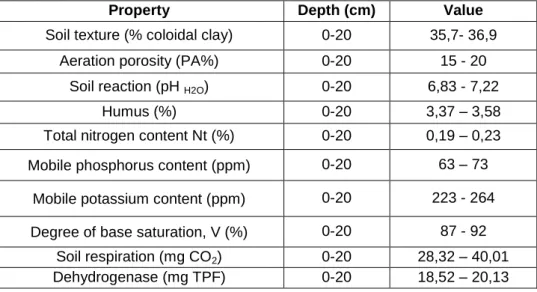
The main quality and fertility characteristics of the soil (cambic chernozem) are given in Table 1.
Table 1 Main physical, chemical and biological properties of the soil
resources
Property Depth (cm) Value
Soil texture (% coloidal clay) 0-20 35,7- 36,9
Aeration porosity (PA%) 0-20 15 - 20
Soil reaction (pH H2O) 0-20 6,83 - 7,22
Humus (%) 0-20 3,37 – 3,58
Total nitrogen content Nt (%) 0-20 0,19 – 0,23
Mobile phosphorus content (ppm) 0-20 63 – 73
Mobile potassium content (ppm) 0-20 223 - 264
Degree of base saturation, V (%) 0-20 87 - 92
Soil respiration (mg CO2) 0-20 28,32 – 40,01
378
The productive efficiency of the fertilizers investigated in this study, using extraradicular application, in 3 treatments consisting of 2.5 liters/ha dosages and 0,5% concentration are summarized in Tables 2 - 3.
Table 2 Productive efficiency (kg/ha) of ALGAFERT, FERT and HIDROFERT fertilizers using
foliar application to tomato crop (Precos variety) in the greenhouse
No. Experimental variants/type
No. of treatme nts
Dosage kg(L)/ha/ treatment
Concentr ation
Average production (kg/ha)
Productive efficiency
kg/ha % Signific
ance 1 Unfertilized
control
- - - 32642 - - -
2 Fert 3 2,5 0,5% 41083 8441 25,86 xxx
3 Algafert 3 2,5 0,5% 41243 8601 26,35 xxx
4 Hidrofert 3 2,5 0,5% 42330 9688 29,68 xxx
DL 5%- 2814 kg/ha DL 1%- 4576 kg/ha DL 0,1%-5838 kg/ha
The obtained production yields were positive and significant compared to the unfertilized control sample for all the fertilization variants, ranging from 25.86% (Fert) to 29.68% (Hidrofert).
Table 3 Productive efficiency (kg/ha) of ALGAFERT, FERT and HIDROFERT fertilizers using
foliar application to apple tree (Idared variety)
No. Experimental variants/type
No. of treatmen ts
Dosage kg(L)/ha/ treatment
Concen tration
Average production (kg/ha)
Productive efficiency
kg/ha % Signific
ance 1 Unfertilized
control
- - - 15213 - - -
2 Fert 3 0,5% 19375 4162 27,36 xxx
3 Algafert 3 0,5% 19500 4287 28,18 xxx
4 Hidrofert 3 0,5% 20152 4939 32,47 xxx
DL 5%- 1852 kg/ha DL 1%- 2481 kg/ha DL 0,1%-3675 kg/ha
The obtained production yields were positive and significant compared to the unfertilized control sample, for all the fertilization variants, ranging from 27.36% (Fert) to 32.47% (Hidrofert).
379
Table 4 Influence of foliar fertilization with ALGAFERT, FERT, HIDROFERT products on the
tomato leaves photosynthesis (Precos variety) grown in the greenhouse
Assimilatory pigments
Significance Fertilization variants/type
CONTROL ALGAFERT FERT HIDROFERT
Chlorophyll a
mg/g 0,9451 1,2315 1,2435 1,2641
diff. - 0,2864 0,2984 0,3190
% - 30,31 31,58 33,76
significance - xxx xxx xxx
Chlorophyll b
mg/g 0,7741 1,0189 1,0277 1,0441
diff. - 0,2448 0,2536 0,2700
% - 31,63 32,77 34,88
significance - xxx xxx xxx
Carotene mg/g 0,5968 0,7750 0,7801 0,7888
diff. - 0,1782 0,1833 0,1920
% 100 29,86 30,72 32,18
significance - xxx xxx xxx
Total assimilatory pigments
mg/g 2,3160 3,0254 3,0513 3,0970
diff. - 0,7094 0,7353 0,7810
% - 30,63 31,74 33,72
significance - xxx xxx xxx
Chlorophyll a Chlorophyll b Carotene Total pigments DL 5%-0,1006 mg/g DL5%-0,0921 mg/g DL 5%-0,0531 mg/g DL 5%-0,2523 mg/g DL 1%-0,1534 mg/g DL 1%-0,1407 mg/g DL 1%-0,0862 mg/g DL 1%-0,3746 m/g DL 0,1%-0,2016 mg/g DL 0,1%-0,1733 mg/g DL 0,1%0,1125 mg/g DL 0,1%-0,5017/ mg/g
Table 5 Influence of foliar fertilization with ALGAFERT, FERT, HIDROFERT products on the
apple tree leaves photosynthesis (Idared variety)
Assimilatory pigments
Significance Fertilization variants/type
CONTROL ALGAFERT FERT HIDROFERT
Chlorophyll a
mg/g 0,7816 1,0428 1,0579 1,0718
diff. - 0,2612 0,2763 0,2902
% - 33,42 35,36 37,14
significance - xxx xxx xxx
Chlorophyll b
mg/g 0,6245 0,8407 0,8525 0,8635
diff. - 0,2162 0,2280 0,2390
% - 34,62 36,51 38,28
significance - xxx xxx xxx
Carotene mg/g 0,5351 0,7128 0,7203 0,7317
diff. - 0,1777 0,1852 0,1966
% - 33,21 34,62 36,75
significance - xxx xxx xxx
Total assimilatory pigments
mg/g 1,9412 2,5963 2,6307 2,6670
diff. - 0,6551 0,6895 0,7258
% - 33,74 35,51 37,38
significance - xxx xxx xxx
Chlorophyll a Chlorophyll b Carotene Total pigments DL 5%-0,1112mg/g DL5%-0,0981mg/g DL 5%-0,0736mg/g DL 5%-0,2631mg/g DL 1%-0,1563mg/g DL 1%-0,1426mg/g DL 1%-0,1121mg/g DL 1%-0,3276 mg/g DL0,1%-0,2231mg/g DL0,1%-0,2057mg/g DL0,1%0,1542mg/g DL0,1%-0,5104mg/g
According to the data presented in Tables 2-5 it can be observed that there are significant differences registered for the three fertilizers in comparison to the unfertilized control sample and these are statistically insured.
380
This research was conducted under the NUCLEU Program Contract No. 16N/2016 - Risk management induced by global changes on soil resources - critical land area border (GRISGSOL), Project PN 16 07 02 01: "Development of new fertilizing products suitable for organic farming: production technologies, physicochemical characteristics and agrochemical efficiency".
CONCLUSIONS
1. In this study were developed (and physicochemical characterized) 3 fertilizers with extraradicular application. They present a complex composition formed by associating microelements (e.g. Fe, Cu, Zn, Mn, Mg) and organic substances (algae and protein hydrolysates) with chelation and biostimulation role in a NPK matrix.
2. The use of organic substances fertilizers led to production yields ranging from 25 - 30% for tomato crop, respectively 27 - 32.5% for apple, as well as changes in photosynthesis process.
3. The presence of organic substances conducted to a yield increase of 3% for ALGAFERT and 18% for HIDROFERT compared to the control matrix FERT.
4. Assimilatory pigments showed significant increases of 30-34% for tomato crop, respectively 33-37% for apple in comparison to the unfertilized control sample.
BIBLIOGRAPHY
1. Ditta, A., Arshad, M., Zahir, Z.A.., Jamil, A., 2015 - Comparative Efficacy of Rock
Phosphate Enriched Organic Fertilizer vs. Mineral Phosphatic Fertilizer for Nodulation, Growth and Yield of Lentil, International Journal of Agriculture and Biology, vol. 17.
2. Feng G., Shan Z., Li S., Hui, C. 2013- The production of organic fertilizer using
tannery sludge, Journal of the American Leather Chemists Association, vol. 108.
3. Huang, Y., Li, R., Liu, HJ., Wang, BB., Zhang, CM., Shen, 2014 - Novel resource
utilization of refloated algal sludge to improve the quality of organic fertilizer, Environmental Technology, vol. 35.
4. Möller, K., Schultheiß U., 2015 - Chemical characterization of commercial organic
fertilizers, Archives of Agronomy and Soil Science, vol. 61.
5. Lam, M. K., Lee, K. T., 2012 - Potential of using organic fertilizer to cultivate
Chlorella vulgaris for biodiesel production, Applied Energy, vol. 94.
6. Li, Z., Schulz, R., Müller, T., 2015 - Mineralization of legume seed meals as
organicfertilizers affected by their quality at low temperatures, Biological Agriculture & Horticulture, vol. 31.
7. López-Mosquera, M. E., Fernández-L., E., 2011 - Composting fish waste and
seaweed to produce a fertilizer for use in organic agriculture, Procedia Environmental Sciences, vol. 9.
8. Mooney, P.A., van Staden, J., 2015 - Algae and cytokinins, Journal of Plant
Physiology, vol. 123.
9. Mucheru-Muna, M., Mugendi, D., Pypers, P., Mugwe, J;., Kung'u, J., Vanlauwe,
B., Merckx, R., 2014 - Enhancing maize productivity and profitability using organic
inputs and mineral fertilizer in central kenya small-hold farms, Experimental Agriculture, vol. 50.
10. Nest, T.V., Ruysschaert, G., Vandecasteele, B., Cougnon, M., Merckx, R.,
Reheul, D. P., 2015 - Availability and P leaching after reducing the mineral P
fertilization and the use of digestate products as neworganic fertilizers in a 4-year field trial with high P status, Agriculture Ecosystems & Environment,vol. 202.
11. Onder, U., Ozge, F. U., Ekinci, K., 2015 - Evaluation of microalgae as microbial
381
12. Regulation (EC) no 2003/2003 of the European Parliament and of the Council from 13 October 2003 relating to fertilisers (accessed 01.10.2016);
13. Sîrbu, C., Cioroianu, T., Cojocaru I., Trandafir, V., Albu, M., G., 2009 - The
fertilizers with the protein chelated structures with the biostimulator role, vol. 60.
14. Štýbnarová, M., Mičová, P., Fiala, K., Karabcová, H., Látal, O., Pozdíšek, J.,
2014 - Effect of organic fertilizers on botanical composition of grassland, herbage yield and quality, Agriculture, vol. 60.
15. Zhang, M., Li, R., Cao, LL, Shi, JJ., Liu, HJ., Huang, Y., Shen, QR., 2014 - Algal