248
THE MEASUREMENT OF POLLUTANT EMISSIONS FROM BURNING
GASES WHICH RESULT DURING THE WORKING PROCESS OF A FNC
VASILE CRISTIAN, PETRE SĂVESCU, MIHNEA GLODEANU
Faculty of Agriculture and Horticulture, Craiova, Romania
Keywords: analyzer, sensor, burning gas, pollutant emissions, chemical reactions
ABSTRACT
In order to follow the norms of the European Union for the processing of corny products it will be necessary and compulsory that each FNC should be endowed with modern and efficient equipment that displays a high degree of mechanisation, automation and computerising, enabling quick productivity and low costs. [5, 6]
Also the rules of European Union impose the strict control of the processes within a FNC's technological flux.
This article presents the analysis and the measurements of pollutant emissions that were carried out in different points on the technological flux of the combined fodder. We need to mention that the results of these measurements were, throughout the batch of assortement, within the limits of the actual law.
INTRODUCTION
The processes that are carried out along the technological flux of a FNC are: reception-storing, transportation to different installation, recirculation, processing, packing, storing-delivery.
Within the manufacturing process of raw materials is performed the crumbling, then they are mixed, and under a jet of steam which is generated by a steam generator it will obtain particles of different forms and dimensions. . The steam from the generator has a role of homogenization of the particles and sterilizing them. At the end of the steam generator it has been taken samples and it has been made different measurements in order to analyze the functional parameters of the installation. So, in this working point it has been measured the burning gas emissions resulted from obtaining the jet of steam necessary to the homogenization of the mass of the prime matter in order to obtain compound feed grains.
These analysis and measurements of the emissions of the burning gas at the end of the steam generator were made with the help of the gas analyzer TESTO 350 M/XL, during an interval of 100 minutes, which represents the minimum time required to create a batch of compound feed grains.
MATERIAL AND METHOD
The analysis principle is based on the changing the intensity of the galvanic current generated by a galvanic battery of who’s electrolyte modifies its properties, after its reaction with gas component which needs to be detected and which concentration needs to be measured [1, 2, 8].
The measurement cells are represented of some galvanic elements, which generate a current proportionally with the number of ions which is dissociate in the solution of electrolytes, as a result of the interaction with the studied gas.
Analyzers built by this principle are much cheaper compared to infrared-based analyzers, but may only be used for short or normal periods of time, usually by portable devices. With the aid of these instruments, one could determine the concentration of any
249
In figure 1 we have demonstrated the principles of operation within a twin-electrode
sensor, specifically for detecting O2. During this analysis, the sample gas diffuses through
a membrane towards the alkaline electrolyte.
Figure 1 – A simplified diagram for the twin-electrode sensor (for O2) [1]
The following chemical reaction takes place on the cathode:
O2 + 2H2O + 4e- = 4 OH- (1)
The electrons necessary for the reaction (1) result from the oxidation of the material which the anode is composed of (the anode is made of Pb) under the following reaction:
Pb 4OH- = PbO2 2H2O 4e- (2)
By combining reaction (1) and (2), we obtain the whole of the reaction (3). The result is lead oxidation inside the anode’s twin-cell electrode, across the sensor’s whole lifetime:
O2 + Pb = PbO (3)
The electrolyte is not consumed, though the lead anode will wear down over time and become depleted, shortening the sensor’s lifespan to a duration of approximately three years.
The physical separation of reaction (1) and reaction (2) enables the generation of an electrical signal proportional to the concentration of oxygen in the mixture of gases that diffuse through the sensor’s periphery. [1, 2, 4]
Figure 2 show a diagram of a three-electrode sensor’s functions, normally used to
detect the toxic gases NO, NO2, CO, SO2, given here as an example to demonstrate how
to determine the concentration of CO.
Figure 2 - Diagram of a three-electrode sensor [2]
1,5 – diffusion barrier, 2 - anode, 3 - electrolyte (H2SO4), 4 - cathode,
6 – reference gas, 7 – reference electrode, 8 – voltage regulator.
Apart from the anode (also known as an active electrode) and a counter electrode
(the cathode), the device is provided with a reference electrode as well.
250
To find the correct concentration of CO in the sample is exemplified reaction (4), taking place on the anode reaction (5), which takes place on the cathode and the reaction amount (6). It is noted the advantage offered by the three-electrode sensor to the two electrodes as the electrodes are not consumed while they are subjected to aging.
CO + H2O = CO2 + 2H+ + 2e- (4)
1/2O2+ 2H+ + 2e- = H2O (5)
CO + 1/2O2 = CO2 (6)
A constant voltage regulator (continuous) provided between the active electrode (anode) and the reference electrode, is designed to prevent a potential modification of the active electrode due to the current generated by reactions (4) and (5).
This widens the stability and the measuring sensor. The voltage between the active electrode and the reference, as well as a proper choice of the electrode and the electrolyte, provides an adequate selectivity of the sensor. [1, 2]
Description and working with the analyzer TESTO 350 M / XL
The gas analyzer TESTO 350 M/XL is an powerful equipment which determines the gas emissions from the burning gases, their determination is obtained in special cells, as
the result of some electro-chemical reactions type Peltier. Analyzed gases are: SO2, CO,
CmHn, O2, NO and NO2. [2, 7, 8]
This device, used in the analyzers of the study FNC consists of three main parts: the unit of analysis, the control unit and gas sampling probe.
The analysis unit contains reaction cells, battery pack, filters for retaining solid impurities in the flue gas and air, settling for condensation and electro-pneumatic connections, as shown in figure 3.
The gas drawn through the probe is inserted in the reaction cells when the gas pump is started manually or automatically. However, before the analyzed gas is suddenly
cooled at 48°C, taking place the precipitation of the condensate with low absorption of
NO2 and SO2, condensate which is evacuated at regular intervals by a condensate pump.
Figure 3 - Analysis Unit [8]
1-electical contacts; 2- control LEDs; 3-solid particles filter; 4-filters for retaining particles from air aspiration; 5-condensate collecting; 6-analysis cells; 7-intergrated system for speed determination
and gas pressure; 8- connections
After Peltier reactions are emitted, an electrical signal is sent and processed in the control unit, being displayed the concentration values of the analyzed gases. The gas excess is continuously discharged.
251
there are also displayed information like the system configuration and the location of the activity.
By connecting the device to a PC, this can be used for long-term measurements (days, even weeks), being controlled by a special program called TESTO Easy Emissions.
Picture 4- The control unit [8]
1- the printer, 2 - touch pen, 3 - the system information bar, 4 - showing the values measured, 5 - information about functioning bar, 6 - operating functioning tasts,
7- keyboard, 8 - connecting preasure sond, 9 - connection probe, 10 - connection to the analise unit, 11- serial interface
The machine can be equipted with many sonds of prelevation the gas , but those can be different regarding the caracteristics of the gases which have been prelevated.In figure 5 we can see the sampling probe for gas, which has its tub at 180 degree, which operates at maximum temperature of 1200 degrees.
Figure 5 - The sampling probe for gas [8]
252
Figure 6 – Zero calibration for Testo 350 M/XL [8]
After the machine enters in the normal regim of working, he must be programeted to achieve and to show the data, which presents interes for the one who works (figure 7).
Figure 7- Display, Testo 350 M/XL [8]
It is obligatory to set the machine for the right type of fuel, from the data base of the machine (figure 8). After we set the parameters which we want to measure, the sonda is due to be introduced in the canal of the gases and the activity of measuring the size starts.
Figure 8 – The parameters setting,Testo 350 M/XL [8]
RESULTS AND DISCUSSIONS
Table 1 presents the values of the Broiler chicken-the starter faza, transformated in mg/m and raportated to the reference oxigen.For the stationary burning instalation which works with GPL, the raportation is realised for a three per cent value of the reference oxigen.
253
Table 1
The values of the measurements raportated to the reference oxigen of 3%
No. Crt.
CO [mg/m3N]
NOx [mg/m3N]
SO2 [mg/m3N]
CO2 [g/m3N]
CO* [mg/m3N]
NOx* [mg/m3N]
SO2* [mg/m3N]
CO2* [g/m3N] 1 61.25 16.42 0.00 182.44 84.68 22.70 0.00 252.22 2 61.25 16.42 0.00 182.44 84.68 22.70 0.00 252.22 3 63.75 18.47 0.00 182.83 88.27 25.58 0.00 253.15 4 60.00 18.47 0.00 182.44 82.95 25.54 0.00 252.22 5 61.25 16.42 0.00 183.81 85.47 22.91 0.00 256.48 6 58.75 18.47 0.00 182.44 81.22 25.54 0.00 252.22 7 63.75 18.47 0.00 182.63 88.27 25.58 0.00 252.88 8 62.50 18.47 0.00 182.63 87.21 25.78 0.00 254.84 9 58.75 16.42 0.00 182.44 81.22 22.70 0.00 252.22 10 58.75 18.47 0.00 182.44 81.22 25.54 0.00 252.22 Aver. 61.00 17.65 0.00 182.65 84.52 24.46 0.00 253.06
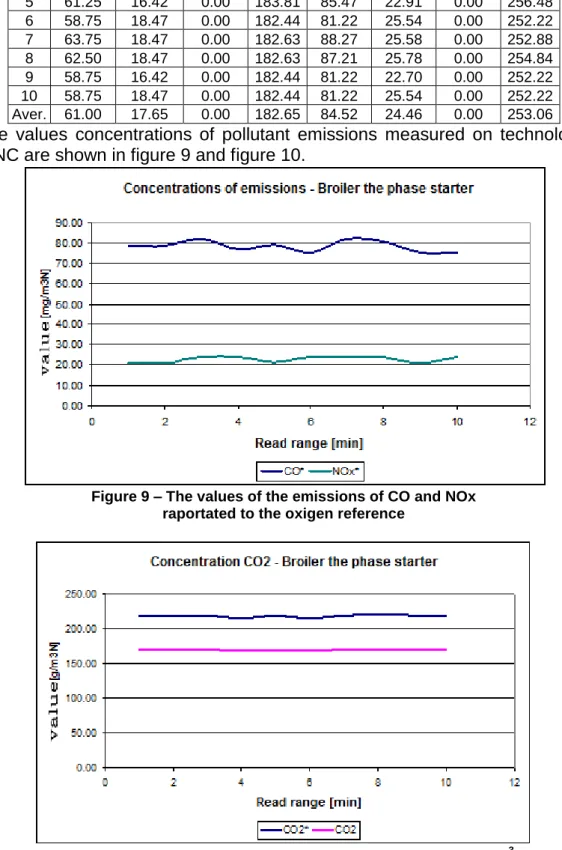
The values concentrations of pollutant emissions measured on technological flow
time of FNC are shown in figure 9 and figure 10.
Figure 9 – The values of the emissions of CO and NOx raportated to the oxigen reference
Figure 10 - The values of the emissions of CO2 exprimated in g/m 3
N
254 CONLUSIONS
Analising the values of the emissions obtained from the assortment of the Broiler
ckichen - from the phase starter in picture 9 and 10, it may be established that is doesn’t
exceede the admisible quota, which is impose by the legislation today [7], which semnificates the fact that those are beeing apropiate to the limits impose by legislation today regarding the protection of the environment:
- the values of the emissions of CO are between 48,81-78,48 mg/m3N and do not exceede
the maximum value which is permited:100,00 mg/ m3N.
- the emission values of NOx are between 20,84 mg/ m3N and mg/ m3N ,no more than the
prag limit of 35 mg/ m3N.
- the emission values of CO2 are between 174,26g/ m3N and 182,51 g/ m3N ,and do not
exceede the prag limit of 200g/ m3N.
A major advantage of the analised work instalation, which is associated to the burning of the fosil fuel to the steam generator , is the lack of the SO.
So, from the analyses and the measurements which were made we can put in the light, from the point of view of automatization, the fact that the instalation have presented normal function parameters and the utilisation in FNC is very indicated.
BIBLIOGRAPHY
1. Ionel I., ș.a. – Măsurarea emisiilor din gazele de ardere cu ajutorul senzorilor
electrolitici, Conferința națională de termotehnică, Vol.I, p. 231-235, iunie 1994, Timișoara.
2. Ionel I., ș.a. – Măsurarea calității aerului și dispersia noxelor, Editura Politehnica,
Timișoara, 2004.
3. Franke M., REY A.- Buhler AG Uzwil, Switzerland, „Improving pellet quality and
efficiency”, Feed Tech, 2006
4. Popa C. Ion- Exploatarea maşinilor şi instalaţiilor zootehnice, Editura BRUMAR,
Timişoara, 1996;
5. Vasile Cristian – Modern Tools and Complex Systems for Preparation in Industrial Farming, Durable Agriculture - Agriculture of the Future, Craiova, 28-29 November 2008.
6. Vasile Cristian – The Utilization of Automatic and Computerized Systems in the
Process of Grinding Cereals for Mixed Fodders, Durable Agriculture - Agriculture of the Future, Craiova, November 2009.
7. *** ORDIN nr. 197 din 23 august 2006 - pentru aplicarea Normei sanitare veterinare ce stabileşte condiţiile care reglementează prepararea, punerea pe piaţă, utilizarea furajelor în CE.
![Figure 1 – A simplified diagram for the twin-electrode sensor (for O 2 ) [1]](https://thumb-us.123doks.com/thumbv2/123dok_us/8074241.2139060/2.892.246.707.756.1009/figure-simplified-diagram-twin-electrode-sensor-o.webp)
![Figure 5 - The sampling probe for gas [8]](https://thumb-us.123doks.com/thumbv2/123dok_us/8074241.2139060/4.892.172.720.196.438/figure-the-sampling-probe-for-gas.webp)
![Figure 6 – Zero calibration for Testo 350 M/XL [8]](https://thumb-us.123doks.com/thumbv2/123dok_us/8074241.2139060/5.892.247.644.96.348/figure-zero-calibration-for-testo-m-xl.webp)