Journal of Global Pharma Technology
Available Online at:
www.jgpt.co.in
RESEARCH ARTICLE
Post Reconstitution Stability of Co-Amoxiclav Injection for
Multiple Usages in Developing Countries
Jamilu Maiwada
1,Mazlina M Said
1*
Drug and Herbal Research Center, Faculty of Pharmacy, University Kebangsaan Malaysia, jalan Raja Muda Abdul Aziz, 50300 Kuala Lumpur, Malaysia.
*Corresponding Author: Mazlina M Said
Abstract
Objective: Co-amoxiclav injections are stored after reconstitution by healthcare givers for multiple usage contrary to manufacturer’s instructions in pediatric patients to reduce the cost of treatment in developing countries. The purpose of this study is to determine the percentage content of amoxicillin and clavulanic acid in co-amoxiclav injections at the point of administering of second dose after reconstitution. Methods: Samples were reconstituted according to manufacturers’ instructions and stored in a refrigerator (2-5°C) and at tropical temperature (30°C and 75% RH). The samples were assayed immediately and then 8 hours after reconstitution. The assay was carried out using HPLC according to the USP monograph for amoxicillin-clavulanic acid suspension and the percentage content during the administration of the second dose was calculated in reference to a freshly prepared samples. Results: The percentage content of amoxicillin and clavulanic acid in refrigerated samples was <70% and <35% of the freshly prepared samples respectively, While at simulated tropical room temperature, it was <45% and <15% of the freshly prepared samples respectively. Conclusion: The study showed that storage of reconstituted co-amoxiclav injection will lead to administering of lower dose at the point of admistration of the second dose; this will lead to treatment and antibiotic resistance.
Keywords: Amoxicillin; Clavulanic acid; Refrigerated; Room Temperature; Multiple Usage
Developing countries.
Introduction
The combination of amoxicillin and clavulanic acid (Co-Amoxiclav) is widely used as an antibiotic of choice for wide range of infections [1, 2]. Amoxicillin is penicillin, and clavulanic acid is a β-lactamase inhibitor. These drugs together with cephalosporins form the broad class of antibiotics known as the β-lactam antibiotics.
The main problem with the use of penicillins and the rest of β-lactam antibiotics in general is the instability of the β- lactam ring in aqueous solutions. Due to this instability, the injections of β-lactam antibiotics are formulated as powders to be reconstituted immediately prior to use. The British Pharmacopoeia (2015) stated that all penicillins injections should be used immediately after reconstitution [3].
The manufacturers of co-amoxiclav in particular stated the reconstituted solution should be used within 20 minutes of reconstitution [4]. However, in pediatric patients, only a small part of the reconstituted solution is used in single dose based on patients’ relatively low body weight. The remaining of these products should be normally discarded due to dosage form instability.
the manufacturers and the monograph of the drug.
Two studies demonstrated both amoxicillin and clavulanic acid were stable for up to 24 hours at a very dilute solution (200µg/ml) [6,7]. Another study showed the combination amoxicillin/clavulanic acid was only stable for maximum of 2 hours at 10/2 mg/ml concentration in normal saline at room temperature [8].Given the fact that the degradation of penicillins follow first order kinetic [9], the stability of a dilute penicillin infusion will be different to that of a concentrated solution in an injection vial.
Recent studies showed that Amoxicillin in co-amoxiclav degrades to less than 90% within one hour when stored at both 4-8°C and at 30°C with clavulanic acid showing more degradation [10]. However, none of these studies reported the extent of degradation and the actual concentration of the drug given to the patient during the administration of the second dose after reconstitution as practiced in developing countries.
In this study, the extent of degradation and concentration of reconstituted co-amoxiclav injection was determined to ascertain the amount of the drug given to the patient at the time of administration of a second dose from a single vial as practiced in developing countries.
Materials and Methods
Materials and Instrument
All reagents such as sodium dihydrogen phosphate, orthophosphoric acid, and sodium hydroxide used were analytical grades while methanol was of high performance liquid chromatography (HPLC) grade. Deionized water was used for the preparation of buffer and water for injections was used for the reconstitution of injections. United States Pharmacopoeia (USP) reference standards amoxicillin trihydrate (86.6% amoxicillin) and clavulanate lithium (99.6% clavulanate) were used to standardize the amoxicillin and clavulanic acid in the injections.
Nylon filter (0.45µm) was used for the filtration of samples and mobile phases. The mobile phase was degassed using a sonicator (Branson 5510, USA). pH meter (Metler-toledo, Canada) was used for the determination of Ph of the buffer used.
Humidity chamber (Terchy, Taiwan) equipped with a chart recorder (Yokogawa, Taiwan) were used for the storage of samples at 30°C during the study.
A HPLC system (Shimadzu, Kyoto, Japan) equipped with XBridge® C18 column (4.6 mm x 25 cm, 5μm, Waters, Ireland), a pump (LC-20AT, Prominence), Auto sampler (SIL- 20A Prominence) and a Diode array detector operating at 220 nm (SPD-M20A, Prominence) was used for the assay.
Sampling and Storage Conditions of Samples after Reconstitution
Three brands (1 innovator product and 2 generic products) of co-amoxiclav injections 600mg (500 mg of amoxicillin and 100 mg of clavulanic acid) were purchased from community and hospital pharmacies in Nigeria. A total of 9 vials were randomly selected as samples (3 vials from each brand) and were stored in a refrigerator after reconstitution. The temperature was monitored hourly and maintained between 2-5°C.
Another 3 vials from the innovator brand of the samples were stored at simulated tropical temperature (30°C and 75% RH) in a humidity chamber [11]. The temperature and the humidity were monitored and recorded hourly. The samples in both conditions were stored for 8 hours after reconstitution in both storage conditions. All samples were registered with the National Agency for Food and Drug Administration and Control (NAFDAC) and were within their shelf life.
Preparation of Calibration Solutions
A calibration solution series of 200, 300, 400, 500 and 600 µg/mL of amoxicillin and 40, 60, 80, 100 and 120 µg/mL of clavulanic acid was prepared and used to make the calibration curve. This calibration curve was used for the assay of the injection samples.
Preparation of Sample Solutions
The percentage content of the samples stored for 8 hours was calculated in reference with the freshly prepared sample.
High Performance Liquid
Chromatography Condition
Chromatographic analysis of samples was conducted based on the USP assay for amoxicillin-clavulanic acid suspension [12]. The mobile phase consisted of sodium phosphate buffer (pH 4.4 ± 0.1) and methanol (95:5).
The buffer was prepared by dissolving 7.8 g of monobasic sodium phosphate in 900 ml of water; the pH was adjusted with othophosphoric acid to a pH of 4.4 ± 0.1, and further diluted to 1000 mL [12]. The mobile phase was then filtered using a micro filter and degassed using a sonicator for 15 minutes. Pre-optimization work indicated that flow rate of 1.5 mL/minute provided the best peak and therefore was used for the assay. The injection volume of 20 µL was used for both sample and standard solutions and detection was done using diode array detector at 220 nm wavelength.
Method Re-validation
A USP method was used for the assay with slight modification on the flow rate and column size, due to these modifications, the system need to be revalidated. The system
was re-validated for linearity, specificity, precision and system suitability according the ICH guidelines for validation of analytical procedure [13].
Linearity and Range
Linearity was established at 5 levels within the range of 40% to 120% of the sample concentration. A calibration curve was constructed and from the calibration curve, the correlation co-efficient (r2), the regression
equation and the residual sum of squares were calculated.
Precision
A Six replicate of the sample was prepared at a concentration equivalent to 500 µg/mL of amoxicillin and the relative standard deviation (RSD) was calculated. A system is said to be precise with a percentage RSD of less than 2.
Specificity
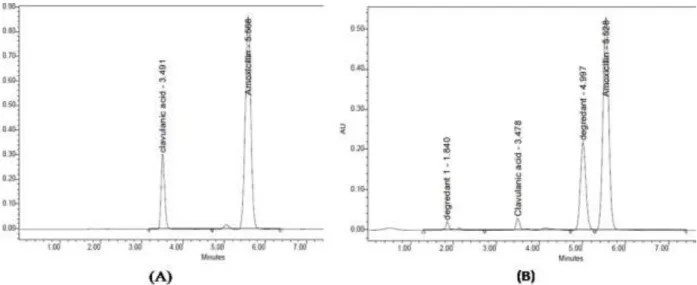
A volume of 10 mL of a 1:0.1 mg/mL of amoxicillin: clavulanic solution was prepared and 1 mL of 0.1N Sodium hydroxide solution was added and stored at 40°C for 1 hour. The solution was neutralized and injected into the HPLC. The peaks of the drugs and the degradation product were noted.
Limit of Detection and Quantitation
Detection limit was calculated by
Where σ = the standard deviation of the response of 3 replicate samples
S = the slope of the calibration curve
Quantitation limit can be calculated by
Where σ = the standard deviation of the response of 3 replicate samples
S = the slope of the calibration curve
System Suitability
The theoretical plates and tailing factor of the chromatographic peaks were calculated according to USP. The resolution between the amoxicillin and clavulanic acid peaks should not be less than 3.5; The column efficiency
Results
Amoxicillin and clavulanic acid showed distinct peaks on the chromatogram at RT of 3.375 and 5.282 respectively (Figure 1).Fig. 1: HPLC analysis of the standards showing the two peaks of amoxicillin and clavulanic acid
The calibration curves (Figure 2) with the
regression equations was used to calculate the concentration of the respective samples at different times of analysis.
Fig. 2: Calibration curves of (A) Amoxicillin and (B) Clavulanic acid
After the 8 hour storage period, the injection solutions turn brownish in colour. The initial concentration of all samples ranges from 653 - 515 µg/mL for amoxicillin and 136 to 100 µg/mL for clavulanic acid. After 8 hours of storage, the concentration of amoxicillin dropped to 382 -301 µg/mL while clavulanic
acid dropped to 36 – 26 µg/mL for samples stored at refrigerated temperature. For the samples stored at simulated tropical room temperature (30°C, RH 75%), the concentration of amoxicillin dropped to 233 µg/mL while clavulanic acid dropped to 10 µg/mL (Table 1).
Table 1: The concentration and percentage of content of amoxicillin and clavulanic acid injection after 8 hours of reconstitution
Concentration (µg/mL) ± SEM Percentage content (%) ± SEM Brand 0 hours After 8 hours
(2-8°C)
After 8 hours (30°C)
After 8 hours (2-8°C)
After 8 hours (30°C) Brand
A
Amoxicillin 592.21 ±4.81 382.31 ± 43.63 233.601±16.93 64.56 ± 7.37 39.44 ± 2.86
Clavulanic
acid 117.97 ± 1.33 36.32 ± 4.90 10.48 ± 0.71 30.79 ± 4.16 8.88 ± 0.60 Brand
B
Amoxicillin 515.19
±20.62 345.24 ± 3.66 N/A 67.01 ± 0.71 N/A
acid
Brand C
Amoxicillin 653.50
±23.78 301.55± 61.06 N/A 46.14 ± 9.34 N/A
Clavulanic
acid 136.8336 ±5.01 29.30 ± 4.59 N/A 21.42 ± 3.36 N/A
Discussions
The choice of the storage conditions for the samples was based on the common practice where the samples were refrigerated for second dose administration in hospitals and community pharmacies. Due to case of electricity outage which is common in developing countries [14, 15], some samples were subjected to tropical room temperature to ascertain the stability of the reconstituted injection in room temperature.
Fewer samples were stored at room temperature compared to the ones stored in the refrigerator because storage in refrigerator is the most common practice. Furthermore, the storage at room temperature is to observe the extent of degradation, because a drug that is unstable in the refrigerator is definitely unstable at room temperature.
The recommended condition for real time stability studies for tropical Africa is a temperature of 30°C with a relative humidity of 75% [11], this storage condition was used to ascertain the extent of degradation of the samples in room temperature. The 8 hour period used for the second analysis is the time for the administration of second dose of the injection during the treatment period [5]. Both amoxicillin and clavulanic acid were considered to be stable if they retained 90% or more of their baseline (initial) drug concentration [16].
The results from this study are in agreement with the findings by Nur et al (2015) which showed the drug was not stable after one hour of reconstitution [10]. Similar findings were seen from the findings of Carlier et al. (2016) which showed the combination of amoxicillin/clavulanic acid was stable for only 2 hours at room temperature (22°C) at a concentration of 10 mg/mL [8].
Furthermore, the results showed that the stability for 24 hours of Co-amoxiclav solution shown in studies by Tippa & Singh (2010) and Rajesh et al. (2013) was due to the fact that a dilute solution of 200 µg/mL equivalent of amoxicillin was subjected to the stability studies rather than the initial reconstituted injection (50 mg/mL) [6, 7]. This further showed that the concentration of the drug affects the rate of degredation is dependent of concentration [9].
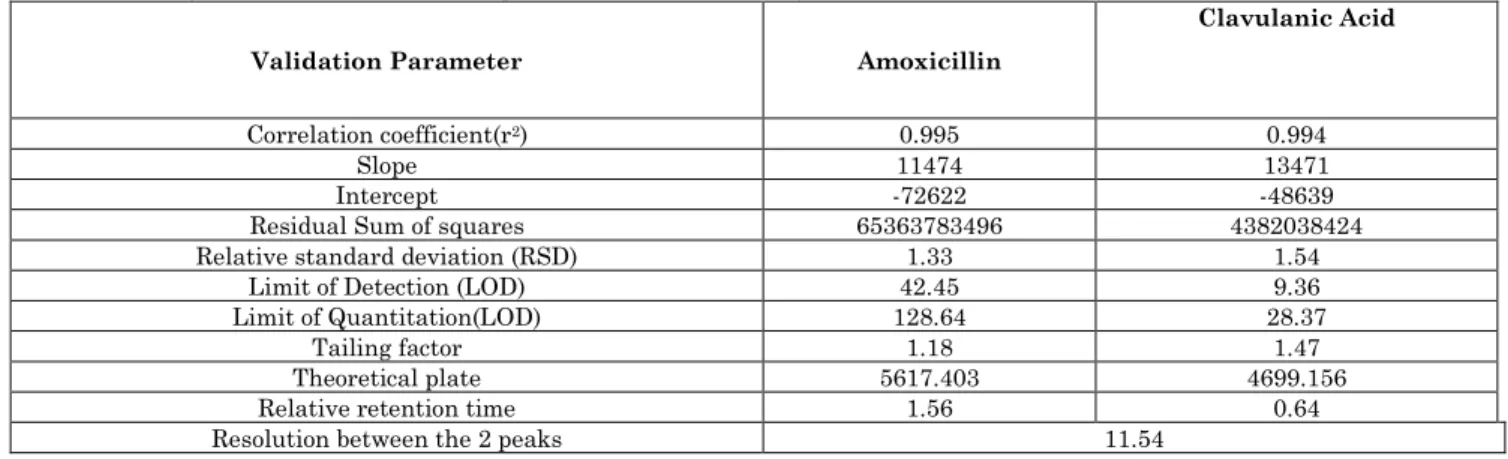
The results also showed that the rate of degredation of clavulanic acid is faster than that of amoxicillin[15].Due to the modification of the pharmacopiea analytical method with respect to flow rate and column size, the method was re-validated for linearity, precision, specificity, limit of detection and quantitation and system according the ICH guideline [13].From the results (Table 2 and figure 3), the assay method was found to be linear, precise, accurate and specific in accordance to ICH guidelines and also in accordance with USP system suitability paramaters for the assay of amoxicillin and clavulanic acid [12].
Table 2: Analytical method validation parameters for the analysis of Co-Amoxiclav injections
Validation Parameter Amoxicillin
Clavulanic Acid
Correlation coefficient(r2) 0.995 0.994
Slope 11474 13471
Intercept -72622 -48639
Residual Sum of squares 65363783496 4382038424
Relative standard deviation (RSD) 1.33 1.54
Limit of Detection (LOD) 42.45 9.36
Limit of Quantitation(LOD) 128.64 28.37
Tailing factor 1.18 1.47
Theoretical plate 5617.403 4699.156
Relative retention time 1.56 0.64
Fig. 3: Chromatograms of specificity test (A) Before alkaline (B) after alkaline hydrolysis
Conclusion
At the end of the study, it was found that less than 70% of the initial content of amoxicillin and less than 35% of clavulanic acid will be administered to the patient when administering a second dose from a vial stored in the refrigerator after reconstitution. While if the drug is stored in room temperature due to lack of electricity, less than 45% of the initial content of amoxicillin and less than 15% of clavulanic acid will be administered.
This study further showed that increase in the storage temperature increases the rate of degradation of co-amoxiclav as seen in samples stored at room temperature compared to samples stored in the refrigerator. It also showed that clavulanic acid was less stable than amoxicillin and more sensitive to higher storage temperature
increase. Therefore it is necessary for co-amoxiclav injection to be used immediately after reconstitution and should not be stored for further use. The practice in hospitals, clinics, and community pharmacies in developing countries where co-amoxiclav and other penicillins injections are stored for further use after reconstitution should be stopped.
This improper practice will lead to administration of a lower dose, which will eventually lead to treatment failure and antibiotic resistance. Further studies should be conducted to demonstrate the clinical consequence of the multiple usages of reconstituted co-amoxiclav and other penicillins general.
References
1. Klein JO (2003) Amoxicillin/clavulanate for infections in infants and children: past, present and future. Pediatr. Infect Dis. J., 22: 139-148.
2. Martínez MA, Inglada L, Ochoa C, Villagrasa JR (2007) Assessment of antibiotic prescription in acute urinary tract infections in adults. J. Infect, 54: 235-244. 3. British Pharmacopiea Commission (2015)
British Pharmacopoeia.
4. Glaxo Smith Kline (2018) Augmentine
Intravenous Available at:
https://www.medicines.org.uk/emc/product/1
153/smpc#companyDetails. Accessed 8th October, 2018.
5. British Medical Association (2012) British National Formulary.
6. Rajesh K, Yadav A, Patel A (2013) Development and Validation of Stability Indicating HPLC Method for Estimation of Co-Amoxyclav Injection. Pharmagene, 1: 60-64.
amoxicillin and clavulanic acid in injection. Am J. Analyt. Chem., 1: 95-101.
8. Carlier M, Verstraete AG, De Waele JJ, Stove V (2016) Stability of amoxicillin and amoxicillin/clavulanic acid reconstituted in isotonic saline. J. Chemother, 1-3.
9. Newton D (1978) Physicochemical determinants of incompatibility and instability in injectable drug solutions and admixtures. Am J. Health Syst. Pharm., 35: 1213-1222.
10.Nur A, Hassan A, Gadkariem EA, Osman Z, Ali G (2015) Stability of Co-Amoxiclav Reconstituted Injectable Solution. Eur. J. Pharm. Med. Res, 2: 109-123.
11.International Conference on Harmonisation of Technical Requirements for Registration of Pharmaceuticals for Human Use (ICH) (2003) Stability testing of new drug substances and products Q1A (R2).
12.United States Pharmacopoiea Convention (2014) The United States Pharmacopeia.
Amoxicillin and Clavulanate Potassium Oral Suspension.
13.International Conference on Harmonisation of Technical Requirements for Registration of Pharmaceuticals for Human Use (ICH) (2005) Validation of analytical procedures: text and methodology Q2 (R1).
14.Jassim A-M (2010) In-home drug storage and self-medication with antimicrobial drugs in Basrah, Iraq. Oman Med. J., 25:79-87. 15.Peace N, Olubukola O, Moshood A (2012)
Stability of reconstituted amoxicillin clavulanate potassium under simulated in-home storage conditions. J. Appl. Pharm. Sci., 2: 28-31.