1
Forward Private Searchable Symmetric
Encryption with Optimized I/O Efficiency
Xiangfu Song, Changyu Dong, Dandan Yuan, Qiuliang Xu and Minghao Zhao
Abstract—Recently, several practical attacks raised serious concerns over the security of searchable encryption. The attacks have brought emphasis on forward privacy, which is the key concept behind solutions to the adaptive leakage-exploiting attacks, and will very likely to become a must-have property of all new searchable encryption schemes. For a long time, forward privacy implies inefficiency and thus most existing searchable encryption schemes do not support it. Very recently, Bost (CCS 2016) showed that forward privacy can be obtained without inducing a large communication overhead. However, Bost’s scheme is constructed with a relatively inefficient public key cryptographic primitive, and has poor I/O performance. Both of the deficiencies significantly hinder the practical efficiency of the scheme, and prevent it from scaling to large data settings. To address the problems, we first present FAST, which achieves forward privacy and the same communication efficiency as Bost’s scheme, but uses only symmetric cryptographic primitives. We then present FASTIO, which retains all good properties of FAST, and further improves I/O efficiency. We implemented the two schemes and compared their performance with Bost’s scheme. The experiment results show that both our schemes are highly efficient.
Index Terms—searchable encryption, symmetric primitives, forward privacy, I/O efficiency.
F
1
INTRODUCTION
S
EARCHABLE encryption is perhaps one of the most inten-sively studied cryptographic primitives. The need for search-able encryption comes from the surge of Storage-as-a-service, a service model in which the clients store their data on remote servers that are managed by external service providers (e.g. Amazon S3, Microsoft Azure Storage, Google Cloud Storage etc.). When data storage is outsourced, data privacy becomes a primary concern because the service providers may not always be trusted. While conventional encryption can be used to protect the outsourced data, it does not allow effective retrieval of data by searching on encrypted data. Searchable encryption was proposed to solve this problem. In general, searchable encryption schemes work by generating an encrypted index, which will be outsourced to the service provider along with the encrypted data. Later the client can generate search tokens that encrypt certain keywords and the server can perform a search algorithm using the tokens and the encrypted index to find matches. In this way, even though data is stored on and searching is handled by an untrusted server, the privacy of the data can still be preserved.• X. Song, D. Yuan and Q. Xu are with the School of Computer Science and Technoloy, Shandong University, 250101 Jinan, China.
E-mail: [email protected], [email protected], [email protected]
• C. Dong is with the School of Computing, Newcastle University, NE4 5TG Newcastle Upon Tyne, U.K.
E-mail: [email protected]
• M. Zhao is with the School of Software, Tsinghua University, 100084 Beijing, China.
E-mail: [email protected]
• Accepted to be published in IEEE Transactions on Dependable and Secure Computing.
• DOI: 10.1109/TDSC.2018.2822294c 2018 IEEE. Personal use of this material is permitted. Permission from IEEE must be obtained for all other uses, in any current or future media, including reprinting/republishing this material for advertising or promotional purposes, creating new collective works, for resale or redistribution to servers or lists, or reuse of any copyrighted component of this work in other works.
Oblivious Data structure (DOD) [6], which hides search patterns and access patterns from the server. In this approach, the server cannot observe which files match the token, therefore cannot learn anything about the query. Nevertheless, the communication cost is still too high unless replying on strong assumptions like multiple non-colluding servers. One notable work by Chang and Mitzenmacher [7] achieves forward privacy without using an oblivious data storage. However, in this scheme the search query size grows linearly in the number of updates, which means after the system has run for a period of time, the communication cost for the search operation will become unacceptably high due to the ever-growing query size.
In CCS 2016, Bost [8] proposed an efficient forward secure searchable encryption scheme called Sophos that achieves a low communication cost. In this scheme, the client keeps a state for each keyword and evolves the state when updating a file on the server that contains this keyword. The state is used as an input when generating the encrypted index for the updated file, which means the previous tokens are outdated and cannot be used to match the new index. The state is kept secret from the server until the client performs a search, at which point a constant size token is generated that contains the current state. The token enables the server to recover all previous states from the current state. By knowing all states, the server can search through all updates and find matching files. Sophos uses trapdoor permutation, a public key primitive, for evolving the state so that the server, who does not know the private key, cannot predict future states. Thus when new updates come in, the server learns nothing and forward privacy is achieved.
Although Sophos is more efficient than previous forward private schemes, there are still two significant deficiencies in the design. Firstly, the scheme is based on public key cryptography. It has been showed clearly in Bost’s paper [8] that if the data is updated frequently, the public key operations become a major performance bottleneck. It would be ideal if only symmetric cryptographic primitives are used. Secondly, the search operation is not I/O efficient. Recently it has been shown that I/O has become a major bottleneck that prevents searchable encryption from scaling up to large data [9], [10]. In Sophos, the locality, a measure of I/O efficiency, of the search operation increases linearly in the number of updates. The performance of the search operation is inversely proportional to the locality, which means search performance will degrade inevitably and eventually become unacceptably slow after a long run. The author acknowledged this problem but also argued that the poor locality is a necessary price paid for forward privacy.
1.1 Our Contributions
Our investigation started from two questions: 1) can we construct a communication-efficient forward private searchable encryption scheme using only symmetric key primitives? 2) to what extent can we optimize the I/O efficiency under the security constraint imposed by forward privacy? We present positive answers to these two questions by constructing two new searchable encryption schemes FAST and FASTIO.
• FAST (Forward privAte searchable Symmetric encrypTion) is our first attempt to construct a forward private searchable encryption scheme using only symmetric key primitives. The design of FAST follows the state-based approach used by Sophos [8], but with a very different idea. In Sophos, the
states are related by a trapdoor permutation. Since the trapdoor permutation is a public key primitive, by giving the server only the public key, the server can generate states backwards, but not forwards. This strategy however is not valid when using symmetric key primitives. The idea in FAST is inspired by singly linked list, a classic data structure. Each update is like a node in a singly linked list and contains a randomly generated ephemeral key (encrypted). The key is like the pointer in a list node that points backwards to the previous node. In FAST, a new state is generated by encrypting the previous state using the ephemeral key. Given the current key and the current state, the server can compute the previous state by decryption. The decrypted state will help the server to get the previous update and then the previous key. Iteratively, the server can find all previous states as well as all previous updates. However, since a future key is randomly generated on-the-fly by the client and is independent of the current and past keys, by no means can the server predict the future keys/states given the keys/states it has already known. Thus forward privacy is achieved.
• FASTIO, where IO in the name stands for I/O Optimized. While FAST is entirely based on symmetric key cryptography which makes it computationally more efficient, it has bad I/O efficiency. The I/O overhead comes from 1) the ephemeral keys that are required to be stored on the server, and 2) the fact that the server is forced to read the index in a very non-local manner in order to achieve forward privacy. Our idea is simple: after each search query, we can let the server store the result. Since the search result has already been revealed to the server, saving it will not leak additional information to the server. The server now needs only the latest state and does not need to store ephemeral keys anymore. In addition, the non-local reads are also minimized because the previous search result can be read continuously.
We implemented the two schemes and conducted experi-ments to measure their performance. The results confirm that our schemes are more efficient in terms of computation than Sophos, which is the most efficient forward private searchable encryption scheme to date. The results also confirm that FASTIO has a much better I/O efficiency, which makes its much more scalable.
2
RELATED
WORK
Searchable encryption The functionality of secure search can be realized by using generic cryptographic primitives such as Fully Homomorphic Encryption (FHE) [11], Oblivious RAM (ORAM)[12], [13] and Secure Multi-Party Computation(SMPC) [14], [15]. With the generic primitives, it is possible to per-form secure search with minimum inper-formation leakage. However, searchable encryption based on generic primitives is inefficient and is not suitable to be used in practice. Research in practical searchable encryption started from the seminal paper by Song et al. [16], and the goal is to achieve practical efficiency and scalability with the price of accepting a small leakage.
are not suitable in many application scenarios where updates are required.
Dynamic searchable encryption enables the client to add and delete data items after the dataset is outsourced to the cloud. Actu-ally, the work of Song et al. [16] supports dynamically update, but search and update operations require sequential scan performed on the full-text. Kamara et al. [19] proposed a dynamic searchable symmetric encryption (DSSE) scheme as an improvement of [17]. Their scheme achieves sub-linear search time but has a high complexity for the add and delete operations. The scheme also leaks much more information to the server than [17]. Dong et al. [20] proposed a dynamic searchable encryption scheme that supports multiple users. However the scheme is based on public key cryptography. Kamara and Papamanthou [21] proposed a parallel DSSE scheme, which leaks less information but requires multiple interactions between the server and client. Sun et al. [22] proposed a multi-client version of DSSE scheme that supports boolean query. Hahn and Kerschbaum [23] proposed a scheme that only leaks the search pattern and also achieves linear searching complexity. Naveed et al. [24] proposed a new primitive called blind-storage, and based on it, they constructed a DSSE scheme. Instead of processing and computing on the data stored on it, in this scheme, the server just acts as a transmission and storage entity. It achieves less information leakage but requires multiple rounds of interaction between the client and server. Gajek [25] proposed a DSSE scheme based on constrained functional en-cryption (CFE), which encodes the index as an encrypted binary tree and constructed an inner product functionality to traverse the encrypted tree. Another DSSE scheme with multi-keyword ranked search was given by Xia et al. [26].
Forward PrivacyRoughly, forward privacy requires that a newly inserted file cannot be matched with previous search queries. This notion is not applicable to static searchable encryption schemes because they do not support update. Most dynamic searchable encryption schemes do not support forward privacy. To date, most existing forward secure dynamic searchable encryption schemes are constructed based on ORAM-like structure. Among them, the concept of forward privacy was firstly precisely stated by Stefanov et al. [4]. They proposed a forward private DSSE scheme based on hierarchical ORAM. Likewise, Garg et al. [5] proposed the first efficient round-optimal oblivious RAM(ORAM) scheme. As an application of their ORAM scheme, they constructed a DSSE scheme with sub-linear search efficiency that conceals the search pattern. The problem of this approach is the high communication cost that is resulted from using ORAM like structures. In the scheme of Hoang et al. [6], they use a distributed oblivious data structure that is a distributed encrypted incidence matrix created on two non-colluding servers. There are only a few forward private searchable encryption schemes that do not use ORAM. In the scheme proposed by Chang and Mitzenmacher [7], forward privacy was achieved by changing search token after each update. The tokens are unrelated. Thus to perform a search, the client needs to submit all previous tokens in the query. The most efficient forward private searchable encryption scheme was proposed by Bost [8], in which forward privacy is achieved by using a one-way trapdoor permutation to evolve a state stored at the client side. I/O Efficiency of Searchable EncryptionFocusing on the prac-tical performance of searchable encryption, Cash et al. [9] made a compromise in security and efficiency and proposed a scheme with good I/O efficiency based on T-Set (a data structure of keyword-entry tuple). Their method was extended by Cash et al.
[27]. The new scheme has a better performance in both searching and updating phase. Cash and Tessaro [10] investigated the I/O efficiency of searchable encryption and proved that it is impossible to achieve optimal server storage, read efficiency and locality at the same time due to the security requirement of searchable encryption. Following the work of Cash and Tessaro, a tight lower bound of storage locality was given by Asharov et al. [28]. A tunable SSE scheme was given by Demertzis et al. [29] in which the locality can be tuned. Recently, Demertzis et al. [30] proposed a linear-space searchable encryption scheme with constant locality and sublogarithmic read efficiency. All these schemes are mainly for the static setting and do not support dynamic update. Miers et al. [31] came up with a DSSE scheme by using oblivious update index (OUI) as an intermediate cache and pushing a bucket of document identifiers from OUI to append-only storage when that bucket is full. Their scheme has a higher I/O efficiency compared to using an ORAM scheme and achieves a better locality through the bucket mechanism, but leaks more information and does not support forward privacy.
Recent WorkWhile this manuscript was in submission, four new papers appeared [32], [33], [34], [35]. Some ideas in this paper were independently developed in those papers. Here we provide a brief review of the overlaps and differences between our work and the simultaneous work. All four papers construct a forward private searchable encryption scheme using only symmetric key primi-tives. As we have discussed in section 1.1, the difficulty of using only symmetric key primitives is how to prevent the server from generating future states. In [32], the strategy is the same as that in [7], thus has a big communication overhead because a search query needs to include one token for each new update since the last search. In [33], they observe that updates are naturally ordered in a sequence. By using a range-constrained PRF, a search token can be restricted to only applicable to updates within a specified range. Thus, future updates are secure as they are out of the range of past search tokens. However, there is an upper bound on the number of updates that can be performed, and this scheme has a higher computational and communication overhead compared to our schemes. In [34], [35], they both generate a new key for future updates after each search query (the current key is given to the server as part of the search token). A major disadvantage of this rekeying strategy is that the search operation is not read-only and the search result has to be re-encrypted and written back, which increases computational and I/O costs. Re-encryption is done by the server in [34], and by the client in [35] (which requires an additional round and more data to be transferred). While in FAST, our search is read-only because we use an ephemeral key for each update, which means rekeying and re-encryption are not needed. Communication and/or computational wise, our schemes are better than the schemes in the four papers. The idea of caching previous search results to improve efficiency, which we use in FASTIO, is also used/mentioned in [32], [33].
3
PRELIMINARIES
3.1 NotationsWe user←−$ X to denote that an elementris sampled uniformly at random from a set X, {0,1}l to denote the set of all l-bit
strings,{0,1}∗ to denote the set of arbitrary length strings, and
a||bto denote the concatenation of two stringsaandb. Letλbe a security parameter, we say a functionν :N→Ris negligible inλ
largeλ. We usepoly(λ)andnegl(λ)to represent the unspecified polynomial and negligible functions inλ, respectively. For a set
S, we use|S|to denoteS’s cardinality. For a stringa, we use|a|
to denotea’s bit length.
3.2 Searchable Encryption
A dynamic searchable symmetric encryption (DSSE) scheme enables a client to outsource its data to an untrusted server in an encrypted form. Later the server can execute search or update queries on the encrypted data. We only consider the dynamic setting in this paper because forward privacy is not applicable to the static setting.
Let a database DB = {(indi,Wi)}Di=1 be a D-vector of
identifier/keyword-set pairs, whereindi ∈ {0,1}lis a document
identifier and Wi ⊆ P({0,1}∗). The universe of keywords of
the databaseDBisW = ∪D
i=1Wi. We useN =PDi=1|Wi| to
denote the number of document/keyword pairs. We useDB(w) =
{indi|w ∈ Wi} to denote the set of documents that contain the
keyword w. A DSSE scheme Π = {Setup,Search,Update}
consists of three protocols ran by the client and the server: • ((K, σ);EDB)←Setup(λ,DB;⊥): It takes a security
param-eter λand a database DBas inputs and outputs(K, σ)to the client andEDBto the server, whereKis a secret key,σis the client’s state, andEDBis the encrypted database.
• ((σ0,DB(w));EDB0)←Search(K, σ, w;EDB): The client’s input consists of its secret key K, the stateσ and a keyword
w, the server’s input is the encrypted database EDB. The client’s output includes a possibly updated stateσ0andDB(w), i.e. the set of the identifiers of the documents that contain the keyword w. The server’s output is the possibly updated encrypted databaseEDB0.
• (σ0;EDB0) ← Update(K, σ, ind, w, op;EDB): The client’s input is the secret keyK, the stateσ, a document identifierind, a keyword w and an operation type op. The server’s input is EDB. The operationopis taken from the set{add,del}, which means the client wants to add or delete a document/keyword pair. The client updates its state and the server updatesEDBas requested by the client.
3.3 Security Definition
All existing searchable encryption schemes leak more or less some information to the server, as a tradeoff to gain efficiency. Thus, the security of searchable encryption is defined in the sense that no more information is leaked than allowed. This is captured by using the simulation paradigm and providing the simulator a set of predefined leakage functionsL={LSetup,LSearch,LUpdate}.
Definition 1 (Adaptively Secure Searchable Encryption). Let Π = (Setup, Search, Update) be a searchable encryption scheme, A be an adversary,S be a simulator parameterized with leakage function L= {LSetup,LSearch,LUpdate}. We
define the following two probabilistic experiments:
• RealΠA(λ): Achooses a database DB, the experiment runs Setup(λ,DB;⊥) and returns EDB to A. Then, the ad-versary adaptively chooses queries qi. If qi is a search
query then the experiment answers the query by running ((σi+1,DBi(wi)),EDBi+1))←Search(K, σi, qi;EDBi).
If qi is an update query, then the experiment
an-swers the query by running (σi+1,EDBi+1) ←
Update(K, σi, qi;EDBi). Finally, the adversary Aoutputs
a bitb∈ {0,1}.
• IdealΠA,S(λ):Achooses a databaseDB. Given the leakage functionLSetup(DB), the simulatorSgenerates an encrypted
database EDB ← S(LSetup(DB)) and returns it to A.
Then, the adversary adaptively chooses queriesqi. If qi is
a search query, the simulator answers the query by running
S(LSearch(qi)). If qi is an update query, the simulator
answers the query by runningS(LUpdate(qi)). Finally, the
adversaryAoutputs a bitb∈ {0,1}.
We say Π is an L-adaptively-secure searchable encryption scheme if for any probabilistic, polynomial-time (PPT) ad-versaryA, there exists a PPT simulatorSsuch that:
|Pr(RealΠA(λ) = 1)−Pr(IdealΠA,S(λ) = 1)| ≤negl(λ)
3.4 Leakage Functions and Forward Privacy
A good searchable encryption scheme should reveal as little information as possible. The leakage is captured by the leakage functions. Usually we requireLSetup = (D, N), i.e. the Setup
protocol only leaks the size of DB and the number of docu-ment/keyword pairs. For the Search protocol, we usually require
LSearch = (ap,qp), where ap is the access pattern and qp
is the query pattern. More formally, LSearch keeps a history
Hist = {(DBi, qi)} Q
i=0, which contains all queries qi so far
and the snapshot of the databaseDBi corresponding to qi. The
access pattern is defined asap(Hist) = (t1, . . . , tQ)whereti= (i,DBi(wi))ifqi =wi is a search query, orti = (i, opi, indi)
ifqi = (indi, wi, opi)is an update query. The query pattern is
defined asqp(w) ={j|qjcontainswfor eachqjinHist}.
Note that in Section 3.2, 3.3 and this section, we only consider the encrypted index, but not the encrypted files. The operations for manipulating the actual stored files are not included in the protocols and information leaked through file operations are not modeled explicitly. This simplified treatment of SSE is one of the influential formalizations and is often seen in the literature, e.g. see [27], [9], [8], [33]. The rationale behind this simplification is that the actual files are always encrypted using a semantically secure encryption scheme thus the ciphertext of a file leak no information about its content except size. If operations on files are limited to only add and delete, then the information leaked from file operation is limited to the size of the file. The size information is assumed to be implicitly included in the identifier (ind) and can be computed from it if needed.
Forward privacy is a strong property regarding the leakage of the update operation in DSSE. Intuitively, it requires that given previous search tokens, an update query leaks no information about the keywords being searched in the past. If a searchable encryption scheme is not forward private, a search token can be used to retrieve documents added after the token being issued. Thus, after a token has been given to a curious server, the server can save it and test it on every new update to see whether the new update matches the old token. This is exactly what has been exploited in the file-injection attack: the server tricks the client into encrypting files containing certain chosen keywords, then test previously received tokens over the injected files to find for each token which files it matches. Then the server can deduce which keyword is encoded in this token. With forward privacy, this attack can be prevented because the previous tokens cannot be used on new updates. The formal definition is as the following:
(indi, wi, opi), the update leakage functionLUpdate(qi) = (i, opi, indi).
For the convenience of proof, in our definition the update query contains only one document/keyword pair. This definition is actually equivalent to the one in [8], where the update query contains multiple keywords. Our definition also supports adding or removing full document, which can be regarded as iteratively adding or removing the corresponding document/keyword pairs. The number of updated pairs to a document is also leaked and can be computed easily from our defined leakage.
3.5 Searchable Encryption and I/O Efficiency
Scalability is a key consideration when designing a searchable encryption scheme because the target application is data storage outsourcing, which usually implies that there is a large amount of data. Recent searchable encryption schemes are often very efficient in terms of computation so one consequence is that I/O efficiency becomes the bottleneck for scaling [9], [10], [31], [29]. The I/O efficiency of searchable encryption is characterized by three factors: server side index size, the locality and the read efficiency. The first is self-explanatory. The locality is the number of non-contiguous reads the server must perform when answering a search query. High locality means more random access I/O requests and a longer latency due to the inter-requests latency. The read efficiency is quantified by the amount of unnecessary or irrelevant data read. More formally, we have:
Definition 3 (Locality).LetΠbe a searchable encryption scheme,
K be a secret key, σ be the client’s state and EDB be a database encrypted by Π under K with regard to σ. For every w ∈ W, we say the locality isr for the search query Search(K, σ, w;EDB)if the server can answer the query by reading at mostrintervals fromEDB.
Definition 4 (Read Efficiency).LetΠbe a searchable encryption scheme,Kbe a secret key,σbe the client’s state andEDBbe a database encrypted byΠunderKwith regard toσ. For every
w ∈ W, we say the read efficiency is cfor the search query Search(K, σ, w;EDB)if the server can answer the query by reading at mostc·(P
si∈DB(w)|si|)bits.
Cash et al. [10] noticed that the security property has a negative effect on I/O efficiency and pointed out that, for the sake of security, a searchable encryption scheme must either extend the encrypted index to an overwhelming large size, or perform searching in a non-local way (e.g. in a random manner), or read much more bits than actually needed. Afterwards Bost [8] additionally observed that locality and forward privacy are two irreconcilable notions. On the one hand, forward privacy requires that in an update operation for a keywordw, the locations in the EDBthat are modified should be unrelated to the locations that are already known to matchw. On the other hand, to reduce locality, it is necessary to organize entries inEDB relating towtogether so that they can be read continuously. Bost concluded, which is not entirely true as we will show later, that under the constraint of forward privacy, no locality optimization is possible for keyword
w unless large modification is done to the encrypted database, either during searches or updates.
4
FAST: FORWARD PRIVATE SEARCHABLE
SYM-METRIC ENCRYP
TION
In this section, we present FAST, our first forward private search-able encryption scheme. The main design goal of this scheme is to eliminate public key operations while retaining optimal communication complexity.
Recall that a forward private searchable encryption scheme can be based on ORAM. While ORAM can be purely symmetric key based [12], [13], [36], [37], it has a large communication overhead. Therefore, we turned to the state-based approach that was used in a few existing schemes [7], [8]. The main challenge of this approach is how to allow the server to re-generate all previous states (so that communication cost can be reduced), but not later states (so that forward privacy can be achieved). Sophos [8] solved this problem by using a public key primitive (trapdoor permutation), so that the client can evolve the state forward using a private key and the server can re-generate the whole history of the states using the public key. However, there exists a huge gap in adopting this strategy with symmetric key cryptography. Symmetric key means there is only one key and once it is released to the server, the server can compute future states and there is no forward privacy any more. This is why in [7], the client has to keep the key secret and generate the history of states locally rather than giving the key to the server and letting the server to generate the history. However since the query contains the full history of the state, this results in a huge expansion in the token size and a large communication overhead.
A naive symmetric key based solution with low communica-tion overhead is to use a hash chain for the states. More specif-ically, for each keyword, the client chooses the last statestL
$
←− {0,1}λ, then generates all other states st
i ← H(sti+1),0 ≤ i < L. When performing update queries, the client starts from
st0thenst1and so on so forth. When performing a search query, a state stc is revealed to the server. By the one-wayness of the
hash function, the server can recoverstc−1, . . . , st0but not states afterstc, thus forward privacy is guaranteed. However, there are
two intrinsic problems. The first problem is that the hash chain parameter Lmust be fixed at the beginning, which is inflexible because it limits the number of update operations the client can perform. The second problem is that, if the client stores the hash chains, then the storage overhead is too high; on the other hand, if the client only stores stL and computes the state stc
on-the-fly, then it will needL−chash invocations per search or update query, which is computationally too expensive. Therefore we need a better way to generate and evolve the states.
Setup(λ,⊥;⊥)
Client:
1: ks
$
←− {0,1}λ 2: ΣΣΣ←empty map
Server:
3: T←empty map
Update(ks,ΣΣΣ, ind, w, op;T)
Client:
4: tw←F(ks, h(w)) 5: (stc, c)←ΣΣΣ[w] 6: if(stc, c)=⊥then
7: st0
$
←− {0,1}λ,c←0 8: end if
9: kc+1 $
←− {0,1}λ 10: stc+1←P(kc+1, stc)
11: ΣΣΣ[w]←(stc+1, c+ 1)
12: e←(ind||op||kc+1)⊕H2(tw||stc+1) 13: u←H1(tw||stc+1)
14: send (u,e) to server
Server:
15: T[u] =e
Search(ks,ΣΣΣ, w;T)
Client:
16: tw←F(ks, h(w)) 17: (stc, c)←ΣΣΣ[w] 18: if(stc, c)=⊥then 19: return∅
20: end if
21: send (tw, stc, c) to Server
Server:
22: ID,∆← ∅
23: fori=cto1do
24: u←H1(tw||sti) 25: e←T[u]
26: (ind, op, ki)←e⊕H2(tw||sti) 27: ifop= “del”then
28: ∆←∆∪ {ind}
29: else ifop= “add”then
30: ifind∈∆then
31: ∆←∆−ind
32: else
33: ID←ID∪ {ind}
34: end if
35: end if
36: sti−1←P−1(ki, sti) 37: end for
38: sendIDto client
Fig. 1: Pseudocode of Protocols in FAST
stc+1 P(kc+1,stc)
stc
H1(tw||stc)
P-1(k c+1,stc+1)
st1
H1(tw||st1)
P(k1,st1)
st0 P-1(k
1,st1)
k1 kc+1
Update
...
Search
st2
H1(tw||st2)
P-1(k 2,st2)
P(k2,st2)
... k2
P-1
P
H2(tw||stc+1)
kc+1op ind
H1(tw||stc+1)
H2(tw||stc)
kc op ind
H2(tw||st2)
k2 op ind
H2(tw||st1)
k1 op ind
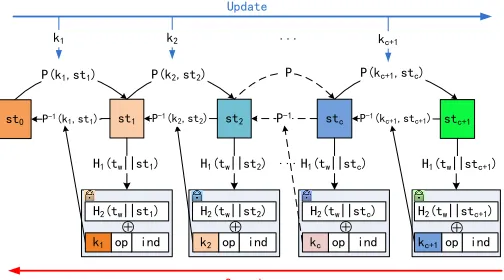
Fig. 2: Update and Search in FAST
Fig. 1 shows the protocols of the scheme. We also depict in Fig. 2 how the states evolve forward and backward in the update and search protocols. In theSetupprotocol, the client generates
ks andΣ, where ks is a λ-bit long-term key that will be used
to encrypt keywords and Σ is an empty map that will be used to store the states on the client side. The long-term key ks is
necessary to prevent the server from generating tokens by itself. The server generatesT, which is an empty map to be used to store the encrypted index. In theUpdateand theSearchprotocols,F
is a pseudorandom function, P is a pseudorandom permutation (andP−1 is the inverse permutation), and h, H
1, H2 are secure
hash functions with appropriate output lengths. When updating a file that contains a keyword wand whose identifier is ind, the client needs to retrieve the previous statestcfrom the local state
storeΣ(line 5-8), then generates a random ephemeral keykc+1
and evolves the state forward to the current statestc+1using the
pseudorandom permutation (line 9-11). The ephemeral keykc+1
is not stored on the client side, but is embedded in the encrypted index entry e that will be stored on the server side (line 12). The client also generates a reference u from the current state and the keyword (line 13). The pair(u, e) is sent to the server and the server updates its mapTaccordingly (line 15). To search
a keyword w, the client retrieves the current state from Σand sends a search token that contains the encrypted keyword and the current state to the server. Given the current state, the server needs to generate all previous statesstiand find the corresponding
update sequence. In the for loop of the algorithm, the server can recover the ephemeral keyki (line 26), which can later be used
to recover the previous state (line 36). Because both “add” and “del” are allowed update operations, the server needs to make sure not including deleted files in the result set. To do so, the server maintains a set∆that contains deleted file identifiers during the search process. When the server sees a delete update, the server puts the file identifierindinto ∆. When the server sees an add update and the file identifierindis in∆, the server removesind
from∆. The idea is that the server searches backwards with regard to the update sequence, thereforeind∈∆ means the added file later was deleted. So the two operations cancelled, thenindshould be removed from∆and should not be added to the result set. If the server sees an add update and the file identifier is not in∆then the file was not deleted and the identifier is added to the result set.
Complexity AnalysisOn the client side, the computational com-plexity for update and search isO(1). The client stores aλ-bit key and a mapΣΣΣwhose size isO(|W|), where|W|is the total number of keywords. On the server side, the computational complexity for update is O(1), and for search is O(cw) where cw is the
total number of updates (add + del) that contain the keyword being searched since the initialization of the system. The server stores a mapTwhose size isO(Nu), whereNu =Pw∈Wcw
is the total number of updated document/keyword pairs since setup. The communication complexity is O(1) for update. For search, the communication complexity isO(1)for the query and
O(|DB(w)|) for the result set, which contains |DB(w)| match-ing files. Complexity-wise, FAST is optimal (given the security constraints).
the security of FAST:
Theorem 1. Let F be a pseudorandom function, P be a pseudorandom permutation. Let H1 and H2 be two hash functions modeled as random oracles. Define leakage L = (LSetup,LSearch,LUpdate)as
LSetup=⊥
LSearch(w) = (ap(w),qp(w)) LUpdate(i,opi, w,indi) = (i,opi,indi)
Then FAST is a L-adaptively-secure dynamic SSE with for-ward privacy.
The proof can be found in Appendix A.
5
FASTIO: I/O OPTIMIZED SCHEME
In this section, we present FASTIO, our second forward private searchable encryption scheme. FASTIO retains all good properties of FAST, and has been optimized for I/O efficiency, which enables it to scale up to very large datasets.
5.1 I/O Deficiencies in FAST
Let us compare Sophos and FAST in term of I/O efficiency. The criteria are the server side index size, read efficiency and locality. In Sophos, the server side index size is N ·l bits where N is the number of document/keyword pairs in the index andl is the identifier’s size. This is optimal. To answer a search query with keyword w, Sophos needs to read cw ·l bits, where cw is the
number of updates that contain wsince the initialization of the system. The read efficiency is 1, which means no unnecessary data is read and the read efficiency is optimal. The locality of Sophos is
cw because thecw entries are located randomly in the encrypted
index. In FAST, the server side index size is N ·(l + 1 +λ) bits where λ is the size of the random ephemeral key and the additional 1 bit is used to indicate the operation (“add” or “del”). To answer a search query with keywordw, FAST needs to read
cw·(l+1+λ)bits, which means the read efficiency is(l+1+λ)/l.
The locality of searching a keyword in FAST iscw, which is the
same as Sophos.
As we can see, in FAST the server side index size and read efficiency are worse than those in Sophos. And the locality is as poor as Sophos. Take a closer look, we can find that the I/O deficiencies in FAST are related to its symmetric key construction. To use symmetric key primitives, FAST has to store the ephemeral key in the index. The key sizeλis often similar tol, which means a concrete overhead of 100% or so. However, if we do not store the key in the index, the server cannot re-generate previous states and cannot search. The question is: do we have to sacrifice I/O efficiency for computational efficient (i.e. using symmetric key primitives)?
5.2 The Construction
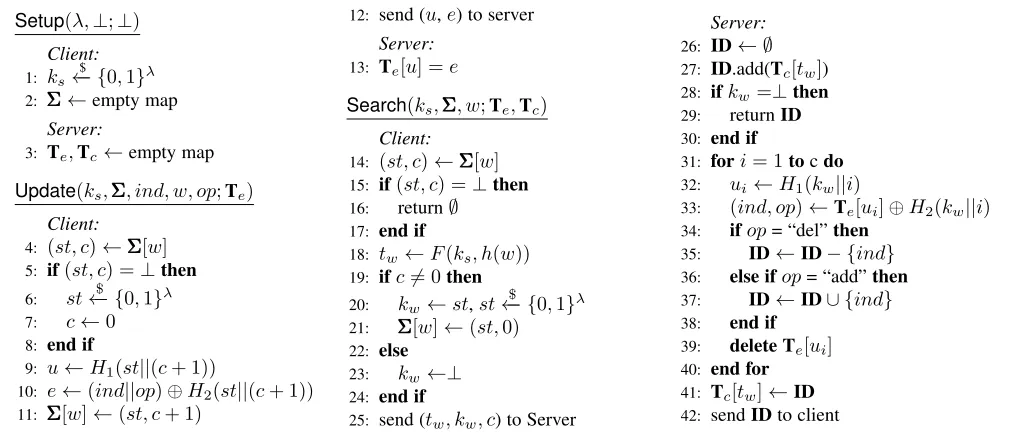
The idea of FATIO is to store the search query result, then when the server answers a new search query, it can use the saved result and only needs to search through new updates since the last search query. The protocols of FASTIO can be found in Fig. 3. In the Setupprotocol, the client generates a long-term key for blinding keywords, and an empty map ΣΣΣ for storing states. The server generates two empty maps,Teis to be used to store the encrypted
index and Tc is to store the last search query results. For each
keyword w, the client stores inΣΣΣtwo things: a statest that is generated randomly at the first timewis encountered or after each
search query ofw, and a countercto produce a sub-state for each update after a search query (until the next search query). Note that unlike in FAST that the statestmust evolve each time an update is made, in FASTIO st stays unchanged in between two search queries even though there might be many updates. Although two updates may be based on the samest, in theUpdate protocol, the client can still make them unlinkable by hashing a sub-state that is the concatenation ofstand a counter (line 9 - 12). In the Searchprotocol, if there are some documents on the server side that contain the keywordw, the client generatestw(line 18). The
purpose oftwis to enable the server to find the last search query
result ofwinTc. The client also retrieves the stored state as well
as the counter, and checks whether they should be sent to the server as part of the search token (line 19 - 25). In this process, if the countercis non-zero, which means there have been updates since the last search query, thenstwill be sent to the server and the client must generate a new random statestand reset the counter at this point so that future updates can be made unlinkable. If the counter c is zero, then there is no update since the last search query and the query result should be the same as the previous search. Therefore in this casetwalone is enough to retrieve the
result and the client keeps st secret. Search on the server side consists of two steps. The first step is to retrieve the last search query result usingtw(line 27). Then the server may proceed to the
second step (line 31 - 40). If there have been updates since the last search query, the server finds all updates usingkw(the state) and
the counter. Then the server finds the document identifier from each update and either removes it from or adds it to the result set depending on whether the update operation is del or add. The server also removes the update fromTesince its content has been
revealed and is no long secret to the server. After all updates have been processed, the server returns the result set to the client and also stores it inTc(line 41 - 42).
Complexity Analysis Complexity wise, FASTIO is almost the same as FAST, except that on the server side, the computational complexity for search now isO(¯cw)where¯cwis the total number
of updates that contain the keywordwsince the last timewwas searched.
Security Analysis FASTIO achieves the same security level as FAST. We have the following theorem regarding the security of FASTIO:
Theorem 2.Let F be a pseudorandom function,H1 andH2 be two hash functions modeled as random oracles. Define leakage functionsL= (LSetup,LSearch,LUpdate)as
LSetup=⊥
LSearch(w) = (ap(w),qp(w)) LUpdate(i,opi, w,indi) = (i,opi,indi)
Then FASTIO is an L-adaptively-secure dynamic SSE with forward privacy
The proof can be found in Appendix B.
5.3 I/O Efficiency Analysis
FASTIO has a near optimal server side index size and read efficiency. In FASTIO, the server stores the index in two maps TeandTc. InTe, each entry isl+ 1bits wherelis the size of
the document identifier. In Tc, each entry is a set of document
identifiers, thus the size is a multiple of l. In total, when there are Nu document/keyword pairs, the size of the whole index is
betweenNu·landNu·(l+ 1)bits. To answer each search query,
Setup(λ,⊥;⊥)
Client:
1: ks
$
←− {0,1}λ 2: ΣΣΣ←empty map
Server:
3: Te,Tc←empty map
Update(ks,ΣΣΣ, ind, w, op;Te)
Client:
4: (st, c)←ΣΣΣ[w]
5: if(st, c) =⊥then
6: st←− {$ 0,1}λ
7: c←0
8: end if
9: u←H1(st||(c+ 1))
10: e←(ind||op)⊕H2(st||(c+ 1))
11: ΣΣΣ[w]←(st, c+ 1)
12: send (u,e) to server
Server:
13: Te[u] =e
Search(ks,ΣΣΣ, w;Te,Tc)
Client:
14: (st, c)←ΣΣΣ[w]
15: if(st, c) =⊥then
16: return∅ 17: end if
18: tw←F(ks, h(w)) 19: ifc6= 0then
20: kw←st,st
$
←− {0,1}λ 21: ΣΣΣ[w]←(st,0)
22: else
23: kw←⊥
24: end if
25: send (tw, kw, c) to Server
Server:
26: ID← ∅
27: ID.add(Tc[tw]) 28: ifkw=⊥then 29: returnID
30: end if
31: fori= 1tocdo
32: ui←H1(kw||i)
33: (ind, op)←Te[ui]⊕H2(kw||i) 34: ifop= “del”then
35: ID←ID− {ind}
36: else ifop= “add”then
37: ID←ID∪ {ind}
38: end if
39: delete Te[ui] 40: end for
41: Tc[tw]←ID 42: sendIDto client
Fig. 3: Pseudocode of Protocols in FASTIO
10 100 1000 10000 100000
Number of matching documents(log scala) 0.000
0.004 0.008 0.012 0.016 0.020 0.024
Search time per matching entry(ms)
FAST FASTIO Sophos
(a)|DB|= 14×106
10 100 1000 10000 100000
Number of matching documents(log scala) 0.000
0.004 0.008 0.012 0.016 0.020 0.024
Search time per matching entry(ms)
FAST FASTIO Sophos
(b)|DB|= 14×107
10 100 1000 10000 100000 Number of matching documents(log scala) 0.080
0.120 0.160 0.200 0.240
Search time per matching entry(ms)
FAST FASTIO Sophos
(c)|DB|= 14×108
Fig. 4: Search time per matched document for FAST, FASTIO and Sophos.
needs to read in total|DB(w)| document identifier (|DB(w)|is the number of documents matching the keywordw). In a plaintext search, the server must read in at least all identifiers of the documents matching the keyword, which is in total |DB(w)| ·l
bits. In FASTIO, some identifiers are read fromTeand some are
read fromTc. Entries inTeadds 1 bit overhead per identifier for
the operation type, and entries inTchave no overhead. Therefore,
the read efficiency of the search query is between1 and1 + 1l. In practice, the document identifiers need to be long enough to be unique andl is often large, e.g. 128. Then the server side index size and read efficiency in FASTIO are only less than 1% worse than optimal.
The locality can be improved because reading the previous search query result can be done in one go. If there have been ¯
cw new updates after the last search query, we need ¯cw
non-contiguous reads (this part cannot be improved by caching pre-vious result). Therefore the overall locality is¯cw+ 1(in contrast
tocw). As we have discussed in Section 3.5, locality and forward
privacy are two irreconcilable notions. The implication is that, as Bost observed, the worst-case locality cannot be improved unless large modifications is done to the encrypted database. If the keyword is rarely searched, the optimization has little effect.
6
PERFORMANCE
EVALUATION
In this section, we evaluate the performance of FAST and FASTIO, and compare the results with Sophos, which is the most efficient forward private searchable encryption to date.
6.1 Implementation and Experiment Settings
We implemented FAST and FASTIO using C++1. We use Crypto++ library2 for the cryptographic operations: SHA256 for
H1andH2, and AES-128 forF andP. To make the comparison fair, in our implementation, we use the same underlying libraries as in the Sophos implementation: Rocksdb3 for storing key-value pairs and gRPC4 for communication. We used the C++ implementation of Sophos5by the author in our comparison. The identifier length is set to 64-bit in all schemes. The server is deployed on an Alibaba Cloud ECS.i1.xlarge instance located in US West, which has 4 cores (Intel Xeon E5-2682v4, 2.5 GHz),
1. https://github.com/BintaSong/DistSSE/tree/2.0 2. https://cryptopp.com
16GB RAM and2×104GB SSD disks. The client is deployed on a desktop PC located in China, which has 4 cores (Intel Core i5-3470, 3.7Ghz), 4 GB RAM and 500 GB hard disk.
6.2 Experiment Results
6.2.1 Update Efficiency
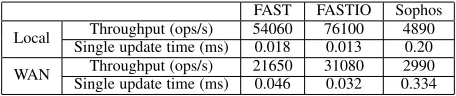
We first show the performance of the update operation. As we explained earlier, the update operation in Sophos is based on a public key primitive, while update operations in FAST and FASTIO are all symmetric key based. We first measured the update efficiency of FAST, FASTIO and Sophos in a local setting in which we ran the client and the server on the same cloud instance. In this setting, the time we measured does not include latency caused by network, therefore it gives a better picture of the difference in computational efficiency. We then measured the update efficiency in a WAN setting, in which the server (in US) and the client (in China) are distributed. The results are shown in Table 1.
As we can see, in the local setting, the throughput of FAST is about 11×, and FASTIO is about 15×, that of Sophos. In the WAN setting, the throughput of FAST is about 7×, and FASTIO about 10×, that of Sophos. The results confirm that FAST and FASTIO are superior in terms of update efficiency, compared to public key based Sophos.
FAST FASTIO Sophos
Local Single update time (ms)Throughput (ops/s) 540600.018 761000.013 48900.20
WAN Throughput (ops/s) 21650 31080 2990
Single update time (ms) 0.046 0.032 0.334
TABLE 1: Update efficiency for FAST, FASTIO and Sophos
6.2.2 Search Efficiency – Index Processing
For FAST, FASTIO and Sophos, the search operation on the server side requires processing a list of encrypted index entries to find matching documents. The search efficiency thus depends crucially on the efficiency of processing the index. In Fig. 4, we show the performance of index processing in the three schemes.
We conducted three experiments with different database sizes 14×106,14×107and14×108. In each experiment, we measured the total time on the server side (i.e. without counting network latency and token generation time on the client side) for searching keywords that have10−105matching documents. We repeated
30 times and took the average, then divided it by the number of matching documents to get the time for processing a single entry. As we can see in the figure, the time for processing a single entry decreases when the number of entries increases. This is because there is a fixed cost for initializing the search, which is amortized into the per entry processing time. As the number of entries increases, the amortized initialization cost becomes less significant. When the database size is 14×106 and 14×107,
FAST performs better than FASTIO and Sophos in the cases where the number of entries is small (10). This is because FAST has a smaller initialization cost, which is the result of an implementation level optimization.
We can observe the impact of I/O from Fig. 4. As we can see, for the same scheme and the same index size, the time we measured with the largest database (14×108) is much higher
than the time we measured with the smaller databases (14×106
and14×107). The performance degradation is about 2 orders of magnitude. The observation is in line with the results from
previous studies (see Section 2). We can also see that FAST was impacted the most as it has the worst I/O efficiency.
In smaller databases where I/O does not dominates the pro-cessing time, FASTIO performs much better than Sophos. The performance difference is about 1 - 2 times. This is mainly because FASTIO uses only symmetric key operations. In large databases, the performance difference is not that large, but FASTIO still performs marginally better than Sophos.
Even though FAST is based on symmetric primitives, we can observe that compared to Sophos, the efficiency improvement for search (around 2×faster) is not as significant as that with update (10×faster). One reason is that in the Sophos implementation, the trapdoor permutation evaluation (for generating previous states) on the server side is done by a dedicated thread, and there are multiple threads taking the states produced and searching in parallel. While in FAST, due to its inherent structure (conceptually a linked list), the search cannot be parallelized because the previous state cannot be found until the search has gone through the current node. FASTIO does not have this problem.
6.2.3 Search Efficiency – Trace Simulation
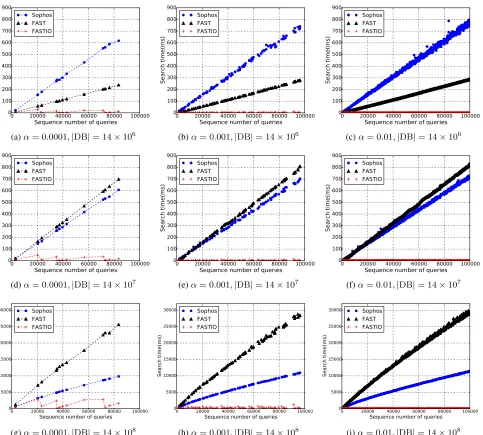
The experiments in Section 6.2.2 do not fully reflect the search performance of FASTIO. In fact, it shows theworst-case perfor-mance of FASTIO. Recall that in FASTIO, the previous search results are stored to make search more efficient. In order to see how significant this improvement is, we also simulated the dynamic setting using traces. We generated 3 traces. Each trace is a list of update and search queries for a certain keyword. We fixed the length of the trace to 100,000. Each trace has a parameterα
that is the probability of search queries, i.e. each query in the trace has a probability of αto be a search query and a probability of 1−αto be an update query. In the experiment, we let the client to replay the traces to simulate a real-world setting where updates and search queries are interleaved. We recorded the total time on the server side for each search query (from receiving search token to obtaining the results) in the trace.
In Fig. 5, we show the comparison of search efficiency with regard to the random traces. We used three different database sizes and three different query probabilities. In each sub-figure, the x-axis shows the sequence number of the query in the trace and they-axis shows the search time. For FAST and Sophos, the search time increases almost monotonically in accordance to the number of update queries performed so far. Recall that in these two schemes, their indexes contain all entries from all previous updates. The index entries have to be stored in random locations in order to ensure forward privacy, this results in the decrease of I/O efficiency as the locality will increase monotonically. For FASTIO, as we can see, the search performance is much better, especially when search is more frequent. The difference is more significant for large databases. This is because in FASTIO, the index contains only entries since the last search query. The locality is much better than in the other two schemes.
0 20000 40000 60000 80000 100000
Sequence number of queries
0 100 200 300 400 500 600 700 800 900 Search time(ms) Sophos FAST FASTIO
(a)α= 0.0001,|DB|= 14×106
0 20000 40000 60000 80000 100000
Sequence number of queries
0 100 200 300 400 500 600 700 800 900 Search time(ms) Sophos FAST FASTIO
(b)α= 0.001,|DB|= 14×106
0 20000 40000 60000 80000 100000
Sequence number of queries
0 100 200 300 400 500 600 700 800 900 Search time(ms) Sophos FAST FASTIO
(c)α= 0.01,|DB|= 14×106
0 20000 40000 60000 80000 100000
Sequence number of queries
0 100 200 300 400 500 600 700 800 900 Search time(ms) Sophos FAST FASTIO
(d)α= 0.0001,|DB|= 14×107
0 20000 40000 60000 80000 100000
Sequence number of queries
0 100 200 300 400 500 600 700 800 900 Search time(ms) Sophos FAST FASTIO
(e)α= 0.001,|DB|= 14×107
0 20000 40000 60000 80000 100000
Sequence number of queries
0 100 200 300 400 500 600 700 800 900 Search time(ms) Sophos FAST FASTIO
(f)α= 0.01,|DB|= 14×107
0 20000 40000 60000 80000 100000 Sequence number of queries
0 5000 10000 15000 20000 25000 30000 Search time(ms) Sophos FAST FASTIO
(g)α= 0.0001,|DB|= 14×108
0 20000 40000 60000 80000 100000 Sequence number of queries
0 5000 10000 15000 20000 25000 30000 Search time(ms) Sophos FAST FASTIO
(h)α= 0.001,|DB|= 14×108
0 20000 40000 60000 80000 100000 Sequence number of queries
0 5000 10000 15000 20000 25000 30000 Search time(ms) Sophos FAST FASTIO
(i)α= 0.01,|DB|= 14×108
Fig. 5: Search efficiency by trace simulation.
0 20000 40000 60000 80000 100000 Sequence number of the queries 0.1 1 10 100 1000 10000 Search time(ms) α=0.0001 α=0.001 α=0.01
(a)|DB|= 14×106
0 20000 40000 60000 80000 100000 Sequence number of queries 0.1 1 10 100 1000 10000 Search time(ms) α=0.0001 α=0.001 α=0.01
(b)|DB|= 14×107
0 20000 40000 60000 80000 100000 Sequence number of queries 0.1 1 10 100 1000 10000 Search time(ms) α=0.0001 α=0.001 α=0.01
(c)|DB|= 14×108
Fig. 6: Trace simulation for FASTIO. Search time is presented in log scale.
7
CONCLUSION
Designing searchable symmetric encryption is not trivial if we want to combine efficiency and forward privacy, which are two
optimal computational and communicational complexity. As the first attempt, FAST utilized a state based approach and is compu-tation friendly for its symmetric construction. Based on the idea from FAST and utilizing intrinsic leakage, our second construction FASTIO improves I/O efficiency significantly. Our experiment results demonstrated that our schemes are efficient and scalable. Future work and Open questionsFor static searchable encryp-tion, Cash et al. [10] gave theoretical bounds of locality, storage, and read efficiency and showed the relationship between them and the security notion. For dynamic searchable encryption, the relationship has not been well-understood and there has not been any theoretical study to establish the bounds. We would like to investigate in this direction so that we can understand better the limit and margin of further performance improvement.
In addition, modern data management system leverage dis-tributed and parallel architecture to handle large amount of data. For SSE, search efficiency will sharply drop when the database is out of the capability of the single machine. In fact, even for plaintext database, it’s not practical to be deployed on a single server. We would like to investigate searchable encryption in distributed and parallel settings.
ACKNOWLEDGMENT
The authors would like to thank the editor and the anonymous reviewers for their help in improving the paper. This work is supported by the National Natural Science Foundation of China (Grant No. 61572294, Grant No. 61632020), the Special Fund for General Scientific Research in Shandong University (Grant No. 2017JC019), and by the Engineering and Physical Sciences Research Council of UK (Grant No. EP/M013561/2). Qiuliang Xu and Changyu Dong are corresponding authors.
REFERENCES
[1] M. S. Islam, M. Kuzu, and M. Kantarcioglu, “Access pattern disclosure on searchable encryption: Ramification, attack and mitigation.” inNDSS, 2012.
[2] D. Cash, P. Grubbs, J. Perry, and T. Ristenpart, “Leakage-abuse attacks against searchable encryption,” inACM CCS, 2015, pp. 668–679. [3] Y. Zhang, J. Katz, and C. Papamanthou, “All your queries are belong
to us: The power of file-injection attacks on searchable encryption,” in
USENIX Security, 2016, pp. 707–720.
[4] E. Stefanov, C. Papamanthou, and E. Shi, “Practical dynamic searchable encryption with small leakage.” inNDSS, 2014.
[5] S. Garg, P. Mohassel, and C. Papamanthou, “TWORAM: efficient obliv-ious RAM in two rounds with applications to searchable encryption,” in
CRYPTO, 2016, pp. 563–592.
[6] T. Hoang, A. A. Yavuz, and J. Guajardo, “Practical and secure dynamic searchable encryption via oblivious access on distributed data structure,” inACSAC, 2016, pp. 302–313.
[7] Y.-C. Chang and M. Mitzenmacher, “Privacy preserving keyword searches on remote encrypted data,” inACNS, 2005, pp. 442–455. [8] R. Bost, “Σoϕoς: Forward secure searchable encryption,” inACM CCS,
2016, pp. 1143–1154.
[9] D. Cash, S. Jarecki, C. Jutla, H. Krawczyk, M.-C. Ros¸u, and M. Steiner, “Highly-scalable searchable symmetric encryption with support for boolean queries,” inCRYPTO, 2013, pp. 353–373.
[10] D. Cash and S. Tessaro, “The locality of searchable symmetric encryp-tion,” inEUROCRYPT, 2014, pp. 351–368.
[11] C. Gentryet al., “Fully homomorphic encryption using ideal lattices.” in
STOC, vol. 9, no. 2009, 2009, pp. 169–178.
[12] O. Goldreich, “Towards a theory of software protection and simulation by oblivious rams,” inSTOC, 1987, pp. 182–194.
[13] O. Goldreich and R. Ostrovsky, “Software protection and simulation on oblivious rams,”JACM, vol. 43, no. 3, pp. 431–473, 1996.
[14] A. C. Yao, “Protocols for secure computations,” inFOCS, 1982, pp. 160–164.
[15] O. Goldreich, S. Micali, and A. Wigderson, “How to play any mental game,” inSTOC, 1987, pp. 218–229.
[16] D. X. Song, D. Wagner, and A. Perrig, “Practical techniques for searches on encrypted data,” inIEEE (SP)., 2000, pp. 44–55.
[17] R. Curtmola, J. Garay, S. Kamara, and R. Ostrovsky, “Searchable symmetric encryption: improved definitions and efficient constructions,”
Journal of Computer Security, vol. 19, no. 5, pp. 895–934, 2011. [18] M. Chase and S. Kamara, “Structured encryption and controlled
disclo-sure,” inASIACRYPT, 2010, pp. 577–594.
[19] S. Kamara, C. Papamanthou, and T. Roeder, “Dynamic searchable symmetric encryption,” inACM CCS, 2012, pp. 965–976.
[20] C. Dong, G. Russello, and N. Dulay, “Shared and searchable encrypted data for untrusted servers,”Journal of Computer Security, vol. 19, no. 3, pp. 367–397, 2011.
[21] S. Kamara and C. Papamanthou, “Parallel and dynamic searchable symmetric encryption,” inFC, 2013, pp. 258–274.
[22] S.-F. Sun, J. K. Liu, A. Sakzad, R. Steinfeld, and T. H. Yuen, “An efficient non-interactive multi-client searchable encryption with support for boolean queries,” inESORICS, 2016, pp. 154–172.
[23] F. Hahn and F. Kerschbaum, “Searchable encryption with secure and efficient updates,” inACM CCS, 2014, pp. 310–320.
[24] M. Naveed, M. Prabhakaran, and C. A. Gunter, “Dynamic searchable encryption via blind storage,” inIEEE (SP)., 2014, pp. 639–654. [25] S. Gajek, “Dynamic symmetric searchable encryption from constrained
functional encryption,” inCT-RSA, 2016, pp. 75–89.
[26] Z. Xia, X. Wang, X. Sun, and Q. Wang, “A secure and dynamic multi-keyword ranked search scheme over encrypted cloud data,”IEEE Transactions on Parallel and Distributed Systems, vol. 27, no. 2, pp. 340–352, 2016.
[27] D. Cash, J. Jaeger, S. Jarecki, C. S. Jutla, H. Krawczyk, M. Rosu, and M. Steiner, “Dynamic searchable encryption in very-large databases: Data structures and implementation,” inNDSS, 2014.
[28] G. Asharov, M. Naor, G. Segev, and I. Shahaf, “Searchable symmetric en-cryption: Optimal locality in linear space via two-dimensional balanced allocations,” inSTOC, 2016, pp. 1101–1114.
[29] I. Demertzis and C. Papamanthou, “Fast searchable encryption with tunable locality,” inSIGMOD, 2017, pp. 1053–1067.
[30] I. Demertzis, D. Papadopoulos, and C. Papamanthou, “Searchable en-cryption with optimal locality: Achieving sublogarithmic read efficiency,”
IACR eprint, 2017.
[31] I. Miers and P. Mohassel, “Io-dsse: Scaling dynamic searchable encryp-tion to millions of indexes by improving locality,”IACR eprint, 2017. [32] R. W. F. Lai and S. S. M. Chow, “Forward-secure searchable encryption
on labeled bipartite graphs,” inACNS, 2017, pp. 478–497.
[33] R. Bost, B. Minaud, and O. Ohrimenko, “Forward and backward private searchable encryption from constrained cryptographic primitives,” in
ACM CCS, 2017, pp. 1465–1482.
[34] K. S. Kim, M. Kim, D. Lee, J. H. Park, and W. Kim, “Forward secure dynamic searchable symmetric encryption with efficient updates,” in
ACM CCS, 2017, pp. 1449–1463.
[35] M. Etemad, A. K¨upc¸¨u, C. Papamanthou, and D. Evans, “Efficient dy-namic searchable encryption with forward privacy,”PoPETs, vol. 2018, no. 1, pp. 5–20, 2018.
[36] E. Stefanov, M. Van Dijk, E. Shi, C. Fletcher, L. Ren, X. Yu, and S. Devadas, “Path oram: an extremely simple oblivious ram protocol,” inACM CCS, 2013, pp. 299–310.
[37] E. Shi, T.-H. H. Chan, E. Stefanov, and M. Li, “Oblivious ram with O((logN)3) worst-case cost.” inASIACRYPT, 2011, pp. 197–214.
APPENDIX
A
PROOF OF
THEOREM
1
Proof: We model the two hash functions H1 and H2 as
random oracles. The oracles for H1 and H2 are identical except
for different output lengths. Each oracle maintains a mapping Hi
that stores input/output pairs (in, out) where in ∈ {0,1}∗
and
out∈ {0,1}`where`is the the length of the hash function’s output.
Given an input stringx, the oracle first checks mappingHi, if there is
an entry forxthen it returns the value associated withxand terminates
here. If there is not an entry forxinHi, the oracle randomly picks a
stringyfrom{0,1}`, then stores(x, y)inH
iand returnsy.
We prove through a sequence of games. We start fromRealΠA(λ)
and construct a sequence of games that differs slightly from the pre-vious game and show they are indistinguishable. Eventually we reach
indistinguishability, we conclude thatRealΠ
A(λ) is indistinguishable
fromIdealΠA,S(λ)and complete our proof.
Hybrid G1: G1 is the same as RealΠA(λ) except that instead of
generating tw using F, the experiment maintain a mapping Token
to store(h(w), tw)pairs. In the search protocol, whentwis needed,
the experiment first checks whether there is an entry inToken for
h(w), if so returns the entry; otherwise randomly picks atwin{0,1}l
and stores the(h(w), tw)pair in Token. It’s trivial to see that G1
andRealΠ
A(λ)are indistinguishable, otherwise we can distinguish a
pseudo-random functionFand a truly random function.
HybridG2:G2differs fromG1in two places. Firstly, the experiment
maintains a mappingKey. In the update protocol (line 9 in Fig. 1),
afterkc+1is generated, the experiment stores(w||(c+ 1), kc+1)in
Key. Secondly, instead of querying H1 in the update protocol, a
random string is used. The random string is used to program the random oracle when a search query is issued. More specially, Instead
of doingu←H1(tw||stc+1), which is line 13 in the update protocol
in Fig. 1, the experiment does the following:
u←− {$ 0,1}`
L[tw||stc+1]←u
where L is a mapping maintained by the experiment. The second
change is in the search protocol. The following is added after line 20 and line 21 of the search protocol:
fori= 1tocdo
H1[tw||stc+1]←L[tw||stc+1]
ki←Key[w||i] sti−1←P−1(ki, sti)
end for
whereH1is the table for random oracleH1.
NowG1andG2behaves exactly the same except that inG2, with
some probability inconsistency in random oracle query results can be
observed. InG2,H1 is not updated immediately. Fortw||stc+1, the
corresponding valueuis generated in the update protocol. However,u
is only pushed intoH1when a search query is issued. After the update
with state tw||stc+1, if the adversary queries H1 with tw||stc+1
before the next search query, it will get a value u0 such that with
a overwhelming probability u0 6= ubecauseH1[tw||stc+1]has not
been updated and a random stringu0is chosen by the oracle in this
case. If the adversary queriesH1withtw||stc+1again after the next
search query,uwill be updated to theH1and the query result will be
u. If the inconsistency is observed (we denote this event asBad), the
adversary knows it is inG2. We have:
Pr[G1= 1]−Pr[G2= 1]≤Pr[Bad]
Note that the event Bad can only happen if the adversary
can query the oracle with tw||stc+1. Since stc+1 is
pseudoran-dom, the probability of the adversary choosingstc+1 by chance is
2−λ+negl(λ). A PPT adversary can make at most q
1 =poly(λ)
guesses, then Pr[Bad] ≤ q1
2λ +q1 ·negl(λ). The probability is
negligible andG1andG2are indistinguishable.
HybridG3:G3 is obtained fromG2in a similar way. In the update
protocol, we replace the linee ←(ind||op||kc+1)⊕H2(tw||stc+1)
(line 12 in Fig. 1) with the following:
u←− {$ 0,1}l+λ+1 E[tw||stc+1]←u
e←(ind||op||kc+1)⊕u
whereEis a mapping maintained by the experiment. Similarly, the
following is added after line 20 and line 21 of the search protocol: fori= 1tocdo
H2[tw||stc+1]←E[tw||stc+1]
ki←Key[w||i] sti−1←P−1(ki, sti)
end for
Using the same argument, we can conclude that G2 and G3 are
indistinguishable.
HybridG4: InG4, the client side algorithms are changed as shown
in Fig. 7. The main difference between G4 and G3 is that in G4,
stand kis generated on the fly when search is performed. InG4 a
mappingUpdatesis maintained by the experiment to record all the
Setup(λ,⊥;⊥)
Client:
1: L,E←empty map
2: v←0
Update(ks,ΣΣΣ, ind, w, op;T)
Client:
3: v←v+ 1
4: Append (v,op,ind) to
Updates[w]
5: L[v]←− {$ 0,1}`
6: E[v]←− {$ 0,1}l+λ+1 7: send (L[v],E[v]) to server
Search(ks,ΣΣΣ, w;T)
Client:
8: if Token[h(w)] =⊥ then
9: Token[h(w)]←− {$ 0,1}λ 10: end if
11: tw←Token[h(w)] 12: ifΣΣΣ[w] =⊥then
13: ΣΣΣ[w]←− {$ 0,1}λ 14: end if
15: st0←ΣΣΣ[w] 16: c← |Updates[w]|
17: [(u0,op0,ind0), ...,(uc,opc,indc)]←Updates[w] 18: ifc= 0then
19: return∅
20: end if
21: fori= 1tocdo
22: if Key[w||i]6=⊥then
23: ki←Key[w||i]
24: else
25: ki← {0,1}λ 26: Key[w||i]←ki 27: end if
28: sti←P(ki, sti−1) 29: H1(tw||sti)←L[ui]
30: H2(tw||sti)←E[ui]⊕(indi||opi||ki) 31: end for
32: send (tw,stc,c) to Server
Fig. 7: Description of hybridG4
update requests since the last search query. Unlike inG3 where the
random oracle query results are chosen according totw||stc+1, inG4
the values are chosen randomly without the knowledge ofst(line 5
and 6, Fig. 7). Then when performing a search, st0 is generated if
this the first search query ofw(line 12 - 15, Fig. 7). Thenki, stiare
generated retrospectively and then the oracle is updated accordingly (line 21 - 31, Fig 7). The change however are not observable by the
adversary. From the adversary’s perspectively,G3 and G4 behaves
exactly the same: in both games the update protocol outputs two
uniformly random strings, and the search protocol outputs(tw, kw, c)
that has the same distribution in the two games. Therefore they are perfectly indistinguishable.
Pr[G3= 1] = Pr[G4= 1]
IdealΠA,S(λ): in this game, a simulator must generate a view given
only the leakage functions, but not the actual data and queries. For
convenience, in the proof we will use search pattern and update
history instead of using the search leakage function LSearch(w)
directly. The two can be constructed from the leakage function. The
search patternsp(w) ={j|qj=winHist}reveals which queries in