26
A Multiple Determination Support for Web Application Clusters to
Hybrid Clouds
1Mrs. P. Kaladevi,
M.Phil Scholar, Department of Computer Science 2
Dr. P. Sumitra,
Assistant Professor, Department of Computer Science Vivekanandha College of Arts and Sciences for Women (Autonomous)
Elayampalayam, Tiruchengode, Tamilnadu, India [email protected]
Abstract
Internet environment provides huge amount of web applications for the users. Web browsers are used to initiate the web applications. Resource requirement is increased due to the peak load in the web servers. Hardware resource utilization depends upon the request traffic in the servers. Cloud computing environment provides resources to the web applications. Infrastructure, platform and software services are employed to share the resources in the cloud environment. The application migration is carried out from the web server into the cloud resources. Servers, load distributor and database operations are moved to the resources under the cloud environment. The migration process is initiated with reference to the cost, delay, spatial information about data source parameters.
Computational and data resources are provided through the cloud services. The service selection is initiated with economic and performance factors. Web workload movement to the cloud resources is managed by the CloudGenious framework. The migration can be done on multiple component environments. Evolutionary migration process for web application clusters is distributed over multiple locations. A multi-criteria-based selection algorithm on Analytic Hierarchy Process (AHP) is employed in CloudGenius model. Parallel Genetic Algorithm (PGA) is adapted to select migration solutions. The CloudGenius framework is implemented in CumulusGenius middleware.
The web application migration is supported to hybrid cloud environment through the Enhanced CloudGenius framework. The public cloud resources and private cloud data centers are utilized with user selection parameters. Data center spatial properties and control flow operations are combined in the migration process. Data selection based middleware functionalities are included in the migration process.
Index Terms: Computational Clouds, Task Migration, Hybrid Clouds, Web Applications and Parallel Genetic Algorithm
1. Introduction
“Cloud” computing embraces cyber
infrastructure and builds upon decades of research in
virtualization, distributed computing, “grid
computing”, utility computing and, more recently, networking, web and software services. It implies service oriented architecture, reduced information technology Over head for the end-user, greater flexibility, reduced total cost of ownership, on demand services and many other things.
Some workloads have more to gain from a move to the cloud. This is often because they have a greater affinity for the attributes inherent in the cloud model. They align with the standardization, virtualization, automation and level of management and hardware support that a cloud service provides. These workloads can operate easily in a virtualized,
automated cloud environment, where the
infrastructure makes it possible to dynamically request services from a virtualized pool of hardware
and then automatically provision the required software stack and resource capacity.
Existing workloads with the greatest affinity for cloud may be those that are an excellent fit in terms of their potential gain and ease of deployment. These workloads require little to no customization because they can work with and benefit from the cloud’s standard catalog services. Several common IT workloads fare on these two measures, based on IBM’s research and experience with own cloud implementations. In general, the workloads that appear in the upper right quadrant have proven to be the best fit for cloud computing.
Existing workloads must be carefully
27
costly to the organization financially and
operationally that a move to the cloud has the potential to provide considerable benefit. Other workloads may be so highly optimized already that there is little to be gained from such a move.
Workloads that are unusually complex may
offer big potential for improvement, but they may require a high degree of customization or application redesign to conform to the cloud’s architecture. These kinds of workloads can prove too difficult, risky or costly to move to the cloud. Certainly, the risk/reward profile of any workload should be clearly understood before it is deployed in the cloud. Consider complex mission-critical production workloads. In some cases, the risk associated with cloud deployment can far
outweigh the potential gains. Heterogeneous
applications and workloads that involve a high amount of data transfer may be difficult to deploy in the cloud, relative to their anticipated gain.
2. Related Work
Over the last years, some works have been intended to evaluate dependability of cloud infrastructures. Wei et al. show a hierarchical method based on heterogeneous models, combining RBD and SPN for dependability evaluation of a virtual data center (VDC). In this method, a top-level model based on the RBD defines the VDC infrastructure and a low-level model based on SPN contemplates the components of the VDC in failure and repair state. Dantas et al. [1] produce a hierarchical and
heterogeneous modeling to depict redundant
architectures and compare their availability taking in account computers acquisition costs. In this modeling strategy, a high-level model based on RBD denotes the Eucalyptus platform subsystems and a low-level model based on Markov chains represents the respective subsystems employing warm standby replication. Ram et al. [5] investigate the availability of a redundant system through the supplementary variable technique and Laplace transformation. Other works conceive the cost evaluation of cloud infrastructures. Martens et al. [11] show that the analysis of relevant cost types and factors of cloud computing services is an important pillar of decision-making in cloud computing management. In this way, such paper presents a total cost of ownership (TCO) approach for cloud computing services. Li et al. provide metrics and equations for calculating the cloud TCO and utilization cost, considering the elastic feature of cloud infrastructure and the adopted virtualization technology [4]. That paper provides a foundation for evaluating economic efficiency of cloud computing and it provides indications for cost optimization of cloud computing
infrastructures. Differently from previous studies [2], this paper proposes a modeling strategy based on a hierarchical and heterogeneous modeling for cloud infrastructure planning. This work also provides dependability and cost models for representing cloud infrastructures [10]. The modeling strategy allows the selection of cloud infrastructures according to dependability and cost requirements. This modeling strategy is implemented through the SMG4CIP. 3. Web Workload Migration in Clouds
A web application is a computer software application, which interacts with users through a frontend programmed using browser-based language. Web applications are typically accessed by million of users over the internet via a common web browser software. Common web applications include webmail, online retail sales, online auctions, wikis and the like.
In the traditional web application hosting model, hardware needs to be provisioned for handling peak load. Uncertain traffic periods and unexpected variations in workload patterns may result in low utilization rates of expensive hardware. Therefore, the traditional approach of provisioning for peak workloads leads to unused or wasted computing cycles when traffic is low. With the advent of cloud computing, it is expected that more and more web applications will be hosted using cloud-based, virtualized services [6]. Cloud computing provides an elastic Information Communication Technology (ICT) infrastructure for the most demanding and dynamic web applications. Clouds provide an infrastructure that can match ICT cost with workload patterns in real-time. Cloud1 service types can be abstracted into three layers: Software as a Service (SaaS), Platform as a Service (PaaS), and Infrastructure as a Service (IaaS) [3].
28 server components to cloud data centers is selecting the best collection of VM images and compute services to ensure that a system’s QoS targets are met. Furthermore, another challenge is to satisfy conflicting selection criteria related to software and computer services. Additionally, components might be placed at different locations or providers to prevent outages and generate costs for the Internet connectivity.
To address the complexities when migrating multi component web application server clusters, we expand the migration framework CloudGenius. The CloudGenius framework [7] translates cloud service selection steps into multi-criteria decision-making problems using (MC2)2 and the Analytic Hierarchy Process (AHP) [8]. The framework, furthermore, determines the most viable VM images and compatible compute services at IaaS layer. CloudGenius originally provides a framework that guides through a cloud migration process and offers a model and method to determine the best combined and compatible choice of VM images and compute services for a single web server. With enhancements to the framework, we provide comprehensive support for migrations of distributed, multi-component web application clusters while factoring in data flow dependencies of components raising network traffic costs.
As the solution space for the problem grows exponentially, we developed a Hadoop and Genetic Algorithm (GA)-based approach to cope with computational complexities in a growing market of cloud service offerings. By combining a GA with AHP, we created a Hybrid Multi-Goal Optimization Heuristic Method (HMOHM). Details on the HMOHM can be found in Fig. 2. A new challenge resulting from the combination of GA and AHP is to transfer subjective opinions stated once into an AHP-based fitness function. Therefore, we developed a novel approach for AHP-based fitness functions in GAs. AHP requires pair-wise comparisons among all alternatives to normalize values for an absolute scale. This becomes unsolvable with a potentially infinite number of alternatives considered in a GA. Therefore, we needed to develop a novel way for speeding up the execution time for HMOHM. To this end, we implemented a parallel version of the HMOHM over hadoop clusters. Specifically, the main contributions of this paper are:
We clearly identify the most important selection criteria, selection goals, and cloud service alternatives, considering the use case of migrating a web application cluster to public cloud services such as Amazon EC2 and GoGrid.
We extend analytical formulations and models of our previous work for handling the migration of web server cluster components across multiple cloud data centers spanning over geographically distributed network boundaries.
A hybrid decision making technique is proposed that combines multi-criteria decision making (AHP) and evolutionary optimization techniques for selecting best compute service and VM image.
A comprehensive experimental evaluation is carried out based on a realistic scenario for verifying the performance of the proposed decision making technique.
4. Problem Statement
Cloud service provider’s offers
computational services and Virtual Machine (VM) images for information systems. Throughput and cost factors are considered in the service selection process. CloudGenius framework is constructed to handle process migration from web applications into public cloud resources. CloudGenius provides migration support for multi-component web applications. Evolutionary migration process for web application clusters is distributed over multiple locations. A multi-criteria-based selection algorithm on Analytic
Hierarchy Process (AHP) is employed in
CloudGenius model. Parallel Genetic Algorithm (PGA) is applied to select migration solutions. CumulusGenius is an implementation support for
CloudGenius framework.
The following drawbacks are identified from the existing system.
• Hybrid cloud architecture is not supported
• Migration cycles delay is high
• Provider Customization is not supported
• Control and data flow dependencies are not considered
5. A Multiple Determination Support for Web Application Clusters
Public and private cloud resources are provided for the cloud workloads. Web application tasks are transferred into the cloud environment. Workload migration process is supported to manage resource failures. The system is divided into four major modules. They are Cloud Services, Workload Submission, Scheduling Process and Workload Migration.
29 5.1. Cloud Services
Cloud services are provided to execute
functional components. Service provider allocates the services for the users. Computational and data resources are shared with cloud services. Web applications are constructed with cloud service support.
5.2. Workload Submission
Workloads are submitted by the cloud users. Workloads are initiated with resource and service information. Data requirements are considered in the workload submission process. Workload results are passed to the cloud users.
5.3. Scheduling Process
Service components are assigned in the
scheduling process. Cloud resources are provided for the selected service components. CloudGenius middleware handles the scheduling process. Public and private cloud resources are provided under the scheduling process.
5.4. Workload Migration
Resource failures are monitored by the middleware framework. Workload migration is initiated with reference to the fault levels. Deadline factors are also considered in the workload migration process. Data dependency factors are integrated with the workload migration process.
6. Experimental Analysis
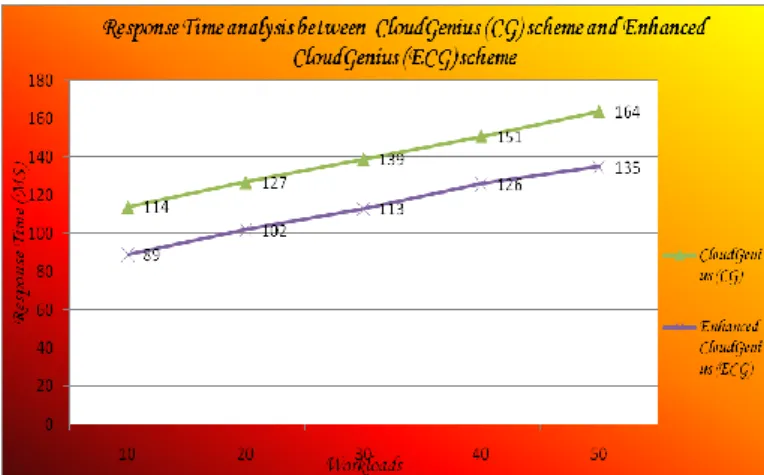
The cloud resource sharing methods are used to share the resources and services to execute the workloads. The workloads are collected from web applications. The workloads are redirected to the cloud resources. CloudGenius (CG) middleware is designed to handle the workload management process. The Enhanced CloudGenius (ECG) is designed to support workload migration on resource failure conditions. The system is tested different resource and workload levels.
Figure No: 6.1. Response Time Analysis between CloudGenius (CG) scheme and Enhanced
CloudGenius (ECG) scheme
The system uses the response time, resource utilization rate and power consumption ratio analysis for the performance process. The response time analysis for the CloudGenius (CG) and Enhanced CloudGenius (ECG) techniques are shown in figure 6.1. The Enhanced CloudGenius (ECG) reduces the average response time 20% than the CloudGenius (CG) model. The resource utilization rate analysis for the CloudGenius (CG) and Enhanced CloudGenius (ECG) techniques are shown in figure 6.2. The resource utilization rate in Enhanced CloudGenius (ECG) is 10% increased than the CloudGenius (CG) mechanism. The power saving analysis for the CloudGenius (CG) and Enhanced CloudGenius (ECG) techniques are shown in figure 6.3. The energy saving ratio in Enhanced CloudGenius (ECG) is 35% reduced than the CloudGenius (CG) model.
Figure No: 6.2. Resource Utilization Rate Analysis between CloudGenius (CG) scheme and Enhanced
CloudGenius (ECG) scheme
Figure No: 6.3. Power Saving Analysis between CloudGenius (CG) scheme and Enhanced
30 7. Conclusion
Cloud services are deployed to provide resources and service components. CloudGenius framework is adapted to handle workload migration for web applications. CloudGenius is enhanced to support migration under hybrid cloud environment. Component dependency analysis, customization and middleware service integration features are added to the system. The web application migration scheme is adapted for the public and private cloud environment. Control flow and data dependencies are analyzed in the migration process. Customization features are adapted in the CloudGenius framework. Workload performances are increased with minimum cost and time.
References
[1] J. Dantas, R. Matos, J. Araújo and P. Maciel, “Models For Dependability Analysis Of Cloud Computing Architectures For Eucalyptus Platform,” Int. Trans. Syst. Sci. Appl., vol. 8, pp. 13–25, Dec. 2012.
[2] Erica Sousa, Fernando Lins, Eduardo Tavares,
Paulo Cunha and Paulo Maciel, “A Modeling
Approach for Cloud Infrastructure Planning
Considering Dependability and Cost Requirements”,
IEEE Transactions On Systems, Man, And
Cybernetics: Systems, Vol. 45, No. 4, April 2015 [3] P. Mell and T. Grance, “The NIST definition of cloud computing, recommendations of the national institute of standards and technology,” NIST Special Publication, Gaithersburg, MD, USA, 2011.
[4] Kejiang Ye, Zhaohui Wu, Chen Wang, Bing Bing Zhou, Weisheng Si, Xiaohong Jiang and Albert Y. Zomaya, “Profiling-Based Workload Consolidation and Migration in Virtualized Data Centers”, IEEE Transactions On Parallel And Distributed Systems, Vol. 26, No. 3, March 2015
[5] M. Ram, S. B. Singh and V. V. Singh, “Stochastic Analysis Of A Standby System With Waiting Repair Strategy,” IEEE Trans. Syst., Man, Cybern. A, Syst., Humans, vol. 43, no. 3, pp. 698–707, May 2013. [6] A. W. Services. (2013, Jan.). The AWS marketplace. https://aws.amazon.com/marketplace
[Online]. Available:
https://aws.amazon.com/marketplace
[7] M. Menzel and R. Ranjan, “CloudGenius: Decision support for web server cloud migration,” in Proc. 21st Int. Conf. World Wide Web, 2012, pp. 979–988.
[8] M. Menzel, M. Sch€onherr, and S. Tai, “(MC2 )2: Criteria, requirements and a software prototype for cloud infrastructure decisions,” Softw. Practice Experience, vol. 43, no. 11, pp. 1283–1297, Nov. 2013.
[9] Haikun Liu and Bingsheng He, “VMbuddies:
Coordinating Live Migration of Multi-Tier
Applications in Cloud Environments”, IEEE Transactions On Parallel And Distributed Systems, Vol. 26, No. 4, April 2015
[10] Amelie Chi Zhou, Bingsheng He and Cheng Liu,
“Monetary Cost Optimizations for Hosting