THE EMERGENCE OF SERVICE QUALITY AND BRAND
AWARENESS TOWARD STRATEGIC COMPETITIVENESS
AND ITS IMPACT ON HOTEL PERFORMANCE
Khairunnisa, Nila Krisnawati Swiss German University
Abstract
Five-star hotels are known by their immense competitiveness, first-class portrayal and are superior in level of extravagance, eccentricity, representation, sophistication and amenities. Slow growth of five-star hotels aggravates strong competition, thus forcing hotel businesses to be competitive. This study attempts to analyze service quality and brand awareness toward strategic competitiveness and its impact on the performance of XYZ Hotel. The study applies both quantitative and qualitative research, which were obtained from questionnaire distribution to 100 respondents who have stayed at the hotel, in-depth interview with the PR and Front Office managers, and Focus Group Discussion with managers and hotel experts from Jakarta and Tangerang. The finding suggests that service quality has no correlation with strategic competitiveness and no significant impact on performance. Thus, brand awareness was found to be the most influential factor on strategic competitiveness. However, it is necessitated that five-star hotel continuously improve the quality of its service and the factors associated with service quality.
Keywords: Service Quality, Brand Awareness, Strategic Competitiveness, Performance, Competitive Advantage, Competitive Strategy, Hotel.
Introduction
Another source of competitiveness is branding. Brands are important and considered as the primary aspect of competitiveness as they raise the tendency of customers to buy a certain product or utilize a certain service of a specific firm as opposed to that of other firms (Miloslava, 2011). Although brands are significantly determined by the competitive advantage that they deliver in the current market, brands are also driven by the forthcoming circumstances in a new unexploited market (Ranjbarian, Fathi, & Mohammadi, 2013). Additionally, international brands in specifically emerging countries are adjuged to have better brand image associated with prestige and high standard than local brands (Suhartanto, 2011). As brand image is positively interrelated with brand awareness, the significance of brand image is required in the formation of brand awareness (Cho, 2011; Laiho & Inha, 2012; Management Study Guide, 2013). Strong awareness implies that the brand is well acknowledged and strong image implies a positive prominence (Cho, 2011).
In Indonesia, increasing sector of hotel and restaurant is fuelling investments, particularly within the industry of tourism (Indonesia Investments, 2014). Substantially, two, three, and four star hotels account for most of the growth with three-star hotels hold 33.47 per cent of the total number of hotels, while two and four star hotels hold 21.89 per cent and 18.83 per cent correspondingly (CEIC Data, 2015). However, the gradual increase of one and five-star hotel is followed by the decreasing number of both hotels from 24.24 per cent to 17.79 per cent and from 8.66 per cent to 8.02 per cent respectively (CEIC Data, 2015). Consequently, slow growth of five-star hotels aggravates strong competition, thus forcing businesses to be competitive (Porter, 2008; Wilkinson, 2013).
Although there has been a gradual increase in the development of five-star hotels, but due to the rapid development in the city’s property sector, hotel rooms in Tangerang were swiftly expanding (Amna, 2014). In 2014, the number of existing hotels in the city had reached 1.569 units approximately, comprising of distinctive classifications and ratings (Amna, 2014). Non-classified hotels had the highest development with 694 units followed by three-star hotels with 467 units. Whereas two-star hotels development had been one of the lowest with 35 units. However, the five star hotels development in particular were moderate, with only 233 units. (Amna, 2014).
Source: XYZ Hotel Internal Data (2015)
Figure 1
Performance of XYZ Hotel 2015
Thus, five-star business hotel in Tangerang with meetings, incentives, conferences or conventions and exhibition rooms, known as MICE is the main object of this research study. Business hotel itself in general is termed as a hotel with facilities related to business interests aimed at business people, such as large convention rooms and ballrooms (Samboh, 2007; Trieha, 2014). Moreover, five-star hotels are selected due to their immense competitiveness, first-class portrayal and are superior in level of extravagance, eccentricity, representation, sophistication and amenities (Chu, 2014). In terms of work force, five-star hotel personnel are purportedly affective, responsive, and enthusiastic in delivering exceeding service (The Five Star Travel Cooperation, 2015).
Hence, the moderate growth of five-star hotel development leads to the further analysis of this research study in evaluating hotel business toward obtaining strategic competiveness and obtaining competitive through service quality and brand awareness.
Research Problem
In a practical manner, as a domestic hotel brand, XYZ has been maximizing its ability in delivering exceptional service to its guests. However, service quality and the existence of brand awareness have not yet been measured as factors affecting strategic competitiveness. However, it is suspected that both service quality and brand awareness are essential factors in determining the hotel’s competitiveness level, which may significantly influence the hotel’s level of performance.
January February March April
Average Rate per Room 796,065 771,010 743,547 712,503
Occupancy Rate 63.34% 59.34% 66.82% 72.91%
RevPAR 504,228 457,500 496,822 519,502
O
cc
upan
cy Ra
te
Av
era
ge
Rat
e pe
r Ro
om
Axis Title
Research Objectives
The purpose of this research has been summarized into three systematical aspects: 1. To analyze the significant influence of service quality on strategic competitiveness
2. To analyze the significant influence of service quality on brand awareness 3. To analyze the significant influence of brand awareness on strategic competitiveness
4. To analyze the significant influence of strategic competitiveness on the performance of XYZ Hotel
Literature Review
Service Quality
Service quality is a term obtained from the subject of marketing which highly regards the personal connection between an organization and its clients (Murasiranwa, Nield, & Ball, 2010). It is stated that service quality is “the consumer’s overall impression of the relative inferiority or superiority of the organization and its services” (Alsaqre O. Z., 2011). Inherently, the intangibility of service produces challenges in determining the acceptable criterion of service quality as the identification and counteraction of deficiencies during the course of service activity become strenuous (Dong, 2007). As a result, researchers moderately administer diverse descriptions of service quality, however united accept the importance of having customer focus in service quality (Dong, 2007). Service quality has been stated to having two elements: technical and functional service quality (Auka, Bosire, & Matern, 2013; Ladhari & Souiden, 2011). Functional quality encompasses ‘how’ a service is delivered and it is generally appraised to be the essential factor of quality based on customers’ perceptions, as the evaluation of technical quality in a realistic manner becomes complicated with regard to information deficiency (Narang, 2010; Njovo & Makacha, 2015). As functional quality substantially incorporates all facets of service encounter procedure, it is implied that service encounter toward customers is as crucial as the outcome of the service (Grubor, Salai, & Lekovic, 2009). Technical quality referred to as the end result elements of service quality that relates to something the customer acquires during a service encounter or ‘what’ service is given, as customers evaluate quality with regards to the advantages that they receive (Grubor, Salai, & Lekovic, 2009; Njovo & Makacha, 2015).
Brand Awareness
to deliver value to a brand, businesses should initally create, in the thoughts of customers, the true meaning of the brand itself (Homer, 2008). Brand awareness is characterized as the longevity of a brand that is deeply settled in the memory of consumers (Severi & Ling, 2013). Therefore, strong brands generate significant portrayals in the memory of service users (Kuhn, Alpert, & Pope, 2010). Furthermore, brand awareness is formed through continuous perceivability, increased awareness and strong bond with associated services or products, as well as the preceding purchase encounter (Severi & Ling, 2013). As customers have a tendency to purchase a recognizable brand, brand awareness is a crucial element in the customers buying selection (Chi, Yeh, & Yang, 2009). Consequently, increasing brand awareness of a service requires the selection and combination of a firm’s marketing mix components that will likely enhance its brand awareness (Conradie, Roberts-Lombard, & Klopper, 2014). Thus, it is stated that brand awareness is the critical initial phase in developing a brand (Romaniuk, Sharp, Paech, & Driesener, 2004).
Two primary forms of brand awareness are (Dhurup, Mafini, & Dumasi, 2014) are Top of the Mind Awareness and Aided Awareness. Aided awareness develops once a customer is presented with a series of brand names and the customer identifies the brand based on the presented selection. Top of the mind awareness takes place once the title of the brand is immediately remembered as the customer directly relates the brand with the service or product classification (Dhurup, Mafini, & Dumasi, 2014). Furthermore, Brand awareness is evaluated by assorted aspects (Moisescu, 2009) are Brand Recognition and Brand Recall. Brand recognition is the capability of customers to identify preceding information of a brand, which is done by making an inquiry regarding the brand or displaying the particular brand, hence customers are able to distinguish the brand as they have previously acknowledged or recognized it (Djakeli, 2012). Brand Recall is the extent to which customers are able to precisely retrieve a brand from their memory when provided a hint and type or classification of a product or service (Djakeli, 2012).
Strategic Competitiveness
Competitive advantage is a favored position obtained above rivals by providing customers a better benefit by offering affordable prices or supplementary advantages and services at similar or only slightly higher prices (Ehmke, 2008). Competitive advantage indicates the capability of a firm to represent a distinctive idea and deliver distinctive services (Al-Qudah, 2012). Two principles for developing and sustaining competitive advantage are as follows (Milohnic & Grzinic, 2010) are Create unique products or deliver exceptional services that beneficial to customersand Create inimitability, so rival businesses are not able to imitate.
Performance
Performance is defined as the procedure of turning strategy into action (Murasiranwa, Nield, & Ball, 2010). It is a term obtained from the subject of strategic management related to assessing the productiveness and efficacy of business activities with regards to the accomplishment of a firm’s objective (Murasiranwa, Nield, & Ball, 2010). Additionally, performance is associated with the growth of “profitability and customer service delivery” (Ongori, Iravo, & Munene, 2013). The assessment of performance depends upon the tactical function of the business and must be collectively considerate and coherent with the mission, purpose and aims of the business (Melia & Robinson, 2010). The strength of a business is related to huge earnings and the ability to recognize factors of performance from the highest to the lowest management (Mutindi, Namusonge, & Obwogi, 2013). Performance assessment procedure serves as a crucial aspect toward the improvement of tactical strategy as it supports to generate business profit, reinforce responsibility, drive inspiration and enthusiasm and increase the effectiveness of exchanging information in an organization (Vinuesa, Maria, & Olalla, 2011; Mutindi, Namusonge, & Obwogi, 2013 ).
Methodology
However, as to ensure maximum accuracy result, therefore the sample size needed is 100 respondents.
Anakysis of Data
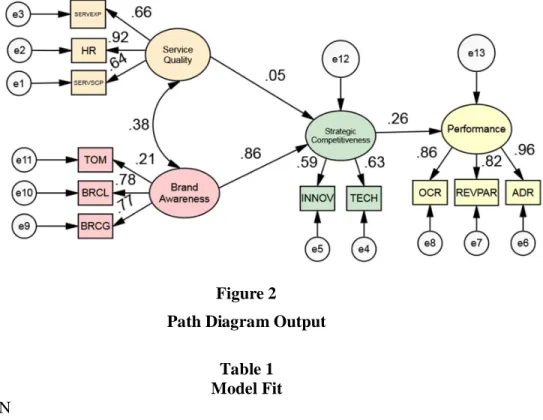
SEM or Structural Equation Modelling is used to measure or analyze the direct or indirect hypothetical causation correlations, expressed in terms of multiplex structure, with interrelated dependent or independent variables (Lamb, Mengersen, Stewart, Attanayake, & Siciliano, 2014; Martinez-Lopez, Gazquez-Abad, & Sousa, 2013). Specifically, to study the correlation between the variables, the researcher used Path Analysis in a form of Path Diagram. This diagram provides the evaluation between Endogeneous variables, termed as the X or observed variables and Exogeneous variables, termed as the Y or observed variables (Karadag, 2012). To see the appropriateness of the model, the researcher runs tests of Goodness-of-Fit, Root Mean Squared Error of Approximation and Comparative Fit Index.
Results and Discussion
Respondent Profile
The respondent profile is summarized based on the following:
a) Based on the questionnaire result, the majority of respondents were male (55%), followed by female (45%).
b) The majority of the respondents were between 25-39 years old. 33% were between the age of 40-49, 17% were more than 50 years old, whereas only 10% were less than 25 years old.
c) 68% of the respondents had Bachelor degrees, followed by 20% of Magister degrees, 7% Doctoral degrees, 3% of Diploma degrees and 2% High School. d) Most of the respondents occupation were private employee, followed by 30%
of civil servant, 17% self-employed, 5% of other and 2% students.
e) Income between 16 million – 25 million dominated the respondent’s monthly income. Followed by 27% of more than 50 million, 23% of 6 million to 15 million, 15% of 26 – 50 million and 5% of less than or equal to 5 million f) The majority of the respondents heard from friends and family with 73%,
followed by other with 12%, 9% from social media, whereas 2% from magazine and newspaper.
Figure 2
Path Diagram Output
Table 1 Model Fit
CMIN
Model NPAR CMIN DF P CMIN/DF Default model 26 62.020 40 .014 1.551 Saturated model 66 .000 0
Independence model 11 472.165 55 .000 8.585
RMR and GFI
Model RMR GFI AGFI PGFI Default model .015 .901 .837 .546 Saturated model .000 1.000
Independence model .057 .517 .420 .431
Baseline Comparisons
Model NFI
Delta1
RFI rho1
IFI Delta2
TLI
RMSEA
Model RMSEA LO 90 HI 90 PCLOSE Default model .075 .034 .109 .135 Independence model .277 .254 .300 .000
Based on Figure 2 above several hypotheses were analyzed:
1. Hypothesis H#1 is rejected, which states that “Service Quality does not have significant influence on Strategic Competitiveness in XYZ Hotel”.
2. Hypothesis H#2 is rejected, which states that “Service Quality does not have significant influence on Brand Awareness in XYZ Hotel”.
3. Hypothesis H#3 is accepted, which states that “Brand Awareness has significant influence on Strategic Competitiveness in XYZ Hotel”.
4. Hypothesis H#4 is rejected, which states that “Strategic Competitiveness does not have significant influence on the Performance of XYZ Hotel”.
Service Quality, followed by Service Experience and Service scape. For Brand Awareness indicators, Brand Recall has the highest influence, followed by Brand Recognition and Top of Mind. Furthermore, Technology has the highest influence on Strategic Competitiveness, followed by Innovation. As for Performance, ADR or Average Daily Rate has the most significant influence on Performance, followed by OCR or Occupancy Rate and RevPAR or Revenue Per Available Room OCR or Occupancy Rate and RevPAR or Revenue Per Available Room.
Conclusion
Based upon the conclusions, XYZ Hotel should utilize the use of social media. Fortunately, the hotel has been using social media, such as Instagram, Facebook, Google + and Pinterest, TripAdvisor, and Twitter. In the future, these online platforms should be persistently used as a way of raising the hotel’s brand awareness and allowing the guests to share opinions and knowledge about the hotel and its service. From this point it is determined that XYZ Hotel may increase its frequency-posting to raise its brand awareness. Hence, another method of measuring brand awareness through social media is evaluating the number of exposure, influence and engagement of the users toward the XYZ Hotel brand. This can be done by keeping track of the number of social conversations, followers, subscribers, retweets, shares and comments
keeping the website and its information up-to-date. In addition, although top of mind awareness has the lowest influence on brand awareness, it is recommended that XYZ Hotel should aggressively shows its existence through the persistence use of various social media platforms and advertising. As the hotel has many guest repeaters, another approach is to develop top-of-mind awareness is by informing these guests repeaters or loyal guests about special discounts or promotions through email.
Furthermore, as the majority guests are staying for business purposes, XYZ Hotel should offer more service or promotional activities (other than special meeting packages) targeting the business guests, such as: corporate discount or business traveler discount, etc. This will attract them to stay again at the hotel.
Service Quality has been indicated to have no significant influence on strategic competitiveness with “none“ strength of association. Therefore, it is suggested that service quality may not be a key variable of strategic competitiveness. However, it is necessitated that in the future, XYZ Hotel should continue delivering exceptional service to its guests, as five-star hotel is famously known for its excellency in service delivery. Hence, this can be done by consistently monitor the quality of food served at all the restaurants in the hotel, the promptness level of staff in fulfilling the needs and wants of the guests and not only monitor the behavior and attitude of staff in the restaurant or front office, but also the housekeepers.
Furthermore, human resource has been indicated to be the most influential factor on Service Quality. This is especially true that in the service sector, human resource is a crucial asset. As hotel staff directly interacts and communicates with guests, therefore XYZ Hotel should consistently monitor the quality of its human resource through more extensive trainings and performance assessment.
Additionally, service experience is the second influential factor on Service Quality. In the future, XYZ Hotel needs to ensure that guests leave a satisfactory experience after their stay at the hotel. This can be done by handing out a mini survey at the reception area when guests chek-out to find out their satisfactory level during their stay. Additionally, servicescape is proven to be one of the influential factors on Service Quality. Therefore, it is important that XYZ Hotel pays attention on its facilities and ambience. This can be done by consistently maintaining its building or delivering good background music in the lobby.
Hence, technology is the most influential factor on Strategic Competitiveness, followed by Innovation. In the future, XYZ Hotel can innovate with the use of technology as it has become a part of every one’s live. It is contemplated that with the proper technology, innovation is forged. This can be done by providing free wifi in all the rooms, automated check-in through cellphones without going through the reception desk and keyless hotel rooms with fingerprint entry system to increase the security of the guests.
enough parameter. Therefore, it is crucial that XYZ Hotel consistently monitor these three factors to maximize its performance. In addition, apart of measuring its performance based on its competitors, XYZ Hotel may consider other external or internal factors, such as analyzing its strength and weaknesses, and identifying the opportunities that the hotel has and minimize threats.
Hence, XYZ Hotel has done extensive measurement of its performance. To increase the hotel’s performance, all strategies related to maintaining service quality, raising brand awareness, providing service innovation and technology should be consistently implemented and monitored. Through good strategy and coordination, XYZ hotel will bear the result of favorable outcome.
Recommendation For Further Research
Further research may continue this research by adding other indicators to measure service quality and strategic competitiveness. Thus, future research may continue this research study to analyze service quality and brand awareness on strategic competitiveness and its impact to performance for different hotel ratings and classification.
Furthermore, it is recommended that not only future researcher identifies the influence of the variables through questionnaires and in-depth interview but also practical investigation through direct observation and further discussion with the hotel managers as to what other factors influence the variables mentioned in this research study and to what extend does those factors affect the variables.
Moreover, the hotel should use other attempts of marketing to raise its brand awareness. This can be done through billboard placement on the streetside and advertising placement on tv, as the hotel cooperates with First Media and Channel Berita Satu News.
References
Al-Qudah, K. A. (2012). The Impact of Total Quality Management on Competitive Advantage of Pharmaceutical Manufacturing Companies in Jordan.Perspectives of Innovations, Economics & Business, 59-75.
Alsaqre, O. Z. (2011, April). Investigating the Effects of Tangible and Intangible Factors on Customers' Perceived Service Quality and Loyalty in Hotel Industry in Al-Ladhiqiyah, Syria. Al-Ladhiqiyah, Syria: World Tourism Organization.
Amna, M. A. (2014, October 16). Wow, Kota Tangerang Punya 1.569 Hotel. Retrieved from Bisnis Jakarta Web site: http://jakarta.bisnis.com/read/20141116/383/273280/wow-kota-tangerang-punya-1.569-hotel#
Auka, D. O., Bosire, J. N., & Matern, V. (2013). Perceived Service Quality and Customer Loyalty in Retail Banking in Kenya. British Journal of Marketing Studies, 32-61.
CEIC Data. (2015, February 23).Incredible Growth Opportunities for Indonesia's Hotel Industry. Retrieved March 1, 2015, from CEIC Data Web site:
http://www.ceicdata.com/en/blog/incredible-growth-opportunities-indonesia-hotel-industry
Chi, H. K., Yeh, H. R., & Yang, Y. T. (2009). The Impact of Brand Awareness on Consumer Purchase Intention: The Mediating Effect of Perceived Quality and Brand Loyalty . The Journal of International Management Studies, 135-144.
Cho, E. (2011). Development of a Brand Image Scale and The Impact of Lovemarks on Brand Equity. Ames, Iowa, United States: Digital Repository Iowa State University.
Conradie, E., Roberts-Lombard, M., & Klopper, H. B. (2014). The influence of eleven Ps: An Internal Marketing and Brand Awareness Perspective in a Service Environment.Southern African Business Review, 100-121.
Cooper, D. R., & Schindler, P. S. (2014).Business Research Methods. Singapore: McGraw-Hill.
Cooper, D., & Schindler, P. (2011). Business Research Methods. New York: Business Research Methods.
David, F. R. (2013).Strategic Management Concepts and Cases. Pearson.
Dhurup, M., Mafini, C., & Dumasi, T. (2014, April 1).The Impact of Packaging, Price and Brand Awareness on Brand Loyalty: Evidence from the Paint Retailing Industry. Vanderbijlpark, South Africa: Acta Commercil.
Djakeli, K. (2012). Matrix of Brand Awareness and a Positive Image as a Success Factor in Political PR.Scientific Journal in Humanities, 31-35.
Domazlicky, B. (2002).From Theory to Reality: Concentration Ratios. Retrieved from http://cstl-hcb.semo.edu/bdomazlicky/ec101text/chap7/chap7sec5.htm
Dong, K. Y. (2007). Perceived Service Quality: Analyzing Relationships Among Employees, Customers, and Financial Performance. The International Journal of Quality & Reliability Management, 908-926.
Du, J., Chen, S., & Jarrett, J. (2013).Competition in China's Real Estate Industry. The University of Rhode Island.
Ehmke, C. (2008, August 27). Strategies for Competitive Advantage. Tucson, Arizona, United States: Department of Agricultural & Resource Economics University of Arizona.
Grubor, A., Salai, S., & Lekovic, B. (2009, October 1). Service Quality As A Factor of Marketing Competitiveness. Romania: Association of Economic Universities.
Gwin, C. (2001). Babson College Horn Library. Retrieved from A guide for industry study and the analysis of firms and competitive strategy: http://faculty.babson.edu/gwin/indstudy/
Harian Kompas. (2013, November 26). Atasi Defisit Rumah, Aksi Ambil Untung Berlebihan di Properti Harus Dikurang.
He, P., Murmann, S. K., & Perdue, R. R. (2012). Management Commitment and Employee Perceived Service Quality: The Mediating Role of Affective Commitment.Journal of Applied Management and Entrepreneurship. Heise, M. (2011, December 21). Competitiveness is as Important for Balanced
Economists Web site: http://www.economist.com/economics/by-
invitation/guest-contributions/competitiveness-important-balanced-growth-fiscal-sustain
Hoechle, D. (2007). Robust standard errors for panel regressions with cross-sectional dependence.The Stata Journal (2007) 7, Number 3, 281-312. Homer, P. M. (2008). Perceived Quality and Image: When All is Not “Rosy”.
Journal of Business Research, 715-723.
HVS Global Hospitality Services. (2015). Asia Pacific Hotel Watch 2015. Singapore: Hsyndicate.
Indonesia Investments. (2014, April 4). Investments in Indonesia's Tourism Industry on Growing Tourist Numbers. Retrieved February 28, 2015, from Indonesia Investments Web site: http://www.indonesia- investments.com/news/todays-headlines/investments-in-indonesias-tourism-industry-on-growing-tourist-numbers/item1839
Investor Daily Indonesia. (2013, June 1). Investor Daily Indonesia. Retrieved from Saham Properti Tumbuh 73,11%: http://www.investor.co.id/home/saham-properti-tumbuh-7311/61991 Ishaq, M. I., Hussain, N., Asim, A. I., & Cheema, L. J. (2013). Brand Equity in
the Pakistani Hotel industry.Revista de Administração de Empresas, 284-295.
Jonsson, C. (2009). An Exploratory Study of Competitive Strategies Among Hotels in a Small Developing Caribbean State. International Journal of Contemporary Hospitality Management, 491-500.
Kapiki, S. T. (2012). Quality Management in Tourism and Hospitality: an Exploratory Study among Tourism Stakeholders. International Journal of Economic Practices and Theories, 53-61.
Karadag, E. (2012). Basic Features of Structural Equation Modeling and Path Analysis With its Place and Importance in Educational Research Methodology. Bulgarian Journal of Science and Education Policy, 6(1), 194-212.
Katadata. (2013, September 3). News: Katadata Indonesia Business Highlight. Retrieved from Katadata Indonesia Business Highlight: http://www.katadata.co.id/1/1/news/ini-sektor-saham-yang-turun-paling-parah/461/
Kuhn, K.-A. L., & Alpert, F. (2010). An Application of Keller's Brand Equity Model in a B2B Context. In F. D. Riley, Brand Management (pp. 221-244). London: Sage.
Ladhari, R., & Souiden, N. (2011). Determinants of Loyalty and Recommendation: The Role of Perceived Service Quality, Emotional Satisfaction and Image . Journal of Financial Services Marketing, 16(2), 111-124. Retrieved April 12, 2015, from http://www.palgrave-journals.com/fsm/journal/v16/n2/pdf/fsm201110a.pdf
Laiho, M., & Inha, E. (2012). Brand Image and Brand Awareness Case Study: Finnair in Indian Market. Halmstad, Halland, Sweden: Digitala Vetenskapliga Arkivet.
Management Study Guide. (2013). Brand Management: What is Brand Awareness. Retrieved March 16, 2015, from Management Study Guide Web site: http://www.managementstudyguide.com/brand-awareness.htm Melia, D., & Robinson, L. (2010, January 1).Towards Performance Measurement
in Hotels: An Incremental Approach. Dublin, Ireland: Dublin Institute of Technology.
Milohnic, I., & Grzinic, J. (2010). Quality Competitive Advantage of Small Hotels in Croatia. ORIGINAL SCIENTIFIC PAPER, 44-51.
Miloslava, S. (2011). Building a Strong Brand to Support Company Competitiveness. Poland: Humanitas University.
Moisescu, O. I. (2009). The Importance of Brand Awareness in Consumers' Buying Decision and Perceived Risk Assessment. Management and Marketing, 104-110.
Murasiranwa, E. T., Nield, K., & Ball, S. (2010). Hotel Service Quality and Business Performance in Five Hotels belonging to a UK Hotel Chain. International CHRIE Conference-Refereed Track. Boston: University of Massachusetts.
Mutindi, U. J., Namusonge, G., & Obwogi, J. (2013). Effects of Strategic Management Drivers on Organizational Performance: A Survey of the Hotel Industry in Kenyan Coast. International Journal of Arts and Commerce, 83-105.
Narang, R. (2010). Measuring Perceived Quality of Health Care Services in India. International Journal of Health Care Quality Assurance, 171-186.
Njovo, M., & Makacha, C. (2015). Service Quality: A Key Determinant of Organisational Competitiveness. Advances in Social Sciences Research Journal, 238-245.
Okezone. (2012). 2012, Masa Keemasan Industri Properti Indonesia. Retrieved from Okezone.com: Kaleidoskop.
Olubunmi, O. A., Timothy, I. O., Alabi, A. O., & Israel, O. T. (2014). Competitive Strategies of Selected Quantity Surveying Firms in Nigeria. International Journal of Management, Information Technology and Engineering, 1-18.
Ongori, J. K., Iravo, M., & Munene, C. E. (2013). Factors Affecting Performance of Hotels and Restaurants in Kenya: A Case of Kisii County. Interdisciplinary Journal of Contemporary Research in Business, 897-928. Pepall, L., Richards, D., & Norman, G. (2008). Industrial Organization: Contemporary Theory and Empirical Applications, 4th Edition. Malden: Wiley-Blackwell Publishing.
Porter, E. M. (2008, January).The Five Competitive Forces That Shape Strategy. Harvard Business Review.
Porter, M. E. (1985).Competitive Advantage. New York: The Free Press.
Ranjbarian, B., Fathi, S., & Mohammadi, M. (2013). The Effect of Brand Extension Strategies upon Competitive Advantage in Service Companies from Costumers point of View. International Journal of Academic Research in Business and Social Sciences, 474-485.
Samboh, R. D. (2007). Analisa Dampak Kasus-Kasus Peledakan Bom terhadap Tingkat Hunian Hotel Berbintang di Jakarta.Panorama Nusantara, 16-25. Santerre, R., & Neun, S. (2012). Health Economics: Theory, Insights, and
Industry Studies, 6th Edition. Stamford: Cengage Learning.
Schmitt, J., Klarmann, M., & Homburg, C. (2010). Brand Awareness in Business Markets: When is it Related to Firm Performance? International Journal of Research in Marketing, 201-212.
Setiawan, M. (2012). Market Structure, Price Rigidity, and Performance in the Indonesian Food and Beverages Industry. Wageningen University, Netherlands.
Severi, E., & Ling, K. C. (2013). The Mediating Effects of Brand Association, Brand Loyalty, Brand Image and Perceived Quality on Brand Equity. Asian Social Science, 125-137.
Shepherd, W., & Shepherd, J. (2004).The Economics of Industrial Organization, Fifth Edition. Long Grove, Illinois: Waveland Press, Inc.
Shughart II, W. (2008). The Concise Encyclopedia of Economics: Industry Concentration. Retrieved from Library of Economics and Liberty: http://www.econlib.org/library/Enc/IndustrialConcentration.html
So, K., & King, C. (2010). "When experience matters": Building and measuring hotel brand equity - The customers' perspective. International Journal of Contemporary Hospitality Management, 589-608.
Suhartanto, D. (2011).An Examination of Brand Loyalty in the Indonesian Hotel Industry. Christchurch, New Zealand : Lincoln University.
The Bank of Indonesia. (2014).Survei Harga Properti Residensial Triwulan IV -2013. Retrieved from The Bank of Indonesia Web site:
http://www.bi.go.id/id/publikasi/survei/harga-properti- primer/Documents/SHPR%20PRIMER%20TW%20IV-2013-Indonesia.pdf
The Five Star Travel Cooperation. (2015). The Original Five Star Standard. Retrieved March 21, 2015, from Forbes Travel Guide Web site: http://www.forbestravelguide.com/about/ratings
Trieha, U. (2014, September 15). Perbedaan Hotel, Resort, Villa, Apartement, dan Penginapan Lainnya. Retrieved March 15, 2015, from Ensiklopedia Pengetahuan Populer Web site: http://ensiklo.com/2014/09/perbedaan-hotel-resort-villa-apartement-dan-penginapan-lainnya/
Tsai, H., Song, H., & Wong, K. K. (2008). Tourism and Hotel Competitiveness Research.Journal of Travel and Tourism Marketing, 1-45.
Tung, G.-S., Cheng, T.-M., & Wu, L.-C. (2009). The Measurement of Competitiveness of International Tourist Hotels in Taiwan .The Journal of International Management Studies, 41-49.
Vinuesa, M., Maria, L., & Olalla, R. (2011). Non-Financial Measures in Quality Environments: Their Contribution to Business Performance. ESIC Market Economic and Business Journal, 169-193.
Wilkinson, J. (2013, July 24).Intensity of Rivalry (one of Porter’s Five Forces). Retrieved March March, 2015, from The Strategic CFO : http://strategiccfo.com/wikicfo/intensity-of-rivalry-one-of-porters-five-forces/
APPENDIX
MODEL FIT
CMIN
Model NPAR CMIN DF P CMIN/DF Default model 26 62.020 40 .014 1.551 Saturated model 66 .000 0
Independence model 11 472.165 55 .000 8.585
RMR and GFI
Model RMR GFI AGFI PGFI Default model .015 .901 .837 .546 Saturated model .000 1.000
Independence model .057 .517 .420 .431
Baseline Comparisons
Model NFI
Delta1
RFI rho1
IFI Delta2
TLI
rho2 CFI Default model .869 .819 .949 .927 .947 Saturated model 1.000 1.000 1.000 Independence model .000 .000 .000 .000 .000
RMSEA