THE IMPACT OF COMER’S SCHOOL DEVELOPMENT PROGRAM’S STUDENT STAFF SUPPORT TEAM PROCESS ON HIGH-INCIDENCE SPECIAL EDUCATION
REFFERALS IN ONE ELEMENTARY SCHOOL
Joi Gibson-Robinson
A dissertation submitted to the faculty of the University of North Carolina at Chapel Hill in partial fulfillment of the requirements for the degree of Doctor of Education in the School of Education.
Chapel Hill 2010
Approved by:
ii ©2010
iii ABSTRACT
JOI GIBSON-ROBINSON: The Impact of Comer’s School Development Program’s Student Staff Support Team Process on High-Incidence Special Education Referrals in One
Elementary School
Under the direction of Dr. Frank Brown
This study examines whether the Comer (1996) placement model process reduces the overrepresentation of certain student groups into high-incidence disabilities programs. High-incidence disabilities are those disabilities which require an extensive degree of “professional judgment” by the teacher in determining whether or not a disability exists (MacMillan, D. L. & Reschley, D. J., 1998). High-incidence disabilities include: (a) speech and language impairments, (b) specific learning disabilities, and (c) mild/moderate mental retardation. This author conducted this study using semi-structured interviews with school-based administrators and faculty and staff, reviewed and analyzed archival data and observed two School Development Program’s (SDP) Student Staff Support Team (SSST) meetings.
Participants in this study included members of the Comer SDP’s SSST in one elementary school. Team members included the school’s principal, five regular education teachers, two special education teachers, the school’s guidance counselor, a literacy specialist and the school’s psychologist.
iv
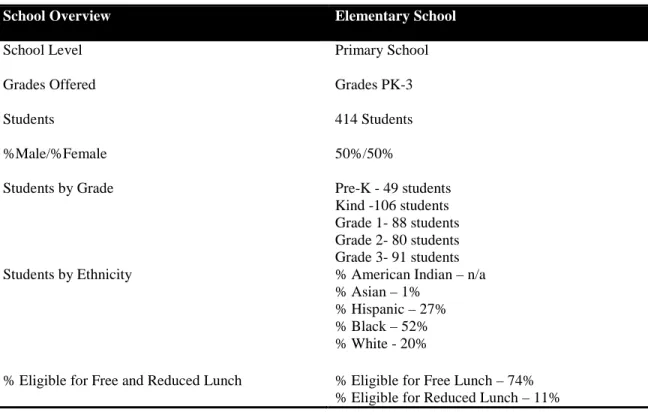
American. Twenty percent of the school’s population is comprised of White students. Eighty five percent of the student population qualifies for free and reduced lunch and no students are identified by the state as Academically Gifted.
v
DEDICATION
This dissertation is dedicated to my husband, Wilhelm Russell Robinson, III and my two sons: Wilhelm Russell (IV) and John Christian.
vi
ACKNOWLEDGEMENTS
The voices of a million angels could not express my gratitude! First, I give God all the glory and praise for never leaving me throughout my journey in graduate school. Thank you for your faithfulness and favor. I am extremely humbled that you have allowed me to receive this doctoral degree and will use it in service to glorify you.
I am thankful to the principal of the School Development Program (SDP) site for allowing me to conduct this study. I am also grateful to the Team for sharing the details of their journey in becoming a Team that supports the students, teachers, and families at their school.
I am forever indebted to my dissertation advisor, Dr. Frank Brown who was
extremely gracious in agreeing to be my dissertation advisor midway through the dissertation process. Dr. Brown has served as a coach in challenging me to accomplish more than I ever thought I was capable of and I will be eternally grateful. I would also like to thank the members of my dissertation committee: Dr. Kathleen Brown and Dr. George Noblit. Dr. Kathleen Brown kindly stepped in during the final phase of the dissertation and always challenged me in the most encouraging way. I had the pleasure of working with Dr. George Noblit as a graduate research assistant when I was first introduced to the Comer SDP. Dr. Noblit has been consistently there for me providing words of wisdom, support and
vii
I would be remised if I did not thank Dr. William Malloy and Dr. Carol Malloy. Dr. William Malloy served as my academic advisor and dissertation advisor until his retirement. Dr. William Malloy was also the professor who afforded me the opportunity to work as a research assistant and introduced me to the Comer School Development Program. I also had the good fortune to work with Dr. Carol Malloy, who also served on my dissertation
committee prior to her retirement. Dr. Carol Malloy not only challenged me, but also set the standard in professionalism, work ethic and service. I am thankful to the Comer family which includes Dr. William Malloy, Dr. Carol Malloy and Dr. George Noblit. Thank you for providing me with a wealth of information and invaluable experiences regarding research practices, school administration, district level administration and the professorship.
I am thankful to Dr. Mary Anne Wheeler, who is my principal. Thank you for understanding that in addition to being an assistant principal, I am also a wife, mother and graduate student. I thank you for your encouragement, support and guidance in finding it not selfish in assisting me to achieve my goal.
I am grateful to my family and friends who have supported me throughout this season in my life. I am thankful to my parents who always believed that I could accomplish
viii
all of your love, guidance, support and encouragement throughout my years in North Carolina!
I must recognize my husband and best friend, Wilhelm Russell Robinson, III. Thank you for your unconditional love, support and patience throughout this journey. I am so blessed to have you in my life and could not have gotten through this season without you. To my two rambunctious sons, Wilhelm Russell Robinson, IV, who kept up with every chapter written and John Christian who tried his best to help me type them, thank you for
ix
TABLE OF CONTENTS
LIST OF TABLES…………..……….…..xiii
LIST OF FIGURES………...xiv
Chapter I. INTRODUCTION………...………..1
Background to the Problem……….…..1
The School Development Program and the Comer Approach……….…..8
The Study………...11
Theoretical Framework………...15
Problem Statement………...19
Significance of the Research………...21
Limitations of the Research……… 23
Definition of Terms………..24
Assumptions of the Research………...32
Summary………..34
II. REVIEW OF THE LITERATURE………36
Introduction………36
Child Development………...38
Environmentalist View of Child Development………...39
Cognitive View of Child Development……….……..44
Psychoanalytic Development………...51
Collaboration and Special Education………...…..56
Collaboration………..……..57
Obstacles to Collaboration……...………...……...61
Results of Collaboration………..………64
Special Education Placement………...66
x
Intervention Strategies for Reducing
Special Education Referrals………..72
School Reform Programs…………...……….……….……76
Comprehensive Programs………..………77
Summary………..82
III. RESEARCH METHODOLOGY…...87
Introduction………..87
Sample Population………...88
Instrumentation………91
Data Collection and Analysis………..92
Setting……….96
Limitations of this Study………....98
Summary………...…100
IV. FINDINGS……….104
Introduction………104
Instrumentation………..105
Findings……….108
Principal’s Response to the School Intervention Team Questionnaire………..111
Organization and Management………114
Collaboration Among Adults………...118
Child Centered Planning Through Problem Solving………...121
Summary of Findings from the Principal’s Interview………..………125
Organization and Management………125
Collaboration Among Adults………..127
Child Centered Planning Through Problem Solving………..128
Student Staff Support Team’s Response to the School Intervention Team Questionnaire………...130
xi
Collaboration Among Adults………..135
Child Centered Planning through Problem Solving……...139
Summary of Findings from the SDP’s SSST Interview………...144
Organization and Management………..144
Collaboration Among Adults……….146
Child Centered Planning………147
Narrative Illustrations of the SDP’s SSST Meetings………...………149
Observation #1 of the SDP’s SSST Meeting……….150
Observation #2 of the SDP’s SSST Meeting……… 156
Summary of the Findings of the SDP’s SSST Meetings………....160
Guiding Principles………...160
Developmental Pathways……….163
Parent Involvement………..163
Assessment and Modification………..164
Comprehensive Planning and Problem Solving………..164
V. CONCLUSIONS………165
Introduction………165
Findings of the Study……….168
Demographics of the Population………...168
Instrumentation……….170
Data Results………..171
Limitations of the Study……….174
Significance of the Research……….. ………175
Summary………176
Significant Findings of the Study………..177
Interpretations of the Findings………...178
Conceptual Frameworks………189
Implications for Future Research………...196
Final Note………...196
xii
xiii
LIST OF TABLES Table
1. Demographics of the site studied………..90
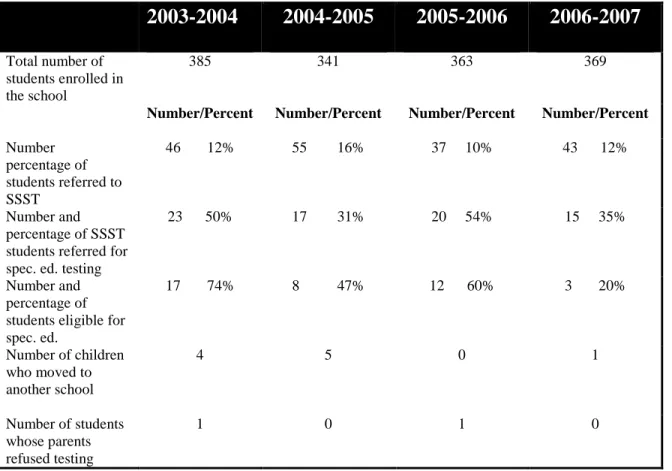
2. Archival data over a four year time span………...109
3. Demographics of the elementary school studies……….167
xiv
LIST OF FIGURES Figure
1. The percentage of students referred to
SSST over time………...172 2. The percentage of SSST students referred
for special education testing over time………173 3. The Percentage of Students Referred by the Team for Special
xv
ABBREVIATIONS
CEC Council for Exceptional Children
CRESCSRM Center Report on Elementary School Comprehensive School Reform Models
CSP Comprehensive School Plan DI Direct Instruction
EC Exceptional Children
EBD Emotional and Behavior Disorders ED Emotionally Disturbed
EOG End of Grade
ESL English Speaking other Languages FAPE Free and Appropriate Public Education IAT Intervention Assistance Team(s) IC Instructional Consultation
IDEA Individuals with Disabilities Education Act
IDEIA Individuals with Disabilities Education Improvement Act IEP Individual Education Plan
xvi LEA Local Education Agency LRE Least Restrictive Environment
MAPS Measure Academic Performance Summary MID Mild Intellectual Disabilities
MMR Mild Mental Retardation
MR Mentally Retarded
NC North Carolina
NCES National Center for Education Statistics OHI Other Health Impairment
PLUS Powerful Learning Unlimited Success
PT Parent Team
RTI Response to Intervention
SBIT Student Based Intervention Team SLD Specific Learning Disabilities SDP School Development Program SEA State Educational Agency SIP School Improvement Plan SIT Student Intervention Team(s)
CHAPTER I – INTRODUCTION Background to the Problem
The National Center for Education Statistics (NCES, 2007) reports an increase of at least 100,000 students served under the Individuals with Disabilities Education Act (IDEA) in special education programs for each year from 1990 to 2007. As of 2007, the number of students being served under IDEA had reached 6.6 million (NCES, 2007). Of all the students served under the IDEA in special education programs, African American students are almost three times as likely as White European students to be labeled mentally retarded (MR), two times as likely to be labeled emotionally disturbed (ED), and 1.3 times as likely to be labeled as having a learning disability (LD) (Council for Exceptional Children, 2002). This
escalating trend of overrepresentation of minority students placed in special education programs shows no signs of declining, and even more dramatic are the underlying influences that place several minority students in special education programs each year.
2
backgrounds-including Afro-Americans, American Indians, Mexicans, and Puerto Rican Americans; those from nonstandard English speaking, broken, disorganized, and inadequate homes; and children from other non-middle class environments (p. 6). Data from the
National Research Council (2002) indicates that when compared to White European students, African American students are overrepresented in the categories of mental retardation (MR), emotional disturbance (ED), and multiple disabilities; American Indian/Alaskan Native students are overrepresented in the category of learning disabilities and; Asian/Pacific Islander and African American students have slightly higher rates of identification in autism spectrum disorders. Recent studies suggest that English language learners are
overrepresented in districts that serve large populations of English language learners (Artiles, Rueda, Salazar, and Higareda, 2005).
Overrepresentation in special education occurs when a group’s membership or percentage in special education is greater than their percentage in the general education population or within a given disability category (Green, 2005). Overrepresentation affects the high-incidence disabilities, rather than low-incidence disabilities. High-incidence disabilities are those disabilities which require an extensive degree of “professional
3
disabilities are those physical disabilities that require a medical diagnosis. Low-incidence disabilities include: (a) blindness, (b) low vision, (c) deafness, (d) hard-of-hearing, (e) deaf-blindness, (f) significant developmental delay, (g) complex health issues, (h) serious physical impairment, (i) multiple disability, (j) autism and (k) emotional of behavioral disorders.
The problem of overrepresentation of minority students does not exist in the diagnosis of low incidence disabilities (Overton, 2000), but instead exists with African Americans in the EMR and ED categories, which are categorized as high-incidence disabilities (Harry & Klingner, 2006). Currently, out of the number of students served under IDEA in North Carolina with high-incidence disabilities 2 percent is Asian/Pacific Islander, 4 percent is White, 4.8 percent is Hispanic, 6.9 percent is American Indian/Alaskan and 7.8 percent is African American (Office of Special Education Programs, 2007). A large number of students referred to and placed in special education programs under high-incidence disabilities are students from low socioeconomic backgrounds. When you combine a student’s low socioeconomic status with other factors such as race and ethnicity, it is highly likely that disproportionality or overrepresentation in special education programs will occur (Losen & Orfield, 2002).
The National Institute for Urban School Improvement (2001) believes that overrepresentation is about students being misdiagnosed as disabled and being placed in special education programs that they do not need. Misdiagnosis happens for a variety of reasons which includes, but is not limited to inadequate professional and instructional practices, bias on the part of the teacher and/or the institution of learning, socioeconomic issues, quality of schooling, school climate, personnel and student demographics and assessment issues (Artiles, Harry, Reschly and Chinn, 2002). In assessing whether
4
all phases of the placement process which consists of: (a) early instruction, (b) pre-referral activities, (c) the decision to refer and (d) the process of assessment (Harry & Klingner, 2006). If it is determined that special education placement was not beneficial to the child and bias or inappropriate practice at any phase of the process occurred, then disproportionality or overrepresentation must be treated as a problem (Harry & Klingner, 2006).
Overrepresentation results in: (a) denial of access to the general education curriculum, (b) failure to receive services that meet the student’s specific needs, (c) misclassification or inappropriate labels, often leading families and communities to mistrust the school and the school system and (d) significant racial separation (CEC, 2002; Harry & Klingner, 2006; Losen & Orfield, 2002). The central research question for this study is:
Does the School Development Program’s Student Staff Support Team (SSST) process reduce the number of students referred for testing for high-incidence disabilities in one elementary school?
The participants in this study include members of the School Development Program’s Student Staff Support Team at an elementary school in North Carolina using the Comer (SDP) model. The Team is comprised of the: school administrators, school psychologist, guidance counselor, special education teacher, regular education teacher, and all other appropriate staff persons.
The majority of referrals for special education services take place during the first four years of elementary school and the majority of children who receive referrals prove to be eligible for special education services (White & Calhoun, 1987). Students receive these referrals for a variety of reasons, which include but are not limited to a teacher’s perception of a learning disability, race, socioeconomic status, behavior and instructional practices (Drane, 2002). Drane (2002) further stated that those individuals who comprise the
5
eventually find reasons to support the preliminary referral decisions, thereby confirming the original judgments even if they are flawed. It is of course difficult to calculate the number of students who are misdiagnosed and are thereby deprived of an appropriate education, but misdiagnosis is a widely recognized deficiency in our educational system. Among attempts to answer how misdiagnosis of students for special education services can be eliminated and the likelihood that all students receive an appropriate education increased, the use of student-based intervention team processes shows promise (Logan, Hansen, Nieminen and Wright, 2001).
According to Schrag and Henderson (1996), student intervention teams (SIT) perform three major tasks: (1) a teacher identifies a student with behavior or learning problems who is at risk for being referred to special education and the SIT analyzes the problem with attention to child factors and identifies specific interventions; (2) the teacher identifies the specific intervention(s) and; (3) the effectiveness of the plan is determined. If the first intervention is determined to be successful, the process is ended. Schrag and Henderson (1996) assert that if the first intervention is unsuccessful, then a second intervention is designed by the SIT or a recommendation is made for referral to special education. It is common practice for SITs to employ more than one intervention strategy before referring the child for the initial
evaluation to receive special education services. Referring students for special education services is a three-leveled procedure involving the referral, evaluation and individual education plan (IEP) process (Policies Governing Services for Children with Disabilities, 2007).
6
Disabilities, 2007). North Carolina Policy 1503-2 states that such a referral can be submitted to the child’s teacher, the principal of the school, or the appointed official Local Educational Agency (LEA). An LEA is the public board of education or other public authority legally constituted within the State for administrative control or to perform a specific service for public schools in the district or State (NC 1500-2.22).
The second step of this process requires that the LEA conduct an initial evaluation. Under the requirements of NC 1503-1, an LEA or the parent of a child can request an initial evaluation to determine if the child has a disability. According to NC 1503-1, the LEA takes responsibility for providing assistance in completing the written referral if a parent makes an oral request. The initial evaluation determines whether the child has a disability under NC 1500-2.4 and whether the child has the requisite educational needs. This evaluation requires a variety of assessment tools, technically sound instruments, and appropriate strategies for gathering relevant functional, developmental and academic information (NC 1503-2.5). The initial evaluation must be conducted, eligibility must be determined, and the IEP must be developed if the child has a disability, all within ninety days of receiving the initial referral (NC 1503-2.4).
7
parental consent has been obtained, then an Individual Education Plan (IEP) will be developed for the child in accordance with NC 1503-4.1 through NC 1503-5.1.
The Policies Governing Services for Children with Disabilities (2007) defines an IEP as a written statement for each child with a disability developed, reviewed and revised in a meeting in accordance with NC 4.1 through NC 5.1. North Carolina Policy 1503-4.1 states that the IEP must include: (1) a statement of the child’s present levels of academic achievement and functional performance; (2) a statement of measurable annual goals,
including academic and functional goals; (3) a description of how the child’s progress toward meeting these annual goals and more formal periodic reports on the progress the child is making toward goals; (4) a statement of the special education and related services and
supplementary aids and services as well as a statement of program modifications or supports for school personnel to be provided; (5) an explanation of the extent to which the child will or will not participate with non-disabled children in the regular class; (6) a statement of any appropriate accommodations necessary to measure the academic achievement and functional performance of the child on state and district-wide assessments as well as the reason for alternative assessments if the IEP team considers the regular assessments inappropriate; and (7) the projected date for the beginning of the services and modifications if any. The IEP team consists of the child’s parents, a regular education teacher, a special education teacher, an LEA, an individual who can interpret the instructional implications of evaluation results, other individuals who have knowledge or special expertise regarding the child at the
8
(3) the results of the initial or most recent evaluation of the child; and (4) the academic, developmental, and functional needs of the child. (NC 1503-5.1)
IDEA stipulates that children with disabilities must receive a “free and appropriate public education” (FAPE) (Boyle & Weishaar, 2001). A FAPE is defined to mean special education and related services that: (1) have been provided at public expense- which is to say at no cost to parents and under public supervision and direction; (2) meet state educational standards; (3) include an appropriate preschool, elementary, or secondary school education in the state involved and; (4) is consistent with the individualized educational program (IEP) (Henderson, 2001). Providing children with a free and appropriate public education is far from a casual undertaking. This course of action-- which includes the referral, evaluation and IEP process-- requires collaboration on the part of the school-based intervention team that can be extensive because placing students in special education programs may not always present the solution.
The School Development Program and the Comer Approach
The Comer School Development Program (SDP) began in 1968, when four Yale Child Study team members piloted this program in two New Haven Connecticut schools that were performing at low levels in the areas of achievement, attendance, and behavior
9
There are nine basic components of the SDP, which bring together in a methodical and coordinated way the adult caretakers in children’s lives (Comer, Haynes, Joyner and Ben-Avie, 1996). The nine components are comprised of three guiding principles, from which springs three mechanisms and three operations (Comer et. al, 1996).
The three guiding principles that guide the function of the SDP are: no-fault, consensus and collaboration (Haynes, 1998). No-fault problem solving requires adults to seek the causes of problems, instead of laying blame on others (Squiers & Kranyik, 1996). By focusing on solutions rather than blaming others, team members model effective
leadership and teamwork that is beneficial to everyone involved (Haynes, 1998). Consensus eliminates voting and relies on honest discussions in an atmosphere of trust and mutual respect (Haynes, 1998). Decisions are carried out only when everyone agrees (Squires & Kranyik, 1995; 1996). Collaboration refers to the teamwork and shared responsibility among all of the teams (Haynes, 1998).
10
team develop intervention strategies, monitor individual student progress along each of the developmental pathways and offers recommendations in the area of staff development (Emmons et al., 1995). This team consists of the school’s administrator(s), guidance
counselor, special education teacher, regular education teacher, school psychologist and other support staff as they are needed (e.g. attendance officer, social worker, school nurse) (Comer et. al, 1996). The PT exists to ensure that parents actively participate in the school
community (Emmons et. al., 1995). This team supports the general mission of the school through parent involvement in all aspects of the school (Haynes, 1998).
The three operations of the SDP, which the SPMT is primarily responsible for is (a) the Comprehensive School Plan (CSP), which is also known as the School Improvement Plan, (b) staff development, and (C) assessment and modification (Haynes, 1998). The CSP is the school’s course of action for the year. It outlines the school’s academic, social climate and community relations goals as well as the activities created to achieve them (Haynes, 1998). Staff development is created and implemented by the SPMT based on the needs identified by the CSP (Haynes, 1998). The assessment and modification operation enables the SPMT to gather information to monitor progress and outcomes and make adjustments as they are needed to strengthen program implementation (Haynes, 1998).
At the heart of the SDP is a focus on understanding child development through a series of six interconnecting pathways: physical, language, ethical, social, psychological, and cognitive (Haynes, 1998). The developmental pathways organizes and governs adult support in meaningful and effective ways ensuring positive outcomes for students by: (a)
11
implement strategies that promote the health and positive self-esteem of students (Comer, Joyner, and Ben-Avie, 2004, p. 35). All developmental pathways are equally important and must be balanced in order for healthy development to occur (Malloy & Rayle, 2000).
Research findings indicate that the SDP embraces all aspects of diversity, including those students classified as English Speaking other Languages (ESL) and students who are being served in special education programs (Malloy & Rayle, 2000). The SDP (Comer Model) has been credited with raising test scores, increasing attendance and fostering unparalleled levels of parent involvement in some of the nation’s most troubled school districts (June, 2003).
The Study
This study investigates whether the School Development Program’s (SDP) student staff support team process reduces the number of students referred for testing for high-incidence disabilities in one elementary school. High-high-incidence disabilities were chosen as the area of focus due to the relationship that high-incidence disabilities has with
overrepresentation of minority students for special education programs. This study has been designed as an instrumental case study since it seeks to address the issue of high-incidence special education referrals and the impact that the SDP’s student-staff support team (SSST) process on the referral rate over a three-year period. This study is concerned only with the SDP’s SSST in one elementary school during the 2006-2007 school year.
12
teacher. The author assumed that the participants would answer the questions as accurately as possible.
To collect other forms of qualitative data, the author relied on an observation checklist that provides narrative descriptions of the Team’s meetings. The data obtained from both sources (the interviews and observations) provide the information necessary to develop themes or categories that reflect the information inherent in each source.
The population for this study included members of the Team in one such elementary school located in North Carolina. The Team is comprised of the school administrators, the school psychologist, guidance counselor, school nurse, special education teacher, regular education teacher, attendance officer, pupil personnel workers, and any other appropriate staff persons. The author focused on a school that uses the Comer model because of its identification as a Comer (1996) site for more than five years and because the school’s principal approved.
The school under examination is located in a rural community of North Carolina. The student population is diverse in terms of race and learning challenges. The school’s population of students includes Asians (1 percent), Hispanics (26 percent), Non-Hispanic Blacks (52 percent), Non-Hispanic Whites (20 percent) and Other (1percent). Eighty-five percent of students, who attend the school, receive free or reduced-price lunches.
The site being studied is a primary school serving pre-kindergarten through grade three. The basic curriculum in pre-kindergarten through grade three is presented in a heterogeneous, self-contained classroom. Because of the school’s large population of Hispanic students, English speaking other languages (ESL) is also a component of the
13
mandates governing the identification of high-incidence disabilities, students at this school are referred for special education services by the school’s SSST.
Populations with high-incidence disabilities are more liable to experience such factors as peer rejection, depression, anxiety, behavioral and conduct problems, delinquency, poor academic adjustment and school dropout than students without disabilities (Werner, 1993; Guevremont & Dumas, 1994; Haager & Vaughn, 1995; Manikam, Matson, Coe, and
Hillman, 1995; Murray, Goldstein, and Edgar, 1997; Pearl & Bay, 1999). More specifically, children with learning disabilities (LD), emotional and behavioral disorders (EBD), and mild mental retardation (MMR) are at a high risk for experiencing difficulties throughout their lives (Werner, 1993; Pearl & Bay, 1999; Al-Yagon & Mikulincer, 2004). High-incidence disabilities are those disabilities that fall into one of three categories: (1) emotional
disturbance; (2) a specific learning disability; or (3) speech or language impairment (Policies Governing Services for Children with Disabilities, 2007). Low-incidence disabilities
include: (1) mental retardation, (2) multiple disabilities, (3) hearing impairments, (4)
orthopedic impairments, (5) other health impairments, (6) visual impairments, (7) autism, (8) deaf-blindness, (9) traumatic brain injury, and (10) developmental delay (Policies Governing Services for Children with Disabilities, 2007).
This study examines referral rates of high-incidence disabilities, which fall into one if the following four categories:
(1) mild-mental retardation-- a developmental disability marked by lower- than - normal (less than 75) intelligence and limited daily living skills,
(2) learning disability-- a disorder of the basic psychological processes involved in understanding or in using spoken or written language which may manifest itself in an imperfect ability to listen, think, speak, read, write, spell or make mathematical calculations,
14
(a) an inability to learn that cannot be explained by intellectual, sensory or health factors,
(b) an inability to build or maintain satisfactory interpersonal relationships with peers and teachers,
(c) inappropriate types of behavior of feelings under normal circumstances, (d) a general pervasive mood of unhappiness or depression, and
(e) a tendency to develop physical symptoms or fears associated with personal or school problems.” [Code of Federal Regulations, Title 34, Section
300.7(c)(4)(i)]; and
(4) speech and language impairments-- problems in such communication and related areas as oral-motor function. These disorders range from simple sound substitutions to an inability to understand or use language or use the oral-motor mechanism for functional speech and feeding (Reschley, 1988; Reschley, 1997; Harry & Klingner, 2006).
High-incidence disabilities require an extensive degree of “professional judgment,” exercised mainly by a professional, which includes the student’s teacher, in order to
determine if an actual disability exists (MacMillan & Reschley, 1998). The risk rate for African Americans and Native Americans to be categorized with one these four disabilities are much higher, possibly because these disabilities rely on clinical judgment rather than on biological data (Harry & Klingner, 2006). Hence, the term “high-incidence” disability is used to categorize the disabilities that fall under these four labels. One detects a likelihood that the “clinical judgment” or “teacher’s judgment” used to refer students for special education services may be biased and therefore skewed or inaccurate. The core of this problem lies in both the referral and evaluation processes used when placing students in special education programs.
To determine if a relationship exists between the Team process and the decrease in the number of students referred for testing for high-incidence disabilities in one elementary school, the author posed this research question:
Does the School Development Program’s (SDP) Student Staff Support Team (SSST) process reduce the number of students referred for testing for high-incidence
15
Theoretical Framework
In the effort to attain a theoretical framework most suitable for this research, the author reviewed other theoretical models considered by Comer (1996). When Comer (1996) formulated his theoretical framework for school reform, he reviewed the following four mental health theories:
(1) Lewin’s (1936) Social Psychology Theory, which states that the individual functions in a psychological environment composed of feelings about objects, situations, self, and others and that behavior is an adaptation or reaction to the environment;
(2) Kelly’s (1966) Human Ecological Systems Theory, which defines behavior as an interaction and adjustment of human beings with their physical, social, moral and psychological environments;
(3) Becker, Wylan and McCourt (1971) and Hartman’s (1979) Population
Adjustment Model, which identifies populations at risk for developing mental illness and intervenes by modifying the environment to promote mental health and by
providing the identified population with support systems and coping skills to improve their adjustment and;
(4) Reiff’s (1966) Social Action Model, teaches that program planning should be a collaborative effort between professionals and community members who have an integral knowledge of the community in which they work in order to bring about societal change for the benefit of the community.
16
(1) a child’s behavior is determined by his or her interaction with the physical, social, and psychological environments,
(2) children need positive interactions with adults in order to develop adequately, (3) child-centered planning and collaboration among adults facilitate positive
interactions, and
(4) all planning for child development should be a collaborative effort between professionals and community members.
This study examines one component of Comer’s theoretical framework which is: Child-centered planning and collaboration among adults facilitate positive interactions. The author chose this component of Comer’s school reform model as opposed to all four of the above mentioned components of the theoretical framework, because of its particular relevance to the study, focused as it is on child-centered planning and collaboration among adults. In examining whether the Team’s process decreases the number of students referred for testing for high-incidence disabilities in one elementary school, the author found it imperative that her research question elucidate the process that the Team takes in child-centered planning and collaboration among adults to facilitate positive interactions. This research question required the author: (1) to examine how the Team identifies children at risk for school failure; (2) clarify the process the Team follows in problem solving and working as a team; (3) to study modifications made to the environment to promote learning; and (4) to investigate whether the special education referral rate increases, decreases or remains at a constant rate over a three-year period.
17
stakeholders connected with the school. School reform programs that meet these standards include such reform models as Success For All (Slavin & Madden, 1992), Levin’s
Accelerated Schools Model (Hopfenburg & Levin, 1993), Direct Instruction (Adams & Englemann, 1996), and Sizer’s (1992) Coalition of Essential Schools. These programs allow educators to decide how to put reform principles into practice with the help of consultants to implement instructional programs. Conversely, none of these reforms takes into
consideration the social, emotional, and academic composition of the child.
But Yale University’s psychiatrist James P. Comer (1996) created a school model that takes into consideration the social, emotional and academic facets of the child by merging two schools of thought – child psychology and education – into a School Development Program now known as the “Comer School Development Program” (SDP). Deeply
concerned about students being excluded from the mainstream (economically and socially) and placed into special education classes, Comer developed a holistic framework for changing schools based on interventions, outcomes, and a developmental theory with the belief that teachers, parents, and administrators could define and pursue shared educational objectives (Comer, Haynes, Joyner, and Avie, 1996). Comer organized his schools around three teams: the Parent Team, the Student Staff Support Team, and the School Planning and Management Team (Comer et. al., 1996).
18
decisions that guide the school and develop the School Improvement Plan. The School Improvement Plan includes goals and objectives geared towards student performance, curriculum, and pedagogy.
Because the SDP originally did not represent an instructional scripted program, but rather focused on strategies that addressed school climate, family relationships and society issues, three academic components were added to the SDP: Teachers Helping Teachers, the Balanced Curriculum, and the Essentials of Literacy Program (Comer, 2004). These
programs, which now fall under the Comer SDP umbrella, support the No Child Left Behind Act by (a) improving the academic performance of disadvantaged students, (b) boosting teacher quality, (c) moving limited English proficient students to English fluency, (d) promoting informed parental choice and innovative programs, (e) encouraging safe schools for the 21st century, and (f) encouraging freedom and accountability (Bush, 2001).
Comer (1996) believed the development of children begins when they are ready to grasp various concepts along a progression of “pathways”, which include the social, psychological, physical, linguistic, ethical, and cognitive. These developmental pathways serve as benchmarks upon which the Comer SDP relies so as to determine whether a child is developing healthfully. If one takes all of these aspects into consideration when diagnosing a child for a specific program, would fewer special education referrals occur and would
19
Problem Statement
This study investigates whether the Comer (1996) School Development Program’s Student Staff Support Team process reduces the number of students referred for testing for high-incidence disabilities in one elementary school. It also elucidates underlying motives that influence the recommendation of students for testing for high-incidence disabilities.
This qualitative study examines the question of whether the School Development Program’s SSST process reduces the number of students in pre-kindergarten through the third grade who are referred to be tested for high-incidence disabilities. These are students who (1) score below average on the NC State mandated end of grade assessments in reading, writing and mathematics; (2) have grades below a level 3 on a 4 point scale on their report cards in reading, writing and mathematics; and (3) consistently exhibit behavior patterns that place them in alternative classroom settings. The central research question for this study follows:
Does the Comer School Development Program’s (SDP) Student Staff Support Team (SSST) process reduce the number of students referred for testing for high-incidence disabilities in one elementary school?
This research question required the author: (1) to examine how the SDP’s SSST identifies children at risk for school failure; (2) to analyze the process the SDP’s SSST follows in problem solving and working as a team; (3) to study modifications made to the environment in order to promote learning; and (4) to investigate whether the special education referral rate of high-incidence disabilities increases, decreases or remains at a constant rate over a specified three-year period.
20
developed by Becker, Wylan and McCourt (1971) and Hartman (1979), which is a primary prevention model of mental health services stating that organizations should (1) identify populations at risk, and (2) intervene by modifying the environment so as to encourage preventative interventions. In applying Comer’s theoretical framework to this study, two central themes of focus are: child-centered planning and collaboration among adults.
When participating in the child-centered planning process, Comer et al. (1996) asserted that the Team’s first responsibility is to identify students at risk for school failure. After the Team has identified those students at risk, the next step is for the SSST to modify the environment to promote a healthful, safe, caring and stimulating environment in which the at-risk child can function and learn. The final step in the child-centered planning process is to help the student develop coping skills in order to succeed (Comer et al., 1996).
The second theme of relevance, collaboration among adults, is a separate entity inter-connected with the child-centered process. Comer et al. (1996) emphasized the importance of parents being involved in the service provided to the student. Collaboration as it applies to this study involves a parent being involved with the designing and implementation of the service as well as those individuals serving on the SDP’s SSST using the consensus,
collaboration and no-fault approach to teamwork and problem solving (Comer et. al., 1996).
Significance of the Research
21
and Duffy (1995); Schrag (1995); Gravois & Rosenfield, (2002) and; Levinsohn, (2000) all credit student-based intervention team processes responsible for a decrease in special education referrals. This study, which is the first study conducted on the SDP’s SSST process, investigates whether the SDP’s Student Staff Support Team process reduces the number of students referred for testing for high-incidence disabilities in one elementary school. It also provides insight into those underlying rationales for recommending students for special education services.
The qualitative study described here examines the impact the SDP’s SSST process has on the number of students referred to testing for high-incidence disabilities from pre- kindergarten to grade three who (a) score below grade level on the end of grade assessments in reading and mathematics; (b) have grades below a level 3 on a 4 point scale on their report cards in the areas of reading, writing and mathematics-, and; (c) consistently exhibit behavior patterns that would require them to be placed in alternative classroom settings. The school district of the study site requires that students in kindergarten through grade three meet local attendance requirements as well as perform at a level 3 (at grade level) or 4 (above grade level) in reading and mathematics assessments in order to be promoted to the next grade in compliance with the district’s School Board Policy 5.1.5. Students who score below grade level on reading and mathematics grade assessments (level 2) are categorized as performing “below grade level”. Students who exhibit behaviors that have an adverse effect on
educational performance and require specially designed instruction under NC policy 1503-2.5 are also referred to the SSST for strategies, interventions or evaluation, or are
22
To determine if a relationship exists between the Comer process and the decrease in high-incidence referrals of students to special education programs, the author posed this research question:
Does the School Development Program’s (SDP) Student Staff Support Team (SSST) process decrease the number of students referred for testing for high-incidence disabilities in one elementary school?
This research question reflects Comer’s (1996) theoretical framework: Child-centered planning and collaboration among adults facilitate positive interactions. In examining
whether the SDP’s SSST process decreases the number of students referred for testing for high-incidence disabilities in one elementary school, one should make sure that the research question elucidates the process that the SDP’s SSST follows in child-centered planning and collaboration among adults to facilitate positive interactions. Such a research question requires that the researcher: (1) examine how the SDP’s SSST identifies children at risk for school failure; (2) analyze the process the SDP’s SSST takes in problem solving and working as a team; (3) study modifications made to the environment to promote learning; and (4) investigate if the special education referral rate increases, decreases or remains at a constant rate over a three-year period.
Limitations of the Research
This study focuses on the Comer (1996) SDP’s SSST process in one elementary school during the 2006-2007 school-year.
23
included observation checklists, which served to provide narrative descriptions of the SDP’s SSST meetings. Data obtained from both sources (interviews and observations) provide the information necessary to develop themes or categories reflecting the information obtained from each source.
The school selected for this study was not selected randomly, but reflected the
willingness of the principal involved to participate in the study. The case study of one school makes it difficult to offer extensive inferences or generalizations beyond this single site.
Definition of Terms
Comer--The Yale psychiatrist who merged child psychology with education and developed the Comer School Development Program, known as the Comer Model (1996).
Evaluation--Procedures used in accordance with NC State Laws (1503-2 through 1505-3) relating to studies of disabilities to determine whether a child has a disability and the nature and extent of the special education services the child requires.
24
Individualized Education Plan (IEP) --A written statement for a child with a disability that is developed, reviewed, and revised in accordance with North Carolina Policy (NC) 1503-4 through 1503-5.1.
Least Restrictive Environment (LRE) --To the maximum extent appropriate, children with disabilities shall be educated with children who are not disabled; and special classes, separate schooling, or other removal of children with disabilities from the regular educational
environment occurs only when the nature of the disability is such that education in the regular classes with the use of supplementary aids and services cannot be achieved satisfactorily.
Local Educational Agency (LEA) -- A public board or other public authority legally constituted within the State for either administrative control or direction of, or to perform a service function for, public elementary or secondary schools in a city, county, township, school district, or other political subdivision, or for a combination of school districts or counties as are recognized in the State as an administrative agency for its public elementary schools or secondary schools.
25
classrooms. The third level of the parent team involves parents serving on the School Planning and Management Team.
Referral-- The process of requesting a screening (that is, part of the evaluation process used in determining appropriate instructional strategies) to determine if a child should be
evaluated to determine if a need exists for special education services, in response to a specific disability.
School Development Program (SDP) -- The Comer School Model (1996) is rooted in child development and organized around school teams: the Parent Team, the Student Staff Support Team and the School Planning and Management Team. Comer’s model focuses on both the academic performance of the students as well as the governance in and climate of the school.
Screening-- The examination of a student by a teacher or specialist to determine appropriate instructional strategies for curriculum implementation; part of the evaluation process for eligibility for special education or related services.
Special Education-- Specially designed instruction, at no cost to the parents, to meet the unique needs of a child with a disability, including (a) instruction conducted in the
classroom, in the home, in hospitals and institutions, and in other settings; and (b) instruction in physical education.
School Planning and Management Team (SPMT)--A team that includes school
26
is to develop and monitor a Comprehensive School Plan for the academic, social climate, and staff development goals of students and adults in the school.
State Educational Agency (SEA) -- The State board of education responsible for the State supervision of public elementary schools and secondary schools.
Student and Staff Support Team (SSST) -- A staff knowledgeable in child development and mental health. Such staff members as the school psychologist, guidance counselor, school nurse, special education teacher, regular education teacher, and school administrators all belong to this team, which addresses the school-wide climate and psychosocial issues likely to affect the students’ adjustment and life path choices.
High-incidence Disabilities-- Disabilities that constitute more than 70 percent of all youth with disabilities that fall under the following four categories: (1) emotional-behavioral disorders (EBD); (2) learning disabilities (LD); (3) mild intellectual disabilities (MID); and (4) attention disorders (attention deficit disorder and attention deficit hyperactive disorder). The five categories of high-incidence disabilities are:
A. Developmental Delay-- A child between the ages of three and seven, whose development or behavior is so significantly delayed or atypical that special education and related services are required.
27
functioning intellectually well below the mean on an individually administered standardized intelligence test. Measures below the mean are as follows:
(1) mild or two standard deviations below the mean plus or minus one standard error of measurement.
(2) moderate or three standard deviations below the mean plus or minus one standard error of measurement.
(3) severe or four or more standard deviations below the mean plus or minus one standard error of measure.
C. Other Health Impairment (OHI)-- A chronic or acute health problem resulting in one or more of the following three limitations: (1) limited strength (2) limited vitality (3) limited alertness, including heightened alertness to environmental stimuli that result in limited alertness with respect to the educational environment. This disability has an adverse effect on educational performance and requires specially designed instruction.
D. Specific Learning Disability-- A disability that exerts an adverse effect on educational performance and requires specially designed instruction. To be
28
the educational evaluation) and measured ability (as determined by the intellectual evaluation) of at least 15 points. Finally, the child must also exhibit characteristics consistent with the definition of specific learning disabilities.
E. Speech or Language Impairment-- A disability with an adverse effect on educational performance that requires specially designed instruction. A child must meet the criteria listed in one or more of the following areas:
A. Articulation. A child’s speech must have
1. two or more phonemic errors not expected at the child’s age or developmental level observed during direct testing or in conversational speech, or
2. two or more phonological processes not expected at the child’s age or developmental level observed during direct testing or in
conversational speech.
B. Fluency. A child must demonstrate non-fluent speech behavior
characterized by repetitions or prolongations or blocks on a regular basis. C. Language. Two diagnostic measures must occur, one assessing
comprehension and the other assessing production of language. It is required that
1. standard scores on the particular standard evaluation instrument suggest a language disorder; or
29
D. Voice-- A child must demonstrate consistent deviations in vocal
production inappropriate for chronological or mental age, gender and ability.
Low-Incidence Disabilities--Low incidence disabilities refers to a collection of disabilities that fall into one of the following five categories: (1) hearing impairments (2) visual
impairments (3) traumatic brain injury (4) orthopedic impairments (cerebral palsy, burns, spinal bifida and so forth) and (5) other health impairments. The nine categories of low-incidence disabilities are:
A. Autism-- A disability that exerts an adverse effect on educational performance and requires specially designed instruction attributable to (1) impairment in
communication (2) impairment in social interaction (3) unusual responses to sensory experiences, or (4) restricted, repetitive, or stereotypic patterns of behavior, interests, or activities.
B. Deaf/blindness-- A disability with an adverse effect on educational performance requiring specially designed instruction because of a visual impairment in
combination with a hearing impairment that results in severe communication,
developmental, and educational needs. This disability cannot be accommodated in a program for a child with solely a visual impairment or hearing impairment.
30
with peers and teachers; (3) inappropriate types of behavior or feelings under normal circumstances; (4) a general pervasive mood of unhappiness or depression; or (5) a tendency to develop physical symptoms or fears associated with personal or school problems.
D. Hearing Impairment-- A disability with an adverse effect on educational performance that requires specially designed instruction.
E. Mental Retardation--A disability characterized by significant limitations both in intellectual functioning and in adaptive behavior as expressed in conceptual, social, and practical adaptive skills.
F. Multiple Disabilities-- Two or more disabilities occurring together where the combination is so severe, complex, and interwoven that one cannot relegate the student to a single category of disability. This disability has an adverse effect on educational performance and requires specially designed instruction.
G. Orthopedic Impairment-- A disability that exerts an adverse effect on educational performance and requires specially designed instruction because of a severe physical impairment attributable to congenital abnormalities, disease or other causes.
31
requires written verification by a licensed physician or a licensed psychologist, appropriately practicing in the specialty of neuro-psychology, that the child has sustained an injury from which one can infer brain impairment.
I. Visual Impairment-- A disability that exerts an adverse effect on educational performance and requires specially designed instruction. To be eligible in this disability category, a child must have a visual acuity between 20/70 and 20/200 in the better eye after correction to be classified as visually impaired. The child must also have a visual acuity of 20/200 or less in the better eye after correction or a peripheral field so contracted that the widest diameter subtends an arc no greater than 20 degrees.
Assumptions of the Research
32
SSST sets up individualized programs for children with special needs, which involve outside services when necessary and possible; (d) the SDP’s SSST is comprised of individuals who refer students to special education programs and; (e) the SDP’s SSST analyzes problems with attention to relative as well as child factors and identifies specific interventions. All of the above mentioned factors are prerequisites for being a member of the School Development Program’s (SDP) Student Staff Support Team (SSST).
The author chose this population after considering how the SDP’s SSST collaborates and facilitates child-centered planning in helping students at risk for being referred for special education services. The school district of the site studied requires that students in kindergarten through grade three meet local attendance requirements as well as perform at a level 3 (that is to say, at grade level) or 4 (above grade level) in reading and mathematics assessments in order to be promoted to the next grade in compliance with Board Policy 5.1.5. Students who score below grade level on reading and mathematics grade assessments (level 2) are categorized as performing “below grade level”. Students who exhibit behaviors that exert an adverse effect on educational performance and require specially designed instruction under NC policy 1503-2.5 are also referred to the SSST for strategies, intervention or
evaluation, or they are recommended for special education services. Students who fall under categories (a), (b) or (c) are usually brought to the SIT or SSST for evaluations or
33
The author set out to interview administrators and SSST members, including the school’s administrators, regular education teachers, special education teachers, the school psychologist, the guidance counselor, the social worker, and parents. She expected the subjects to provide valid and accurate information in response to all questions posed. The study is not, however, designed to measure the strengths and weaknesses of the overall Comer school reform program.
Summary
Slavin (2001) stated that the main objective of school reform initiatives is to improve student achievement. In disparate instances, school reform initiatives are selected in
response to the needs of students as a group. While such factors as developmentally
appropriate curriculum content, research-based instructional methods, assessment, and modes of service delivery have improved practices in education, Comer (2005) maintains that there is insufficient attention focused on child and adolescent development. If all of these
characteristics were examined and analyzed when one diagnosis a student for special education services, would fewer special education referrals and less misdiagnose result?
In the context of this case study in one elementary school, the author set out to
34
CHAPTER II -REVIEW OF THE LITERATURE Introduction
This study investigated whether the Comer (1996) School Development
Program’s Student Staff Support Team process reduces the number of students referred for testing for high-incidence disabilities in one elementary school. Included in this chapter is a review of the literature in regard to child development, collaboration in schools, and the Individual with Disabilities Education Improvement Act’s
(IDEIA/IDEA) special education practices as they relate to school reform initiatives. To determine whether a relationship exists between the SDP’s SSST process and a decrease in high-incidence referrals of students for special education services, the author formulated this research question:
Does the School Development Program’s Student Staff Support Team’s process decrease the number of students referred for testing for high-incidence disabilities in one elementary school?
The research question derives from Comer’s (1996) theoretical framework: Child-centered planning and collaboration among adults facilitate positive interactions. In examining the impact of the Team’s process on the rate of high-incidence special
examine how the Team identifies children at risk for school failure; (2) study modifications made to the environment so as to promote learning; (3) investigate whether the special education referral rate of high-incidence disabilities increases, decreases or remains at a constant rate over a four-year period; and (4) assess the process the Team takes in problem solving and working as a team.
This study centers on one component of Comer’s school model (SDP): Child-centered planning and collaboration among adults facilitate positive interactions. This portion of Comer’s theoretical framework arose from the two-part Population Adjustment Model developed by Becker, Wylan, and McCourt (1971) and Hartman (1979), which is a primary prevention model of mental health services urging organizations (1) to identify populations at risk, and (2) to intervene by modifying the environment to design preventative interventions. The author chose to adopt this portion of Comer’s theoretical framework in order to determine whether a relationship existed between the SDP’s SSST process and the rate of students referred to special education programs for high-incidence disabilities.
This chapter presents a review of the literature regarding child development,
37
Child Development
This section focuses on theories that affect children’s development and learning. The author examined only those theories that focus on child development and learning as it pertains to Comer’s theoretical framework-- namely the environmentalist view, the cognitive view, and the psychoanalytic view.
A review of child development theories is an essential component of this study. Comer (1993) believed that education should be rooted in the understanding of child development. All other programs that are developed should grow out of that understanding of how children grow, function and develop (Comer, 1993). When educating the child, the child’s overall development has to be the area of focus because overall child development embraces more than just cognitive or intellectual development. Appropriate child
development occurs when educators interact with young people in ways that help them grow socially, psychologically, emotionally, ethically, linguistically, and physically, as well as intellectually (Comer, 2003). For these reasons, a review of multiple theories was reviewed for this study.
38 Environmentalist View of Child Development
In 1690, John Locke, an early educational environmentalist, developed a theory asserting that children are neither inherently good nor inherently corrupt. Locke took this pronouncement a step further by declaring that the child’s mind is initially a tabula rosa (“blank slate”) and whatever becomes of the mind is the result of a combination of learning and experience because it is the environment that actually shapes the individual both cognitively and socially (Crain, 1980).
Environmentalists believe that individuals develop socially in one of or in a combination of four ways: (1) through the structure and organization of their specific
environments, (2) through association, (3) through a combination of practice, repetition, and imitation; or (4) in ways that bring about positive reinforcement while avoiding actions that bring about punishment (Crain, 1980). Watson (1929) maintained that environmental interaction is responsible for such behaviors as how to cope with everyday situations and how to get along with others. B.F. Skinner (1953) who through a series of experiments found that animals could operate mechanisms to receive rewards advanced this school of thought, known as behaviorism, in the 1950’s. His theory became known as “operant conditioning” (Skinner, 1953).
39
theory of ecological systems as they relate to child development in controlling and shaping behavior also receives attention in this section of the literature review.
Operant Conditioning
Operant conditioning is the belief that the environment (parents, teachers and peers) aids in either reinforcing or eliminating the behavior, which is essentially operant
conditioning (Elliott, Kratochwill, Cook and Travers, 2000). Operant conditioning is based on the principle that if a behavior produces a pleasant or rewarding consequence, that behavior is likely to be repeated (Gormly & Brodzinsky, 1993).
Early behaviorists often had difficulty identifying what stimulus produced the various responses they observed. Skinner (1953) suggested the problem lay in the fact that two types of conditioning had been isolated, one deemed classical conditioning, and the other identified as operant conditioning. The premise behind operant conditioning was that instead of looking for behavior (a response) to be elicited by a stimulus, the behavior (response) is expressed without an observable stimulus evoking it. There are eight principles of operant conditioning: (1) reinforcement and extinction, (2) immediacy of reinforcement, (3)
discriminative stimuli, (4) generalization, (5) shaping, (6) behavior chains, (7) schedules of reinforcement, and (8) negative reinforcement and punishment (Schunk, 2008).
40
and help shape human behavior as well as learning (Turner & Helms, 1995). This form of learning led to the social learning theory (Berger, 1998).
Social Learning Theory
Social learning theory first emerged in the late 1930s and early 1940s when a group of psychologists (Sears, Hull and Miller, 1939) attempted to apply behavioral ideas to the study of complex social behavior. According to Cairns (1979), all social learning theories accept the proposition that social behaviors are acquired, maintained, and changed primarily through learning processes. This precept does not negate the biological role that helps to shape behavior, but does affirm the import role experience plays in shaping behavior (Travers, 1982).
The contrast between the two theories of operant conditioning and social learning is that Skinner (1980), who espoused operant conditioning, believed learning to be a gradual process through which stimulations, responses, physical rewards, and punishments guided responses (Cairns, 1979). Bandura (1969), a social learning theorist, argued that in social situations that involve observation and modeling, the observation of both positive and negative behavior leads to more rapid learning. Bandura (1977) further concluded that in daily life people notice the consequences of their actions, such as which actions succeed and fail, and adjust their behavior accordingly. He believed that children learned best by
41
Miller, 1999). Second, we learn through observation the consequences of new behavior and what occurs when others exhibit these observed behaviors (Vasta et al., 1999). This process is called vicarious reinforcement, because others carry out the reinforcement (Crain, 2000).
Not only do we acquire learning through observation, but we also obtain it from models. Models provide information about the likely consequences of actions and motivate observers to act appropriately (Schunk, 2000). Models can be either alive or symbolic. Symbolic models include those observed on television, read about in books, or experienced through verbal instruction (Bandura, 1962). Children identify with and model the behaviors of living people they perceive to be more powerful, nurturing, and knowledgeable than they are (Mischel & Mischel, 1976). The behavior most often observed tends to be the behavior that children imitate the most (Bussey, 1981). Once children model the observed behavior they can strengthen it or be further influenced by seeing others rewarded or punished for imitating the same behavior (Rice, 2001).
How imitation and modeling shape human behavior and how individuals were socialized also interested Bandura (1977). His theoretical contributions include his account of (1) observational learning, (2) the influence of cognitive processes on behavioral
acquisition and performance, and (3) the interaction of mind and society in individual development (Green & Piel, 2002).
Ecological Systems Theory